
Analyzing Tone AP Language and Composition Tone is

Description: Analyzing Tone AP Language and Composition Tone is the writers or speakers attitude or feeling toward the subject or toward the audience. Tone is the means by which the authors attitude is communicated to his or her audience. DICTION,
Related Topics
Download Presentation
"Analyzing Tone AP Language and Composition Tone is" is the property of its rightful owner. Permission is granted to download and print the materials on this website for personal, non-commercial use only, and to display it on your personal computer provided you do not modify the materials and that you retain all copyright notices contained in the materials. By downloading content from our website, you accept the terms of this agreement.
Presentation Transcript
slide1. Analyzing Tone AP Language and Composition<br>
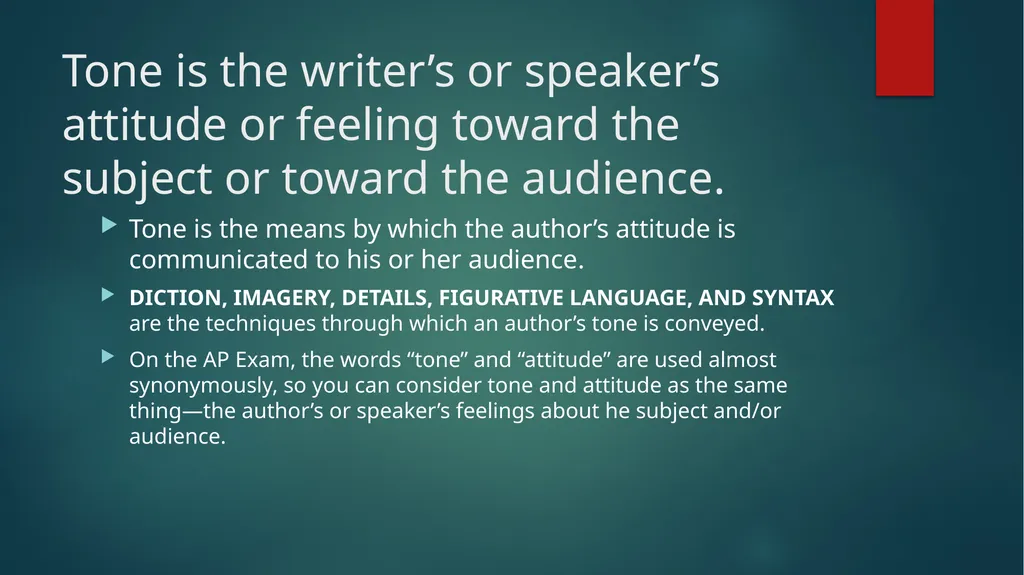
slide2. Tone is the writer’s or speaker’s attitude or feeling toward the subject or toward the audience. Tone is the means by which the author’s attitude is communicated to his or her audience.
DICTION, IMAGERY, DETAILS, FIGURATIVE LANGUAGE, AND SYNTAX are the techniques through which an author’s tone is conveyed.
On the AP Exam, the words “tone” and “attitude” are used almost synonymously, so you can consider tone and attitude as the same thing—the author’s or speaker’s feelings about he subject and/or audience.<br>
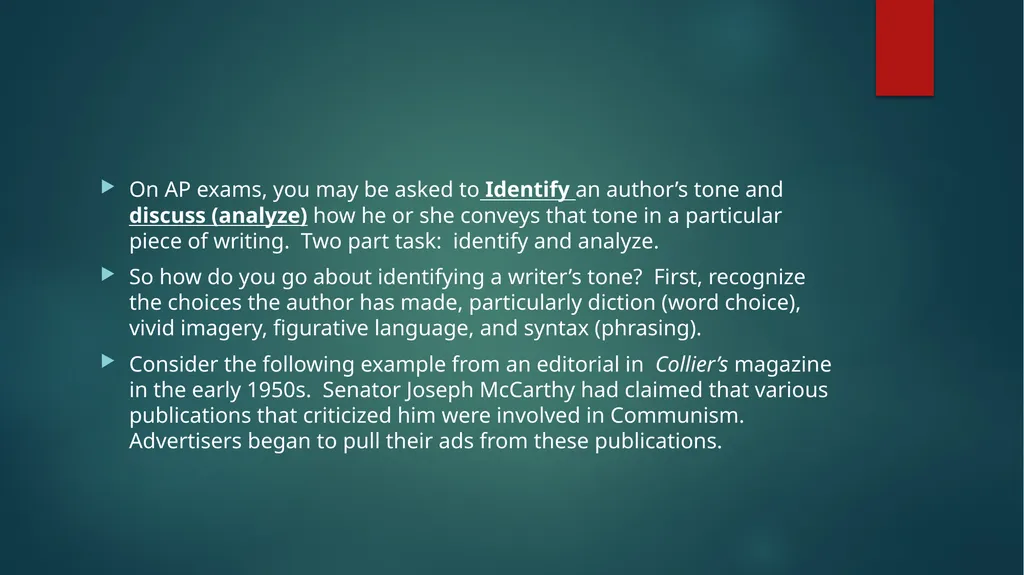
slide3. On AP exams, you may be asked to Identify an author’s tone and discuss (analyze) how he or she conveys that tone in a particular piece of writing. Two part task: identify and analyze.
So how do you go about identifying a writer’s tone? First, recognize the choices the author has made, particularly diction (word choice), vivid imagery, figurative language, and syntax (phrasing).
Consider the following example from an editorial in Collier’s magazine in the early 1950s. Senator Joseph McCarthy had claimed that various publications that criticized him were involved in Communism. Advertisers began to pull their ads from these publications.<br>
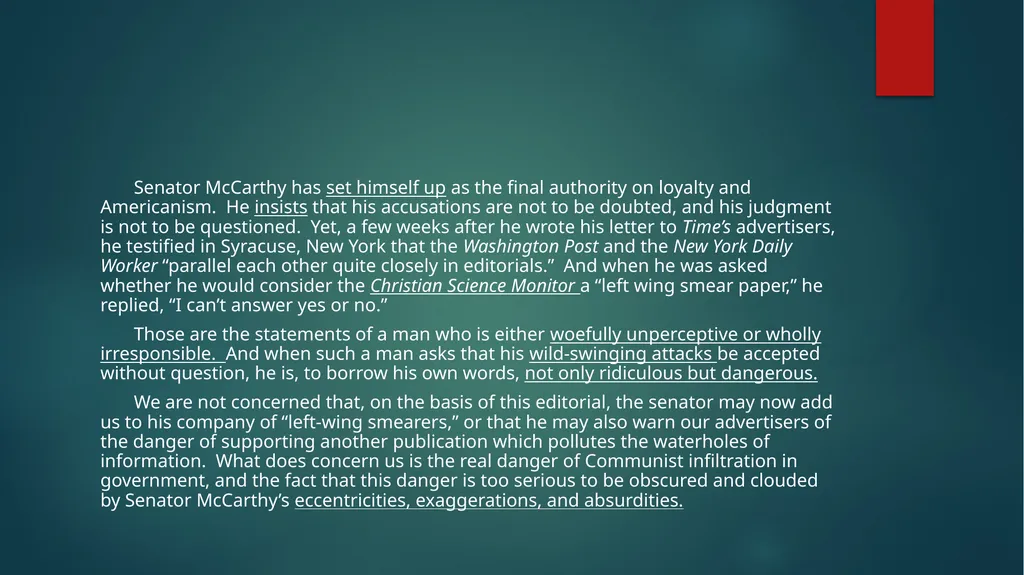
slide4. Senator McCarthy has set himself up as the final authority on loyalty and Americanism. He insists that his accusations are not to be doubted, and his judgment is not to be questioned. Yet, a few weeks after he wrote his letter to Time’s advertisers, he testified in Syracuse, New York that the Washington Post and the New York Daily Worker “parallel each other quite closely in editorials.” And when he was asked whether he would consider the Christian Science Monitor a “left wing smear paper,” he replied, “I can’t answer yes or no.”
Those are the statements of a man who is either woefully unperceptive or wholly irresponsible. And when such a man asks that his wild-swinging attacks be accepted without question, he is, to borrow his own words, not only ridiculous but dangerous.
We are not concerned that, on the basis of this editorial, the senator may now add us to his company of “left-wing smearers,” or that he may also warn our advertisers of the danger of supporting another publication which pollutes the waterholes of information. What does concern us is the real danger of Communist infiltration in government, and the fact that this danger is too serious to be obscured and clouded by Senator McCarthy’s eccentricities, exaggerations, and absurdities.<br>
slide5. Underlined word choice—reveal the editorial’s disdain for McCarthy.
Suggests pompousness—how?
Diction? Own words?
Syntax—yet.
We might label the tone as critical, negative, or upset but his is not enough to fit the degree of the text.
Vehement, indignant, caustic
Could use all of these knowing some labels are more precise than others.<br>
slide6. May be more tones—two tones within the same selection may be complementary tones, reinforcing each other, or contrasting tones, differing significantly.
These shifts are usually subtle, but shifts in the connotations of words or in the types of images, figures of speech, or syntax can indicate a tone shift.
Look back at example—where is there a tone shift? What is it? How would we describe this tone?<br>
slide2. Tone is the writer’s or speaker’s attitude or feeling toward the subject or toward the audience. Tone is the means by which the author’s attitude is communicated to his or her audience.
DICTION, IMAGERY, DETAILS, FIGURATIVE LANGUAGE, AND SYNTAX are the techniques through which an author’s tone is conveyed.
On the AP Exam, the words “tone” and “attitude” are used almost synonymously, so you can consider tone and attitude as the same thing—the author’s or speaker’s feelings about he subject and/or audience.<br>
slide3. On AP exams, you may be asked to Identify an author’s tone and discuss (analyze) how he or she conveys that tone in a particular piece of writing. Two part task: identify and analyze.
So how do you go about identifying a writer’s tone? First, recognize the choices the author has made, particularly diction (word choice), vivid imagery, figurative language, and syntax (phrasing).
Consider the following example from an editorial in Collier’s magazine in the early 1950s. Senator Joseph McCarthy had claimed that various publications that criticized him were involved in Communism. Advertisers began to pull their ads from these publications.<br>
slide4. Senator McCarthy has set himself up as the final authority on loyalty and Americanism. He insists that his accusations are not to be doubted, and his judgment is not to be questioned. Yet, a few weeks after he wrote his letter to Time’s advertisers, he testified in Syracuse, New York that the Washington Post and the New York Daily Worker “parallel each other quite closely in editorials.” And when he was asked whether he would consider the Christian Science Monitor a “left wing smear paper,” he replied, “I can’t answer yes or no.”
Those are the statements of a man who is either woefully unperceptive or wholly irresponsible. And when such a man asks that his wild-swinging attacks be accepted without question, he is, to borrow his own words, not only ridiculous but dangerous.
We are not concerned that, on the basis of this editorial, the senator may now add us to his company of “left-wing smearers,” or that he may also warn our advertisers of the danger of supporting another publication which pollutes the waterholes of information. What does concern us is the real danger of Communist infiltration in government, and the fact that this danger is too serious to be obscured and clouded by Senator McCarthy’s eccentricities, exaggerations, and absurdities.<br>
slide5. Underlined word choice—reveal the editorial’s disdain for McCarthy.
Suggests pompousness—how?
Diction? Own words?
Syntax—yet.
We might label the tone as critical, negative, or upset but his is not enough to fit the degree of the text.
Vehement, indignant, caustic
Could use all of these knowing some labels are more precise than others.<br>
slide6. May be more tones—two tones within the same selection may be complementary tones, reinforcing each other, or contrasting tones, differing significantly.
These shifts are usually subtle, but shifts in the connotations of words or in the types of images, figures of speech, or syntax can indicate a tone shift.
Look back at example—where is there a tone shift? What is it? How would we describe this tone?<br>