
Ancient Greek (Intermediate Level) ATHENS MA IN
SB
Published · 43 slides · 0 views

1 / 1

Description
Ancient Greek (Intermediate Level) ATHENS MA IN ANCIENT PHILOSOPHY NATIONAL AND KAPODISTRIAN UNIVERSITY OF ATHENS Department of History and Philosophy of Science In collaboration with: UNIVERSITY OF PATRAS Department of Philosophy
Related Topics
Share
Embed code
Download this presentation From Below
"Ancient Greek (Intermediate Level) ATHENS MA IN" is the property of its rightful owner. Permission is granted to download and print the materials on this website for personal, non-commercial use only, and to display it on your personal computer provided you do not modify the materials and that you retain all copyright notices contained in the materials. By downloading content from our website, you accept the terms of this agreement.
Presentation Transcript
01
Ancient Greek (Intermediate Level) ATHENS MA IN ANCIENT PHILOSOPHY
NATIONAL AND KAPODISTRIAN UNIVERSITY OF ATHENS / Department of History and Philosophy of Science
In collaboration with:
•UNIVERSITY OF PATRAS / Department of Philosophy
•UNIVERSITY OF CRETE / Department of Philosophy and Social Studies<br>
NATIONAL AND KAPODISTRIAN UNIVERSITY OF ATHENS / Department of History and Philosophy of Science
In collaboration with:
•UNIVERSITY OF PATRAS / Department of Philosophy
•UNIVERSITY OF CRETE / Department of Philosophy and Social Studies<br>
02
WEEK 13 Reading and Translating the Apology<br>
03
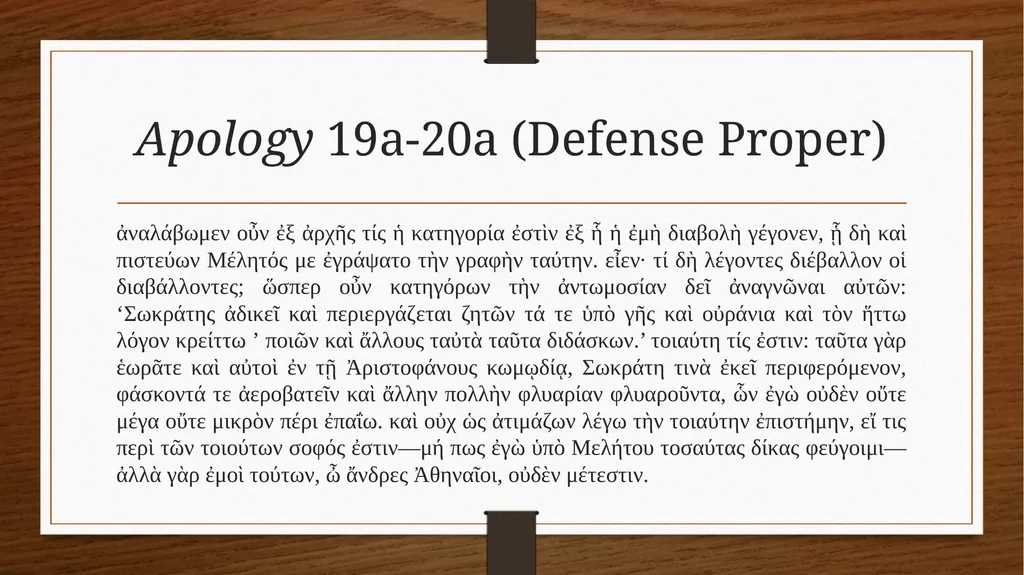
Apology 19a-20a (Defense Proper) ἀναλάβωμεν οὖν ἐξ ἀρχῆς τίς ἡ κατηγορία ἐστὶν ἐξ ἧ ἡ ἐμὴ διαβολὴ γέγονεν, ᾗ δὴ καὶ πιστεύων Μέλητός με ἐγράψατο τὴν γραφὴν ταύτην. εἶεν· τί δὴ λέγοντες διέβαλλον οἱ διαβάλλοντες; ὥσπερ οὖν κατηγόρων τὴν ἀντωμοσίαν δεῖ ἀναγνῶναι αὐτῶν: ‘Σωκράτης ἀδικεῖ καὶ περιεργάζεται ζητῶν τά τε ὑπὸ γῆς καὶ οὐράνια καὶ τὸν ἥττω λόγον κρείττω ’ ποιῶν καὶ ἄλλους ταὐτὰ ταῦτα διδάσκων.’ τοιαύτη τίς ἐστιν: ταῦτα γὰρ ἑωρᾶτε καὶ αὐτοὶ ἐν τῇ Ἀριστοφάνους κωμῳδίᾳ, Σωκράτη τινὰ ἐκεῖ περιφερόμενον, φάσκοντά τε ἀεροβατεῖν καὶ ἄλλην πολλὴν φλυαρίαν φλυαροῦντα, ὧν ἐγὼ οὐδὲν οὔτε μέγα οὔτε μικρὸν πέρι ἐπαΐω. καὶ οὐχ ὡς ἀτιμάζων λέγω τὴν τοιαύτην ἐπιστήμην, εἴ τις περὶ τῶν τοιούτων σοφός ἐστιν—μή πως ἐγὼ ὑπὸ Μελήτου τοσαύτας δίκας φεύγοιμι— ἀλλὰ γὰρ ἐμοὶ τούτων, ὦ ἄνδρες Ἀθηναῖοι, οὐδὲν μέτεστιν.<br>
04
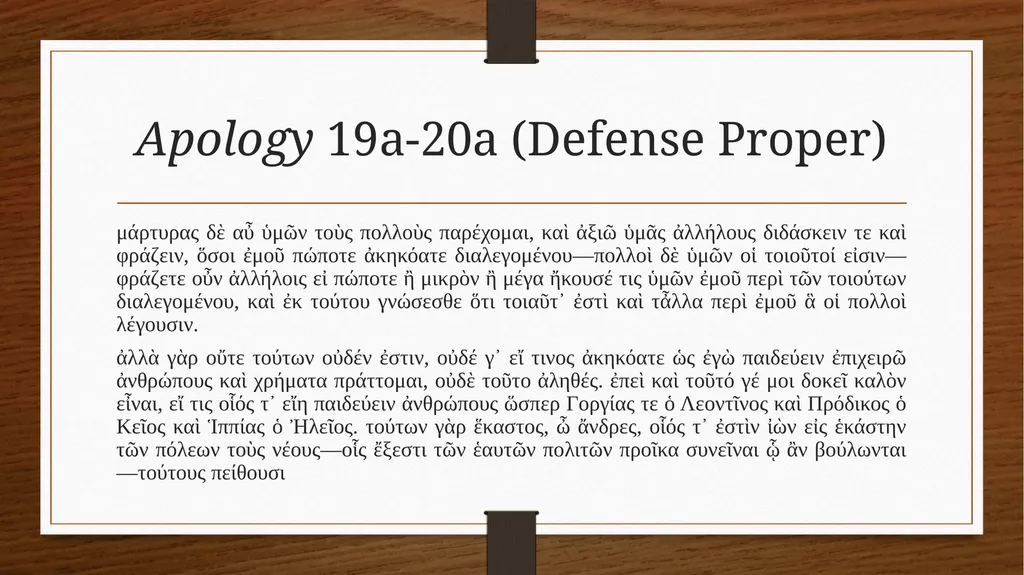
Apology 19a-20a (Defense Proper) μάρτυρας δὲ αὖ ὑμῶν τοὺς πολλοὺς παρέχομαι, καὶ ἀξιῶ ὑμᾶς ἀλλήλους διδάσκειν τε καὶ φράζειν, ὅσοι ἐμοῦ πώποτε ἀκηκόατε διαλεγομένου—πολλοὶ δὲ ὑμῶν οἱ τοιοῦτοί εἰσιν— φράζετε οὖν ἀλλήλοις εἰ πώποτε ἢ μικρὸν ἢ μέγα ἤκουσέ τις ὑμῶν ἐμοῦ περὶ τῶν τοιούτων διαλεγομένου, καὶ ἐκ τούτου γνώσεσθε ὅτι τοιαῦτ᾽ ἐστὶ καὶ τἆλλα περὶ ἐμοῦ ἃ οἱ πολλοὶ λέγουσιν.
ἀλλὰ γὰρ οὔτε τούτων οὐδέν ἐστιν, οὐδέ γ᾽ εἴ τινος ἀκηκόατε ὡς ἐγὼ παιδεύειν ἐπιχειρῶ ἀνθρώπους καὶ χρήματα πράττομαι, οὐδὲ τοῦτο ἀληθές. ἐπεὶ καὶ τοῦτό γέ μοι δοκεῖ καλὸν εἶναι, εἴ τις οἷός τ᾽ εἴη παιδεύειν ἀνθρώπους ὥσπερ Γοργίας τε ὁ Λεοντῖνος καὶ Πρόδικος ὁ Κεῖος καὶ Ἱππίας ὁ Ἠλεῖος. τούτων γὰρ ἕκαστος, ὦ ἄνδρες, οἷός τ᾽ ἐστὶν ἰὼν εἰς ἑκάστην τῶν πόλεων τοὺς νέους—οἷς ἔξεστι τῶν ἑαυτῶν πολιτῶν προῖκα συνεῖναι ᾧ ἂν βούλωνται—τούτους πείθουσι<br>
ἀλλὰ γὰρ οὔτε τούτων οὐδέν ἐστιν, οὐδέ γ᾽ εἴ τινος ἀκηκόατε ὡς ἐγὼ παιδεύειν ἐπιχειρῶ ἀνθρώπους καὶ χρήματα πράττομαι, οὐδὲ τοῦτο ἀληθές. ἐπεὶ καὶ τοῦτό γέ μοι δοκεῖ καλὸν εἶναι, εἴ τις οἷός τ᾽ εἴη παιδεύειν ἀνθρώπους ὥσπερ Γοργίας τε ὁ Λεοντῖνος καὶ Πρόδικος ὁ Κεῖος καὶ Ἱππίας ὁ Ἠλεῖος. τούτων γὰρ ἕκαστος, ὦ ἄνδρες, οἷός τ᾽ ἐστὶν ἰὼν εἰς ἑκάστην τῶν πόλεων τοὺς νέους—οἷς ἔξεστι τῶν ἑαυτῶν πολιτῶν προῖκα συνεῖναι ᾧ ἂν βούλωνται—τούτους πείθουσι<br>
05
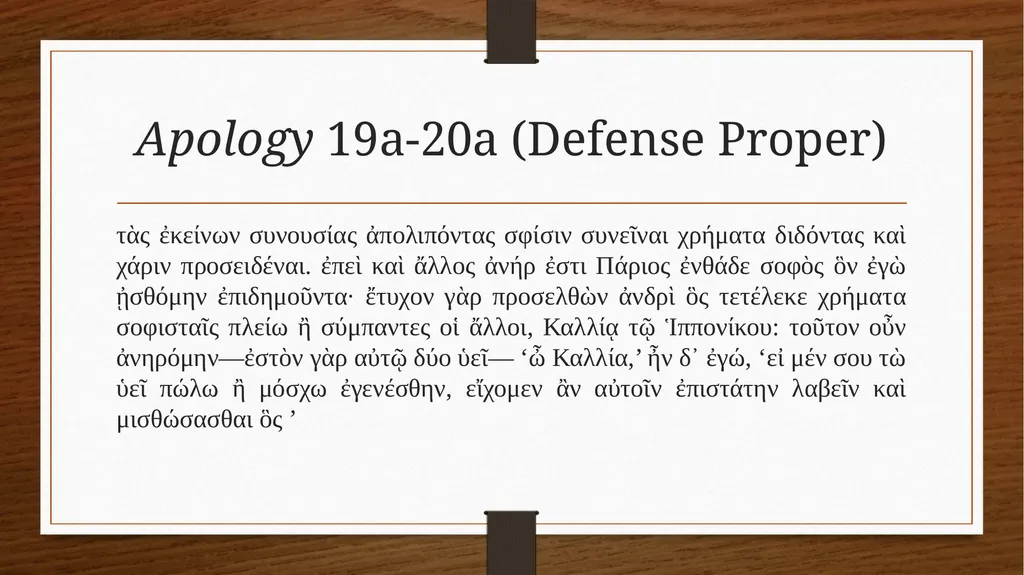
Apology 19a-20a (Defense Proper) τὰς ἐκείνων συνουσίας ἀπολιπόντας σφίσιν συνεῖναι χρήματα διδόντας καὶ χάριν προσειδέναι. ἐπεὶ καὶ ἄλλος ἀνήρ ἐστι Πάριος ἐνθάδε σοφὸς ὃν ἐγὼ ᾐσθόμην ἐπιδημοῦντα· ἔτυχον γὰρ προσελθὼν ἀνδρὶ ὃς τετέλεκε χρήματα σοφισταῖς πλείω ἢ σύμπαντες οἱ ἄλλοι, Καλλίᾳ τῷ Ἱππονίκου: τοῦτον οὖν ἀνηρόμην—ἐστὸν γὰρ αὐτῷ δύο ὑεῖ— ‘ὦ Καλλία,’ ἦν δ᾽ ἐγώ, ‘εἰ μέν σου τὼ ὑεῖ πώλω ἢ μόσχω ἐγενέσθην, εἴχομεν ἂν αὐτοῖν ἐπιστάτην λαβεῖν καὶ μισθώσασθαι ὃς ’<br>
06
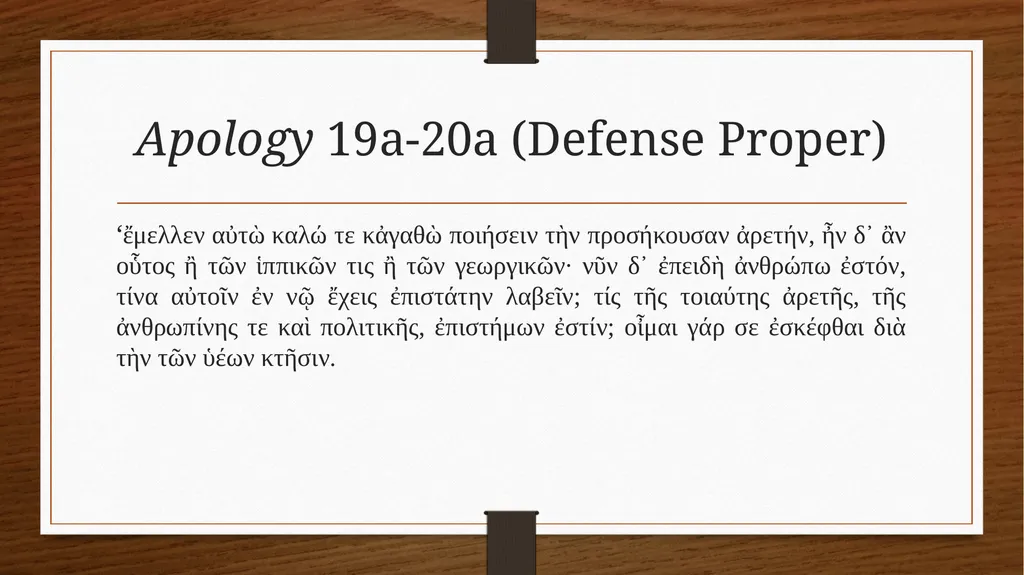
Apology 19a-20a (Defense Proper) ‘ἔμελλεν αὐτὼ καλώ τε κἀγαθὼ ποιήσειν τὴν προσήκουσαν ἀρετήν, ἦν δ᾽ ἂν οὗτος ἢ τῶν ἱππικῶν τις ἢ τῶν γεωργικῶν· νῦν δ᾽ ἐπειδὴ ἀνθρώπω ἐστόν, τίνα αὐτοῖν ἐν νῷ ἔχεις ἐπιστάτην λαβεῖν; τίς τῆς τοιαύτης ἀρετῆς, τῆς ἀνθρωπίνης τε καὶ πολιτικῆς, ἐπιστήμων ἐστίν; οἶμαι γάρ σε ἐσκέφθαι διὰ τὴν τῶν ὑέων κτῆσιν.<br>
07
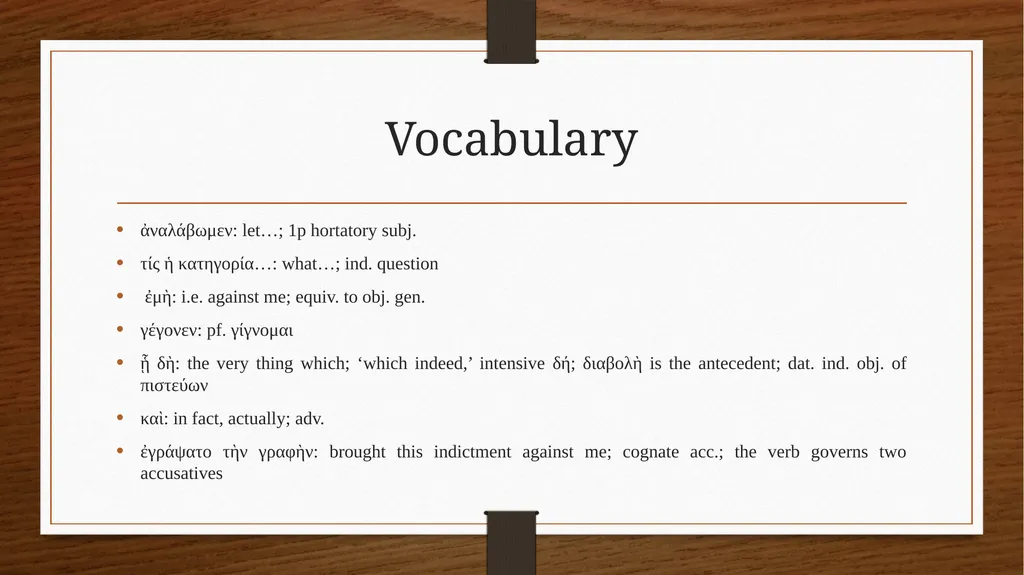
Vocabulary ἀναλάβωμεν: let…; 1p hortatory subj.
τίς ἡ κατηγορία…: what…; ind. question
ἐμὴ: i.e. against me; equiv. to obj. gen.
γέγονεν: pf. γίγνομαι
ᾗ δὴ: the very thing which; ‘which indeed,’ intensive δή; διαβολὴ is the antecedent; dat. ind. obj. of πιστεύων
καὶ: in fact, actually; adv.
ἐγράψατο τὴν γραφὴν: brought this indictment against me; cognate acc.; the verb governs two accusatives<br>
τίς ἡ κατηγορία…: what…; ind. question
ἐμὴ: i.e. against me; equiv. to obj. gen.
γέγονεν: pf. γίγνομαι
ᾗ δὴ: the very thing which; ‘which indeed,’ intensive δή; διαβολὴ is the antecedent; dat. ind. obj. of πιστεύων
καὶ: in fact, actually; adv.
ἐγράψατο τὴν γραφὴν: brought this indictment against me; cognate acc.; the verb governs two accusatives<br>
08
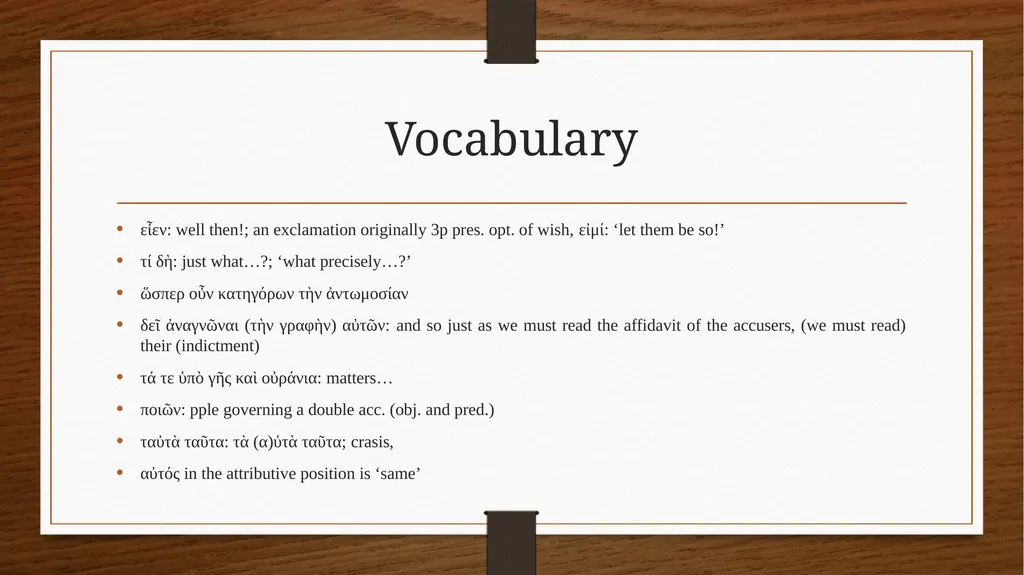
Vocabulary εἶεν: well then!; an exclamation originally 3p pres. opt. of wish, εἰμί: ‘let them be so!’
τί δὴ: just what…?; ‘what precisely…?’
ὥσπερ οὖν κατηγόρων τὴν ἀντωμοσίαν
δεῖ ἀναγνῶναι (τὴν γραφὴν) αὐτῶν: and so just as we must read the affidavit of the accusers, (we must read) their (indictment)
τά τε ὑπὸ γῆς καὶ οὐράνια: matters…
ποιῶν: pple governing a double acc. (obj. and pred.)
ταὐτὰ ταῦτα: τὰ (α)ὐτὰ ταῦτα; crasis,
αὐτός in the attributive position is ‘same’<br>
τί δὴ: just what…?; ‘what precisely…?’
ὥσπερ οὖν κατηγόρων τὴν ἀντωμοσίαν
δεῖ ἀναγνῶναι (τὴν γραφὴν) αὐτῶν: and so just as we must read the affidavit of the accusers, (we must read) their (indictment)
τά τε ὑπὸ γῆς καὶ οὐράνια: matters…
ποιῶν: pple governing a double acc. (obj. and pred.)
ταὐτὰ ταῦτα: τὰ (α)ὐτὰ ταῦτα; crasis,
αὐτός in the attributive position is ‘same’<br>
09
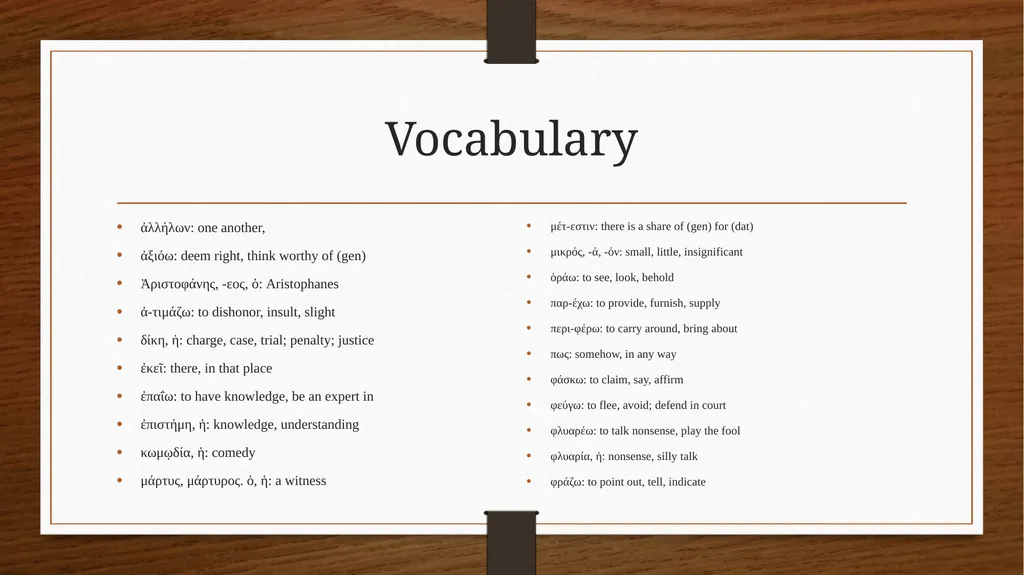
Vocabulary ἀλλήλων: one another,
ἀξιόω: deem right, think worthy of (gen)
Ἀριστοφάνης, -εος, ὁ: Aristophanes
ἀ-τιμάζω: to dishonor, insult, slight
δίκη, ἡ: charge, case, trial; penalty; justice
ἐκεῖ: there, in that place
ἐπαΐω: to have knowledge, be an expert in
ἐπιστήμη, ἡ: knowledge, understanding
κωμῳδία, ἡ: comedy
μάρτυς, μάρτυρος. ὁ, ἡ: a witness μέτ-εστιν: there is a share of (gen) for (dat)
μικρός, -ά, -όν: small, little, insignificant
ὁράω: to see, look, behold
παρ-έχω: to provide, furnish, supply
περι-φέρω: to carry around, bring about
πως: somehow, in any way
φάσκω: to claim, say, affirm
φεύγω: to flee, avoid; defend in court
φλυαρέω: to talk nonsense, play the fool
φλυαρία, ἡ: nonsense, silly talk
φράζω: to point out, tell, indicate<br>
ἀξιόω: deem right, think worthy of (gen)
Ἀριστοφάνης, -εος, ὁ: Aristophanes
ἀ-τιμάζω: to dishonor, insult, slight
δίκη, ἡ: charge, case, trial; penalty; justice
ἐκεῖ: there, in that place
ἐπαΐω: to have knowledge, be an expert in
ἐπιστήμη, ἡ: knowledge, understanding
κωμῳδία, ἡ: comedy
μάρτυς, μάρτυρος. ὁ, ἡ: a witness μέτ-εστιν: there is a share of (gen) for (dat)
μικρός, -ά, -όν: small, little, insignificant
ὁράω: to see, look, behold
παρ-έχω: to provide, furnish, supply
περι-φέρω: to carry around, bring about
πως: somehow, in any way
φάσκω: to claim, say, affirm
φεύγω: to flee, avoid; defend in court
φλυαρέω: to talk nonsense, play the fool
φλυαρία, ἡ: nonsense, silly talk
φράζω: to point out, tell, indicate<br>
10
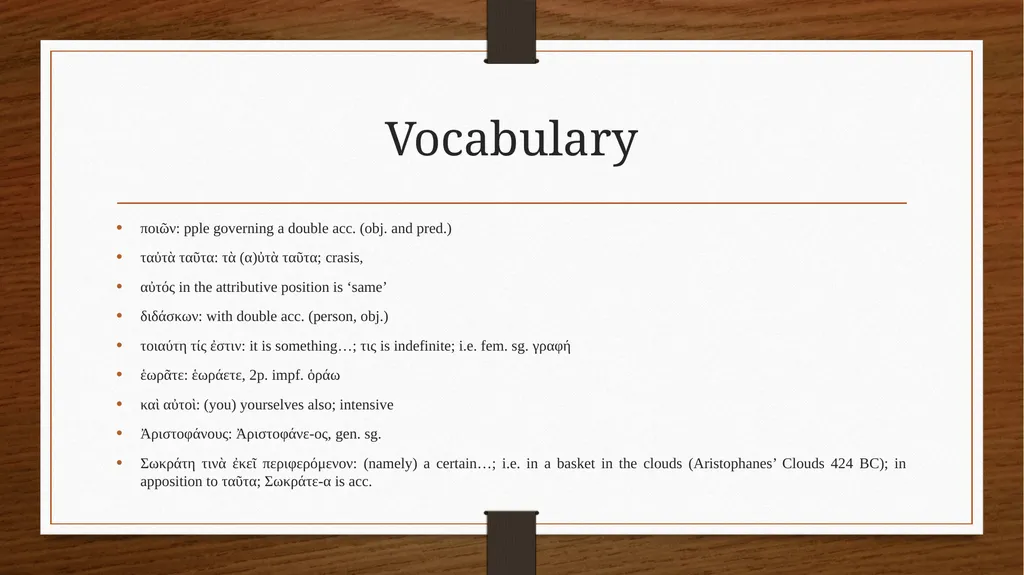
Vocabulary ποιῶν: pple governing a double acc. (obj. and pred.)
ταὐτὰ ταῦτα: τὰ (α)ὐτὰ ταῦτα; crasis,
αὐτός in the attributive position is ‘same’
διδάσκων: with double acc. (person, obj.)
τοιαύτη τίς ἐστιν: it is something…; τις is indefinite; i.e. fem. sg. γραφή
ἑωρᾶτε: ἑωράετε, 2p. impf. ὁράω
καὶ αὐτοὶ: (you) yourselves also; intensive
Ἀριστοφάνους: Ἀριστοφάνε-ος, gen. sg.
Σωκράτη τινὰ ἐκεῖ περιφερόμενον: (namely) a certain…; i.e. in a basket in the clouds (Aristophanes’ Clouds 424 BC); in apposition to ταῦτα; Σωκράτε-α is acc.<br>
ταὐτὰ ταῦτα: τὰ (α)ὐτὰ ταῦτα; crasis,
αὐτός in the attributive position is ‘same’
διδάσκων: with double acc. (person, obj.)
τοιαύτη τίς ἐστιν: it is something…; τις is indefinite; i.e. fem. sg. γραφή
ἑωρᾶτε: ἑωράετε, 2p. impf. ὁράω
καὶ αὐτοὶ: (you) yourselves also; intensive
Ἀριστοφάνους: Ἀριστοφάνε-ος, gen. sg.
Σωκράτη τινὰ ἐκεῖ περιφερόμενον: (namely) a certain…; i.e. in a basket in the clouds (Aristophanes’ Clouds 424 BC); in apposition to ταῦτα; Σωκράτε-α is acc.<br>
11
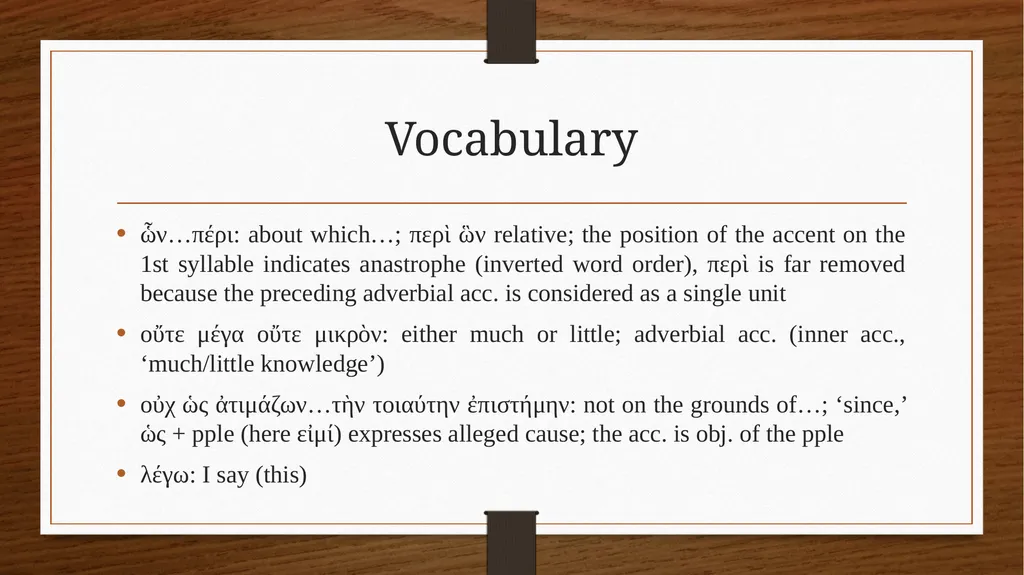
Vocabulary ὧν…πέρι: about which…; περὶ ὣν relative; the position of the accent on the 1st syllable indicates anastrophe (inverted word order), περὶ is far removed because the preceding adverbial acc. is considered as a single unit
οὔτε μέγα οὔτε μικρὸν: either much or little; adverbial acc. (inner acc., ‘much/little knowledge’)
οὐχ ὡς ἀτιμάζων…τὴν τοιαύτην ἐπιστήμην: not on the grounds of…; ‘since,’ ὡς + pple (here εἰμί) expresses alleged cause; the acc. is obj. of the pple
λέγω: I say (this)<br>
οὔτε μέγα οὔτε μικρὸν: either much or little; adverbial acc. (inner acc., ‘much/little knowledge’)
οὐχ ὡς ἀτιμάζων…τὴν τοιαύτην ἐπιστήμην: not on the grounds of…; ‘since,’ ὡς + pple (here εἰμί) expresses alleged cause; the acc. is obj. of the pple
λέγω: I say (this)<br>
12
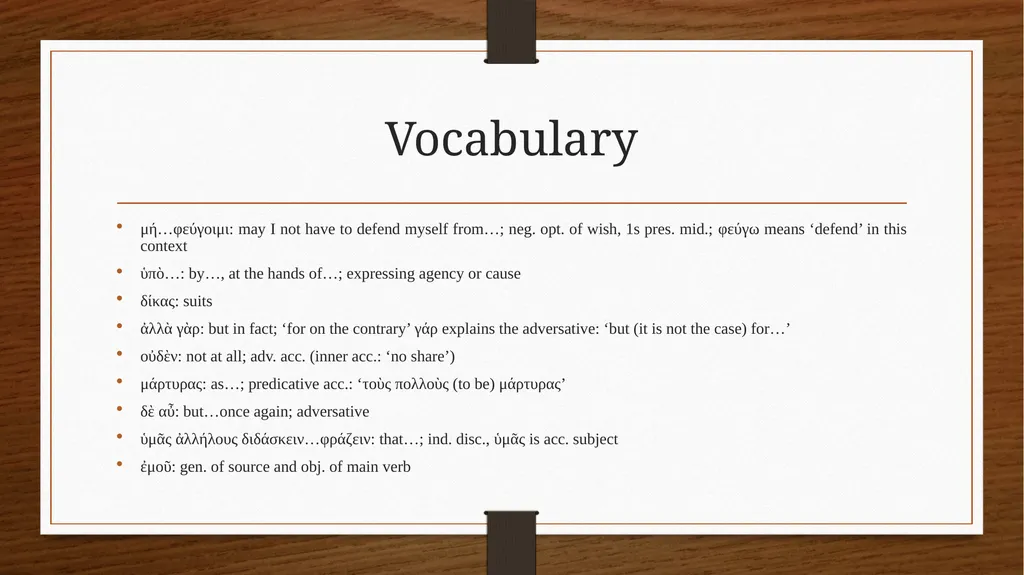
Vocabulary μή…φεύγοιμι: may I not have to defend myself from…; neg. opt. of wish, 1s pres. mid.; φεύγω means ‘defend’ in this context
ὑπὸ…: by…, at the hands of…; expressing agency or cause
δίκας: suits
ἀλλὰ γὰρ: but in fact; ‘for on the contrary’ γάρ explains the adversative: ‘but (it is not the case) for…’
οὐδὲν: not at all; adv. acc. (inner acc.: ‘no share’)
μάρτυρας: as…; predicative acc.: ‘τοὺς πολλοὺς (to be) μάρτυρας’
δὲ αὖ: but…once again; adversative
ὑμᾶς ἀλλήλους διδάσκειν…φράζειν: that…; ind. disc., ὑμᾶς is acc. subject
ἐμοῦ: gen. of source and obj. of main verb<br>
ὑπὸ…: by…, at the hands of…; expressing agency or cause
δίκας: suits
ἀλλὰ γὰρ: but in fact; ‘for on the contrary’ γάρ explains the adversative: ‘but (it is not the case) for…’
οὐδὲν: not at all; adv. acc. (inner acc.: ‘no share’)
μάρτυρας: as…; predicative acc.: ‘τοὺς πολλοὺς (to be) μάρτυρας’
δὲ αὖ: but…once again; adversative
ὑμᾶς ἀλλήλους διδάσκειν…φράζειν: that…; ind. disc., ὑμᾶς is acc. subject
ἐμοῦ: gen. of source and obj. of main verb<br>
13
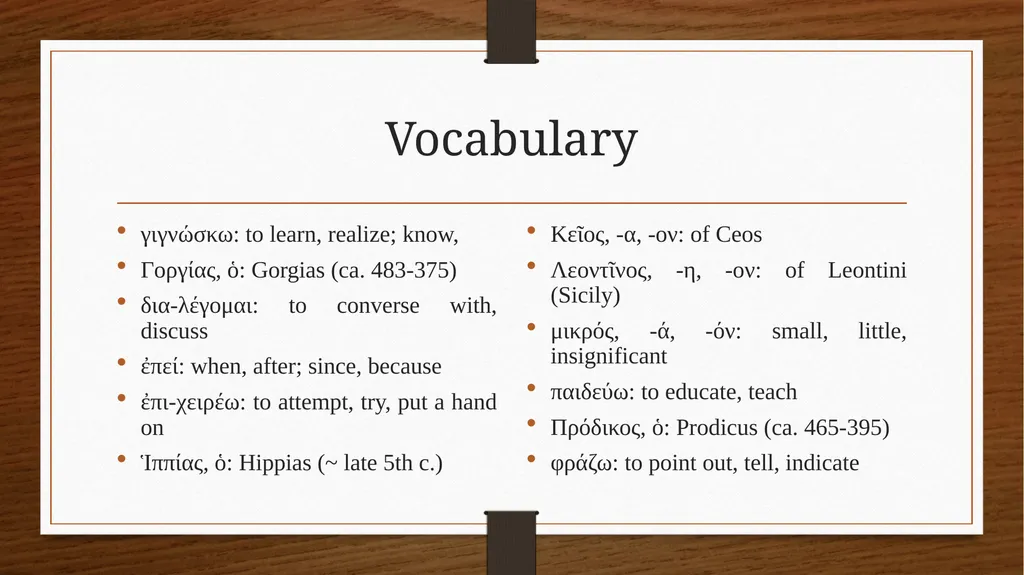
Vocabulary γιγνώσκω: to learn, realize; know,
Γοργίας, ὁ: Gorgias (ca. 483-375)
δια-λέγομαι: to converse with, discuss
ἐπεί: when, after; since, because
ἐπι-χειρέω: to attempt, try, put a hand on
Ἱππίας, ὁ: Hippias (~ late 5th c.) Κεῖος, -α, -ον: of Ceos
Λεοντῖνος, -η, -ον: of Leontini (Sicily)
μικρός, -ά, -όν: small, little, insignificant
παιδεύω: to educate, teach
Πρόδικος, ὁ: Prodicus (ca. 465-395)
φράζω: to point out, tell, indicate<br>
Γοργίας, ὁ: Gorgias (ca. 483-375)
δια-λέγομαι: to converse with, discuss
ἐπεί: when, after; since, because
ἐπι-χειρέω: to attempt, try, put a hand on
Ἱππίας, ὁ: Hippias (~ late 5th c.) Κεῖος, -α, -ον: of Ceos
Λεοντῖνος, -η, -ον: of Leontini (Sicily)
μικρός, -ά, -όν: small, little, insignificant
παιδεύω: to educate, teach
Πρόδικος, ὁ: Prodicus (ca. 465-395)
φράζω: to point out, tell, indicate<br>
14
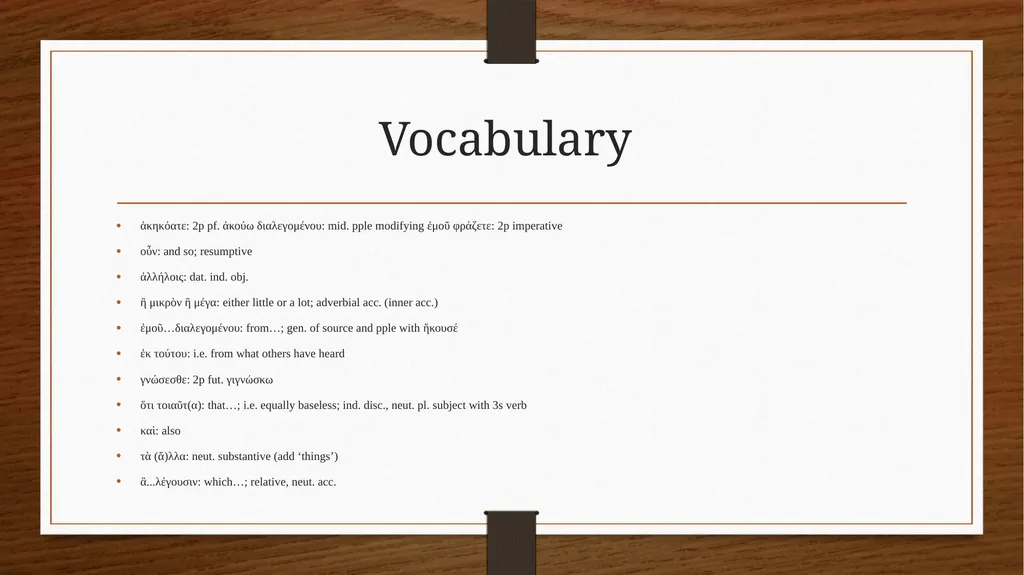
Vocabulary ἀκηκόατε: 2p pf. ἀκούω διαλεγομένου: mid. pple modifying ἐμοῦ φράζετε: 2p imperative
οὖν: and so; resumptive
ἀλλήλοις: dat. ind. obj.
ἢ μικρὸν ἢ μέγα: either little or a lot; adverbial acc. (inner acc.)
ἐμοῦ…διαλεγομένου: from…; gen. of source and pple with ἤκουσέ
ἐκ τούτου: i.e. from what others have heard
γνώσεσθε: 2p fut. γιγνώσκω
ὅτι τοιαῦτ(α): that…; i.e. equally baseless; ind. disc., neut. pl. subject with 3s verb
καὶ: also
τὰ (ἄ)λλα: neut. substantive (add ‘things’)
ἃ...λέγουσιν: which…; relative, neut. acc.<br>
οὖν: and so; resumptive
ἀλλήλοις: dat. ind. obj.
ἢ μικρὸν ἢ μέγα: either little or a lot; adverbial acc. (inner acc.)
ἐμοῦ…διαλεγομένου: from…; gen. of source and pple with ἤκουσέ
ἐκ τούτου: i.e. from what others have heard
γνώσεσθε: 2p fut. γιγνώσκω
ὅτι τοιαῦτ(α): that…; i.e. equally baseless; ind. disc., neut. pl. subject with 3s verb
καὶ: also
τὰ (ἄ)λλα: neut. substantive (add ‘things’)
ἃ...λέγουσιν: which…; relative, neut. acc.<br>
15
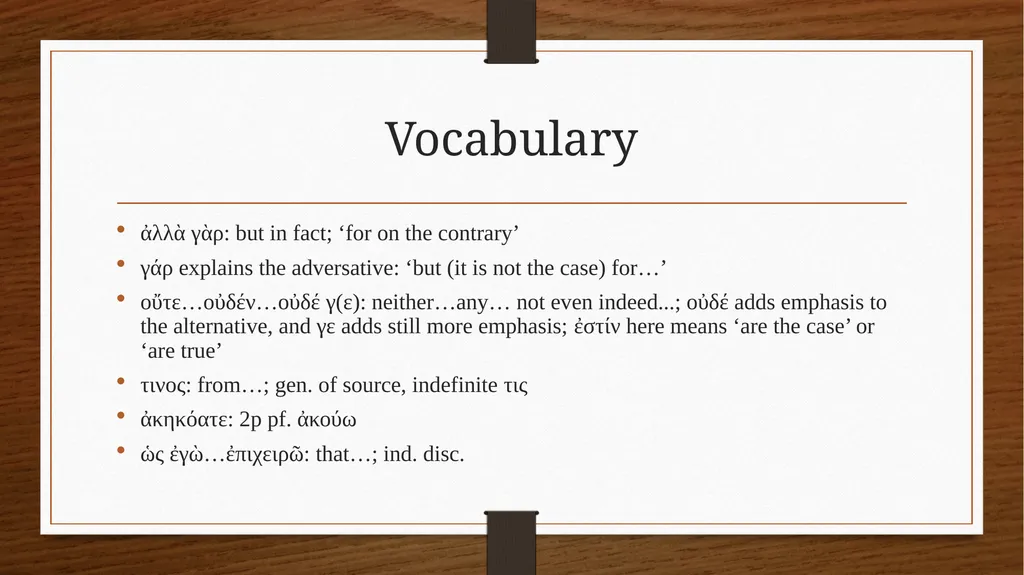
Vocabulary ἀλλὰ γὰρ: but in fact; ‘for on the contrary’
γάρ explains the adversative: ‘but (it is not the case) for…’
οὔτε…οὐδέν…οὐδέ γ(ε): neither…any… not even indeed...; οὐδέ adds emphasis to the alternative, and γε adds still more emphasis; ἐστίν here means ‘are the case’ or ‘are true’
τινος: from…; gen. of source, indefinite τις
ἀκηκόατε: 2p pf. ἀκούω
ὡς ἐγὼ…ἐπιχειρῶ: that…; ind. disc.<br>
γάρ explains the adversative: ‘but (it is not the case) for…’
οὔτε…οὐδέν…οὐδέ γ(ε): neither…any… not even indeed...; οὐδέ adds emphasis to the alternative, and γε adds still more emphasis; ἐστίν here means ‘are the case’ or ‘are true’
τινος: from…; gen. of source, indefinite τις
ἀκηκόατε: 2p pf. ἀκούω
ὡς ἐγὼ…ἐπιχειρῶ: that…; ind. disc.<br>
16
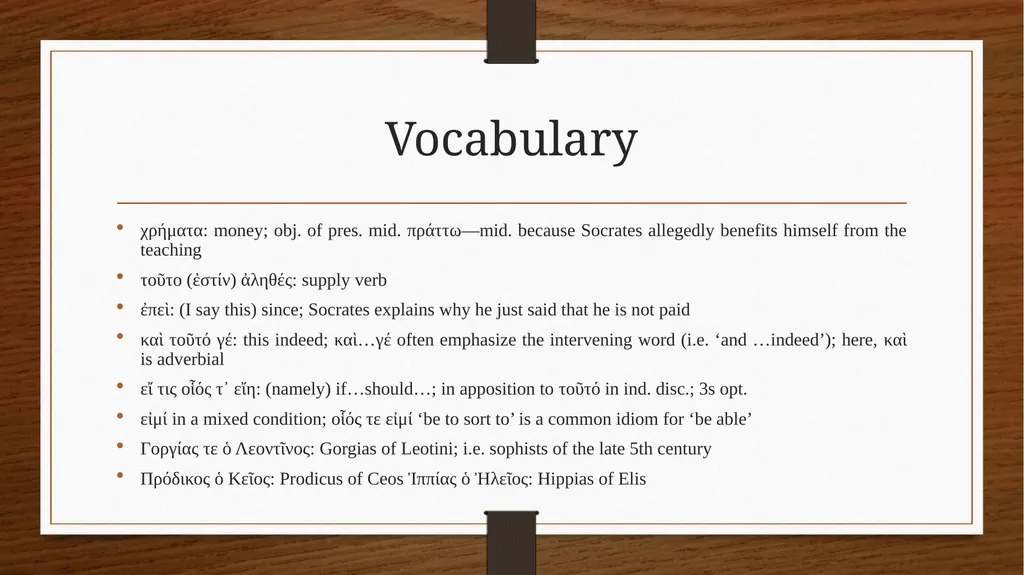
Vocabulary χρήματα: money; obj. of pres. mid. πράττω—mid. because Socrates allegedly benefits himself from the teaching
τοῦτο (ἐστίν) ἀληθές: supply verb
ἐπεὶ: (I say this) since; Socrates explains why he just said that he is not paid
καὶ τοῦτό γέ: this indeed; καὶ…γέ often emphasize the intervening word (i.e. ‘and …indeed’); here, καὶ is adverbial
εἴ τις οἷός τ᾽ εἴη: (namely) if…should…; in apposition to τοῦτό in ind. disc.; 3s opt.
εἰμί in a mixed condition; οἷός τε εἰμί ‘be to sort to’ is a common idiom for ‘be able’
Γοργίας τε ὁ Λεοντῖνος: Gorgias of Leotini; i.e. sophists of the late 5th century
Πρόδικος ὁ Κεῖος: Prodicus of Ceos Ἱππίας ὁ Ἠλεῖος: Hippias of Elis<br>
τοῦτο (ἐστίν) ἀληθές: supply verb
ἐπεὶ: (I say this) since; Socrates explains why he just said that he is not paid
καὶ τοῦτό γέ: this indeed; καὶ…γέ often emphasize the intervening word (i.e. ‘and …indeed’); here, καὶ is adverbial
εἴ τις οἷός τ᾽ εἴη: (namely) if…should…; in apposition to τοῦτό in ind. disc.; 3s opt.
εἰμί in a mixed condition; οἷός τε εἰμί ‘be to sort to’ is a common idiom for ‘be able’
Γοργίας τε ὁ Λεοντῖνος: Gorgias of Leotini; i.e. sophists of the late 5th century
Πρόδικος ὁ Κεῖος: Prodicus of Ceos Ἱππίας ὁ Ἠλεῖος: Hippias of Elis<br>
17
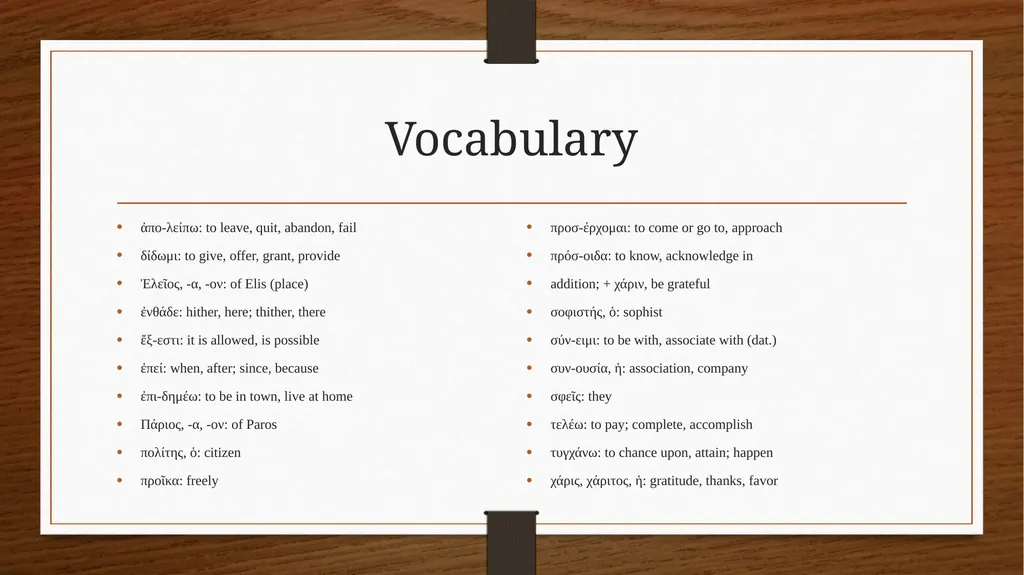
Vocabulary ἀπο-λείπω: to leave, quit, abandon, fail
δίδωμι: to give, offer, grant, provide
Ἐλεῖος, -α, -ον: of Elis (place)
ἐνθάδε: hither, here; thither, there
ἔξ-εστι: it is allowed, is possible
ἐπεί: when, after; since, because
ἐπι-δημέω: to be in town, live at home
Πάριος, -α, -ον: of Paros
πολίτης, ὁ: citizen
προῖκα: freely προσ-έρχομαι: to come or go to, approach
πρόσ-οιδα: to know, acknowledge in
addition; + χάριν, be grateful
σοφιστής, ὁ: sophist
σύν-ειμι: to be with, associate with (dat.)
συν-ουσία, ἡ: association, company
σφεῖς: they
τελέω: to pay; complete, accomplish
τυγχάνω: to chance upon, attain; happen
χάρις, χάριτος, ἡ: gratitude, thanks, favor<br>
δίδωμι: to give, offer, grant, provide
Ἐλεῖος, -α, -ον: of Elis (place)
ἐνθάδε: hither, here; thither, there
ἔξ-εστι: it is allowed, is possible
ἐπεί: when, after; since, because
ἐπι-δημέω: to be in town, live at home
Πάριος, -α, -ον: of Paros
πολίτης, ὁ: citizen
προῖκα: freely προσ-έρχομαι: to come or go to, approach
πρόσ-οιδα: to know, acknowledge in
addition; + χάριν, be grateful
σοφιστής, ὁ: sophist
σύν-ειμι: to be with, associate with (dat.)
συν-ουσία, ἡ: association, company
σφεῖς: they
τελέω: to pay; complete, accomplish
τυγχάνω: to chance upon, attain; happen
χάρις, χάριτος, ἡ: gratitude, thanks, favor<br>
18
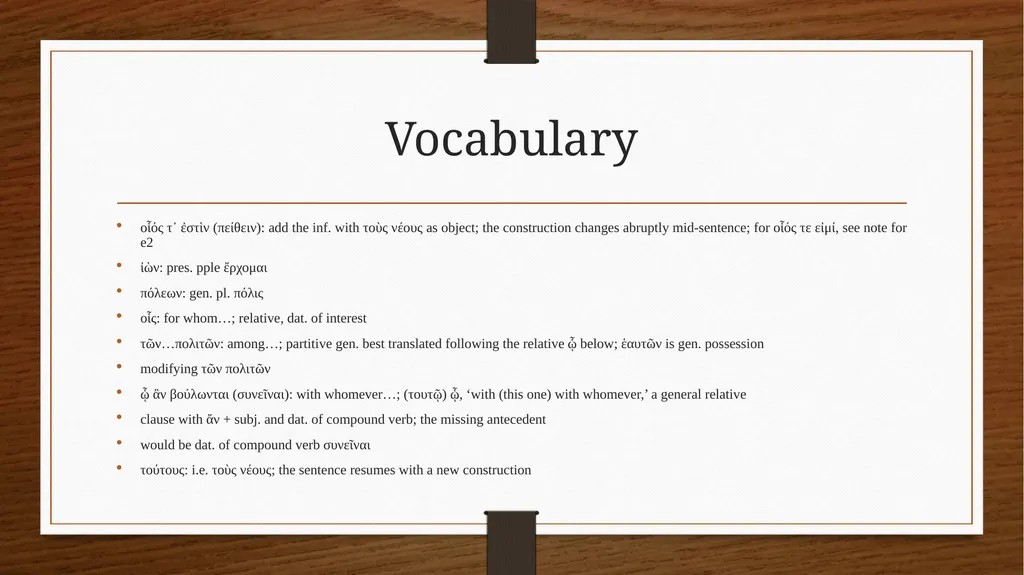
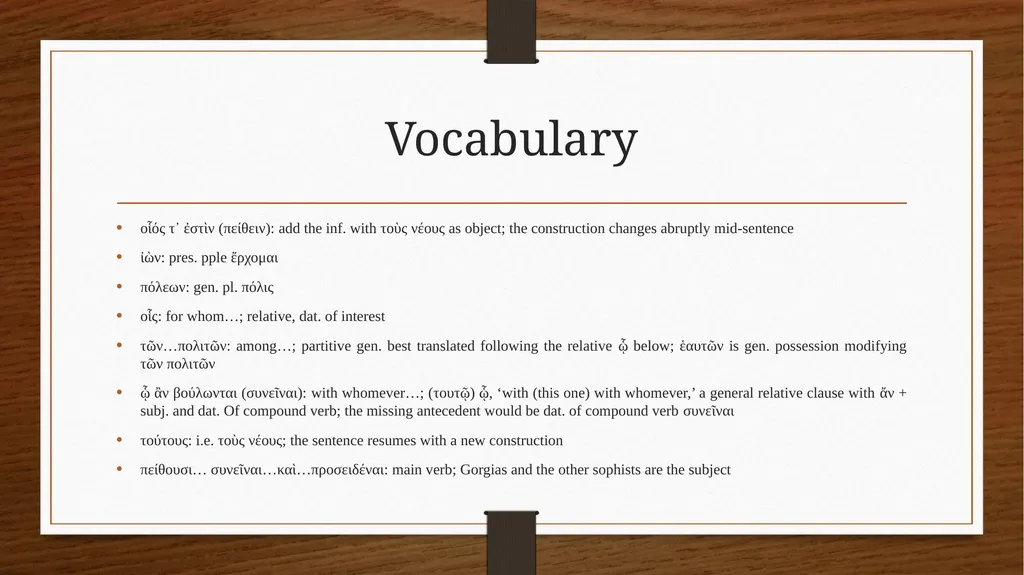
Vocabulary οἷός τ᾽ ἐστὶν (πείθειν): add the inf. with τοὺς νέους as object; the construction changes abruptly mid-sentence; for οἷός τε εἰμί, see note for e2
ἰὼν: pres. pple ἔρχομαι
πόλεων: gen. pl. πόλις
οἷς: for whom…; relative, dat. of interest
τῶν…πολιτῶν: among…; partitive gen. best translated following the relative ᾧ below; ἑαυτῶν is gen. possession
modifying τῶν πολιτῶν
ᾧ ἂν βούλωνται (συνεῖναι): with whomever…; (τουτῷ) ᾧ, ‘with (this one) with whomever,’ a general relative
clause with ἄν + subj. and dat. of compound verb; the missing antecedent
would be dat. of compound verb συνεῖναι
τούτους: i.e. τοὺς νέους; the sentence resumes with a new construction<br>
ἰὼν: pres. pple ἔρχομαι
πόλεων: gen. pl. πόλις
οἷς: for whom…; relative, dat. of interest
τῶν…πολιτῶν: among…; partitive gen. best translated following the relative ᾧ below; ἑαυτῶν is gen. possession
modifying τῶν πολιτῶν
ᾧ ἂν βούλωνται (συνεῖναι): with whomever…; (τουτῷ) ᾧ, ‘with (this one) with whomever,’ a general relative
clause with ἄν + subj. and dat. of compound verb; the missing antecedent
would be dat. of compound verb συνεῖναι
τούτους: i.e. τοὺς νέους; the sentence resumes with a new construction<br>
19
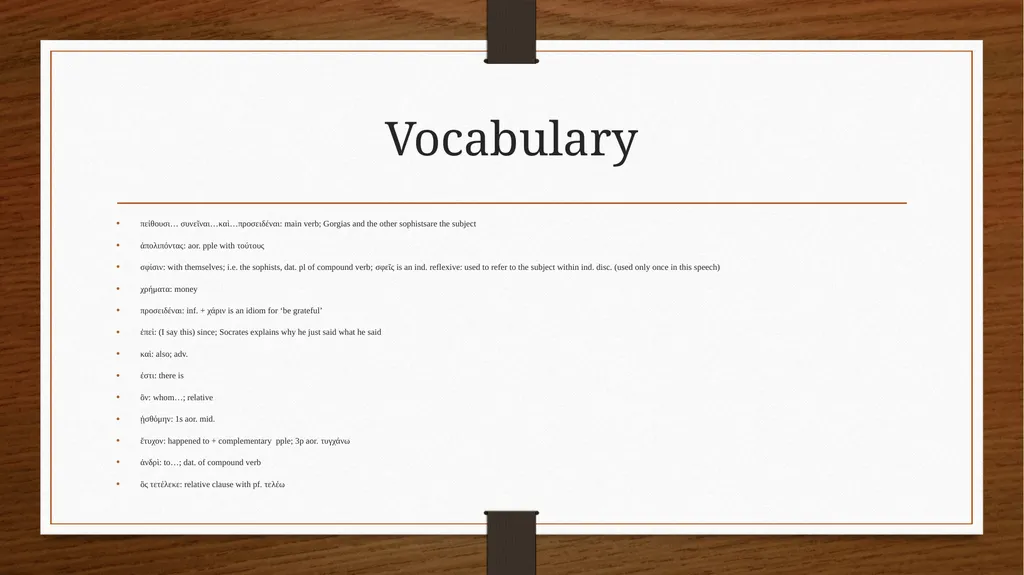
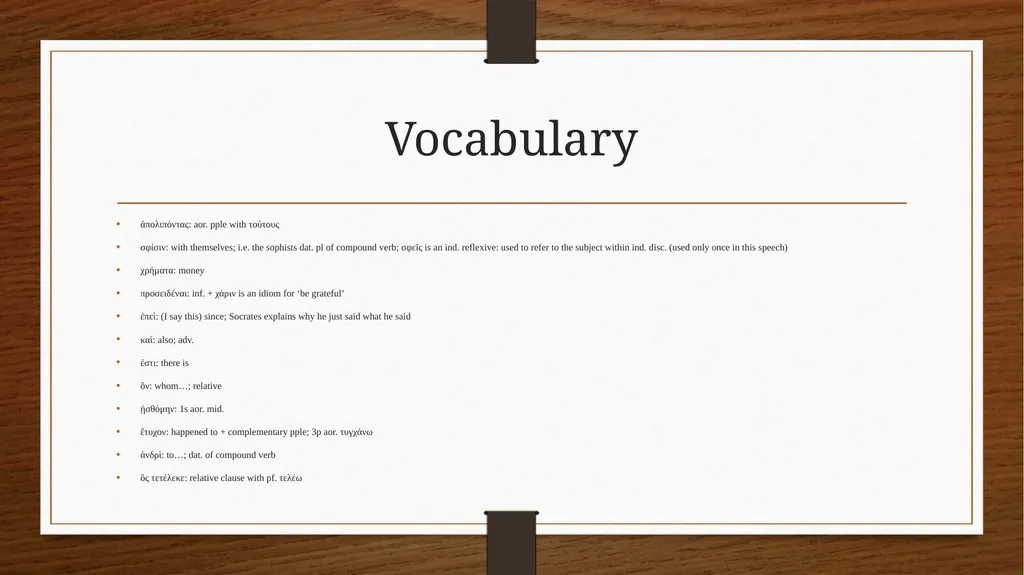
Vocabulary πείθουσι… συνεῖναι…καὶ…προσειδέναι: main verb; Gorgias and the other sophistsare the subject
ἀπολιπόντας: aor. pple with τούτους
σφίσιν: with themselves; i.e. the sophists, dat. pl of compound verb; σφεῖς is an ind. reflexive: used to refer to the subject within ind. disc. (used only once in this speech)
χρήματα: money
προσειδέναι: inf. + χάριν is an idiom for ‘be grateful’
ἐπεὶ: (I say this) since; Socrates explains why he just said what he said
καὶ: also; adv.
ἐστι: there is
ὃν: whom…; relative
ᾐσθόμην: 1s aor. mid.
ἔτυχον: happened to + complementary pple; 3p aor. τυγχάνω
ἀνδρὶ: to…; dat. of compound verb
ὃς τετέλεκε: relative clause with pf. τελέω<br>
ἀπολιπόντας: aor. pple with τούτους
σφίσιν: with themselves; i.e. the sophists, dat. pl of compound verb; σφεῖς is an ind. reflexive: used to refer to the subject within ind. disc. (used only once in this speech)
χρήματα: money
προσειδέναι: inf. + χάριν is an idiom for ‘be grateful’
ἐπεὶ: (I say this) since; Socrates explains why he just said what he said
καὶ: also; adv.
ἐστι: there is
ὃν: whom…; relative
ᾐσθόμην: 1s aor. mid.
ἔτυχον: happened to + complementary pple; 3p aor. τυγχάνω
ἀνδρὶ: to…; dat. of compound verb
ὃς τετέλεκε: relative clause with pf. τελέω<br>
20
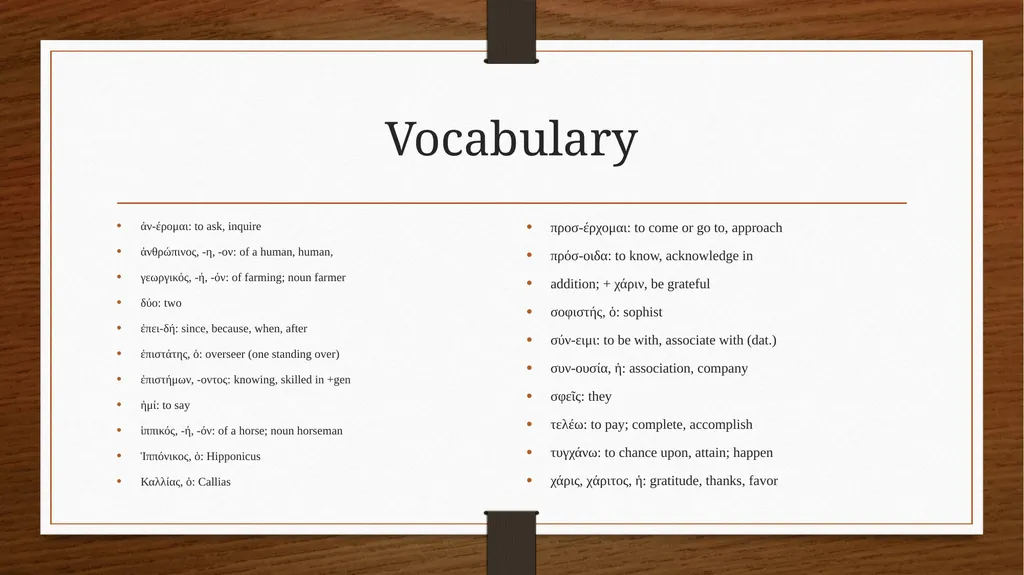
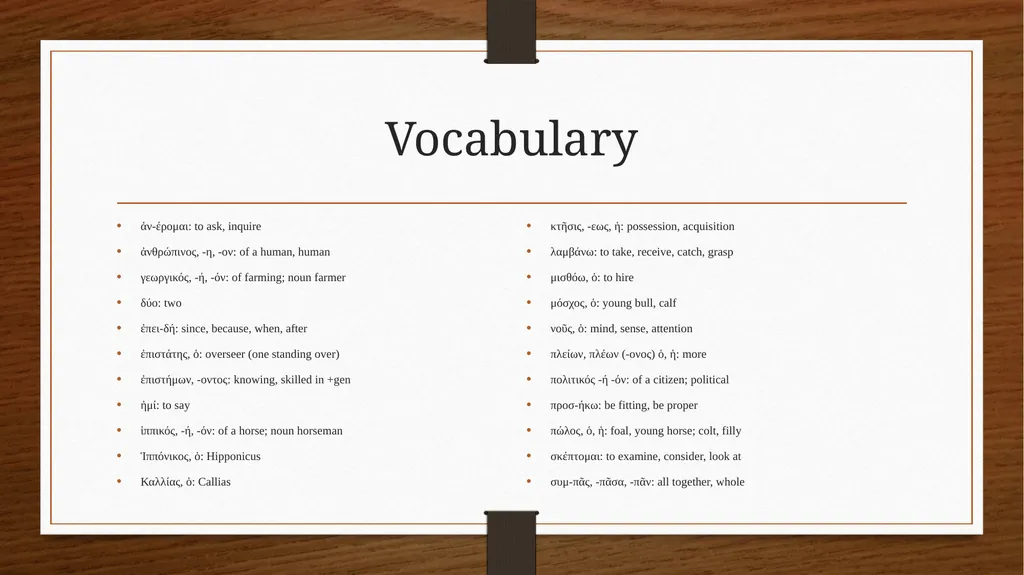
Vocabulary ἀν-έρομαι: to ask, inquire
ἀνθρώπινος, -η, -ον: of a human, human,
γεωργικός, -ή, -όν: of farming; noun farmer
δύο: two
ἐπει-δή: since, because, when, after
ἐπιστάτης, ὁ: overseer (one standing over)
ἐπιστήμων, -οντος: knowing, skilled in +gen
ἠμί: to say
ἱππικός, -ή, -όν: of a horse; noun horseman
Ἱππόνικος, ὁ: Hipponicus
Καλλίας, ὁ: Callias προσ-έρχομαι: to come or go to, approach
πρόσ-οιδα: to know, acknowledge in
addition; + χάριν, be grateful
σοφιστής, ὁ: sophist
σύν-ειμι: to be with, associate with (dat.)
συν-ουσία, ἡ: association, company
σφεῖς: they
τελέω: to pay; complete, accomplish
τυγχάνω: to chance upon, attain; happen
χάρις, χάριτος, ἡ: gratitude, thanks, favor<br>
ἀνθρώπινος, -η, -ον: of a human, human,
γεωργικός, -ή, -όν: of farming; noun farmer
δύο: two
ἐπει-δή: since, because, when, after
ἐπιστάτης, ὁ: overseer (one standing over)
ἐπιστήμων, -οντος: knowing, skilled in +gen
ἠμί: to say
ἱππικός, -ή, -όν: of a horse; noun horseman
Ἱππόνικος, ὁ: Hipponicus
Καλλίας, ὁ: Callias προσ-έρχομαι: to come or go to, approach
πρόσ-οιδα: to know, acknowledge in
addition; + χάριν, be grateful
σοφιστής, ὁ: sophist
σύν-ειμι: to be with, associate with (dat.)
συν-ουσία, ἡ: association, company
σφεῖς: they
τελέω: to pay; complete, accomplish
τυγχάνω: to chance upon, attain; happen
χάρις, χάριτος, ἡ: gratitude, thanks, favor<br>
21
Vocabulary οἷός τ᾽ ἐστὶν (πείθειν): add the inf. with τοὺς νέους as object; the construction changes abruptly mid-sentence
ἰὼν: pres. pple ἔρχομαι
πόλεων: gen. pl. πόλις
οἷς: for whom…; relative, dat. of interest
τῶν…πολιτῶν: among…; partitive gen. best translated following the relative ᾧ below; ἑαυτῶν is gen. possession modifying τῶν πολιτῶν
ᾧ ἂν βούλωνται (συνεῖναι): with whomever…; (τουτῷ) ᾧ, ‘with (this one) with whomever,’ a general relative clause with ἄν + subj. and dat. Of compound verb; the missing antecedent would be dat. of compound verb συνεῖναι
τούτους: i.e. τοὺς νέους; the sentence resumes with a new construction
πείθουσι… συνεῖναι…καὶ…προσειδέναι: main verb; Gorgias and the other sophists are the subject<br>
ἰὼν: pres. pple ἔρχομαι
πόλεων: gen. pl. πόλις
οἷς: for whom…; relative, dat. of interest
τῶν…πολιτῶν: among…; partitive gen. best translated following the relative ᾧ below; ἑαυτῶν is gen. possession modifying τῶν πολιτῶν
ᾧ ἂν βούλωνται (συνεῖναι): with whomever…; (τουτῷ) ᾧ, ‘with (this one) with whomever,’ a general relative clause with ἄν + subj. and dat. Of compound verb; the missing antecedent would be dat. of compound verb συνεῖναι
τούτους: i.e. τοὺς νέους; the sentence resumes with a new construction
πείθουσι… συνεῖναι…καὶ…προσειδέναι: main verb; Gorgias and the other sophists are the subject<br>
22
Vocabulary ἀπολιπόντας: aor. pple with τούτους
σφίσιν: with themselves; i.e. the sophists dat. pl of compound verb; σφεῖς is an ind. reflexive: used to refer to the subject within ind. disc. (used only once in this speech)
χρήματα: money
προσειδέναι: inf. + χάριν is an idiom for ‘be grateful’
ἐπεὶ: (I say this) since; Socrates explains why he just said what he said
καὶ: also; adv.
ἐστι: there is
ὃν: whom…; relative
ᾐσθόμην: 1s aor. mid.
ἔτυχον: happened to + complementary pple; 3p aor. τυγχάνω
ἀνδρὶ: to…; dat. of compound verb
ὃς τετέλεκε: relative clause with pf. τελέω<br>
σφίσιν: with themselves; i.e. the sophists dat. pl of compound verb; σφεῖς is an ind. reflexive: used to refer to the subject within ind. disc. (used only once in this speech)
χρήματα: money
προσειδέναι: inf. + χάριν is an idiom for ‘be grateful’
ἐπεὶ: (I say this) since; Socrates explains why he just said what he said
καὶ: also; adv.
ἐστι: there is
ὃν: whom…; relative
ᾐσθόμην: 1s aor. mid.
ἔτυχον: happened to + complementary pple; 3p aor. τυγχάνω
ἀνδρὶ: to…; dat. of compound verb
ὃς τετέλεκε: relative clause with pf. τελέω<br>
23
Vocabulary ἀν-έρομαι: to ask, inquire
ἀνθρώπινος, -η, -ον: of a human, human
γεωργικός, -ή, -όν: of farming; noun farmer
δύο: two
ἐπει-δή: since, because, when, after
ἐπιστάτης, ὁ: overseer (one standing over)
ἐπιστήμων, -οντος: knowing, skilled in +gen
ἠμί: to say
ἱππικός, -ή, -όν: of a horse; noun horseman
Ἱππόνικος, ὁ: Hipponicus
Καλλίας, ὁ: Callias κτῆσις, -εως, ἡ: possession, acquisition
λαμβάνω: to take, receive, catch, grasp
μισθόω, ὁ: to hire
μόσχος, ὁ: young bull, calf
νοῦς, ὁ: mind, sense, attention
πλείων, πλέων (-ονος) ὁ, ἡ: more
πολιτικός -ή -όν: of a citizen; political
προσ-ήκω: be fitting, be proper
πώλος, ὁ, ἡ: foal, young horse; colt, filly
σκέπτομαι: to examine, consider, look at
συμ-πᾶς, -πᾶσα, -πᾶν: all together, whole<br>
ἀνθρώπινος, -η, -ον: of a human, human
γεωργικός, -ή, -όν: of farming; noun farmer
δύο: two
ἐπει-δή: since, because, when, after
ἐπιστάτης, ὁ: overseer (one standing over)
ἐπιστήμων, -οντος: knowing, skilled in +gen
ἠμί: to say
ἱππικός, -ή, -όν: of a horse; noun horseman
Ἱππόνικος, ὁ: Hipponicus
Καλλίας, ὁ: Callias κτῆσις, -εως, ἡ: possession, acquisition
λαμβάνω: to take, receive, catch, grasp
μισθόω, ὁ: to hire
μόσχος, ὁ: young bull, calf
νοῦς, ὁ: mind, sense, attention
πλείων, πλέων (-ονος) ὁ, ἡ: more
πολιτικός -ή -όν: of a citizen; political
προσ-ήκω: be fitting, be proper
πώλος, ὁ, ἡ: foal, young horse; colt, filly
σκέπτομαι: to examine, consider, look at
συμ-πᾶς, -πᾶσα, -πᾶν: all together, whole<br>
24
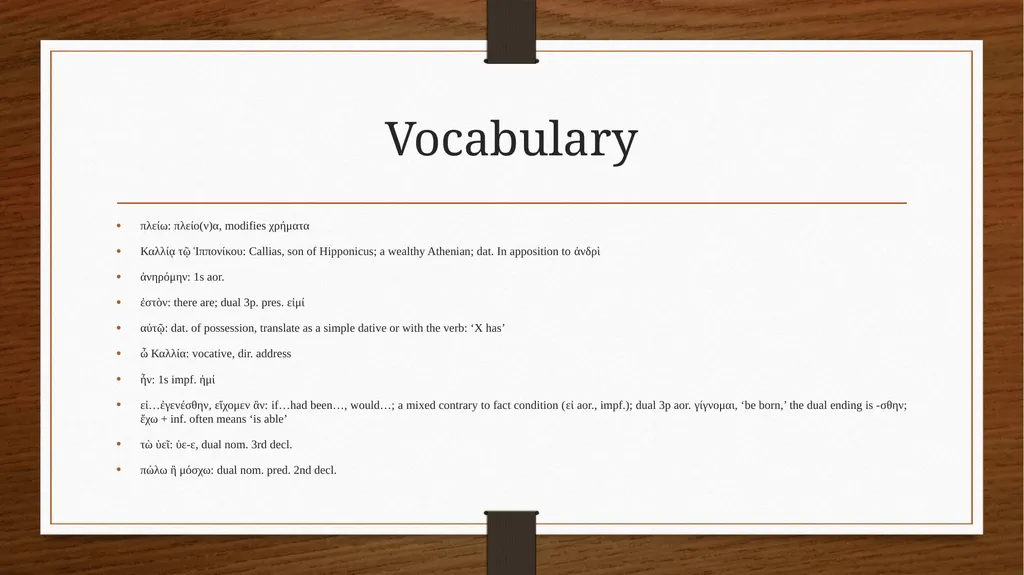
Vocabulary πλείω: πλείο(ν)α, modifies χρήματα
Καλλίᾳ τῷ Ἱππονίκου: Callias, son of Hipponicus; a wealthy Athenian; dat. In apposition to ἀνδρὶ
ἀνηρόμην: 1s aor.
ἐστὸν: there are; dual 3p. pres. εἰμί
αὐτῷ: dat. of possession, translate as a simple dative or with the verb: ‘X has’
ὦ Καλλία: vocative, dir. address
ἦν: 1s impf. ἠμί
εἰ…ἐγενέσθην, εἴχομεν ἂν: if…had been…, would…; a mixed contrary to fact condition (εἰ aor., impf.); dual 3p aor. γίγνομαι, ‘be born,’ the dual ending is -σθην; ἔχω + inf. often means ‘is able’
τὼ ὑεῖ: ὑε-ε, dual nom. 3rd decl.
πώλω ἢ μόσχω: dual nom. pred. 2nd decl.<br>
Καλλίᾳ τῷ Ἱππονίκου: Callias, son of Hipponicus; a wealthy Athenian; dat. In apposition to ἀνδρὶ
ἀνηρόμην: 1s aor.
ἐστὸν: there are; dual 3p. pres. εἰμί
αὐτῷ: dat. of possession, translate as a simple dative or with the verb: ‘X has’
ὦ Καλλία: vocative, dir. address
ἦν: 1s impf. ἠμί
εἰ…ἐγενέσθην, εἴχομεν ἂν: if…had been…, would…; a mixed contrary to fact condition (εἰ aor., impf.); dual 3p aor. γίγνομαι, ‘be born,’ the dual ending is -σθην; ἔχω + inf. often means ‘is able’
τὼ ὑεῖ: ὑε-ε, dual nom. 3rd decl.
πώλω ἢ μόσχω: dual nom. pred. 2nd decl.<br>
25
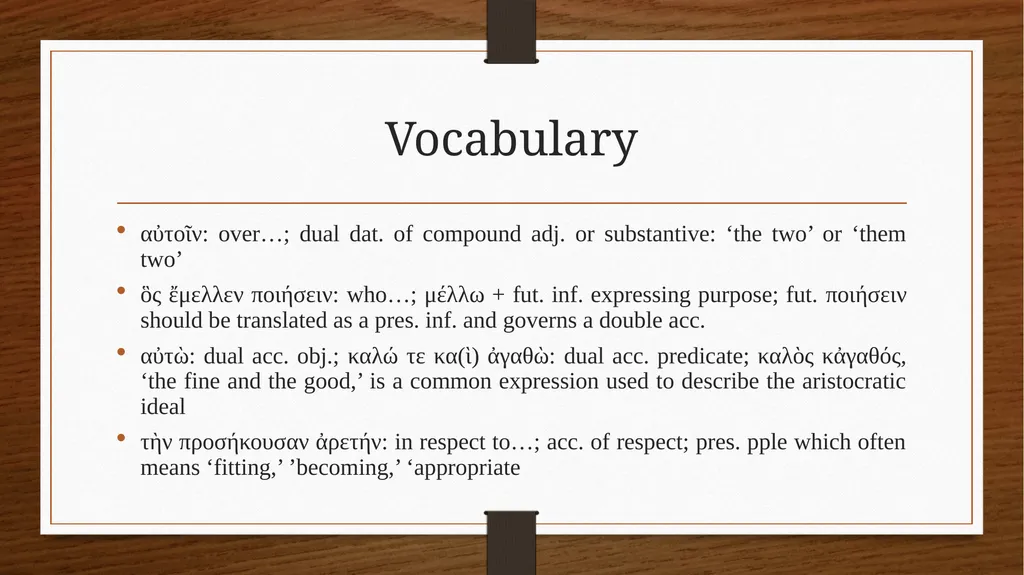
Vocabulary αὐτοῖν: over…; dual dat. of compound adj. or substantive: ‘the two’ or ‘them two’
ὃς ἔμελλεν ποιήσειν: who…; μέλλω + fut. inf. expressing purpose; fut. ποιήσειν should be translated as a pres. inf. and governs a double acc.
αὐτὼ: dual acc. obj.; καλώ τε κα(ὶ) ἀγαθὼ: dual acc. predicate; καλὸς κἀγαθός, ‘the fine and the good,’ is a common expression used to describe the aristocratic ideal
τὴν προσήκουσαν ἀρετήν: in respect to…; acc. of respect; pres. pple which often means ‘fitting,’ ’becoming,’ ‘appropriate<br>
ὃς ἔμελλεν ποιήσειν: who…; μέλλω + fut. inf. expressing purpose; fut. ποιήσειν should be translated as a pres. inf. and governs a double acc.
αὐτὼ: dual acc. obj.; καλώ τε κα(ὶ) ἀγαθὼ: dual acc. predicate; καλὸς κἀγαθός, ‘the fine and the good,’ is a common expression used to describe the aristocratic ideal
τὴν προσήκουσαν ἀρετήν: in respect to…; acc. of respect; pres. pple which often means ‘fitting,’ ’becoming,’ ‘appropriate<br>
26
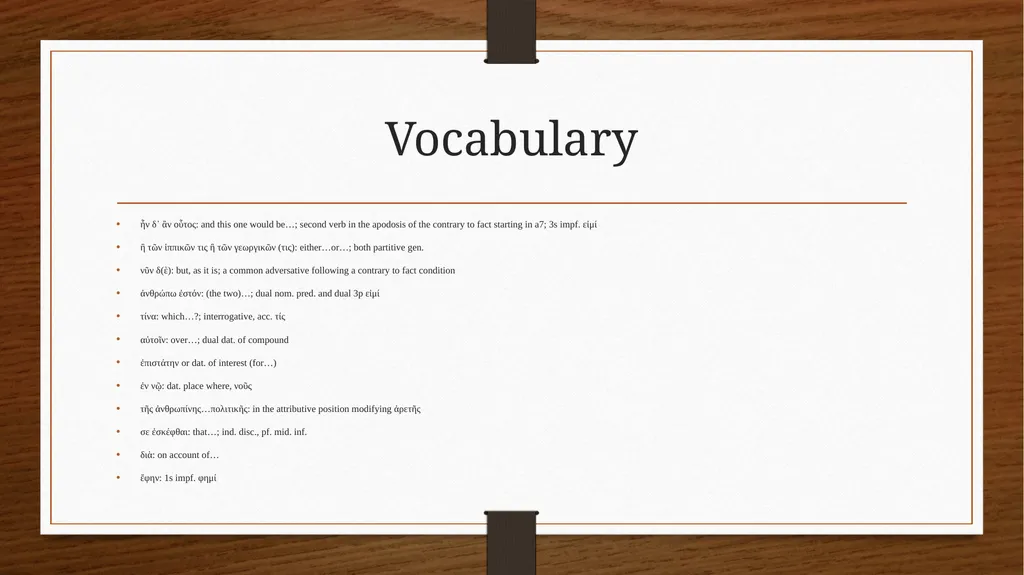
Vocabulary ἦν δ᾽ ἂν οὗτος: and this one would be…; second verb in the apodosis of the contrary to fact starting in a7; 3s impf. εἰμί
ἢ τῶν ἱππικῶν τις ἢ τῶν γεωργικῶν (τις): either…or…; both partitive gen.
νῦν δ(ὲ): but, as it is; a common adversative following a contrary to fact condition
ἀνθρώπω ἐστόν: (the two)…; dual nom. pred. and dual 3p εἰμί
τίνα: which…?; interrogative, acc. τίς
αὐτοῖν: over…; dual dat. of compound
ἐπιστάτην or dat. of interest (for…)
ἐν νῷ: dat. place where, νοῦς
τῆς ἀνθρωπίνης…πολιτικῆς: in the attributive position modifying ἀρετῆς
σε ἐσκέφθαι: that…; ind. disc., pf. mid. inf.
διὰ: on account of…
ἔφην: 1s impf. φημί<br>
ἢ τῶν ἱππικῶν τις ἢ τῶν γεωργικῶν (τις): either…or…; both partitive gen.
νῦν δ(ὲ): but, as it is; a common adversative following a contrary to fact condition
ἀνθρώπω ἐστόν: (the two)…; dual nom. pred. and dual 3p εἰμί
τίνα: which…?; interrogative, acc. τίς
αὐτοῖν: over…; dual dat. of compound
ἐπιστάτην or dat. of interest (for…)
ἐν νῷ: dat. place where, νοῦς
τῆς ἀνθρωπίνης…πολιτικῆς: in the attributive position modifying ἀρετῆς
σε ἐσκέφθαι: that…; ind. disc., pf. mid. inf.
διὰ: on account of…
ἔφην: 1s impf. φημί<br>
27
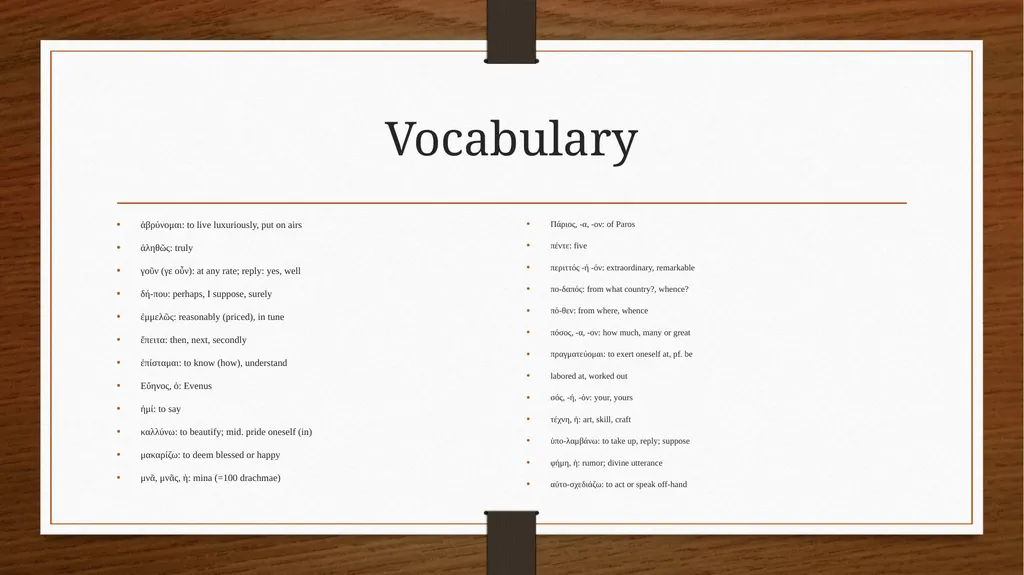
Vocabulary ἁβρύνομαι: to live luxuriously, put on airs
ἀληθῶς: truly
γοῦν (γε οὖν): at any rate; reply: yes, well
δή-που: perhaps, I suppose, surely
ἐμμελῶς: reasonably (priced), in tune
ἔπειτα: then, next, secondly
ἐπίσταμαι: to know (how), understand
Εὔηνος, ὁ: Evenus
ἠμί: to say
καλλύνω: to beautify; mid. pride oneself (in)
μακαρίζω: to deem blessed or happy
μνᾶ, μνᾶς, ἡ: mina (=100 drachmae) Πάριος, -α, -ον: of Paros
πέντε: five
περιττός -ή -όν: extraordinary, remarkable
πο-δαπός: from what country?, whence?
πό-θεν: from where, whence
πόσος, -α, -ον: how much, many or great
πραγματεύομαι: to exert oneself at, pf. be
labored at, worked out
σός, -ή, -όν: your, yours
τέχνη, ἡ: art, skill, craft
ὑπο-λαμβάνω: to take up, reply; suppose
φήμη, ἡ: rumor; divine utterance
αὐτο-σχεδιάζω: to act or speak off-hand<br>
ἀληθῶς: truly
γοῦν (γε οὖν): at any rate; reply: yes, well
δή-που: perhaps, I suppose, surely
ἐμμελῶς: reasonably (priced), in tune
ἔπειτα: then, next, secondly
ἐπίσταμαι: to know (how), understand
Εὔηνος, ὁ: Evenus
ἠμί: to say
καλλύνω: to beautify; mid. pride oneself (in)
μακαρίζω: to deem blessed or happy
μνᾶ, μνᾶς, ἡ: mina (=100 drachmae) Πάριος, -α, -ον: of Paros
πέντε: five
περιττός -ή -όν: extraordinary, remarkable
πο-δαπός: from what country?, whence?
πό-θεν: from where, whence
πόσος, -α, -ον: how much, many or great
πραγματεύομαι: to exert oneself at, pf. be
labored at, worked out
σός, -ή, -όν: your, yours
τέχνη, ἡ: art, skill, craft
ὑπο-λαμβάνω: to take up, reply; suppose
φήμη, ἡ: rumor; divine utterance
αὐτο-σχεδιάζω: to act or speak off-hand<br>
28
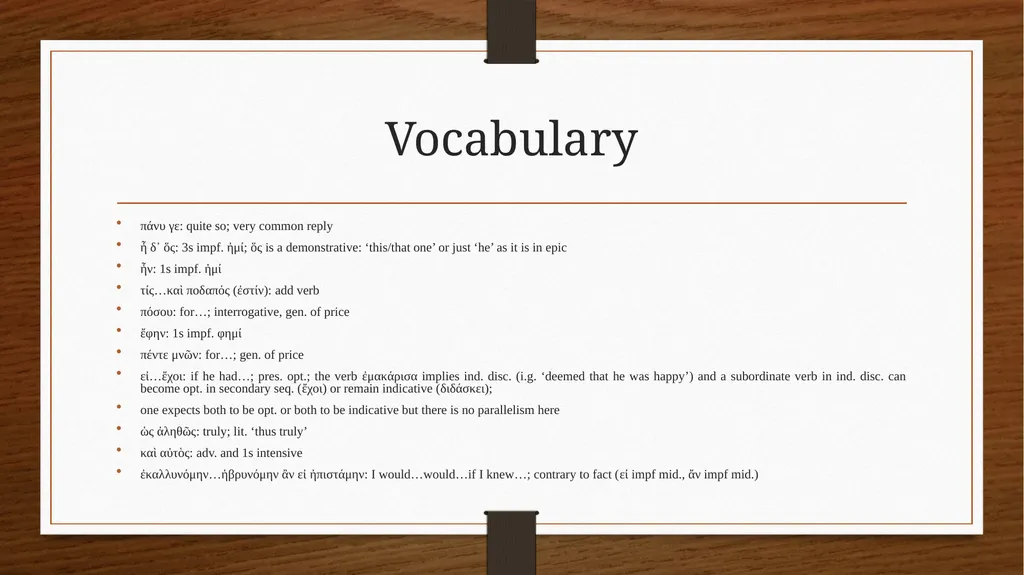
Vocabulary πάνυ γε: quite so; very common reply
ἦ δ᾽ ὅς: 3s impf. ἠμί; ὅς is a demonstrative: ‘this/that one’ or just ‘he’ as it is in epic
ἦν: 1s impf. ἠμί
τίς…καὶ ποδαπός (ἐστίν): add verb
πόσου: for…; interrogative, gen. of price
ἔφην: 1s impf. φημί
πέντε μνῶν: for…; gen. of price
εἰ…ἔχοι: if he had…; pres. opt.; the verb ἐμακάρισα implies ind. disc. (i.g. ‘deemed that he was happy’) and a subordinate verb in ind. disc. can become opt. in secondary seq. (ἔχοι) or remain indicative (διδάσκει);
one expects both to be opt. or both to be indicative but there is no parallelism here
ὡς ἀληθῶς: truly; lit. ‘thus truly’
καὶ αὐτὸς: adv. and 1s intensive
ἐκαλλυνόμην…ἡβρυνόμην ἂν εἰ ἠπιστάμην: I would…would…if I knew…; contrary to fact (εἰ impf mid., ἄν impf mid.)<br>
ἦ δ᾽ ὅς: 3s impf. ἠμί; ὅς is a demonstrative: ‘this/that one’ or just ‘he’ as it is in epic
ἦν: 1s impf. ἠμί
τίς…καὶ ποδαπός (ἐστίν): add verb
πόσου: for…; interrogative, gen. of price
ἔφην: 1s impf. φημί
πέντε μνῶν: for…; gen. of price
εἰ…ἔχοι: if he had…; pres. opt.; the verb ἐμακάρισα implies ind. disc. (i.g. ‘deemed that he was happy’) and a subordinate verb in ind. disc. can become opt. in secondary seq. (ἔχοι) or remain indicative (διδάσκει);
one expects both to be opt. or both to be indicative but there is no parallelism here
ὡς ἀληθῶς: truly; lit. ‘thus truly’
καὶ αὐτὸς: adv. and 1s intensive
ἐκαλλυνόμην…ἡβρυνόμην ἂν εἰ ἠπιστάμην: I would…would…if I knew…; contrary to fact (εἰ impf mid., ἄν impf mid.)<br>
29
Vocabulary ἀλλ(ὰ)…γὰρ: but in fact; γάρ explains the adversative: ‘but (it is not the case) for…’
ὑπολάβοι ἂν: would…; potential aor. opt.; i.e. ‘reply’ or ‘take up’ in a conversation
ἀλλὰ: well; often used at the beginning of speeches in opposition to what was said
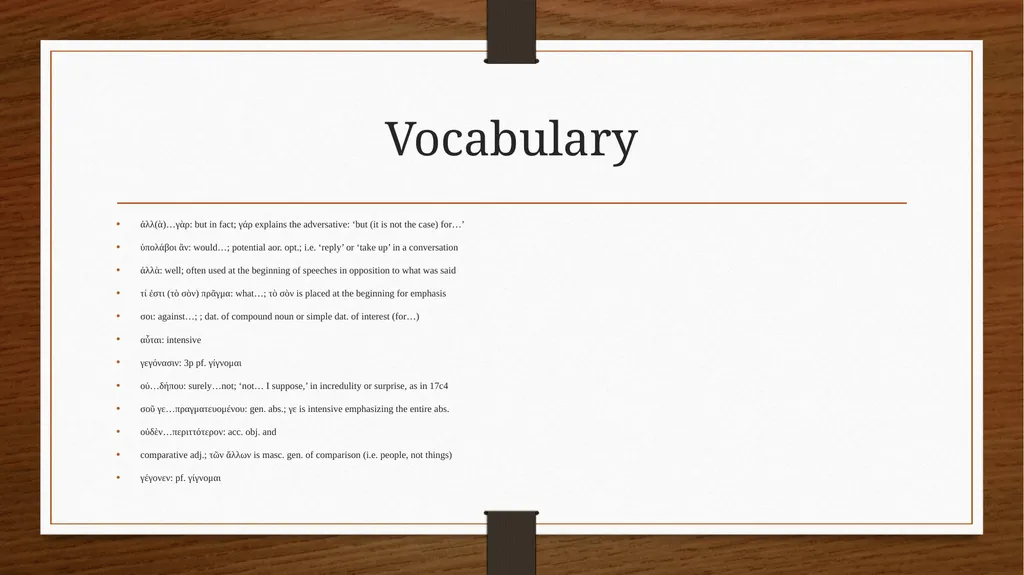
τί ἐστι (τὸ σὸν) πρᾶγμα: what…; τὸ σὸν is placed at the beginning for emphasis
σοι: against…; ; dat. of compound noun or simple dat. of interest (for…)
αὗται: intensive
γεγόνασιν: 3p pf. γίγνομαι
οὐ…δήπου: surely…not; ‘not… I suppose,’ in incredulity or surprise, as in 17c4
σοῦ γε…πραγματευομένου: gen. abs.; γε is intensive emphasizing the entire abs.
οὐδὲν…περιττότερον: acc. obj. and
comparative adj.; τῶν ἄλλων is masc. gen. of comparison (i.e. people, not things)
γέγονεν: pf. γίγνομαι<br>
ὑπολάβοι ἂν: would…; potential aor. opt.; i.e. ‘reply’ or ‘take up’ in a conversation
ἀλλὰ: well; often used at the beginning of speeches in opposition to what was said
τί ἐστι (τὸ σὸν) πρᾶγμα: what…; τὸ σὸν is placed at the beginning for emphasis
σοι: against…; ; dat. of compound noun or simple dat. of interest (for…)
αὗται: intensive
γεγόνασιν: 3p pf. γίγνομαι
οὐ…δήπου: surely…not; ‘not… I suppose,’ in incredulity or surprise, as in 17c4
σοῦ γε…πραγματευομένου: gen. abs.; γε is intensive emphasizing the entire abs.
οὐδὲν…περιττότερον: acc. obj. and
comparative adj.; τῶν ἄλλων is masc. gen. of comparison (i.e. people, not things)
γέγονεν: pf. γίγνομαι<br>
30
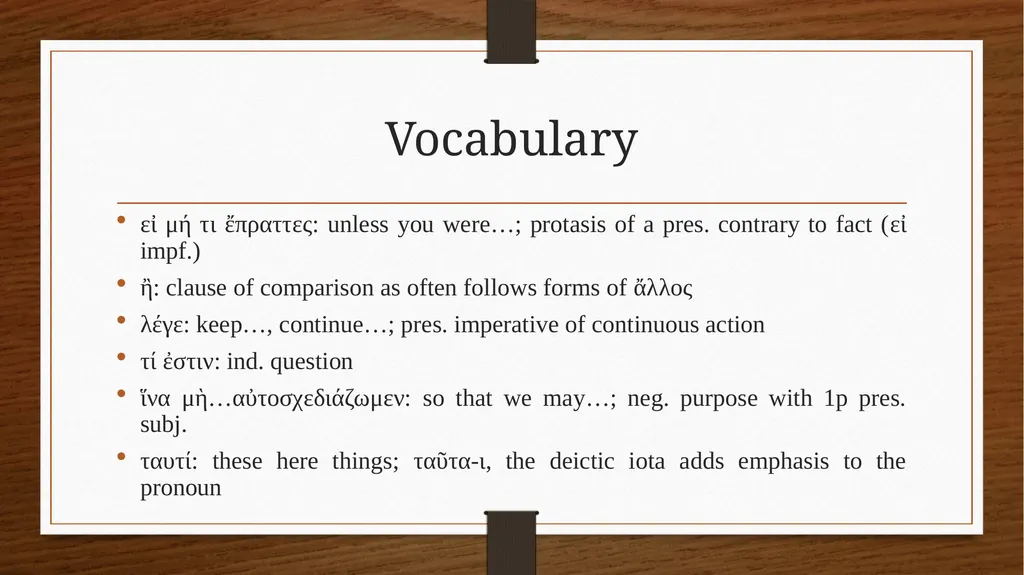
Vocabulary εἰ μή τι ἔπραττες: unless you were…; protasis of a pres. contrary to fact (εἰ impf.)
ἢ: clause of comparison as often follows forms of ἄλλος
λέγε: keep…, continue…; pres. imperative of continuous action
τί ἐστιν: ind. question
ἵνα μὴ…αὐτοσχεδιάζωμεν: so that we may…; neg. purpose with 1p pres. subj.
ταυτί: these here things; ταῦτα-ι, the deictic iota adds emphasis to the pronoun<br>
ἢ: clause of comparison as often follows forms of ἄλλος
λέγε: keep…, continue…; pres. imperative of continuous action
τί ἐστιν: ind. question
ἵνα μὴ…αὐτοσχεδιάζωμεν: so that we may…; neg. purpose with 1p pres. subj.
ταυτί: these here things; ταῦτα-ι, the deictic iota adds emphasis to the pronoun<br>
31
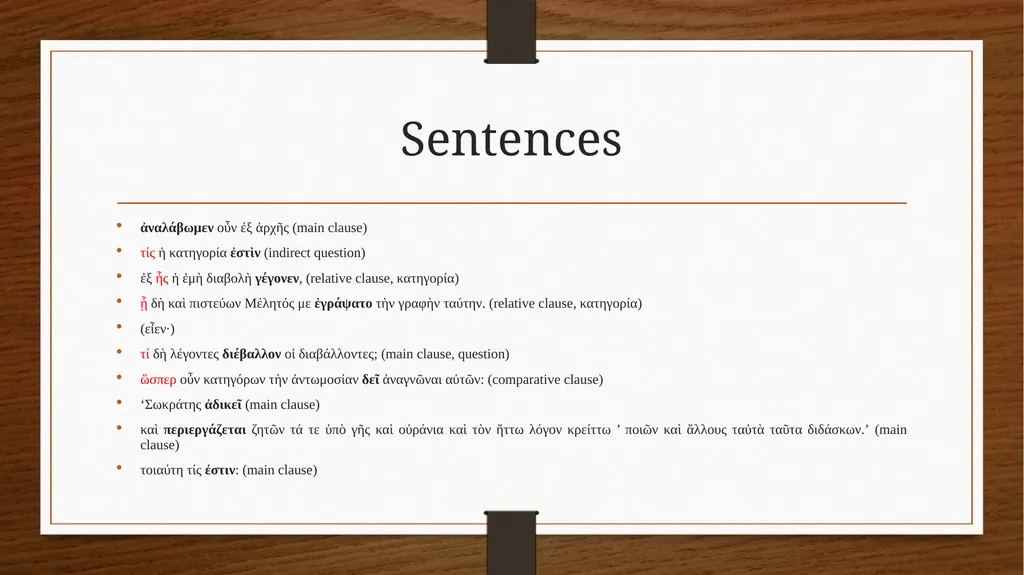
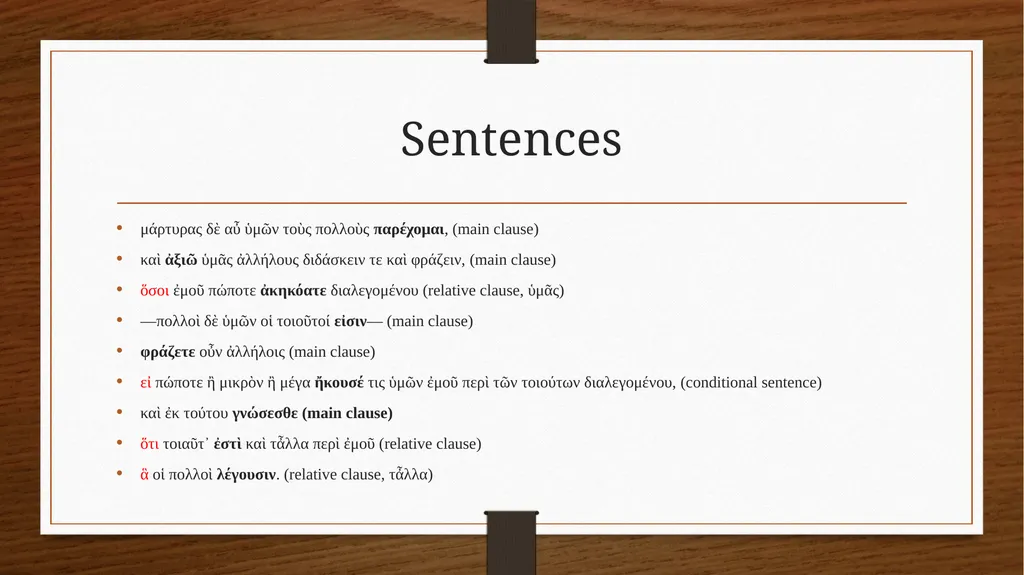
Sentences ἀναλάβωμεν οὖν ἐξ ἀρχῆς (main clause)
τίς ἡ κατηγορία ἐστὶν (indirect question)
ἐξ ἧς ἡ ἐμὴ διαβολὴ γέγονεν, (relative clause, κατηγορία)
ᾗ δὴ καὶ πιστεύων Μέλητός με ἐγράψατο τὴν γραφὴν ταύτην. (relative clause, κατηγορία)
(εἶεν·)
τί δὴ λέγοντες διέβαλλον οἱ διαβάλλοντες; (main clause, question)
ὥσπερ οὖν κατηγόρων τὴν ἀντωμοσίαν δεῖ ἀναγνῶναι αὐτῶν: (comparative clause)
‘Σωκράτης ἀδικεῖ (main clause)
καὶ περιεργάζεται ζητῶν τά τε ὑπὸ γῆς καὶ οὐράνια καὶ τὸν ἥττω λόγον κρείττω ’ ποιῶν καὶ ἄλλους ταὐτὰ ταῦτα διδάσκων.’ (main clause)
τοιαύτη τίς ἐστιν: (main clause)<br>
τίς ἡ κατηγορία ἐστὶν (indirect question)
ἐξ ἧς ἡ ἐμὴ διαβολὴ γέγονεν, (relative clause, κατηγορία)
ᾗ δὴ καὶ πιστεύων Μέλητός με ἐγράψατο τὴν γραφὴν ταύτην. (relative clause, κατηγορία)
(εἶεν·)
τί δὴ λέγοντες διέβαλλον οἱ διαβάλλοντες; (main clause, question)
ὥσπερ οὖν κατηγόρων τὴν ἀντωμοσίαν δεῖ ἀναγνῶναι αὐτῶν: (comparative clause)
‘Σωκράτης ἀδικεῖ (main clause)
καὶ περιεργάζεται ζητῶν τά τε ὑπὸ γῆς καὶ οὐράνια καὶ τὸν ἥττω λόγον κρείττω ’ ποιῶν καὶ ἄλλους ταὐτὰ ταῦτα διδάσκων.’ (main clause)
τοιαύτη τίς ἐστιν: (main clause)<br>
32
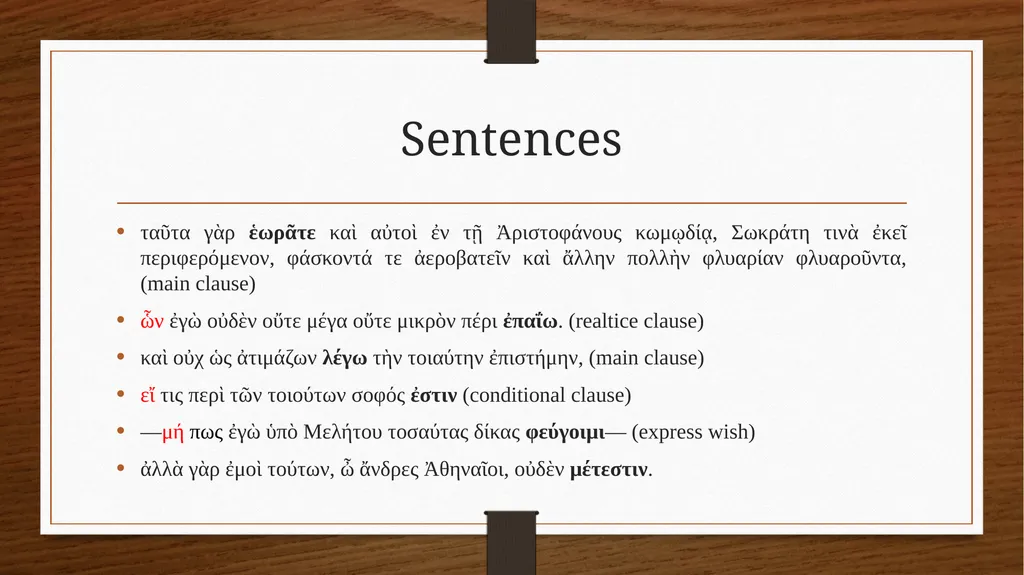
Sentences ταῦτα γὰρ ἑωρᾶτε καὶ αὐτοὶ ἐν τῇ Ἀριστοφάνους κωμῳδίᾳ, Σωκράτη τινὰ ἐκεῖ περιφερόμενον, φάσκοντά τε ἀεροβατεῖν καὶ ἄλλην πολλὴν φλυαρίαν φλυαροῦντα, (main clause)
ὧν ἐγὼ οὐδὲν οὔτε μέγα οὔτε μικρὸν πέρι ἐπαΐω. (realtice clause)
καὶ οὐχ ὡς ἀτιμάζων λέγω τὴν τοιαύτην ἐπιστήμην, (main clause)
εἴ τις περὶ τῶν τοιούτων σοφός ἐστιν (conditional clause)
—μή πως ἐγὼ ὑπὸ Μελήτου τοσαύτας δίκας φεύγοιμι— (express wish)
ἀλλὰ γὰρ ἐμοὶ τούτων, ὦ ἄνδρες Ἀθηναῖοι, οὐδὲν μέτεστιν.<br>
ὧν ἐγὼ οὐδὲν οὔτε μέγα οὔτε μικρὸν πέρι ἐπαΐω. (realtice clause)
καὶ οὐχ ὡς ἀτιμάζων λέγω τὴν τοιαύτην ἐπιστήμην, (main clause)
εἴ τις περὶ τῶν τοιούτων σοφός ἐστιν (conditional clause)
—μή πως ἐγὼ ὑπὸ Μελήτου τοσαύτας δίκας φεύγοιμι— (express wish)
ἀλλὰ γὰρ ἐμοὶ τούτων, ὦ ἄνδρες Ἀθηναῖοι, οὐδὲν μέτεστιν.<br>
33
Sentences μάρτυρας δὲ αὖ ὑμῶν τοὺς πολλοὺς παρέχομαι, (main clause)
καὶ ἀξιῶ ὑμᾶς ἀλλήλους διδάσκειν τε καὶ φράζειν, (main clause)
ὅσοι ἐμοῦ πώποτε ἀκηκόατε διαλεγομένου (relative clause, ὑμᾶς)
—πολλοὶ δὲ ὑμῶν οἱ τοιοῦτοί εἰσιν— (main clause)
φράζετε οὖν ἀλλήλοις (main clause)
εἰ πώποτε ἢ μικρὸν ἢ μέγα ἤκουσέ τις ὑμῶν ἐμοῦ περὶ τῶν τοιούτων διαλεγομένου, (conditional sentence)
καὶ ἐκ τούτου γνώσεσθε (main clause)
ὅτι τοιαῦτ᾽ ἐστὶ καὶ τἆλλα περὶ ἐμοῦ (relative clause)
ἃ οἱ πολλοὶ λέγουσιν. (relative clause, τἆλλα)<br>
καὶ ἀξιῶ ὑμᾶς ἀλλήλους διδάσκειν τε καὶ φράζειν, (main clause)
ὅσοι ἐμοῦ πώποτε ἀκηκόατε διαλεγομένου (relative clause, ὑμᾶς)
—πολλοὶ δὲ ὑμῶν οἱ τοιοῦτοί εἰσιν— (main clause)
φράζετε οὖν ἀλλήλοις (main clause)
εἰ πώποτε ἢ μικρὸν ἢ μέγα ἤκουσέ τις ὑμῶν ἐμοῦ περὶ τῶν τοιούτων διαλεγομένου, (conditional sentence)
καὶ ἐκ τούτου γνώσεσθε (main clause)
ὅτι τοιαῦτ᾽ ἐστὶ καὶ τἆλλα περὶ ἐμοῦ (relative clause)
ἃ οἱ πολλοὶ λέγουσιν. (relative clause, τἆλλα)<br>
34
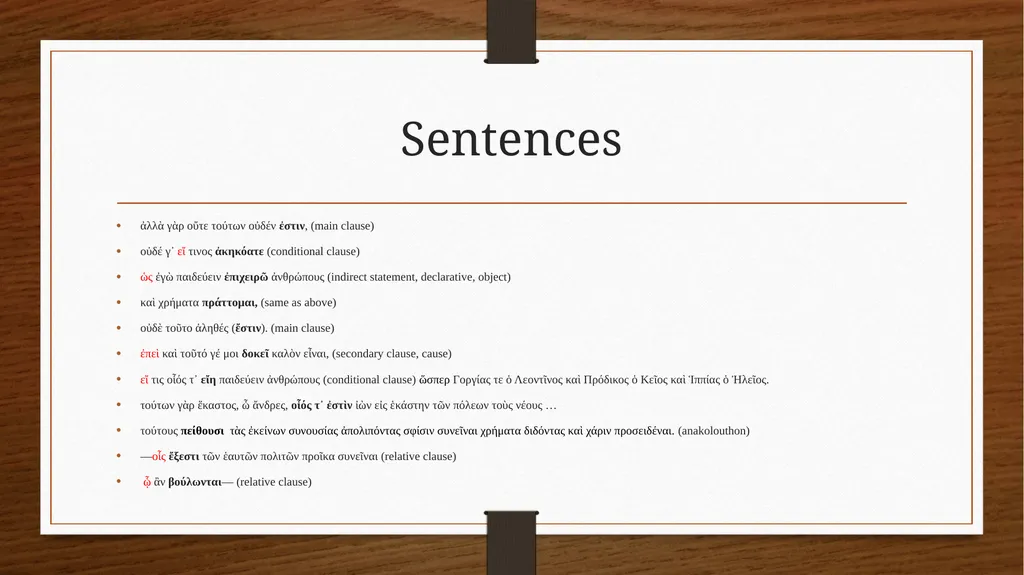
Sentences ἀλλὰ γὰρ οὔτε τούτων οὐδέν ἐστιν, (main clause)
οὐδέ γ᾽ εἴ τινος ἀκηκόατε (conditional clause)
ὡς ἐγὼ παιδεύειν ἐπιχειρῶ ἀνθρώπους (indirect statement, declarative, object)
καὶ χρήματα πράττομαι, (same as above)
οὐδὲ τοῦτο ἀληθές (ἔστιν). (main clause)
ἐπεὶ καὶ τοῦτό γέ μοι δοκεῖ καλὸν εἶναι, (secondary clause, cause)
εἴ τις οἷός τ᾽ εἴη παιδεύειν ἀνθρώπους (conditional clause) ὥσπερ Γοργίας τε ὁ Λεοντῖνος καὶ Πρόδικος ὁ Κεῖος καὶ Ἱππίας ὁ Ἠλεῖος.
τούτων γὰρ ἕκαστος, ὦ ἄνδρες, οἷός τ᾽ ἐστὶν ἰὼν εἰς ἑκάστην τῶν πόλεων τοὺς νέους …
τούτους πείθουσι τὰς ἐκείνων συνουσίας ἀπολιπόντας σφίσιν συνεῖναι χρήματα διδόντας καὶ χάριν προσειδέναι. (anakolouthon)
—οἷς ἔξεστι τῶν ἑαυτῶν πολιτῶν προῖκα συνεῖναι (relative clause)
ᾧ ἂν βούλωνται— (relative clause)<br>
οὐδέ γ᾽ εἴ τινος ἀκηκόατε (conditional clause)
ὡς ἐγὼ παιδεύειν ἐπιχειρῶ ἀνθρώπους (indirect statement, declarative, object)
καὶ χρήματα πράττομαι, (same as above)
οὐδὲ τοῦτο ἀληθές (ἔστιν). (main clause)
ἐπεὶ καὶ τοῦτό γέ μοι δοκεῖ καλὸν εἶναι, (secondary clause, cause)
εἴ τις οἷός τ᾽ εἴη παιδεύειν ἀνθρώπους (conditional clause) ὥσπερ Γοργίας τε ὁ Λεοντῖνος καὶ Πρόδικος ὁ Κεῖος καὶ Ἱππίας ὁ Ἠλεῖος.
τούτων γὰρ ἕκαστος, ὦ ἄνδρες, οἷός τ᾽ ἐστὶν ἰὼν εἰς ἑκάστην τῶν πόλεων τοὺς νέους …
τούτους πείθουσι τὰς ἐκείνων συνουσίας ἀπολιπόντας σφίσιν συνεῖναι χρήματα διδόντας καὶ χάριν προσειδέναι. (anakolouthon)
—οἷς ἔξεστι τῶν ἑαυτῶν πολιτῶν προῖκα συνεῖναι (relative clause)
ᾧ ἂν βούλωνται— (relative clause)<br>
35
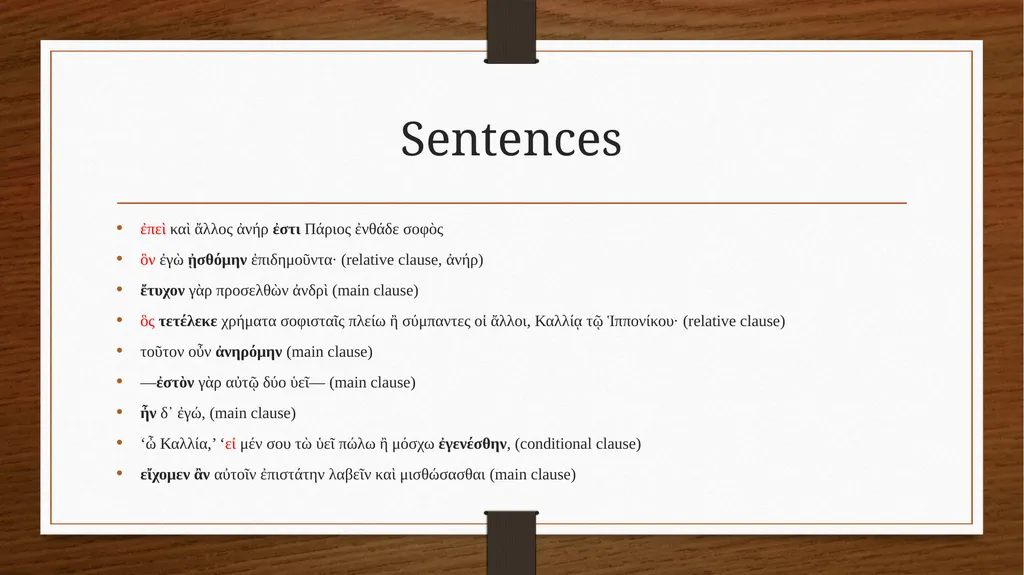
Sentences ἐπεὶ καὶ ἄλλος ἀνήρ ἐστι Πάριος ἐνθάδε σοφὸς
ὃν ἐγὼ ᾐσθόμην ἐπιδημοῦντα· (relative clause, ἀνήρ)
ἔτυχον γὰρ προσελθὼν ἀνδρὶ (main clause)
ὃς τετέλεκε χρήματα σοφισταῖς πλείω ἢ σύμπαντες οἱ ἄλλοι, Καλλίᾳ τῷ Ἱππονίκου· (relative clause)
τοῦτον οὖν ἀνηρόμην (main clause)
—ἐστὸν γὰρ αὐτῷ δύο ὑεῖ— (main clause)
ἦν δ᾽ ἐγώ, (main clause)
‘ὦ Καλλία,’ ‘εἰ μέν σου τὼ ὑεῖ πώλω ἢ μόσχω ἐγενέσθην, (conditional clause)
εἴχομεν ἂν αὐτοῖν ἐπιστάτην λαβεῖν καὶ μισθώσασθαι (main clause)<br>
ὃν ἐγὼ ᾐσθόμην ἐπιδημοῦντα· (relative clause, ἀνήρ)
ἔτυχον γὰρ προσελθὼν ἀνδρὶ (main clause)
ὃς τετέλεκε χρήματα σοφισταῖς πλείω ἢ σύμπαντες οἱ ἄλλοι, Καλλίᾳ τῷ Ἱππονίκου· (relative clause)
τοῦτον οὖν ἀνηρόμην (main clause)
—ἐστὸν γὰρ αὐτῷ δύο ὑεῖ— (main clause)
ἦν δ᾽ ἐγώ, (main clause)
‘ὦ Καλλία,’ ‘εἰ μέν σου τὼ ὑεῖ πώλω ἢ μόσχω ἐγενέσθην, (conditional clause)
εἴχομεν ἂν αὐτοῖν ἐπιστάτην λαβεῖν καὶ μισθώσασθαι (main clause)<br>
36
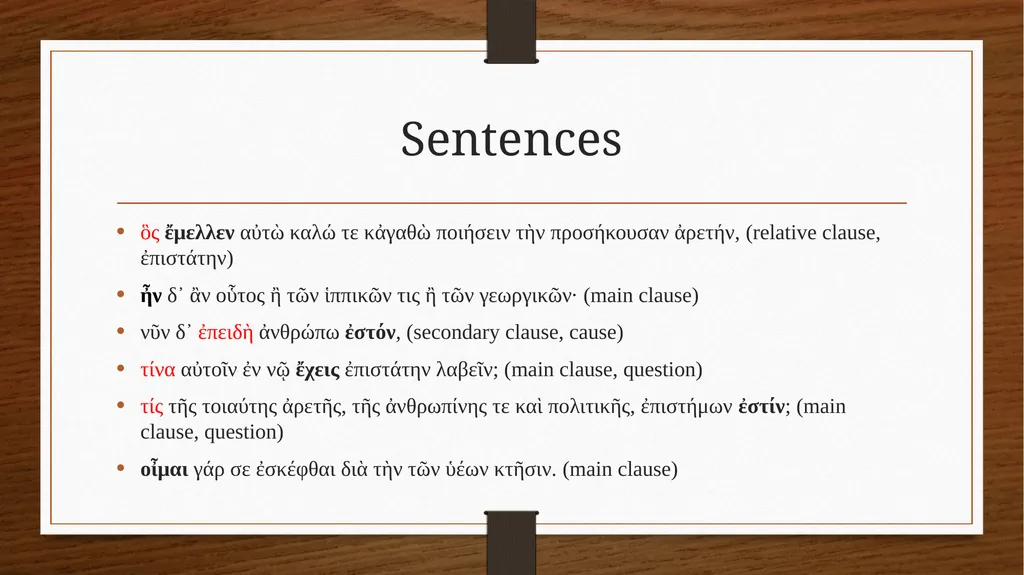
Sentences ὃς ἔμελλεν αὐτὼ καλώ τε κἀγαθὼ ποιήσειν τὴν προσήκουσαν ἀρετήν, (relative clause, ἐπιστάτην)
ἦν δ᾽ ἂν οὗτος ἢ τῶν ἱππικῶν τις ἢ τῶν γεωργικῶν· (main clause)
νῦν δ᾽ ἐπειδὴ ἀνθρώπω ἐστόν, (secondary clause, cause)
τίνα αὐτοῖν ἐν νῷ ἔχεις ἐπιστάτην λαβεῖν; (main clause, question)
τίς τῆς τοιαύτης ἀρετῆς, τῆς ἀνθρωπίνης τε καὶ πολιτικῆς, ἐπιστήμων ἐστίν; (main clause, question)
οἶμαι γάρ σε ἐσκέφθαι διὰ τὴν τῶν ὑέων κτῆσιν. (main clause)<br>
ἦν δ᾽ ἂν οὗτος ἢ τῶν ἱππικῶν τις ἢ τῶν γεωργικῶν· (main clause)
νῦν δ᾽ ἐπειδὴ ἀνθρώπω ἐστόν, (secondary clause, cause)
τίνα αὐτοῖν ἐν νῷ ἔχεις ἐπιστάτην λαβεῖν; (main clause, question)
τίς τῆς τοιαύτης ἀρετῆς, τῆς ἀνθρωπίνης τε καὶ πολιτικῆς, ἐπιστήμων ἐστίν; (main clause, question)
οἶμαι γάρ σε ἐσκέφθαι διὰ τὴν τῶν ὑέων κτῆσιν. (main clause)<br>
37
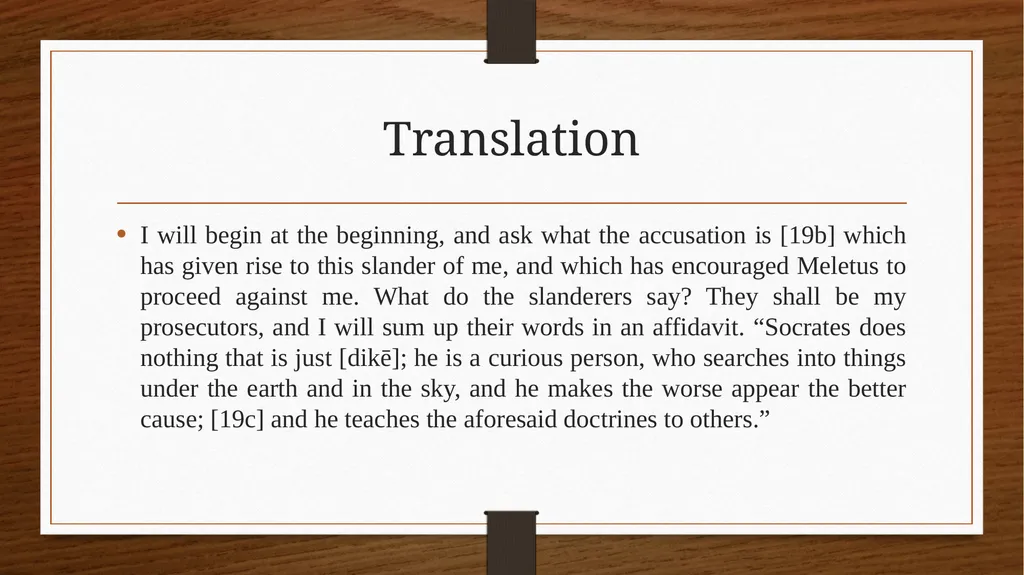
Translation I will begin at the beginning, and ask what the accusation is [19b] which has given rise to this slander of me, and which has encouraged Meletus to proceed against me. What do the slanderers say? They shall be my prosecutors, and I will sum up their words in an affidavit. “Socrates does nothing that is just [dikē]; he is a curious person, who searches into things under the earth and in the sky, and he makes the worse appear the better cause; [19c] and he teaches the aforesaid doctrines to others.”<br>
38
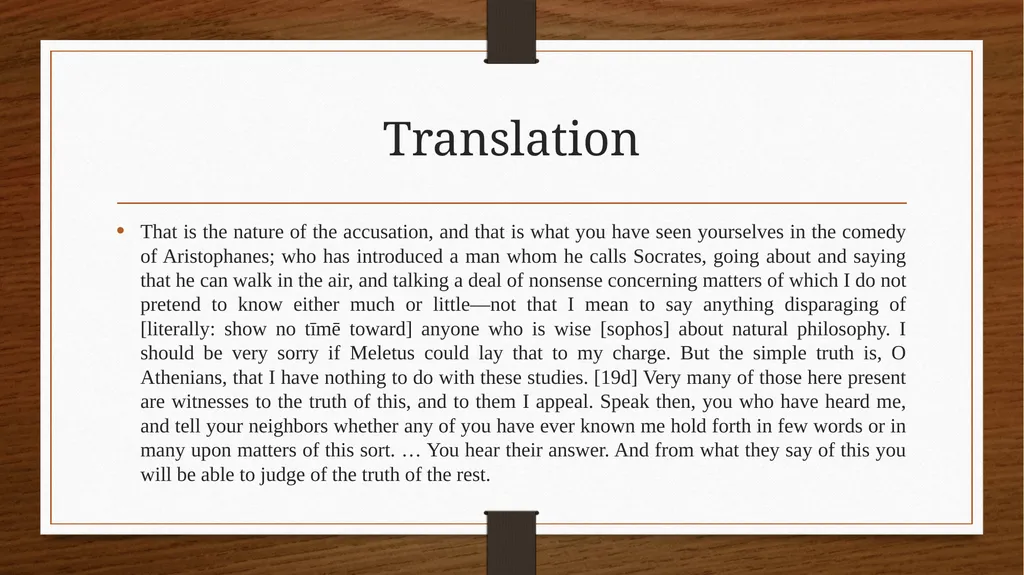
Translation That is the nature of the accusation, and that is what you have seen yourselves in the comedy of Aristophanes; who has introduced a man whom he calls Socrates, going about and saying that he can walk in the air, and talking a deal of nonsense concerning matters of which I do not pretend to know either much or little—not that I mean to say anything disparaging of [literally: show no tīmē toward] anyone who is wise [sophos] about natural philosophy. I should be very sorry if Meletus could lay that to my charge. But the simple truth is, O Athenians, that I have nothing to do with these studies. [19d] Very many of those here present are witnesses to the truth of this, and to them I appeal. Speak then, you who have heard me, and tell your neighbors whether any of you have ever known me hold forth in few words or in many upon matters of this sort. … You hear their answer. And from what they say of this you will be able to judge of the truth of the rest.<br>
39
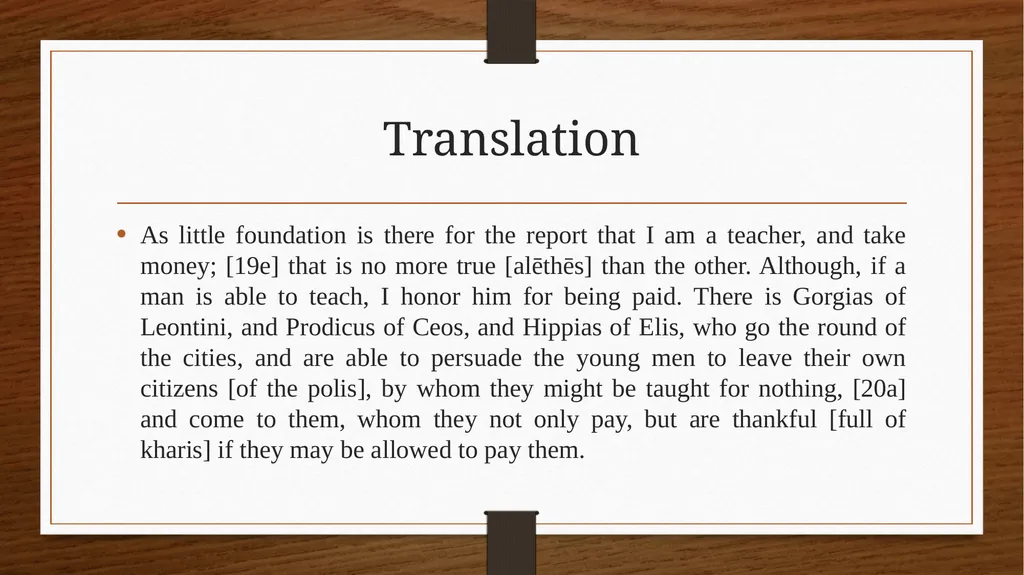
Translation As little foundation is there for the report that I am a teacher, and take money; [19e] that is no more true [alēthēs] than the other. Although, if a man is able to teach, I honor him for being paid. There is Gorgias of Leontini, and Prodicus of Ceos, and Hippias of Elis, who go the round of the cities, and are able to persuade the young men to leave their own citizens [of the polis], by whom they might be taught for nothing, [20a] and come to them, whom they not only pay, but are thankful [full of kharis] if they may be allowed to pay them.<br>
40
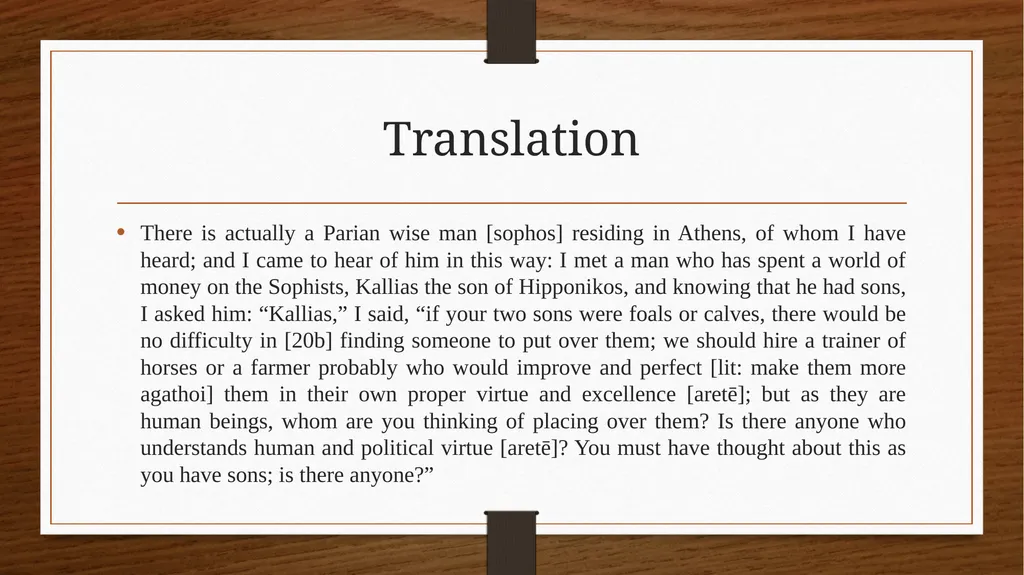
Translation There is actually a Parian wise man [sophos] residing in Athens, of whom I have heard; and I came to hear of him in this way: I met a man who has spent a world of money on the Sophists, Kallias the son of Hipponikos, and knowing that he had sons, I asked him: “Kallias,” I said, “if your two sons were foals or calves, there would be no difficulty in [20b] finding someone to put over them; we should hire a trainer of horses or a farmer probably who would improve and perfect [lit: make them more agathoi] them in their own proper virtue and excellence [aretē]; but as they are human beings, whom are you thinking of placing over them? Is there anyone who understands human and political virtue [aretē]? You must have thought about this as you have sons; is there anyone?”<br>
41
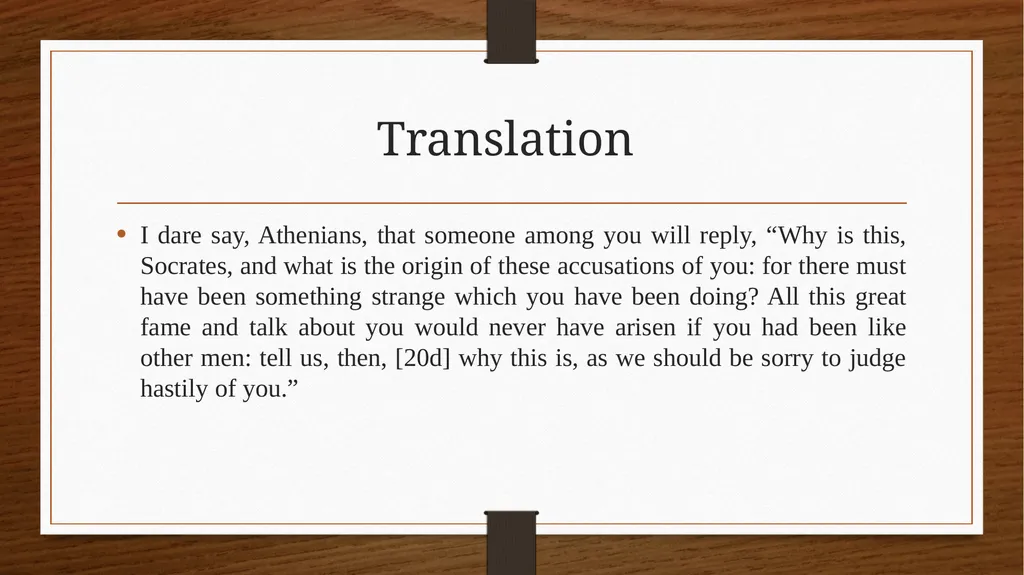
Translation I dare say, Athenians, that someone among you will reply, “Why is this, Socrates, and what is the origin of these accusations of you: for there must have been something strange which you have been doing? All this great fame and talk about you would never have arisen if you had been like other men: tell us, then, [20d] why this is, as we should be sorry to judge hastily of you.”<br>
42
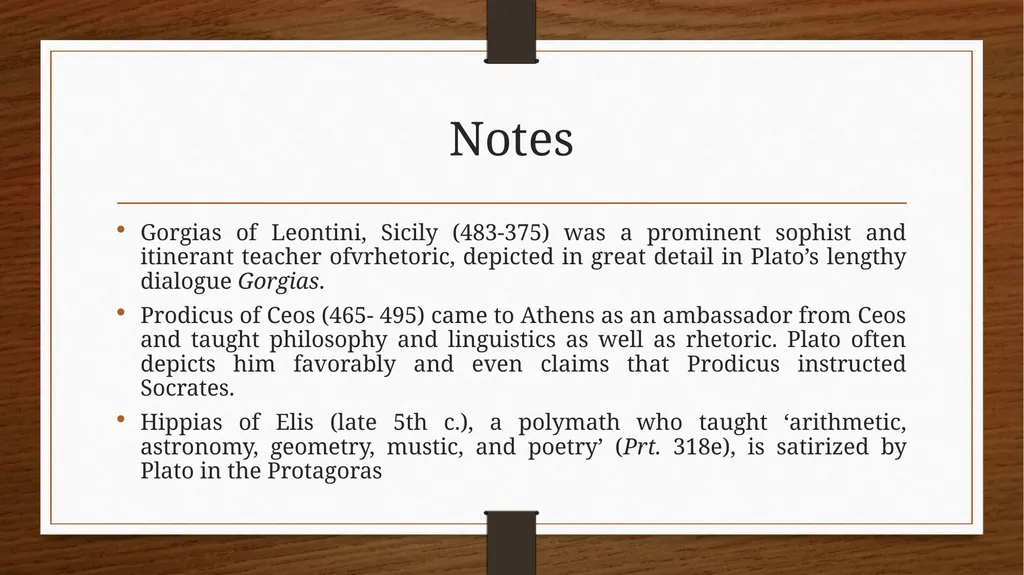
Notes Gorgias of Leontini, Sicily (483-375) was a prominent sophist and itinerant teacher ofvrhetoric, depicted in great detail in Plato’s lengthy dialogue Gorgias.
Prodicus of Ceos (465- 495) came to Athens as an ambassador from Ceos and taught philosophy and linguistics as well as rhetoric. Plato often depicts him favorably and even claims that Prodicus instructed Socrates.
Hippias of Elis (late 5th c.), a polymath who taught ‘arithmetic, astronomy, geometry, mustic, and poetry’ (Prt. 318e), is satirized by Plato in the Protagoras<br>
Prodicus of Ceos (465- 495) came to Athens as an ambassador from Ceos and taught philosophy and linguistics as well as rhetoric. Plato often depicts him favorably and even claims that Prodicus instructed Socrates.
Hippias of Elis (late 5th c.), a polymath who taught ‘arithmetic, astronomy, geometry, mustic, and poetry’ (Prt. 318e), is satirized by Plato in the Protagoras<br>
43
Ευχαριστώ πολύ! Have a nice evening!<br>