
Animal Biotechnology Introduction The term

Description: Animal Biotechnology Introduction The term biotechnology was coined by Karl Ereky in 1919 Office of technology of the United States Any technique that uses living organisms, or substances from those organisms, to make or modify a product
Related Topics
Download Presentation
"Animal Biotechnology Introduction The term" is the property of its rightful owner. Permission is granted to download and print the materials on this website for personal, non-commercial use only, and to display it on your personal computer provided you do not modify the materials and that you retain all copyright notices contained in the materials. By downloading content from our website, you accept the terms of this agreement.
Presentation Transcript
slide1. Animal Biotechnology<br>
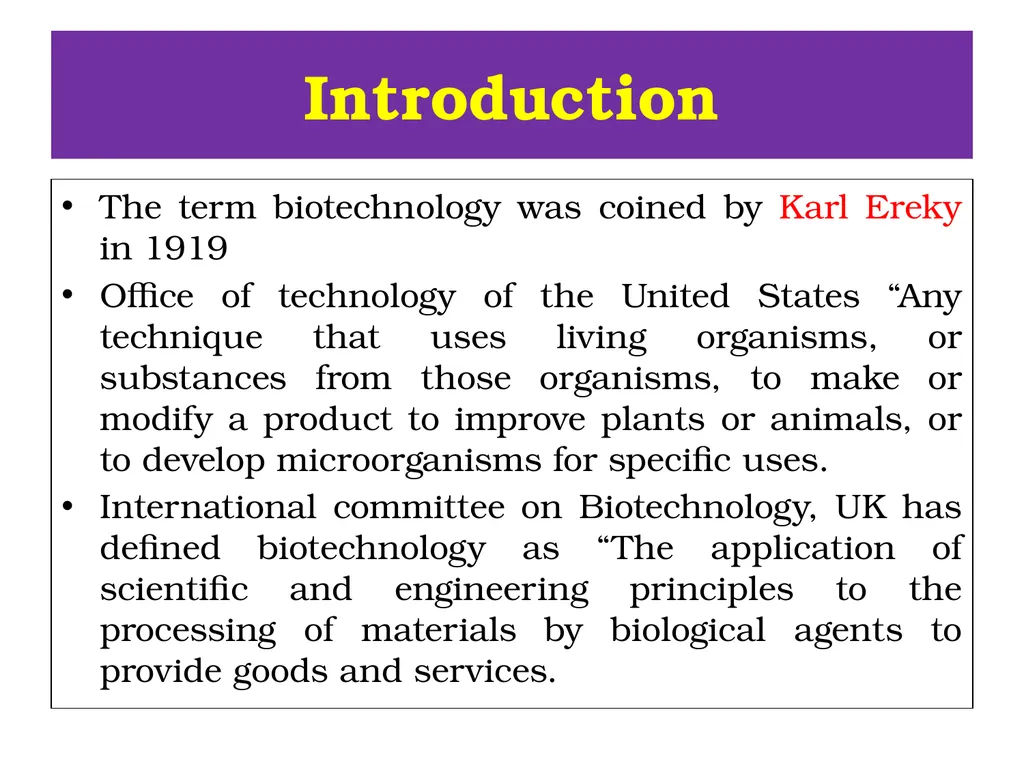
slide2. Introduction The term biotechnology was coined by Karl Ereky in 1919
Office of technology of the United States “Any technique that uses living organisms, or substances from those organisms, to make or modify a product to improve plants or animals, or to develop microorganisms for specific uses.
International committee on Biotechnology, UK has defined biotechnology as “The application of scientific and engineering principles to the processing of materials by biological agents to provide goods and services.<br>
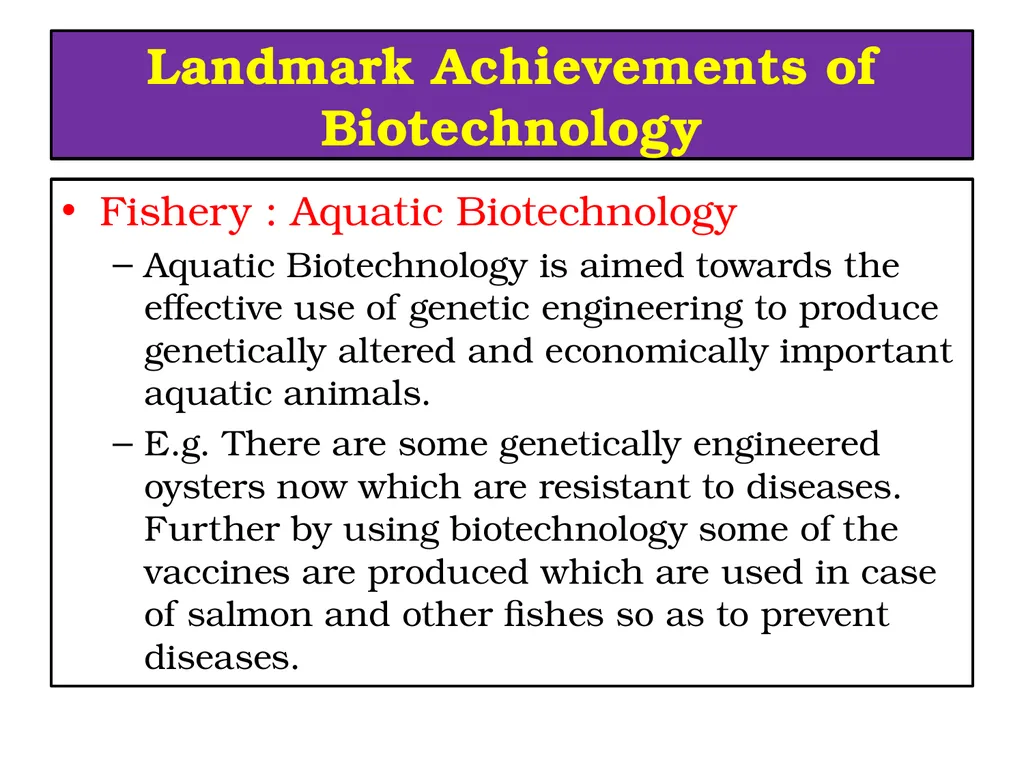
slide3. Landmark Achievements of Biotechnology Fishery : Aquatic Biotechnology
Aquatic Biotechnology is aimed towards the effective use of genetic engineering to produce genetically altered and economically important aquatic animals.
E.g. There are some genetically engineered oysters now which are resistant to diseases. Further by using biotechnology some of the vaccines are produced which are used in case of salmon and other fishes so as to prevent diseases.<br>
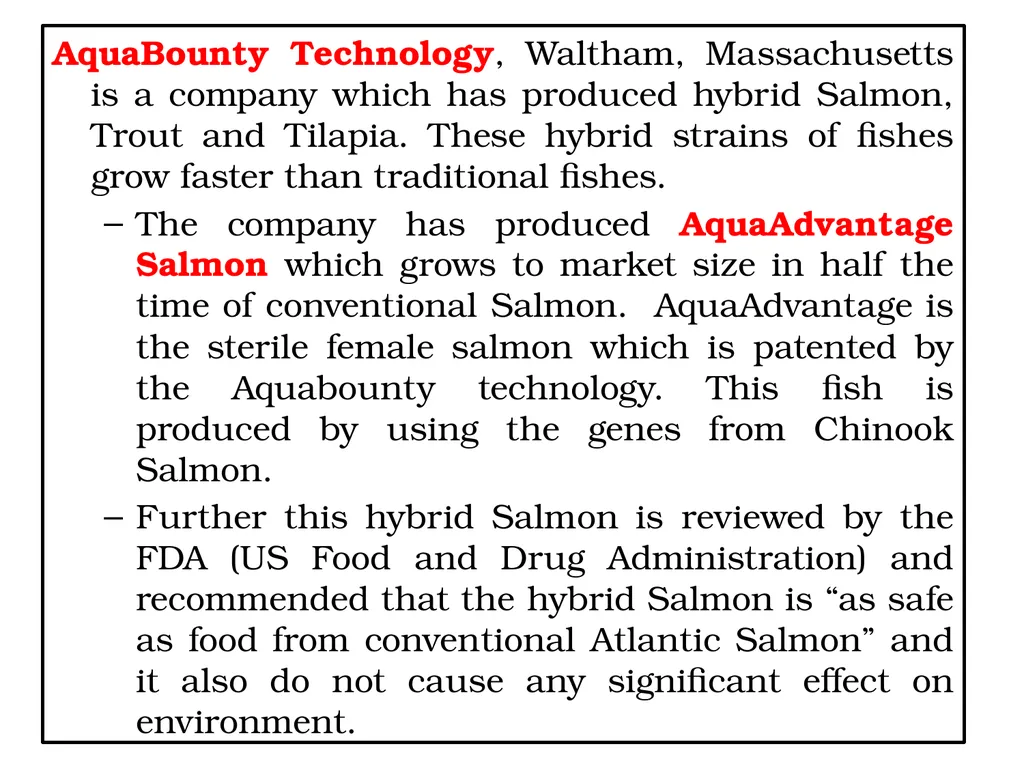
slide4. AquaBounty Technology, Waltham, Massachusetts is a company which has produced hybrid Salmon, Trout and Tilapia. These hybrid strains of fishes grow faster than traditional fishes.
The company has produced AquaAdvantage Salmon which grows to market size in half the time of conventional Salmon. AquaAdvantage is the sterile female salmon which is patented by the Aquabounty technology. This fish is produced by using the genes from Chinook Salmon.
Further this hybrid Salmon is reviewed by the FDA (US Food and Drug Administration) and recommended that the hybrid Salmon is “as safe as food from conventional Atlantic Salmon” and it also do not cause any significant effect on environment.<br>
slide5. Discovery of genes for Antifreeze Proteins (AFPs) is the another major breakthrough in the field of aquatic biotechnology. Antifreeze proteins are the proteins which have the ability to resist the cold temperatures and freezing. These proteins are also called as cryoprotective proteins. These proteins are encoded by genes and these are present in some fishes like ocean Pout, Herring etc. Salmon fish is not cold resistant and can not live at freezing conditions. If these genes for AFPs are successfully incorporated into the Salmon then such Salmon will also become cold resistant.<br>
slide6. Production of polyploid fishes is the another major research project carried out in the aquatic biotechnology by Dr. T.J. Pandian, School of biological sciences, Madurai Kamraj University.
A hybrid fish called Jayanti Rohu was developed by Central Institute of freshwater Aquaculture (CIFA) which is run by ICAR i.e. Indian Council of Agricultural Research in collaboration with institute of aquaculture research, Norway. The fish produced by these efforts, Jayanti Rohu has the greater growth efficiency.
Biotechnology has been effectively used in the field of aquaculture specifically for the improvement of fish varieties so as to have greater growth efficiency and better ability to resist the disease.<br>
slide7. TRANSGENESIS It is a method of cell manipulation in order to produce an animal or plant breed.
This is an effective method in which desired exogenous gene can be introduced in the living organism. The gene thereby is called transgene.
Transgenesis has led to the powerful technique like cloning of mammals.
With the help of transgenesis many animals having useful traits have been produced.<br>
slide8. Methods used for Transgenesis Retroviral Vector Method
Nuclear Transplantation Method
DNA Microinjection Method
Embryonic Stem Cell Method<br>
slide2. Introduction The term biotechnology was coined by Karl Ereky in 1919
Office of technology of the United States “Any technique that uses living organisms, or substances from those organisms, to make or modify a product to improve plants or animals, or to develop microorganisms for specific uses.
International committee on Biotechnology, UK has defined biotechnology as “The application of scientific and engineering principles to the processing of materials by biological agents to provide goods and services.<br>
slide3. Landmark Achievements of Biotechnology Fishery : Aquatic Biotechnology
Aquatic Biotechnology is aimed towards the effective use of genetic engineering to produce genetically altered and economically important aquatic animals.
E.g. There are some genetically engineered oysters now which are resistant to diseases. Further by using biotechnology some of the vaccines are produced which are used in case of salmon and other fishes so as to prevent diseases.<br>
slide4. AquaBounty Technology, Waltham, Massachusetts is a company which has produced hybrid Salmon, Trout and Tilapia. These hybrid strains of fishes grow faster than traditional fishes.
The company has produced AquaAdvantage Salmon which grows to market size in half the time of conventional Salmon. AquaAdvantage is the sterile female salmon which is patented by the Aquabounty technology. This fish is produced by using the genes from Chinook Salmon.
Further this hybrid Salmon is reviewed by the FDA (US Food and Drug Administration) and recommended that the hybrid Salmon is “as safe as food from conventional Atlantic Salmon” and it also do not cause any significant effect on environment.<br>
slide5. Discovery of genes for Antifreeze Proteins (AFPs) is the another major breakthrough in the field of aquatic biotechnology. Antifreeze proteins are the proteins which have the ability to resist the cold temperatures and freezing. These proteins are also called as cryoprotective proteins. These proteins are encoded by genes and these are present in some fishes like ocean Pout, Herring etc. Salmon fish is not cold resistant and can not live at freezing conditions. If these genes for AFPs are successfully incorporated into the Salmon then such Salmon will also become cold resistant.<br>
slide6. Production of polyploid fishes is the another major research project carried out in the aquatic biotechnology by Dr. T.J. Pandian, School of biological sciences, Madurai Kamraj University.
A hybrid fish called Jayanti Rohu was developed by Central Institute of freshwater Aquaculture (CIFA) which is run by ICAR i.e. Indian Council of Agricultural Research in collaboration with institute of aquaculture research, Norway. The fish produced by these efforts, Jayanti Rohu has the greater growth efficiency.
Biotechnology has been effectively used in the field of aquaculture specifically for the improvement of fish varieties so as to have greater growth efficiency and better ability to resist the disease.<br>
slide7. TRANSGENESIS It is a method of cell manipulation in order to produce an animal or plant breed.
This is an effective method in which desired exogenous gene can be introduced in the living organism. The gene thereby is called transgene.
Transgenesis has led to the powerful technique like cloning of mammals.
With the help of transgenesis many animals having useful traits have been produced.<br>
slide8. Methods used for Transgenesis Retroviral Vector Method
Nuclear Transplantation Method
DNA Microinjection Method
Embryonic Stem Cell Method<br>