Animal Farm by George Orwell Presentation by, G.Sowdambika Guest Lecturer English Department(SF) C.P.A.College,Bodinayakanur Why Animals? In explaining how he came to write Animal Farm, Orwell says he once saw a little boy whipping a horse
"Animal Farm by George Orwell Presentation by," is the property of its rightful owner. Permission is granted to
download and print the materials on this website for personal, non-commercial use only, and to display it
on your personal computer provided you do not modify the materials and that you retain all copyright
notices contained in the materials. By downloading content from our website, you accept the terms of this
agreement.
Presentation Transcript
01
Animal Farm by George Orwell
Presentation by,
G.Sowdambika
Guest Lecturer
English Department(SF)
C.P.A.College,Bodinayakanur<br>
02
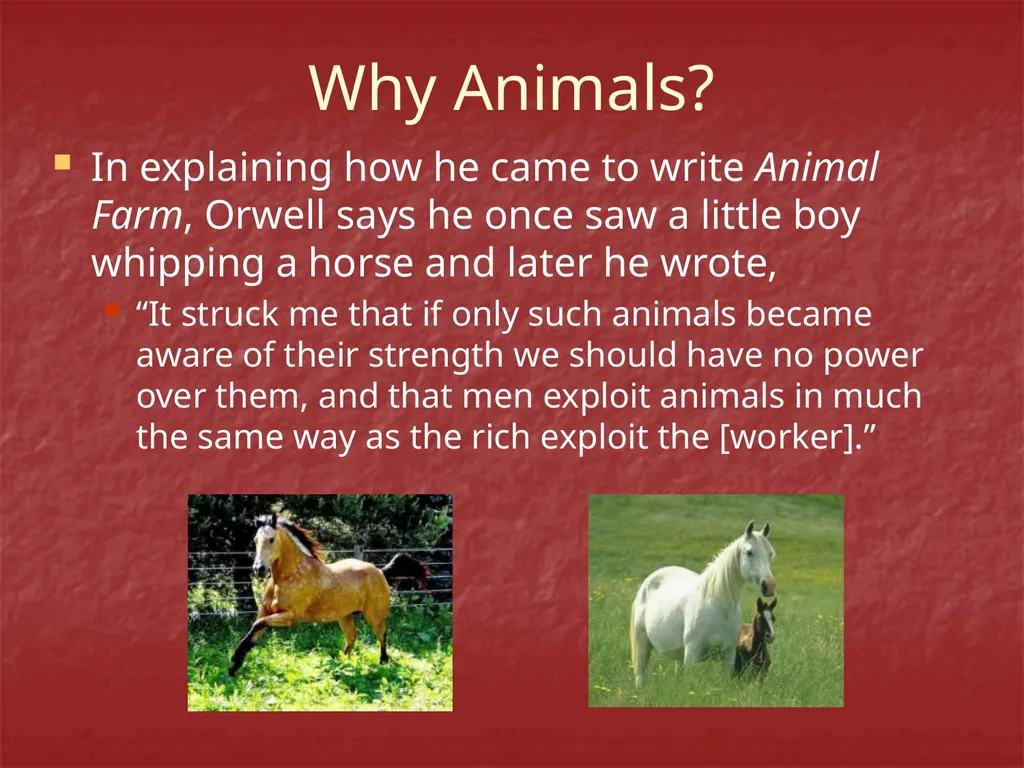
Why Animals? In explaining how he came to write Animal Farm, Orwell says he once saw a little boy whipping a horse and later he wrote,
“It struck me that if only such animals became aware of their strength we should have no power over them, and that men exploit animals in much the same way as the rich exploit the [worker].”<br>
03
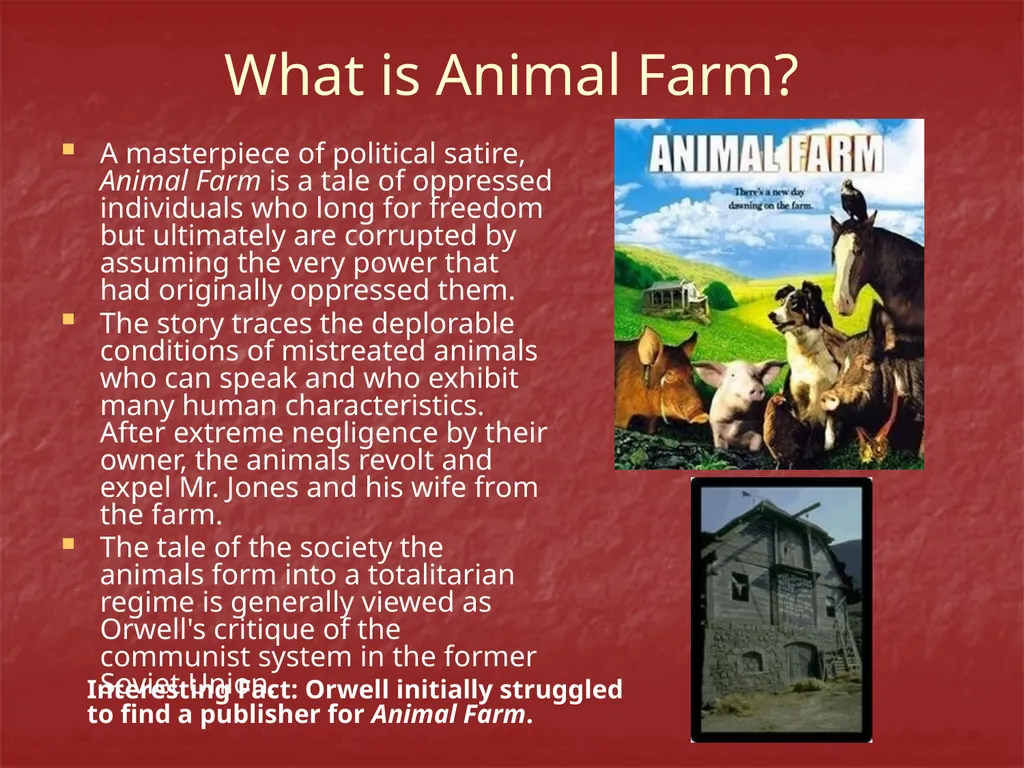
What is Animal Farm? A masterpiece of political satire, Animal Farm is a tale of oppressed individuals who long for freedom but ultimately are corrupted by assuming the very power that had originally oppressed them.
The story traces the deplorable conditions of mistreated animals who can speak and who exhibit many human characteristics. After extreme negligence by their owner, the animals revolt and expel Mr. Jones and his wife from the farm.
The tale of the society the animals form into a totalitarian regime is generally viewed as Orwell's critique of the communist system in the former Soviet Union. Interesting Fact: Orwell initially struggled to find a publisher for Animal Farm.<br>
04
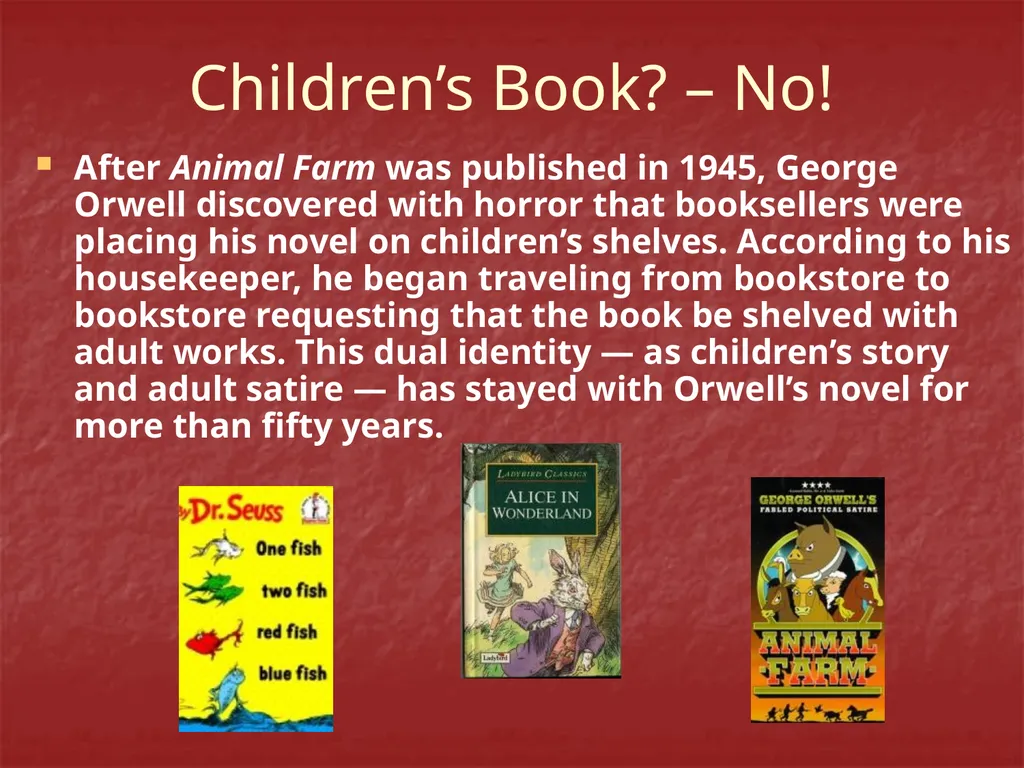
Children’s Book? – No! After Animal Farm was published in 1945, George Orwell discovered with horror that booksellers were placing his novel on children’s shelves. According to his housekeeper, he began traveling from bookstore to bookstore requesting that the book be shelved with adult works. This dual identity — as children’s story and adult satire — has stayed with Orwell’s novel for more than fifty years.<br>
05
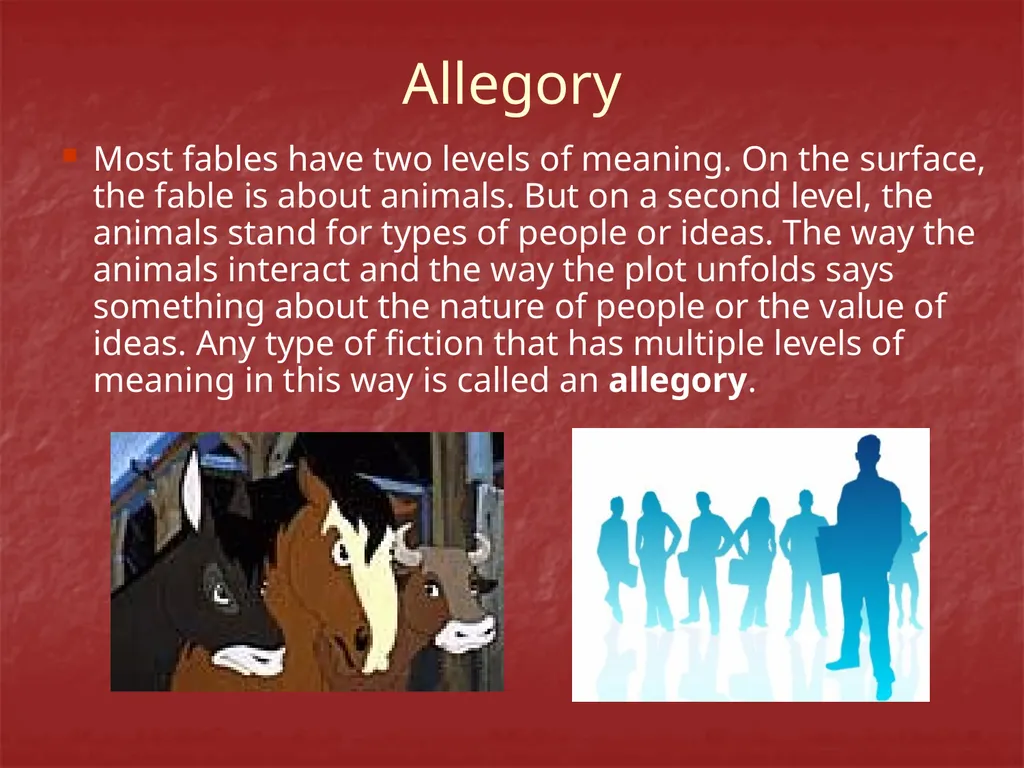
Allegory Most fables have two levels of meaning. On the surface, the fable is about animals. But on a second level, the animals stand for types of people or ideas. The way the animals interact and the way the plot unfolds says something about the nature of people or the value of ideas. Any type of fiction that has multiple levels of meaning in this way is called an allegory.<br>
06
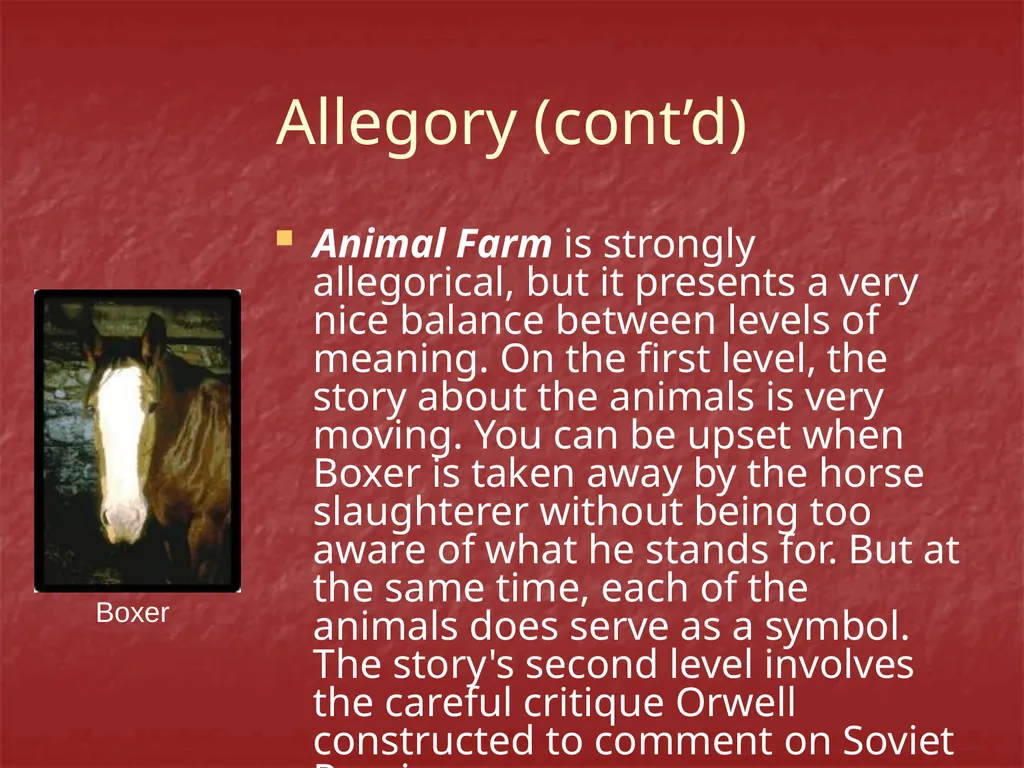
Allegory (cont’d) Animal Farm is strongly allegorical, but it presents a very nice balance between levels of meaning. On the first level, the story about the animals is very moving. You can be upset when Boxer is taken away by the horse slaughterer without being too aware of what he stands for. But at the same time, each of the animals does serve as a symbol. The story's second level involves the careful critique Orwell constructed to comment on Soviet Russia. Boxer<br>
07
Satire In a satire, the writer attacks a serious issue by presenting it in a ridiculous light or otherwise poking fun at it. Orwell uses satire to expose what he saw as the myth of Soviet socialism. Thus, the novel tells a story that people of all ages can understand, but it also tells us a second story— that of the real-life revolution. Soviet Coat of Arms<br>
08
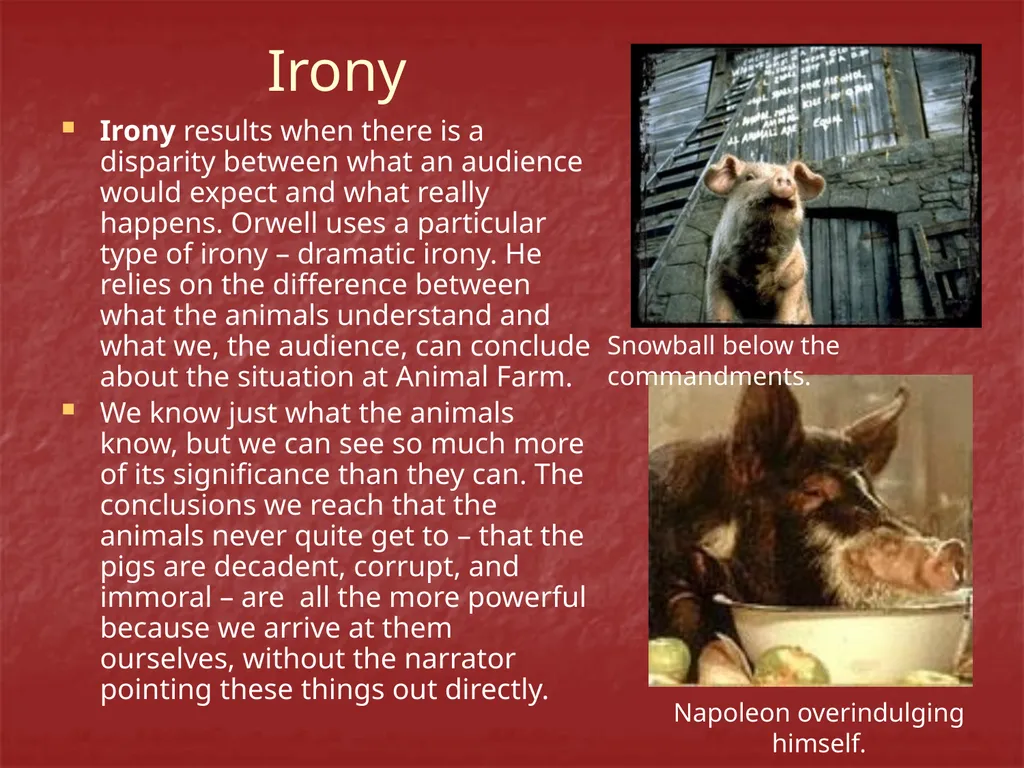
Irony Irony results when there is a disparity between what an audience would expect and what really happens. Orwell uses a particular type of irony – dramatic irony. He relies on the difference between what the animals understand and what we, the audience, can conclude about the situation at Animal Farm.
We know just what the animals know, but we can see so much more of its significance than they can. The conclusions we reach that the animals never quite get to – that the pigs are decadent, corrupt, and immoral – are all the more powerful because we arrive at them ourselves, without the narrator pointing these things out directly. Napoleon overindulging himself. Snowball below the commandments.<br>
09
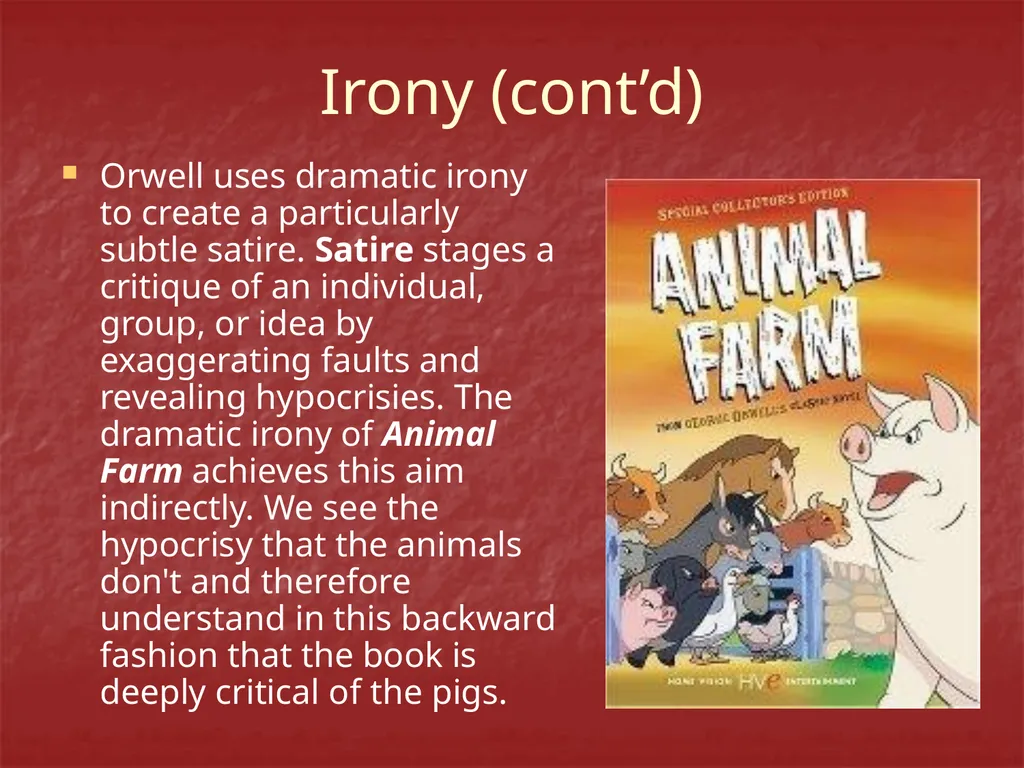
Irony (cont’d) Orwell uses dramatic irony to create a particularly subtle satire. Satire stages a critique of an individual, group, or idea by exaggerating faults and revealing hypocrisies. The dramatic irony of Animal Farm achieves this aim indirectly. We see the hypocrisy that the animals don't and therefore understand in this backward fashion that the book is deeply critical of the pigs.<br>
10
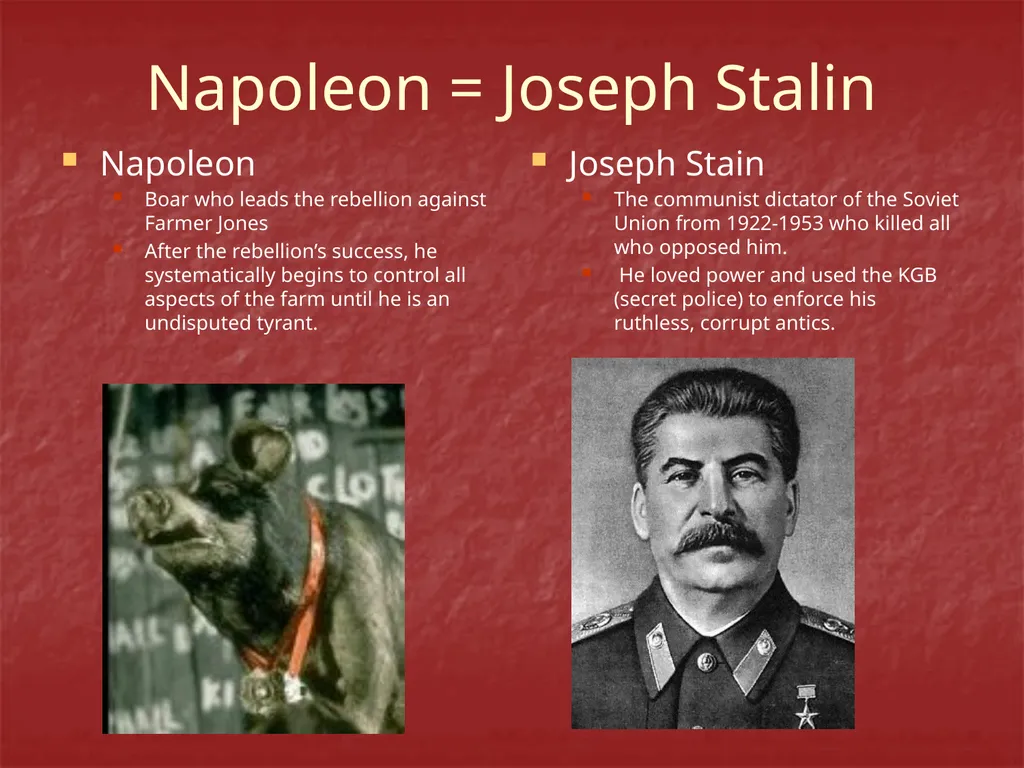
Napoleon = Joseph Stalin Napoleon
Boar who leads the rebellion against Farmer Jones
After the rebellion’s success, he systematically begins to control all aspects of the farm until he is an undisputed tyrant. Joseph Stain
The communist dictator of the Soviet Union from 1922-1953 who killed all who opposed him.
He loved power and used the KGB (secret police) to enforce his ruthless, corrupt antics.<br>
11
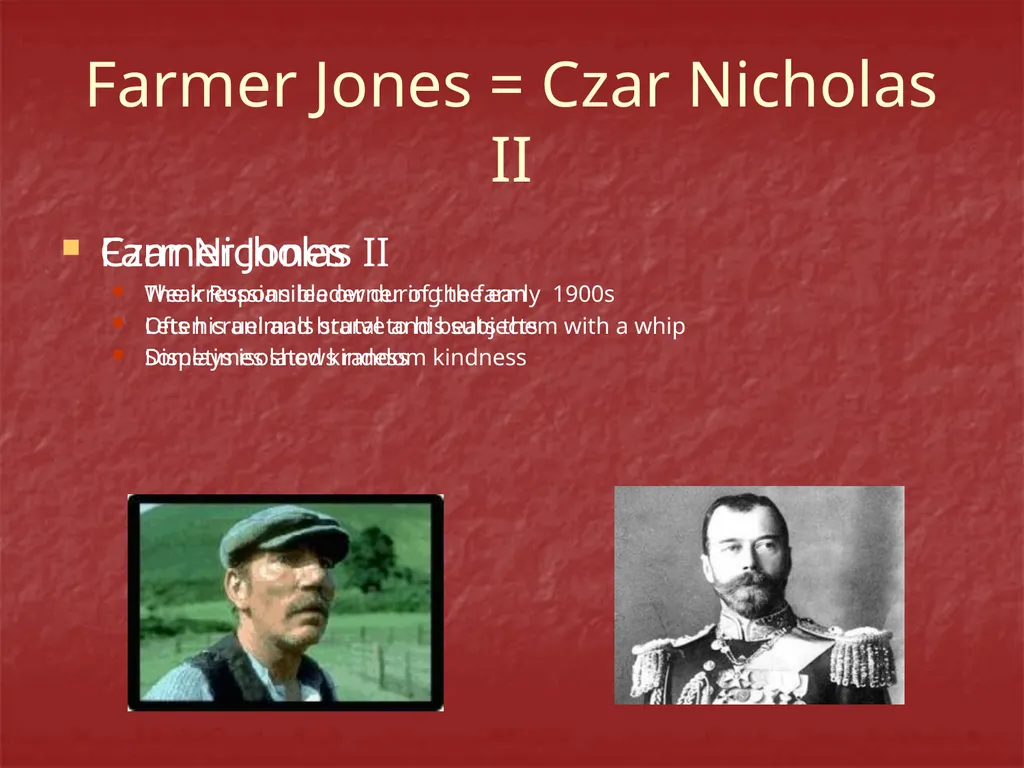
Farmer Jones = Czar Nicholas II Farmer Jones
The irresponsible owner of the farm
Lets his animals starve and beats them with a whip
Sometimes shows random kindness Czar Nicholas II
Weak Russian leader during the early 1900s
Often cruel and brutal to his subjects
Displays isolated kindess<br>
12
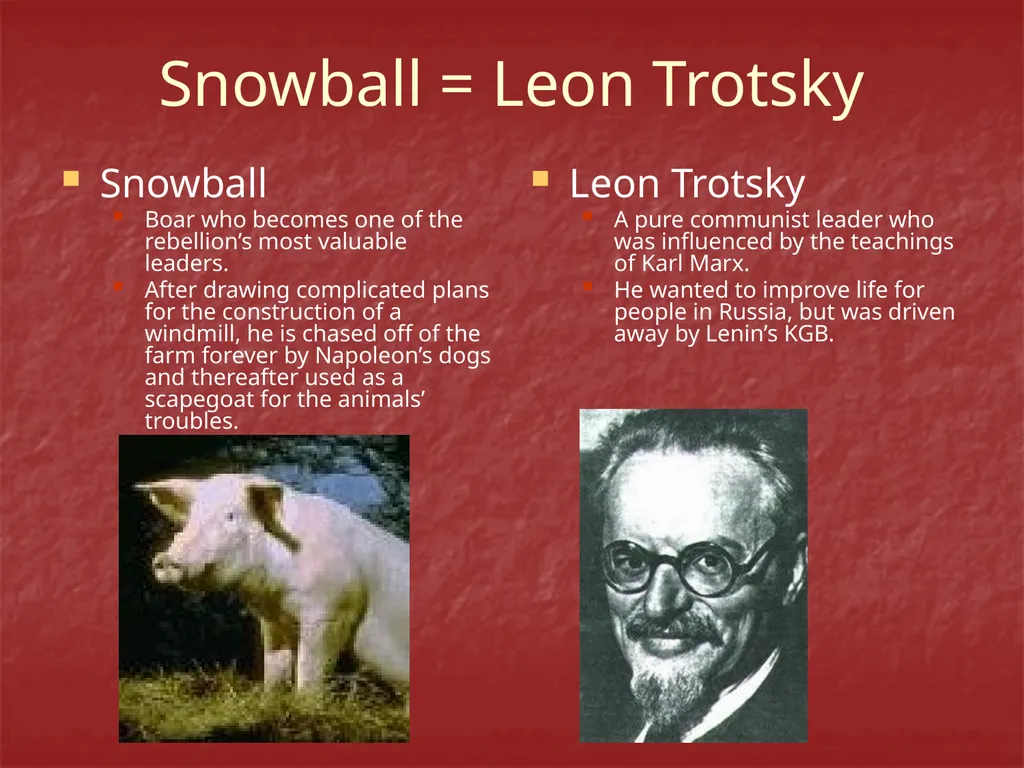
Snowball = Leon Trotsky Snowball
Boar who becomes one of the rebellion’s most valuable leaders.
After drawing complicated plans for the construction of a windmill, he is chased off of the farm forever by Napoleon’s dogs and thereafter used as a scapegoat for the animals’ troubles. Leon Trotsky
A pure communist leader who was influenced by the teachings of Karl Marx.
He wanted to improve life for people in Russia, but was driven away by Lenin’s KGB.<br>
13
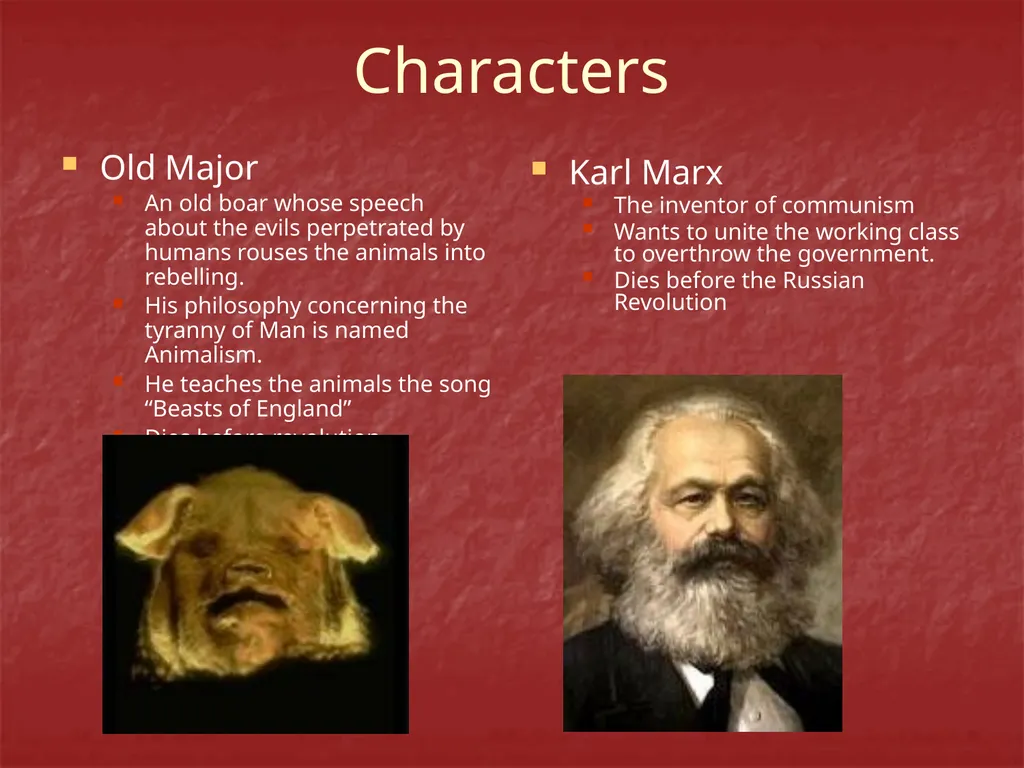
Characters Old Major
An old boar whose speech about the evils perpetrated by humans rouses the animals into rebelling.
His philosophy concerning the tyranny of Man is named Animalism.
He teaches the animals the song “Beasts of England”
Dies before revolution Karl Marx
The inventor of communism
Wants to unite the working class to overthrow the government.
Dies before the Russian Revolution<br>
14
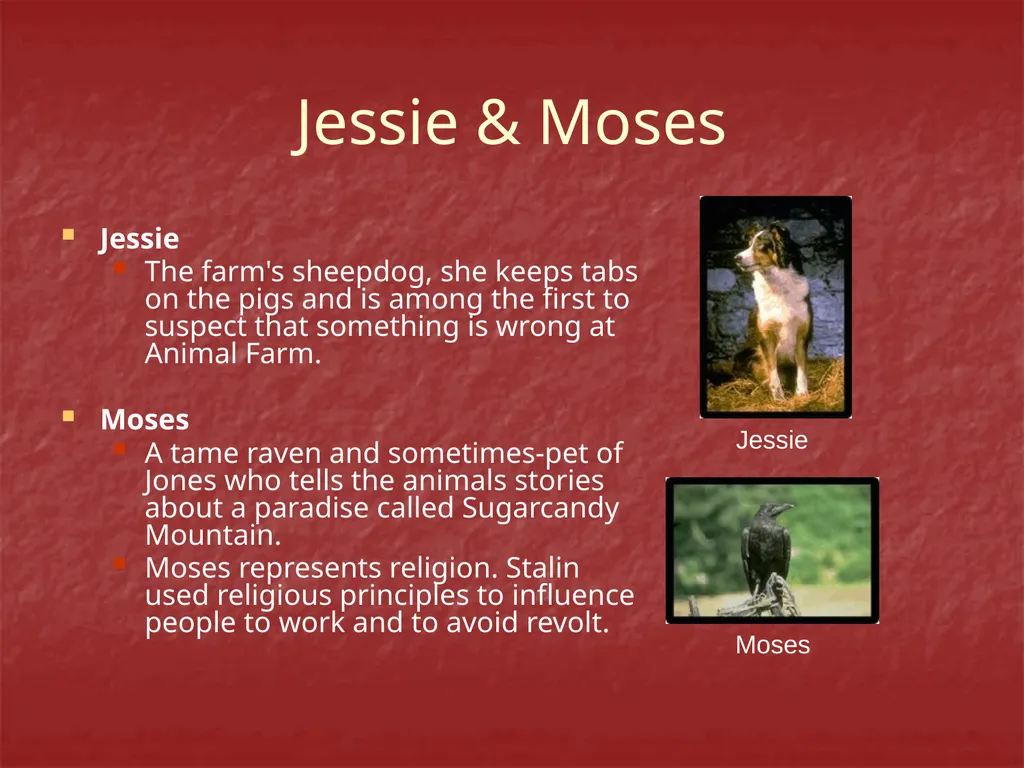
Jessie & Moses Jessie
The farm's sheepdog, she keeps tabs on the pigs and is among the first to suspect that something is wrong at Animal Farm.
Moses
A tame raven and sometimes-pet of Jones who tells the animals stories about a paradise called Sugarcandy Mountain.
Moses represents religion. Stalin used religious principles to influence people to work and to avoid revolt. Jessie Moses<br>
15
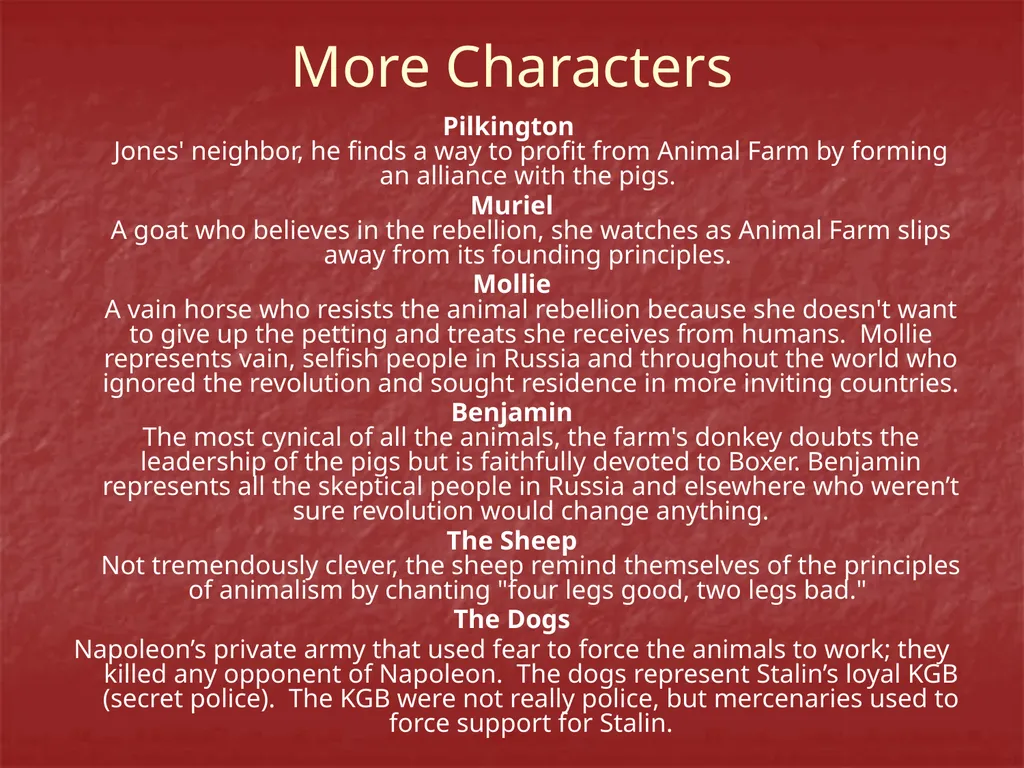
More Characters Pilkington Jones' neighbor, he finds a way to profit from Animal Farm by forming an alliance with the pigs.
Muriel A goat who believes in the rebellion, she watches as Animal Farm slips away from its founding principles.
Mollie A vain horse who resists the animal rebellion because she doesn't want to give up the petting and treats she receives from humans. Mollie represents vain, selfish people in Russia and throughout the world who ignored the revolution and sought residence in more inviting countries.
Benjamin The most cynical of all the animals, the farm's donkey doubts the leadership of the pigs but is faithfully devoted to Boxer. Benjamin represents all the skeptical people in Russia and elsewhere who weren’t sure revolution would change anything.
The Sheep Not tremendously clever, the sheep remind themselves of the principles of animalism by chanting "four legs good, two legs bad."
The Dogs
Napoleon’s private army that used fear to force the animals to work; they killed any opponent of Napoleon. The dogs represent Stalin’s loyal KGB (secret police). The KGB were not really police, but mercenaries used to force support for Stalin.<br>
16
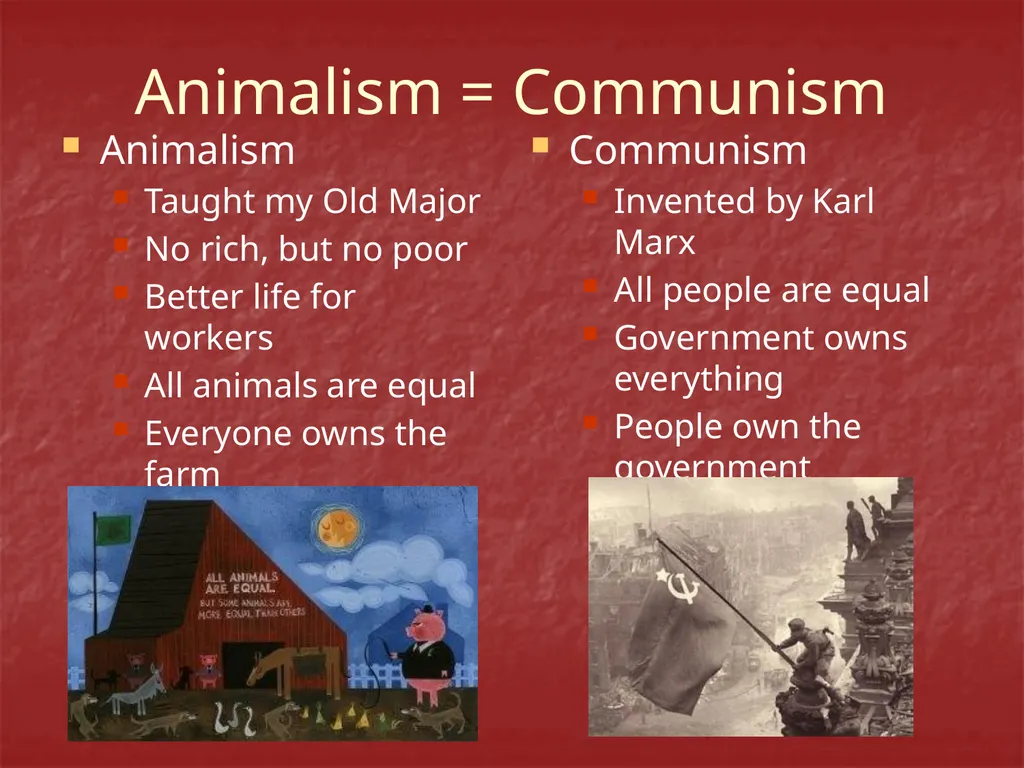
Animalism = Communism Animalism
Taught my Old Major
No rich, but no poor
Better life for workers
All animals are equal
Everyone owns the farm Communism
Invented by Karl Marx
All people are equal
Government owns everything
People own the government<br>