
Anisotropy – Key ideas From Mays, 2011, Ground and

Published  . 0 views
↓ Download
Anisotropy – Key ideas From Mays, 2011, Ground and
1 / 1
Anisotropy – Key ideas From Mays, 2011, Ground and - slide 1 of 4 Anisotropy – Key ideas From Mays, 2011, Ground and - slide 2 of 4 Anisotropy – Key ideas From Mays, 2011, Ground and - slide 3 of 4 Anisotropy – Key ideas From Mays, 2011, Ground and - slide 4 of 4
Description: Anisotropy Key ideas From Mays, 2011, Ground and Surface Water Hydrology Effective conductivity that represents aggregate effect of flow through a layered system Effective conductivity is different parallel to than perpendicular to the

Related Topics

Download Presentation

"Anisotropy – Key ideas From Mays, 2011, Ground and" is the property of its rightful owner. Permission is granted to download and print the materials on this website for personal, non-commercial use only, and to display it on your personal computer provided you do not modify the materials and that you retain all copyright notices contained in the materials. By downloading content from our website, you accept the terms of this agreement.

Presentation Transcript

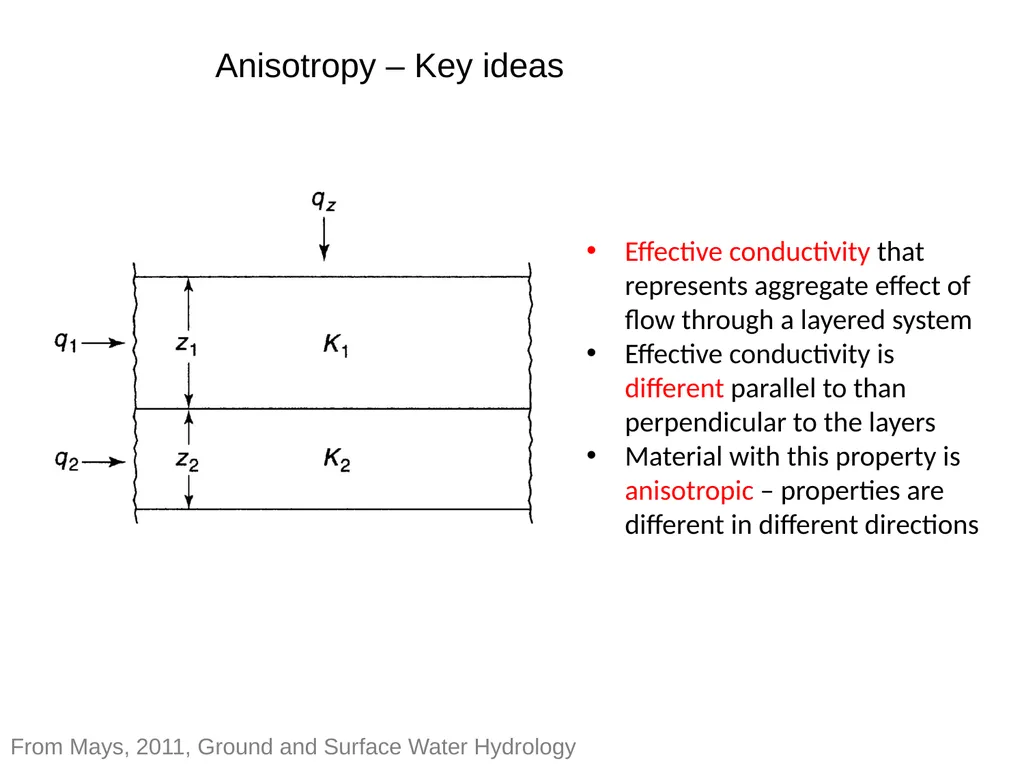
slide1. Anisotropy – Key ideas From Mays, 2011, Ground and Surface Water Hydrology Effective conductivity that represents aggregate effect of flow through a layered system
Effective conductivity is different parallel to than perpendicular to the layers
Material with this property is anisotropic – properties are different in different directions<br>
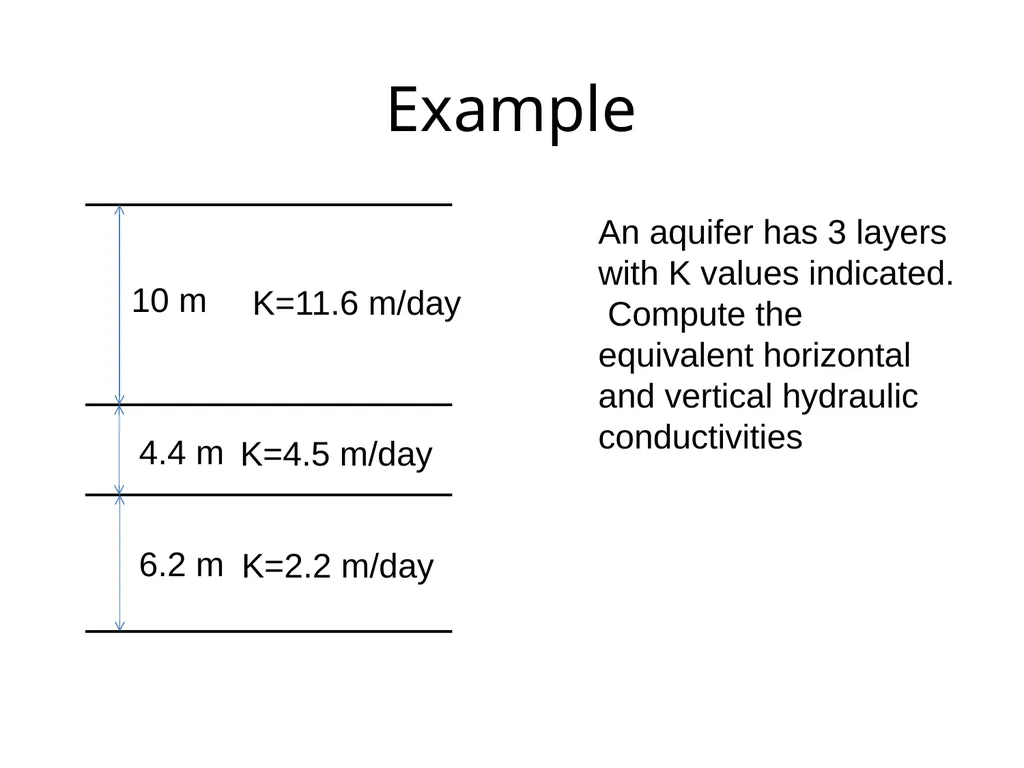
slide2. Example An aquifer has 3 layers with K values indicated. Compute the equivalent horizontal and vertical hydraulic conductivities 10 m 4.4 m 6.2 m K=11.6 m/day K=4.5 m/day K=2.2 m/day<br>
slide3. Aquifer Anisotropy and general flow equations Objective
To be able to quantify the anisotropy of an aquifer due to layering
To be able to describe the equations used in general groundwater flow calculations<br>
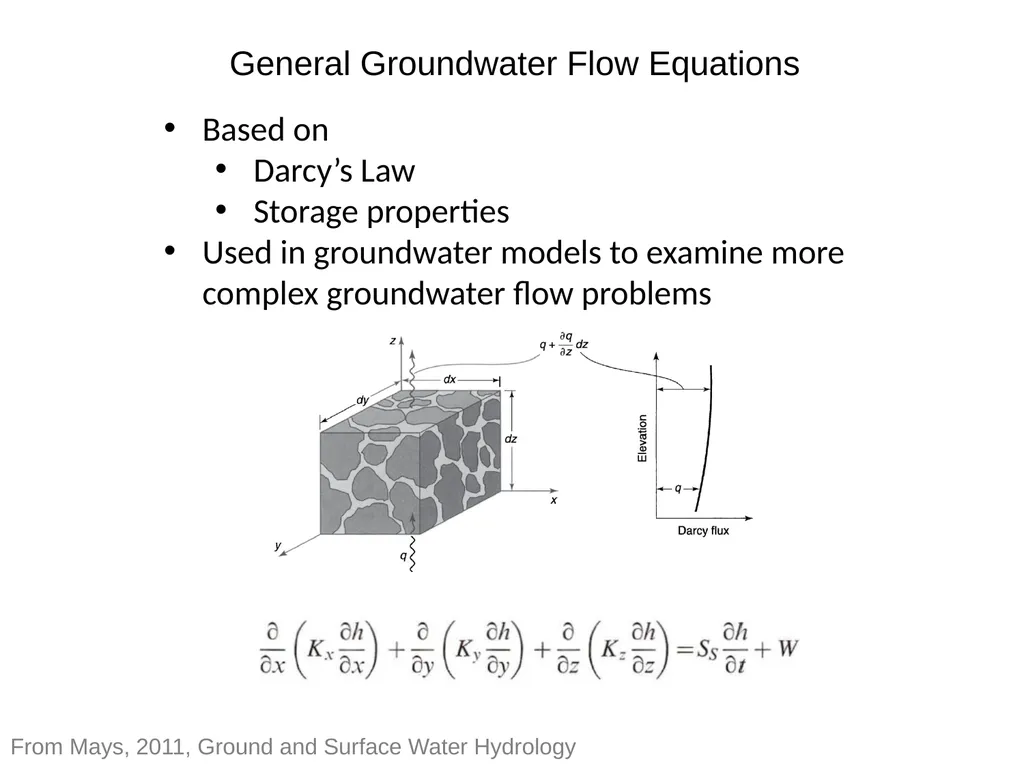
slide4. General Groundwater Flow Equations From Mays, 2011, Ground and Surface Water Hydrology Based on
Darcy’s Law
Storage properties
Used in groundwater models to examine more complex groundwater flow problems<br>