
Annotating Semantic Issues Presented by: Halla
Description: Annotating Semantic Issues Presented by: Halla Mohammed Translation In order to translate the text into English, a global strategy, one that stands somewhere between a semantic translation and a communicative translation, will be adopted.
Related Topics
Download Presentation
"Annotating Semantic Issues Presented by: Halla" is the property of its rightful owner. Permission is granted to download and print the materials on this website for personal, non-commercial use only, and to display it on your personal computer provided you do not modify the materials and that you retain all copyright notices contained in the materials. By downloading content from our website, you accept the terms of this agreement.
Presentation Transcript
slide1. Annotating Semantic Issues Presented by: Halla Mohammed<br>
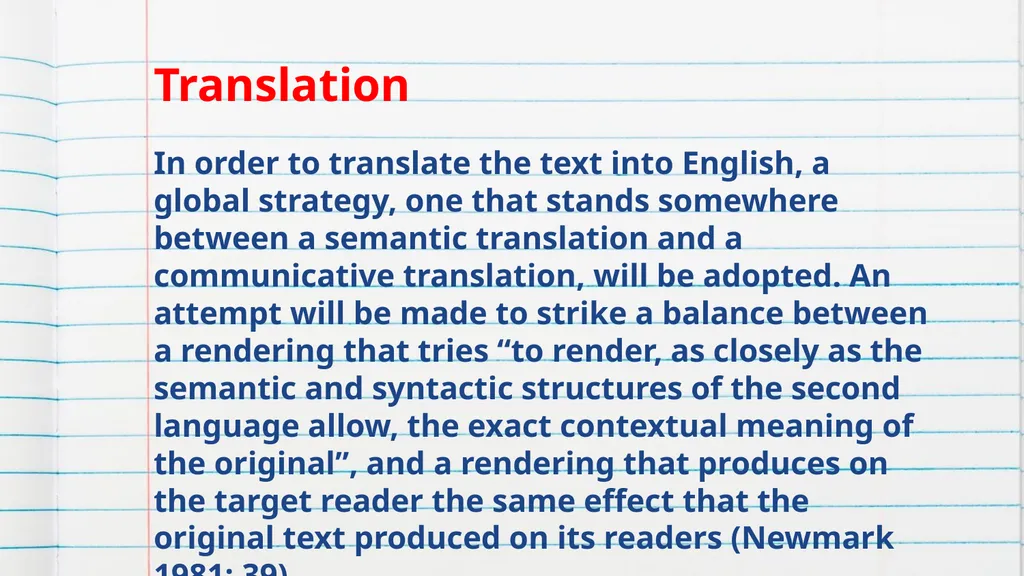
slide2. Translation In order to translate the text into English, a global strategy, one that stands somewhere between a semantic translation and a communicative translation, will be adopted. An attempt will be made to strike a balance between a rendering that tries “to render, as closely as the semantic and syntactic structures of the second language allow, the exact contextual meaning of the original”, and a rendering that produces on the target reader the same effect that the original text produced on its readers (Newmark 1981: 39).<br>
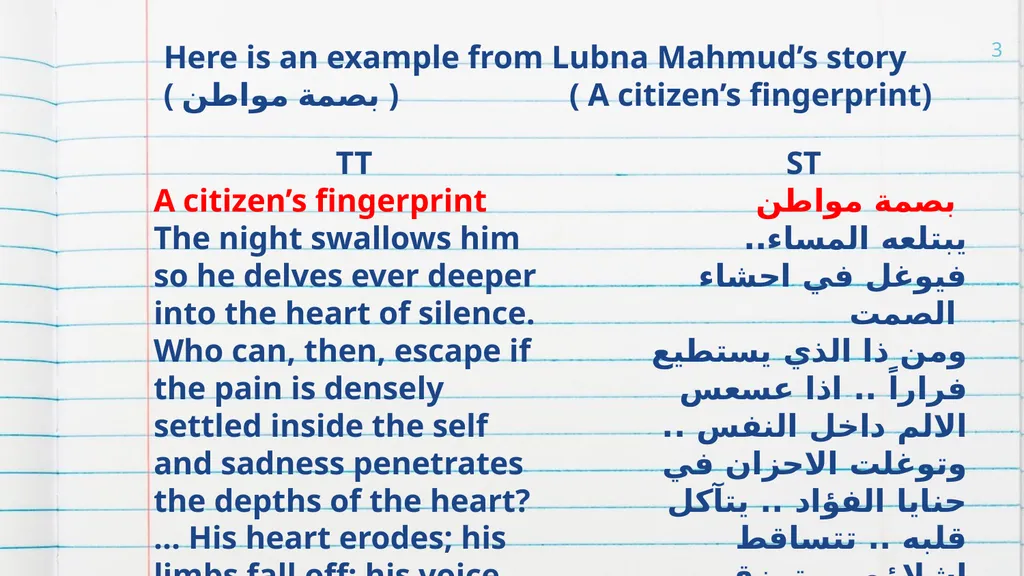
slide3. TT
A citizen’s fingerprint
The night swallows him so he delves ever deeper into the heart of silence. Who can, then, escape if the pain is densely settled inside the self and sadness penetrates the depths of the heart? … His heart erodes; his limbs fall off; his voice gets torn away at the boundaries of time, yet no response comes. ST
بصمة مواطن
يبتلعه المساء.. فيوغل في احشاء الصمت
ومن ذا الذي يستطيع فراراً .. اذا عسعس الالم داخل النفس .. وتوغلت الاحزان في حنايا الفؤاد .. يتآكل قلبه .. تتساقط اشلاؤه .. يتمزق صوته على حدود الزمان ولا من مجيب 3 Here is an example from Lubna Mahmud’s story ( بصمة مواطن ) ( A citizen’s fingerprint)<br>
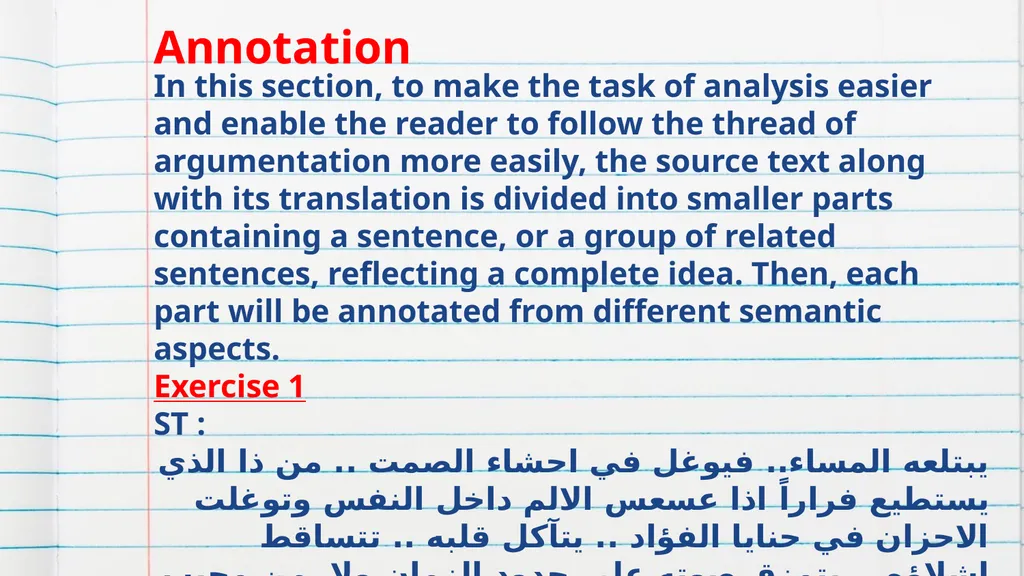
slide4. Annotation In this section, to make the task of analysis easier and enable the reader to follow the thread of argumentation more easily, the source text along with its translation is divided into smaller parts containing a sentence, or a group of related sentences, reflecting a complete idea. Then, each part will be annotated from different semantic aspects.
Exercise 1
ST :
يبتلعه المساء.. فيوغل في احشاء الصمت .. من ذا الذي يستطيع فراراً اذا عسعس الالم داخل النفس وتوغلت الاحزان في حنايا الفؤاد .. يتآكل قلبه .. تتساقط اشلاؤه .. يتمزق صوته على حدود الزمان ولا من مجيب
TT:
The night swallows him so he delves ever deeper into the heart of silence. Who can, then, escape if the pain is densely settled inside the self and sadness penetrates the depths of the heart? … His heart erodes; his limbs fall off; his voice gets torn away at the boundaries of time, yet no response comes<br>
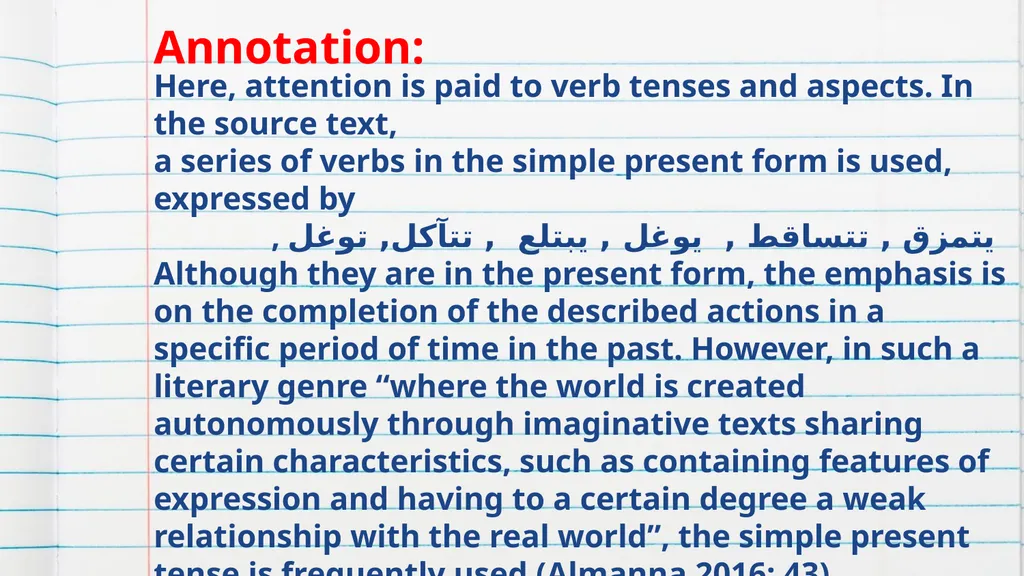
slide5. Annotation: Here, attention is paid to verb tenses and aspects. In the source text,
a series of verbs in the simple present form is used, expressed by
, يتمزق , تتساقط , يوغل , يبتلع , تتآكل, توغل
Although they are in the present form, the emphasis is on the completion of the described actions in a specific period of time in the past. However, in such a literary genre “where the world is created autonomously through imaginative texts sharing certain characteristics, such as containing features of expression and having to a certain degree a weak relationship with the real world”, the simple present tense is frequently used (Almanna 2016: 43).<br>
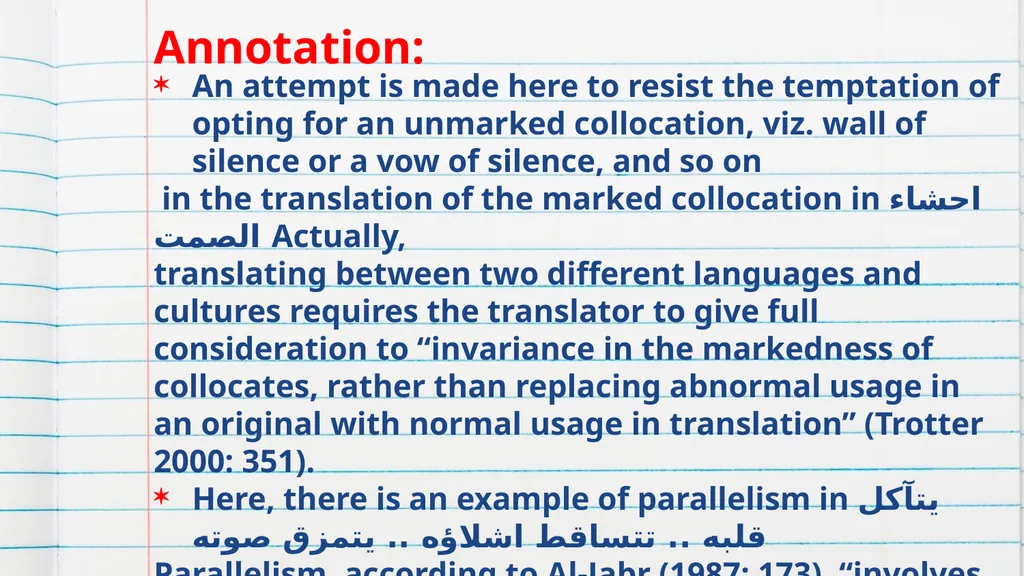
slide6. Annotation: An attempt is made here to resist the temptation of opting for an unmarked collocation, viz. wall of silence or a vow of silence, and so on
in the translation of the marked collocation in احشاء الصمت Actually,
translating between two different languages and cultures requires the translator to give full consideration to “invariance in the markedness of collocates, rather than replacing abnormal usage in an original with normal usage in translation” (Trotter 2000: 351).
Here, there is an example of parallelism in يتآكل قلبه .. تتساقط اشلاؤه .. يتمزق صوته
Parallelism, according to Al-Jabr (1987: 173), “involves the use of particular syntactic and semantic configuration more than once, in rapid succession”. Placing these parallel structures in juxtaposition is not determined
arbitrarily, but rather it is a result of choice. Here, the writer deliberately produces her above parallel structures without connectors<br>
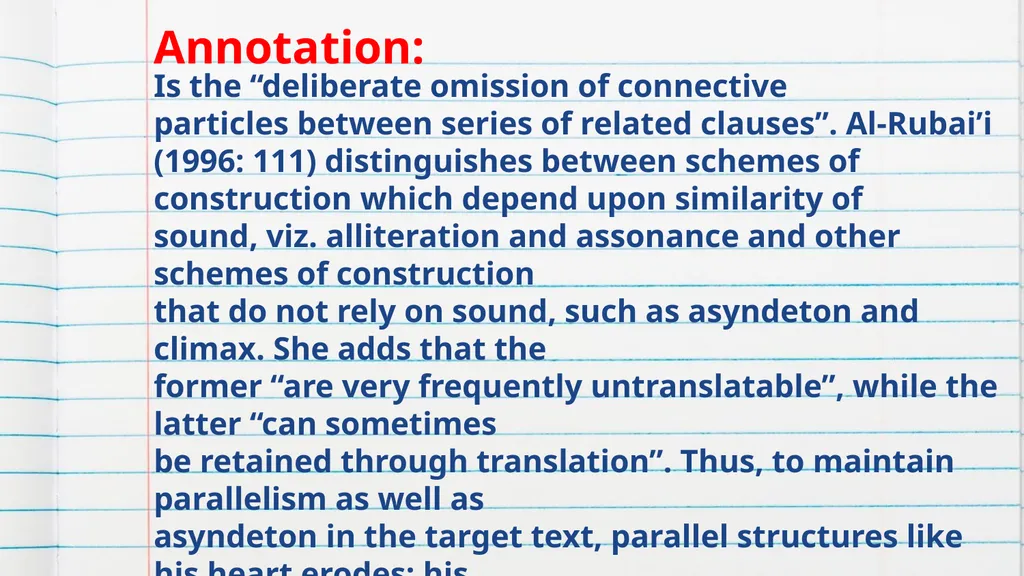
slide7. Annotation: Is the “deliberate omission of connective
particles between series of related clauses”. Al-Rubai’i (1996: 111) distinguishes between schemes of construction which depend upon similarity of
sound, viz. alliteration and assonance and other schemes of construction
that do not rely on sound, such as asyndeton and climax. She adds that the
former “are very frequently untranslatable”, while the latter “can sometimes
be retained through translation”. Thus, to maintain parallelism as well as
asyndeton in the target text, parallel structures like his heart erodes; his
limbs fall off; his voice gets torn away may be used.<br>
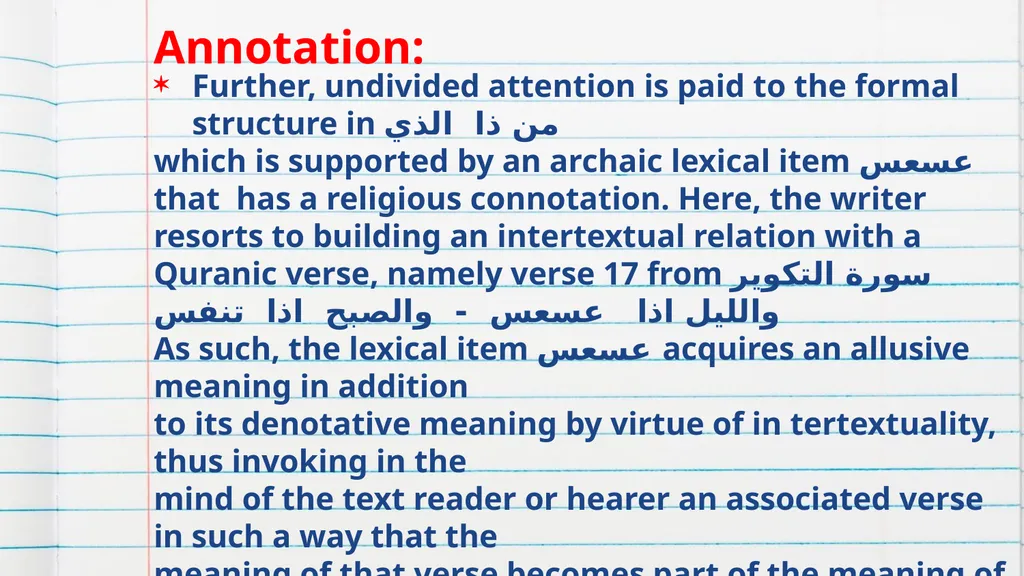
slide8. Annotation: Further, undivided attention is paid to the formal structure in من ذا الذي
which is supported by an archaic lexical item عسعس that has a religious connotation. Here, the writer resorts to building an intertextual relation with a Quranic verse, namely verse 17 from سورة التكوير
والليل اذا عسعس - والصبح اذا تنفس
As such, the lexical item عسعس acquires an allusive meaning in addition
to its denotative meaning by virtue of in tertextuality, thus invoking in the
mind of the text reader or hearer an associated verse in such a way that the
meaning of that verse becomes part of the meaning of the lexical item عسعس<br>
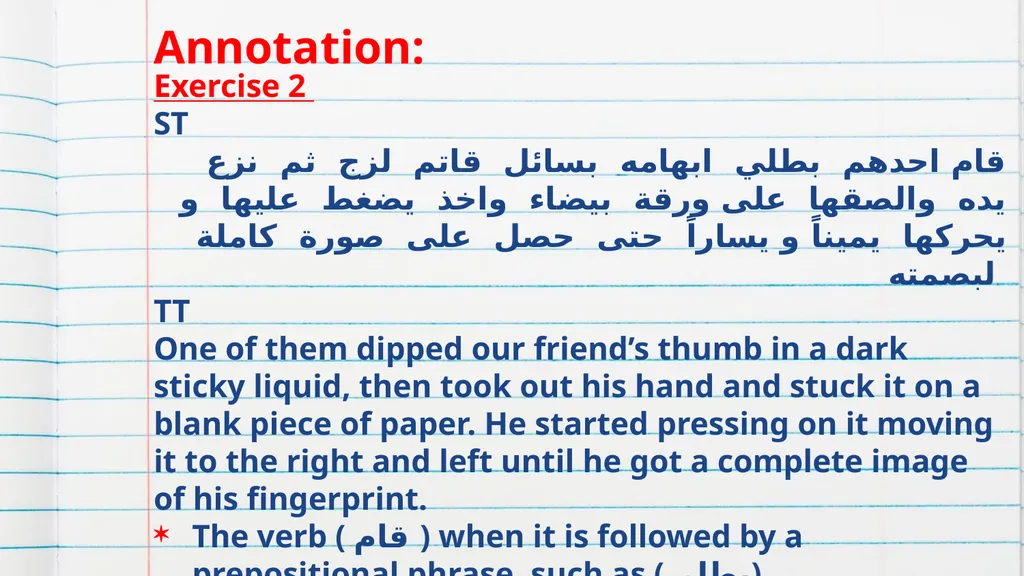
slide9. Annotation: Exercise 2
ST
قام احدهم بطلي ابهامه بسائل قاتم لزج ثم نزع يده والصقها على ورقة بيضاء واخذ يضغط عليها و يحركها يميناً و يساراً حتى حصل على صورة كاملة لبصمته
TT
One of them dipped our friend’s thumb in a dark sticky liquid, then took out his hand and stuck it on a blank piece of paper. He started pressing on it moving it to the right and left until he got a complete image of his fingerprint.
The verb ( قام ) when it is followed by a prepositional phrase, such as (بطلي)
Simply means ( طلي ) ,that is, to paint. However, the verb ( طلي ) in such a context lends itself to to dip as this is what is meant by the original writer.<br>
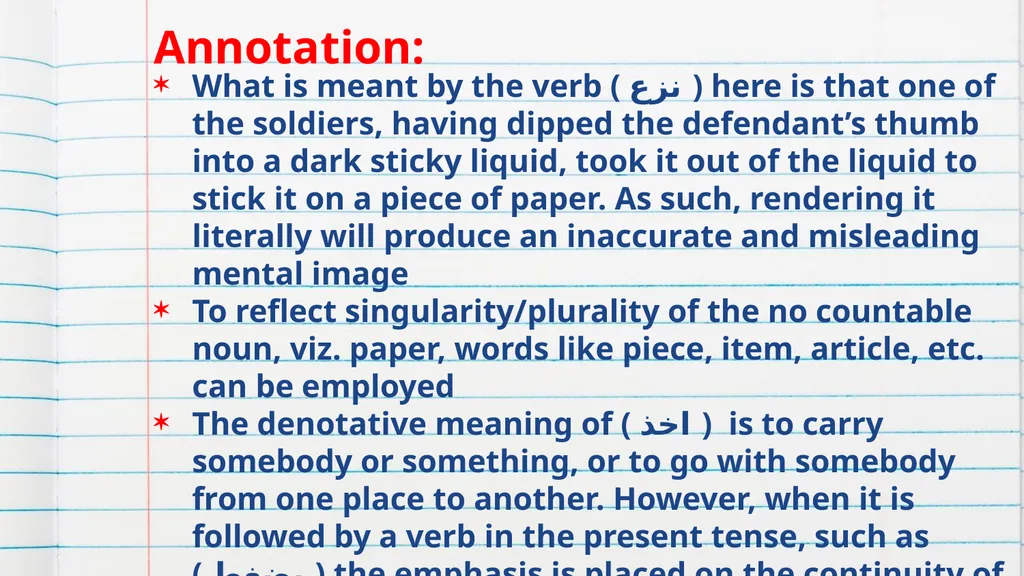
slide10. Annotation: What is meant by the verb ( نزع ) here is that one of the soldiers, having dipped the defendant’s thumb into a dark sticky liquid, took it out of the liquid to stick it on a piece of paper. As such, rendering it literally will produce an inaccurate and misleading mental image
To reflect singularity/plurality of the no countable noun, viz. paper, words like piece, item, article, etc. can be employed
The denotative meaning of ( اخذ ) is to carry somebody or something, or to go with somebody from one place to another. However, when it is followed by a verb in the present tense, such as ( يضغط ) the emphasis is placed on the continuity of the act of pressing in a specific period of time in the past, and thus it is best rendered as to begin or to start in the past.<br>
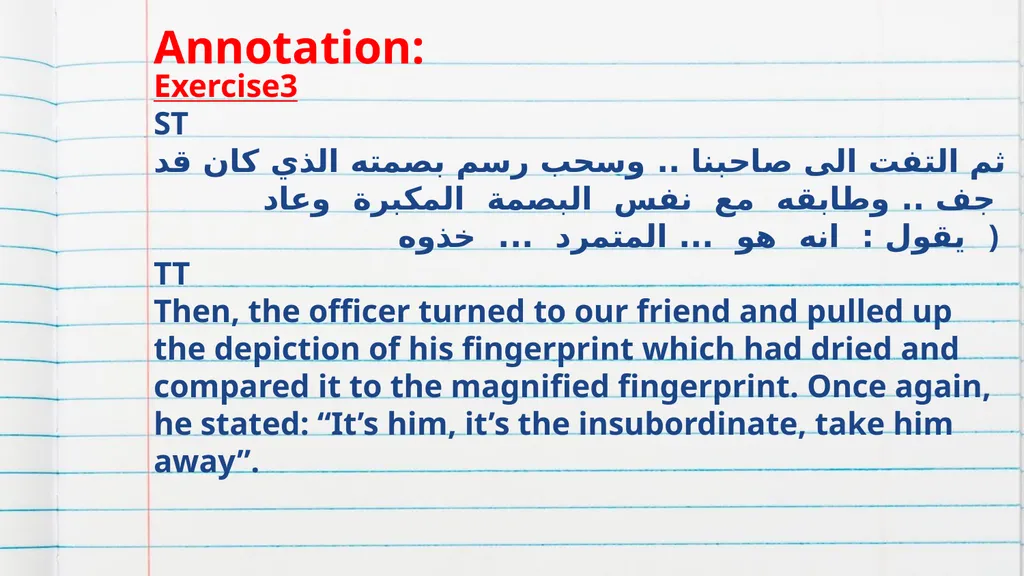
slide11. Annotation: Exercise3
ST
ثم التفت الى صاحبنا .. وسحب رسم بصمته الذي كان قد جف .. وطابقه مع نفس البصمة المكبرة وعاد يقول : انه هو ... المتمرد ... خذوه )
TT
Then, the officer turned to our friend and pulled up the depiction of his fingerprint which had dried and compared it to the magnified fingerprint. Once again, he stated: “It’s him, it’s the insubordinate, take him away”.<br>
slide12. Annotation: In the original text, there are four processes, namely process of doing التفت الى صاحبنا process of doing, سحب رسم بصمته الذي كان قد جف , process of doing طابقه مع نفس البصمة المكبرة and process of saying وعاد يقول it is worth noting that the second and third processes are conjoined by the additive connector (و) (and) thus indicating that there is no time span between the two processes سحب رسم بصمته .. طابقه سحب) he pulled up the depiction of his fingerprint … and compared it). As such, an attempt is made here to avoid translating it into something like to or in order to. Resorting to connectors, such as to or in order to, for instance, will safeguard acceptability, readability and naturalness. However, it will create a time gap that slows down the psychological speed of events.<br>
slide13. Annotation: Further, the emphasis in the original relative clause الذي كان قد جف is
placed on the duration of the action that began in the past and is seen
as relevant to the act of pulling up the depiction of his fingerprint. It
therefore lends itself to a past perfect tense had dried. The change in
aspect from perfect aspect to simple aspect will definitely produce a
change in time reference, thereby affecting the pragmatic communicative effect.<br>
slide14. Thank you 14<br>
slide2. Translation In order to translate the text into English, a global strategy, one that stands somewhere between a semantic translation and a communicative translation, will be adopted. An attempt will be made to strike a balance between a rendering that tries “to render, as closely as the semantic and syntactic structures of the second language allow, the exact contextual meaning of the original”, and a rendering that produces on the target reader the same effect that the original text produced on its readers (Newmark 1981: 39).<br>
slide3. TT
A citizen’s fingerprint
The night swallows him so he delves ever deeper into the heart of silence. Who can, then, escape if the pain is densely settled inside the self and sadness penetrates the depths of the heart? … His heart erodes; his limbs fall off; his voice gets torn away at the boundaries of time, yet no response comes. ST
بصمة مواطن
يبتلعه المساء.. فيوغل في احشاء الصمت
ومن ذا الذي يستطيع فراراً .. اذا عسعس الالم داخل النفس .. وتوغلت الاحزان في حنايا الفؤاد .. يتآكل قلبه .. تتساقط اشلاؤه .. يتمزق صوته على حدود الزمان ولا من مجيب 3 Here is an example from Lubna Mahmud’s story ( بصمة مواطن ) ( A citizen’s fingerprint)<br>
slide4. Annotation In this section, to make the task of analysis easier and enable the reader to follow the thread of argumentation more easily, the source text along with its translation is divided into smaller parts containing a sentence, or a group of related sentences, reflecting a complete idea. Then, each part will be annotated from different semantic aspects.
Exercise 1
ST :
يبتلعه المساء.. فيوغل في احشاء الصمت .. من ذا الذي يستطيع فراراً اذا عسعس الالم داخل النفس وتوغلت الاحزان في حنايا الفؤاد .. يتآكل قلبه .. تتساقط اشلاؤه .. يتمزق صوته على حدود الزمان ولا من مجيب
TT:
The night swallows him so he delves ever deeper into the heart of silence. Who can, then, escape if the pain is densely settled inside the self and sadness penetrates the depths of the heart? … His heart erodes; his limbs fall off; his voice gets torn away at the boundaries of time, yet no response comes<br>
slide5. Annotation: Here, attention is paid to verb tenses and aspects. In the source text,
a series of verbs in the simple present form is used, expressed by
, يتمزق , تتساقط , يوغل , يبتلع , تتآكل, توغل
Although they are in the present form, the emphasis is on the completion of the described actions in a specific period of time in the past. However, in such a literary genre “where the world is created autonomously through imaginative texts sharing certain characteristics, such as containing features of expression and having to a certain degree a weak relationship with the real world”, the simple present tense is frequently used (Almanna 2016: 43).<br>
slide6. Annotation: An attempt is made here to resist the temptation of opting for an unmarked collocation, viz. wall of silence or a vow of silence, and so on
in the translation of the marked collocation in احشاء الصمت Actually,
translating between two different languages and cultures requires the translator to give full consideration to “invariance in the markedness of collocates, rather than replacing abnormal usage in an original with normal usage in translation” (Trotter 2000: 351).
Here, there is an example of parallelism in يتآكل قلبه .. تتساقط اشلاؤه .. يتمزق صوته
Parallelism, according to Al-Jabr (1987: 173), “involves the use of particular syntactic and semantic configuration more than once, in rapid succession”. Placing these parallel structures in juxtaposition is not determined
arbitrarily, but rather it is a result of choice. Here, the writer deliberately produces her above parallel structures without connectors<br>
slide7. Annotation: Is the “deliberate omission of connective
particles between series of related clauses”. Al-Rubai’i (1996: 111) distinguishes between schemes of construction which depend upon similarity of
sound, viz. alliteration and assonance and other schemes of construction
that do not rely on sound, such as asyndeton and climax. She adds that the
former “are very frequently untranslatable”, while the latter “can sometimes
be retained through translation”. Thus, to maintain parallelism as well as
asyndeton in the target text, parallel structures like his heart erodes; his
limbs fall off; his voice gets torn away may be used.<br>
slide8. Annotation: Further, undivided attention is paid to the formal structure in من ذا الذي
which is supported by an archaic lexical item عسعس that has a religious connotation. Here, the writer resorts to building an intertextual relation with a Quranic verse, namely verse 17 from سورة التكوير
والليل اذا عسعس - والصبح اذا تنفس
As such, the lexical item عسعس acquires an allusive meaning in addition
to its denotative meaning by virtue of in tertextuality, thus invoking in the
mind of the text reader or hearer an associated verse in such a way that the
meaning of that verse becomes part of the meaning of the lexical item عسعس<br>
slide9. Annotation: Exercise 2
ST
قام احدهم بطلي ابهامه بسائل قاتم لزج ثم نزع يده والصقها على ورقة بيضاء واخذ يضغط عليها و يحركها يميناً و يساراً حتى حصل على صورة كاملة لبصمته
TT
One of them dipped our friend’s thumb in a dark sticky liquid, then took out his hand and stuck it on a blank piece of paper. He started pressing on it moving it to the right and left until he got a complete image of his fingerprint.
The verb ( قام ) when it is followed by a prepositional phrase, such as (بطلي)
Simply means ( طلي ) ,that is, to paint. However, the verb ( طلي ) in such a context lends itself to to dip as this is what is meant by the original writer.<br>
slide10. Annotation: What is meant by the verb ( نزع ) here is that one of the soldiers, having dipped the defendant’s thumb into a dark sticky liquid, took it out of the liquid to stick it on a piece of paper. As such, rendering it literally will produce an inaccurate and misleading mental image
To reflect singularity/plurality of the no countable noun, viz. paper, words like piece, item, article, etc. can be employed
The denotative meaning of ( اخذ ) is to carry somebody or something, or to go with somebody from one place to another. However, when it is followed by a verb in the present tense, such as ( يضغط ) the emphasis is placed on the continuity of the act of pressing in a specific period of time in the past, and thus it is best rendered as to begin or to start in the past.<br>
slide11. Annotation: Exercise3
ST
ثم التفت الى صاحبنا .. وسحب رسم بصمته الذي كان قد جف .. وطابقه مع نفس البصمة المكبرة وعاد يقول : انه هو ... المتمرد ... خذوه )
TT
Then, the officer turned to our friend and pulled up the depiction of his fingerprint which had dried and compared it to the magnified fingerprint. Once again, he stated: “It’s him, it’s the insubordinate, take him away”.<br>
slide12. Annotation: In the original text, there are four processes, namely process of doing التفت الى صاحبنا process of doing, سحب رسم بصمته الذي كان قد جف , process of doing طابقه مع نفس البصمة المكبرة and process of saying وعاد يقول it is worth noting that the second and third processes are conjoined by the additive connector (و) (and) thus indicating that there is no time span between the two processes سحب رسم بصمته .. طابقه سحب) he pulled up the depiction of his fingerprint … and compared it). As such, an attempt is made here to avoid translating it into something like to or in order to. Resorting to connectors, such as to or in order to, for instance, will safeguard acceptability, readability and naturalness. However, it will create a time gap that slows down the psychological speed of events.<br>
slide13. Annotation: Further, the emphasis in the original relative clause الذي كان قد جف is
placed on the duration of the action that began in the past and is seen
as relevant to the act of pulling up the depiction of his fingerprint. It
therefore lends itself to a past perfect tense had dried. The change in
aspect from perfect aspect to simple aspect will definitely produce a
change in time reference, thereby affecting the pragmatic communicative effect.<br>
slide14. Thank you 14<br>