
Annual Inbound Marketing Plan Template [Your

Description: Annual Inbound Marketing Plan Template Your Company Name Year Your Company Logo Whats in this template? Im glad you asked. Here are the sections weve laid out for you to work in. This is an editable document, so feel free to adapt
Related Topics
Download Presentation
"Annual Inbound Marketing Plan Template [Your" is the property of its rightful owner. Permission is granted to download and print the materials on this website for personal, non-commercial use only, and to display it on your personal computer provided you do not modify the materials and that you retain all copyright notices contained in the materials. By downloading content from our website, you accept the terms of this agreement.
Presentation Transcript
slide1. Annual Inbound Marketing Plan Template [Your Company Name]
[Year] [Your Company Logo]<br>
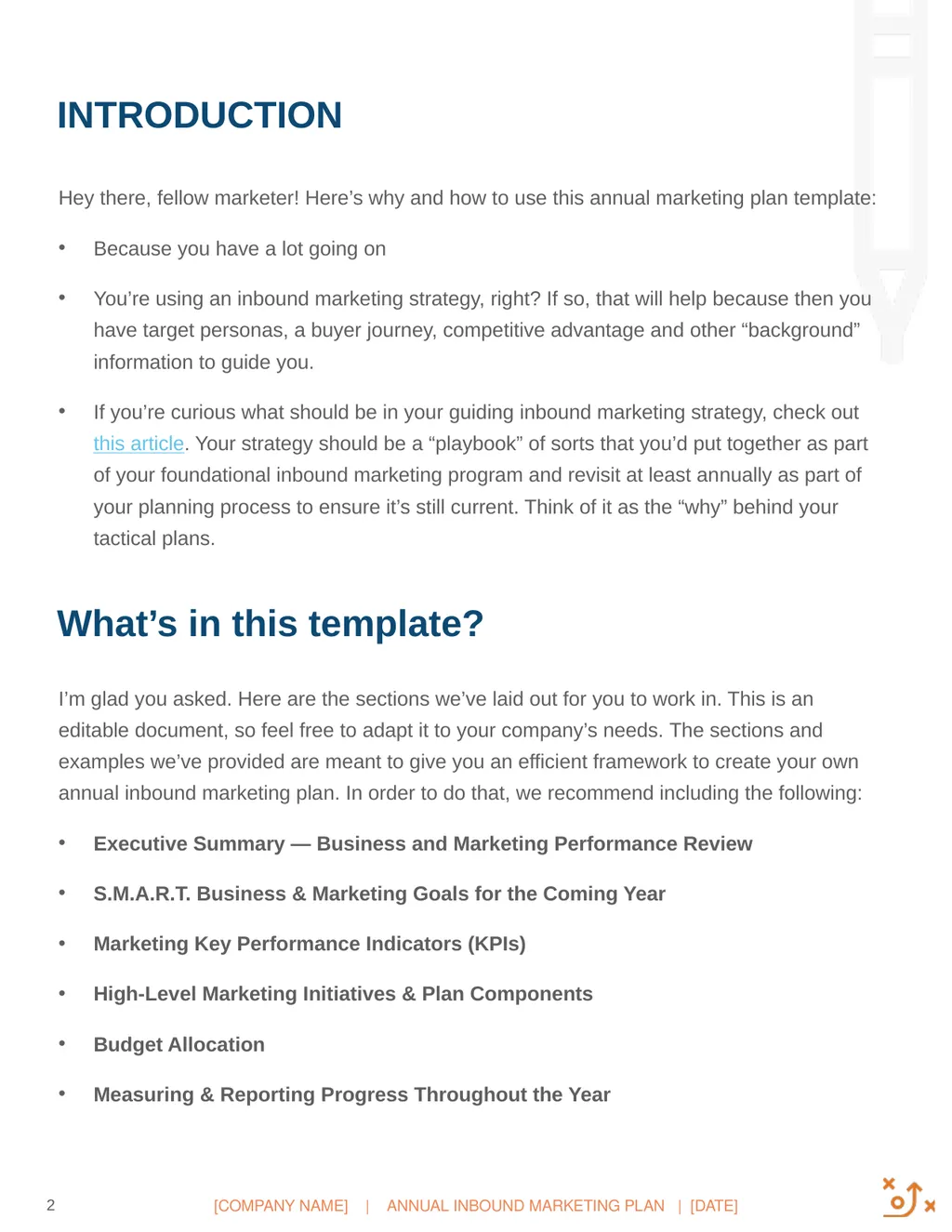
slide2. What’s in this template? I’m glad you asked. Here are the sections we’ve laid out for you to work in. This is an editable document, so feel free to adapt it to your company’s needs. The sections and examples we’ve provided are meant to give you an efficient framework to create your own annual inbound marketing plan. In order to do that, we recommend including the following:
Executive Summary — Business and Marketing Performance Review
S.M.A.R.T. Business & Marketing Goals for the Coming Year
Marketing Key Performance Indicators (KPIs)
High-Level Marketing Initiatives & Plan Components
Budget Allocation
Measuring & Reporting Progress Throughout the Year 2 INTRODUCTION Hey there, fellow marketer! Here’s why and how to use this annual marketing plan template:
Because you have a lot going on
You’re using an inbound marketing strategy, right? If so, that will help because then you have target personas, a buyer journey, competitive advantage and other “background” information to guide you.
If you’re curious what should be in your guiding inbound marketing strategy, check out this article. Your strategy should be a “playbook” of sorts that you’d put together as part of your foundational inbound marketing program and revisit at least annually as part of your planning process to ensure it’s still current. Think of it as the “why” behind your tactical plans.<br>
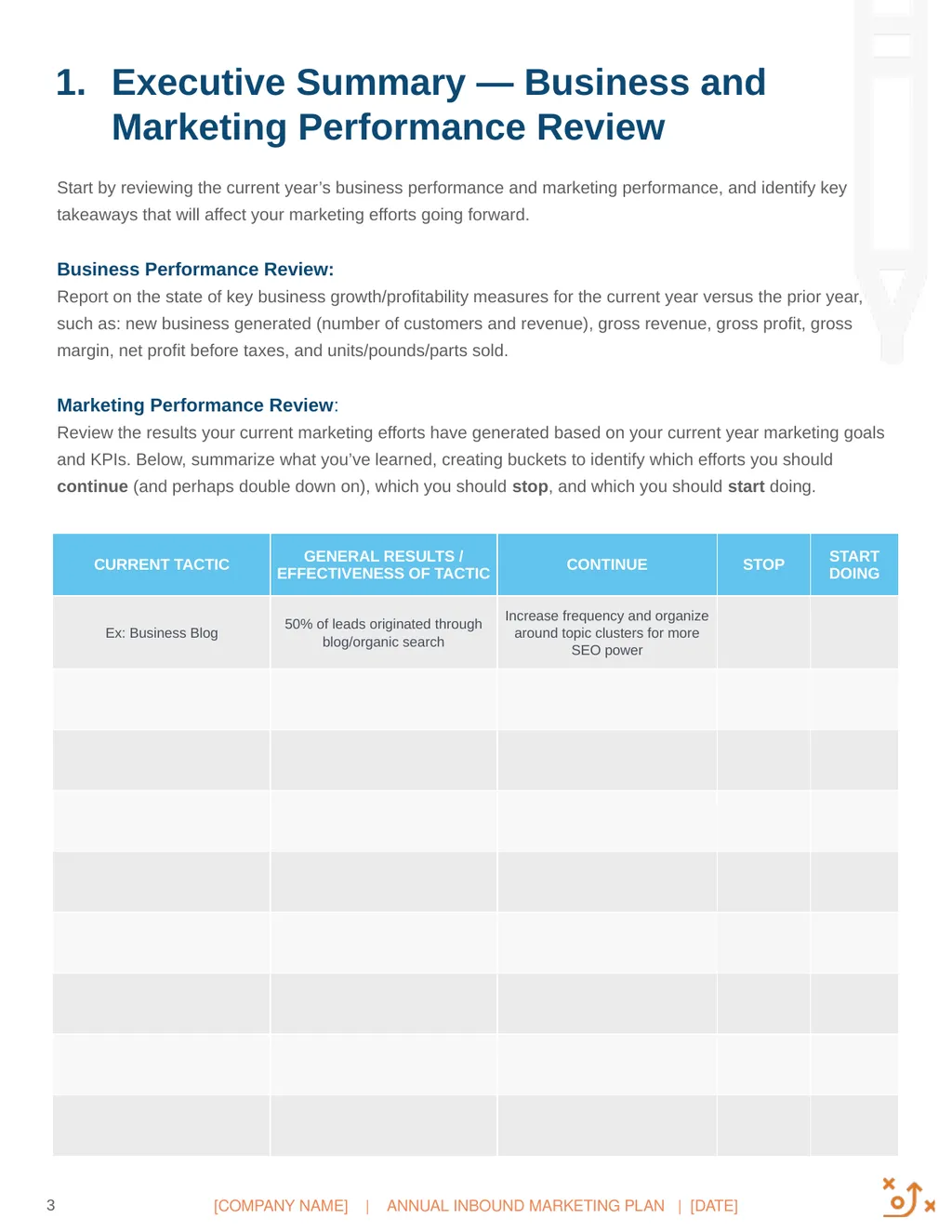
slide3. Executive Summary — Business and Marketing Performance Review Start by reviewing the current year’s business performance and marketing performance, and identify key takeaways that will affect your marketing efforts going forward.
Business Performance Review:
Report on the state of key business growth/profitability measures for the current year versus the prior year, such as: new business generated (number of customers and revenue), gross revenue, gross profit, gross margin, net profit before taxes, and units/pounds/parts sold.
Marketing Performance Review:
Review the results your current marketing efforts have generated based on your current year marketing goals and KPIs. Below, summarize what you’ve learned, creating buckets to identify which efforts you should continue (and perhaps double down on), which you should stop, and which you should start doing. 3<br>
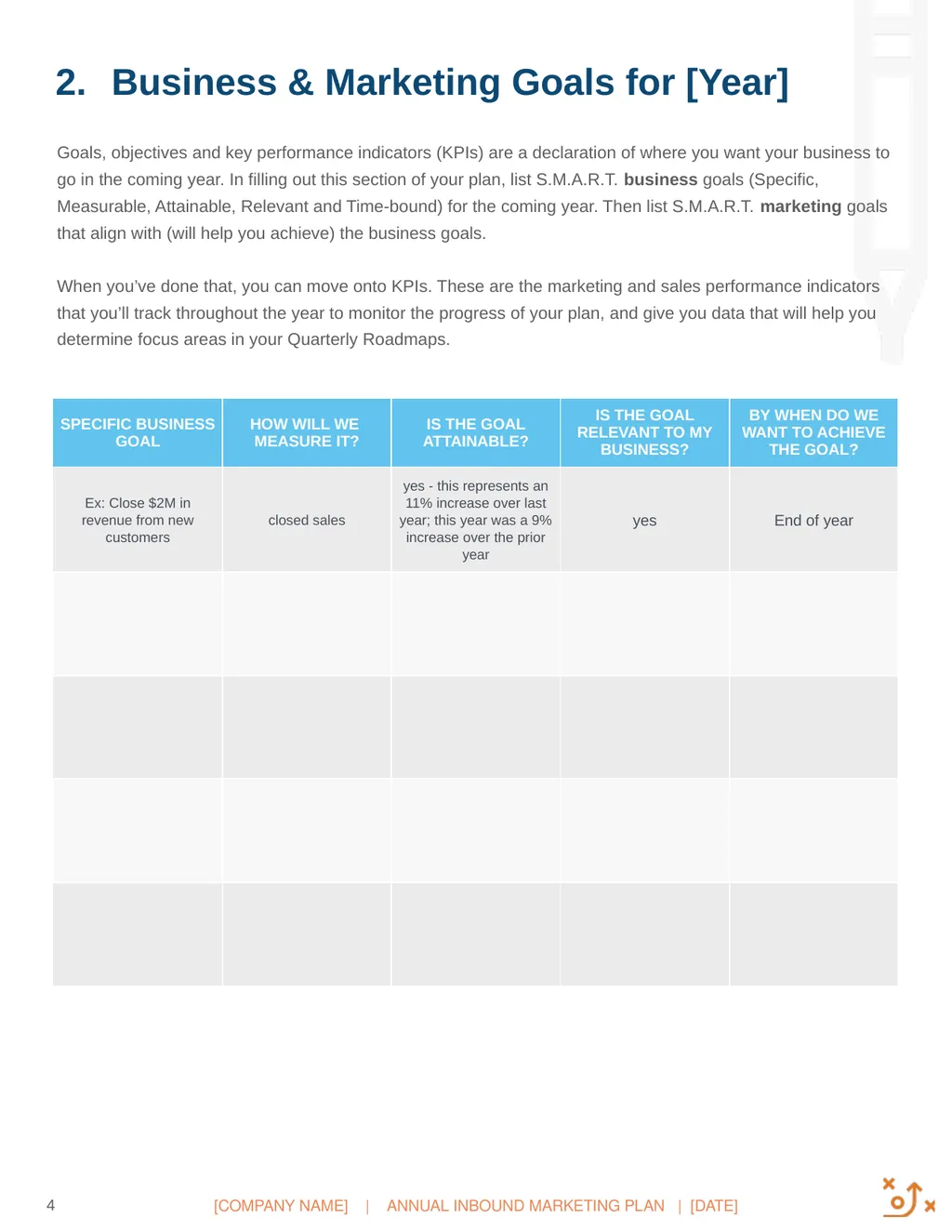
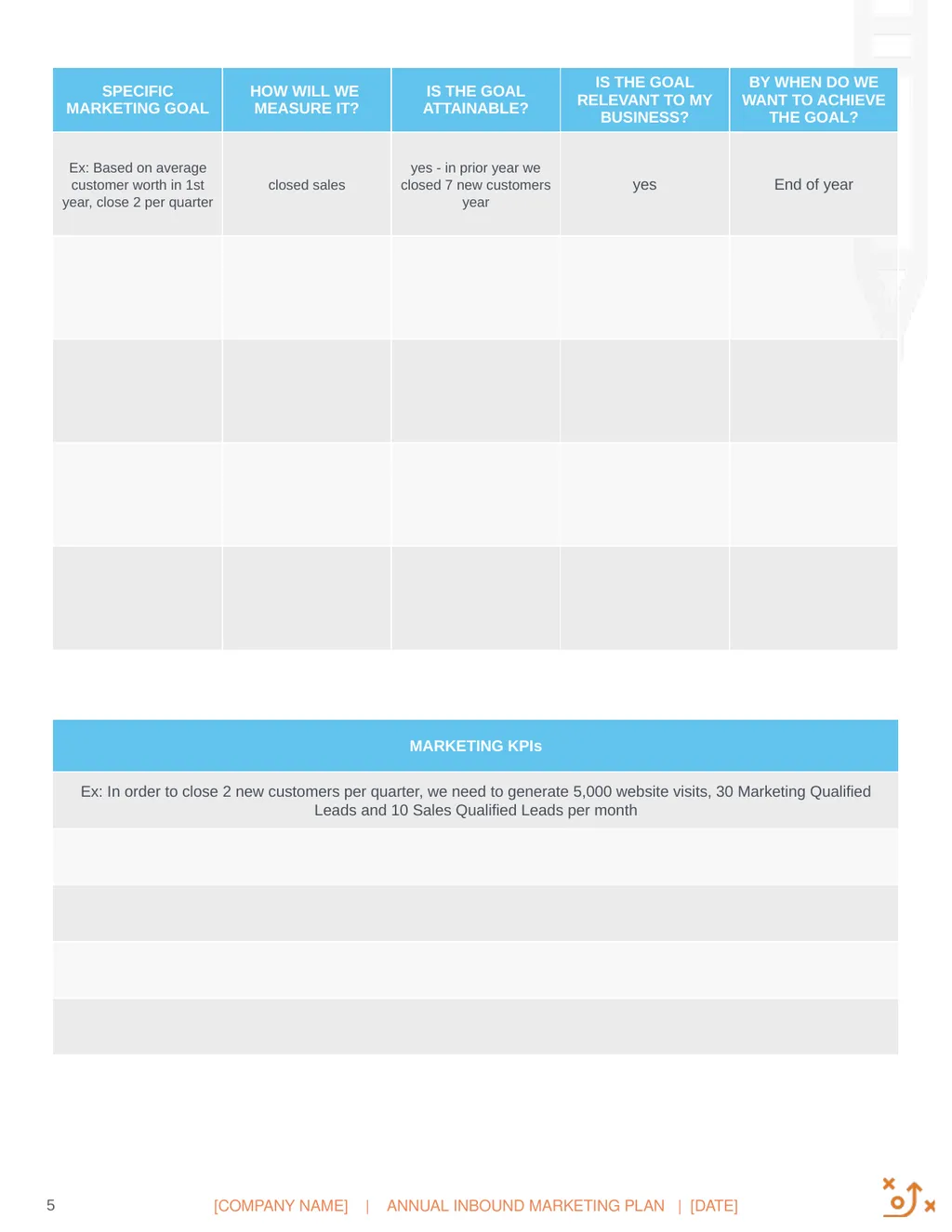
slide4. Business & Marketing Goals for [Year] Goals, objectives and key performance indicators (KPIs) are a declaration of where you want your business to go in the coming year. In filling out this section of your plan, list S.M.A.R.T. business goals (Specific, Measurable, Attainable, Relevant and Time-bound) for the coming year. Then list S.M.A.R.T. marketing goals that align with (will help you achieve) the business goals.
When you’ve done that, you can move onto KPIs. These are the marketing and sales performance indicators that you’ll track throughout the year to monitor the progress of your plan, and give you data that will help you determine focus areas in your Quarterly Roadmaps. 4<br>
slide5. 5<br>
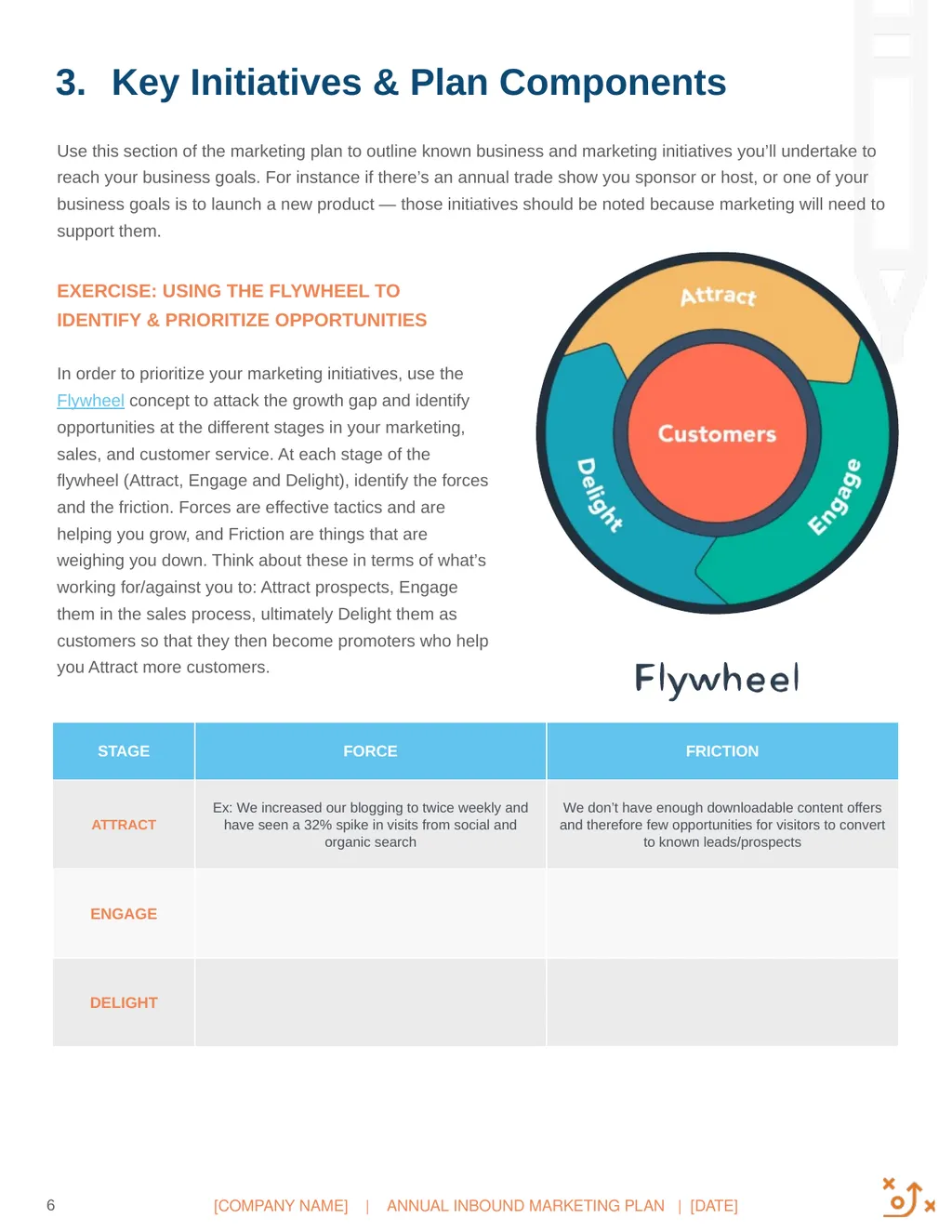
slide6. Key Initiatives & Plan Components Use this section of the marketing plan to outline known business and marketing initiatives you’ll undertake to reach your business goals. For instance if there’s an annual trade show you sponsor or host, or one of your business goals is to launch a new product — those initiatives should be noted because marketing will need to support them. EXERCISE: USING THE FLYWHEEL TO IDENTIFY & PRIORITIZE OPPORTUNITIES
In order to prioritize your marketing initiatives, use the Flywheel concept to attack the growth gap and identify opportunities at the different stages in your marketing, sales, and customer service. At each stage of the flywheel (Attract, Engage and Delight), identify the forces and the friction. Forces are effective tactics and are helping you grow, and Friction are things that are weighing you down. Think about these in terms of what’s working for/against you to: Attract prospects, Engage them in the sales process, ultimately Delight them as customers so that they then become promoters who help you Attract more customers. 6<br>
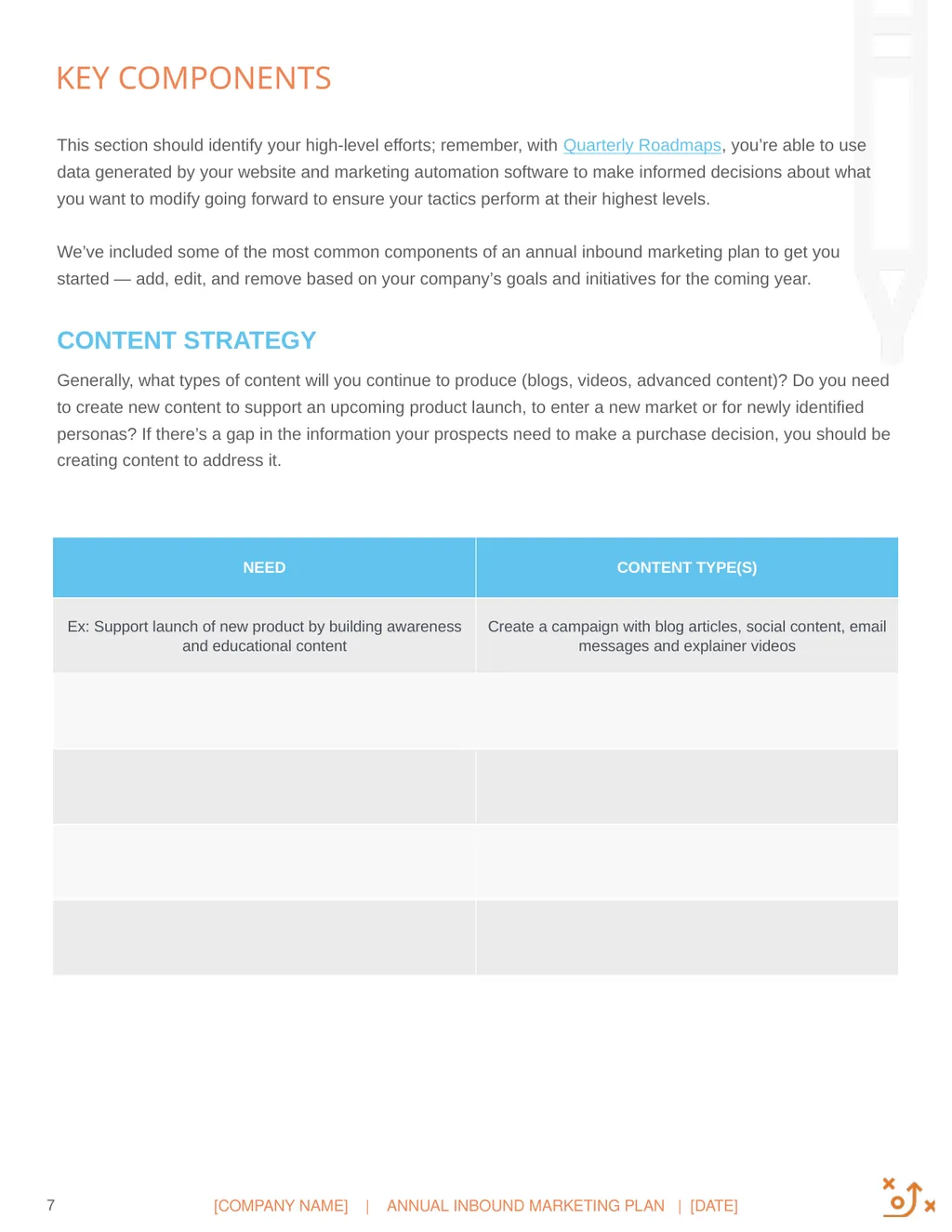
slide7. KEY COMPONENTS This section should identify your high-level efforts; remember, with Quarterly Roadmaps, you’re able to use data generated by your website and marketing automation software to make informed decisions about what you want to modify going forward to ensure your tactics perform at their highest levels.
We’ve included some of the most common components of an annual inbound marketing plan to get you started — add, edit, and remove based on your company’s goals and initiatives for the coming year.
CONTENT STRATEGY
Generally, what types of content will you continue to produce (blogs, videos, advanced content)? Do you need to create new content to support an upcoming product launch, to enter a new market or for newly identified personas? If there’s a gap in the information your prospects need to make a purchase decision, you should be creating content to address it. 7<br>
slide8. SEO STRATEGY
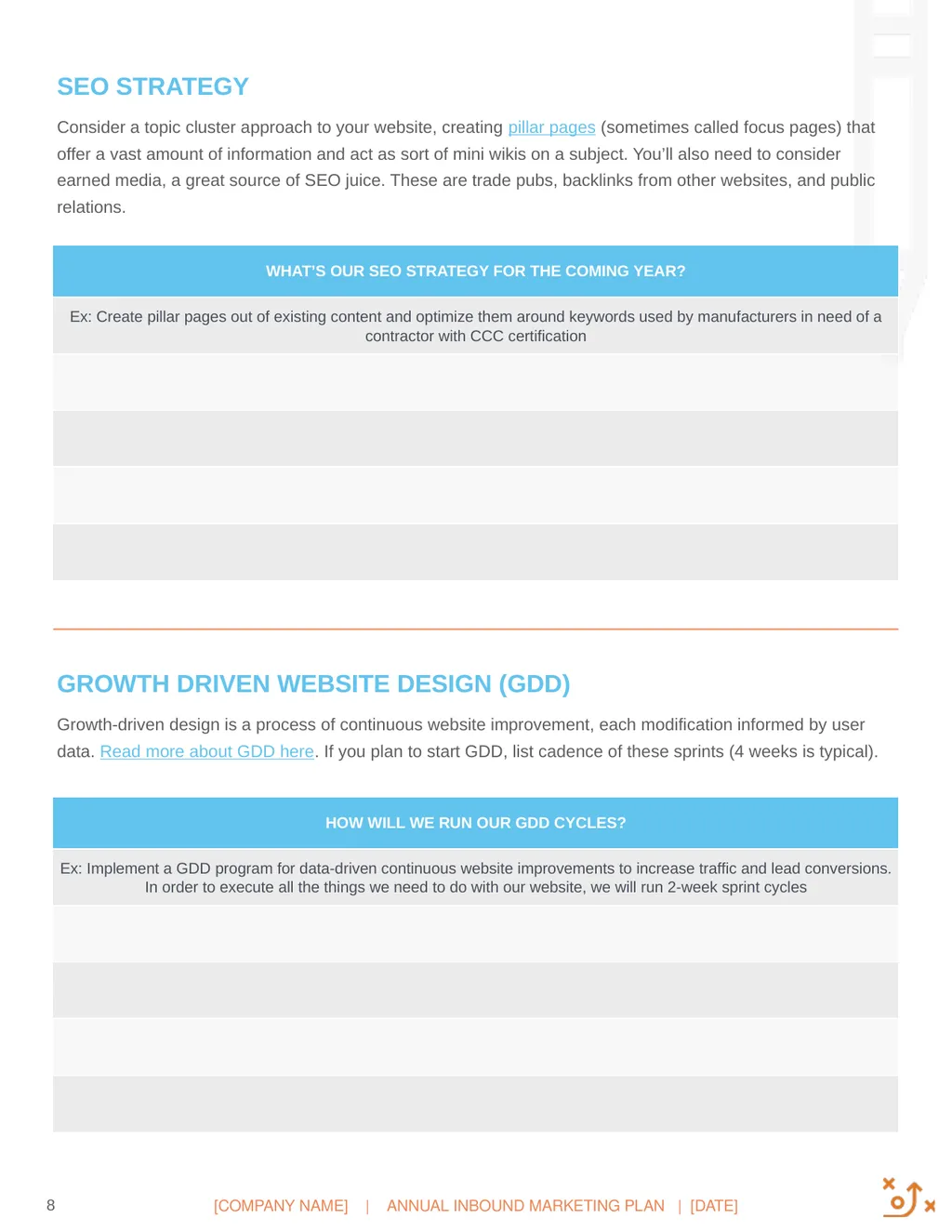
Consider a topic cluster approach to your website, creating pillar pages (sometimes called focus pages) that offer a vast amount of information and act as sort of mini wikis on a subject. You’ll also need to consider earned media, a great source of SEO juice. These are trade pubs, backlinks from other websites, and public relations. GROWTH DRIVEN WEBSITE DESIGN (GDD)
Growth-driven design is a process of continuous website improvement, each modification informed by user data. Read more about GDD here. If you plan to start GDD, list cadence of these sprints (4 weeks is typical). 8<br>
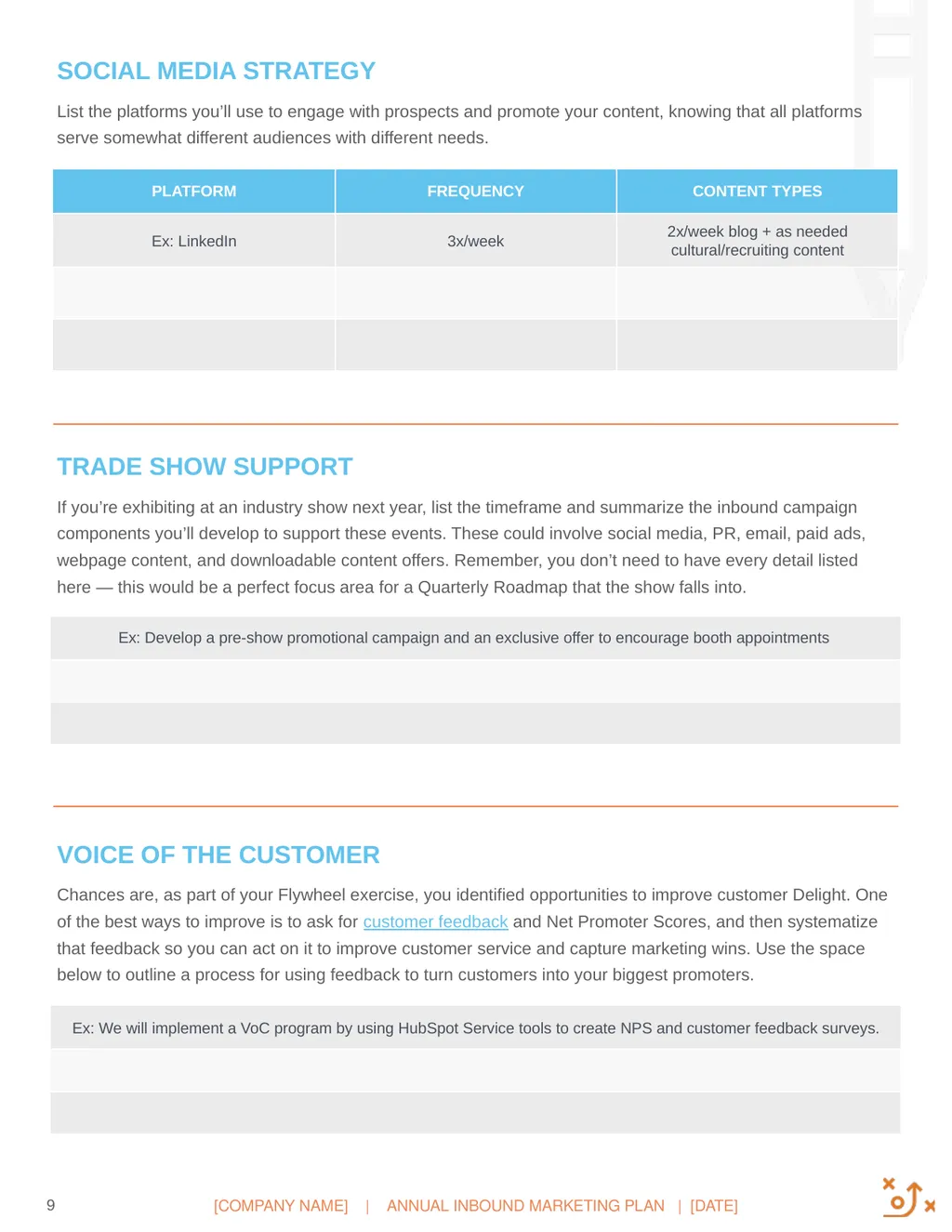
slide9. SOCIAL MEDIA STRATEGY
List the platforms you’ll use to engage with prospects and promote your content, knowing that all platforms serve somewhat different audiences with different needs. TRADE SHOW SUPPORT
If you’re exhibiting at an industry show next year, list the timeframe and summarize the inbound campaign components you’ll develop to support these events. These could involve social media, PR, email, paid ads, webpage content, and downloadable content offers. Remember, you don’t need to have every detail listed here — this would be a perfect focus area for a Quarterly Roadmap that the show falls into. VOICE OF THE CUSTOMER
Chances are, as part of your Flywheel exercise, you identified opportunities to improve customer Delight. One of the best ways to improve is to ask for customer feedback and Net Promoter Scores, and then systematize that feedback so you can act on it to improve customer service and capture marketing wins. Use the space below to outline a process for using feedback to turn customers into your biggest promoters. 9<br>
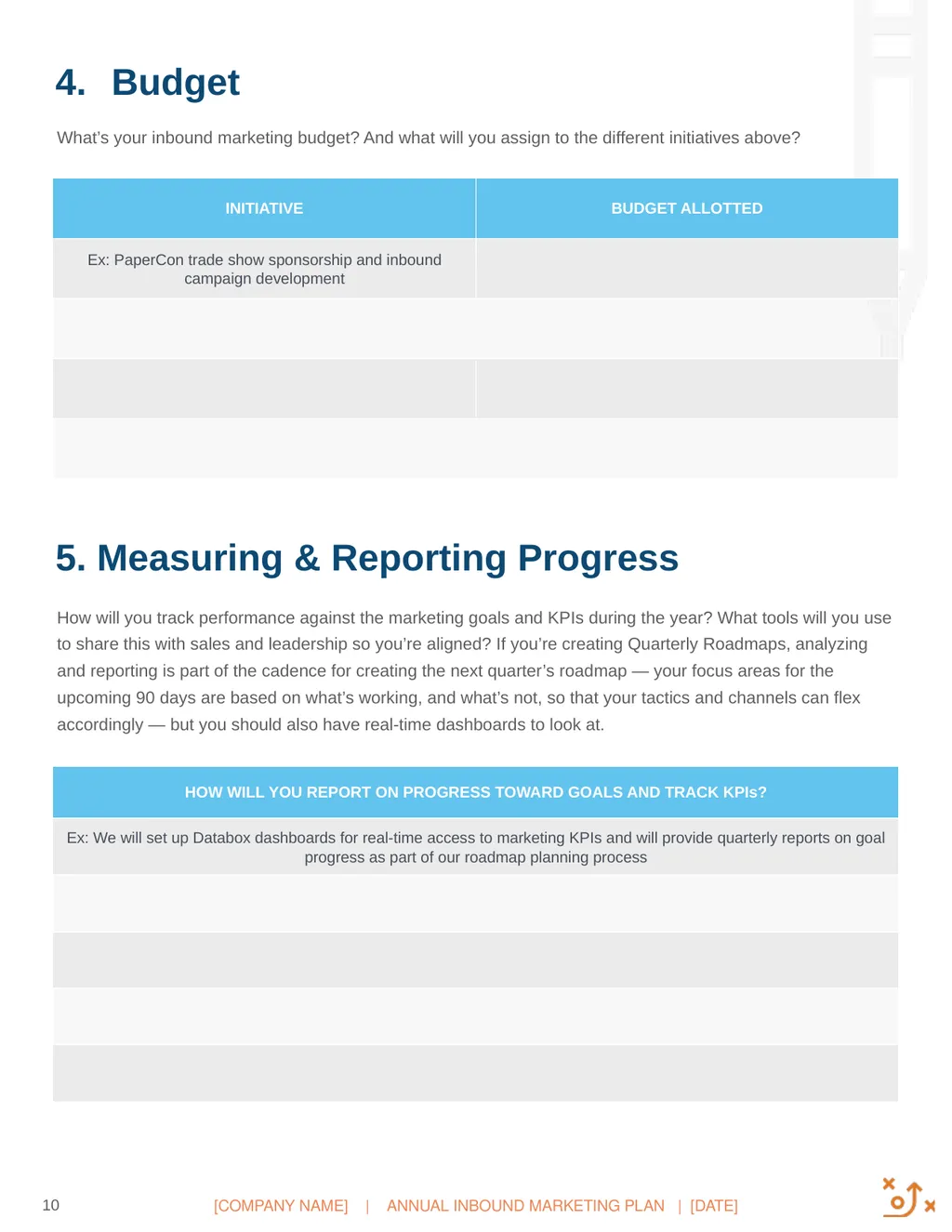
slide10. Budget What’s your inbound marketing budget? And what will you assign to the different initiatives above? 5. Measuring & Reporting Progress How will you track performance against the marketing goals and KPIs during the year? What tools will you use to share this with sales and leadership so you’re aligned? If you’re creating Quarterly Roadmaps, analyzing and reporting is part of the cadence for creating the next quarter’s roadmap — your focus areas for the upcoming 90 days are based on what’s working, and what’s not, so that your tactics and channels can flex accordingly — but you should also have real-time dashboards to look at. 10<br>
slide11. Need More Help Putting Together Your Inbound Marketing Plan?
We love helping companies in complex industries execute inbound strategies to help align their marketing and sales teams and grow their business better. Reach out for a free consultation today.
If you haven’t already, we also highly recommend subscribing to our blog where we frequently publish the latest best practices in inbound marketing, sales and growth. You can also follow us on LinkedIn, Twitter, and Facebook.
Oh, and you can delete this page from your own company’s plan. © 2019 Weidert Group Inc.<br>
[Year] [Your Company Logo]<br>
slide2. What’s in this template? I’m glad you asked. Here are the sections we’ve laid out for you to work in. This is an editable document, so feel free to adapt it to your company’s needs. The sections and examples we’ve provided are meant to give you an efficient framework to create your own annual inbound marketing plan. In order to do that, we recommend including the following:
Executive Summary — Business and Marketing Performance Review
S.M.A.R.T. Business & Marketing Goals for the Coming Year
Marketing Key Performance Indicators (KPIs)
High-Level Marketing Initiatives & Plan Components
Budget Allocation
Measuring & Reporting Progress Throughout the Year 2 INTRODUCTION Hey there, fellow marketer! Here’s why and how to use this annual marketing plan template:
Because you have a lot going on
You’re using an inbound marketing strategy, right? If so, that will help because then you have target personas, a buyer journey, competitive advantage and other “background” information to guide you.
If you’re curious what should be in your guiding inbound marketing strategy, check out this article. Your strategy should be a “playbook” of sorts that you’d put together as part of your foundational inbound marketing program and revisit at least annually as part of your planning process to ensure it’s still current. Think of it as the “why” behind your tactical plans.<br>
slide3. Executive Summary — Business and Marketing Performance Review Start by reviewing the current year’s business performance and marketing performance, and identify key takeaways that will affect your marketing efforts going forward.
Business Performance Review:
Report on the state of key business growth/profitability measures for the current year versus the prior year, such as: new business generated (number of customers and revenue), gross revenue, gross profit, gross margin, net profit before taxes, and units/pounds/parts sold.
Marketing Performance Review:
Review the results your current marketing efforts have generated based on your current year marketing goals and KPIs. Below, summarize what you’ve learned, creating buckets to identify which efforts you should continue (and perhaps double down on), which you should stop, and which you should start doing. 3<br>
slide4. Business & Marketing Goals for [Year] Goals, objectives and key performance indicators (KPIs) are a declaration of where you want your business to go in the coming year. In filling out this section of your plan, list S.M.A.R.T. business goals (Specific, Measurable, Attainable, Relevant and Time-bound) for the coming year. Then list S.M.A.R.T. marketing goals that align with (will help you achieve) the business goals.
When you’ve done that, you can move onto KPIs. These are the marketing and sales performance indicators that you’ll track throughout the year to monitor the progress of your plan, and give you data that will help you determine focus areas in your Quarterly Roadmaps. 4<br>
slide5. 5<br>
slide6. Key Initiatives & Plan Components Use this section of the marketing plan to outline known business and marketing initiatives you’ll undertake to reach your business goals. For instance if there’s an annual trade show you sponsor or host, or one of your business goals is to launch a new product — those initiatives should be noted because marketing will need to support them. EXERCISE: USING THE FLYWHEEL TO IDENTIFY & PRIORITIZE OPPORTUNITIES
In order to prioritize your marketing initiatives, use the Flywheel concept to attack the growth gap and identify opportunities at the different stages in your marketing, sales, and customer service. At each stage of the flywheel (Attract, Engage and Delight), identify the forces and the friction. Forces are effective tactics and are helping you grow, and Friction are things that are weighing you down. Think about these in terms of what’s working for/against you to: Attract prospects, Engage them in the sales process, ultimately Delight them as customers so that they then become promoters who help you Attract more customers. 6<br>
slide7. KEY COMPONENTS This section should identify your high-level efforts; remember, with Quarterly Roadmaps, you’re able to use data generated by your website and marketing automation software to make informed decisions about what you want to modify going forward to ensure your tactics perform at their highest levels.
We’ve included some of the most common components of an annual inbound marketing plan to get you started — add, edit, and remove based on your company’s goals and initiatives for the coming year.
CONTENT STRATEGY
Generally, what types of content will you continue to produce (blogs, videos, advanced content)? Do you need to create new content to support an upcoming product launch, to enter a new market or for newly identified personas? If there’s a gap in the information your prospects need to make a purchase decision, you should be creating content to address it. 7<br>
slide8. SEO STRATEGY
Consider a topic cluster approach to your website, creating pillar pages (sometimes called focus pages) that offer a vast amount of information and act as sort of mini wikis on a subject. You’ll also need to consider earned media, a great source of SEO juice. These are trade pubs, backlinks from other websites, and public relations. GROWTH DRIVEN WEBSITE DESIGN (GDD)
Growth-driven design is a process of continuous website improvement, each modification informed by user data. Read more about GDD here. If you plan to start GDD, list cadence of these sprints (4 weeks is typical). 8<br>
slide9. SOCIAL MEDIA STRATEGY
List the platforms you’ll use to engage with prospects and promote your content, knowing that all platforms serve somewhat different audiences with different needs. TRADE SHOW SUPPORT
If you’re exhibiting at an industry show next year, list the timeframe and summarize the inbound campaign components you’ll develop to support these events. These could involve social media, PR, email, paid ads, webpage content, and downloadable content offers. Remember, you don’t need to have every detail listed here — this would be a perfect focus area for a Quarterly Roadmap that the show falls into. VOICE OF THE CUSTOMER
Chances are, as part of your Flywheel exercise, you identified opportunities to improve customer Delight. One of the best ways to improve is to ask for customer feedback and Net Promoter Scores, and then systematize that feedback so you can act on it to improve customer service and capture marketing wins. Use the space below to outline a process for using feedback to turn customers into your biggest promoters. 9<br>
slide10. Budget What’s your inbound marketing budget? And what will you assign to the different initiatives above? 5. Measuring & Reporting Progress How will you track performance against the marketing goals and KPIs during the year? What tools will you use to share this with sales and leadership so you’re aligned? If you’re creating Quarterly Roadmaps, analyzing and reporting is part of the cadence for creating the next quarter’s roadmap — your focus areas for the upcoming 90 days are based on what’s working, and what’s not, so that your tactics and channels can flex accordingly — but you should also have real-time dashboards to look at. 10<br>
slide11. Need More Help Putting Together Your Inbound Marketing Plan?
We love helping companies in complex industries execute inbound strategies to help align their marketing and sales teams and grow their business better. Reach out for a free consultation today.
If you haven’t already, we also highly recommend subscribing to our blog where we frequently publish the latest best practices in inbound marketing, sales and growth. You can also follow us on LinkedIn, Twitter, and Facebook.
Oh, and you can delete this page from your own company’s plan. © 2019 Weidert Group Inc.<br>