
Annual Review Meeting Operational Programme

Description: Annual Review Meeting Operational Programme Growth and Employment The Ministry of Finance 22.11.2023. 2. Strategic aspects of implementation 2.1. Overall economic outlook, achievement of strategic objectives and CSRs (current situation
Related Topics
Download Presentation
"Annual Review Meeting Operational Programme" is the property of its rightful owner. Permission is granted to download and print the materials on this website for personal, non-commercial use only, and to display it on your personal computer provided you do not modify the materials and that you retain all copyright notices contained in the materials. By downloading content from our website, you accept the terms of this agreement.
Presentation Transcript
slide1. Annual Review Meeting Operational Programme
«Growth and Employment» The Ministry of Finance
22.11.2023.<br>
slide2. 2. Strategic aspects of implementation 2.1. Overall economic outlook, achievement of strategic objectives and CSRs (current situation and prognosis); 2.2. Main findings of evaluations performed in 2023; 2.3. EU Strategy for the Baltic Sea Region (EUSBR). State of play of cooperation activities in the region. 2<br>
slide3. 2.1. Overall economic outlook, achievement of strategic objectives and CSRs 3<br>
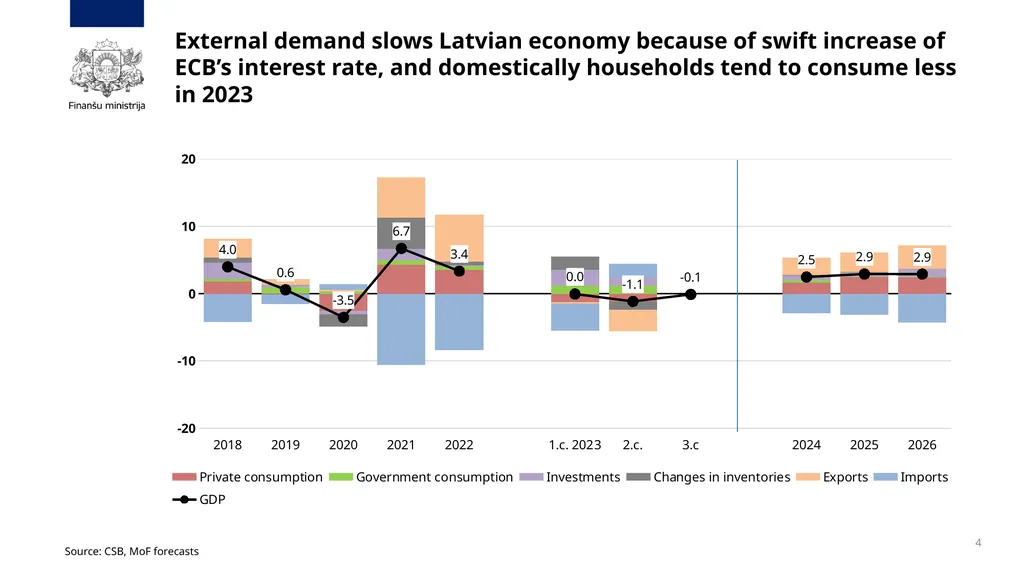
slide4. Source: CSB, MoF forecasts 4 External demand slows Latvian economy because of swift increase of ECB’s interest rate, and domestically households tend to consume less in 2023<br>
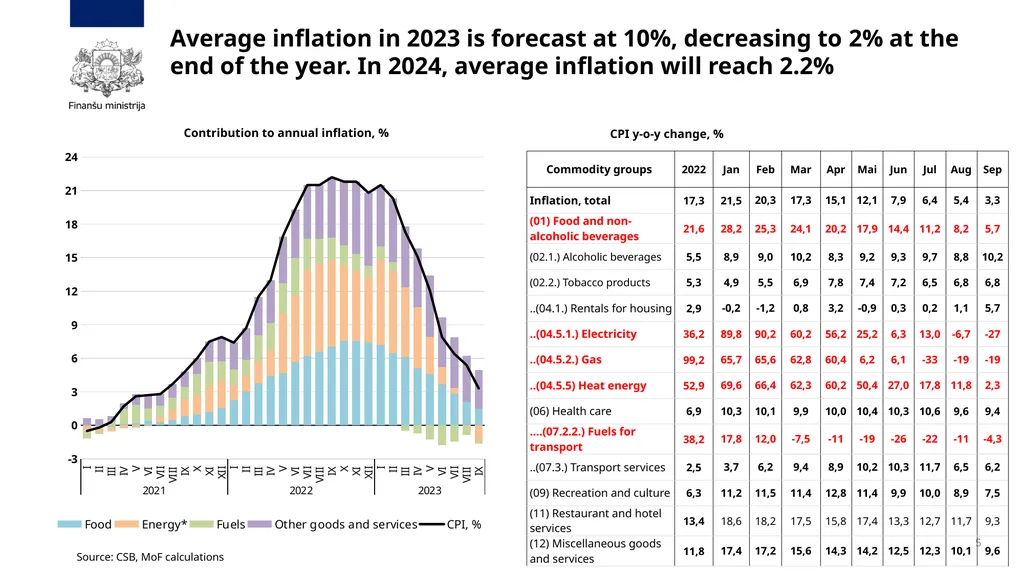
slide5. Average inflation in 2023 is forecast at 10%, decreasing to 2% at the end of the year. In 2024, average inflation will reach 2.2% 5 Source: CSB, MoF calculations Contribution to annual inflation, % CPI y-o-y change, %<br>
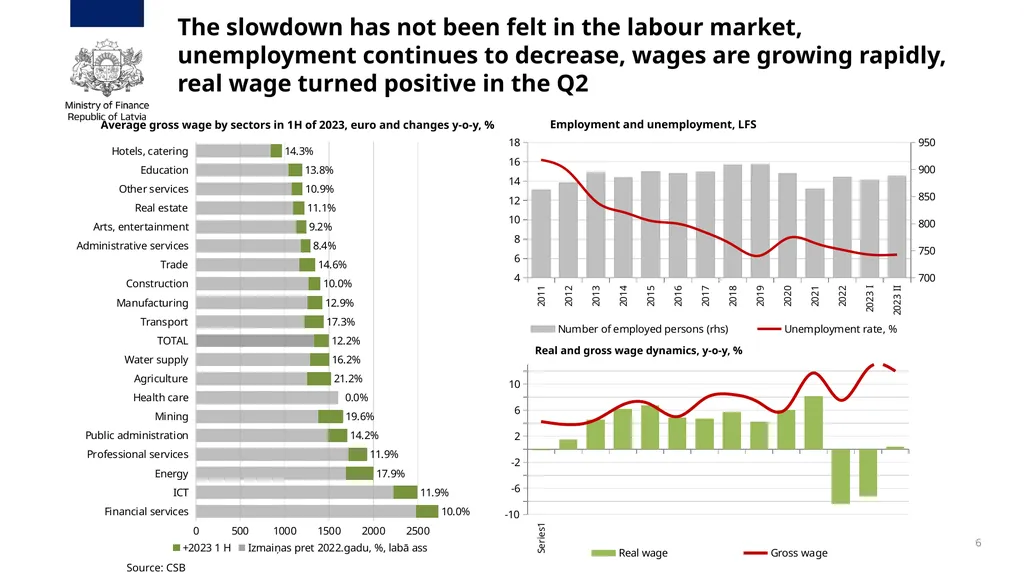
slide6. The slowdown has not been felt in the labour market, unemployment continues to decrease, wages are growing rapidly, real wage turned positive in the Q2 Source: CSB Employment and unemployment, LFS Average gross wage by sectors in 1H of 2023, euro and changes y-o-y, % Real and gross wage dynamics, y-o-y, % 6<br>
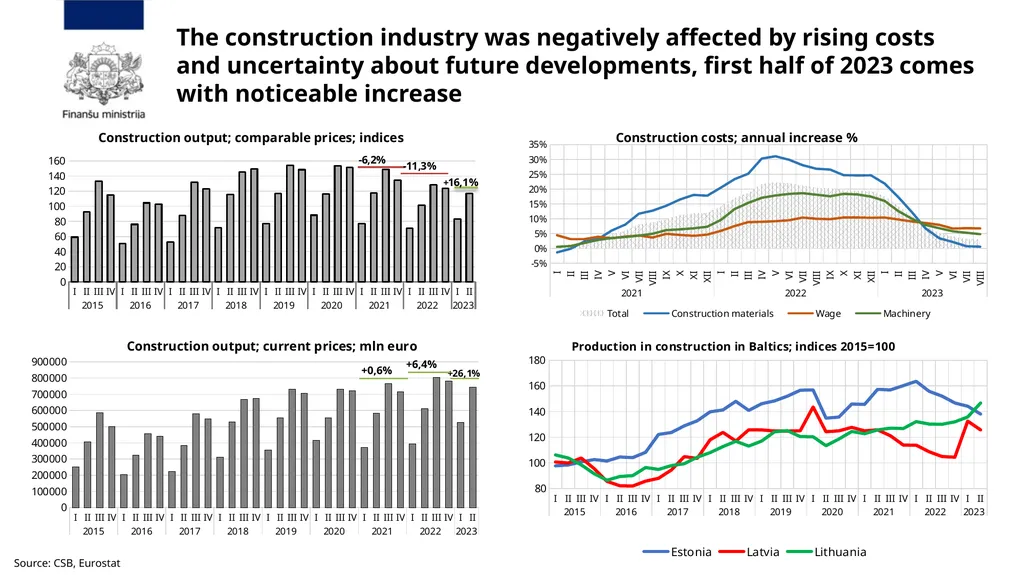
slide7. The construction industry was negatively affected by rising costs and uncertainty about future developments, first half of 2023 comes with noticeable increase Source: CSB, Eurostat +0,6% +6,4%<br>
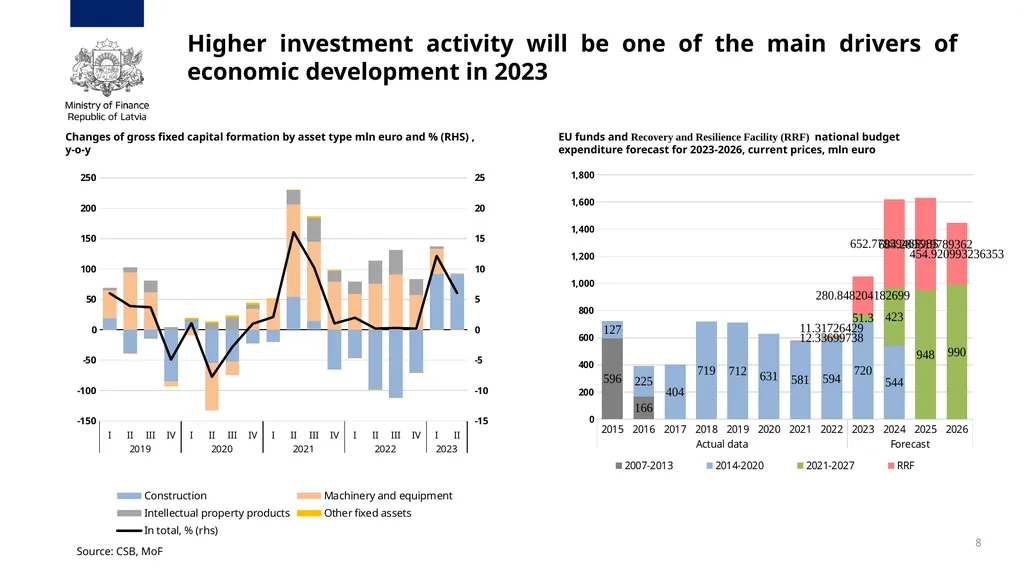
slide8. 8 Higher investment activity will be one of the main drivers of economic development in 2023 Source: CSB, MoF Changes of gross fixed capital formation by asset type mln euro and % (RHS) , y-o-y EU funds and Recovery and Resilience Facility (RRF) national budget expenditure forecast for 2023-2026, current prices, mln euro<br>
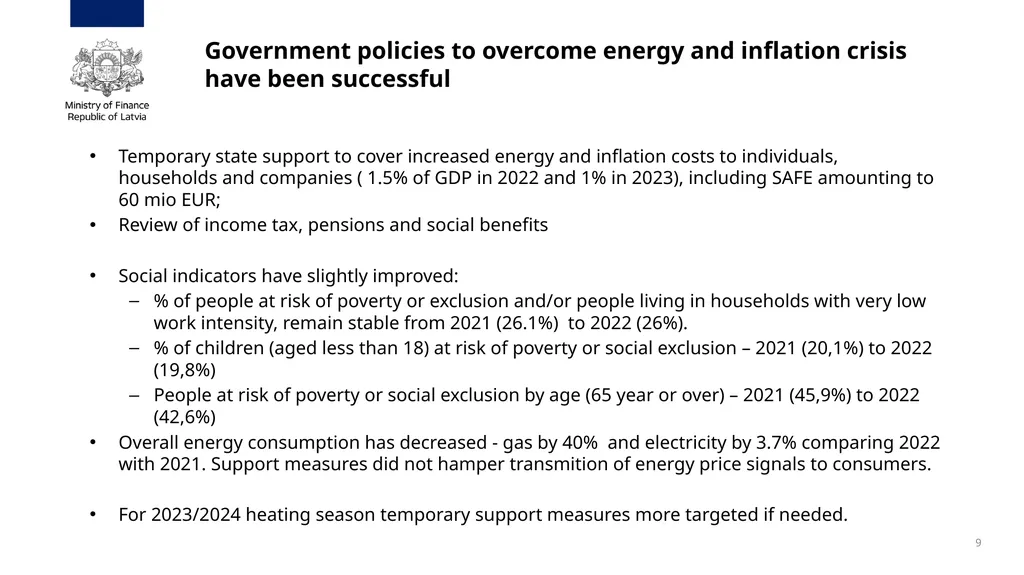
slide9. Government policies to overcome energy and inflation crisis have been successful Temporary state support to cover increased energy and inflation costs to individuals, households and companies ( 1.5% of GDP in 2022 and 1% in 2023), including SAFE amounting to 60 mio EUR;
Review of income tax, pensions and social benefits
Social indicators have slightly improved:
% of people at risk of poverty or exclusion and/or people living in households with very low work intensity, remain stable from 2021 (26.1%) to 2022 (26%).
% of children (aged less than 18) at risk of poverty or social exclusion – 2021 (20,1%) to 2022 (19,8%)
People at risk of poverty or social exclusion by age (65 year or over) – 2021 (45,9%) to 2022 (42,6%)
Overall energy consumption has decreased - gas by 40% and electricity by 3.7% comparing 2022 with 2021. Support measures did not hamper transmition of energy price signals to consumers.
For 2023/2024 heating season temporary support measures more targeted if needed. 9<br>
slide10. Macroeconomic and socioeconomic risks for economic development and EU fund implementation Prolonged high overall uncertainty and subdued growth for main trading partners.
Geopolitical risks that have materialised:
gas imports from Russia from 100% to 0% in one year
unprecedented inflation driven mostly by energy cost increases -> disruptions in project implementation
export share of goods and services to Russia down to 4,9% in 2022 from 11.7% in 2014
increased security risks on external border in addition to economic development challenges
Increased borrowing costs and high prices impact financial capacity of economy players, beneficiaries, especially in private sector.
Demographic trends in medium term – as of 2025 number of persons employed expected to decline (end of pension reform, shrinking population). 10<br>
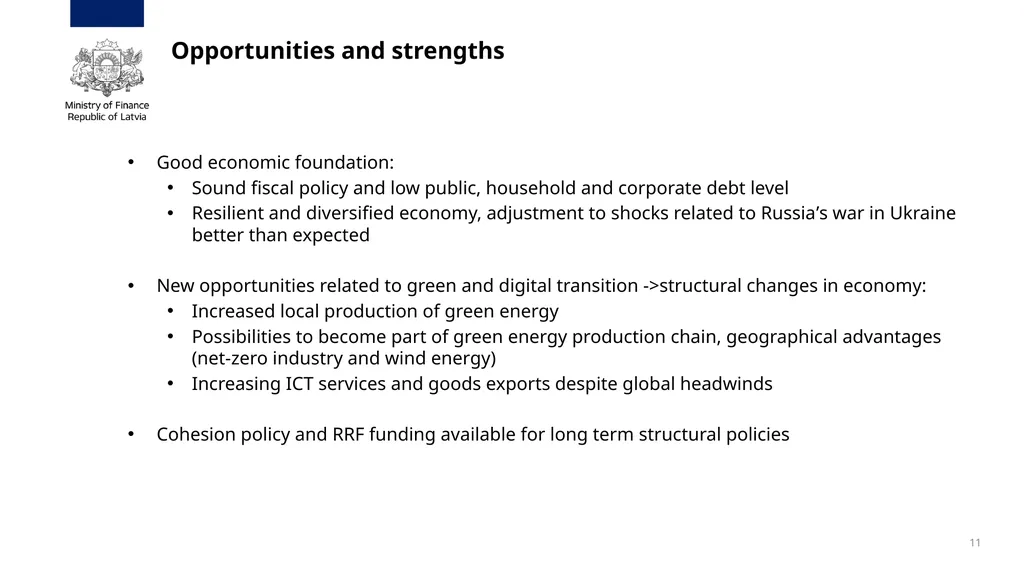
slide11. Opportunities and strengths Good economic foundation:
Sound fiscal policy and low public, household and corporate debt level
Resilient and diversified economy, adjustment to shocks related to Russia’s war in Ukraine better than expected
New opportunities related to green and digital transition ->structural changes in economy:
Increased local production of green energy
Possibilities to become part of green energy production chain, geographical advantages (net-zero industry and wind energy)
Increasing ICT services and goods exports despite global headwinds
Cohesion policy and RRF funding available for long term structural policies 11<br>
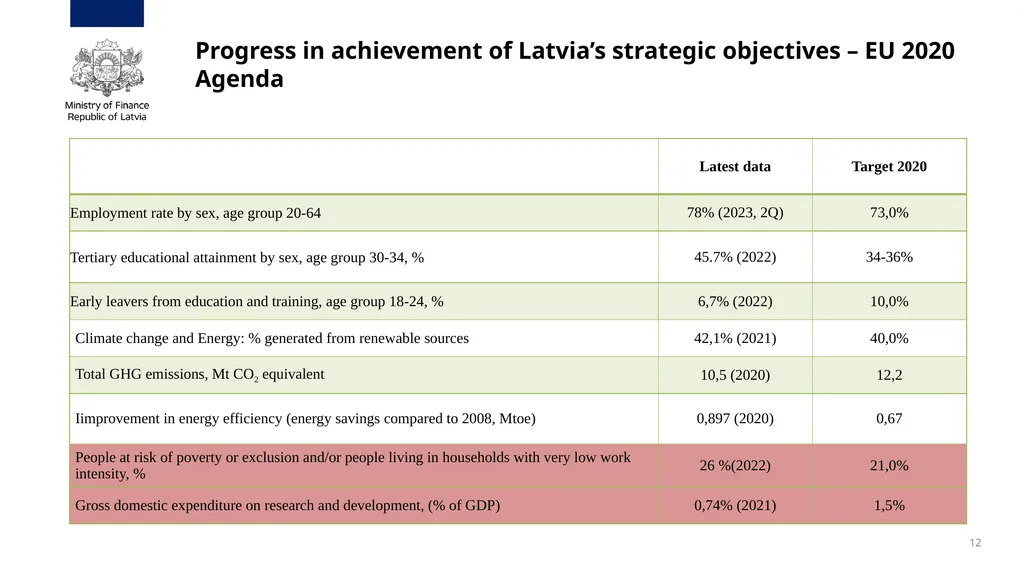
slide12. Progress in achievement of Latvia’s strategic objectives – EU 2020 Agenda 12<br>
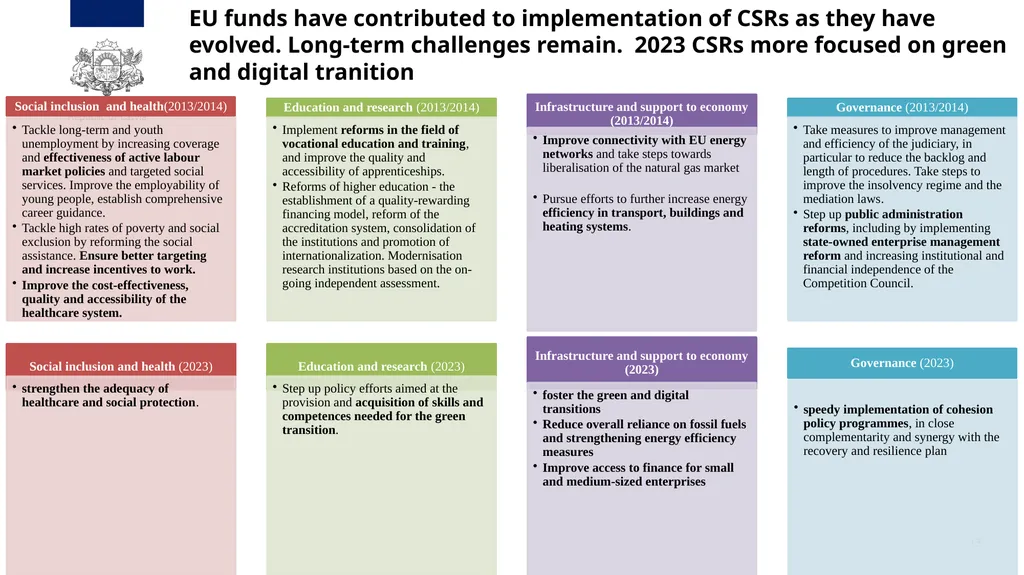
slide13. EU funds have contributed to implementation of CSRs as they have evolved. Long-term challenges remain. 2023 CSRs more focused on green and digital tranition 13<br>
slide14. 2.2. Main findings of evaluations performed in 2022 14<br>
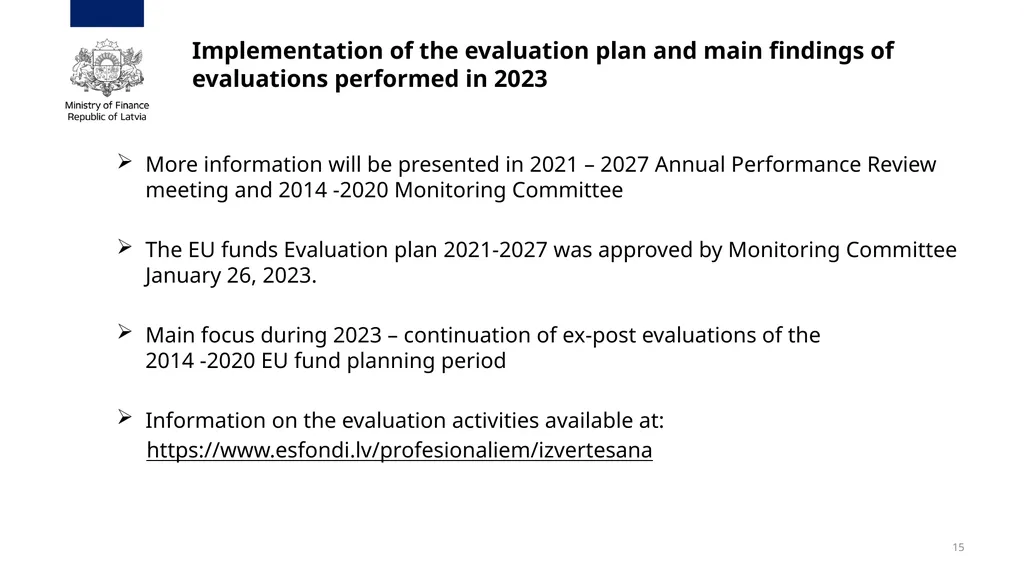
slide15. Implementation of the evaluation plan and main findings of evaluations performed in 2023 More information will be presented in 2021 – 2027 Annual Performance Review meeting and 2014 -2020 Monitoring Committee
The EU funds Evaluation plan 2021-2027 was approved by Monitoring Committee January 26, 2023.
Main focus during 2023 – continuation of ex-post evaluations of the 2014 -2020 EU fund planning period
Information on the evaluation activities available at:
https://www.esfondi.lv/profesionaliem/izvertesana 15<br>
slide16. 2.3. EU Strategy for the Baltic Sea Region (EUSBR). State of play of cooperation activities in the region 16<br>
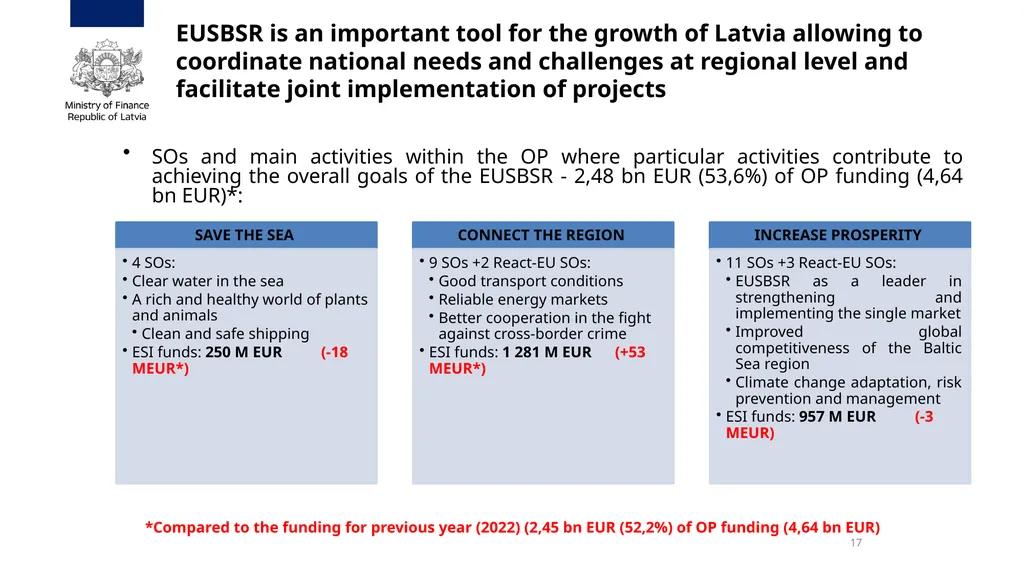
slide17. EUSBSR is an important tool for the growth of Latvia allowing to coordinate national needs and challenges at regional level and facilitate joint implementation of projects SOs and main activities within the OP where particular activities contribute to achieving the overall goals of the EUSBSR - 2,48 bn EUR (53,6%) of OP funding (4,64 bn EUR)*:
*Compared to the funding for previous year (2022) (2,45 bn EUR (52,2%) of OP funding (4,64 bn EUR) 17<br>
slide18. State of play of EUSBR cooperation activities in the region Since 2016 Latvia is a member of the EUSBSR ERDF Managing Authorities’ Network.
66 projects* with participation of Latvian partners have been approved under the Interreg Baltic Sea Region Programme 2021-2027 contributing to the implementation of the EUSBSR - EUR 18.9 million ERDF allocated to Latvian partners.
The Annual EUSBSR Forum took place in Riga on 4-5 October 2023.
Latvia will continue to facilitate cross-sectoral cooperation in the region during its Presidency in EUSBSR National Coordinators’ Group from July 2023 till June 2024.
* Data as of 24.10.2023 18<br>
slide19. Annual Review Meeting Operational Programme «Growth and Employment» The Ministry of Finance
22.11.2023.<br>
22.11.2023.<br>
slide2. 2. Strategic aspects of implementation 2.1. Overall economic outlook, achievement of strategic objectives and CSRs (current situation and prognosis); 2.2. Main findings of evaluations performed in 2023; 2.3. EU Strategy for the Baltic Sea Region (EUSBR). State of play of cooperation activities in the region. 2<br>
slide3. 2.1. Overall economic outlook, achievement of strategic objectives and CSRs 3<br>
slide4. Source: CSB, MoF forecasts 4 External demand slows Latvian economy because of swift increase of ECB’s interest rate, and domestically households tend to consume less in 2023<br>
slide5. Average inflation in 2023 is forecast at 10%, decreasing to 2% at the end of the year. In 2024, average inflation will reach 2.2% 5 Source: CSB, MoF calculations Contribution to annual inflation, % CPI y-o-y change, %<br>
slide6. The slowdown has not been felt in the labour market, unemployment continues to decrease, wages are growing rapidly, real wage turned positive in the Q2 Source: CSB Employment and unemployment, LFS Average gross wage by sectors in 1H of 2023, euro and changes y-o-y, % Real and gross wage dynamics, y-o-y, % 6<br>
slide7. The construction industry was negatively affected by rising costs and uncertainty about future developments, first half of 2023 comes with noticeable increase Source: CSB, Eurostat +0,6% +6,4%<br>
slide8. 8 Higher investment activity will be one of the main drivers of economic development in 2023 Source: CSB, MoF Changes of gross fixed capital formation by asset type mln euro and % (RHS) , y-o-y EU funds and Recovery and Resilience Facility (RRF) national budget expenditure forecast for 2023-2026, current prices, mln euro<br>
slide9. Government policies to overcome energy and inflation crisis have been successful Temporary state support to cover increased energy and inflation costs to individuals, households and companies ( 1.5% of GDP in 2022 and 1% in 2023), including SAFE amounting to 60 mio EUR;
Review of income tax, pensions and social benefits
Social indicators have slightly improved:
% of people at risk of poverty or exclusion and/or people living in households with very low work intensity, remain stable from 2021 (26.1%) to 2022 (26%).
% of children (aged less than 18) at risk of poverty or social exclusion – 2021 (20,1%) to 2022 (19,8%)
People at risk of poverty or social exclusion by age (65 year or over) – 2021 (45,9%) to 2022 (42,6%)
Overall energy consumption has decreased - gas by 40% and electricity by 3.7% comparing 2022 with 2021. Support measures did not hamper transmition of energy price signals to consumers.
For 2023/2024 heating season temporary support measures more targeted if needed. 9<br>
slide10. Macroeconomic and socioeconomic risks for economic development and EU fund implementation Prolonged high overall uncertainty and subdued growth for main trading partners.
Geopolitical risks that have materialised:
gas imports from Russia from 100% to 0% in one year
unprecedented inflation driven mostly by energy cost increases -> disruptions in project implementation
export share of goods and services to Russia down to 4,9% in 2022 from 11.7% in 2014
increased security risks on external border in addition to economic development challenges
Increased borrowing costs and high prices impact financial capacity of economy players, beneficiaries, especially in private sector.
Demographic trends in medium term – as of 2025 number of persons employed expected to decline (end of pension reform, shrinking population). 10<br>
slide11. Opportunities and strengths Good economic foundation:
Sound fiscal policy and low public, household and corporate debt level
Resilient and diversified economy, adjustment to shocks related to Russia’s war in Ukraine better than expected
New opportunities related to green and digital transition ->structural changes in economy:
Increased local production of green energy
Possibilities to become part of green energy production chain, geographical advantages (net-zero industry and wind energy)
Increasing ICT services and goods exports despite global headwinds
Cohesion policy and RRF funding available for long term structural policies 11<br>
slide12. Progress in achievement of Latvia’s strategic objectives – EU 2020 Agenda 12<br>
slide13. EU funds have contributed to implementation of CSRs as they have evolved. Long-term challenges remain. 2023 CSRs more focused on green and digital tranition 13<br>
slide14. 2.2. Main findings of evaluations performed in 2022 14<br>
slide15. Implementation of the evaluation plan and main findings of evaluations performed in 2023 More information will be presented in 2021 – 2027 Annual Performance Review meeting and 2014 -2020 Monitoring Committee
The EU funds Evaluation plan 2021-2027 was approved by Monitoring Committee January 26, 2023.
Main focus during 2023 – continuation of ex-post evaluations of the 2014 -2020 EU fund planning period
Information on the evaluation activities available at:
https://www.esfondi.lv/profesionaliem/izvertesana 15<br>
slide16. 2.3. EU Strategy for the Baltic Sea Region (EUSBR). State of play of cooperation activities in the region 16<br>
slide17. EUSBSR is an important tool for the growth of Latvia allowing to coordinate national needs and challenges at regional level and facilitate joint implementation of projects SOs and main activities within the OP where particular activities contribute to achieving the overall goals of the EUSBSR - 2,48 bn EUR (53,6%) of OP funding (4,64 bn EUR)*:
*Compared to the funding for previous year (2022) (2,45 bn EUR (52,2%) of OP funding (4,64 bn EUR) 17<br>
slide18. State of play of EUSBR cooperation activities in the region Since 2016 Latvia is a member of the EUSBSR ERDF Managing Authorities’ Network.
66 projects* with participation of Latvian partners have been approved under the Interreg Baltic Sea Region Programme 2021-2027 contributing to the implementation of the EUSBSR - EUR 18.9 million ERDF allocated to Latvian partners.
The Annual EUSBSR Forum took place in Riga on 4-5 October 2023.
Latvia will continue to facilitate cross-sectoral cooperation in the region during its Presidency in EUSBSR National Coordinators’ Group from July 2023 till June 2024.
* Data as of 24.10.2023 18<br>
slide19. Annual Review Meeting Operational Programme «Growth and Employment» The Ministry of Finance
22.11.2023.<br>