ANS Pharmacology: General Considerations(Part-I) Dr. Rashmi Rekha Kumari Asstt. Prof, Deptt. Of Pharmacology Toxicology,BVC,Patna-14 Autonomic Nervous System: General considerations Nervous system division CNS: Brain and spinal chord
"ANS Pharmacology: General Considerations(Part-I)" is the property of its rightful owner. Permission is granted to
download and print the materials on this website for personal, non-commercial use only, and to display it
on your personal computer provided you do not modify the materials and that you retain all copyright
notices contained in the materials. By downloading content from our website, you accept the terms of this
agreement.
Presentation Transcript
01
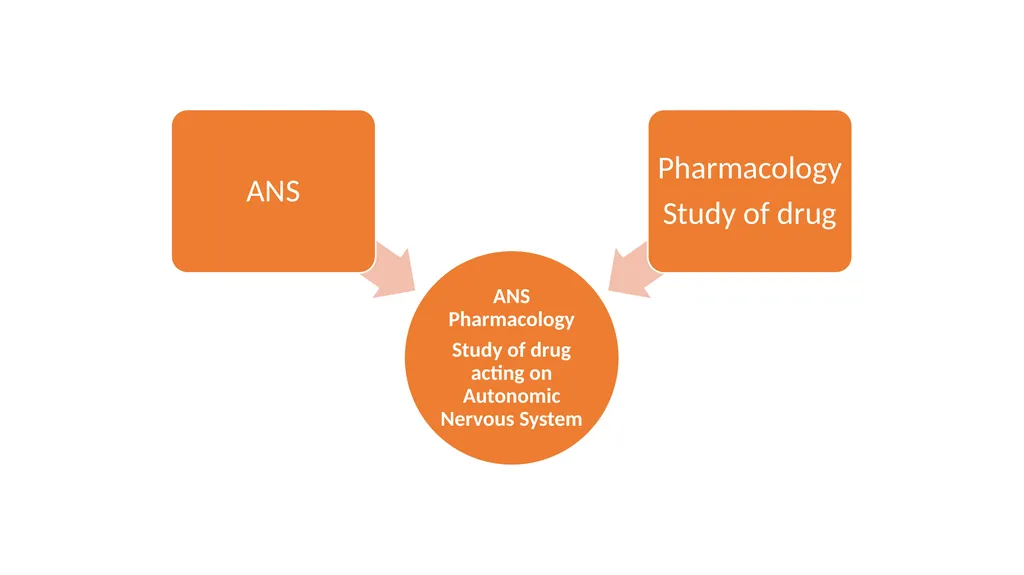
ANS Pharmacology: General Considerations(Part-I) Dr. Rashmi Rekha Kumari
Asstt. Prof, Deptt. Of Pharmacology & Toxicology,BVC,Patna-14<br>
02
Autonomic Nervous System: General considerations<br>
03
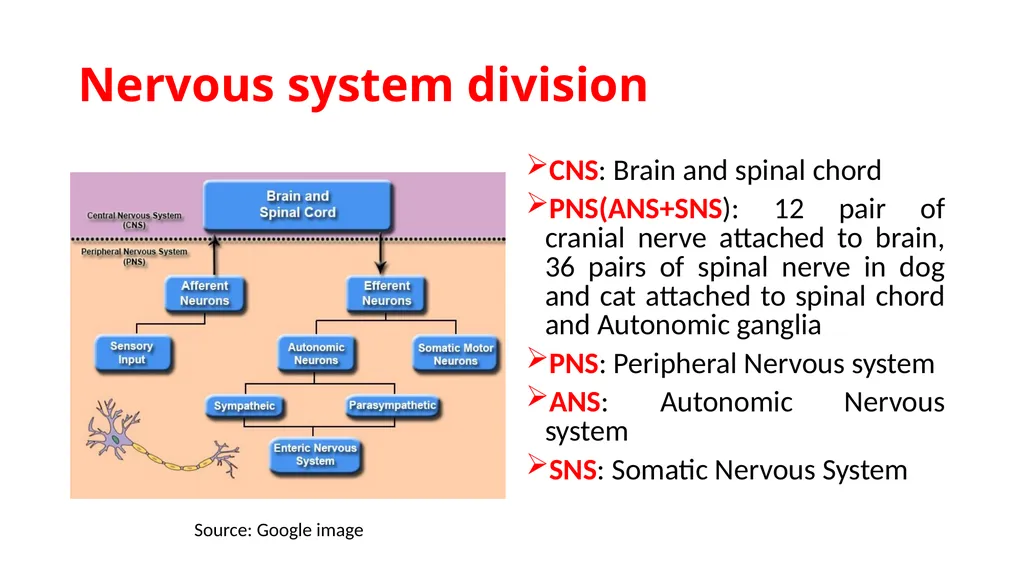
Nervous system division CNS: Brain and spinal chord
PNS(ANS+SNS): 12 pair of cranial nerve attached to brain, 36 pairs of spinal nerve in dog and cat attached to spinal chord and Autonomic ganglia
PNS: Peripheral Nervous system
ANS: Autonomic Nervous system
SNS: Somatic Nervous System Source: Google image<br>
04
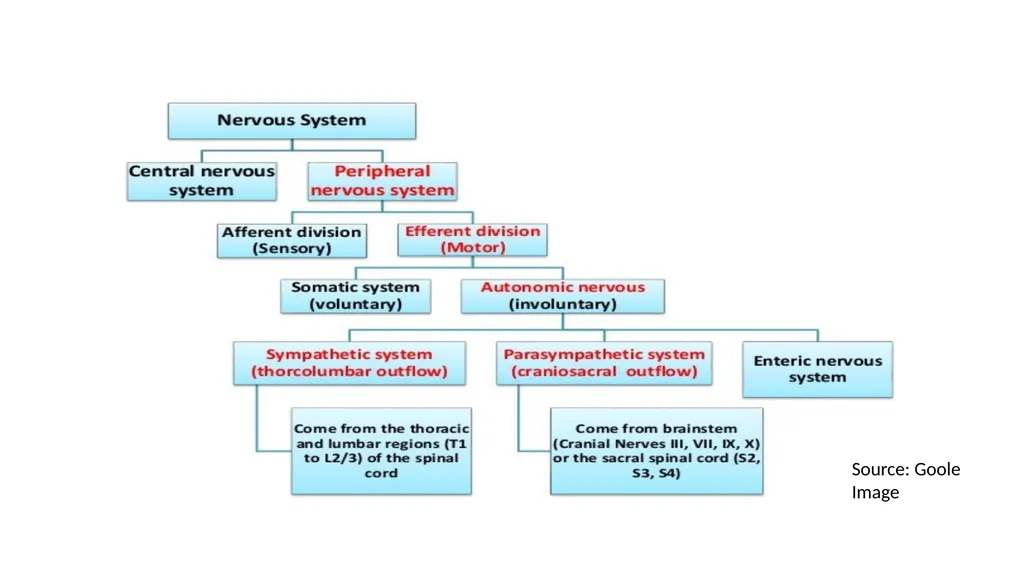
Source: Goole Image<br>
05
Organisation and Function of ANS ANS functions below the level of consciousness
Control Visceral functions
Also called Visceral, vegetative and involuntary nervous system
In the periphery its representation consist of nerves, ganglia and plexuses that provide innervation to visceral tissue
The efferent division of ANS supply all innervated structure of body except skeletal muscle
Skeletal muscle is supplied by somatic nerve<br>
06
Function of ANS •The autonomic nervous system in periphery is a complex of nerve, plexuses and ganglia that are organized to modulate the involuntary activity of secretory glands, smooth muscle and visceral organ
• The autonomic nervous system (ANS) is a complex set of neurons that mediate internal homeostasis without conscious intervention or voluntary control.
•Thus respiration, circulation, digestion, body temperature, metabolism, sweating and the secretion of certain endocrine gland are regulated in part or entirely by ANS.<br>
07
ANS function to sustain homeostatic condition during the period of reduced physical activity and also assist in internal bodily reaction to stressful circumstances.
In relation to clinical Pharmacology the most important components of nervous system are the outflow(efferent) nerve track.
Efferent nerve tracks supply motor innervation to visceral structures<br>
08
.
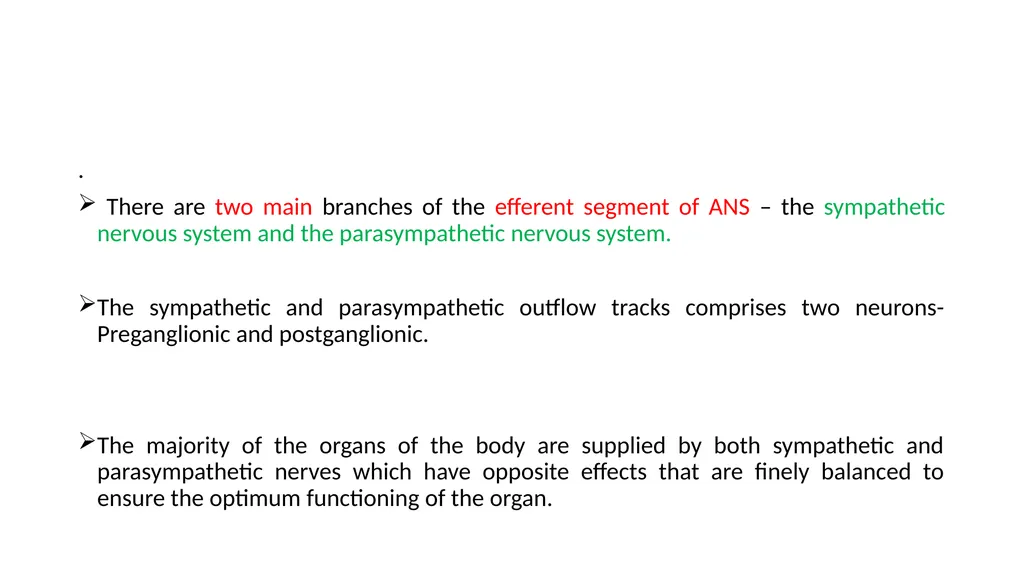
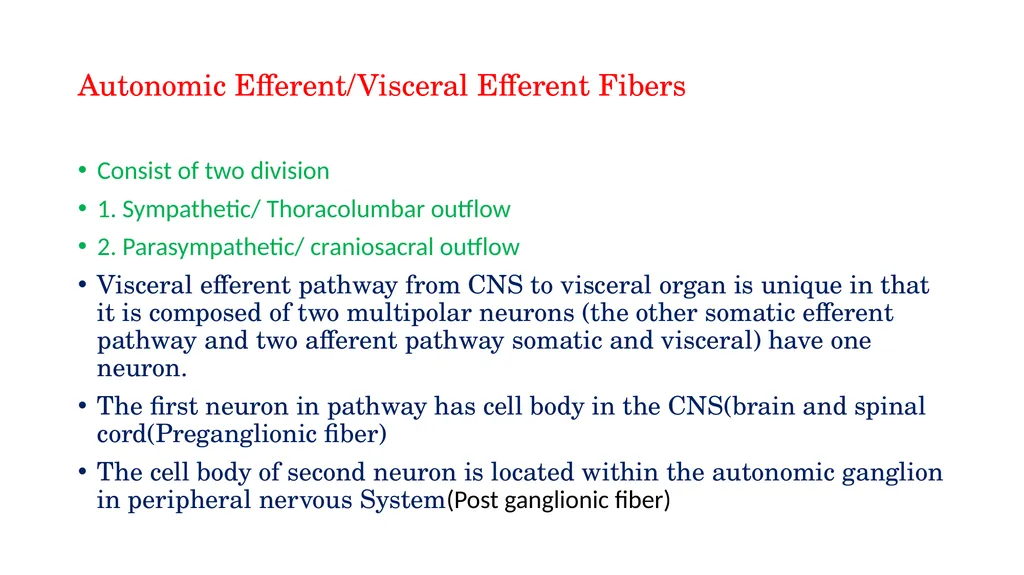
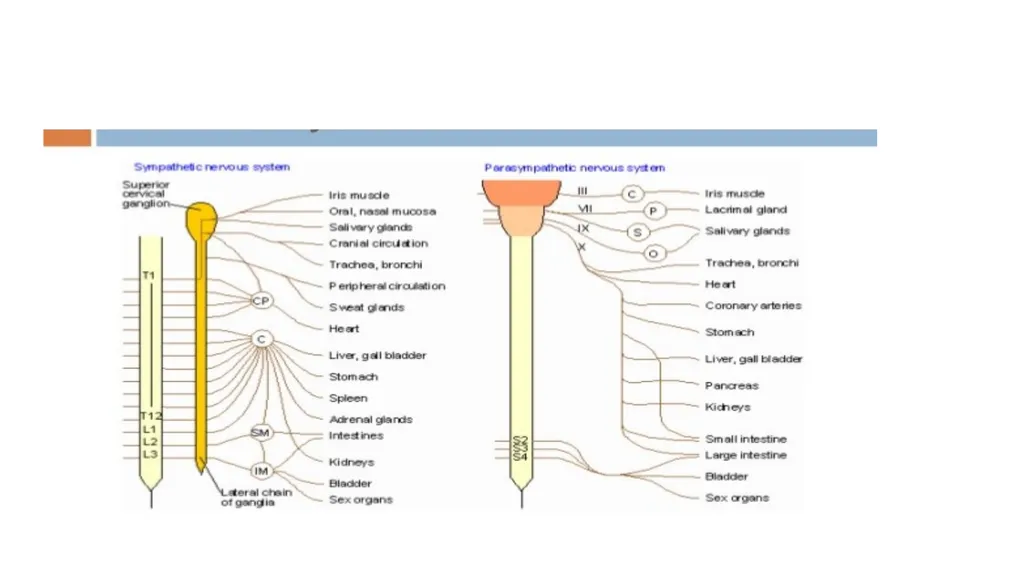
There are two main branches of the efferent segment of ANS – the sympathetic nervous system and the parasympathetic nervous system.
The sympathetic and parasympathetic outflow tracks comprises two neurons-Preganglionic and postganglionic.
The majority of the organs of the body are supplied by both sympathetic and parasympathetic nerves which have opposite effects that are finely balanced to ensure the optimum functioning of the organ.<br>
09
Components of ANS Autonomic afferents/ Visceral afferent fibers
Central autonomic connection and
Autonomic Efferent/Visceral Efferent fibers<br>
10
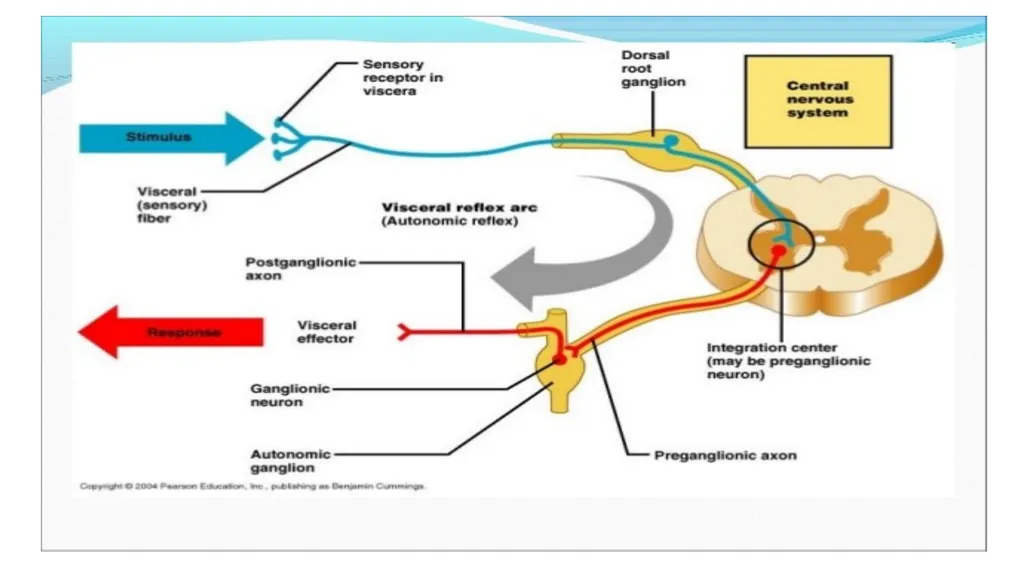
Autonomic afferents/Visceral afferent fibers( mostly nonmyelinated) Most visceral nerves are mixed nerve and carry nonmyelinted visceral afferent fibers
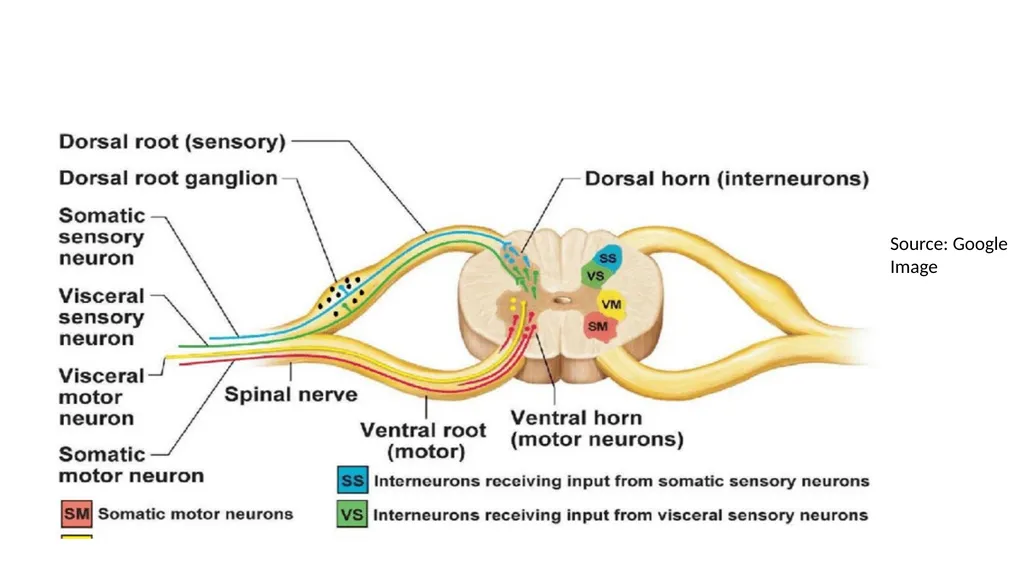
Cell body of visceral afferent fiber lie in the dorsal root ganglia of the spinal nerve and in the corresponding sensory ganglia of certain cranial nerve, such as nodose ganglion of vagus.
VAF mediates visceral sensation such as pain and reffered pain; with vasomotor, respiratory and viscerosomatic reflexes; and regulation of interrelated visceral activities<br>
11
Central autonomic connection There is no any exclusive autonomic area in the C.N.S.
Considerable intermixing and integration of somatic and autonomic innervation occurs.Somatic responses always are accompanied by visceral responses or vice versa
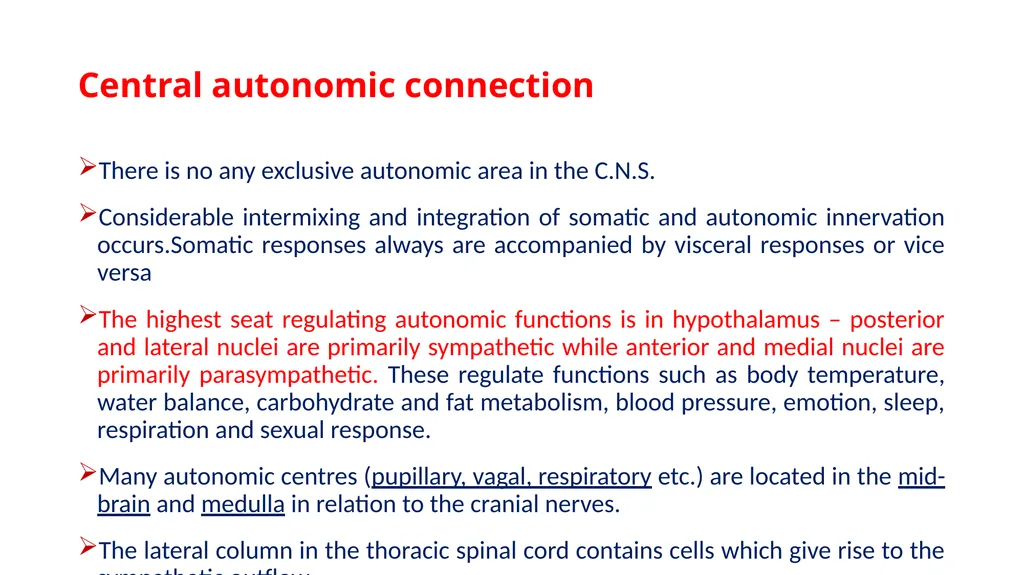
The highest seat regulating autonomic functions is in hypothalamus – posterior and lateral nuclei are primarily sympathetic while anterior and medial nuclei are primarily parasympathetic. These regulate functions such as body temperature, water balance, carbohydrate and fat metabolism, blood pressure, emotion, sleep, respiration and sexual response.
Many autonomic centres (pupillary, vagal, respiratory etc.) are located in the mid-brain and medulla in relation to the cranial nerves.
The lateral column in the thoracic spinal cord contains cells which give rise to the sympathetic outflow.<br>
12
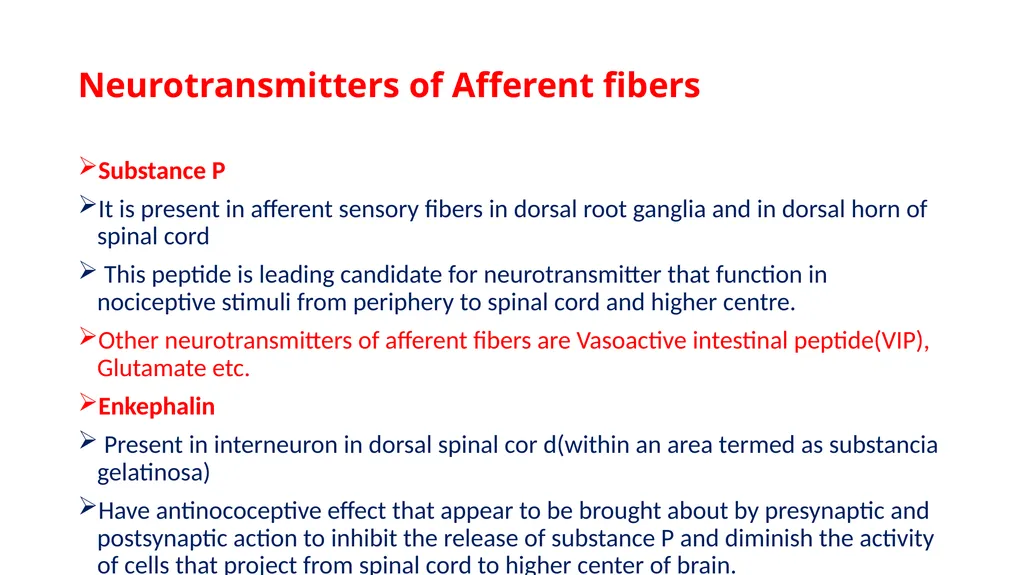
Neurotransmitters of Afferent fibers Substance P
It is present in afferent sensory fibers in dorsal root ganglia and in dorsal horn of spinal cord
This peptide is leading candidate for neurotransmitter that function in nociceptive stimuli from periphery to spinal cord and higher centre.
Other neurotransmitters of afferent fibers are Vasoactive intestinal peptide(VIP), Glutamate etc.
Enkephalin
Present in interneuron in dorsal spinal cor d(within an area termed as substancia gelatinosa)
Have antinococeptive effect that appear to be brought about by presynaptic and postsynaptic action to inhibit the release of substance P and diminish the activity of cells that project from spinal cord to higher center of brain.<br>
13
Source: Google Image<br>
14
Autonomic Efferent/Visceral Efferent Fibers Consist of two division
1. Sympathetic/ Thoracolumbar outflow
2. Parasympathetic/ craniosacral outflow
Visceral efferent pathway from CNS to visceral organ is unique in that it is composed of two multipolar neurons (the other somatic efferent pathway and two afferent pathway somatic and visceral) have one neuron.
The first neuron in pathway has cell body in the CNS(brain and spinal cord(Preganglionic fiber)
The cell body of second neuron is located within the autonomic ganglion in peripheral nervous System(Post ganglionic fiber)<br>
15
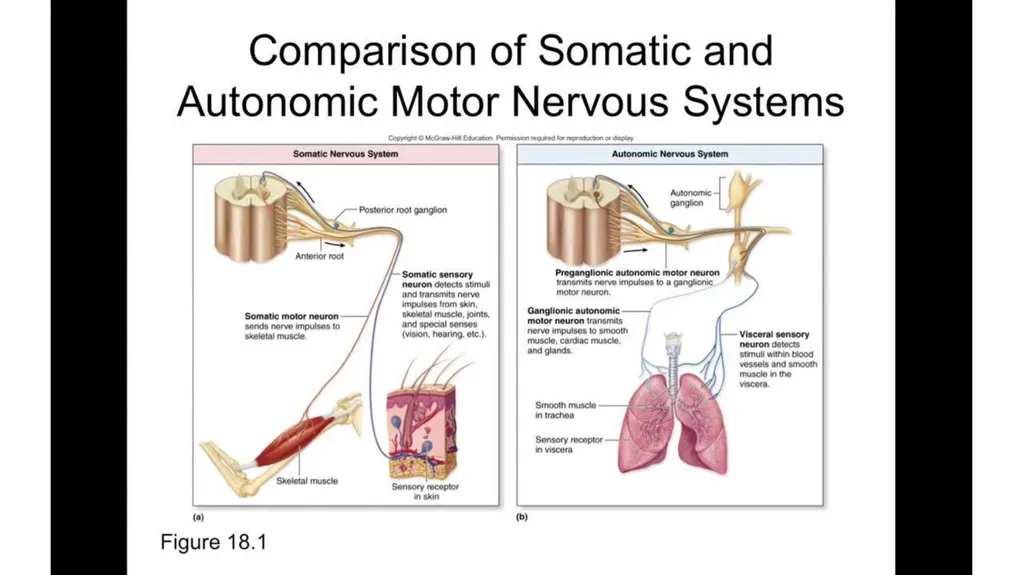
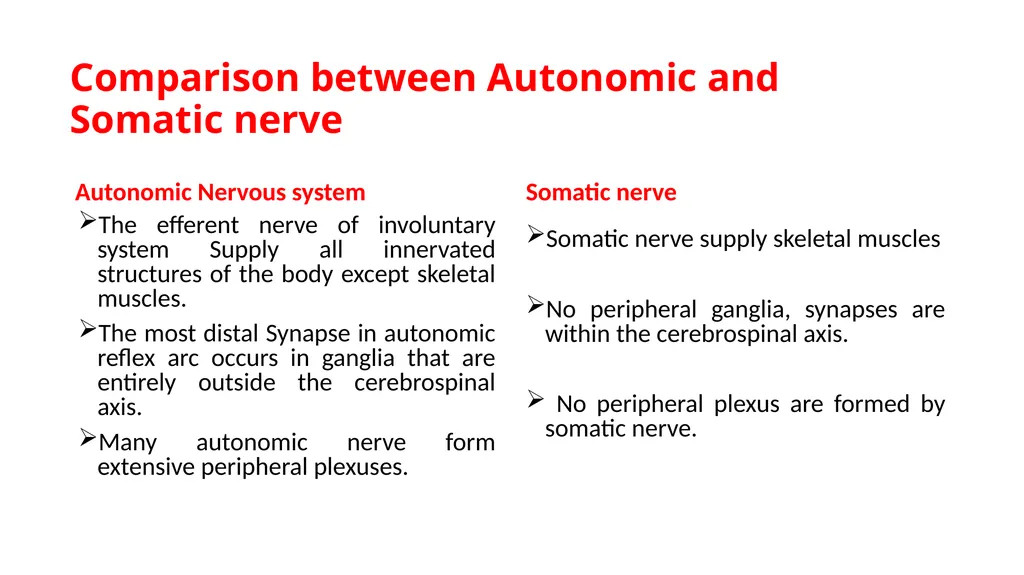
Comparison between Autonomic and Somatic nerve Autonomic Nervous system The efferent nerve of involuntary system Supply all innervated structures of the body except skeletal muscles.
The most distal Synapse in autonomic reflex arc occurs in ganglia that are entirely outside the cerebrospinal axis.
Many autonomic nerve form extensive peripheral plexuses. Somatic nerve Somatic nerve supply skeletal muscles
No peripheral ganglia, synapses are within the cerebrospinal axis.
No peripheral plexus are formed by somatic nerve.<br>
16
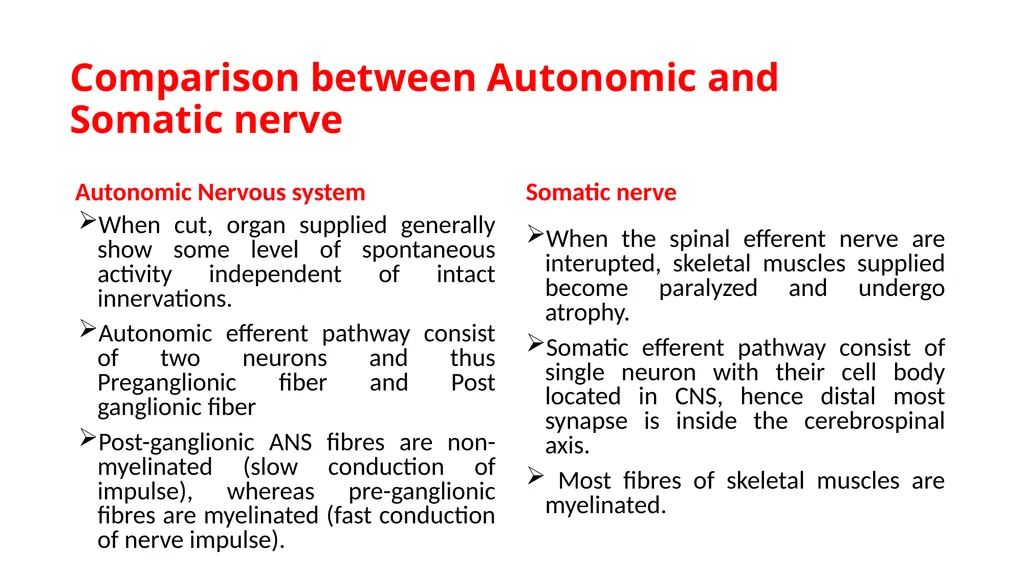
Comparison between Autonomic and Somatic nerve Autonomic Nervous system When cut, organ supplied generally show some level of spontaneous activity independent of intact innervations.
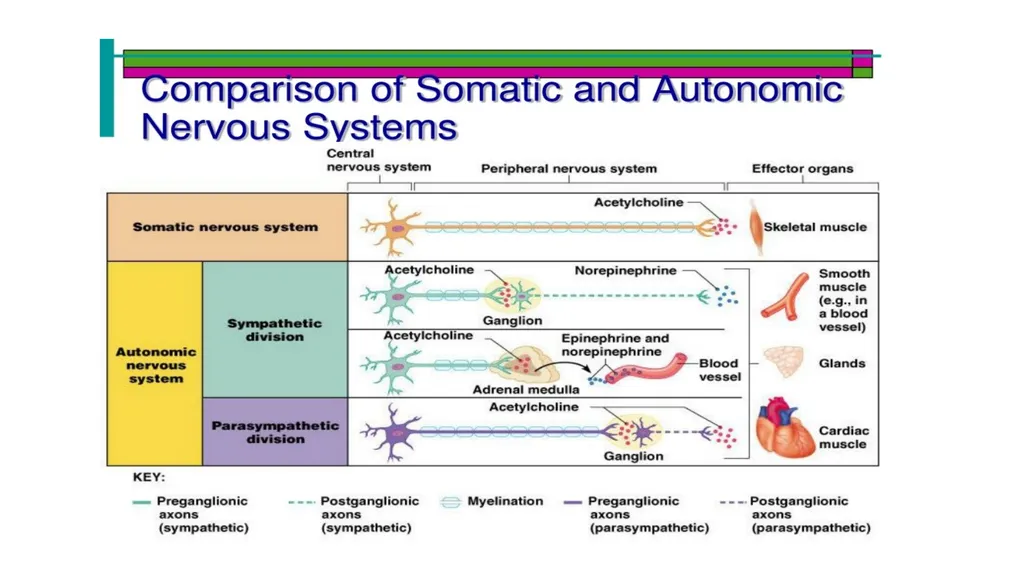
Autonomic efferent pathway consist of two neurons and thus Preganglionic fiber and Post ganglionic fiber
Post-ganglionic ANS fibres are non-myelinated (slow conduction of impulse), whereas pre-ganglionic fibres are myelinated (fast conduction of nerve impulse). Somatic nerve When the spinal efferent nerve are interupted, skeletal muscles supplied become paralyzed and undergo atrophy.
Somatic efferent pathway consist of single neuron with their cell body located in CNS, hence distal most synapse is inside the cerebrospinal axis.
Most fibres of skeletal muscles are myelinated.<br>