Antiprotozoal and anthelminthic agents Antiprotozoan Drugs There are a few mechanisms by which antiprotozoan drugs target infectious protozoans. Some are antimetabolites, such as atovaquone, proguanil, and artemisinins. Atovaquone, in
"Antiprotozoal and anthelminthic agents" is the property of its rightful owner. Permission is granted to
download and print the materials on this website for personal, non-commercial use only, and to display it
on your personal computer provided you do not modify the materials and that you retain all copyright
notices contained in the materials. By downloading content from our website, you accept the terms of this
agreement.
Presentation Transcript
01
Antiprotozoal and anthelminthic agents Antiprotozoan Drugs
There are a few mechanisms by which antiprotozoan drugs target infectious protozoans.
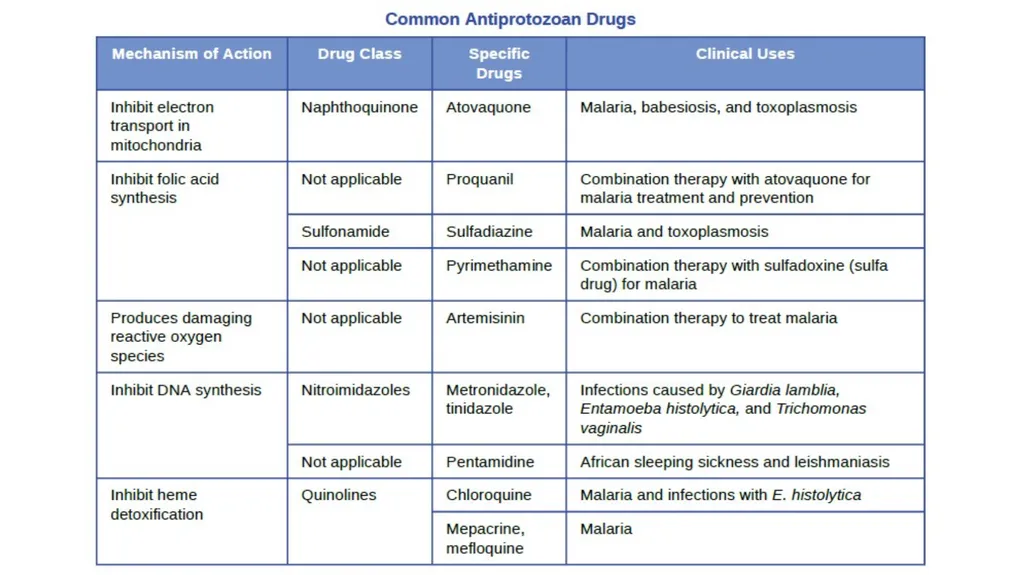
Some are antimetabolites, such as atovaquone, proguanil, and artemisinins.
Atovaquone, in addition to being antifungal, blocks electron transport in protozoans and is used for the treatment of protozoan infections including malaria, babesiosis, and toxoplasmosis.
Proguanil is another synthetic antimetabolite that is processed in parasitic cells into its active form, which inhibits protozoan folic acid synthesis.
It is often used in combination with atovaquone, and the combination is marketed as Malarone for both malaria treatment and prevention.<br>
02
Artemisinin, a plant-derived antifungal first discovered by Chinese scientists in the 1970s, is quite effective against malaria.
Semisynthetic derivatives of artemisinin are more water soluble than the natural version, which makes them more bioavailable.
Although the exact mechanism of action is unclear, artemisinins appear to act as prodrugs that are metabolized by target cells to produce reactive oxygen species (ROS) that damage target cells.
Due to the rise in resistance to antimalarial drugs, artemisinins are also commonly used in combination with other antimalarial compounds in artemisinin-based combination therapy (ACT).<br>
03
Several antimetabolites are used for the treatment of toxoplasmosis caused by the parasite Toxoplasma gondii.
The synthetic sulfa drug sulfadiazine competitively inhibits an enzyme in folic acid production in parasites and can be used to treat malaria and toxoplasmosis.
Pyrimethamine is a synthetic drug that inhibits a different enzyme in the folic acid production pathway and is often used in combination with sulfadoxine (another sulfa drug) for the treatment of malaria or in combination with sulfadiazine for the treatment of toxoplasmosis.
Side effects of pyrimethamine include decreased bone marrow activity that may cause increased bruising and low red blood cell counts.
When toxicity is a concern, spiramycin, a macrolide protein synthesis inhibitor, is typically administered for the treatment of toxoplasmosis.<br>
04
Two classes of antiprotozoan drugs interfere with nucleic acid synthesis: nitroimidazoles and quinolines.
Nitroimidazoles, including semisynthetic metronidazole, which was discussed previously as an antibacterial drug, and synthetic tinidazole, are useful in combating a wide variety of protozoan pathogens, such as Giardia lamblia, Entamoeba histolytica, and Trichomonas vaginalis.
Upon introduction into these cells in low-oxygen environments, nitroimidazoles become activated and introduce DNA strand breakage, interfering with DNA replication in target cells.
Unfortunately, metronidazole is associated with carcinogenesis (the development of cancer) in humans.<br>
05
The quinolines are a class of synthetic compounds related to quinine, which has a long history of use against malaria.
Quinolines are thought to interfere with heme detoxification, which is necessary for the parasite’s effective breakdown of hemoglobin into amino acids inside red blood cells.
The synthetic derivatives chloroquine, quinacrine (also called mepacrine), and mefloquine are commonly used as antimalarials, and chloroquine is also used to treat amebiasis typically caused by Entamoeba histolytica.
Long-term prophylactic use of chloroquine or mefloquine may result in serious side effects, including hallucinations or cardiac issues.
Patients with glucose-6-phosphate dehydrogenase deficiency experience severe anemia when treated with chloroquine.<br>
06
Another type of synthetic antiprotozoan drug that has long been thought to specifically interfere with DNA replication in certain pathogens is pentamidine.
It has historically been used for the treatment of African sleeping sickness (caused by the protozoan Trypanosoma brucei) and leishmaniasis (caused by protozoa of the genus Leishmania), but it is also an alternative treatment for the fungus Pneumocystis.
Some studies indicate that it specifically binds to the DNA found within kinetoplasts (kDNA; long mitochondrion-like structures unique to trypanosomes), leading to the cleavage of kDNA.
However, nuclear DNA of both the parasite and host remain unaffected.
It also appears to bind to tRNA, inhibiting the addition of amino acids to tRNA, thus preventing protein synthesis.
Possible side effects of pentamidine use include pancreatic dysfunction and liver damage.<br>
07
Antihelminthic Drugs
Because helminths are multicellular eukaryotes like humans, developing drugs with selective toxicity against them is extremely challenging.
Despite this, several effective classes have been developed.
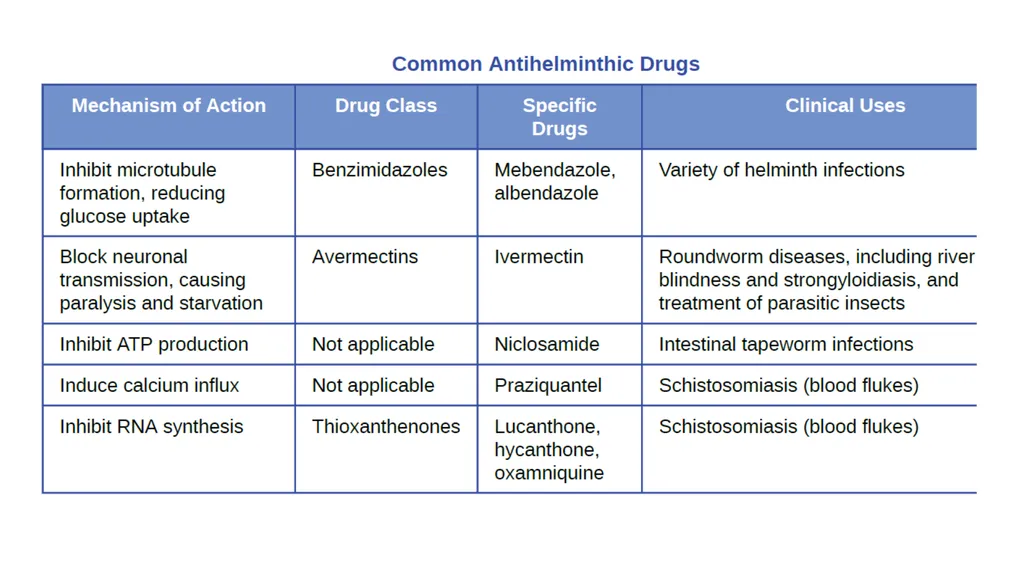
Synthetic benzimidazoles, like mebendazole and albendazole, bind to helminthic β-tubulin, preventing microtubule formation.
Microtubules in the intestinal cells of the worms seem to be particularly affected, leading to a reduction in glucose uptake.
Besides their activity against a broad range of helminths, benzimidazoles are also active against many protozoans, fungi, and viruses, and their use for inhibiting mitosis and cell cycle progression in cancer cells is under study.
Possible side effects of their use include liver damage and bone marrow suppression.<br>
08
The avermectins are members of the macrolide family that were first discovered from a Japanese soil isolate, Streptomyces avermectinius.
A more potent semisynthetic derivative of avermectin is ivermectin, which binds to glutamate-gated chloride channels specific to invertebrates including helminths, blocking neuronal transmission and causing starvation, paralysis, and death of the worms.
Ivermectin is used to treat roundworm diseases, including onchocerciasis (also called river blindness, caused by the worm Onchocerca volvulus) and strongyloidiasis (caused by the worm Strongyloides stercoralis or S. fuelleborni).
Ivermectin can also treat parasitic insects like mites, lice, and bed bugs, and is nontoxic to humans.<br>
09
Niclosamide is a synthetic drug that has been used for over 50 years to treat tapeworm infections.
Although its mode of action is not entirely clear, niclosamide appears to inhibit ATP formation under anaerobic conditions and inhibit oxidative phosphorylation in the mitochondria of its target pathogens.
Niclosamide is not absorbed from the gastrointestinal tract, thus it can achieve high localized intestinal concentrations in patients. Recently, it has been shown to also have antibacterial, antiviral, and antitumor activities.<br>
10
Another synthetic antihelminthic drug is praziquantel, which used for the treatment of parasitic tapeworms and liver flukes, and is particularly useful for the treatment of schistosomiasis (caused by blood flukes from three genera of Schistosoma).
Its mode of action remains unclear, but it appears to cause the influx of calcium into the worm, resulting in intense spasm and paralysis of the worm.
It is often used as a preferred alternative to niclosamide in the treatment of tapeworms when gastrointestinal discomfort limits niclosamide use.<br>
11
The thioxanthenones, another class of synthetic drugs structurally related to quinine, exhibit antischistosomal activity by inhibiting RNA synthesis.
The thioxanthenone lucanthone and its metabolite hycanthone were the first used clinically, but serious neurological, gastrointestinal, cardiovascular, and hepatic side effects led to their discontinuation.
Oxamniquine, a less toxic derivative of hycanthone, is only effective against S. mansoni, one of the three species known to cause schistosomiasis in humans.
Praziquantel was developed to target the other two schistosome species, but concerns about increasing resistance have renewed interest in developing additional derivatives of oxamniquine to target all three clinically important schistosome species.<br>