
APA 7th Edition center for writing excellence


























Description: APA 7th Edition center for writing excellence University of north Alabama Director, Dr. Kathleen Richards APA for Student Papers Rules for student papers are slightly different than a professional paper. This PowerPoint will focus on
Related Topics
Download Presentation
"APA 7th Edition center for writing excellence" is the property of its rightful owner. Permission is granted to download and print the materials on this website for personal, non-commercial use only, and to display it on your personal computer provided you do not modify the materials and that you retain all copyright notices contained in the materials. By downloading content from our website, you accept the terms of this agreement.
Presentation Transcript
slide1. APA 7th Edition center for writing excellence
University of north Alabama
Director, Dr. Kathleen Richards<br>
slide2. APA for Student Papers Rules for student papers are slightly different than a professional paper. This PowerPoint will focus on formatting student papers, including title page, headings, documentation, in-text citations, and other various guidelines.<br>
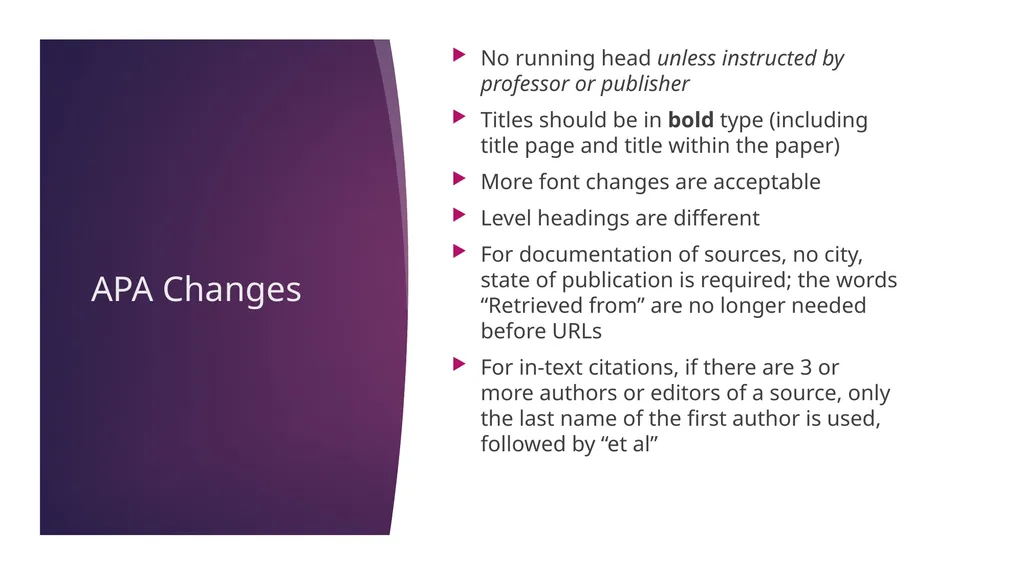
slide3. APA Changes No running head unless instructed by professor or publisher
Titles should be in bold type (including title page and title within the paper)
More font changes are acceptable
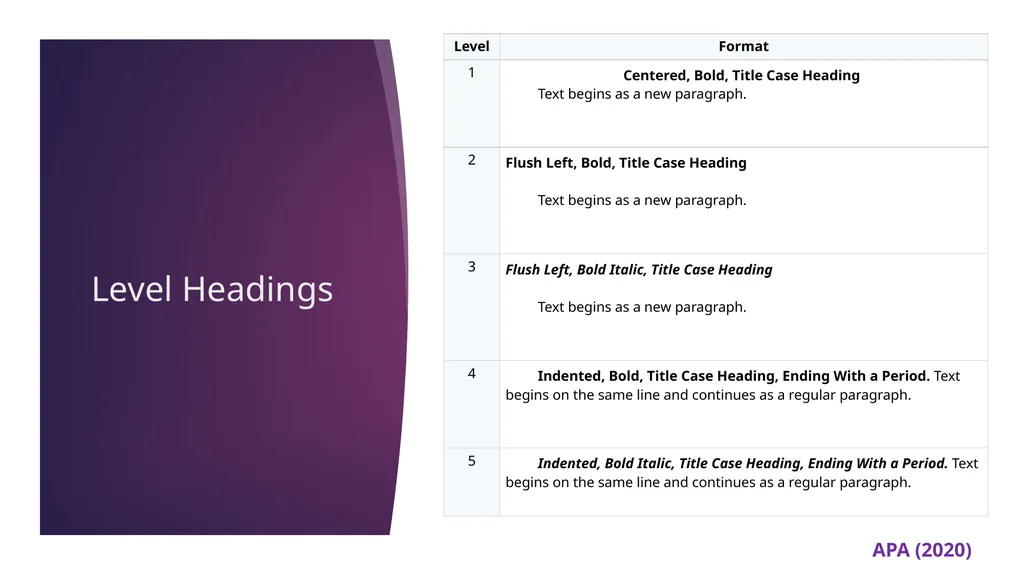
Level headings are different
For documentation of sources, no city, state of publication is required; the words “Retrieved from” are no longer needed before URLs
For in-text citations, if there are 3 or more authors or editors of a source, only the last name of the first author is used, followed by “et al”<br>
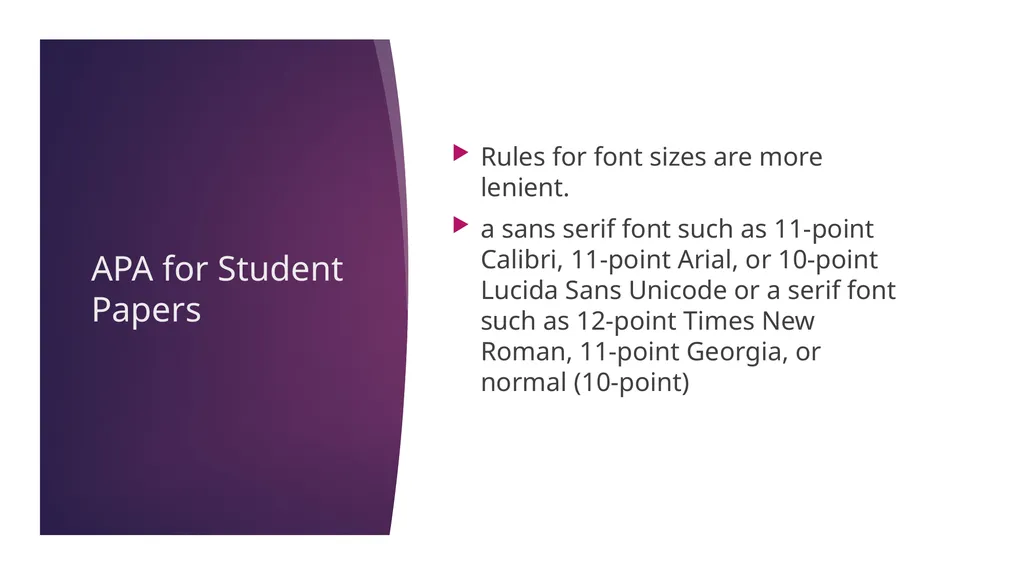
slide4. APA for Student Papers Rules for font sizes are more lenient.
a sans serif font such as 11-point Calibri, 11-point Arial, or 10-point Lucida Sans Unicode or a serif font such as 12-point Times New Roman, 11-point Georgia, or normal (10-point)<br>
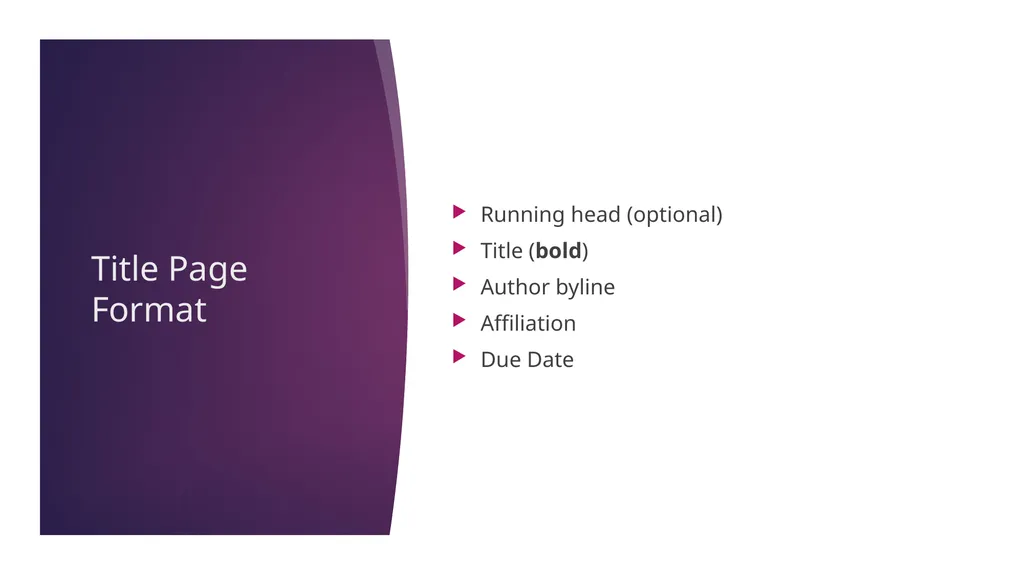
slide5. Title Page Format Running head (optional)
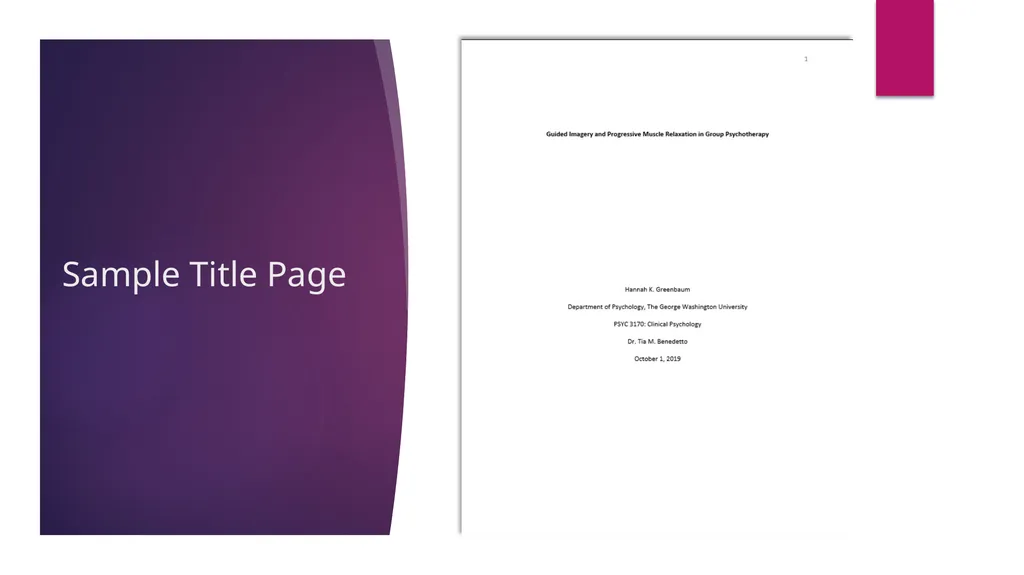
Title (bold)
Author byline
Affiliation
Due Date<br>
slide6. Title Page (headers) New changes for 7th edition for Title Page:
Running head is no longer required unless professor requires one. If professor requires a header, then the following information is needed:
Include a running head fewer than 50 characters and are left aligned; capitalize every letter
The words “Running head:” no longer appear as a label on the first page
Page numbers are still right aligned, with title page as number 1<br>
slide7. Title Page (title information) New changes for 7th edition for Title Page:
Titles are placed in the upper 2/3rds of the title page in bold print, center aligned.
All words should be capitalized except the following: articles (a, an, the);conjunctions (so, but, nor, and, or, yet, for); prepositions that are three letters or fewer ( examples: on, in, for, at, by, of)
Titles are normally 12 words or fewer
If colons are included in titles, the first letter of the first word should be capitalized
Lines should be double spaced<br>
slide8. Title Page (author information) Below the title, type the author byline: first name, middle initial (if applicable), and last name
If there is more than one author, then list the authors’ names in order of their contribution (or alphabetical order), and separate names with a comma. Use “and” before the last name.
Example: Whitney Post, Sam Ruitz, and Matt Henson
or
Matt Henson, Whitney Post, and Sam Ruitz<br>
slide9. Sample Title Page<br>
slide10. Headings<br>
slide11. Level Headings APA (2020)<br>
slide12. Summarizing, Paraphrasing, and Quoting<br>
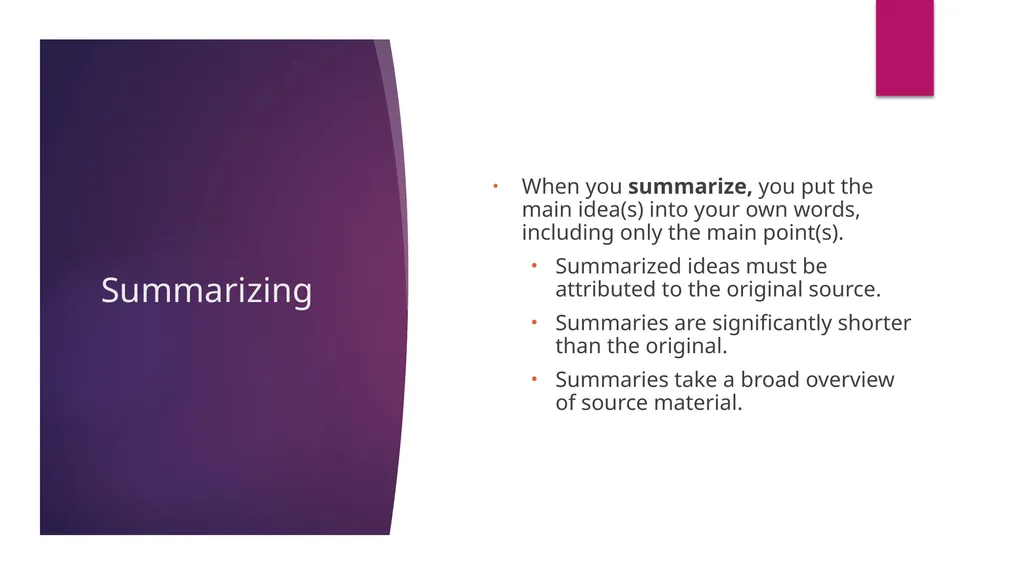
slide13. Summarizing When you summarize, you put the main idea(s) into your own words, including only the main point(s).
Summarized ideas must be attributed to the original source.
Summaries are significantly shorter than the original.
Summaries take a broad overview of source material.<br>
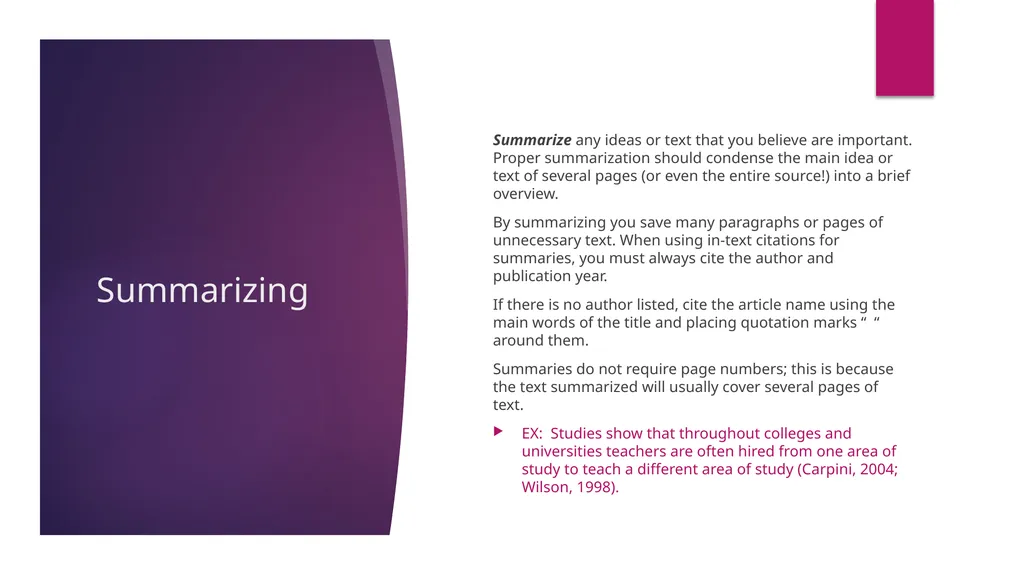
slide14. Summarizing Summarize any ideas or text that you believe are important. Proper summarization should condense the main idea or text of several pages (or even the entire source!) into a brief overview.
By summarizing you save many paragraphs or pages of unnecessary text. When using in-text citations for summaries, you must always cite the author and publication year.
If there is no author listed, cite the article name using the main words of the title and placing quotation marks “ “ around them.
Summaries do not require page numbers; this is because the text summarized will usually cover several pages of text.
EX: Studies show that throughout colleges and universities teachers are often hired from one area of study to teach a different area of study (Carpini, 2004; Wilson, 1998).<br>
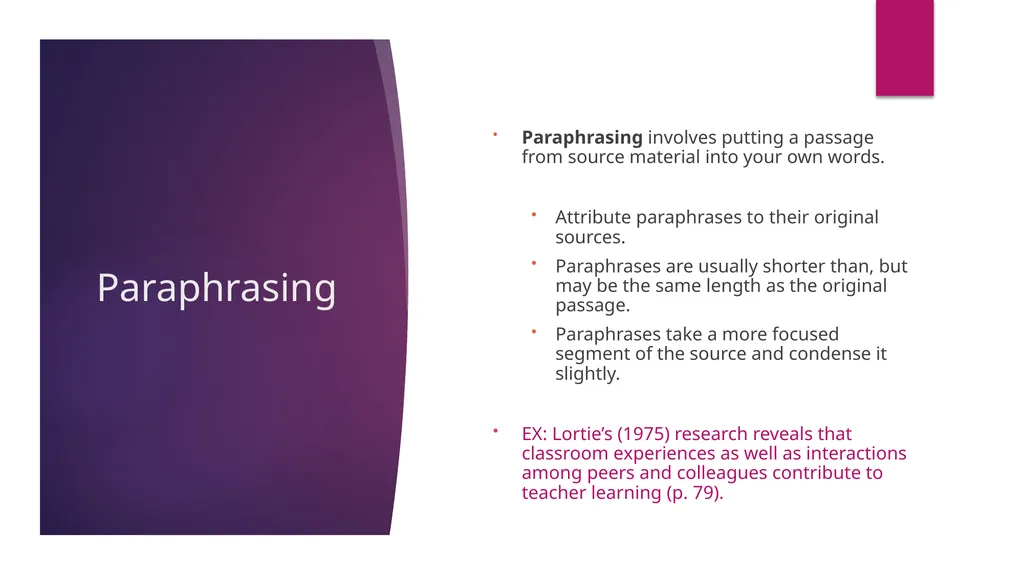
slide15. Paraphrasing Paraphrasing involves putting a passage from source material into your own words.
Attribute paraphrases to their original sources.
Paraphrases are usually shorter than, but may be the same length as the original passage.
Paraphrases take a more focused segment of the source and condense it slightly.
EX: Lortie’s (1975) research reveals that classroom experiences as well as interactions among peers and colleagues contribute to teacher learning (p. 79).<br>
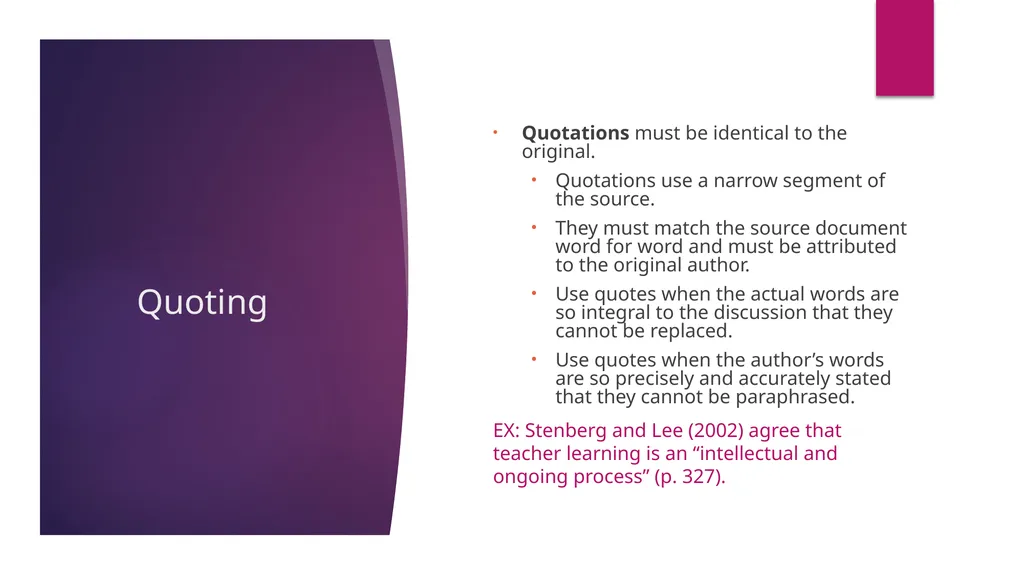
slide16. Quoting Quotations must be identical to the original.
Quotations use a narrow segment of the source.
They must match the source document word for word and must be attributed to the original author.
Use quotes when the actual words are so integral to the discussion that they cannot be replaced.
Use quotes when the author’s words are so precisely and accurately stated that they cannot be paraphrased.
EX: Stenberg and Lee (2002) agree that teacher learning is an “intellectual and ongoing process” (p. 327).<br>
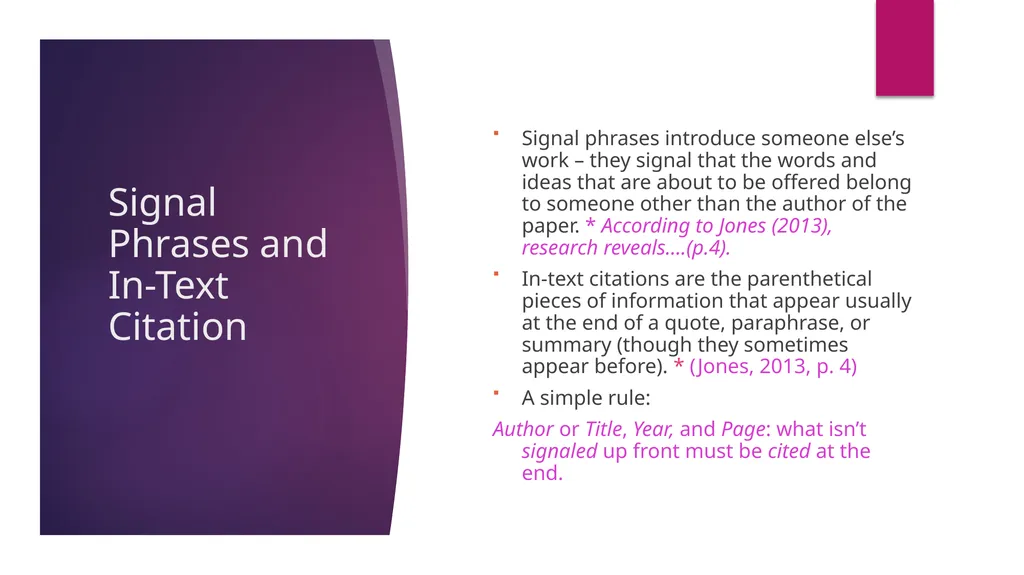
slide17. Signal Phrases and In-Text Citation Signal phrases introduce someone else’s work – they signal that the words and ideas that are about to be offered belong to someone other than the author of the paper. * According to Jones (2013), research reveals….(p.4).
In-text citations are the parenthetical pieces of information that appear usually at the end of a quote, paraphrase, or summary (though they sometimes appear before). * (Jones, 2013, p. 4)
A simple rule:
Author or Title, Year, and Page: what isn’t signaled up front must be cited at the end.<br>
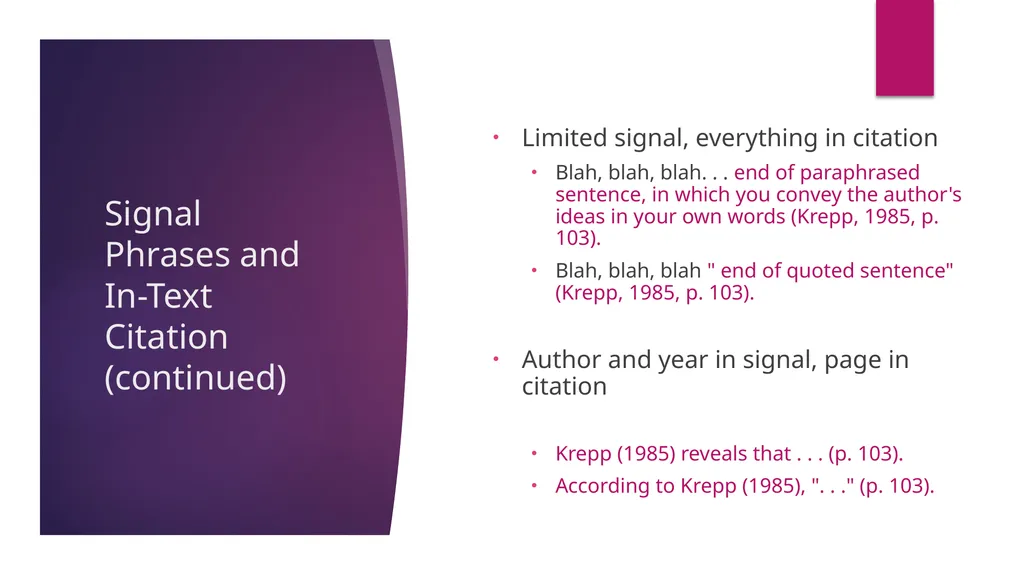
slide18. Signal Phrases and In-Text Citation (continued) Limited signal, everything in citation
Blah, blah, blah. . . end of paraphrased sentence, in which you convey the author's ideas in your own words (Krepp, 1985, p. 103).
Blah, blah, blah " end of quoted sentence" (Krepp, 1985, p. 103).
Author and year in signal, page in citation
Krepp (1985) reveals that . . . (p. 103).
According to Krepp (1985), ". . ." (p. 103).<br>
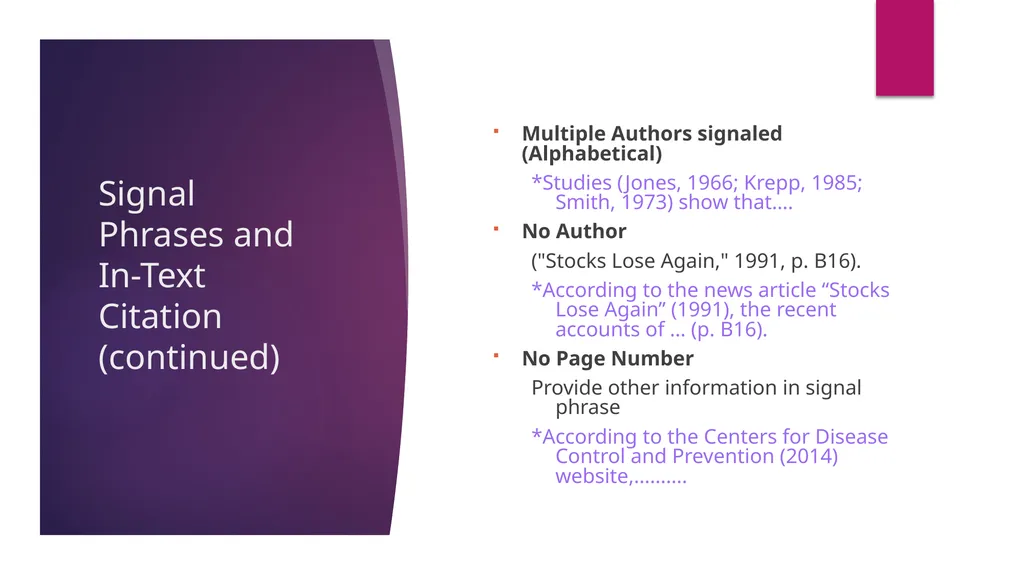
slide19. Signal Phrases and In-Text Citation (continued) Multiple Authors signaled (Alphabetical)
*Studies (Jones, 1966; Krepp, 1985; Smith, 1973) show that….
No Author
("Stocks Lose Again," 1991, p. B16).
*According to the news article “Stocks Lose Again” (1991), the recent accounts of … (p. B16).
No Page Number
Provide other information in signal phrase
*According to the Centers for Disease Control and Prevention (2014) website,……….<br>
slide20. Documentation<br>
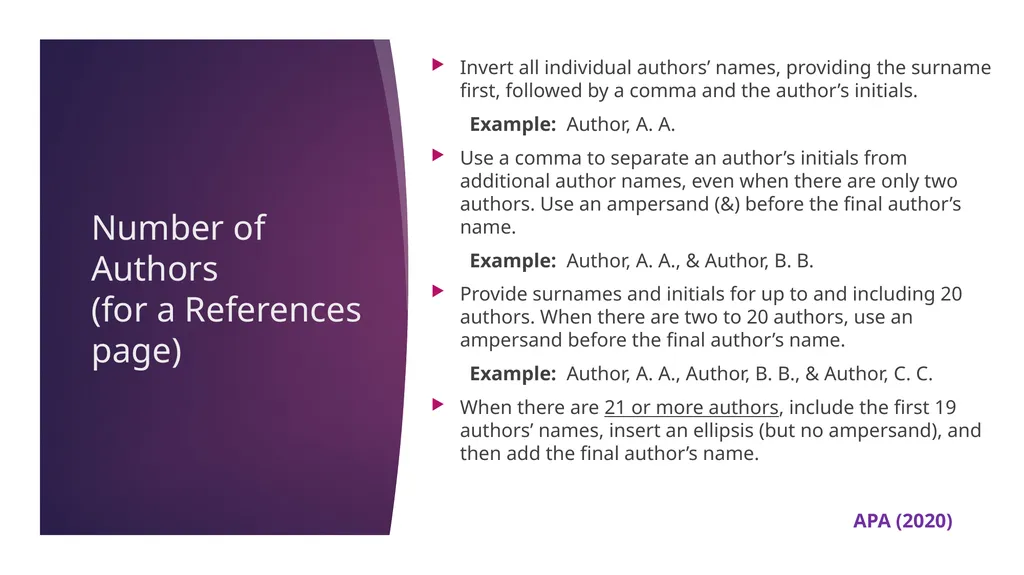
slide21. Number of Authors (for a References page) Invert all individual authors’ names, providing the surname first, followed by a comma and the author’s initials.
Example: Author, A. A.
Use a comma to separate an author’s initials from additional author names, even when there are only two authors. Use an ampersand (&) before the final author’s name.
Example: Author, A. A., & Author, B. B.
Provide surnames and initials for up to and including 20 authors. When there are two to 20 authors, use an ampersand before the final author’s name.
Example: Author, A. A., Author, B. B., & Author, C. C.
When there are 21 or more authors, include the first 19 authors’ names, insert an ellipsis (but no ampersand), and then add the final author’s name.
APA (2020)<br>
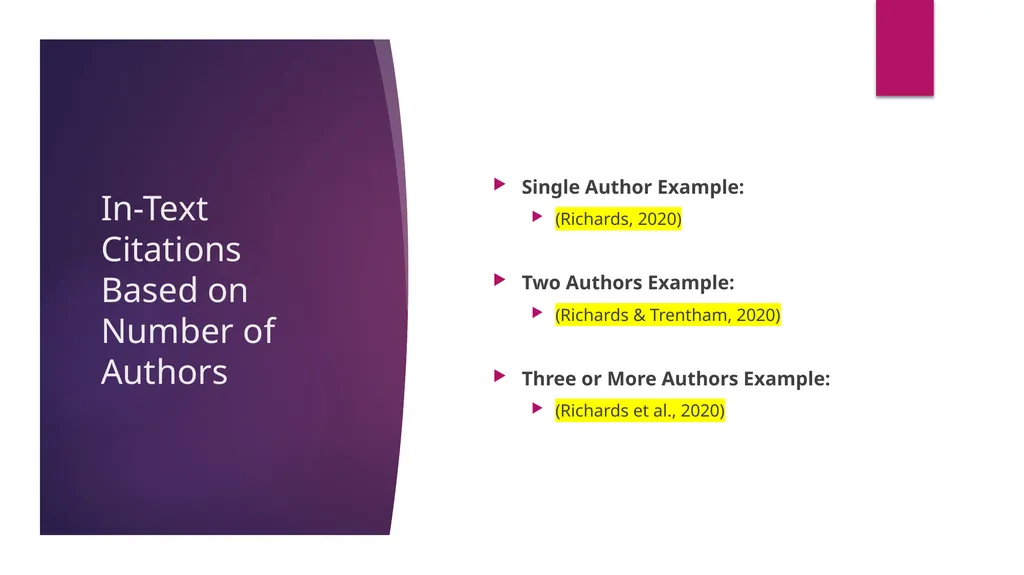
slide22. In-Text Citations Based on Number of Authors Single Author Example:
(Richards, 2020)
Two Authors Example:
(Richards & Trentham, 2020)
Three or More Authors Example:
(Richards et al., 2020)<br>
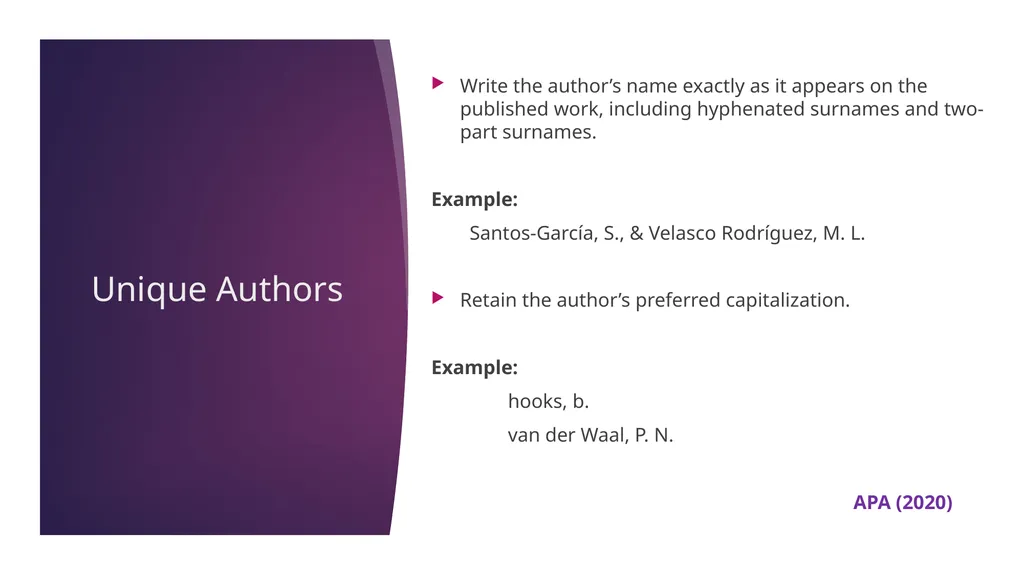
slide23. Unique Authors Write the author’s name exactly as it appears on the published work, including hyphenated surnames and two-part surnames.
Example:
Santos-García, S., & Velasco Rodríguez, M. L.
Retain the author’s preferred capitalization.
Example:
hooks, b.
van der Waal, P. N.
APA (2020)<br>
slide24. Two Authors with the Same Last Name Reference List Citation:
When two authors of the same source share a surname, use first initials with the last names.
Ehrlich, P., & Ehrlich, A. (1998). Betrayal of science and reason: How anti-environmental rhetoric threatens our future. Island Press.
In-Text Citation:
If multiple authors within a single reference share the same surname, the initials are not needed in the in-text citation; cite the work in the standard author–date format.
(Ehrlich & Ehrlich, 1998)<br>
slide25. Citing Works With the Same Author and Year When multiple references have an identical author (or authors) and publication year, include a lowercase letter after the year. These letters are assigned when the references are placed in order in the reference list.
The year–letter combination is used in both the in-text citation and the reference list entry. Use only the year with a letter in the in-text citation, even if the reference list entry contains a more specific date.
In-text: (Blondaux & O'Hanrahan, 2018a) Reference list: Blondaux and O'Hanrahan (2018b)<br>
slide26. Web Sources with the Same Author, Same Year, and Different Day of Post Kang, C. (2020a, October 28). Big tech’s chief executives are becoming regulars on Capitol Hill. New York Times. https://www.nytimes.com/2020/10/28/tec hnology/big-techs-chief-executives-are- becoming-regulars-on-capitol-hill.html
Kang, C. (2020b, October 22). Top investigator in Google case says there ‘was not a rush’ to sue. New York Times. https://www.nytimes.com/2020/10/22/tec hnology/doj-google-jeffrey-rosen.html
In-text citation examples
Parenthetical: (Kang 2020a; Kang 2020b)
Narrative: Kang (2020a)and (2020b)<br>
slide27. Organization As Author On a page from an organizational or government agency website, the organization or government agency itself is considered the author, unless otherwise specified. The author of a webpage or website may also be located on an “about us” or acknowledgments page.
An abbreviation for the group author can be used in the text (e.g., NIMH for National Institute of Mental Health); however, do not include an abbreviation for a group author in a reference list entry.
Correct: National Institute of Mental Health.
Incorrect: National Institute of Mental Health (NIMH).
Incorrect: NIMH.
APA (2020)<br>
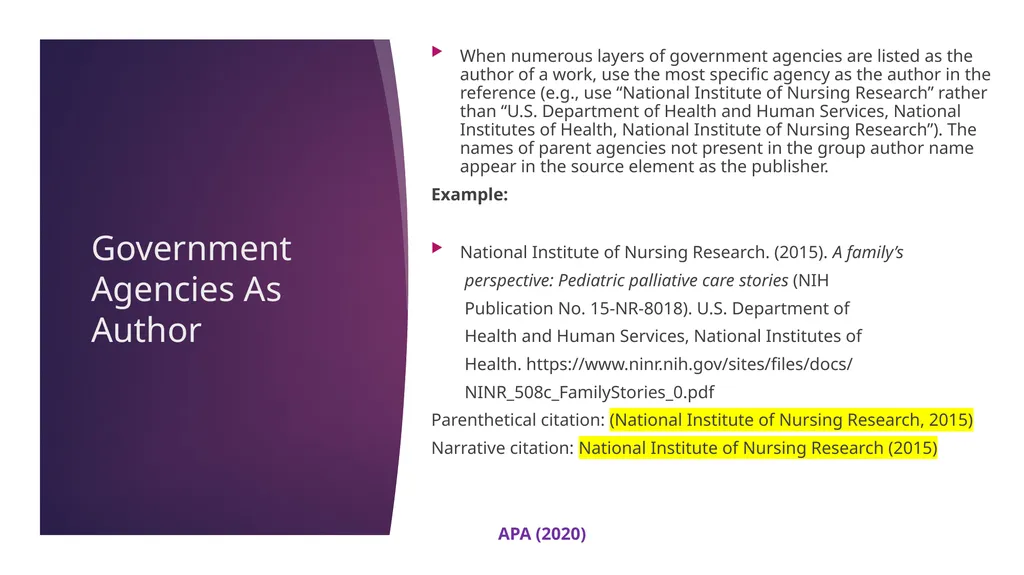
slide28. Government Agencies As Author When numerous layers of government agencies are listed as the author of a work, use the most specific agency as the author in the reference (e.g., use “National Institute of Nursing Research” rather than “U.S. Department of Health and Human Services, National Institutes of Health, National Institute of Nursing Research”). The names of parent agencies not present in the group author name appear in the source element as the publisher.
Example:
National Institute of Nursing Research. (2015). A family’s
perspective: Pediatric palliative care stories (NIH
Publication No. 15-NR-8018). U.S. Department of
Health and Human Services, National Institutes of
Health. https://www.ninr.nih.gov/sites/files/docs/
NINR_508c_FamilyStories_0.pdf
Parenthetical citation: (National Institute of Nursing Research, 2015)
Narrative citation: National Institute of Nursing Research (2015)
APA (2020)<br>
slide29. Books<br>
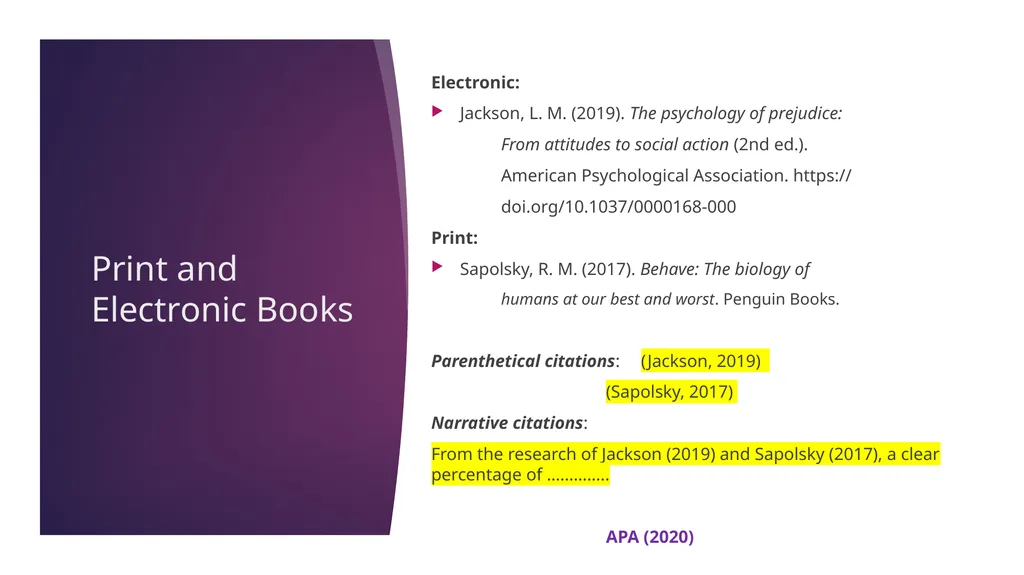
slide30. Print and Electronic Books Electronic:
Jackson, L. M. (2019). The psychology of prejudice:
From attitudes to social action (2nd ed.).
American Psychological Association. https://
doi.org/10.1037/0000168-000
Print:
Sapolsky, R. M. (2017). Behave: The biology of
humans at our best and worst. Penguin Books.
Parenthetical citations: (Jackson, 2019)
(Sapolsky, 2017)
Narrative citations:
From the research of Jackson (2019) and Sapolsky (2017), a clear percentage of …………..
APA (2020)<br>
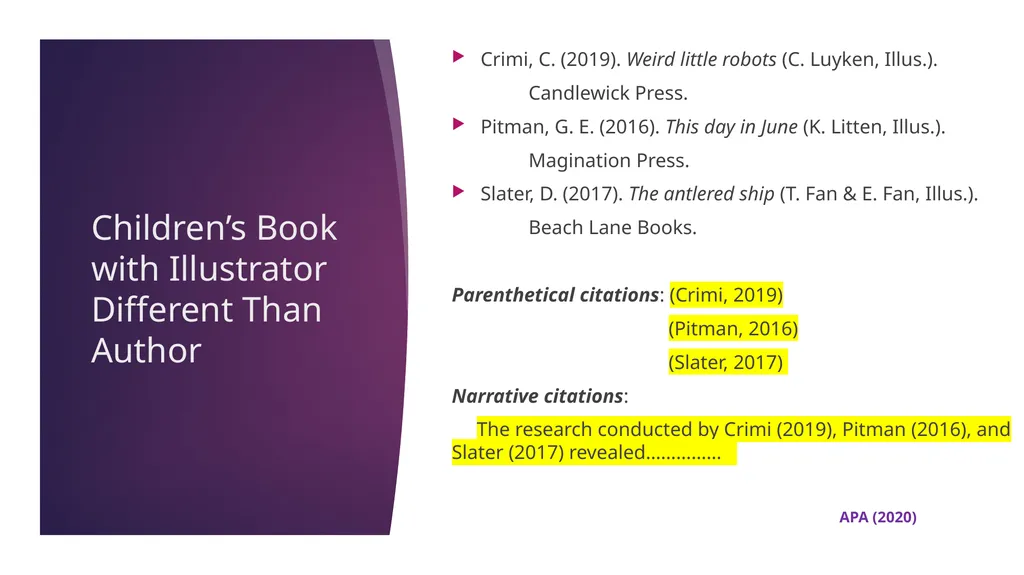
slide31. Children’s Book with Illustrator Different Than Author Crimi, C. (2019). Weird little robots (C. Luyken, Illus.).
Candlewick Press.
Pitman, G. E. (2016). This day in June (K. Litten, Illus.).
Magination Press.
Slater, D. (2017). The antlered ship (T. Fan & E. Fan, Illus.).
Beach Lane Books.
Parenthetical citations: (Crimi, 2019)
(Pitman, 2016)
(Slater, 2017)
Narrative citations:
The research conducted by Crimi (2019), Pitman (2016), and Slater (2017) revealed……………
APA (2020)<br>
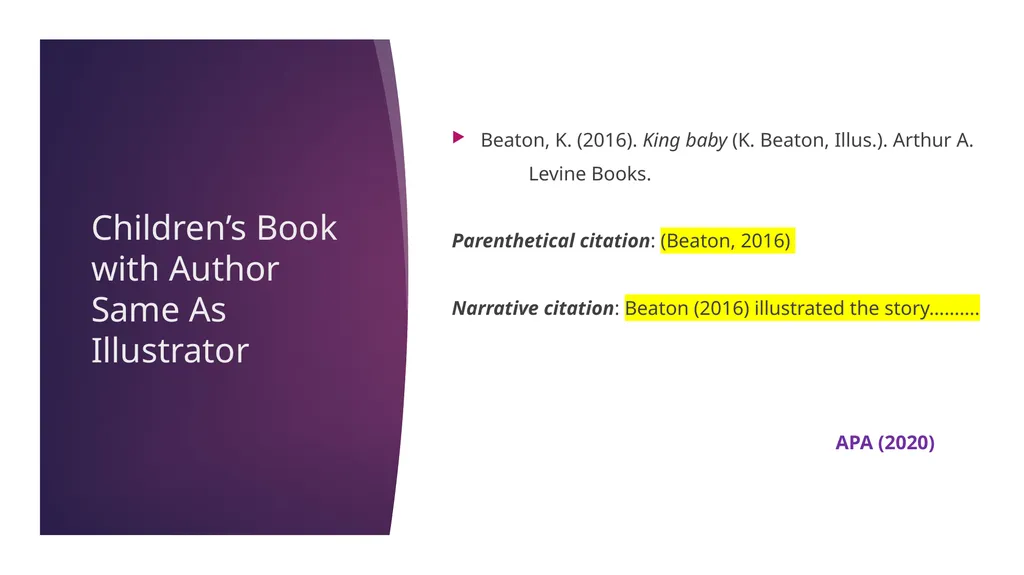
slide32. Children’s Book with Author Same As Illustrator Beaton, K. (2016). King baby (K. Beaton, Illus.). Arthur A.
Levine Books.
Parenthetical citation: (Beaton, 2016)
Narrative citation: Beaton (2016) illustrated the story……….
APA (2020)<br>
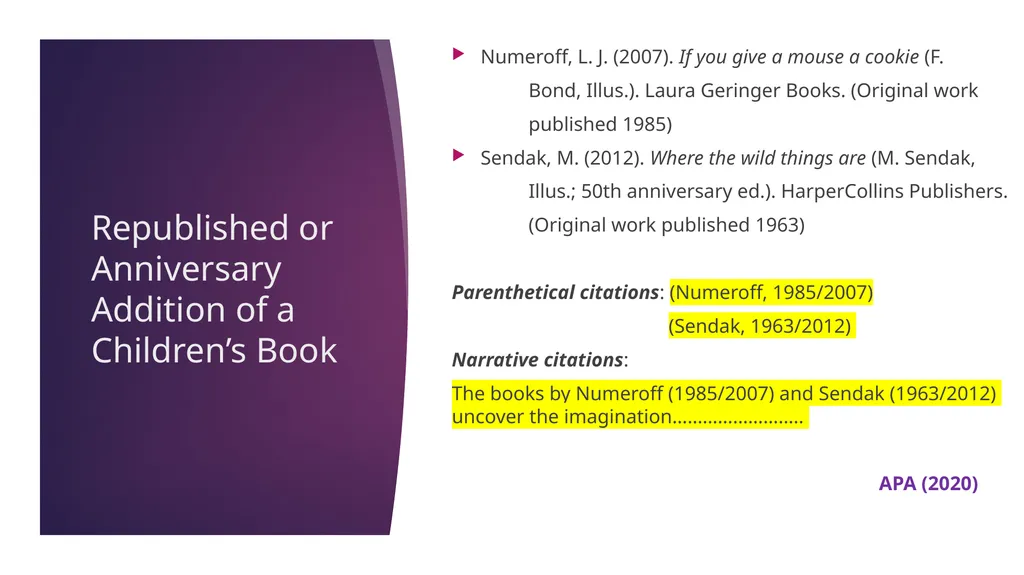
slide33. Republished or Anniversary Addition of a Children’s Book Numeroff, L. J. (2007). If you give a mouse a cookie (F.
Bond, Illus.). Laura Geringer Books. (Original work
published 1985)
Sendak, M. (2012). Where the wild things are (M. Sendak,
Illus.; 50th anniversary ed.). HarperCollins Publishers.
(Original work published 1963)
Parenthetical citations: (Numeroff, 1985/2007)
(Sendak, 1963/2012)
Narrative citations:
The books by Numeroff (1985/2007) and Sendak (1963/2012) uncover the imagination……………………..
APA (2020)<br>
slide34. Edited Books<br>
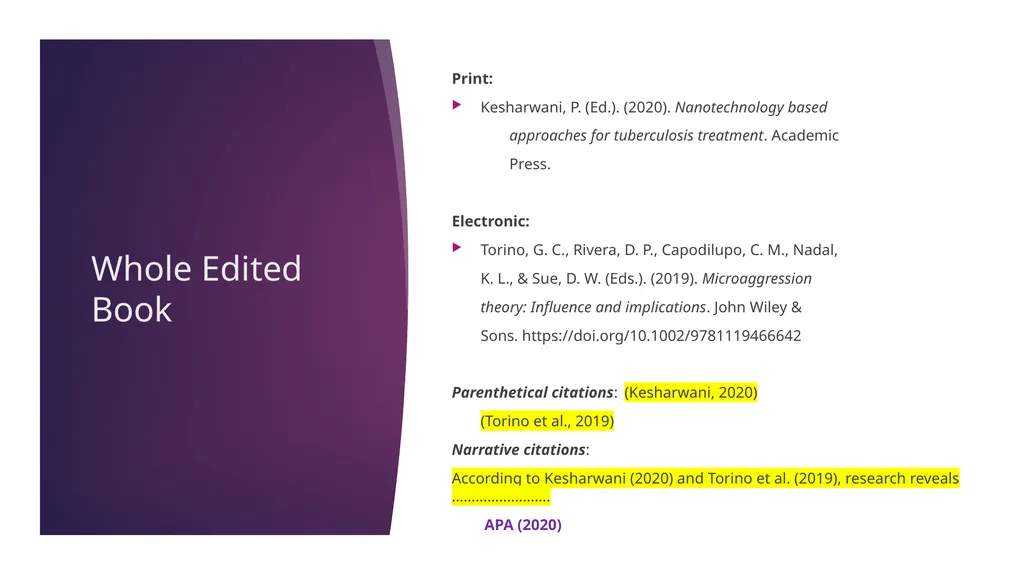
slide35. Whole Edited Book Print:
Kesharwani, P. (Ed.). (2020). Nanotechnology based
approaches for tuberculosis treatment. Academic
Press.
Electronic:
Torino, G. C., Rivera, D. P., Capodilupo, C. M., Nadal,
K. L., & Sue, D. W. (Eds.). (2019). Microaggression
theory: Influence and implications. John Wiley &
Sons. https://doi.org/10.1002/9781119466642
Parenthetical citations: (Kesharwani, 2020)
(Torino et al., 2019)
Narrative citations:
According to Kesharwani (2020) and Torino et al. (2019), research reveals …………………….
APA (2020)<br>
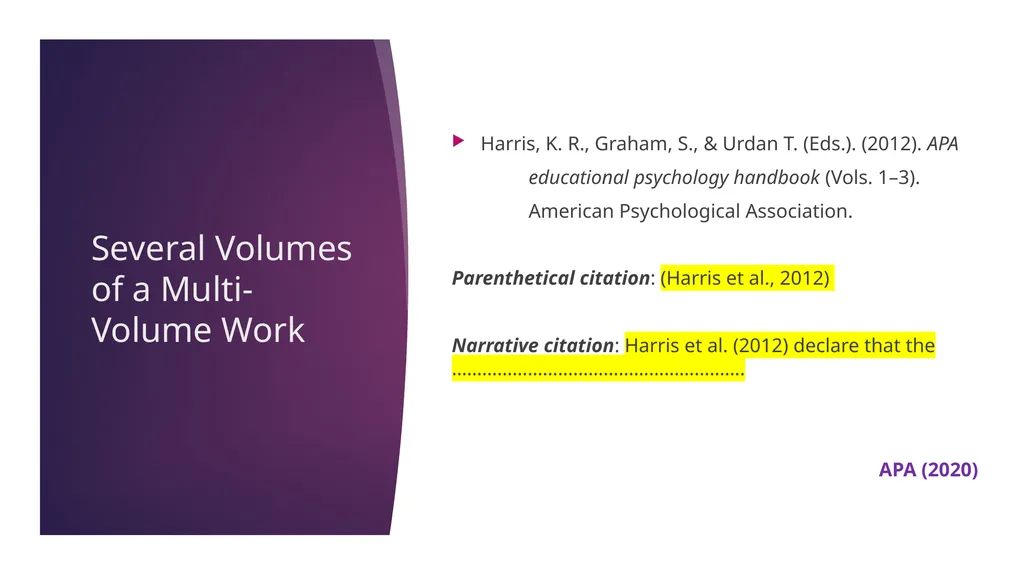
slide36. Several Volumes of a Multi-Volume Work Harris, K. R., Graham, S., & Urdan T. (Eds.). (2012). APA
educational psychology handbook (Vols. 1–3).
American Psychological Association.
Parenthetical citation: (Harris et al., 2012)
Narrative citation: Harris et al. (2012) declare that the ………………………………………………….
APA (2020)<br>
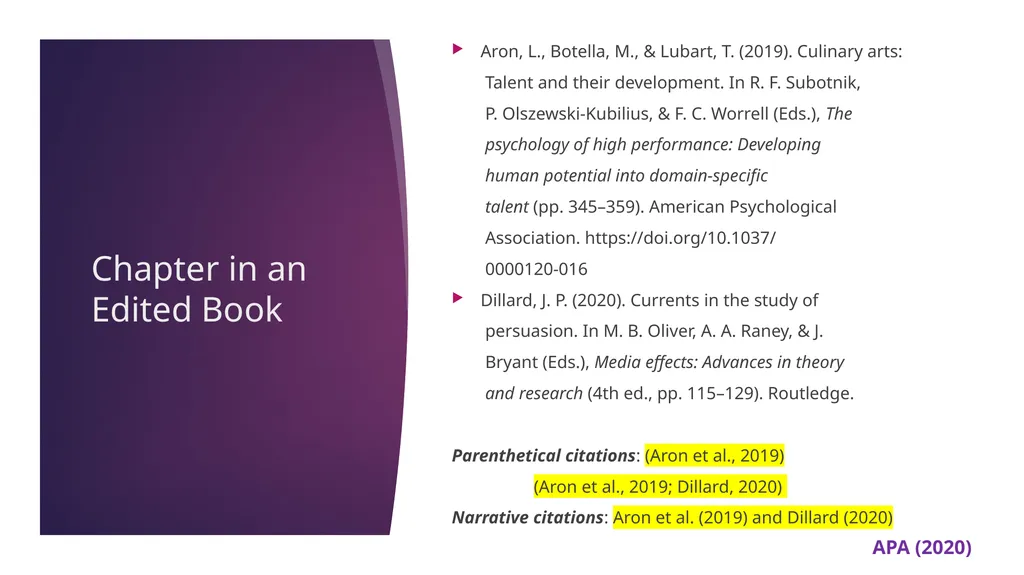
slide37. Chapter in an Edited Book Aron, L., Botella, M., & Lubart, T. (2019). Culinary arts:
Talent and their development. In R. F. Subotnik,
P. Olszewski-Kubilius, & F. C. Worrell (Eds.), The
psychology of high performance: Developing
human potential into domain-specific
talent (pp. 345–359). American Psychological
Association. https://doi.org/10.1037/
0000120-016
Dillard, J. P. (2020). Currents in the study of
persuasion. In M. B. Oliver, A. A. Raney, & J.
Bryant (Eds.), Media effects: Advances in theory
and research (4th ed., pp. 115–129). Routledge.
Parenthetical citations: (Aron et al., 2019)
(Aron et al., 2019; Dillard, 2020)
Narrative citations: Aron et al. (2019) and Dillard (2020) APA (2020)<br>
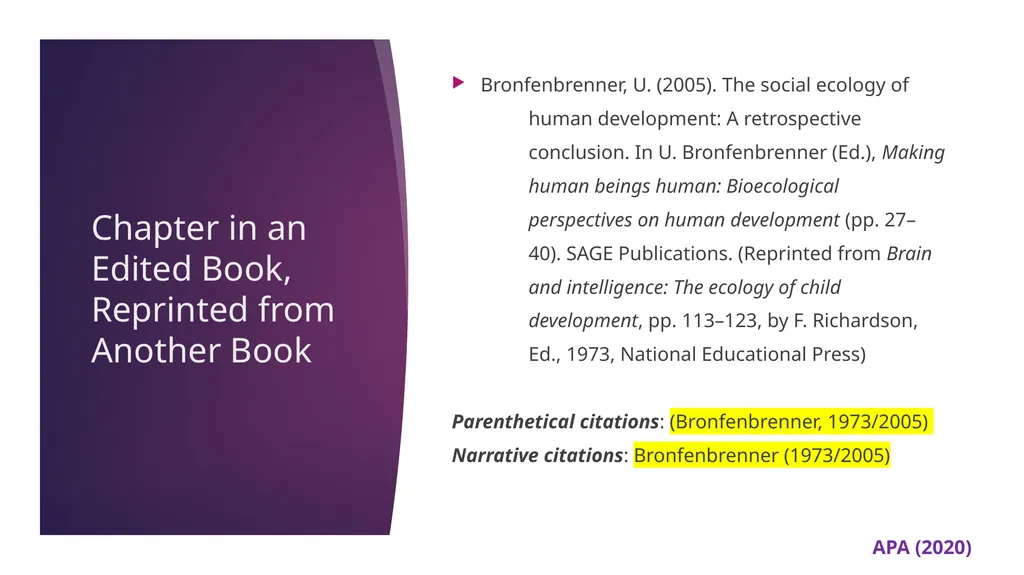
slide38. Chapter in an Edited Book, Reprinted from Another Book Bronfenbrenner, U. (2005). The social ecology of
human development: A retrospective
conclusion. In U. Bronfenbrenner (Ed.), Making
human beings human: Bioecological
perspectives on human development (pp. 27–
40). SAGE Publications. (Reprinted from Brain
and intelligence: The ecology of child
development, pp. 113–123, by F. Richardson,
Ed., 1973, National Educational Press)
Parenthetical citations: (Bronfenbrenner, 1973/2005)
Narrative citations: Bronfenbrenner (1973/2005) APA (2020)<br>
slide39. Diagnostic Manuals<br>
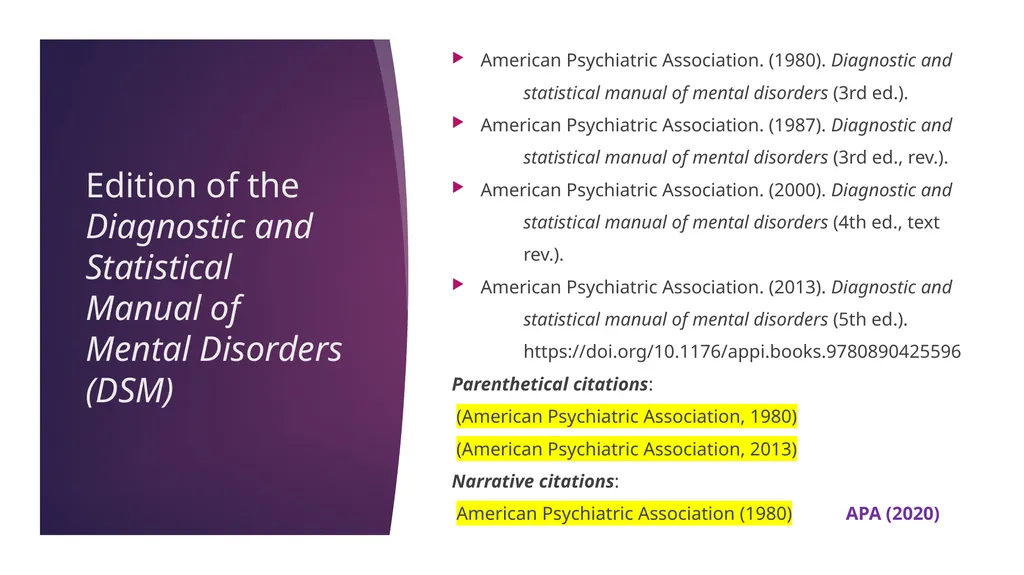
slide40. Edition of the Diagnostic and Statistical Manual of Mental Disorders (DSM) American Psychiatric Association. (1980). Diagnostic and
statistical manual of mental disorders (3rd ed.).
American Psychiatric Association. (1987). Diagnostic and
statistical manual of mental disorders (3rd ed., rev.).
American Psychiatric Association. (2000). Diagnostic and
statistical manual of mental disorders (4th ed., text
rev.).
American Psychiatric Association. (2013). Diagnostic and
statistical manual of mental disorders (5th ed.).
https://doi.org/10.1176/appi.books.9780890425596
Parenthetical citations:
(American Psychiatric Association, 1980)
(American Psychiatric Association, 2013)
Narrative citations:
American Psychiatric Association (1980) APA (2020)<br>
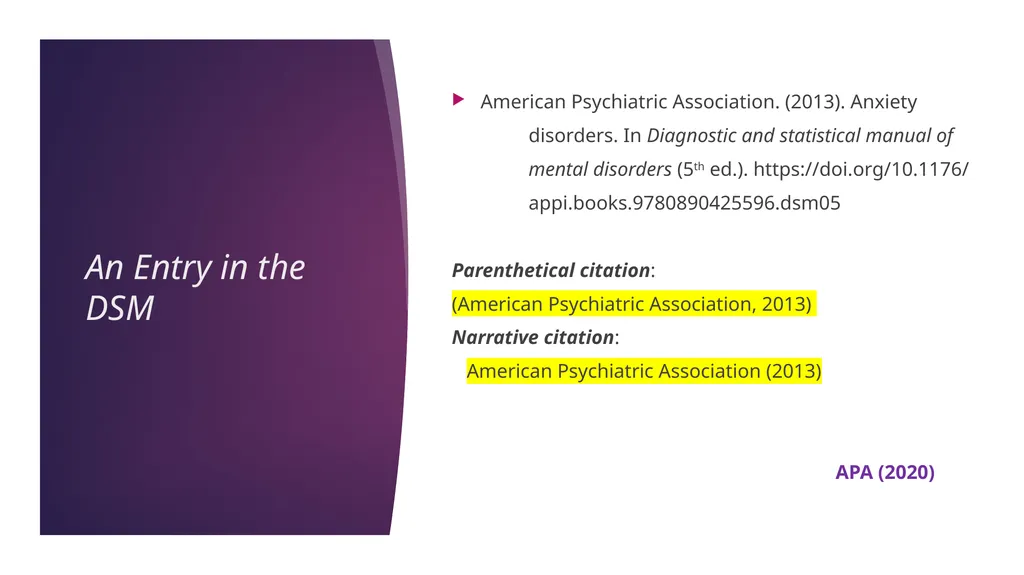
slide41. An Entry in the DSM American Psychiatric Association. (2013). Anxiety
disorders. In Diagnostic and statistical manual of
mental disorders (5th ed.). https://doi.org/10.1176/
appi.books.9780890425596.dsm05
Parenthetical citation:
(American Psychiatric Association, 2013)
Narrative citation:
American Psychiatric Association (2013)
APA (2020)<br>
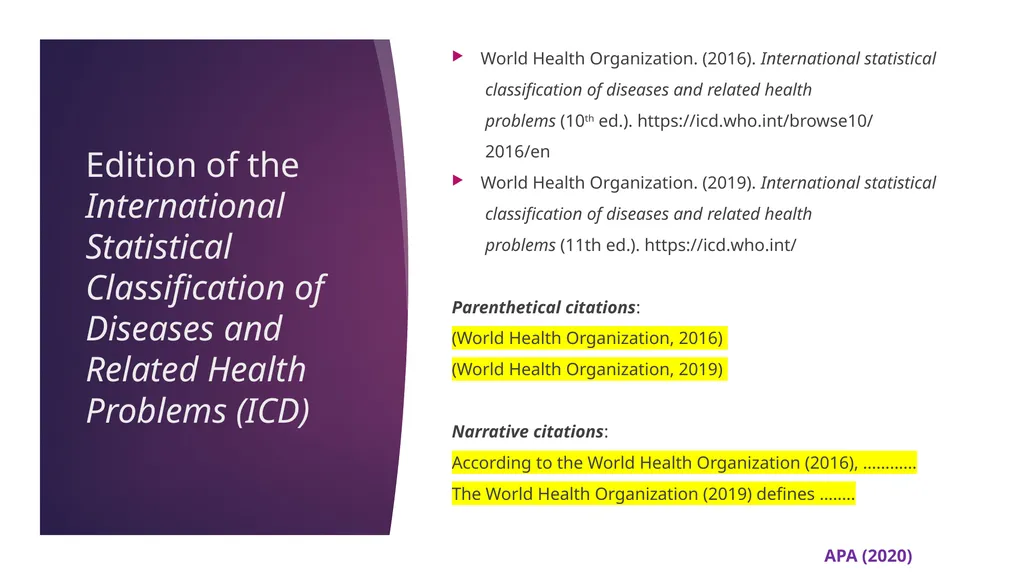
slide42. Edition of the International Statistical Classification of Diseases and Related Health Problems (ICD) World Health Organization. (2016). International statistical
classification of diseases and related health
problems (10th ed.). https://icd.who.int/browse10/
2016/en
World Health Organization. (2019). International statistical
classification of diseases and related health
problems (11th ed.). https://icd.who.int/
Parenthetical citations:
(World Health Organization, 2016)
(World Health Organization, 2019)
Narrative citations:
According to the World Health Organization (2016), …………
The World Health Organization (2019) defines ……..
APA (2020)<br>
slide43. An Entry in the ICD World Health Organization. (2019). 2A85.5 Mantle cell
lymphoma. In International statistical classification of
diseases and related health problems (11th
ed.). https://icd.who.int/browse11/l-
m/en#/http://id.who.int/icd/entity/1804127841
Parenthetical citation: (World Health Organization, 2019)
Narrative citation: World Health Organization (2019) APA (2020)<br>
slide44. Journals<br>
slide45. Journal Article Grady, J. S., Her, M., Moreno, G., Perez, C., & Yelinek, J.
(2019). Emotions in storybooks: A comparison of
storybooks that represent ethnic and racial groups
in the United States. Psychology of Popular Media
Culture, 8(3), 207–217. https://doi.org/10.1037/
ppm0000185
Parenthetical citation: (Grady et al., 2019)
Narrative citation: Grady et al. (2019) APA (2020)<br>
slide46. Journal Article with an Article Number Jerrentrup, A., Mueller, T., Glowalla, U., Herder, M.,
Henrichs, N., Neubauer, A., & Schaefer, J. R. (2018).
Teaching medicine with the help of “Dr. House.”
PLoS ONE, 13(3), Article e0193972. https://doi.org/
10.1371/journal.pone.0193972
Parenthetical citation: (Jerrentrup et al., 2018)
Narrative citation: Jerrentrup et al. (2018) APA (2020)<br>
slide47. Journal Article with Missing information Missing volume number
Stegmeir, M. (2016). Climate change: New discipline
practices promote college access. The Journal of
College Admission, (231), 44-47. https://www.
nxtbook.com/ygsreprints/NACAC/nacac_jca_
spring2016/#/46
Missing issue number
Sanchiz, M., Chevalier, A., & Amadieu, F. (2017). How do
older and young adults start searching for
information? Impact of age, domain knowledge
and problem complexity on the different steps of
information searching. Computers in Human
Behavior, 72, 67–78. https://doi.org/10.1016/j.chb.2017.
02.038
Parenthetical citation: (Stegmeir, 2016, p. 44)
Narrative citation: Sanchiz et al. (2017) APA (2020)<br>
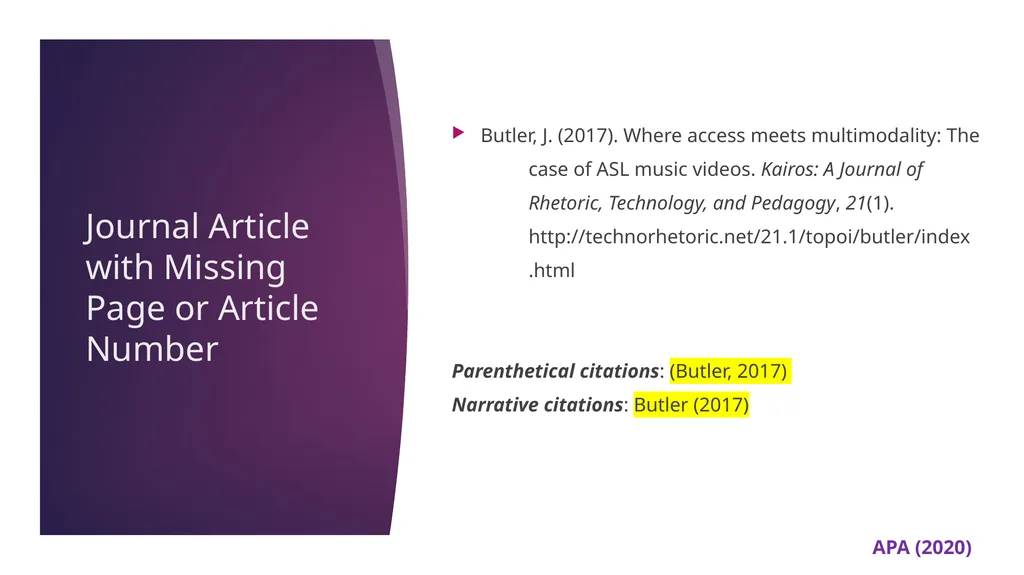
slide48. Journal Article with Missing Page or Article Number Butler, J. (2017). Where access meets multimodality: The
case of ASL music videos. Kairos: A Journal of
Rhetoric, Technology, and Pedagogy, 21(1).
http://technorhetoric.net/21.1/topoi/butler/index
.html
Parenthetical citations: (Butler, 2017)
Narrative citations: Butler (2017) APA (2020)<br>
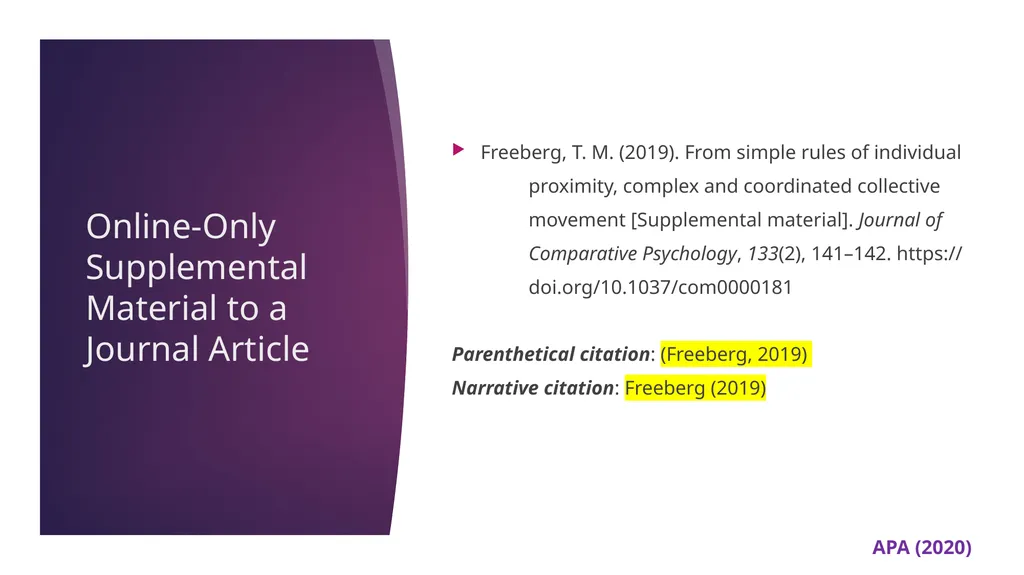
slide49. Online-Only Supplemental Material to a Journal Article Freeberg, T. M. (2019). From simple rules of individual
proximity, complex and coordinated collective
movement [Supplemental material]. Journal of
Comparative Psychology, 133(2), 141–142. https://
doi.org/10.1037/com0000181
Parenthetical citation: (Freeberg, 2019)
Narrative citation: Freeberg (2019) APA (2020)<br>
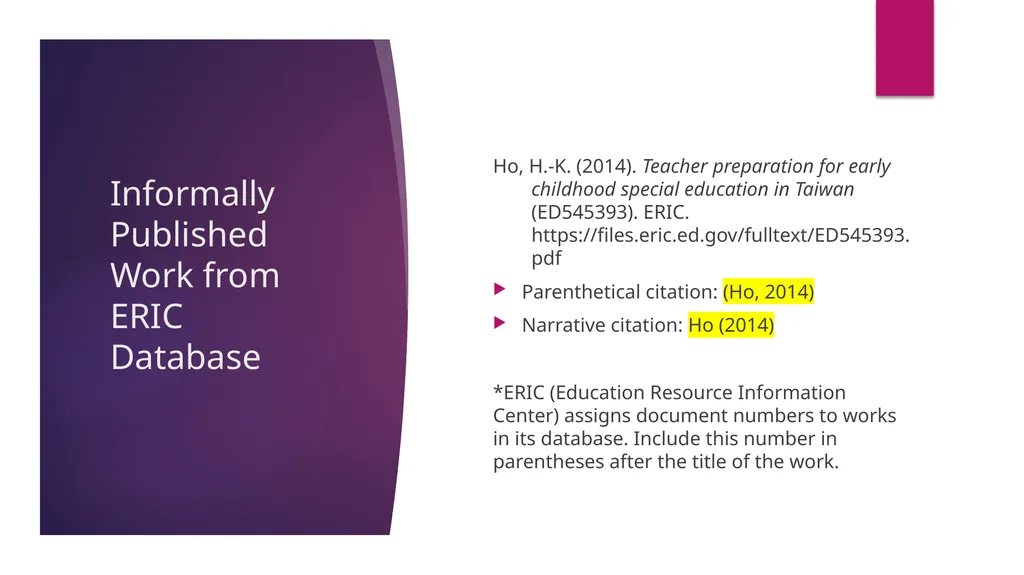
slide50. Informally Published Work from ERIC Database Ho, H.-K. (2014). Teacher preparation for early childhood special education in Taiwan (ED545393). ERIC. https://files.eric.ed.gov/fulltext/ED545393.pdf
Parenthetical citation: (Ho, 2014)
Narrative citation: Ho (2014)
*ERIC (Education Resource Information Center) assigns document numbers to works in its database. Include this number in parentheses after the title of the work.<br>
slide51. Secondary Sources<br>
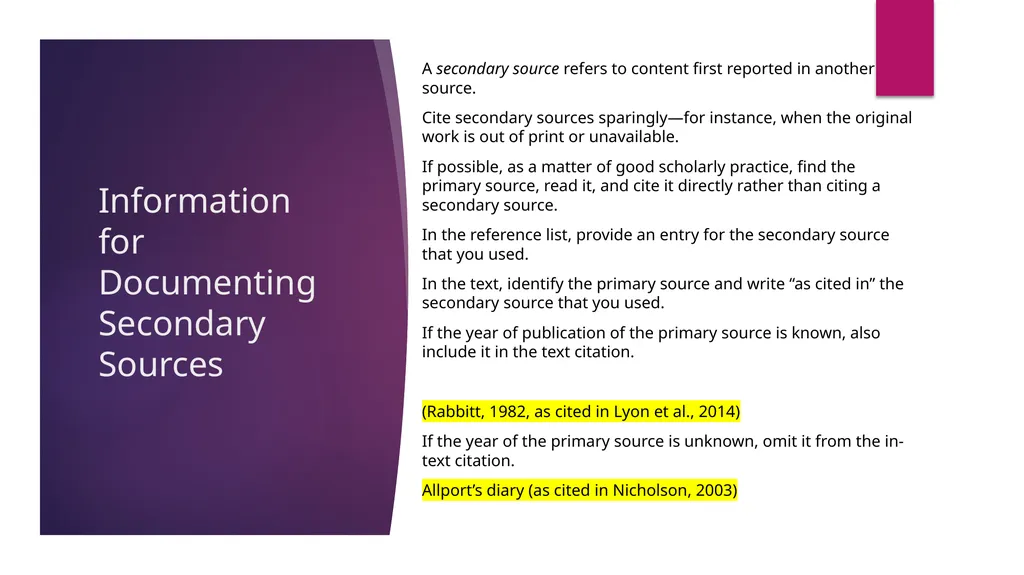
slide52. Information for Documenting Secondary Sources A secondary source refers to content first reported in another source.
Cite secondary sources sparingly—for instance, when the original work is out of print or unavailable.
If possible, as a matter of good scholarly practice, find the primary source, read it, and cite it directly rather than citing a secondary source.
In the reference list, provide an entry for the secondary source that you used.
In the text, identify the primary source and write “as cited in” the secondary source that you used.
If the year of publication of the primary source is known, also include it in the text citation.
(Rabbitt, 1982, as cited in Lyon et al., 2014)
If the year of the primary source is unknown, omit it from the in-text citation.
Allport’s diary (as cited in Nicholson, 2003)<br>
slide53. Magazines<br>
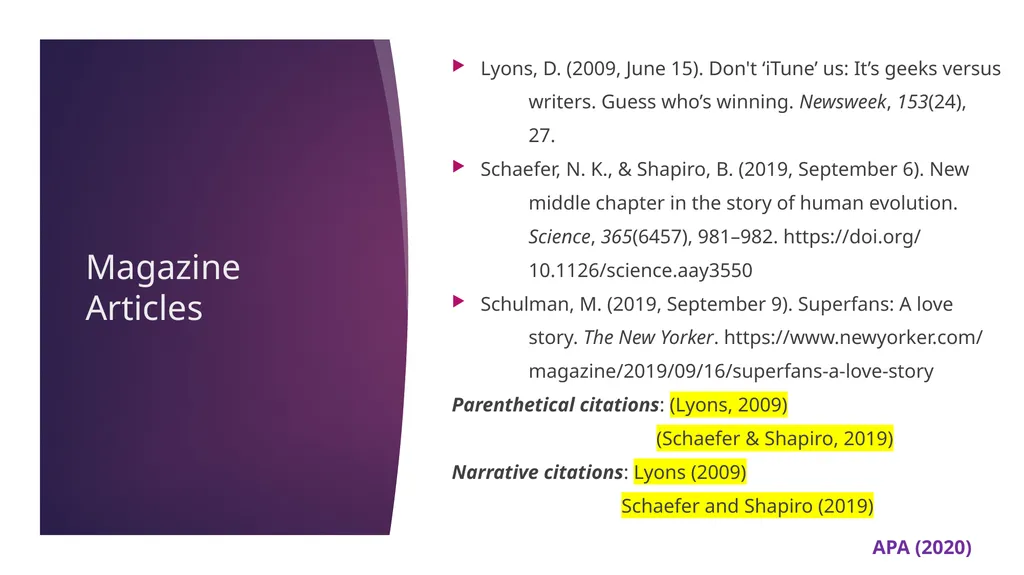
slide54. Magazine Articles Lyons, D. (2009, June 15). Don't ‘iTune’ us: It’s geeks versus
writers. Guess who’s winning. Newsweek, 153(24),
27.
Schaefer, N. K., & Shapiro, B. (2019, September 6). New
middle chapter in the story of human evolution.
Science, 365(6457), 981–982. https://doi.org/
10.1126/science.aay3550
Schulman, M. (2019, September 9). Superfans: A love
story. The New Yorker. https://www.newyorker.com/
magazine/2019/09/16/superfans-a-love-story
Parenthetical citations: (Lyons, 2009)
(Schaefer & Shapiro, 2019)
Narrative citations: Lyons (2009)
Schaefer and Shapiro (2019) APA (2020)<br>
slide55. Newspapers<br>
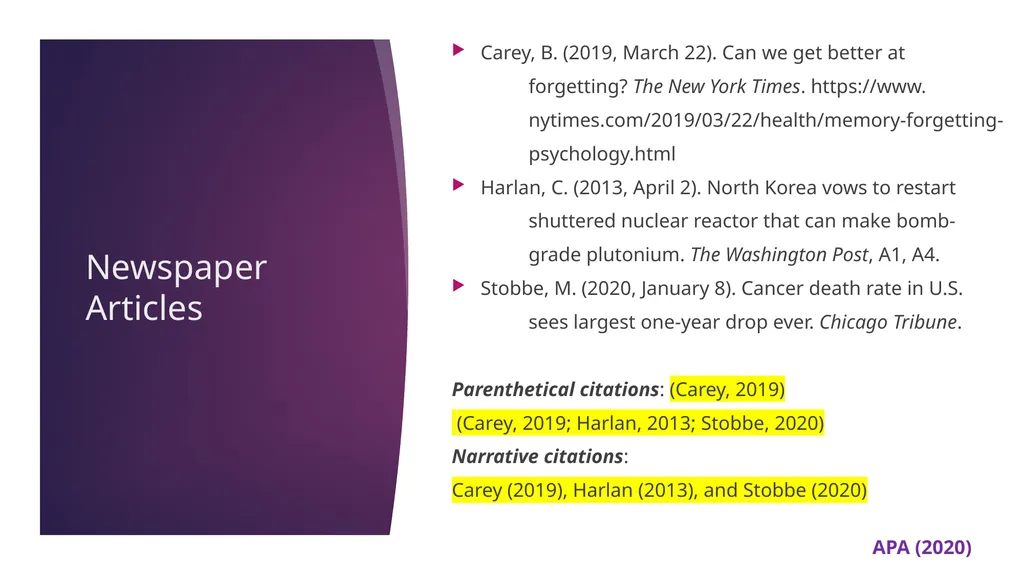
slide56. Newspaper Articles Carey, B. (2019, March 22). Can we get better at
forgetting? The New York Times. https://www.
nytimes.com/2019/03/22/health/memory-forgetting-
psychology.html
Harlan, C. (2013, April 2). North Korea vows to restart
shuttered nuclear reactor that can make bomb-
grade plutonium. The Washington Post, A1, A4.
Stobbe, M. (2020, January 8). Cancer death rate in U.S.
sees largest one-year drop ever. Chicago Tribune.
Parenthetical citations: (Carey, 2019)
(Carey, 2019; Harlan, 2013; Stobbe, 2020)
Narrative citations:
Carey (2019), Harlan (2013), and Stobbe (2020) APA (2020)<br>
slide57. Blogs<br>
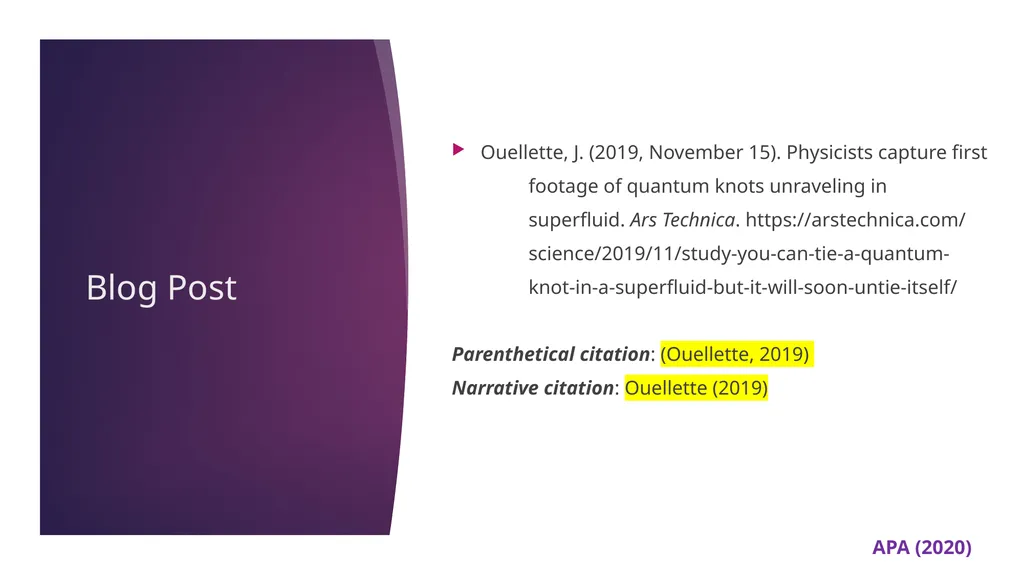
slide58. Blog Post Ouellette, J. (2019, November 15). Physicists capture first
footage of quantum knots unraveling in
superfluid. Ars Technica. https://arstechnica.com/
science/2019/11/study-you-can-tie-a-quantum-
knot-in-a-superfluid-but-it-will-soon-untie-itself/
Parenthetical citation: (Ouellette, 2019)
Narrative citation: Ouellette (2019) APA (2020)<br>
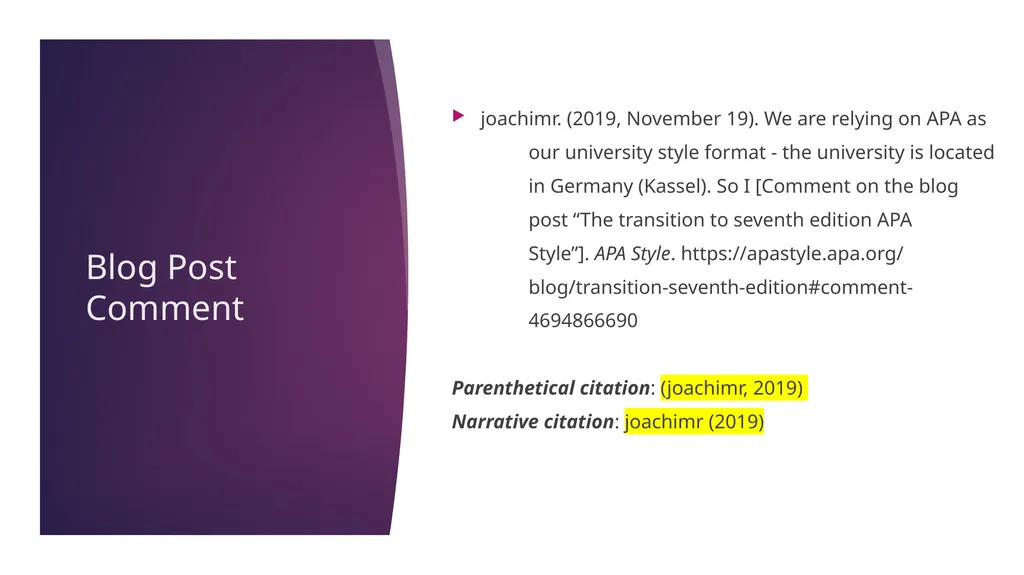
slide59. Blog Post Comment joachimr. (2019, November 19). We are relying on APA as
our university style format - the university is located
in Germany (Kassel). So I [Comment on the blog
post “The transition to seventh edition APA
Style”]. APA Style. https://apastyle.apa.org/
blog/transition-seventh-edition#comment-
4694866690
Parenthetical citation: (joachimr, 2019)
Narrative citation: joachimr (2019)<br>
slide60. Websites<br>
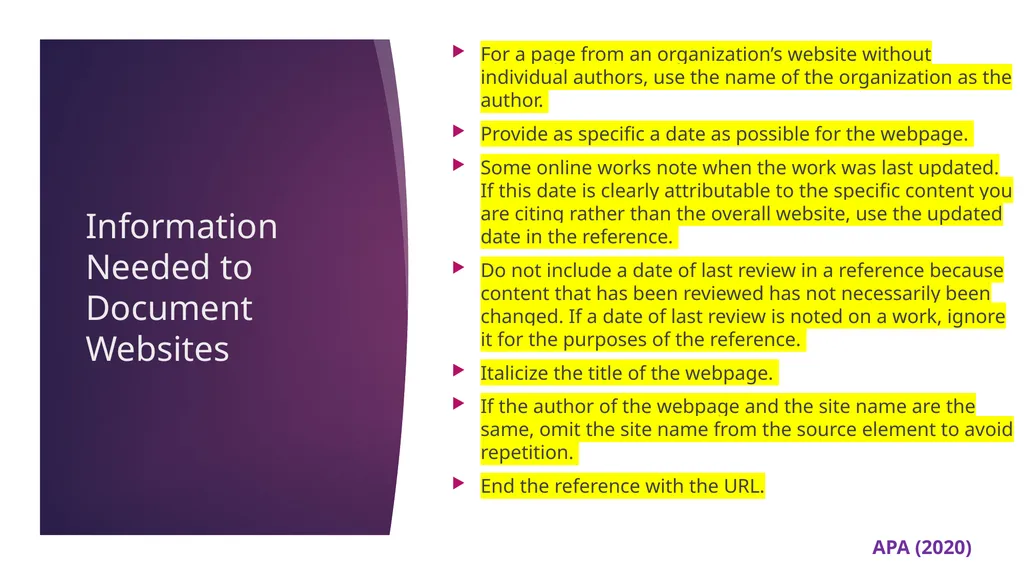
slide61. Information Needed to Document Websites For a page from an organization’s website without individual authors, use the name of the organization as the author.
Provide as specific a date as possible for the webpage.
Some online works note when the work was last updated. If this date is clearly attributable to the specific content you are citing rather than the overall website, use the updated date in the reference.
Do not include a date of last review in a reference because content that has been reviewed has not necessarily been changed. If a date of last review is noted on a work, ignore it for the purposes of the reference.
Italicize the title of the webpage.
If the author of the webpage and the site name are the same, omit the site name from the source element to avoid repetition.
End the reference with the URL. APA (2020)<br>
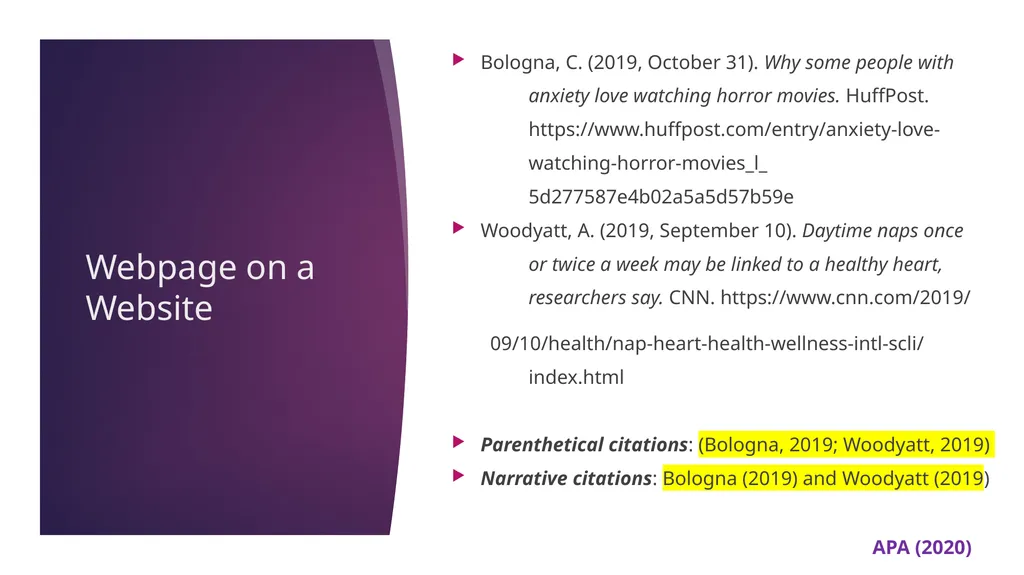
slide62. Webpage on a Website Bologna, C. (2019, October 31). Why some people with
anxiety love watching horror movies. HuffPost.
https://www.huffpost.com/entry/anxiety-love-
watching-horror-movies_l_
5d277587e4b02a5a5d57b59e
Woodyatt, A. (2019, September 10). Daytime naps once
or twice a week may be linked to a healthy heart,
researchers say. CNN. https://www.cnn.com/2019/ 09/10/health/nap-heart-health-wellness-intl-scli/
index.html
Parenthetical citations: (Bologna, 2019; Woodyatt, 2019)
Narrative citations: Bologna (2019) and Woodyatt (2019) APA (2020)<br>
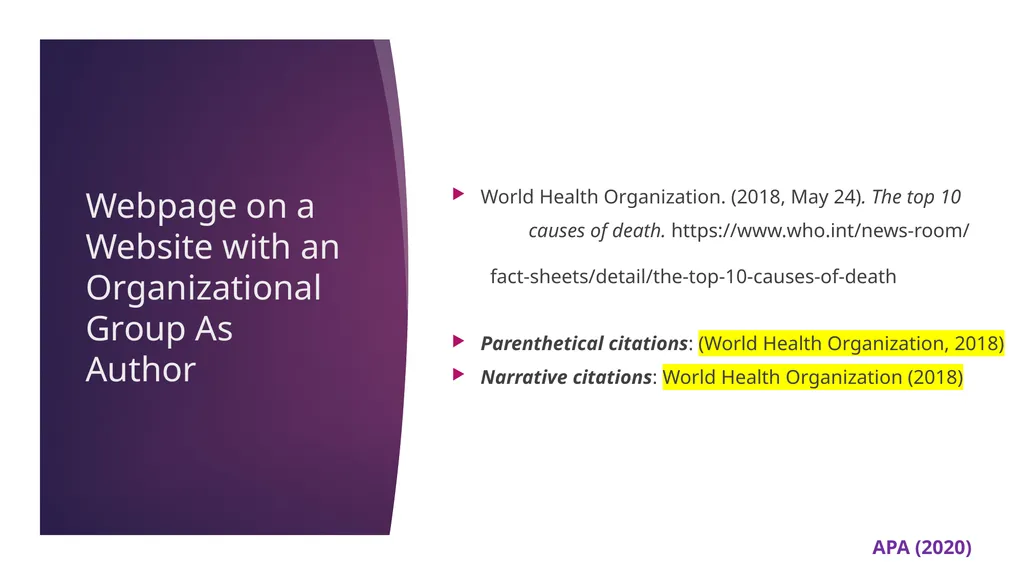
slide63. Webpage on a Website with an Organizational Group As Author World Health Organization. (2018, May 24). The top 10
causes of death. https://www.who.int/news-room/ fact-sheets/detail/the-top-10-causes-of-death
Parenthetical citations: (World Health Organization, 2018)
Narrative citations: World Health Organization (2018) APA (2020)<br>
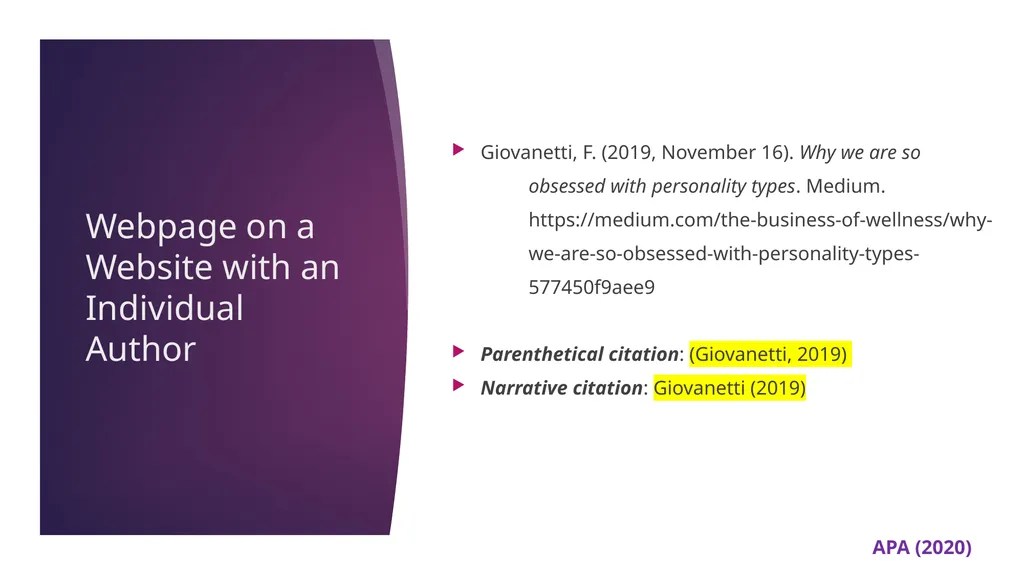
slide64. Webpage on a Website with an Individual Author Giovanetti, F. (2019, November 16). Why we are so
obsessed with personality types. Medium.
https://medium.com/the-business-of-wellness/why-
we-are-so-obsessed-with-personality-types-
577450f9aee9
Parenthetical citation: (Giovanetti, 2019)
Narrative citation: Giovanetti (2019) APA (2020)<br>
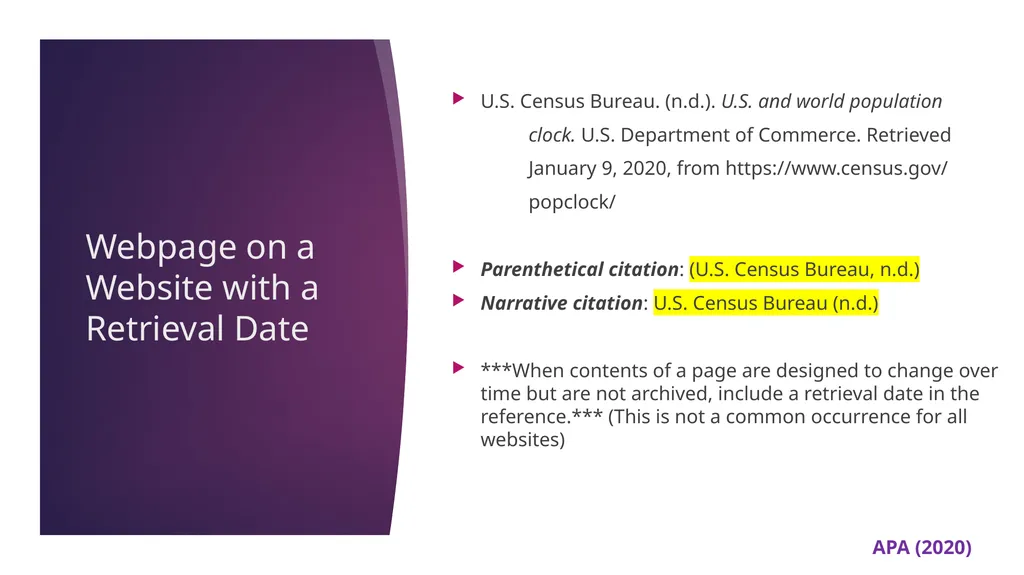
slide65. Webpage on a Website with a Retrieval Date U.S. Census Bureau. (n.d.). U.S. and world population
clock. U.S. Department of Commerce. Retrieved
January 9, 2020, from https://www.census.gov/
popclock/
Parenthetical citation: (U.S. Census Bureau, n.d.)
Narrative citation: U.S. Census Bureau (n.d.)
***When contents of a page are designed to change over time but are not archived, include a retrieval date in the reference.*** (This is not a common occurrence for all websites) APA (2020)<br>
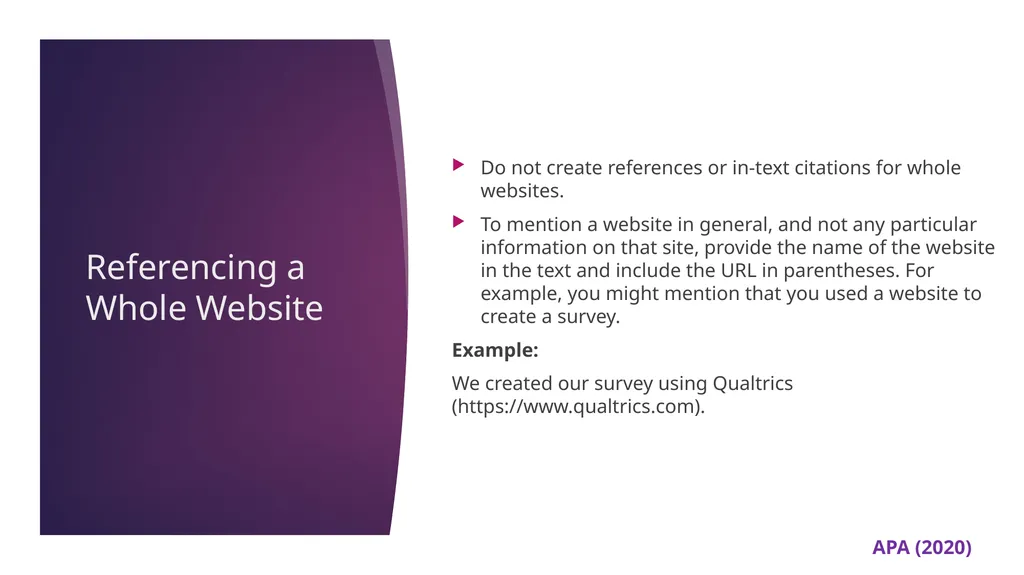
slide66. Referencing a Whole Website Do not create references or in-text citations for whole websites.
To mention a website in general, and not any particular information on that site, provide the name of the website in the text and include the URL in parentheses. For example, you might mention that you used a website to create a survey.
Example:
We created our survey using Qualtrics (https://www.qualtrics.com). APA (2020)<br>
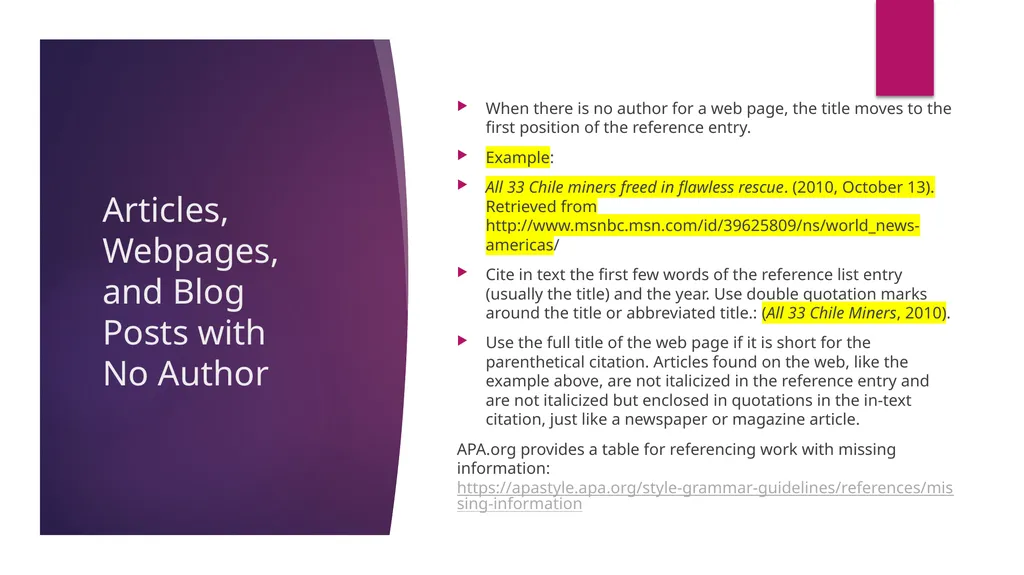
slide67. Articles, Webpages, and Blog Posts with No Author When there is no author for a web page, the title moves to the first position of the reference entry.
Example:
All 33 Chile miners freed in flawless rescue. (2010, October 13). Retrieved from http://www.msnbc.msn.com/id/39625809/ns/world_news-americas/
Cite in text the first few words of the reference list entry (usually the title) and the year. Use double quotation marks around the title or abbreviated title.: (All 33 Chile Miners, 2010).
Use the full title of the web page if it is short for the parenthetical citation. Articles found on the web, like the example above, are not italicized in the reference entry and are not italicized but enclosed in quotations in the in-text citation, just like a newspaper or magazine article.
APA.org provides a table for referencing work with missing information: https://apastyle.apa.org/style-grammar-guidelines/references/missing-information<br>
slide68. Social Media<br>
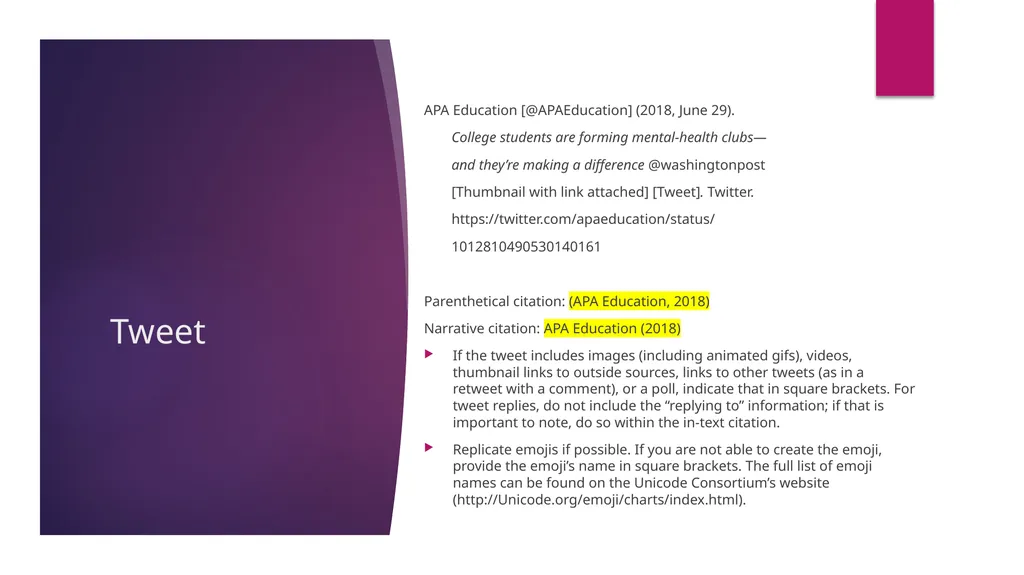
slide69. Tweet APA Education [@APAEducation] (2018, June 29).
College students are forming mental-health clubs—
and they’re making a difference @washingtonpost
[Thumbnail with link attached] [Tweet]. Twitter.
https://twitter.com/apaeducation/status/
1012810490530140161
Parenthetical citation: (APA Education, 2018)
Narrative citation: APA Education (2018)
If the tweet includes images (including animated gifs), videos, thumbnail links to outside sources, links to other tweets (as in a retweet with a comment), or a poll, indicate that in square brackets. For tweet replies, do not include the “replying to” information; if that is important to note, do so within the in-text citation.
Replicate emojis if possible. If you are not able to create the emoji, provide the emoji’s name in square brackets. The full list of emoji names can be found on the Unicode Consortium’s website (http://Unicode.org/emoji/charts/index.html).<br>
slide70. Twitter Profile APA Style [@APA_Style]. (n.d.). Tweets [Twitter
profile]. Twitter. Retrieved November 1, 2019,
from https://twitter.com/APA_Style
Parenthetical citation: (APA Style, n.d.)
Narrative citation: APA Style (n.d.)
Provide a retrieval date because the contents of the page change over time.
A Twitter profile has several tabs (“Tweets” is the default. To reference one of the other tabs (e.g., “Lists” or “Moments”), substitute that tab name for “Tweets.”
Include the notation “Twitter profile” in square brackets.<br>
slide71. Facebook Post Gaiman, N. (2018, March 22). 100,000+ Rohingya
refugees could be at serious risk during
Bangladesh’s monsoon season. My fellow UNHCR
Goodwill Ambassador Cate Blanchett is [Image
attached] [Status update]. Facebook.
http://bit.ly/2JQxPAD
Parenthetical citation: (Gaiman, 2018)
Narrative citation: Gaiman (2018)
This format can be used for posts to other social media services, including Tumblr, LinkedIn, and so forth.
If a status update includes images, videos, thumbnail links to outside sources, or content from another Facebook post (such as when sharing a link), indicate that in square brackets.
Replicate emojis or name them in brackets.<br>
slide72. Facebook Page Smithsonian’s National Zoo and Conservation
Biology Institute. (n.d.). Home [Facebook
page]. Facebook. Retrieved July 22, 2019,
from https://www.facebook.com/nationalzoo
Parenthetical citation: (Smithsonian’s National Zoo and Conservation Biology Institute, 2018)
Narrative citation: Smithsonian’s National Zoo and Conservation Biology Institute (2018)
Use the page title in the reference (e.g., “Timeline,” “Home,” “Photos,” “About”).
Include the notation “Facebook page” in square brackets.
This format can be used or adopted for references to other platform or profile pages, including YouTube, Instagram, Tumblr, LinkedIn, and so forth.<br>
slide73. Instagram Photo or Video Zeitz MOCAA [@zeitzmocaa]. (2018, November 26). Grade 6
learners from Parkfields Primary School in Hanover Park
visited the museum for a tour and workshop hosted by
[Photographs]. Instagram. https://www.Instagram.com/
p/BqpHpjFBs3b
Parenthetical citation: (Zeitz MOCAA, 2018)
Narrative citation: Zeitz MOCAA (2018)<br>
slide74. Instagram highlight The New York Public Library [@nypl]. (n.d.). The raven
[Highlight]. Instagram. Retrieved April 16, 2019, from
https://bitly.com/2FV8bu3
Parenthetical citation: (The New York Public Library, n.d.)
Narrative citation: The New York Public Library (n.d.)<br>
slide75. Podcasts<br>
slide76. Referencing a Podcast Vedantam, S. (Host). (2015-present). Hidden brain
[Audio podcast]. NPR. https://www.npr.org/
series/423302056/hidden-brain
Parenthetical citation: (Vedantam, 2015-present)
Narrative citation: Vedantam (2015-present)
List the host of the podcast as the author. Alternatively, provide the executive producers, if known. In either case, include their role in parentheses.
Specify the podcast type (audio or video) in square brackets.
If the URL of the podcast is unknown (e.g., if accessed via an app), omit the URL.<br>
slide77. Referencing a Podcast Episode Glass, I. (Host). (2011, August 12). Amusement
park. (No. 443) [Audio podcast episode]. In
This American life. WBEZ Chicago.
https://www.thisamericanlife.org/radio-
archives/episode/443/amusement-park
Parenthetical citation: (Glass, 2011)
Narrative citation: Glass (2011)
List the host of the podcast as the author and include their role in parentheses.
Provide the episode number after the title in parentheses. If the podcast does not number episodes, omit the number from the reference.<br>
slide78. Clinical Practice References<br>
slide79. Information Needed to Document Clinical Practice Guidelines Most clinical practice guidelines are published as reports or webpages and so follow the report or webpage reference type, which have the same structure.
Use the committee or agency that developed the guideline in the author element of the reference when no individual authors are credited.
When the title page or cover credits both a committee and an agency, provide the committee name in the author element of the reference and the agency name in the source element of the reference. The first example shows this: The committee is the Healthcare Infection Control Practices Advisory Committee, and the agency is the U.S. Department of Health & Human Services, Centers for Disease Control and Prevention.
When the title page or cover credits only an agency, provide the agency name in the author element of the reference. The second and third examples show this: The National Institute for Health and Care Excellence (NICE) and the World Health Organization are agencies.
Provide the year in which the guideline was developed in the date element of the reference.
If you are citing an updated guideline, use the year of the update in the reference.
Provide the title of the guideline in italic sentence case.
Provide the name of the website from which the guideline was obtained in the source element of the reference.
If the website name is the same as the author, omit the site name to avoid repetition (as in the NICE guideline example).
Provide a URL for the guideline. APA (2020)<br>
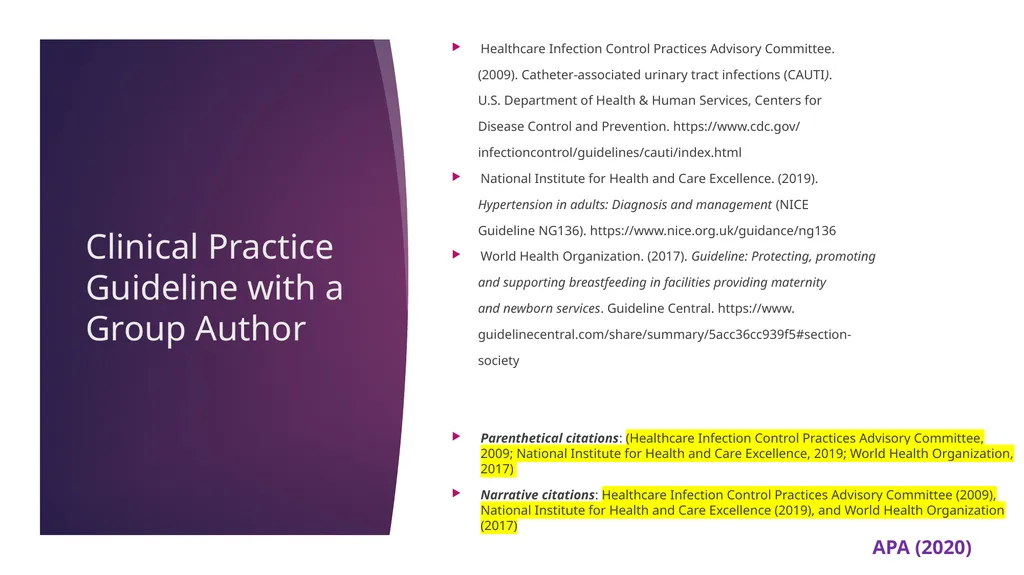
slide80. Clinical Practice Guideline with a Group Author Healthcare Infection Control Practices Advisory Committee.
(2009). Catheter-associated urinary tract infections (CAUTI).
U.S. Department of Health & Human Services, Centers for
Disease Control and Prevention. https://www.cdc.gov/
infectioncontrol/guidelines/cauti/index.html
National Institute for Health and Care Excellence. (2019).
Hypertension in adults: Diagnosis and management (NICE
Guideline NG136). https://www.nice.org.uk/guidance/ng136
World Health Organization. (2017). Guideline: Protecting, promoting
and supporting breastfeeding in facilities providing maternity
and newborn services. Guideline Central. https://www.
guidelinecentral.com/share/summary/5acc36cc939f5#section-
society
Parenthetical citations: (Healthcare Infection Control Practices Advisory Committee, 2009; National Institute for Health and Care Excellence, 2019; World Health Organization, 2017)
Narrative citations: Healthcare Infection Control Practices Advisory Committee (2009), National Institute for Health and Care Excellence (2019), and World Health Organization (2017) APA (2020)<br>
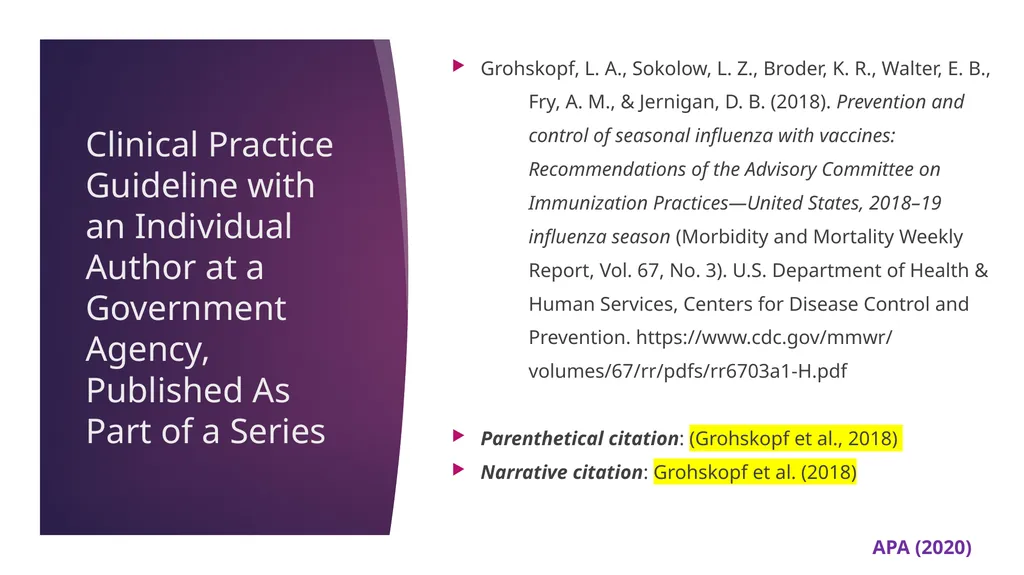
slide81. Clinical Practice Guideline with an Individual Author at a Government Agency, Published As Part of a Series Grohskopf, L. A., Sokolow, L. Z., Broder, K. R., Walter, E. B.,
Fry, A. M., & Jernigan, D. B. (2018). Prevention and
control of seasonal influenza with vaccines:
Recommendations of the Advisory Committee on
Immunization Practices—United States, 2018–19
influenza season (Morbidity and Mortality Weekly
Report, Vol. 67, No. 3). U.S. Department of Health &
Human Services, Centers for Disease Control and
Prevention. https://www.cdc.gov/mmwr/
volumes/67/rr/pdfs/rr6703a1-H.pdf
Parenthetical citation: (Grohskopf et al., 2018)
Narrative citation: Grohskopf et al. (2018) APA (2020)<br>
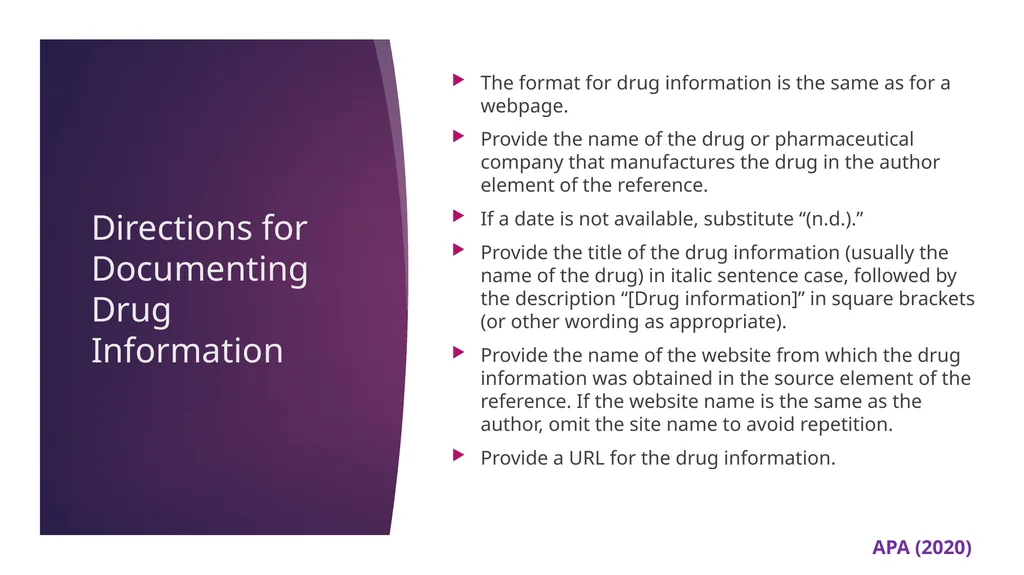
slide82. Directions for Documenting Drug Information The format for drug information is the same as for a webpage.
Provide the name of the drug or pharmaceutical company that manufactures the drug in the author element of the reference.
If a date is not available, substitute “(n.d.).”
Provide the title of the drug information (usually the name of the drug) in italic sentence case, followed by the description “[Drug information]” in square brackets (or other wording as appropriate).
Provide the name of the website from which the drug information was obtained in the source element of the reference. If the website name is the same as the author, omit the site name to avoid repetition.
Provide a URL for the drug information. APA (2020)<br>
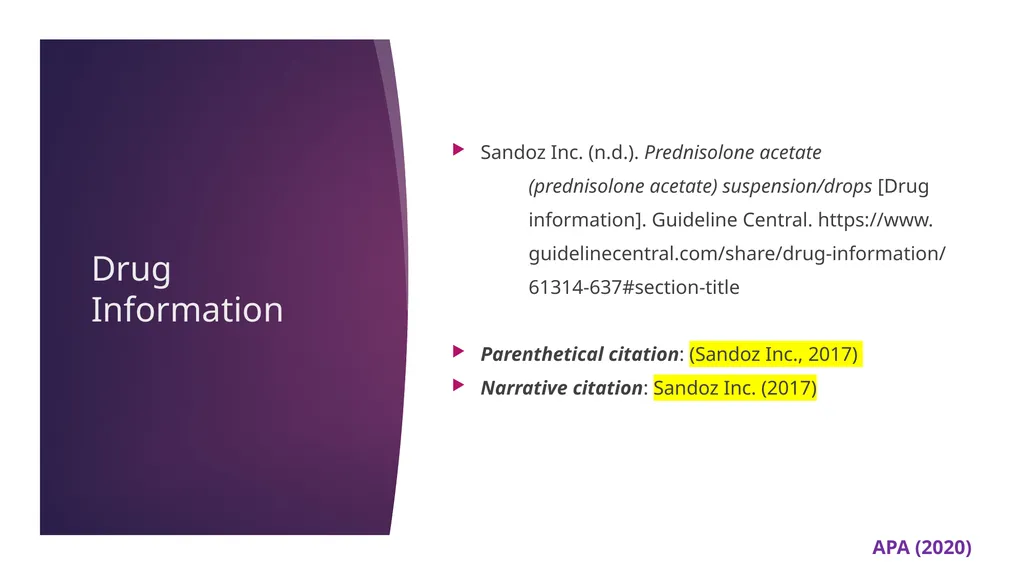
slide83. Drug Information Sandoz Inc. (n.d.). Prednisolone acetate
(prednisolone acetate) suspension/drops [Drug
information]. Guideline Central. https://www.
guidelinecentral.com/share/drug-information/
61314-637#section-title
Parenthetical citation: (Sandoz Inc., 2017)
Narrative citation: Sandoz Inc. (2017) APA (2020)<br>
slide84. Cases or Court Decisions<br>
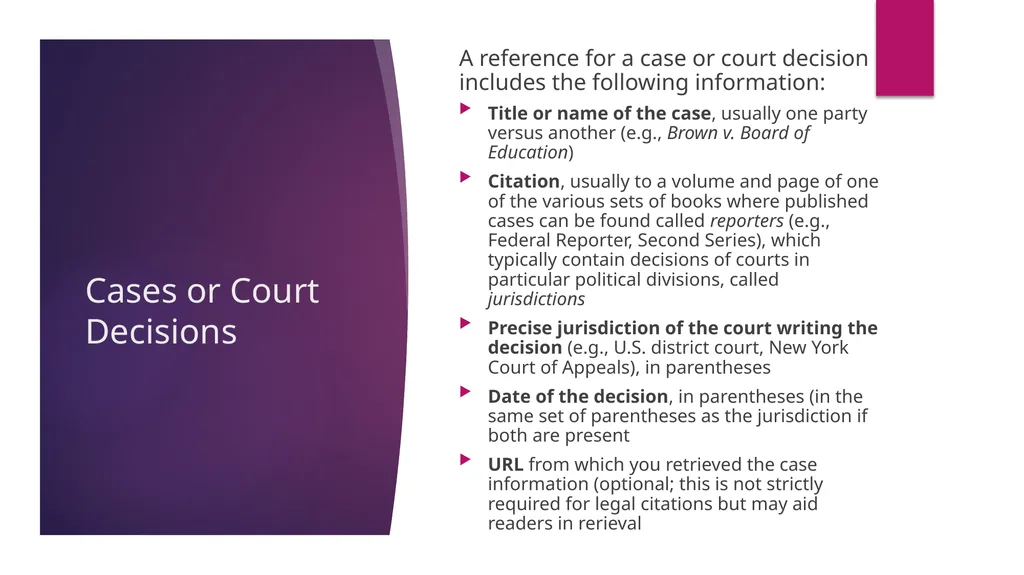
slide85. Cases or Court Decisions A reference for a case or court decision includes the following information:
Title or name of the case, usually one party versus another (e.g., Brown v. Board of Education)
Citation, usually to a volume and page of one of the various sets of books where published cases can be found called reporters (e.g., Federal Reporter, Second Series), which typically contain decisions of courts in particular political divisions, called jurisdictions
Precise jurisdiction of the court writing the decision (e.g., U.S. district court, New York Court of Appeals), in parentheses
Date of the decision, in parentheses (in the same set of parentheses as the jurisdiction if both are present
URL from which you retrieved the case information (optional; this is not strictly required for legal citations but may aid readers in rerieval<br>
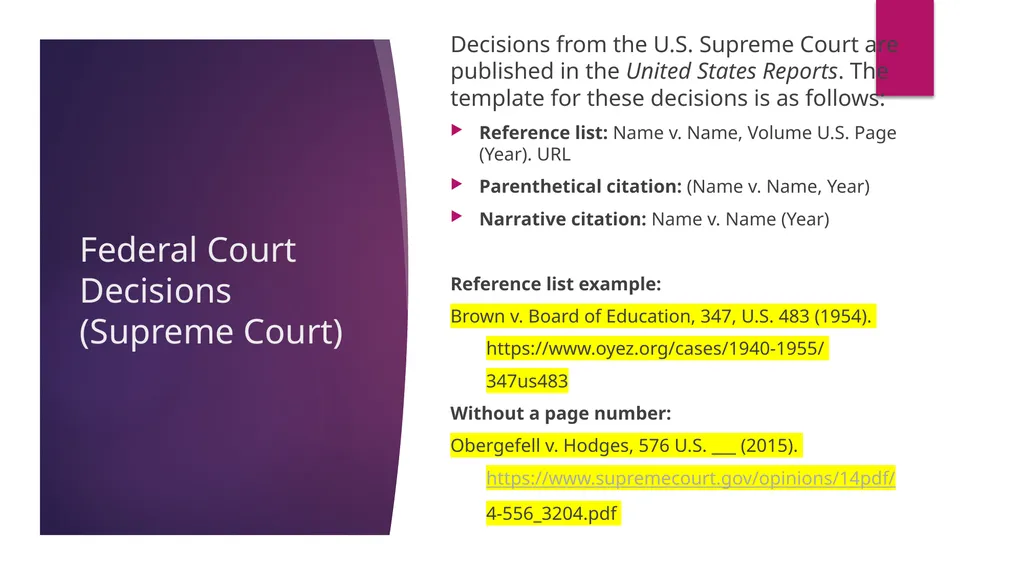
slide86. Federal Court Decisions (Supreme Court) Decisions from the U.S. Supreme Court are published in the United States Reports. The template for these decisions is as follows:
Reference list: Name v. Name, Volume U.S. Page (Year). URL
Parenthetical citation: (Name v. Name, Year)
Narrative citation: Name v. Name (Year)
Reference list example:
Brown v. Board of Education, 347, U.S. 483 (1954).
https://www.oyez.org/cases/1940-1955/
347us483
Without a page number:
Obergefell v. Hodges, 576 U.S. ___ (2015).
https://www.supremecourt.gov/opinions/14pdf/
4-556_3204.pdf<br>
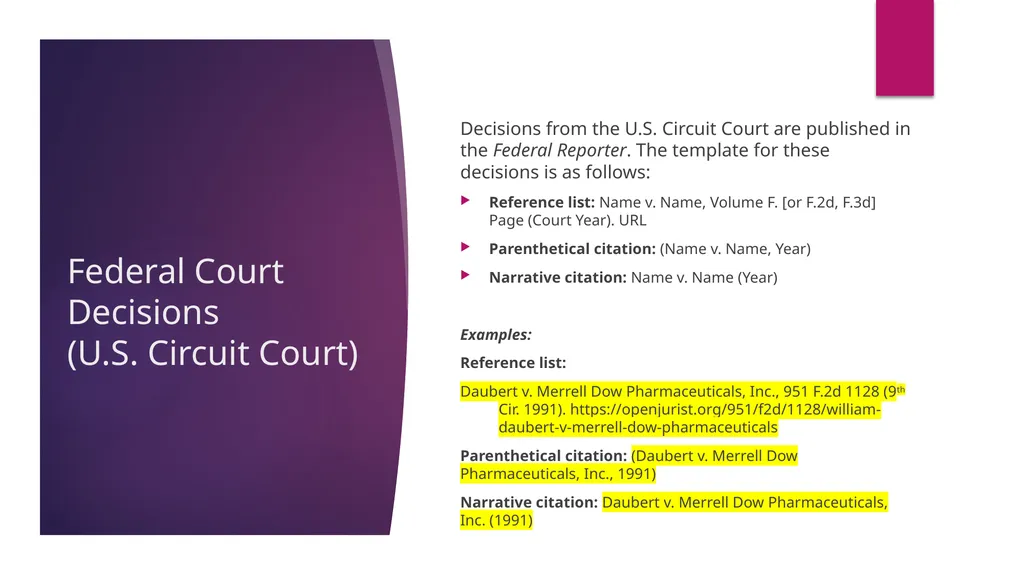
slide87. Federal Court Decisions (U.S. Circuit Court) Decisions from the U.S. Circuit Court are published in the Federal Reporter. The template for these decisions is as follows:
Reference list: Name v. Name, Volume F. [or F.2d, F.3d] Page (Court Year). URL
Parenthetical citation: (Name v. Name, Year)
Narrative citation: Name v. Name (Year)
Examples:
Reference list:
Daubert v. Merrell Dow Pharmaceuticals, Inc., 951 F.2d 1128 (9th Cir. 1991). https://openjurist.org/951/f2d/1128/william-daubert-v-merrell-dow-pharmaceuticals
Parenthetical citation: (Daubert v. Merrell Dow Pharmaceuticals, Inc., 1991)
Narrative citation: Daubert v. Merrell Dow Pharmaceuticals, Inc. (1991)<br>
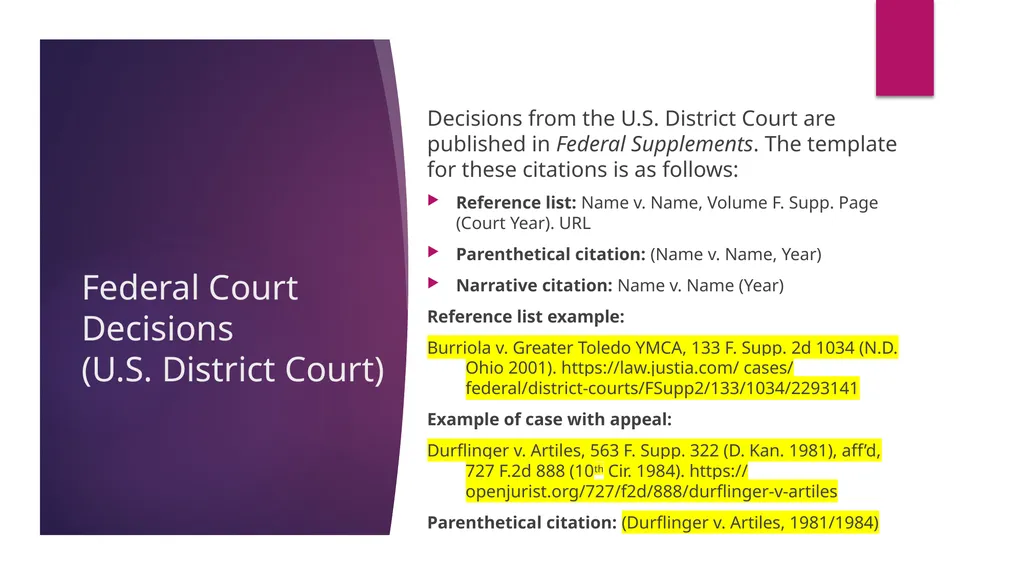
slide88. Federal Court Decisions (U.S. District Court) Decisions from the U.S. District Court are published in Federal Supplements. The template for these citations is as follows:
Reference list: Name v. Name, Volume F. Supp. Page (Court Year). URL
Parenthetical citation: (Name v. Name, Year)
Narrative citation: Name v. Name (Year)
Reference list example:
Burriola v. Greater Toledo YMCA, 133 F. Supp. 2d 1034 (N.D. Ohio 2001). https://law.justia.com/ cases/ federal/district-courts/FSupp2/133/1034/2293141
Example of case with appeal:
Durflinger v. Artiles, 563 F. Supp. 322 (D. Kan. 1981), aff’d, 727 F.2d 888 (10th Cir. 1984). https:// openjurist.org/727/f2d/888/durflinger-v-artiles
Parenthetical citation: (Durflinger v. Artiles, 1981/1984)<br>
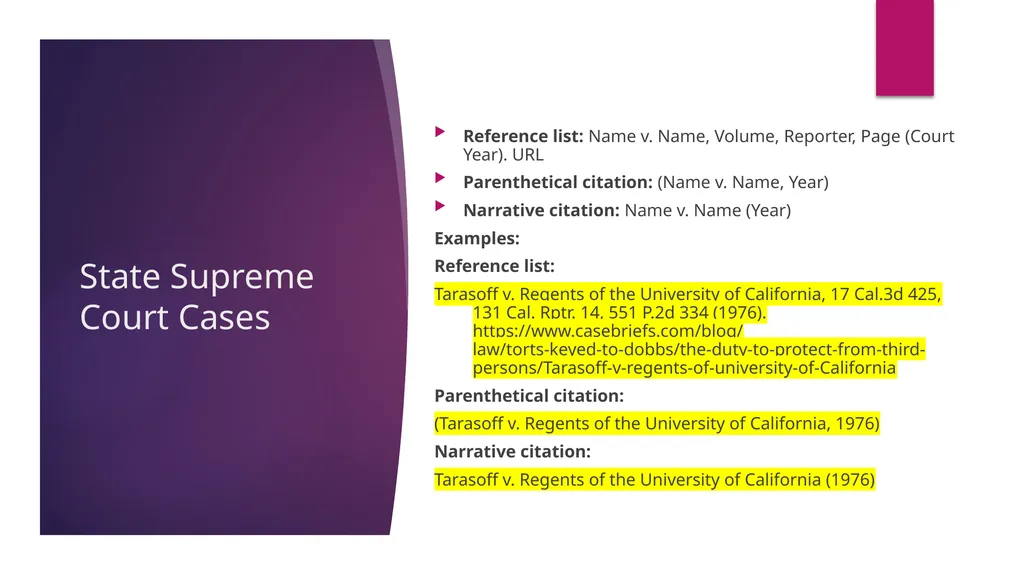
slide89. State Supreme Court Cases Reference list: Name v. Name, Volume, Reporter, Page (Court Year). URL
Parenthetical citation: (Name v. Name, Year)
Narrative citation: Name v. Name (Year)
Examples:
Reference list:
Tarasoff v. Regents of the University of California, 17 Cal.3d 425, 131 Cal. Rptr. 14, 551 P.2d 334 (1976). https://www.casebriefs.com/blog/ law/torts-keyed-to-dobbs/the-duty-to-protect-from-third-persons/Tarasoff-v-regents-of-university-of-California
Parenthetical citation:
(Tarasoff v. Regents of the University of California, 1976)
Narrative citation:
Tarasoff v. Regents of the University of California (1976)<br>
slide90. Statutes (Laws and Acts)<br>
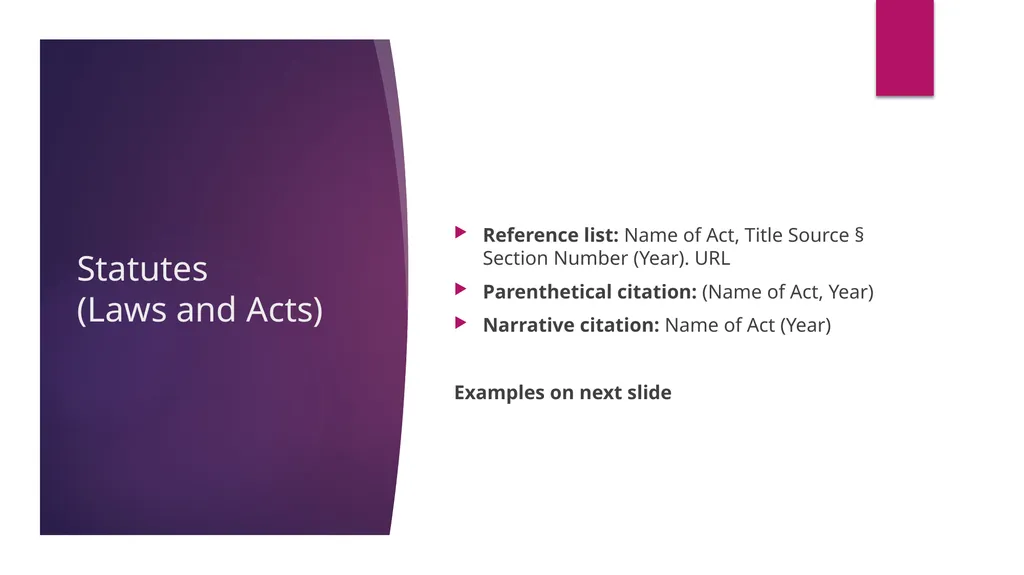
slide91. Statutes (Laws and Acts) Reference list: Name of Act, Title Source § Section Number (Year). URL
Parenthetical citation: (Name of Act, Year)
Narrative citation: Name of Act (Year)
Examples on next slide<br>
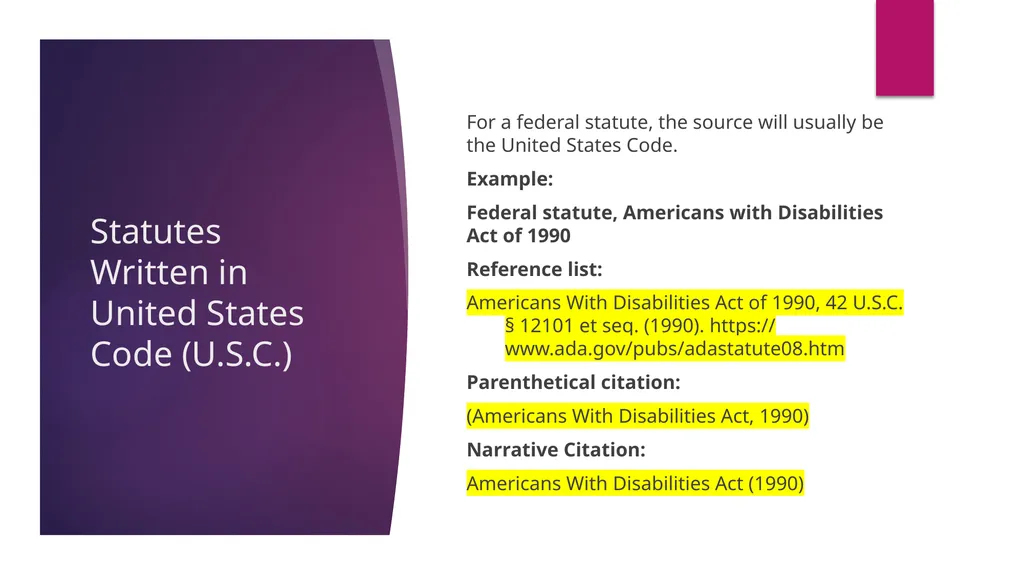
slide92. Statutes Written in United States Code (U.S.C.) For a federal statute, the source will usually be the United States Code.
Example:
Federal statute, Americans with Disabilities Act of 1990
Reference list:
Americans With Disabilities Act of 1990, 42 U.S.C. § 12101 et seq. (1990). https:// www.ada.gov/pubs/adastatute08.htm
Parenthetical citation:
(Americans With Disabilities Act, 1990)
Narrative Citation:
Americans With Disabilities Act (1990)<br>
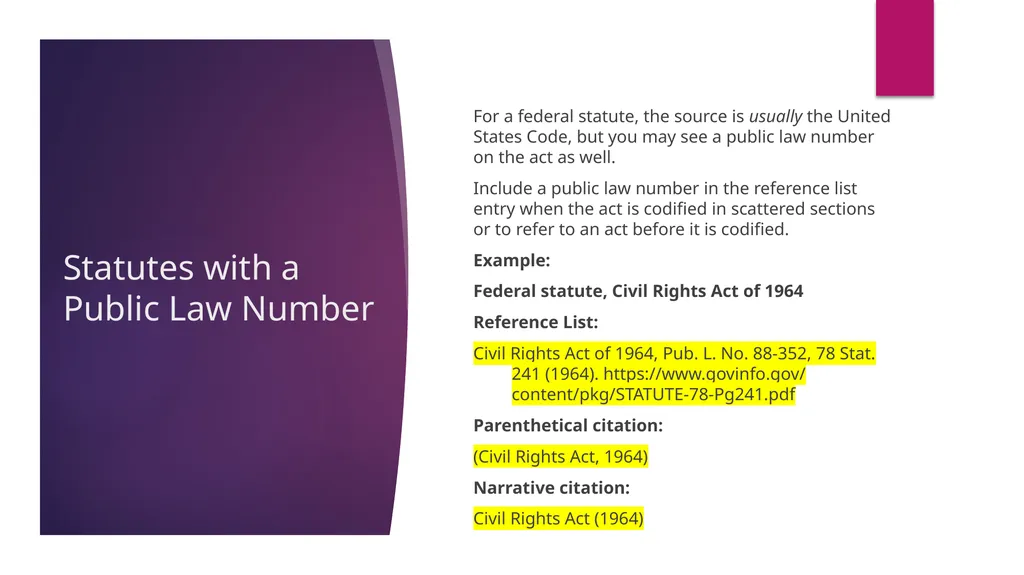
slide93. Statutes with a Public Law Number For a federal statute, the source is usually the United States Code, but you may see a public law number on the act as well.
Include a public law number in the reference list entry when the act is codified in scattered sections or to refer to an act before it is codified.
Example:
Federal statute, Civil Rights Act of 1964
Reference List:
Civil Rights Act of 1964, Pub. L. No. 88-352, 78 Stat. 241 (1964). https://www.govinfo.gov/ content/pkg/STATUTE-78-Pg241.pdf
Parenthetical citation:
(Civil Rights Act, 1964)
Narrative citation:
Civil Rights Act (1964)<br>
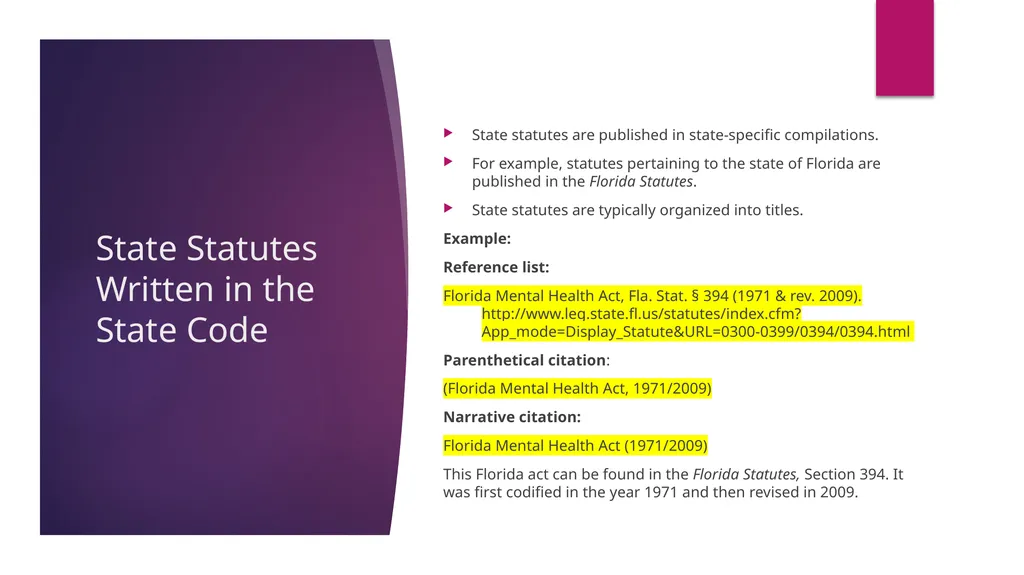
slide94. State Statutes Written in the State Code State statutes are published in state-specific compilations.
For example, statutes pertaining to the state of Florida are published in the Florida Statutes.
State statutes are typically organized into titles.
Example:
Reference list:
Florida Mental Health Act, Fla. Stat. § 394 (1971 & rev. 2009). http://www.leg.state.fl.us/statutes/index.cfm?App_mode=Display_Statute&URL=0300-0399/0394/0394.html
Parenthetical citation:
(Florida Mental Health Act, 1971/2009)
Narrative citation:
Florida Mental Health Act (1971/2009)
This Florida act can be found in the Florida Statutes, Section 394. It was first codified in the year 1971 and then revised in 2009.<br>
slide95. Constitutions and Charters<br>
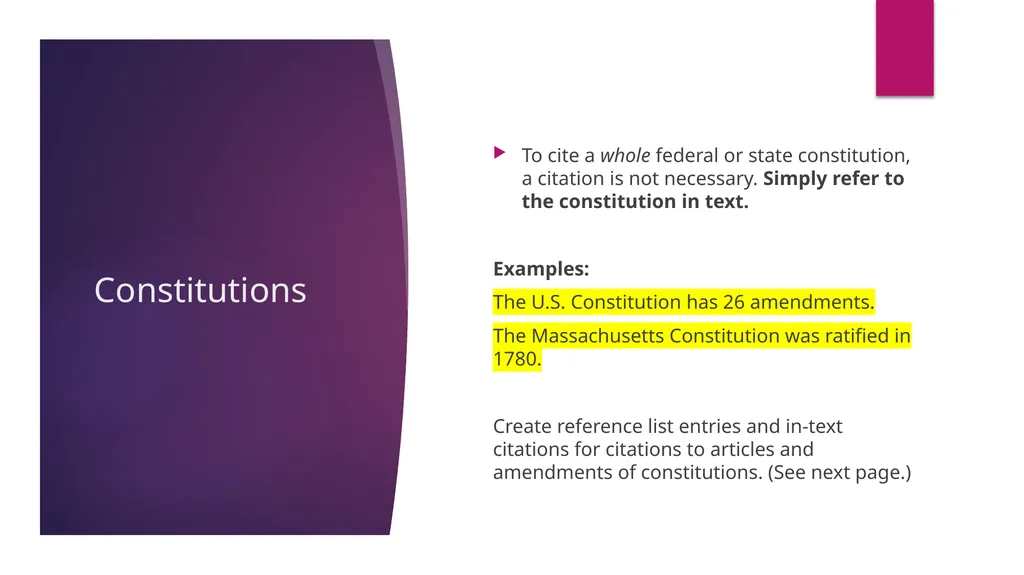
slide96. Constitutions To cite a whole federal or state constitution, a citation is not necessary. Simply refer to the constitution in text.
Examples:
The U.S. Constitution has 26 amendments.
The Massachusetts Constitution was ratified in 1780.
Create reference list entries and in-text citations for citations to articles and amendments of constitutions. (See next page.)<br>
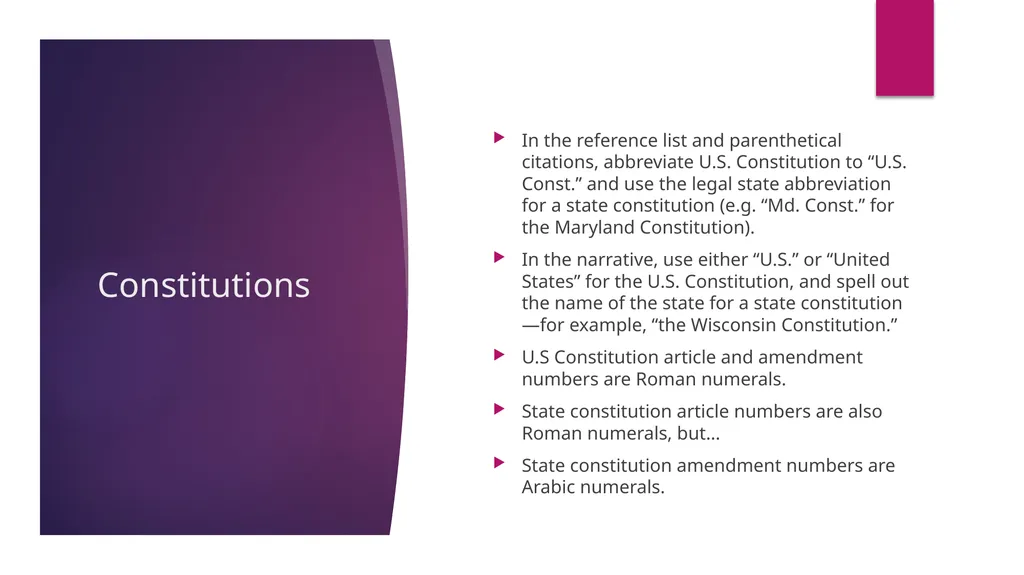
slide97. Constitutions In the reference list and parenthetical citations, abbreviate U.S. Constitution to “U.S. Const.” and use the legal state abbreviation for a state constitution (e.g. “Md. Const.” for the Maryland Constitution).
In the narrative, use either “U.S.” or “United States” for the U.S. Constitution, and spell out the name of the state for a state constitution—for example, “the Wisconsin Constitution.”
U.S Constitution article and amendment numbers are Roman numerals.
State constitution article numbers are also Roman numerals, but…
State constitution amendment numbers are Arabic numerals.<br>
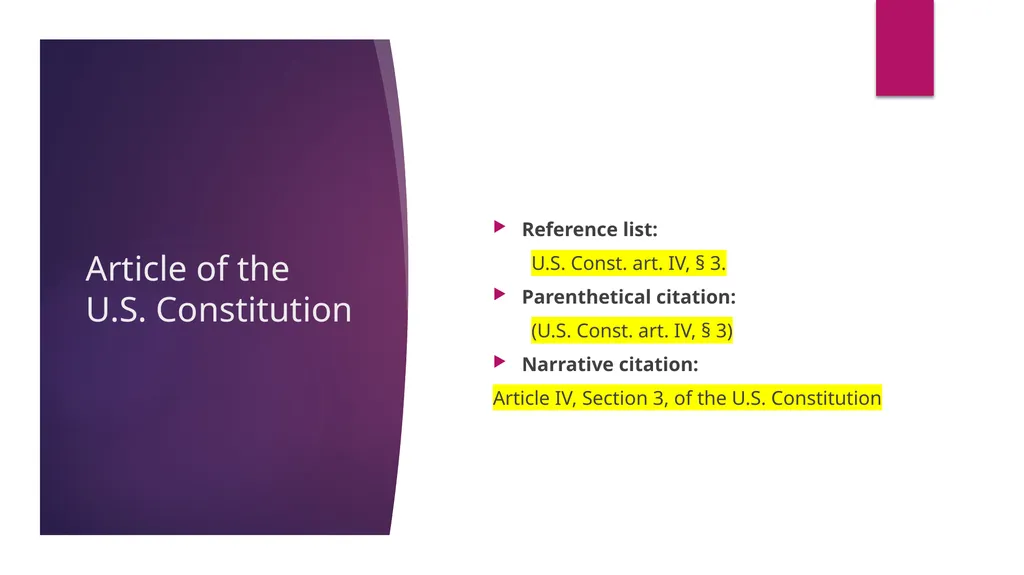
slide98. Article of the U.S. Constitution Reference list:
U.S. Const. art. IV, § 3.
Parenthetical citation:
(U.S. Const. art. IV, § 3)
Narrative citation:
Article IV, Section 3, of the U.S. Constitution<br>
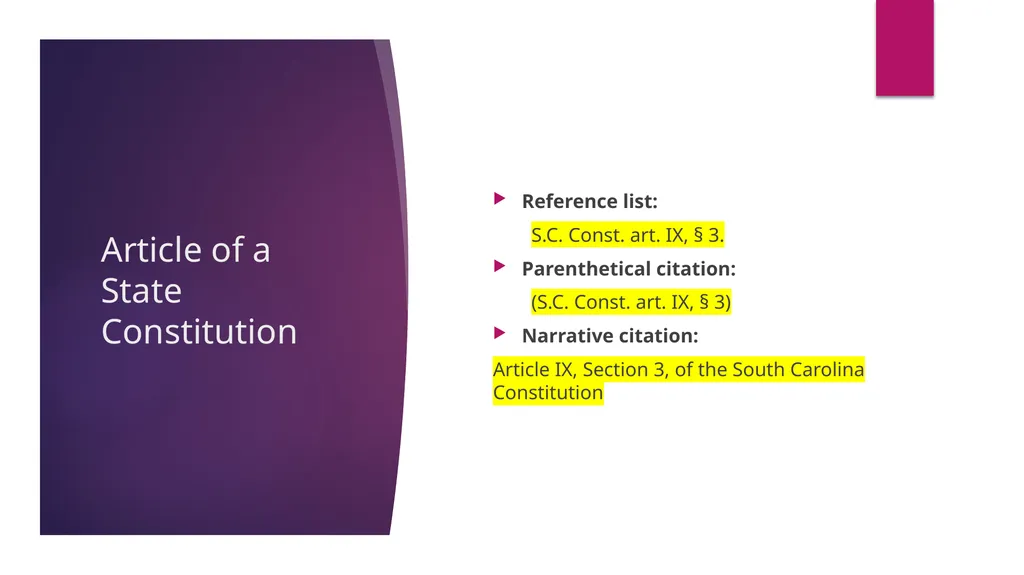
slide99. Article of a State Constitution Reference list:
S.C. Const. art. IX, § 3.
Parenthetical citation:
(S.C. Const. art. IX, § 3)
Narrative citation:
Article IX, Section 3, of the South Carolina Constitution<br>
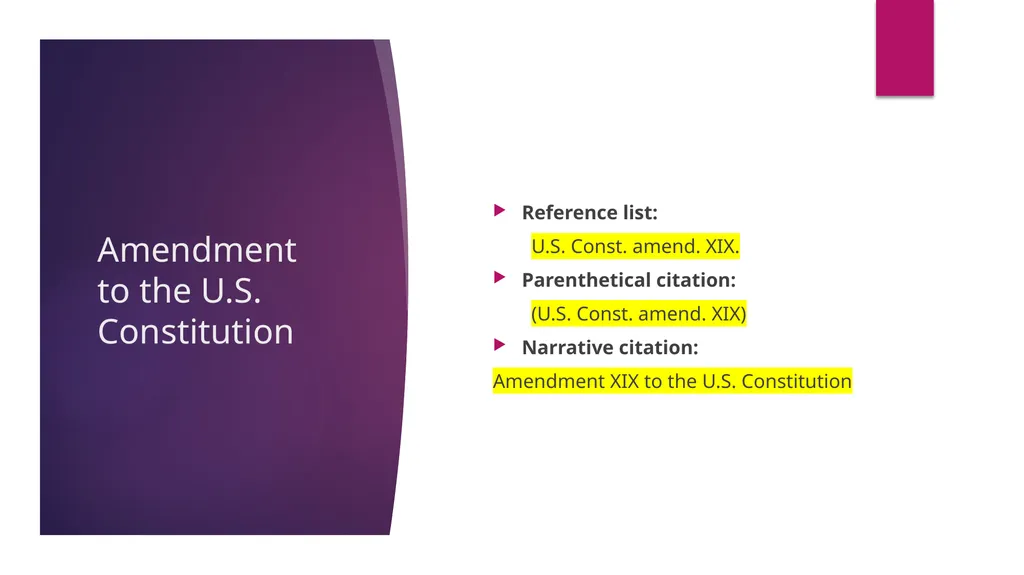
slide100. Amendment to the U.S. Constitution Reference list:
U.S. Const. amend. XIX.
Parenthetical citation:
(U.S. Const. amend. XIX)
Narrative citation:
Amendment XIX to the U.S. Constitution<br>
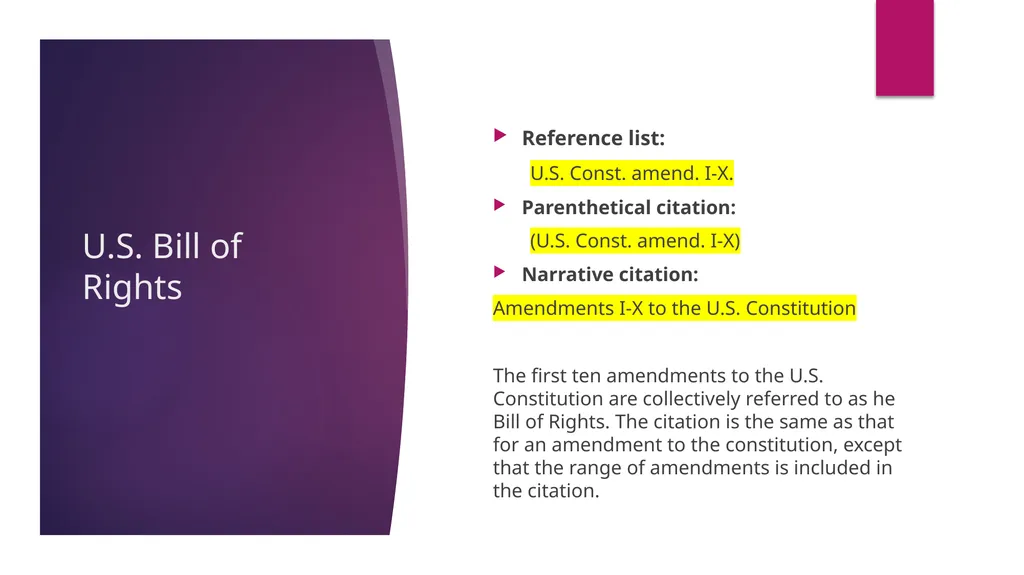
slide101. U.S. Bill of Rights Reference list:
U.S. Const. amend. I-X.
Parenthetical citation:
(U.S. Const. amend. I-X)
Narrative citation:
Amendments I-X to the U.S. Constitution
The first ten amendments to the U.S. Constitution are collectively referred to as he Bill of Rights. The citation is the same as that for an amendment to the constitution, except that the range of amendments is included in the citation.<br>
slide102. Charter of the United Nations Reference list:
U.N. Charter art. 1, para. 3.
Parenthetical citation:
(U.N. Charter art. xx, para. xx.)
Narrative citation:
Article 1, paragraph 3, of the United Nations Charter<br>
slide103. Online Reports and Grey Literature<br>
slide104. Report by a Government Agency National Cancer Institute. (2019). Taking time: Support
for people with cancer (NIH Publication No. 18-
2059). U.S. Department of Health and Human
Services, National Institutes of Health. https://
www.cancer.gov/publications/patient-
education/takingtime.pdf
Parenthetical citation:
(National Cancer Institute, 2019)
Narrative citation: National Cancer Institute (2019) APA (2020)<br>
slide105. Report with Individual Authors Baral, P., Larsen, M., & Archer, M. (2019). Does money
grow on trees? Restoration financing in
Southeast Asia. Atlantic Council. https://www.
atlanticcouncil.org/in-depth-research-reports/
report/does-money-grow-on-trees-restoring-
financing-in-southeast-asia/
Stuster, J., Adolf, J., Byrne, V., & Greene, M.
(2018). Human exploration of Mars: Preliminary
lists of crew tasks (Report No. NASA/CR-2018-
220043). National Aeronautics and Space
Administration. https://ntrs.nasa.gov/archive/
nasa/casi.ntrs.nasa.gov/20190001401.pdf
Parenthetical citations:
(Baral et al., 2019; Stuster et al., 2018)
Narrative citations:
Baral et al. (2019) and Stuster et al. (2018) APA (2020)<br>
slide106. Brochure Published by Company Cedars-Sinai. (2015). Human papillomavirus (HPV)
and oropharyngeal cancer [Brochure]. https://
www.cedars-sinai.org/content/dam/cedars-
sinai/cancer/sub-clinical-areas/head-neck/
documents/hpv-throat-cancer-brochure.pdf
Parenthetical citation: (Cedars-Sinai, 2015)
Narrative citation: Cedars-Sinai (2015)
Note:
Brochures, pamphlets, or flyers follow the same format as report references.
This brochure has an organizational author rather than individual authors.
Include the description “[Brochure]” in square brackets after the title of the brochure. APA (2020)<br>
slide107. Fact Sheet Agency for Toxic Substances and Disease Registry.
(n.d.). Asbestos in your environment: What you can
do to limit exposure [Fact sheet]. U.S. Department of
Health & Human Services. https://www.atsdr.cdc.
gov/docs/limitingenvironmentalexposures_factsheet-
508.pdf
American Association of Colleges of Nursing.
(2017). Nursing shortage fact sheet [Fact sheet].
http://www.aacnnursing.org/Portals/42/News/
Factsheets/Nursing-Shortage-Factsheet-
2017.pdf
Parenthetical citations:
(Agency for Toxic Substances and Disease Registry, n.d.) (American Association of Colleges of Nursing, 2017)
Narrative citations:
Agency for Toxic Substances and Disease Registry (n.d.) and American Association of Colleges of Nursing (2017) APA (2020)<br>
slide108. White Paper with a Group Author Department for Business Innovation & Skills.
(2016). Success as a knowledge economy:
Teaching excellent, social mobility and student
choice [White paper].Crown. https://www.gov.
uk/government/uploads/system/uploads/
attachment_data/file/523396/bis-16-265-
success-as-a-knowledge-economy.pdf
Parenthetical citation:
(Department for Business Innovation & Skills, 2016)
Narrative citation:
Department for Business Innovation & Skills (2016)
Note:
A white paper is a persuasive document that is written by a person or group to convince readers of their position and philosophy on a topic.
Include the description “[White paper]” in square brackets after the title of the white paper. APA (2020)<br>
slide109. Conference Presentations and Proceedings<br>
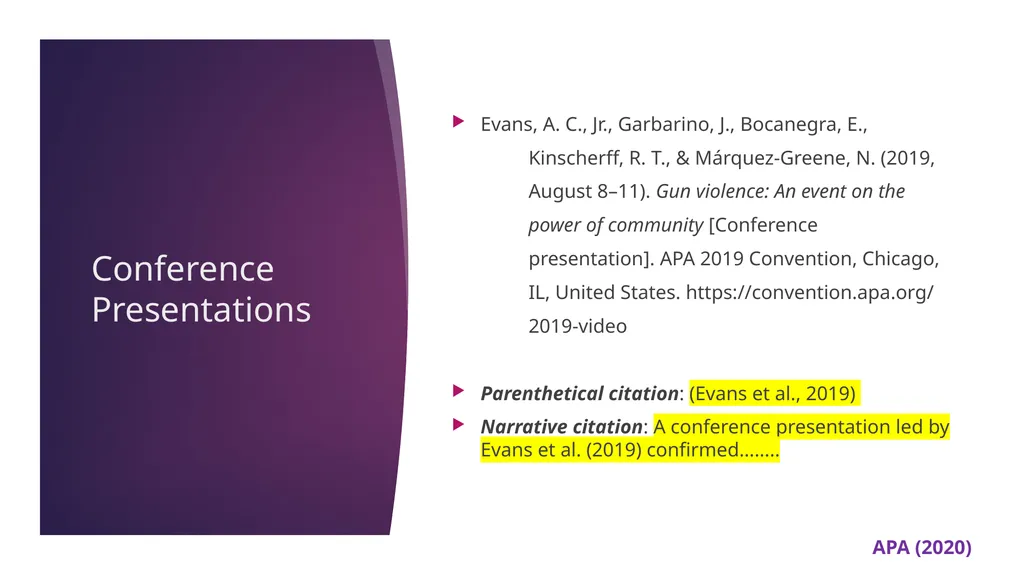
slide110. Information to Include in Documentation of Conference Presentations Provide the names of the presenters in the author element of the reference.
Provide the full dates of the conference in the date element of the reference.
Describe the presentation in square brackets after the title. The description is flexible (e.g., “[Conference session],” “[Paper presentation],” “[Poster session],” “[Keynote address]”).
Provide the name of the conference or meeting and its location in the source element of the reference.
If video of the conference presentation is available, include a link at the end of the reference. APA (2020)<br>
slide111. Conference Presentations Evans, A. C., Jr., Garbarino, J., Bocanegra, E.,
Kinscherff, R. T., & Márquez-Greene, N. (2019,
August 8–11). Gun violence: An event on the
power of community [Conference
presentation]. APA 2019 Convention, Chicago,
IL, United States. https://convention.apa.org/
2019-video
Parenthetical citation: (Evans et al., 2019)
Narrative citation: A conference presentation led by Evans et al. (2019) confirmed…….. APA (2020)<br>
slide112. Dissertations and Theses<br>
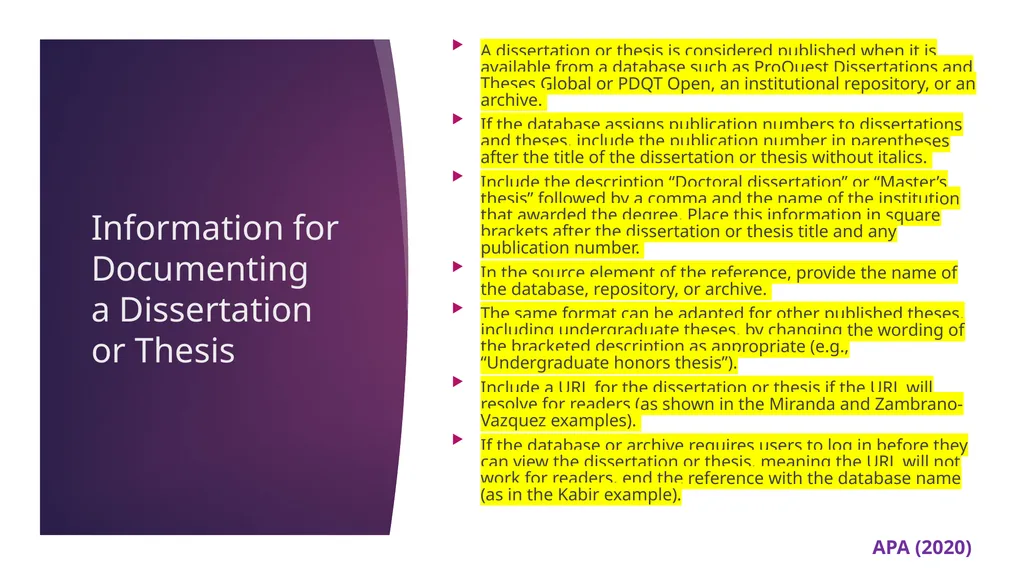
slide113. Information for Documenting a Dissertation or Thesis A dissertation or thesis is considered published when it is available from a database such as ProQuest Dissertations and Theses Global or PDQT Open, an institutional repository, or an archive.
If the database assigns publication numbers to dissertations and theses, include the publication number in parentheses after the title of the dissertation or thesis without italics.
Include the description “Doctoral dissertation” or “Master’s thesis” followed by a comma and the name of the institution that awarded the degree. Place this information in square brackets after the dissertation or thesis title and any publication number.
In the source element of the reference, provide the name of the database, repository, or archive.
The same format can be adapted for other published theses, including undergraduate theses, by changing the wording of the bracketed description as appropriate (e.g., “Undergraduate honors thesis”).
Include a URL for the dissertation or thesis if the URL will resolve for readers (as shown in the Miranda and Zambrano-Vazquez examples).
If the database or archive requires users to log in before they can view the dissertation or thesis, meaning the URL will not work for readers, end the reference with the database name (as in the Kabir example). APA (2020)<br>
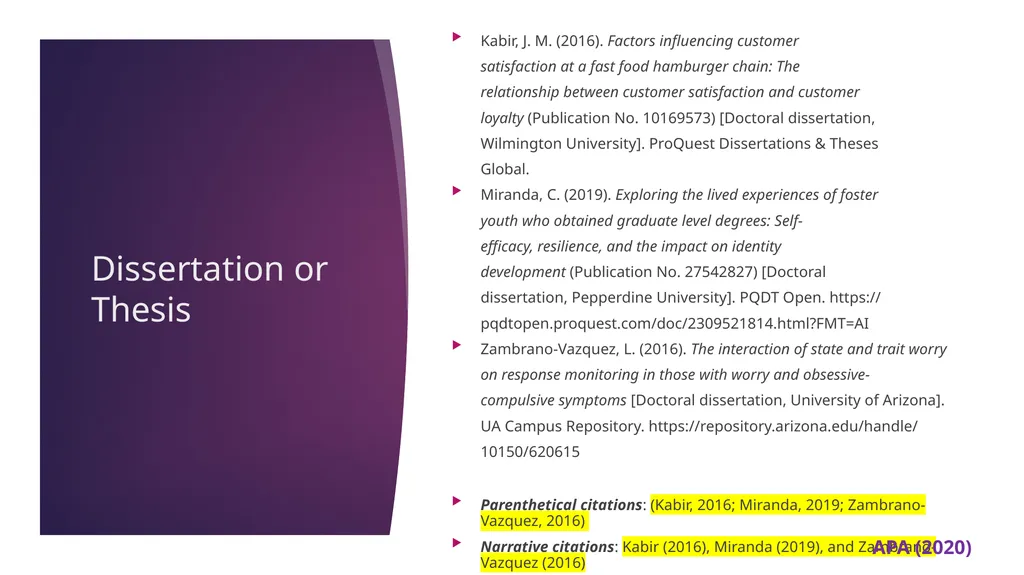
slide114. Dissertation or Thesis Kabir, J. M. (2016). Factors influencing customer
satisfaction at a fast food hamburger chain: The
relationship between customer satisfaction and customer
loyalty (Publication No. 10169573) [Doctoral dissertation,
Wilmington University]. ProQuest Dissertations & Theses
Global.
Miranda, C. (2019). Exploring the lived experiences of foster
youth who obtained graduate level degrees: Self-
efficacy, resilience, and the impact on identity
development (Publication No. 27542827) [Doctoral
dissertation, Pepperdine University]. PQDT Open. https://
pqdtopen.proquest.com/doc/2309521814.html?FMT=AI
Zambrano-Vazquez, L. (2016). The interaction of state and trait worry
on response monitoring in those with worry and obsessive-
compulsive symptoms [Doctoral dissertation, University of Arizona].
UA Campus Repository. https://repository.arizona.edu/handle/
10150/620615
Parenthetical citations: (Kabir, 2016; Miranda, 2019; Zambrano-Vazquez, 2016)
Narrative citations: Kabir (2016), Miranda (2019), and Zambrano-Vazquez (2016) APA (2020)<br>
slide115. Personal Communication/Interview<br>
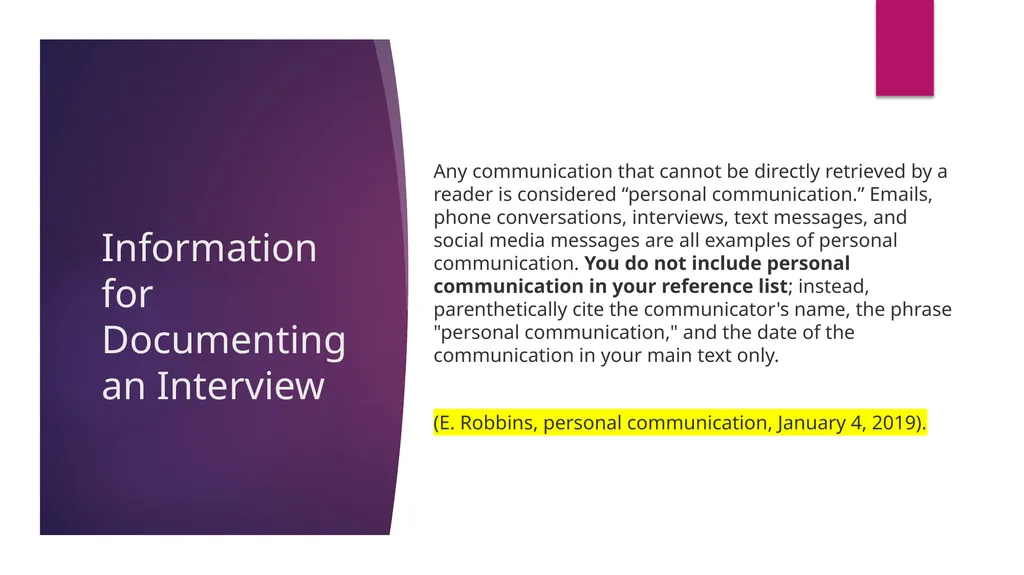
slide116. Information for Documenting an Interview Any communication that cannot be directly retrieved by a reader is considered “personal communication.” Emails, phone conversations, interviews, text messages, and social media messages are all examples of personal communication. You do not include personal communication in your reference list; instead, parenthetically cite the communicator's name, the phrase "personal communication," and the date of the communication in your main text only.
(E. Robbins, personal communication, January 4, 2019).<br>
slide117. Audiovisual Media<br>
slide118. You Tube Harvard University. (2019, August 28). Soft robotic
gripper for jellyfish [Video]. YouTube. https://
www.youtube.com/watch?v=guRoWTYfxMs
Parenthetical citation: (Harvard University, 2019)
Narrative citation: Harvard University (2019) APA (2020)<br>
slide119. TED Talk from the TED website Cuddy, A. (2012, June). Your body language may
shape who you are [Video]. TED Conferences.
https://www.ted.com/talks/amy_cuddy_your_
body_language_shapes_who_you_are
Parenthetical citation: (Cuddy, 2012)
Narrative citation: Cuddy (2012) APA (2020)<br>
slide120. TED Talk from YouTube TED. (2019, November 13). The danger of AI is weirder
than you think | Janelle Shane [Video].
YouTube. https://www.youtube.com/watch?v=
OhCzX0iLnOc
Parenthetical citation: (TED, 2019)
Narrative citation: TED (2019) APA (2020)<br>
slide121. PowerPoint Slides Available Online Jones, J. (2016, March 23). Guided reading: Making
the most of it [PowerPoint slides]. SlideShare.
https://www.slideshare.net/hellojenjones/
guided-reading-making-the-most-of-it
Parenthetical citation: (Jones, 2016)
Narrative citation: Jones (2016) APA (2020)<br>
slide122. PowerPoint Slides from a Classroom Website Mack, R., & Spake, G. (2018). Citing open source
images and formatting references for
presentations [PowerPoint slides]. Canvas@FNU.
https://fnu.onelogin.com/login
Parenthetical citation: (Mack & Spake, 2018)
Narrative citation: Mack and Spake (2018) APA (2020)<br>
slide123. Radio Broadcast Mottram, L. (2020, January 8). Hazard reduction
burning is not a panacea to bushfire risk:
Expert [Radio broadcast]. ABC. https://www.
abc.net.au/radio/programs/pm/thinned-forests-
can-be-more-prone-to-fire,-expert-says/
11853280
Parenthetical citation: (Mottram, 2020)
Narrative citation: Mottram (2020) APA (2020)<br>
slide124. Clip Art or Stock Image GDJ. (2018). Neural network deep learning
prismatic [Clip art]. Openclipart.
https://openclipart.org/detail/309343/
neural-network-deep-learning-prismatic
Parenthetical citation: (GDJ, 2018)
Narrative citation: GDJ (2018)
Use this format to cite (but not reproduce) most clip art or stock image. To reproduce clip art or stock images, permission and/or a copyright attribution may be necessary in addition to the reference. No citation, permission, or copyright attribution is necessary for clip art from programs like Microsoft Word or PowerPoint.<br>
slide125. Grammar Usage<br>
slide126. Pronouns The pronoun “they” or “their” is now acceptable to be used as a gender neutral singular pronoun when referring to an unknown person.
Example:
When a student is ready to register for classes, they must first attain a personal identification number (PIN) from their advisor. APA (2020)<br>
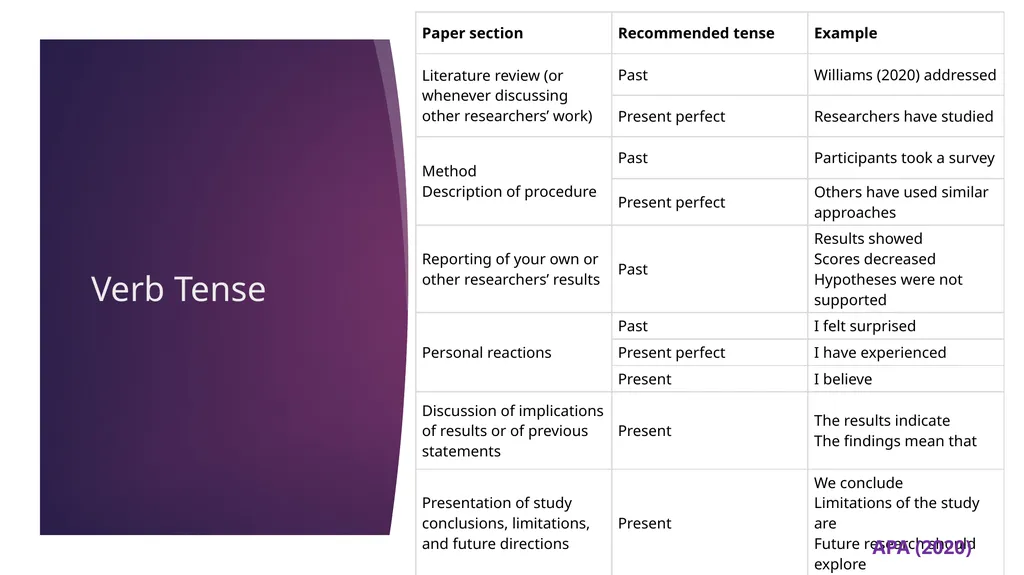
slide127. Verb Tense APA (2020)<br>
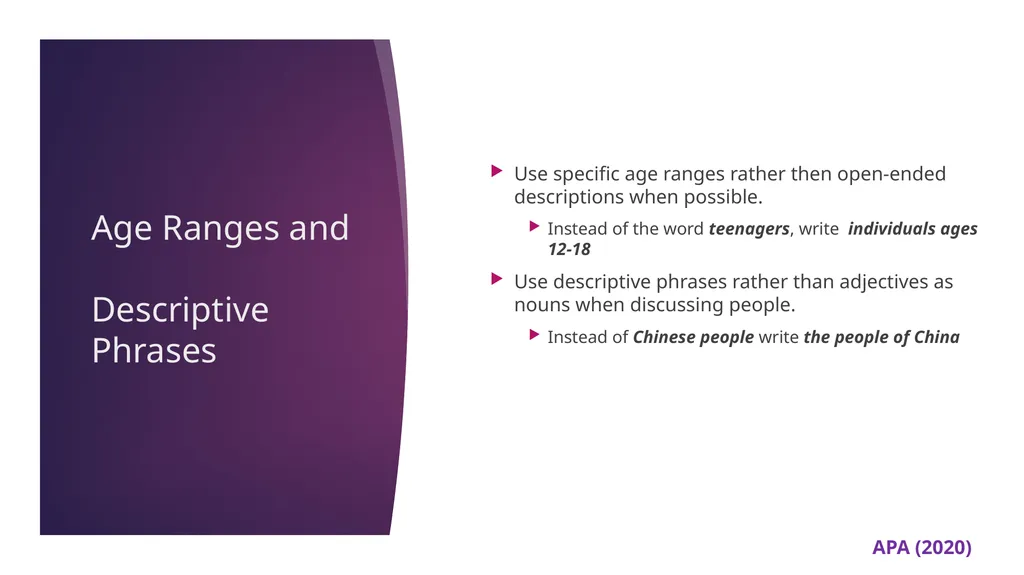
slide128. Age Ranges and Descriptive Phrases Use specific age ranges rather then open-ended descriptions when possible.
Instead of the word teenagers, write individuals ages 12-18
Use descriptive phrases rather than adjectives as nouns when discussing people.
Instead of Chinese people write the people of China APA (2020)<br>
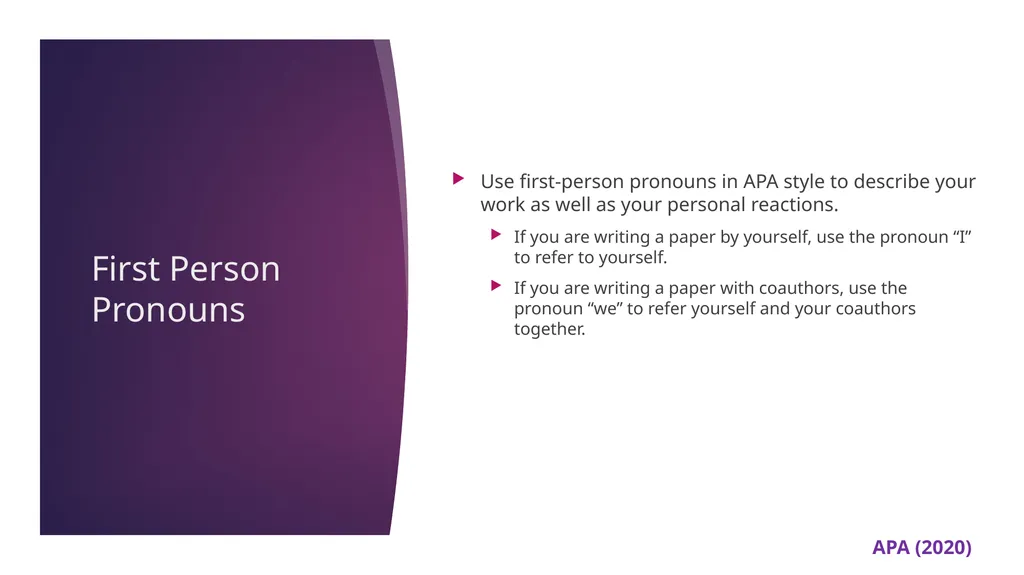
slide129. First Person Pronouns Use first-person pronouns in APA style to describe your work as well as your personal reactions.
If you are writing a paper by yourself, use the pronoun “I” to refer to yourself.
If you are writing a paper with coauthors, use the pronoun “we” to refer yourself and your coauthors together. APA (2020)<br>
slide130. Mechanics<br>
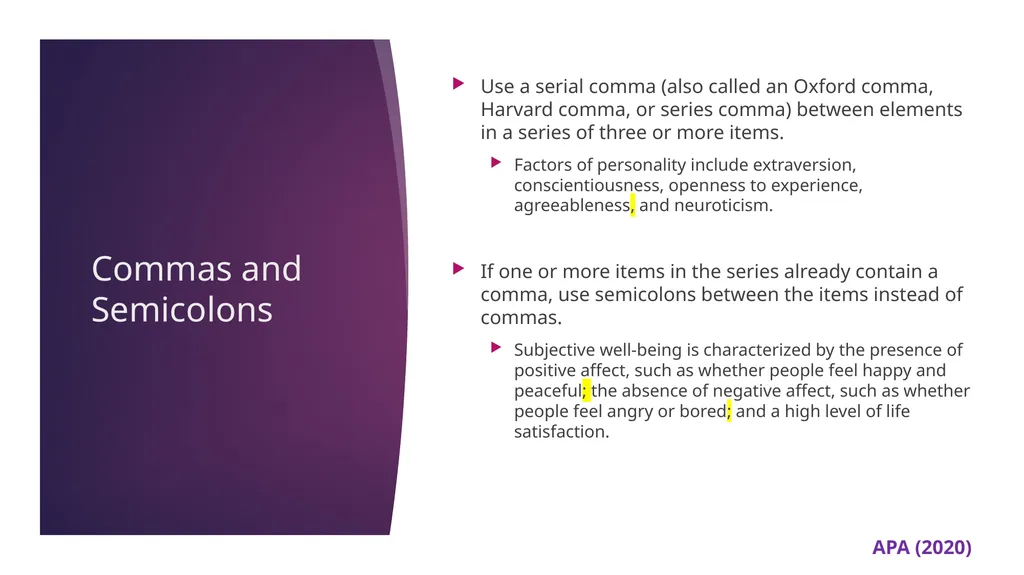
slide131. Commas and Semicolons Use a serial comma (also called an Oxford comma, Harvard comma, or series comma) between elements in a series of three or more items.
Factors of personality include extraversion, conscientiousness, openness to experience, agreeableness, and neuroticism.
If one or more items in the series already contain a comma, use semicolons between the items instead of commas.
Subjective well-being is characterized by the presence of positive affect, such as whether people feel happy and peaceful; the absence of negative affect, such as whether people feel angry or bored; and a high level of life satisfaction. APA (2020)<br>
slide132. Numbers<br>
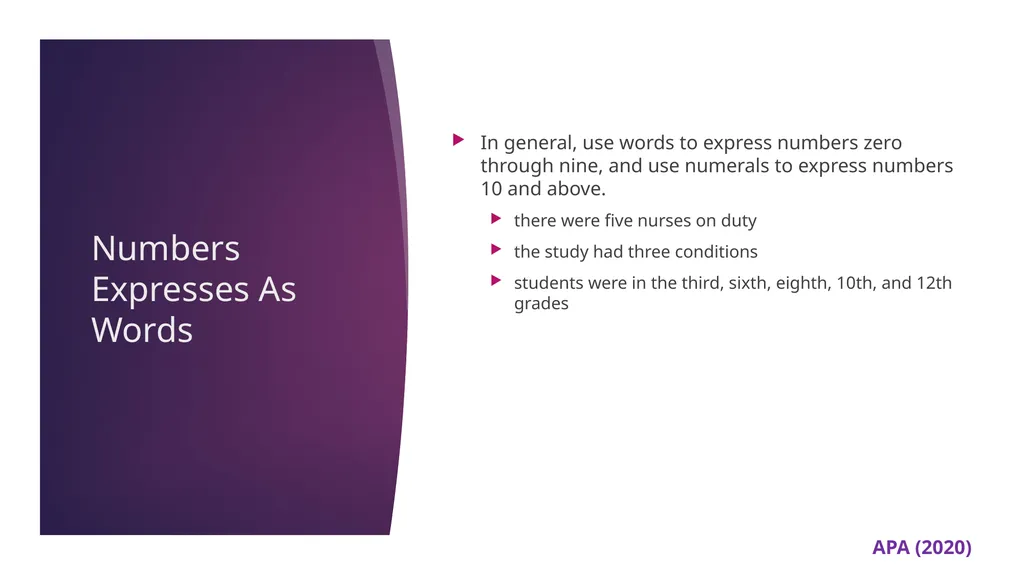
slide133. Numbers Expresses As Words In general, use words to express numbers zero through nine, and use numerals to express numbers 10 and above.
there were five nurses on duty
the study had three conditions
students were in the third, sixth, eighth, 10th, and 12th grades APA (2020)<br>
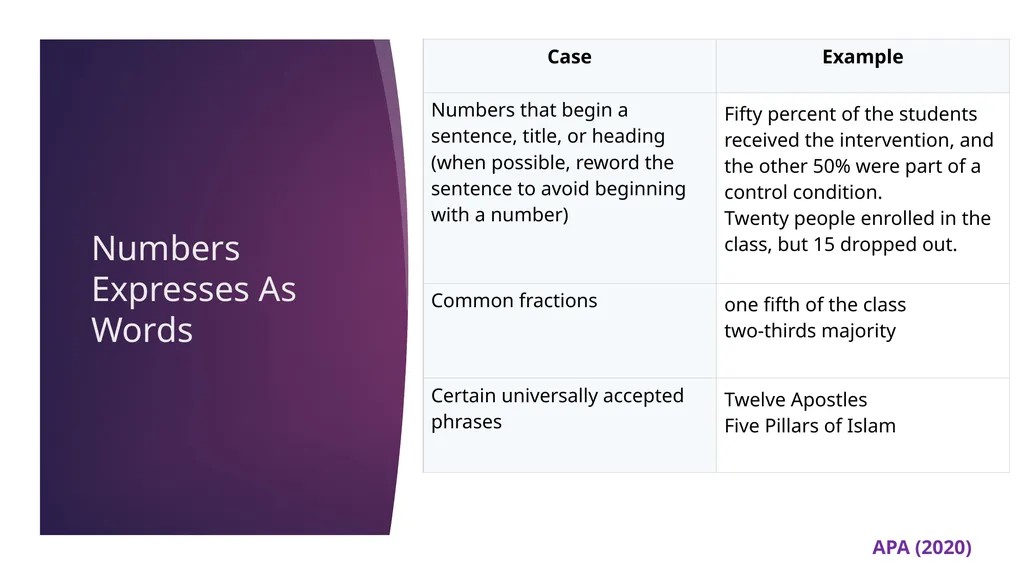
slide134. Numbers Expresses As Words APA (2020)<br>
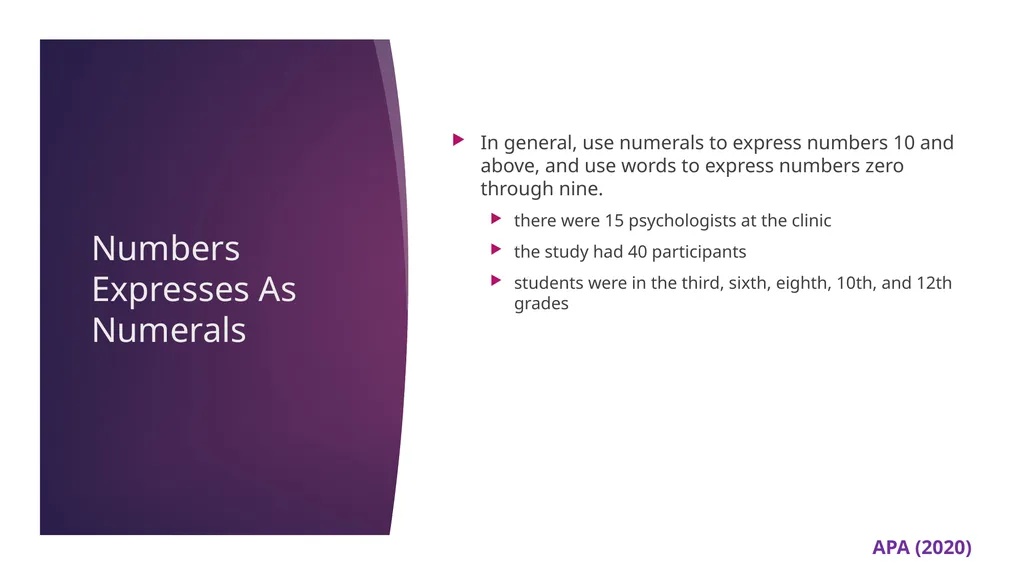
slide135. Numbers Expresses As Numerals In general, use numerals to express numbers 10 and above, and use words to express numbers zero through nine.
there were 15 psychologists at the clinic
the study had 40 participants
students were in the third, sixth, eighth, 10th, and 12th grades APA (2020)<br>
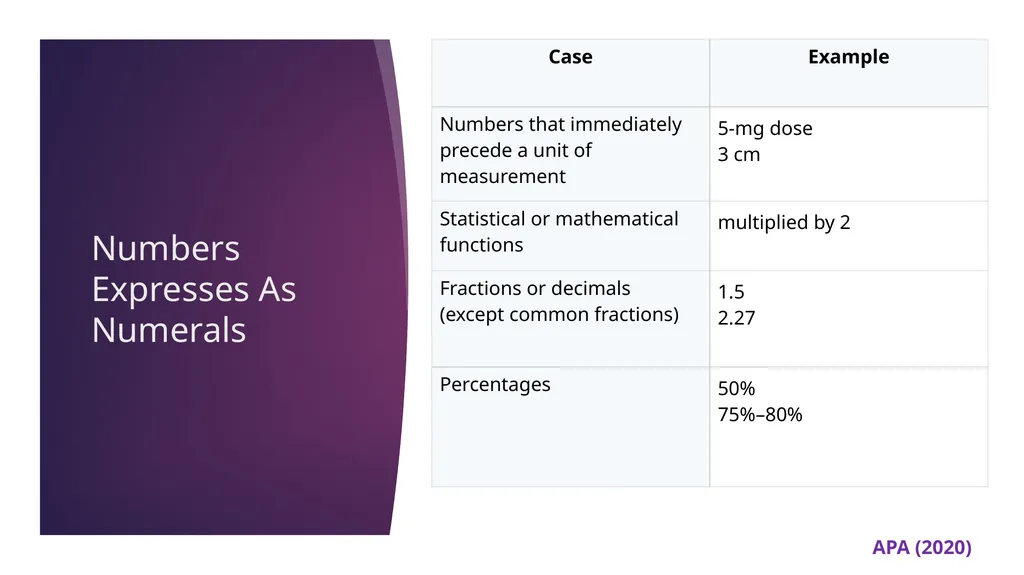
slide136. Numbers Expresses As Numerals APA (2020)<br>
slide137. Abbreviations<br>
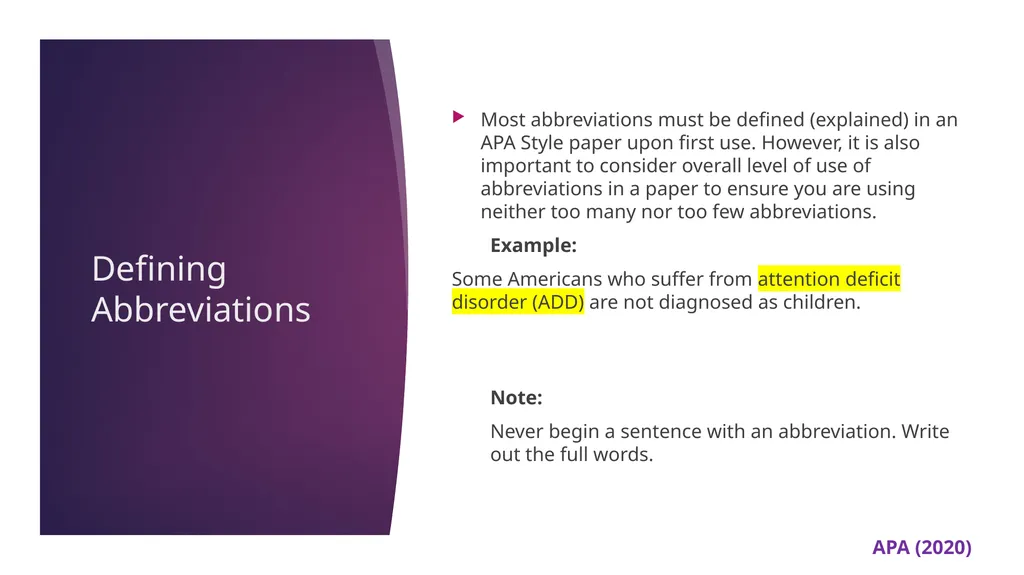
slide138. Defining Abbreviations Most abbreviations must be defined (explained) in an APA Style paper upon first use. However, it is also important to consider overall level of use of abbreviations in a paper to ensure you are using neither too many nor too few abbreviations.
Example:
Some Americans who suffer from attention deficit disorder (ADD) are not diagnosed as children.
Note:
Never begin a sentence with an abbreviation. Write out the full words. APA (2020)<br>
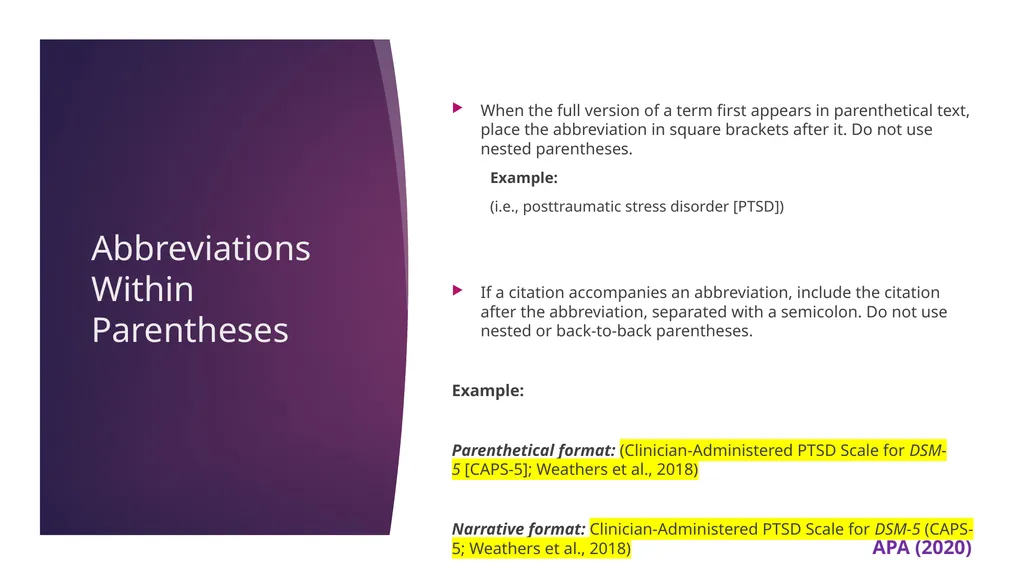
slide139. Abbreviations Within Parentheses When the full version of a term first appears in parenthetical text, place the abbreviation in square brackets after it. Do not use nested parentheses.
Example:
(i.e., posttraumatic stress disorder [PTSD])
If a citation accompanies an abbreviation, include the citation after the abbreviation, separated with a semicolon. Do not use nested or back-to-back parentheses.
Example:
Parenthetical format: (Clinician-Administered PTSD Scale for DSM-5 [CAPS-5]; Weathers et al., 2018)
Narrative format: Clinician-Administered PTSD Scale for DSM-5 (CAPS-5; Weathers et al., 2018) APA (2020)<br>
slide140. Capitalization<br>
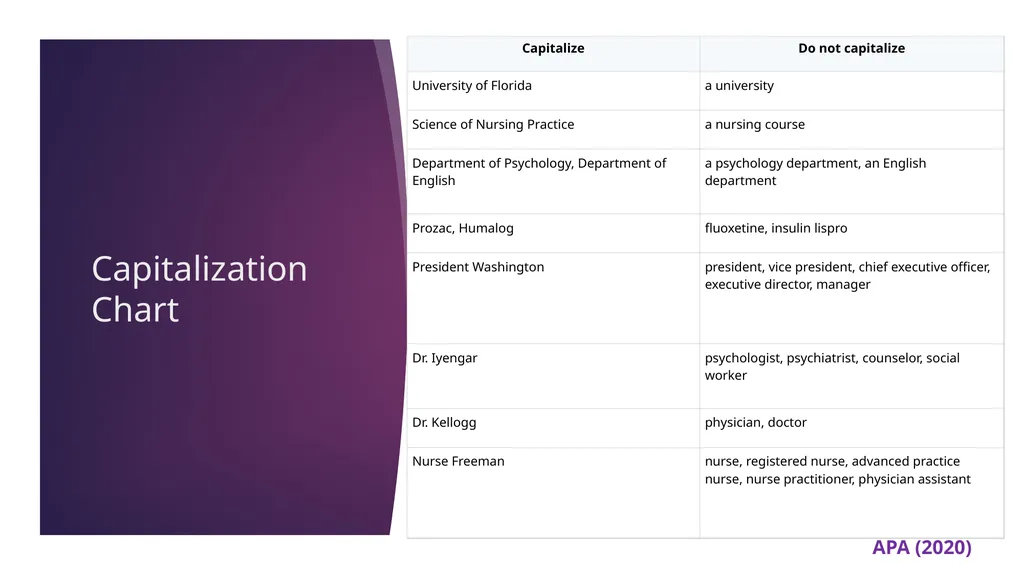
slide141. Capitalization Chart APA (2020)<br>
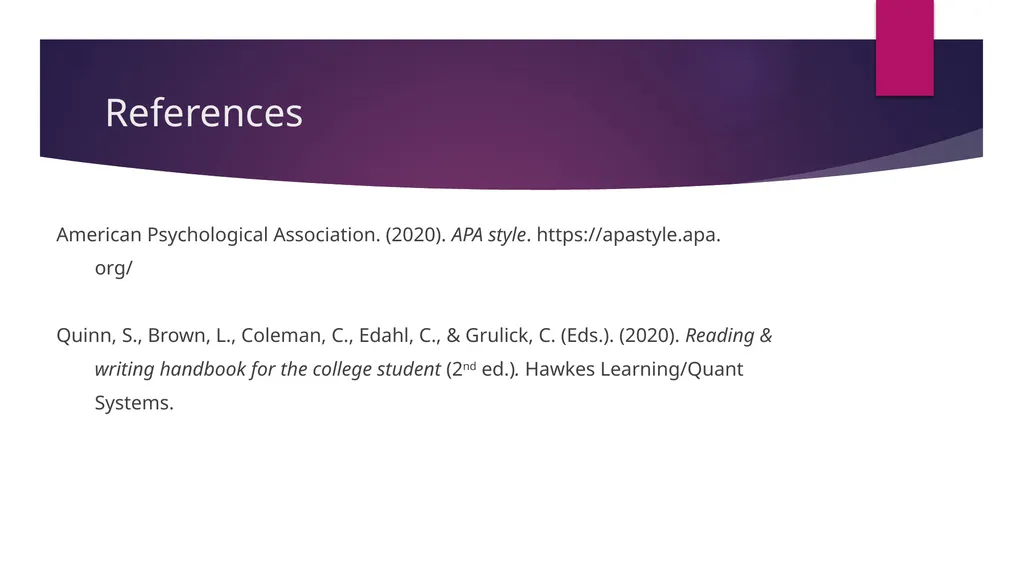
slide142. References American Psychological Association. (2020). APA style. https://apastyle.apa.
org/
Quinn, S., Brown, L., Coleman, C., Edahl, C., & Grulick, C. (Eds.). (2020). Reading &
writing handbook for the college student (2nd ed.). Hawkes Learning/Quant
Systems.<br>
University of north Alabama
Director, Dr. Kathleen Richards<br>
slide2. APA for Student Papers Rules for student papers are slightly different than a professional paper. This PowerPoint will focus on formatting student papers, including title page, headings, documentation, in-text citations, and other various guidelines.<br>
slide3. APA Changes No running head unless instructed by professor or publisher
Titles should be in bold type (including title page and title within the paper)
More font changes are acceptable
Level headings are different
For documentation of sources, no city, state of publication is required; the words “Retrieved from” are no longer needed before URLs
For in-text citations, if there are 3 or more authors or editors of a source, only the last name of the first author is used, followed by “et al”<br>
slide4. APA for Student Papers Rules for font sizes are more lenient.
a sans serif font such as 11-point Calibri, 11-point Arial, or 10-point Lucida Sans Unicode or a serif font such as 12-point Times New Roman, 11-point Georgia, or normal (10-point)<br>
slide5. Title Page Format Running head (optional)
Title (bold)
Author byline
Affiliation
Due Date<br>
slide6. Title Page (headers) New changes for 7th edition for Title Page:
Running head is no longer required unless professor requires one. If professor requires a header, then the following information is needed:
Include a running head fewer than 50 characters and are left aligned; capitalize every letter
The words “Running head:” no longer appear as a label on the first page
Page numbers are still right aligned, with title page as number 1<br>
slide7. Title Page (title information) New changes for 7th edition for Title Page:
Titles are placed in the upper 2/3rds of the title page in bold print, center aligned.
All words should be capitalized except the following: articles (a, an, the);conjunctions (so, but, nor, and, or, yet, for); prepositions that are three letters or fewer ( examples: on, in, for, at, by, of)
Titles are normally 12 words or fewer
If colons are included in titles, the first letter of the first word should be capitalized
Lines should be double spaced<br>
slide8. Title Page (author information) Below the title, type the author byline: first name, middle initial (if applicable), and last name
If there is more than one author, then list the authors’ names in order of their contribution (or alphabetical order), and separate names with a comma. Use “and” before the last name.
Example: Whitney Post, Sam Ruitz, and Matt Henson
or
Matt Henson, Whitney Post, and Sam Ruitz<br>
slide9. Sample Title Page<br>
slide10. Headings<br>
slide11. Level Headings APA (2020)<br>
slide12. Summarizing, Paraphrasing, and Quoting<br>
slide13. Summarizing When you summarize, you put the main idea(s) into your own words, including only the main point(s).
Summarized ideas must be attributed to the original source.
Summaries are significantly shorter than the original.
Summaries take a broad overview of source material.<br>
slide14. Summarizing Summarize any ideas or text that you believe are important. Proper summarization should condense the main idea or text of several pages (or even the entire source!) into a brief overview.
By summarizing you save many paragraphs or pages of unnecessary text. When using in-text citations for summaries, you must always cite the author and publication year.
If there is no author listed, cite the article name using the main words of the title and placing quotation marks “ “ around them.
Summaries do not require page numbers; this is because the text summarized will usually cover several pages of text.
EX: Studies show that throughout colleges and universities teachers are often hired from one area of study to teach a different area of study (Carpini, 2004; Wilson, 1998).<br>
slide15. Paraphrasing Paraphrasing involves putting a passage from source material into your own words.
Attribute paraphrases to their original sources.
Paraphrases are usually shorter than, but may be the same length as the original passage.
Paraphrases take a more focused segment of the source and condense it slightly.
EX: Lortie’s (1975) research reveals that classroom experiences as well as interactions among peers and colleagues contribute to teacher learning (p. 79).<br>
slide16. Quoting Quotations must be identical to the original.
Quotations use a narrow segment of the source.
They must match the source document word for word and must be attributed to the original author.
Use quotes when the actual words are so integral to the discussion that they cannot be replaced.
Use quotes when the author’s words are so precisely and accurately stated that they cannot be paraphrased.
EX: Stenberg and Lee (2002) agree that teacher learning is an “intellectual and ongoing process” (p. 327).<br>
slide17. Signal Phrases and In-Text Citation Signal phrases introduce someone else’s work – they signal that the words and ideas that are about to be offered belong to someone other than the author of the paper. * According to Jones (2013), research reveals….(p.4).
In-text citations are the parenthetical pieces of information that appear usually at the end of a quote, paraphrase, or summary (though they sometimes appear before). * (Jones, 2013, p. 4)
A simple rule:
Author or Title, Year, and Page: what isn’t signaled up front must be cited at the end.<br>
slide18. Signal Phrases and In-Text Citation (continued) Limited signal, everything in citation
Blah, blah, blah. . . end of paraphrased sentence, in which you convey the author's ideas in your own words (Krepp, 1985, p. 103).
Blah, blah, blah " end of quoted sentence" (Krepp, 1985, p. 103).
Author and year in signal, page in citation
Krepp (1985) reveals that . . . (p. 103).
According to Krepp (1985), ". . ." (p. 103).<br>
slide19. Signal Phrases and In-Text Citation (continued) Multiple Authors signaled (Alphabetical)
*Studies (Jones, 1966; Krepp, 1985; Smith, 1973) show that….
No Author
("Stocks Lose Again," 1991, p. B16).
*According to the news article “Stocks Lose Again” (1991), the recent accounts of … (p. B16).
No Page Number
Provide other information in signal phrase
*According to the Centers for Disease Control and Prevention (2014) website,……….<br>
slide20. Documentation<br>
slide21. Number of Authors (for a References page) Invert all individual authors’ names, providing the surname first, followed by a comma and the author’s initials.
Example: Author, A. A.
Use a comma to separate an author’s initials from additional author names, even when there are only two authors. Use an ampersand (&) before the final author’s name.
Example: Author, A. A., & Author, B. B.
Provide surnames and initials for up to and including 20 authors. When there are two to 20 authors, use an ampersand before the final author’s name.
Example: Author, A. A., Author, B. B., & Author, C. C.
When there are 21 or more authors, include the first 19 authors’ names, insert an ellipsis (but no ampersand), and then add the final author’s name.
APA (2020)<br>
slide22. In-Text Citations Based on Number of Authors Single Author Example:
(Richards, 2020)
Two Authors Example:
(Richards & Trentham, 2020)
Three or More Authors Example:
(Richards et al., 2020)<br>
slide23. Unique Authors Write the author’s name exactly as it appears on the published work, including hyphenated surnames and two-part surnames.
Example:
Santos-García, S., & Velasco Rodríguez, M. L.
Retain the author’s preferred capitalization.
Example:
hooks, b.
van der Waal, P. N.
APA (2020)<br>
slide24. Two Authors with the Same Last Name Reference List Citation:
When two authors of the same source share a surname, use first initials with the last names.
Ehrlich, P., & Ehrlich, A. (1998). Betrayal of science and reason: How anti-environmental rhetoric threatens our future. Island Press.
In-Text Citation:
If multiple authors within a single reference share the same surname, the initials are not needed in the in-text citation; cite the work in the standard author–date format.
(Ehrlich & Ehrlich, 1998)<br>
slide25. Citing Works With the Same Author and Year When multiple references have an identical author (or authors) and publication year, include a lowercase letter after the year. These letters are assigned when the references are placed in order in the reference list.
The year–letter combination is used in both the in-text citation and the reference list entry. Use only the year with a letter in the in-text citation, even if the reference list entry contains a more specific date.
In-text: (Blondaux & O'Hanrahan, 2018a) Reference list: Blondaux and O'Hanrahan (2018b)<br>
slide26. Web Sources with the Same Author, Same Year, and Different Day of Post Kang, C. (2020a, October 28). Big tech’s chief executives are becoming regulars on Capitol Hill. New York Times. https://www.nytimes.com/2020/10/28/tec hnology/big-techs-chief-executives-are- becoming-regulars-on-capitol-hill.html
Kang, C. (2020b, October 22). Top investigator in Google case says there ‘was not a rush’ to sue. New York Times. https://www.nytimes.com/2020/10/22/tec hnology/doj-google-jeffrey-rosen.html
In-text citation examples
Parenthetical: (Kang 2020a; Kang 2020b)
Narrative: Kang (2020a)and (2020b)<br>
slide27. Organization As Author On a page from an organizational or government agency website, the organization or government agency itself is considered the author, unless otherwise specified. The author of a webpage or website may also be located on an “about us” or acknowledgments page.
An abbreviation for the group author can be used in the text (e.g., NIMH for National Institute of Mental Health); however, do not include an abbreviation for a group author in a reference list entry.
Correct: National Institute of Mental Health.
Incorrect: National Institute of Mental Health (NIMH).
Incorrect: NIMH.
APA (2020)<br>
slide28. Government Agencies As Author When numerous layers of government agencies are listed as the author of a work, use the most specific agency as the author in the reference (e.g., use “National Institute of Nursing Research” rather than “U.S. Department of Health and Human Services, National Institutes of Health, National Institute of Nursing Research”). The names of parent agencies not present in the group author name appear in the source element as the publisher.
Example:
National Institute of Nursing Research. (2015). A family’s
perspective: Pediatric palliative care stories (NIH
Publication No. 15-NR-8018). U.S. Department of
Health and Human Services, National Institutes of
Health. https://www.ninr.nih.gov/sites/files/docs/
NINR_508c_FamilyStories_0.pdf
Parenthetical citation: (National Institute of Nursing Research, 2015)
Narrative citation: National Institute of Nursing Research (2015)
APA (2020)<br>
slide29. Books<br>
slide30. Print and Electronic Books Electronic:
Jackson, L. M. (2019). The psychology of prejudice:
From attitudes to social action (2nd ed.).
American Psychological Association. https://
doi.org/10.1037/0000168-000
Print:
Sapolsky, R. M. (2017). Behave: The biology of
humans at our best and worst. Penguin Books.
Parenthetical citations: (Jackson, 2019)
(Sapolsky, 2017)
Narrative citations:
From the research of Jackson (2019) and Sapolsky (2017), a clear percentage of …………..
APA (2020)<br>
slide31. Children’s Book with Illustrator Different Than Author Crimi, C. (2019). Weird little robots (C. Luyken, Illus.).
Candlewick Press.
Pitman, G. E. (2016). This day in June (K. Litten, Illus.).
Magination Press.
Slater, D. (2017). The antlered ship (T. Fan & E. Fan, Illus.).
Beach Lane Books.
Parenthetical citations: (Crimi, 2019)
(Pitman, 2016)
(Slater, 2017)
Narrative citations:
The research conducted by Crimi (2019), Pitman (2016), and Slater (2017) revealed……………
APA (2020)<br>
slide32. Children’s Book with Author Same As Illustrator Beaton, K. (2016). King baby (K. Beaton, Illus.). Arthur A.
Levine Books.
Parenthetical citation: (Beaton, 2016)
Narrative citation: Beaton (2016) illustrated the story……….
APA (2020)<br>
slide33. Republished or Anniversary Addition of a Children’s Book Numeroff, L. J. (2007). If you give a mouse a cookie (F.
Bond, Illus.). Laura Geringer Books. (Original work
published 1985)
Sendak, M. (2012). Where the wild things are (M. Sendak,
Illus.; 50th anniversary ed.). HarperCollins Publishers.
(Original work published 1963)
Parenthetical citations: (Numeroff, 1985/2007)
(Sendak, 1963/2012)
Narrative citations:
The books by Numeroff (1985/2007) and Sendak (1963/2012) uncover the imagination……………………..
APA (2020)<br>
slide34. Edited Books<br>
slide35. Whole Edited Book Print:
Kesharwani, P. (Ed.). (2020). Nanotechnology based
approaches for tuberculosis treatment. Academic
Press.
Electronic:
Torino, G. C., Rivera, D. P., Capodilupo, C. M., Nadal,
K. L., & Sue, D. W. (Eds.). (2019). Microaggression
theory: Influence and implications. John Wiley &
Sons. https://doi.org/10.1002/9781119466642
Parenthetical citations: (Kesharwani, 2020)
(Torino et al., 2019)
Narrative citations:
According to Kesharwani (2020) and Torino et al. (2019), research reveals …………………….
APA (2020)<br>
slide36. Several Volumes of a Multi-Volume Work Harris, K. R., Graham, S., & Urdan T. (Eds.). (2012). APA
educational psychology handbook (Vols. 1–3).
American Psychological Association.
Parenthetical citation: (Harris et al., 2012)
Narrative citation: Harris et al. (2012) declare that the ………………………………………………….
APA (2020)<br>
slide37. Chapter in an Edited Book Aron, L., Botella, M., & Lubart, T. (2019). Culinary arts:
Talent and their development. In R. F. Subotnik,
P. Olszewski-Kubilius, & F. C. Worrell (Eds.), The
psychology of high performance: Developing
human potential into domain-specific
talent (pp. 345–359). American Psychological
Association. https://doi.org/10.1037/
0000120-016
Dillard, J. P. (2020). Currents in the study of
persuasion. In M. B. Oliver, A. A. Raney, & J.
Bryant (Eds.), Media effects: Advances in theory
and research (4th ed., pp. 115–129). Routledge.
Parenthetical citations: (Aron et al., 2019)
(Aron et al., 2019; Dillard, 2020)
Narrative citations: Aron et al. (2019) and Dillard (2020) APA (2020)<br>
slide38. Chapter in an Edited Book, Reprinted from Another Book Bronfenbrenner, U. (2005). The social ecology of
human development: A retrospective
conclusion. In U. Bronfenbrenner (Ed.), Making
human beings human: Bioecological
perspectives on human development (pp. 27–
40). SAGE Publications. (Reprinted from Brain
and intelligence: The ecology of child
development, pp. 113–123, by F. Richardson,
Ed., 1973, National Educational Press)
Parenthetical citations: (Bronfenbrenner, 1973/2005)
Narrative citations: Bronfenbrenner (1973/2005) APA (2020)<br>
slide39. Diagnostic Manuals<br>
slide40. Edition of the Diagnostic and Statistical Manual of Mental Disorders (DSM) American Psychiatric Association. (1980). Diagnostic and
statistical manual of mental disorders (3rd ed.).
American Psychiatric Association. (1987). Diagnostic and
statistical manual of mental disorders (3rd ed., rev.).
American Psychiatric Association. (2000). Diagnostic and
statistical manual of mental disorders (4th ed., text
rev.).
American Psychiatric Association. (2013). Diagnostic and
statistical manual of mental disorders (5th ed.).
https://doi.org/10.1176/appi.books.9780890425596
Parenthetical citations:
(American Psychiatric Association, 1980)
(American Psychiatric Association, 2013)
Narrative citations:
American Psychiatric Association (1980) APA (2020)<br>
slide41. An Entry in the DSM American Psychiatric Association. (2013). Anxiety
disorders. In Diagnostic and statistical manual of
mental disorders (5th ed.). https://doi.org/10.1176/
appi.books.9780890425596.dsm05
Parenthetical citation:
(American Psychiatric Association, 2013)
Narrative citation:
American Psychiatric Association (2013)
APA (2020)<br>
slide42. Edition of the International Statistical Classification of Diseases and Related Health Problems (ICD) World Health Organization. (2016). International statistical
classification of diseases and related health
problems (10th ed.). https://icd.who.int/browse10/
2016/en
World Health Organization. (2019). International statistical
classification of diseases and related health
problems (11th ed.). https://icd.who.int/
Parenthetical citations:
(World Health Organization, 2016)
(World Health Organization, 2019)
Narrative citations:
According to the World Health Organization (2016), …………
The World Health Organization (2019) defines ……..
APA (2020)<br>
slide43. An Entry in the ICD World Health Organization. (2019). 2A85.5 Mantle cell
lymphoma. In International statistical classification of
diseases and related health problems (11th
ed.). https://icd.who.int/browse11/l-
m/en#/http://id.who.int/icd/entity/1804127841
Parenthetical citation: (World Health Organization, 2019)
Narrative citation: World Health Organization (2019) APA (2020)<br>
slide44. Journals<br>
slide45. Journal Article Grady, J. S., Her, M., Moreno, G., Perez, C., & Yelinek, J.
(2019). Emotions in storybooks: A comparison of
storybooks that represent ethnic and racial groups
in the United States. Psychology of Popular Media
Culture, 8(3), 207–217. https://doi.org/10.1037/
ppm0000185
Parenthetical citation: (Grady et al., 2019)
Narrative citation: Grady et al. (2019) APA (2020)<br>
slide46. Journal Article with an Article Number Jerrentrup, A., Mueller, T., Glowalla, U., Herder, M.,
Henrichs, N., Neubauer, A., & Schaefer, J. R. (2018).
Teaching medicine with the help of “Dr. House.”
PLoS ONE, 13(3), Article e0193972. https://doi.org/
10.1371/journal.pone.0193972
Parenthetical citation: (Jerrentrup et al., 2018)
Narrative citation: Jerrentrup et al. (2018) APA (2020)<br>
slide47. Journal Article with Missing information Missing volume number
Stegmeir, M. (2016). Climate change: New discipline
practices promote college access. The Journal of
College Admission, (231), 44-47. https://www.
nxtbook.com/ygsreprints/NACAC/nacac_jca_
spring2016/#/46
Missing issue number
Sanchiz, M., Chevalier, A., & Amadieu, F. (2017). How do
older and young adults start searching for
information? Impact of age, domain knowledge
and problem complexity on the different steps of
information searching. Computers in Human
Behavior, 72, 67–78. https://doi.org/10.1016/j.chb.2017.
02.038
Parenthetical citation: (Stegmeir, 2016, p. 44)
Narrative citation: Sanchiz et al. (2017) APA (2020)<br>
slide48. Journal Article with Missing Page or Article Number Butler, J. (2017). Where access meets multimodality: The
case of ASL music videos. Kairos: A Journal of
Rhetoric, Technology, and Pedagogy, 21(1).
http://technorhetoric.net/21.1/topoi/butler/index
.html
Parenthetical citations: (Butler, 2017)
Narrative citations: Butler (2017) APA (2020)<br>
slide49. Online-Only Supplemental Material to a Journal Article Freeberg, T. M. (2019). From simple rules of individual
proximity, complex and coordinated collective
movement [Supplemental material]. Journal of
Comparative Psychology, 133(2), 141–142. https://
doi.org/10.1037/com0000181
Parenthetical citation: (Freeberg, 2019)
Narrative citation: Freeberg (2019) APA (2020)<br>
slide50. Informally Published Work from ERIC Database Ho, H.-K. (2014). Teacher preparation for early childhood special education in Taiwan (ED545393). ERIC. https://files.eric.ed.gov/fulltext/ED545393.pdf
Parenthetical citation: (Ho, 2014)
Narrative citation: Ho (2014)
*ERIC (Education Resource Information Center) assigns document numbers to works in its database. Include this number in parentheses after the title of the work.<br>
slide51. Secondary Sources<br>
slide52. Information for Documenting Secondary Sources A secondary source refers to content first reported in another source.
Cite secondary sources sparingly—for instance, when the original work is out of print or unavailable.
If possible, as a matter of good scholarly practice, find the primary source, read it, and cite it directly rather than citing a secondary source.
In the reference list, provide an entry for the secondary source that you used.
In the text, identify the primary source and write “as cited in” the secondary source that you used.
If the year of publication of the primary source is known, also include it in the text citation.
(Rabbitt, 1982, as cited in Lyon et al., 2014)
If the year of the primary source is unknown, omit it from the in-text citation.
Allport’s diary (as cited in Nicholson, 2003)<br>
slide53. Magazines<br>
slide54. Magazine Articles Lyons, D. (2009, June 15). Don't ‘iTune’ us: It’s geeks versus
writers. Guess who’s winning. Newsweek, 153(24),
27.
Schaefer, N. K., & Shapiro, B. (2019, September 6). New
middle chapter in the story of human evolution.
Science, 365(6457), 981–982. https://doi.org/
10.1126/science.aay3550
Schulman, M. (2019, September 9). Superfans: A love
story. The New Yorker. https://www.newyorker.com/
magazine/2019/09/16/superfans-a-love-story
Parenthetical citations: (Lyons, 2009)
(Schaefer & Shapiro, 2019)
Narrative citations: Lyons (2009)
Schaefer and Shapiro (2019) APA (2020)<br>
slide55. Newspapers<br>
slide56. Newspaper Articles Carey, B. (2019, March 22). Can we get better at
forgetting? The New York Times. https://www.
nytimes.com/2019/03/22/health/memory-forgetting-
psychology.html
Harlan, C. (2013, April 2). North Korea vows to restart
shuttered nuclear reactor that can make bomb-
grade plutonium. The Washington Post, A1, A4.
Stobbe, M. (2020, January 8). Cancer death rate in U.S.
sees largest one-year drop ever. Chicago Tribune.
Parenthetical citations: (Carey, 2019)
(Carey, 2019; Harlan, 2013; Stobbe, 2020)
Narrative citations:
Carey (2019), Harlan (2013), and Stobbe (2020) APA (2020)<br>
slide57. Blogs<br>
slide58. Blog Post Ouellette, J. (2019, November 15). Physicists capture first
footage of quantum knots unraveling in
superfluid. Ars Technica. https://arstechnica.com/
science/2019/11/study-you-can-tie-a-quantum-
knot-in-a-superfluid-but-it-will-soon-untie-itself/
Parenthetical citation: (Ouellette, 2019)
Narrative citation: Ouellette (2019) APA (2020)<br>
slide59. Blog Post Comment joachimr. (2019, November 19). We are relying on APA as
our university style format - the university is located
in Germany (Kassel). So I [Comment on the blog
post “The transition to seventh edition APA
Style”]. APA Style. https://apastyle.apa.org/
blog/transition-seventh-edition#comment-
4694866690
Parenthetical citation: (joachimr, 2019)
Narrative citation: joachimr (2019)<br>
slide60. Websites<br>
slide61. Information Needed to Document Websites For a page from an organization’s website without individual authors, use the name of the organization as the author.
Provide as specific a date as possible for the webpage.
Some online works note when the work was last updated. If this date is clearly attributable to the specific content you are citing rather than the overall website, use the updated date in the reference.
Do not include a date of last review in a reference because content that has been reviewed has not necessarily been changed. If a date of last review is noted on a work, ignore it for the purposes of the reference.
Italicize the title of the webpage.
If the author of the webpage and the site name are the same, omit the site name from the source element to avoid repetition.
End the reference with the URL. APA (2020)<br>
slide62. Webpage on a Website Bologna, C. (2019, October 31). Why some people with
anxiety love watching horror movies. HuffPost.
https://www.huffpost.com/entry/anxiety-love-
watching-horror-movies_l_
5d277587e4b02a5a5d57b59e
Woodyatt, A. (2019, September 10). Daytime naps once
or twice a week may be linked to a healthy heart,
researchers say. CNN. https://www.cnn.com/2019/ 09/10/health/nap-heart-health-wellness-intl-scli/
index.html
Parenthetical citations: (Bologna, 2019; Woodyatt, 2019)
Narrative citations: Bologna (2019) and Woodyatt (2019) APA (2020)<br>
slide63. Webpage on a Website with an Organizational Group As Author World Health Organization. (2018, May 24). The top 10
causes of death. https://www.who.int/news-room/ fact-sheets/detail/the-top-10-causes-of-death
Parenthetical citations: (World Health Organization, 2018)
Narrative citations: World Health Organization (2018) APA (2020)<br>
slide64. Webpage on a Website with an Individual Author Giovanetti, F. (2019, November 16). Why we are so
obsessed with personality types. Medium.
https://medium.com/the-business-of-wellness/why-
we-are-so-obsessed-with-personality-types-
577450f9aee9
Parenthetical citation: (Giovanetti, 2019)
Narrative citation: Giovanetti (2019) APA (2020)<br>
slide65. Webpage on a Website with a Retrieval Date U.S. Census Bureau. (n.d.). U.S. and world population
clock. U.S. Department of Commerce. Retrieved
January 9, 2020, from https://www.census.gov/
popclock/
Parenthetical citation: (U.S. Census Bureau, n.d.)
Narrative citation: U.S. Census Bureau (n.d.)
***When contents of a page are designed to change over time but are not archived, include a retrieval date in the reference.*** (This is not a common occurrence for all websites) APA (2020)<br>
slide66. Referencing a Whole Website Do not create references or in-text citations for whole websites.
To mention a website in general, and not any particular information on that site, provide the name of the website in the text and include the URL in parentheses. For example, you might mention that you used a website to create a survey.
Example:
We created our survey using Qualtrics (https://www.qualtrics.com). APA (2020)<br>
slide67. Articles, Webpages, and Blog Posts with No Author When there is no author for a web page, the title moves to the first position of the reference entry.
Example:
All 33 Chile miners freed in flawless rescue. (2010, October 13). Retrieved from http://www.msnbc.msn.com/id/39625809/ns/world_news-americas/
Cite in text the first few words of the reference list entry (usually the title) and the year. Use double quotation marks around the title or abbreviated title.: (All 33 Chile Miners, 2010).
Use the full title of the web page if it is short for the parenthetical citation. Articles found on the web, like the example above, are not italicized in the reference entry and are not italicized but enclosed in quotations in the in-text citation, just like a newspaper or magazine article.
APA.org provides a table for referencing work with missing information: https://apastyle.apa.org/style-grammar-guidelines/references/missing-information<br>
slide68. Social Media<br>
slide69. Tweet APA Education [@APAEducation] (2018, June 29).
College students are forming mental-health clubs—
and they’re making a difference @washingtonpost
[Thumbnail with link attached] [Tweet]. Twitter.
https://twitter.com/apaeducation/status/
1012810490530140161
Parenthetical citation: (APA Education, 2018)
Narrative citation: APA Education (2018)
If the tweet includes images (including animated gifs), videos, thumbnail links to outside sources, links to other tweets (as in a retweet with a comment), or a poll, indicate that in square brackets. For tweet replies, do not include the “replying to” information; if that is important to note, do so within the in-text citation.
Replicate emojis if possible. If you are not able to create the emoji, provide the emoji’s name in square brackets. The full list of emoji names can be found on the Unicode Consortium’s website (http://Unicode.org/emoji/charts/index.html).<br>
slide70. Twitter Profile APA Style [@APA_Style]. (n.d.). Tweets [Twitter
profile]. Twitter. Retrieved November 1, 2019,
from https://twitter.com/APA_Style
Parenthetical citation: (APA Style, n.d.)
Narrative citation: APA Style (n.d.)
Provide a retrieval date because the contents of the page change over time.
A Twitter profile has several tabs (“Tweets” is the default. To reference one of the other tabs (e.g., “Lists” or “Moments”), substitute that tab name for “Tweets.”
Include the notation “Twitter profile” in square brackets.<br>
slide71. Facebook Post Gaiman, N. (2018, March 22). 100,000+ Rohingya
refugees could be at serious risk during
Bangladesh’s monsoon season. My fellow UNHCR
Goodwill Ambassador Cate Blanchett is [Image
attached] [Status update]. Facebook.
http://bit.ly/2JQxPAD
Parenthetical citation: (Gaiman, 2018)
Narrative citation: Gaiman (2018)
This format can be used for posts to other social media services, including Tumblr, LinkedIn, and so forth.
If a status update includes images, videos, thumbnail links to outside sources, or content from another Facebook post (such as when sharing a link), indicate that in square brackets.
Replicate emojis or name them in brackets.<br>
slide72. Facebook Page Smithsonian’s National Zoo and Conservation
Biology Institute. (n.d.). Home [Facebook
page]. Facebook. Retrieved July 22, 2019,
from https://www.facebook.com/nationalzoo
Parenthetical citation: (Smithsonian’s National Zoo and Conservation Biology Institute, 2018)
Narrative citation: Smithsonian’s National Zoo and Conservation Biology Institute (2018)
Use the page title in the reference (e.g., “Timeline,” “Home,” “Photos,” “About”).
Include the notation “Facebook page” in square brackets.
This format can be used or adopted for references to other platform or profile pages, including YouTube, Instagram, Tumblr, LinkedIn, and so forth.<br>
slide73. Instagram Photo or Video Zeitz MOCAA [@zeitzmocaa]. (2018, November 26). Grade 6
learners from Parkfields Primary School in Hanover Park
visited the museum for a tour and workshop hosted by
[Photographs]. Instagram. https://www.Instagram.com/
p/BqpHpjFBs3b
Parenthetical citation: (Zeitz MOCAA, 2018)
Narrative citation: Zeitz MOCAA (2018)<br>
slide74. Instagram highlight The New York Public Library [@nypl]. (n.d.). The raven
[Highlight]. Instagram. Retrieved April 16, 2019, from
https://bitly.com/2FV8bu3
Parenthetical citation: (The New York Public Library, n.d.)
Narrative citation: The New York Public Library (n.d.)<br>
slide75. Podcasts<br>
slide76. Referencing a Podcast Vedantam, S. (Host). (2015-present). Hidden brain
[Audio podcast]. NPR. https://www.npr.org/
series/423302056/hidden-brain
Parenthetical citation: (Vedantam, 2015-present)
Narrative citation: Vedantam (2015-present)
List the host of the podcast as the author. Alternatively, provide the executive producers, if known. In either case, include their role in parentheses.
Specify the podcast type (audio or video) in square brackets.
If the URL of the podcast is unknown (e.g., if accessed via an app), omit the URL.<br>
slide77. Referencing a Podcast Episode Glass, I. (Host). (2011, August 12). Amusement
park. (No. 443) [Audio podcast episode]. In
This American life. WBEZ Chicago.
https://www.thisamericanlife.org/radio-
archives/episode/443/amusement-park
Parenthetical citation: (Glass, 2011)
Narrative citation: Glass (2011)
List the host of the podcast as the author and include their role in parentheses.
Provide the episode number after the title in parentheses. If the podcast does not number episodes, omit the number from the reference.<br>
slide78. Clinical Practice References<br>
slide79. Information Needed to Document Clinical Practice Guidelines Most clinical practice guidelines are published as reports or webpages and so follow the report or webpage reference type, which have the same structure.
Use the committee or agency that developed the guideline in the author element of the reference when no individual authors are credited.
When the title page or cover credits both a committee and an agency, provide the committee name in the author element of the reference and the agency name in the source element of the reference. The first example shows this: The committee is the Healthcare Infection Control Practices Advisory Committee, and the agency is the U.S. Department of Health & Human Services, Centers for Disease Control and Prevention.
When the title page or cover credits only an agency, provide the agency name in the author element of the reference. The second and third examples show this: The National Institute for Health and Care Excellence (NICE) and the World Health Organization are agencies.
Provide the year in which the guideline was developed in the date element of the reference.
If you are citing an updated guideline, use the year of the update in the reference.
Provide the title of the guideline in italic sentence case.
Provide the name of the website from which the guideline was obtained in the source element of the reference.
If the website name is the same as the author, omit the site name to avoid repetition (as in the NICE guideline example).
Provide a URL for the guideline. APA (2020)<br>
slide80. Clinical Practice Guideline with a Group Author Healthcare Infection Control Practices Advisory Committee.
(2009). Catheter-associated urinary tract infections (CAUTI).
U.S. Department of Health & Human Services, Centers for
Disease Control and Prevention. https://www.cdc.gov/
infectioncontrol/guidelines/cauti/index.html
National Institute for Health and Care Excellence. (2019).
Hypertension in adults: Diagnosis and management (NICE
Guideline NG136). https://www.nice.org.uk/guidance/ng136
World Health Organization. (2017). Guideline: Protecting, promoting
and supporting breastfeeding in facilities providing maternity
and newborn services. Guideline Central. https://www.
guidelinecentral.com/share/summary/5acc36cc939f5#section-
society
Parenthetical citations: (Healthcare Infection Control Practices Advisory Committee, 2009; National Institute for Health and Care Excellence, 2019; World Health Organization, 2017)
Narrative citations: Healthcare Infection Control Practices Advisory Committee (2009), National Institute for Health and Care Excellence (2019), and World Health Organization (2017) APA (2020)<br>
slide81. Clinical Practice Guideline with an Individual Author at a Government Agency, Published As Part of a Series Grohskopf, L. A., Sokolow, L. Z., Broder, K. R., Walter, E. B.,
Fry, A. M., & Jernigan, D. B. (2018). Prevention and
control of seasonal influenza with vaccines:
Recommendations of the Advisory Committee on
Immunization Practices—United States, 2018–19
influenza season (Morbidity and Mortality Weekly
Report, Vol. 67, No. 3). U.S. Department of Health &
Human Services, Centers for Disease Control and
Prevention. https://www.cdc.gov/mmwr/
volumes/67/rr/pdfs/rr6703a1-H.pdf
Parenthetical citation: (Grohskopf et al., 2018)
Narrative citation: Grohskopf et al. (2018) APA (2020)<br>
slide82. Directions for Documenting Drug Information The format for drug information is the same as for a webpage.
Provide the name of the drug or pharmaceutical company that manufactures the drug in the author element of the reference.
If a date is not available, substitute “(n.d.).”
Provide the title of the drug information (usually the name of the drug) in italic sentence case, followed by the description “[Drug information]” in square brackets (or other wording as appropriate).
Provide the name of the website from which the drug information was obtained in the source element of the reference. If the website name is the same as the author, omit the site name to avoid repetition.
Provide a URL for the drug information. APA (2020)<br>
slide83. Drug Information Sandoz Inc. (n.d.). Prednisolone acetate
(prednisolone acetate) suspension/drops [Drug
information]. Guideline Central. https://www.
guidelinecentral.com/share/drug-information/
61314-637#section-title
Parenthetical citation: (Sandoz Inc., 2017)
Narrative citation: Sandoz Inc. (2017) APA (2020)<br>
slide84. Cases or Court Decisions<br>
slide85. Cases or Court Decisions A reference for a case or court decision includes the following information:
Title or name of the case, usually one party versus another (e.g., Brown v. Board of Education)
Citation, usually to a volume and page of one of the various sets of books where published cases can be found called reporters (e.g., Federal Reporter, Second Series), which typically contain decisions of courts in particular political divisions, called jurisdictions
Precise jurisdiction of the court writing the decision (e.g., U.S. district court, New York Court of Appeals), in parentheses
Date of the decision, in parentheses (in the same set of parentheses as the jurisdiction if both are present
URL from which you retrieved the case information (optional; this is not strictly required for legal citations but may aid readers in rerieval<br>
slide86. Federal Court Decisions (Supreme Court) Decisions from the U.S. Supreme Court are published in the United States Reports. The template for these decisions is as follows:
Reference list: Name v. Name, Volume U.S. Page (Year). URL
Parenthetical citation: (Name v. Name, Year)
Narrative citation: Name v. Name (Year)
Reference list example:
Brown v. Board of Education, 347, U.S. 483 (1954).
https://www.oyez.org/cases/1940-1955/
347us483
Without a page number:
Obergefell v. Hodges, 576 U.S. ___ (2015).
https://www.supremecourt.gov/opinions/14pdf/
4-556_3204.pdf<br>
slide87. Federal Court Decisions (U.S. Circuit Court) Decisions from the U.S. Circuit Court are published in the Federal Reporter. The template for these decisions is as follows:
Reference list: Name v. Name, Volume F. [or F.2d, F.3d] Page (Court Year). URL
Parenthetical citation: (Name v. Name, Year)
Narrative citation: Name v. Name (Year)
Examples:
Reference list:
Daubert v. Merrell Dow Pharmaceuticals, Inc., 951 F.2d 1128 (9th Cir. 1991). https://openjurist.org/951/f2d/1128/william-daubert-v-merrell-dow-pharmaceuticals
Parenthetical citation: (Daubert v. Merrell Dow Pharmaceuticals, Inc., 1991)
Narrative citation: Daubert v. Merrell Dow Pharmaceuticals, Inc. (1991)<br>
slide88. Federal Court Decisions (U.S. District Court) Decisions from the U.S. District Court are published in Federal Supplements. The template for these citations is as follows:
Reference list: Name v. Name, Volume F. Supp. Page (Court Year). URL
Parenthetical citation: (Name v. Name, Year)
Narrative citation: Name v. Name (Year)
Reference list example:
Burriola v. Greater Toledo YMCA, 133 F. Supp. 2d 1034 (N.D. Ohio 2001). https://law.justia.com/ cases/ federal/district-courts/FSupp2/133/1034/2293141
Example of case with appeal:
Durflinger v. Artiles, 563 F. Supp. 322 (D. Kan. 1981), aff’d, 727 F.2d 888 (10th Cir. 1984). https:// openjurist.org/727/f2d/888/durflinger-v-artiles
Parenthetical citation: (Durflinger v. Artiles, 1981/1984)<br>
slide89. State Supreme Court Cases Reference list: Name v. Name, Volume, Reporter, Page (Court Year). URL
Parenthetical citation: (Name v. Name, Year)
Narrative citation: Name v. Name (Year)
Examples:
Reference list:
Tarasoff v. Regents of the University of California, 17 Cal.3d 425, 131 Cal. Rptr. 14, 551 P.2d 334 (1976). https://www.casebriefs.com/blog/ law/torts-keyed-to-dobbs/the-duty-to-protect-from-third-persons/Tarasoff-v-regents-of-university-of-California
Parenthetical citation:
(Tarasoff v. Regents of the University of California, 1976)
Narrative citation:
Tarasoff v. Regents of the University of California (1976)<br>
slide90. Statutes (Laws and Acts)<br>
slide91. Statutes (Laws and Acts) Reference list: Name of Act, Title Source § Section Number (Year). URL
Parenthetical citation: (Name of Act, Year)
Narrative citation: Name of Act (Year)
Examples on next slide<br>
slide92. Statutes Written in United States Code (U.S.C.) For a federal statute, the source will usually be the United States Code.
Example:
Federal statute, Americans with Disabilities Act of 1990
Reference list:
Americans With Disabilities Act of 1990, 42 U.S.C. § 12101 et seq. (1990). https:// www.ada.gov/pubs/adastatute08.htm
Parenthetical citation:
(Americans With Disabilities Act, 1990)
Narrative Citation:
Americans With Disabilities Act (1990)<br>
slide93. Statutes with a Public Law Number For a federal statute, the source is usually the United States Code, but you may see a public law number on the act as well.
Include a public law number in the reference list entry when the act is codified in scattered sections or to refer to an act before it is codified.
Example:
Federal statute, Civil Rights Act of 1964
Reference List:
Civil Rights Act of 1964, Pub. L. No. 88-352, 78 Stat. 241 (1964). https://www.govinfo.gov/ content/pkg/STATUTE-78-Pg241.pdf
Parenthetical citation:
(Civil Rights Act, 1964)
Narrative citation:
Civil Rights Act (1964)<br>
slide94. State Statutes Written in the State Code State statutes are published in state-specific compilations.
For example, statutes pertaining to the state of Florida are published in the Florida Statutes.
State statutes are typically organized into titles.
Example:
Reference list:
Florida Mental Health Act, Fla. Stat. § 394 (1971 & rev. 2009). http://www.leg.state.fl.us/statutes/index.cfm?App_mode=Display_Statute&URL=0300-0399/0394/0394.html
Parenthetical citation:
(Florida Mental Health Act, 1971/2009)
Narrative citation:
Florida Mental Health Act (1971/2009)
This Florida act can be found in the Florida Statutes, Section 394. It was first codified in the year 1971 and then revised in 2009.<br>
slide95. Constitutions and Charters<br>
slide96. Constitutions To cite a whole federal or state constitution, a citation is not necessary. Simply refer to the constitution in text.
Examples:
The U.S. Constitution has 26 amendments.
The Massachusetts Constitution was ratified in 1780.
Create reference list entries and in-text citations for citations to articles and amendments of constitutions. (See next page.)<br>
slide97. Constitutions In the reference list and parenthetical citations, abbreviate U.S. Constitution to “U.S. Const.” and use the legal state abbreviation for a state constitution (e.g. “Md. Const.” for the Maryland Constitution).
In the narrative, use either “U.S.” or “United States” for the U.S. Constitution, and spell out the name of the state for a state constitution—for example, “the Wisconsin Constitution.”
U.S Constitution article and amendment numbers are Roman numerals.
State constitution article numbers are also Roman numerals, but…
State constitution amendment numbers are Arabic numerals.<br>
slide98. Article of the U.S. Constitution Reference list:
U.S. Const. art. IV, § 3.
Parenthetical citation:
(U.S. Const. art. IV, § 3)
Narrative citation:
Article IV, Section 3, of the U.S. Constitution<br>
slide99. Article of a State Constitution Reference list:
S.C. Const. art. IX, § 3.
Parenthetical citation:
(S.C. Const. art. IX, § 3)
Narrative citation:
Article IX, Section 3, of the South Carolina Constitution<br>
slide100. Amendment to the U.S. Constitution Reference list:
U.S. Const. amend. XIX.
Parenthetical citation:
(U.S. Const. amend. XIX)
Narrative citation:
Amendment XIX to the U.S. Constitution<br>
slide101. U.S. Bill of Rights Reference list:
U.S. Const. amend. I-X.
Parenthetical citation:
(U.S. Const. amend. I-X)
Narrative citation:
Amendments I-X to the U.S. Constitution
The first ten amendments to the U.S. Constitution are collectively referred to as he Bill of Rights. The citation is the same as that for an amendment to the constitution, except that the range of amendments is included in the citation.<br>
slide102. Charter of the United Nations Reference list:
U.N. Charter art. 1, para. 3.
Parenthetical citation:
(U.N. Charter art. xx, para. xx.)
Narrative citation:
Article 1, paragraph 3, of the United Nations Charter<br>
slide103. Online Reports and Grey Literature<br>
slide104. Report by a Government Agency National Cancer Institute. (2019). Taking time: Support
for people with cancer (NIH Publication No. 18-
2059). U.S. Department of Health and Human
Services, National Institutes of Health. https://
www.cancer.gov/publications/patient-
education/takingtime.pdf
Parenthetical citation:
(National Cancer Institute, 2019)
Narrative citation: National Cancer Institute (2019) APA (2020)<br>
slide105. Report with Individual Authors Baral, P., Larsen, M., & Archer, M. (2019). Does money
grow on trees? Restoration financing in
Southeast Asia. Atlantic Council. https://www.
atlanticcouncil.org/in-depth-research-reports/
report/does-money-grow-on-trees-restoring-
financing-in-southeast-asia/
Stuster, J., Adolf, J., Byrne, V., & Greene, M.
(2018). Human exploration of Mars: Preliminary
lists of crew tasks (Report No. NASA/CR-2018-
220043). National Aeronautics and Space
Administration. https://ntrs.nasa.gov/archive/
nasa/casi.ntrs.nasa.gov/20190001401.pdf
Parenthetical citations:
(Baral et al., 2019; Stuster et al., 2018)
Narrative citations:
Baral et al. (2019) and Stuster et al. (2018) APA (2020)<br>
slide106. Brochure Published by Company Cedars-Sinai. (2015). Human papillomavirus (HPV)
and oropharyngeal cancer [Brochure]. https://
www.cedars-sinai.org/content/dam/cedars-
sinai/cancer/sub-clinical-areas/head-neck/
documents/hpv-throat-cancer-brochure.pdf
Parenthetical citation: (Cedars-Sinai, 2015)
Narrative citation: Cedars-Sinai (2015)
Note:
Brochures, pamphlets, or flyers follow the same format as report references.
This brochure has an organizational author rather than individual authors.
Include the description “[Brochure]” in square brackets after the title of the brochure. APA (2020)<br>
slide107. Fact Sheet Agency for Toxic Substances and Disease Registry.
(n.d.). Asbestos in your environment: What you can
do to limit exposure [Fact sheet]. U.S. Department of
Health & Human Services. https://www.atsdr.cdc.
gov/docs/limitingenvironmentalexposures_factsheet-
508.pdf
American Association of Colleges of Nursing.
(2017). Nursing shortage fact sheet [Fact sheet].
http://www.aacnnursing.org/Portals/42/News/
Factsheets/Nursing-Shortage-Factsheet-
2017.pdf
Parenthetical citations:
(Agency for Toxic Substances and Disease Registry, n.d.) (American Association of Colleges of Nursing, 2017)
Narrative citations:
Agency for Toxic Substances and Disease Registry (n.d.) and American Association of Colleges of Nursing (2017) APA (2020)<br>
slide108. White Paper with a Group Author Department for Business Innovation & Skills.
(2016). Success as a knowledge economy:
Teaching excellent, social mobility and student
choice [White paper].Crown. https://www.gov.
uk/government/uploads/system/uploads/
attachment_data/file/523396/bis-16-265-
success-as-a-knowledge-economy.pdf
Parenthetical citation:
(Department for Business Innovation & Skills, 2016)
Narrative citation:
Department for Business Innovation & Skills (2016)
Note:
A white paper is a persuasive document that is written by a person or group to convince readers of their position and philosophy on a topic.
Include the description “[White paper]” in square brackets after the title of the white paper. APA (2020)<br>
slide109. Conference Presentations and Proceedings<br>
slide110. Information to Include in Documentation of Conference Presentations Provide the names of the presenters in the author element of the reference.
Provide the full dates of the conference in the date element of the reference.
Describe the presentation in square brackets after the title. The description is flexible (e.g., “[Conference session],” “[Paper presentation],” “[Poster session],” “[Keynote address]”).
Provide the name of the conference or meeting and its location in the source element of the reference.
If video of the conference presentation is available, include a link at the end of the reference. APA (2020)<br>
slide111. Conference Presentations Evans, A. C., Jr., Garbarino, J., Bocanegra, E.,
Kinscherff, R. T., & Márquez-Greene, N. (2019,
August 8–11). Gun violence: An event on the
power of community [Conference
presentation]. APA 2019 Convention, Chicago,
IL, United States. https://convention.apa.org/
2019-video
Parenthetical citation: (Evans et al., 2019)
Narrative citation: A conference presentation led by Evans et al. (2019) confirmed…….. APA (2020)<br>
slide112. Dissertations and Theses<br>
slide113. Information for Documenting a Dissertation or Thesis A dissertation or thesis is considered published when it is available from a database such as ProQuest Dissertations and Theses Global or PDQT Open, an institutional repository, or an archive.
If the database assigns publication numbers to dissertations and theses, include the publication number in parentheses after the title of the dissertation or thesis without italics.
Include the description “Doctoral dissertation” or “Master’s thesis” followed by a comma and the name of the institution that awarded the degree. Place this information in square brackets after the dissertation or thesis title and any publication number.
In the source element of the reference, provide the name of the database, repository, or archive.
The same format can be adapted for other published theses, including undergraduate theses, by changing the wording of the bracketed description as appropriate (e.g., “Undergraduate honors thesis”).
Include a URL for the dissertation or thesis if the URL will resolve for readers (as shown in the Miranda and Zambrano-Vazquez examples).
If the database or archive requires users to log in before they can view the dissertation or thesis, meaning the URL will not work for readers, end the reference with the database name (as in the Kabir example). APA (2020)<br>
slide114. Dissertation or Thesis Kabir, J. M. (2016). Factors influencing customer
satisfaction at a fast food hamburger chain: The
relationship between customer satisfaction and customer
loyalty (Publication No. 10169573) [Doctoral dissertation,
Wilmington University]. ProQuest Dissertations & Theses
Global.
Miranda, C. (2019). Exploring the lived experiences of foster
youth who obtained graduate level degrees: Self-
efficacy, resilience, and the impact on identity
development (Publication No. 27542827) [Doctoral
dissertation, Pepperdine University]. PQDT Open. https://
pqdtopen.proquest.com/doc/2309521814.html?FMT=AI
Zambrano-Vazquez, L. (2016). The interaction of state and trait worry
on response monitoring in those with worry and obsessive-
compulsive symptoms [Doctoral dissertation, University of Arizona].
UA Campus Repository. https://repository.arizona.edu/handle/
10150/620615
Parenthetical citations: (Kabir, 2016; Miranda, 2019; Zambrano-Vazquez, 2016)
Narrative citations: Kabir (2016), Miranda (2019), and Zambrano-Vazquez (2016) APA (2020)<br>
slide115. Personal Communication/Interview<br>
slide116. Information for Documenting an Interview Any communication that cannot be directly retrieved by a reader is considered “personal communication.” Emails, phone conversations, interviews, text messages, and social media messages are all examples of personal communication. You do not include personal communication in your reference list; instead, parenthetically cite the communicator's name, the phrase "personal communication," and the date of the communication in your main text only.
(E. Robbins, personal communication, January 4, 2019).<br>
slide117. Audiovisual Media<br>
slide118. You Tube Harvard University. (2019, August 28). Soft robotic
gripper for jellyfish [Video]. YouTube. https://
www.youtube.com/watch?v=guRoWTYfxMs
Parenthetical citation: (Harvard University, 2019)
Narrative citation: Harvard University (2019) APA (2020)<br>
slide119. TED Talk from the TED website Cuddy, A. (2012, June). Your body language may
shape who you are [Video]. TED Conferences.
https://www.ted.com/talks/amy_cuddy_your_
body_language_shapes_who_you_are
Parenthetical citation: (Cuddy, 2012)
Narrative citation: Cuddy (2012) APA (2020)<br>
slide120. TED Talk from YouTube TED. (2019, November 13). The danger of AI is weirder
than you think | Janelle Shane [Video].
YouTube. https://www.youtube.com/watch?v=
OhCzX0iLnOc
Parenthetical citation: (TED, 2019)
Narrative citation: TED (2019) APA (2020)<br>
slide121. PowerPoint Slides Available Online Jones, J. (2016, March 23). Guided reading: Making
the most of it [PowerPoint slides]. SlideShare.
https://www.slideshare.net/hellojenjones/
guided-reading-making-the-most-of-it
Parenthetical citation: (Jones, 2016)
Narrative citation: Jones (2016) APA (2020)<br>
slide122. PowerPoint Slides from a Classroom Website Mack, R., & Spake, G. (2018). Citing open source
images and formatting references for
presentations [PowerPoint slides]. Canvas@FNU.
https://fnu.onelogin.com/login
Parenthetical citation: (Mack & Spake, 2018)
Narrative citation: Mack and Spake (2018) APA (2020)<br>
slide123. Radio Broadcast Mottram, L. (2020, January 8). Hazard reduction
burning is not a panacea to bushfire risk:
Expert [Radio broadcast]. ABC. https://www.
abc.net.au/radio/programs/pm/thinned-forests-
can-be-more-prone-to-fire,-expert-says/
11853280
Parenthetical citation: (Mottram, 2020)
Narrative citation: Mottram (2020) APA (2020)<br>
slide124. Clip Art or Stock Image GDJ. (2018). Neural network deep learning
prismatic [Clip art]. Openclipart.
https://openclipart.org/detail/309343/
neural-network-deep-learning-prismatic
Parenthetical citation: (GDJ, 2018)
Narrative citation: GDJ (2018)
Use this format to cite (but not reproduce) most clip art or stock image. To reproduce clip art or stock images, permission and/or a copyright attribution may be necessary in addition to the reference. No citation, permission, or copyright attribution is necessary for clip art from programs like Microsoft Word or PowerPoint.<br>
slide125. Grammar Usage<br>
slide126. Pronouns The pronoun “they” or “their” is now acceptable to be used as a gender neutral singular pronoun when referring to an unknown person.
Example:
When a student is ready to register for classes, they must first attain a personal identification number (PIN) from their advisor. APA (2020)<br>
slide127. Verb Tense APA (2020)<br>
slide128. Age Ranges and Descriptive Phrases Use specific age ranges rather then open-ended descriptions when possible.
Instead of the word teenagers, write individuals ages 12-18
Use descriptive phrases rather than adjectives as nouns when discussing people.
Instead of Chinese people write the people of China APA (2020)<br>
slide129. First Person Pronouns Use first-person pronouns in APA style to describe your work as well as your personal reactions.
If you are writing a paper by yourself, use the pronoun “I” to refer to yourself.
If you are writing a paper with coauthors, use the pronoun “we” to refer yourself and your coauthors together. APA (2020)<br>
slide130. Mechanics<br>
slide131. Commas and Semicolons Use a serial comma (also called an Oxford comma, Harvard comma, or series comma) between elements in a series of three or more items.
Factors of personality include extraversion, conscientiousness, openness to experience, agreeableness, and neuroticism.
If one or more items in the series already contain a comma, use semicolons between the items instead of commas.
Subjective well-being is characterized by the presence of positive affect, such as whether people feel happy and peaceful; the absence of negative affect, such as whether people feel angry or bored; and a high level of life satisfaction. APA (2020)<br>
slide132. Numbers<br>
slide133. Numbers Expresses As Words In general, use words to express numbers zero through nine, and use numerals to express numbers 10 and above.
there were five nurses on duty
the study had three conditions
students were in the third, sixth, eighth, 10th, and 12th grades APA (2020)<br>
slide134. Numbers Expresses As Words APA (2020)<br>
slide135. Numbers Expresses As Numerals In general, use numerals to express numbers 10 and above, and use words to express numbers zero through nine.
there were 15 psychologists at the clinic
the study had 40 participants
students were in the third, sixth, eighth, 10th, and 12th grades APA (2020)<br>
slide136. Numbers Expresses As Numerals APA (2020)<br>
slide137. Abbreviations<br>
slide138. Defining Abbreviations Most abbreviations must be defined (explained) in an APA Style paper upon first use. However, it is also important to consider overall level of use of abbreviations in a paper to ensure you are using neither too many nor too few abbreviations.
Example:
Some Americans who suffer from attention deficit disorder (ADD) are not diagnosed as children.
Note:
Never begin a sentence with an abbreviation. Write out the full words. APA (2020)<br>
slide139. Abbreviations Within Parentheses When the full version of a term first appears in parenthetical text, place the abbreviation in square brackets after it. Do not use nested parentheses.
Example:
(i.e., posttraumatic stress disorder [PTSD])
If a citation accompanies an abbreviation, include the citation after the abbreviation, separated with a semicolon. Do not use nested or back-to-back parentheses.
Example:
Parenthetical format: (Clinician-Administered PTSD Scale for DSM-5 [CAPS-5]; Weathers et al., 2018)
Narrative format: Clinician-Administered PTSD Scale for DSM-5 (CAPS-5; Weathers et al., 2018) APA (2020)<br>
slide140. Capitalization<br>
slide141. Capitalization Chart APA (2020)<br>
slide142. References American Psychological Association. (2020). APA style. https://apastyle.apa.
org/
Quinn, S., Brown, L., Coleman, C., Edahl, C., & Grulick, C. (Eds.). (2020). Reading &
writing handbook for the college student (2nd ed.). Hawkes Learning/Quant
Systems.<br>