
Appellate Update for Law Enforcement 2022-2023
TG
Published · 97 slides · 0 views

1 / 1













Description
Appellate Update for Law Enforcement 2022-2023 Commonwealths Attorneys Services Council This document was prepared by the Virginia Commonwealths Attorneys Services Council pursuant to Va. Code 2.2-3705.7(29) for the training of state
Related Topics
Download this presentation From Below
"Appellate Update for Law Enforcement 2022-2023" is the property of its rightful owner. Permission is granted to download and print the materials on this website for personal, non-commercial use only, and to display it on your personal computer provided you do not modify the materials and that you retain all copyright notices contained in the materials. By downloading content from our website, you accept the terms of this agreement.
Share
Embed code
Presentation Transcript
01
Appellate Update
for Law Enforcement 2022-2023
Commonwealth’s Attorneys’ Services Council This document was prepared by the Virginia Commonwealth’s Attorneys’ Services Council
pursuant to Va. Code § 2.2-3705.7(29) for the training of state prosecutors and law enforcement personnel.<br>
Commonwealth’s Attorneys’ Services Council This document was prepared by the Virginia Commonwealth’s Attorneys’ Services Council
pursuant to Va. Code § 2.2-3705.7(29) for the training of state prosecutors and law enforcement personnel.<br>
02
This Presentation is Only an OVERVIEW For a complete summary of all cases, including the facts and holdings, please see the full “2022-23 Appellate Update Case List” by CASC.
The case list has cases broken down by topic and court, with citations when available at time of print.<br>
The case list has cases broken down by topic and court, with citations when available at time of print.<br>
03
Goals of this Presentation Cover Significant Changes and Holdings
Review Trends and Patterns
Identify Issues to Expect in the Future<br>
Review Trends and Patterns
Identify Issues to Expect in the Future<br>
04
PART ONE:
Criminal Procedure Constitutional Law and Virginia Procedure<br>
05
Fifth Amendment Interviews and Interrogations<br>
06
When Is Miranda Required? CUSTODIAL
INTERROGATION<br>
INTERROGATION<br>
07
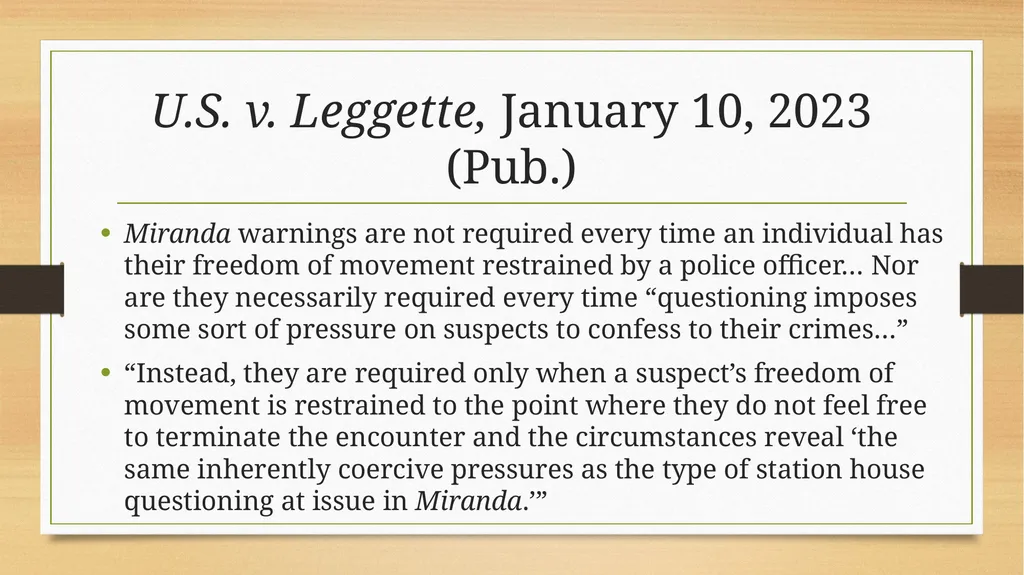
U.S. v. Leggette, January 10, 2023 (Pub.) Miranda warnings are not required every time an individual has their freedom of movement restrained by a police officer… Nor are they necessarily required every time “questioning imposes some sort of pressure on suspects to confess to their crimes…”
“Instead, they are required only when a suspect’s freedom of movement is restrained to the point where they do not feel free to terminate the encounter and the circumstances reveal ‘the same inherently coercive pressures as the type of station house questioning at issue in Miranda.’”<br>
“Instead, they are required only when a suspect’s freedom of movement is restrained to the point where they do not feel free to terminate the encounter and the circumstances reveal ‘the same inherently coercive pressures as the type of station house questioning at issue in Miranda.’”<br>
08
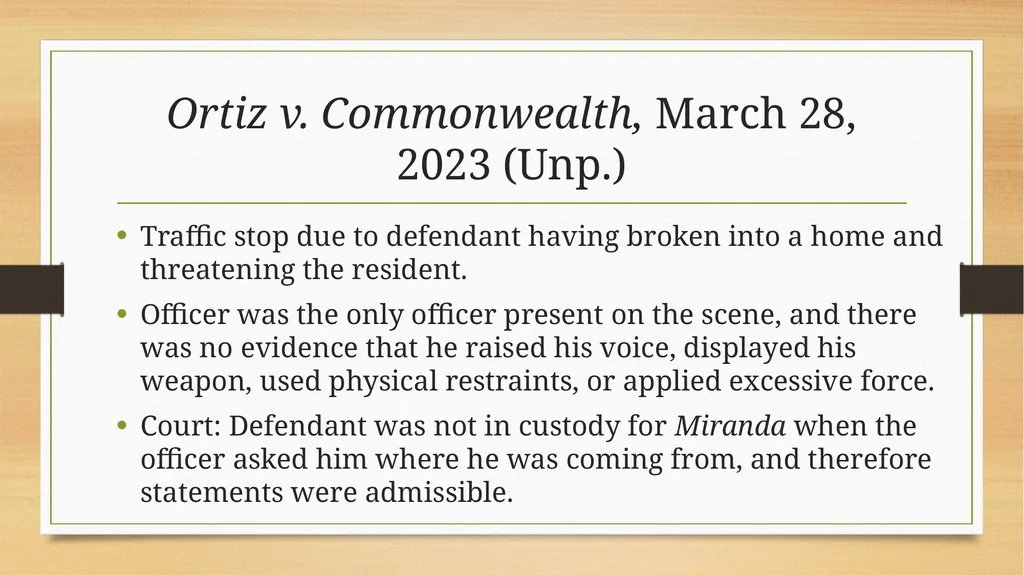
Ortiz v. Commonwealth, March 28, 2023 (Unp.) Traffic stop due to defendant having broken into a home and threatening the resident.
Officer was the only officer present on the scene, and there was no evidence that he raised his voice, displayed his weapon, used physical restraints, or applied excessive force.
Court: Defendant was not in custody for Miranda when the officer asked him where he was coming from, and therefore statements were admissible.<br>
Officer was the only officer present on the scene, and there was no evidence that he raised his voice, displayed his weapon, used physical restraints, or applied excessive force.
Court: Defendant was not in custody for Miranda when the officer asked him where he was coming from, and therefore statements were admissible.<br>
09
U.S. v. Ezequiel Arce, September 8, 2022 (Pub.) Officers executed search warrant for child exploitation material.
Officers never drew their guns and never physically restrained defendant.
Officers displayed a calm demeanor throughout.
Officers kept the defendant under observation during the house search but told defendant that he was free to leave.<br>
Officers never drew their guns and never physically restrained defendant.
Officers displayed a calm demeanor throughout.
Officers kept the defendant under observation during the house search but told defendant that he was free to leave.<br>
10
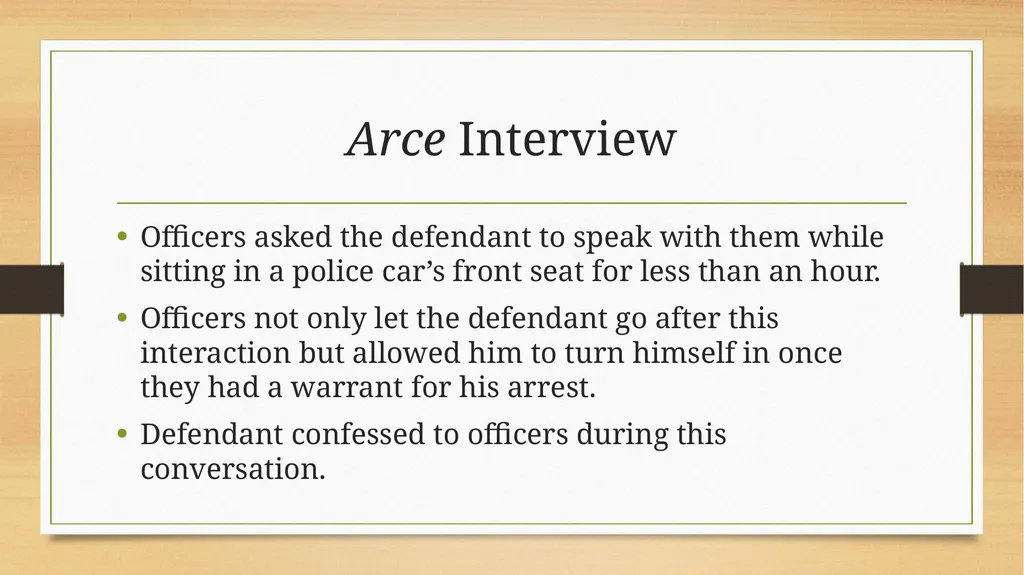
Arce Interview Officers asked the defendant to speak with them while sitting in a police car’s front seat for less than an hour.
Officers not only let the defendant go after this interaction but allowed him to turn himself in once they had a warrant for his arrest.
Defendant confessed to officers during this conversation.<br>
Officers not only let the defendant go after this interaction but allowed him to turn himself in once they had a warrant for his arrest.
Defendant confessed to officers during this conversation.<br>
11
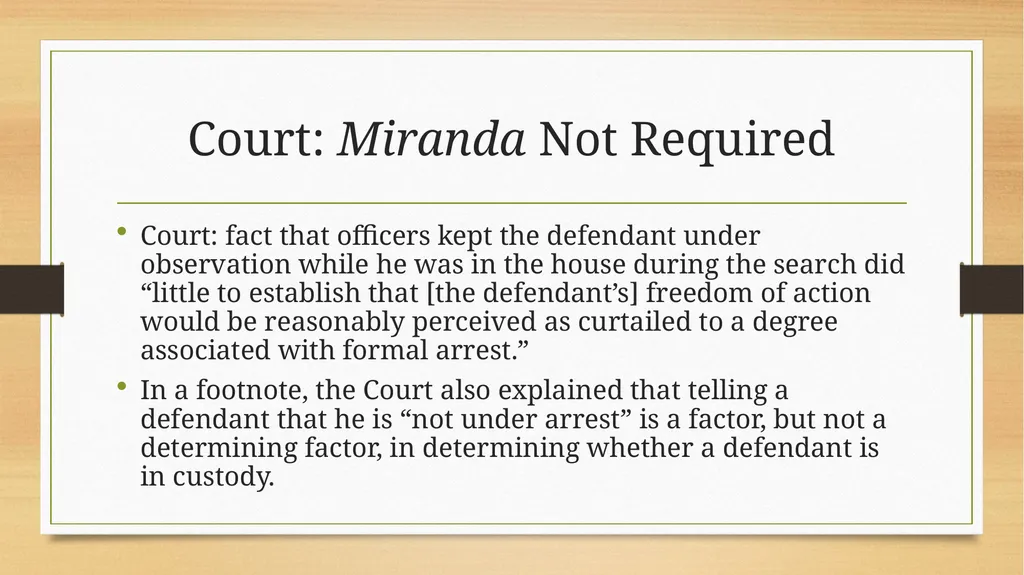
Court: Miranda Not Required Court: fact that officers kept the defendant under observation while he was in the house during the search did “little to establish that [the defendant’s] freedom of action would be reasonably perceived as curtailed to a degree associated with formal arrest.”
In a footnote, the Court also explained that telling a defendant that he is “not under arrest” is a factor, but not a determining factor, in determining whether a defendant is in custody.<br>
In a footnote, the Court also explained that telling a defendant that he is “not under arrest” is a factor, but not a determining factor, in determining whether a defendant is in custody.<br>
12
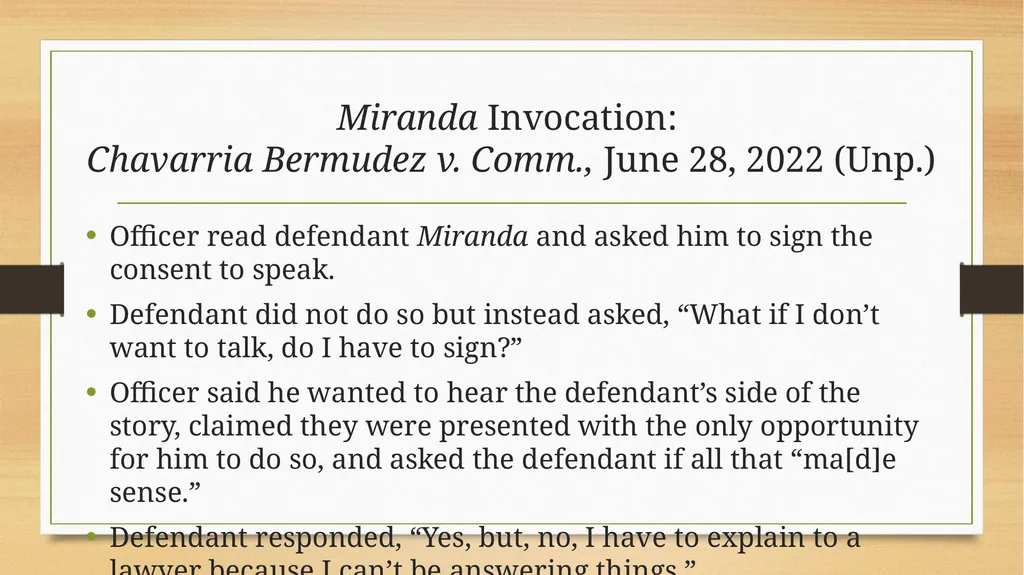
Miranda Invocation:
Chavarria Bermudez v. Comm., June 28, 2022 (Unp.) Officer read defendant Miranda and asked him to sign the consent to speak.
Defendant did not do so but instead asked, “What if I don’t want to talk, do I have to sign?”
Officer said he wanted to hear the defendant’s side of the story, claimed they were presented with the only opportunity for him to do so, and asked the defendant if all that “ma[d]e sense.”
Defendant responded, “Yes, but, no, I have to explain to a lawyer because I can’t be answering things.”<br>
Defendant did not do so but instead asked, “What if I don’t want to talk, do I have to sign?”
Officer said he wanted to hear the defendant’s side of the story, claimed they were presented with the only opportunity for him to do so, and asked the defendant if all that “ma[d]e sense.”
Defendant responded, “Yes, but, no, I have to explain to a lawyer because I can’t be answering things.”<br>
13
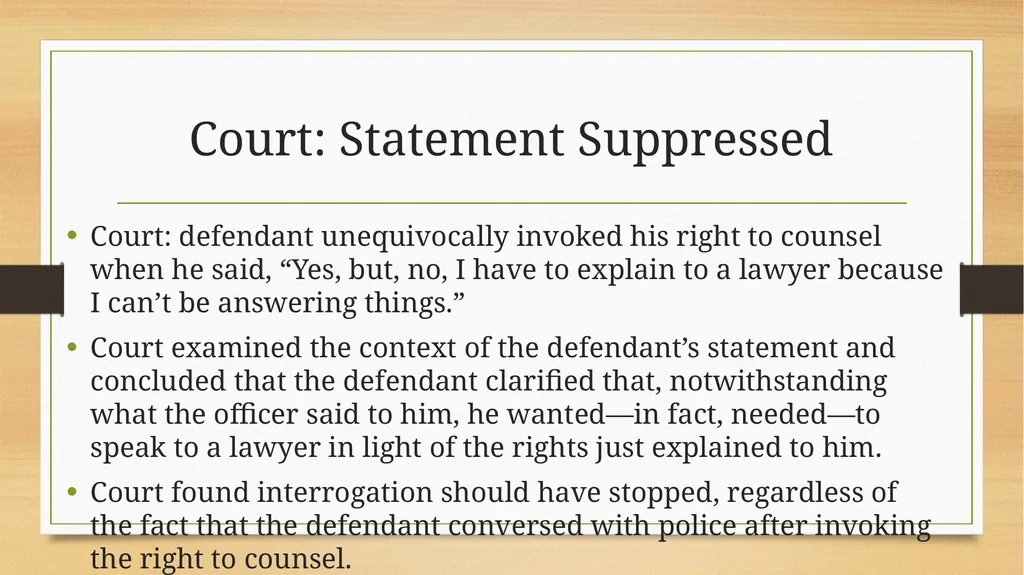
Court: Statement Suppressed Court: defendant unequivocally invoked his right to counsel when he said, “Yes, but, no, I have to explain to a lawyer because I can’t be answering things.”
Court examined the context of the defendant’s statement and concluded that the defendant clarified that, notwithstanding what the officer said to him, he wanted—in fact, needed—to speak to a lawyer in light of the rights just explained to him.
Court found interrogation should have stopped, regardless of the fact that the defendant conversed with police after invoking the right to counsel.<br>
Court examined the context of the defendant’s statement and concluded that the defendant clarified that, notwithstanding what the officer said to him, he wanted—in fact, needed—to speak to a lawyer in light of the rights just explained to him.
Court found interrogation should have stopped, regardless of the fact that the defendant conversed with police after invoking the right to counsel.<br>
14
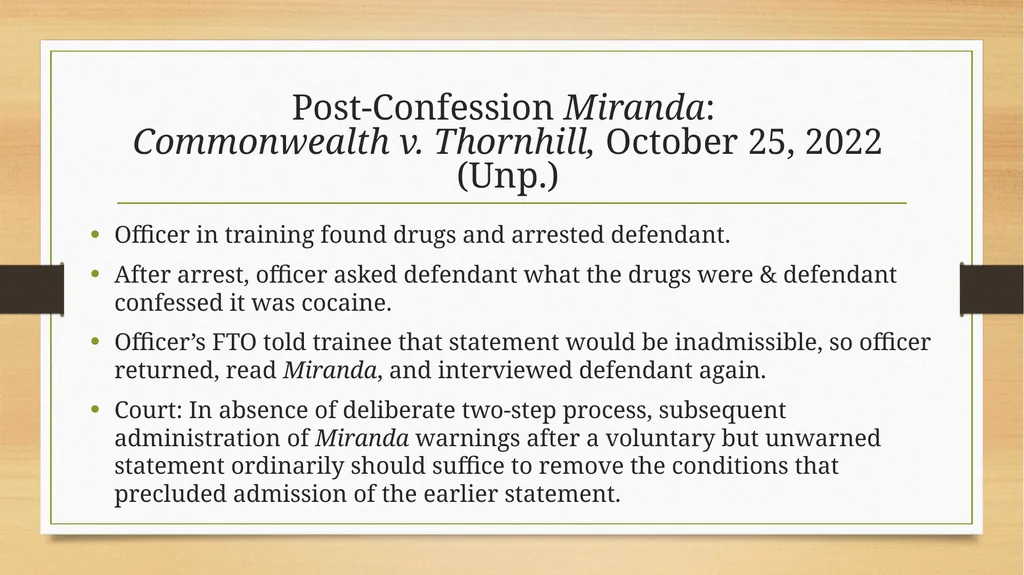
Post-Confession Miranda:
Commonwealth v. Thornhill, October 25, 2022 (Unp.) Officer in training found drugs and arrested defendant.
After arrest, officer asked defendant what the drugs were & defendant confessed it was cocaine.
Officer’s FTO told trainee that statement would be inadmissible, so officer returned, read Miranda, and interviewed defendant again.
Court: In absence of deliberate two-step process, subsequent administration of Miranda warnings after a voluntary but unwarned statement ordinarily should suffice to remove the conditions that precluded admission of the earlier statement.<br>
After arrest, officer asked defendant what the drugs were & defendant confessed it was cocaine.
Officer’s FTO told trainee that statement would be inadmissible, so officer returned, read Miranda, and interviewed defendant again.
Court: In absence of deliberate two-step process, subsequent administration of Miranda warnings after a voluntary but unwarned statement ordinarily should suffice to remove the conditions that precluded admission of the earlier statement.<br>
15
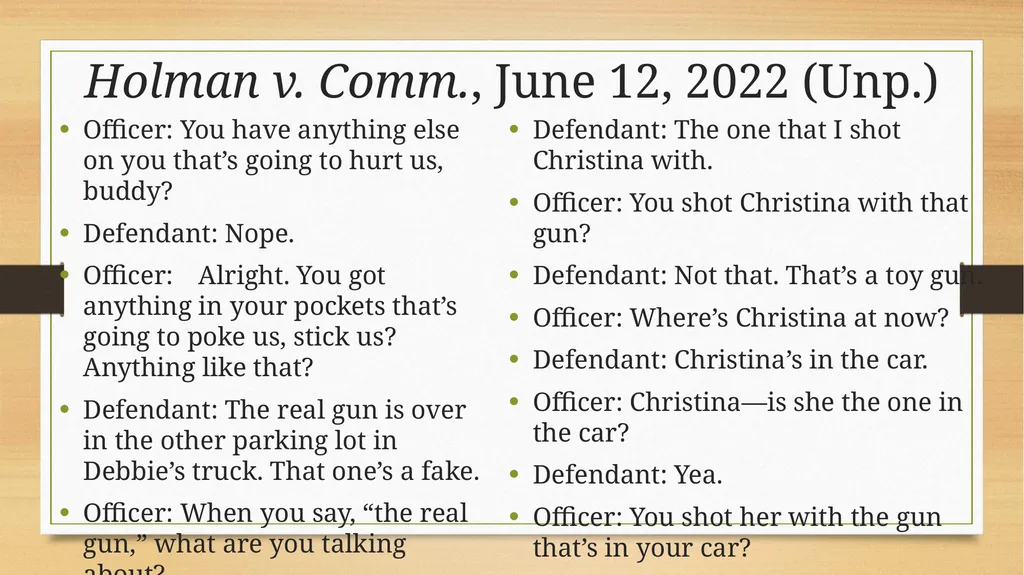
Holman v. Comm., June 12, 2022 (Unp.) Officer: You have anything else on you that’s going to hurt us, buddy?
Defendant: Nope.
Officer: Alright. You got anything in your pockets that’s going to poke us, stick us? Anything like that?
Defendant: The real gun is over in the other parking lot in Debbie’s truck. That one’s a fake.
Officer: When you say, “the real gun,” what are you talking about? Defendant: The one that I shot Christina with.
Officer: You shot Christina with that gun?
Defendant: Not that. That’s a toy gun.
Officer: Where’s Christina at now?
Defendant: Christina’s in the car.
Officer: Christina—is she the one in the car?
Defendant: Yea.
Officer: You shot her with the gun that’s in your car?
Defendant: I shot her with the [unintelligible]<br>
Defendant: Nope.
Officer: Alright. You got anything in your pockets that’s going to poke us, stick us? Anything like that?
Defendant: The real gun is over in the other parking lot in Debbie’s truck. That one’s a fake.
Officer: When you say, “the real gun,” what are you talking about? Defendant: The one that I shot Christina with.
Officer: You shot Christina with that gun?
Defendant: Not that. That’s a toy gun.
Officer: Where’s Christina at now?
Defendant: Christina’s in the car.
Officer: Christina—is she the one in the car?
Defendant: Yea.
Officer: You shot her with the gun that’s in your car?
Defendant: I shot her with the [unintelligible]<br>
16
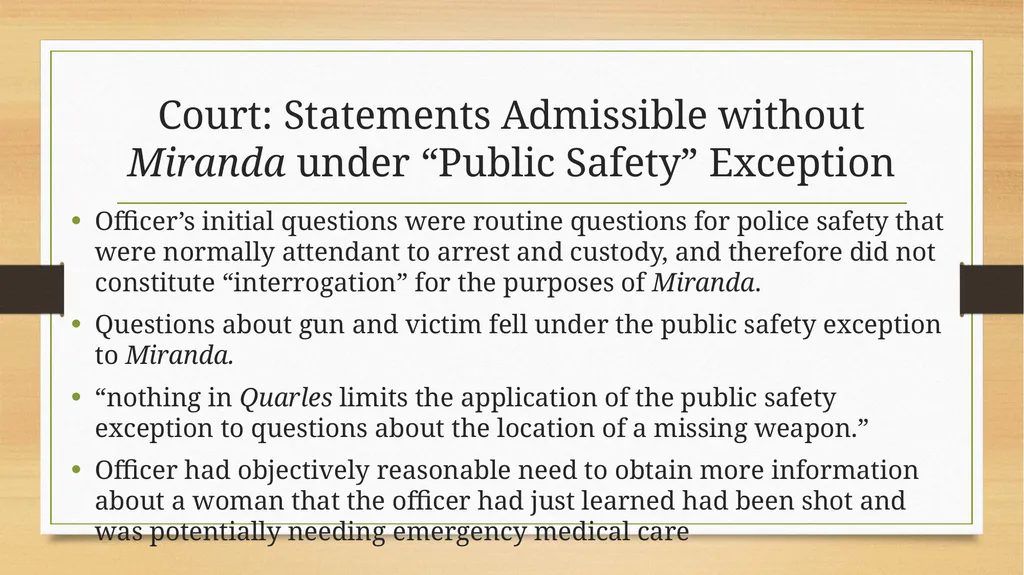
Court: Statements Admissible without Miranda under “Public Safety” Exception Officer’s initial questions were routine questions for police safety that were normally attendant to arrest and custody, and therefore did not constitute “interrogation” for the purposes of Miranda.
Questions about gun and victim fell under the public safety exception to Miranda.
“nothing in Quarles limits the application of the public safety exception to questions about the location of a missing weapon.”
Officer had objectively reasonable need to obtain more information about a woman that the officer had just learned had been shot and was potentially needing emergency medical care<br>
Questions about gun and victim fell under the public safety exception to Miranda.
“nothing in Quarles limits the application of the public safety exception to questions about the location of a missing weapon.”
Officer had objectively reasonable need to obtain more information about a woman that the officer had just learned had been shot and was potentially needing emergency medical care<br>
17
Fourth Amendment Search and Seizure<br>
18
Consent:
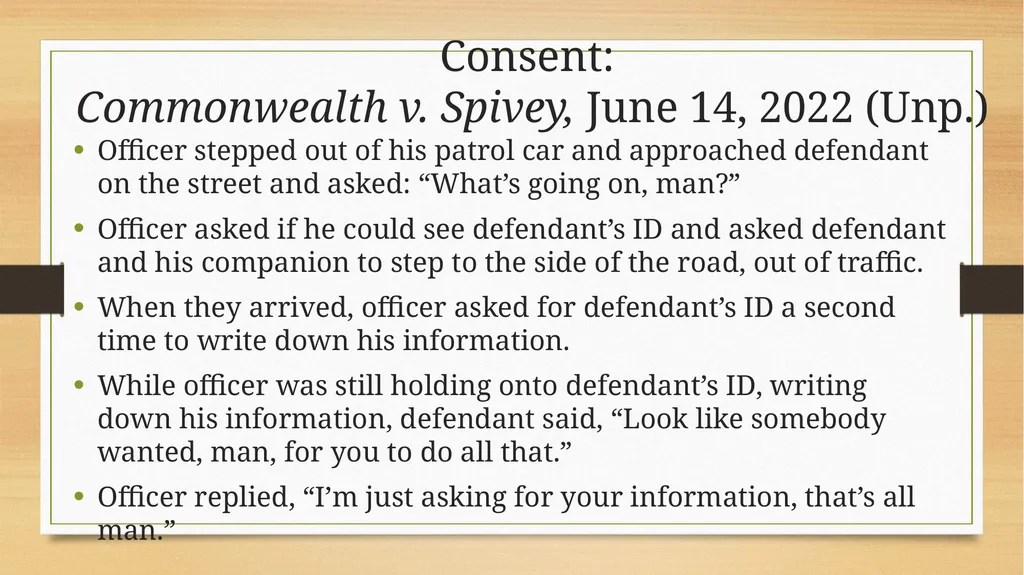
Commonwealth v. Spivey, June 14, 2022 (Unp.) Officer stepped out of his patrol car and approached defendant on the street and asked: “What’s going on, man?”
Officer asked if he could see defendant’s ID and asked defendant and his companion to step to the side of the road, out of traffic.
When they arrived, officer asked for defendant’s ID a second time to write down his information.
While officer was still holding onto defendant’s ID, writing down his information, defendant said, “Look like somebody wanted, man, for you to do all that.”
Officer replied, “I’m just asking for your information, that’s all man.”<br>
Officer asked if he could see defendant’s ID and asked defendant and his companion to step to the side of the road, out of traffic.
When they arrived, officer asked for defendant’s ID a second time to write down his information.
While officer was still holding onto defendant’s ID, writing down his information, defendant said, “Look like somebody wanted, man, for you to do all that.”
Officer replied, “I’m just asking for your information, that’s all man.”<br>
19
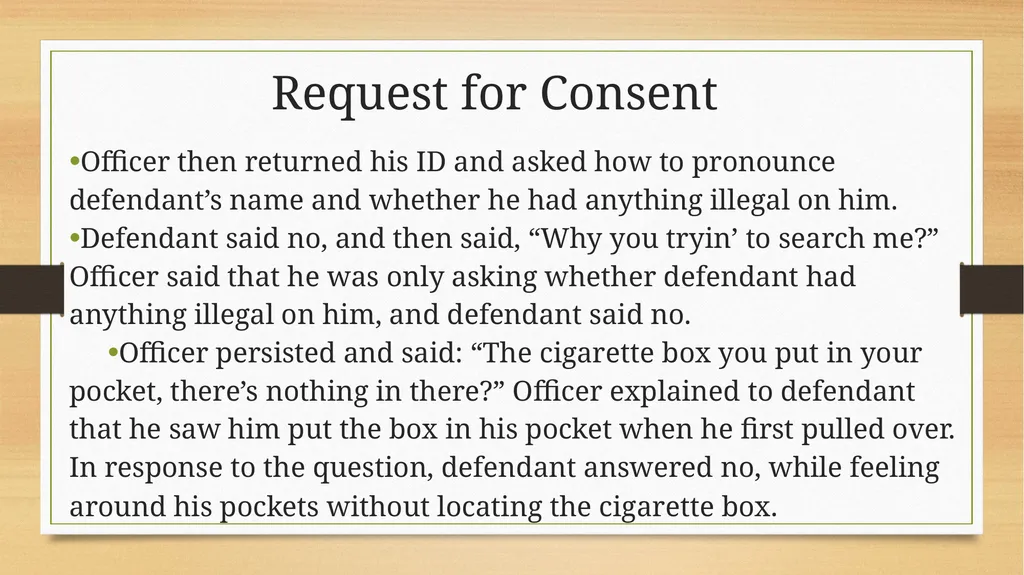
Request for Consent Officer then returned his ID and asked how to pronounce defendant’s name and whether he had anything illegal on him.
Defendant said no, and then said, “Why you tryin’ to search me?” Officer said that he was only asking whether defendant had anything illegal on him, and defendant said no.
Officer persisted and said: “The cigarette box you put in your pocket, there’s nothing in there?” Officer explained to defendant that he saw him put the box in his pocket when he first pulled over. In response to the question, defendant answered no, while feeling around his pockets without locating the cigarette box.<br>
Defendant said no, and then said, “Why you tryin’ to search me?” Officer said that he was only asking whether defendant had anything illegal on him, and defendant said no.
Officer persisted and said: “The cigarette box you put in your pocket, there’s nothing in there?” Officer explained to defendant that he saw him put the box in his pocket when he first pulled over. In response to the question, defendant answered no, while feeling around his pockets without locating the cigarette box.<br>
20
Three More Requests for Consent Officer continued to insist, three times, that defendant had a cigarette box in his pocket, despite the defendant’s repeated denials.
Another officer arrived, immediately parked, and walked up directly behind defendant.
Defendant finally pulled out the box, with the second officer standing right behind him, hand on his firearm, while officer simultaneously reached for the box asking, “May I see it?”
Defendant finally agreed, revealing heroin. He later admitted he regularly sold heroin.<br>
Another officer arrived, immediately parked, and walked up directly behind defendant.
Defendant finally pulled out the box, with the second officer standing right behind him, hand on his firearm, while officer simultaneously reached for the box asking, “May I see it?”
Defendant finally agreed, revealing heroin. He later admitted he regularly sold heroin.<br>
21
Court:
Motion to Suppress Properly Granted Court: When an officer merely asks for a person’s ID, even for investigatory purposes, that is not enough to show the person was seized without more.
Court explained that when an officer explicitly tells the defendant that he is suspected of a crime, that is strong reason to believe that a reasonable person would not have felt free to go on his way.
Court pointed out that the officer did not tell the defendant he was free to go, but otherwise did not give any further explanation about why the encounter was not a consensual encounter.<br>
Court explained that when an officer explicitly tells the defendant that he is suspected of a crime, that is strong reason to believe that a reasonable person would not have felt free to go on his way.
Court pointed out that the officer did not tell the defendant he was free to go, but otherwise did not give any further explanation about why the encounter was not a consensual encounter.<br>
22
Investigative Detention Reasonable Suspicion and Terry<br>
23
Insufficient Reasonable Suspicion for Stop: Turay & Carr Turay v. Commonwealth, March 21, 2023 (Reversed En Banc)
Carr v. Commonwealth, October 18, 2022 (Unpublished)
Defendants forced their way into a home, robbed several individuals at gun point, and fled the scene on foot.
Police responded quickly thereafter and issued an initial lookout (“BOLO”) for “three black males wearing black sweatshirts.”<br>
Carr v. Commonwealth, October 18, 2022 (Unpublished)
Defendants forced their way into a home, robbed several individuals at gun point, and fled the scene on foot.
Police responded quickly thereafter and issued an initial lookout (“BOLO”) for “three black males wearing black sweatshirts.”<br>
24
Stop Thirty minutes after the robbery, an officer detained the defendants, after seeing the men walking on the street less than 10 blocks away, and less than a minute’s drive from the crime scene.
No other people were around, and the night was cold.
Officer noted that there were only two men, not three, one defendant was wearing a black jacket, but other defendant’s clothing was not black.<br>
No other people were around, and the night was cold.
Officer noted that there were only two men, not three, one defendant was wearing a black jacket, but other defendant’s clothing was not black.<br>
25
Court: Stop Unlawful Court: there was no evidence that the officer observed defendants do anything suspicious or evasive.
No evidence that they were walking away from, rather than toward, the scene of the robbery.
“The mere observation of two Black men walking late at night in a residential neighborhood cannot give rise to reasonable, individualized suspicion that they were involved in a robbery that occurred six to ten blocks away thirty minutes earlier.”<br>
No evidence that they were walking away from, rather than toward, the scene of the robbery.
“The mere observation of two Black men walking late at night in a residential neighborhood cannot give rise to reasonable, individualized suspicion that they were involved in a robbery that occurred six to ten blocks away thirty minutes earlier.”<br>
26
Time Limitations Set by Rodriguez on Traffic Stops Detention for a “Reasonable Amount of Time”<br>
27
What is a “Reasonable Amount of Time?”
for an Investigative Detention? Rodriguez v. United States (April 2015)
Officer completed his traffic stop but ordered the defendant to remain until a K-9 officer arrived.
5 Minutes later, K-9 officer arrived and found drugs
Held: Authority for the seizure ended when tasks tied to the traffic infraction were —or reasonably should have been —completed.<br>
Officer completed his traffic stop but ordered the defendant to remain until a K-9 officer arrived.
5 Minutes later, K-9 officer arrived and found drugs
Held: Authority for the seizure ended when tasks tied to the traffic infraction were —or reasonably should have been —completed.<br>
28
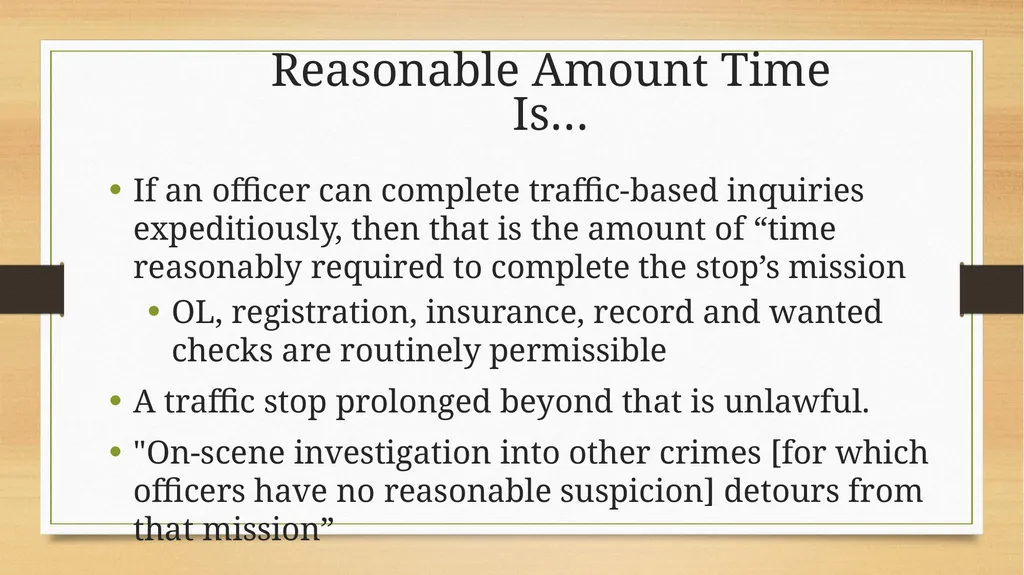
Reasonable Amount Time Is… If an officer can complete traffic-based inquiries expeditiously, then that is the amount of “time reasonably required to complete the stop’s mission
OL, registration, insurance, record and wanted checks are routinely permissible
A traffic stop prolonged beyond that is unlawful.
"On-scene investigation into other crimes [for which officers have no reasonable suspicion] detours from that mission”<br>
OL, registration, insurance, record and wanted checks are routinely permissible
A traffic stop prolonged beyond that is unlawful.
"On-scene investigation into other crimes [for which officers have no reasonable suspicion] detours from that mission”<br>
29
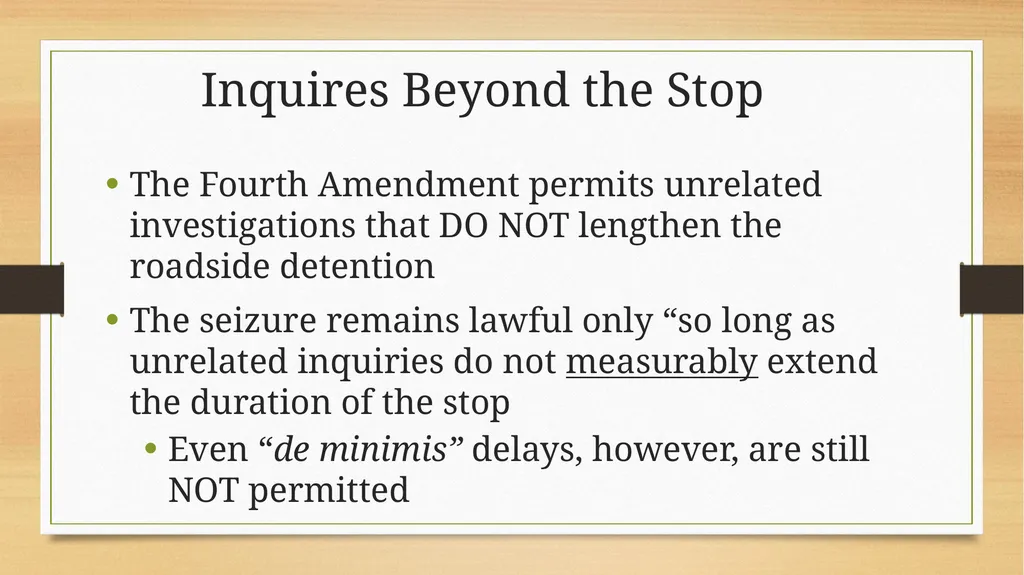
Inquires Beyond the Stop The Fourth Amendment permits unrelated investigations that DO NOT lengthen the roadside detention
The seizure remains lawful only “so long as unrelated inquiries do not measurably extend the duration of the stop
Even “de minimis” delays, however, are still NOT permitted<br>
The seizure remains lawful only “so long as unrelated inquiries do not measurably extend the duration of the stop
Even “de minimis” delays, however, are still NOT permitted<br>
30
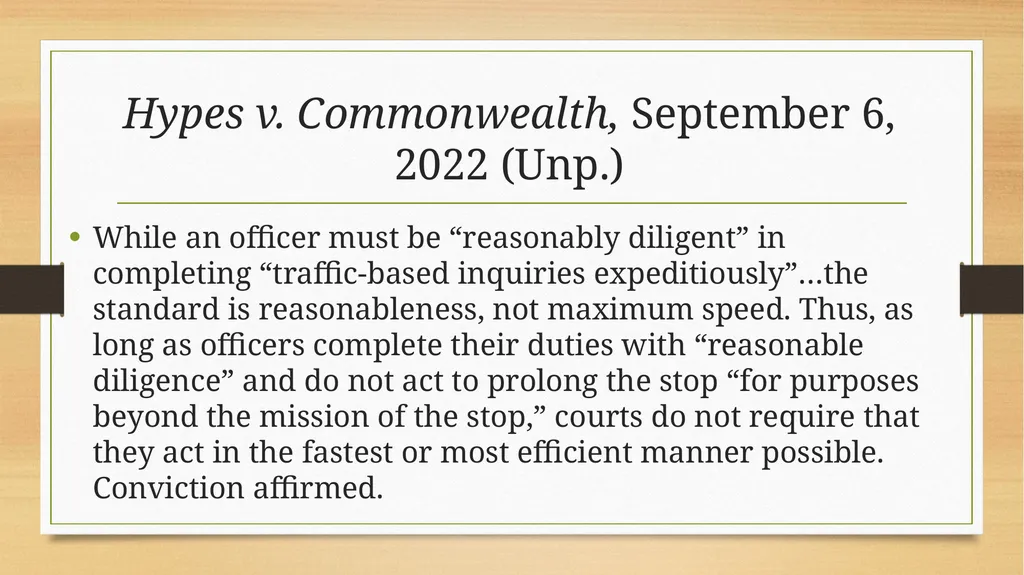
Hypes v. Commonwealth, September 6, 2022 (Unp.) While an officer must be “reasonably diligent” in completing “traffic-based inquiries expeditiously”…the standard is reasonableness, not maximum speed. Thus, as long as officers complete their duties with “reasonable diligence” and do not act to prolong the stop “for purposes beyond the mission of the stop,” courts do not require that they act in the fastest or most efficient manner possible. Conviction affirmed.<br>
31
Detention of Passengers Lawful:
Terry v. Commonwealth, January 31, 2023 (Unp.) Defendant was lawfully detained as a passenger in a vehicle properly stopped for traffic infractions.
During that lawful detention, officer properly requested the defendant’s identification, which the defendant voluntarily provided.
Discovering that the defendant had outstanding arrest warrants, officers lawfully arrested him, discovering narcotics in their search incident to arrest.
Court rejected the defendant’s claim that he was tricked into providing his identification.<br>
During that lawful detention, officer properly requested the defendant’s identification, which the defendant voluntarily provided.
Discovering that the defendant had outstanding arrest warrants, officers lawfully arrested him, discovering narcotics in their search incident to arrest.
Court rejected the defendant’s claim that he was tricked into providing his identification.<br>
32
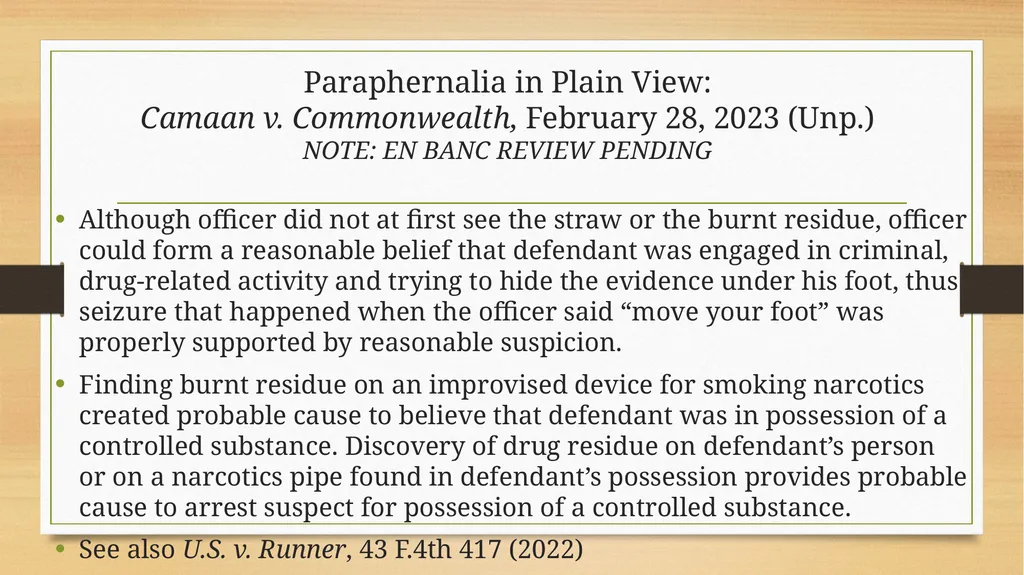
Paraphernalia in Plain View:
Camaan v. Commonwealth, February 28, 2023 (Unp.)
NOTE: EN BANC REVIEW PENDING Although officer did not at first see the straw or the burnt residue, officer could form a reasonable belief that defendant was engaged in criminal, drug-related activity and trying to hide the evidence under his foot, thus seizure that happened when the officer said “move your foot” was properly supported by reasonable suspicion.
Finding burnt residue on an improvised device for smoking narcotics created probable cause to believe that defendant was in possession of a controlled substance. Discovery of drug residue on defendant’s person or on a narcotics pipe found in defendant’s possession provides probable cause to arrest suspect for possession of a controlled substance.
See also U.S. v. Runner, 43 F.4th 417 (2022)<br>
Finding burnt residue on an improvised device for smoking narcotics created probable cause to believe that defendant was in possession of a controlled substance. Discovery of drug residue on defendant’s person or on a narcotics pipe found in defendant’s possession provides probable cause to arrest suspect for possession of a controlled substance.
See also U.S. v. Runner, 43 F.4th 417 (2022)<br>
33
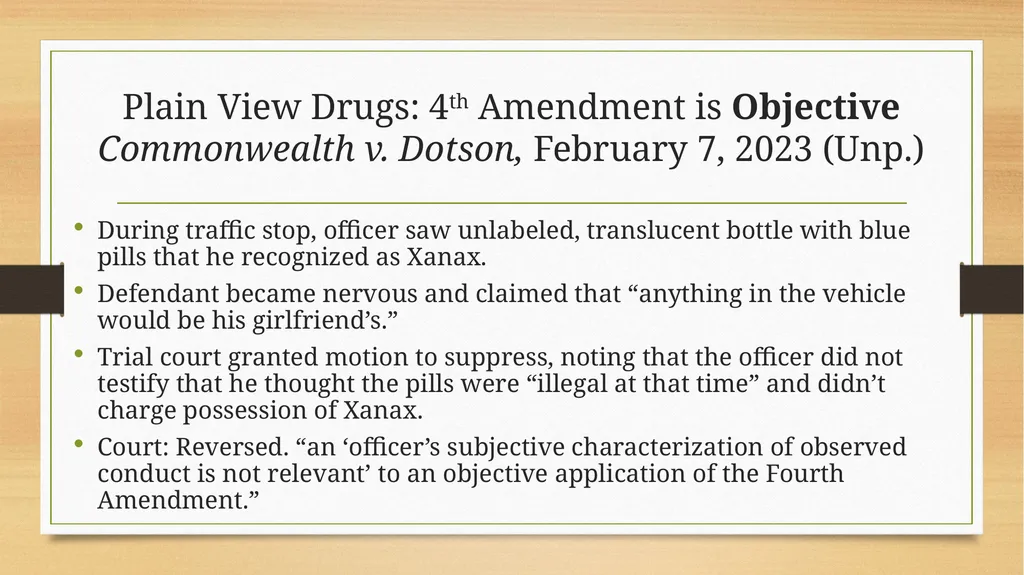
Plain View Drugs: 4th Amendment is Objective
Commonwealth v. Dotson, February 7, 2023 (Unp.) During traffic stop, officer saw unlabeled, translucent bottle with blue pills that he recognized as Xanax.
Defendant became nervous and claimed that “anything in the vehicle would be his girlfriend’s.”
Trial court granted motion to suppress, noting that the officer did not testify that he thought the pills were “illegal at that time” and didn’t charge possession of Xanax.
Court: Reversed. “an ‘officer’s subjective characterization of observed conduct is not relevant’ to an objective application of the Fourth Amendment.”<br>
Defendant became nervous and claimed that “anything in the vehicle would be his girlfriend’s.”
Trial court granted motion to suppress, noting that the officer did not testify that he thought the pills were “illegal at that time” and didn’t charge possession of Xanax.
Court: Reversed. “an ‘officer’s subjective characterization of observed conduct is not relevant’ to an objective application of the Fourth Amendment.”<br>
34
Pat-Downs Scope of Lawful Frisks<br>
35
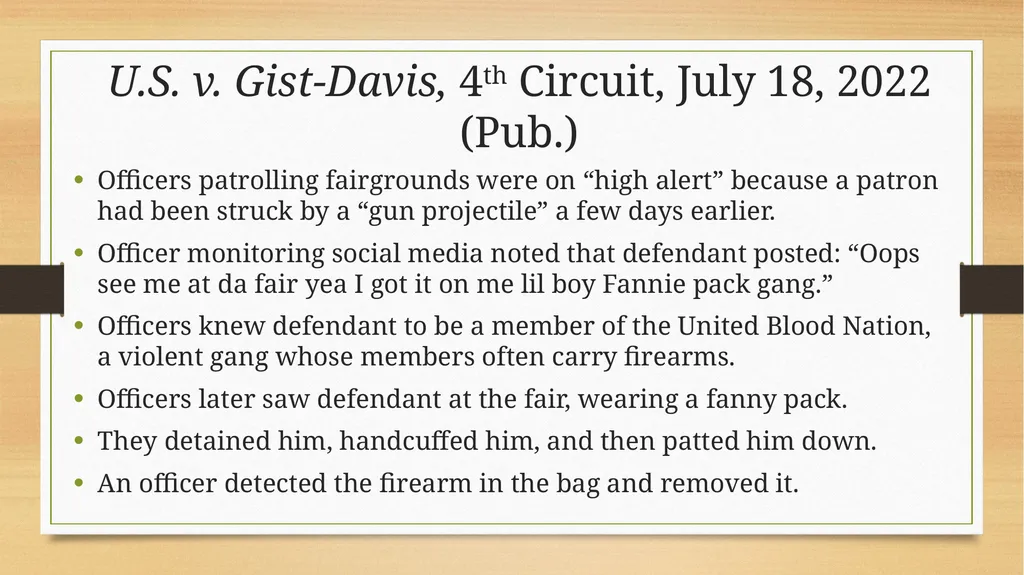
U.S. v. Gist-Davis, 4th Circuit, July 18, 2022 (Pub.) Officers patrolling fairgrounds were on “high alert” because a patron had been struck by a “gun projectile” a few days earlier.
Officer monitoring social media noted that defendant posted: “Oops see me at da fair yea I got it on me lil boy Fannie pack gang.”
Officers knew defendant to be a member of the United Blood Nation, a violent gang whose members often carry firearms.
Officers later saw defendant at the fair, wearing a fanny pack.
They detained him, handcuffed him, and then patted him down.
An officer detected the firearm in the bag and removed it.<br>
Officer monitoring social media noted that defendant posted: “Oops see me at da fair yea I got it on me lil boy Fannie pack gang.”
Officers knew defendant to be a member of the United Blood Nation, a violent gang whose members often carry firearms.
Officers later saw defendant at the fair, wearing a fanny pack.
They detained him, handcuffed him, and then patted him down.
An officer detected the firearm in the bag and removed it.<br>
36
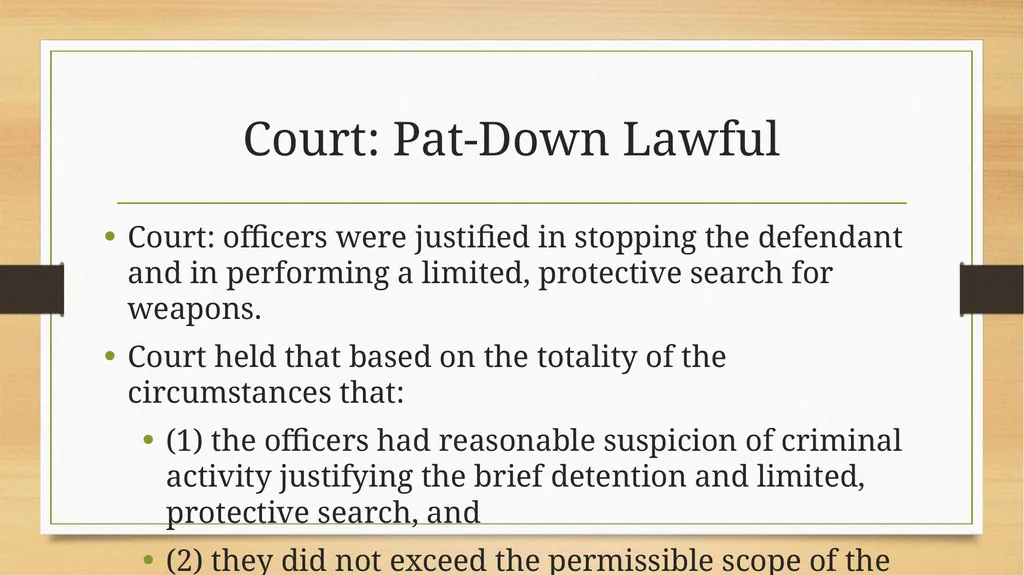
Court: Pat-Down Lawful Court: officers were justified in stopping the defendant and in performing a limited, protective search for weapons.
Court held that based on the totality of the circumstances that:
(1) the officers had reasonable suspicion of criminal activity justifying the brief detention and limited, protective search, and
(2) they did not exceed the permissible scope of the Terry stop.<br>
Court held that based on the totality of the circumstances that:
(1) the officers had reasonable suspicion of criminal activity justifying the brief detention and limited, protective search, and
(2) they did not exceed the permissible scope of the Terry stop.<br>
37
Court: Scope of Pat-Down Lawful Court: Officers did not exceed the scope of this permissible stop and frisk.
Court noted that officers conducted the pat-down without delay after he was placed in the handcuffs and recovered the gun fewer than 30 seconds after placing the handcuffs on defendant.
Because the defendant’s liberty was restricted only temporarily to permit the officers to conduct the protective frisk for weapons, Court ruled that officers’ use of handcuffs in this crowded public space was permissible as part of the brief investigatory stop and did not transform the stop into a custodial arrest.<br>
Court noted that officers conducted the pat-down without delay after he was placed in the handcuffs and recovered the gun fewer than 30 seconds after placing the handcuffs on defendant.
Because the defendant’s liberty was restricted only temporarily to permit the officers to conduct the protective frisk for weapons, Court ruled that officers’ use of handcuffs in this crowded public space was permissible as part of the brief investigatory stop and did not transform the stop into a custodial arrest.<br>
38
Exceeding Scope of Pat-Down:
Commonwealth v. Hendrick, December 29, 2022 (Unp.) During vehicle pat-down, dispatch confirmed that defendant was “probably armed.”
A few moments later, officer located drugs in a baggie, stating: “[o]h, there you go. There’s all the drugs right there.”
Court concluded that officers did not confine themselves to such a limited, permissible search for weapons, but they expanded their conduct to search for drugs.
Court examined officers’ statements to one another and concluded that the officers were concerned to search for and find drugs, rather than weapons, and noted that once officers located the drugs, they ceased examining the car.<br>
A few moments later, officer located drugs in a baggie, stating: “[o]h, there you go. There’s all the drugs right there.”
Court concluded that officers did not confine themselves to such a limited, permissible search for weapons, but they expanded their conduct to search for drugs.
Court examined officers’ statements to one another and concluded that the officers were concerned to search for and find drugs, rather than weapons, and noted that once officers located the drugs, they ceased examining the car.<br>
39
Probable Cause and Marijuana:
Commonwealth v. Spencer, February 14, 2023 (Unp.) Officer in a hotel parking lot smelled the odor of marijuana, which led her to defendant.
Officer found defendant smoking a marijuana cigarette in her car and spoke with her. The engine was running, and the car was parked.
Defendant admitted that she was smoking marijuana and stated that she was staying at the hotel. She told the officer, “All I have is a blunt.”
At the time of this offense, marijuana possession was a civil offense.
Officers searched the car and found cocaine.<br>
Officer found defendant smoking a marijuana cigarette in her car and spoke with her. The engine was running, and the car was parked.
Defendant admitted that she was smoking marijuana and stated that she was staying at the hotel. She told the officer, “All I have is a blunt.”
At the time of this offense, marijuana possession was a civil offense.
Officers searched the car and found cocaine.<br>
40
Court: Evidence Suppressed.
No Probable Cause to Search Car Court rejected argument that the presence of the marijuana cigarette alone established probable cause to search for more marijuana.
Officer did not see any paraphernalia or other drugs and did not detect any additional marijuana odor from the vehicle, and no other facts indicated that there was additional evidence or contraband in the vehicle.
Court noted that Defendant was not in a high crime area, did not try to hide the cigarette, did not make any furtive movements, did not appear to have any weapons, and was cooperative with the officer.<br>
Officer did not see any paraphernalia or other drugs and did not detect any additional marijuana odor from the vehicle, and no other facts indicated that there was additional evidence or contraband in the vehicle.
Court noted that Defendant was not in a high crime area, did not try to hide the cigarette, did not make any furtive movements, did not appear to have any weapons, and was cooperative with the officer.<br>
41
Court: No PC to search for DUI Evidence While the officers suggested during their interaction that the defendant might be committing a DUI, officer had admitted in her testimony that the defendant “was acting normal” and that she saw no need to initiate a DUI investigation.
“under the facts of this case, it is not clear what evidence of a DUI the officers would have probable cause to search for other than the burning cigarette in appellee’s hand, which they could already seize.”<br>
“under the facts of this case, it is not clear what evidence of a DUI the officers would have probable cause to search for other than the burning cigarette in appellee’s hand, which they could already seize.”<br>
42
Police Response to Emergency Fourth Amendment & Exigent Circumstances<br>
43
Baskerville v. Commonwealth, February 21, 2023 (Pub.) Officers responded to a 911 “disorderly” call. The caller, a woman, reported having a verbal altercation with her boyfriend, who had been drinking, was often violent when he drank, and had vandalized their apartment.
Officers arrived at residence. The woman opened the door and spoke as she walked out of the unit. She did not identify herself as the 911 caller at the time (although later officers discovered that she had made the call), nor did she appear to be injured or distressed.
She proceeded to enter the apartment unit immediately next door.<br>
Officers arrived at residence. The woman opened the door and spoke as she walked out of the unit. She did not identify herself as the 911 caller at the time (although later officers discovered that she had made the call), nor did she appear to be injured or distressed.
She proceeded to enter the apartment unit immediately next door.<br>
44
Investigation Woman’s aunt reported that the defendant had been in an argument with the woman, had kicked the aunt’s door, and then broken the aunt’s window. Officer observed a broken window.
Officers knocked on door of apartment next door, and defendant and the woman answered the door.
Defendant refused to allow police to enter.
Officers noticed a TV in the apartment lying face down on the floor.<br>
Officers knocked on door of apartment next door, and defendant and the woman answered the door.
Defendant refused to allow police to enter.
Officers noticed a TV in the apartment lying face down on the floor.<br>
45
Forced Entry Officers argued with the defendant about whether they could enter.
Defendant told the officer, “you can’t give me a pass . . . I know where you live at, I know where your family is at.”
Defendant tried to close the door, but officer kept it open with his leg and hand, and then entered with other officers.
Officers learned defendant was wanted, arrested defendant on open warrant, searched him, and located drugs.<br>
Defendant told the officer, “you can’t give me a pass . . . I know where you live at, I know where your family is at.”
Defendant tried to close the door, but officer kept it open with his leg and hand, and then entered with other officers.
Officers learned defendant was wanted, arrested defendant on open warrant, searched him, and located drugs.<br>
46
Court: Evidence Suppressed.
No Exigent Circumstance Court applied Verez factors and cited Lange v. California to note that the police pursuit of a person charged with a misdemeanor does not categorically justify a warrantless entry into his residence.
Court held that no exigent circumstances justified officers’ warrantless entry into defendant’s home.
A reasonably well-trained officer would have known that warrantless entry into the defendant’s apartment was illegal and unnecessary.<br>
Court held that no exigent circumstances justified officers’ warrantless entry into defendant’s home.
A reasonably well-trained officer would have known that warrantless entry into the defendant’s apartment was illegal and unnecessary.<br>
47
Court: No Basis for Exigent Entry No ongoing disorderly conduct or any indication of any other ongoing crime.
Woman appeared to be unharmed when she walked past police.
No reasonable belief that contraband would be removed or destroyed.
Property damage and vandalism are crimes “that involve a low level of violence,” and no indication that defendant was going to escape.<br>
Woman appeared to be unharmed when she walked past police.
No reasonable belief that contraband would be removed or destroyed.
Property damage and vandalism are crimes “that involve a low level of violence,” and no indication that defendant was going to escape.<br>
48
Limits:
Commonwealth v. Mihokovich, November 15, 2022 (Unp.) Through a window, police noticed defendant in a motel room asleep, and believed he may have been overdosing.
They stopped man’s friend and questioned him.
Friend admitted he himself had taken fentanyl, and that he had carried defendant to the room, but denied that defendant had taken anything.
Officers talked with friend for approximately 10 minutes before deciding to get a key to defendant’s room and enter that motel room without a search warrant.<br>
They stopped man’s friend and questioned him.
Friend admitted he himself had taken fentanyl, and that he had carried defendant to the room, but denied that defendant had taken anything.
Officers talked with friend for approximately 10 minutes before deciding to get a key to defendant’s room and enter that motel room without a search warrant.<br>
49
Entry Officers waited 10 minutes until room key arrived.
Once in the room, officers waited a few minutes before trying to rouse defendant themselves and first relied on the woman in bed with him to see if he was breathing.
Officers then summoned EMS.
Officers did not retrieve Narcan from their own police vehicle; instead, they waited for EMS personnel to arrive and administer Narcan to defendant to successfully revive him.<br>
Once in the room, officers waited a few minutes before trying to rouse defendant themselves and first relied on the woman in bed with him to see if he was breathing.
Officers then summoned EMS.
Officers did not retrieve Narcan from their own police vehicle; instead, they waited for EMS personnel to arrive and administer Narcan to defendant to successfully revive him.<br>
50
Court: Evidence Suppressed Court complained that officers did not tap on the window or shout through the window to the defendant or the woman, yell to ask the occupants about whether they needed medical help, or knock on the wall or door to see if they could rouse the defendant or the woman to determine if they were all right.
Court also explained that, if the officers had then received no response during this time that they stood mere feet away outside defendant’s motel room, there almost certainly would have been an objective basis to enter the motel room without a search warrant under the emergency aid exception.<br>
Court also explained that, if the officers had then received no response during this time that they stood mere feet away outside defendant’s motel room, there almost certainly would have been an objective basis to enter the motel room without a search warrant under the emergency aid exception.<br>
51
Automobile Exception:
Torrence v. Commonwealth, August 16, 2022 (Unp.) Warrantless search of vehicle lawful under Carroll doctrine upheld.
“The fact that the police might feasibly have frozen the scene using such a method in order to secure a warrant is simply not dispositive of whether the search was reasonable under the Fourth Amendment” under the automobile exception.
“Ready mobility depends solely upon whether the automobile itself is operational or reasonably appears to be, not on whether law enforcement are capable of temporarily disabling it such as by physically blocking it in, detaining the driver, or taking his keys.”<br>
“The fact that the police might feasibly have frozen the scene using such a method in order to secure a warrant is simply not dispositive of whether the search was reasonable under the Fourth Amendment” under the automobile exception.
“Ready mobility depends solely upon whether the automobile itself is operational or reasonably appears to be, not on whether law enforcement are capable of temporarily disabling it such as by physically blocking it in, detaining the driver, or taking his keys.”<br>
52
Search Warrants: Probable Cause Does NOT Mean “More Likely Than Not” Comm. v. Barrett, January 31, 2023 (Unp.) – Trial court wrongly granted motion to suppress search warrant.
Probable cause “does not demand any showing that such a belief be more likely true than false.”
Affidavits provided time and location, a nexus between the evidence and the defendant, and non-conclusory information supporting probable cause, giving the magistrate sufficient evidence to decide that the defendant was “fairly probably” committing animal cruelty on her property<br>
Probable cause “does not demand any showing that such a belief be more likely true than false.”
Affidavits provided time and location, a nexus between the evidence and the defendant, and non-conclusory information supporting probable cause, giving the magistrate sufficient evidence to decide that the defendant was “fairly probably” committing animal cruelty on her property<br>
53
Electronic Device Search Warrants<br>
54
Particularity and Electronic Devices:
U.S. v. Suiero, 4th Circuit, February 3, 2023 (Pub.) Defendant argued that warrant that sought “[a]ny and all mobile telephones and GPS devices,” “[a]ny computers/laptops,” “printers,” and other devices “capable of storing data” violated DC Court’s ruling Griffith.
Court: When a warrant states a charged offense, such reference to the crime effectively narrows the description of the items to be seized.
“we do not view as overbroad the inclusion of “mobile phones” in a warrant when [the defendant’s] alleged crime of sending threats via email required the use of an electronic device and, in 2014, “more than 90% of American adults . . . own[ed] a cell phone.”<br>
Court: When a warrant states a charged offense, such reference to the crime effectively narrows the description of the items to be seized.
“we do not view as overbroad the inclusion of “mobile phones” in a warrant when [the defendant’s] alleged crime of sending threats via email required the use of an electronic device and, in 2014, “more than 90% of American adults . . . own[ed] a cell phone.”<br>
55
Scope of Phone Warrant:
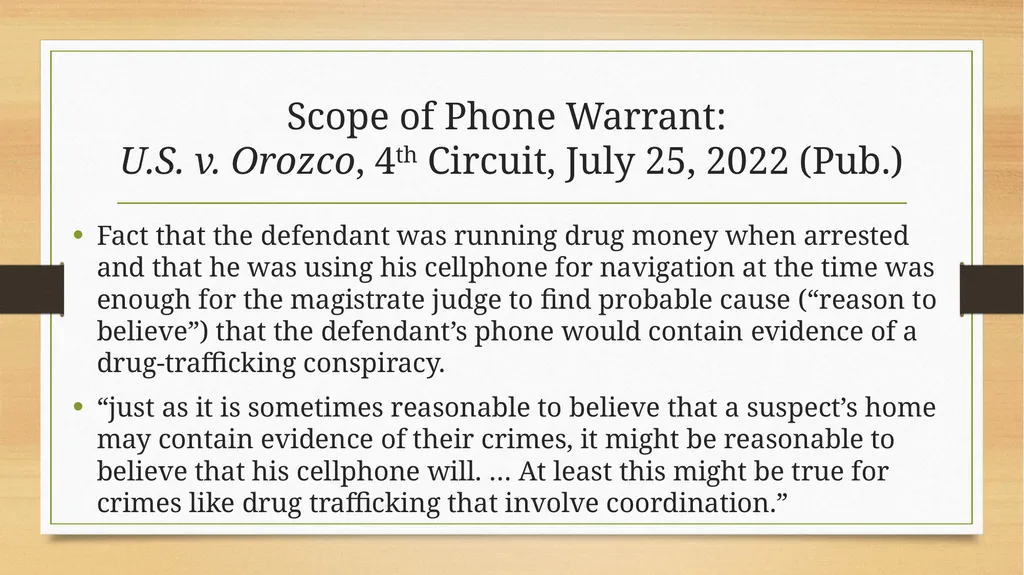
U.S. v. Orozco, 4th Circuit, July 25, 2022 (Pub.) Fact that the defendant was running drug money when arrested and that he was using his cellphone for navigation at the time was enough for the magistrate judge to find probable cause (“reason to believe”) that the defendant’s phone would contain evidence of a drug-trafficking conspiracy.
“just as it is sometimes reasonable to believe that a suspect’s home may contain evidence of their crimes, it might be reasonable to believe that his cellphone will. … At least this might be true for crimes like drug trafficking that involve coordination.”<br>
“just as it is sometimes reasonable to believe that a suspect’s home may contain evidence of their crimes, it might be reasonable to believe that his cellphone will. … At least this might be true for crimes like drug trafficking that involve coordination.”<br>
56
Scope of Phone Warrant:
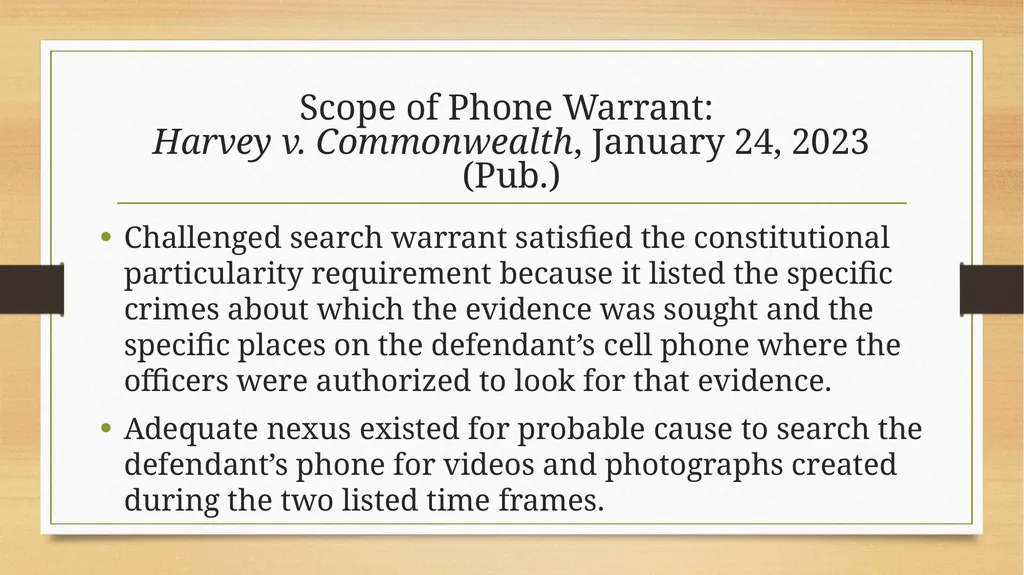
Harvey v. Commonwealth, January 24, 2023 (Pub.) Challenged search warrant satisfied the constitutional particularity requirement because it listed the specific crimes about which the evidence was sought and the specific places on the defendant’s cell phone where the officers were authorized to look for that evidence.
Adequate nexus existed for probable cause to search the defendant’s phone for videos and photographs created during the two listed time frames.<br>
Adequate nexus existed for probable cause to search the defendant’s phone for videos and photographs created during the two listed time frames.<br>
57
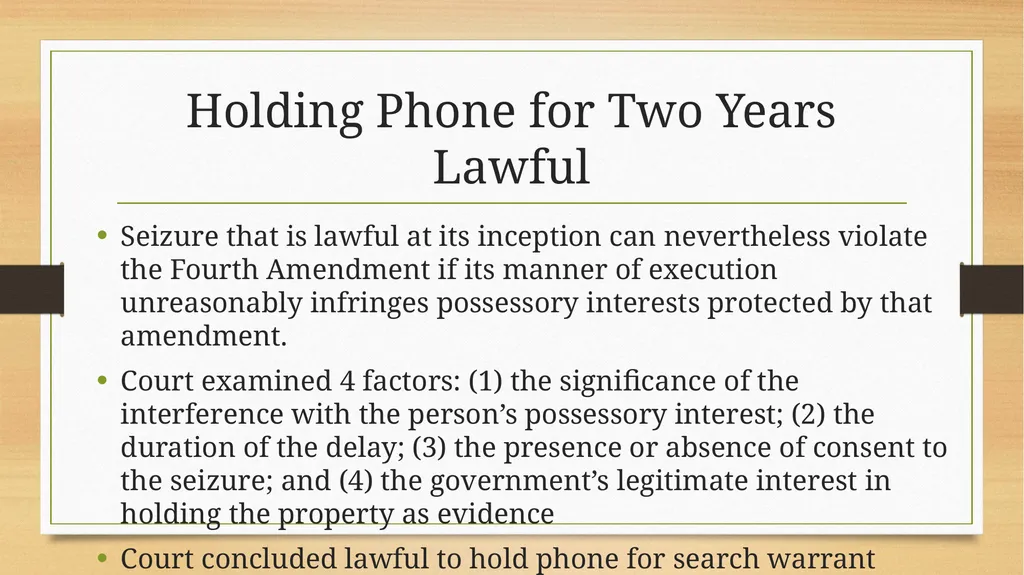
Holding Phone for Two Years Lawful Seizure that is lawful at its inception can nevertheless violate the Fourth Amendment if its manner of execution unreasonably infringes possessory interests protected by that amendment.
Court examined 4 factors: (1) the significance of the interference with the person’s possessory interest; (2) the duration of the delay; (3) the presence or absence of consent to the seizure; and (4) the government’s legitimate interest in holding the property as evidence
Court concluded lawful to hold phone for search warrant examination.<br>
Court examined 4 factors: (1) the significance of the interference with the person’s possessory interest; (2) the duration of the delay; (3) the presence or absence of consent to the seizure; and (4) the government’s legitimate interest in holding the property as evidence
Court concluded lawful to hold phone for search warrant examination.<br>
58
Answer:
Timing is not relevant to the 4th Amendment Court: Neither the Fourth Amendment nor § 19.2-56(A) provide for suppression of the evidence.<br>
59
PART TWO:
Crimes & Offenses New Cases Worth Noting<br>
60
Adult Abuse and Neglect:
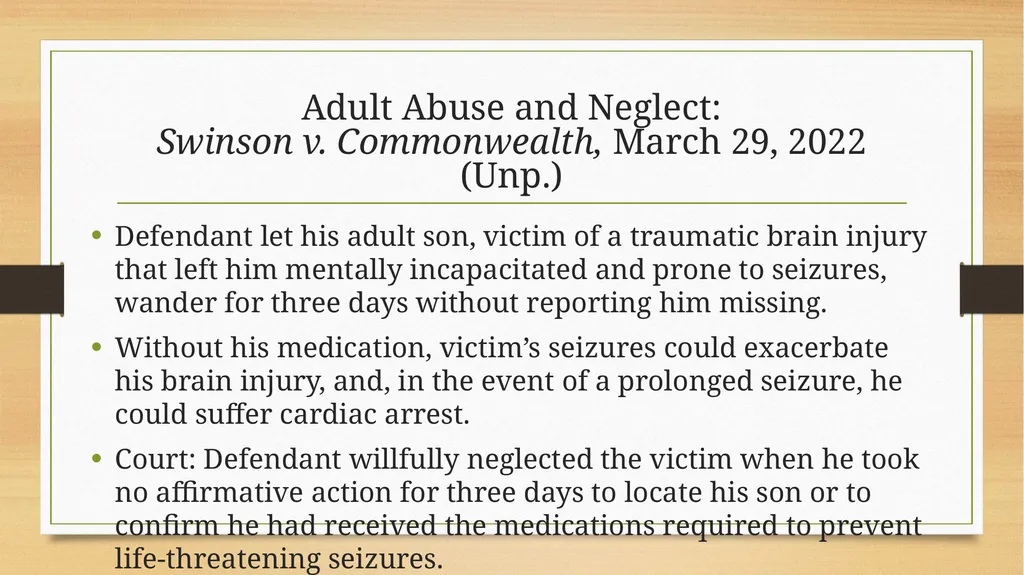
Swinson v. Commonwealth, March 29, 2022 (Unp.) Defendant let his adult son, victim of a traumatic brain injury that left him mentally incapacitated and prone to seizures, wander for three days without reporting him missing.
Without his medication, victim’s seizures could exacerbate his brain injury, and, in the event of a prolonged seizure, he could suffer cardiac arrest.
Court: Defendant willfully neglected the victim when he took no affirmative action for three days to locate his son or to confirm he had received the medications required to prevent life-threatening seizures.<br>
Without his medication, victim’s seizures could exacerbate his brain injury, and, in the event of a prolonged seizure, he could suffer cardiac arrest.
Court: Defendant willfully neglected the victim when he took no affirmative action for three days to locate his son or to confirm he had received the medications required to prevent life-threatening seizures.<br>
61
Malicious Wounding:
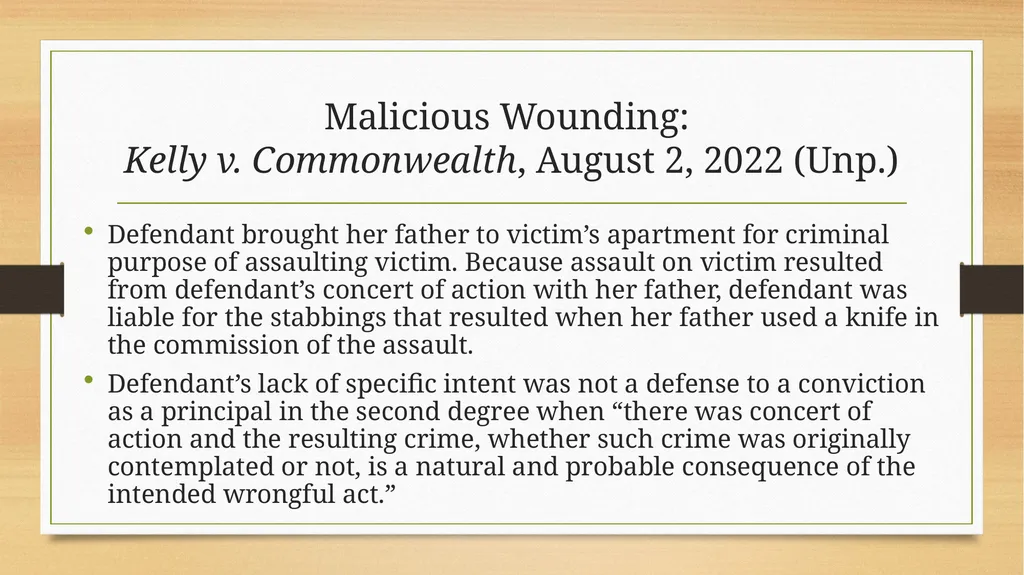
Kelly v. Commonwealth, August 2, 2022 (Unp.) Defendant brought her father to victim’s apartment for criminal purpose of assaulting victim. Because assault on victim resulted from defendant’s concert of action with her father, defendant was liable for the stabbings that resulted when her father used a knife in the commission of the assault.
Defendant’s lack of specific intent was not a defense to a conviction as a principal in the second degree when “there was concert of action and the resulting crime, whether such crime was originally contemplated or not, is a natural and probable consequence of the intended wrongful act.”<br>
Defendant’s lack of specific intent was not a defense to a conviction as a principal in the second degree when “there was concert of action and the resulting crime, whether such crime was originally contemplated or not, is a natural and probable consequence of the intended wrongful act.”<br>
62
Strangulation:
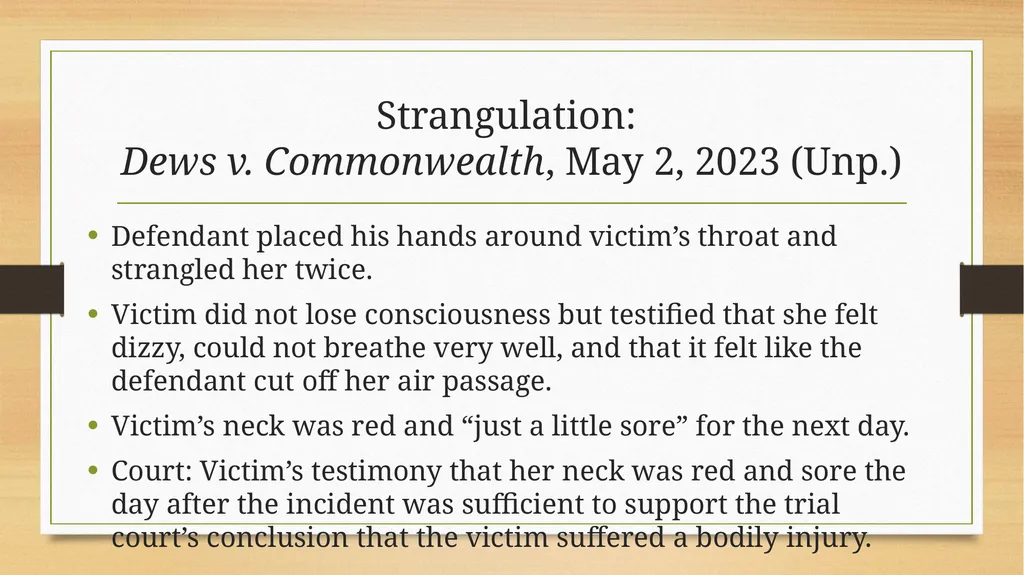
Dews v. Commonwealth, May 2, 2023 (Unp.) Defendant placed his hands around victim’s throat and strangled her twice.
Victim did not lose consciousness but testified that she felt dizzy, could not breathe very well, and that it felt like the defendant cut off her air passage.
Victim’s neck was red and “just a little sore” for the next day.
Court: Victim’s testimony that her neck was red and sore the day after the incident was sufficient to support the trial court’s conclusion that the victim suffered a bodily injury.<br>
Victim did not lose consciousness but testified that she felt dizzy, could not breathe very well, and that it felt like the defendant cut off her air passage.
Victim’s neck was red and “just a little sore” for the next day.
Court: Victim’s testimony that her neck was red and sore the day after the incident was sufficient to support the trial court’s conclusion that the victim suffered a bodily injury.<br>
63
Burglary & Authority to Enter:
Carr v. Commonwealth, August 23, 2022 (Unp.) Defendant broke into estranged wife’s home and savagely beat her.
Parties had been separated for a year, and the victim had made it clear to the defendant that he was not welcome at the home, which was only titled in the victim’s name.
Defendant was living with his mother at the time of the attack.
Victim had changed the locks and installed a security system to protect herself.
Defendant argued that he was not guilty of armed burglary and burglary tools because he could not break into a home that he claims he shared with his wife.<br>
Parties had been separated for a year, and the victim had made it clear to the defendant that he was not welcome at the home, which was only titled in the victim’s name.
Defendant was living with his mother at the time of the attack.
Victim had changed the locks and installed a security system to protect herself.
Defendant argued that he was not guilty of armed burglary and burglary tools because he could not break into a home that he claims he shared with his wife.<br>
64
Court: Burglary Conviction Affirmed.
Defendant had No Right to Occupy Home Court: “a person may not unlawfully break and enter a home in which she has the right to occupy.”
Fact that a defendant may have some sort of legal title in the property or license to use it does not establish his right to occupy it.
Court noted that the defendant had no legal or proprietary interest in the victim’s home, which was titled exclusively in her name, and had to break into the home to get access.<br>
Fact that a defendant may have some sort of legal title in the property or license to use it does not establish his right to occupy it.
Court noted that the defendant had no legal or proprietary interest in the victim’s home, which was titled exclusively in her name, and had to break into the home to get access.<br>
65
DUI, Impairment, & Experts:
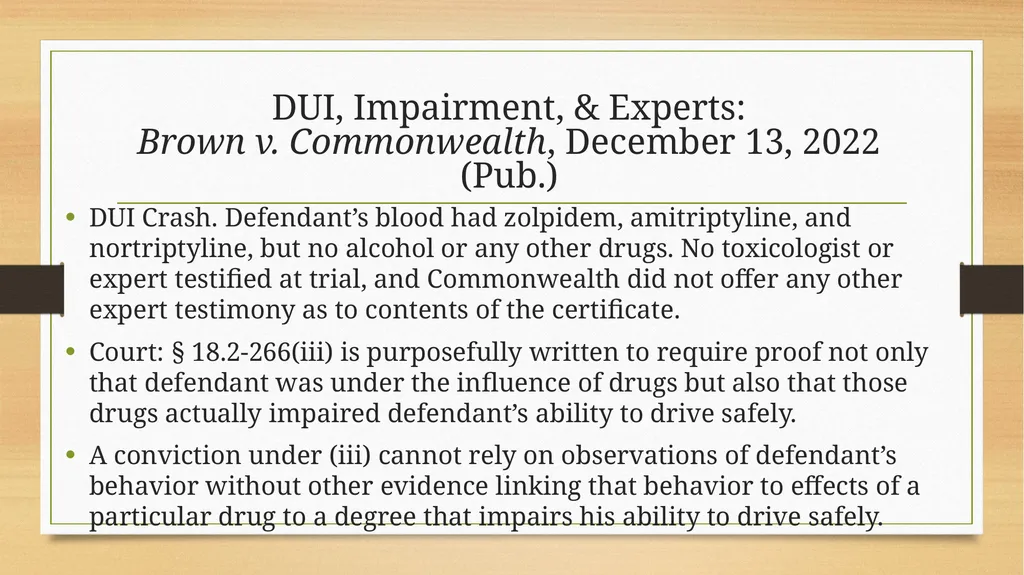
Brown v. Commonwealth, December 13, 2022 (Pub.) DUI Crash. Defendant’s blood had zolpidem, amitriptyline, and nortriptyline, but no alcohol or any other drugs. No toxicologist or expert testified at trial, and Commonwealth did not offer any other expert testimony as to contents of the certificate.
Court: § 18.2-266(iii) is purposefully written to require proof not only that defendant was under the influence of drugs but also that those drugs actually impaired defendant’s ability to drive safely.
A conviction under (iii) cannot rely on observations of defendant’s behavior without other evidence linking that behavior to effects of a particular drug to a degree that impairs his ability to drive safely.<br>
Court: § 18.2-266(iii) is purposefully written to require proof not only that defendant was under the influence of drugs but also that those drugs actually impaired defendant’s ability to drive safely.
A conviction under (iii) cannot rely on observations of defendant’s behavior without other evidence linking that behavior to effects of a particular drug to a degree that impairs his ability to drive safely.<br>
66
Child Neglect, DUI, and Crashes Good Rulings on DUI-related crashes<br>
67
Pollard v. Commonwealth, September 27, 2022 (Unp.) Defendant, to avoid highway traffic, drove into a construction work zone at 70 miles per hour, struck construction gear, and struck a construction worker.
Defendant had a four-year-old child, his nephew, in the vehicle.
Witnesses heard the defendant’s brakes and saw his brake lights as the worker tried to run and dive out of the way, but the defendant’s truck hit the victim’s legs, “spun him like a top,” and threw him to the ground; worker suffered serious injuries
Defendant did not stop, and instead fled the area..<br>
Defendant had a four-year-old child, his nephew, in the vehicle.
Witnesses heard the defendant’s brakes and saw his brake lights as the worker tried to run and dive out of the way, but the defendant’s truck hit the victim’s legs, “spun him like a top,” and threw him to the ground; worker suffered serious injuries
Defendant did not stop, and instead fled the area..<br>
68
Court: Conviction for §18.2-371.1 Affirmed Court: As the driver of a vehicle in which a four-year-old child was a passenger, defendant exercised care and control over that child, even in the presence of another adult.
§18.2-371.1(B)(1) applies to any “person responsible for the care of a child under the age of 18,” including any person who drives a motor vehicle knowing that a child is in the vehicle.<br>
§18.2-371.1(B)(1) applies to any “person responsible for the care of a child under the age of 18,” including any person who drives a motor vehicle knowing that a child is in the vehicle.<br>
69
Rose v. Commonwealth, July 19, 2022 (Unp.) Defendant drove while intoxicated with four children, including a three-year-old, in the vehicle.
None of the children had been secured with protective seat devices.
Defendant told police that she had been chasing her father, who had been driving “really fast,” and she had attempted to keep up with him.<br>
None of the children had been secured with protective seat devices.
Defendant told police that she had been chasing her father, who had been driving “really fast,” and she had attempted to keep up with him.<br>
70
Crash When she attempted to call her father from her cell phone, defendant lost control of her vehicle as she approached a curve, striking several groups of trees and causing the vehicle to overturn twice.
An officer who responded discovered a nine-year-old child lying in the roadway with a bloody “hole in his head,” injured with “road rash” from sliding along the pavement after being ejected from the vehicle. Another child received similar injuries.
Court: Defendant’s driving was “clearly was reckless” and her conduct violated § 18.2-371.1(B).<br>
An officer who responded discovered a nine-year-old child lying in the roadway with a bloody “hole in his head,” injured with “road rash” from sliding along the pavement after being ejected from the vehicle. Another child received similar injuries.
Court: Defendant’s driving was “clearly was reckless” and her conduct violated § 18.2-371.1(B).<br>
71
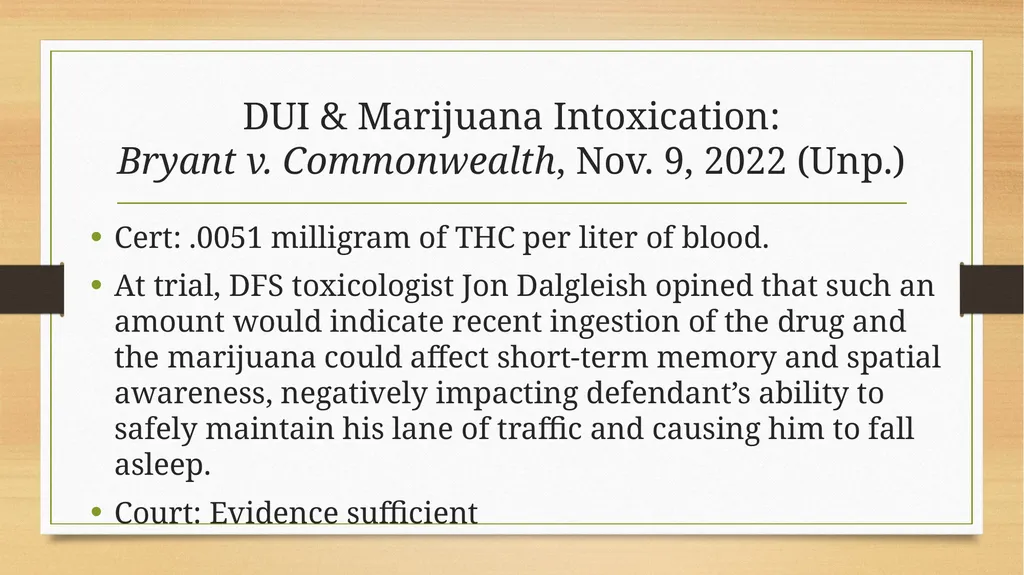
DUI & Marijuana Intoxication:
Bryant v. Commonwealth, Nov. 9, 2022 (Unp.) Cert: .0051 milligram of THC per liter of blood.
At trial, DFS toxicologist Jon Dalgleish opined that such an amount would indicate recent ingestion of the drug and the marijuana could affect short-term memory and spatial awareness, negatively impacting defendant’s ability to safely maintain his lane of traffic and causing him to fall asleep.
Court: Evidence sufficient<br>
At trial, DFS toxicologist Jon Dalgleish opined that such an amount would indicate recent ingestion of the drug and the marijuana could affect short-term memory and spatial awareness, negatively impacting defendant’s ability to safely maintain his lane of traffic and causing him to fall asleep.
Court: Evidence sufficient<br>
72
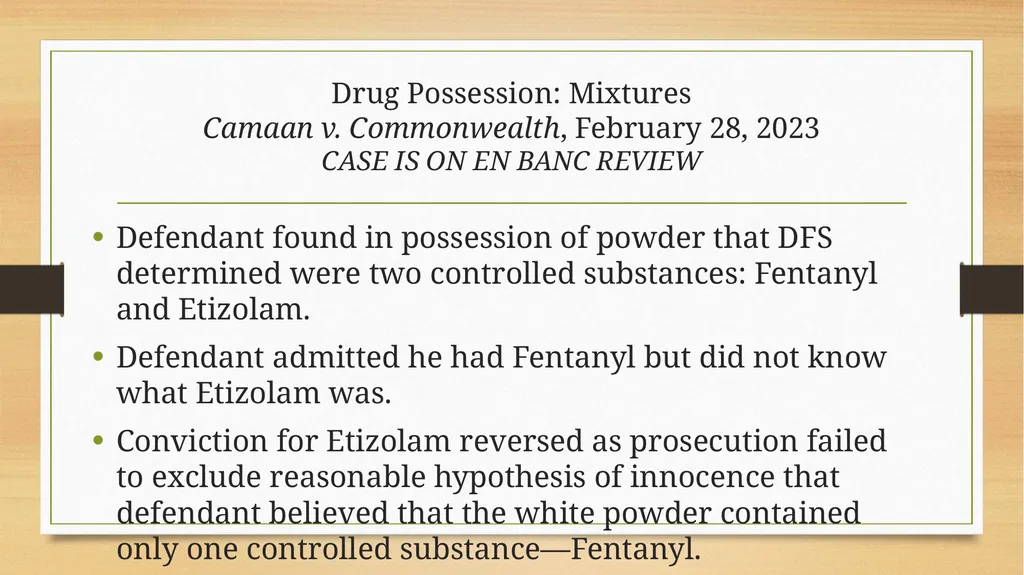
Drug Possession: Mixtures
Camaan v. Commonwealth, February 28, 2023
CASE IS ON EN BANC REVIEW Defendant found in possession of powder that DFS determined were two controlled substances: Fentanyl and Etizolam.
Defendant admitted he had Fentanyl but did not know what Etizolam was.
Conviction for Etizolam reversed as prosecution failed to exclude reasonable hypothesis of innocence that defendant believed that the white powder contained only one controlled substance—Fentanyl.<br>
Defendant admitted he had Fentanyl but did not know what Etizolam was.
Conviction for Etizolam reversed as prosecution failed to exclude reasonable hypothesis of innocence that defendant believed that the white powder contained only one controlled substance—Fentanyl.<br>
73
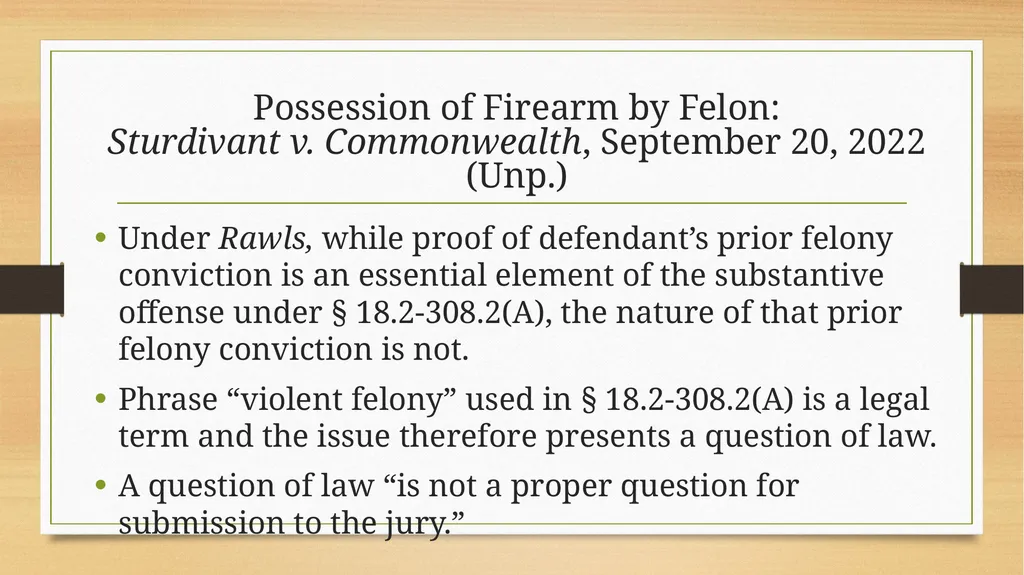
Possession of Firearm by Felon:
Sturdivant v. Commonwealth, September 20, 2022 (Unp.) Under Rawls, while proof of defendant’s prior felony conviction is an essential element of the substantive offense under § 18.2-308.2(A), the nature of that prior felony conviction is not.
Phrase “violent felony” used in § 18.2-308.2(A) is a legal term and the issue therefore presents a question of law.
A question of law “is not a proper question for submission to the jury.”<br>
Phrase “violent felony” used in § 18.2-308.2(A) is a legal term and the issue therefore presents a question of law.
A question of law “is not a proper question for submission to the jury.”<br>
74
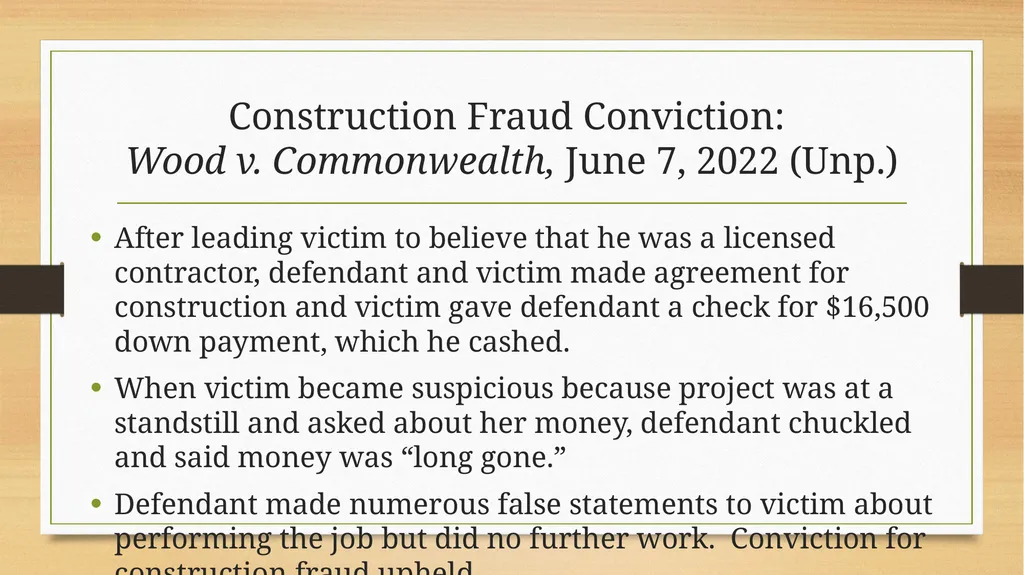
Construction Fraud Conviction:
Wood v. Commonwealth, June 7, 2022 (Unp.) After leading victim to believe that he was a licensed contractor, defendant and victim made agreement for construction and victim gave defendant a check for $16,500 down payment, which he cashed.
When victim became suspicious because project was at a standstill and asked about her money, defendant chuckled and said money was “long gone.”
Defendant made numerous false statements to victim about performing the job but did no further work. Conviction for construction fraud upheld.<br>
When victim became suspicious because project was at a standstill and asked about her money, defendant chuckled and said money was “long gone.”
Defendant made numerous false statements to victim about performing the job but did no further work. Conviction for construction fraud upheld.<br>
75
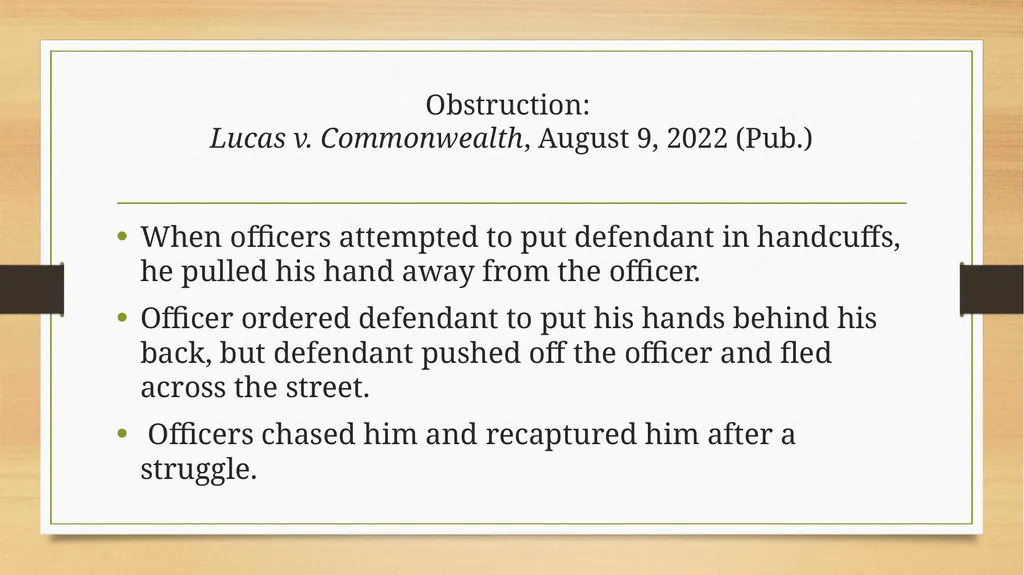
Obstruction:
Lucas v. Commonwealth, August 9, 2022 (Pub.) When officers attempted to put defendant in handcuffs, he pulled his hand away from the officer.
Officer ordered defendant to put his hands behind his back, but defendant pushed off the officer and fled across the street.
Officers chased him and recaptured him after a struggle.<br>
Officer ordered defendant to put his hands behind his back, but defendant pushed off the officer and fled across the street.
Officers chased him and recaptured him after a struggle.<br>
76
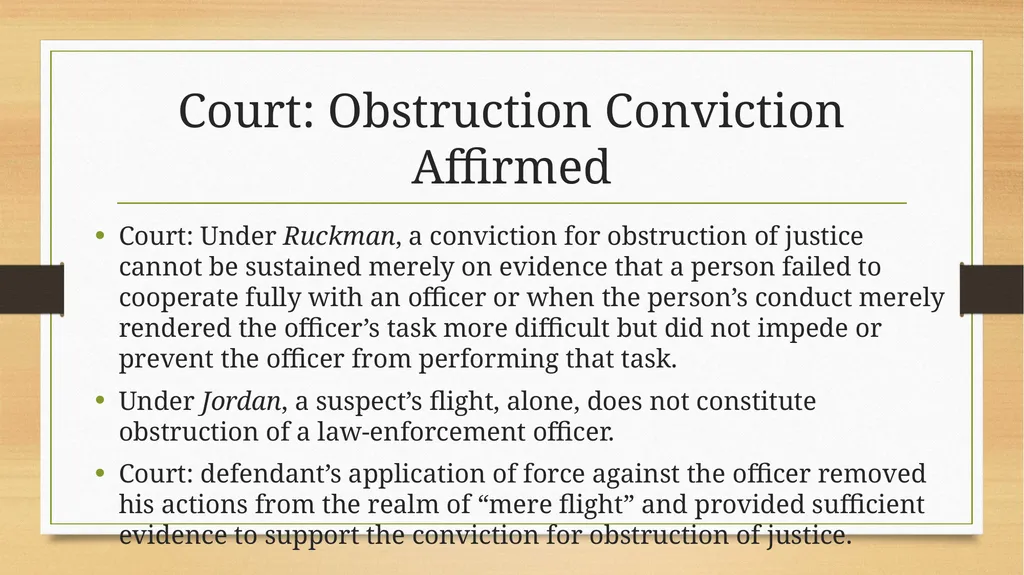
Court: Obstruction Conviction Affirmed Court: Under Ruckman, a conviction for obstruction of justice cannot be sustained merely on evidence that a person failed to cooperate fully with an officer or when the person’s conduct merely rendered the officer’s task more difficult but did not impede or prevent the officer from performing that task.
Under Jordan, a suspect’s flight, alone, does not constitute obstruction of a law-enforcement officer.
Court: defendant’s application of force against the officer removed his actions from the realm of “mere flight” and provided sufficient evidence to support the conviction for obstruction of justice.<br>
Under Jordan, a suspect’s flight, alone, does not constitute obstruction of a law-enforcement officer.
Court: defendant’s application of force against the officer removed his actions from the realm of “mere flight” and provided sufficient evidence to support the conviction for obstruction of justice.<br>
77
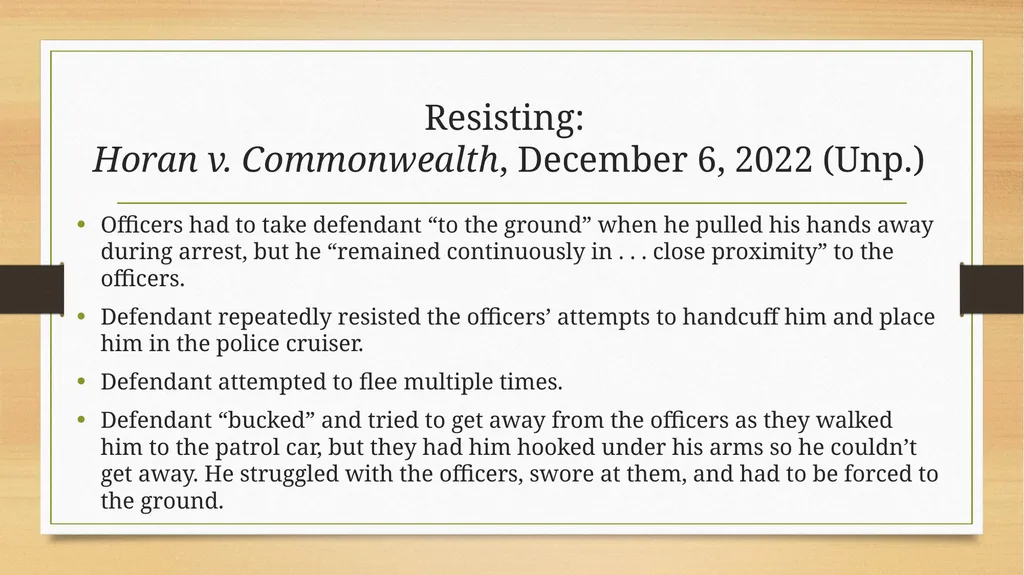
Resisting:
Horan v. Commonwealth, December 6, 2022 (Unp.) Officers had to take defendant “to the ground” when he pulled his hands away during arrest, but he “remained continuously in . . . close proximity” to the officers.
Defendant repeatedly resisted the officers’ attempts to handcuff him and place him in the police cruiser.
Defendant attempted to flee multiple times.
Defendant “bucked” and tried to get away from the officers as they walked him to the patrol car, but they had him hooked under his arms so he couldn’t get away. He struggled with the officers, swore at them, and had to be forced to the ground.<br>
Defendant repeatedly resisted the officers’ attempts to handcuff him and place him in the police cruiser.
Defendant attempted to flee multiple times.
Defendant “bucked” and tried to get away from the officers as they walked him to the patrol car, but they had him hooked under his arms so he couldn’t get away. He struggled with the officers, swore at them, and had to be forced to the ground.<br>
78
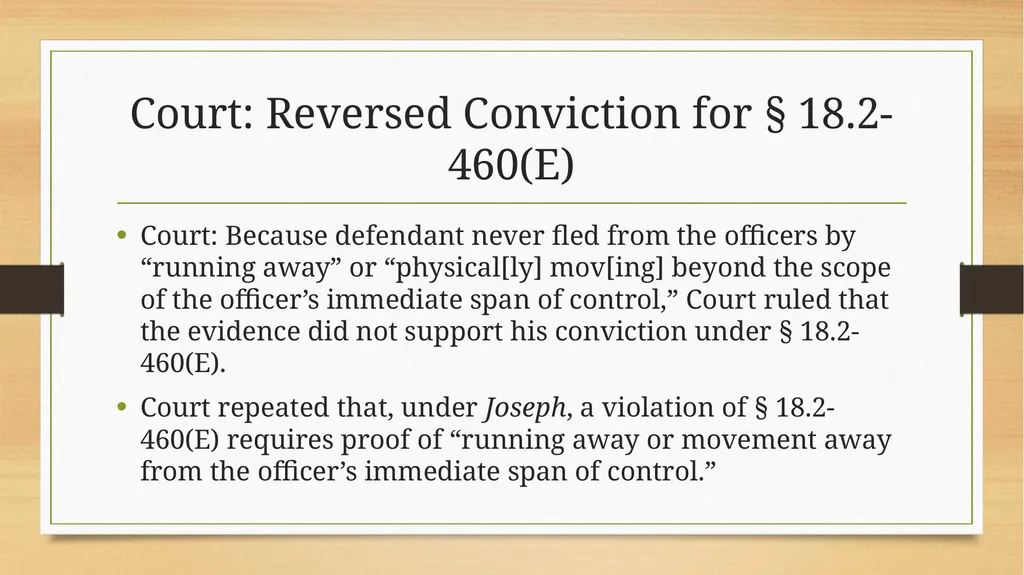
Court: Reversed Conviction for § 18.2-460(E) Court: Because defendant never fled from the officers by “running away” or “physical[ly] mov[ing] beyond the scope of the officer’s immediate span of control,” Court ruled that the evidence did not support his conviction under § 18.2-460(E).
Court repeated that, under Joseph, a violation of § 18.2-460(E) requires proof of “running away or movement away from the officer’s immediate span of control.”<br>
Court repeated that, under Joseph, a violation of § 18.2-460(E) requires proof of “running away or movement away from the officer’s immediate span of control.”<br>
79
Sexual Assault Good Rulings on Fear and Intimidation<br>
80
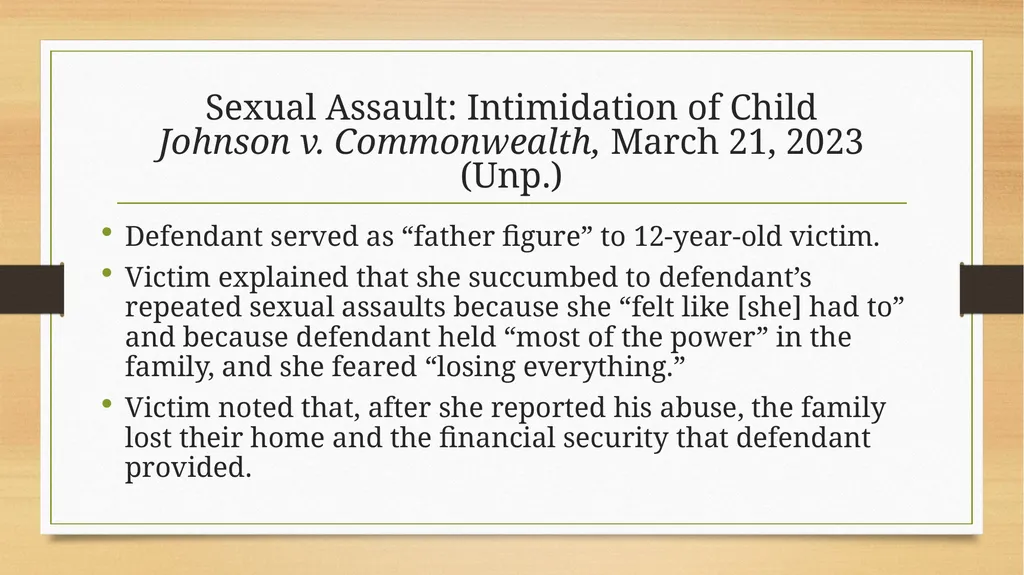
Sexual Assault: Intimidation of Child
Johnson v. Commonwealth, March 21, 2023 (Unp.) Defendant served as “father figure” to 12-year-old victim.
Victim explained that she succumbed to defendant’s repeated sexual assaults because she “felt like [she] had to” and because defendant held “most of the power” in the family, and she feared “losing everything.”
Victim noted that, after she reported his abuse, the family lost their home and the financial security that defendant provided.<br>
Victim explained that she succumbed to defendant’s repeated sexual assaults because she “felt like [she] had to” and because defendant held “most of the power” in the family, and she feared “losing everything.”
Victim noted that, after she reported his abuse, the family lost their home and the financial security that defendant provided.<br>
81
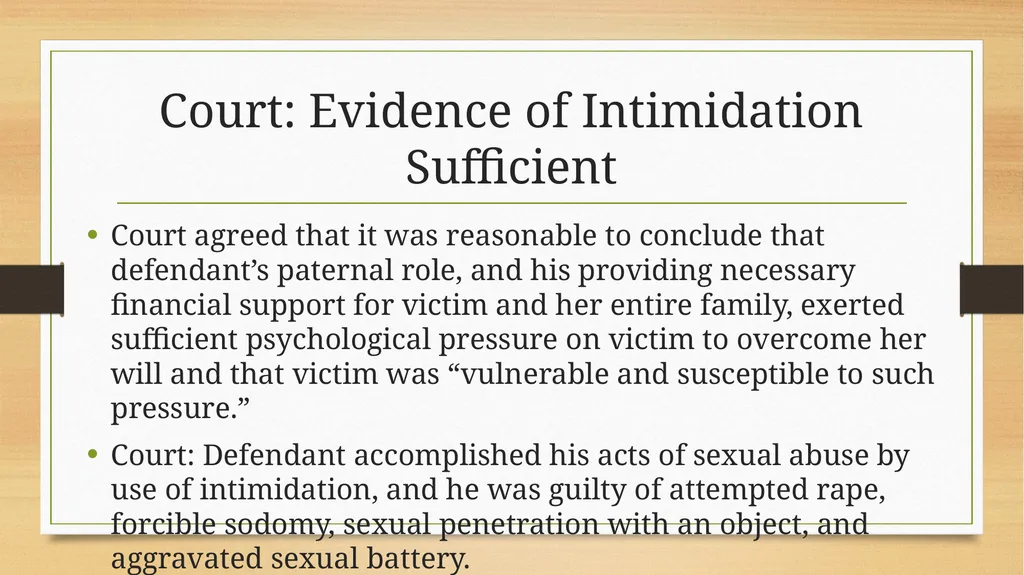
Court: Evidence of Intimidation Sufficient Court agreed that it was reasonable to conclude that defendant’s paternal role, and his providing necessary financial support for victim and her entire family, exerted sufficient psychological pressure on victim to overcome her will and that victim was “vulnerable and susceptible to such pressure.”
Court: Defendant accomplished his acts of sexual abuse by use of intimidation, and he was guilty of attempted rape, forcible sodomy, sexual penetration with an object, and aggravated sexual battery.<br>
Court: Defendant accomplished his acts of sexual abuse by use of intimidation, and he was guilty of attempted rape, forcible sodomy, sexual penetration with an object, and aggravated sexual battery.<br>
82
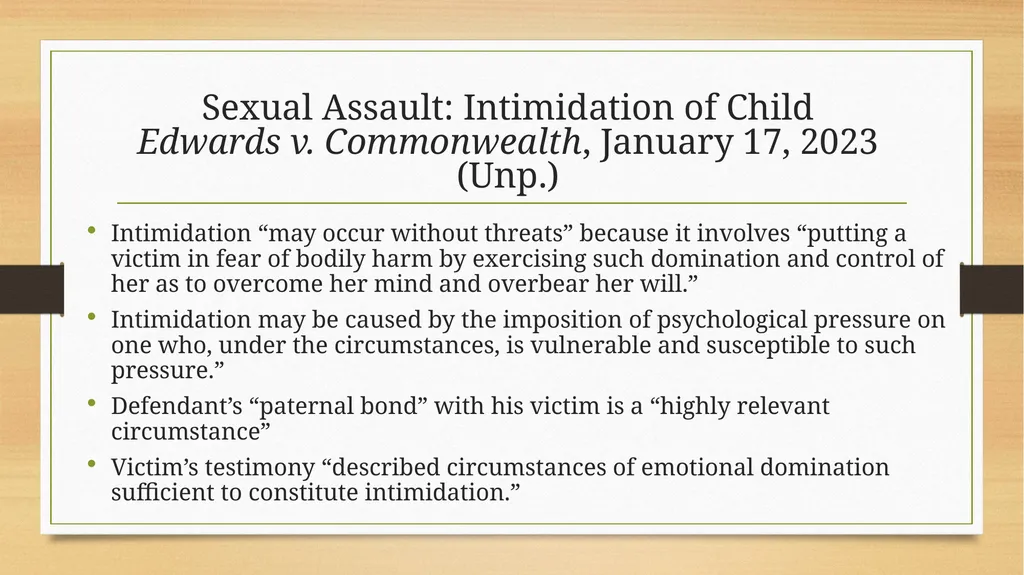
Sexual Assault: Intimidation of Child
Edwards v. Commonwealth, January 17, 2023 (Unp.) Intimidation “may occur without threats” because it involves “putting a victim in fear of bodily harm by exercising such domination and control of her as to overcome her mind and overbear her will.”
Intimidation may be caused by the imposition of psychological pressure on one who, under the circumstances, is vulnerable and susceptible to such pressure.”
Defendant’s “paternal bond” with his victim is a “highly relevant circumstance”
Victim’s testimony “described circumstances of emotional domination sufficient to constitute intimidation.”<br>
Intimidation may be caused by the imposition of psychological pressure on one who, under the circumstances, is vulnerable and susceptible to such pressure.”
Defendant’s “paternal bond” with his victim is a “highly relevant circumstance”
Victim’s testimony “described circumstances of emotional domination sufficient to constitute intimidation.”<br>
83
Sexual Assault: Intimidation of Adult Victim
Robinson v. Commonwealth, August 23, 2022 (Unp.) Sexual assault by Massage Therapist: “Our precedent establishes that force, threat, and intimidation inhere in a situation like this one, where a massage therapist improperly touches a vulnerable client who lies frozen in fear. … His intent was plain from his conduct, which left no room for any reasonable hypothesis of innocence.”
“Force, threat, or intimidation” is not a required element of aggravated sexual battery when committed by a massage therapist under subsection (A)(5) of § 18.2-67.3.<br>
“Force, threat, or intimidation” is not a required element of aggravated sexual battery when committed by a massage therapist under subsection (A)(5) of § 18.2-67.3.<br>
84
Racing:
Brown v. Commonwealth, January 17, 2023 (Unp.) Defendant and friend raced.
Defendant pulled alongside the other racer at a stoplight and accelerated quickly ahead of him when the light turned green.
Defendant pulled ahead of the other racer, until the other racer passed the defendant after about ten seconds.
Both vehicles were traveling at 80 or 90 miles per hour in a 45-mph zone.
Race ended only seconds after the other racer passed the defendant —stopping when the other racer crashed into the victim.<br>
Defendant pulled alongside the other racer at a stoplight and accelerated quickly ahead of him when the light turned green.
Defendant pulled ahead of the other racer, until the other racer passed the defendant after about ten seconds.
Both vehicles were traveling at 80 or 90 miles per hour in a 45-mph zone.
Race ended only seconds after the other racer passed the defendant —stopping when the other racer crashed into the victim.<br>
85
Court: Conviction for § 46.2-865.1 Affirmed Court: An ordinarily prudent person would have known that racing another at speeds of eighty or ninety miles per hour in a forty-five mile per hour zone posed a risk of serious injury to the race participants and other drivers.
Defendant’s actions in racing contributed to the other racer’s inability to avoid the other driver, and it was foreseeable that one of the racers would be unable to avoid other vehicles or would otherwise lose control.<br>
Defendant’s actions in racing contributed to the other racer’s inability to avoid the other driver, and it was foreseeable that one of the racers would be unable to avoid other vehicles or would otherwise lose control.<br>
86
Police Use of Force Two Cases from 2023<br>
87
Franklin v. Charlotte, 4th Circuit, April 4, 2023 (Pub.) Officers responded to a call that the plaintiff was threatening patrons and staff with a firearm.
Officers find plaintiff crouched in a “catcher’s” crouch, with his hands clasped together between his legs.
Officers repeatedly yelled at the plaintiff “Drop the gun!” “Put it on the ground!” although the gun was concealed under his jacket, not in his hands.<br>
Officers find plaintiff crouched in a “catcher’s” crouch, with his hands clasped together between his legs.
Officers repeatedly yelled at the plaintiff “Drop the gun!” “Put it on the ground!” although the gun was concealed under his jacket, not in his hands.<br>
88
Shooting Plaintiff did not move for a while, but soon, without moving his head or legs, plaintiff slowly reached into the right side of his jacket and retrieved a black handgun with his right hand.
Officer shot plaintiff, killing him.
District Court granted summary judgment, finding shooting to be lawful, and dismissed lawsuit.
4th Circuit on Appeal: “Viewing the non-threatening way [the plaintiff] handled the weapon once he retrieved it, a jury may conclude that this was not a menacing act, but mere compliance with orders.”<br>
Officer shot plaintiff, killing him.
District Court granted summary judgment, finding shooting to be lawful, and dismissed lawsuit.
4th Circuit on Appeal: “Viewing the non-threatening way [the plaintiff] handled the weapon once he retrieved it, a jury may conclude that this was not a menacing act, but mere compliance with orders.”<br>
89
Court: Matter Should Go to Trial “Unlike us, Officer Kerl could not press pause or rewind before determining whether Franklin posed an imminent threat. Still, we remain resolute that qualified immunity is not appropriate for the disposition of this case. The officers rushed headlong onto a scene that had subsided, established no dialogue, and shouted at Franklin loudly enough that they did not hear him try to communicate back. In their zeal to disarm Franklin, it hardly occurred to the officers that their commands defied reality. As a result, Franklin faced a catch 22: obey and risk death or disobey and risk death. These facts entitle a jury of community members to decide whether Officer Kerl shot Franklin unlawfully.”<br>
90
Shooting in Defense of Others:
Colas v. Tyree, January 26, 2023 (Va. Supreme Ct.) Plaintiff, Tyree, had a mental breakdown and assaulted a family member, who called police.
Police responded and encountered the plaintiff, armed with a ”military-style” knife with a six-inch blade.
Officers, including Colas, spend over 2 hours negotiating with plaintiff to persuade him to surrender the knife and seek mental health assistance.
Plaintiff was angry but did not threaten anyone.<br>
Police responded and encountered the plaintiff, armed with a ”military-style” knife with a six-inch blade.
Officers, including Colas, spend over 2 hours negotiating with plaintiff to persuade him to surrender the knife and seek mental health assistance.
Plaintiff was angry but did not threaten anyone.<br>
91
Escalation Plaintiff then held the knife to his throat repeatedly.
He said: “This is only going to end one of two ways. I’m going to slit my throat and you guys are going to watch me bleed out or I’m going to charge at an officer and force you to shoot me.”
Stated that he would hurt the officers if they made him.
Plaintiff became increasingly agitated<br>
He said: “This is only going to end one of two ways. I’m going to slit my throat and you guys are going to watch me bleed out or I’m going to charge at an officer and force you to shoot me.”
Stated that he would hurt the officers if they made him.
Plaintiff became increasingly agitated<br>
92
Plan Officers decided to convince plaintiff to drop the knife, then shoot plaintiff with a SAGE gun and then another officer would tackle the plaintiff.
Officers convinced plaintiff to drop the knife.
However, before anyone could shoot the SAGE gun, the officer charged with tackling the plaintiff ran in and tackled the plaintiff, who was able to retrieve the knife before being hit.<br>
Officers convinced plaintiff to drop the knife.
However, before anyone could shoot the SAGE gun, the officer charged with tackling the plaintiff ran in and tackled the plaintiff, who was able to retrieve the knife before being hit.<br>
93
Shooting Plaintiff raised the knife in the air while on the ground with the officer, who had started to roll away from plaintiff.
Fearing that plaintiff would stab the officer, a detective fired one shot, striking and killing plaintiff.
From the tackle to the shot, the incident took place within two seconds.<br>
Fearing that plaintiff would stab the officer, a detective fired one shot, striking and killing plaintiff.
From the tackle to the shot, the incident took place within two seconds.<br>
94
Court:
“Imminent Danger” Required “The ‘bare fear’ of serious bodily injury, or even death, however well-grounded, will not justify the taking of human life.”
“There must also be some overt act indicative of imminent danger at the time.”
“In the self-defense context, “‘imminent danger’ is defined as ‘an immediate, real threat to one’s safety.’”<br>
“There must also be some overt act indicative of imminent danger at the time.”
“In the self-defense context, “‘imminent danger’ is defined as ‘an immediate, real threat to one’s safety.’”<br>
95
Court:
Shooting Was Lawful Self-Defense Court: “A mentally disturbed person who seizes a knife, and lifts it in the air in very close proximity to the officer who just tackled this person, presents an obvious imminent danger.”
“The evidence establishes that an officer was on the ground, lying next to a profoundly disturbed and potentially dangerous individual, who then lifted a military-style knife in the air in such a way that the knife might be employed to stab the officer. Applying the adverse party witness rule, the evidence establishes that Detective Colas faced an immediate and possibly mortal danger to a fellow officer, and he was justified in taking a single shot in defense of his fellow officer.”<br>
“The evidence establishes that an officer was on the ground, lying next to a profoundly disturbed and potentially dangerous individual, who then lifted a military-style knife in the air in such a way that the knife might be employed to stab the officer. Applying the adverse party witness rule, the evidence establishes that Detective Colas faced an immediate and possibly mortal danger to a fellow officer, and he was justified in taking a single shot in defense of his fellow officer.”<br>
96
Court’s View: “In the immediacy of that moment, Colas was not required to wait and see whether Tyree might plunge the knife into Tuft-Williams’ heart or neck, or whether something else might happen.”
Note: Jury had rejected negligence claim, so Court found that “what was said and done before this imminent danger may be relevant background, but it is not dispositive on the question of self- defense.”<br>
Note: Jury had rejected negligence claim, so Court found that “what was said and done before this imminent danger may be relevant background, but it is not dispositive on the question of self- defense.”<br>
97
Elliott Casey
Commonwealth’s Attorneys’ Services Council
Staff Attorney
P. O. Box 3549
Williamsburg, Virginia 23187
ejcasey@wm.edu<br>
Commonwealth’s Attorneys’ Services Council
Staff Attorney
P. O. Box 3549
Williamsburg, Virginia 23187
ejcasey@wm.edu<br>