
“Applications of Research” Auditing in the Shared
GB
Published · 26 slides · 0 views

1 / 1
Description
Applications of Research Auditing in the Shared Service World Robert Milford MA PGDip CMIIA CMgr FCMI AMS Head of Internal Audit Part-time PhD Student The Researcher This is an insider researcher model reviewing two case study local
Related Topics
Share
Embed code
Download this presentation From Below
"“Applications of Research” Auditing in the Shared" is the property of its rightful owner. Permission is granted to download and print the materials on this website for personal, non-commercial use only, and to display it on your personal computer provided you do not modify the materials and that you retain all copyright notices contained in the materials. By downloading content from our website, you accept the terms of this agreement.
Presentation Transcript
01
“Applications of Research”
Auditing in the Shared Service World Robert Milford MA PGDip CMIIA CMgr FCMI AMS
Head of Internal Audit & Part-time PhD Student<br>
Head of Internal Audit & Part-time PhD Student<br>
02
The Researcher This is an “insider researcher” model reviewing two case study local authorities
The key methodology adopted is that of Czarniawska’s (2008) ‘follow-the-object’ where each shared service is an object
This presentation is built from ‘Phase 1’ running records review and auto-ethnographical analysis
The research is sponsored by the case study organisations
The researcher is the Head of Internal Audit at both case study organisations and part of a shared service (created by the researcher)
There is interest in the research output from the sponsors, professional bodies, and the researcher for his PhD<br>
The key methodology adopted is that of Czarniawska’s (2008) ‘follow-the-object’ where each shared service is an object
This presentation is built from ‘Phase 1’ running records review and auto-ethnographical analysis
The research is sponsored by the case study organisations
The researcher is the Head of Internal Audit at both case study organisations and part of a shared service (created by the researcher)
There is interest in the research output from the sponsors, professional bodies, and the researcher for his PhD<br>
03
Objectives of the Presentation Background and Context – Shared Services
Boundary Objects within the context of “Organising between organisations”
The role of Internal Audit and Boundary Objects<br>
Boundary Objects within the context of “Organising between organisations”
The role of Internal Audit and Boundary Objects<br>
04
Background on the research Full title of research:
“The evolution and devolution of governance within the shared service networks in Local Government”
Internal audit is part of the governance framework in shared services – additional paper and basis of this presentation<br>
“The evolution and devolution of governance within the shared service networks in Local Government”
Internal audit is part of the governance framework in shared services – additional paper and basis of this presentation<br>
05
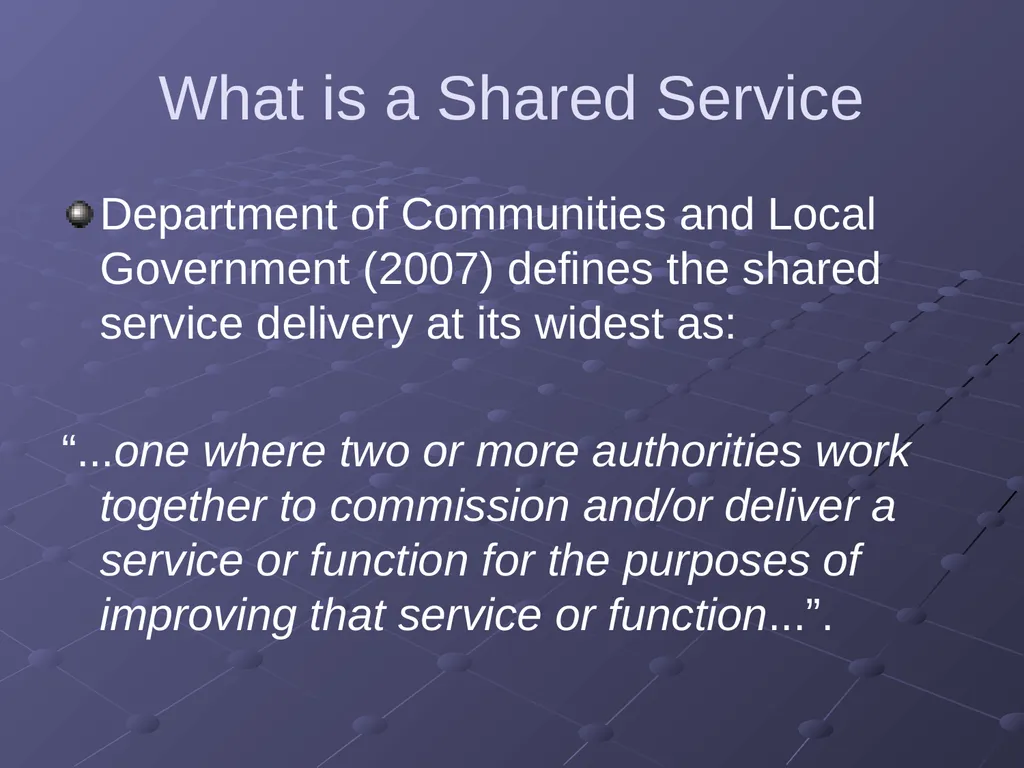
What is a Shared Service Department of Communities and Local Government (2007) defines the shared service delivery at its widest as:
“...one where two or more authorities work together to commission and/or deliver a service or function for the purposes of improving that service or function...”.<br>
“...one where two or more authorities work together to commission and/or deliver a service or function for the purposes of improving that service or function...”.<br>
06
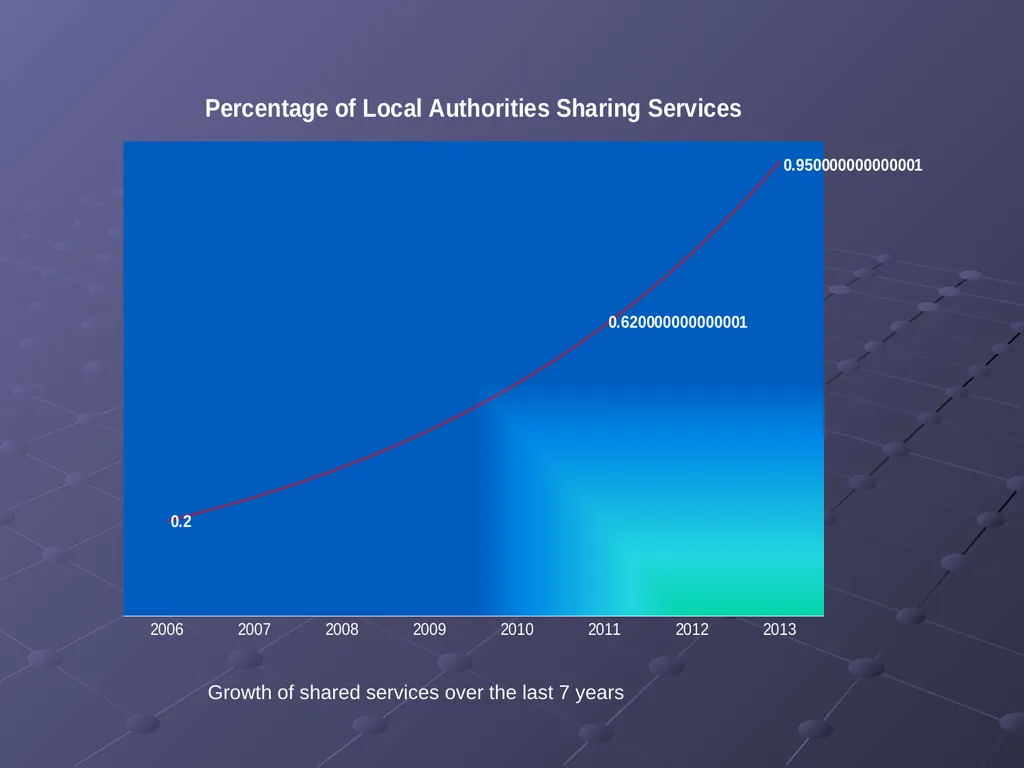
Growth of shared services over the last 7 years<br>
07
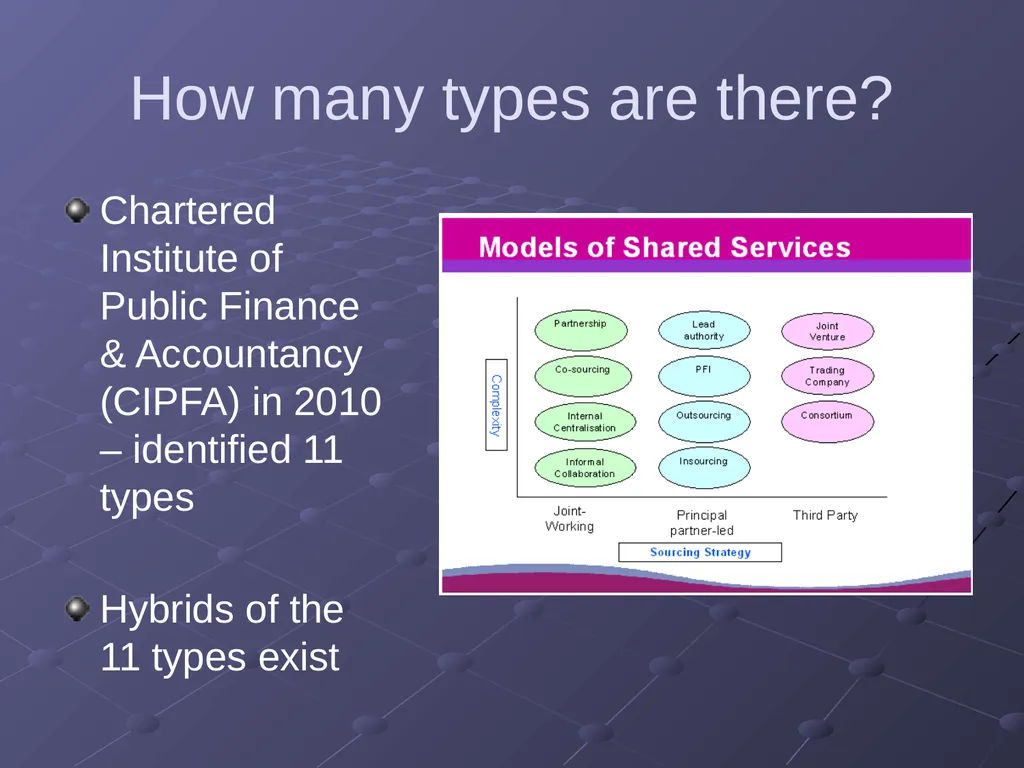
How many types are there? Chartered Institute of Public Finance & Accountancy (CIPFA) in 2010 – identified 11 types
Hybrids of the 11 types exist<br>
Hybrids of the 11 types exist<br>
08
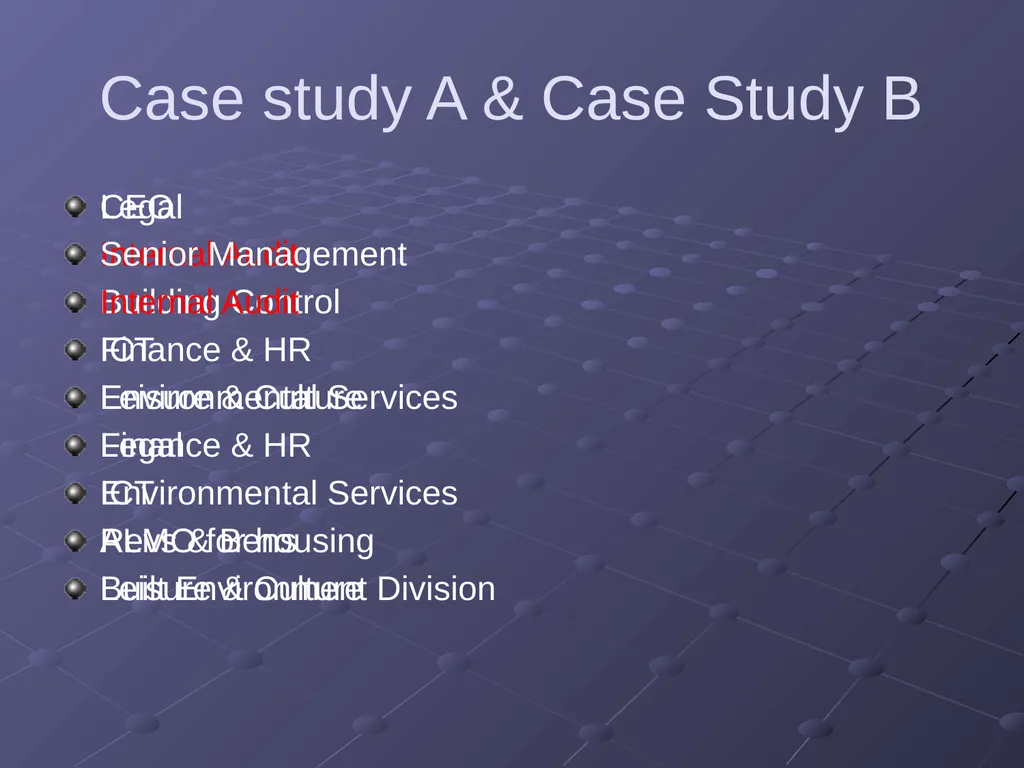
Case study A & Case Study B Legal
Internal Audit
Building Control
ICT
Leisure & Culture
Finance & HR
Environmental Services
ALMO for housing
Built Environment Division CEO
Senior Management
Internal Audit
Finance & HR
Environmental Services
Legal
ICT
Revs & Bens
Leisure & Culture<br>
Internal Audit
Building Control
ICT
Leisure & Culture
Finance & HR
Environmental Services
ALMO for housing
Built Environment Division CEO
Senior Management
Internal Audit
Finance & HR
Environmental Services
Legal
ICT
Revs & Bens
Leisure & Culture<br>
09
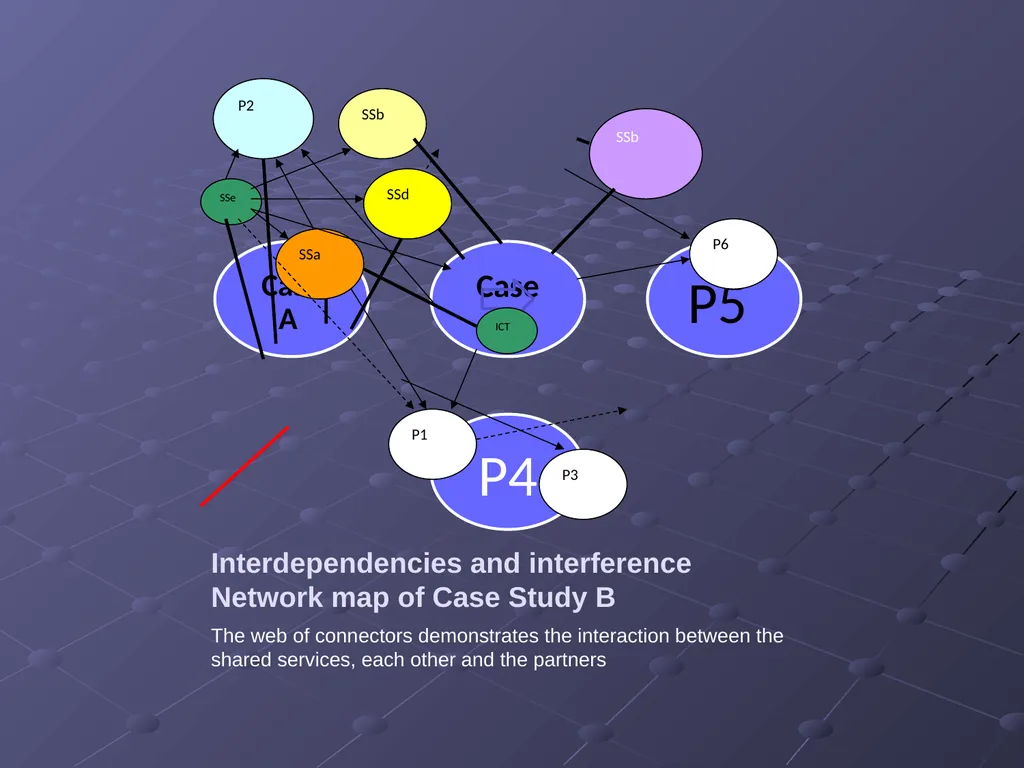
Interdependencies and interference Network map of Case Study B The web of connectors demonstrates the interaction between the shared services, each other and the partners<br>
10
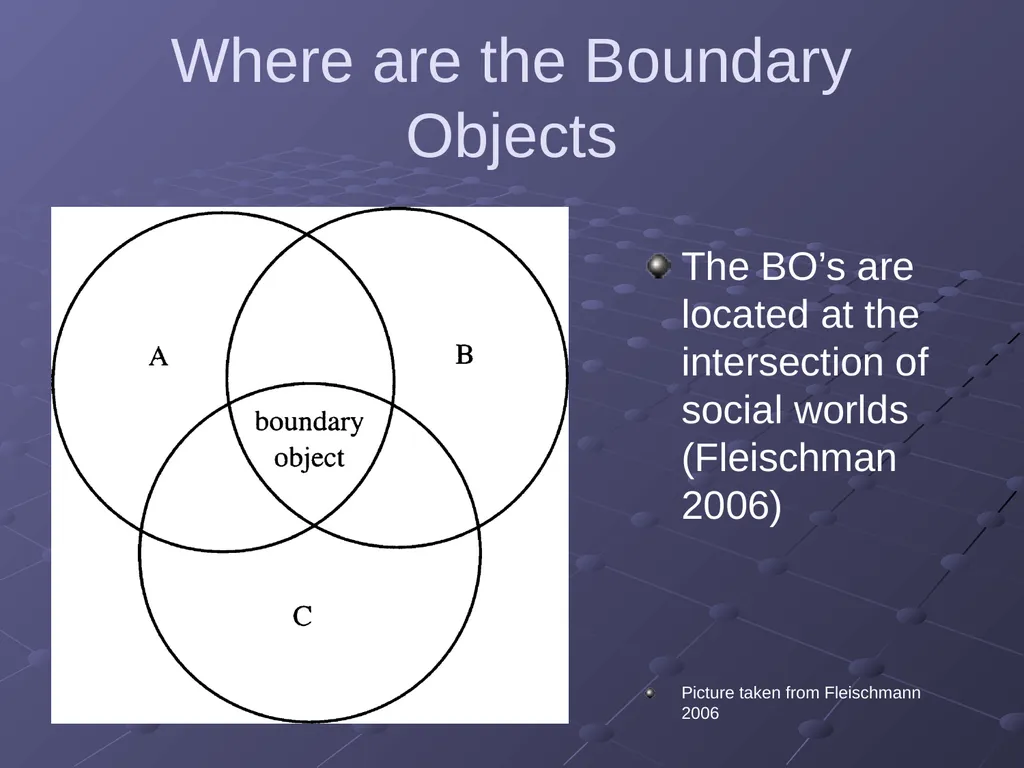
Where are the Boundary Objects The BO’s are located at the intersection of social worlds (Fleischman 2006)
Picture taken from Fleischmann 2006<br>
Picture taken from Fleischmann 2006<br>
11
Boundary Object Typology There are various types of BO in use in the various shared services. Star & Griesemer (1989) offer four types of BOs and define a BO as:
“analytic concepts of those scientific objects which both inhabit several intersecting social worlds and satisfy informational requirements of each of them.”
However, in this research the BOs are still being assessed for type but as an example of typology:
Temporal – Gantt charts, Project plans
Legal – S101, Secondment, Collaboration agreement, Articles of a company
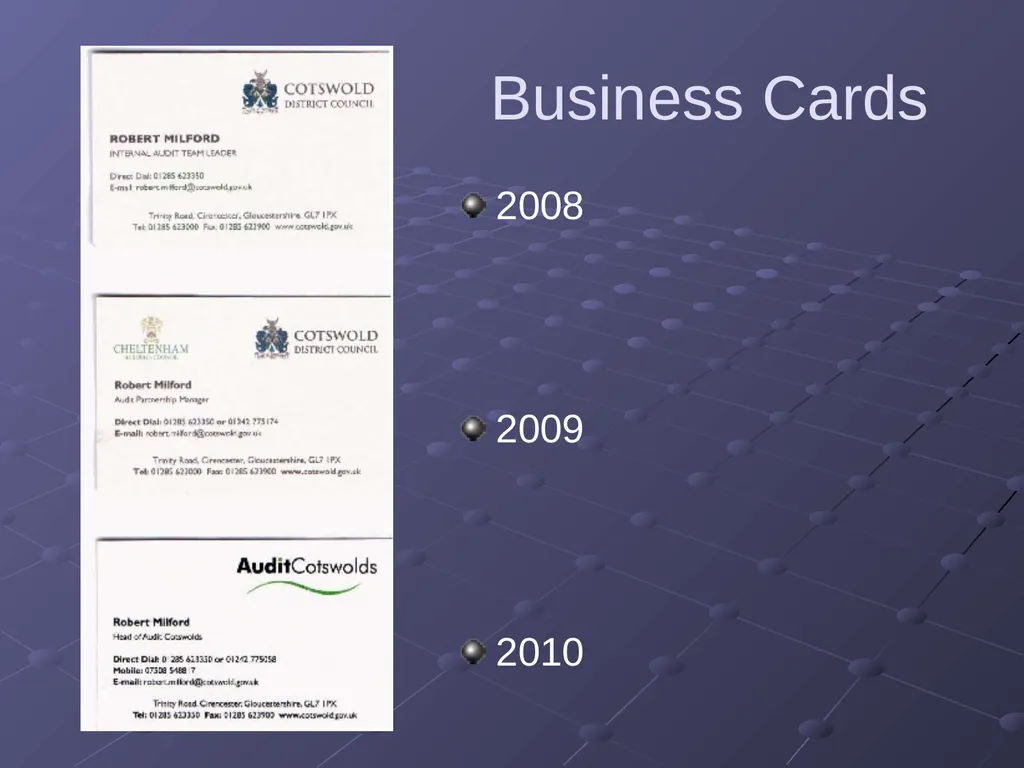
Cultural – business cards, letterheads, websites logos<br>
“analytic concepts of those scientific objects which both inhabit several intersecting social worlds and satisfy informational requirements of each of them.”
However, in this research the BOs are still being assessed for type but as an example of typology:
Temporal – Gantt charts, Project plans
Legal – S101, Secondment, Collaboration agreement, Articles of a company
Cultural – business cards, letterheads, websites logos<br>
12
Boundary Objects
What do they do? Helps contain the shared service
Help to translate change
Helps to ‘bind’ individuals in network
Captures events and stories
Helps to stabilise the network
Can be wrapped around a network to create a new organisation (Lindberg & Czarniawska 2006)
Provides evidence for an auditor<br>
Help to translate change
Helps to ‘bind’ individuals in network
Captures events and stories
Helps to stabilise the network
Can be wrapped around a network to create a new organisation (Lindberg & Czarniawska 2006)
Provides evidence for an auditor<br>
13
Where BOs don’t exist Shared service ‘X’ has no business case or legal agreement – so what?
Unable to demonstrate ‘improvement’ in service as no comparator in place
Uncertain of inter-partner charging as not set out in agreement
Unclear on strategic service direction
Possibly acting ‘beyond legal powers’
Can sell the service as successful on original performance indicators – which are no longer relevant
The public cannot hold anyone to account for service failure as it is lost in a ‘black hole’ of organisations and ownership and accountability webs – against Localism Act 2011 principles.<br>
Unable to demonstrate ‘improvement’ in service as no comparator in place
Uncertain of inter-partner charging as not set out in agreement
Unclear on strategic service direction
Possibly acting ‘beyond legal powers’
Can sell the service as successful on original performance indicators – which are no longer relevant
The public cannot hold anyone to account for service failure as it is lost in a ‘black hole’ of organisations and ownership and accountability webs – against Localism Act 2011 principles.<br>
14
Internal audit considerations in Shared Services Definition of Internal Audit:
“Internal auditing is an independent, objective assurance and consulting activity designed to add value and improve an organisation's operations. It helps an organisation accomplish its objectives by bringing a systematic, disciplined approach to evaluate and improve the effectiveness of risk management, control, and governance processes.” (IIA 2013)
What happens to control, governance and other aspects when there are big ones, small ones, or more than one of these shared services per organisation? And who covers the partner(s)?<br>
“Internal auditing is an independent, objective assurance and consulting activity designed to add value and improve an organisation's operations. It helps an organisation accomplish its objectives by bringing a systematic, disciplined approach to evaluate and improve the effectiveness of risk management, control, and governance processes.” (IIA 2013)
What happens to control, governance and other aspects when there are big ones, small ones, or more than one of these shared services per organisation? And who covers the partner(s)?<br>
15
What is
Organising between Organisations Phases of shared service development:
Concept to business case
Business case to implementation
Implementation to stability
Stability to cultural identity
Exit / collapse
Different networks of people from different organisations at each stage and / or through stages<br>
Concept to business case
Business case to implementation
Implementation to stability
Stability to cultural identity
Exit / collapse
Different networks of people from different organisations at each stage and / or through stages<br>
16
Shared Service Assurance CIPFA (2013) refer to four key problem areas to consider in setting up a shared service [Partner selection, staff buy-in, issues of ICT integration and standardisation, and programme and contract management] – each of which can individually or together collapse a shared service project
My research to date on shared services is showing that:
Internal Audit use many tools but arguably they seek “Boundary Objects and Artifacts” and assure stakeholders that these are in place and working effectively
Internal Audit can be regarded as a “stabiliser” in “organising between organisations”<br>
My research to date on shared services is showing that:
Internal Audit use many tools but arguably they seek “Boundary Objects and Artifacts” and assure stakeholders that these are in place and working effectively
Internal Audit can be regarded as a “stabiliser” in “organising between organisations”<br>
17
Boundary Objects or Artefacts – What are they Minutes of a meeting
Business cases
Gantt Charts
Project plans
Section 101 agreements
Terms of Reference
Job Descriptions
Risk Registers & Appetite Business cards
Websites
Letterheads
Systems
Pictures
Uniforms
Invoices
Behaviour & Language…!<br>
Business cases
Gantt Charts
Project plans
Section 101 agreements
Terms of Reference
Job Descriptions
Risk Registers & Appetite Business cards
Websites
Letterheads
Systems
Pictures
Uniforms
Invoices
Behaviour & Language…!<br>
18
Business Cards 2008
2009
2010<br>
2009
2010<br>
19
Legal BOs Used & Extent Contract
SLA
S101
Company & Trading
Secondment
Informal
Management Agreement
Outsourced & Co-Sourced Single officers e.g CEO
Just management e.g. Revs & Bens
Just officers e.g. Legal
Full service e.g. Internal Audit
Co-sourced e.g. ICT<br>
SLA
S101
Company & Trading
Secondment
Informal
Management Agreement
Outsourced & Co-Sourced Single officers e.g CEO
Just management e.g. Revs & Bens
Just officers e.g. Legal
Full service e.g. Internal Audit
Co-sourced e.g. ICT<br>
20
The Internal Auditor
- Indiana Jones Concept -
(Explorer / Archaeologist) Seeks out the BO’s and artefacts ~ makes the invisible visible
Compares the artefacts to BO’s and vice versa – and cross refers to “organisational” objectives
Compares actual phases to temporal BO’s and artefacts
Determines the key stakeholders and accountable parties based on BO’s
Shares findings with fellow explorers e.g. External Audit
Reports on BO’s to stakeholder assurance seekers covering such issues as deviation
Help management and other parties to take stock of BO’s and review the shared service<br>
Compares the artefacts to BO’s and vice versa – and cross refers to “organisational” objectives
Compares actual phases to temporal BO’s and artefacts
Determines the key stakeholders and accountable parties based on BO’s
Shares findings with fellow explorers e.g. External Audit
Reports on BO’s to stakeholder assurance seekers covering such issues as deviation
Help management and other parties to take stock of BO’s and review the shared service<br>
21
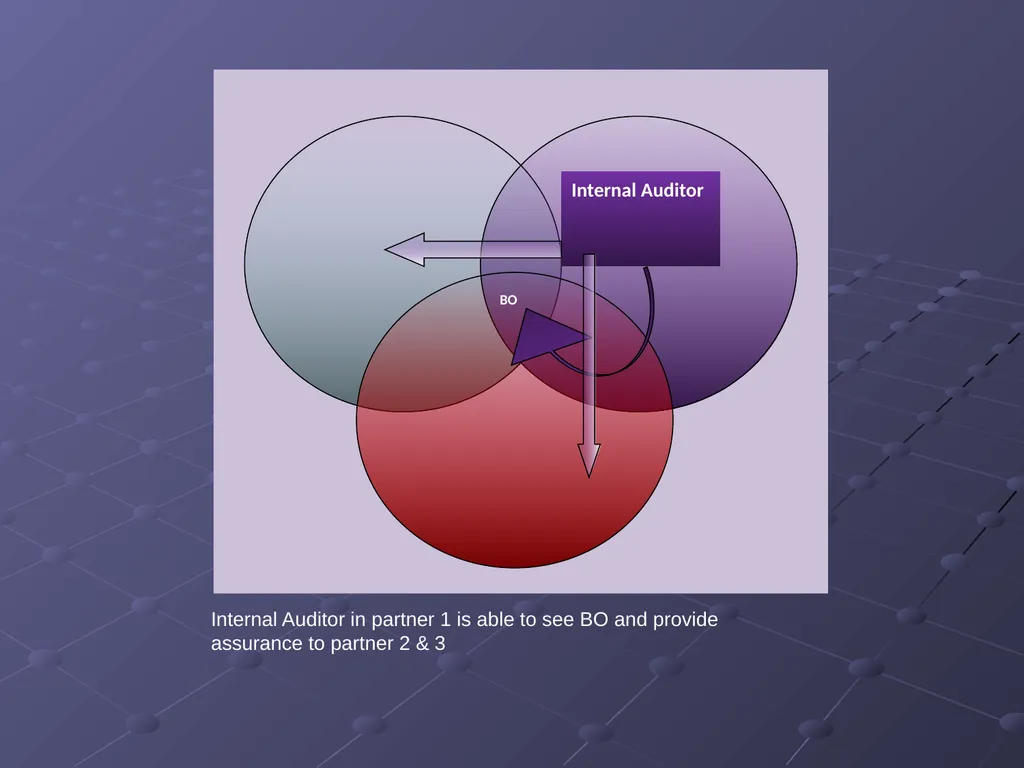
Internal Auditor in partner 1 is able to see BO and provide assurance to partner 2 & 3<br>
22
Time & Space Audits are based on evidence:
Available at the time
At a certain location or from a certain perspective
Temporal issues – [non-linear]
Crisis and calm (Kairotic time)(Czarniawska 2004)
Cabinet / SMT decisions (Chronological time)
From whose perspective
Audit Committee
Senior Management
Fellow auditors
The public<br>
Available at the time
At a certain location or from a certain perspective
Temporal issues – [non-linear]
Crisis and calm (Kairotic time)(Czarniawska 2004)
Cabinet / SMT decisions (Chronological time)
From whose perspective
Audit Committee
Senior Management
Fellow auditors
The public<br>
23
Conclusion The research to date has enabled an interesting research subset of the relationship between Internal Audit and Boundary Objects to be considered
It has shown that Internal Audit can use Boundary Objects to help assess and stabilise the shared service<br>
It has shown that Internal Audit can use Boundary Objects to help assess and stabilise the shared service<br>
24
There is more to come Any questions?
Thank you for your time.
Contact info
Email: robert.milford@cotswold.gov.uk
University Profile: http://www.worcester.ac.uk/discover/robert-milford.html<br>
Thank you for your time.
Contact info
Email: robert.milford@cotswold.gov.uk
University Profile: http://www.worcester.ac.uk/discover/robert-milford.html<br>
25
References CIPFA (2010a) Shared Services; TISonline.net [online] Available from: http://www.tisonline.net/internalaudit/content/Models_of_Shared_Services.gif [Accessed 17th January 2012]
CIPFA (2010b) The Role of the Head of Internal Audit, [Online] Available from: http://www.cipfa.org/-/media/Files/Publications/Reports/Role_of_the_HIA_NOVEMBERv5.pdf [Accessed 5th June 2012]
CIPFA (2013a) LGA Shared Service Map, Shared Services, ICT and Business Transformation, TISOnline [Online] Available from: http://www.tisonline.net/informationtechnology/default.asp?section=Shared%20Services [Accessed 9th March 2013]
CIPFA (2013b) Public Sector Internal Audit Standards, [Online] Available from: http://www.cipfa.org/-/media/Files/Publications/Standards/Public%20Sector%20Internal%20Audit%20Standards.pdf [Accessed 12th March 2013]
Costley C, Elliott G and Gibbs P (2010) Doing work based research: approaches to enquiry for insider-researchers, Sage Publications Ltd, London
Czarniawska B. (2004) On Time, Space and Action Nets, Paper prepared for the International Conference on Spacing and Timing: Rethinking Globalization and Standardization, Palermo, Italy, November 1-3, 2001. [Online] Available from: https://gupea.ub.gu.se/bitstream/2077/3000/1/2004_5.pdf [Accessed 22nd June 2012]
Czarniawska B. (2008) Organising: how to study it and how to write about it, Qualitative Research in Organisation and Management, Emerald Group Publishing Ltd
DCLG (2007) Developing the local government services market to support the long-term strategy for local government, [online] Available from: http://www.cabinetoffice.gov.uk/media/141734/transgov-strategy.pdf [accessed 13th February 2012]
DCLG (2013) Making local councils more transparent and accountable to local people, [Online] Available from: https://www.gov.uk/government/policies/making-local-councils-more-transparent-and-accountable-to-local-people [Accessed 15th May 2013]<br>
CIPFA (2010b) The Role of the Head of Internal Audit, [Online] Available from: http://www.cipfa.org/-/media/Files/Publications/Reports/Role_of_the_HIA_NOVEMBERv5.pdf [Accessed 5th June 2012]
CIPFA (2013a) LGA Shared Service Map, Shared Services, ICT and Business Transformation, TISOnline [Online] Available from: http://www.tisonline.net/informationtechnology/default.asp?section=Shared%20Services [Accessed 9th March 2013]
CIPFA (2013b) Public Sector Internal Audit Standards, [Online] Available from: http://www.cipfa.org/-/media/Files/Publications/Standards/Public%20Sector%20Internal%20Audit%20Standards.pdf [Accessed 12th March 2013]
Costley C, Elliott G and Gibbs P (2010) Doing work based research: approaches to enquiry for insider-researchers, Sage Publications Ltd, London
Czarniawska B. (2004) On Time, Space and Action Nets, Paper prepared for the International Conference on Spacing and Timing: Rethinking Globalization and Standardization, Palermo, Italy, November 1-3, 2001. [Online] Available from: https://gupea.ub.gu.se/bitstream/2077/3000/1/2004_5.pdf [Accessed 22nd June 2012]
Czarniawska B. (2008) Organising: how to study it and how to write about it, Qualitative Research in Organisation and Management, Emerald Group Publishing Ltd
DCLG (2007) Developing the local government services market to support the long-term strategy for local government, [online] Available from: http://www.cabinetoffice.gov.uk/media/141734/transgov-strategy.pdf [accessed 13th February 2012]
DCLG (2013) Making local councils more transparent and accountable to local people, [Online] Available from: https://www.gov.uk/government/policies/making-local-councils-more-transparent-and-accountable-to-local-people [Accessed 15th May 2013]<br>
26
References Dirckinck-Holmfeld L. (2006) Designing for Collaboration and Mutual Negotiation of Meaning – Boundary Objects in Networked Learning, [Online] Available from: http://halshs.archives-ouvertes.fr/docs/00/19/03/04/PDF/DirckinckHolmfeld-2006.pdf [Accessed 12th May 2013]
Fleischmann (2006) Boundary Objects with Agency: A Method for Studying the Design-Use Interface, The Information Society, 22 77-87, [Online] Available from: http://citeseerx.ist.psu.edu/viewdoc/download?doi=10.1.1.87.6231&rep=rep1&type=pdf [Accessed 10th May 2013]
Grant Thornton (2013) Local Government Governance Review 2013, [Online] Available from: http://www.grant-thornton.co.uk/Global/Publication_pdf/Local-Government-Governance-Review-2013.pdf [Accessed 5th May 2013]
Gray D. (2009) Doing Research in the Real World, Second Edition, Sage, London
IIA (2009) International Standards for the Professional Practice of Internal Auditing, The Institute of Internal Auditors – UK and Ireland, London
Local Government Association (LGA)(2011) National Map of Shared Services; [online] Available from: http://www.local.gov.uk/better-for-less-po-map [accessed 17th January 2012]
Lindberg K. and Czarniawska B. (2006) Knotting the action net, or organising between organisations, Scandinavian Journal of Management, volume 22 number 4
Pickett S (2007) The Essential Handbook of Internal Auditing, John Wiley & Sons Ltd, West Sussex
Star S. and Griesemer J. (1989) as cited in Dirckinck-Holmfeld L. (2006) Designing for Collaboration and Mutual Negotiation of Meaning – Boundary Objects in Networked Learning, [Online] Available from: http://halshs.archives-ouvertes.fr/docs/00/19/03/04/PDF/DirckinckHolmfeld-2006.pdf [Accessed 12th May 2013]
Tomkinson R. (2007) Shared Services in Local Government: Improving Service Delivery, Gower
Yakura, E. K. (2002). Charting Time: Timelines as Temporal Boundary Objects, Academy of Management Journal, 45(5), 956-970. [Online] Available from: http://www.aom.pace.edu/amj/October2002/yakura.pdf [Accessed 15th March 2013]<br>
Fleischmann (2006) Boundary Objects with Agency: A Method for Studying the Design-Use Interface, The Information Society, 22 77-87, [Online] Available from: http://citeseerx.ist.psu.edu/viewdoc/download?doi=10.1.1.87.6231&rep=rep1&type=pdf [Accessed 10th May 2013]
Grant Thornton (2013) Local Government Governance Review 2013, [Online] Available from: http://www.grant-thornton.co.uk/Global/Publication_pdf/Local-Government-Governance-Review-2013.pdf [Accessed 5th May 2013]
Gray D. (2009) Doing Research in the Real World, Second Edition, Sage, London
IIA (2009) International Standards for the Professional Practice of Internal Auditing, The Institute of Internal Auditors – UK and Ireland, London
Local Government Association (LGA)(2011) National Map of Shared Services; [online] Available from: http://www.local.gov.uk/better-for-less-po-map [accessed 17th January 2012]
Lindberg K. and Czarniawska B. (2006) Knotting the action net, or organising between organisations, Scandinavian Journal of Management, volume 22 number 4
Pickett S (2007) The Essential Handbook of Internal Auditing, John Wiley & Sons Ltd, West Sussex
Star S. and Griesemer J. (1989) as cited in Dirckinck-Holmfeld L. (2006) Designing for Collaboration and Mutual Negotiation of Meaning – Boundary Objects in Networked Learning, [Online] Available from: http://halshs.archives-ouvertes.fr/docs/00/19/03/04/PDF/DirckinckHolmfeld-2006.pdf [Accessed 12th May 2013]
Tomkinson R. (2007) Shared Services in Local Government: Improving Service Delivery, Gower
Yakura, E. K. (2002). Charting Time: Timelines as Temporal Boundary Objects, Academy of Management Journal, 45(5), 956-970. [Online] Available from: http://www.aom.pace.edu/amj/October2002/yakura.pdf [Accessed 15th March 2013]<br>