
Applications of Text Analytics: Drunk-texting and
SN
Published · 49 slides · 0 views

1 / 1



Description
Applications of Text Analytics: Drunk-texting and Sarcasm Aditya Joshi IITB-Monash Research Academy Joint work with Abhijit Mishra, Vinita Sharma, Balamurali AR, Prof. Pushpak Bhattacharyya, Prof. Mark James Carman 1 Contact email:
Related Topics
Share
Embed code
Download this presentation From Below
"Applications of Text Analytics: Drunk-texting and" is the property of its rightful owner. Permission is granted to download and print the materials on this website for personal, non-commercial use only, and to display it on your personal computer provided you do not modify the materials and that you retain all copyright notices contained in the materials. By downloading content from our website, you accept the terms of this agreement.
Presentation Transcript
01
Applications of Text Analytics: Drunk-texting and Sarcasm Aditya Joshi
IITB-Monash Research Academy Joint work with Abhijit Mishra, Vinita Sharma, Balamurali AR,
Prof. Pushpak Bhattacharyya, Prof. Mark James Carman 1 Contact email: adityaj@cse.iitb.ac.in<br>
IITB-Monash Research Academy Joint work with Abhijit Mishra, Vinita Sharma, Balamurali AR,
Prof. Pushpak Bhattacharyya, Prof. Mark James Carman 1 Contact email: adityaj@cse.iitb.ac.in<br>
02
Text Analytics Learning from text
Outline for today:
Introduction
Drunk-texting prediction
Sarcasm prediction 2<br>
Outline for today:
Introduction
Drunk-texting prediction
Sarcasm prediction 2<br>
03
Humans learn all the time We learn to drive a car
We learn to cook Maggi
We learn to speak
How does a child learn language?<br>
We learn to cook Maggi
We learn to speak
How does a child learn language?<br>
04
The story of my year-old nephew According to a baby, the first meaning of their name is...?*
The Kaka anecdote * : Child language Acquisition; Jean Piaget<br>
The Kaka anecdote * : Child language Acquisition; Jean Piaget<br>
05
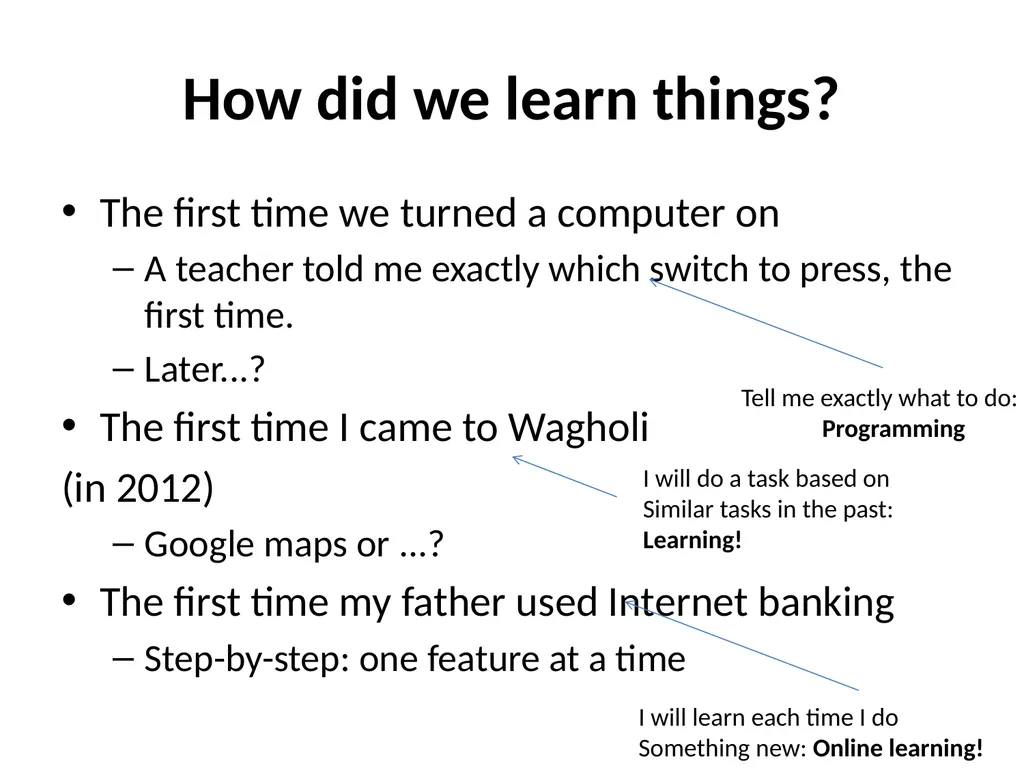
How did we learn things? The first time we turned a computer on
A teacher told me exactly which switch to press, the first time.
Later...?
The first time I came to Wagholi
(in 2012)
Google maps or ...?
The first time my father used Internet banking
Step-by-step: one feature at a time Tell me exactly what to do:
Programming I will do a task based on
Similar tasks in the past: Learning! I will learn each time I do
Something new: Online learning!<br>
A teacher told me exactly which switch to press, the first time.
Later...?
The first time I came to Wagholi
(in 2012)
Google maps or ...?
The first time my father used Internet banking
Step-by-step: one feature at a time Tell me exactly what to do:
Programming I will do a task based on
Similar tasks in the past: Learning! I will learn each time I do
Something new: Online learning!<br>
06
Machine Learning: Definition A set of methods that can automatically detect patterns in data, and then use the uncovered patterns to predict future data, or to perform other kinds of decision making under uncertainty
Predict whether a given piece of news is related to Sports, Politics or Bollywood
Decide whether you want to cross the traffic
Can machines do what humans do, seamlessly?<br>
Predict whether a given piece of news is related to Sports, Politics or Bollywood
Decide whether you want to cross the traffic
Can machines do what humans do, seamlessly?<br>
07
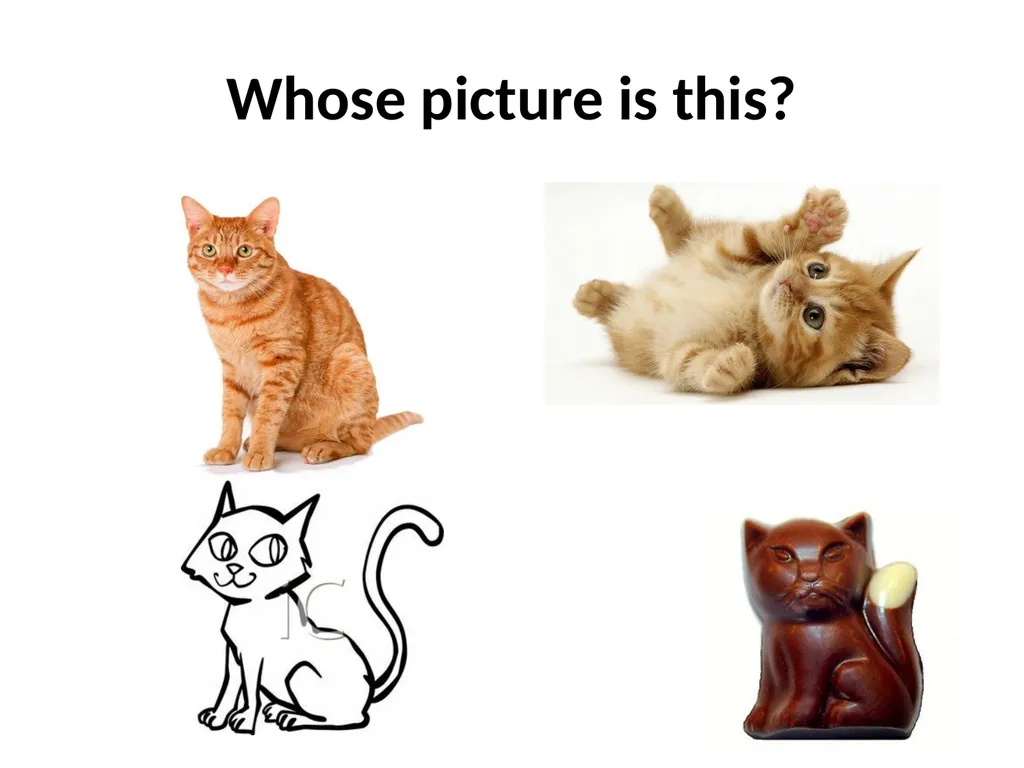
Whose picture is this?<br>
08
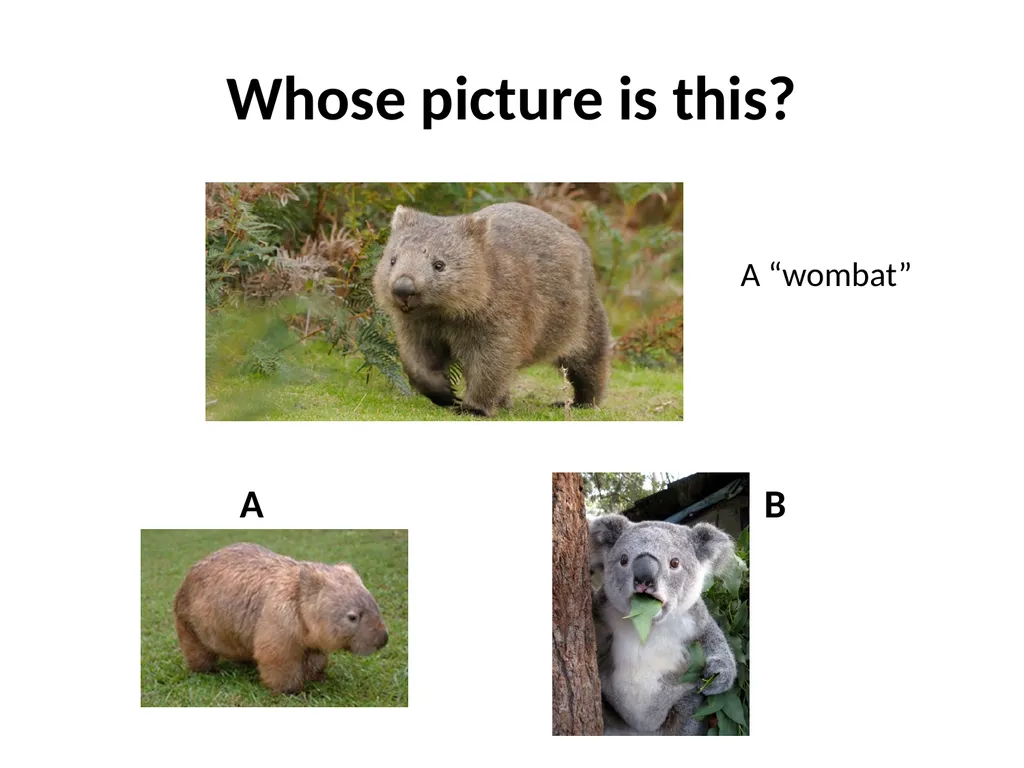
Whose picture is this? A “wombat” A B<br>
09
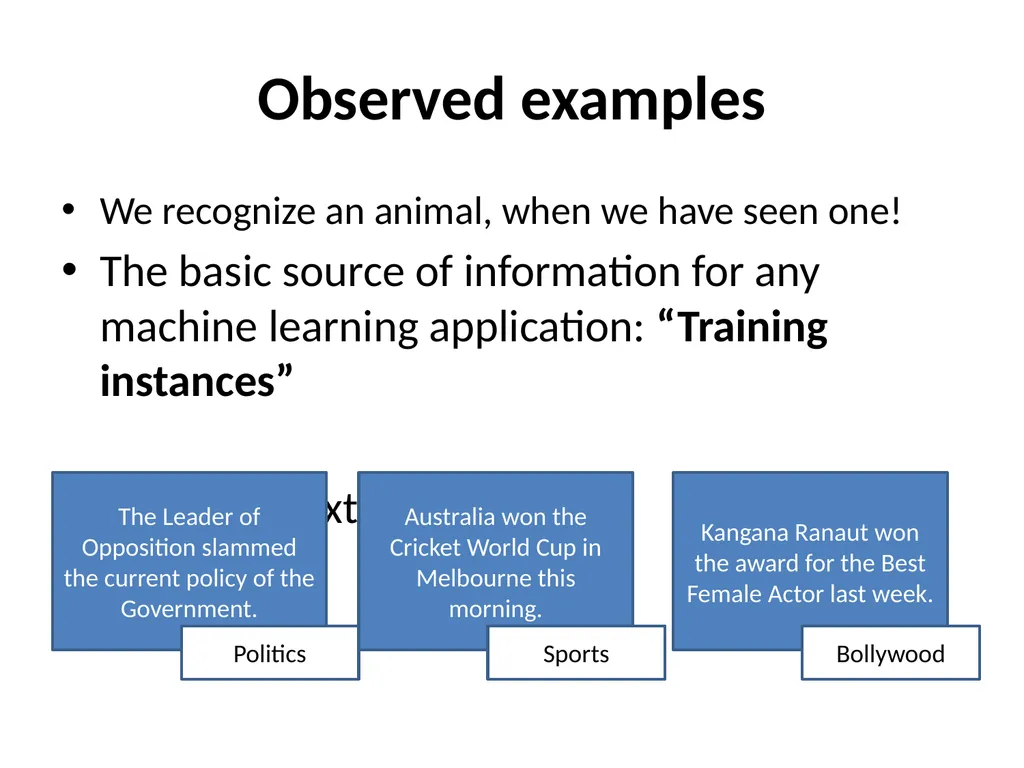
Observed examples We recognize an animal, when we have seen one!
The basic source of information for any machine learning application: “Training instances”
Example: Text categorization The Leader of Opposition slammed the current policy of the Government. Politics Australia won the Cricket World Cup in Melbourne this morning. Sports Kangana Ranaut won the award for the Best Female Actor last week. Bollywood<br>
The basic source of information for any machine learning application: “Training instances”
Example: Text categorization The Leader of Opposition slammed the current policy of the Government. Politics Australia won the Cricket World Cup in Melbourne this morning. Sports Kangana Ranaut won the award for the Best Female Actor last week. Bollywood<br>
10
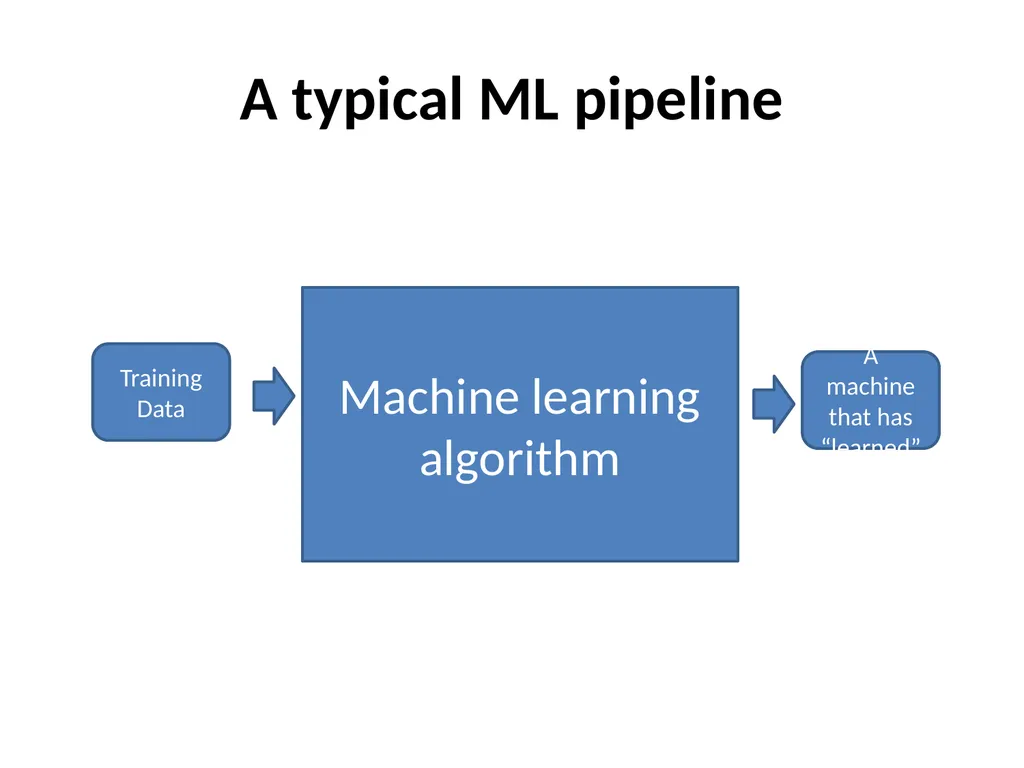
A typical ML pipeline Machine learning algorithm Training Data A machine that has “learned”<br>
11
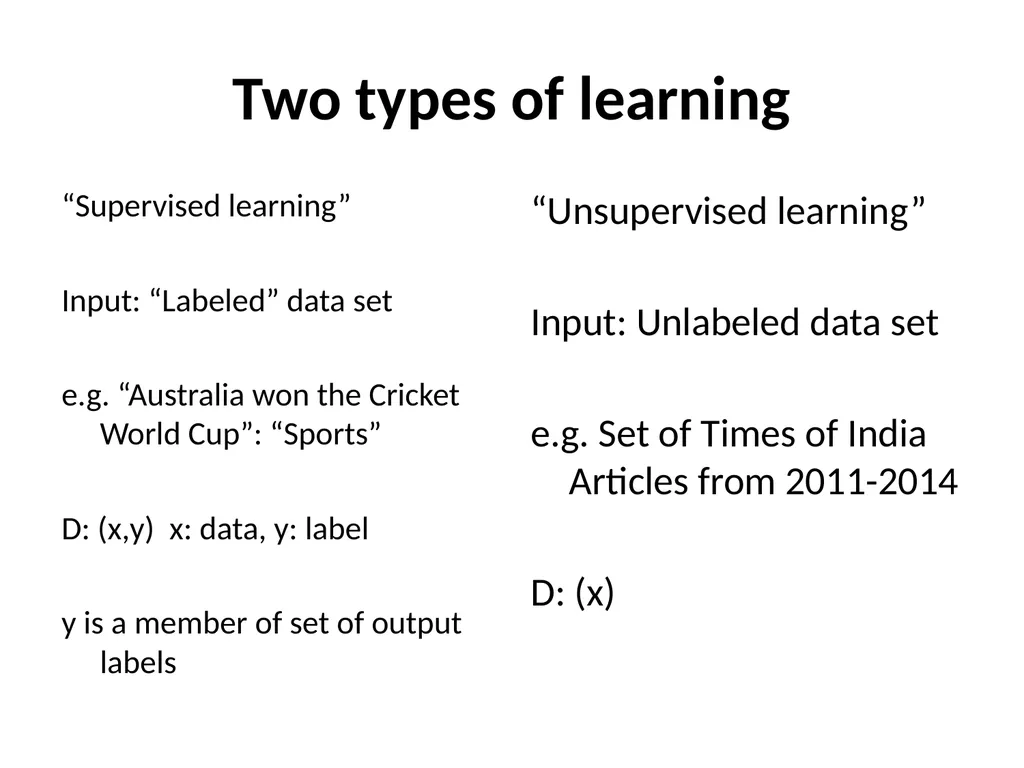
Two types of learning “Supervised learning”
Input: “Labeled” data set
e.g. “Australia won the Cricket World Cup”: “Sports”
D: (x,y) x: data, y: label
y is a member of set of output labels “Unsupervised learning”
Input: Unlabeled data set
e.g. Set of Times of India Articles from 2011-2014
D: (x)<br>
Input: “Labeled” data set
e.g. “Australia won the Cricket World Cup”: “Sports”
D: (x,y) x: data, y: label
y is a member of set of output labels “Unsupervised learning”
Input: Unlabeled data set
e.g. Set of Times of India Articles from 2011-2014
D: (x)<br>
12
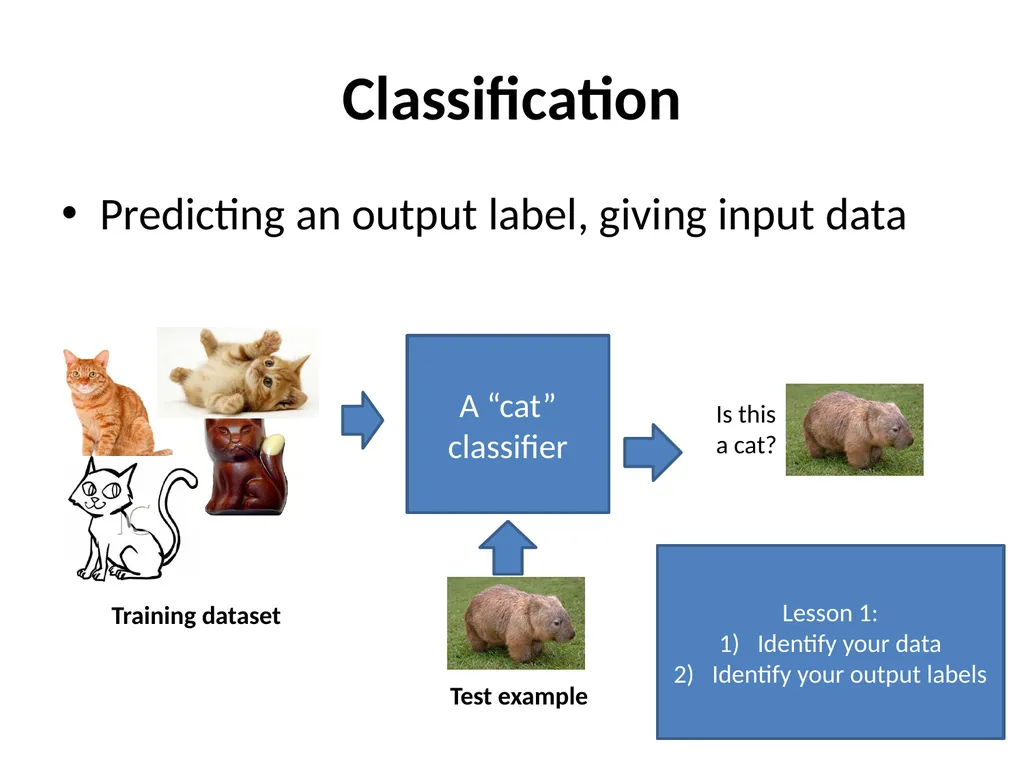
Classification Predicting an output label, giving input data Training dataset A “cat” classifier Test example Is this
a cat? Lesson 1:
Identify your data
Identify your output labels<br>
a cat? Lesson 1:
Identify your data
Identify your output labels<br>
13
A Computational Approach to Automatic Prediction of
Drunk-Texting Aditya Joshi 13 First presented at ACL 2015, Beijing, 2015<br>
14
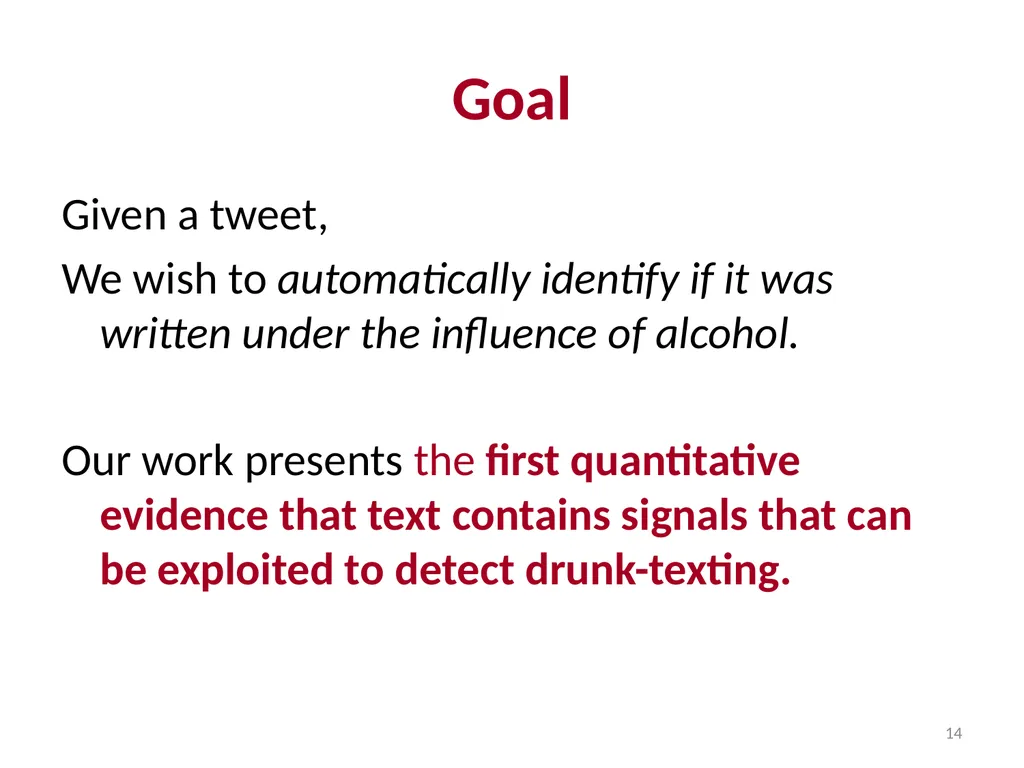
Goal Given a tweet,
We wish to automatically identify if it was written under the influence of alcohol.
Our work presents the first quantitative evidence that text contains signals that can be exploited to detect drunk-texting. 14<br>
We wish to automatically identify if it was written under the influence of alcohol.
Our work presents the first quantitative evidence that text contains signals that can be exploited to detect drunk-texting. 14<br>
15
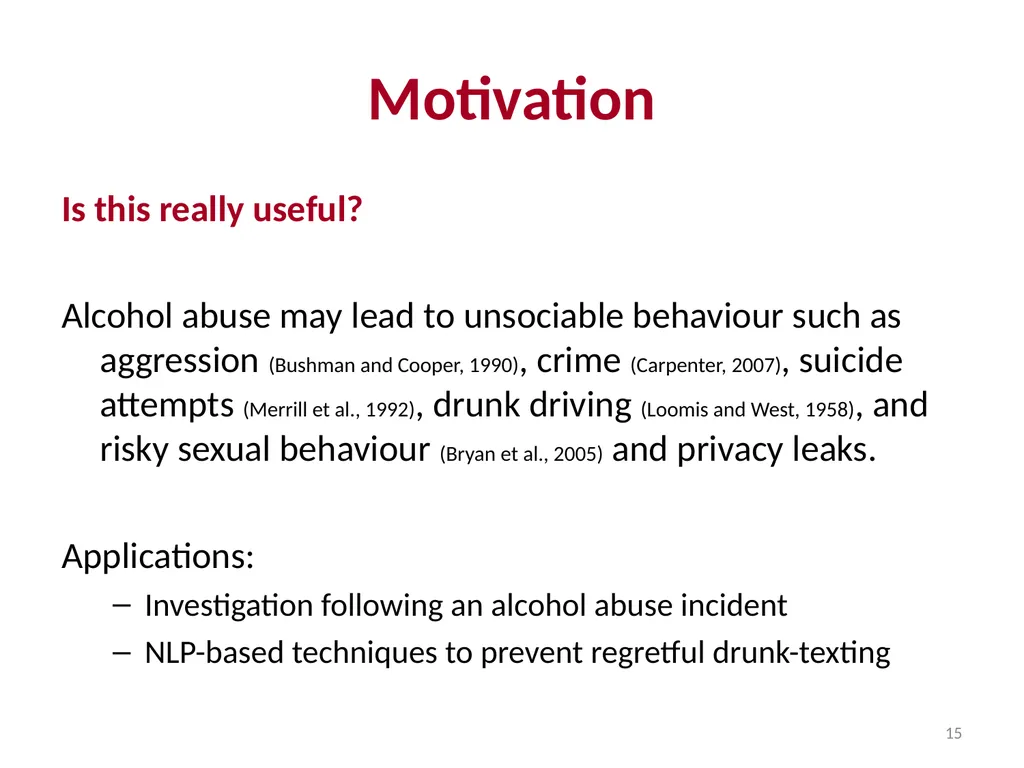
Motivation Is this really useful?
Alcohol abuse may lead to unsociable behaviour such as aggression (Bushman and Cooper, 1990), crime (Carpenter, 2007), suicide attempts (Merrill et al., 1992), drunk driving (Loomis and West, 1958), and risky sexual behaviour (Bryan et al., 2005) and privacy leaks.
Applications:
Investigation following an alcohol abuse incident
NLP-based techniques to prevent regretful drunk-texting 15<br>
Alcohol abuse may lead to unsociable behaviour such as aggression (Bushman and Cooper, 1990), crime (Carpenter, 2007), suicide attempts (Merrill et al., 1992), drunk driving (Loomis and West, 1958), and risky sexual behaviour (Bryan et al., 2005) and privacy leaks.
Applications:
Investigation following an alcohol abuse incident
NLP-based techniques to prevent regretful drunk-texting 15<br>
16
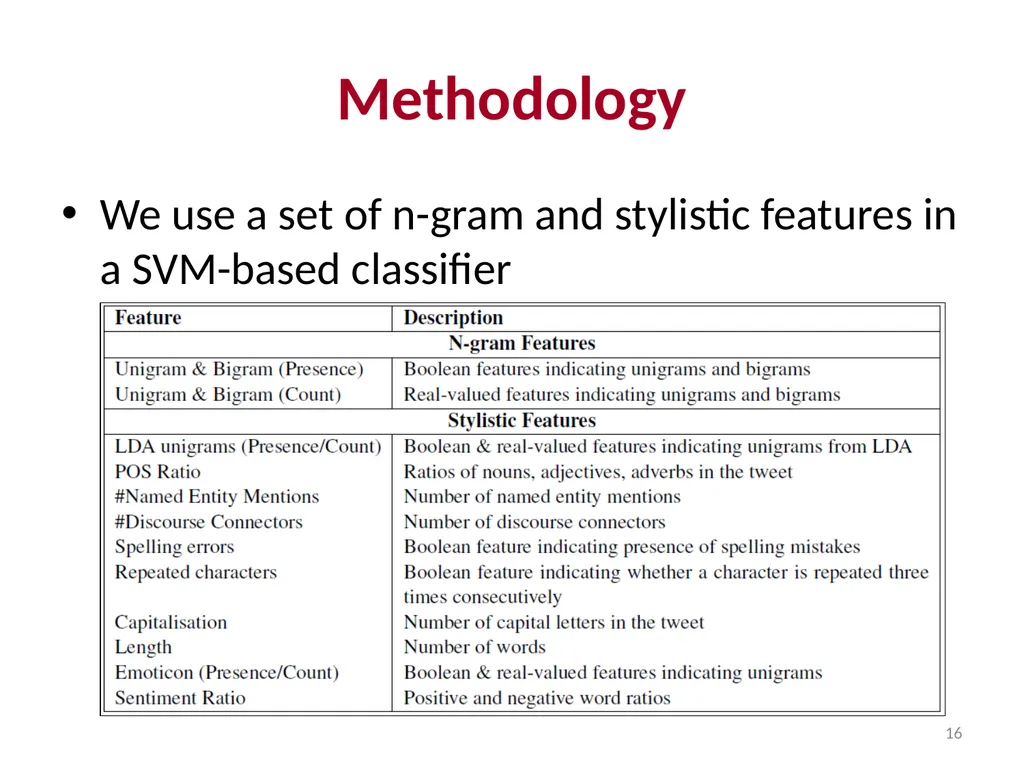
Methodology We use a set of n-gram and stylistic features in a SVM-based classifier 16<br>
17
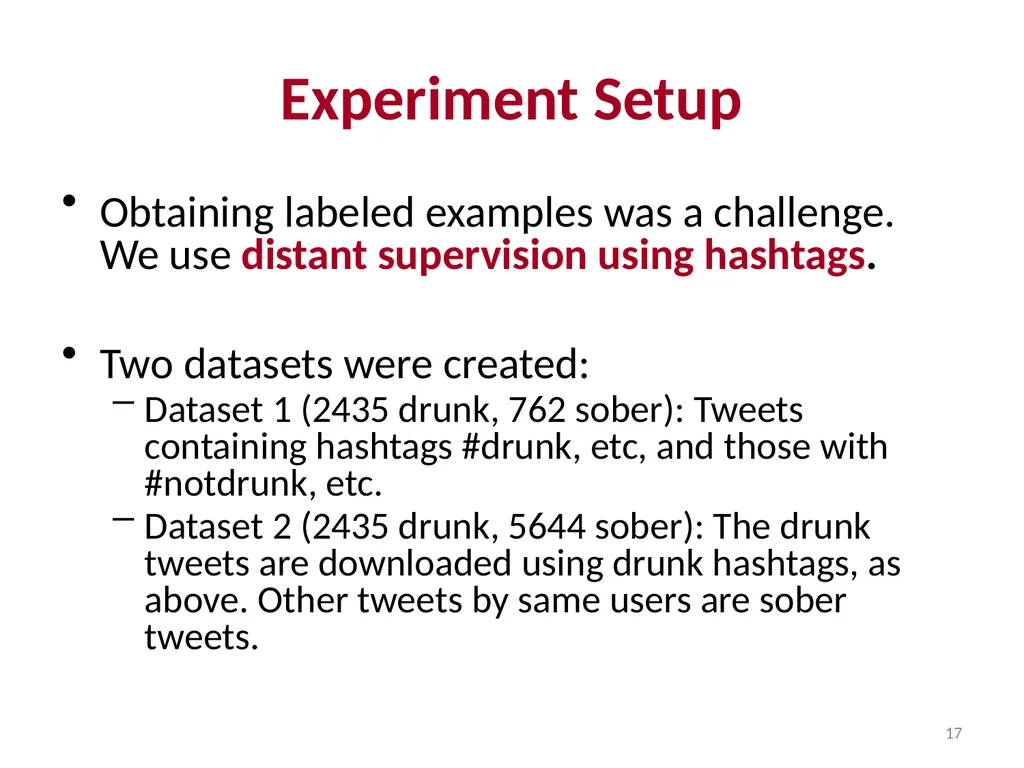
Experiment Setup Obtaining labeled examples was a challenge. We use distant supervision using hashtags.
Two datasets were created:
Dataset 1 (2435 drunk, 762 sober): Tweets containing hashtags #drunk, etc, and those with #notdrunk, etc.
Dataset 2 (2435 drunk, 5644 sober): The drunk tweets are downloaded using drunk hashtags, as above. Other tweets by same users are sober tweets. 17<br>
Two datasets were created:
Dataset 1 (2435 drunk, 762 sober): Tweets containing hashtags #drunk, etc, and those with #notdrunk, etc.
Dataset 2 (2435 drunk, 5644 sober): The drunk tweets are downloaded using drunk hashtags, as above. Other tweets by same users are sober tweets. 17<br>
18
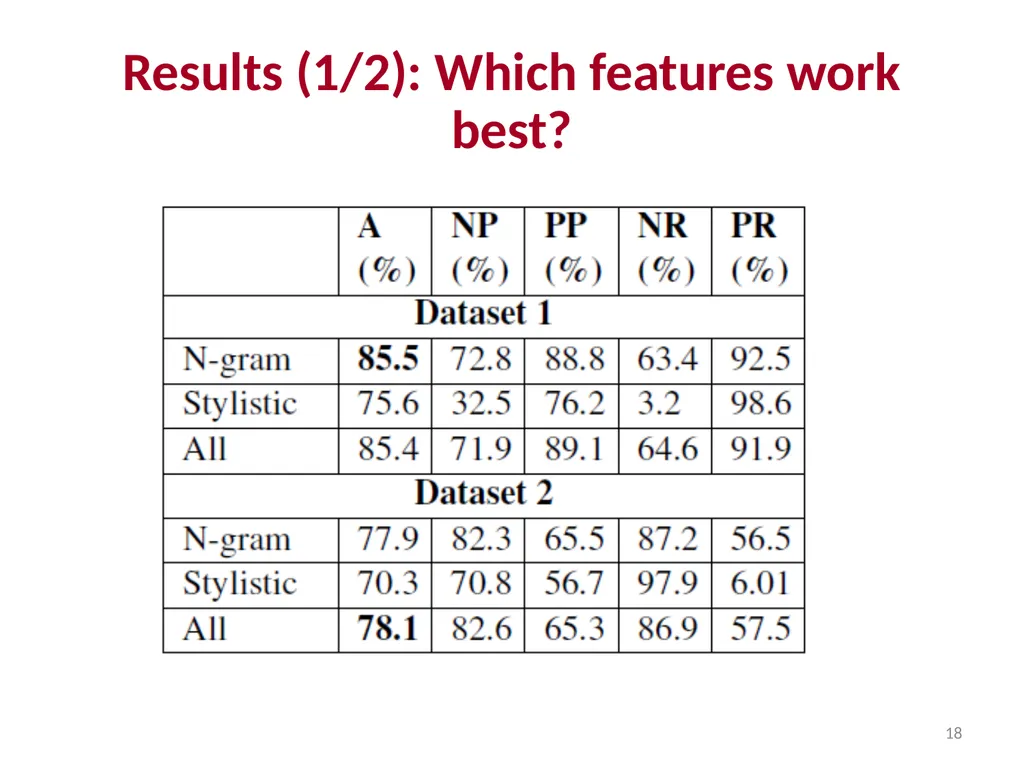
Results (1/2): Which features work best? 18<br>
19
Results (2/2): What are the top stylistic features for drunk texting? 19<br>
20
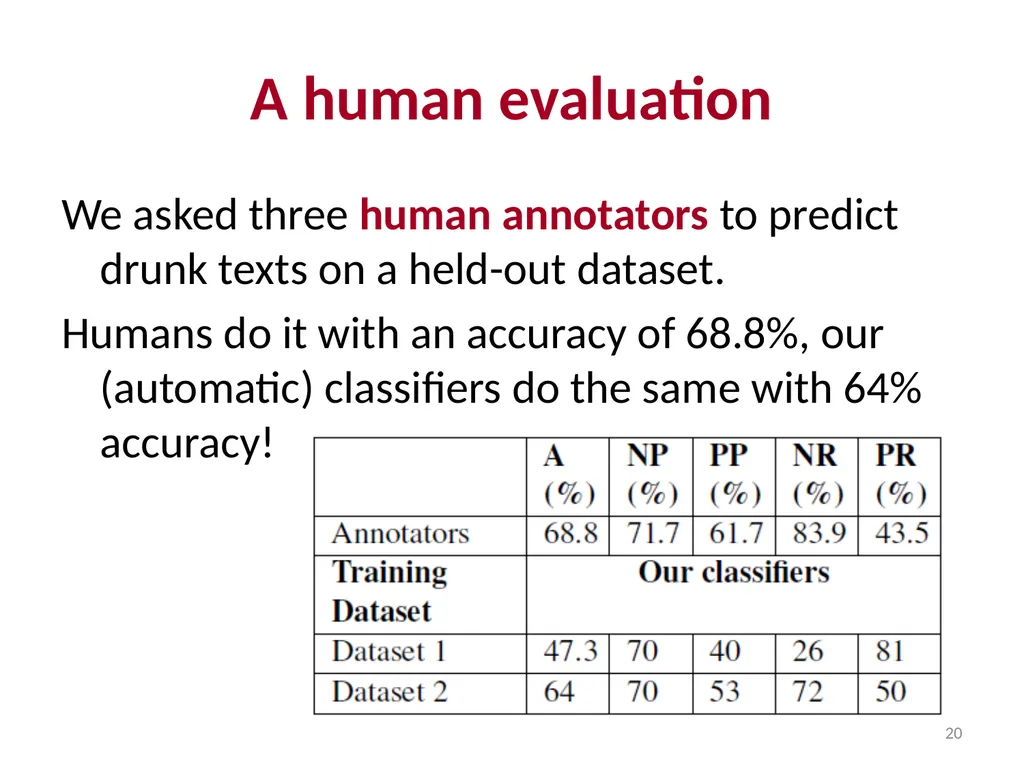
A human evaluation We asked three human annotators to predict drunk texts on a held-out dataset.
Humans do it with an accuracy of 68.8%, our (automatic) classifiers do the same with 64% accuracy! 20<br>
Humans do it with an accuracy of 68.8%, our (automatic) classifiers do the same with 64% accuracy! 20<br>
21
Conclusion Our drunk prediction system obtains a best accuracy of 78.1%.
While human annotators achieve an accuracy of 68.8%, our system reaches 64%.
We, thus, make a case for drunk-texting prediction as a useful and feasible NLP application.
Refer the paper for a detailed description of drunk-texting prediction, and error analysis of our results For dataset and other questions, please contact: adityaj@cse.iitb.ac.in 21<br>
While human annotators achieve an accuracy of 68.8%, our system reaches 64%.
We, thus, make a case for drunk-texting prediction as a useful and feasible NLP application.
Refer the paper for a detailed description of drunk-texting prediction, and error analysis of our results For dataset and other questions, please contact: adityaj@cse.iitb.ac.in 21<br>
22
Computational Sarcasm Aditya Joshi First presented at ACL 2015, Beijing, 2015, and WASSA at
EMNLP 2015, Lisbon, 2015 22<br>
EMNLP 2015, Lisbon, 2015 22<br>
23
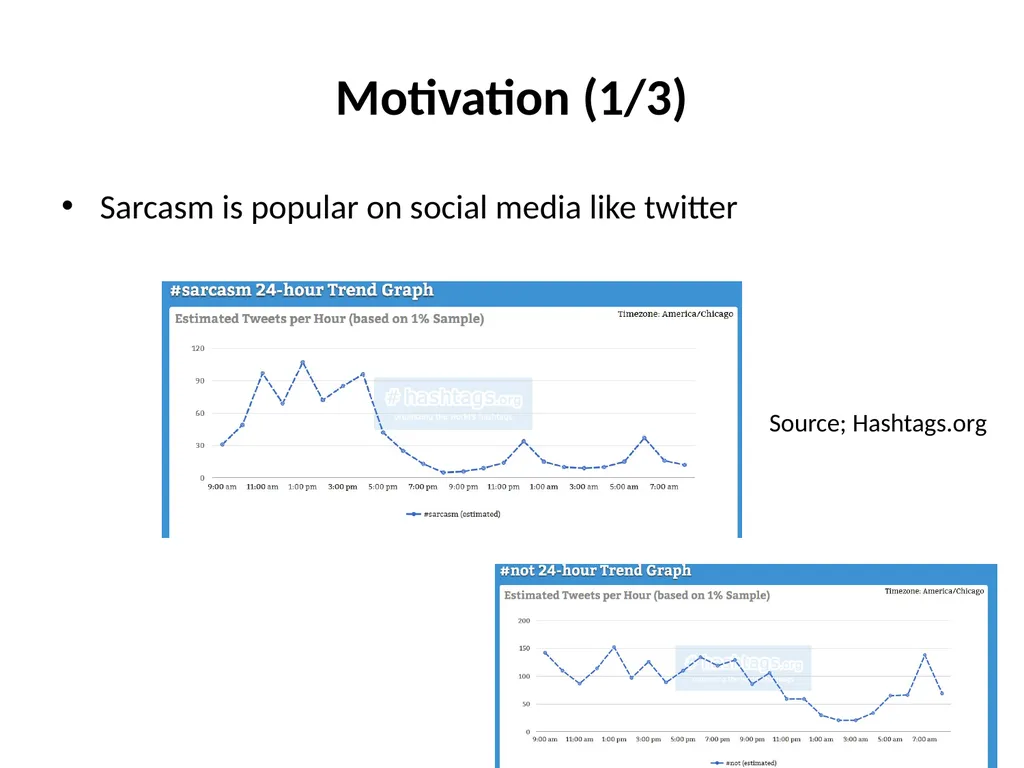
Motivation (1/3) Sarcasm is popular on social media like twitter Source; Hashtags.org 23<br>
24
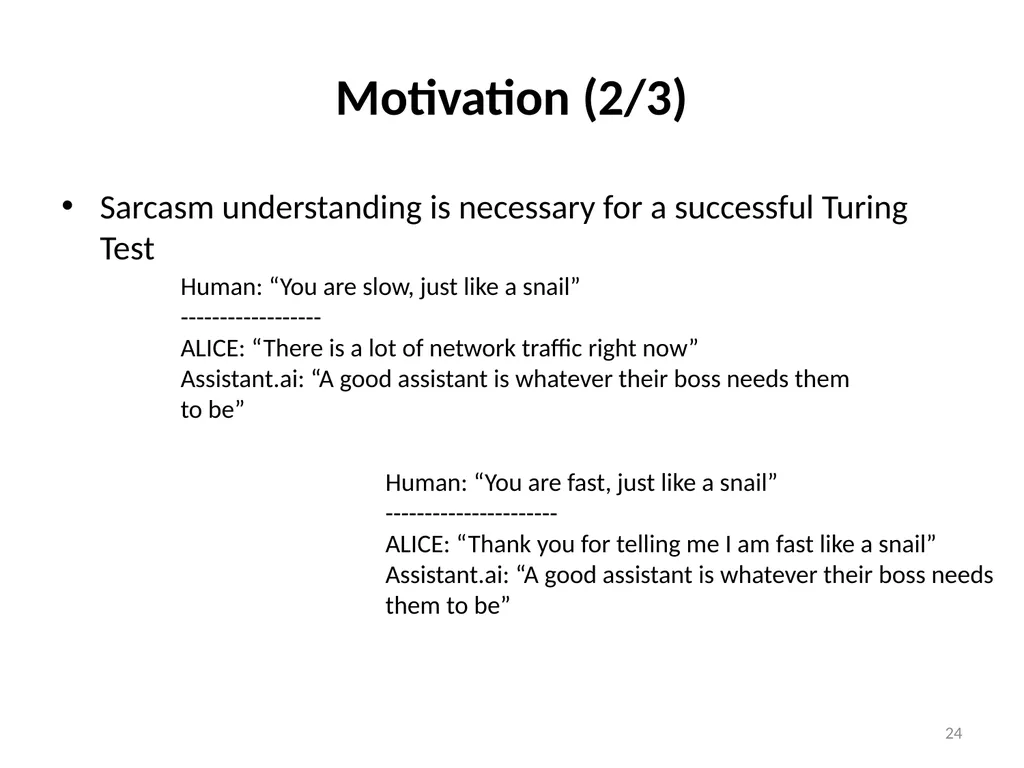
Motivation (2/3) Sarcasm understanding is necessary for a successful Turing Test Human: “You are fast, just like a snail”
----------------------
ALICE: “Thank you for telling me I am fast like a snail”
Assistant.ai: “A good assistant is whatever their boss needs them to be” Human: “You are slow, just like a snail”
------------------
ALICE: “There is a lot of network traffic right now”
Assistant.ai: “A good assistant is whatever their boss needs them to be” 24<br>
----------------------
ALICE: “Thank you for telling me I am fast like a snail”
Assistant.ai: “A good assistant is whatever their boss needs them to be” Human: “You are slow, just like a snail”
------------------
ALICE: “There is a lot of network traffic right now”
Assistant.ai: “A good assistant is whatever their boss needs them to be” 24<br>
25
Motivation (3/3) Sarcasm detection is a challenge to existing sentiment analysis systems
Linguistic Perspective
Computational Perspective 25<br>
Linguistic Perspective
Computational Perspective 25<br>
26
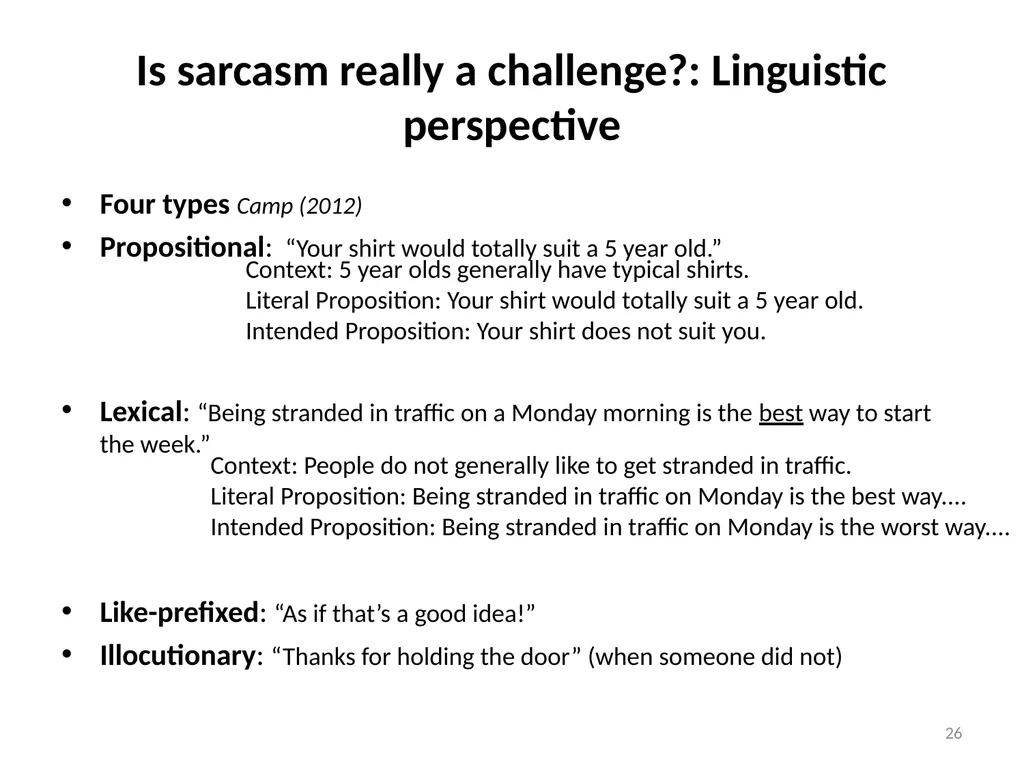
Is sarcasm really a challenge?: Linguistic perspective Four types Camp (2012)
Propositional: “Your shirt would totally suit a 5 year old.”
Lexical: “Being stranded in traffic on a Monday morning is the best way to start the week.”
Like-prefixed: “As if that’s a good idea!”
Illocutionary: “Thanks for holding the door” (when someone did not) Context: 5 year olds generally have typical shirts.
Literal Proposition: Your shirt would totally suit a 5 year old.
Intended Proposition: Your shirt does not suit you. Context: People do not generally like to get stranded in traffic.
Literal Proposition: Being stranded in traffic on Monday is the best way....
Intended Proposition: Being stranded in traffic on Monday is the worst way.... 26<br>
Propositional: “Your shirt would totally suit a 5 year old.”
Lexical: “Being stranded in traffic on a Monday morning is the best way to start the week.”
Like-prefixed: “As if that’s a good idea!”
Illocutionary: “Thanks for holding the door” (when someone did not) Context: 5 year olds generally have typical shirts.
Literal Proposition: Your shirt would totally suit a 5 year old.
Intended Proposition: Your shirt does not suit you. Context: People do not generally like to get stranded in traffic.
Literal Proposition: Being stranded in traffic on Monday is the best way....
Intended Proposition: Being stranded in traffic on Monday is the worst way.... 26<br>
27
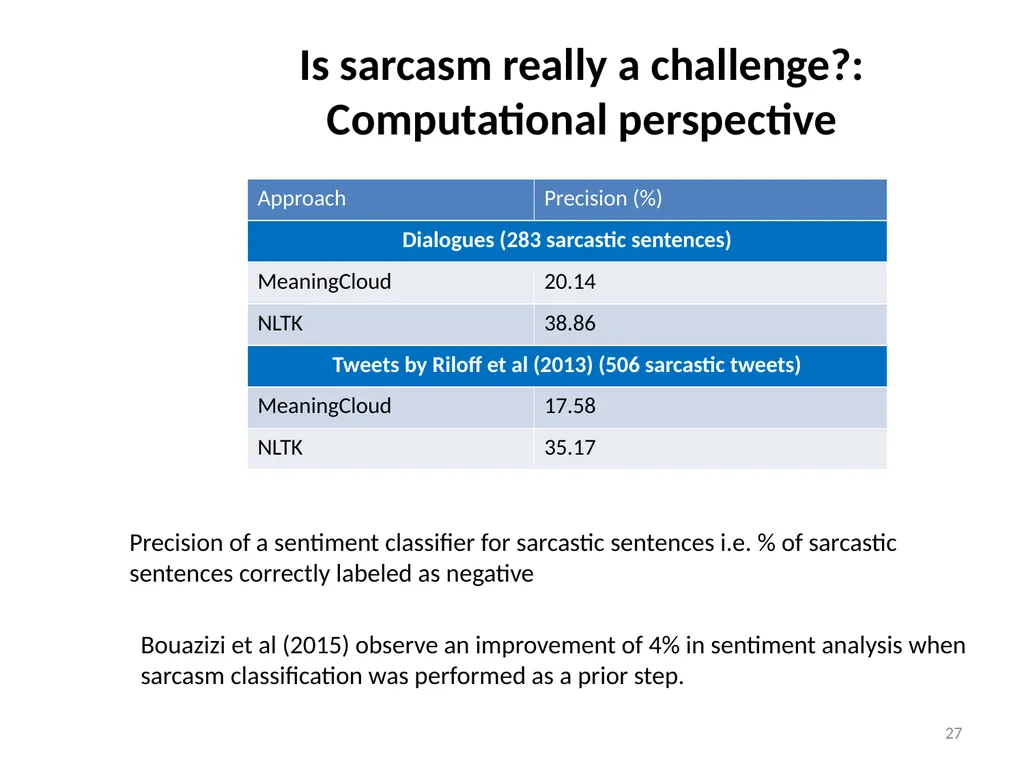
Is sarcasm really a challenge?: Computational perspective Precision of a sentiment classifier for sarcastic sentences i.e. % of sarcastic sentences correctly labeled as negative Bouazizi et al (2015) observe an improvement of 4% in sentiment analysis when
sarcasm classification was performed as a prior step. 27<br>
sarcasm classification was performed as a prior step. 27<br>
28
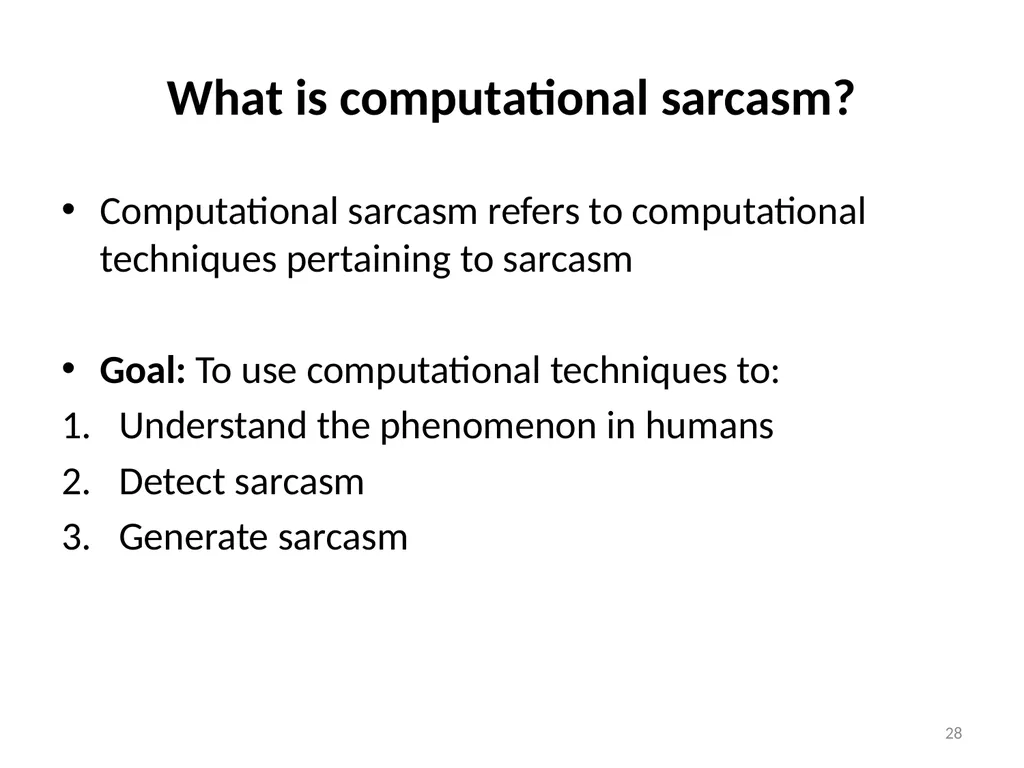
What is computational sarcasm? Computational sarcasm refers to computational techniques pertaining to sarcasm
Goal: To use computational techniques to:
Understand the phenomenon in humans
Detect sarcasm
Generate sarcasm 28<br>
Goal: To use computational techniques to:
Understand the phenomenon in humans
Detect sarcasm
Generate sarcasm 28<br>
29
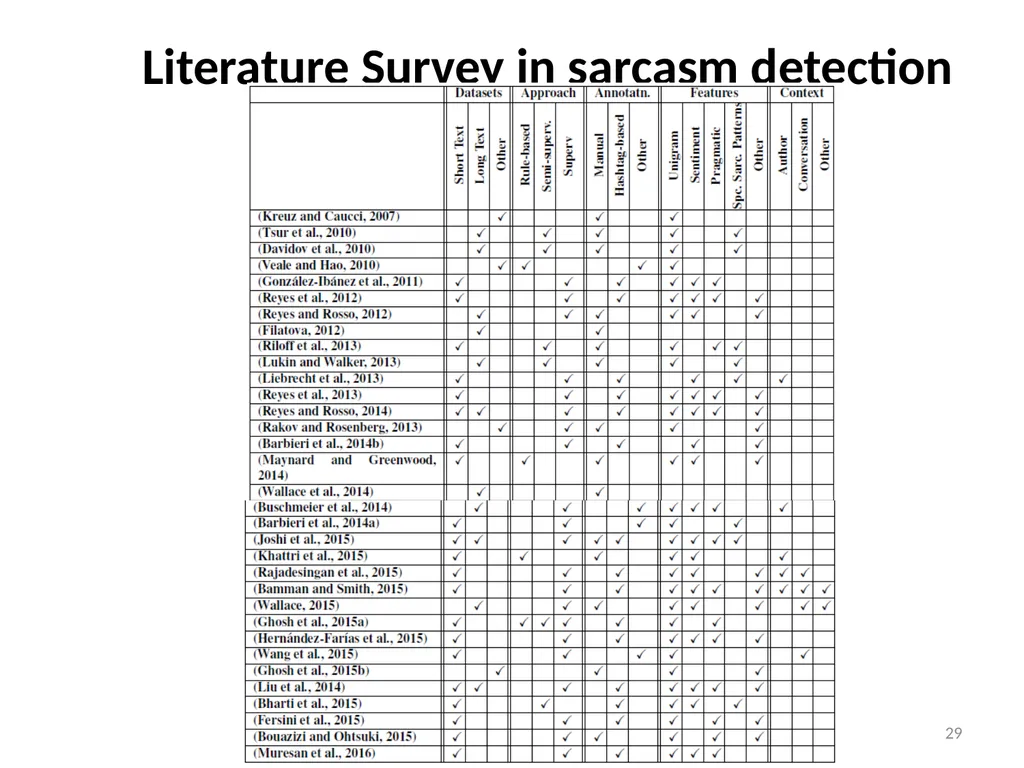
Literature Survey in sarcasm detection 29<br>
30
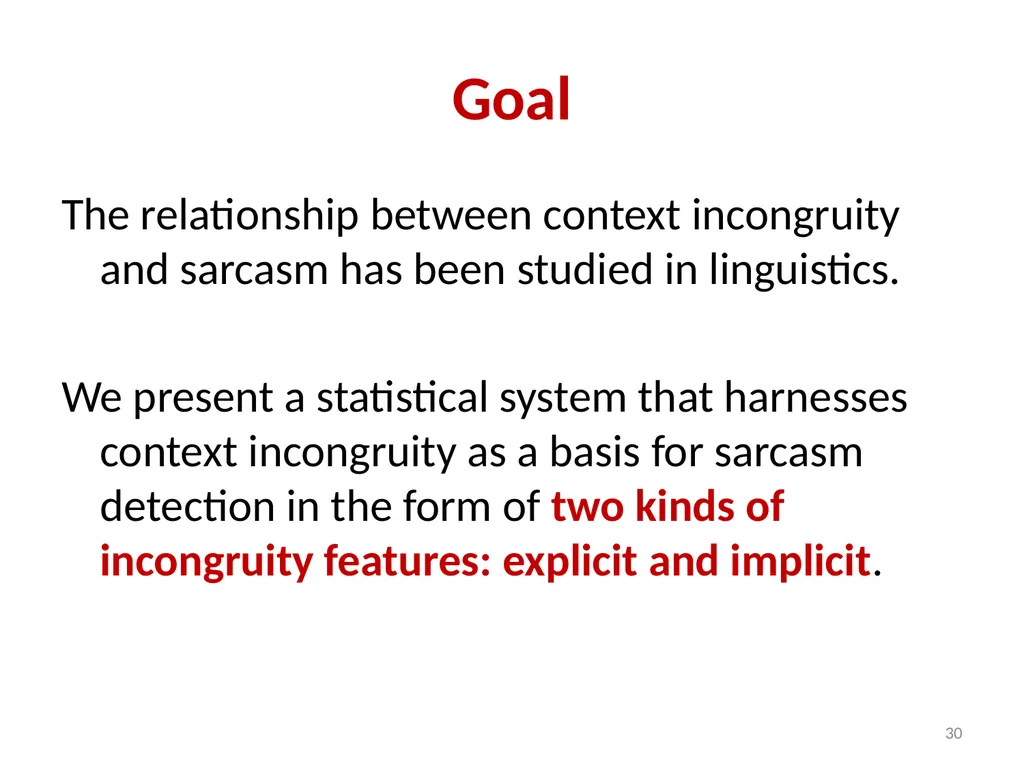
Goal The relationship between context incongruity and sarcasm has been studied in linguistics.
We present a statistical system that harnesses context incongruity as a basis for sarcasm detection in the form of two kinds of incongruity features: explicit and implicit. 30<br>
We present a statistical system that harnesses context incongruity as a basis for sarcasm detection in the form of two kinds of incongruity features: explicit and implicit. 30<br>
31
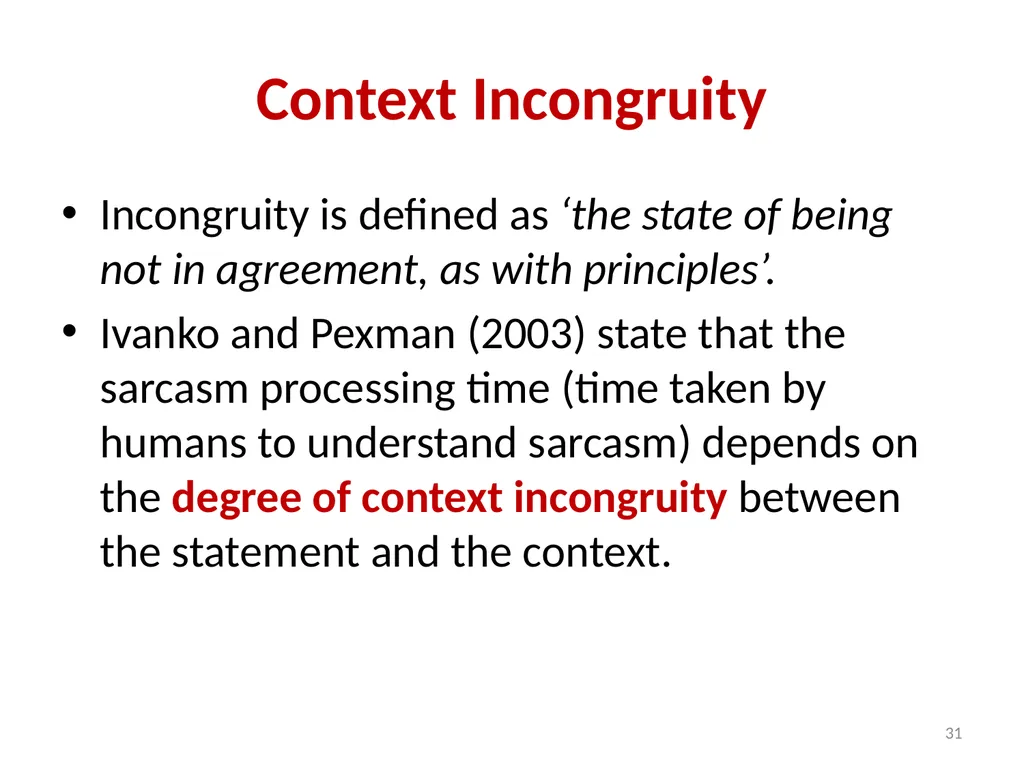
Context Incongruity Incongruity is defined as ‘the state of being not in agreement, as with principles’.
Ivanko and Pexman (2003) state that the sarcasm processing time (time taken by humans to understand sarcasm) depends on the degree of context incongruity between the statement and the context. 31<br>
Ivanko and Pexman (2003) state that the sarcasm processing time (time taken by humans to understand sarcasm) depends on the degree of context incongruity between the statement and the context. 31<br>
32
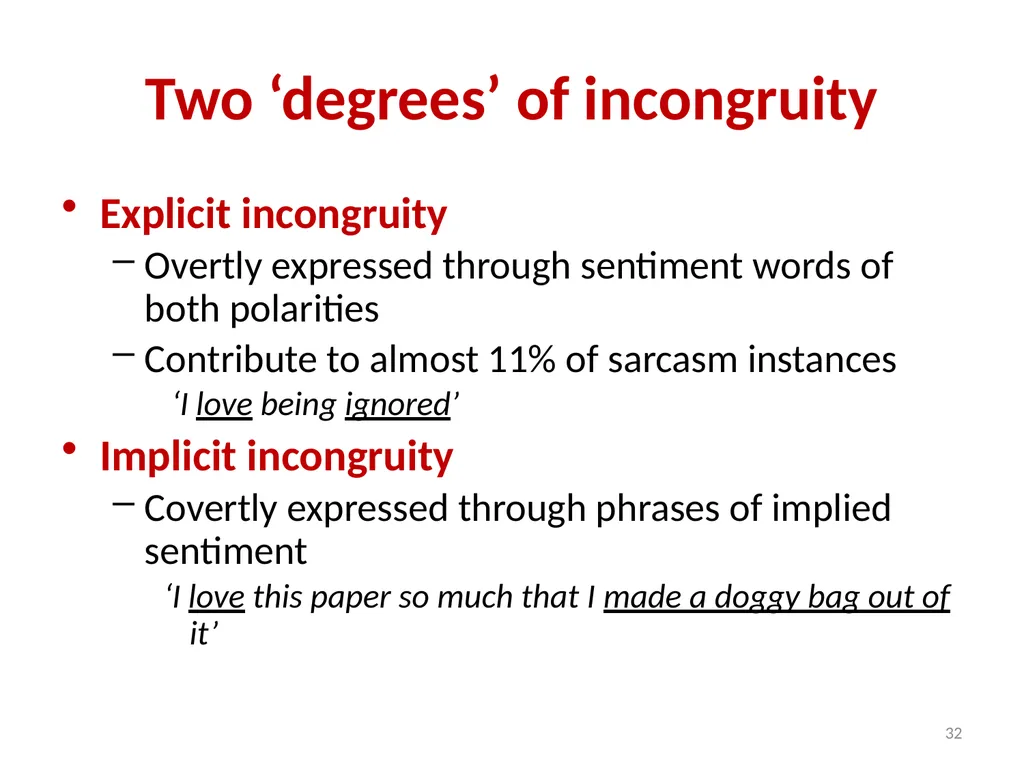
Two ‘degrees’ of incongruity Explicit incongruity
Overtly expressed through sentiment words of both polarities
Contribute to almost 11% of sarcasm instances
‘I love being ignored’
Implicit incongruity
Covertly expressed through phrases of implied sentiment
‘I love this paper so much that I made a doggy bag out of it’ 32<br>
Overtly expressed through sentiment words of both polarities
Contribute to almost 11% of sarcasm instances
‘I love being ignored’
Implicit incongruity
Covertly expressed through phrases of implied sentiment
‘I love this paper so much that I made a doggy bag out of it’ 32<br>
33
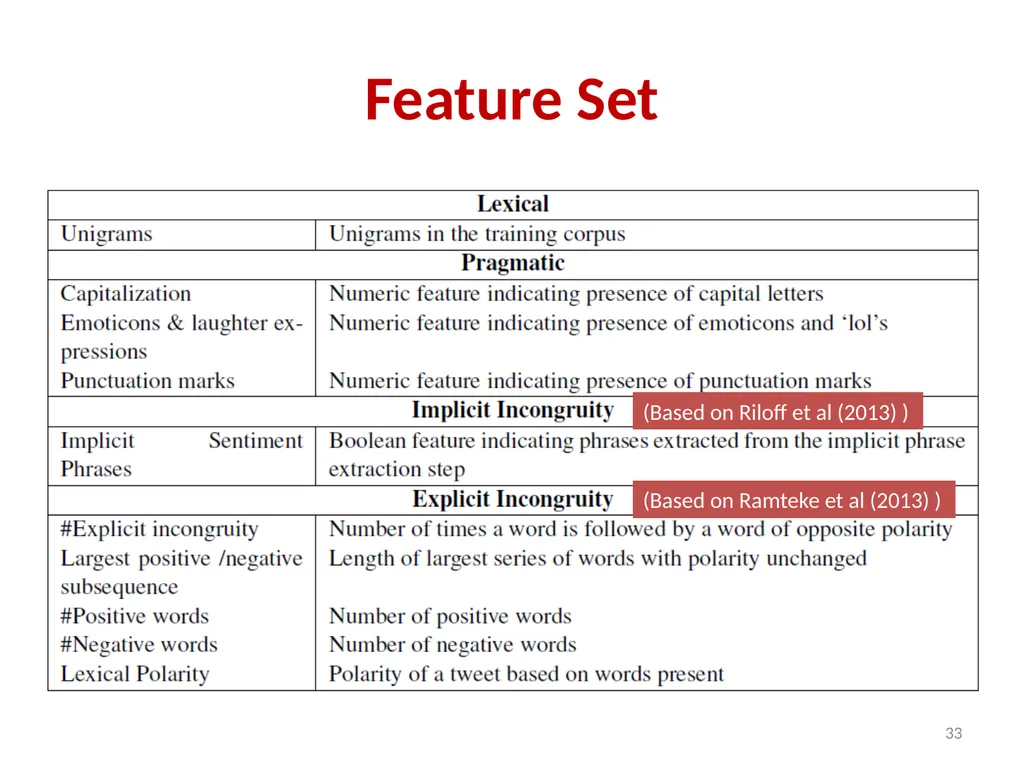
Feature Set (Based on Riloff et al (2013) ) (Based on Ramteke et al (2013) ) 33<br>
34
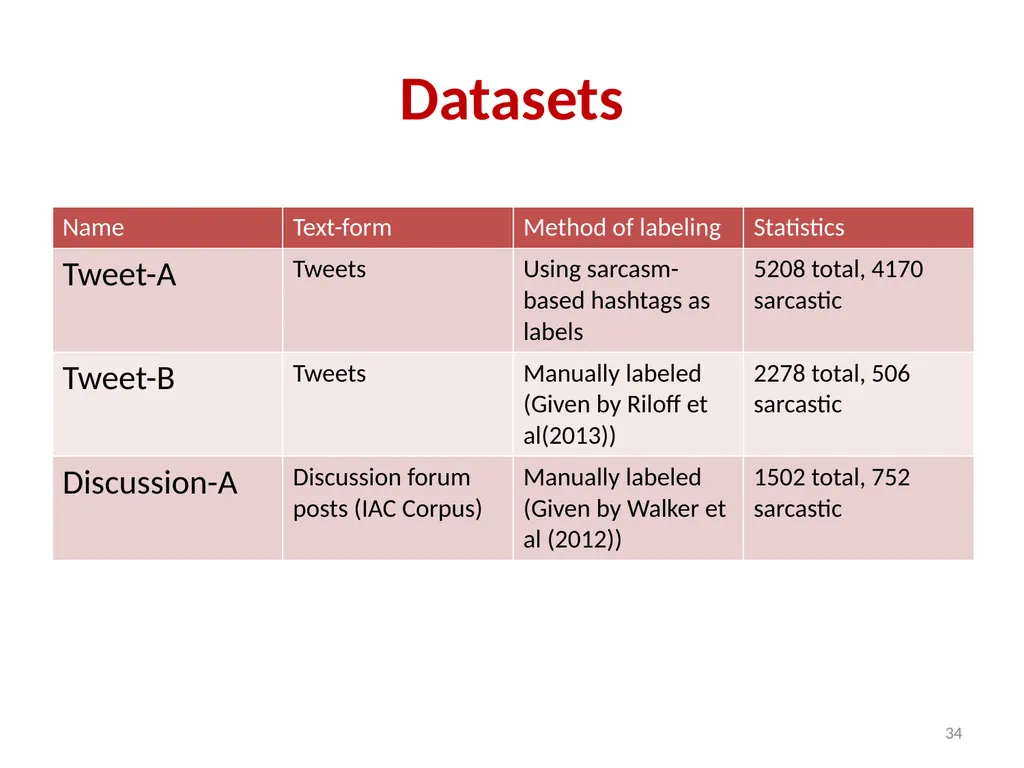
Datasets 34<br>
35
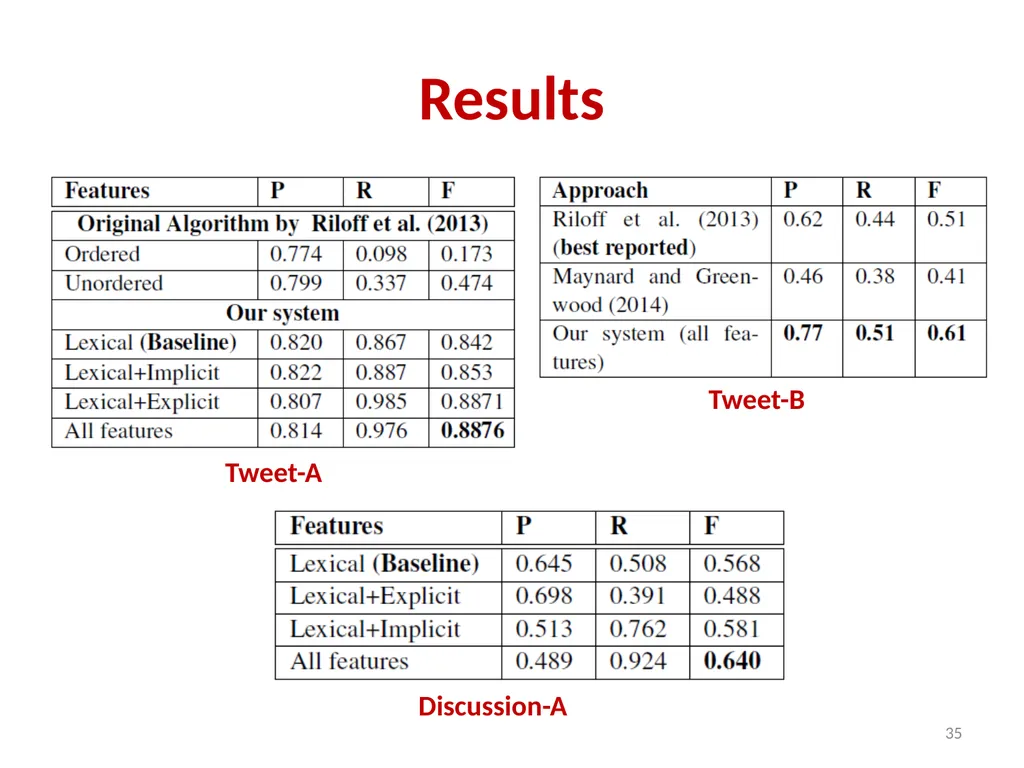
Results Tweet-A Tweet-B Discussion-A 35<br>
36
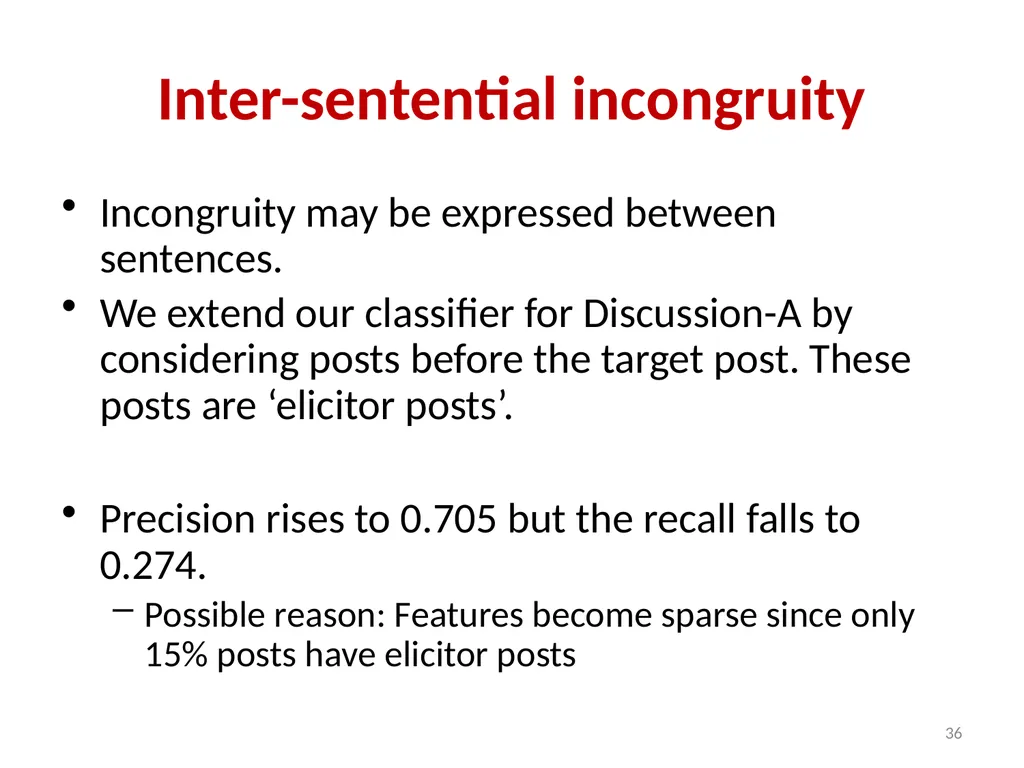
Inter-sentential incongruity Incongruity may be expressed between sentences.
We extend our classifier for Discussion-A by considering posts before the target post. These posts are ‘elicitor posts’.
Precision rises to 0.705 but the recall falls to 0.274.
Possible reason: Features become sparse since only 15% posts have elicitor posts 36<br>
We extend our classifier for Discussion-A by considering posts before the target post. These posts are ‘elicitor posts’.
Precision rises to 0.705 but the recall falls to 0.274.
Possible reason: Features become sparse since only 15% posts have elicitor posts 36<br>
37
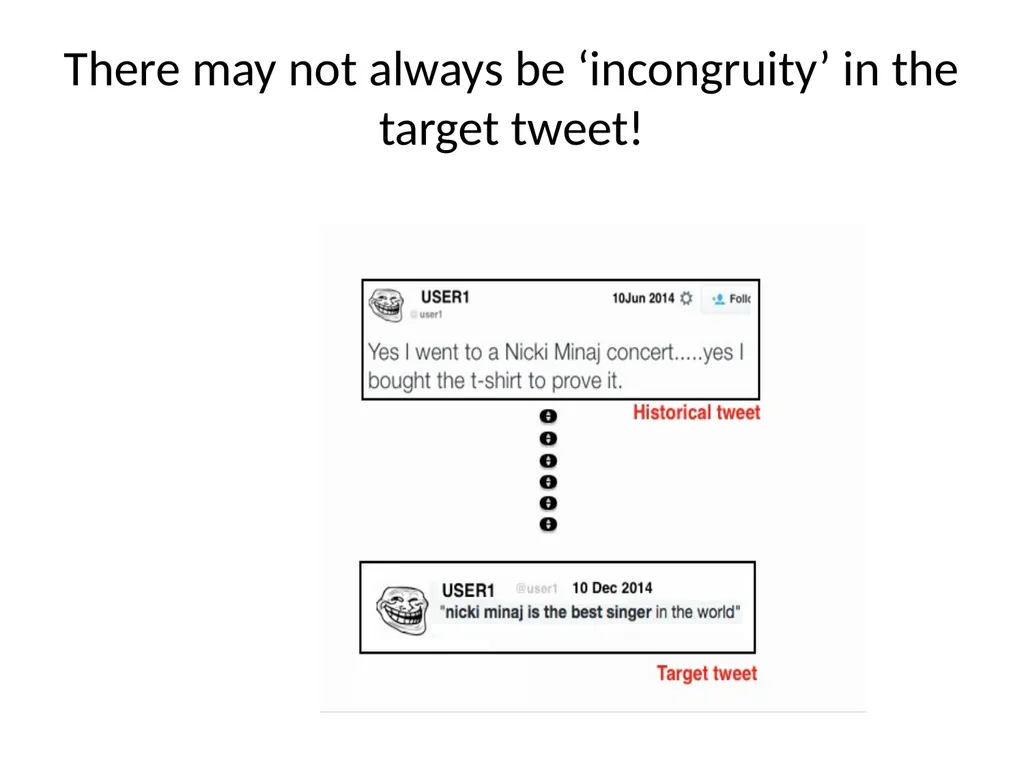
There may not always be ‘incongruity’ in the target tweet!<br>
38
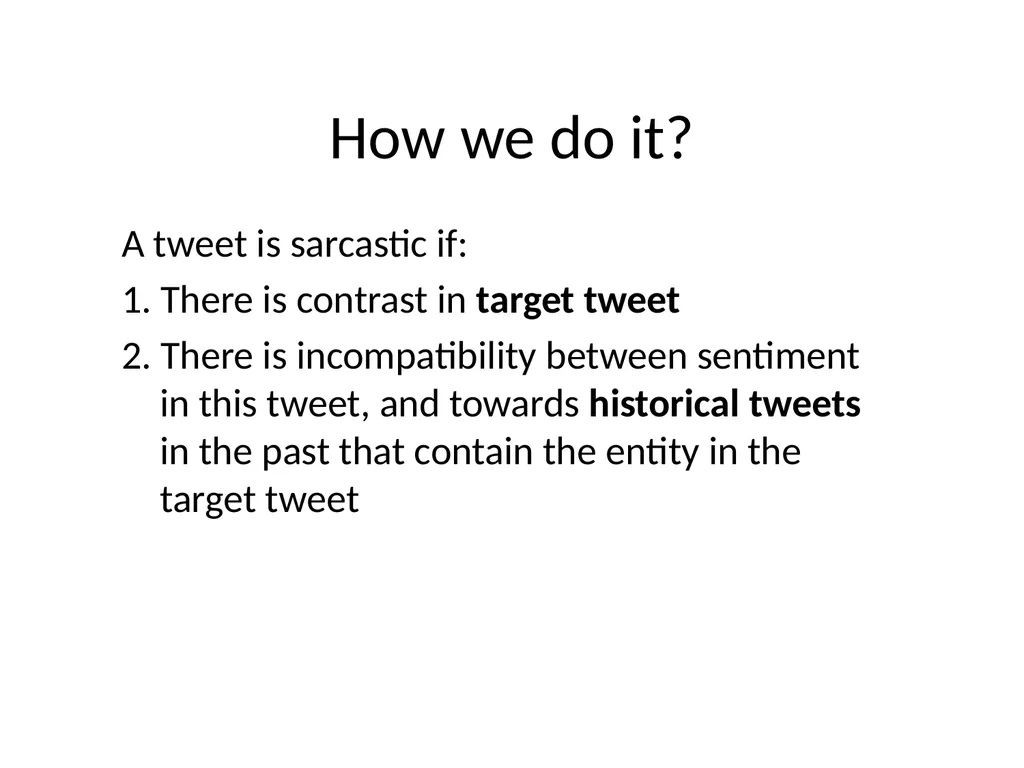
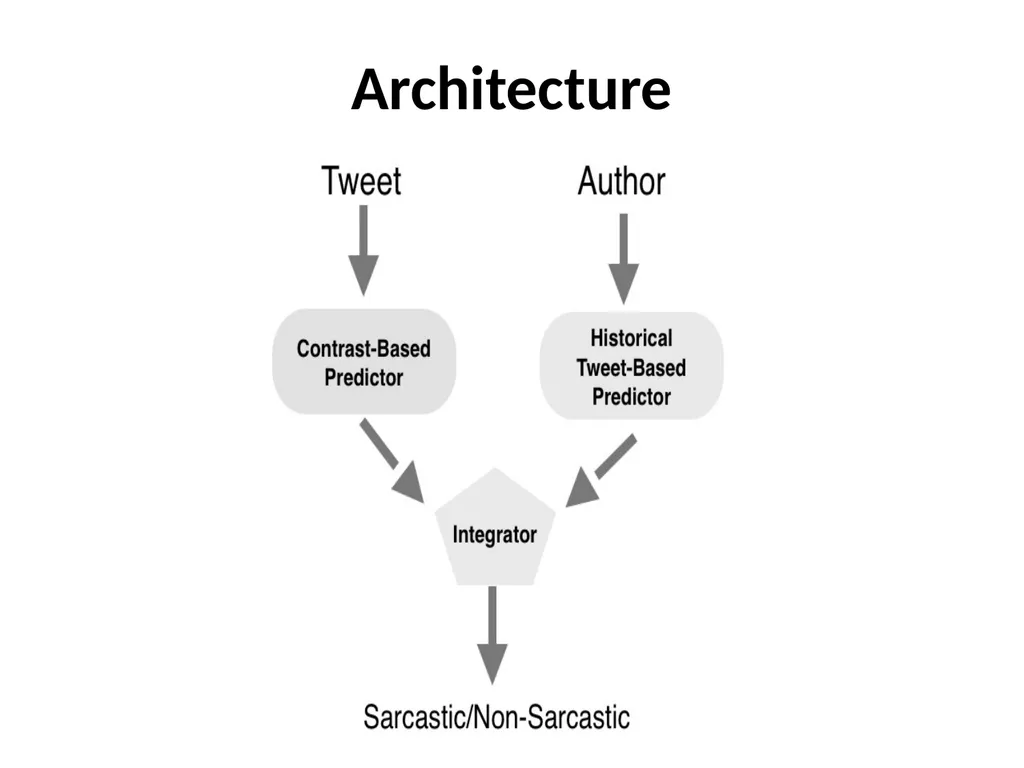
How we do it? A tweet is sarcastic if:
1. There is contrast in target tweet
2. There is incompatibility between sentiment in this tweet, and towards historical tweets in the past that contain the entity in the target tweet<br>
1. There is contrast in target tweet
2. There is incompatibility between sentiment in this tweet, and towards historical tweets in the past that contain the entity in the target tweet<br>
39
Architecture<br>
40
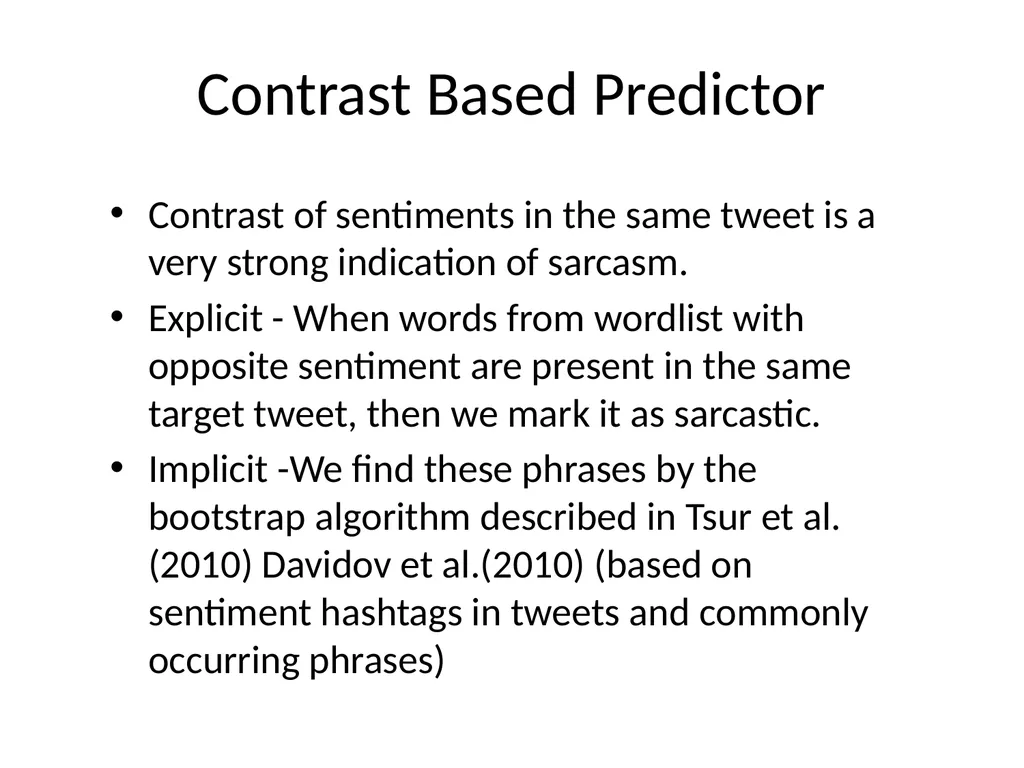
Contrast of sentiments in the same tweet is a very strong indication of sarcasm.
Explicit - When words from wordlist with opposite sentiment are present in the same target tweet, then we mark it as sarcastic.
Implicit -We find these phrases by the bootstrap algorithm described in Tsur et al. (2010) Davidov et al.(2010) (based on sentiment hashtags in tweets and commonly occurring phrases) Contrast Based Predictor<br>
Explicit - When words from wordlist with opposite sentiment are present in the same target tweet, then we mark it as sarcastic.
Implicit -We find these phrases by the bootstrap algorithm described in Tsur et al. (2010) Davidov et al.(2010) (based on sentiment hashtags in tweets and commonly occurring phrases) Contrast Based Predictor<br>
41
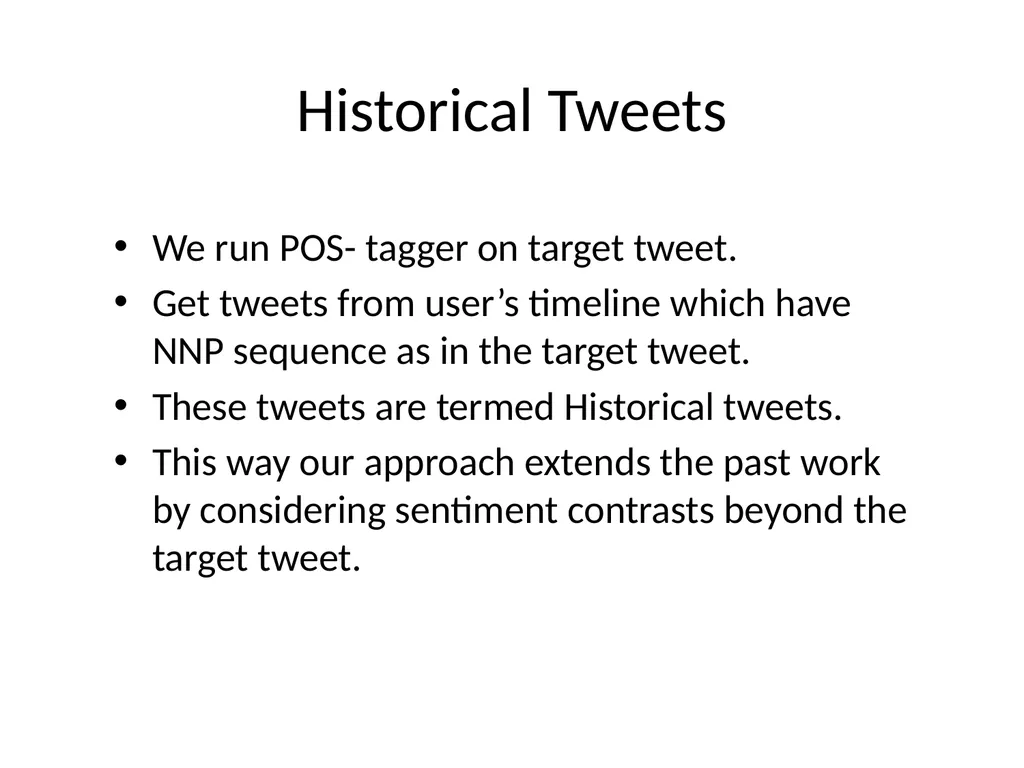
Historical Tweets We run POS- tagger on target tweet.
Get tweets from user’s timeline which have NNP sequence as in the target tweet.
These tweets are termed Historical tweets.
This way our approach extends the past work by considering sentiment contrasts beyond the target tweet.<br>
Get tweets from user’s timeline which have NNP sequence as in the target tweet.
These tweets are termed Historical tweets.
This way our approach extends the past work by considering sentiment contrasts beyond the target tweet.<br>
42
Historical text is taken as the users view about the subject (NNP). Why only NNP?
Sentiment of all the historical tweets in averaged to get the users views.
Sentiment is calculated using a simple rule-based engine that looks up lexicon and rules for negation and conjunctions
If the target tweet sentiment is in contrast to the historical sentiment then target tweet is classified as sarcastic else non- sarcastic. Historical Tweet Based Predictor<br>
Sentiment of all the historical tweets in averaged to get the users views.
Sentiment is calculated using a simple rule-based engine that looks up lexicon and rules for negation and conjunctions
If the target tweet sentiment is in contrast to the historical sentiment then target tweet is classified as sarcastic else non- sarcastic. Historical Tweet Based Predictor<br>
43
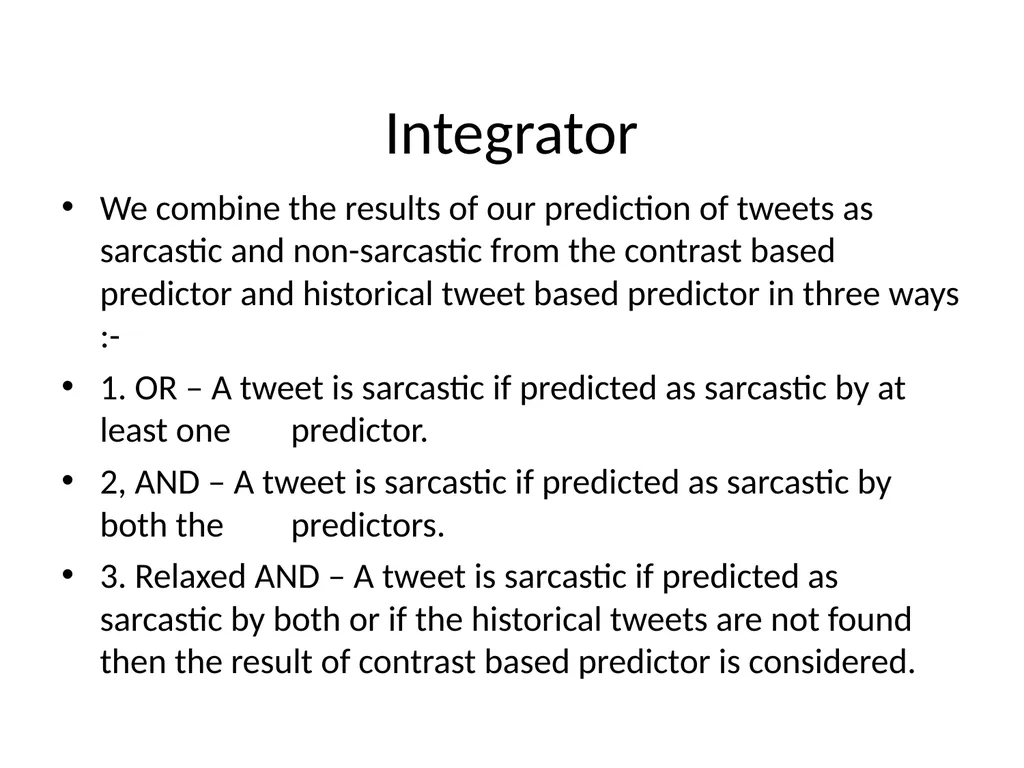
Integrator We combine the results of our prediction of tweets as sarcastic and non-sarcastic from the contrast based predictor and historical tweet based predictor in three ways :-
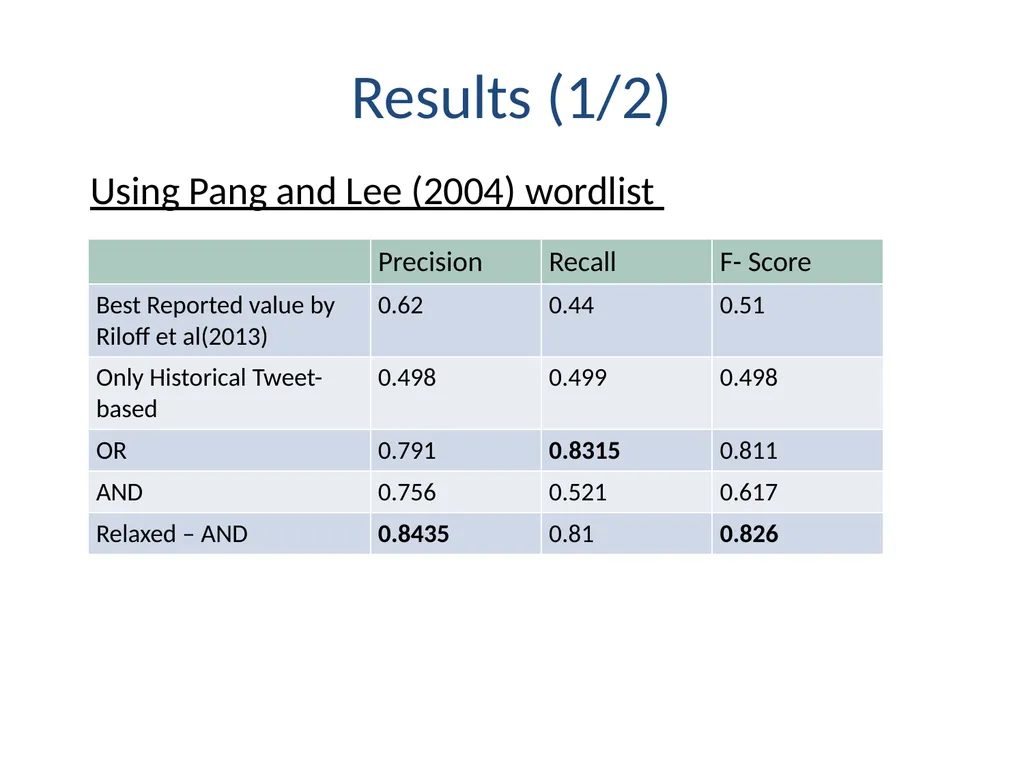
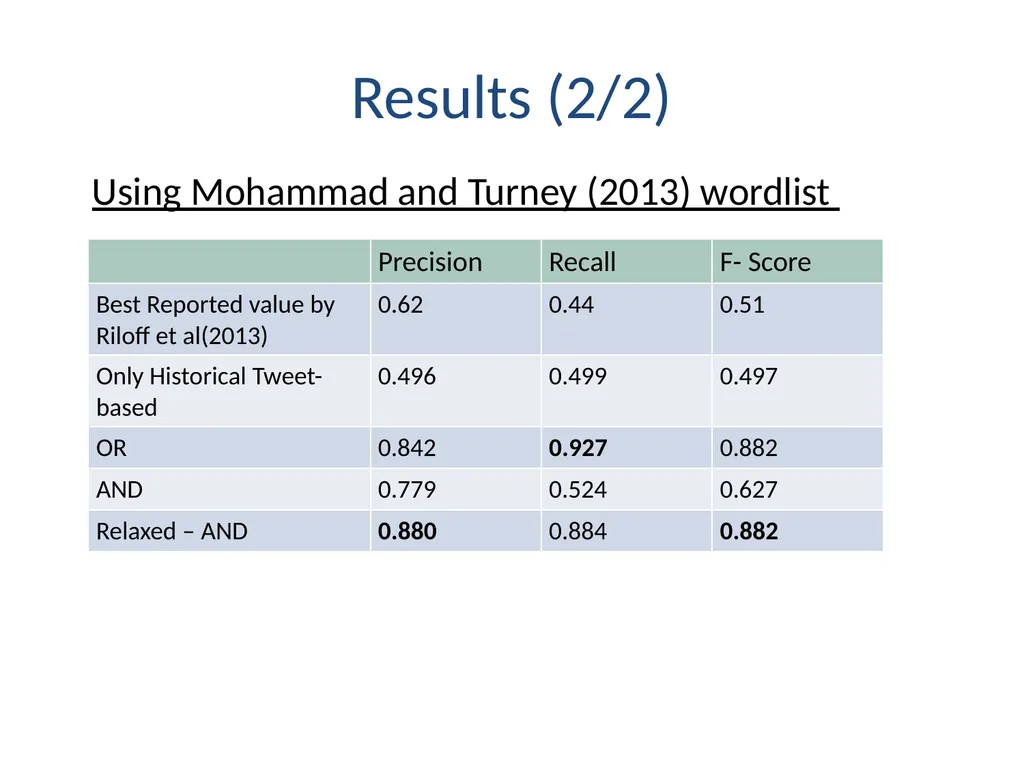
1. OR – A tweet is sarcastic if predicted as sarcastic by at least one predictor.
2, AND – A tweet is sarcastic if predicted as sarcastic by both the predictors.
3. Relaxed AND – A tweet is sarcastic if predicted as sarcastic by both or if the historical tweets are not found then the result of contrast based predictor is considered.<br>
1. OR – A tweet is sarcastic if predicted as sarcastic by at least one predictor.
2, AND – A tweet is sarcastic if predicted as sarcastic by both the predictors.
3. Relaxed AND – A tweet is sarcastic if predicted as sarcastic by both or if the historical tweets are not found then the result of contrast based predictor is considered.<br>
44
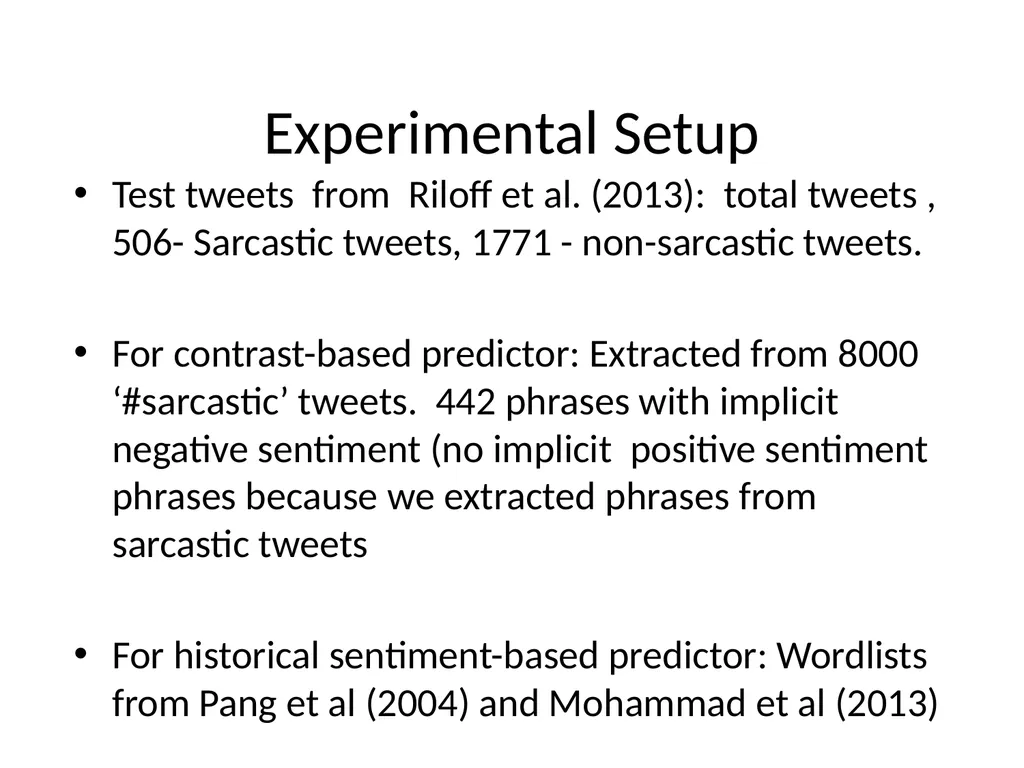
Experimental Setup Test tweets from Riloff et al. (2013): total tweets , 506- Sarcastic tweets, 1771 - non-sarcastic tweets.
For contrast-based predictor: Extracted from 8000 ‘#sarcastic’ tweets. 442 phrases with implicit negative sentiment (no implicit positive sentiment phrases because we extracted phrases from sarcastic tweets
For historical sentiment-based predictor: Wordlists from Pang et al (2004) and Mohammad et al (2013)<br>
For contrast-based predictor: Extracted from 8000 ‘#sarcastic’ tweets. 442 phrases with implicit negative sentiment (no implicit positive sentiment phrases because we extracted phrases from sarcastic tweets
For historical sentiment-based predictor: Wordlists from Pang et al (2004) and Mohammad et al (2013)<br>
45
Results (1/2) Using Pang and Lee (2004) wordlist<br>
46
Results (2/2) Using Mohammad and Turney (2013) wordlist<br>
47
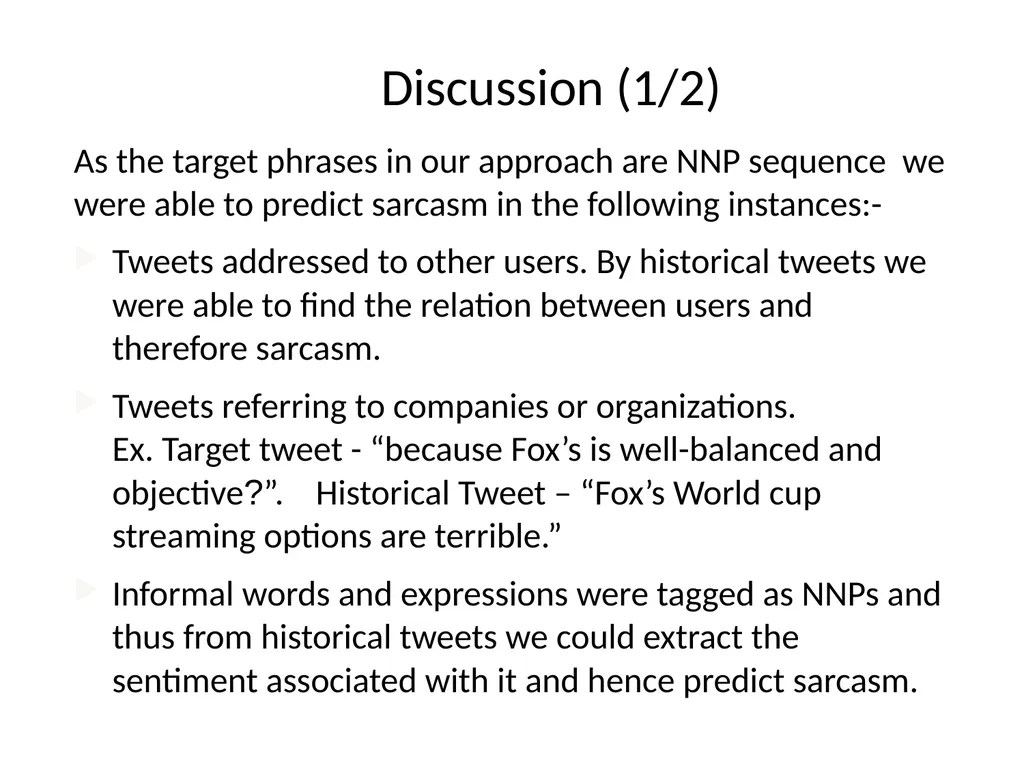
Discussion (1/2) As the target phrases in our approach are NNP sequence we were able to predict sarcasm in the following instances:-
Tweets addressed to other users. By historical tweets we were able to find the relation between users and therefore sarcasm.
Tweets referring to companies or organizations. Ex. Target tweet - “because Fox’s is well-balanced and objective?”. Historical Tweet – “Fox’s World cup streaming options are terrible.”
Informal words and expressions were tagged as NNPs and thus from historical tweets we could extract the sentiment associated with it and hence predict sarcasm.<br>
Tweets addressed to other users. By historical tweets we were able to find the relation between users and therefore sarcasm.
Tweets referring to companies or organizations. Ex. Target tweet - “because Fox’s is well-balanced and objective?”. Historical Tweet – “Fox’s World cup streaming options are terrible.”
Informal words and expressions were tagged as NNPs and thus from historical tweets we could extract the sentiment associated with it and hence predict sarcasm.<br>
48
Discussion (2/2) Limitation of our approach:
The assumption that our historical tweet-based predictor makes is that the author has not been sarcastic about a target phrase in the past.
A twitter timeline may be private or twitter handle name was changed or account was deactivated.<br>
The assumption that our historical tweet-based predictor makes is that the author has not been sarcastic about a target phrase in the past.
A twitter timeline may be private or twitter handle name was changed or account was deactivated.<br>
49
Conclusion We present a sarcasm detection approach based on a linguistic theory: context incongruity
Our features perform 5% over a baseline of unigrams for tweets, and 8% for discussion forum posts.
We also outperform two past works substantially.
We introduce the concept of ‘looking beyond target text’ for sarcasm detection using inter-sentential incongruity. This promises to be an exciting future work! 49<br>
Our features perform 5% over a baseline of unigrams for tweets, and 8% for discussion forum posts.
We also outperform two past works substantially.
We introduce the concept of ‘looking beyond target text’ for sarcasm detection using inter-sentential incongruity. This promises to be an exciting future work! 49<br>