
APPLIED GEOMORPHOLOGY - UNIT:V APPLIED GMORPHOLGY
MY
Published · 24 slides · 0 views
1 / 1


Description
APPLIED GEOMORPHOLOGY - UNIT:V APPLIED GMORPHOLGY ENGINERRING AND LANDUSE PLANNING Dr. B.ANUSUYA, Assistant Professor Head, Department of Geography, Government College for Women (A), Kumbakonam. GOVERNMENT COLLEGE FOR WOMEN (AUTONOMOUS)
Related Topics
Share
Embed code
Download this presentation From Below
"APPLIED GEOMORPHOLOGY - UNIT:V APPLIED GMORPHOLGY" is the property of its rightful owner. Permission is granted to download and print the materials on this website for personal, non-commercial use only, and to display it on your personal computer provided you do not modify the materials and that you retain all copyright notices contained in the materials. By downloading content from our website, you accept the terms of this agreement.
Presentation Transcript
01
APPLIED GEOMORPHOLOGY - UNIT:V
APPLIED GMORPHOLGY
ENGINERRING AND LANDUSE PLANNING Dr. B.ANUSUYA,
Assistant Professor & Head,
Department of Geography,
Government College for Women (A),
Kumbakonam. GOVERNMENT COLLEGE FOR WOMEN (AUTONOMOUS) KUMBAKONAM
DEPARTMENT OF GEOGRAPHY I – M.Sc - GEOGRAPHY<br>
Assistant Professor & Head,
Department of Geography,
Government College for Women (A),
Kumbakonam. GOVERNMENT COLLEGE FOR WOMEN (AUTONOMOUS) KUMBAKONAM
DEPARTMENT OF GEOGRAPHY I – M.Sc - GEOGRAPHY<br>
02
UNIT: V
APPLIED GEOMORPHOLOGY - P18GC101
APPLIED GEOMORPHOLOGY
ENGINEERING AND LANDUSE PLANNING Geomorphology and Engineering Works:
Engineering works most often involve evaluation of geologic factors of one type or another; terrain characteristics are among the most common factors.
Road Construction:
The most feasible highway routes would be best determined by the topographic features of the area. Knowledge of the geologic structure, lithological and stratigraphic characteristics, strength of the surficial deposits, geomorphic history of the area, among other things are of importance in road engineering.<br>
Engineering works most often involve evaluation of geologic factors of one type or another; terrain characteristics are among the most common factors.
Road Construction:
The most feasible highway routes would be best determined by the topographic features of the area. Knowledge of the geologic structure, lithological and stratigraphic characteristics, strength of the surficial deposits, geomorphic history of the area, among other things are of importance in road engineering.<br>
03
A route over a karst plain necessitates repeated cut and fill otherwise the road will be flooded after heavy rains as sinkholes fill with surface runoff. Bridge abutments in a karst region should be so designed that they will not be weakened by enlarged solutional cavities which are likely to be present.
Glacial terrains present many types of engineering problems. A flat till plain is topographically ideal for road construction, but in areas where end-moraines, eskers, kames or drumlins exist there is need for cut and fill to avoid circuitous routes. Muck areas, which mark sites of former lakes, are unsuited for roads which are to carry heavy traffic. If a road is built across them as they are, heavy traffic will cause the plastic materials beneath the lake floor to flow, and ‘sinks’ in the road bed will result. To avoid this, the lacustrine fill may have to be excavated and replaced with materials that will not flow under heavy load.<br>
Glacial terrains present many types of engineering problems. A flat till plain is topographically ideal for road construction, but in areas where end-moraines, eskers, kames or drumlins exist there is need for cut and fill to avoid circuitous routes. Muck areas, which mark sites of former lakes, are unsuited for roads which are to carry heavy traffic. If a road is built across them as they are, heavy traffic will cause the plastic materials beneath the lake floor to flow, and ‘sinks’ in the road bed will result. To avoid this, the lacustrine fill may have to be excavated and replaced with materials that will not flow under heavy load.<br>
04
Areas with the considerable relief which characterises late youth and early maturity will necessitate much bridge construction and many cuts and fills. In such areas landslides, earth flows and slumping become serious problems.
In highway construction designed to carry heavy traffic, the nature of the soil beneath a road surface, or what is called the subgrade, has become increasingly significant because of its control over the drainage beneath a highway.
The lifetime of a highway, under moderate loads, is determined largely by two factors: the quality of the aggregate used in the highway and the soil texture and drainage of its subgrade.
Thus an appreciation of the relationships of soils to varying topographic conditions and type of parent material becomes essential in modern highway construction. A knowledge of soil profiles, which to a large degree reflect the influence of geomorphic conditions and history, is basic. Poor highway performance characterises silty-clay subgrades with a high water table, and best performance is found on granular materials with a low water table.<br>
In highway construction designed to carry heavy traffic, the nature of the soil beneath a road surface, or what is called the subgrade, has become increasingly significant because of its control over the drainage beneath a highway.
The lifetime of a highway, under moderate loads, is determined largely by two factors: the quality of the aggregate used in the highway and the soil texture and drainage of its subgrade.
Thus an appreciation of the relationships of soils to varying topographic conditions and type of parent material becomes essential in modern highway construction. A knowledge of soil profiles, which to a large degree reflect the influence of geomorphic conditions and history, is basic. Poor highway performance characterises silty-clay subgrades with a high water table, and best performance is found on granular materials with a low water table.<br>
05
Dam Site Selection:
Selecting sites for the construction of dams would be greatly helped by a synthesis of knowledge concerning geomorphology, lithology, and geologic structure of terrains.
Five main requirements of good reservoir sites depend on geologic conditions, according to Kirk Bryan:
(1) a water-tight basin of adequate size; (2) a narrow outlet of the basin with a foundation that will permit economical construction of a dam; (3) opportunity to build an adequate and safe spillway to carry surplus waters; (4) availability of materials needed for dam construction (this is particularly true of earthen dams); and (5) assurance that the life of the reservoir will not be too short as a result of excessive deposition of mud and silt.<br>
Selecting sites for the construction of dams would be greatly helped by a synthesis of knowledge concerning geomorphology, lithology, and geologic structure of terrains.
Five main requirements of good reservoir sites depend on geologic conditions, according to Kirk Bryan:
(1) a water-tight basin of adequate size; (2) a narrow outlet of the basin with a foundation that will permit economical construction of a dam; (3) opportunity to build an adequate and safe spillway to carry surplus waters; (4) availability of materials needed for dam construction (this is particularly true of earthen dams); and (5) assurance that the life of the reservoir will not be too short as a result of excessive deposition of mud and silt.<br>
06
Limestone terrain, for instance, may prove a difficult one for constructing a dam. The bedrock surface may be irregular because of differential solution and, unless a true picture of the subsurface is understood, it could lead to avoidable expenditure.
A construction in a valley is desirable from the standpoint of the size of the dam that will have to be built, but it may not always be a good dam site. In glaciated areas, where buried bedrock valleys containing sand and gravel fills are common, surficial topography may not give an adequate picture of sub-surface conditions.
On a superficial level, a dam could be situated at a constriction in a valley between a valley wall on one side and a spur end on the other. However, it is possible that the subsurface topography is not suitable; there may be a buried preglacial valley with sand and gravel in it. The dam, if built on such a site, would leak.<br>
A construction in a valley is desirable from the standpoint of the size of the dam that will have to be built, but it may not always be a good dam site. In glaciated areas, where buried bedrock valleys containing sand and gravel fills are common, surficial topography may not give an adequate picture of sub-surface conditions.
On a superficial level, a dam could be situated at a constriction in a valley between a valley wall on one side and a spur end on the other. However, it is possible that the subsurface topography is not suitable; there may be a buried preglacial valley with sand and gravel in it. The dam, if built on such a site, would leak.<br>
07
Construction of Air Strips While selecting sites for air strips, where aeroplanes may land and take off from, requires engineering skill, the engineer could well benefit from a geomorphologist’s knowledge of landscape characteristics. The best sites for air strips would show an extensive flat surface with resistant geomaterials available: here a safe and suitable runway can be constructed. Furthermore, the ground surface should show an almost level slope, the area should be free of floods and marked by good visibility (may be free of frequent and intense fog). These characteristics could be gathered from a morphological map of the region where the air strip is to be built.
Locating Sand and Gravel Pits:
Sand and gravel have many engineering as well as commercial and industrial uses. Selection of suitable sites for sand and gravel pits will entail evaluation of such geologic factors as variation in grade sizes, lithologic composition, degree of weathering, amount of overburden and continuity of the deposits. Sand and gravel may be found as floodplain, river terrace, alluvial fan and cone, talus, wind-blown, residual and glacial deposits of various types.<br>
Locating Sand and Gravel Pits:
Sand and gravel have many engineering as well as commercial and industrial uses. Selection of suitable sites for sand and gravel pits will entail evaluation of such geologic factors as variation in grade sizes, lithologic composition, degree of weathering, amount of overburden and continuity of the deposits. Sand and gravel may be found as floodplain, river terrace, alluvial fan and cone, talus, wind-blown, residual and glacial deposits of various types.<br>
08
All have distinctive topographic relationships and expressions and varying inherent qualities and possibilities of development. Recognition of the type of deposit is essential to proper evaluation of its potentialities. Demand for gravel is generally greater than for sand, particularly in recent years with the decreased use of plaster in home construction, and thus knowledge of the percentages of various grade sizes is important.
Floodplain deposits are likely to contain high proportions of silt and sand and show many variable and heterogeneous lateral and vertical gradations. Alluvial fan and cone gravels are angular in shape as well as variable in size, especially near their apices. Talus materials, in addition to being angular, are too large to be suitable for most uses and are limited in extent.
Wind-blown sands may be satisfactory sources of sand but have no gravel in them. Residual deposits lack assortment and are likely to contain pebbles that are too deeply weathered to be suitable for use as aggregate in cement work. A high percentage of iron-coated chert when used as aggregate usually has deleterious effects. Residual deposits are furthermore likely to be limited in extent.<br>
Floodplain deposits are likely to contain high proportions of silt and sand and show many variable and heterogeneous lateral and vertical gradations. Alluvial fan and cone gravels are angular in shape as well as variable in size, especially near their apices. Talus materials, in addition to being angular, are too large to be suitable for most uses and are limited in extent.
Wind-blown sands may be satisfactory sources of sand but have no gravel in them. Residual deposits lack assortment and are likely to contain pebbles that are too deeply weathered to be suitable for use as aggregate in cement work. A high percentage of iron-coated chert when used as aggregate usually has deleterious effects. Residual deposits are furthermore likely to be limited in extent.<br>
09
Terraced valley trains and outwash plains are usually favourable sites for pits, for they do not have a thick overburden and are usually extensive.
Geomorphology and Military Geology:
Thornbury points out the importance of geomorphology in the context of war.
“World War I was largely stabilised trench warfare, and the information that was most useful was more geologic than geomorphic in nature (Brooks, 1921). Information about the kind of rock that would be encountered in digging trenches, in mining and countermining and the possibilities of water supply and supplies of other geologic materials was most utilised. Topography did play a role in maneuvering and planning routes of attack, but it can hardly be said that the Allies utilised basic geomorphic knowledge to any great extent.<br>
Geomorphology and Military Geology:
Thornbury points out the importance of geomorphology in the context of war.
“World War I was largely stabilised trench warfare, and the information that was most useful was more geologic than geomorphic in nature (Brooks, 1921). Information about the kind of rock that would be encountered in digging trenches, in mining and countermining and the possibilities of water supply and supplies of other geologic materials was most utilised. Topography did play a role in maneuvering and planning routes of attack, but it can hardly be said that the Allies utilised basic geomorphic knowledge to any great extent.<br>
10
“With development of the blitzkrieg type of warfare during World War II, topography became more important, because the effectiveness of a blitz depends to a large degree upon the trafficability of the terrain. As a consequence, in more recent years terrain appreciation or terrain analysis have become semi-magic words with the military. A geomorphologist may lack knowledge as to how best to utilise terrains in military operations, but certainly his concepts of terrain conditions are far more adequate than those of the military specialist or other geologists for that matter. He appreciates that landforms are the result of an interaction of geomorphic and geologic processes through time; that landforms are not groups of unrelated and haphazard individual forms but have systematic relationships that reveal their origins and tell much about the underlying bedrock geology and structure, as well as the soils and vegetation of a region.<br>
11
As Erdmann (1943) put it, the geomorphologist has ‘an eye for the ground or an instinctive eye for configuration, the judgement of how distant ground, seen or unseen, is likely to lie when you come to it… Terrain is the common denominator of geology and war.’ Whether it is in connection with the interpretation of topographic maps or aerial photographs, this basic appreciation of different types of terrain is fundamental to a proper planning of military campaigns.”
Regarding the use of aerial photographs in this connection, Hunt (1950) stated: “Even where geologic maps are lacking or are on such a small- scale as to be practically useless for tactical intelligence, geologic principles can be applied with advantage to interpreting the terrain from aerial photographs. Little training in reading vertical photographs is required to recognise mountains, hills, lakes, rivers, woods, plains or some kinds of swamps. But much more than that can and should be interpreted from the pictures for the purposes of acquiring complete terrain intelligence. It is essential to know the kind of hill, the kind of plain, the kind of river or lake, and so on, because by knowing this it is frequently possible to reconstruct the geology.<br>
Regarding the use of aerial photographs in this connection, Hunt (1950) stated: “Even where geologic maps are lacking or are on such a small- scale as to be practically useless for tactical intelligence, geologic principles can be applied with advantage to interpreting the terrain from aerial photographs. Little training in reading vertical photographs is required to recognise mountains, hills, lakes, rivers, woods, plains or some kinds of swamps. But much more than that can and should be interpreted from the pictures for the purposes of acquiring complete terrain intelligence. It is essential to know the kind of hill, the kind of plain, the kind of river or lake, and so on, because by knowing this it is frequently possible to reconstruct the geology.<br>
12
The interpreter, with some confidence, can then make predictions as to water supply, the kind and depth of soil, traffic-ability, ground drainage and other construction problems, construction materials, movement and cover, and many of the other elements that are essential to an adequate estimate of the terrain situation. In brief, therefore, aerial photographs are useful to the preparation of terrain intelligence insofar as they provide information on the geology of’ the area. Identification of a hill or other terrain feature is but a small part of the story that can be read from a photograph; all important is the recognition of the significance of the particular landform, in terms of kind of ground and slope.”<br>
13
Geomorphology and Urbanisation:
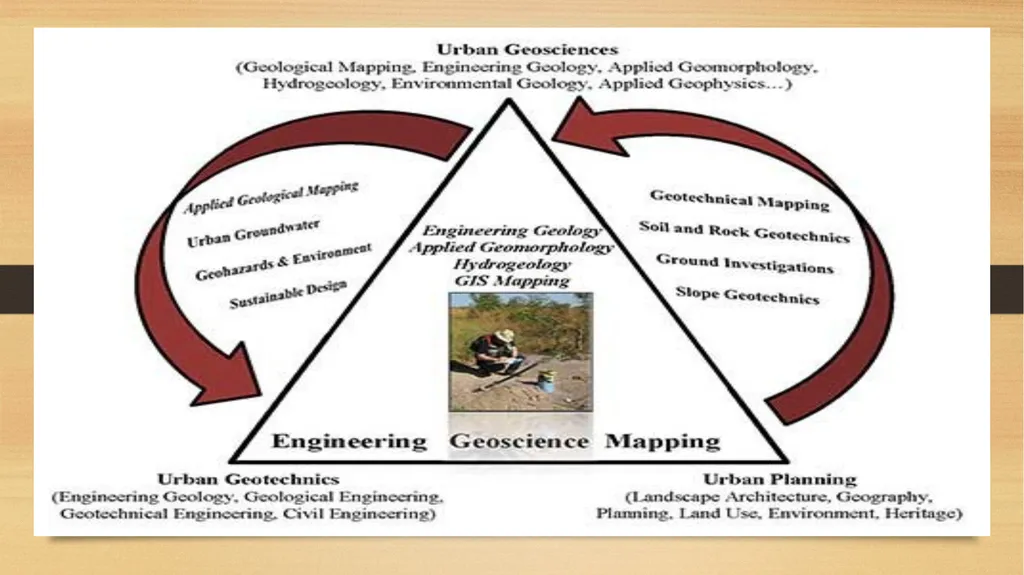
Geomorphological knowledge applied to urban development has become important enough to grow into a separate branch, namely, urban geomorphology. This branch of geomorphology is concerned with “the study of landforms and their related processes, materials and hazards, ways that are beneficial to planning, development and management of urbanised areas where urban growth is expected,” according to R.U. Cooke.
A city or town depends for its stability, safety, basic needs and, later, its expansion on geomorphological features: lithological and topographical features, hydrological conditions and geomorphic features. An urban geomorphologist begins work even before urban development through field survey, terrain classification, identification and selection of alternative sites for settlements. During and after urban development, an urban geomorphologist would be concerned with studying the impact of natural events on’ the urban community and that of urban development on the environment.<br>
Geomorphological knowledge applied to urban development has become important enough to grow into a separate branch, namely, urban geomorphology. This branch of geomorphology is concerned with “the study of landforms and their related processes, materials and hazards, ways that are beneficial to planning, development and management of urbanised areas where urban growth is expected,” according to R.U. Cooke.
A city or town depends for its stability, safety, basic needs and, later, its expansion on geomorphological features: lithological and topographical features, hydrological conditions and geomorphic features. An urban geomorphologist begins work even before urban development through field survey, terrain classification, identification and selection of alternative sites for settlements. During and after urban development, an urban geomorphologist would be concerned with studying the impact of natural events on’ the urban community and that of urban development on the environment.<br>
14
It has been pointed out by R.U. Cooke that “various geomorphological problems hitherto not understood by the planners and engineers lead to destruction and damage to urban settlements in varying environmental realms viz., settling of foundation materials in the dry lands of oil-rich states and in the periglacial regions; destruction of foundations by weathering processes; damage of highways; damage to buildings through inundation during floods in the subtropical humid regions etc.
All these and many other problems arise in part from mismanagement or misunderstanding of geomorphological conditions.” Very little attention is paid to understanding the geomorphological conditions before the development of existing urban centres mainly in the developing countries. This results in uncontrolled growth, giving rise to squatter settlements or shanty towns. It commonly creates serious social and environmental problems.<br>
All these and many other problems arise in part from mismanagement or misunderstanding of geomorphological conditions.” Very little attention is paid to understanding the geomorphological conditions before the development of existing urban centres mainly in the developing countries. This results in uncontrolled growth, giving rise to squatter settlements or shanty towns. It commonly creates serious social and environmental problems.<br>
15
Geomorphology and Hazard Management:
Events, natural or man-induced, exceeding a tolerable level or of an unexpected nature may be called hazards. A geomorphic hazard, says Chorley, may be defined as “any change, natural or man- made, that may affect the geomorphic stability of a landform to the adversity of’ living things”. These hazards may arise from long-term factors such as faulting, folding, warping, uplifting, subsidence caused by earth movements, or changes in vegetation cover and hydrologic regime caused by climatic change. More immediate and sudden hazards are volcanic eruptions, earthquakes, landslides, avalanches, floods, etc.
Geomorphic knowledge can be of use in identifying and predicting such hazards and in assessing their effects and proper management.<br>
Events, natural or man-induced, exceeding a tolerable level or of an unexpected nature may be called hazards. A geomorphic hazard, says Chorley, may be defined as “any change, natural or man- made, that may affect the geomorphic stability of a landform to the adversity of’ living things”. These hazards may arise from long-term factors such as faulting, folding, warping, uplifting, subsidence caused by earth movements, or changes in vegetation cover and hydrologic regime caused by climatic change. More immediate and sudden hazards are volcanic eruptions, earthquakes, landslides, avalanches, floods, etc.
Geomorphic knowledge can be of use in identifying and predicting such hazards and in assessing their effects and proper management.<br>
16
Regular measurement of seismic events and earth tremors by seismic methods; regular measurement of ground surface, mainly tilt measurement by tilt metres; constant measurement of temperature of crater lakes, hot springs, geysers, fumaroles; monitoring of gases coming out of craters, hot springs, geysers; monitoring of changes in the configuration of dormant or extinct volcanoes by lasers; measurement of local gravity and magnetic fields and their trends etc., help in making predictions of possible eruptions in the areas having past case histories of vulcanism. The path of lava flow can be better predicted on the basis of detailed analysis of topography and identification of possible eruption points.
The geomorphic knowledge of the behaviour of a river system and its morphological characteristics viz. channel geometry, channel morphology and channel pattern, river metamorphosis, bank morphology etc., may help in controlling river floods through flood control measures.<br>
The geomorphic knowledge of the behaviour of a river system and its morphological characteristics viz. channel geometry, channel morphology and channel pattern, river metamorphosis, bank morphology etc., may help in controlling river floods through flood control measures.<br>
17
These include steps:
(i) To delay the return of runoff resulting from torrential rainfall to the rivers;
(ii) To hasten the discharge of water (by straightening the meandering channels);
(iii) To divert the flow of water (through, diversion channels);
(iv) To reduce the impact of floods (through construction of protective embankments); and
(v) To forewarn the occurrence of floods.
Without the knowledge of the nature of erosion in the upper catchment area and sediment ” load characteristics of the river, the construction of levees to confine the flood water within the valley may prove disastrous: if the rate of erosion is very high in the upper catchment area, resulting in high sediment load, there would be more sedimentation in the valley causing a gradual rise in the river bed; this may lead to sudden flash floods whenever the levee is breached.<br>
(i) To delay the return of runoff resulting from torrential rainfall to the rivers;
(ii) To hasten the discharge of water (by straightening the meandering channels);
(iii) To divert the flow of water (through, diversion channels);
(iv) To reduce the impact of floods (through construction of protective embankments); and
(v) To forewarn the occurrence of floods.
Without the knowledge of the nature of erosion in the upper catchment area and sediment ” load characteristics of the river, the construction of levees to confine the flood water within the valley may prove disastrous: if the rate of erosion is very high in the upper catchment area, resulting in high sediment load, there would be more sedimentation in the valley causing a gradual rise in the river bed; this may lead to sudden flash floods whenever the levee is breached.<br>
18
Earthquakes may be natural or man-induced geomorphic hazards. The geomorphic knowledge of the stability of terrain and probable impacts of man-made structures (such as dams and reservoirs) on crustal stability is of paramount importance in identifying weaker zones which are likely to be affected by seismic events. Similarly, the geomorphic study of the nature of hill slopes and their associated lithologies enable us to know the stability or instability of the hill slopes. This knowledge would help in identifying and mapping unstable hill slopes unsuitable for human settlements and road construction.<br>
19
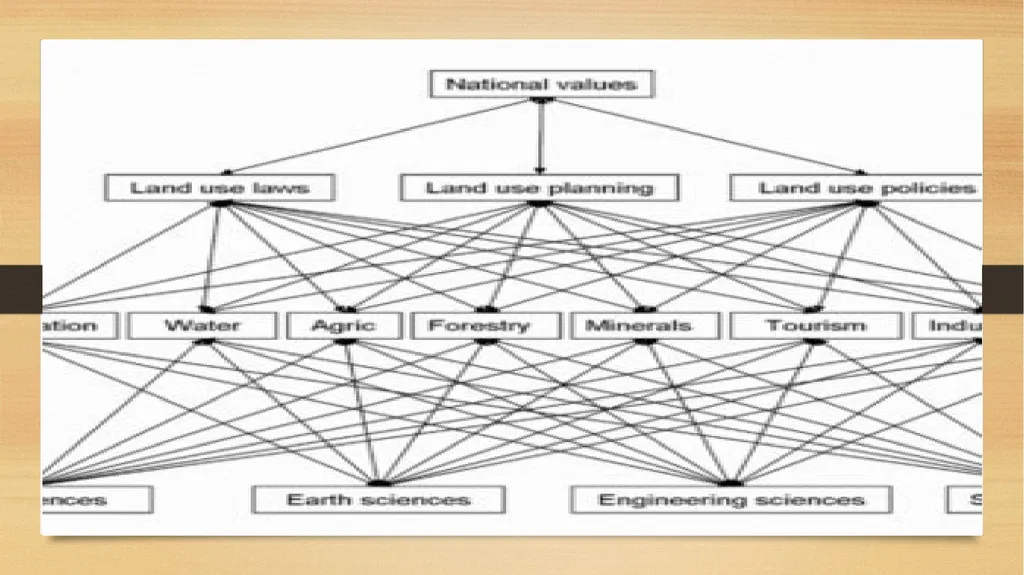
Geomorphology and Regional Planning:
Applied geomorphology has a place in regional planning. A balanced growth of a country’s economy requires a careful understanding of what each region offers in terms of resources, natural and human. Detailed information on topography, soils, hydrology, litho-logy and terrain characteristics are of obvious interest to enlightened regional planners who may then devise development projects best suited for the region.<br>
Applied geomorphology has a place in regional planning. A balanced growth of a country’s economy requires a careful understanding of what each region offers in terms of resources, natural and human. Detailed information on topography, soils, hydrology, litho-logy and terrain characteristics are of obvious interest to enlightened regional planners who may then devise development projects best suited for the region.<br>
20
Thank you<br>