
Applied linguistics research: a teacher's
AS
Published · 71 slides · 0 views

1 / 1













































Description
Applied linguistics research: a teachers perspective The Future of ELT Regents College June 30 2019 Penny Ur What do you think? Of the following factors, which do you feel has contributed most to your present teaching expertise? Give each
Related Topics
Share
Embed code
Download this presentation From Below
"Applied linguistics research: a teacher's" is the property of its rightful owner. Permission is granted to download and print the materials on this website for personal, non-commercial use only, and to display it on your personal computer provided you do not modify the materials and that you retain all copyright notices contained in the materials. By downloading content from our website, you accept the terms of this agreement.
Presentation Transcript
01
Applied linguistics research: a teacher's perspective The Future of ELT
Regent’s College June 30 2019
Penny Ur<br>
Regent’s College June 30 2019
Penny Ur<br>
02
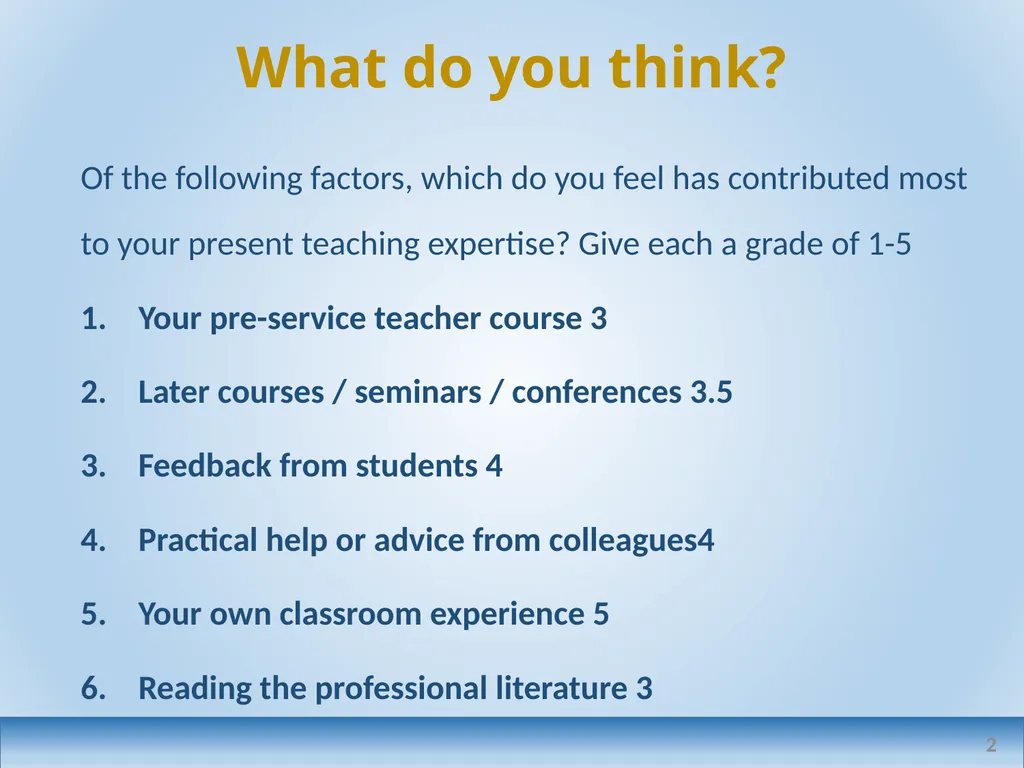
What do you think? Of the following factors, which do you feel has contributed most to your present teaching expertise? Give each a grade of 1-5
Your pre-service teacher course 3
Later courses / seminars / conferences 3.5
Feedback from students 4
Practical help or advice from colleagues4
Your own classroom experience 5
Reading the professional literature 3 2<br>
Your pre-service teacher course 3
Later courses / seminars / conferences 3.5
Feedback from students 4
Practical help or advice from colleagues4
Your own classroom experience 5
Reading the professional literature 3 2<br>
03
Conclusion? 3<br>
04
In general: the central role of experience in professional work Evidence from the field; what the teachers say
Evidence from other professions: doctors, lawyers, nurses: ‘novice versus expert’
Evidence from research on expertise
‘deliberate practice’ as the major factor
Ericsson et al., 2006
Gladwell, 2008 4<br>
Evidence from other professions: doctors, lawyers, nurses: ‘novice versus expert’
Evidence from research on expertise
‘deliberate practice’ as the major factor
Ericsson et al., 2006
Gladwell, 2008 4<br>
05
How useful is research
as a source of
professional knowledge for the teacher? 5<br>
06
Conflicting Approaches ‘Academic research has relatively modest value for teaching and learning’ (Maley, 2015)
VERSUS
‘This paper argues for ...the central place of research ... in the professional education of teachers.’ (Hudson, 2011) 6<br>
VERSUS
‘This paper argues for ...the central place of research ... in the professional education of teachers.’ (Hudson, 2011) 6<br>
07
Major ELT journals ELT Journal
TESOL Quarterly
RELC Journal
System 7<br>
TESOL Quarterly
RELC Journal
System 7<br>
08
My position Academic research is a minor, but significant, contributor to teacher expertise.
The problem is how to identify research that can benefit practitioners ...
... And how to make it accessible to them 8<br>
The problem is how to identify research that can benefit practitioners ...
... And how to make it accessible to them 8<br>
09
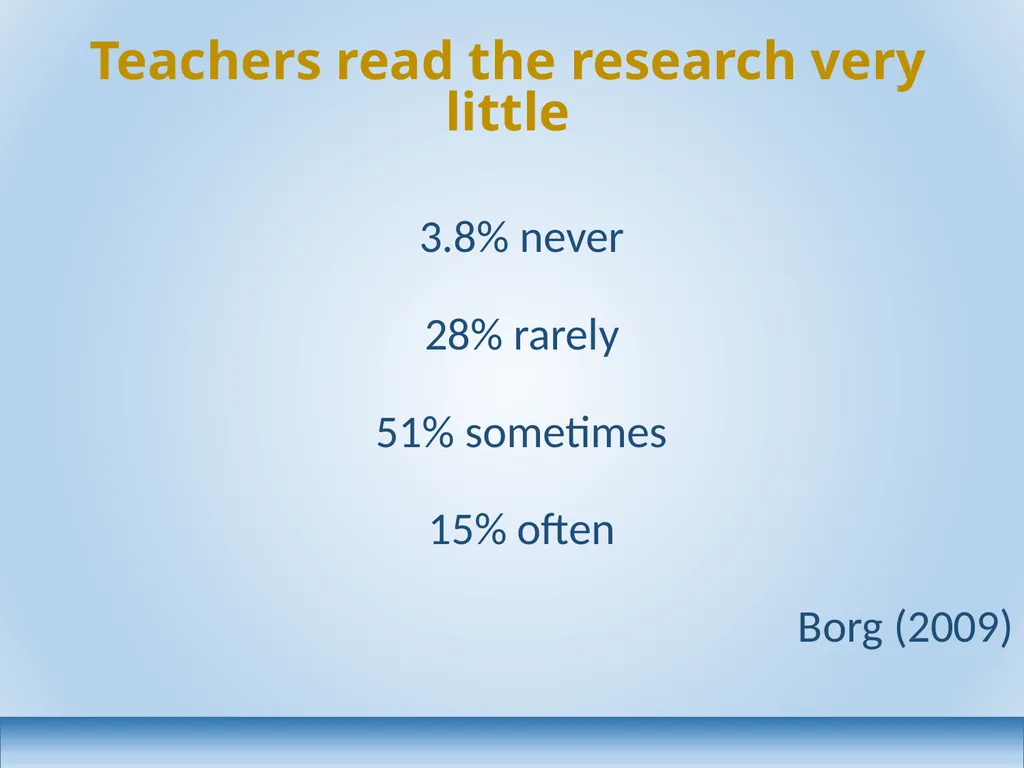
Teachers read the research very little 3.8% never
28% rarely
51% sometimes
15% often
Borg (2009)<br>
28% rarely
51% sometimes
15% often
Borg (2009)<br>
10
Why don’t teachers read the research? No time
Lack of clarity
Limited practical application Borg, 2009<br>
Lack of clarity
Limited practical application Borg, 2009<br>
11
No time A full teaching schedule (+ preparation + marking)
Reading the research is not part of most teachers’ job description.
Sometimes even actively discouraged! 11<br>
Reading the research is not part of most teachers’ job description.
Sometimes even actively discouraged! 11<br>
12
Lack of clarity Sometimes inevitable: specific terminology, statistics
Often unnecessary (and unforgivable!): difficult language for its own sake<br>
Often unnecessary (and unforgivable!): difficult language for its own sake<br>
13
Limited practical application (1)
Researcher aims Most researchers in our field are not doing research in order to be ‘useful’ or ‘practical’, but rather in order to...
... come up with, or test, interesting or insightful hypotheses
...complete a doctoral thesis
...get published in a prestigious journal<br>
... come up with, or test, interesting or insightful hypotheses
...complete a doctoral thesis
...get published in a prestigious journal<br>
14
Limited practical application (2)
Inadequate professional expertise of the researcher Where the research paper provides ‘practical pedagogical implications’, these are often in fact impractical.
Many excellent studies are followed by ‘off the wall’ suggestions for classroom teaching.<br>
Many excellent studies are followed by ‘off the wall’ suggestions for classroom teaching.<br>
15
Limited practical application (3) Pedagogical considerations English language teaching research is mainly on second language acquisition (SLA).
What about practical pedagogical issues?
For example:
large and/or heterogeneous classes
discipline problems
teaching for exams
the local culture of learning
limited preparation and teaching time<br>
What about practical pedagogical issues?
For example:
large and/or heterogeneous classes
discipline problems
teaching for exams
the local culture of learning
limited preparation and teaching time<br>
16
Limited practical application (4) Political or stakeholder pressure Local pressures may ensure that research-based policies are not implemented
e.g. The age of starting English in schools
Research: in the context of instructed language learning, late starters learn better.
(Muñoz & Singleton, 2011)
But the pressure of parents, politicians and commercial interests outweighs the evidence. 16<br>
e.g. The age of starting English in schools
Research: in the context of instructed language learning, late starters learn better.
(Muñoz & Singleton, 2011)
But the pressure of parents, politicians and commercial interests outweighs the evidence. 16<br>
17
The contribution of research to teacher knowledge 17<br>
18
In principle Research can provide us with ideas that we would not otherwise have encountered.
It enables us to progress beyond a ‘ceiling’ based on personal experience and discussion. 18<br>
It enables us to progress beyond a ‘ceiling’ based on personal experience and discussion. 18<br>
19
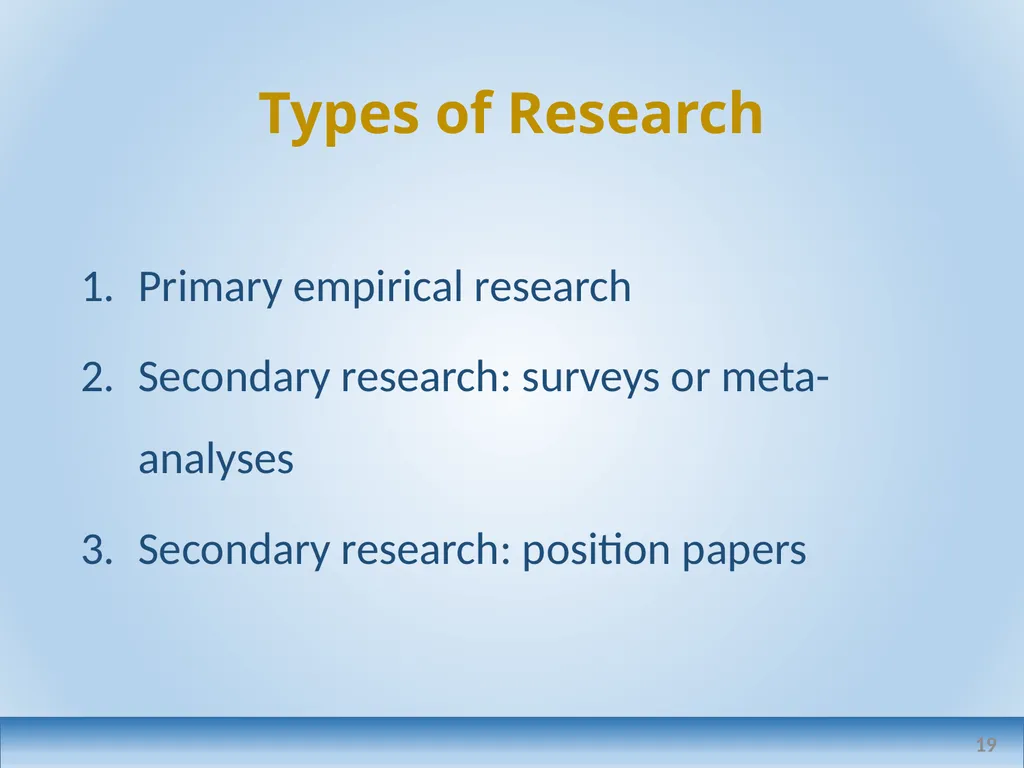
Types of Research Primary empirical research
Secondary research: surveys or meta-analyses
Secondary research: position papers 19<br>
Secondary research: surveys or meta-analyses
Secondary research: position papers 19<br>
20
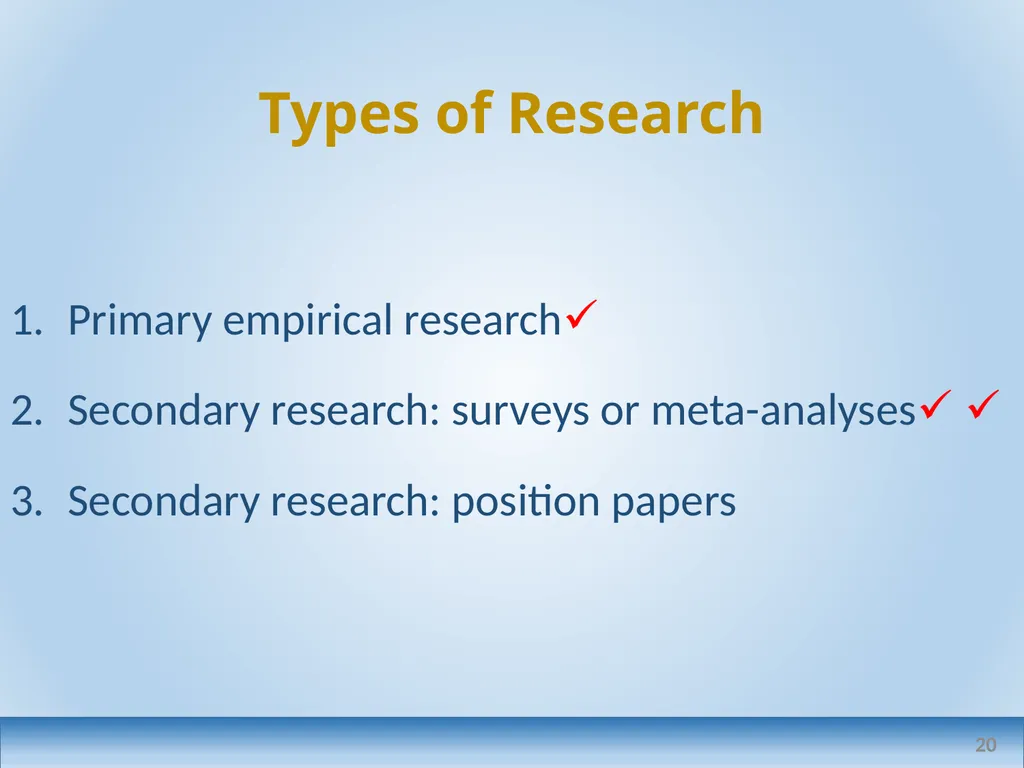
Types of Research Primary empirical research
Secondary research: surveys or meta-analyses
Secondary research: position papers 20<br>
Secondary research: surveys or meta-analyses
Secondary research: position papers 20<br>
21
The research can help us Confirm previous assumptions
Add more depth and detail to previous knowledge
Provide new information or ideas
‘Destabilize’: make us rethink previous assumptions 21<br>
Add more depth and detail to previous knowledge
Provide new information or ideas
‘Destabilize’: make us rethink previous assumptions 21<br>
22
Confirm previous assumptions 22<br>
23
Example 1 The importance of explicit grammar teaching
(Norris & Ortega, 2001)
A meta-analysis.
Found no significant advantage for ‘form-focus’ over ‘formS-focus’
But a clear conclusion with regard to explicit grammar teaching. 23<br>
(Norris & Ortega, 2001)
A meta-analysis.
Found no significant advantage for ‘form-focus’ over ‘formS-focus’
But a clear conclusion with regard to explicit grammar teaching. 23<br>
24
Example 2 The importance for mastery of repeated exposure to new vocabulary
(Webb 2007)
You need to encounter a new item several times in order to remember it.
How many?
6-16? 24<br>
(Webb 2007)
You need to encounter a new item several times in order to remember it.
How many?
6-16? 24<br>
25
Add more depth and detail
to previous knowledge 25<br>
26
Example The importance of ‘retrieval-based’ review of vocabulary (Karpicke & Roeder, 2008; Kang et al., 2013; Laufer & Rozovski-Roitblat, 2015) 26<br>
27
Retrieval Learners need multiple encounters with a new item in order to master it; but the quality of these encounters is significant.
Passive exposure, or repetition, doesn’t help much.
Learners need to be actively retrieving either form or meaning of the item in order to benefit. 27<br>
Passive exposure, or repetition, doesn’t help much.
Learners need to be actively retrieving either form or meaning of the item in order to benefit. 27<br>
28
Karpicke & Roeder, 2008 Groups of students given 40 words to learn in Swahili.
Subsequent learning through sessions based on
either
study (repeated exposure)
or
test (eliciting translations)
Students in the ‘test’ condition learned better. 28<br>
Subsequent learning through sessions based on
either
study (repeated exposure)
or
test (eliciting translations)
Students in the ‘test’ condition learned better. 28<br>
29
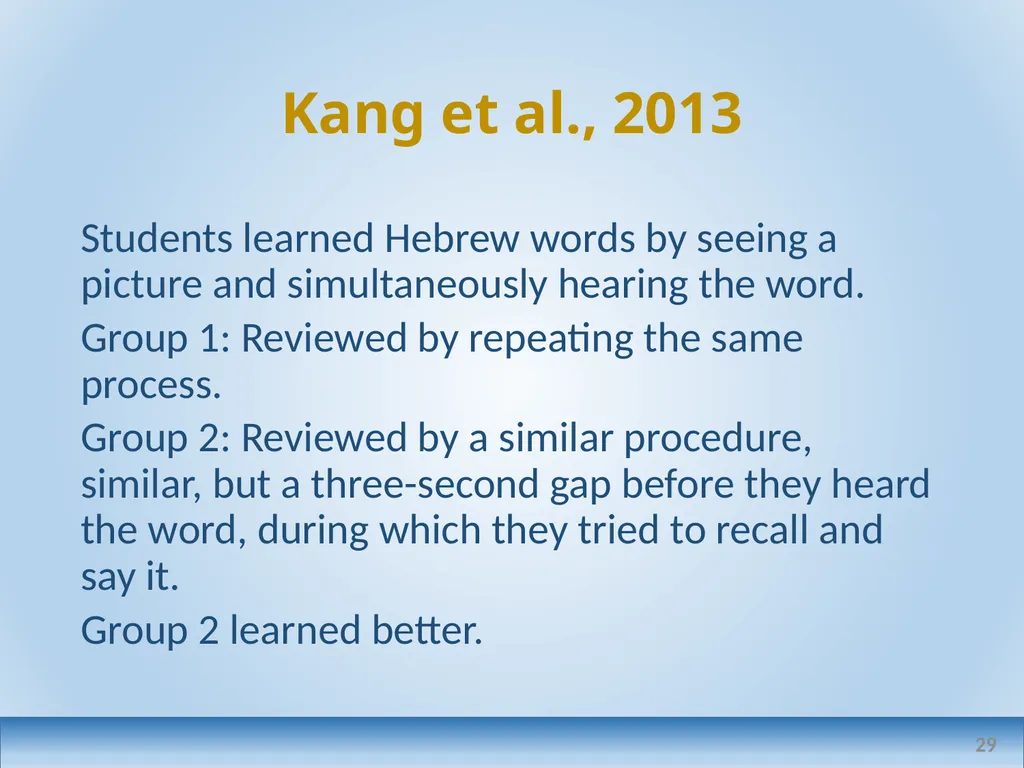
Kang et al., 2013 Students learned Hebrew words by seeing a picture and simultaneously hearing the word.
Group 1: Reviewed by repeating the same process.
Group 2: Reviewed by a similar procedure, similar, but a three-second gap before they heard the word, during which they tried to recall and say it.
Group 2 learned better. 29<br>
Group 1: Reviewed by repeating the same process.
Group 2: Reviewed by a similar procedure, similar, but a three-second gap before they heard the word, during which they tried to recall and say it.
Group 2 learned better. 29<br>
30
Laufer & Rozovski-Roitblat, 2015 Students learned words through encounter with them in a text (+ looking up).
Group 1: Re-encounter through further reading of the words in context.
Group 2: Re-encounter through focused exercises (recall / recognition).
Group 2 learned better. 30<br>
Group 1: Re-encounter through further reading of the words in context.
Group 2: Re-encounter through focused exercises (recall / recognition).
Group 2 learned better. 30<br>
31
Provide new information 31<br>
32
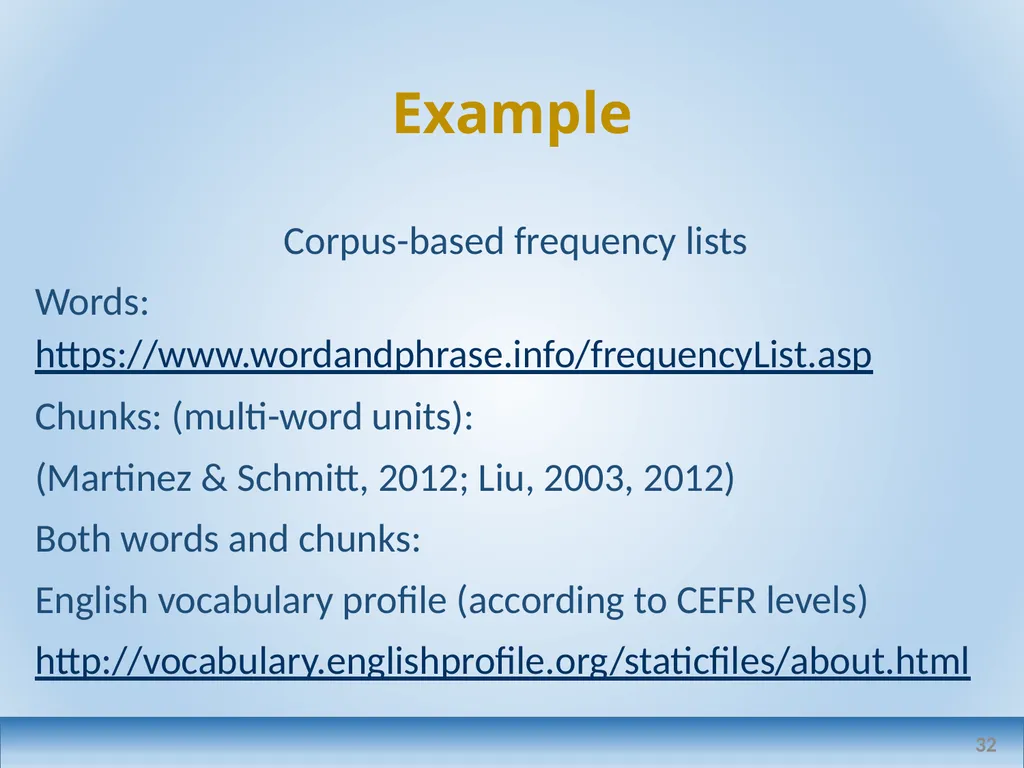
Example Corpus-based frequency lists
Words: https://www.wordandphrase.info/frequencyList.asp
Chunks: (multi-word units):
(Martinez & Schmitt, 2012; Liu, 2003, 2012)
Both words and chunks:
English vocabulary profile (according to CEFR levels)
http://vocabulary.englishprofile.org/staticfiles/about.html 32<br>
Words: https://www.wordandphrase.info/frequencyList.asp
Chunks: (multi-word units):
(Martinez & Schmitt, 2012; Liu, 2003, 2012)
Both words and chunks:
English vocabulary profile (according to CEFR levels)
http://vocabulary.englishprofile.org/staticfiles/about.html 32<br>
33
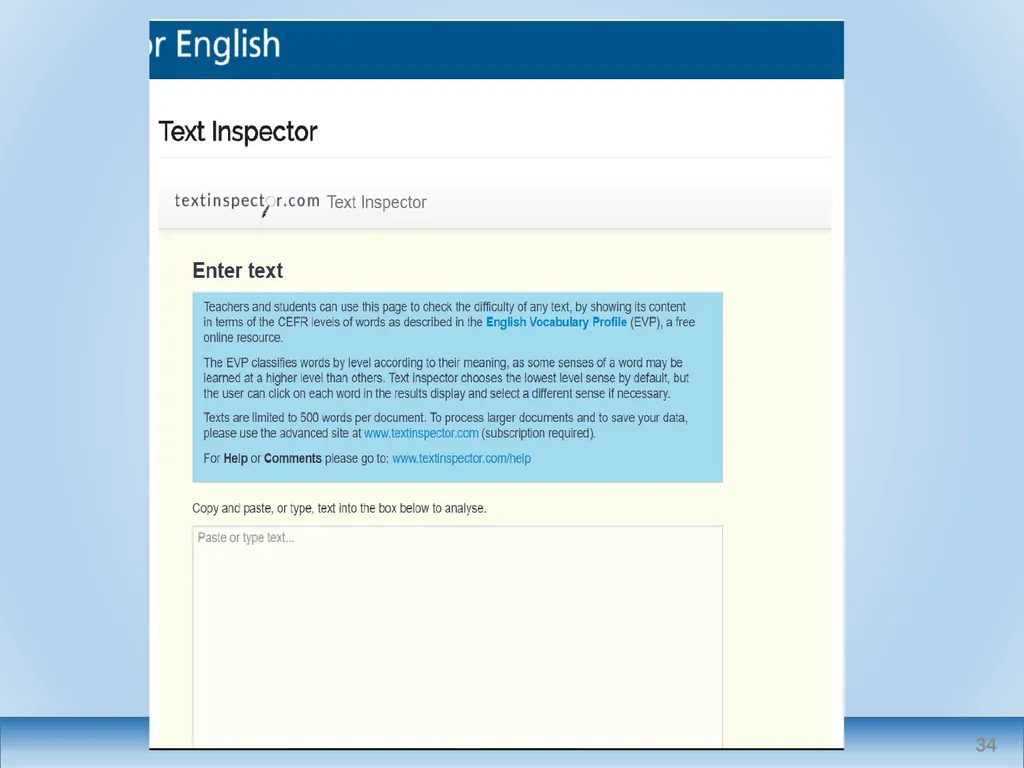
Uses For materials writers and teachers: selection of vocabulary
Particularly useful: vocabulary profiling tools
http://englishprofile.org/wordlists/text-inspector
https://www.wordandphrase.info/analyzeText.asp
https://www.lextutor.ca/vp/eng/ 33<br>
Particularly useful: vocabulary profiling tools
http://englishprofile.org/wordlists/text-inspector
https://www.wordandphrase.info/analyzeText.asp
https://www.lextutor.ca/vp/eng/ 33<br>
34
34<br>
35
Destabilize, or make us rethink previous assumptions 35<br>
36
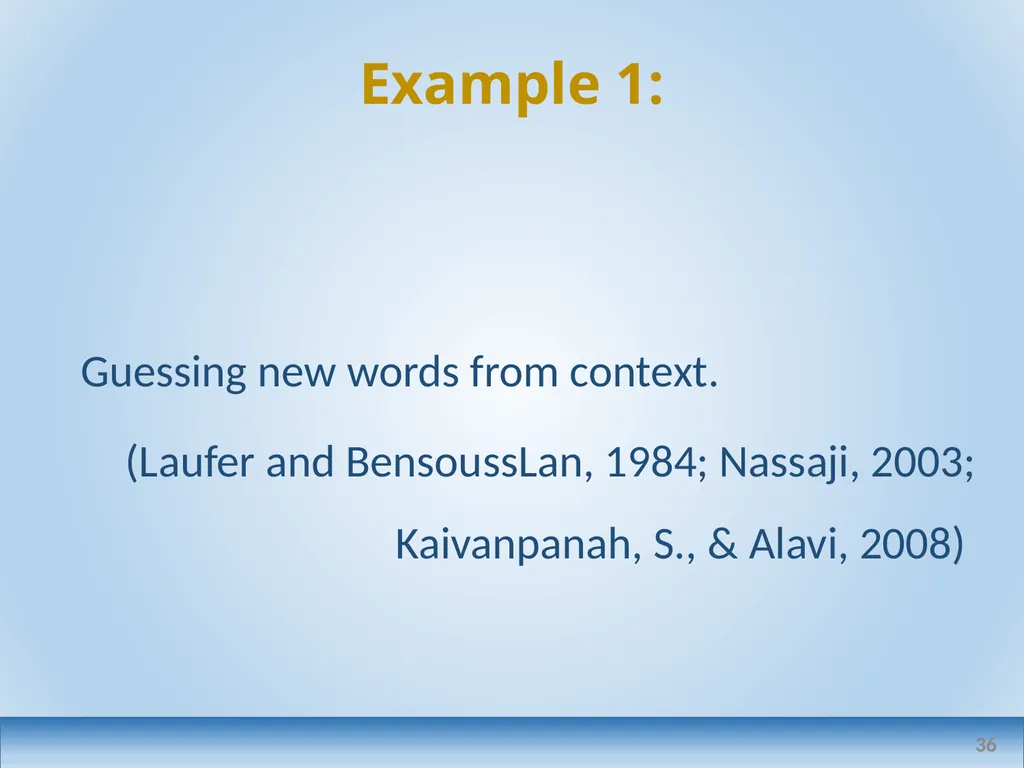
Example 1: Guessing new words from context.
(Laufer and BensoussLan, 1984; Nassaji, 2003; Kaivanpanah, S., & Alavi, 2008) 36<br>
(Laufer and BensoussLan, 1984; Nassaji, 2003; Kaivanpanah, S., & Alavi, 2008) 36<br>
37
BenSoussan & Laufer Of 70 unknown words the researchers determined that there were:
no contextual clues for 29
Partial clues for 28
Clear clues for 13
Students were able to guess correctly 17 out of the 70. 37<br>
no contextual clues for 29
Partial clues for 28
Clear clues for 13
Students were able to guess correctly 17 out of the 70. 37<br>
38
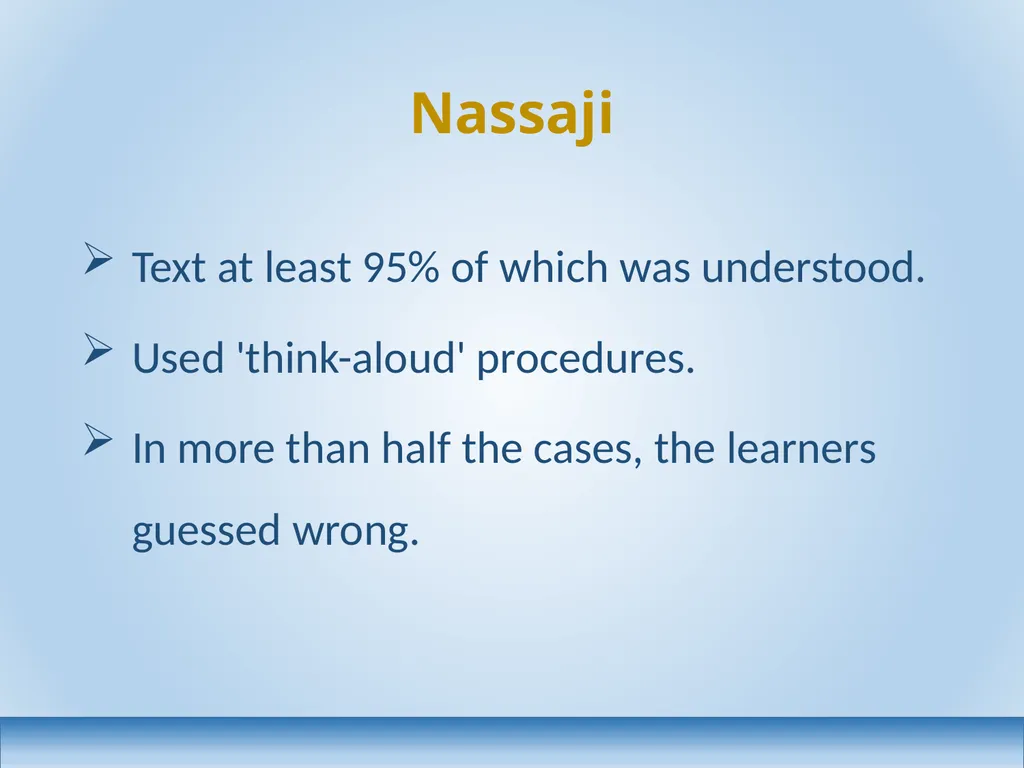
Nassaji Text at least 95% of which was understood.
Used 'think-aloud' procedures.
In more than half the cases, the learners guessed wrong.<br>
Used 'think-aloud' procedures.
In more than half the cases, the learners guessed wrong.<br>
39
Kaivanpanah, S., & Alavi, 2008 Not only did the students mostly guess wrong ...
... They also consistently over-estimated their own accuracy.<br>
... They also consistently over-estimated their own accuracy.<br>
40
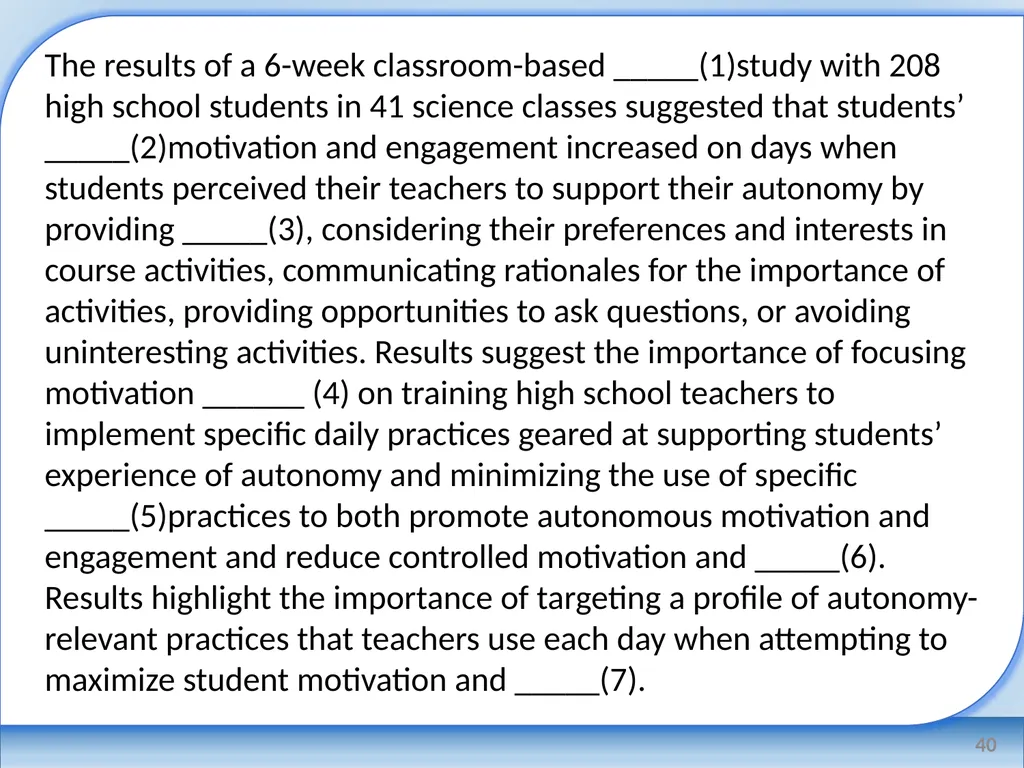
40 The results of a 6-week classroom-based _____(1)study with 208 high school students in 41 science classes suggested that students’ _____(2)motivation and engagement increased on days when students perceived their teachers to support their autonomy by providing _____(3), considering their preferences and interests in course activities, communicating rationales for the importance of activities, providing opportunities to ask questions, or avoiding uninteresting activities. Results suggest the importance of focusing motivation ______ (4) on training high school teachers to implement specific daily practices geared at supporting students’ experience of autonomy and minimizing the use of specific _____(5)practices to both promote autonomous motivation and engagement and reduce controlled motivation and _____(6). Results highlight the importance of targeting a profile of autonomy-relevant practices that teachers use each day when attempting to maximize student motivation and _____(7).<br>
41
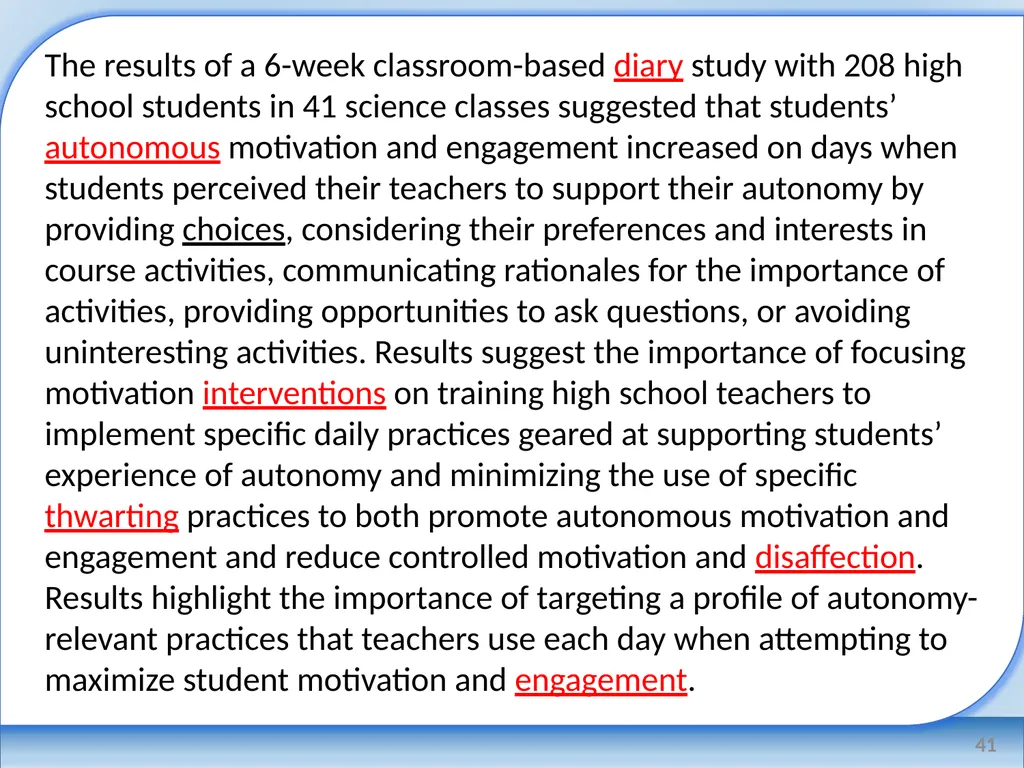
41 The results of a 6-week classroom-based diary study with 208 high school students in 41 science classes suggested that students’ autonomous motivation and engagement increased on days when students perceived their teachers to support their autonomy by providing choices, considering their preferences and interests in course activities, communicating rationales for the importance of activities, providing opportunities to ask questions, or avoiding uninteresting activities. Results suggest the importance of focusing motivation interventions on training high school teachers to implement specific daily practices geared at supporting students’ experience of autonomy and minimizing the use of specific thwarting practices to both promote autonomous motivation and engagement and reduce controlled motivation and disaffection. Results highlight the importance of targeting a profile of autonomy-relevant practices that teachers use each day when attempting to maximize student motivation and engagement.<br>
42
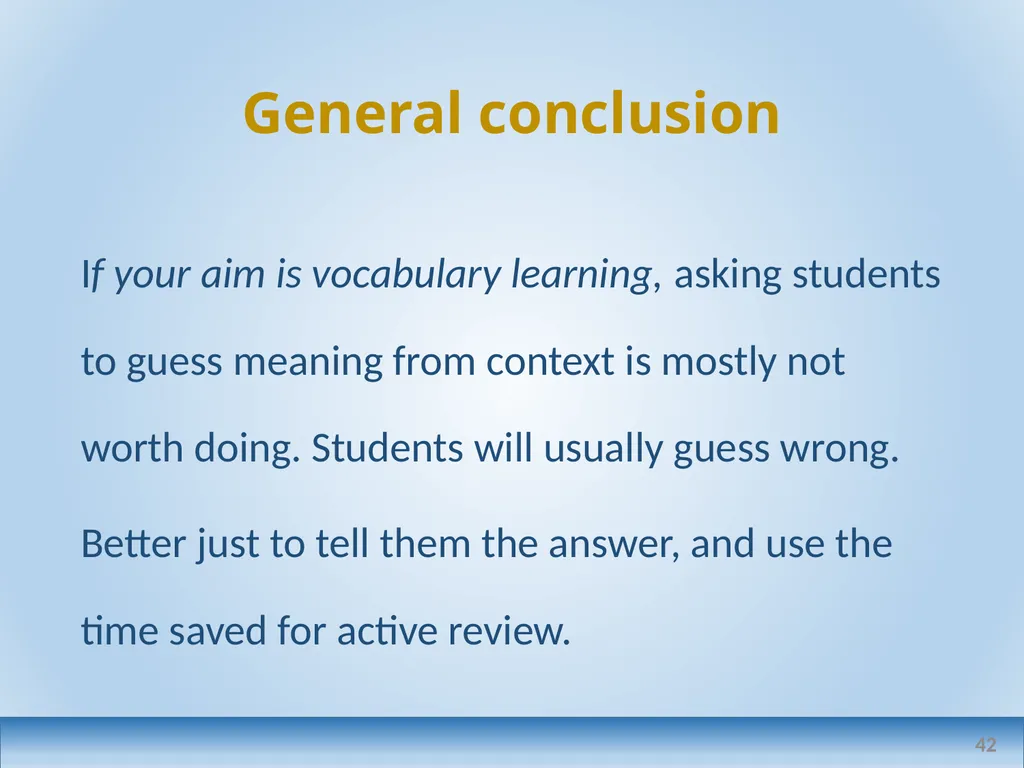
General conclusion If your aim is vocabulary learning, asking students to guess meaning from context is mostly not worth doing. Students will usually guess wrong.
Better just to tell them the answer, and use the time saved for active review. 42<br>
Better just to tell them the answer, and use the time saved for active review. 42<br>
43
Example 2 Teaching words in lexical / semantic sets 43<br>
44
Research on learning semantic sets Tinkham (1993)
Does it help learners to master a new set of lexical items if they are all members of a semantic set (same part of speech, same kind of meaning: e.g. clothes, animals)? 44<br>
Does it help learners to master a new set of lexical items if they are all members of a semantic set (same part of speech, same kind of meaning: e.g. clothes, animals)? 44<br>
45
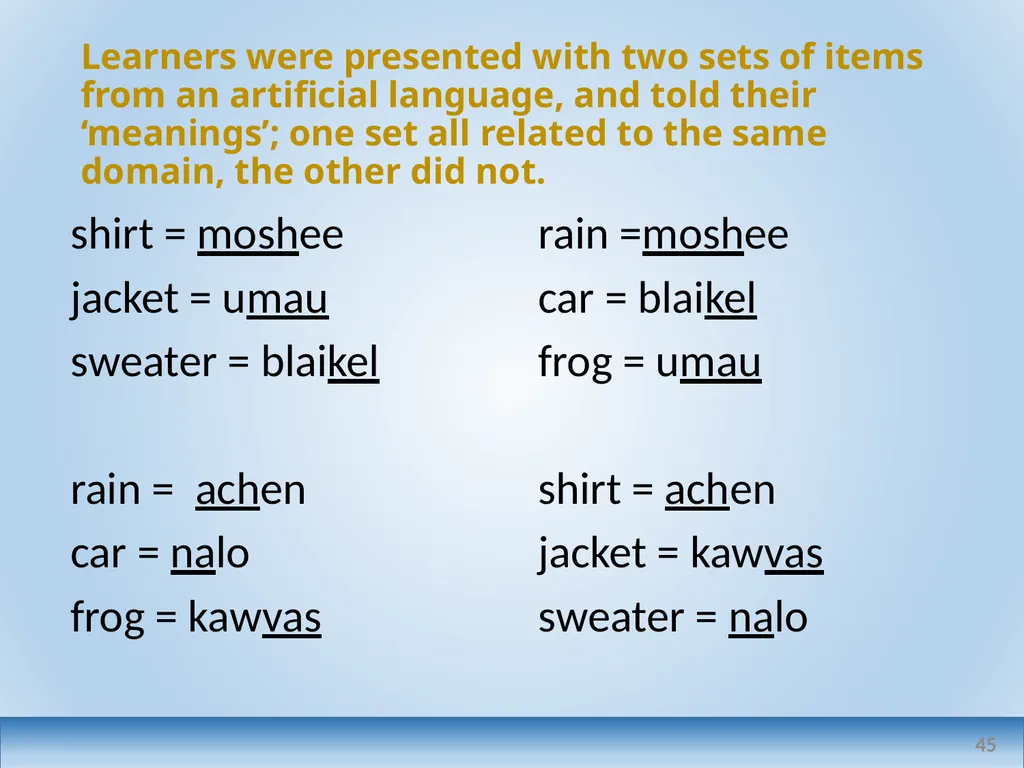
Learners were presented with two sets of items from an artificial language, and told their ‘meanings’; one set all related to the same domain, the other did not. rain =moshee
car = blaikel
frog = umau
shirt = achen
jacket = kawvas
sweater = nalo shirt = moshee
jacket = umau
sweater = blaikel
rain = achen
car = nalo
frog = kawvas 45<br>
car = blaikel
frog = umau
shirt = achen
jacket = kawvas
sweater = nalo shirt = moshee
jacket = umau
sweater = blaikel
rain = achen
car = nalo
frog = kawvas 45<br>
46
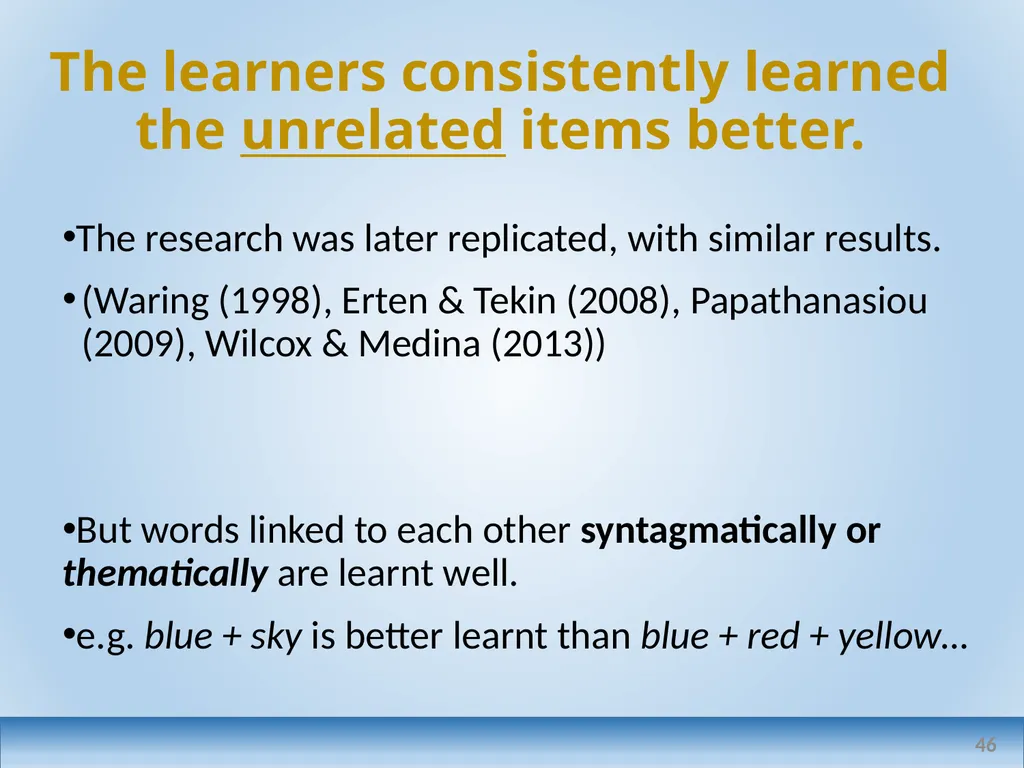
The learners consistently learned the unrelated items better. The research was later replicated, with similar results.
(Waring (1998), Erten & Tekin (2008), Papathanasiou (2009), Wilcox & Medina (2013))
But words linked to each other syntagmatically or thematically are learnt well.
e.g. blue + sky is better learnt than blue + red + yellow… 46<br>
(Waring (1998), Erten & Tekin (2008), Papathanasiou (2009), Wilcox & Medina (2013))
But words linked to each other syntagmatically or thematically are learnt well.
e.g. blue + sky is better learnt than blue + red + yellow… 46<br>
47
General conclusion Materials writers of elementary textbooks:
Group target vocabulary by theme or situation, rather than lexical sets.
Teachers:
If you have to a coursebook unit based on a lexical set, try to present and practise each item within its own context. 47<br>
Group target vocabulary by theme or situation, rather than lexical sets.
Teachers:
If you have to a coursebook unit based on a lexical set, try to present and practise each item within its own context. 47<br>
48
Further notes 1. The teaching of lexical sets also results in teaching students fairly infrequent items at an early stage.
2. The research relates to the first learning of items. Grouping them in lexical sets for later review may be helpful.
2. The same principle probably applies to any set of similar items, e.g. homonyms, synonyms, homophones. 48<br>
2. The research relates to the first learning of items. Grouping them in lexical sets for later review may be helpful.
2. The same principle probably applies to any set of similar items, e.g. homonyms, synonyms, homophones. 48<br>
49
Example 3: The use of digital technology
Macaro et al., 2012; OECD, 2015 49<br>
Macaro et al., 2012; OECD, 2015 49<br>
50
Macaro et al. overview This exhaustive search of the literature on technology in primary and secondary teaching of English as an L2 has not yielded clear or sufficient evidence of its effectiveness. This is of some concern given the very large amounts of funding that are being made available worldwide for the purpose of encouraging its use for whatever reasons, political, economic or pedagogical. …(p.24) 50<br>
51
OECD A comparative survey of PISA scores with the amount of computer use in OECD countries revealed …
…. a tendency towards a generally negative correlation. 51<br>
…. a tendency towards a generally negative correlation. 51<br>
52
... even when computers are used in the classroom, their impact on student performance is mixed, at best. Students who use computers moderately at school tend to have somewhat better outcomes than students who use computers rarely. But students who use computers very frequently at school do a lot worse in most learning outcomes, even after accounting for social background and student demographics. (p.3) 52<br>
53
... even when computers are used in the classroom, their impact on student performance is mixed, at best. Students who use computers moderately at school tend to have somewhat better outcomes than students who use computers rarely. But students who use computers very frequently at school do a lot worse in most learning outcomes, even after accounting for social background and student demographics. (p.3) 53<br>
54
To summarize 54<br>
55
Applied linguistics research is an important additional source of professional knowledge But often inaccessible to teachers for a variety of reasons. 55<br>
56
Its value: The enhancement of teacher understanding and contribution to materials or task design
by confirming intuitive assumptions
by providing useful information
by debunking popular assumptions 56<br>
by confirming intuitive assumptions
by providing useful information
by debunking popular assumptions 56<br>
57
Postscript 1: Where there is no supporting research for a hypothesis 57<br>
58
Lack of research is significant If a popular approach, method or model has no clear research evidence to support it ...
... we should reconsider it in the light of our own professional judgement. 58<br>
... we should reconsider it in the light of our own professional judgement. 58<br>
59
Examples Visual, auditory and kinaesthetic learning styles
Neuro-linguistic programming
Task-based learning
Multiple intelligences 59<br>
Neuro-linguistic programming
Task-based learning
Multiple intelligences 59<br>
60
Postscript 2: Where good research is less helpful 60<br>
61
The research can help us less when... ... the conclusions are valid and interesting in themselves
BUT
Do not in fact contribute much to practice 61<br>
BUT
Do not in fact contribute much to practice 61<br>
62
Example 1 Spoken grammar
Carter & McCarthy (2017)
e.g.
coordinate rather than compound constructions
utterances rather than sentences
ellipsis
‘heads’ and ‘tails’ 62<br>
Carter & McCarthy (2017)
e.g.
coordinate rather than compound constructions
utterances rather than sentences
ellipsis
‘heads’ and ‘tails’ 62<br>
63
Should we teach learners spoken grammar? Most of the features of spoken grammar are language-universal, and are likely to occur naturally ...
... so probably don’t need teaching. 63<br>
... so probably don’t need teaching. 63<br>
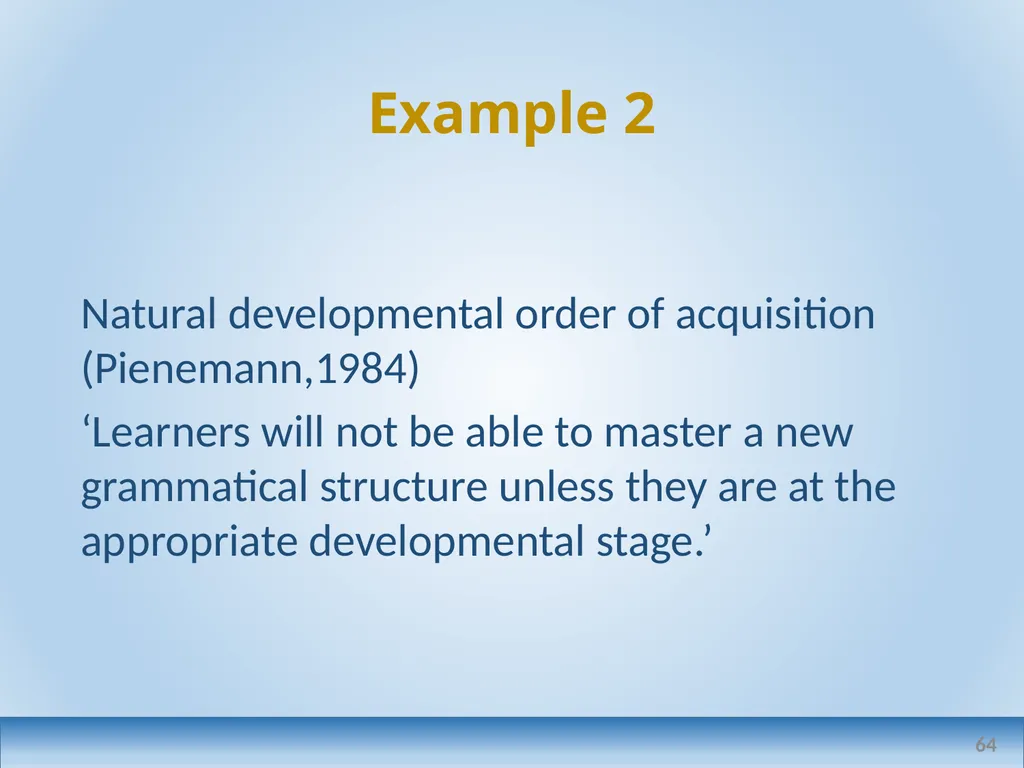
64
Example 2 Natural developmental order of acquisition (Pienemann,1984)
‘Learners will not be able to master a new grammatical structure unless they are at the appropriate developmental stage.’ 64<br>
‘Learners will not be able to master a new grammatical structure unless they are at the appropriate developmental stage.’ 64<br>
65
Can this be implemented in teaching? We can’t spend time diagnosing the ‘stage’ of each student in a group.
Even if we could, they won’t all be at the same stage.
So what do we teach when? 65<br>
Even if we could, they won’t all be at the same stage.
So what do we teach when? 65<br>
66
My answer We carry on teaching the grammatical features as they come up.
BUT
Be aware that...
... if a student doesn’t get it, he/she may simply not be ready.
... and that you will need to re-teach key features later. 66<br>
BUT
Be aware that...
... if a student doesn’t get it, he/she may simply not be ready.
... and that you will need to re-teach key features later. 66<br>
67
Thank you for your attention! pennyur@gmail.com 67<br>
68
References Carter, R., & McCarthy, M. (2017). Spoken grammar: Where are we and where are we going? Applied Linguistics, 38(1), 1-20.
Erten, I. H., & Tekin, M. (2008). Effects on vocabulary acquisition of presenting new words in semantic sets versus semantically unrelated sets . System, 36 (3), 407-422.
Hudson, B. (2011). Reclaiming scholarship as an integrating dimension of academic work for the impact of research on teaching and learning in Higher Education. Scottish Educational Review, 43(1), 24-40.
Kaivanpanah, S., & Alavi, M. (2008). Deriving unknown word meaning from context: Is it reliable?. RELC Journal, 39(1), 77-95.
Kang, S. H., Gollan, T. H., & Pashler, H. (2013). Don’t just repeat after me: Retrieval practice is better than imitation for foreign vocabulary learning. Psychonomic Bulletin & Review, 20(6), 1259-1265.
Karpicke, J., & Roediger, H. L. (2008). The critical importance of retrieval for learning. Science, 319, 966-968. 68<br>
Erten, I. H., & Tekin, M. (2008). Effects on vocabulary acquisition of presenting new words in semantic sets versus semantically unrelated sets . System, 36 (3), 407-422.
Hudson, B. (2011). Reclaiming scholarship as an integrating dimension of academic work for the impact of research on teaching and learning in Higher Education. Scottish Educational Review, 43(1), 24-40.
Kaivanpanah, S., & Alavi, M. (2008). Deriving unknown word meaning from context: Is it reliable?. RELC Journal, 39(1), 77-95.
Kang, S. H., Gollan, T. H., & Pashler, H. (2013). Don’t just repeat after me: Retrieval practice is better than imitation for foreign vocabulary learning. Psychonomic Bulletin & Review, 20(6), 1259-1265.
Karpicke, J., & Roediger, H. L. (2008). The critical importance of retrieval for learning. Science, 319, 966-968. 68<br>
69
Laufer, B., & Rozovski-Roitblat, B. (2015). Retention of new words: Quantity of encounters, quality of task, and degree of knowledge. Language Teaching Research, 19(6), 687-711.
Liu, D. (2003). The most frequently used spoken American English idioms: A corpus analysis and its implications. Tesol Quarterly, 37(4), 671-700.
Liu, D. (2012). The most frequently-used multi-word constructions in academic written English: A multi-corpus study. English for Specific Purposes, 31(1), 25-35.
Macaro, E, Handley, C., & Walter, C. (2012). A systematic review of CALL in English as a second language: Focus on primary and secondary education. Language Teaching, 45, 1-43.
Maley, A. (2016). More research is needed–A mantra too far. Humanising Language Teaching, 18(3).
Martinez, R., & Schmitt, N. (2012). A phrasal expressions list. Applied linguistics, 33(2), 299-320.
Nassaji, H. (2003). L2 vocabulary learning from context: Strategies, knowledge sources and their relationship with success in L2 lexical inferencing. TESOL Quarterly, 37(4), 645-670. 69<br>
Liu, D. (2003). The most frequently used spoken American English idioms: A corpus analysis and its implications. Tesol Quarterly, 37(4), 671-700.
Liu, D. (2012). The most frequently-used multi-word constructions in academic written English: A multi-corpus study. English for Specific Purposes, 31(1), 25-35.
Macaro, E, Handley, C., & Walter, C. (2012). A systematic review of CALL in English as a second language: Focus on primary and secondary education. Language Teaching, 45, 1-43.
Maley, A. (2016). More research is needed–A mantra too far. Humanising Language Teaching, 18(3).
Martinez, R., & Schmitt, N. (2012). A phrasal expressions list. Applied linguistics, 33(2), 299-320.
Nassaji, H. (2003). L2 vocabulary learning from context: Strategies, knowledge sources and their relationship with success in L2 lexical inferencing. TESOL Quarterly, 37(4), 645-670. 69<br>
70
Norris, J. M., & Ortega, L. (2001). Does type of instruction make a difference? Substantive findings from a meta-analytic review. Language Learning, 51, Supplement 1, 157-213.
Papathanasiou, E. (2009). An investigation of two ways of presenting vocabulary. ELT Journal, 63(4), 313-322.
Pienemann, M. 1984. Psychological Constraints on the Teachability of Language. Studies in Second Language Acquisition, 6, 186–214.
Tinkham, T. 1993. The effects of semantic and thematic clustering in the learning of second language vocabulary. Second Language Research 13(2), 138-63.
Waring, R. 1998. The negative effect of learning words in semantic sets: a replication. System 25(2), 261-74.
Webb, S. (2007). The effects of repetition on vocabulary knowledge. Applied Linguistics, 28, 46–65.
Ur, P. (2014). Practice and Research-based Theory in English Teacher Development. European Journal of Applied Linguistics and TEFL, 3(2), 143-155.
Wilcox, A., & Medina, A. (2013). Effects of semantic and phonological clustering on L2 vocabulary acquisition among novice learners. System, 41(4), 1056-1069. 70<br>
Papathanasiou, E. (2009). An investigation of two ways of presenting vocabulary. ELT Journal, 63(4), 313-322.
Pienemann, M. 1984. Psychological Constraints on the Teachability of Language. Studies in Second Language Acquisition, 6, 186–214.
Tinkham, T. 1993. The effects of semantic and thematic clustering in the learning of second language vocabulary. Second Language Research 13(2), 138-63.
Waring, R. 1998. The negative effect of learning words in semantic sets: a replication. System 25(2), 261-74.
Webb, S. (2007). The effects of repetition on vocabulary knowledge. Applied Linguistics, 28, 46–65.
Ur, P. (2014). Practice and Research-based Theory in English Teacher Development. European Journal of Applied Linguistics and TEFL, 3(2), 143-155.
Wilcox, A., & Medina, A. (2013). Effects of semantic and phonological clustering on L2 vocabulary acquisition among novice learners. System, 41(4), 1056-1069. 70<br>
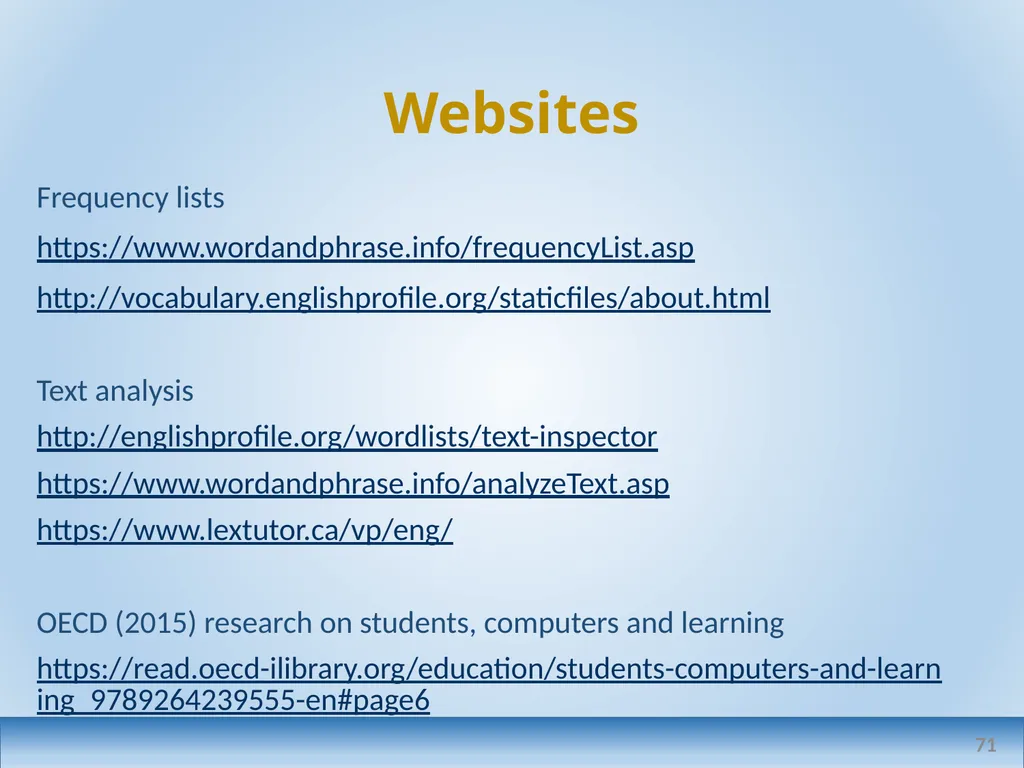
71
Websites Frequency lists
https://www.wordandphrase.info/frequencyList.asp
http://vocabulary.englishprofile.org/staticfiles/about.html
Text analysis
http://englishprofile.org/wordlists/text-inspector
https://www.wordandphrase.info/analyzeText.asp
https://www.lextutor.ca/vp/eng/
OECD (2015) research on students, computers and learning
https://read.oecd-ilibrary.org/education/students-computers-and-learning_9789264239555-en#page6 71<br>
https://www.wordandphrase.info/frequencyList.asp
http://vocabulary.englishprofile.org/staticfiles/about.html
Text analysis
http://englishprofile.org/wordlists/text-inspector
https://www.wordandphrase.info/analyzeText.asp
https://www.lextutor.ca/vp/eng/
OECD (2015) research on students, computers and learning
https://read.oecd-ilibrary.org/education/students-computers-and-learning_9789264239555-en#page6 71<br>