
Appraisal Law Update with Supervisory/Provisional
OM
Published · 117 slides · 0 views

1 / 1






Description
Appraisal Law Update with SupervisoryProvisional Appraiser Education www.ct.govdcp DCP.RealEstatect.gov Linda Kieft-Robitaille Real Estate Examiner Department of Consumer Protection linda.kieft-robitaillect.gov General State Contact
Related Topics
Share
Embed code
Download this presentation From Below
"Appraisal Law Update with Supervisory/Provisional" is the property of its rightful owner. Permission is granted to download and print the materials on this website for personal, non-commercial use only, and to display it on your personal computer provided you do not modify the materials and that you retain all copyright notices contained in the materials. By downloading content from our website, you accept the terms of this agreement.
Presentation Transcript
01
Appraisal Law Update
with
Supervisory/Provisional Appraiser Education<br>
with
Supervisory/Provisional Appraiser Education<br>
02
www.ct.gov/dcp
DCP.RealEstate@ct.gov
Linda Kieft-Robitaille
Real Estate Examiner
Department of Consumer Protection
linda.kieft-robitaille@ct.gov General State Contact Information<br>
DCP.RealEstate@ct.gov
Linda Kieft-Robitaille
Real Estate Examiner
Department of Consumer Protection
linda.kieft-robitaille@ct.gov General State Contact Information<br>
03
To view the CT State Statutes pertaining to Real Estate Appraisers, please go to:
http://www.cga.ct.gov/current/pub/chap_400g.htm
All regulations concerning Real Estate Appraisers can be found at:
http://www.ct.gov/dcp/lib/dcp/pdf/laws_and_regulations/regs_-_real_estate_appraisal_and_schools2012.pdf Statutes and Regulations<br>
http://www.cga.ct.gov/current/pub/chap_400g.htm
All regulations concerning Real Estate Appraisers can be found at:
http://www.ct.gov/dcp/lib/dcp/pdf/laws_and_regulations/regs_-_real_estate_appraisal_and_schools2012.pdf Statutes and Regulations<br>
04
Consists of 8 persons
5 Certified Appraisers
3 Public Members
They are NOT paid
Members appointed by governor
Not just one political party or congressional district CT Real Estate
Appraisal Commission<br>
5 Certified Appraisers
3 Public Members
They are NOT paid
Members appointed by governor
Not just one political party or congressional district CT Real Estate
Appraisal Commission<br>
05
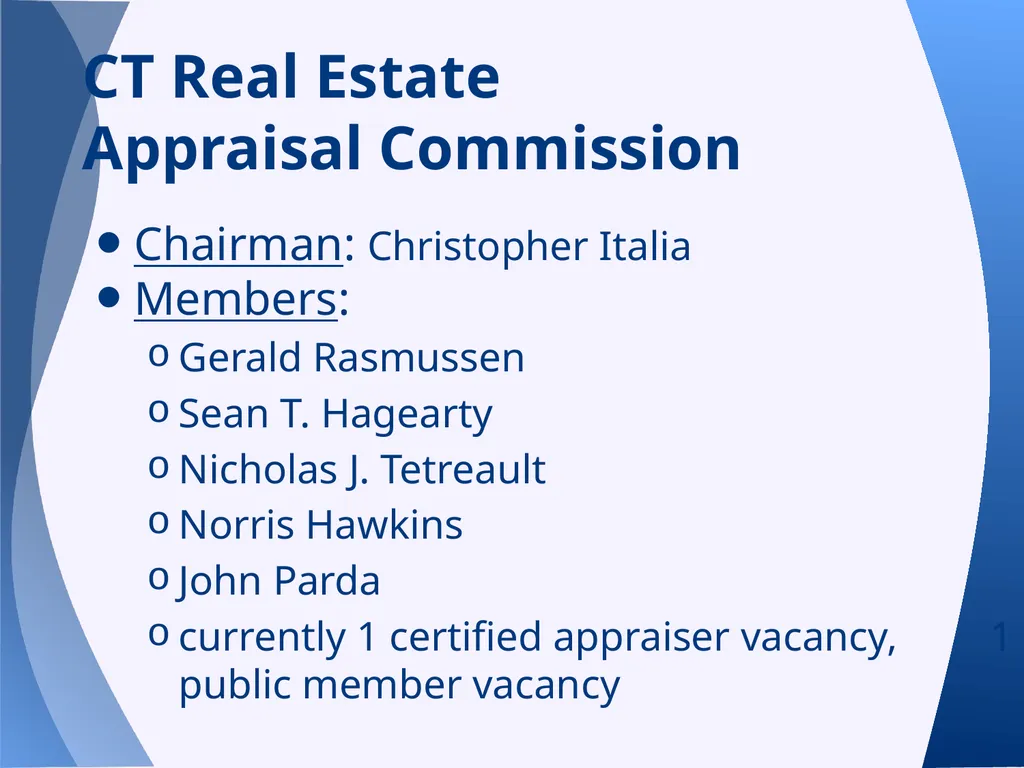
Chairman: Christopher Italia
Members:
Gerald Rasmussen
Sean T. Hagearty
Nicholas J. Tetreault
Norris Hawkins
John Parda
currently 1 certified appraiser vacancy, 1 public member vacancy CT Real Estate
Appraisal Commission<br>
Members:
Gerald Rasmussen
Sean T. Hagearty
Nicholas J. Tetreault
Norris Hawkins
John Parda
currently 1 certified appraiser vacancy, 1 public member vacancy CT Real Estate
Appraisal Commission<br>
06
Administers state law as to:
certification
licensing
issuance
renewal
suspension or
revocation
concerning the RE Appraisal business CT Real Estate
Appraisal Commission<br>
certification
licensing
issuance
renewal
suspension or
revocation
concerning the RE Appraisal business CT Real Estate
Appraisal Commission<br>
07
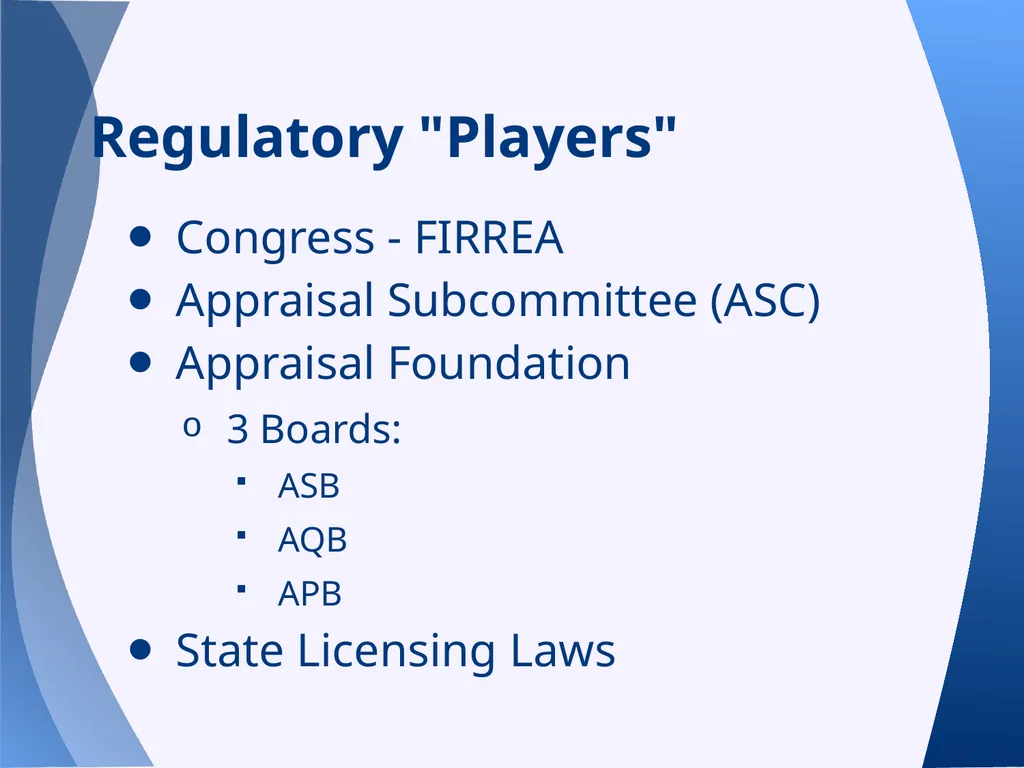
Congress - FIRREA
Appraisal Subcommittee (ASC)
Appraisal Foundation
3 Boards:
ASB
AQB
APB
State Licensing Laws Regulatory "Players"<br>
Appraisal Subcommittee (ASC)
Appraisal Foundation
3 Boards:
ASB
AQB
APB
State Licensing Laws Regulatory "Players"<br>
08
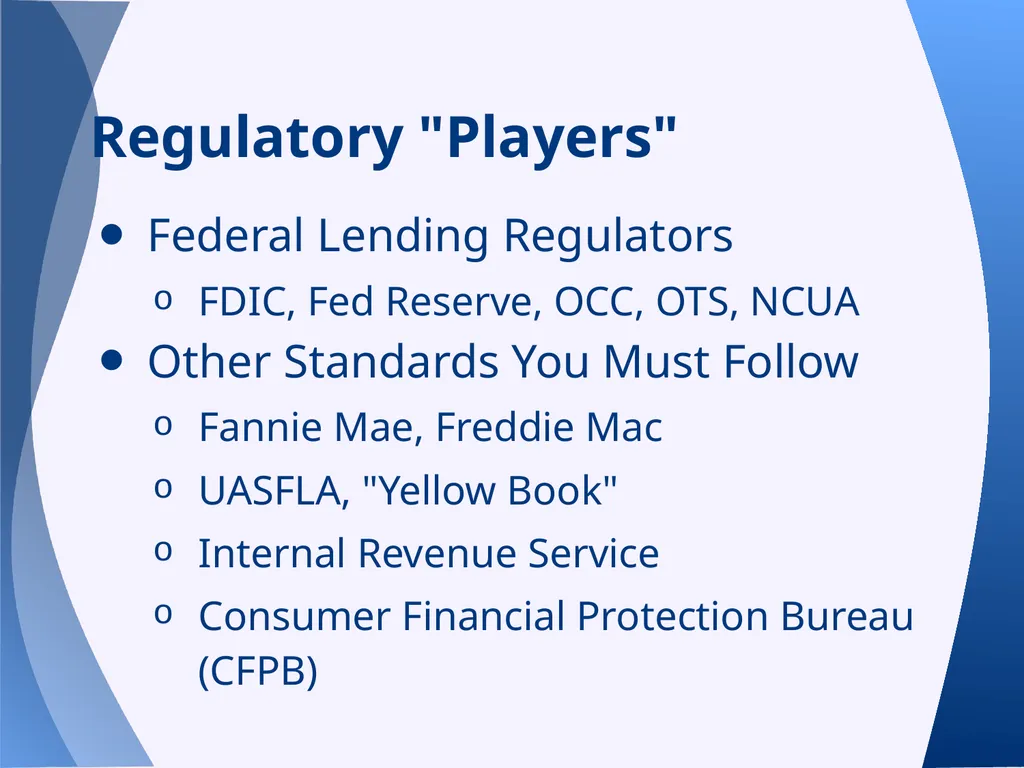
Federal Lending Regulators
FDIC, Fed Reserve, OCC, OTS, NCUA
Other Standards You Must Follow
Fannie Mae, Freddie Mac
UASFLA, "Yellow Book"
Internal Revenue Service
Consumer Financial Protection Bureau (CFPB) Regulatory "Players"<br>
FDIC, Fed Reserve, OCC, OTS, NCUA
Other Standards You Must Follow
Fannie Mae, Freddie Mac
UASFLA, "Yellow Book"
Internal Revenue Service
Consumer Financial Protection Bureau (CFPB) Regulatory "Players"<br>
09
Congress’s 1989 Reaction to S&L Crisis
Required Licensing in All States
Referenced Appraisal Foundation
(already formed by appraisal organizations)
Appraisals Conform to USPAP
FDIC, etc. All Must Establish Appraisal Regulations FIRREA
(Federal Institutions Reform, Recovery & Enforcement Act of 1989)<br>
Required Licensing in All States
Referenced Appraisal Foundation
(already formed by appraisal organizations)
Appraisals Conform to USPAP
FDIC, etc. All Must Establish Appraisal Regulations FIRREA
(Federal Institutions Reform, Recovery & Enforcement Act of 1989)<br>
10
Must Meet Minimums:
Education
Experience
Testing
Established the Appraisal Subcommittee (ASC) FIRREA<br>
Education
Experience
Testing
Established the Appraisal Subcommittee (ASC) FIRREA<br>
11
Focus is Supervisory Role over State Boards and Appraisers
Duty to ensure that the Government has sufficient controls over appraisal activity to protect it (the GOVERNMENT) from loss Appraisal Subcommittee (ASC)<br>
Duty to ensure that the Government has sufficient controls over appraisal activity to protect it (the GOVERNMENT) from loss Appraisal Subcommittee (ASC)<br>
12
Not part of Appraisal Foundation
Oversees Foundation and provides funding to its Boards (through your annual registration fee)
Oversees State Appraisal Licensure and Certification Agencies (most recent audit completed in 2012, next due in July 2014) Appraisal Subcommittee (ASC)<br>
Oversees Foundation and provides funding to its Boards (through your annual registration fee)
Oversees State Appraisal Licensure and Certification Agencies (most recent audit completed in 2012, next due in July 2014) Appraisal Subcommittee (ASC)<br>
13
Contact Info:
Website: https://www.asc.gov/Home.aspx
Phone: (202)289-2735
Fax: (202)289-4101
Mailing Address:
1401 H Street N.W.
Suite 760
Washington, D.C. 20005 Appraisal Subcommittee (ASC)<br>
Website: https://www.asc.gov/Home.aspx
Phone: (202)289-2735
Fax: (202)289-4101
Mailing Address:
1401 H Street N.W.
Suite 760
Washington, D.C. 20005 Appraisal Subcommittee (ASC)<br>
14
Predates FIRREA
Has both sponsoring and affiliate organizations
Establishes minimum standards for education, work experience and examination for appraisers seeking to become certified
Accomplishes above through boards The Appraisal Foundation<br>
Has both sponsoring and affiliate organizations
Establishes minimum standards for education, work experience and examination for appraisers seeking to become certified
Accomplishes above through boards The Appraisal Foundation<br>
15
The Appraisal Standards Board (ASB), the Appraisal Practices Board (APB), and the Appraiser Qualifications Board (AQB)
Sets minimum requirements and required course content and topics for qualifying education
Develops questions for the national certification exam The Appraisal Foundation<br>
Sets minimum requirements and required course content and topics for qualifying education
Develops questions for the national certification exam The Appraisal Foundation<br>
16
AQB establishes minimum hours of appraisal experience for license and certification
AQB also provides input on continuing education
ASB promulgates and updates the Uniform Standards of Professional Appraisal Practice
APB offers voluntary guidance to appraisers, regulators and users of appraisal services on recognized valuation methods and techniques for all valuation disciplines The Appraisal Foundation<br>
AQB also provides input on continuing education
ASB promulgates and updates the Uniform Standards of Professional Appraisal Practice
APB offers voluntary guidance to appraisers, regulators and users of appraisal services on recognized valuation methods and techniques for all valuation disciplines The Appraisal Foundation<br>
17
Contact Info:
Website: http://www.appraisalfoundation.org/
E-Mail: info@appraisalfoundation.org
Phone: (202)347-7722
Fax: (202)347-7727
Mailing Address:
The Appraisal Foundation
1155 15th Street, NW
Suite 1111 Washington, DC 20005 The Appraisal Foundation<br>
Website: http://www.appraisalfoundation.org/
E-Mail: info@appraisalfoundation.org
Phone: (202)347-7722
Fax: (202)347-7727
Mailing Address:
The Appraisal Foundation
1155 15th Street, NW
Suite 1111 Washington, DC 20005 The Appraisal Foundation<br>
18
Handles complaints regarding the improper influence of appraisers
Writes rules, supervises companies, and enforces federal consumer financial protection laws
Restricts unfair, deceptive, or abusive acts or practices Consumer Financial
Protection Bureau (CFPB)<br>
Writes rules, supervises companies, and enforces federal consumer financial protection laws
Restricts unfair, deceptive, or abusive acts or practices Consumer Financial
Protection Bureau (CFPB)<br>
19
Promotes financial education
Researches consumer behavior
Monitors financial markets for new risks to consumers
Enforces laws that outlaw discrimination and other unfair treatment in consumer finance Consumer Financial
Protection Bureau (CFPB)<br>
Researches consumer behavior
Monitors financial markets for new risks to consumers
Enforces laws that outlaw discrimination and other unfair treatment in consumer finance Consumer Financial
Protection Bureau (CFPB)<br>
20
Consumer Financial
Protection Bureau (CFPB) Contact Info:
Website: http://www.consumerfinance.gov/
E-Mail: info@consumerfinance.gov
Phone: (202) 435-7000
Mailing Address:
Consumer Financial Protection Bureau
Attention: [Employee Name, Division, and/or Office Number]
1700 G Street, NW
Washington, D.C. 20552<br>
Protection Bureau (CFPB) Contact Info:
Website: http://www.consumerfinance.gov/
E-Mail: info@consumerfinance.gov
Phone: (202) 435-7000
Mailing Address:
Consumer Financial Protection Bureau
Attention: [Employee Name, Division, and/or Office Number]
1700 G Street, NW
Washington, D.C. 20552<br>
21
The OCC's primary mission is to charter, regulate, and supervise all national banks and federal savings associations
Also supervises the federal branches and agencies of foreign banks
Established in 1863 as an independent bureau of the U.S. Department of the Treasury Office of the Comptroller of the Currency (OCC)<br>
Also supervises the federal branches and agencies of foreign banks
Established in 1863 as an independent bureau of the U.S. Department of the Treasury Office of the Comptroller of the Currency (OCC)<br>
22
Contact Info:
Website: http://www.occ.gov/index.html
E-Mail: publicaffairs3@occ.treas.gov
Phone: (202) 649-6800
Mailing Address:
Office of the Comptroller of the Currency
400 7th Street SW, Suite 3E-218
Washington, D.C. 20219 Office of the Comptroller of the Currency (OCC) To read more about the OCC and banking:
http://www.occ.treas.gov/news-issuances/federal-register/75fr77450.pdf<br>
Website: http://www.occ.gov/index.html
E-Mail: publicaffairs3@occ.treas.gov
Phone: (202) 649-6800
Mailing Address:
Office of the Comptroller of the Currency
400 7th Street SW, Suite 3E-218
Washington, D.C. 20219 Office of the Comptroller of the Currency (OCC) To read more about the OCC and banking:
http://www.occ.treas.gov/news-issuances/federal-register/75fr77450.pdf<br>
23
Appraisal Institute
American Society of Appraisers (ASA)
National Association of Real Estate Appraisers (NAREA)
Appraisers Association of America (AAA) Professional Appraisal Organizations<br>
American Society of Appraisers (ASA)
National Association of Real Estate Appraisers (NAREA)
Appraisers Association of America (AAA) Professional Appraisal Organizations<br>
24
"Real Estate Appraiser" means a person engaged in the business of estimating the value of real estate for a fee or other valuable consideration
"Provisional Appraiser" is in the above business and is under the supervision of a Certified Real Estate Appraiser and who meets the minimum requirements CT Appraiser Licensing Statute<br>
"Provisional Appraiser" is in the above business and is under the supervision of a Certified Real Estate Appraiser and who meets the minimum requirements CT Appraiser Licensing Statute<br>
25
Mandatory Appraiser Licensing
appraisals for any purpose
TWO EXEMPTIONS
re-valuation contracts
RE Agent when for LISTING, SALE or LEASE CT Appraiser Licensing Statute<br>
appraisals for any purpose
TWO EXEMPTIONS
re-valuation contracts
RE Agent when for LISTING, SALE or LEASE CT Appraiser Licensing Statute<br>
26
For LISTING, SALE or LEASE for Owners or Prospective Buyers,
Agents Can Make a Separate Charge for their Market Analysis
Cannot refer to as an “Appraisal” Real Estate Brokers/Salespeople<br>
Agents Can Make a Separate Charge for their Market Analysis
Cannot refer to as an “Appraisal” Real Estate Brokers/Salespeople<br>
27
Appraiser Qualifications Board
NO "Grandfathering" of pre-existing provisional appraisers looking to upgrade
Education and experience must be completed prior to taking the AQB-approved national exam
All candidates for an appraiser credential must undergo a background check AQB Required Changes
Effective 1/1/2015<br>
NO "Grandfathering" of pre-existing provisional appraisers looking to upgrade
Education and experience must be completed prior to taking the AQB-approved national exam
All candidates for an appraiser credential must undergo a background check AQB Required Changes
Effective 1/1/2015<br>
28
Completion of a Real Estate degree from an AQB approved college/university may be used for credit towards qualifying education
2008 Real Property Appraiser Qualification Criteria via the "segmented approach" no longer valid
Only the 7-Hour National USPAP Update course can be used twice in the same continuing education cycle AQB Required Changes
Effective 1/1/2015<br>
2008 Real Property Appraiser Qualification Criteria via the "segmented approach" no longer valid
Only the 7-Hour National USPAP Update course can be used twice in the same continuing education cycle AQB Required Changes
Effective 1/1/2015<br>
29
A written, proctored exam is required for all qualifying online courses (written = on paper or administered electronically)
Added topics on green building, seller concessions, and developing opinions of real property value in appraisals AQB Required Changes
Effective 1/1/2015<br>
Added topics on green building, seller concessions, and developing opinions of real property value in appraisals AQB Required Changes
Effective 1/1/2015<br>
30
The regulations were last updated in 2010. The regulations and statutes are still in the process of being revised in order to better reflect the 2015 AQB requirements. CT Appraiser Licensing Regulations<br>
31
3 categories of Appraiser licensing:
1. Provisional (trainee): RSP
2. Certified Residential: RCR
3. Certified General: RCG CT Appraiser Categories<br>
1. Provisional (trainee): RSP
2. Certified Residential: RCR
3. Certified General: RCG CT Appraiser Categories<br>
32
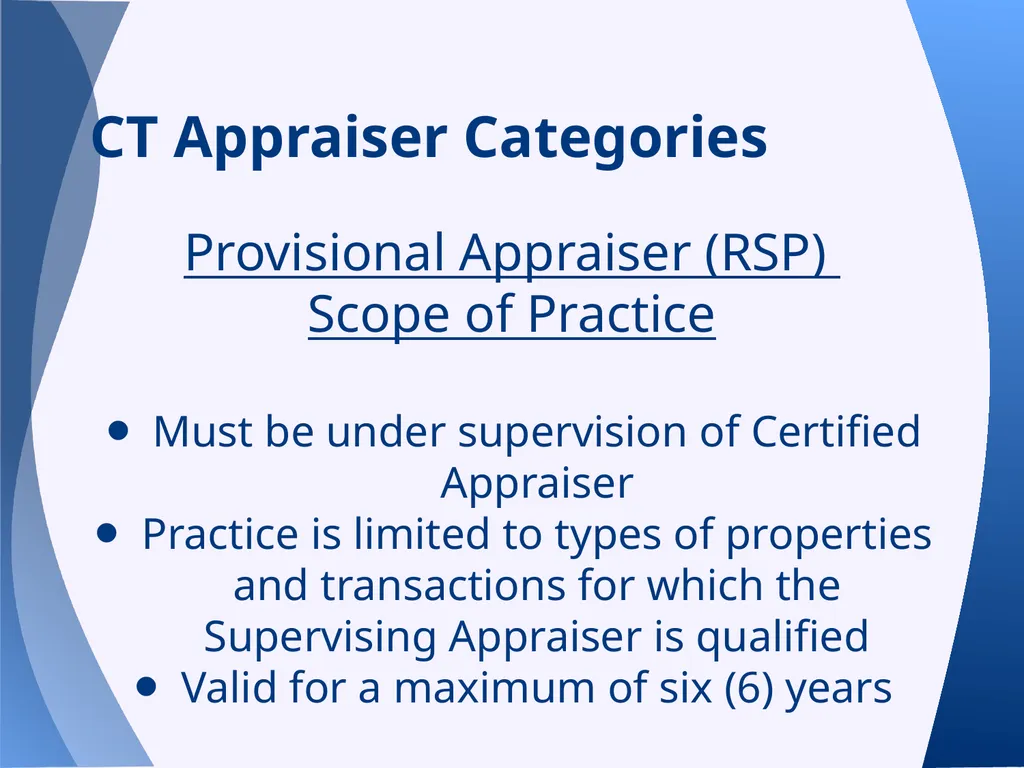
CT Appraiser Categories Provisional Appraiser (RSP)
Scope of Practice
Must be under supervision of Certified Appraiser
Practice is limited to types of properties and transactions for which the Supervising Appraiser is qualified
Valid for a maximum of six (6) years<br>
Scope of Practice
Must be under supervision of Certified Appraiser
Practice is limited to types of properties and transactions for which the Supervising Appraiser is qualified
Valid for a maximum of six (6) years<br>
33
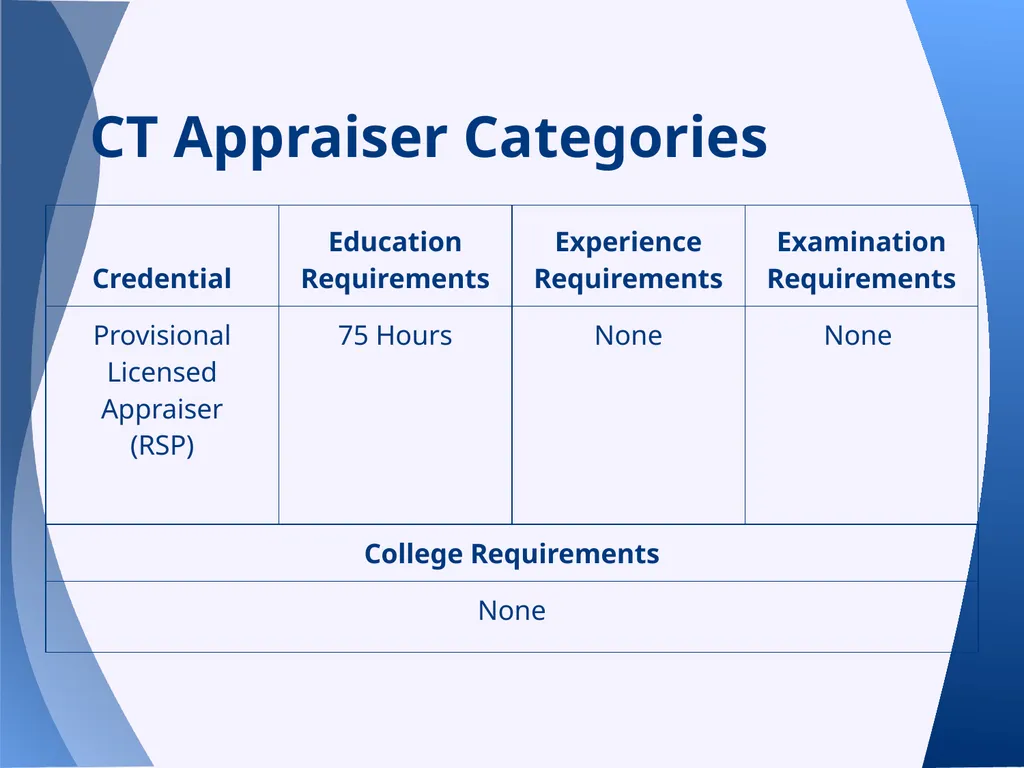
CT Appraiser Categories<br>
34
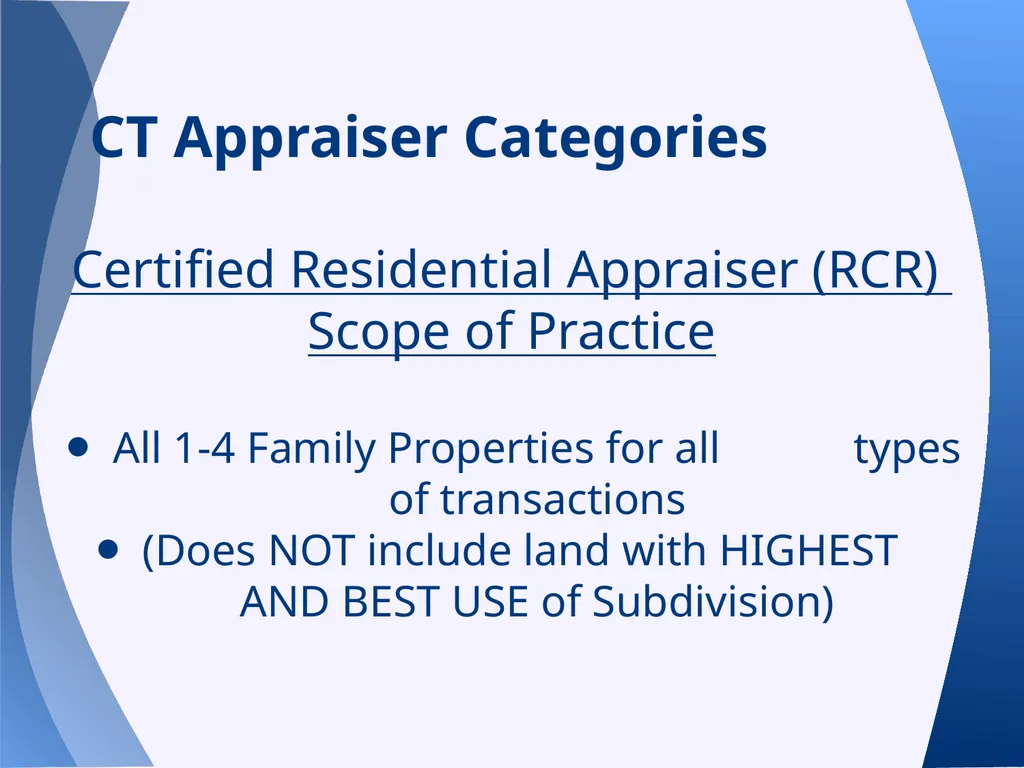
Certified Residential Appraiser (RCR)
Scope of Practice
All 1-4 Family Properties for all types of transactions
(Does NOT include land with HIGHEST AND BEST USE of Subdivision) CT Appraiser Categories<br>
Scope of Practice
All 1-4 Family Properties for all types of transactions
(Does NOT include land with HIGHEST AND BEST USE of Subdivision) CT Appraiser Categories<br>
35
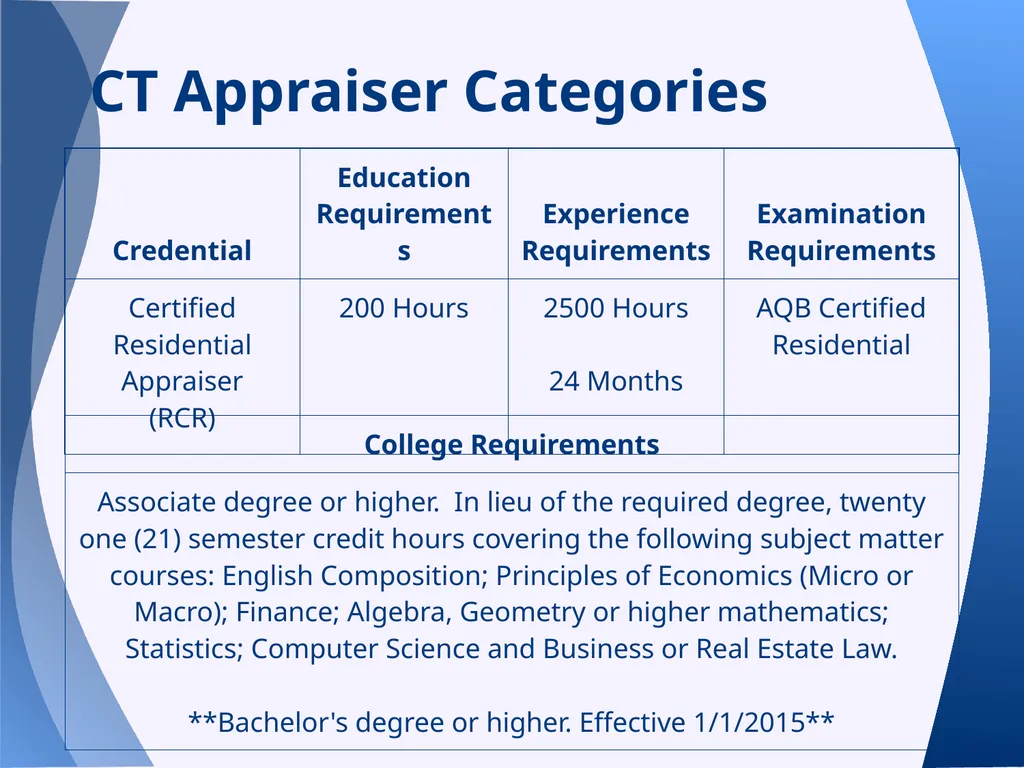
CT Appraiser Categories<br>
36
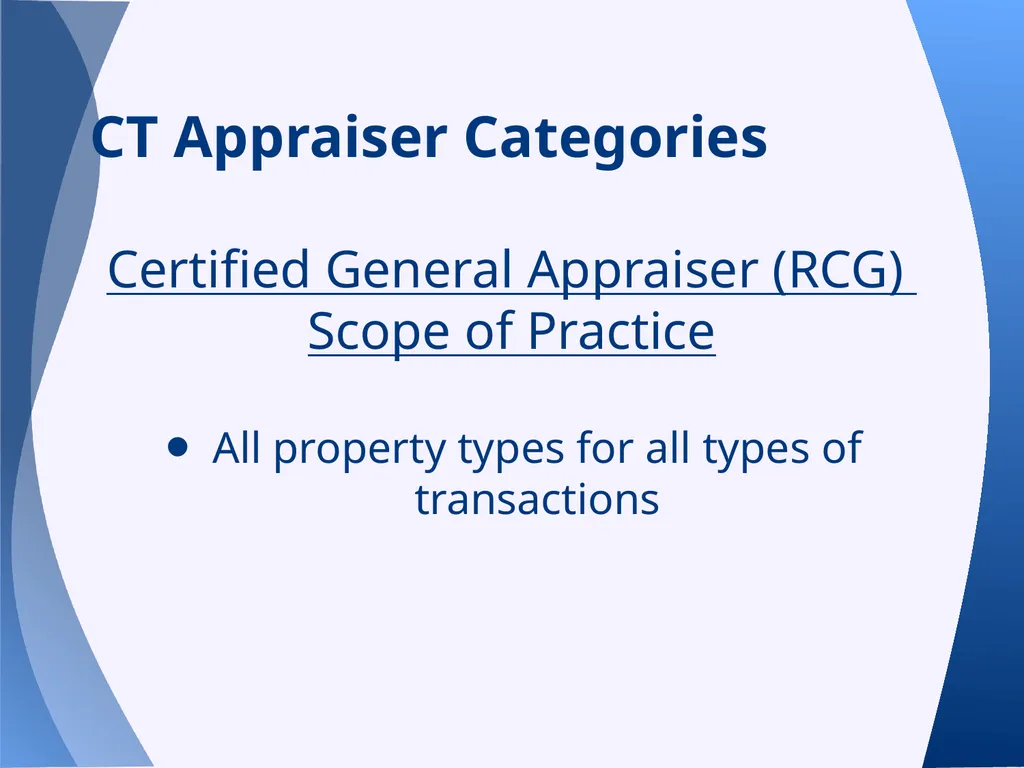
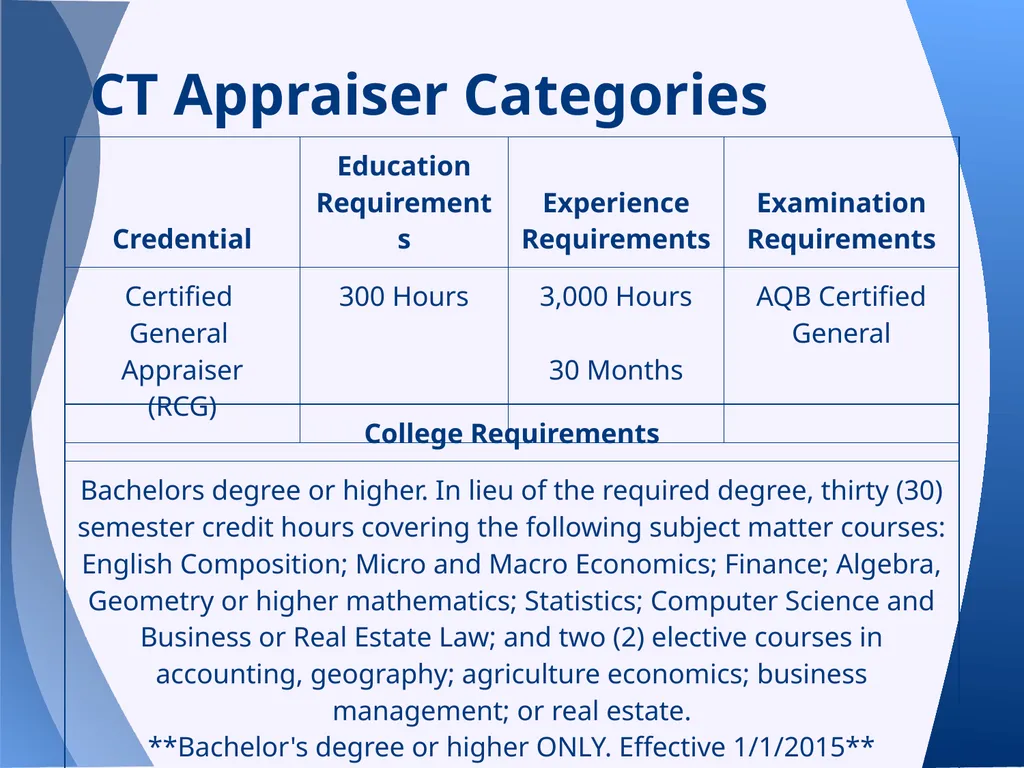
CT Appraiser Categories Certified General Appraiser (RCG)
Scope of Practice
All property types for all types of transactions<br>
Scope of Practice
All property types for all types of transactions<br>
37
CT Appraiser Categories<br>
38
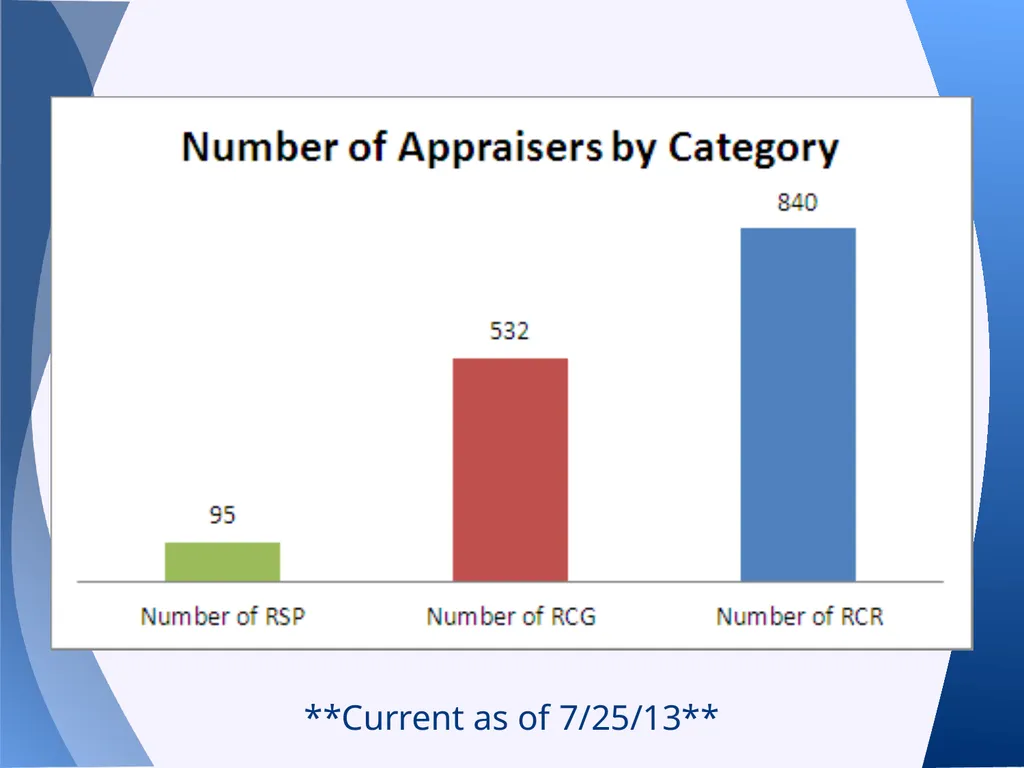
**Current as of 7/25/13**<br>
39
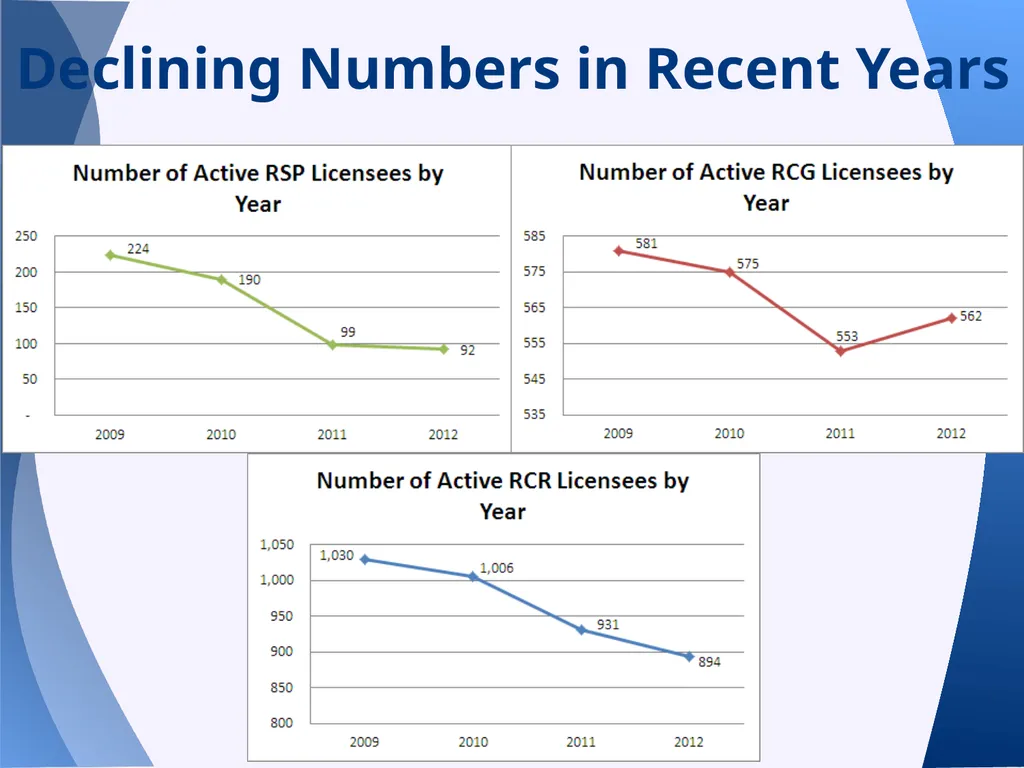
Declining Numbers in Recent Years<br>
40
Per CT State statute, a licensee must requalify and retest to activate a license that has been inactive for more than two (2) years
Per the ASC, a licensee in retirement status must continue to complete the required CE each cycle if he/she wishes to reactivate the license at any point Licensing Regulations<br>
Per the ASC, a licensee in retirement status must continue to complete the required CE each cycle if he/she wishes to reactivate the license at any point Licensing Regulations<br>
41
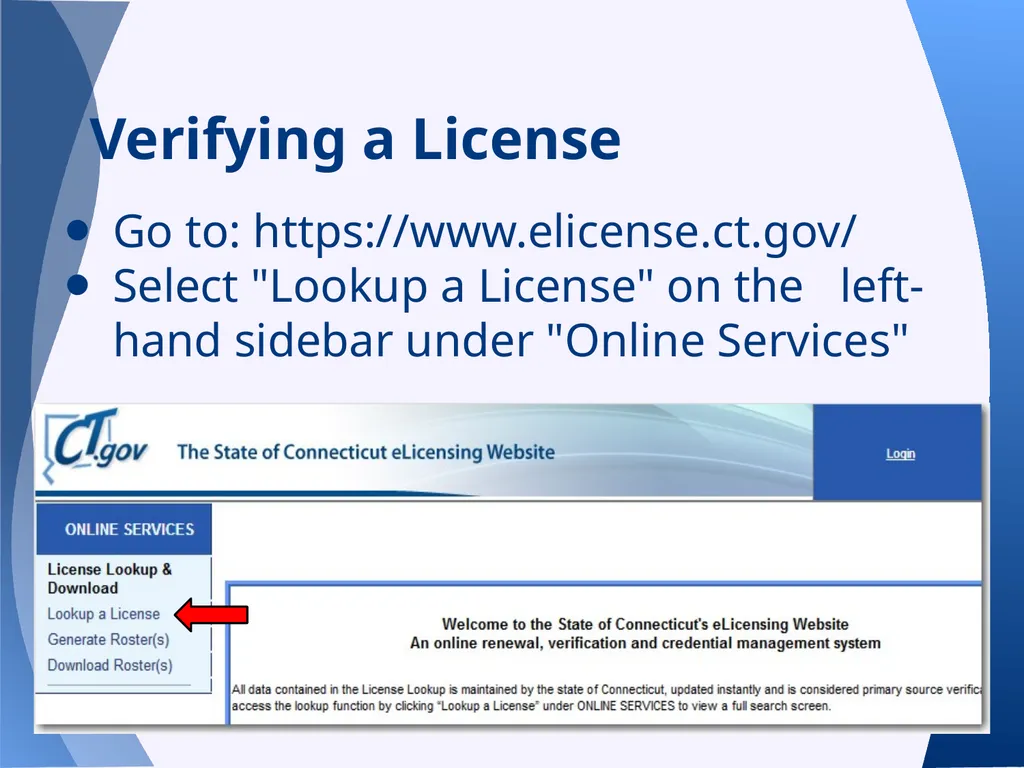
Go to: https://www.elicense.ct.gov/
Select "Lookup a License" on the left-hand sidebar under "Online Services" Verifying a License<br>
Select "Lookup a License" on the left-hand sidebar under "Online Services" Verifying a License<br>
42
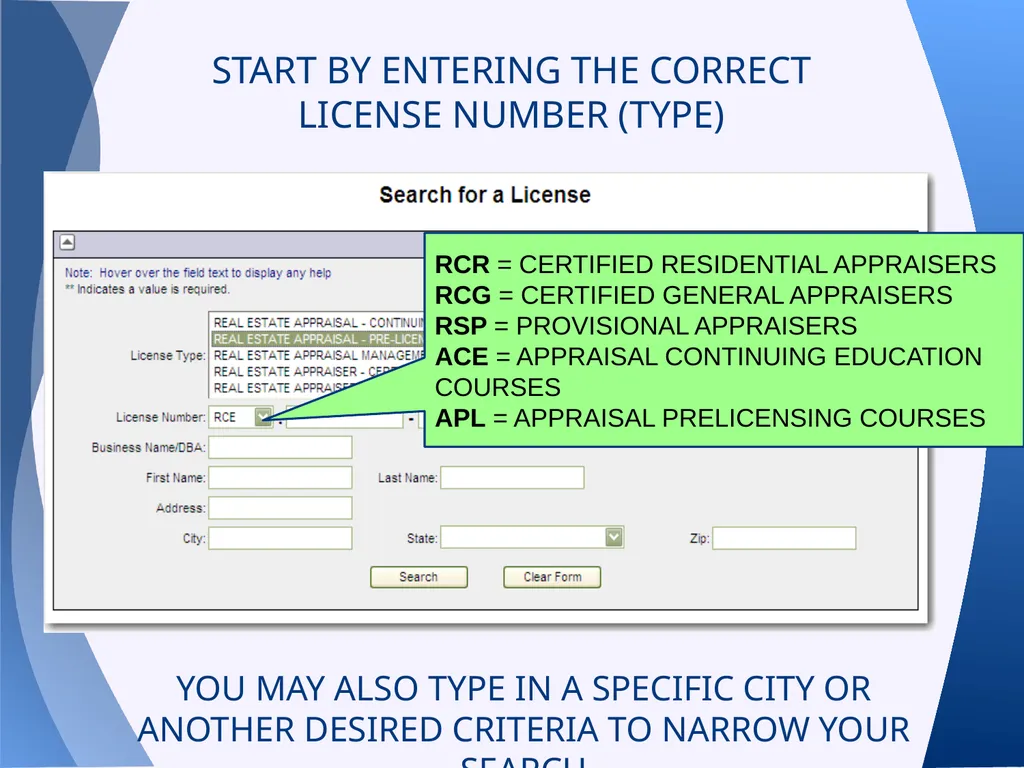
YOU MAY ALSO TYPE IN A SPECIFIC CITY OR ANOTHER DESIRED CRITERIA TO NARROW YOUR SEARCH RCR = CERTIFIED RESIDENTIAL APPRAISERS
RCG = CERTIFIED GENERAL APPRAISERS
RSP = PROVISIONAL APPRAISERS
ACE = APPRAISAL CONTINUING EDUCATION COURSES
APL = APPRAISAL PRELICENSING COURSES START BY ENTERING THE CORRECT LICENSE NUMBER (TYPE)<br>
RCG = CERTIFIED GENERAL APPRAISERS
RSP = PROVISIONAL APPRAISERS
ACE = APPRAISAL CONTINUING EDUCATION COURSES
APL = APPRAISAL PRELICENSING COURSES START BY ENTERING THE CORRECT LICENSE NUMBER (TYPE)<br>
43
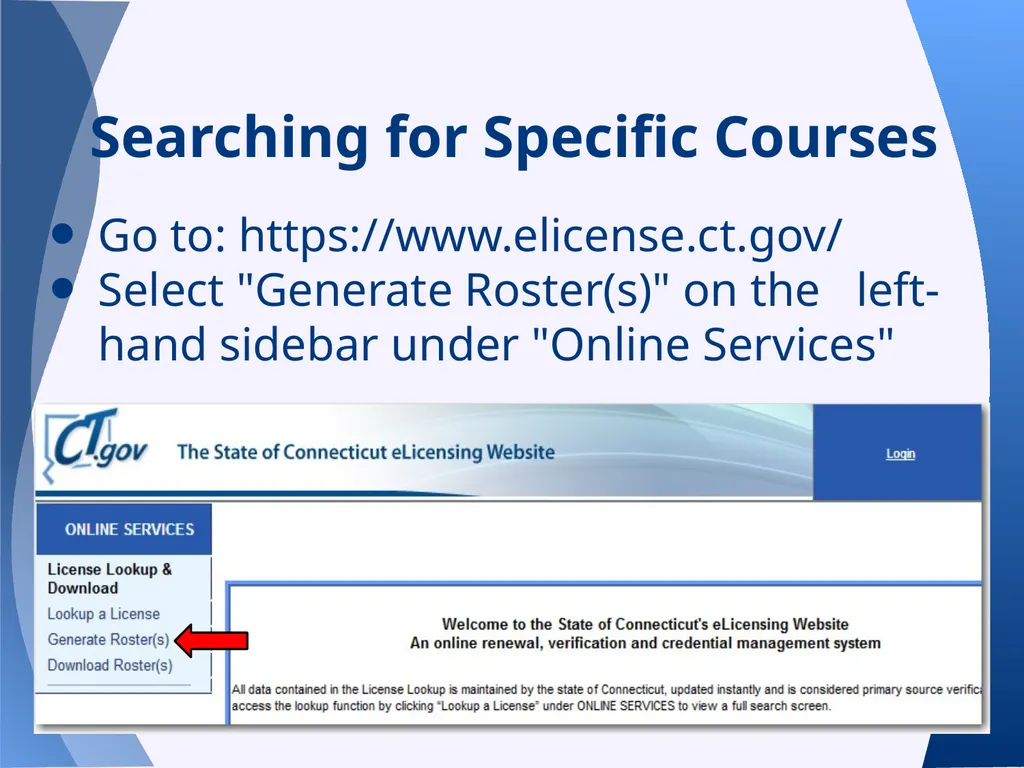
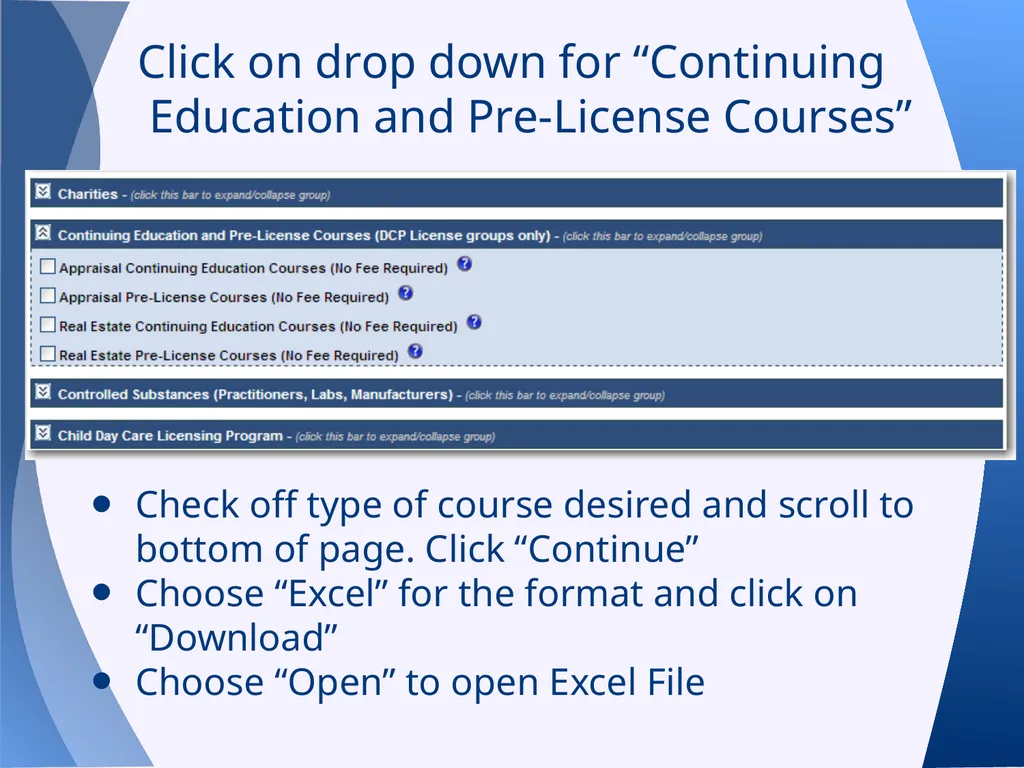
Searching for Specific Courses Go to: https://www.elicense.ct.gov/
Select "Generate Roster(s)" on the left-hand sidebar under "Online Services"<br>
Select "Generate Roster(s)" on the left-hand sidebar under "Online Services"<br>
44
Click on drop down for “Continuing Education and Pre-License Courses” Check off type of course desired and scroll to bottom of page. Click “Continue”
Choose “Excel” for the format and click on “Download”
Choose “Open” to open Excel File<br>
Choose “Excel” for the format and click on “Download”
Choose “Open” to open Excel File<br>
45
AMCs are those that perform appraisal management services, including:
Administering an appraisal panel
Recruiting appraisers to serve on the panel to negotiate fees and determine services to be provided by the appraisers
Receiving appraisal requests or orders and delivering them to the appraisal panel Appraisal Management Company (AMC)<br>
Administering an appraisal panel
Recruiting appraisers to serve on the panel to negotiate fees and determine services to be provided by the appraisers
Receiving appraisal requests or orders and delivering them to the appraisal panel Appraisal Management Company (AMC)<br>
46
AMCs went into effect October 2010
State regulations are in process
Nationally, the number of AMCs have increased due to the Dodd-Frank Act Appraisal Management Company (AMC)<br>
State regulations are in process
Nationally, the number of AMCs have increased due to the Dodd-Frank Act Appraisal Management Company (AMC)<br>
47
Must register with the state before engaging, performing or advertising appraisal management services
Certificates of registration are valid for two years
Renewal fee is $1,000
Renewal forms can be found at:
http://www.ct.gov/dcp/cwp/view.asp?
a=1622&q=501000 Appraisal Management Company (AMC)<br>
Certificates of registration are valid for two years
Renewal fee is $1,000
Renewal forms can be found at:
http://www.ct.gov/dcp/cwp/view.asp?
a=1622&q=501000 Appraisal Management Company (AMC)<br>
48
Compliance managers must be certified appraisers
Per statute all fees to appraisers by AMCs must be paid within 60 days
if payment is not received, appraisers can file a complaint with DCP Appraisal Management Company (AMC)<br>
Per statute all fees to appraisers by AMCs must be paid within 60 days
if payment is not received, appraisers can file a complaint with DCP Appraisal Management Company (AMC)<br>
49
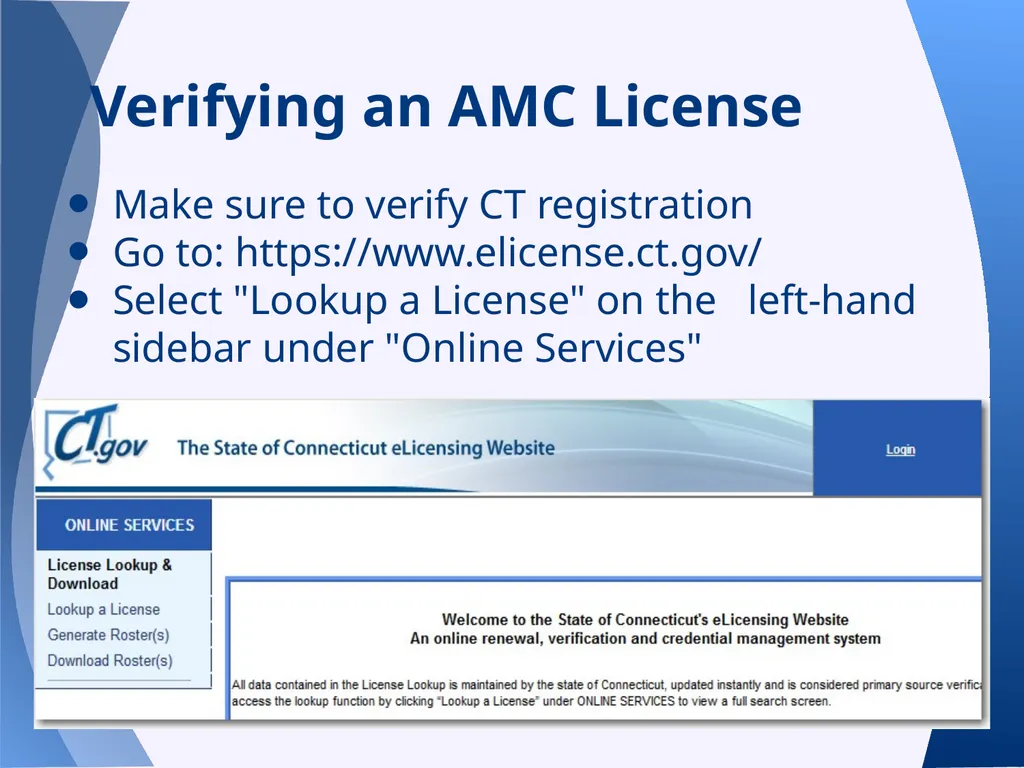
Verifying an AMC License Make sure to verify CT registration
Go to: https://www.elicense.ct.gov/
Select "Lookup a License" on the left-hand sidebar under "Online Services"<br>
Go to: https://www.elicense.ct.gov/
Select "Lookup a License" on the left-hand sidebar under "Online Services"<br>
50
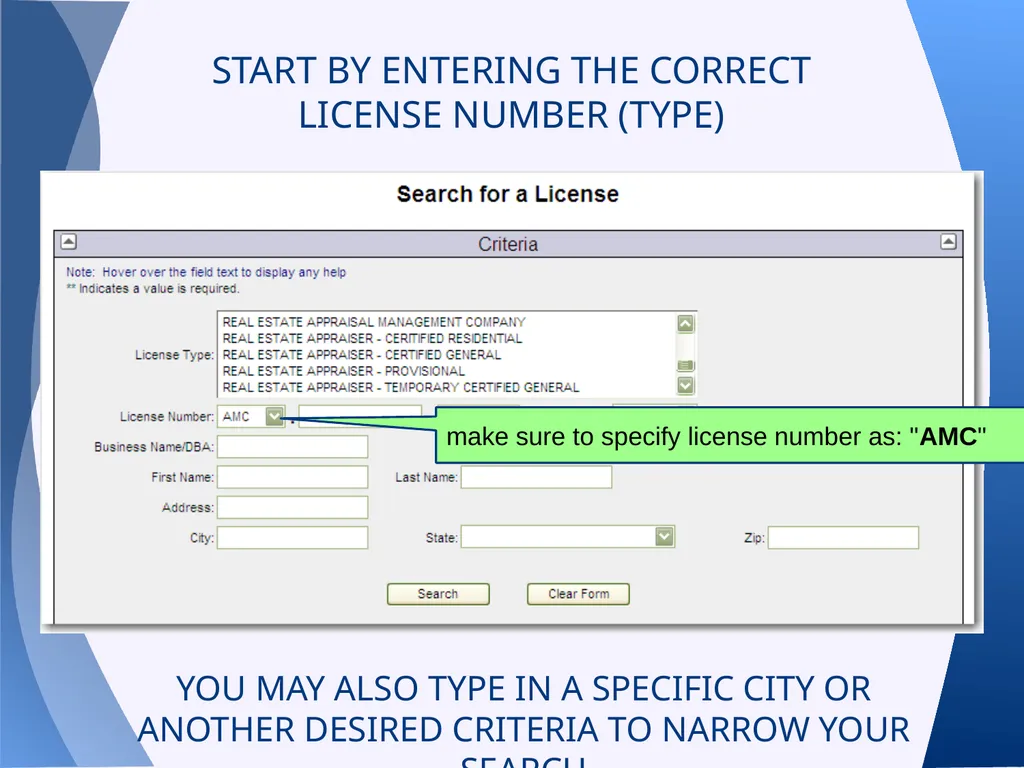
YOU MAY ALSO TYPE IN A SPECIFIC CITY OR ANOTHER DESIRED CRITERIA TO NARROW YOUR SEARCH make sure to specify license number as: "AMC" START BY ENTERING THE CORRECT LICENSE NUMBER (TYPE)<br>
51
*28 Hours of Continuing Education*
Ten (10) of the 28 hours must consist of:
a seven (7) hour Uniform Standards of Professional Appraisal Practice (USPAP) course taught by a Certified USPAP Instructor AND
a three (3) hour Appraisal Law Update with Supervisory/Provisional Appraiser Education course
The remaining eighteen (18) hours must be credit hours approved by the Connecticut Real Estate Appraisal Commission (CREAC). Continuing Education
Requirements for:
State Certified and Provisional Licensed Appraisers<br>
Ten (10) of the 28 hours must consist of:
a seven (7) hour Uniform Standards of Professional Appraisal Practice (USPAP) course taught by a Certified USPAP Instructor AND
a three (3) hour Appraisal Law Update with Supervisory/Provisional Appraiser Education course
The remaining eighteen (18) hours must be credit hours approved by the Connecticut Real Estate Appraisal Commission (CREAC). Continuing Education
Requirements for:
State Certified and Provisional Licensed Appraisers<br>
52
*IMPORTANT*
Successful completion of fifteen (15) hours of USPAP
CANNOT
be used IN PLACE OF the 7 hour USPAP.
If both the 15 hour and 7 hour USPAP are taken
during the renewal cycle
it is the 7 hour that is mandatory. Continuing Education<br>
Successful completion of fifteen (15) hours of USPAP
CANNOT
be used IN PLACE OF the 7 hour USPAP.
If both the 15 hour and 7 hour USPAP are taken
during the renewal cycle
it is the 7 hour that is mandatory. Continuing Education<br>
53
If you are a State Provisional Licensed Real Property Appraiser and your
license was issued to you by the State after May 1, 2013, you are not required
to complete the 2014 CE. Continuing Education:
Exemption<br>
license was issued to you by the State after May 1, 2013, you are not required
to complete the 2014 CE. Continuing Education:
Exemption<br>
54
Ten (10) of the 28 hours must consist of:
a three (3) hour Appraisal Law Update with Supervisory/Provisional Appraiser Education couse AND
a seven (7) hour Uniform Standards of Professional Appraisal Practice (USPAP) course taught by a Certified USPAP Instructor
does not have to be taken in CT
must be taken within CT's CE cycle
The remaining eighteen (18) hours must be credit hours approved by the state in which they are taken Continuing Education:
Reciprocal License Holders<br>
a three (3) hour Appraisal Law Update with Supervisory/Provisional Appraiser Education couse AND
a seven (7) hour Uniform Standards of Professional Appraisal Practice (USPAP) course taught by a Certified USPAP Instructor
does not have to be taken in CT
must be taken within CT's CE cycle
The remaining eighteen (18) hours must be credit hours approved by the state in which they are taken Continuing Education:
Reciprocal License Holders<br>
55
Continuing Education (CE)
documentation does not have to be submitted with the
2014 application for renewal
However, the courses must be completed prior to renewal
it must be completed
and retained by the appraiser
for a state audit Continuing Education<br>
documentation does not have to be submitted with the
2014 application for renewal
However, the courses must be completed prior to renewal
it must be completed
and retained by the appraiser
for a state audit Continuing Education<br>
56
For compliance with
2014 Continuing Education
all courses
must be completed during
the Continuing Education Cycle of
May 1, 2012 to April 30, 2014 Continuing Education<br>
2014 Continuing Education
all courses
must be completed during
the Continuing Education Cycle of
May 1, 2012 to April 30, 2014 Continuing Education<br>
57
Uniform Standards of Professional Appraisal Practice USPAP What is USPAP about, anyway?
People need answers about
real estate that they can trust
in order to make
informed decisions
The role of the appraiser is to
provide those answers<br>
People need answers about
real estate that they can trust
in order to make
informed decisions
The role of the appraiser is to
provide those answers<br>
58
If we want people to continue
asking for those answers
They need to trust that
appraisers will provide the
objective answers that are
needed to make good decisions USPAP<br>
asking for those answers
They need to trust that
appraisers will provide the
objective answers that are
needed to make good decisions USPAP<br>
59
USPAP We have to preserve the trust of
individuals one at a time,
but collectively, they add up to
the general public
which is why the goal of USPAP is to
"PRESERVE THE PUBLIC TRUST"<br>
individuals one at a time,
but collectively, they add up to
the general public
which is why the goal of USPAP is to
"PRESERVE THE PUBLIC TRUST"<br>
60
what are the basic elements of USPAP?
ethics rule
competency rule
scope of work rule
record keeping rule
standard 1 (development)
standard 2 (reporting)
standard 3 (appraisal review)
*appraisers must keep files for a minimum of 5 years* USPAP<br>
ethics rule
competency rule
scope of work rule
record keeping rule
standard 1 (development)
standard 2 (reporting)
standard 3 (appraisal review)
*appraisers must keep files for a minimum of 5 years* USPAP<br>
61
An appraiser must promote and preserve the public trust inherent in appraisal practice by observing the highest standard of professional ethics
CT law reqiures an appraiser to comply with USPAP regulations
The Ethics Rule is divided into three sections:
CONDUCT, MANAGEMENT, and CONFIDENTIALITY USPAP: Highlights
Ethics Rule<br>
CT law reqiures an appraiser to comply with USPAP regulations
The Ethics Rule is divided into three sections:
CONDUCT, MANAGEMENT, and CONFIDENTIALITY USPAP: Highlights
Ethics Rule<br>
62
1. CONDUCT
An appraiser must perform assignments with impartiality, objectivity, and independence, and without accommodation of personal interests USPAP: Highlights
Ethics Rule<br>
An appraiser must perform assignments with impartiality, objectivity, and independence, and without accommodation of personal interests USPAP: Highlights
Ethics Rule<br>
63
2. MANAGEMENT
An appraiser must disclose that he or she paid a fee or commission, or gave a thing of value in connection with the procurement of an assignment
An appraiser must not affix the signature of another appraiser without his or her consent USPAP: Highlights
Ethics Rule<br>
An appraiser must disclose that he or she paid a fee or commission, or gave a thing of value in connection with the procurement of an assignment
An appraiser must not affix the signature of another appraiser without his or her consent USPAP: Highlights
Ethics Rule<br>
64
3. CONFIDENTIALITY
An appraiser must protect the confidential nature of the appraiser-client relationship
An appraiser must act in good faith with regard to the legitimate interests of the client in the use of confidential information
An appraiser must be aware of, and comply with, all confidentiality and privacy laws and regulations applicable in an assignment USPAP: Highlights
Ethics Rule<br>
An appraiser must protect the confidential nature of the appraiser-client relationship
An appraiser must act in good faith with regard to the legitimate interests of the client in the use of confidential information
An appraiser must be aware of, and comply with, all confidentiality and privacy laws and regulations applicable in an assignment USPAP: Highlights
Ethics Rule<br>
65
An appraiser must:
Be competent to perform the assignment
Acquire the necessary competency to perform the assignment
Decline or withdraw from the assignment if found to be incompetent USPAP: Highlights
Competency Rule<br>
Be competent to perform the assignment
Acquire the necessary competency to perform the assignment
Decline or withdraw from the assignment if found to be incompetent USPAP: Highlights
Competency Rule<br>
66
1. BEING COMPETENT REQUIRES:
The ability to properly identify the problem to be addressed; and
The knowledge and experience to complete the assignment competently; and
Recognition of, and compliance with, laws and regulations that apply to the appraiser or to the assignment USPAP: Highlights
Competency Rule<br>
The ability to properly identify the problem to be addressed; and
The knowledge and experience to complete the assignment competently; and
Recognition of, and compliance with, laws and regulations that apply to the appraiser or to the assignment USPAP: Highlights
Competency Rule<br>
67
2. ACQUIRING COMPETENCY
If an appraiser determines he is not competent prior to accepting an assignment, the appraiser must:
disclose the lack of knowledge to the client before accepting the assignment
take all steps necessary to complete the assignment competently
describe, in the report, the lack of knowledge and the steps taken to complete the assignment USPAP: Highlights
Competency Rule<br>
If an appraiser determines he is not competent prior to accepting an assignment, the appraiser must:
disclose the lack of knowledge to the client before accepting the assignment
take all steps necessary to complete the assignment competently
describe, in the report, the lack of knowledge and the steps taken to complete the assignment USPAP: Highlights
Competency Rule<br>
68
3. LACK OF COMPETENCY
If the assignment cannot be completed competently, the appraiser must decline or withdraw from the assignment USPAP: Highlights
Competency Rule<br>
If the assignment cannot be completed competently, the appraiser must decline or withdraw from the assignment USPAP: Highlights
Competency Rule<br>
69
For each appraisal, appraisal review, and appraisal consulting assignment, an appraiser must:
Identify the problem to be solved
Determine and perform the scope of work necessary to develop credible assignment results; and
Disclose the scope of work in the report USPAP: Highlights
Scope of Work Rule<br>
Identify the problem to be solved
Determine and perform the scope of work necessary to develop credible assignment results; and
Disclose the scope of work in the report USPAP: Highlights
Scope of Work Rule<br>
70
1. PROBLEM IDENTIFICATION
An appraiser must gather and analyze information about those assignment elements that are necessary to properly identify the appraisal, appraisal review or appraisal consulting problem to be solved USPAP: Highlights
Scope of Work Rule<br>
An appraiser must gather and analyze information about those assignment elements that are necessary to properly identify the appraisal, appraisal review or appraisal consulting problem to be solved USPAP: Highlights
Scope of Work Rule<br>
71
2. SCOPE OF WORK ACCEPTABILITY
The scope of work must include the research and analyses that are necessary to develop credible assignment results
An appraiser must not allow assignment conditions to limit the scope of work to such a degree that the assignment results are not credible in the context of the intended use USPAP: Highlights
Scope of Work Rule<br>
The scope of work must include the research and analyses that are necessary to develop credible assignment results
An appraiser must not allow assignment conditions to limit the scope of work to such a degree that the assignment results are not credible in the context of the intended use USPAP: Highlights
Scope of Work Rule<br>
72
3. DISCLOSURE OBLIGATIONS
The report must contain sufficient information to allow intended users to understand the scope of work performed USPAP: Highlights
Scope of Work Rule<br>
The report must contain sufficient information to allow intended users to understand the scope of work performed USPAP: Highlights
Scope of Work Rule<br>
73
An appraiser must prepare a workfile for each appraisal
A workfile must be in existence prior to the issuance of any report
A written summary of an oral report must be added to the workfile within a reasonable time after the issuance of the oral report
*must maintain the workfile for a minimum of
5 years* USPAP: Highlights
Record Keeping Rule<br>
A workfile must be in existence prior to the issuance of any report
A written summary of an oral report must be added to the workfile within a reasonable time after the issuance of the oral report
*must maintain the workfile for a minimum of
5 years* USPAP: Highlights
Record Keeping Rule<br>
74
In developing a real property, an appraiser must identify the problem to be solved, determine the scope of work necessary to solve the problem, and correctly complete research and analyses necessary to produce a credible appraisal USPAP: Highlights
Standard 1 (Development)<br>
Standard 1 (Development)<br>
75
Standard 1 is directed toward the substantive aspects of developing a credible appraisal of real property. The requirements set forth in Standard 1 follow the appraisal process in the order of topics addressed and can be used by appraisers as a convenient checklist USPAP: Highlights
Standard 1 (Development)<br>
Standard 1 (Development)<br>
76
In reporting the results of a real property appraisal, an appraiser must communicate each analysis, opinion, and conclusion in a manner that is not misleading USPAP: Highlights
Standard 2 (Reporting)<br>
Standard 2 (Reporting)<br>
77
Standard 2 addresses the content and level of information required in a report that communicates the results of a real property appraisal
Standard 2 does not dictate the form, format, or style of real property appraisal reports USPAP: Highlights
Standard 2 (Reporting)<br>
Standard 2 does not dictate the form, format, or style of real property appraisal reports USPAP: Highlights
Standard 2 (Reporting)<br>
78
In developing an appraisal review assignment, an appraiser acting as a reviewer must identify the problem to be solved, determine the scope of work necessary to solve the problem and correctly complete research and analyses necessary to produce a credible appraisal review USPAP: Highlights
Standard 3 (Review Appraisal)<br>
79
In reporting the results of an appraisal review assignment, an appraiser acting as a reviewer must communicate each analysis, opinion, and conclusion in a manner that is not misleading USPAP: Highlights
Standard 3 (Review Appraisal)<br>
80
USPAP OUTLINES
MINIMUM PRACTICES NEEDED
TO DEVELOP AND REPORT
APPRAISALS WORTHY OF
TRUST USPAP<br>
MINIMUM PRACTICES NEEDED
TO DEVELOP AND REPORT
APPRAISALS WORTHY OF
TRUST USPAP<br>
81
2012 USPAP is good through
12/31/2013
2014-2015 USPAP will be good
through 12/31/2015
(2 years) ASB Work in Progress<br>
12/31/2013
2014-2015 USPAP will be good
through 12/31/2015
(2 years) ASB Work in Progress<br>
82
Types of Enforcement Action:
Appraisal Commission
Lawsuits
FBI Investigations
CT State Police Investigations APPRAISAL COMMISSION ENFORCEMENT<br>
Appraisal Commission
Lawsuits
FBI Investigations
CT State Police Investigations APPRAISAL COMMISSION ENFORCEMENT<br>
83
Enforcement Actions thru Informal Hearings
education
fines
suspensions
revocations APPRAISAL COMMISSION ENFORCEMENT<br>
education
fines
suspensions
revocations APPRAISAL COMMISSION ENFORCEMENT<br>
84
Complaint filed with DCP
Request for workfiles from appraiser (respondent)
Response reviewed for violations
For MINOR items:
letter of caution and/or "education" meeting
possible course recommendations
not considered discipline
not reported to ASC LIFE CYCLE OF A COMPLAINT<br>
Request for workfiles from appraiser (respondent)
Response reviewed for violations
For MINOR items:
letter of caution and/or "education" meeting
possible course recommendations
not considered discipline
not reported to ASC LIFE CYCLE OF A COMPLAINT<br>
85
for MAJOR items:
dfgd
fdgd
dfg
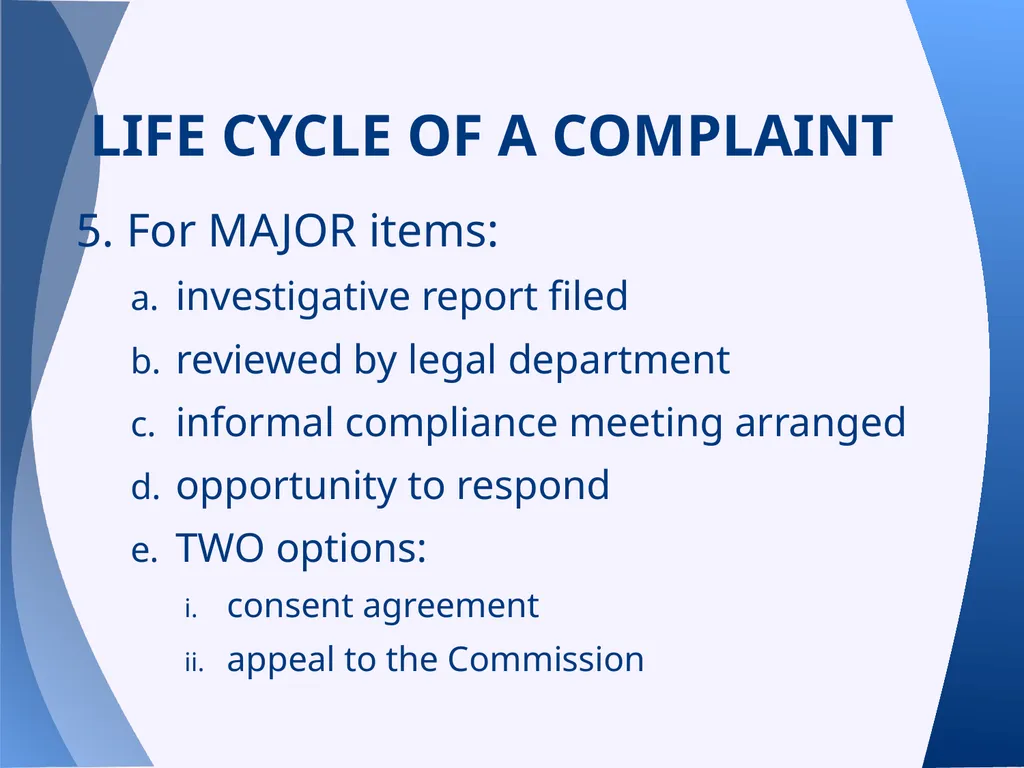
5. For MAJOR items:
investigative report filed
reviewed by legal department
informal compliance meeting arranged
opportunity to respond
TWO options:
consent agreement
appeal to the Commission LIFE CYCLE OF A COMPLAINT<br>
dfgd
fdgd
dfg
5. For MAJOR items:
investigative report filed
reviewed by legal department
informal compliance meeting arranged
opportunity to respond
TWO options:
consent agreement
appeal to the Commission LIFE CYCLE OF A COMPLAINT<br>
86
LIFE CYCLE OF A COMPLAINT<br>
87
LIFE CYCLE OF A COMPLAINT<br>
88
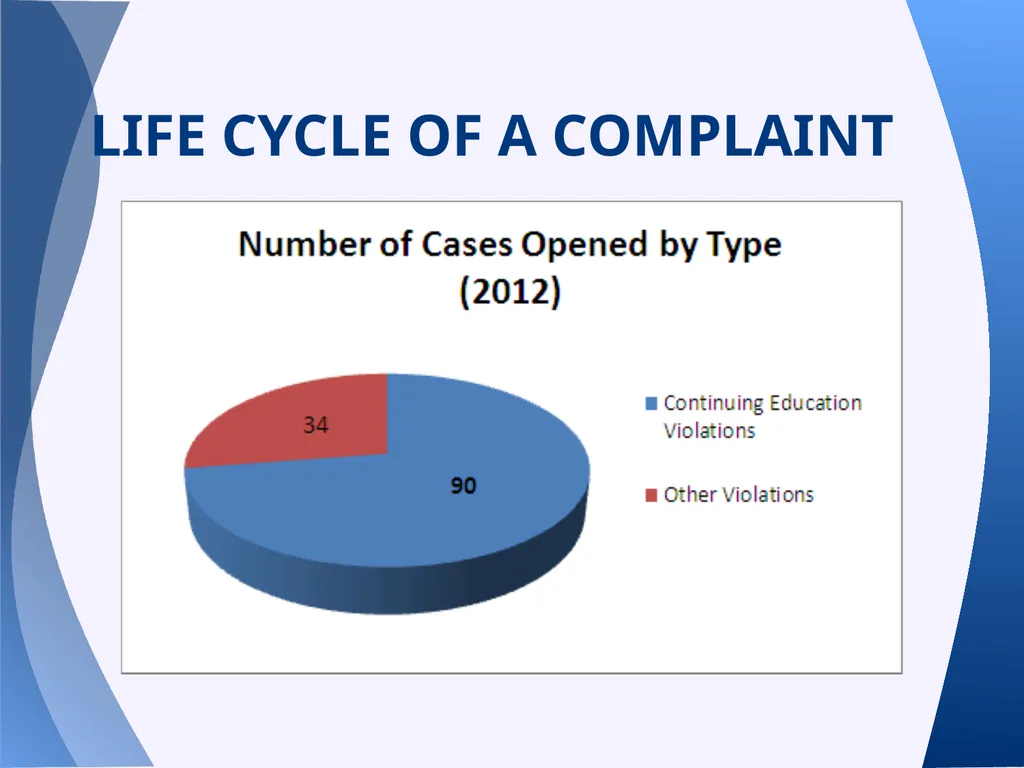
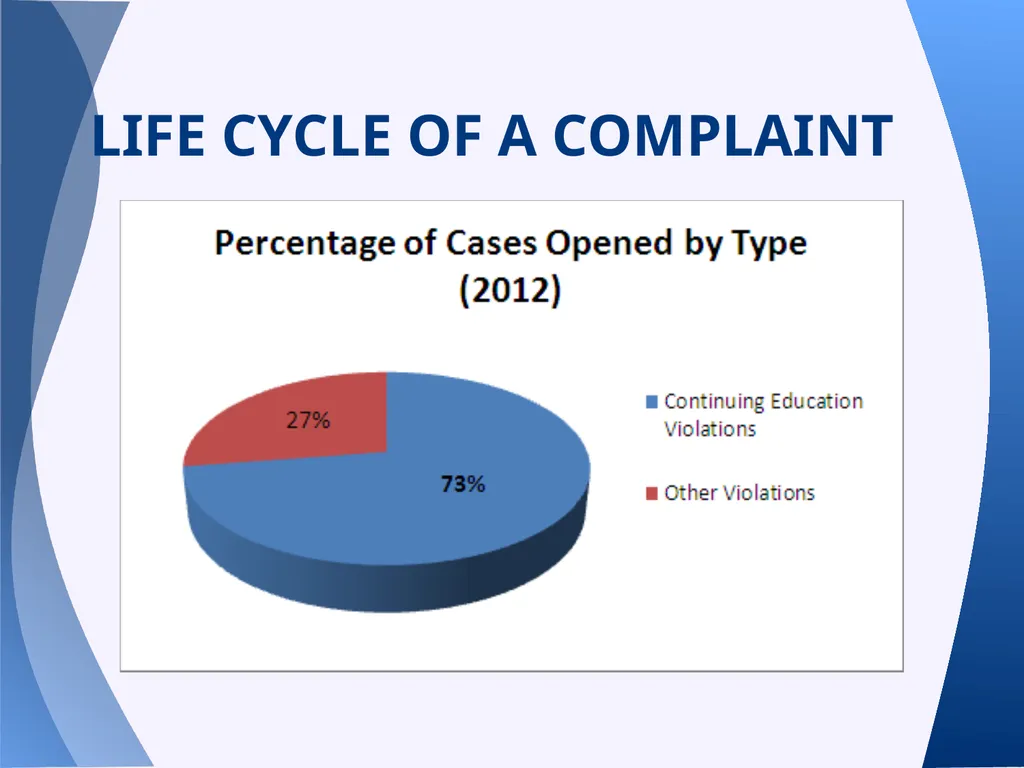
Licensees who were non-compliant with 2012 continuing education requirements were subject to a $400 civil penalty payment and possible loss of licensure
Fine for non-compliance with 2014 continuing education TBD LIFE CYCLE OF A COMPLAINT<br>
Fine for non-compliance with 2014 continuing education TBD LIFE CYCLE OF A COMPLAINT<br>
89
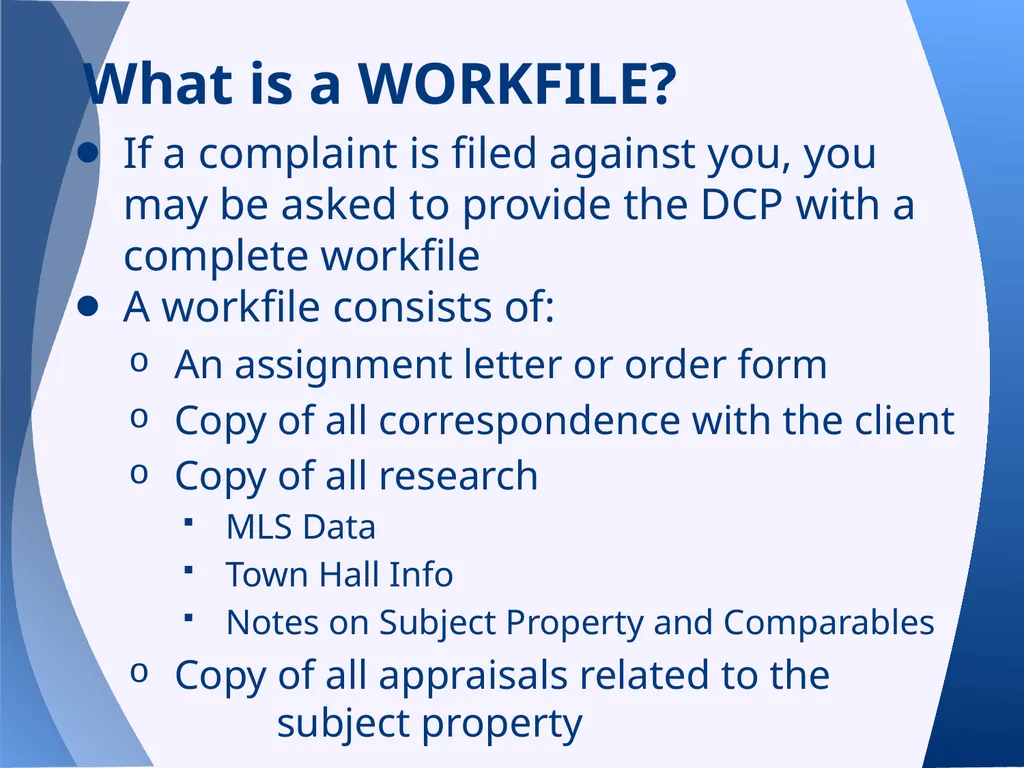
If a complaint is filed against you, you may be asked to provide the DCP with a complete workfile
A workfile consists of:
An assignment letter or order form
Copy of all correspondence with the client
Copy of all research
MLS Data
Town Hall Info
Notes on Subject Property and Comparables
Copy of all appraisals related to the subject property What is a WORKFILE?<br>
A workfile consists of:
An assignment letter or order form
Copy of all correspondence with the client
Copy of all research
MLS Data
Town Hall Info
Notes on Subject Property and Comparables
Copy of all appraisals related to the subject property What is a WORKFILE?<br>
90
Strict Laws That
Apply to Our Biggest
Client Group -
And, By Extension
APPLY TO APPRAISERS Fair Lending<br>
Apply to Our Biggest
Client Group -
And, By Extension
APPLY TO APPRAISERS Fair Lending<br>
91
Objective neighborhood analysis
Appropriate market research Fair Lending:
Key Components of the Appraisal Process<br>
Appropriate market research Fair Lending:
Key Components of the Appraisal Process<br>
92
Identify factors which affect value - with market support
Avoid rating or judging neighborhood or its residents Neighborhood Analysis<br>
Avoid rating or judging neighborhood or its residents Neighborhood Analysis<br>
93
Pride of Ownership
High Crime Area
Drug-Infested Area
Blue-Collar Neighborhood
White-Collar Neighborhood
Low-Income Area
Desirable Neighborhood
Prestigious Neighborhood Avoid Subjective Terms<br>
High Crime Area
Drug-Infested Area
Blue-Collar Neighborhood
White-Collar Neighborhood
Low-Income Area
Desirable Neighborhood
Prestigious Neighborhood Avoid Subjective Terms<br>
94
Fannie Mae:
with market evidence of effect on value -
consider it
without market evidence of effect on value -
don't consider it Market Research<br>
with market evidence of effect on value -
consider it
without market evidence of effect on value -
don't consider it Market Research<br>
95
USPAP
Ethics Rule, Conduct Section Fair Lending Regulation Included In:<br>
Ethics Rule, Conduct Section Fair Lending Regulation Included In:<br>
96
Provide the Provisional Appraiser with a basic understanding of USPAP requirements
Understand the AQB minimum requirements of both the Supervisory Appraiser and Provisional Appraiser, as well as the requirements of the State of CT
Provide proper guidance to the Provisional Appraiser when he/she selects a specific credentialing path (i.e. RCR or RCG) Supervisory Appraiser
Expectations and Responsibilities<br>
Understand the AQB minimum requirements of both the Supervisory Appraiser and Provisional Appraiser, as well as the requirements of the State of CT
Provide proper guidance to the Provisional Appraiser when he/she selects a specific credentialing path (i.e. RCR or RCG) Supervisory Appraiser
Expectations and Responsibilities<br>
97
Monitor the Provisional Appraiser's progress in satisfying both the education and experience requirements necessary to achieve his/her desired credential
Verify that the Supervisory Appraiser and Provisional Appraiser are properly documenting all appropriate experience logs Supervisory Appraiser
Expectations and Responsibilities<br>
Verify that the Supervisory Appraiser and Provisional Appraiser are properly documenting all appropriate experience logs Supervisory Appraiser
Expectations and Responsibilities<br>
98
Accompany the Provisional Appraiser on all inspections until the provisional is COMPETENT to conduct inspections independently, and has met all specific requirements pertaining to property inspection established by the State of CT
Verify that the Provisional Appraiser is properly identified and acknowledged in the appraisal report in compliance with USPAP and state requirements Supervisory Appraiser
Expectations and Responsibilities<br>
Verify that the Provisional Appraiser is properly identified and acknowledged in the appraisal report in compliance with USPAP and state requirements Supervisory Appraiser
Expectations and Responsibilities<br>
99
Monitor and provide assignments and duties that ensure the Provisional Appraiser is developing an understanding and progression of knowledge and experience of all applicable valuation methodologies and approaches to value
Immediately notify the Provisional Appraiser if the Supervisory Appraiser is no longer qualified to supervise and/or sign the Provisional Appraiser's experience log Supervisory Appraiser
Expectations and Responsibilities<br>
Immediately notify the Provisional Appraiser if the Supervisory Appraiser is no longer qualified to supervise and/or sign the Provisional Appraiser's experience log Supervisory Appraiser
Expectations and Responsibilities<br>
100
State-certified Supervisory Appraiser shall be in good standing with the State of CT and not subject to any disciplinary action within the last three (3) years that affects the Supervisory Appraiser's legal ability to engage in appraisal practice
Shall have been certified for a minimum of three (3) years prior to being eligible to become a Supervisory Appraiser Changes in Supervisory
Appraiser Requirements<br>
Shall have been certified for a minimum of three (3) years prior to being eligible to become a Supervisory Appraiser Changes in Supervisory
Appraiser Requirements<br>
101
Supervisory Appraiser may not supervise more than three (3) Provisional Appraisers at one time, unless a CT State program provides to progress monitoring, supervising certified appraiser qualifications, and supervision oversight requirements for Supervisory Appraisers
Supervisory Appraiser must attend Provisional Appraiser’s interview/log review before the Appraisal Commission Changes in Supervisory
Appraiser Requirements<br>
Supervisory Appraiser must attend Provisional Appraiser’s interview/log review before the Appraisal Commission Changes in Supervisory
Appraiser Requirements<br>
102
The Supervisory Appraiser-Provisional Appraiser relationship is a long-term commitment by BOTH parties
The provisional is inherently connected to the "good standing" of the Supervisory Appraiser The Importance of Selecting Your Supervisory Appraiser:<br>
The provisional is inherently connected to the "good standing" of the Supervisory Appraiser The Importance of Selecting Your Supervisory Appraiser:<br>
103
Choose a supervisory appraiser with the experience and competency that best matches the Provisional Appraiser's selected credentialing path
Outline your options if your supervisory appraiser is no longer able to serve as a supervisory appraiser The Importance of Selecting Your Supervisory Appraiser:<br>
Outline your options if your supervisory appraiser is no longer able to serve as a supervisory appraiser The Importance of Selecting Your Supervisory Appraiser:<br>
104
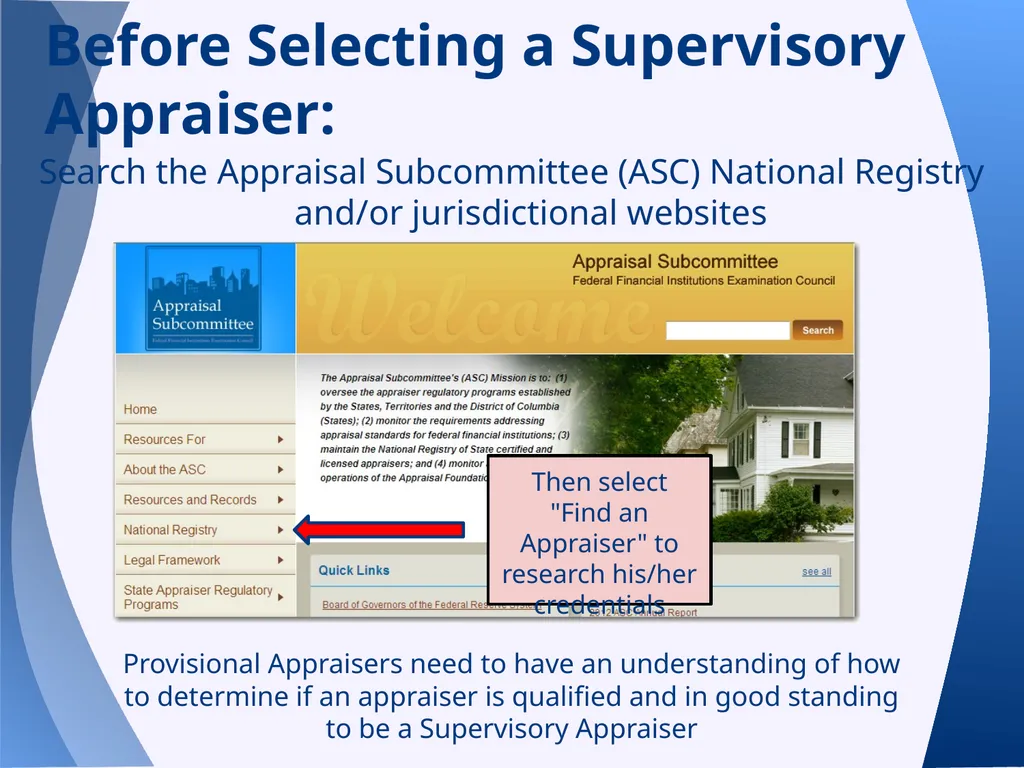
Search the Appraisal Subcommittee (ASC) National Registry and/or jurisdictional websites Before Selecting a Supervisory Appraiser: Then select "Find an Appraiser" to research his/her credentials Provisional Appraisers need to have an understanding of how to determine if an appraiser is qualified and in good standing to be a Supervisory Appraiser<br>
105
To understand it is the supervisory appraiser's responsibility to monitor the progression of the provisional's education and experience necessary to achieve the provisional's selected credential path Provisional Appraiser Expectations and Responsibilities<br>
106
To understand it is the supervisory appraiser's responsibility to provide assignments and duties that ensure the provisional is developing an understanding and progression of knowledge and experience of all applicable valuation methodologies and approaches to value Provisional Appraiser Expectations and Responsibilities<br>
107
To understand the responsibilities of both the Provisional Appraiser and the Supervisory Appraiser in properly documenting all appropriate Provisional Appraiser's experience logs Provisional Appraiser Expectations and Responsibilities<br>
108
Logs can be found on the appraiser application at:
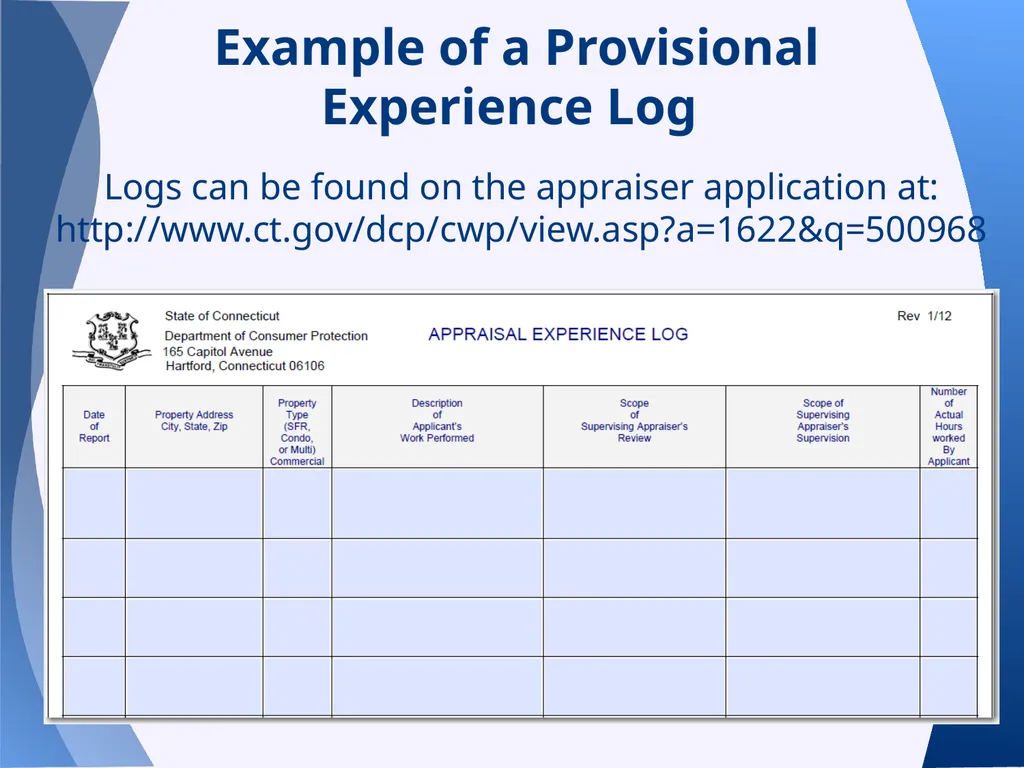
http://www.ct.gov/dcp/cwp/view.asp?a=1622&q=500968 Example of a Provisional Experience Log<br>
http://www.ct.gov/dcp/cwp/view.asp?a=1622&q=500968 Example of a Provisional Experience Log<br>
109
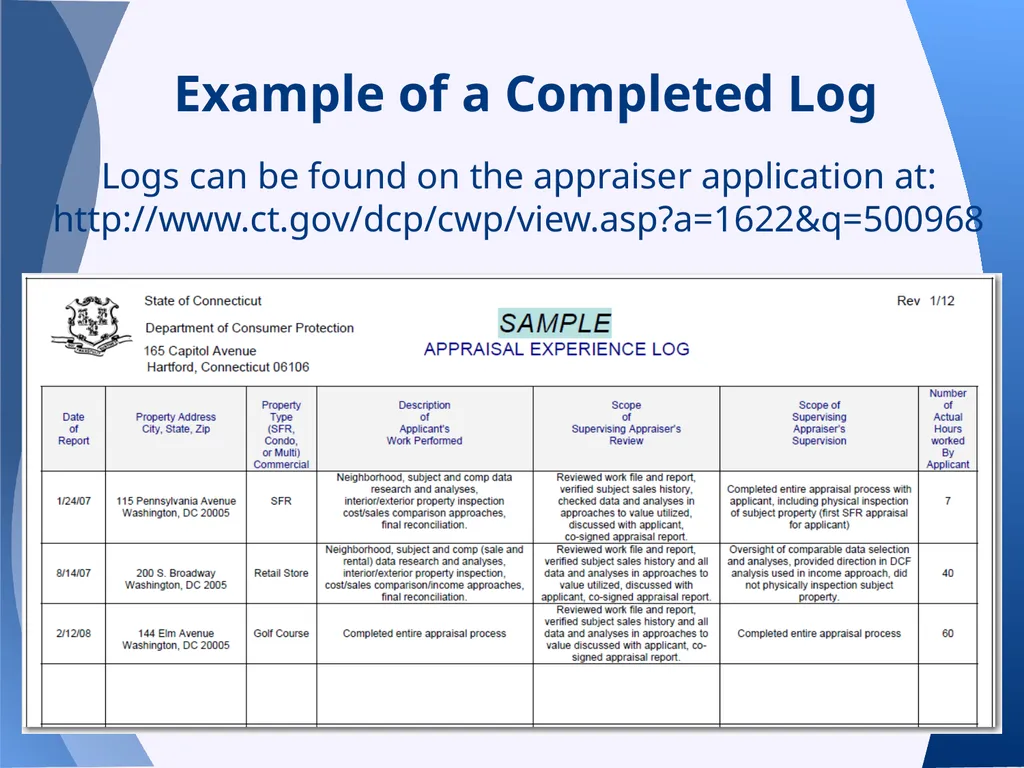
Example of a Completed Log Logs can be found on the appraiser application at:
http://www.ct.gov/dcp/cwp/view.asp?a=1622&q=500968<br>
http://www.ct.gov/dcp/cwp/view.asp?a=1622&q=500968<br>
110
To understand that the Supervisory Appraiser must accompany the provisional on ALL inspections until he or she is COMPETENT to conduct inspections independently, and has met all requirements pertaining to property inspection established by the credentialing jurisdiction Provisional Appraiser Expectations and Responsibilities<br>
111
All qualifying education must be completed within the five (5) year period prior to the date of submission of an application for a Provisional Appraiser credential
A Provisional Appraiser is permitted to have more than one Supervisory Appraiser
15 hour USPAP course only valid for six (6) years prior to upgrading to certified appraiser Changes in Provisional Appraiser Requirements<br>
A Provisional Appraiser is permitted to have more than one Supervisory Appraiser
15 hour USPAP course only valid for six (6) years prior to upgrading to certified appraiser Changes in Provisional Appraiser Requirements<br>
112
Create a written plan of action outlining the provisional's proposed schedule for upgrading within the 6 year period
Responsibility to ensure the appraisal experience log for the Provisional Appraiser is accurate, current, and complies with the requirements of the State of CT Shared Requirements for Supervisory and Provisional Appraisers<br>
Responsibility to ensure the appraisal experience log for the Provisional Appraiser is accurate, current, and complies with the requirements of the State of CT Shared Requirements for Supervisory and Provisional Appraisers<br>
113
Complete a course that, at a minimum, complies with the specifications for course content established by the AQB. The course will be oriented toward the requirements/responsibilities of Supervisory Appraisers and Provisional Appraisers. Shared Requirements for Supervisory and Provisional Appraisers<br>
114
The course must be completed by the Provisional Appraiser prior to obtaining a Provisional Appraiser credential, and completed by the Supervisory Appraiser prior to supervising a Provisional Appraiser Shared Requirements for Supervisory and Provisional Appraisers<br>
115
Provide Supervisory Appraisers and Provisional Appraisers with a summary of the state's requirements that may exceed those of the AQB Criteria State of CT Expectations and Responsibilities<br>
116
Statutes and Regulations:
http://www.cga.ct.gov/current/pub/chap_400g.htm
http://www.ct.gov/dcp/lib/dcp/pdf/laws_and_regulations/regs_-_real_estate_appraisal_and_schools2012.pdf
Appraisal Subcommittee
https://www.asc.gov/Home.aspx
The Appraisal Foundation
http://www.appraisalfoundation.org/
Consumer Protection Finance Bureau
http://www.consumerfinance.gov/ Glossary of External Links:<br>
http://www.cga.ct.gov/current/pub/chap_400g.htm
http://www.ct.gov/dcp/lib/dcp/pdf/laws_and_regulations/regs_-_real_estate_appraisal_and_schools2012.pdf
Appraisal Subcommittee
https://www.asc.gov/Home.aspx
The Appraisal Foundation
http://www.appraisalfoundation.org/
Consumer Protection Finance Bureau
http://www.consumerfinance.gov/ Glossary of External Links:<br>
117
Office of the Comptroller of the Currency:
http://www.occ.treas.gov/news-issuances/federal-register/75fr77450.pdf
To verify a license/search for a course:
https://www.elicense.ct.gov/
AMC Renewal Forms:
http://www.ct.gov/dcp/cwp/view.asp?a=1622&q=501000
Provisional Experience Logs:
http://www.ct.gov/dcp/cwp/view.asp?a=1622&q=500968 Glossary of External Links:<br>
http://www.occ.treas.gov/news-issuances/federal-register/75fr77450.pdf
To verify a license/search for a course:
https://www.elicense.ct.gov/
AMC Renewal Forms:
http://www.ct.gov/dcp/cwp/view.asp?a=1622&q=501000
Provisional Experience Logs:
http://www.ct.gov/dcp/cwp/view.asp?a=1622&q=500968 Glossary of External Links:<br>