
Approved Revision 0: 5/18/2018 Control of
EM
Published · 75 slides · 0 views

1 / 1
Description
Approved Revision 0: 5182018 Control of Radioactive Material Within an RCA RP02.07 Standardized Task Evaluation Program The Standardized Task Evaluation (STE) program promotes a work-ready workforce through the standardization of common
Related Topics
Share
Embed code
Download this presentation From Below
"Approved Revision 0: 5/18/2018 Control of" is the property of its rightful owner. Permission is granted to download and print the materials on this website for personal, non-commercial use only, and to display it on your personal computer provided you do not modify the materials and that you retain all copyright notices contained in the materials. By downloading content from our website, you accept the terms of this agreement.
Presentation Transcript
01
Approved Revision 0: 5/18/2018 Control of Radioactive Material Within an RCA
RP02.07<br>
02
Standardized Task Evaluation Program The Standardized Task Evaluation (STE) program promotes a work-ready workforce through the standardization of common tasks by defining the knowledge and skills required to perform a given task. Subject Matter Experts (SMEs) analyze the task and generate lesson plans, knowledge examination, and performance evaluation elements. These elements are combined to create an STE package.
The Electric Power Research Institute (EPRI) facilitates the development, oversees the quality, and programmatically implements each STE. EPRI STE members have access to these materials and permission to implement these STEs in accordance with their site training and qualification procedures.<br>
The Electric Power Research Institute (EPRI) facilitates the development, oversees the quality, and programmatically implements each STE. EPRI STE members have access to these materials and permission to implement these STEs in accordance with their site training and qualification procedures.<br>
03
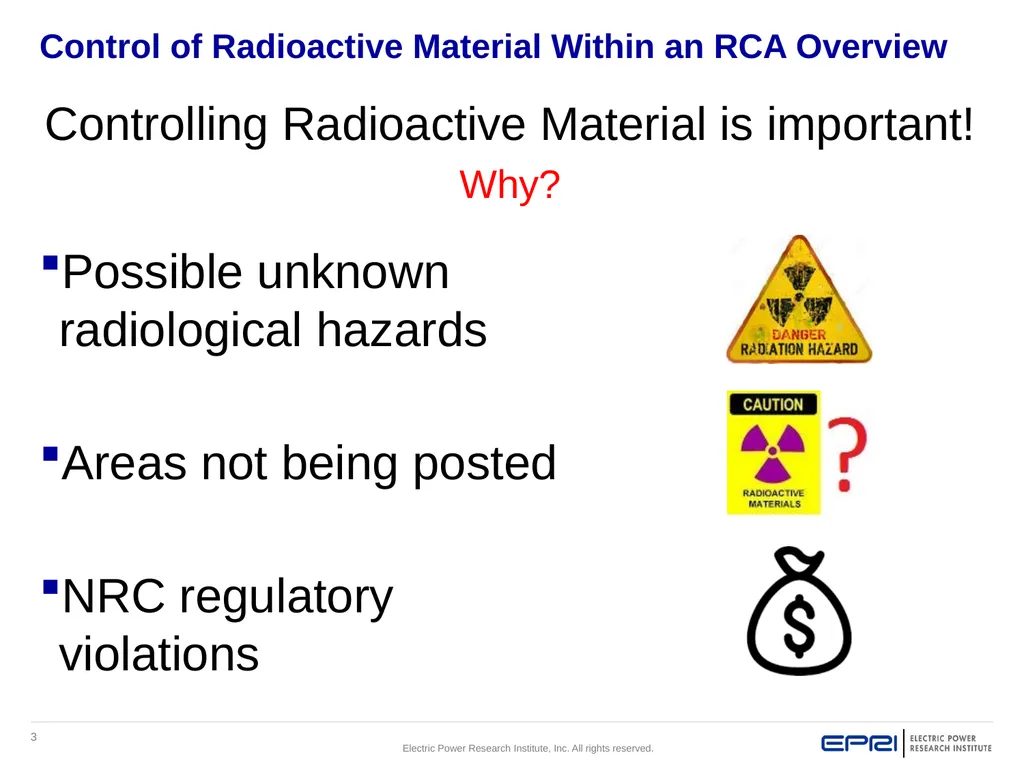
Control of Radioactive Material Within an RCA Overview Controlling Radioactive Material is important!
Why? Possible unknown radiological hazards
Areas not being posted
NRC regulatory violations<br>
Why? Possible unknown radiological hazards
Areas not being posted
NRC regulatory violations<br>
04
Controlling Radioactive Material is important!
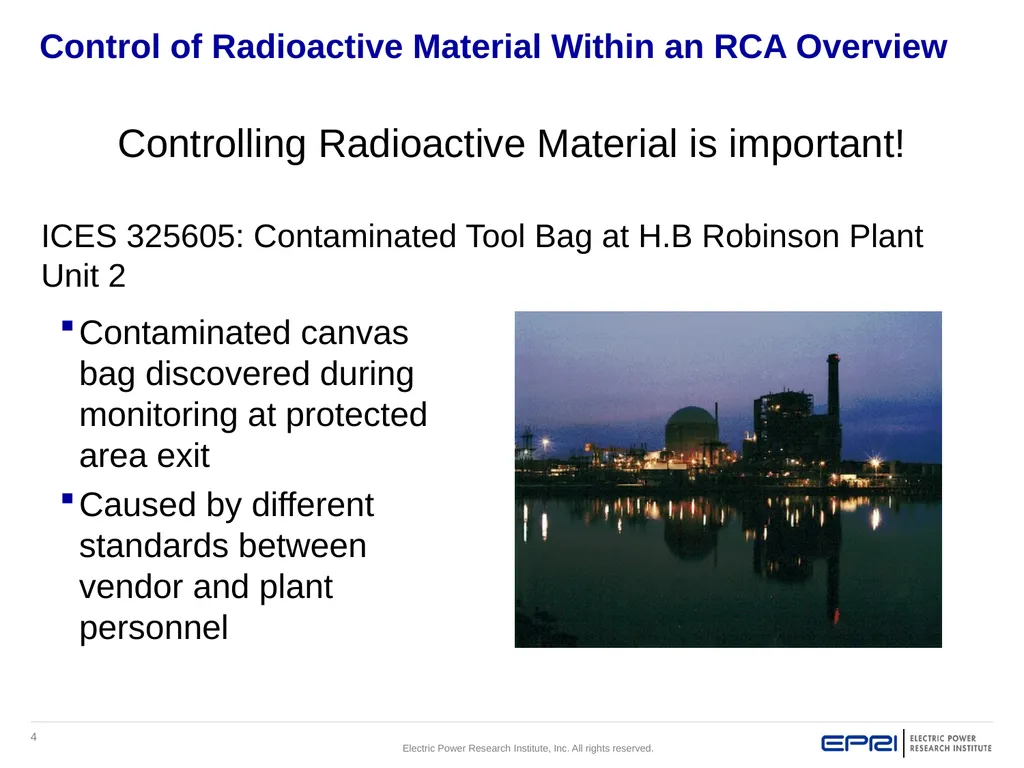
ICES 325605: Contaminated Tool Bag at H.B Robinson Plant Unit 2 Contaminated canvas bag discovered during monitoring at protected area exit
Caused by different standards between vendor and plant personnel Control of Radioactive Material Within an RCA Overview<br>
ICES 325605: Contaminated Tool Bag at H.B Robinson Plant Unit 2 Contaminated canvas bag discovered during monitoring at protected area exit
Caused by different standards between vendor and plant personnel Control of Radioactive Material Within an RCA Overview<br>
05
This STE does not cover and will not qualify you to:
Control or release materials packaged for transportation under Department of Transportation regulations.
Control radioactive sources which may be used at the station for calibration or instrument response verification or Special Nuclear Material.
Special Nuclear Material (SNM) (Definitions – EO 1)
Plutonium, Uranium-233, Uranium enriched in the isotope 233 or the isotope 235, and any other material that the NRC, pursuant to the provisions of Action 51 of the Act, determines to be special nuclear material, but does not include source material.
Any material artificially enriched by any of the foregoing, but does not include source material. Control of Radioactive Material Within an RCA Overview<br>
Control or release materials packaged for transportation under Department of Transportation regulations.
Control radioactive sources which may be used at the station for calibration or instrument response verification or Special Nuclear Material.
Special Nuclear Material (SNM) (Definitions – EO 1)
Plutonium, Uranium-233, Uranium enriched in the isotope 233 or the isotope 235, and any other material that the NRC, pursuant to the provisions of Action 51 of the Act, determines to be special nuclear material, but does not include source material.
Any material artificially enriched by any of the foregoing, but does not include source material. Control of Radioactive Material Within an RCA Overview<br>
06
Terminal Objective Junior
Given radioactive material, incumbent will move, store, and recognize the need to release by a senior RP technician in accordance with NISP-RP-07, Control of Radioactive Material.
Given personal items and security equipment properly released from RCA.
Senior
Given the need to survey material for conditional and unconditional release from a Radiologically Controlled Area (RCA), determine if the material if free of radioactive material and can be released in accordance with NISP-RP-07, Control of Radioactive Material.<br>
Given radioactive material, incumbent will move, store, and recognize the need to release by a senior RP technician in accordance with NISP-RP-07, Control of Radioactive Material.
Given personal items and security equipment properly released from RCA.
Senior
Given the need to survey material for conditional and unconditional release from a Radiologically Controlled Area (RCA), determine if the material if free of radioactive material and can be released in accordance with NISP-RP-07, Control of Radioactive Material.<br>
07
Enabling Objectives From memory:
Define the following terms:
Conditional Release
Detectable Radioactivity
Material Release Plan
Naturally Occurring Radioactive Material (NORM)
Personal Clothing<br>
Define the following terms:
Conditional Release
Detectable Radioactivity
Material Release Plan
Naturally Occurring Radioactive Material (NORM)
Personal Clothing<br>
08
Enabling Objectives From memory: (continued)
Define the following terms:
Personal Items
Radioactive Material Area
Radioactive Material Label
Special Nuclear Material (SNM)
Tools and Equipment Monitor (TEM)<br>
Define the following terms:
Personal Items
Radioactive Material Area
Radioactive Material Label
Special Nuclear Material (SNM)
Tools and Equipment Monitor (TEM)<br>
09
Enabling Objectives From memory:
State the limits for radioactive contamination for release of materials, equipment, and areas for unrestricted use.
State the requirements for surveying and releasing personal items.
State the requirements for surveying and releasing tactical gear worn by security personnel.<br>
State the limits for radioactive contamination for release of materials, equipment, and areas for unrestricted use.
State the requirements for surveying and releasing personal items.
State the requirements for surveying and releasing tactical gear worn by security personnel.<br>
10
Enabling Objectives From memory:
State the requirements for the unconditional release of items.
State the basic operating characteristics of a Tools and Equipment Monitor (TEM).
State the requirements for the operation of a Tools and Equipment Monitor (TEM).
Recognize the level of approval needed and the requirements for transporting radioactive material that has been temporarily (conditionally) released from an RCA.<br>
State the requirements for the unconditional release of items.
State the basic operating characteristics of a Tools and Equipment Monitor (TEM).
State the requirements for the operation of a Tools and Equipment Monitor (TEM).
Recognize the level of approval needed and the requirements for transporting radioactive material that has been temporarily (conditionally) released from an RCA.<br>
11
Enabling Objectives From memory:
Explain the potential impacts and their consequences related to the movement and storage of radioactive material.
State the requirements for storing radioactive material within buildings or in outside areas.
State the requirements for moving radioactive material.<br>
Explain the potential impacts and their consequences related to the movement and storage of radioactive material.
State the requirements for storing radioactive material within buildings or in outside areas.
State the requirements for moving radioactive material.<br>
12
Enabling Objectives From memory:
State dose rates requiring RP escort for moving radioactive material.
State the requirements to unconditionally release liquids.
State the requirements to unconditionally release bulk or aggregate materials.
Describe methods used for decontamination of areas within a plant.<br>
State dose rates requiring RP escort for moving radioactive material.
State the requirements to unconditionally release liquids.
State the requirements to unconditionally release bulk or aggregate materials.
Describe methods used for decontamination of areas within a plant.<br>
13
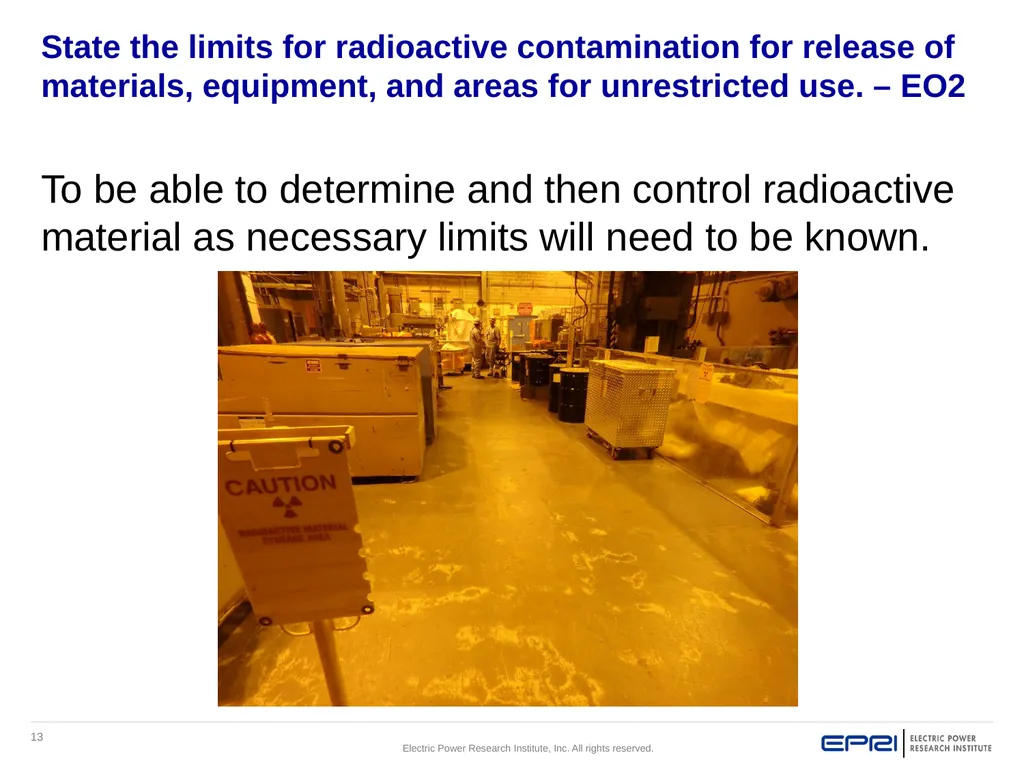
State the limits for radioactive contamination for release of materials, equipment, and areas for unrestricted use. – EO2 To be able to determine and then control radioactive material as necessary limits will need to be known.<br>
14
State the limits for radioactive contamination for release of materials, equipment, and areas for unrestricted use. – EO2 No detectable fixed activity above background, other than naturally occurring isotopes.
Detectable Radioactivity (Definitions – EO 1)
Radioactivity is considered detectable whenever instrumentation gives a reproducible positive indication of its presence, i.e., a reproducible signal distinguishable from background.
Detectability is different for different instrumentation and survey techniques.
Naturally Occurring Radioactive Material (NORM) (Definitions – EO 1)
Radioactive material that consists of radionuclides found in the environment that are not a result of licensee activity.
NORM can include uranium, radium, thorium and their various decay products.<br>
Detectable Radioactivity (Definitions – EO 1)
Radioactivity is considered detectable whenever instrumentation gives a reproducible positive indication of its presence, i.e., a reproducible signal distinguishable from background.
Detectability is different for different instrumentation and survey techniques.
Naturally Occurring Radioactive Material (NORM) (Definitions – EO 1)
Radioactive material that consists of radionuclides found in the environment that are not a result of licensee activity.
NORM can include uranium, radium, thorium and their various decay products.<br>
15
State the limits for radioactive contamination for release of materials, equipment, and areas for unrestricted use. – EO2 No detectable loose surface contamination.
No detectable/suspected internal contamination.
No detectable alpha contamination.
No radioactive labels or markings.
Radioactive Material Label (Definitions – EO 1)
A label or tag which contains the standard radiation symbol and the words, “Caution Radioactive Material” or “Danger Radioactive Material”.
Information including dose rates, contamination levels, other information deemed necessary.
Allows workers handling the material to keep their exposures ALARA.<br>
No detectable/suspected internal contamination.
No detectable alpha contamination.
No radioactive labels or markings.
Radioactive Material Label (Definitions – EO 1)
A label or tag which contains the standard radiation symbol and the words, “Caution Radioactive Material” or “Danger Radioactive Material”.
Information including dose rates, contamination levels, other information deemed necessary.
Allows workers handling the material to keep their exposures ALARA.<br>
16
State the limits for radioactive contamination for release of materials, equipment, and areas for unrestricted use. – EO2 In conclusion, the limits are:
No detectable fixed activity above background, other than naturally occurring isotopes.
No detectable loose surface contamination.
No detectable/suspected internal contamination.
No detectable alpha contamination.
No radioactive labels or markings.<br>
No detectable fixed activity above background, other than naturally occurring isotopes.
No detectable loose surface contamination.
No detectable/suspected internal contamination.
No detectable alpha contamination.
No radioactive labels or markings.<br>
17
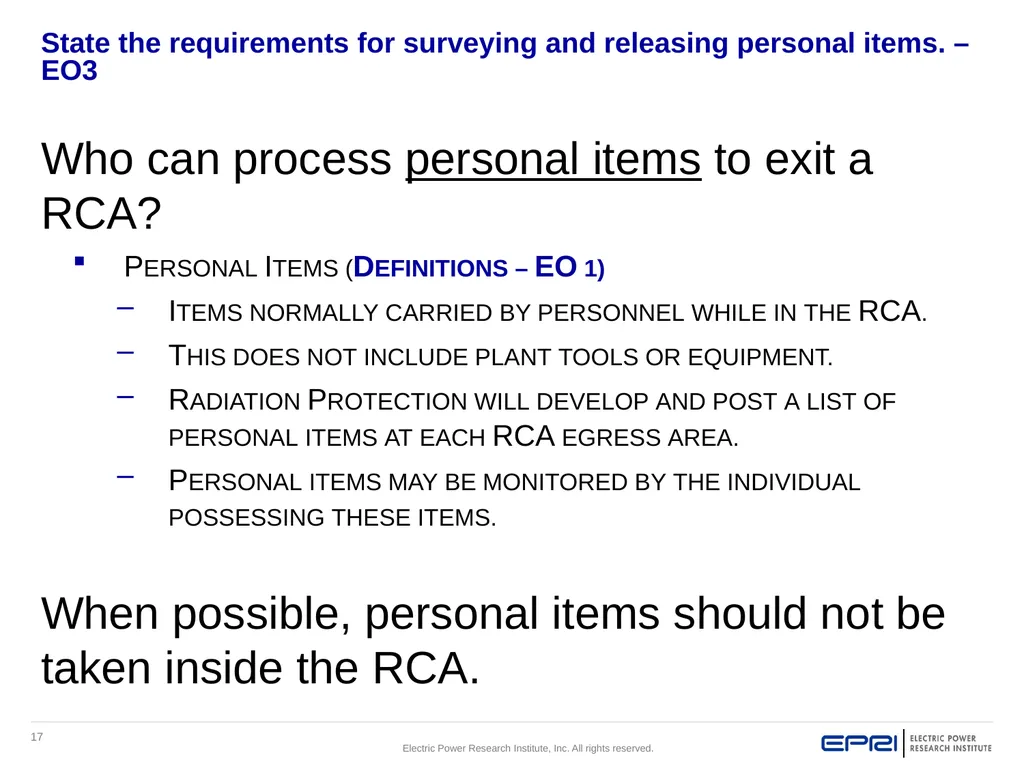
State the requirements for surveying and releasing personal items. – EO3 Who can process personal items to exit a RCA?
Personal Items (Definitions – EO 1)
Items normally carried by personnel while in the RCA.
This does not include plant tools or equipment.
Radiation Protection will develop and post a list of personal items at each RCA egress area.
Personal items may be monitored by the individual possessing these items.
When possible, personal items should not be taken inside the RCA.<br>
Personal Items (Definitions – EO 1)
Items normally carried by personnel while in the RCA.
This does not include plant tools or equipment.
Radiation Protection will develop and post a list of personal items at each RCA egress area.
Personal items may be monitored by the individual possessing these items.
When possible, personal items should not be taken inside the RCA.<br>
18
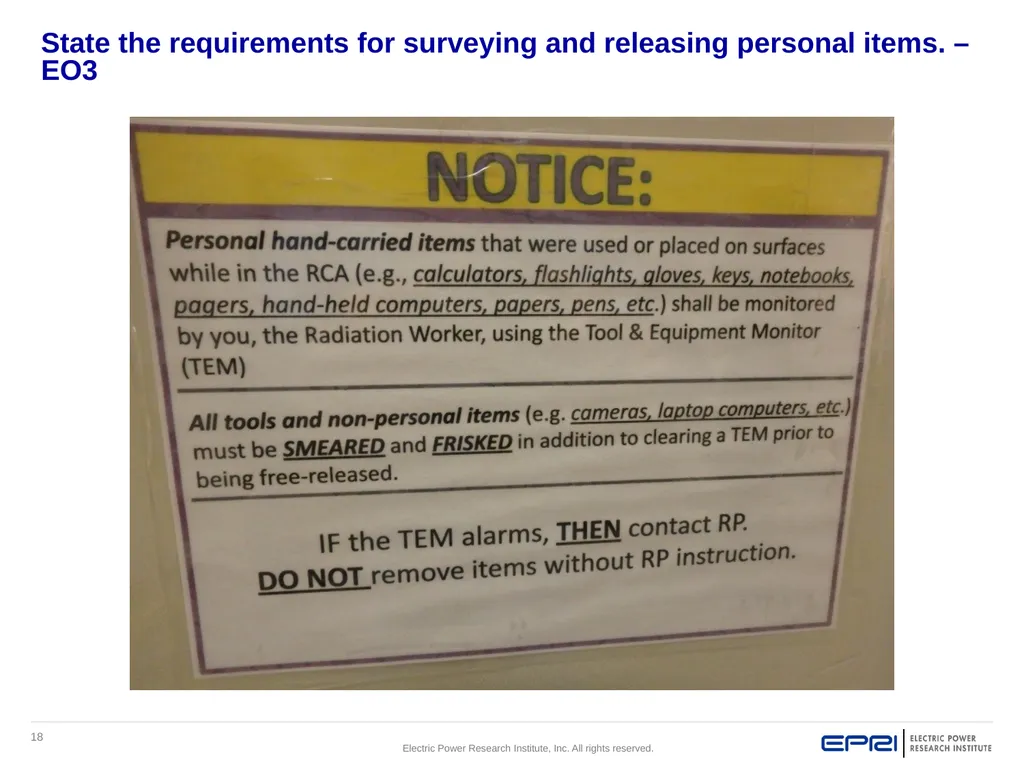
State the requirements for surveying and releasing personal items. – EO3<br>
19
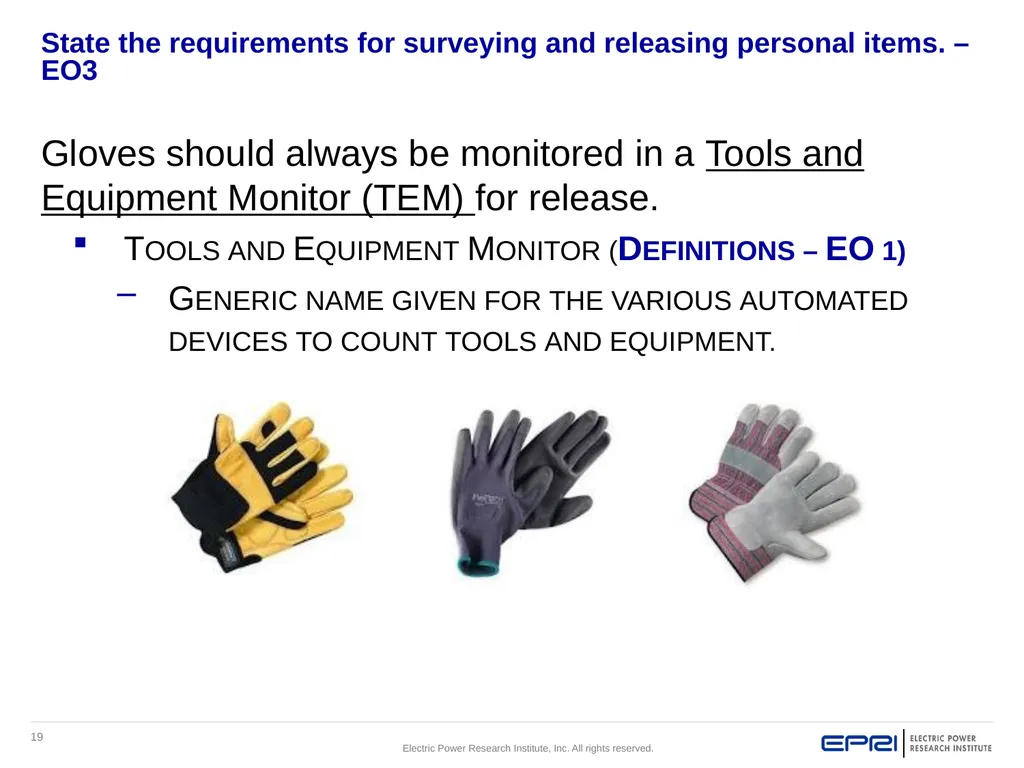
State the requirements for surveying and releasing personal items. – EO3 Gloves should always be monitored in a Tools and Equipment Monitor (TEM) for release.
Tools and Equipment Monitor (Definitions – EO 1)
Generic name given for the various automated devices to count tools and equipment.<br>
Tools and Equipment Monitor (Definitions – EO 1)
Generic name given for the various automated devices to count tools and equipment.<br>
20
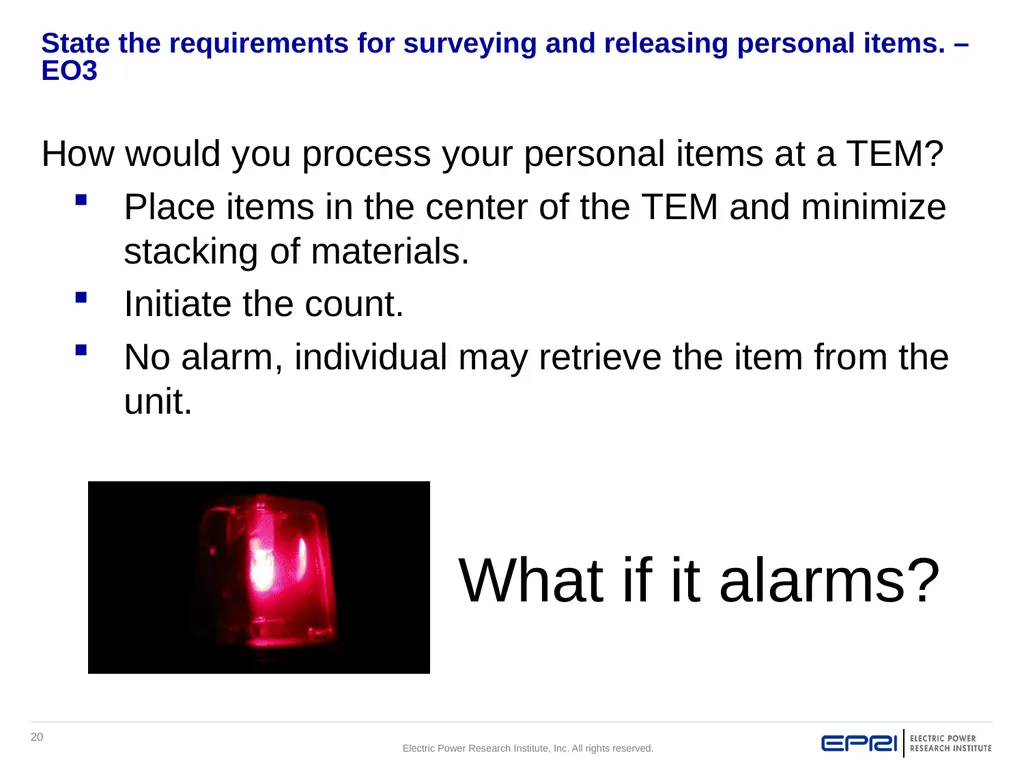
State the requirements for surveying and releasing personal items. – EO3 How would you process your personal items at a TEM?
Place items in the center of the TEM and minimize stacking of materials.
Initiate the count.
No alarm, individual may retrieve the item from the unit. What if it alarms?<br>
Place items in the center of the TEM and minimize stacking of materials.
Initiate the count.
No alarm, individual may retrieve the item from the unit. What if it alarms?<br>
21
State the requirements for surveying and releasing personal items. – EO3 If an alarm occurs:
Initiate the count cycle again.
If alarm does not occur, it may be released.
If alarm occurs again, RP will either:
Decontaminate and release if it clears the TEM.
Control it as RAM<br>
Initiate the count cycle again.
If alarm does not occur, it may be released.
If alarm occurs again, RP will either:
Decontaminate and release if it clears the TEM.
Control it as RAM<br>
22
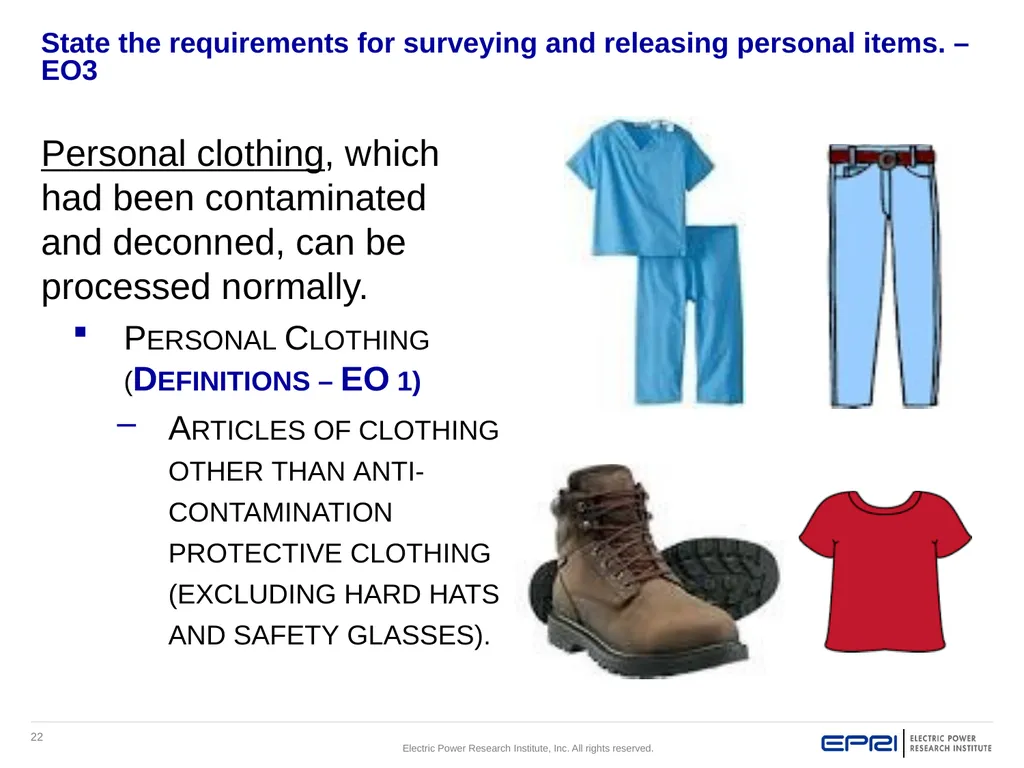
State the requirements for surveying and releasing personal items. – EO3 Personal clothing, which had been contaminated and deconned, can be processed normally.
Personal Clothing (Definitions – EO 1)
Articles of clothing other than anti-contamination protective clothing (excluding hard hats and safety glasses).<br>
Personal Clothing (Definitions – EO 1)
Articles of clothing other than anti-contamination protective clothing (excluding hard hats and safety glasses).<br>
23
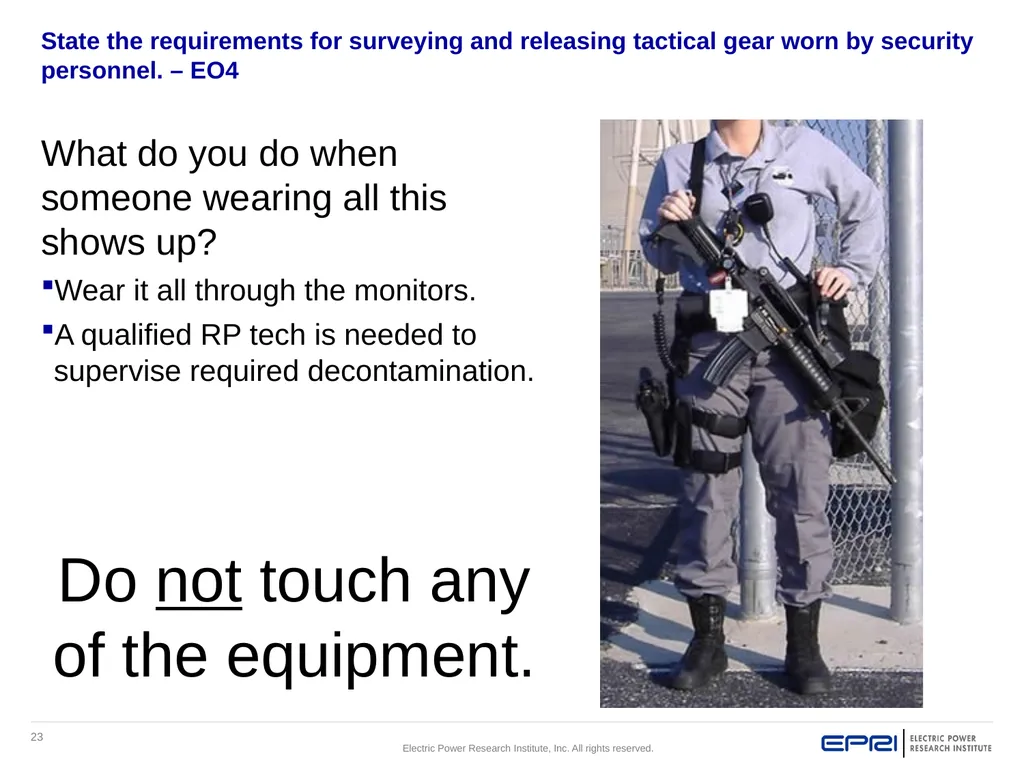
State the requirements for surveying and releasing tactical gear worn by security personnel. – EO4 What do you do when someone wearing all this shows up?
Wear it all through the monitors.
A qualified RP tech is needed to supervise required decontamination.
Do not touch any of the equipment.<br>
Wear it all through the monitors.
A qualified RP tech is needed to supervise required decontamination.
Do not touch any of the equipment.<br>
24
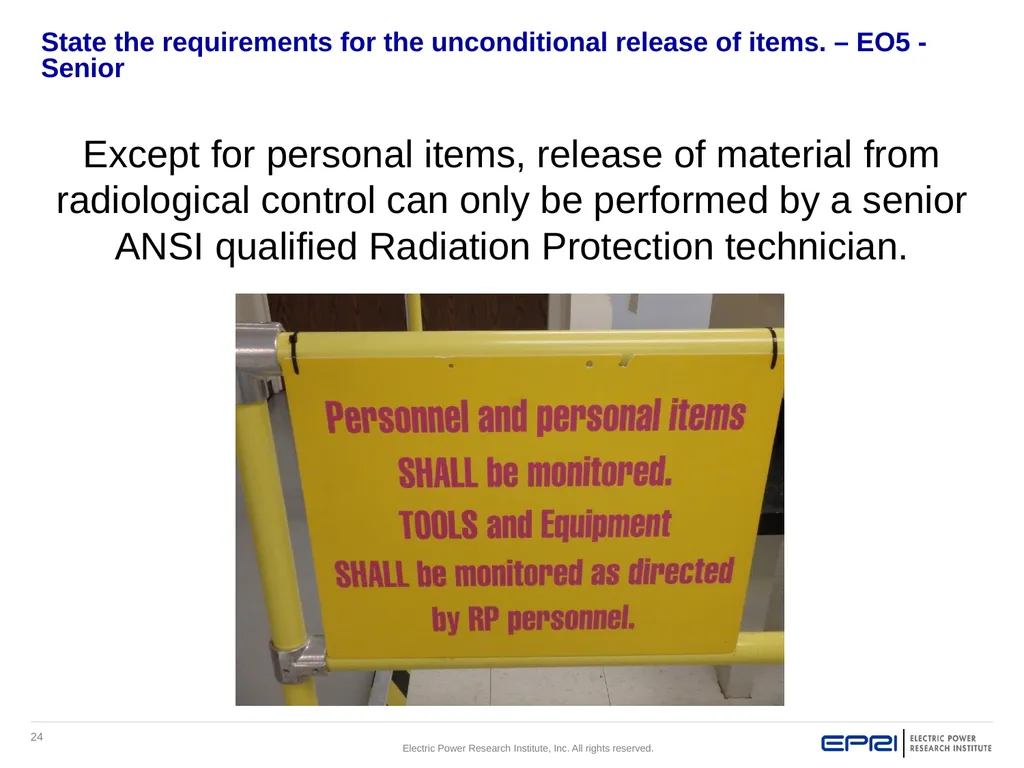
State the requirements for the unconditional release of items. – EO5 - Senior Except for personal items, release of material from radiological control can only be performed by a senior ANSI qualified Radiation Protection technician.<br>
25
State the requirements for the unconditional release of items. – EO5 - Senior Only a senior qualified RP technician may unconditionally (free) release items other than personal items.
Unconditional (or Free) Release (Definitions – EO 1)
Material or equipment that has no detectable licensee generated material above background and therefore may be released from the site for unrestricted use.<br>
Unconditional (or Free) Release (Definitions – EO 1)
Material or equipment that has no detectable licensee generated material above background and therefore may be released from the site for unrestricted use.<br>
26
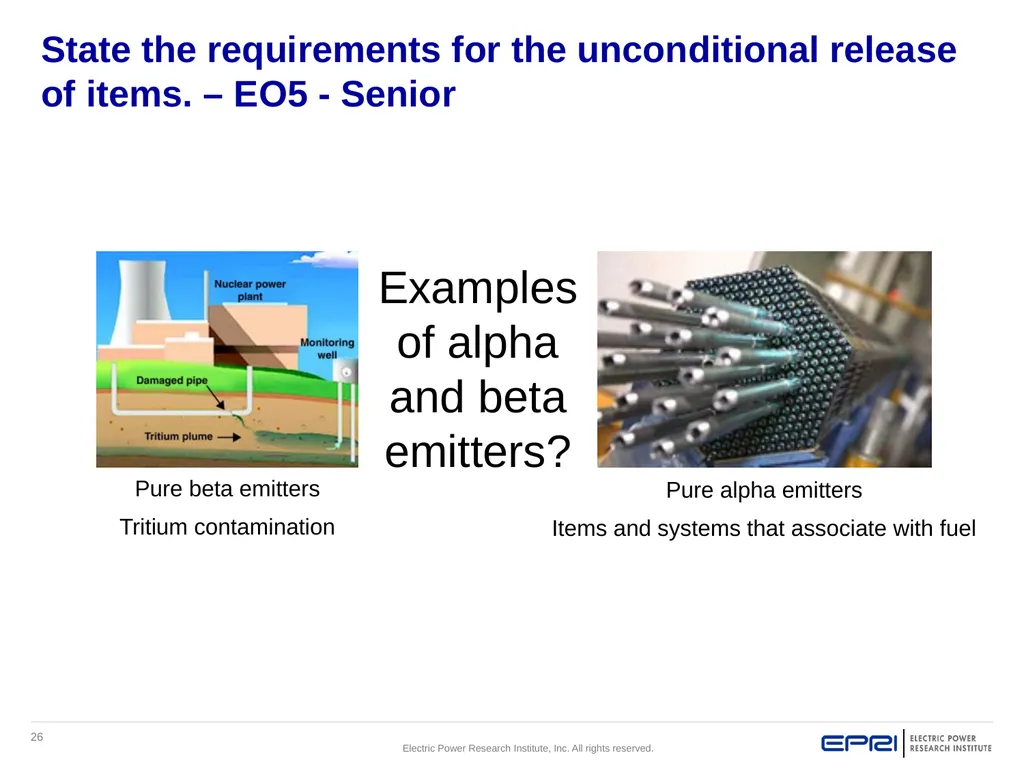
State the requirements for the unconditional release of items. – EO5 - Senior Pure beta emitters
Tritium contamination Pure alpha emitters
Items and systems that associate with fuel Examples of alpha and beta emitters?<br>
Tritium contamination Pure alpha emitters
Items and systems that associate with fuel Examples of alpha and beta emitters?<br>
27
State the requirements for the unconditional release of items. – EO5 - Senior Some other specific notes:
Smoke detectors, or other plant equipment containing radioactive sources, cannot be free released without RP Supervision approval.
Items used during the entry in a contamination area should always be released in a TEM.<br>
Smoke detectors, or other plant equipment containing radioactive sources, cannot be free released without RP Supervision approval.
Items used during the entry in a contamination area should always be released in a TEM.<br>
28
State the requirements for the unconditional release of items. – EO5 - Senior Personnel clothing, which had been contaminated and deconned, can be released after direct frisk of the affected area has been completed, or the item successfully passes the TEM with no indications of radioactivity.
Can you think of any special considerations that should be made when releasing non personal items?
See NISP-RP-07 Attachment 4<br>
Can you think of any special considerations that should be made when releasing non personal items?
See NISP-RP-07 Attachment 4<br>
29
State the requirements for the unconditional release of items. – EO5 - Senior Consider:
Internal contamination
Alpha contamination
Pure beta contamination
Size
Was it disassembled?<br>
Internal contamination
Alpha contamination
Pure beta contamination
Size
Was it disassembled?<br>
30
State the requirements for the unconditional release of items. – EO5 - Senior Certain items require a survey plan to be developed using an Unconditional Release Survey Plan.
Material Release Plan (Definitions – EO 1)
A written plan describing the survey requirements for removing material from the RCA when that material does not fall within the bounds of the procedure for release of material.<br>
Material Release Plan (Definitions – EO 1)
A written plan describing the survey requirements for removing material from the RCA when that material does not fall within the bounds of the procedure for release of material.<br>
31
State the requirements for the unconditional release of items. – EO5 - Senior AGAIN:
Except for personal items, release of material from radiological control can only be performed by a senior ANSI qualified Radiation Protection technician.<br>
Except for personal items, release of material from radiological control can only be performed by a senior ANSI qualified Radiation Protection technician.<br>
32
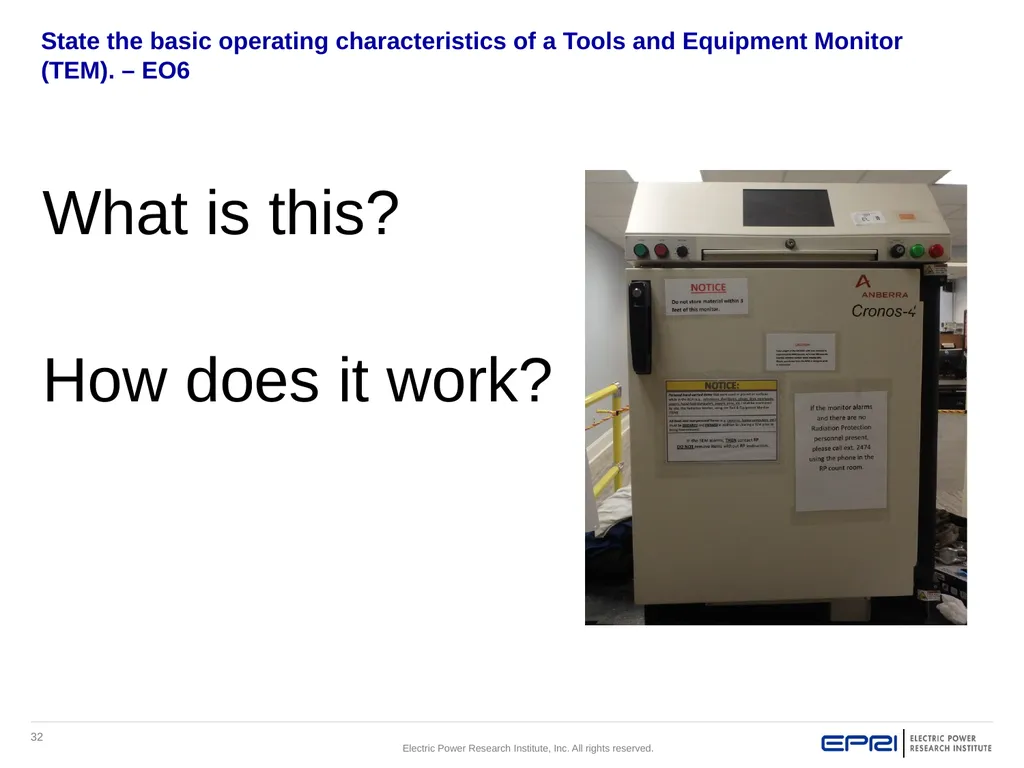
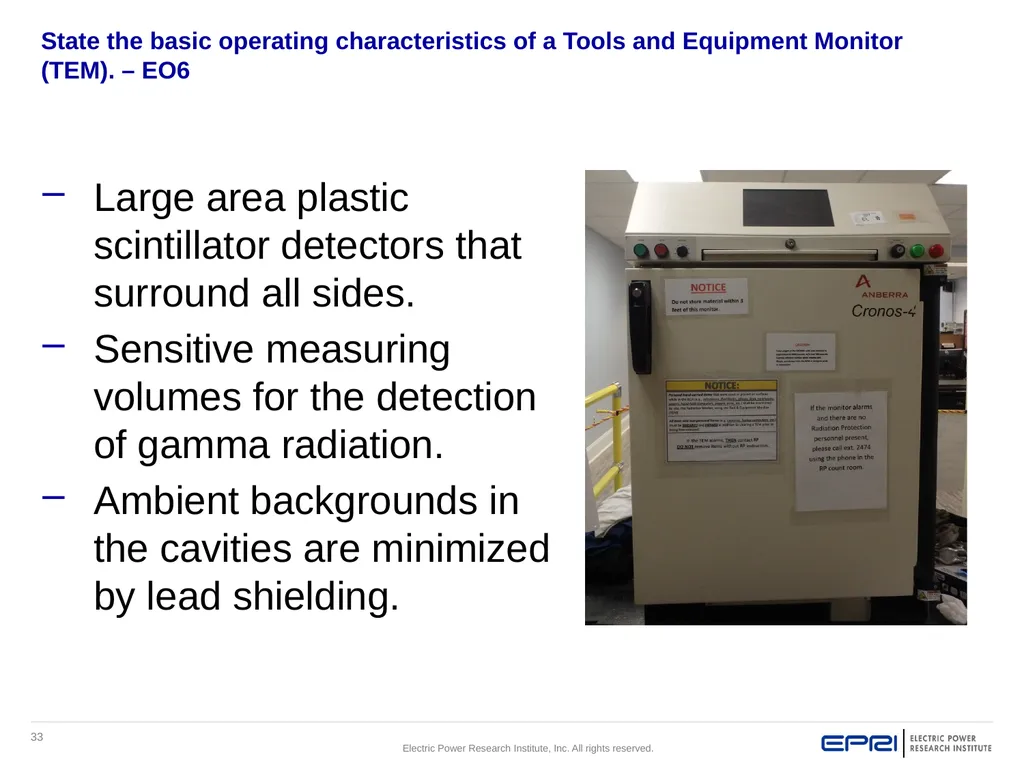
State the basic operating characteristics of a Tools and Equipment Monitor (TEM). – EO6 What is this?
How does it work?<br>
How does it work?<br>
33
State the basic operating characteristics of a Tools and Equipment Monitor (TEM). – EO6 Large area plastic scintillator detectors that surround all sides.
Sensitive measuring volumes for the detection of gamma radiation.
Ambient backgrounds in the cavities are minimized by lead shielding.<br>
Sensitive measuring volumes for the detection of gamma radiation.
Ambient backgrounds in the cavities are minimized by lead shielding.<br>
34
State the requirements for the operation of a Tools and Equipment Monitor (TEM). – EO7 What considerations must be given to the size of items and self shielding effects?
There are also alarm set points requirements to consider:
Established by the site based on:
Background
Instrument efficiency
Hard to detect radionuclides
Should alarm when 5000 dpm of radioactivity has been detected.
If the TEM does not alarm, and direct frisk surveys are equivalent to background, then the item may be released.<br>
There are also alarm set points requirements to consider:
Established by the site based on:
Background
Instrument efficiency
Hard to detect radionuclides
Should alarm when 5000 dpm of radioactivity has been detected.
If the TEM does not alarm, and direct frisk surveys are equivalent to background, then the item may be released.<br>
35
State the requirements for the operation of a Tools and Equipment Monitor (TEM). – EO7 NOTE
If the item is released by survey methods other than a TEM then document the release on an Unconditional Release Survey.<br>
If the item is released by survey methods other than a TEM then document the release on an Unconditional Release Survey.<br>
36
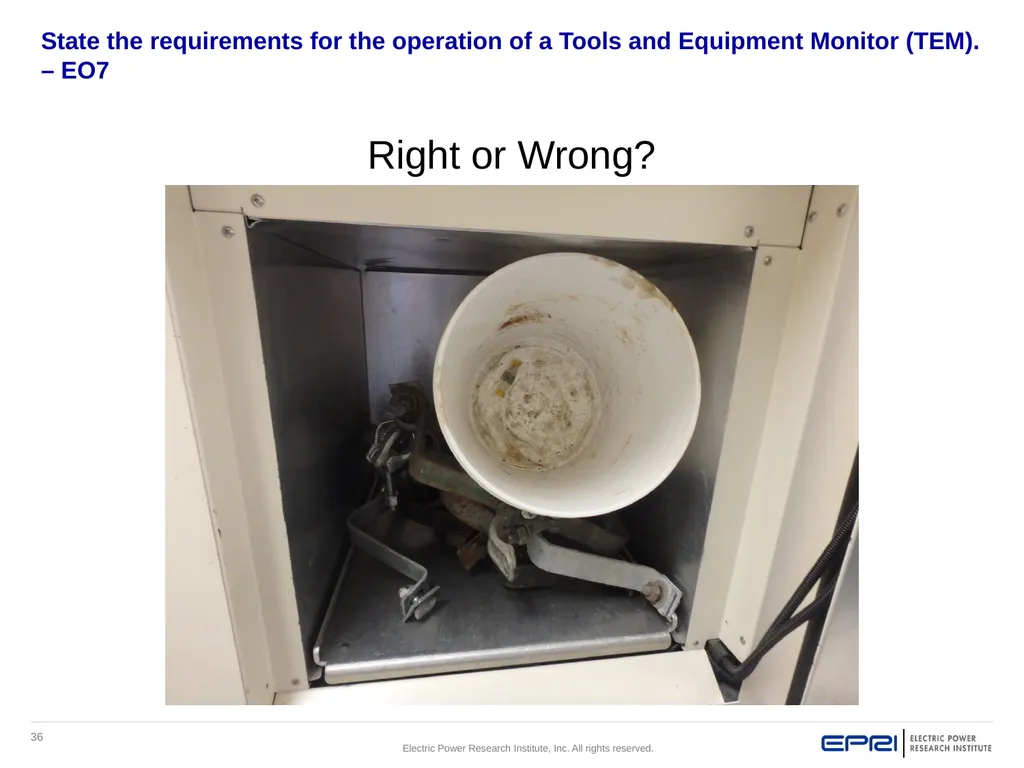
State the requirements for the operation of a Tools and Equipment Monitor (TEM). – EO7 Right or Wrong?<br>
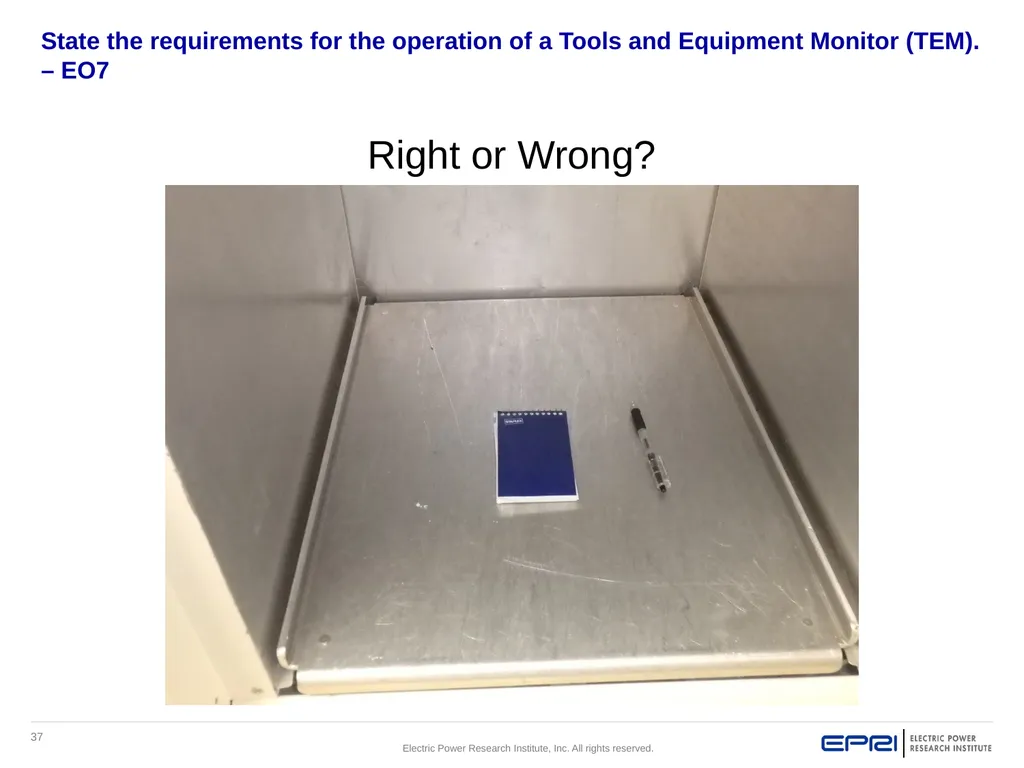
37
State the requirements for the operation of a Tools and Equipment Monitor (TEM). – EO7 Right or Wrong?<br>
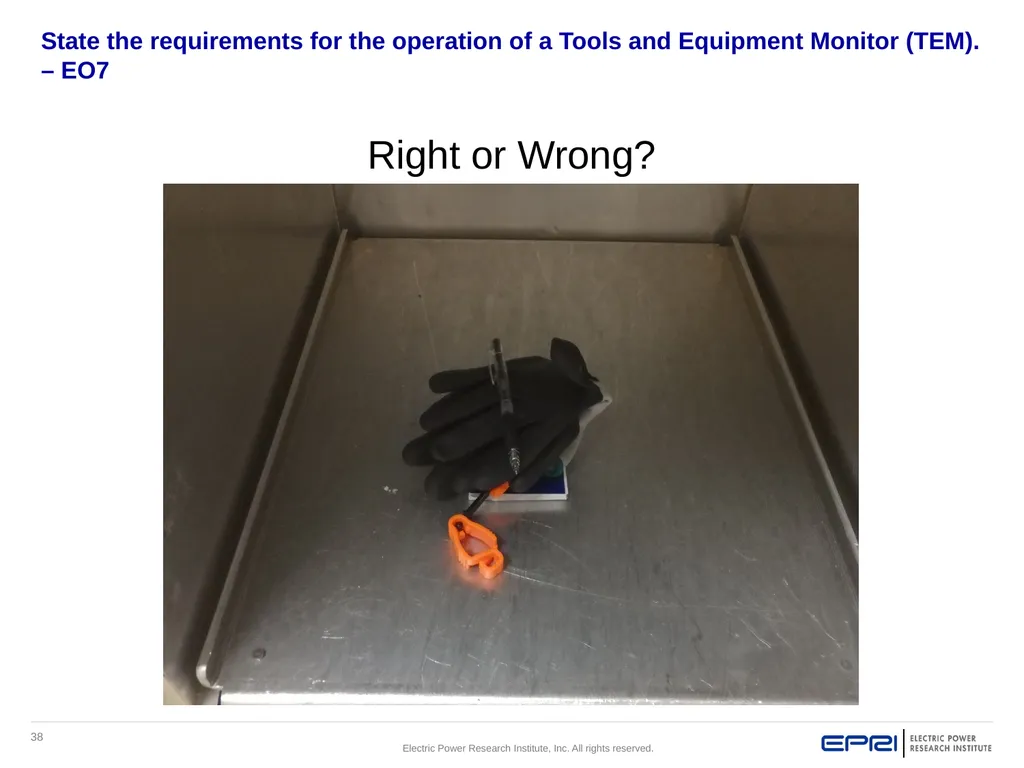
38
State the requirements for the operation of a Tools and Equipment Monitor (TEM). – EO7 Right or Wrong?<br>
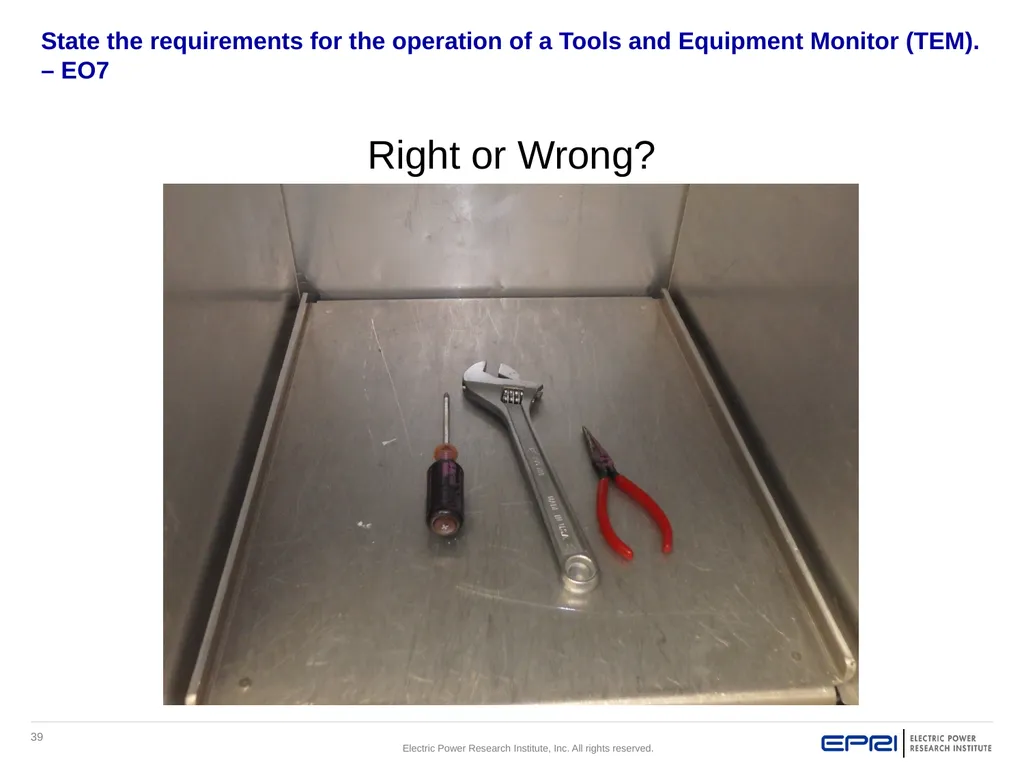
39
State the requirements for the operation of a Tools and Equipment Monitor (TEM). – EO7 Right or Wrong?<br>
40
Recognize the level of approval needed and the requirements for transporting radioactive material that has been temporarily released from an RCA. – EO8 - Senior Items that can not be released and are controlled per NISP-RP-04 may need to be moved from one RCA to another RCA.
Who’s approval do we need to conditionally (temporarily) release an item?
RP Supervisor
Conditional Release (Definitions – EO 1)
A release of radioactive material to an individual other than RP with specific radiological restrictions or controls while outside a posted radiologically controlled area.
What criteria must be met to be conditionally released?
Documented
Labeled
No loose surface contamination<br>
Who’s approval do we need to conditionally (temporarily) release an item?
RP Supervisor
Conditional Release (Definitions – EO 1)
A release of radioactive material to an individual other than RP with specific radiological restrictions or controls while outside a posted radiologically controlled area.
What criteria must be met to be conditionally released?
Documented
Labeled
No loose surface contamination<br>
41
Recognize the level of approval needed and the requirements for transporting radioactive material that has been temporarily released from an RCA. – EO8 - Senior When conditionally releasing radioactive material you must verify it does not meet the requirements for posting of a Radioactive Material Area
Radioactive Material Area (Definitions – EO 1)
An area in which licensed radioactive material in an amount exceeding 10 times the quantity specified in Appendix C, 10CFR20, is used or stored.
This does not apply to radioactive materials contained within process equipment or materials in transport and packaged and labeled in accordance with appropriate regulations.<br>
Radioactive Material Area (Definitions – EO 1)
An area in which licensed radioactive material in an amount exceeding 10 times the quantity specified in Appendix C, 10CFR20, is used or stored.
This does not apply to radioactive materials contained within process equipment or materials in transport and packaged and labeled in accordance with appropriate regulations.<br>
42
Recognize the level of approval needed and the requirements for transporting radioactive material that has been temporarily released from an RCA. – EO8 - Senior What criteria must be met?
There is no potential for spills or leaks.
NISP-RP-04 requirements satisfied.
Logged in on the appropriate RWP.
The dose rate on the item is < 2.0 mrem/hr at 30 cm.<br>
There is no potential for spills or leaks.
NISP-RP-04 requirements satisfied.
Logged in on the appropriate RWP.
The dose rate on the item is < 2.0 mrem/hr at 30 cm.<br>
43
Explain the potential impacts and their consequences related to the movement and storage of radioactive material. – EO9 Impacts must be considered with the movement and storage of radioactive material.
How much material is being moved?
What is the radioactivity levels of what is being moved?
Can the movement change the background dose rates in the old AND new area?<br>
How much material is being moved?
What is the radioactivity levels of what is being moved?
Can the movement change the background dose rates in the old AND new area?<br>
44
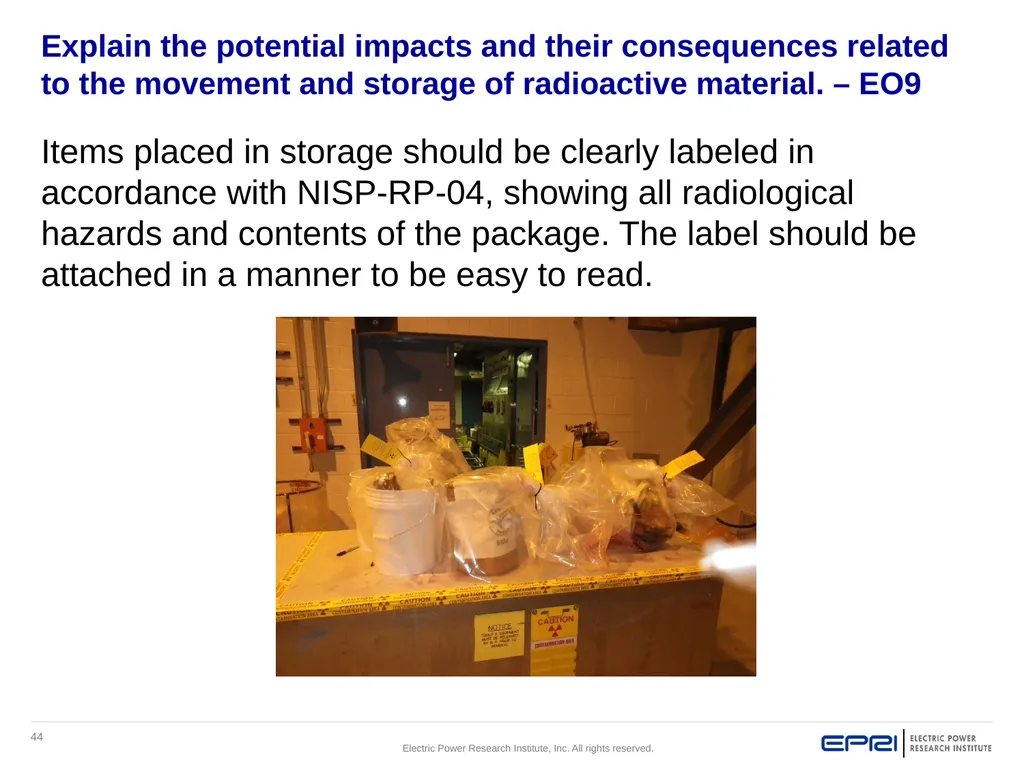
Explain the potential impacts and their consequences related to the movement and storage of radioactive material. – EO9 Items placed in storage should be clearly labeled in accordance with NISP-RP-04, showing all radiological hazards and contents of the package. The label should be attached in a manner to be easy to read.<br>
45
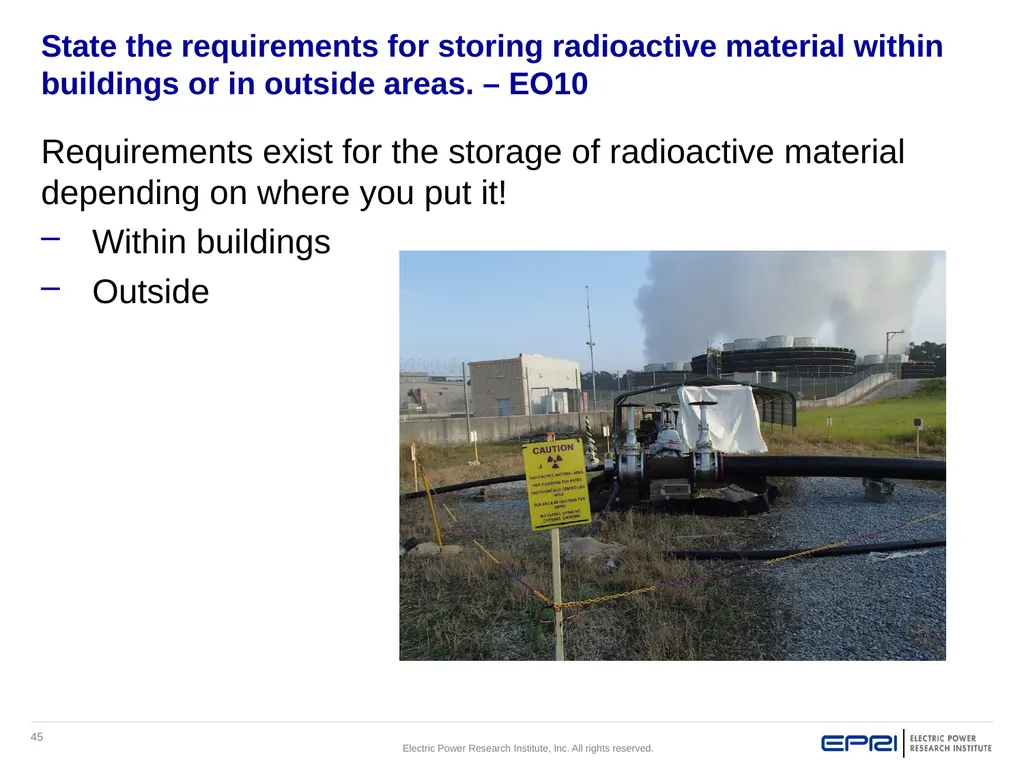
State the requirements for storing radioactive material within buildings or in outside areas. – EO10 Requirements exist for the storage of radioactive material depending on where you put it!
Within buildings
Outside<br>
Within buildings
Outside<br>
46
State the requirements for moving radioactive material. – EO11 When moving radioactive material consider that:
Material must be labeled.
Individual responsibility is key!
Plant impact.
Will surveys need to be complete?
10CFR37 Security requirements.<br>
Material must be labeled.
Individual responsibility is key!
Plant impact.
Will surveys need to be complete?
10CFR37 Security requirements.<br>
47
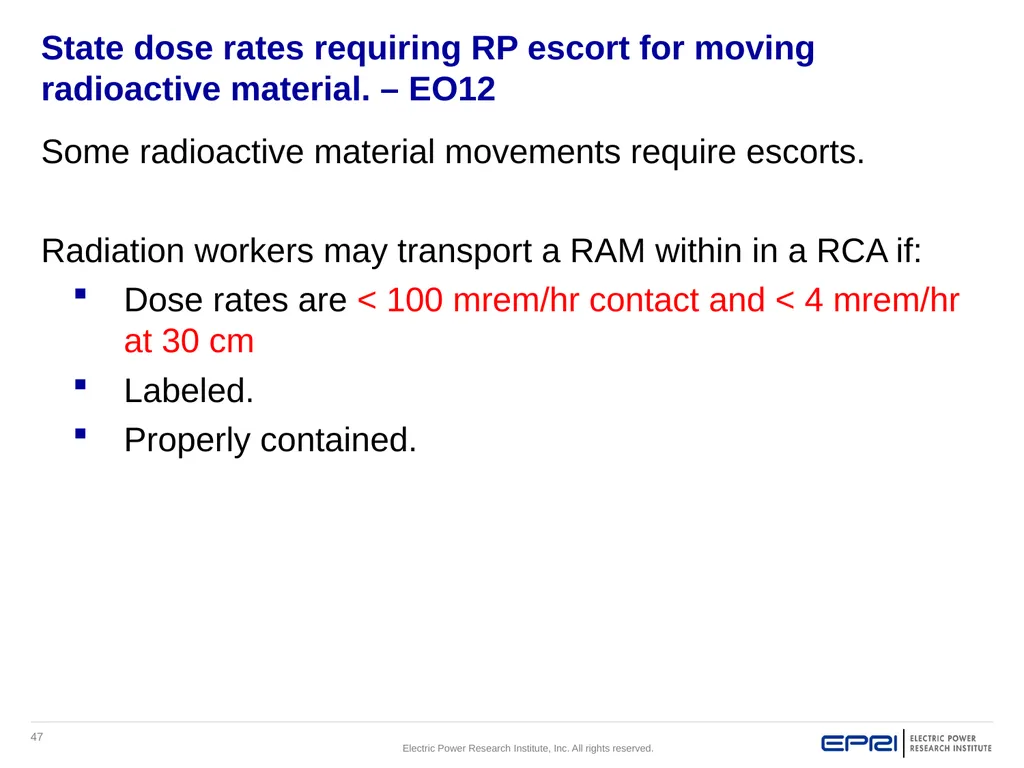
State dose rates requiring RP escort for moving radioactive material. – EO12 Some radioactive material movements require escorts.
Radiation workers may transport a RAM within in a RCA if:
Dose rates are < 100 mrem/hr contact and < 4 mrem/hr at 30 cm
Labeled.
Properly contained.<br>
Radiation workers may transport a RAM within in a RCA if:
Dose rates are < 100 mrem/hr contact and < 4 mrem/hr at 30 cm
Labeled.
Properly contained.<br>
48
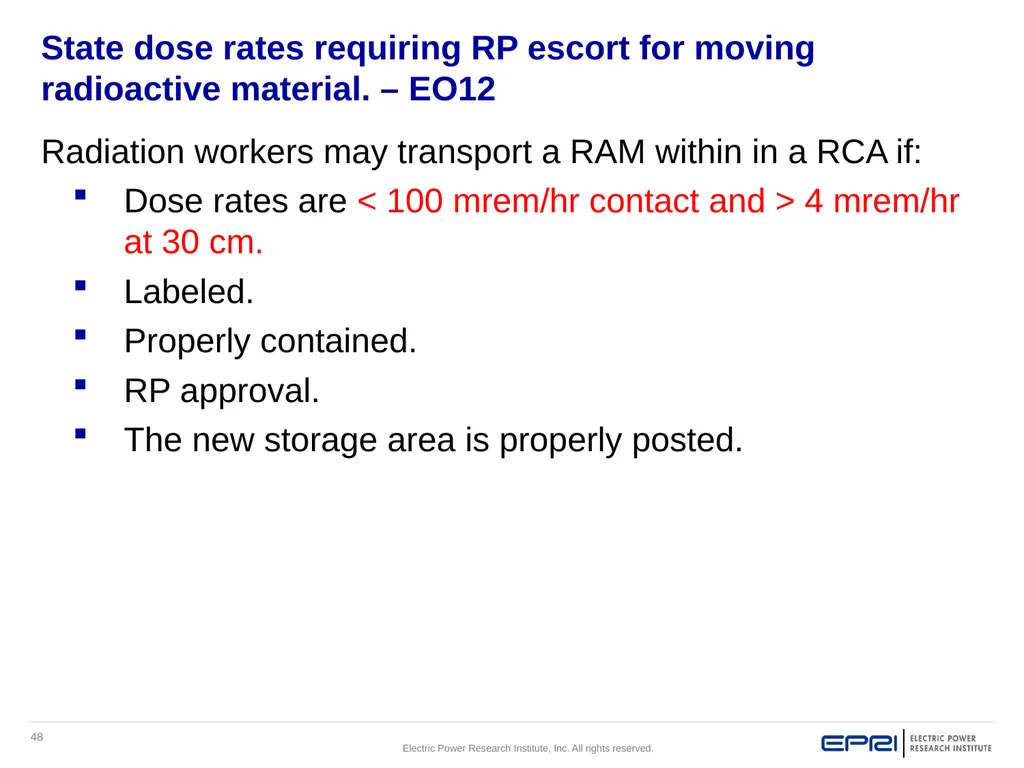
State dose rates requiring RP escort for moving radioactive material. – EO12 Radiation workers may transport a RAM within in a RCA if:
Dose rates are < 100 mrem/hr contact and > 4 mrem/hr at 30 cm.
Labeled.
Properly contained.
RP approval.
The new storage area is properly posted.<br>
Dose rates are < 100 mrem/hr contact and > 4 mrem/hr at 30 cm.
Labeled.
Properly contained.
RP approval.
The new storage area is properly posted.<br>
49
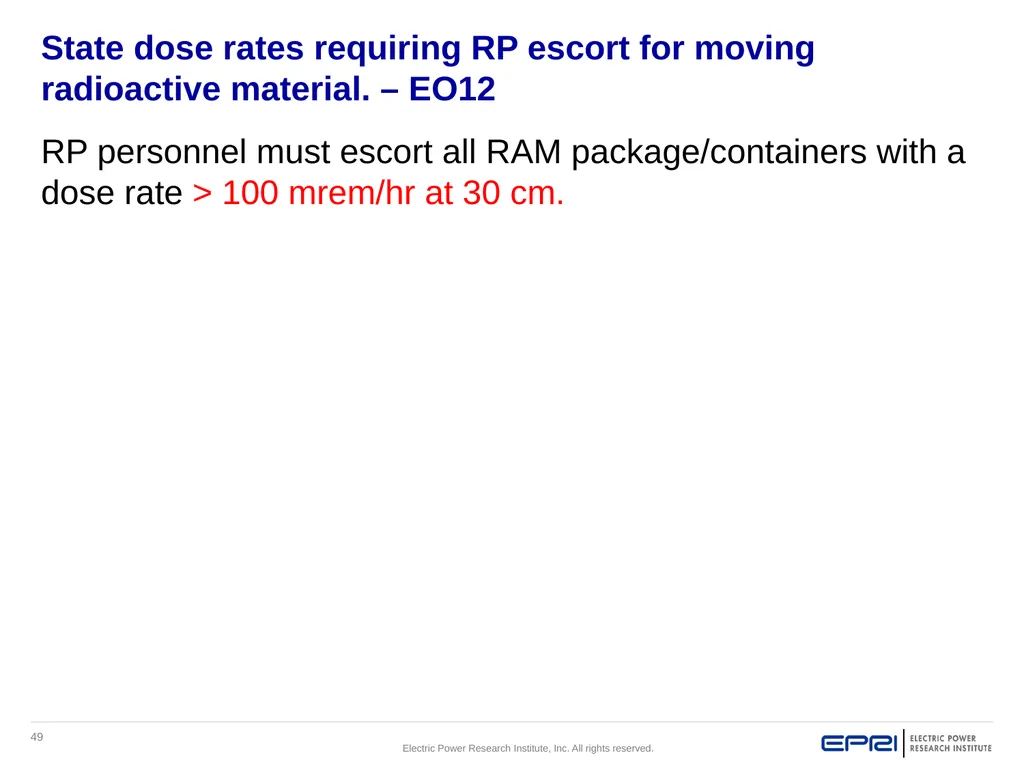
State dose rates requiring RP escort for moving radioactive material. – EO12 RP personnel must escort all RAM package/containers with a dose rate > 100 mrem/hr at 30 cm.<br>
50
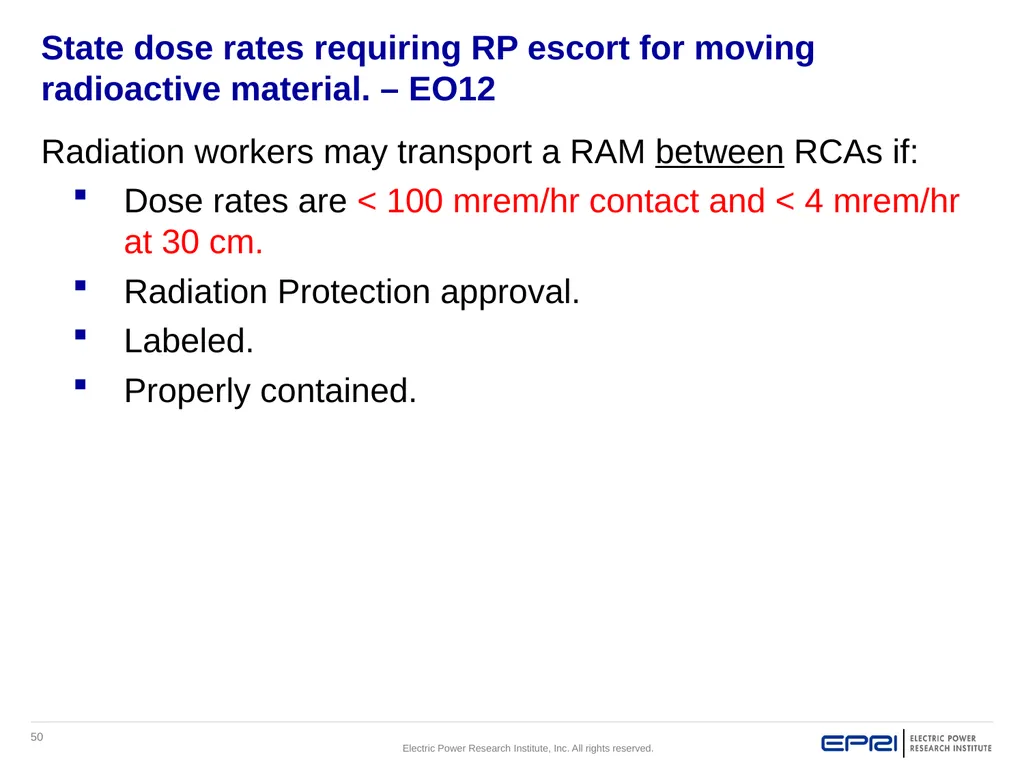
State dose rates requiring RP escort for moving radioactive material. – EO12 Radiation workers may transport a RAM between RCAs if:
Dose rates are < 100 mrem/hr contact and < 4 mrem/hr at 30 cm.
Radiation Protection approval.
Labeled.
Properly contained.<br>
Dose rates are < 100 mrem/hr contact and < 4 mrem/hr at 30 cm.
Radiation Protection approval.
Labeled.
Properly contained.<br>
51
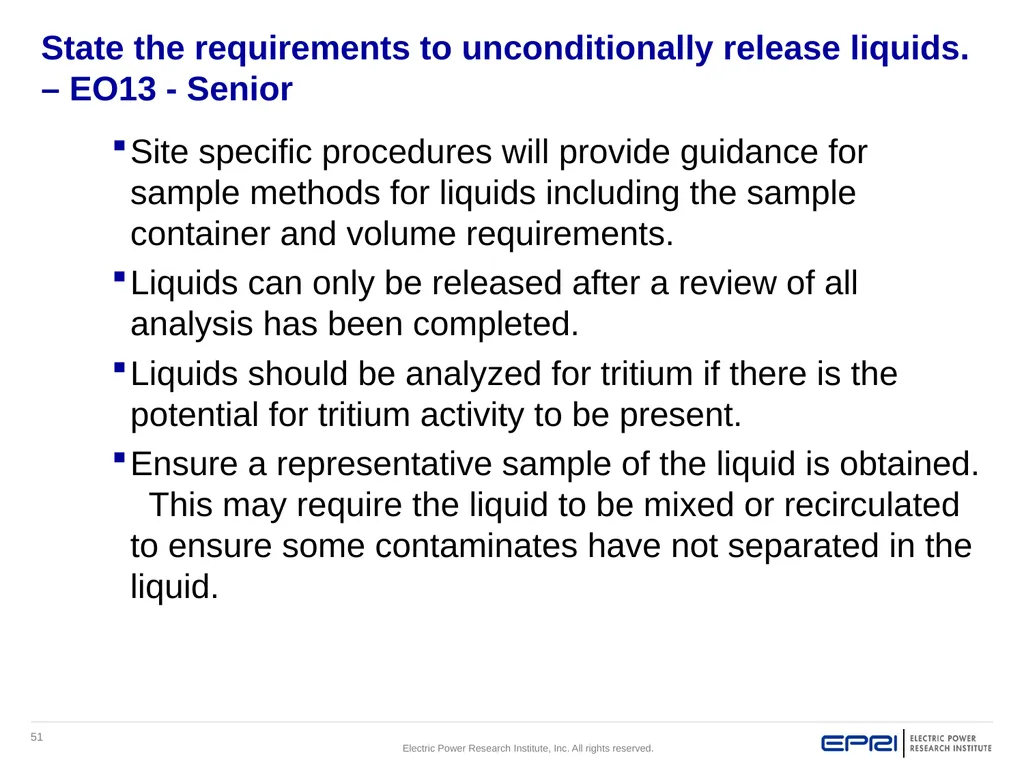
State the requirements to unconditionally release liquids.
– EO13 - Senior Site specific procedures will provide guidance for sample methods for liquids including the sample container and volume requirements.
Liquids can only be released after a review of all analysis has been completed.
Liquids should be analyzed for tritium if there is the potential for tritium activity to be present.
Ensure a representative sample of the liquid is obtained. This may require the liquid to be mixed or recirculated to ensure some contaminates have not separated in the liquid.<br>
Liquids can only be released after a review of all analysis has been completed.
Liquids should be analyzed for tritium if there is the potential for tritium activity to be present.
Ensure a representative sample of the liquid is obtained. This may require the liquid to be mixed or recirculated to ensure some contaminates have not separated in the liquid.<br>
52
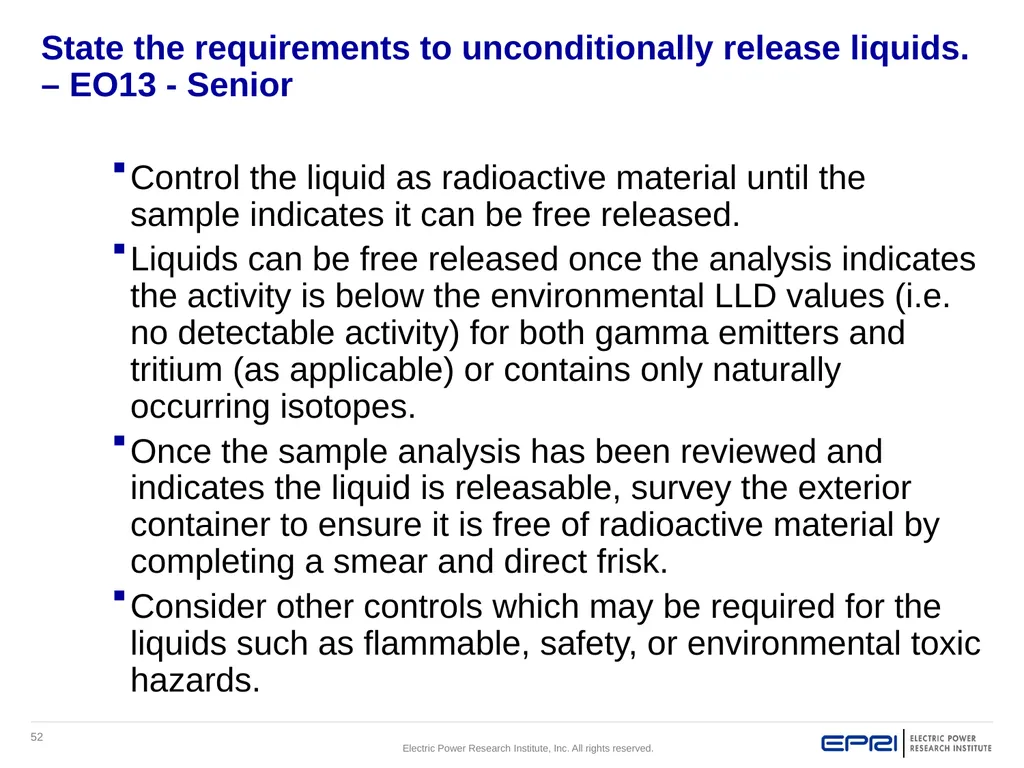
State the requirements to unconditionally release liquids. – EO13 - Senior Control the liquid as radioactive material until the sample indicates it can be free released.
Liquids can be free released once the analysis indicates the activity is below the environmental LLD values (i.e. no detectable activity) for both gamma emitters and tritium (as applicable) or contains only naturally occurring isotopes.
Once the sample analysis has been reviewed and indicates the liquid is releasable, survey the exterior container to ensure it is free of radioactive material by completing a smear and direct frisk.
Consider other controls which may be required for the liquids such as flammable, safety, or environmental toxic hazards.<br>
Liquids can be free released once the analysis indicates the activity is below the environmental LLD values (i.e. no detectable activity) for both gamma emitters and tritium (as applicable) or contains only naturally occurring isotopes.
Once the sample analysis has been reviewed and indicates the liquid is releasable, survey the exterior container to ensure it is free of radioactive material by completing a smear and direct frisk.
Consider other controls which may be required for the liquids such as flammable, safety, or environmental toxic hazards.<br>
53
State the requirements to unconditionally release bulk or aggregate materials. – EO14- Senior Site specific procedures will provide guidance for sample methods for bulk or aggregate materials including the sample container and volume requirements.
Bulk or aggregate material can only be released after a review of all analysis has been completed.
Ensure enough samples are taken of the bulk or aggregate material to determine the radiological characteristic of the overall volume. The sample plan should be approved by RP Supervision.
Examples of bulk or aggregate materials are sand, soil, concrete rubble, gravel, resins or other types of material where the concentration of radioactive material is expected to be uniform if present.
.<br>
Bulk or aggregate material can only be released after a review of all analysis has been completed.
Ensure enough samples are taken of the bulk or aggregate material to determine the radiological characteristic of the overall volume. The sample plan should be approved by RP Supervision.
Examples of bulk or aggregate materials are sand, soil, concrete rubble, gravel, resins or other types of material where the concentration of radioactive material is expected to be uniform if present.
.<br>
54
State the requirements to unconditionally release bulk or aggregate materials. – EO14- Senior If the bulk or aggregate material is concrete, or from a location where a radioactive liquid spill could have occurred, consider the need for sampling for tritium contamination.
Bulk or aggregate materials should be controlled as radioactive material until sample results indicate it can be free released.
Bulk or aggregate material can be released once sample analysis indicates only the presence of naturally occurring radioisotopes or all isotopes is below environmental LLD values<br>
Bulk or aggregate materials should be controlled as radioactive material until sample results indicate it can be free released.
Bulk or aggregate material can be released once sample analysis indicates only the presence of naturally occurring radioisotopes or all isotopes is below environmental LLD values<br>
55
Describe methods used for decontamination of areas within a plant. – EO15 What can we do if something is radioactive material and we would like for it not to be?
Decontamination!
The process of removing radioactive material from surfaces or areas where it is not desired.
Why is it done?
To reduce overall risk and radioactive exposure.<br>
Decontamination!
The process of removing radioactive material from surfaces or areas where it is not desired.
Why is it done?
To reduce overall risk and radioactive exposure.<br>
56
Describe methods used for decontamination of areas within a plant. – EO15 In order to ensure a good decontamination program, efforts are tracked:
Surveys are performed after each decontamination attempt to verify a decrease in contamination from previous levels. This process continues until either the contamination is removed, or, it becomes apparent that the present decontamination technique being used may be ineffective.
Maintain ALARA by verifying the effectiveness of the decontamination activities.<br>
Surveys are performed after each decontamination attempt to verify a decrease in contamination from previous levels. This process continues until either the contamination is removed, or, it becomes apparent that the present decontamination technique being used may be ineffective.
Maintain ALARA by verifying the effectiveness of the decontamination activities.<br>
57
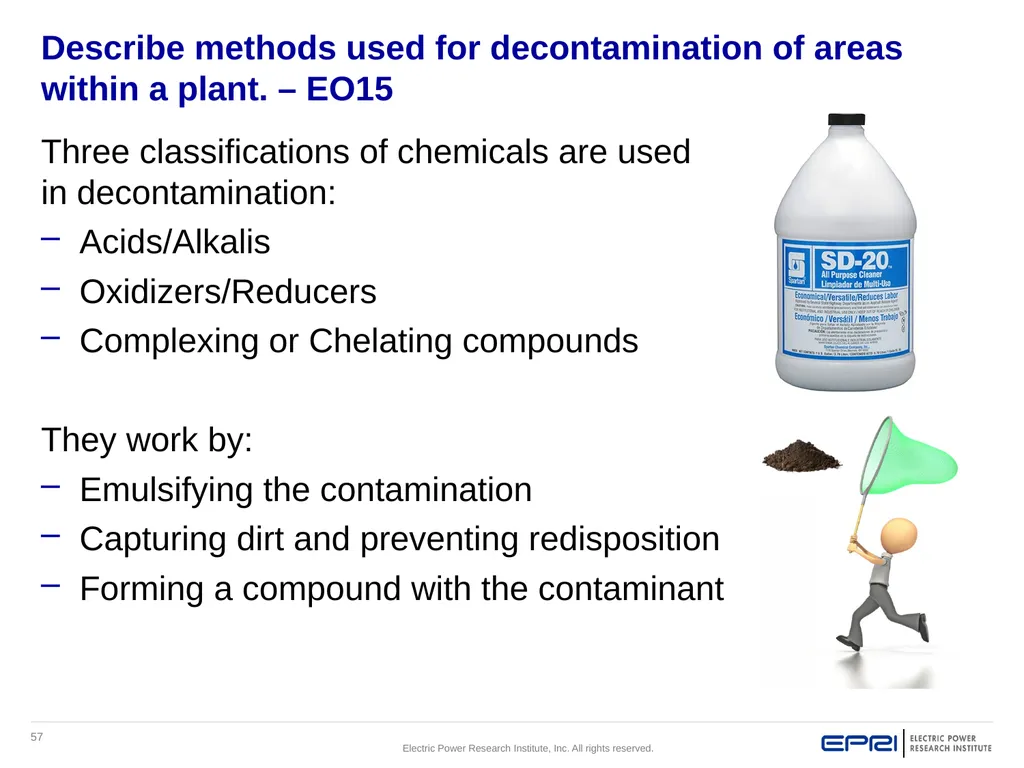
Describe methods used for decontamination of areas within a plant. – EO15 Three classifications of chemicals are used in decontamination:
Acids/Alkalis
Oxidizers/Reducers
Complexing or Chelating compounds
They work by:
Emulsifying the contamination
Capturing dirt and preventing redisposition
Forming a compound with the contaminant<br>
Acids/Alkalis
Oxidizers/Reducers
Complexing or Chelating compounds
They work by:
Emulsifying the contamination
Capturing dirt and preventing redisposition
Forming a compound with the contaminant<br>
58
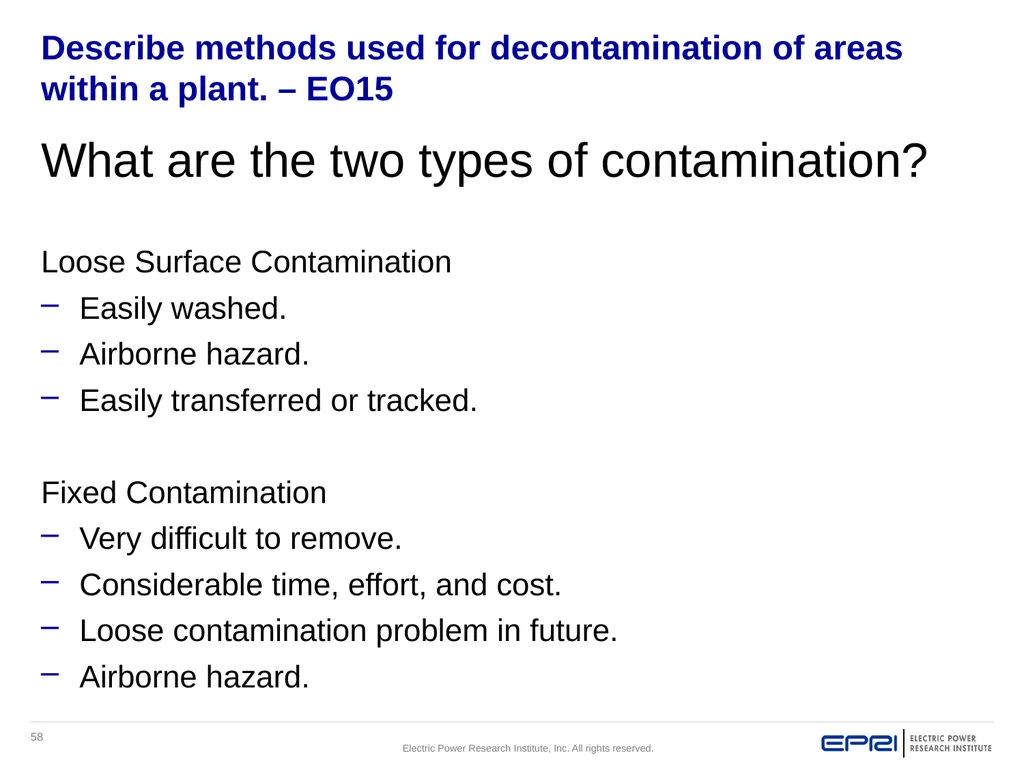
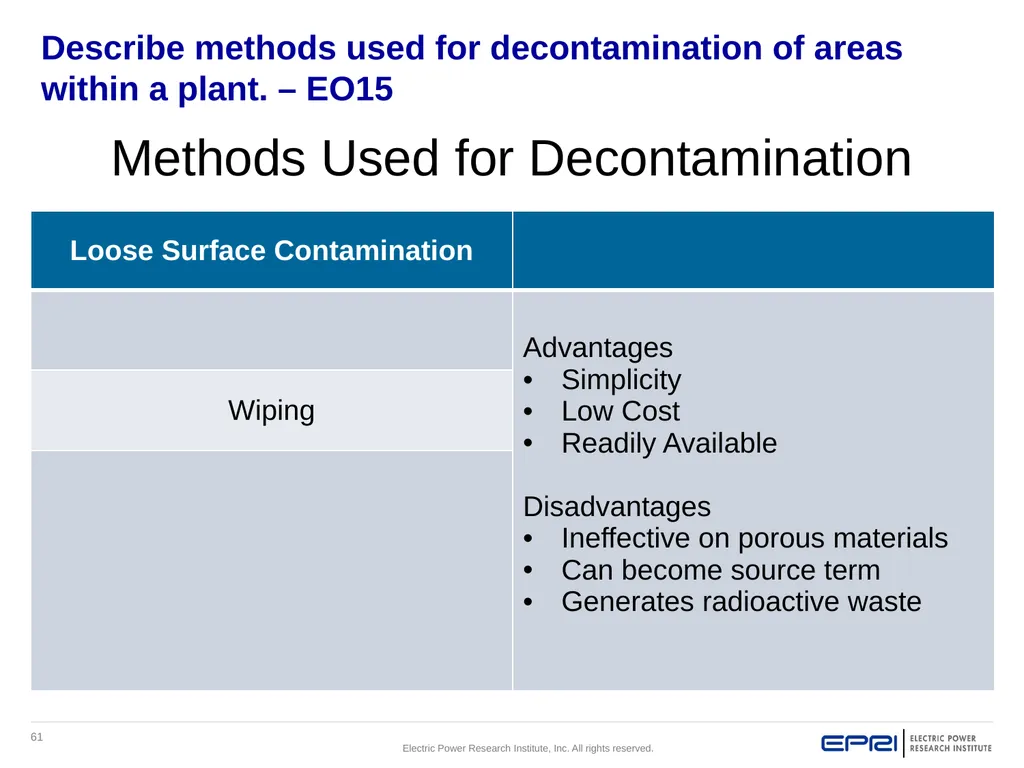
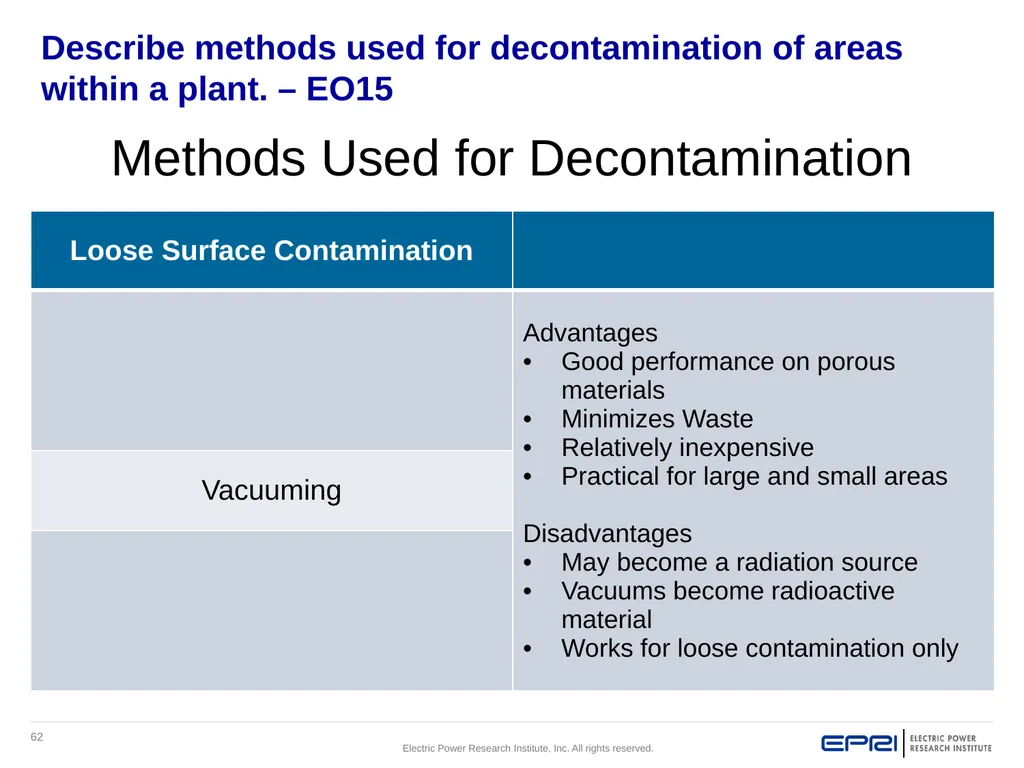
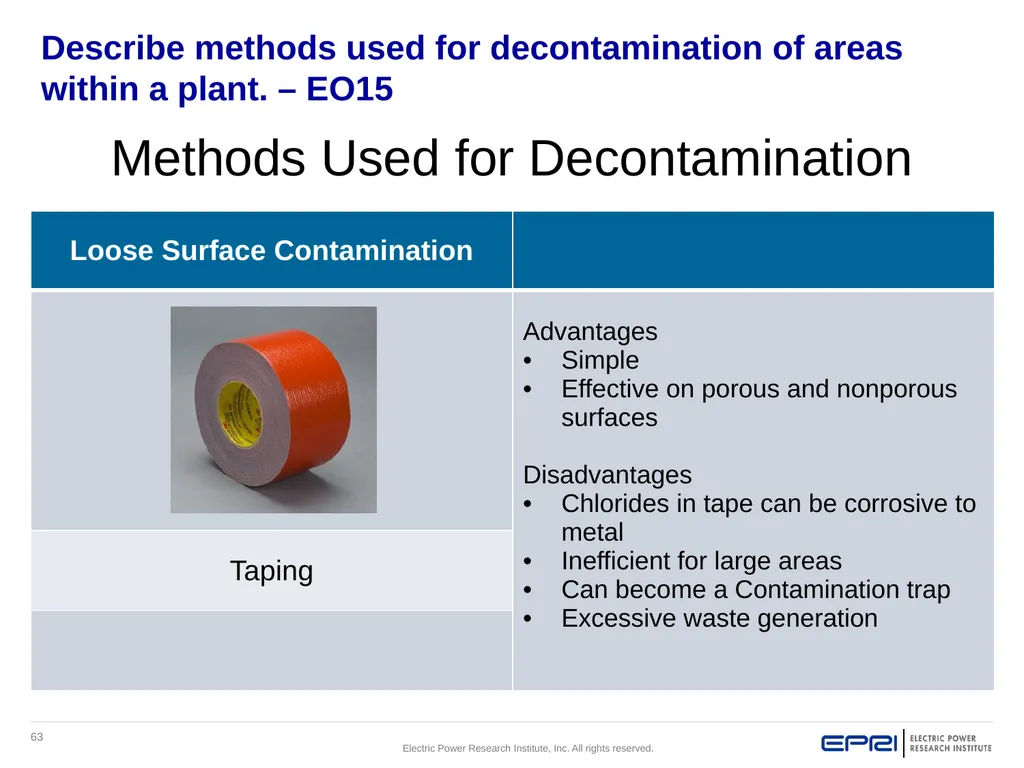
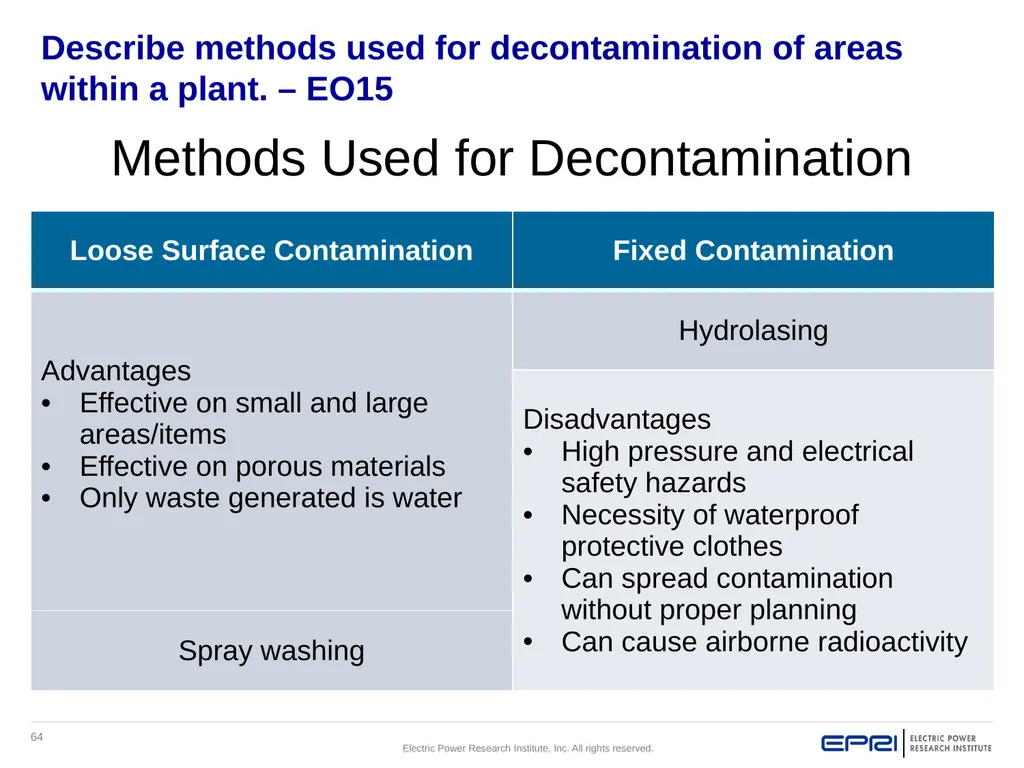
Describe methods used for decontamination of areas within a plant. – EO15 What are the two types of contamination?
Loose Surface Contamination
Easily washed.
Airborne hazard.
Easily transferred or tracked.
Fixed Contamination
Very difficult to remove.
Considerable time, effort, and cost.
Loose contamination problem in future.
Airborne hazard.<br>
Loose Surface Contamination
Easily washed.
Airborne hazard.
Easily transferred or tracked.
Fixed Contamination
Very difficult to remove.
Considerable time, effort, and cost.
Loose contamination problem in future.
Airborne hazard.<br>
59
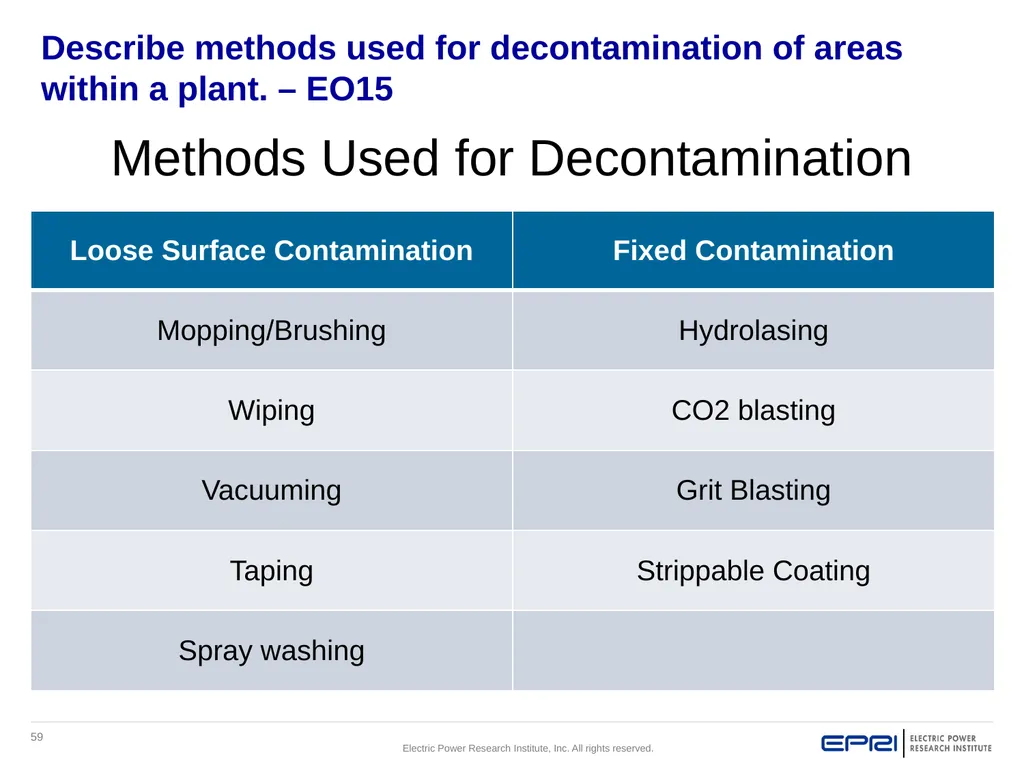
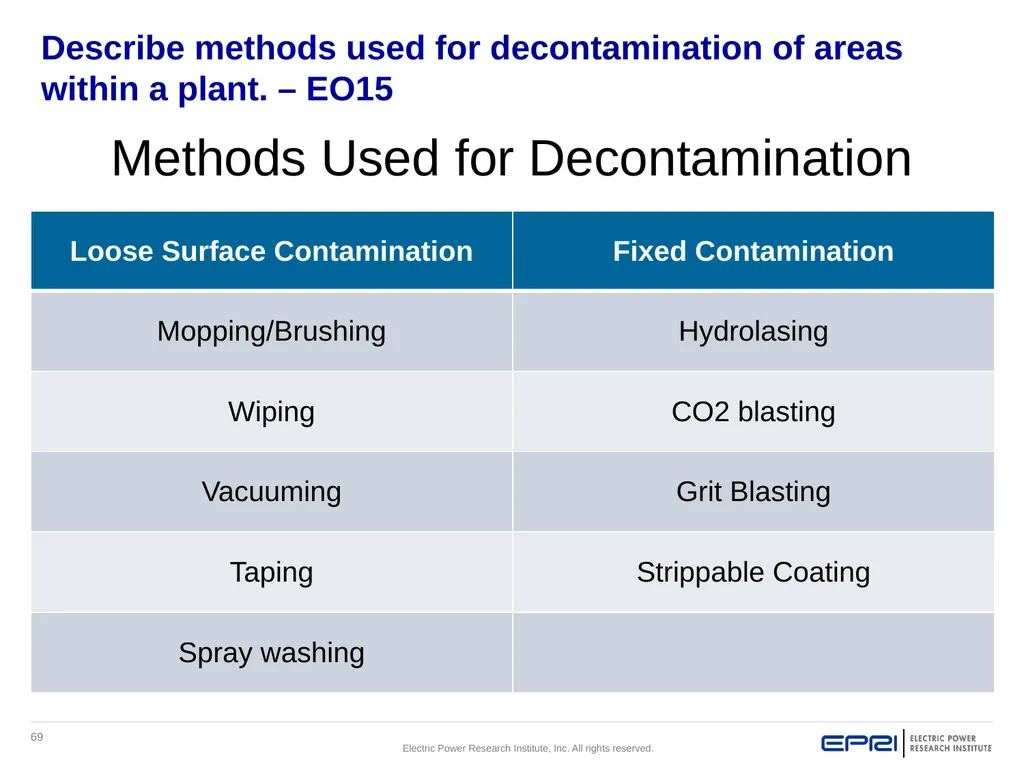
Describe methods used for decontamination of areas within a plant. – EO15 Methods Used for Decontamination<br>
60
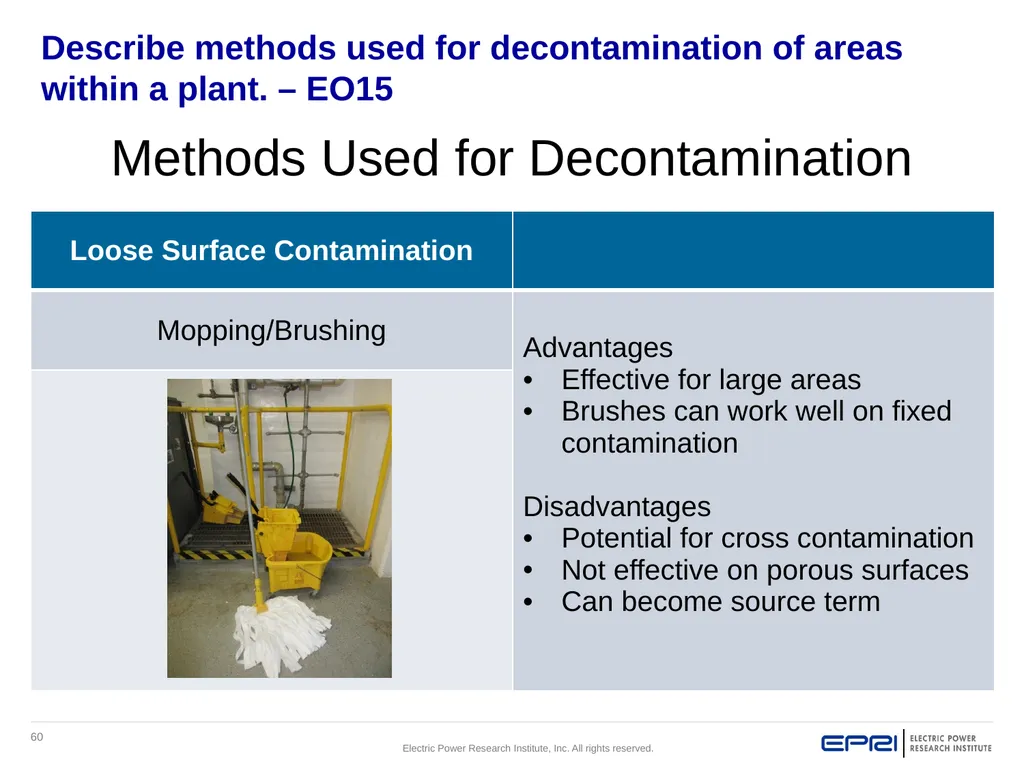
Describe methods used for decontamination of areas within a plant. – EO15 Methods Used for Decontamination<br>
61
Describe methods used for decontamination of areas within a plant. – EO15 Methods Used for Decontamination<br>
62
Describe methods used for decontamination of areas within a plant. – EO15 Methods Used for Decontamination<br>
63
Describe methods used for decontamination of areas within a plant. – EO15 Methods Used for Decontamination<br>
64
Describe methods used for decontamination of areas within a plant. – EO15 Methods Used for Decontamination<br>
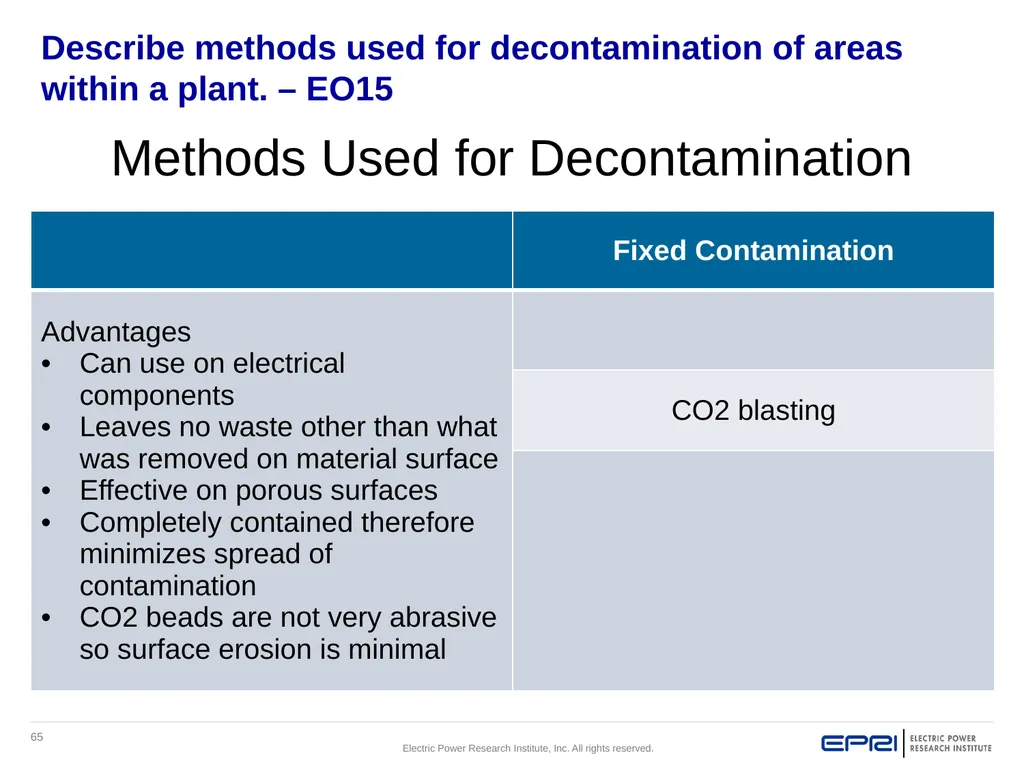
65
Describe methods used for decontamination of areas within a plant. – EO15 Methods Used for Decontamination<br>
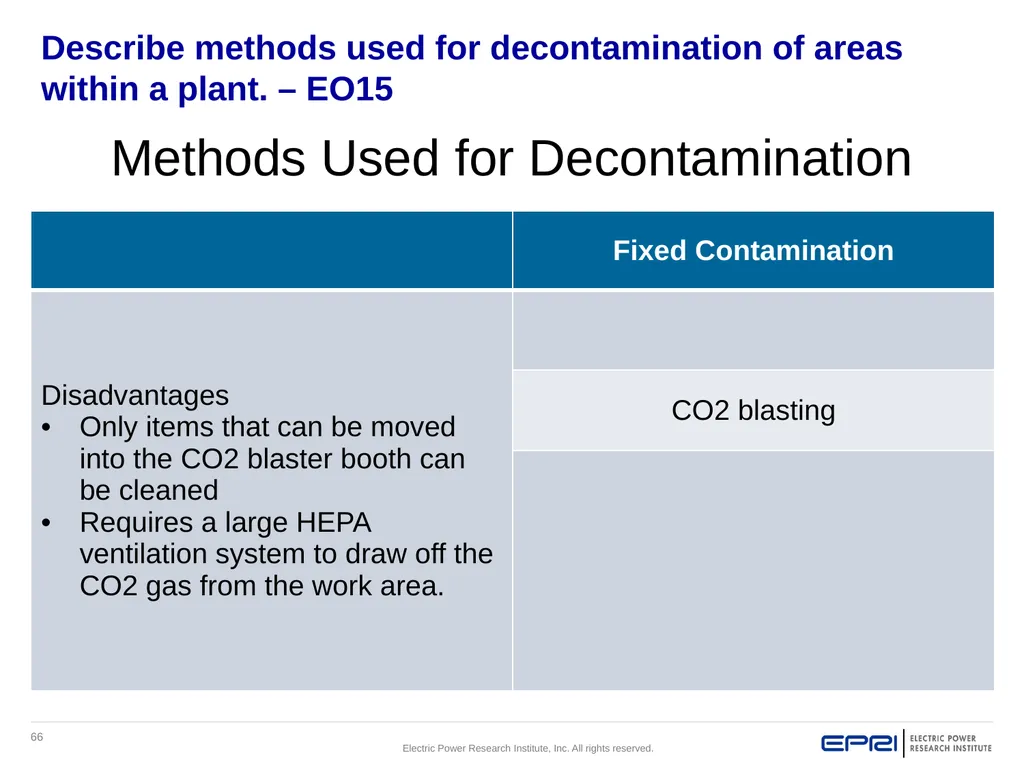
66
Describe methods used for decontamination of areas within a plant. – EO15 Methods Used for Decontamination<br>
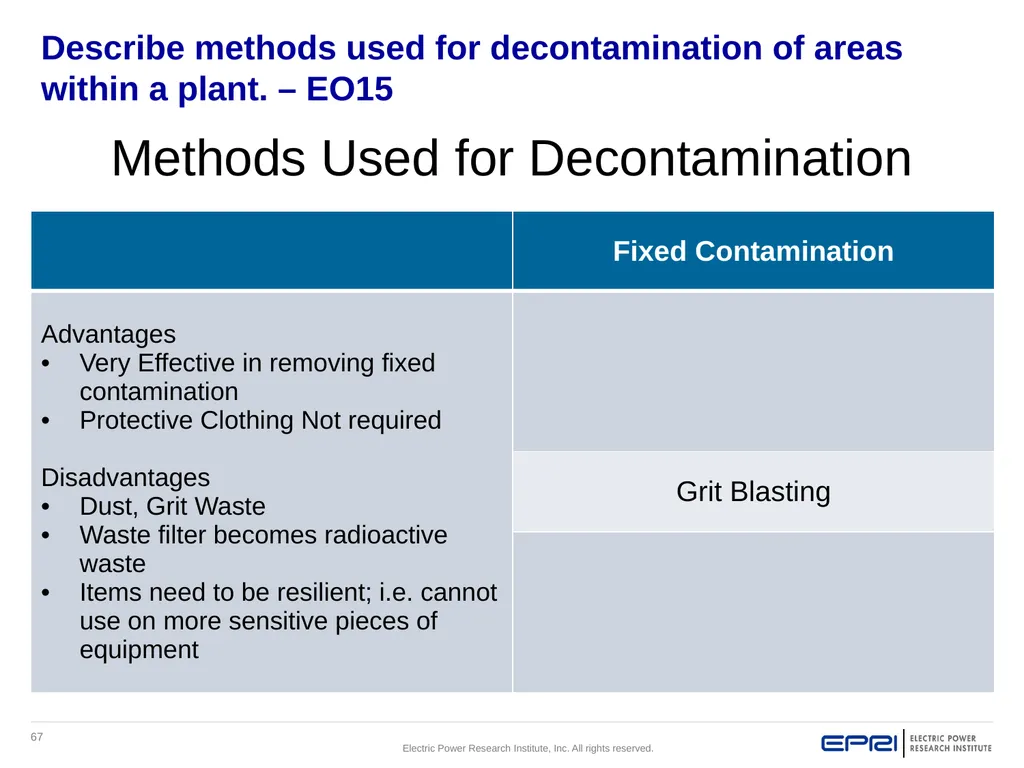
67
Describe methods used for decontamination of areas within a plant. – EO15 Methods Used for Decontamination<br>
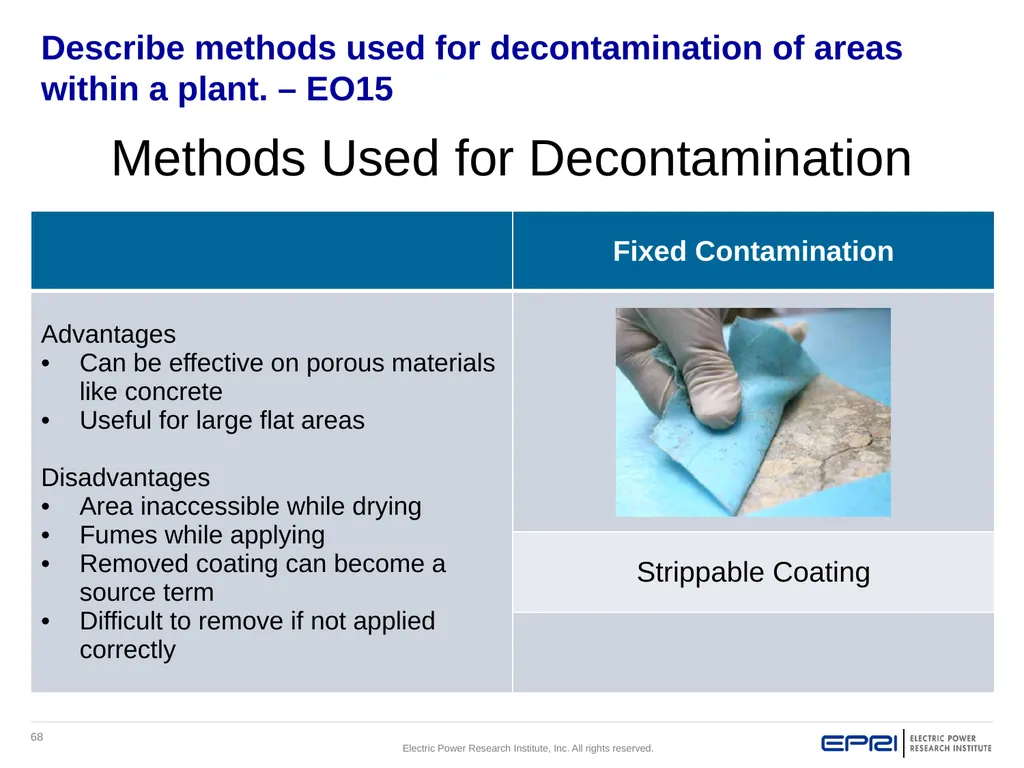
68
Describe methods used for decontamination of areas within a plant. – EO15 Methods Used for Decontamination<br>
69
Describe methods used for decontamination of areas within a plant. – EO15 Methods Used for Decontamination<br>
70
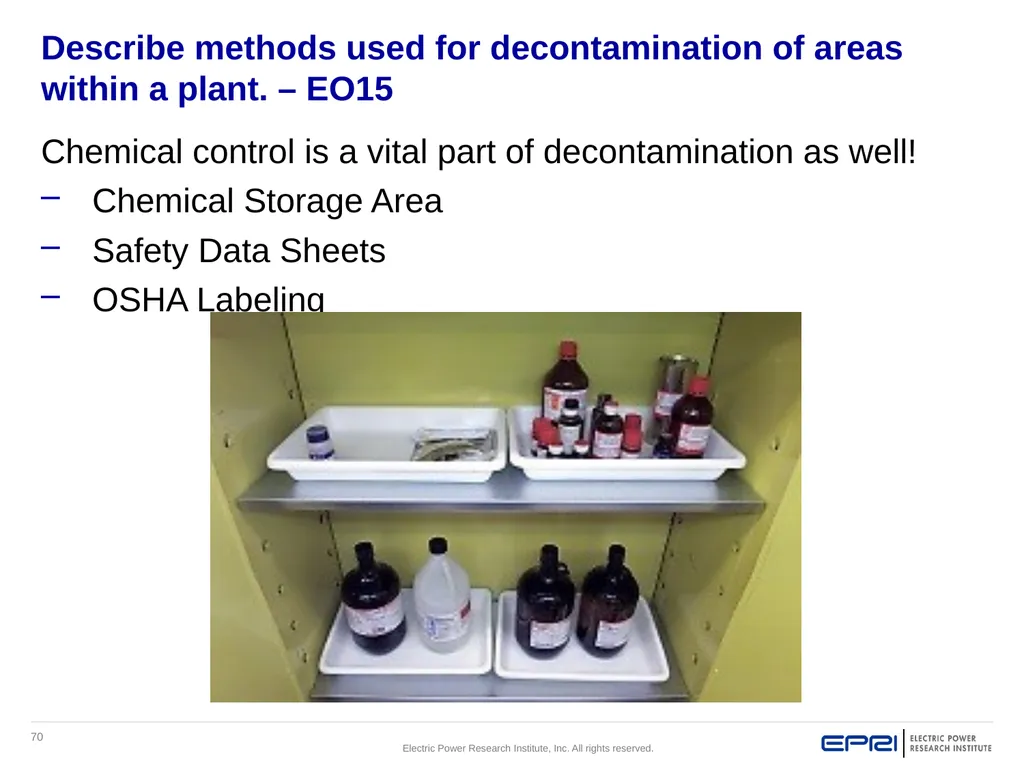
Describe methods used for decontamination of areas within a plant. – EO15 Chemical control is a vital part of decontamination as well!
Chemical Storage Area
Safety Data Sheets
OSHA Labeling<br>
Chemical Storage Area
Safety Data Sheets
OSHA Labeling<br>
71
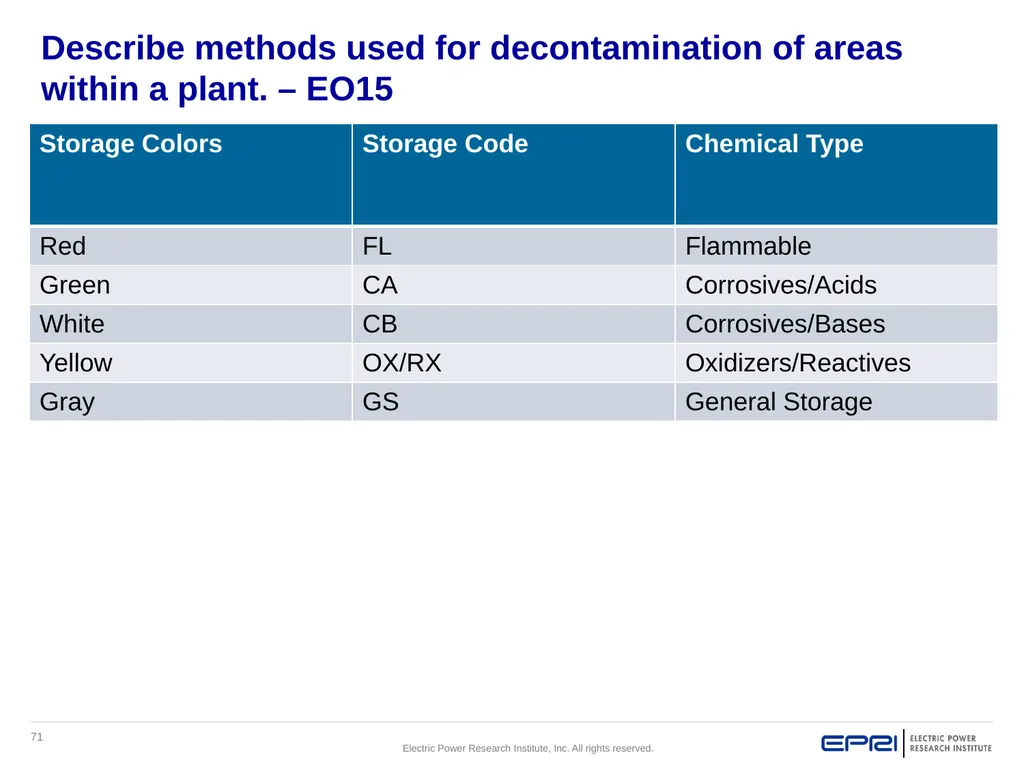
Describe methods used for decontamination of areas within a plant. – EO15<br>
72
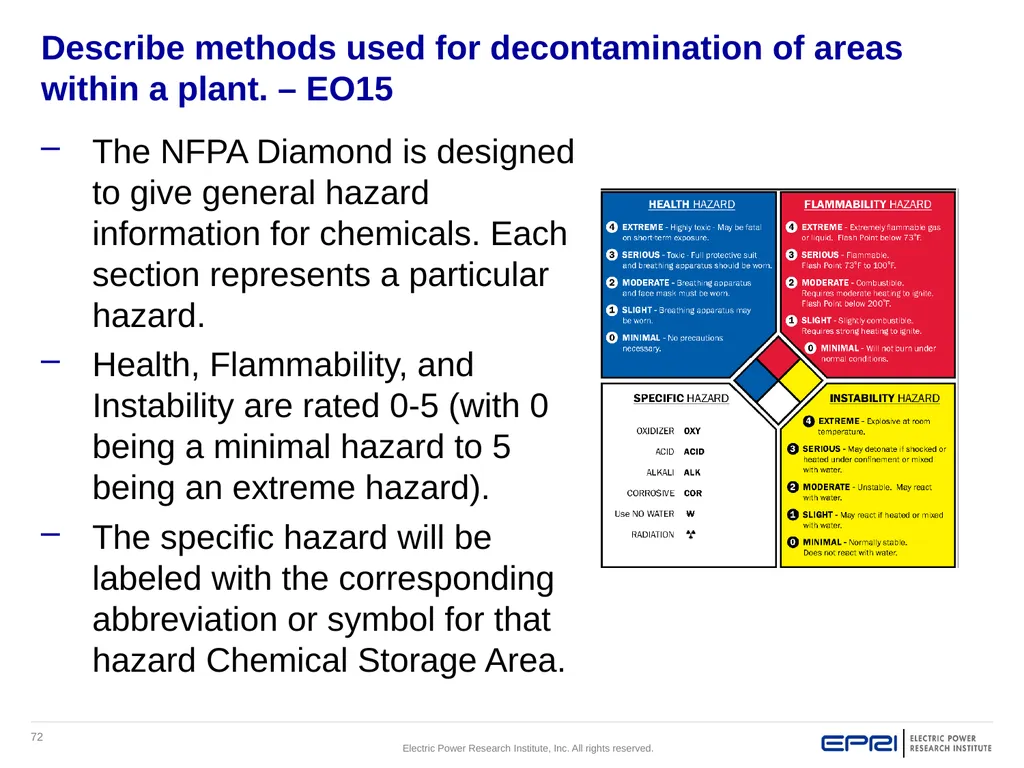
Describe methods used for decontamination of areas within a plant. – EO15 The NFPA Diamond is designed to give general hazard information for chemicals. Each section represents a particular hazard.
Health, Flammability, and Instability are rated 0-5 (with 0 being a minimal hazard to 5 being an extreme hazard).
The specific hazard will be labeled with the corresponding abbreviation or symbol for that hazard Chemical Storage Area.<br>
Health, Flammability, and Instability are rated 0-5 (with 0 being a minimal hazard to 5 being an extreme hazard).
The specific hazard will be labeled with the corresponding abbreviation or symbol for that hazard Chemical Storage Area.<br>
73
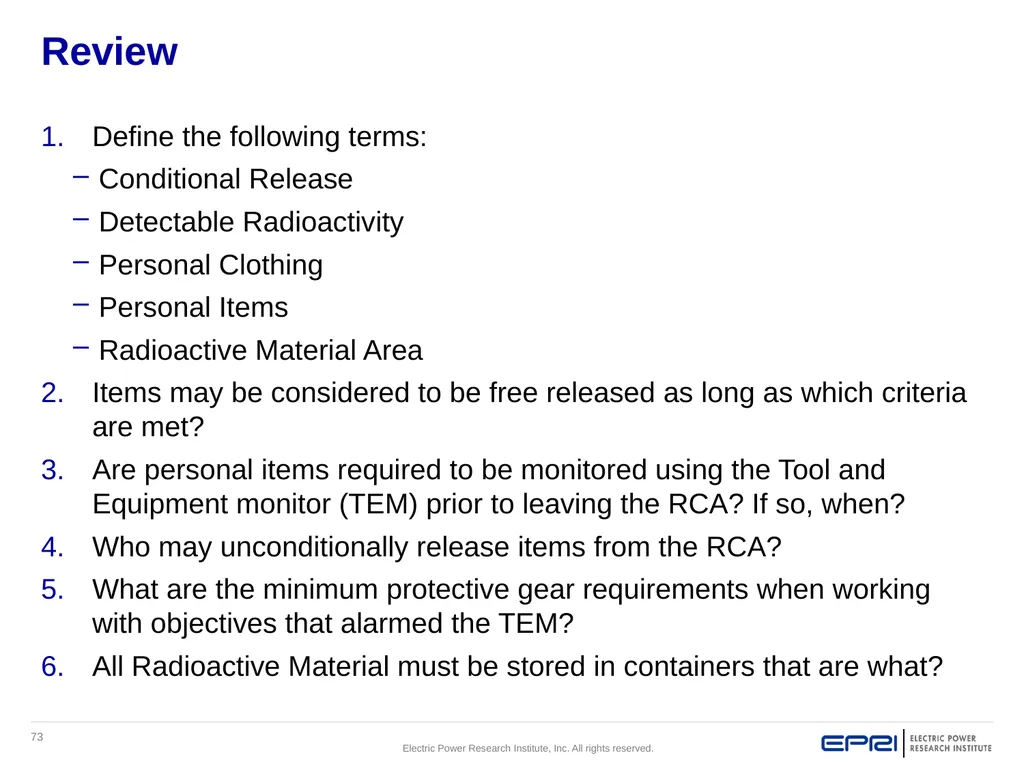
Review Define the following terms:
Conditional Release
Detectable Radioactivity
Personal Clothing
Personal Items
Radioactive Material Area
Items may be considered to be free released as long as which criteria are met?
Are personal items required to be monitored using the Tool and Equipment monitor (TEM) prior to leaving the RCA? If so, when?
Who may unconditionally release items from the RCA?
What are the minimum protective gear requirements when working with objectives that alarmed the TEM?
All Radioactive Material must be stored in containers that are what?<br>
Conditional Release
Detectable Radioactivity
Personal Clothing
Personal Items
Radioactive Material Area
Items may be considered to be free released as long as which criteria are met?
Are personal items required to be monitored using the Tool and Equipment monitor (TEM) prior to leaving the RCA? If so, when?
Who may unconditionally release items from the RCA?
What are the minimum protective gear requirements when working with objectives that alarmed the TEM?
All Radioactive Material must be stored in containers that are what?<br>
74
Terminal Objective - Review Given radioactive material, move, store, and recognize the need to release by a senior RP technician in accordance with NISP-RP-07, Control of Radioactive Material.<br>
75
Control of Radioactive Material Within an RCA Training Conclusion: Together…Shaping the Future of Electricity Questions:
Feedback:
Conclusions:<br>
Feedback:
Conclusions:<br>