Approximating the undirected Multicut problem A folklore algorithm. Based on a result of Karloff et al for Multiway cut. Problem definition Input: Given connected G(V,E) w(e)0 and a collection si, ti of vertex pairs. Required: a minimum
"Approximating the undirected Multicut problem A" is the property of its rightful owner. Permission is granted to
download and print the materials on this website for personal, non-commercial use only, and to display it
on your personal computer provided you do not modify the materials and that you retain all copyright
notices contained in the materials. By downloading content from our website, you accept the terms of this
agreement.
Presentation Transcript
01
Approximating the undirected Multicut problem A folklore algorithm.
Based on a result of Karloff et al for
Multiway cut.<br>
02
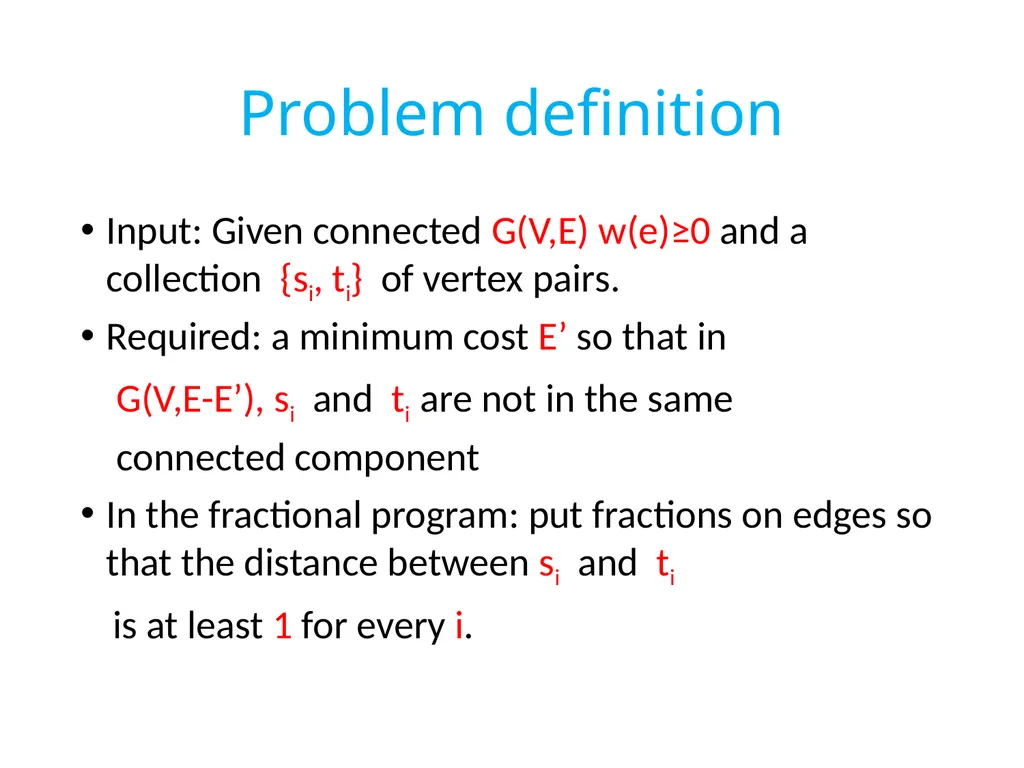
Problem definition Input: Given connected G(V,E) w(e)≥0 and a collection {si, ti} of vertex pairs.
Required: a minimum cost E’ so that in
G(V,E-E’), si and ti are not in the same
connected component
In the fractional program: put fractions on edges so that the distance between si and ti
is at least 1 for every i.<br>
03
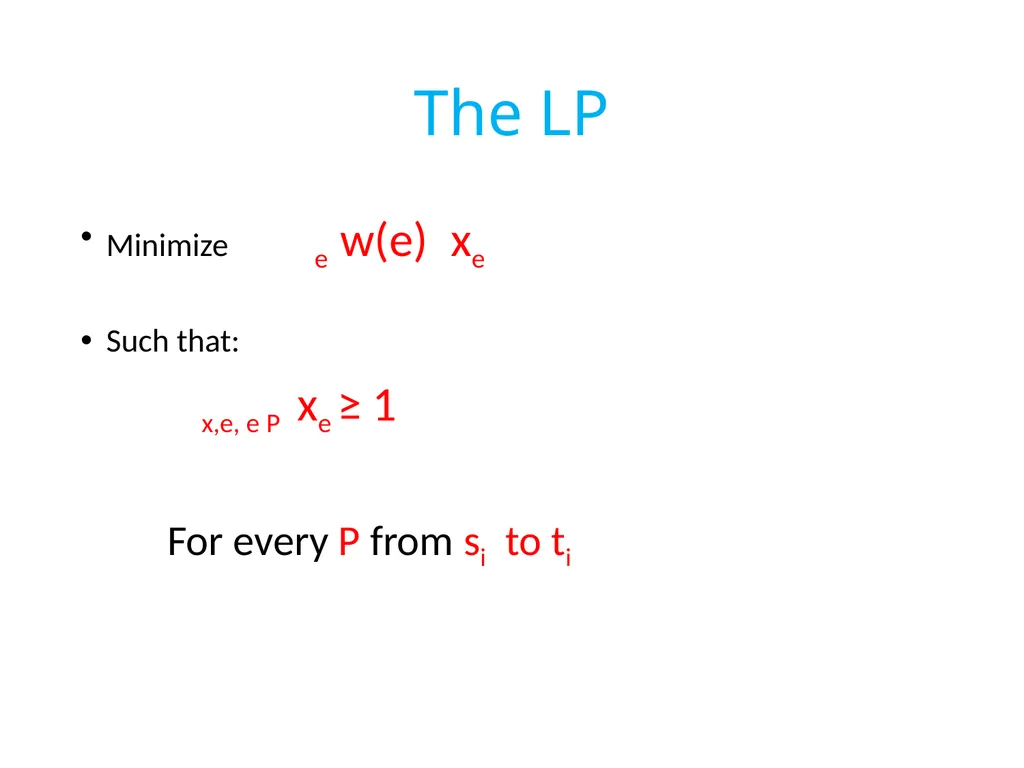
The LP Minimize e w(e) xe
Such that:
x,e, eP xe ≥ 1
For every P from si to ti<br>
04
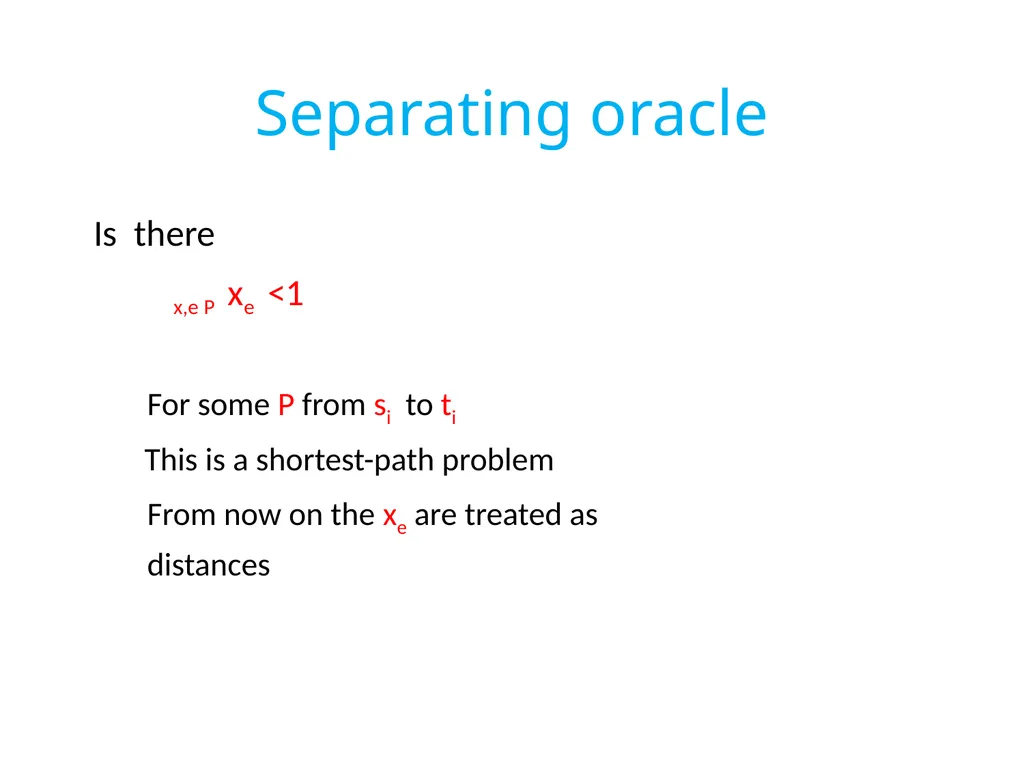
Separating oracle Is there
x,eP xe <1
For some P from si to ti
This is a shortest-path problem
From now on the xe are treated as
distances<br>
05
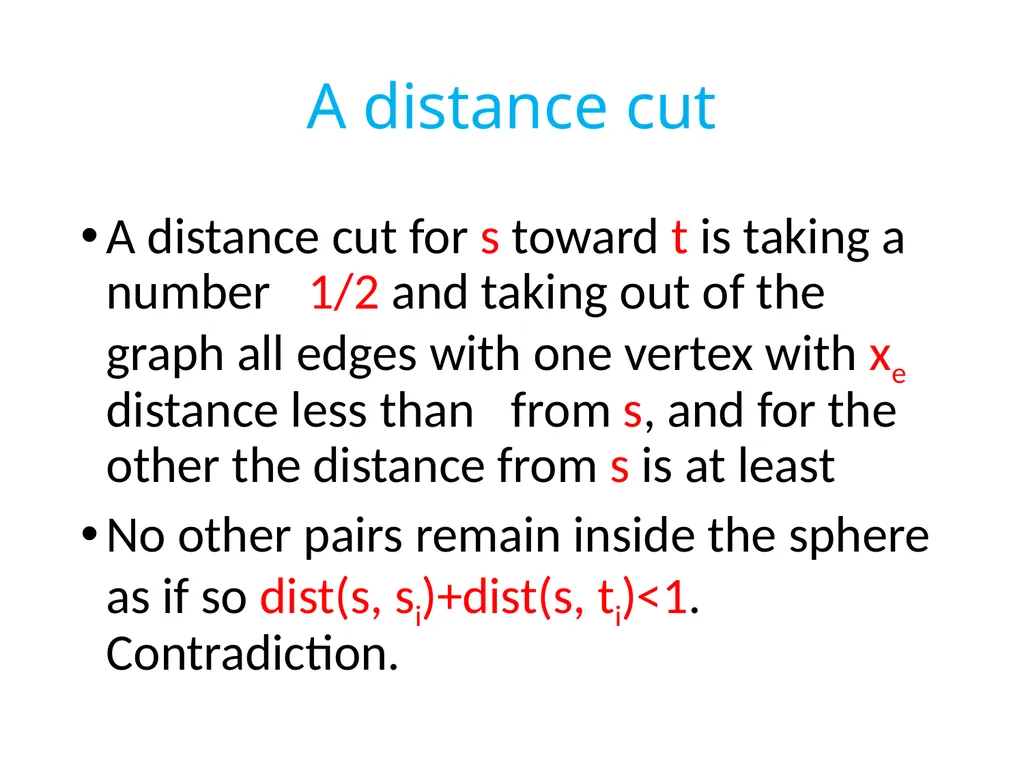
A distance cut A distance cut for s toward t is taking a number 1/2 and taking out of the graph all edges with one vertex with xe distance less than from s, and for the other the distance from s is at least
No other pairs remain inside the sphere as if so dist(s, si)+dist(s, ti)<1. Contradiction.<br>
06
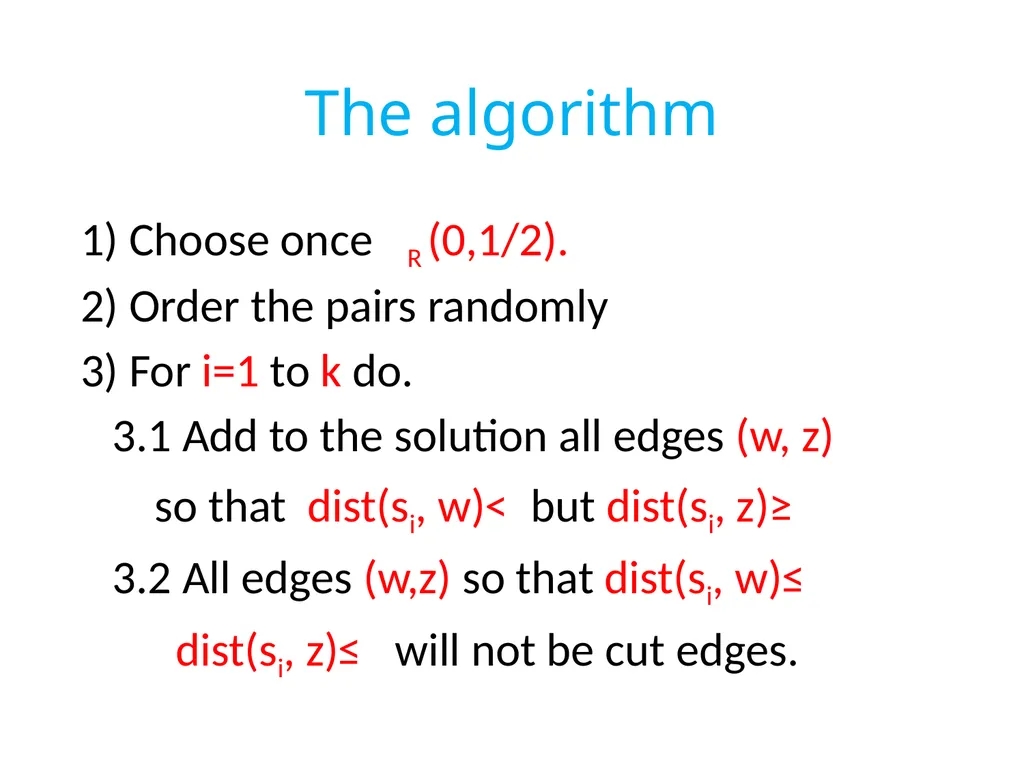
The algorithm 1) Choose once R (0,1/2).
2) Order the pairs randomly
3) For i=1 to k do.
3.1 Add to the solution all edges (w, z)
so that dist(si, w)< but dist(si, z)≥
3.2 All edges (w,z) so that dist(si, w)≤
dist(si, z)≤ will not be cut edges.<br>
07
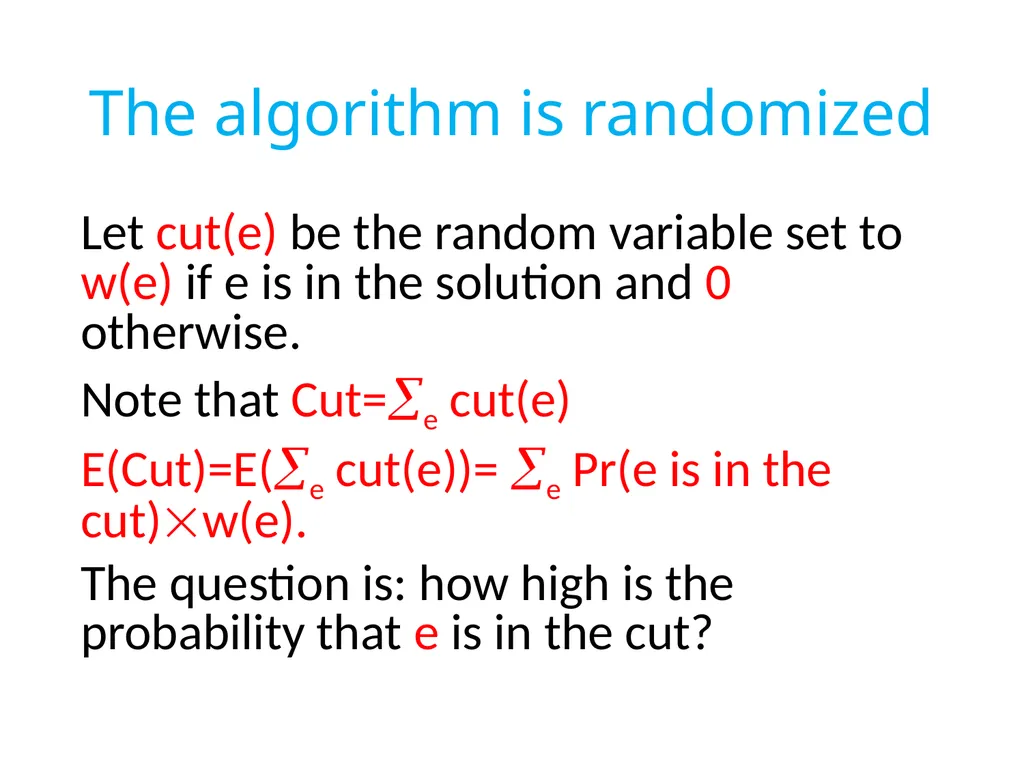
The algorithm is randomized Let cut(e) be the random variable set to w(e) if e is in the solution and 0 otherwise.
Note that Cut=e cut(e)
E(Cut)=E(e cut(e))= e Pr(e is in the cut)w(e).
The question is: how high is the probability that e is in the cut?<br>
08
The algorithm is randomized The question is: how high is the probability that e is in the cut?
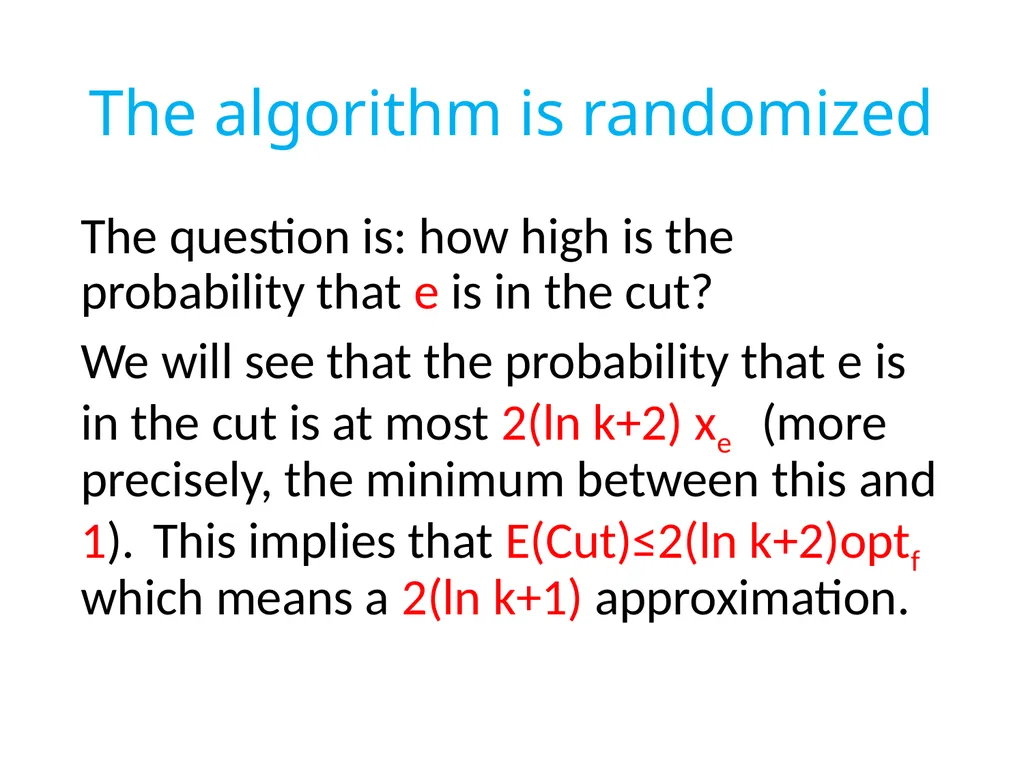
We will see that the probability that e is in the cut is at most 2(ln k+2) xe (more precisely, the minimum between this and 1). This implies that E(Cut)≤2(ln k+2)optf which means a 2(ln k+1) approximation.<br>
09
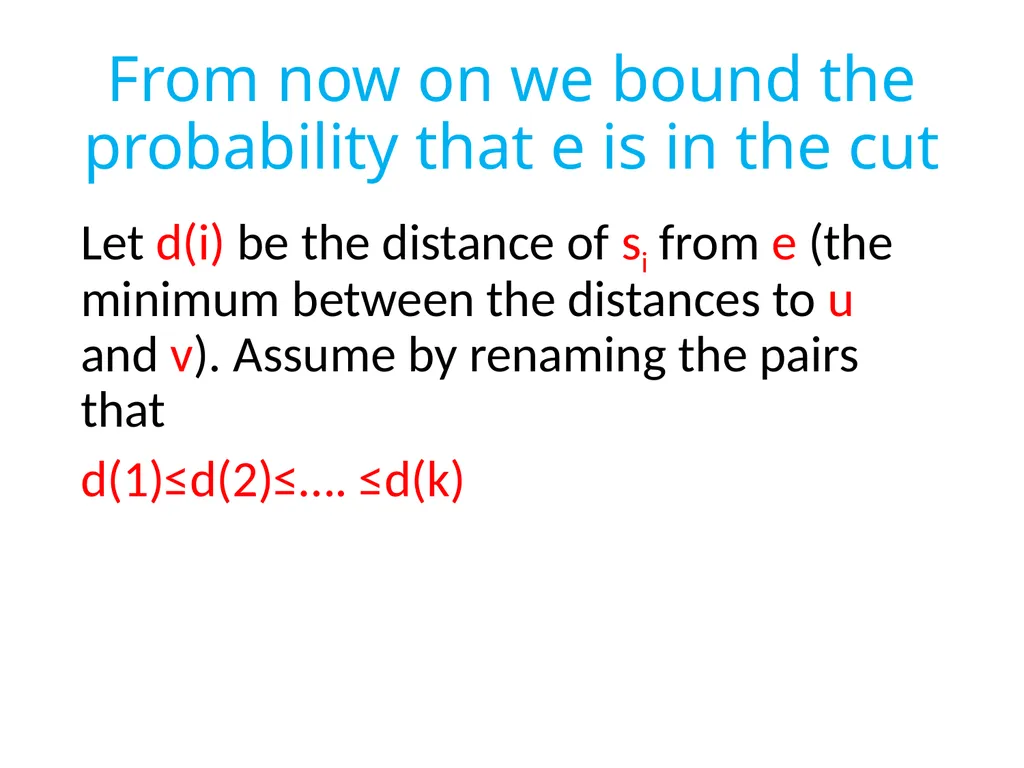
From now on we bound the probability that e is in the cut Let d(i) be the distance of si from e (the minimum between the distances to u and v). Assume by renaming the pairs that
d(1)≤d(2)≤…. ≤d(k)<br>
10
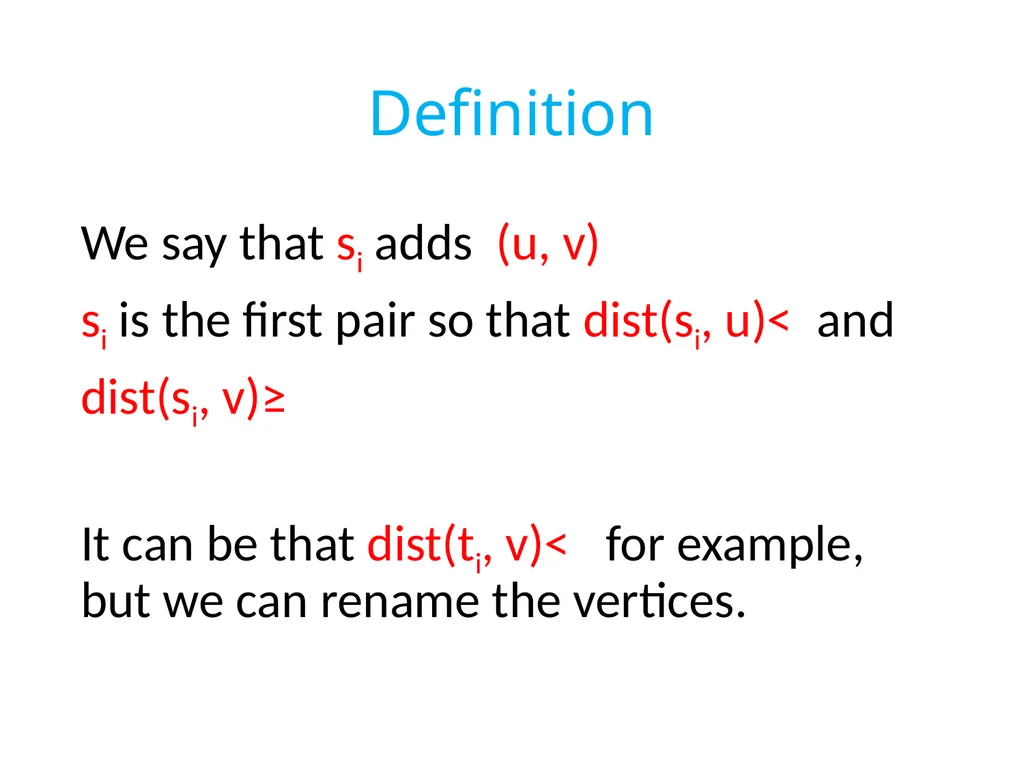
Definition We say that si adds (u, v) to the solution
si is the first pair so that dist(si, u)< and
dist(si, v)≥
It can be that dist(ti, v)< for example, but we can rename the vertices.<br>
11
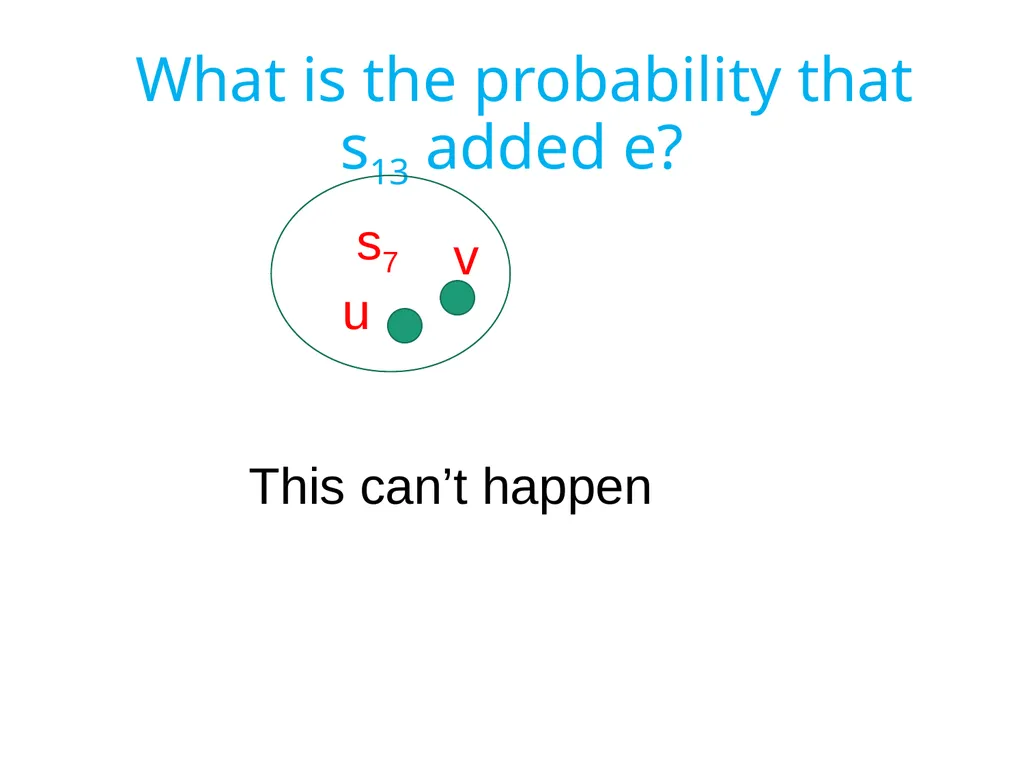
What is the probability that s13 added e? u v s7 This can’t happen<br>
12
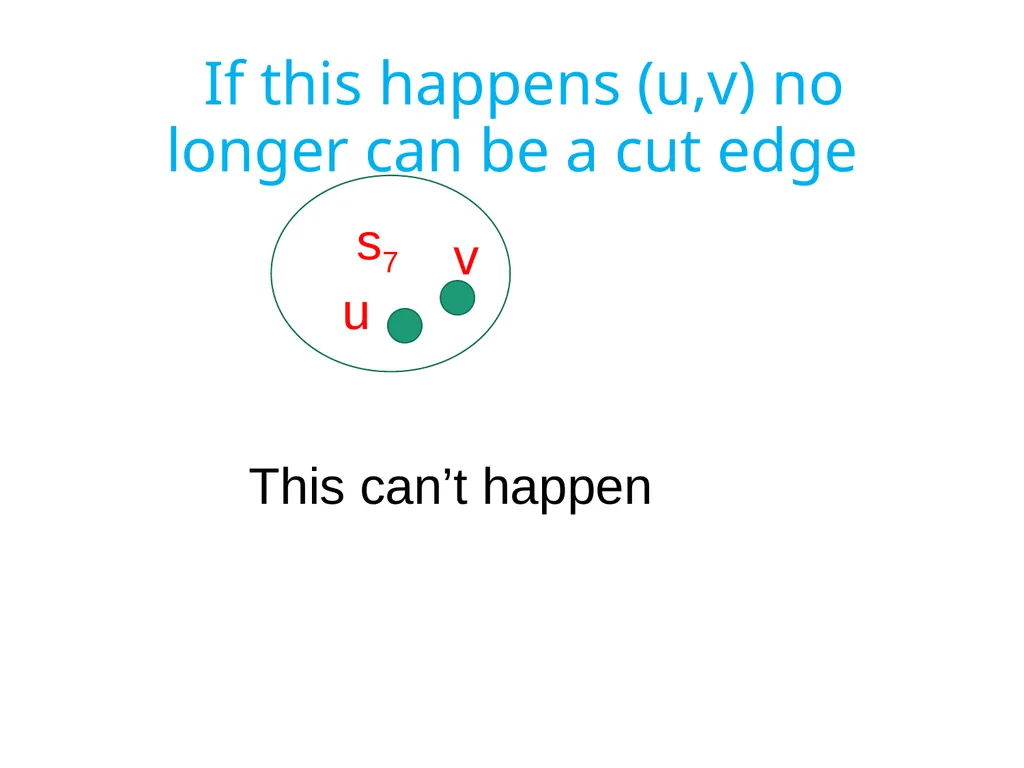
If this happens (u,v) no longer can be a cut edge u v s7 This can’t happen<br>
13
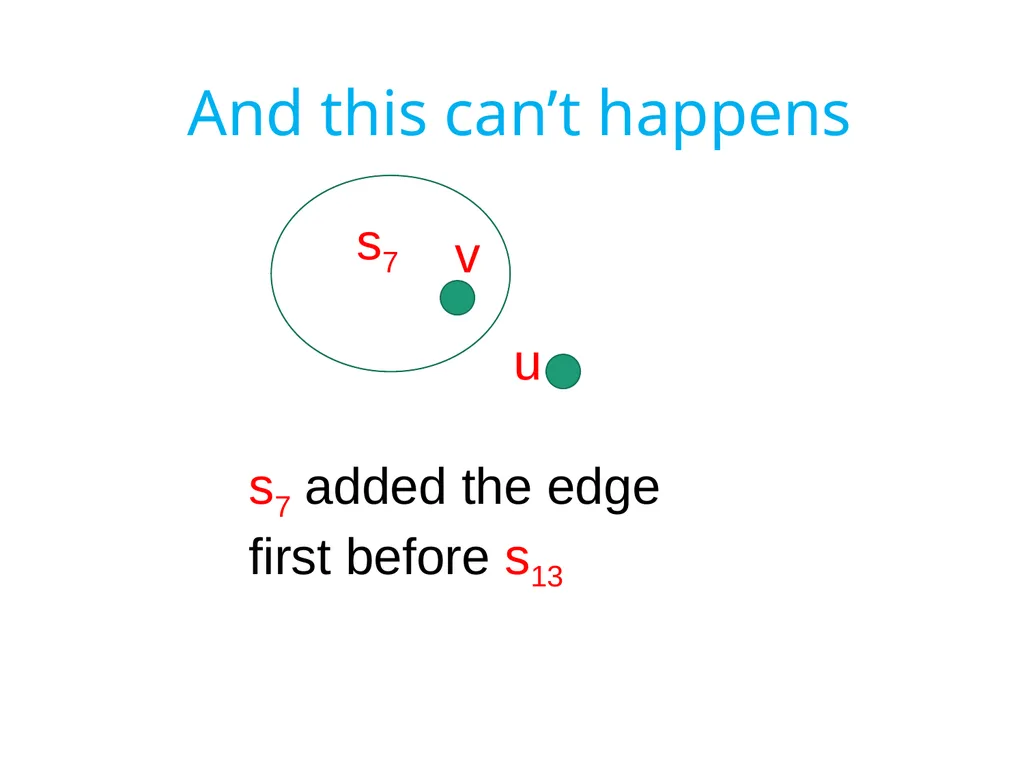
And this can’t happens u v s7 s7 added the edge first before s13<br>
14
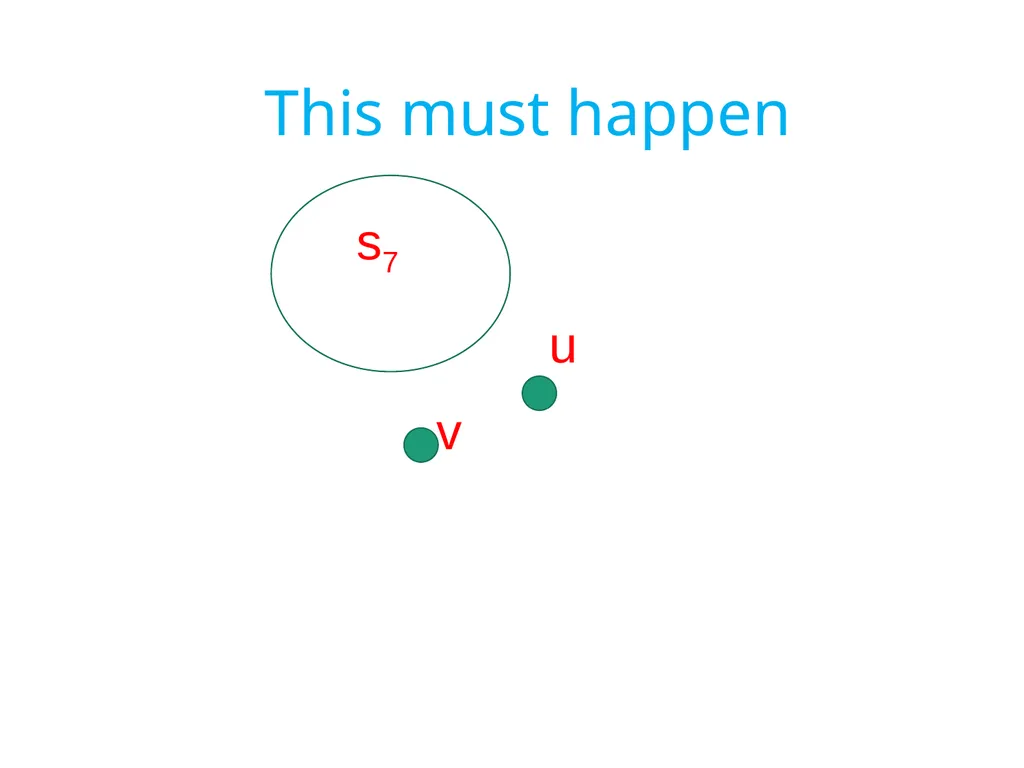
This must happen u v s7<br>
15
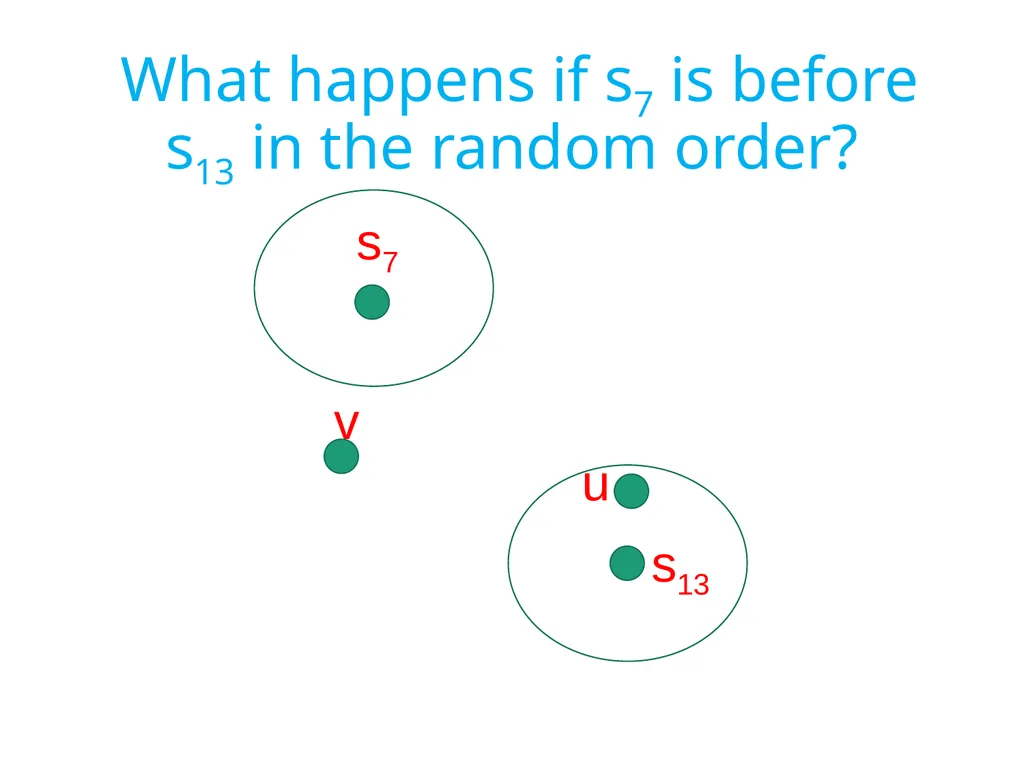
What happens if s7 is before s13 in the random order? u v s7 s13<br>
16
This can’t happen since s7 is closer to the edge u v s7 s13<br>
17
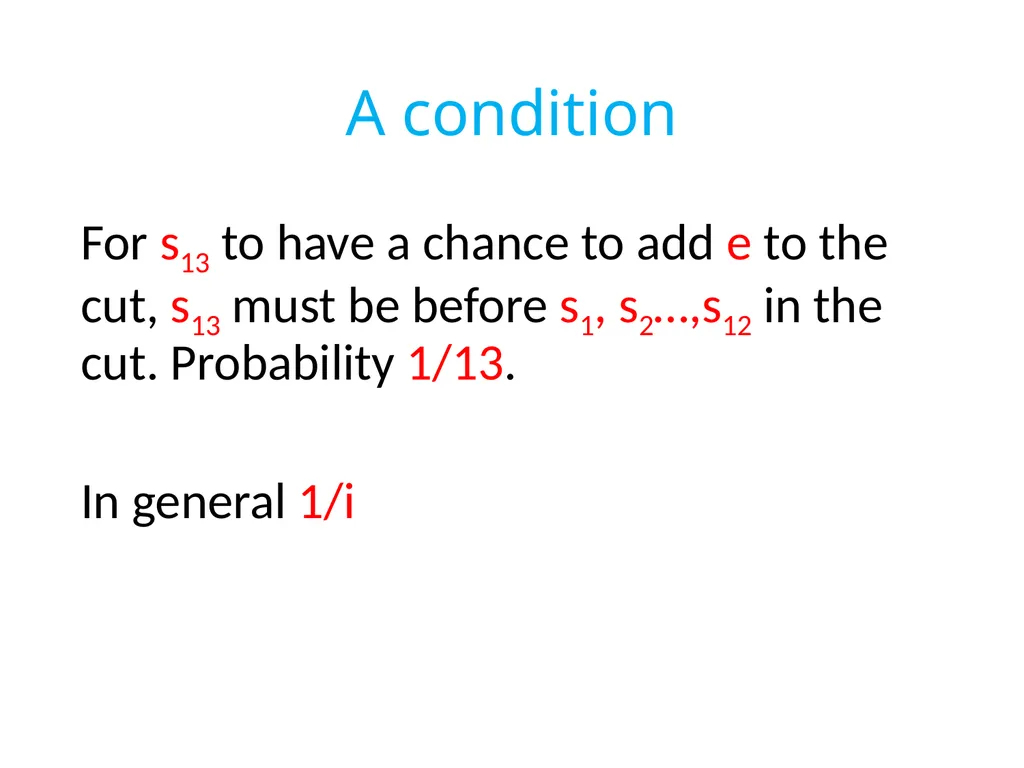
A condition For s13 to have a chance to add e to the cut, s13 must be before s1, s2…,s12 in the cut. Probability 1/13.
In general 1/i<br>
18
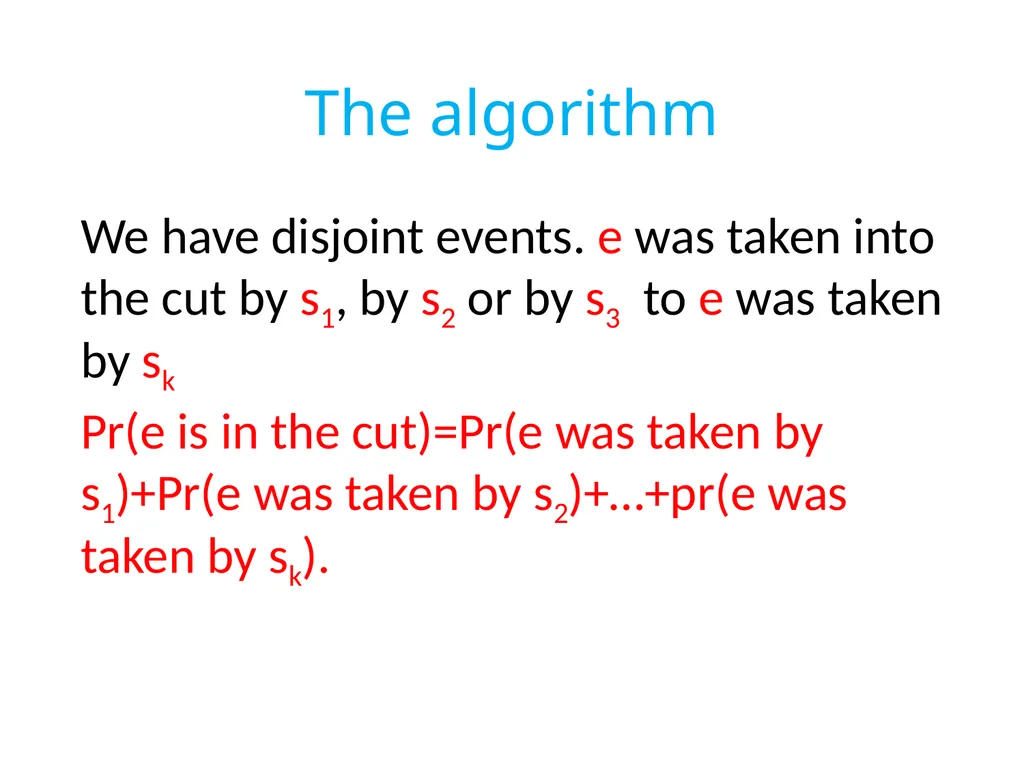
The algorithm We have disjoint events. e was taken into the cut by s1, by s2 or by s3 to e was taken by sk
Pr(e is in the cut)=Pr(e was taken by s1)+Pr(e was taken by s2)+…+pr(e was taken by sk).<br>
19
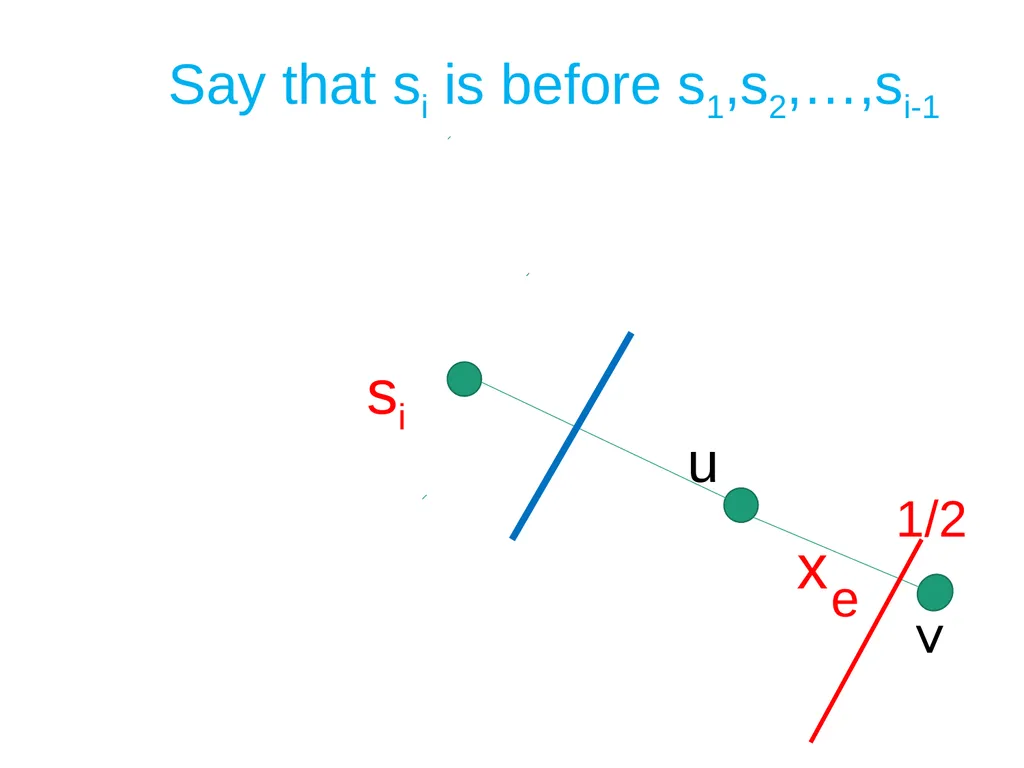
The first condition for si to add e is that si will be in the ordering before sj for all j<i Probability 1/i<br>
20
The first condition for si to add e is that si will be in the ordering before sj for all j<i But even then it is not sure<br>
21
˄ 1/2 Say that si is before s1,s2,…,si-1 x e n si<br>
22
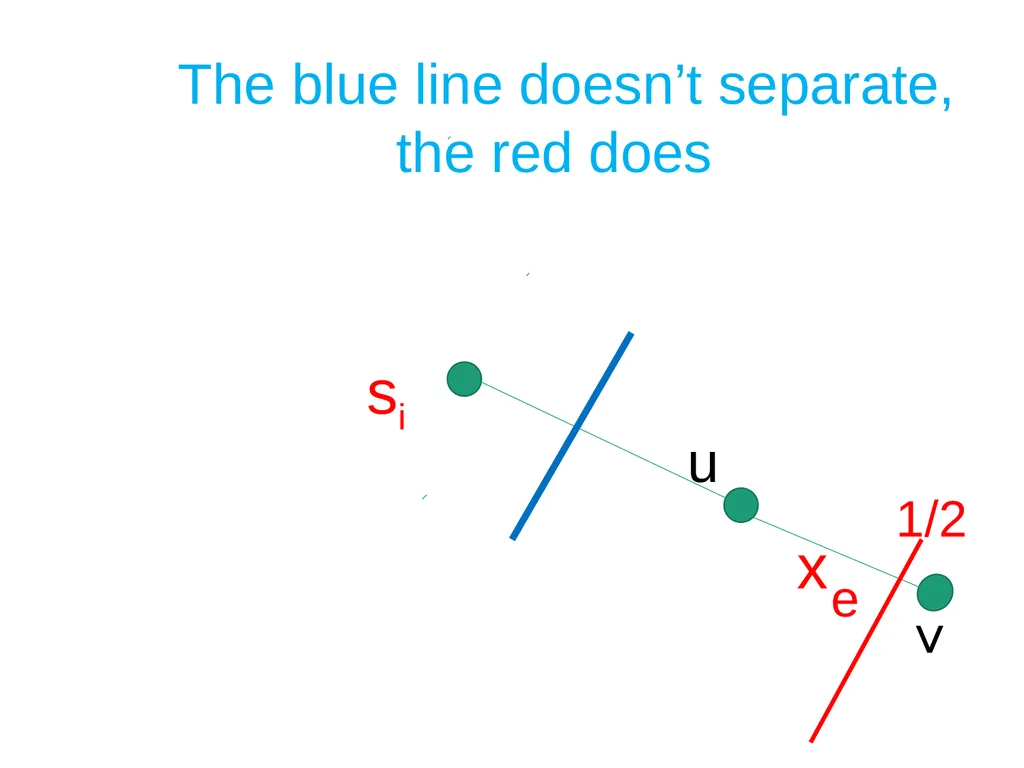
˄ 1/2 The blue line doesn’t separate, the red does x e n si<br>
23
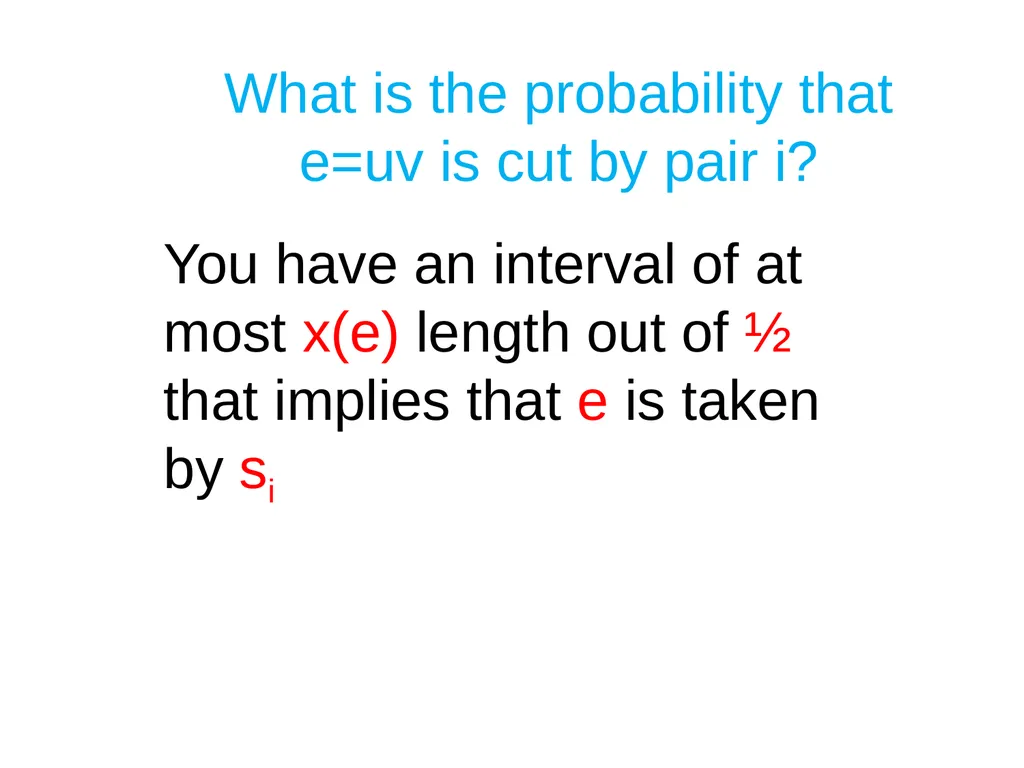
You have an interval of at most x(e) length out of ½ that implies that e is taken by si What is the probability that e=uv is cut by pair i?<br>
24
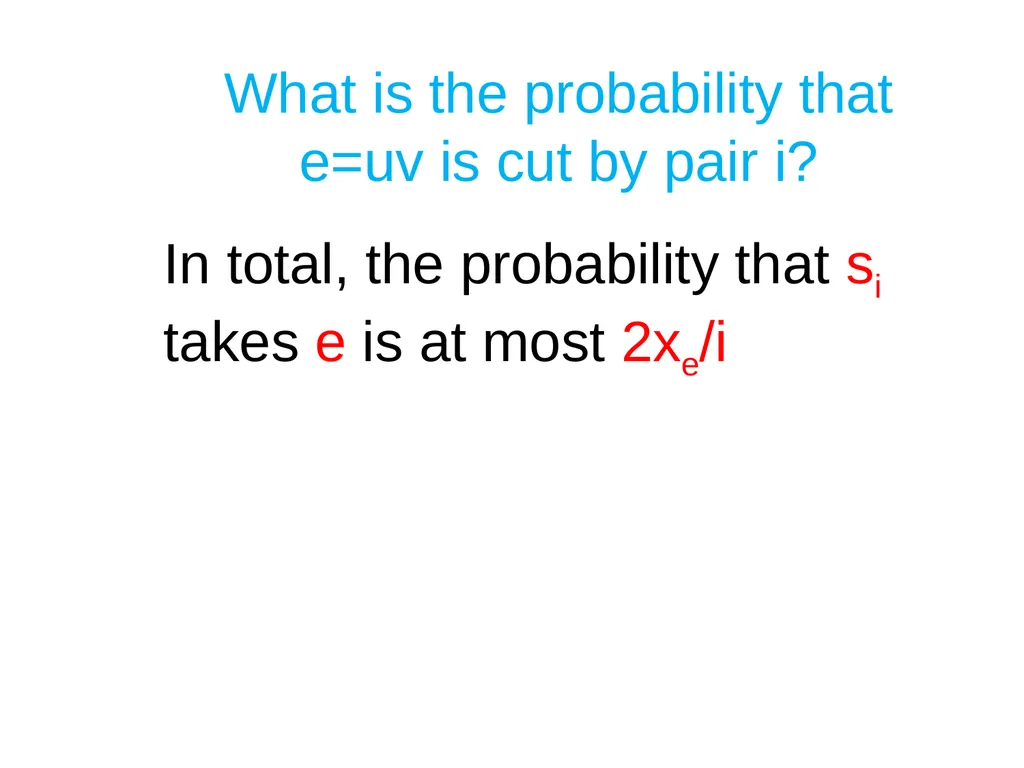
In total, the probability that si takes e is at most 2xe/i What is the probability that e=uv is cut by pair i?<br>
25
Pr(e is in the cut)=
Pr(e is taken by s1)+Pr(e is taken by s2)+… +Pr(e is taken by sk) The probability that e is in the solution<br>
26
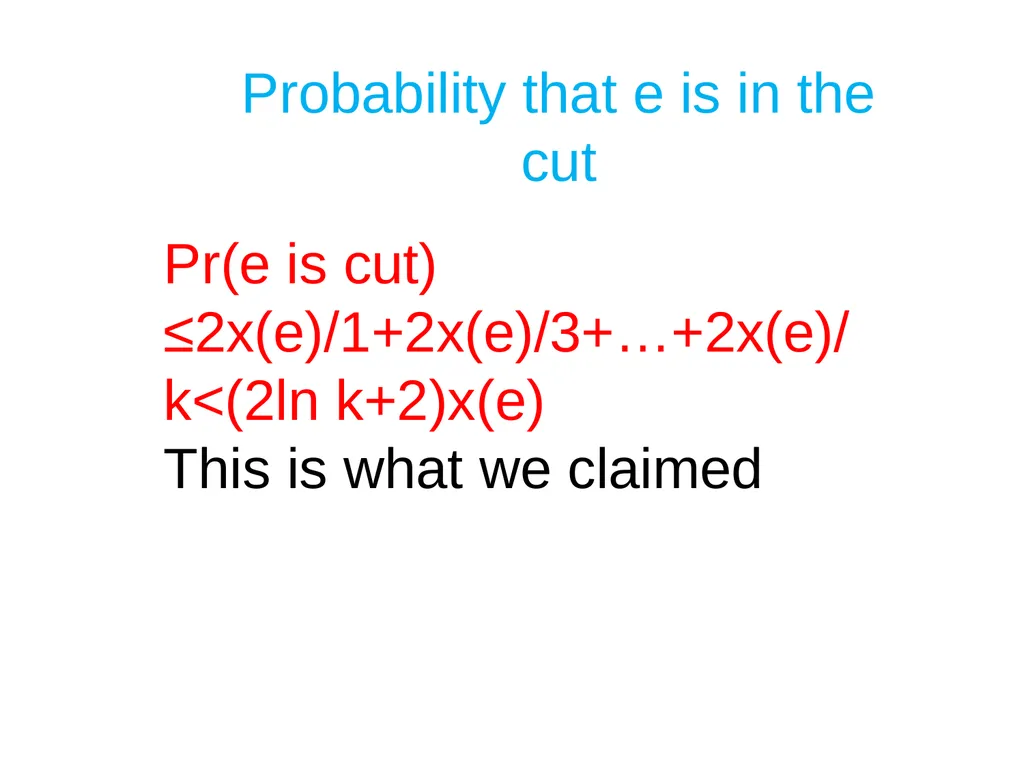
Pr(e is cut)
≤2x(e)/1+2x(e)/3+…+2x(e)/k<(2ln k+2)x(e)
This is what we claimed Probability that e is in the cut<br>
27
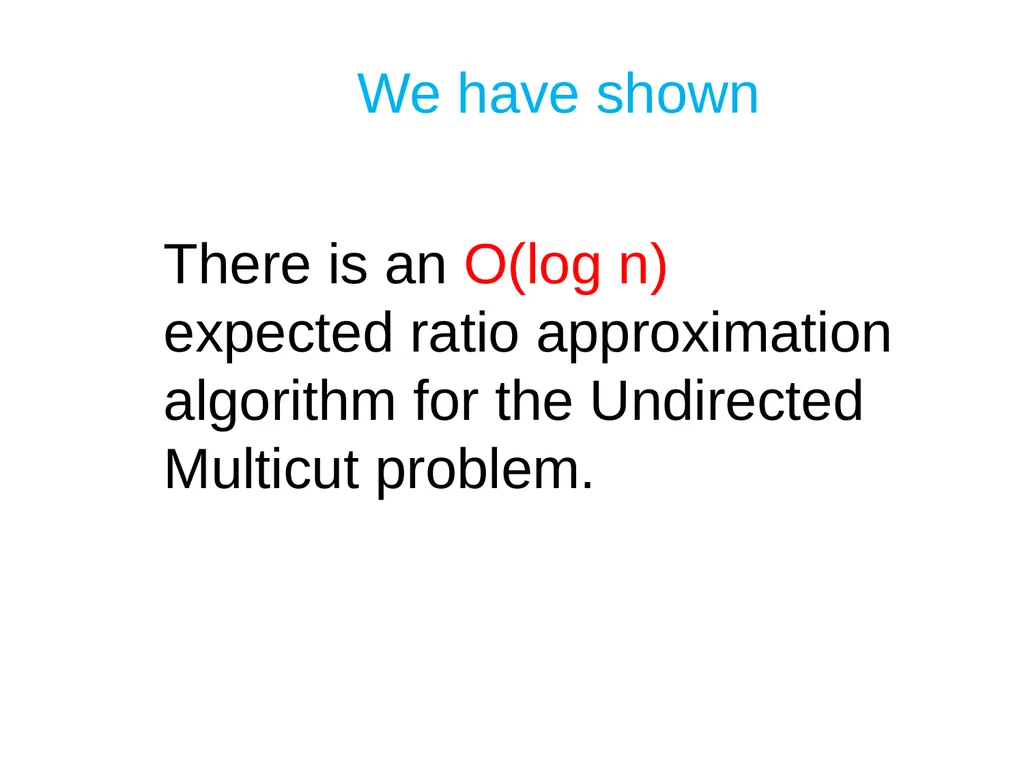
There is an O(log n) expected ratio approximation algorithm for the Undirected Multicut problem. We have shown<br>
28
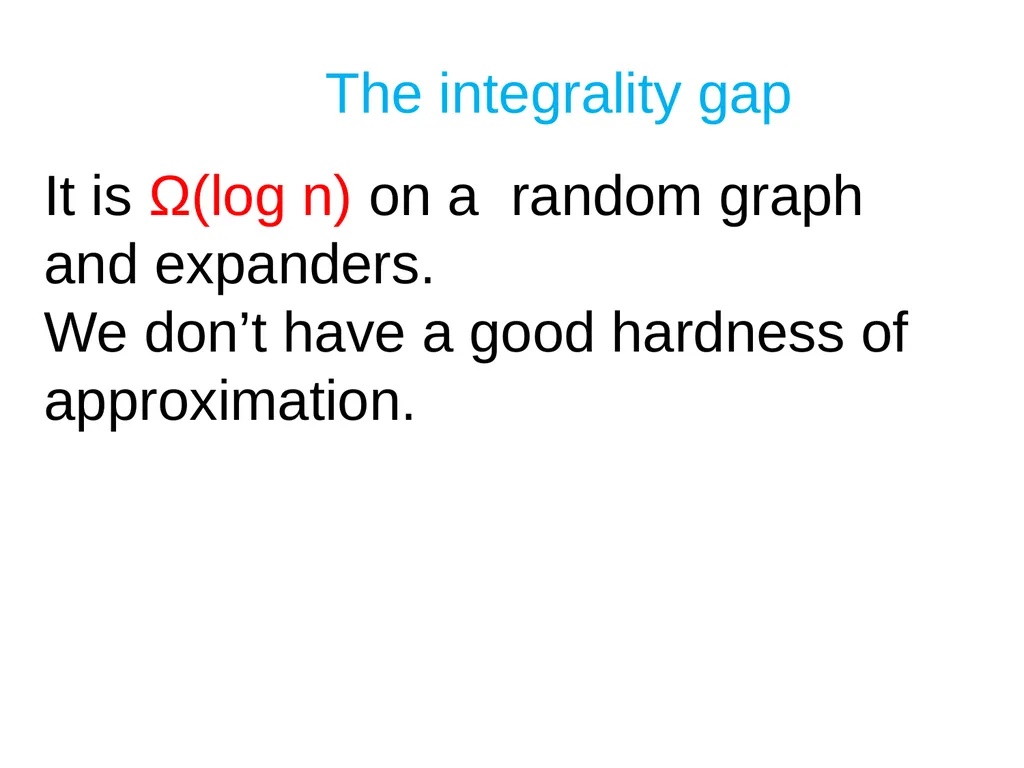
The integrality gap It is Ω(log n) on a random graph
and expanders.
We don’t have a good hardness of
approximation.<br>