April Safety Focus: Biological Registration Process DOHS SOSB April 2023 Administrative Controls ALL work with biological materials, toxins and recombinant DNA must be registered using PI Dashboard https:policymanual.nih.gov3035 The NIH
"April Safety Focus: Biological Registration" is the property of its rightful owner. Permission is granted to
download and print the materials on this website for personal, non-commercial use only, and to display it
on your personal computer provided you do not modify the materials and that you retain all copyright
notices contained in the materials. By downloading content from our website, you accept the terms of this
agreement.
Presentation Transcript
01
April Safety Focus: Biological Registration Process DOHS SOSB
April 2023<br>
02
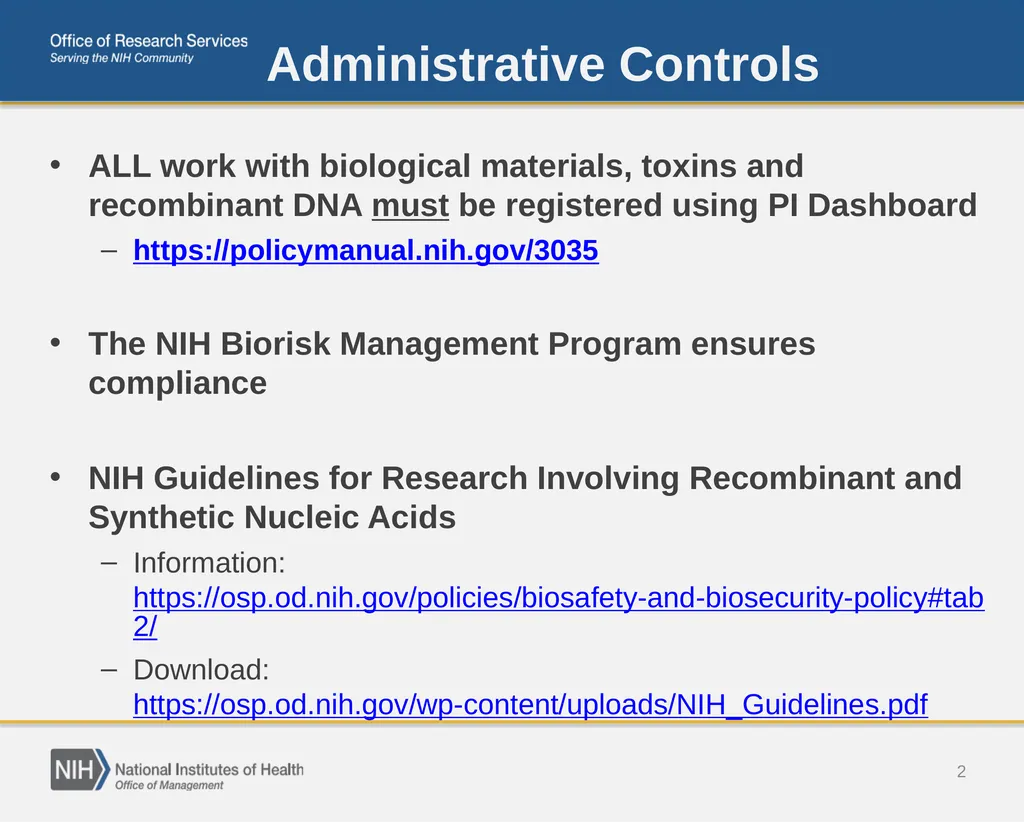
Administrative Controls ALL work with biological materials, toxins and recombinant DNA must be registered using PI Dashboard
https://policymanual.nih.gov/3035
The NIH Biorisk Management Program ensures compliance
NIH Guidelines for Research Involving Recombinant and Synthetic Nucleic Acids
Information: https://osp.od.nih.gov/policies/biosafety-and-biosecurity-policy#tab2/
Download: https://osp.od.nih.gov/wp-content/uploads/NIH_Guidelines.pdf 2<br>
03
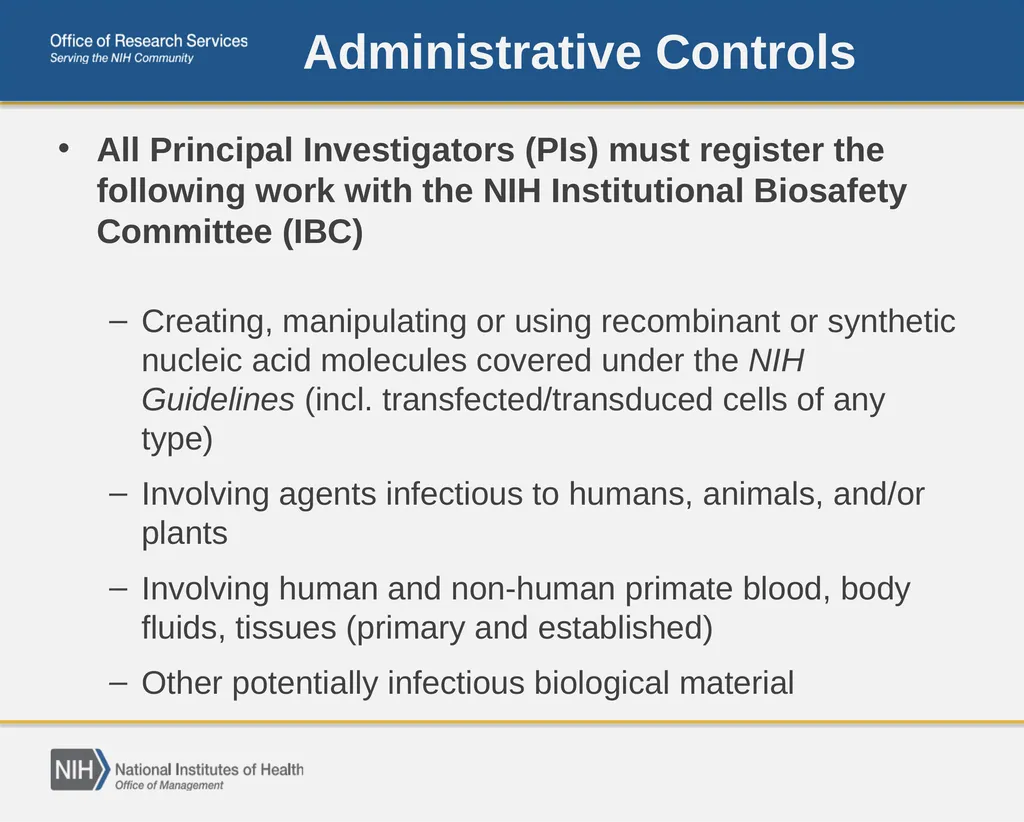
Administrative Controls All Principal Investigators (PIs) must register the following work with the NIH Institutional Biosafety Committee (IBC)
Creating, manipulating or using recombinant or synthetic nucleic acid molecules covered under the NIH Guidelines (incl. transfected/transduced cells of any type)
Involving agents infectious to humans, animals, and/or plants
Involving human and non-human primate blood, body fluids, tissues (primary and established)
Other potentially infectious biological material<br>
04
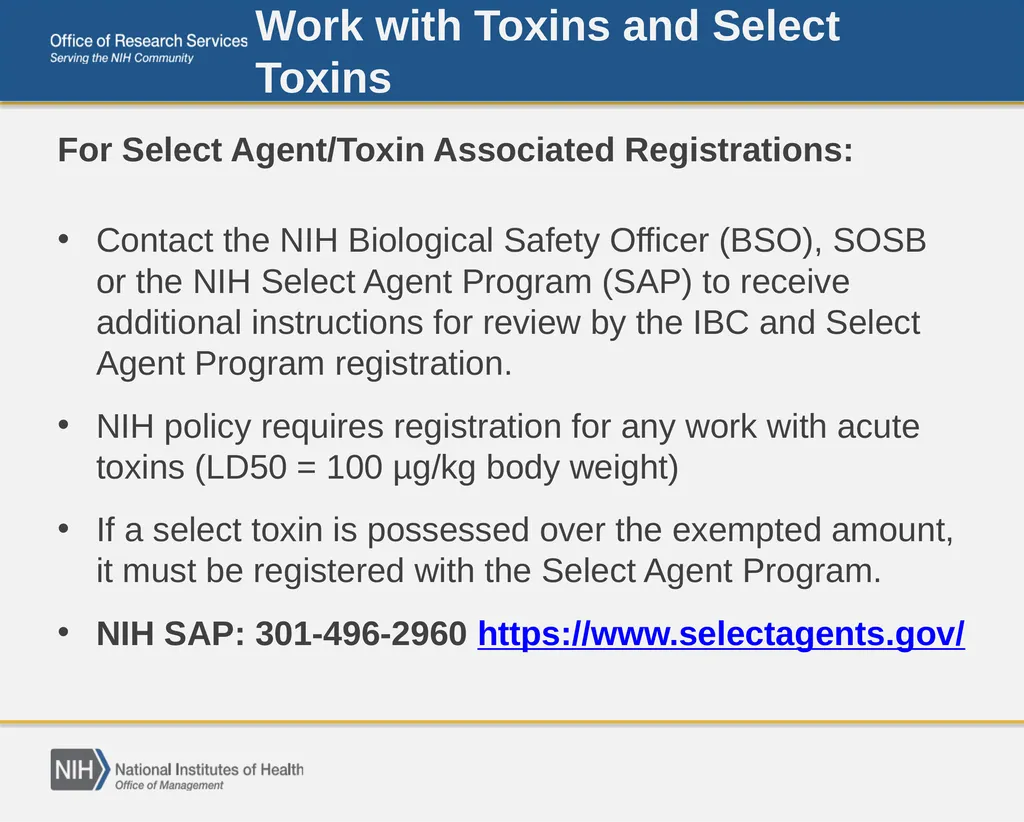
Work with Toxins and Select Toxins For Select Agent/Toxin Associated Registrations:
Contact the NIH Biological Safety Officer (BSO), SOSB or the NIH Select Agent Program (SAP) to receive additional instructions for review by the IBC and Select Agent Program registration.
NIH policy requires registration for any work with acute toxins (LD50 = 100 µg/kg body weight)
If a select toxin is possessed over the exempted amount, it must be registered with the Select Agent Program.
NIH SAP: 301-496-2960 https://www.selectagents.gov/<br>
05
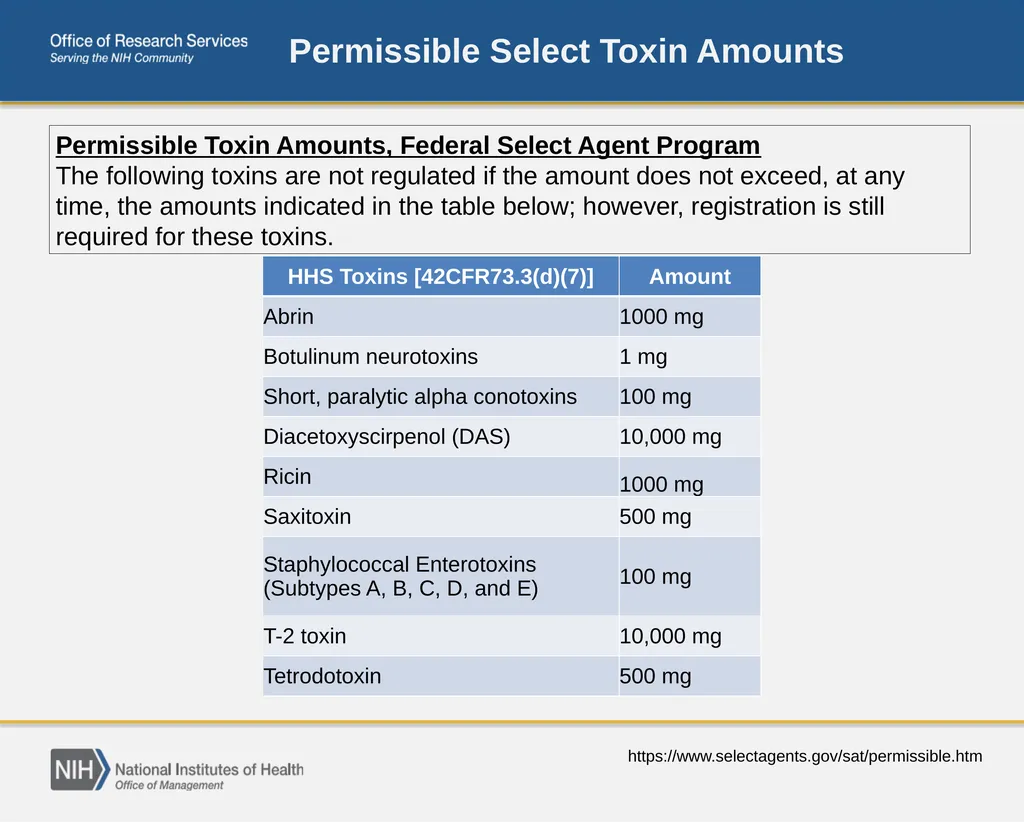
Permissible Select Toxin Amounts Permissible Toxin Amounts, Federal Select Agent Program
The following toxins are not regulated if the amount does not exceed, at any time, the amounts indicated in the table below; however, registration is still required for these toxins. https://www.selectagents.gov/sat/permissible.htm<br>
06
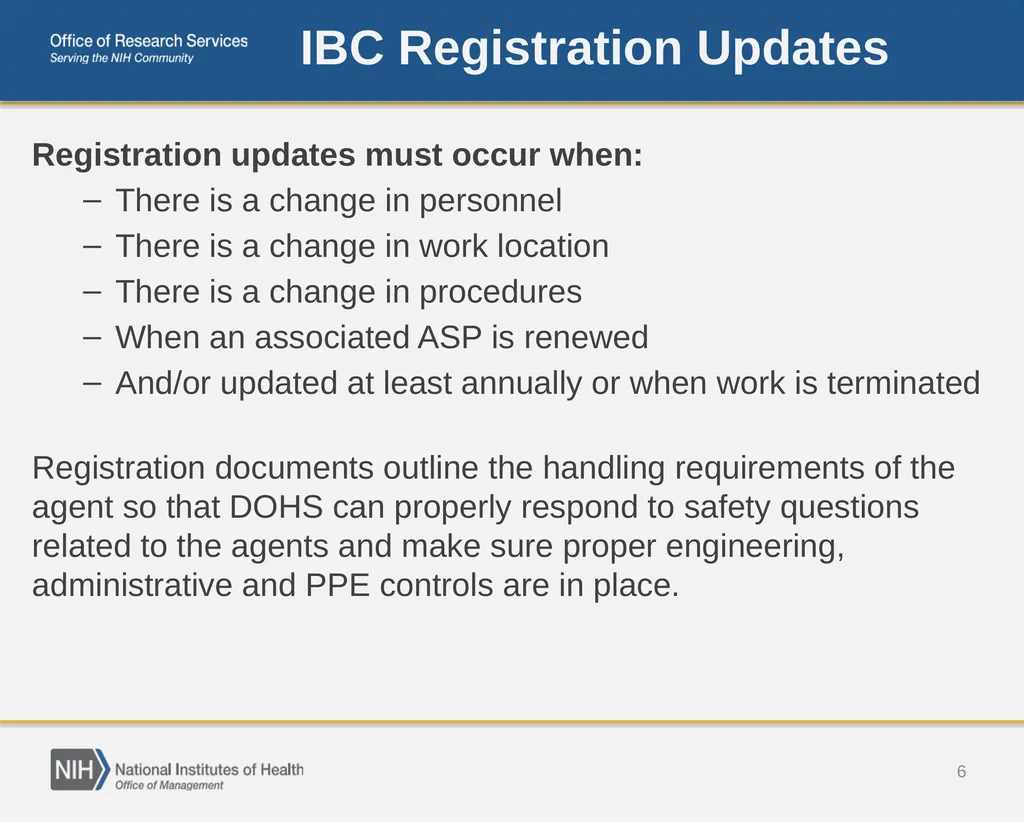
IBC Registration Updates Registration updates must occur when:
There is a change in personnel
There is a change in work location
There is a change in procedures
When an associated ASP is renewed
And/or updated at least annually or when work is terminated
Registration documents outline the handling requirements of the agent so that DOHS can properly respond to safety questions related to the agents and make sure proper engineering, administrative and PPE controls are in place. 6<br>
07
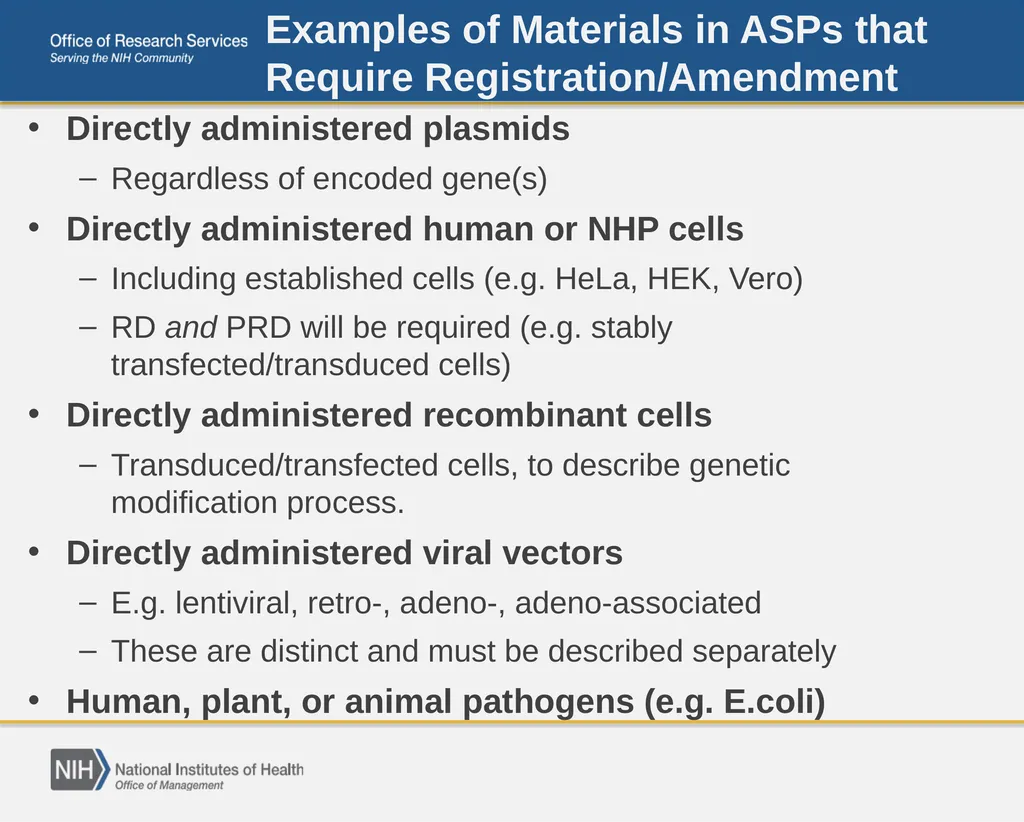
Examples of Materials in ASPs that Require Registration/Amendment Directly administered plasmids
Regardless of encoded gene(s)
Directly administered human or NHP cells
Including established cells (e.g. HeLa, HEK, Vero)
RD and PRD will be required (e.g. stably transfected/transduced cells)
Directly administered recombinant cells
Transduced/transfected cells, to describe genetic modification process.
Directly administered viral vectors
E.g. lentiviral, retro-, adeno-, adeno-associated
These are distinct and must be described separately
Human, plant, or animal pathogens (e.g. E.coli)<br>
08
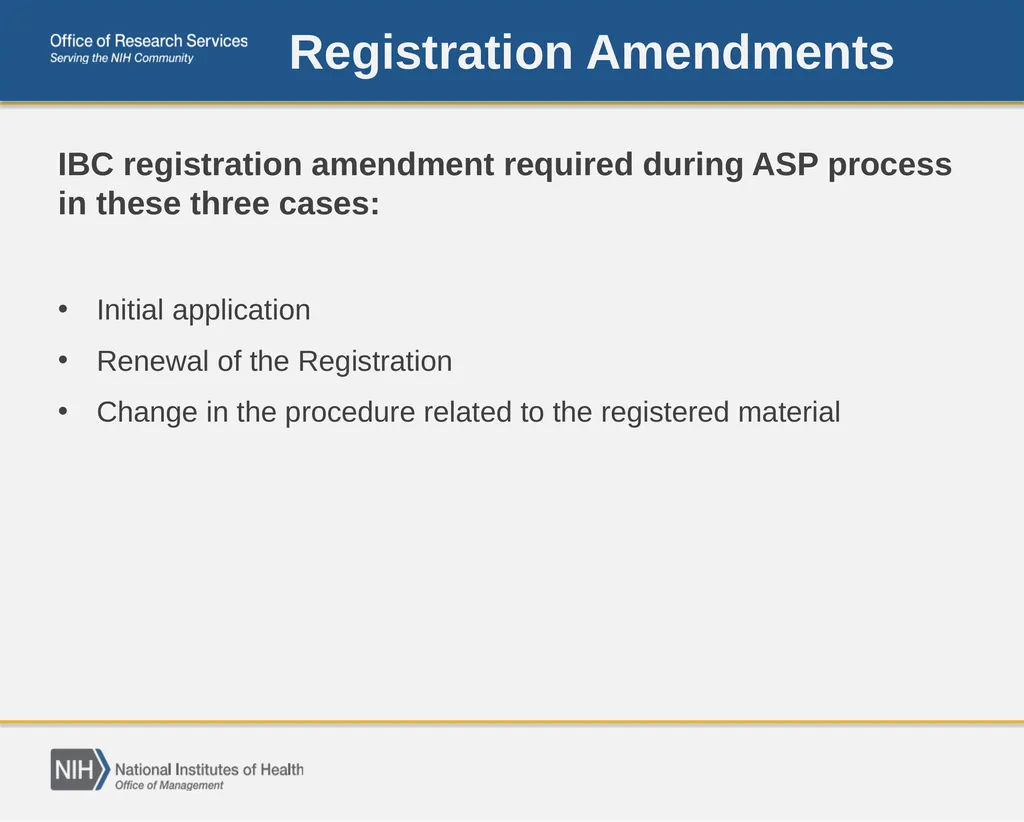
Registration Amendments IBC registration amendment required during ASP process in these three cases:
Initial application
Renewal of the Registration
Change in the procedure related to the registered material<br>
09
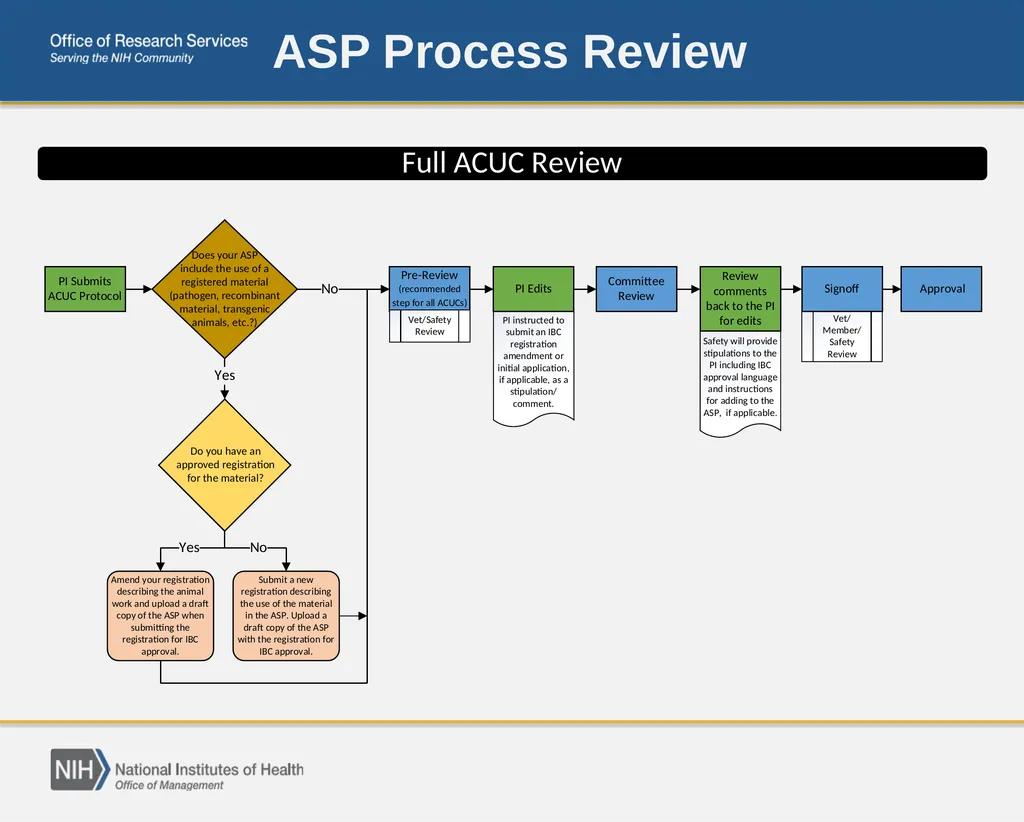
ASP Process Review<br>
10
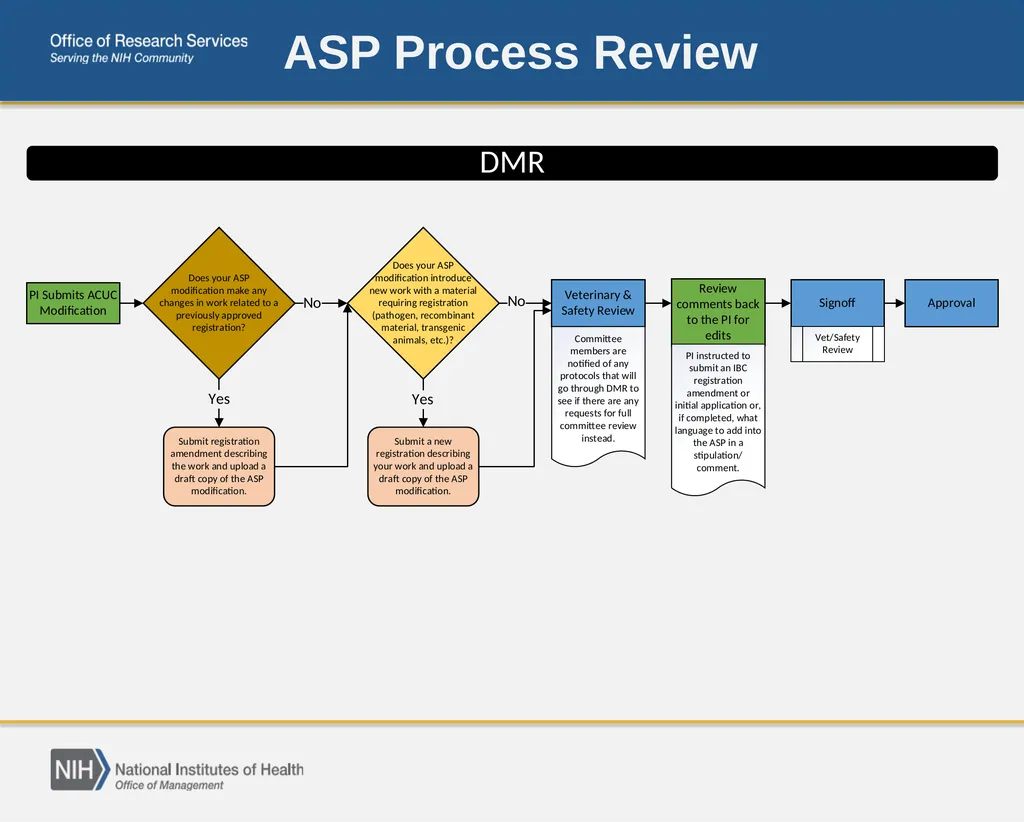
ASP Process Review<br>
11
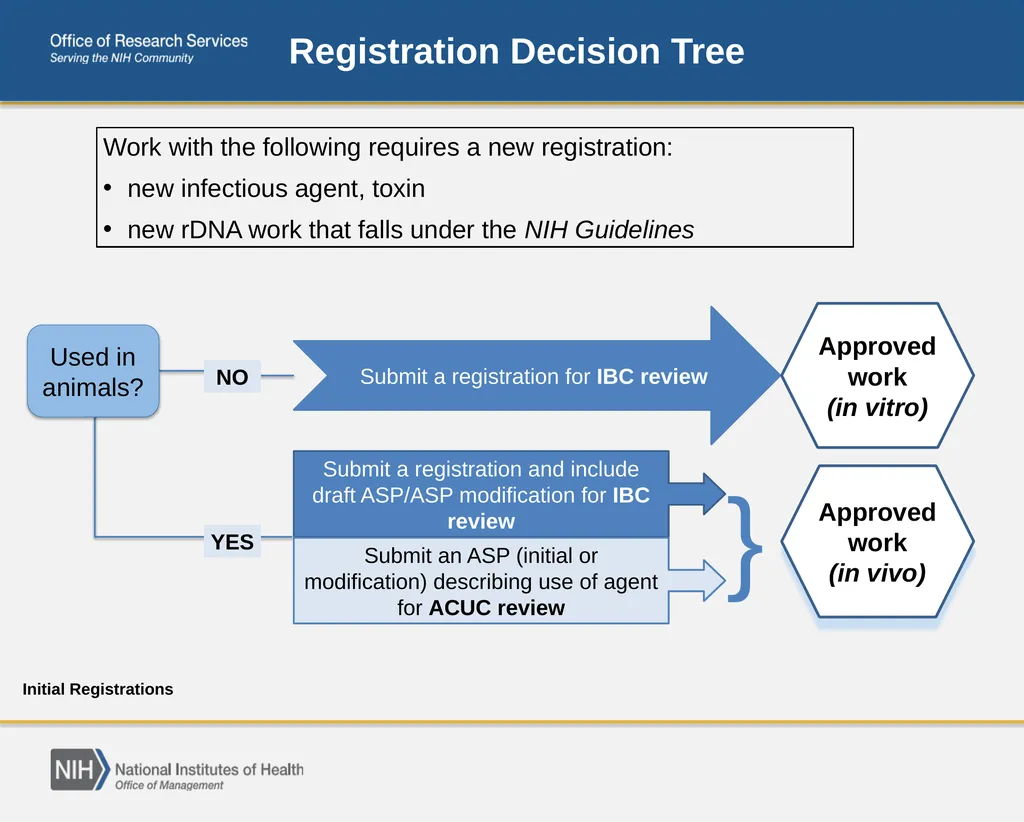
Registration Decision Tree Work with the following requires a new registration:
new infectious agent, toxin
new rDNA work that falls under the NIH Guidelines Used in animals? NO Submit a registration for IBC review Approved work
(in vitro) YES Submit a registration and include draft ASP/ASP modification for IBC review Submit an ASP (initial or modification) describing use of agent for ACUC review Approved work
(in vivo) } Initial Registrations<br>
12
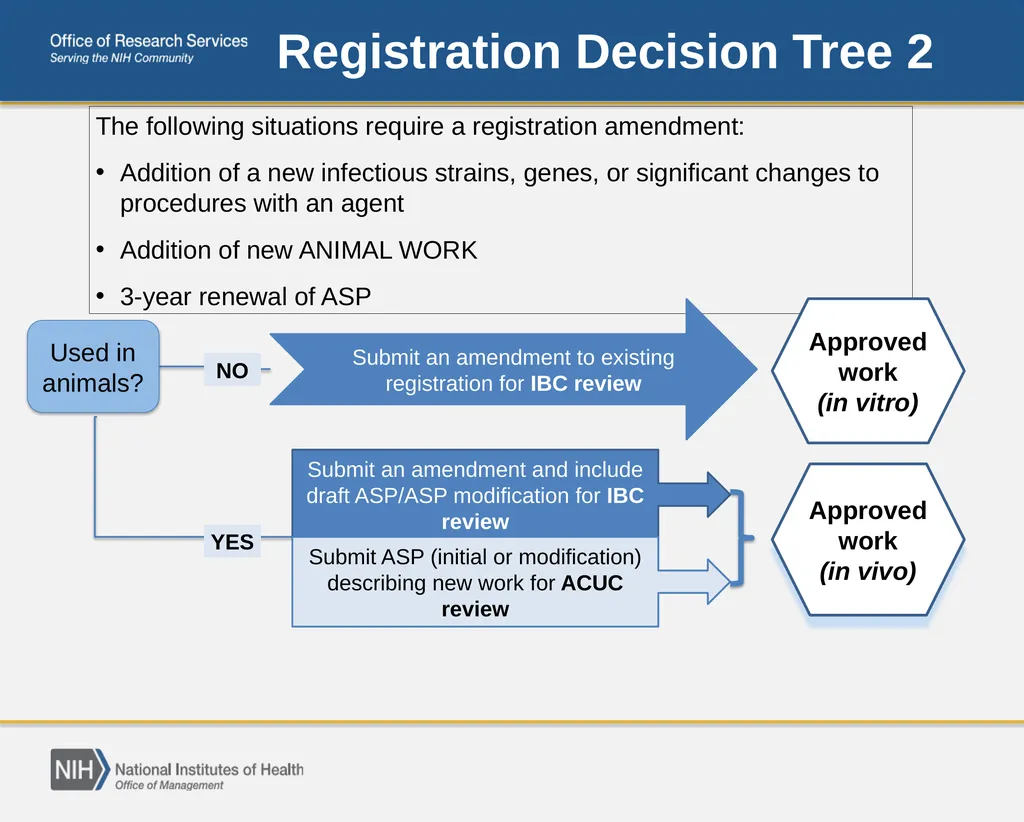
Registration Decision Tree 2 The following situations require a registration amendment:
Addition of a new infectious strains, genes, or significant changes to procedures with an agent
Addition of new ANIMAL WORK
3-year renewal of ASP Used in animals? NO Submit an amendment to existing registration for IBC review Approved work
(in vitro) YES Submit an amendment and include draft ASP/ASP modification for IBC review Submit ASP (initial or modification) describing new work for ACUC review Approved work
(in vivo)<br>
13
References Biorisk Management Branch –
Branch Chief
Jeff Potts, Pottsj@mail.nih.gov
Chief Biosafety Officer
Dr. Richard Baumann, Baumannrg@od.nih.gov
Assoc. Biosafety Officer
Dr. Althea Treacy, Althea.treacy@nih.gov
Select Agent Responsible Official
Dr. Carolyn Buckwalter, Carolyn.Buckwalter@nih.gov
IBC Coordinator
Michael Kujawa, Michael.Kujawa@nih.gov