Aristotle on voluntary action, choice and moral responsibility Michael Lacewing enquiriesalevelphilosophy.co.uk (c) Michael Lacewing Voluntary and involuntary actions In voluntary actions, we know what we are doing and we bring it about
"Aristotle on voluntary action, choice and moral" is the property of its rightful owner. Permission is granted to
download and print the materials on this website for personal, non-commercial use only, and to display it
on your personal computer provided you do not modify the materials and that you retain all copyright
notices contained in the materials. By downloading content from our website, you accept the terms of this
agreement.
Presentation Transcript
01
Aristotle on voluntary action, choice and moral responsibility Michael Lacewing
enquiries@alevelphilosophy.co.uk (c) Michael Lacewing<br>
02
Voluntary and involuntary actions In voluntary actions, we know what we are doing and we bring it about ourselves
Force and ignorance render actions involuntary
3 cases of stepping on someone’s foot (c) Michael Lacewing<br>
03
Force Physical force and psychological pressure
Don’t blame someone where psychological pressure is very strong
When we act involuntarily, we do so with pain and regret
What of sailors throwing goods overboard in a storm?
This is voluntary, in that it is chosen to avoid a greater evil
And we praise them for their choice – praise and blame attaches only to voluntary action (c) Michael Lacewing<br>
04
Ignorance Whether an action done from ignorance is involuntary or ‘not voluntary’ depends on regret
Stepping on someone’s foot (caring, not caring)
Involuntary action from ignorance involves ignorance of the particular circumstances of action
What you are actually doing, its consequences, your manner of acting…
Acting in ignorance ≠ acting from ignorance
Acting from ignorance is not voluntary; acting in ignorance counts as voluntary
E.g. acting when drunk or in a rage – it is these conditions, not ignorance, that bring about the action (c) Michael Lacewing<br>
05
Voluntary action Again: In voluntary actions, we know what we are doing and we bring it about ourselves
Actions done from desire or emotion are still voluntary
If not, then neither children nor animals ever act voluntarily
Many good actions, that we ought to do, are done from desire or emotion
Involuntary actions are painful, many actions done from desire are pleasant
Our desires and emotions are part of us – we act from them (c) Michael Lacewing<br>
06
What is choice? Everything we choose to do is voluntary, but not everything voluntary is chosen
E.g. the actions of children
Choice is what we decide upon as a result of deliberation
Deliberation is reasoning about what we can change
Esp. where we need to act not from habit but differently on different occasions (c) Michael Lacewing<br>
07
Deliberating about ends Do we deliberate about means only, or also ends?
I might deliberate about whether it is worth the effort to get good grades
I might deliberate about which end to pursue when two ends conflict
Aristotle: we don’t deliberate about ends as ends, i.e. we always have some end in view
Getting good grades as a means to an end
Which end to pursue as part of the good life (c) Michael Lacewing<br>
08
Are bad actions voluntary? Do people who are bad do bad things voluntarily and by choice?
Socrates: No - Everyone aims at what they believe is good and doing something bad is acting from ignorance
Aristotle: it involves ignorance, but is still voluntary
To know (fully) what the right act is involves understanding why it is right
Bad people desire what is not truly desirable, but they are ignorant of this fact,
Something bad can seem desirable if we think it is pleasant (c) Michael Lacewing<br>
09
Bad people act voluntarily What it is in our power to do, it is in our power not to do. So we can choose to do either good or bad actions. So bad actions are voluntary.
We encourage people not to do bad actions, yet we don’t encourage people not to do things that are out of their power. (c) Michael Lacewing<br>
10
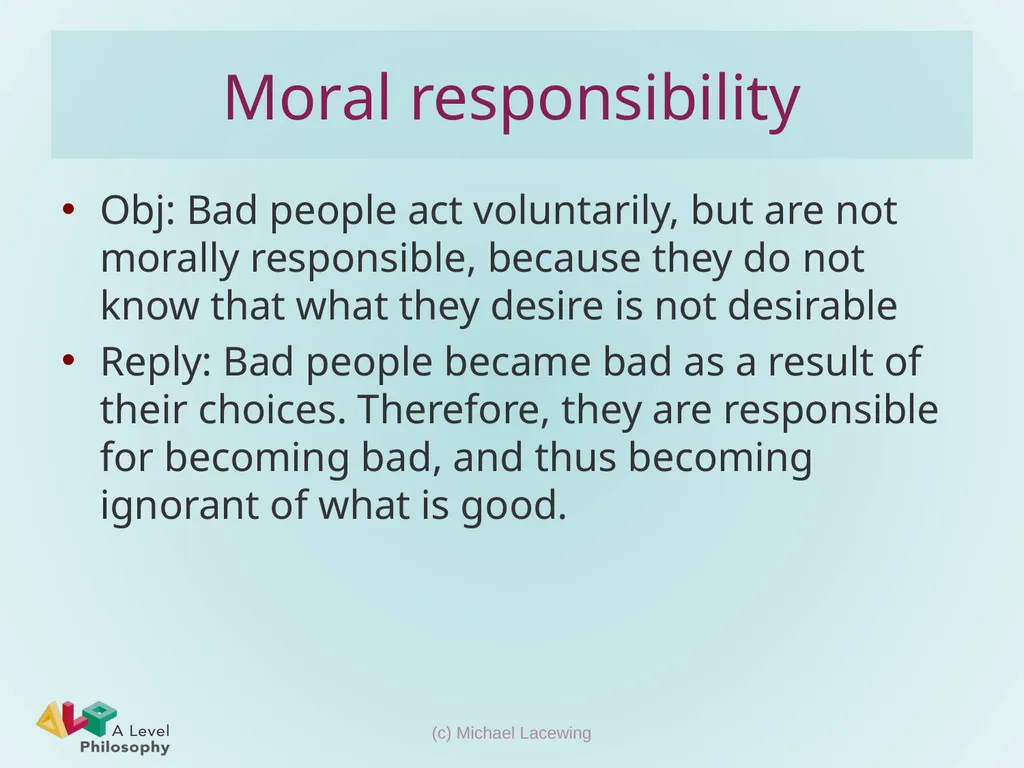
Moral responsibility Obj: Bad people act voluntarily, but are not morally responsible, because they do not know that what they desire is not desirable
Reply: Bad people became bad as a result of their choices. Therefore, they are responsible for becoming bad, and thus becoming ignorant of what is good. (c) Michael Lacewing<br>
11
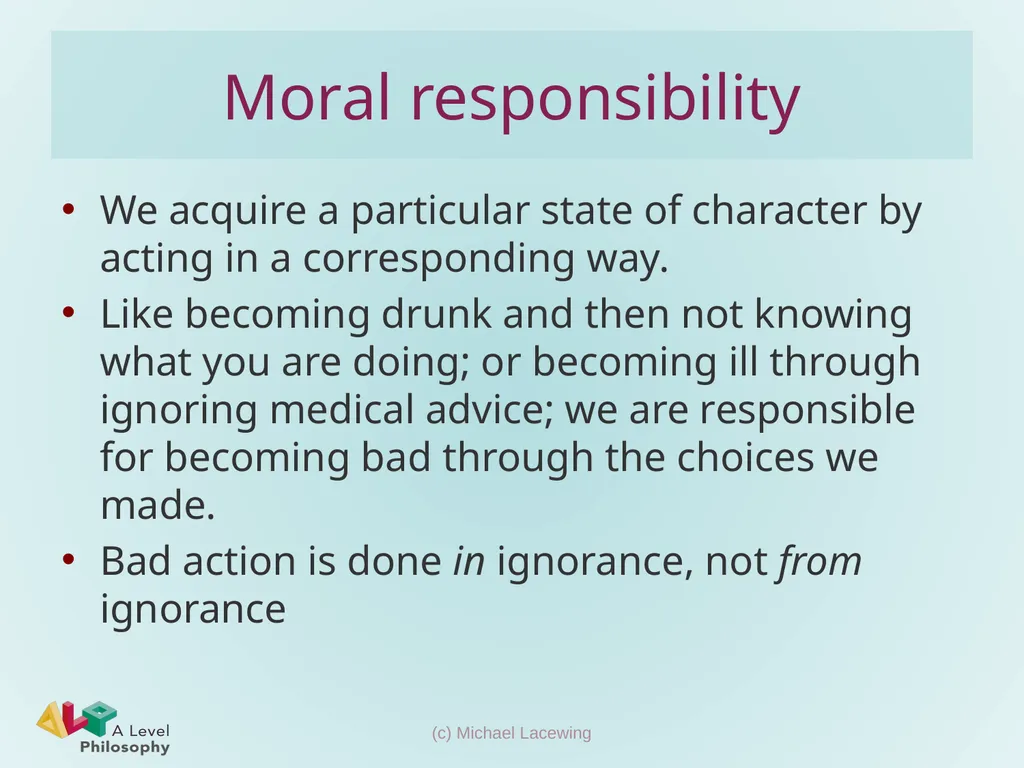
Moral responsibility We acquire a particular state of character by acting in a corresponding way.
Like becoming drunk and then not knowing what you are doing; or becoming ill through ignoring medical advice; we are responsible for becoming bad through the choices we made.
Bad action is done in ignorance, not from ignorance (c) Michael Lacewing<br>
12
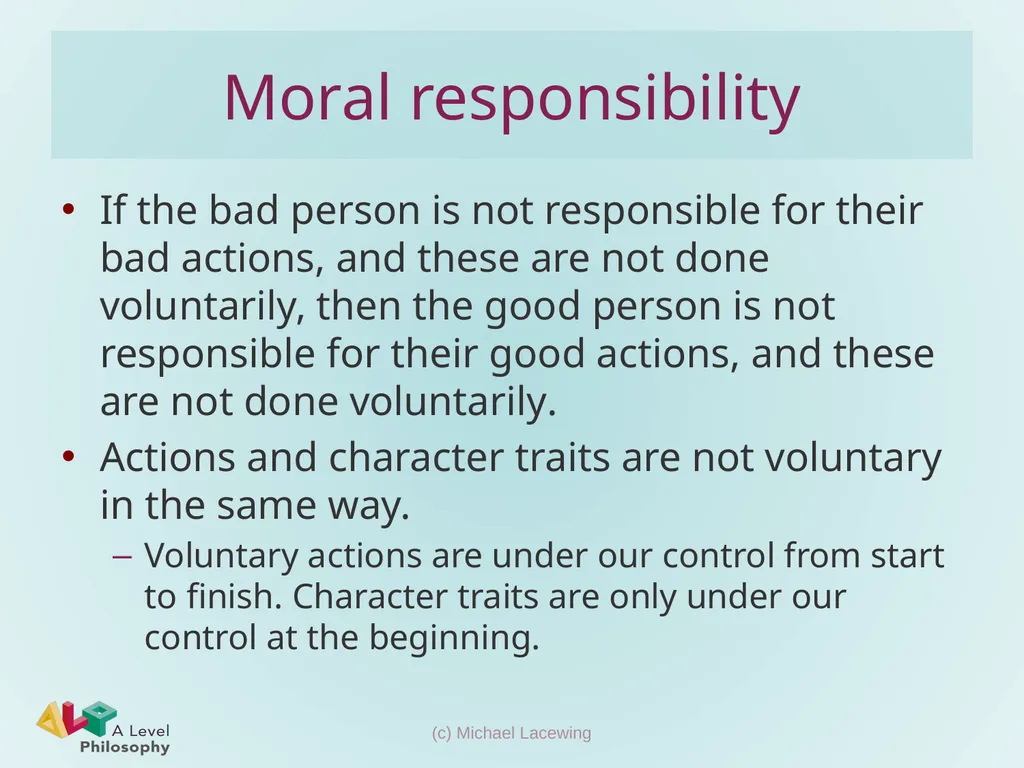
Moral responsibility If the bad person is not responsible for their bad actions, and these are not done voluntarily, then the good person is not responsible for their good actions, and these are not done voluntarily.
Actions and character traits are not voluntary in the same way.
Voluntary actions are under our control from start to finish. Character traits are only under our control at the beginning. (c) Michael Lacewing<br>