
Arranging education for children who cannot attend

Description: Arranging education for children who cannot attend school because of health needs update for schools Context DfE guidance updated Dec 2023 Role of LA, schools and other partners including parents Related guidance: NYC delivery model
Related Topics
Download Presentation
"Arranging education for children who cannot attend" is the property of its rightful owner. Permission is granted to download and print the materials on this website for personal, non-commercial use only, and to display it on your personal computer provided you do not modify the materials and that you retain all copyright notices contained in the materials. By downloading content from our website, you accept the terms of this agreement.
Presentation Transcript
slide1. Arranging education for children who cannot attend school because of health needs – update for schools<br>
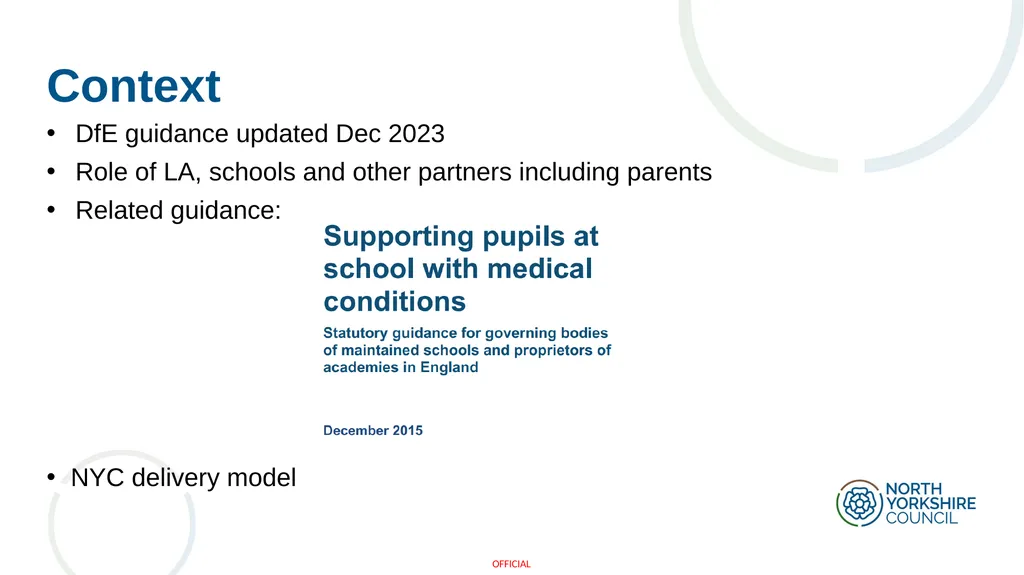
slide2. Context DfE guidance updated Dec 2023
Role of LA, schools and other partners including parents
Related guidance:
NYC delivery model<br>
slide3. Legislative context (Education Act 1996) Section 19 of the Education Act 1996, local authorities are responsible for arranging suitable and (normally) full-time education for children of compulsory school age who, because of exclusion, illness or other reasons, would not receive suitable education without such provision.
Policy statement (should)
Named officer (should) – published for parents and schools<br>
slide4. Education Regulations 2006 requirement on local authorities to arrange suitable full-time education
school has a duty to provide to the local authority, the full name and address of any pupils of compulsory school age who are not attending school regularly (including due to their health needs)<br>
slide5. Equality Act (2010) Schools and the LA must:
Eliminate discrimination
Advance equality of opportunity
Foster good relations
Make reasonable adjustments
Schools:
Individual health care plans (should)
Accessibility plan (must)<br>
slide6. Section 100, Children & Families Act Schools must
Support pupils with medical conditions so that they have the same opportunities as their peers, including access to a full education, school trips and physical education.
ensure that arrangements are in place to support pupils with medical conditions and that these consider the pupil’s needs
have a policy for supporting pupils with medical conditions
ensure staff are adequately trained to support pupils with medical conditions
have clear policies for managing medicines
ensure that pupils with medical conditions can participate in all aspects of school life including extracurricular activities<br>
slide7. Schools should
work in collaboration with LA, health professionals, families and CYP
minimise any disruption to the education of pupils with medical conditions
have Individual healthcare plans for children with medical needs Section 100, Children & Families Act<br>
slide8. Definitions Where possible, schools should continue to provide education to children with health needs who can attend school.
When a child is already attending school, there is a range of circumstances where their health needs can and should be managed by the school so that they can continue to be educated there without the need for the intervention of the local authority
The ‘Supporting pupils at school with medical conditions’ guidance outlines the expectations for schools
Schools also need to be aware of their responsibilities when mental health issues are impacting on a child’s attendance.
The law does not define full-time education but children with health needs should have provision, where possible, which is equivalent to the education they would receive in a mainstream school
The term ‘home school’ refers to the school that the child is on the roll of when they become ill. Not all children will have a home school as, for example, their health needs may have arisen before they were old enough to enroll at school.<br>
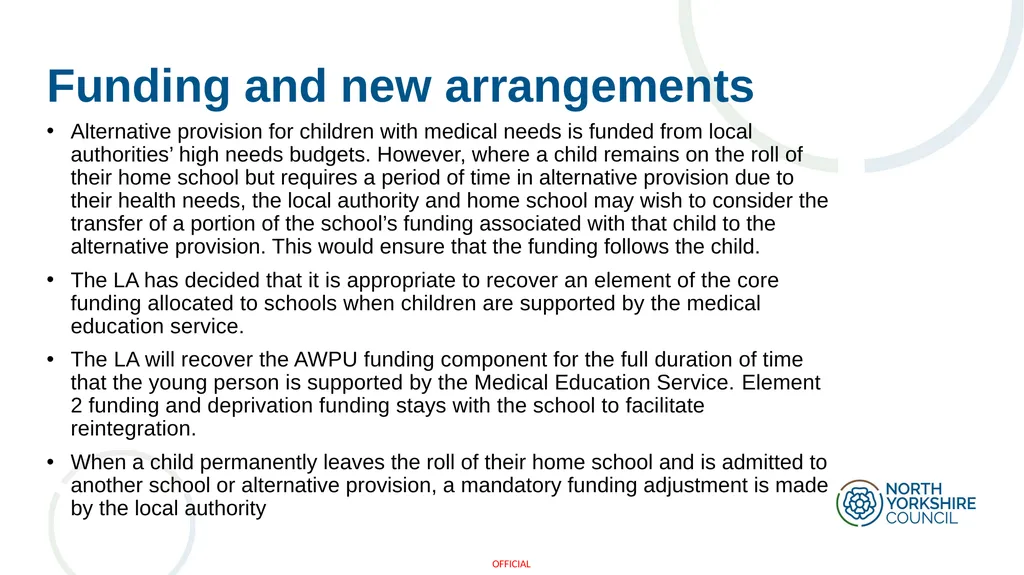
slide9. Funding and new arrangements Alternative provision for children with medical needs is funded from local authorities’ high needs budgets. However, where a child remains on the roll of their home school but requires a period of time in alternative provision due to their health needs, the local authority and home school may wish to consider the transfer of a portion of the school’s funding associated with that child to the alternative provision. This would ensure that the funding follows the child.
The LA has decided that it is appropriate to recover an element of the core funding allocated to schools when children are supported by the medical education service.
The LA will recover the AWPU funding component for the full duration of time that the young person is supported by the Medical Education Service. Element 2 funding and deprivation funding stays with the school to facilitate reintegration.
When a child permanently leaves the roll of their home school and is admitted to another school or alternative provision, a mandatory funding adjustment is made by the local authority<br>
slide10. Working together Parents and carers should always be consulted before new or alternative provision begins.
Children should be involved in decision making to support engagement and reintegration.
Effective collaboration between relevant services is essential to deliver continuous and effective education.
Where possible, the child’s health needs should be managed by the home school so that they can continue to be educated there with support, and without the need for the intervention of the local authority.
However, as soon as it is clear that the home school can no longer support the child’s health needs and provide suitable education, the school should speak to the local authority about putting alternative provision in place.<br>
slide11. Arranging education There is no absolute legal deadline by which local authorities must start to arrange education for children with additional health needs. However, as soon as it is clear that a child will be away from school for 15 days or more because of their health needs, the local authority should arrange suitable alternative provision. The 15 days may be consecutive or over the course of a school year.
When a local authority arranges alternative education, that education should begin as soon as it is possible, and at the latest by the sixth day of the child’s absence from school.
Medical evidence should be used to better understand the needs of the child and identify the most suitable provision. Local authorities, working closely with the child’s home school, medical practitioners and the child’s family, should make every effort to minimise the disruption to a child’s education
Provision should also support the child’s individual needs to overcome barriers to attainment and achievement, giving equal consideration to the pastoral needs of the child to allow them to thrive and prosper in the education system.<br>
slide12. Adapting education All children, regardless of circumstance or setting, should expect to receive the same high standard of education (as outlined in alternative provision statutory guidance).
Alternative provision must be suitable to the child’s age, ability and aptitude, and any special educational needs they have.
Children should be given the opportunity to take appropriate qualifications. This would help prevent them from slipping behind their peers and enable them to better reintegrate successfully back into school, if they so wish.
This should also include personal, social and emotional needs, for example ensuring that the child feel fully part of their home school community, are able to stay in contact with classmates, and have access to the opportunities enjoyed by their peers.
The local authority should, alongside the child’s home school, regularly review the provision offered to ensure that it continues to be appropriate for the child and that it is providing suitable education.<br>
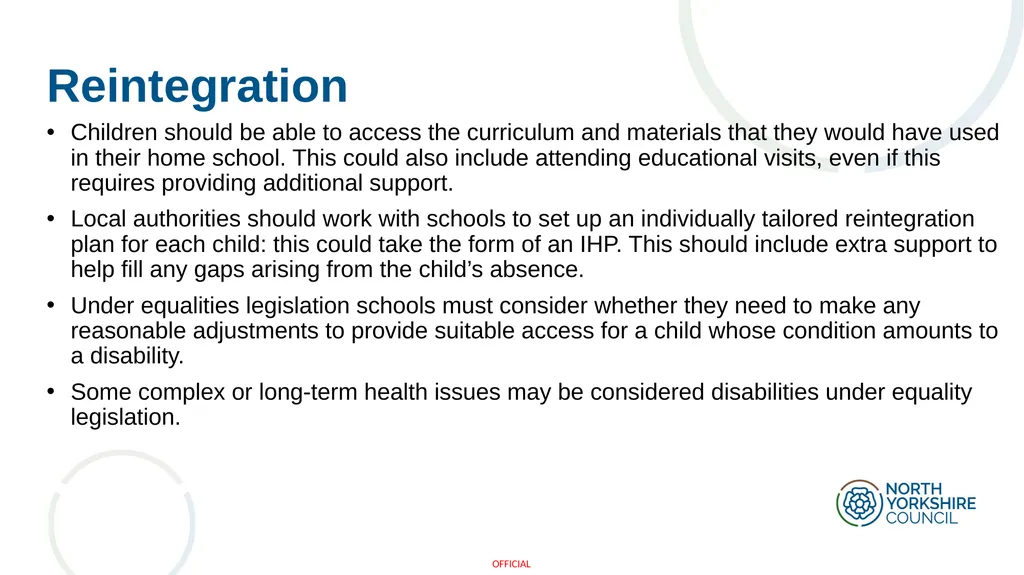
slide13. Reintegration Children should be able to access the curriculum and materials that they would have used in their home school. This could also include attending educational visits, even if this requires providing additional support.
Local authorities should work with schools to set up an individually tailored reintegration plan for each child: this could take the form of an IHP. This should include extra support to help fill any gaps arising from the child’s absence.
Under equalities legislation schools must consider whether they need to make any reasonable adjustments to provide suitable access for a child whose condition amounts to a disability.
Some complex or long-term health issues may be considered disabilities under equality legislation.<br>
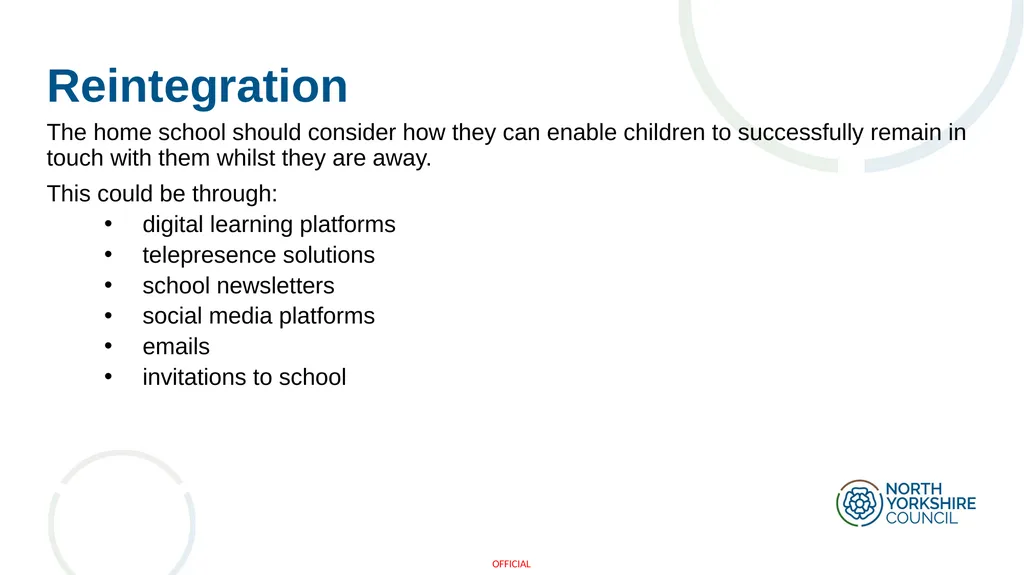
slide14. Reintegration The home school should consider how they can enable children to successfully remain in touch with them whilst they are away.
This could be through:
digital learning platforms
telepresence solutions
school newsletters
social media platforms
emails
invitations to school<br>
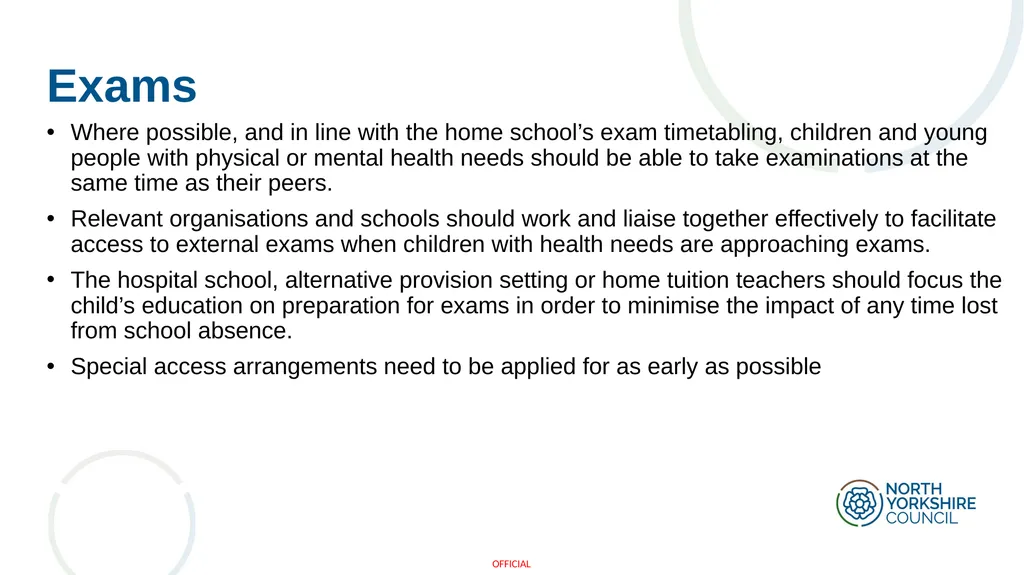
slide15. Exams Where possible, and in line with the home school’s exam timetabling, children and young people with physical or mental health needs should be able to take examinations at the same time as their peers.
Relevant organisations and schools should work and liaise together effectively to facilitate access to external exams when children with health needs are approaching exams.
The hospital school, alternative provision setting or home tuition teachers should focus the child’s education on preparation for exams in order to minimise the impact of any time lost from school absence.
Special access arrangements need to be applied for as early as possible<br>
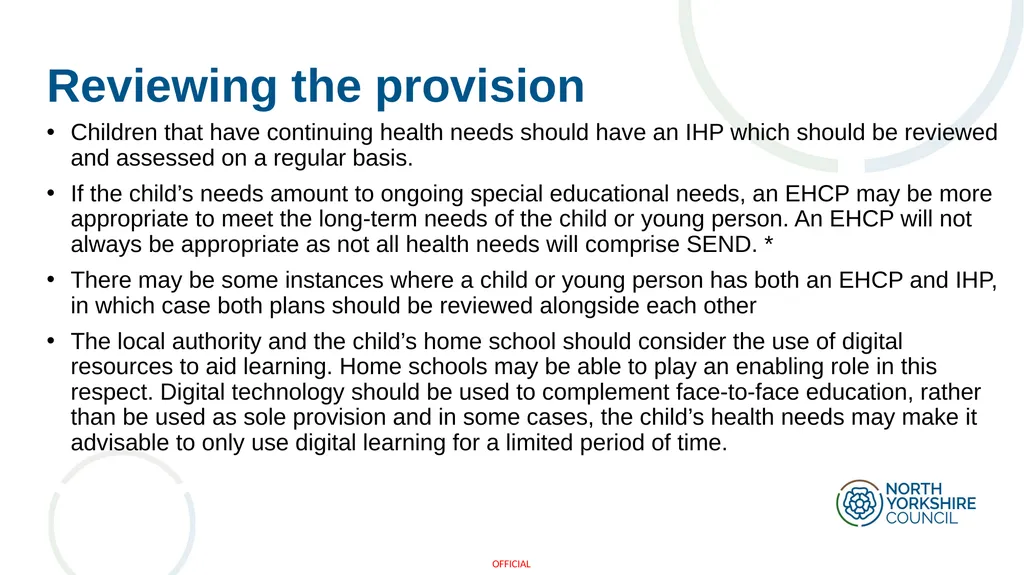
slide16. Reviewing the provision Children that have continuing health needs should have an IHP which should be reviewed and assessed on a regular basis.
If the child’s needs amount to ongoing special educational needs, an EHCP may be more appropriate to meet the long-term needs of the child or young person. An EHCP will not always be appropriate as not all health needs will comprise SEND. *
There may be some instances where a child or young person has both an EHCP and IHP, in which case both plans should be reviewed alongside each other
The local authority and the child’s home school should consider the use of digital resources to aid learning. Home schools may be able to play an enabling role in this respect. Digital technology should be used to complement face-to-face education, rather than be used as sole provision and in some cases, the child’s health needs may make it advisable to only use digital learning for a limited period of time.<br>
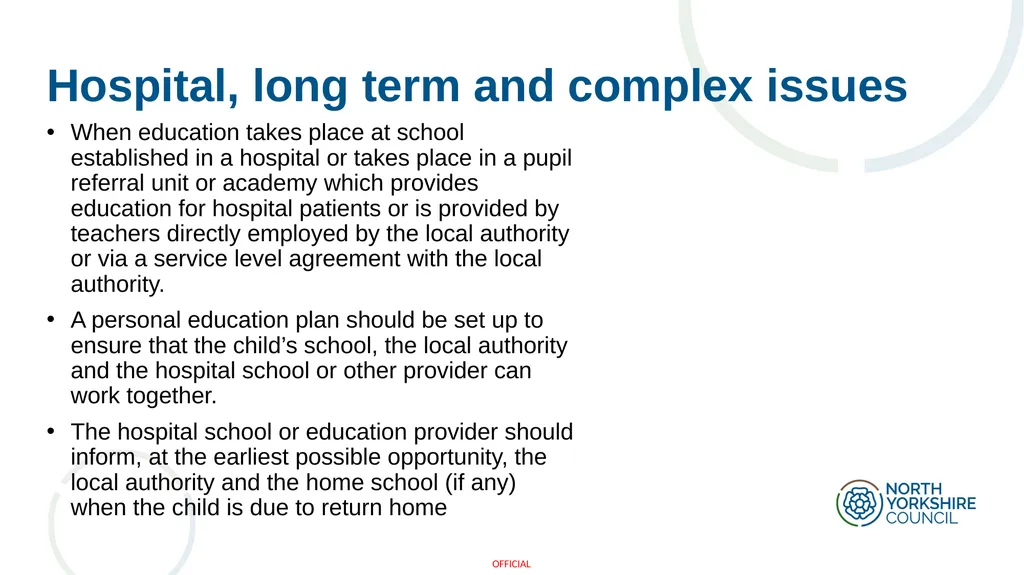
slide17. Hospital, long term and complex issues When education takes place at school established in a hospital or takes place in a pupil referral unit or academy which provides education for hospital patients or is provided by teachers directly employed by the local authority or via a service level agreement with the local authority.
A personal education plan should be set up to ensure that the child’s school, the local authority and the hospital school or other provider can work together.
The hospital school or education provider should inform, at the earliest possible opportunity, the local authority and the home school (if any) when the child is due to return home<br>
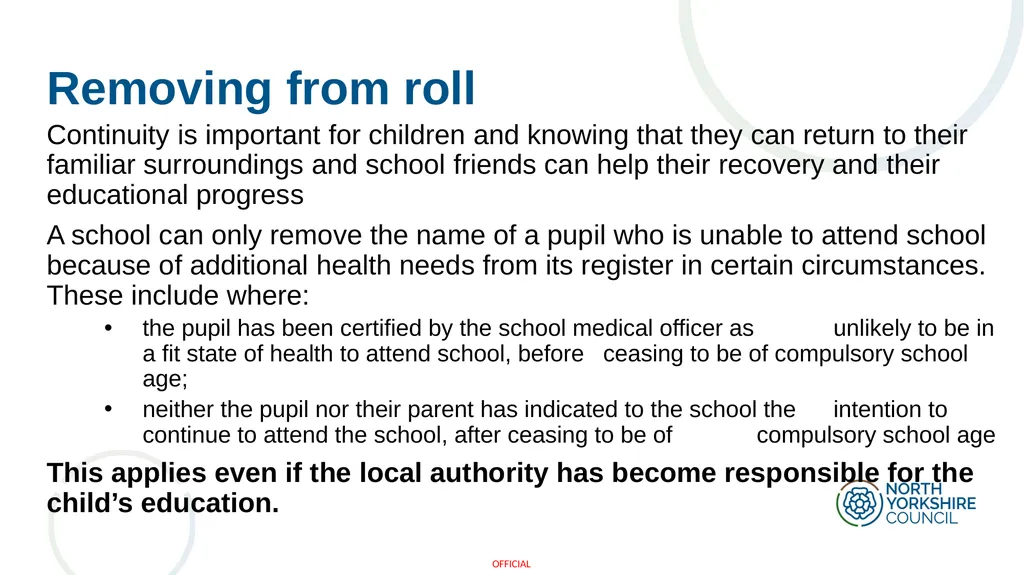
slide18. Removing from roll Continuity is important for children and knowing that they can return to their familiar surroundings and school friends can help their recovery and their educational progress
A school can only remove the name of a pupil who is unable to attend school because of additional health needs from its register in certain circumstances. These include where:
the pupil has been certified by the school medical officer as unlikely to be in a fit state of health to attend school, before ceasing to be of compulsory school age;
neither the pupil nor their parent has indicated to the school the intention to continue to attend the school, after ceasing to be of compulsory school age
This applies even if the local authority has become responsible for the child’s education.<br>
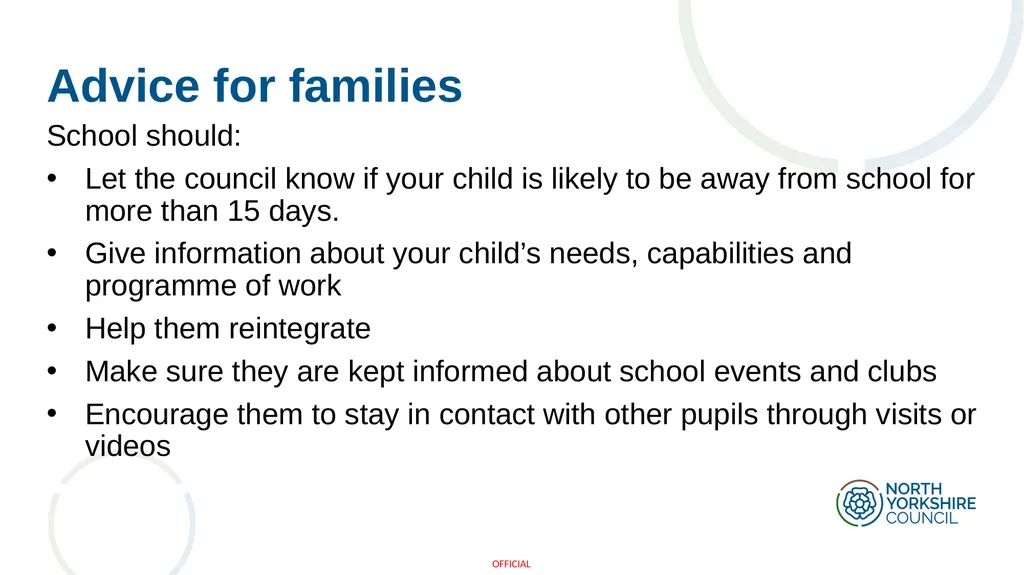
slide19. Advice for families School should:
Let the council know if your child is likely to be away from school for more than 15 days.
Give information about your child’s needs, capabilities and programme of work
Help them reintegrate
Make sure they are kept informed about school events and clubs
Encourage them to stay in contact with other pupils through visits or videos<br>
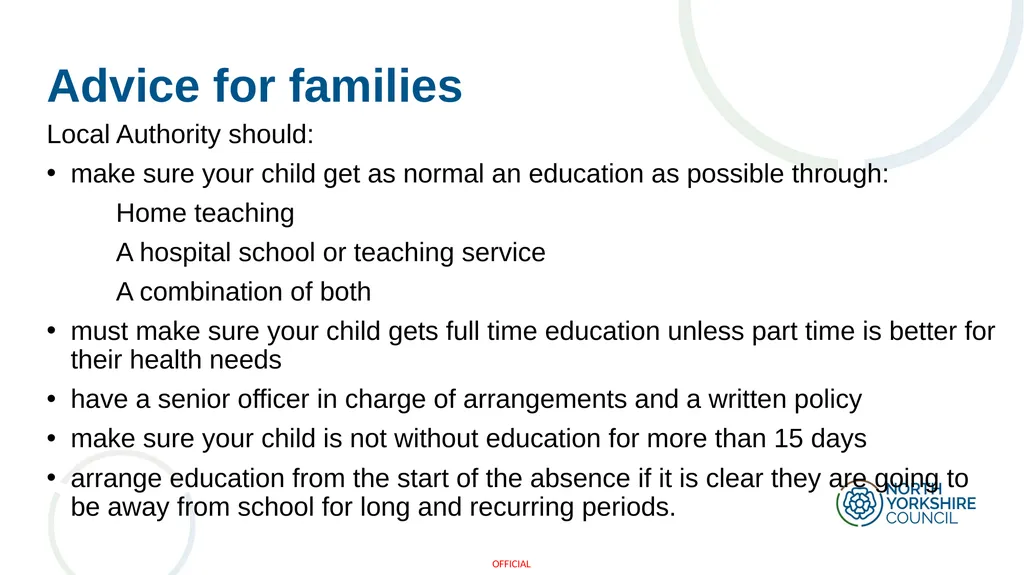
slide20. Advice for families Local Authority should:
make sure your child get as normal an education as possible through:
Home teaching
A hospital school or teaching service
A combination of both
must make sure your child gets full time education unless part time is better for their health needs
have a senior officer in charge of arrangements and a written policy
make sure your child is not without education for more than 15 days
arrange education from the start of the absence if it is clear they are going to be away from school for long and recurring periods.<br>
slide21. Raising concerns Should parents or the child be dissatisfied with the support provided by the home school, they should discuss their concerns directly with the school. If, for whatever reason this does not resolve the issue, they may make a formal complaint via the school’s complaints procedure.
If a parent / carer wishes to query or is unhappy with aspects concerning the arranged alternative provision, the timing, or other related matters, they should contact their local authority in the first instance to discuss the issue.<br>
slide22. The role of the MES as alternative provision for children who cannot attend school because of health needs Our role to arrange (not provide)
Current model involves direct delivery and a mix of face to face tuition, online tuition, use of AV1. Hospital provision is delivered by the hospital schools in most instances
Under continuous review
Alternative provision DFE consultation (registered provision)<br>
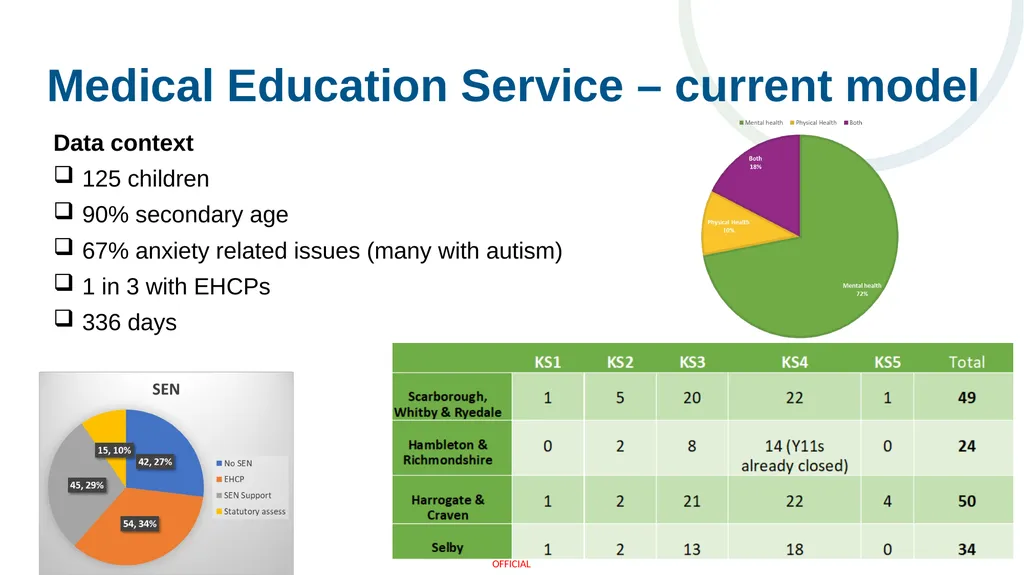
slide23. Medical Education Service – current model Data context
125 children
90% secondary age
67% anxiety related issues (many with autism)
1 in 3 with EHCPs
336 days<br>
slide24. Current challenges for these children Length of time out of school
Inconsistency of offer and of support from home schools
Narrow curriculum impacting later academic achievement
Limited reintegration
Lack of coordinated health support
Isolation from peers and reduced social interaction due to reduced exposure to group learning.
SEN needs not being met<br>
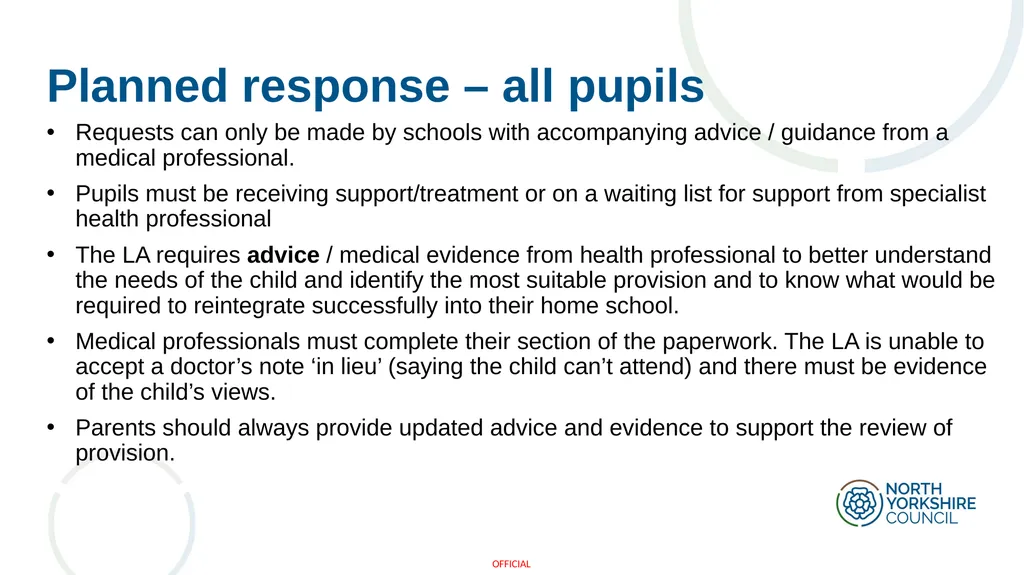
slide25. Planned response – all pupils Requests can only be made by schools with accompanying advice / guidance from a medical professional.
Pupils must be receiving support/treatment or on a waiting list for support from specialist health professional
The LA requires advice / medical evidence from health professional to better understand the needs of the child and identify the most suitable provision and to know what would be required to reintegrate successfully into their home school.
Medical professionals must complete their section of the paperwork. The LA is unable to accept a doctor’s note ‘in lieu’ (saying the child can’t attend) and there must be evidence of the child’s views.
Parents should always provide updated advice and evidence to support the review of provision.<br>
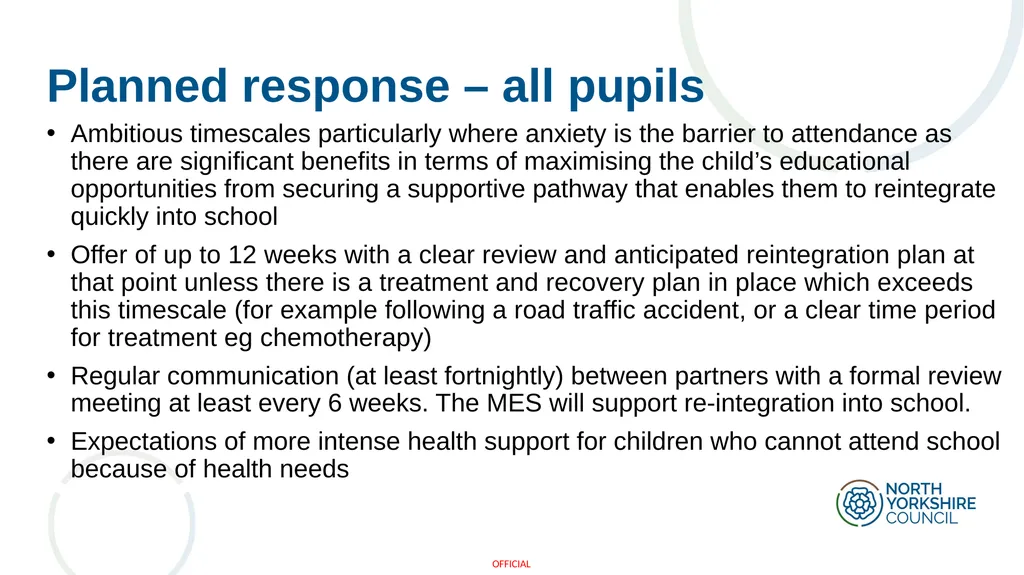
slide26. Planned response – all pupils Ambitious timescales particularly where anxiety is the barrier to attendance as there are significant benefits in terms of maximising the child’s educational opportunities from securing a supportive pathway that enables them to reintegrate quickly into school
Offer of up to 12 weeks with a clear review and anticipated reintegration plan at that point unless there is a treatment and recovery plan in place which exceeds this timescale (for example following a road traffic accident, or a clear time period for treatment eg chemotherapy)
Regular communication (at least fortnightly) between partners with a formal review meeting at least every 6 weeks. The MES will support re-integration into school.
Expectations of more intense health support for children who cannot attend school because of health needs<br>
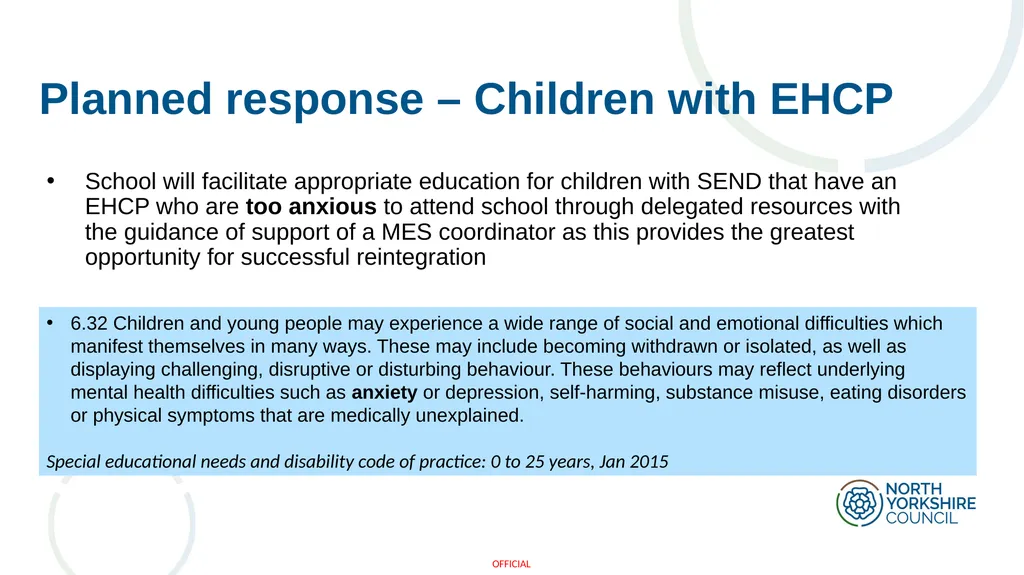
slide27. Planned response – Children with EHCP School will facilitate appropriate education for children with SEND that have an EHCP who are too anxious to attend school through delegated resources with the guidance of support of a MES coordinator as this provides the greatest opportunity for successful reintegration 6.32 Children and young people may experience a wide range of social and emotional difficulties which manifest themselves in many ways. These may include becoming withdrawn or isolated, as well as displaying challenging, disruptive or disturbing behaviour. These behaviours may reflect underlying mental health difficulties such as anxiety or depression, self-harming, substance misuse, eating disorders or physical symptoms that are medically unexplained.
Special educational needs and disability code of practice: 0 to 25 years, Jan 2015<br>
slide28. Planned response – primary Children will remain on the roll of their home school
KS1 & 2 pupils will be offered an AV1 and up to 8 hours of a HLTA
A GTA will support reintegration in line with the reintegration plan<br>
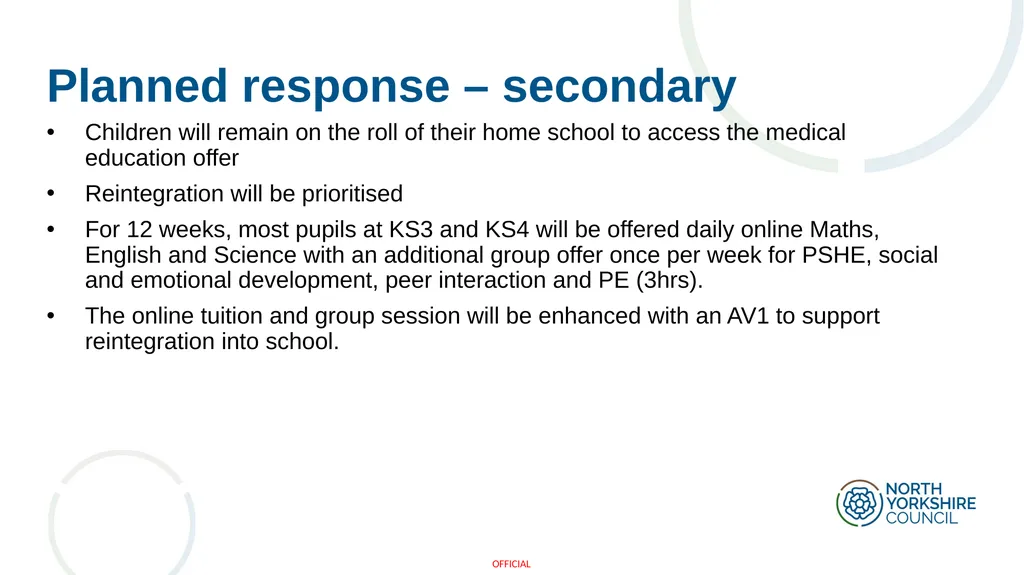
slide29. Planned response – secondary Children will remain on the roll of their home school to access the medical education offer
Reintegration will be prioritised
For 12 weeks, most pupils at KS3 and KS4 will be offered daily online Maths, English and Science with an additional group offer once per week for PSHE, social and emotional development, peer interaction and PE (3hrs).
The online tuition and group session will be enhanced with an AV1 to support reintegration into school.<br>
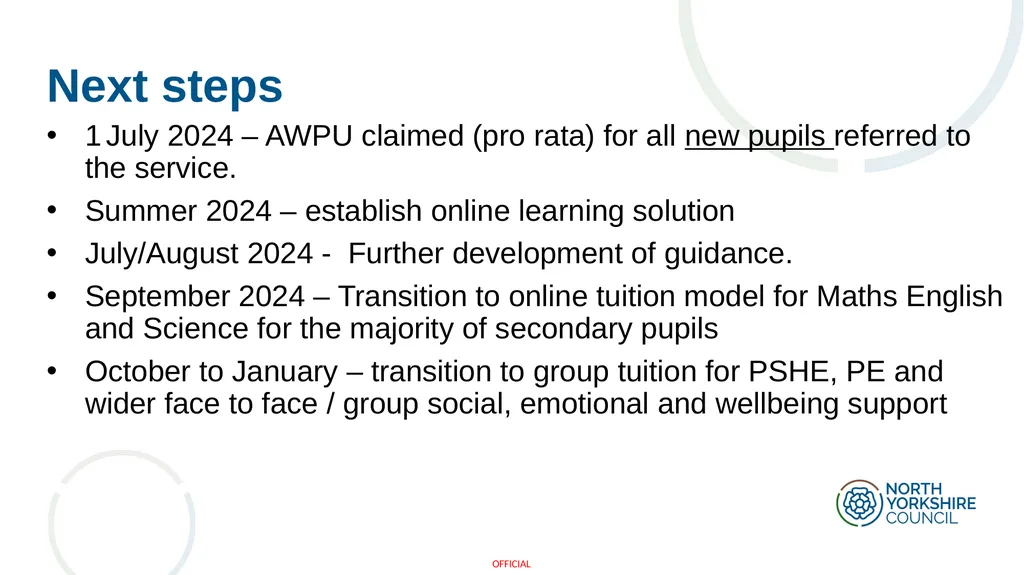
slide30. Next steps 1 July 2024 – AWPU claimed (pro rata) for all new pupils referred to the service.
Summer 2024 – establish online learning solution
July/August 2024 - Further development of guidance.
September 2024 – Transition to online tuition model for Maths English and Science for the majority of secondary pupils
October to January – transition to group tuition for PSHE, PE and wider face to face / group social, emotional and wellbeing support<br>
slide2. Context DfE guidance updated Dec 2023
Role of LA, schools and other partners including parents
Related guidance:
NYC delivery model<br>
slide3. Legislative context (Education Act 1996) Section 19 of the Education Act 1996, local authorities are responsible for arranging suitable and (normally) full-time education for children of compulsory school age who, because of exclusion, illness or other reasons, would not receive suitable education without such provision.
Policy statement (should)
Named officer (should) – published for parents and schools<br>
slide4. Education Regulations 2006 requirement on local authorities to arrange suitable full-time education
school has a duty to provide to the local authority, the full name and address of any pupils of compulsory school age who are not attending school regularly (including due to their health needs)<br>
slide5. Equality Act (2010) Schools and the LA must:
Eliminate discrimination
Advance equality of opportunity
Foster good relations
Make reasonable adjustments
Schools:
Individual health care plans (should)
Accessibility plan (must)<br>
slide6. Section 100, Children & Families Act Schools must
Support pupils with medical conditions so that they have the same opportunities as their peers, including access to a full education, school trips and physical education.
ensure that arrangements are in place to support pupils with medical conditions and that these consider the pupil’s needs
have a policy for supporting pupils with medical conditions
ensure staff are adequately trained to support pupils with medical conditions
have clear policies for managing medicines
ensure that pupils with medical conditions can participate in all aspects of school life including extracurricular activities<br>
slide7. Schools should
work in collaboration with LA, health professionals, families and CYP
minimise any disruption to the education of pupils with medical conditions
have Individual healthcare plans for children with medical needs Section 100, Children & Families Act<br>
slide8. Definitions Where possible, schools should continue to provide education to children with health needs who can attend school.
When a child is already attending school, there is a range of circumstances where their health needs can and should be managed by the school so that they can continue to be educated there without the need for the intervention of the local authority
The ‘Supporting pupils at school with medical conditions’ guidance outlines the expectations for schools
Schools also need to be aware of their responsibilities when mental health issues are impacting on a child’s attendance.
The law does not define full-time education but children with health needs should have provision, where possible, which is equivalent to the education they would receive in a mainstream school
The term ‘home school’ refers to the school that the child is on the roll of when they become ill. Not all children will have a home school as, for example, their health needs may have arisen before they were old enough to enroll at school.<br>
slide9. Funding and new arrangements Alternative provision for children with medical needs is funded from local authorities’ high needs budgets. However, where a child remains on the roll of their home school but requires a period of time in alternative provision due to their health needs, the local authority and home school may wish to consider the transfer of a portion of the school’s funding associated with that child to the alternative provision. This would ensure that the funding follows the child.
The LA has decided that it is appropriate to recover an element of the core funding allocated to schools when children are supported by the medical education service.
The LA will recover the AWPU funding component for the full duration of time that the young person is supported by the Medical Education Service. Element 2 funding and deprivation funding stays with the school to facilitate reintegration.
When a child permanently leaves the roll of their home school and is admitted to another school or alternative provision, a mandatory funding adjustment is made by the local authority<br>
slide10. Working together Parents and carers should always be consulted before new or alternative provision begins.
Children should be involved in decision making to support engagement and reintegration.
Effective collaboration between relevant services is essential to deliver continuous and effective education.
Where possible, the child’s health needs should be managed by the home school so that they can continue to be educated there with support, and without the need for the intervention of the local authority.
However, as soon as it is clear that the home school can no longer support the child’s health needs and provide suitable education, the school should speak to the local authority about putting alternative provision in place.<br>
slide11. Arranging education There is no absolute legal deadline by which local authorities must start to arrange education for children with additional health needs. However, as soon as it is clear that a child will be away from school for 15 days or more because of their health needs, the local authority should arrange suitable alternative provision. The 15 days may be consecutive or over the course of a school year.
When a local authority arranges alternative education, that education should begin as soon as it is possible, and at the latest by the sixth day of the child’s absence from school.
Medical evidence should be used to better understand the needs of the child and identify the most suitable provision. Local authorities, working closely with the child’s home school, medical practitioners and the child’s family, should make every effort to minimise the disruption to a child’s education
Provision should also support the child’s individual needs to overcome barriers to attainment and achievement, giving equal consideration to the pastoral needs of the child to allow them to thrive and prosper in the education system.<br>
slide12. Adapting education All children, regardless of circumstance or setting, should expect to receive the same high standard of education (as outlined in alternative provision statutory guidance).
Alternative provision must be suitable to the child’s age, ability and aptitude, and any special educational needs they have.
Children should be given the opportunity to take appropriate qualifications. This would help prevent them from slipping behind their peers and enable them to better reintegrate successfully back into school, if they so wish.
This should also include personal, social and emotional needs, for example ensuring that the child feel fully part of their home school community, are able to stay in contact with classmates, and have access to the opportunities enjoyed by their peers.
The local authority should, alongside the child’s home school, regularly review the provision offered to ensure that it continues to be appropriate for the child and that it is providing suitable education.<br>
slide13. Reintegration Children should be able to access the curriculum and materials that they would have used in their home school. This could also include attending educational visits, even if this requires providing additional support.
Local authorities should work with schools to set up an individually tailored reintegration plan for each child: this could take the form of an IHP. This should include extra support to help fill any gaps arising from the child’s absence.
Under equalities legislation schools must consider whether they need to make any reasonable adjustments to provide suitable access for a child whose condition amounts to a disability.
Some complex or long-term health issues may be considered disabilities under equality legislation.<br>
slide14. Reintegration The home school should consider how they can enable children to successfully remain in touch with them whilst they are away.
This could be through:
digital learning platforms
telepresence solutions
school newsletters
social media platforms
emails
invitations to school<br>
slide15. Exams Where possible, and in line with the home school’s exam timetabling, children and young people with physical or mental health needs should be able to take examinations at the same time as their peers.
Relevant organisations and schools should work and liaise together effectively to facilitate access to external exams when children with health needs are approaching exams.
The hospital school, alternative provision setting or home tuition teachers should focus the child’s education on preparation for exams in order to minimise the impact of any time lost from school absence.
Special access arrangements need to be applied for as early as possible<br>
slide16. Reviewing the provision Children that have continuing health needs should have an IHP which should be reviewed and assessed on a regular basis.
If the child’s needs amount to ongoing special educational needs, an EHCP may be more appropriate to meet the long-term needs of the child or young person. An EHCP will not always be appropriate as not all health needs will comprise SEND. *
There may be some instances where a child or young person has both an EHCP and IHP, in which case both plans should be reviewed alongside each other
The local authority and the child’s home school should consider the use of digital resources to aid learning. Home schools may be able to play an enabling role in this respect. Digital technology should be used to complement face-to-face education, rather than be used as sole provision and in some cases, the child’s health needs may make it advisable to only use digital learning for a limited period of time.<br>
slide17. Hospital, long term and complex issues When education takes place at school established in a hospital or takes place in a pupil referral unit or academy which provides education for hospital patients or is provided by teachers directly employed by the local authority or via a service level agreement with the local authority.
A personal education plan should be set up to ensure that the child’s school, the local authority and the hospital school or other provider can work together.
The hospital school or education provider should inform, at the earliest possible opportunity, the local authority and the home school (if any) when the child is due to return home<br>
slide18. Removing from roll Continuity is important for children and knowing that they can return to their familiar surroundings and school friends can help their recovery and their educational progress
A school can only remove the name of a pupil who is unable to attend school because of additional health needs from its register in certain circumstances. These include where:
the pupil has been certified by the school medical officer as unlikely to be in a fit state of health to attend school, before ceasing to be of compulsory school age;
neither the pupil nor their parent has indicated to the school the intention to continue to attend the school, after ceasing to be of compulsory school age
This applies even if the local authority has become responsible for the child’s education.<br>
slide19. Advice for families School should:
Let the council know if your child is likely to be away from school for more than 15 days.
Give information about your child’s needs, capabilities and programme of work
Help them reintegrate
Make sure they are kept informed about school events and clubs
Encourage them to stay in contact with other pupils through visits or videos<br>
slide20. Advice for families Local Authority should:
make sure your child get as normal an education as possible through:
Home teaching
A hospital school or teaching service
A combination of both
must make sure your child gets full time education unless part time is better for their health needs
have a senior officer in charge of arrangements and a written policy
make sure your child is not without education for more than 15 days
arrange education from the start of the absence if it is clear they are going to be away from school for long and recurring periods.<br>
slide21. Raising concerns Should parents or the child be dissatisfied with the support provided by the home school, they should discuss their concerns directly with the school. If, for whatever reason this does not resolve the issue, they may make a formal complaint via the school’s complaints procedure.
If a parent / carer wishes to query or is unhappy with aspects concerning the arranged alternative provision, the timing, or other related matters, they should contact their local authority in the first instance to discuss the issue.<br>
slide22. The role of the MES as alternative provision for children who cannot attend school because of health needs Our role to arrange (not provide)
Current model involves direct delivery and a mix of face to face tuition, online tuition, use of AV1. Hospital provision is delivered by the hospital schools in most instances
Under continuous review
Alternative provision DFE consultation (registered provision)<br>
slide23. Medical Education Service – current model Data context
125 children
90% secondary age
67% anxiety related issues (many with autism)
1 in 3 with EHCPs
336 days<br>
slide24. Current challenges for these children Length of time out of school
Inconsistency of offer and of support from home schools
Narrow curriculum impacting later academic achievement
Limited reintegration
Lack of coordinated health support
Isolation from peers and reduced social interaction due to reduced exposure to group learning.
SEN needs not being met<br>
slide25. Planned response – all pupils Requests can only be made by schools with accompanying advice / guidance from a medical professional.
Pupils must be receiving support/treatment or on a waiting list for support from specialist health professional
The LA requires advice / medical evidence from health professional to better understand the needs of the child and identify the most suitable provision and to know what would be required to reintegrate successfully into their home school.
Medical professionals must complete their section of the paperwork. The LA is unable to accept a doctor’s note ‘in lieu’ (saying the child can’t attend) and there must be evidence of the child’s views.
Parents should always provide updated advice and evidence to support the review of provision.<br>
slide26. Planned response – all pupils Ambitious timescales particularly where anxiety is the barrier to attendance as there are significant benefits in terms of maximising the child’s educational opportunities from securing a supportive pathway that enables them to reintegrate quickly into school
Offer of up to 12 weeks with a clear review and anticipated reintegration plan at that point unless there is a treatment and recovery plan in place which exceeds this timescale (for example following a road traffic accident, or a clear time period for treatment eg chemotherapy)
Regular communication (at least fortnightly) between partners with a formal review meeting at least every 6 weeks. The MES will support re-integration into school.
Expectations of more intense health support for children who cannot attend school because of health needs<br>
slide27. Planned response – Children with EHCP School will facilitate appropriate education for children with SEND that have an EHCP who are too anxious to attend school through delegated resources with the guidance of support of a MES coordinator as this provides the greatest opportunity for successful reintegration 6.32 Children and young people may experience a wide range of social and emotional difficulties which manifest themselves in many ways. These may include becoming withdrawn or isolated, as well as displaying challenging, disruptive or disturbing behaviour. These behaviours may reflect underlying mental health difficulties such as anxiety or depression, self-harming, substance misuse, eating disorders or physical symptoms that are medically unexplained.
Special educational needs and disability code of practice: 0 to 25 years, Jan 2015<br>
slide28. Planned response – primary Children will remain on the roll of their home school
KS1 & 2 pupils will be offered an AV1 and up to 8 hours of a HLTA
A GTA will support reintegration in line with the reintegration plan<br>
slide29. Planned response – secondary Children will remain on the roll of their home school to access the medical education offer
Reintegration will be prioritised
For 12 weeks, most pupils at KS3 and KS4 will be offered daily online Maths, English and Science with an additional group offer once per week for PSHE, social and emotional development, peer interaction and PE (3hrs).
The online tuition and group session will be enhanced with an AV1 to support reintegration into school.<br>
slide30. Next steps 1 July 2024 – AWPU claimed (pro rata) for all new pupils referred to the service.
Summer 2024 – establish online learning solution
July/August 2024 - Further development of guidance.
September 2024 – Transition to online tuition model for Maths English and Science for the majority of secondary pupils
October to January – transition to group tuition for PSHE, PE and wider face to face / group social, emotional and wellbeing support<br>