Arts, Commerce and Science College, Alkuti Department of Botany F.Y.B.Sc. Botany ( CBCS) Paper I Semester -I Bo-111: Plant Life and Utilization I Presented By Miss. Vairagar Pooja Balu CreditI Chapter-I Introduction Biology: The science
"Arts, Commerce and Science College, Alkuti" is the property of its rightful owner. Permission is granted to
download and print the materials on this website for personal, non-commercial use only, and to display it
on your personal computer provided you do not modify the materials and that you retain all copyright
notices contained in the materials. By downloading content from our website, you accept the terms of this
agreement.
Presentation Transcript
01
Arts, Commerce and Science College, Alkuti Department of Botany F.Y.B.Sc. Botany ( CBCS) Paper –I Semester -I Bo-111: Plant Life and Utilization I Presented By
Miss. Vairagar Pooja Balu<br>
02
Credit–I Chapter-I Introduction Biology:
The science which deals with study of living organisms is known as Biology. (Bios: life; logos: to study)
Botany:
Botany is a branch of biology which deals with the study of plants. It means the study of plants, their shape and structure, mode of living, reproduction and relationship with one another.
Father of Botany:
"Theophrastus" is Father of Botany. He listed 500 plants in 370-287 B.C.
Plant kingdom:
The plants have well variation in their structure and function. Some plants are small, very microscopic while some are very large trees. Some plants are aquatic while some are terrestrial. They may be autotrophs (can prepare own food material) or heterotrophs (cannot prepare their own food material).<br>
03
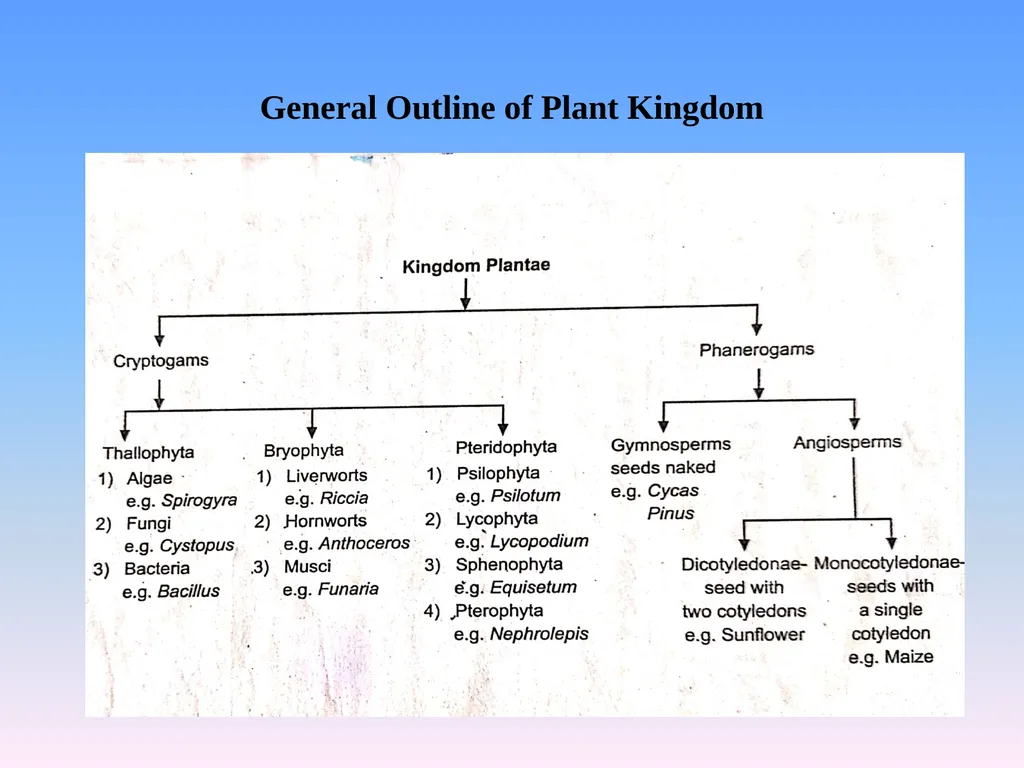
General Outline of Plant Kingdom<br>
04
Cryptogams: The flowerless or non-flowering plants are called as "Cryptogams". General characteristics:
These plants do not bear flowers and seeds.
Vascular tissues are absent.
Sex organs are simple.
Reproductive structures of these plants are embedded in the plant body.
They can reproduce by vegetative, sexual and asexual method.
Reproductive organs are simple, unicellular or multicellular.
Vegetative reproduction takes place by fragmentation or cell division.
Asexual reproduction takes place by spores.
Gametophytic phase represents sexual reproduction while Sporophytic phase is characterize reproduction.<br>
05
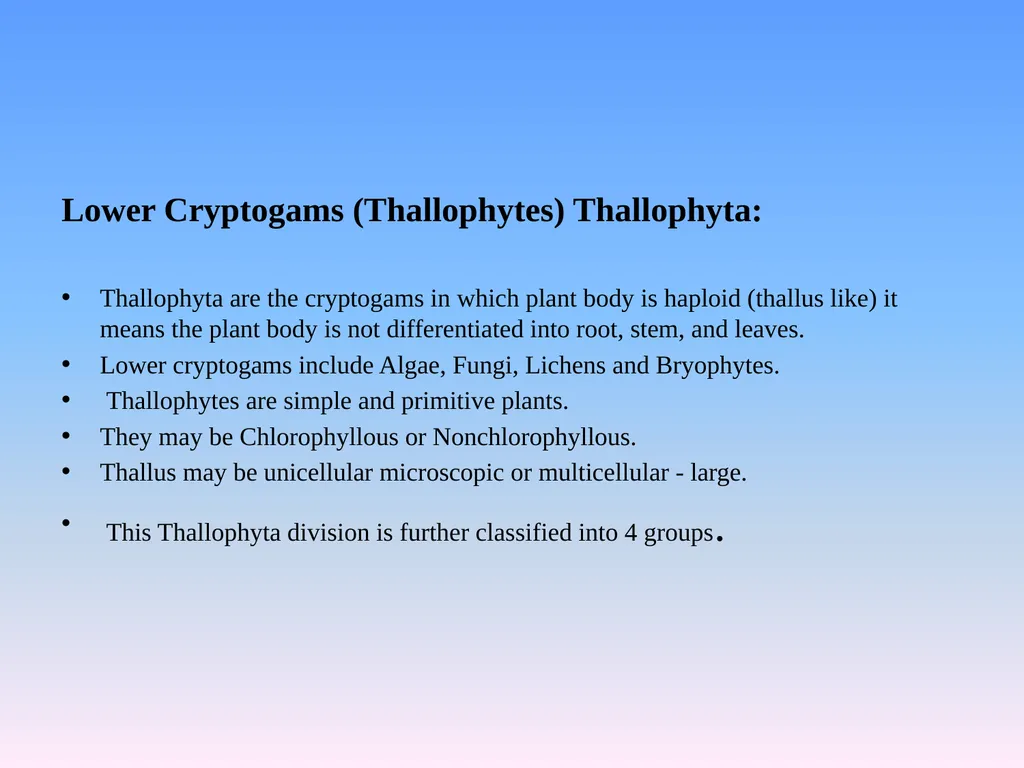
Lower Cryptogams (Thallophytes) Thallophyta:
Thallophyta are the cryptogams in which plant body is haploid (thallus like) it means the plant body is not differentiated into root, stem, and leaves.
Lower cryptogams include Algae, Fungi, Lichens and Bryophytes.
Thallophytes are simple and primitive plants.
They may be Chlorophyllous or Nonchlorophyllous.
Thallus may be unicellular microscopic or multicellular - large.
This Thallophyta division is further classified into 4 groups.<br>
06
Algae: "Algae are chlorophyll containing autotrophic, simple thallophytes".
The plant body is unicellular or multicellular thallus.
Algae are chlorophyll containing organism/plant.
The mode of nutrition is autotrophic.
Majority of algae are aquatic, while few members are terrestrial.
Cell wall is cellulosic.
Reserve food material is starch.
E.g. Spirogyra, Sargassum, Laminaria, etc.
Fungi:
“fungi non chlorophyllus, heterotrophic, simple thallophytes.”
plant body is very simple cellular microscopic or macroscopic the fungal.
plant body consist of microscopic branch and branch threads known as hyphae. together for mass known as mycelium
fungi do not contain chlorophyll and other photosynthetic pigment
mode of nutrition is heterotrophic.
Cells are Eukaryotic with cell all which is composed of fungal cellulose and Chitin
Reserve food material is in the form of glycogen and oil drops.
E.g. Mukar, Rhizopus, Aspergillus. Penicillium etc.<br>
07
Lichen : “Lichen is a composite group of organism in which algal and fungal member living together symbiotically”
can go grown on stone rock branch of tree bark of the tree surface of soil
generally the lichen are found in cold region to express the Barren rocks.
I like and go grow very slowly
On the basis of morphology like an R classified into three types
I) Crustose Lichen
II) Foliose Lichen
III) Fruiticose Lichen
lichen reproduced by vegetative, Asexual & Sexual method
e.g. Graphis Parmelia and Usnia
Bacteria:
Bacteria are primitive smallest prokaryotic organism<br>
08
Higher Cryptogams ( Bryophytes and Pteridophytes) Bryophytes:
“Bryophytes are highly Cryptogams Which posses green and comparatively large thallus.”
Bryophytes are found in water as well as in moist soil or land.
plant body is gametophyte and thalloid .i.e. without stem and leaves but thallus is differentiated into root like rhizoids.
Vascular tissue (xylem and phloem)are absent.
mode of nutrition is autotrophic.
Bryophytes can reproduced by vegetative and a sexual method.
male sex organ is known as antheridium while female sex organ is known as archigonium.
E.g. Riccia, Marchantia, Anthoceros, etc.<br>
09
Pteridophytes: “Pteridophytes are vascular tissue that is xylem and phloem containing cryptogames”
They are highly cryptogames most of the terrestrial (growing moist soil and shade condition) but some are aquatic.
the plant body is sporophetic, well differentiated into root, stem and leaves.
The plant body may be a small to large tree like in habits.
Pteridophytes reproduced by sexual, vegetative and a sexual method.
Pteridophytes plant may be homosporous or heterosperous.
spores are microspore and megaspore<br>
10
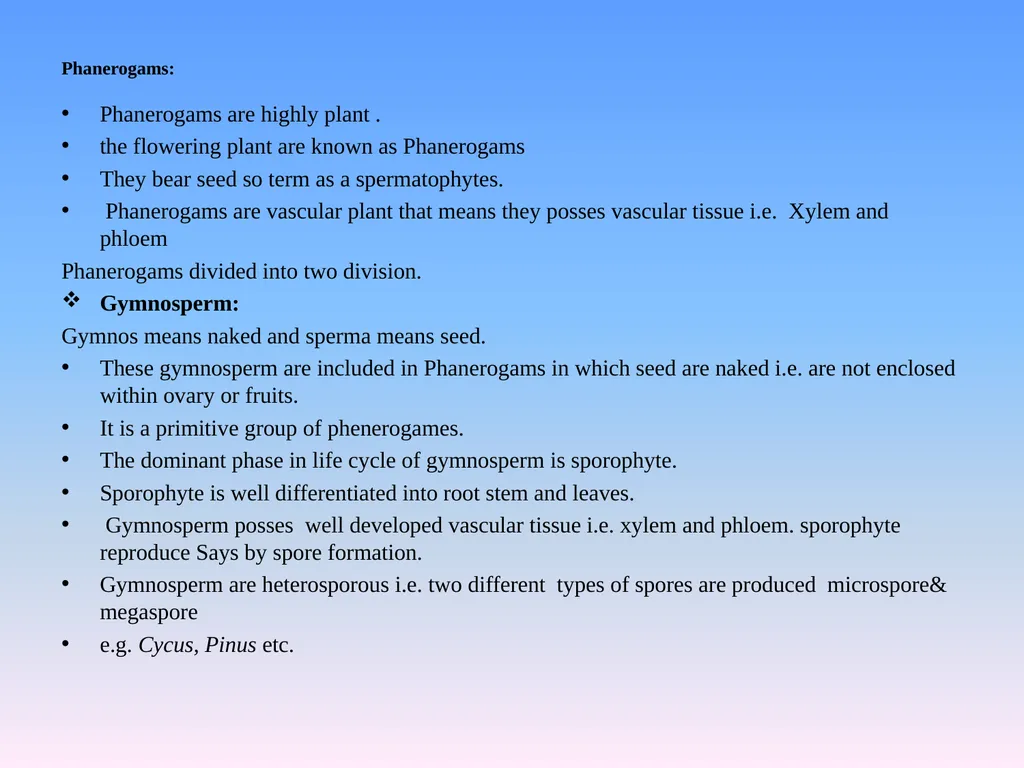
Phanerogams: Phanerogams are highly plant .
the flowering plant are known as Phanerogams
They bear seed so term as a spermatophytes.
Phanerogams are vascular plant that means they posses vascular tissue i.e. Xylem and phloem
Phanerogams divided into two division.
Gymnosperm:
Gymnos means naked and sperma means seed.
These gymnosperm are included in Phanerogams in which seed are naked i.e. are not enclosed within ovary or fruits.
It is a primitive group of phenerogames.
The dominant phase in life cycle of gymnosperm is sporophyte.
Sporophyte is well differentiated into root stem and leaves.
Gymnosperm posses well developed vascular tissue i.e. xylem and phloem. sporophyte reproduce Says by spore formation.
Gymnosperm are heterosporous i.e. two different types of spores are produced microspore& megaspore
e.g. Cycus, Pinus etc.<br>
11
Angiosperm: Angieon means enclosed and Sperma means seed.
These are Phanerogams in which seed enclosed in ovary.
Angiosperm are mostly autotrophic but some members are parasitic, Saprophytic.
They occur in all possible habitat.
Angiosperm may be small herb, shrub, tree or climber.
The plant body is sporophytic.
Sporophyte is Well differentiated into root, stem & leaves.
Sporophytic phase is dominant in the life cycle.
These plants bear flower with distinct floral whorl i.e. calyx corolla, Androecium & Gynoecium.
Angiosperm are further Classified into two classes monocotyledons & Dicotyledons.<br>
12
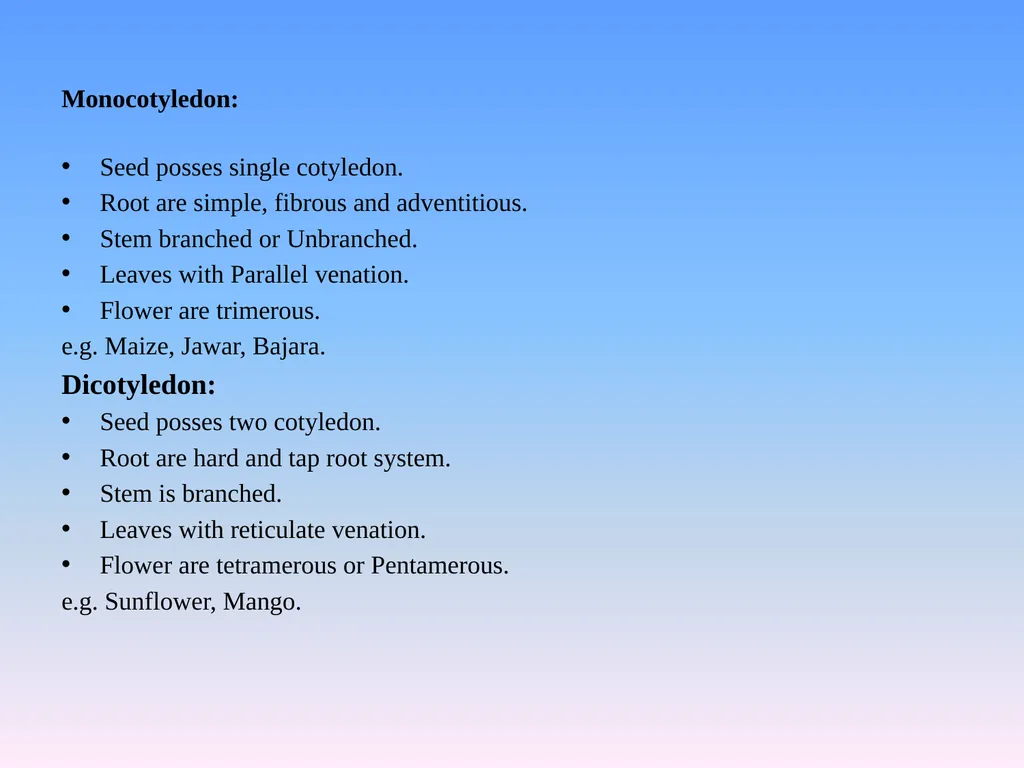
Monocotyledon: Seed posses single cotyledon.
Root are simple, fibrous and adventitious.
Stem branched or Unbranched.
Leaves with Parallel venation.
Flower are trimerous.
e.g. Maize, Jawar, Bajara.
Dicotyledon:
Seed posses two cotyledon.
Root are hard and tap root system.
Stem is branched.
Leaves with reticulate venation.
Flower are tetramerous or Pentamerous.
e.g. Sunflower, Mango.<br>