
ASC Training Mercer County Community College
LS
Published · 71 slides · 0 views

1 / 1





Description
ASC Training Mercer County Community College November 29, 2018 December 4, 2018 The New Jersey Patient Safety Act And Reporting Process Patient Safety Reporting System Patient Safety Reporting System The Presentation will Review Patient
Related Topics
Share
Embed code
Download this presentation From Below
"ASC Training Mercer County Community College" is the property of its rightful owner. Permission is granted to download and print the materials on this website for personal, non-commercial use only, and to display it on your personal computer provided you do not modify the materials and that you retain all copyright notices contained in the materials. By downloading content from our website, you accept the terms of this agreement.
Presentation Transcript
01
ASC Training
Mercer County Community College
November 29, 2018
December 4, 2018 The New Jersey Patient Safety Act
And Reporting Process
Patient Safety Reporting System<br>
Mercer County Community College
November 29, 2018
December 4, 2018 The New Jersey Patient Safety Act
And Reporting Process
Patient Safety Reporting System<br>
02
Patient Safety Reporting System The Presentation will Review
Patient Safety Act and Reporting Requirements
Adverse Event Reporting Process
Root Cause Analysis Reporting Process
New Facility User Registration Process<br>
Patient Safety Act and Reporting Requirements
Adverse Event Reporting Process
Root Cause Analysis Reporting Process
New Facility User Registration Process<br>
03
1. The Patient Safety Act and Reporting Requirements The Patient Safety Act (C.26:2H-12.23*) Enacted in April 2004
Enhance Patient Safety
Minimize Number of Adverse Events
Minimize Patient Harm
Improve System/Facility Performance
* Link available on the NJ Patient Safety website<br>
Enhance Patient Safety
Minimize Number of Adverse Events
Minimize Patient Harm
Improve System/Facility Performance
* Link available on the NJ Patient Safety website<br>
04
1. The Patient Safety Act and Reporting Requirements Patient Safety Act continued
Confidentiality Protection
Encourages honest, critical self-analysis
Restricts
Discoverability
Admissibility
Disclosure of documents, materials and information
Be clear about separation between Patient Safety and Quality Improvement activities<br>
Confidentiality Protection
Encourages honest, critical self-analysis
Restricts
Discoverability
Admissibility
Disclosure of documents, materials and information
Be clear about separation between Patient Safety and Quality Improvement activities<br>
05
1. The Patient Safety Act and Reporting Requirements Patient Safety Act continued
Promotes a culture of safety
Encourages change and improvement
Blame-free environment
Collaboration between all levels and disciplines of staff
Strive for “Zero” adverse events, not just better than the national average
Commit resources to improvement<br>
Promotes a culture of safety
Encourages change and improvement
Blame-free environment
Collaboration between all levels and disciplines of staff
Strive for “Zero” adverse events, not just better than the national average
Commit resources to improvement<br>
06
Patient Safety Act continued
Non-Punitive
No public reports are issued by PSRS that list individual facilities
Encourages evidence-based practices
Collegial 1. The Patient Safety Act and Reporting Requirements<br>
Non-Punitive
No public reports are issued by PSRS that list individual facilities
Encourages evidence-based practices
Collegial 1. The Patient Safety Act and Reporting Requirements<br>
07
1. The Patient Safety Act and
Reporting Requirements Patient Safety Act continued
NJ Licensed healthcare facilities (including one room ASCs) must report every serious preventable adverse event
A negative consequence of care that results in unintended injury or illness
Discrete, auditable and clearly defined occurrence
Preventable: an event that could have been anticipated and prepared against, but occurs because of an error or other system failure.
Frequently unable to make this determination at time of event
Results in death or loss of a body part, or disability or loss of bodily function
Some event types have no threshold of injury such as RFOs, Wrong Surgery
Lasts more than 7 days or present at discharge<br>
NJ Licensed healthcare facilities (including one room ASCs) must report every serious preventable adverse event
A negative consequence of care that results in unintended injury or illness
Discrete, auditable and clearly defined occurrence
Preventable: an event that could have been anticipated and prepared against, but occurs because of an error or other system failure.
Frequently unable to make this determination at time of event
Results in death or loss of a body part, or disability or loss of bodily function
Some event types have no threshold of injury such as RFOs, Wrong Surgery
Lasts more than 7 days or present at discharge<br>
08
Patient Safety Regulations (N.J.A.C. 8:43E-10*) requires facilities to**:
Establish a Patient Safety Committee
Conduct ongoing analysis and application of evidence-based patient safety practices
Conduct analyses of near-misses, with particular attention to serious preventable adverse events
Develop a Patient Safety Plan
Review and revise plan as necessary, at least every 3-years
Foster attitudes, beliefs and behaviors supporting open communication in the facility
Review results of each RCA and, as appropriate, recommend modifications of systems, technology, policies or procedures
* Link available on the NJ Patient Safety website
** List is not inclusive 1. The Patient Safety Act and Reporting Requirements<br>
Establish a Patient Safety Committee
Conduct ongoing analysis and application of evidence-based patient safety practices
Conduct analyses of near-misses, with particular attention to serious preventable adverse events
Develop a Patient Safety Plan
Review and revise plan as necessary, at least every 3-years
Foster attitudes, beliefs and behaviors supporting open communication in the facility
Review results of each RCA and, as appropriate, recommend modifications of systems, technology, policies or procedures
* Link available on the NJ Patient Safety website
** List is not inclusive 1. The Patient Safety Act and Reporting Requirements<br>
09
1. The Patient Safety Act and Reporting Requirements Patient Safety Regulations continued
Report Serious Preventable Adverse Events that occur in the facility to DOH or DHS
If a facility discovers an event subject to mandatory reporting that occurred in a different facility, the discovering facility shall notify DOH but does not need to perform an RCA
The identity of the facility at which the event occurred should be reported to DOH if known
Conduct Root Cause Analyses (RCAs) of Serious Preventable Adverse Events
Submit Root Cause Analyses of Serious Preventable Adverse Events to DOH or DHS<br>
Report Serious Preventable Adverse Events that occur in the facility to DOH or DHS
If a facility discovers an event subject to mandatory reporting that occurred in a different facility, the discovering facility shall notify DOH but does not need to perform an RCA
The identity of the facility at which the event occurred should be reported to DOH if known
Conduct Root Cause Analyses (RCAs) of Serious Preventable Adverse Events
Submit Root Cause Analyses of Serious Preventable Adverse Events to DOH or DHS<br>
10
1. The Patient Safety Act and Reporting Requirements. Patient Safety Regulations continued
Disclose the Serious Preventable Adverse Event to the Patient or Health Care Representative within 24 hours of discovery
Record the time, date, and individuals present when disclosure was made and to whom it was disclosed in the medical record
Record a statement that the occurrence of a serious preventable adverse event was disclosed in the medical record
Inform employees/health care professionals about their option to file anonymous reports of preventable adverse events<br>
Disclose the Serious Preventable Adverse Event to the Patient or Health Care Representative within 24 hours of discovery
Record the time, date, and individuals present when disclosure was made and to whom it was disclosed in the medical record
Record a statement that the occurrence of a serious preventable adverse event was disclosed in the medical record
Inform employees/health care professionals about their option to file anonymous reports of preventable adverse events<br>
11
1. The Patient Safety Act and Reporting Requirements Patient Safety Regulations continued
Event Report must be submitted into the online Patient Safety Reporting System no later than 5 business days after discovery
The date and time of discovery is the date and time anyone associated with the ASC (including the physician) becomes aware of a serious preventable adverse event
The physician or surgeon is a member of the healthcare team.<br>
Event Report must be submitted into the online Patient Safety Reporting System no later than 5 business days after discovery
The date and time of discovery is the date and time anyone associated with the ASC (including the physician) becomes aware of a serious preventable adverse event
The physician or surgeon is a member of the healthcare team.<br>
12
1. The Patient Safety Act and Reporting Requirements Patient Safety Regulations continued
PSRS reviews event report in online system
PSRS determines whether a Root Cause Analysis (RCA) is required based on the rules and regulations and notifies the facility
If the event is reportable, the RCA must be submitted to PSRS within 45 calendar days from initial event report<br>
PSRS reviews event report in online system
PSRS determines whether a Root Cause Analysis (RCA) is required based on the rules and regulations and notifies the facility
If the event is reportable, the RCA must be submitted to PSRS within 45 calendar days from initial event report<br>
13
2. Adverse Event Reporting Process Reporting Categories*
Care Management
Environmental
Product or Device
Surgery-Related
Patient Protection * List of reportable events are located in the Patient Safety Regulations<br>
Care Management
Environmental
Product or Device
Surgery-Related
Patient Protection * List of reportable events are located in the Patient Safety Regulations<br>
14
2. Adverse Event Reporting Process Surgery-Related Events
Wrong Surgery (wrong site, procedure, patient)
Surgery initiated (whether or not completed) on a patient that is not consistent with the patient’s documented informed consent
Wrong site
Wrong procedure
Wrong patient
Retention of a Foreign Object
Excludes objects intentionally implanted as a part of a planned procedure, objects present prior to the procedure intentionally retained and retained broken microneedles<br>
Wrong Surgery (wrong site, procedure, patient)
Surgery initiated (whether or not completed) on a patient that is not consistent with the patient’s documented informed consent
Wrong site
Wrong procedure
Wrong patient
Retention of a Foreign Object
Excludes objects intentionally implanted as a part of a planned procedure, objects present prior to the procedure intentionally retained and retained broken microneedles<br>
15
2. Adverse Event Reporting Process Surgery-Related Events continued
Surgical—Intra/Post-op Coma/Death/Other
Includes cases where anesthesia was administered regardless of whether the planned procedure was carried out
Includes cases where adverse events occur within 24 hours of the procedure in any patient of an ambulatory surgery facility
Surgical—Other
Generally used for any other surgical event that does not fit into the previous surgical event categories<br>
Surgical—Intra/Post-op Coma/Death/Other
Includes cases where anesthesia was administered regardless of whether the planned procedure was carried out
Includes cases where adverse events occur within 24 hours of the procedure in any patient of an ambulatory surgery facility
Surgical—Other
Generally used for any other surgical event that does not fit into the previous surgical event categories<br>
16
2. Adverse Event Reporting Process Other Indicators of Reportable Events
Unplanned hospital admission
Visit to ED or other healthcare facility (e.g., Urgent Care Center) following discharge from ASC
Intra/Post operative complications not limited to
Aspiration
Pneumothorax
Organ Perforation
Moderate to severe bleeding
Serious infections<br>
Unplanned hospital admission
Visit to ED or other healthcare facility (e.g., Urgent Care Center) following discharge from ASC
Intra/Post operative complications not limited to
Aspiration
Pneumothorax
Organ Perforation
Moderate to severe bleeding
Serious infections<br>
17
2. Adverse Event Reporting Process Threshold of Injury
Some event types have no threshold of injury such as
Retained Foreign Object
Wrong Site, Wrong procedure, Wrong patient
Most event types have a “threshold of injury” requirement in the regulations
Coma, death, loss of body part, disability or loss of bodily function lasting more than seven days or still present at discharge<br>
Some event types have no threshold of injury such as
Retained Foreign Object
Wrong Site, Wrong procedure, Wrong patient
Most event types have a “threshold of injury” requirement in the regulations
Coma, death, loss of body part, disability or loss of bodily function lasting more than seven days or still present at discharge<br>
18
2. Adverse Event Reporting Process Threshold of Injury continued
Important for PSRS to determine if the event meets the “threshold of injury” when deciding whether the event will require an RCA
PSRS needs to determine how this event affected the patient
Include this information in the Event Report<br>
Important for PSRS to determine if the event meets the “threshold of injury” when deciding whether the event will require an RCA
PSRS needs to determine how this event affected the patient
Include this information in the Event Report<br>
19
2. Adverse Event Reporting Process Description of the Adverse Event
The Initial Event submission should contain details about the impact on the patient:
The type of injury/harm to the patient
The severity of the injury/harm
Duration of injury/harm
Pertinent lab and imaging results
Impact on the patient’s Activities of Daily Living and function
Chronological timeline
Often need information from hospital about what happened once the patient was transferred or presented for treatment after surgery<br>
The Initial Event submission should contain details about the impact on the patient:
The type of injury/harm to the patient
The severity of the injury/harm
Duration of injury/harm
Pertinent lab and imaging results
Impact on the patient’s Activities of Daily Living and function
Chronological timeline
Often need information from hospital about what happened once the patient was transferred or presented for treatment after surgery<br>
20
2. Adverse Event Reporting Process Description of the Adverse Event continued
If a patient is either transferred, or subsequently presents to a different facility for care following the event, additional information from that facility providing follow-up care may be required.
Examples may include transfer from an ambulatory surgery center to a hospital, from one hospital to another or an emergency department visit.
In these situations, the facility at which the event occurred may need to reach out to the facility that provided follow-up treatment through appropriate channels consistent with the facility’s policies to obtain the required information.<br>
If a patient is either transferred, or subsequently presents to a different facility for care following the event, additional information from that facility providing follow-up care may be required.
Examples may include transfer from an ambulatory surgery center to a hospital, from one hospital to another or an emergency department visit.
In these situations, the facility at which the event occurred may need to reach out to the facility that provided follow-up treatment through appropriate channels consistent with the facility’s policies to obtain the required information.<br>
21
2. Adverse Event Reporting Process Description of the Adverse Event continued
The following information from the facility providing follow-up care may be required:
Date/time of the transfer/admission and discharge
Diagnosis upon presentation and the discharge diagnosis
Results of pertinent diagnostic testing
Treatments received including any new medications prescribed at discharge<br>
The following information from the facility providing follow-up care may be required:
Date/time of the transfer/admission and discharge
Diagnosis upon presentation and the discharge diagnosis
Results of pertinent diagnostic testing
Treatments received including any new medications prescribed at discharge<br>
22
2. Adverse Event Reporting Process Immediate Clinical Actions
Provide the clinical actions taken for the patient following the event
Describe the immediate treatment provided to the patient in response to the event
Timeline
Clinical outcome<br>
Provide the clinical actions taken for the patient following the event
Describe the immediate treatment provided to the patient in response to the event
Timeline
Clinical outcome<br>
23
2. Adverse Event Reporting Process Immediate Corrective Actions
Provide the immediate corrective actions taken in response to the event.
Should include the specific procedures implemented to reduce the likelihood of recurrence of this event
List any additional reports provided to other organizations (e.g., equipment manufacturers, pharmaceutical manufacturers) concerning this event<br>
Provide the immediate corrective actions taken in response to the event.
Should include the specific procedures implemented to reduce the likelihood of recurrence of this event
List any additional reports provided to other organizations (e.g., equipment manufacturers, pharmaceutical manufacturers) concerning this event<br>
24
2. Adverse Event Reporting Process The Online System for Reporting Adverse Events
The two-hour window
The 2 hour window
The 2° window
The 2h window
Did I mention the two hour window?<br>
The two-hour window
The 2 hour window
The 2° window
The 2h window
Did I mention the two hour window?<br>
25
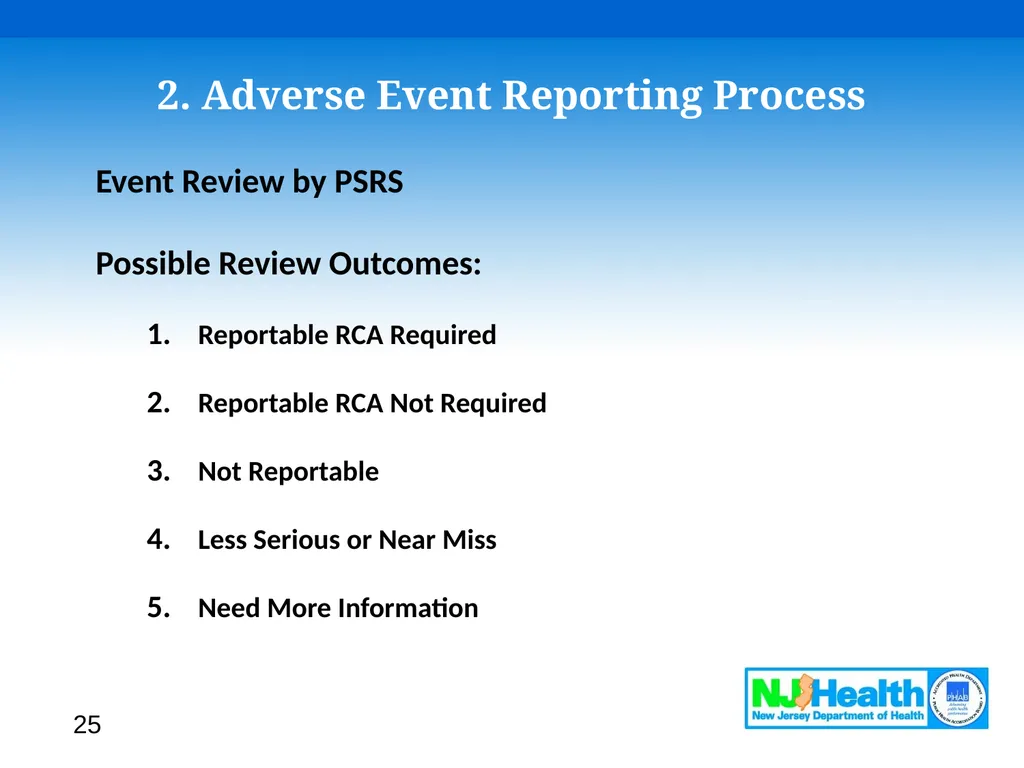
2. Adverse Event Reporting Process Event Review by PSRS
Possible Review Outcomes:
Reportable RCA Required
Reportable RCA Not Required
Not Reportable
Less Serious or Near Miss
Need More Information<br>
Possible Review Outcomes:
Reportable RCA Required
Reportable RCA Not Required
Not Reportable
Less Serious or Near Miss
Need More Information<br>
26
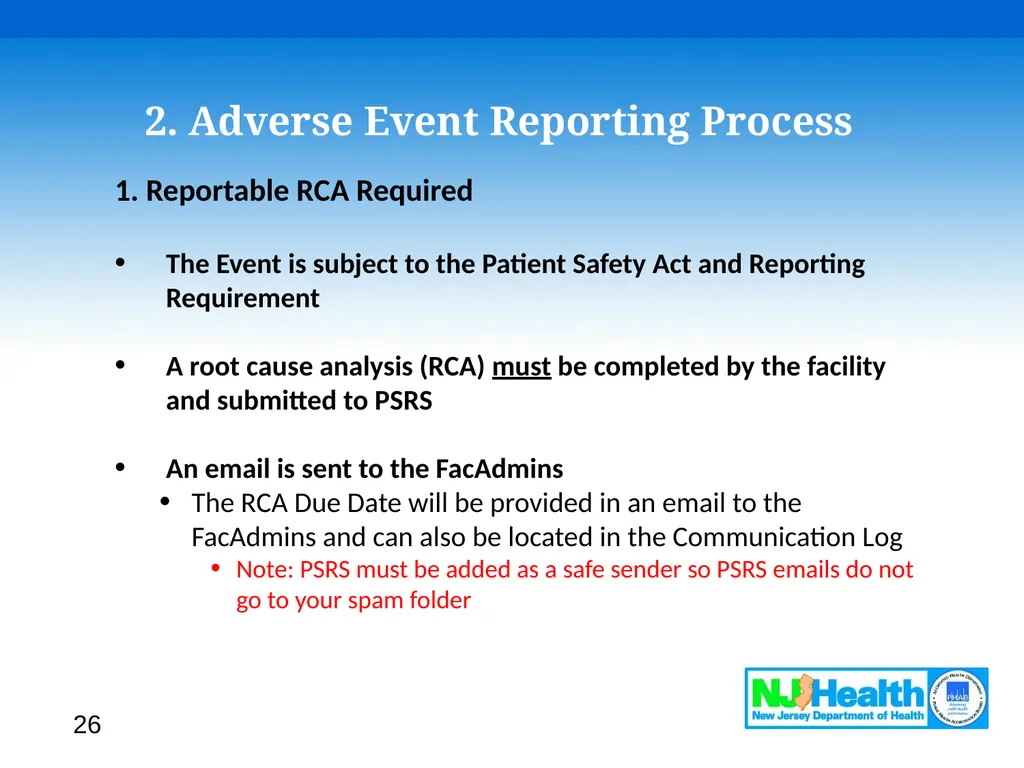
2. Adverse Event Reporting Process 1. Reportable RCA Required
The Event is subject to the Patient Safety Act and Reporting Requirement
A root cause analysis (RCA) must be completed by the facility and submitted to PSRS
An email is sent to the FacAdmins
The RCA Due Date will be provided in an email to the FacAdmins and can also be located in the Communication Log
Note: PSRS must be added as a safe sender so PSRS emails do not go to your spam folder<br>
The Event is subject to the Patient Safety Act and Reporting Requirement
A root cause analysis (RCA) must be completed by the facility and submitted to PSRS
An email is sent to the FacAdmins
The RCA Due Date will be provided in an email to the FacAdmins and can also be located in the Communication Log
Note: PSRS must be added as a safe sender so PSRS emails do not go to your spam folder<br>
27
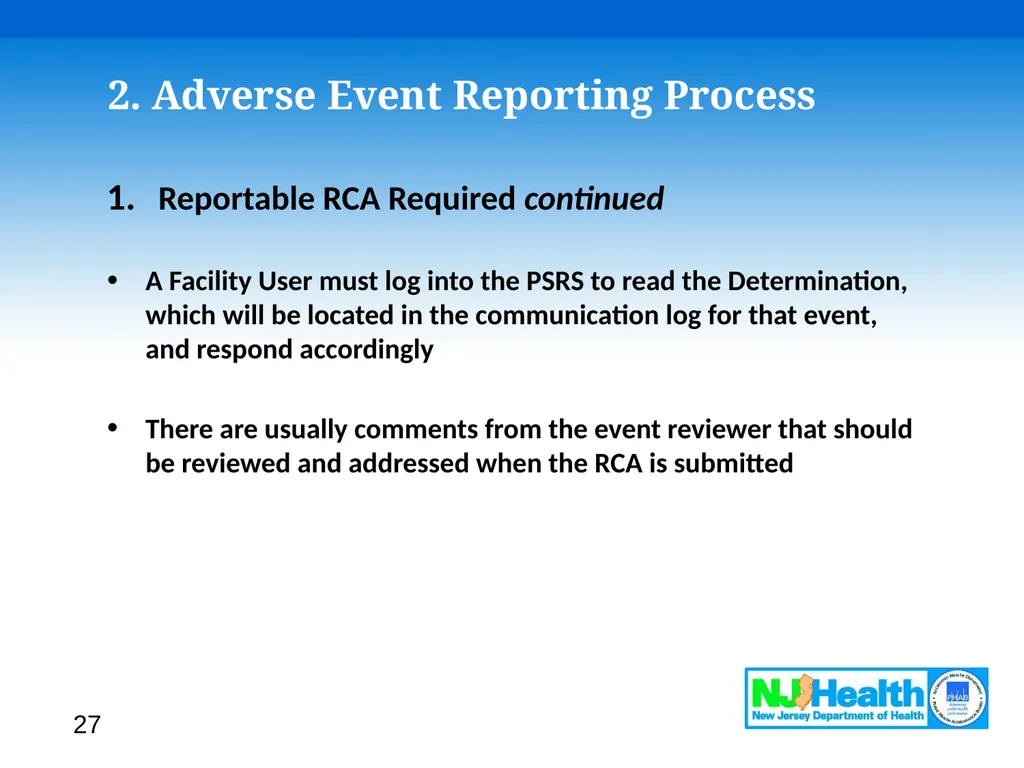
2. Adverse Event Reporting Process Reportable RCA Required continued
A Facility User must log into the PSRS to read the Determination, which will be located in the communication log for that event, and respond accordingly
There are usually comments from the event reviewer that should be reviewed and addressed when the RCA is submitted<br>
A Facility User must log into the PSRS to read the Determination, which will be located in the communication log for that event, and respond accordingly
There are usually comments from the event reviewer that should be reviewed and addressed when the RCA is submitted<br>
28
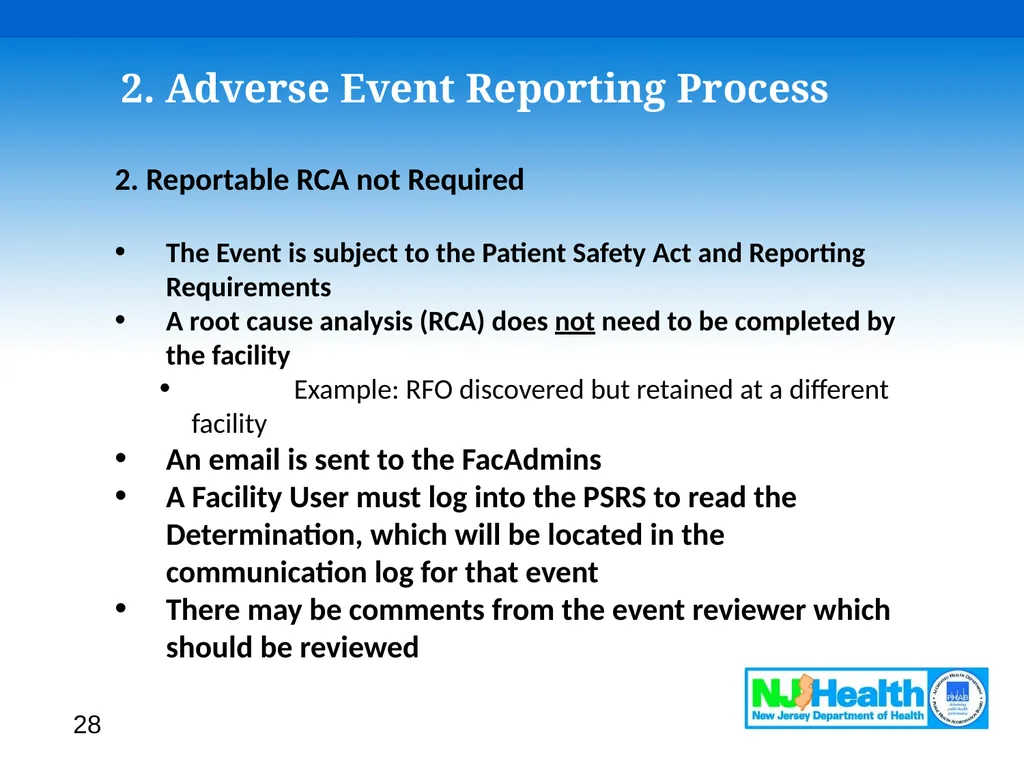
2. Adverse Event Reporting Process 2. Reportable RCA not Required
The Event is subject to the Patient Safety Act and Reporting Requirements
A root cause analysis (RCA) does not need to be completed by the facility
Example: RFO discovered but retained at a different facility
An email is sent to the FacAdmins
A Facility User must log into the PSRS to read the Determination, which will be located in the communication log for that event
There may be comments from the event reviewer which should be reviewed<br>
The Event is subject to the Patient Safety Act and Reporting Requirements
A root cause analysis (RCA) does not need to be completed by the facility
Example: RFO discovered but retained at a different facility
An email is sent to the FacAdmins
A Facility User must log into the PSRS to read the Determination, which will be located in the communication log for that event
There may be comments from the event reviewer which should be reviewed<br>
29
2. Adverse Event Reporting Process 3. Not Reportable
PSRS recommends internal analysis
A root cause analysis (RCA) does not need to be submitted to PSRS
An email is sent to the FacAdmins
A Facility User must log into the PSRS to read the Determination, which will be located in the communication log for that event
There may be comments from the event reviewer which should be reviewed<br>
PSRS recommends internal analysis
A root cause analysis (RCA) does not need to be submitted to PSRS
An email is sent to the FacAdmins
A Facility User must log into the PSRS to read the Determination, which will be located in the communication log for that event
There may be comments from the event reviewer which should be reviewed<br>
30
2. Adverse Event Reporting Process 4. Less Serious or Near Miss
PSRS recommends internal analysis
A root cause analysis (RCA) does not need to be submitted to PSRS
An email is sent to the FacAdmins
A Facility User must log into the PSRS to read the Determination, which will be located in the communication log for that event
There may be comments from the event reviewer which should be reviewed<br>
PSRS recommends internal analysis
A root cause analysis (RCA) does not need to be submitted to PSRS
An email is sent to the FacAdmins
A Facility User must log into the PSRS to read the Determination, which will be located in the communication log for that event
There may be comments from the event reviewer which should be reviewed<br>
31
2. Adverse Event Reporting Process 5. Need More Information
PSRS makes comments to determine the status of the event
An email is sent to the FacAdmins
A Facility User must log into the PSRS and open the event to read the comments and respond accordingly<br>
PSRS makes comments to determine the status of the event
An email is sent to the FacAdmins
A Facility User must log into the PSRS and open the event to read the comments and respond accordingly<br>
32
2. Adverse Event Reporting Process 5. Need More Information continued
Respond to all comments by editing the event
The description of the event is an unlimited text field
Resubmit the event to PSRS
There may be more than 1 cycle of responding to comments<br>
Respond to all comments by editing the event
The description of the event is an unlimited text field
Resubmit the event to PSRS
There may be more than 1 cycle of responding to comments<br>
33
2. Adverse Event Reporting Process Other Communications from PSRS
General Comment or Email-Other
There is a new comment available from the Patient Safety Reporting System. Please log into the web based system and check the Communication Log to review the comment and respond accordingly
Access Communications by
Communication Log--General Comment or E-mail Other<br>
General Comment or Email-Other
There is a new comment available from the Patient Safety Reporting System. Please log into the web based system and check the Communication Log to review the comment and respond accordingly
Access Communications by
Communication Log--General Comment or E-mail Other<br>
34
2. Adverse Event Reporting Process Other Communications to PSRS
General Comment or Respond to PSRS Comment
Send Communication through
Communication Log--General Comment<br>
General Comment or Respond to PSRS Comment
Send Communication through
Communication Log--General Comment<br>
35
2. Adverse Event Reporting Process Extensions for Events and RCAs
May be granted upon request
Send request with rationale as a comment through online system for that Event/RCA
Some extensions granted automatically if time frame for event review is lengthy<br>
May be granted upon request
Send request with rationale as a comment through online system for that Event/RCA
Some extensions granted automatically if time frame for event review is lengthy<br>
36
3. Root Cause Analysis Reporting Process A process to improve patient safety
Emphasis on improving and redesigning systems and processes
Emphasis not on individual performance
Educational opportunity
Nonpunitive Root Cause Analysis<br>
Emphasis on improving and redesigning systems and processes
Emphasis not on individual performance
Educational opportunity
Nonpunitive Root Cause Analysis<br>
37
3. Root Cause Analysis Reporting Process The purpose of the RCA is to uncover the factor(s) that led to and caused a serious preventable adverse event.
It is not intended to assign blame to individuals or to organizations.
Only by determining the underlying systemic causes of an adverse event can an effective action plan be formulated to minimize the chances of reoccurrence.
The goal and purpose of the Patient Safety Act is to improve system processes and implement best practices in order to prevent similar events from recurring. Root Cause Analysis<br>
It is not intended to assign blame to individuals or to organizations.
Only by determining the underlying systemic causes of an adverse event can an effective action plan be formulated to minimize the chances of reoccurrence.
The goal and purpose of the Patient Safety Act is to improve system processes and implement best practices in order to prevent similar events from recurring. Root Cause Analysis<br>
38
3. Root Cause Analysis Reporting Process N.J.A.C. 8:43E-10.6(l)* requires the following RCA components**:
A description of the event and the adverse outcome
An analysis of why the event happened
Direct causes(s)
Potential underlying causes related to design/operation of facility systems
The corrective actions taken for the patient(s) RCA Required Components * Link available on the NJ Patient Safety website
** List is not inclusive<br>
A description of the event and the adverse outcome
An analysis of why the event happened
Direct causes(s)
Potential underlying causes related to design/operation of facility systems
The corrective actions taken for the patient(s) RCA Required Components * Link available on the NJ Patient Safety website
** List is not inclusive<br>
39
3. Root Cause Analysis Reporting Process The method to identify other patients having potential to be affected by the same event and corrective action(s)
The measures to be put into place or the systematic changes needed to reduce the likelihood of similar events
How the corrective action(s) will be monitored to assess their impact RCA Required Components continued<br>
The measures to be put into place or the systematic changes needed to reduce the likelihood of similar events
How the corrective action(s) will be monitored to assess their impact RCA Required Components continued<br>
40
3. Root Cause Analysis Reporting Process RCA Report Questions
Initial Event Reviewer’s Comments
Literature Review
Information Consulted
Literature cited in ALL RCAs
Information in this field is accessible to all facilities
RCA Form Definitions RCA Resources<br>
Initial Event Reviewer’s Comments
Literature Review
Information Consulted
Literature cited in ALL RCAs
Information in this field is accessible to all facilities
RCA Form Definitions RCA Resources<br>
41
3. Root Cause Analysis Reporting Process Ad hoc under Patient Safety Committee
Distinct from QI activities
Multidisciplinary and diverse
Leadership involvement
Subject matter experts
Front line staff
Staff involved in event?
Commitment to RCA Process
Resources RCA: General Information
RCA Team<br>
Distinct from QI activities
Multidisciplinary and diverse
Leadership involvement
Subject matter experts
Front line staff
Staff involved in event?
Commitment to RCA Process
Resources RCA: General Information
RCA Team<br>
42
3. Root Cause Analysis Reporting Process Review number and trend of similar events in the same Event Classification
Review prior root causes and action plans
Review effectiveness of prior action plans
Review how serious preventable adverse events are identified RCA: General Information
Prior Similar Events<br>
Review prior root causes and action plans
Review effectiveness of prior action plans
Review how serious preventable adverse events are identified RCA: General Information
Prior Similar Events<br>
43
3. Root Cause Analysis Reporting Process Detailed chronological narrative
Who, what, when, where and how
Clear, complete and understandable
Include the direct cause of the event
Include any factors that may have contributed to the occurrence of the event. RCA: Facts of the Event<br>
Who, what, when, where and how
Clear, complete and understandable
Include the direct cause of the event
Include any factors that may have contributed to the occurrence of the event. RCA: Facts of the Event<br>
44
3. Root Cause Analysis Reporting Process Do NOT copy and paste medical records or autopsy reports into the RCA
Summarize the pertinent information that is related to the event (e.g., lab results, diagnostic studies, etc.)
Remember that the MyNJ Portal has a two-hour time limit RCA: Facts of the Event continued<br>
Summarize the pertinent information that is related to the event (e.g., lab results, diagnostic studies, etc.)
Remember that the MyNJ Portal has a two-hour time limit RCA: Facts of the Event continued<br>
45
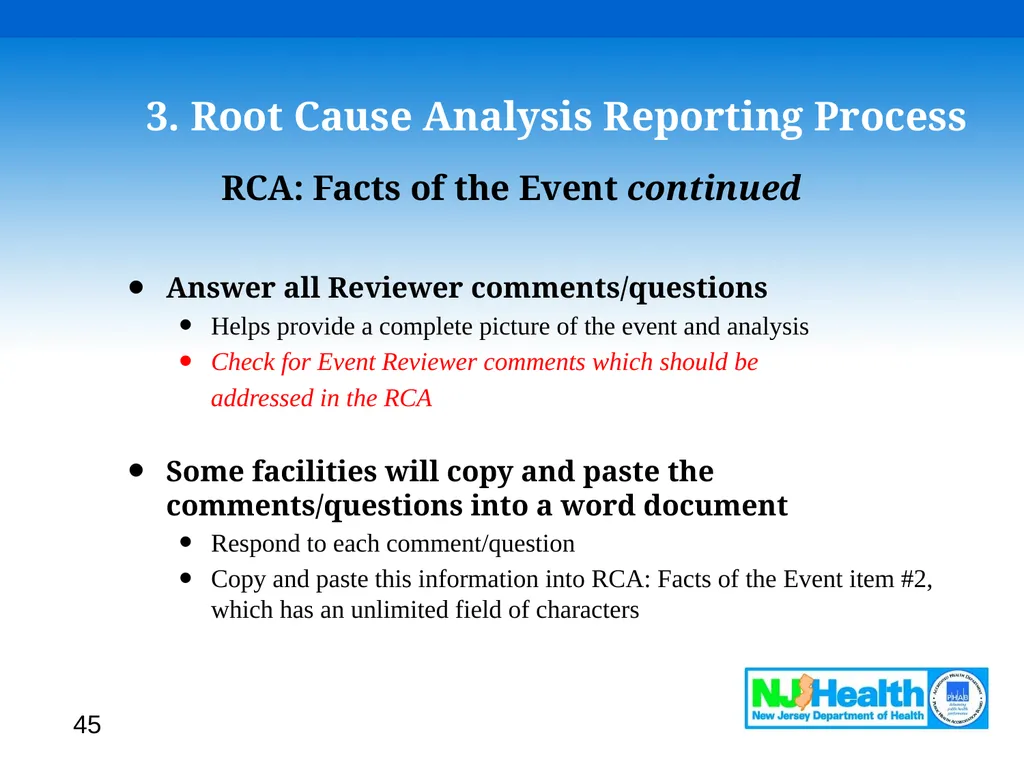
3. Root Cause Analysis Reporting Process Answer all Reviewer comments/questions
Helps provide a complete picture of the event and analysis
Check for Event Reviewer comments which should be
addressed in the RCA
Some facilities will copy and paste the comments/questions into a word document
Respond to each comment/question
Copy and paste this information into RCA: Facts of the Event item #2, which has an unlimited field of characters RCA: Facts of the Event continued<br>
Helps provide a complete picture of the event and analysis
Check for Event Reviewer comments which should be
addressed in the RCA
Some facilities will copy and paste the comments/questions into a word document
Respond to each comment/question
Copy and paste this information into RCA: Facts of the Event item #2, which has an unlimited field of characters RCA: Facts of the Event continued<br>
46
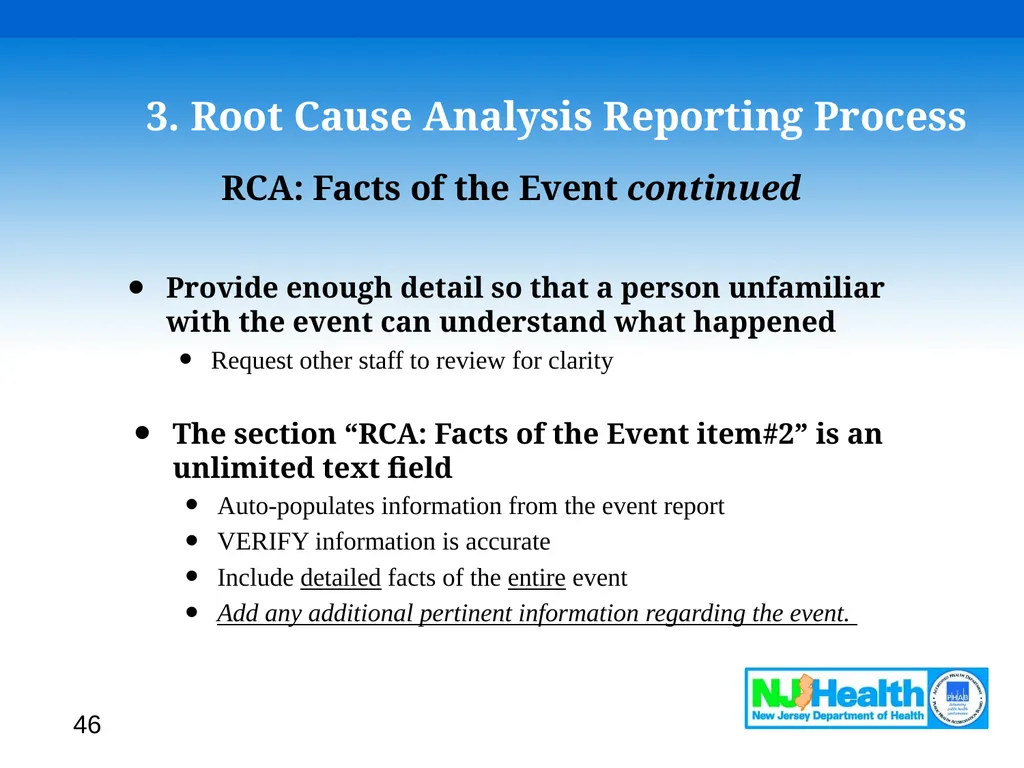
3. Root Cause Analysis Reporting Process Provide enough detail so that a person unfamiliar with the event can understand what happened
Request other staff to review for clarity
The section “RCA: Facts of the Event item#2” is an unlimited text field
Auto-populates information from the event report
VERIFY information is accurate
Include detailed facts of the entire event
Add any additional pertinent information regarding the event. RCA: Facts of the Event continued<br>
Request other staff to review for clarity
The section “RCA: Facts of the Event item#2” is an unlimited text field
Auto-populates information from the event report
VERIFY information is accurate
Include detailed facts of the entire event
Add any additional pertinent information regarding the event. RCA: Facts of the Event continued<br>
47
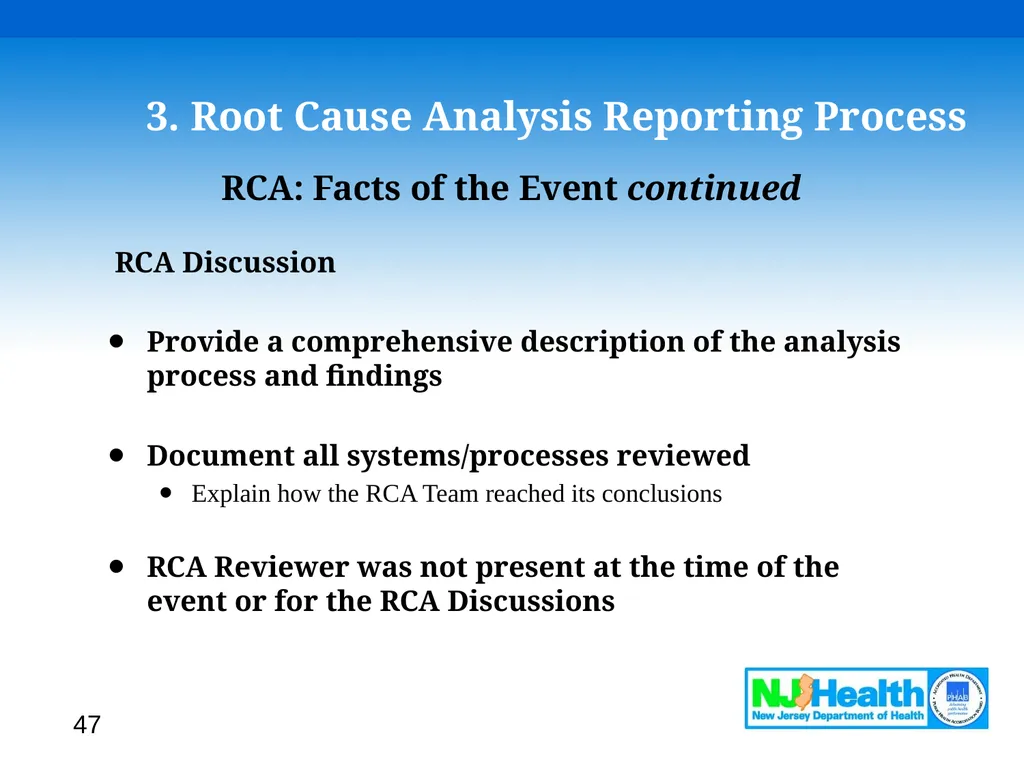
3. Root Cause Analysis Reporting Process RCA Discussion
Provide a comprehensive description of the analysis process and findings
Document all systems/processes reviewed
Explain how the RCA Team reached its conclusions
RCA Reviewer was not present at the time of the event or for the RCA Discussions RCA: Facts of the Event continued<br>
Provide a comprehensive description of the analysis process and findings
Document all systems/processes reviewed
Explain how the RCA Team reached its conclusions
RCA Reviewer was not present at the time of the event or for the RCA Discussions RCA: Facts of the Event continued<br>
48
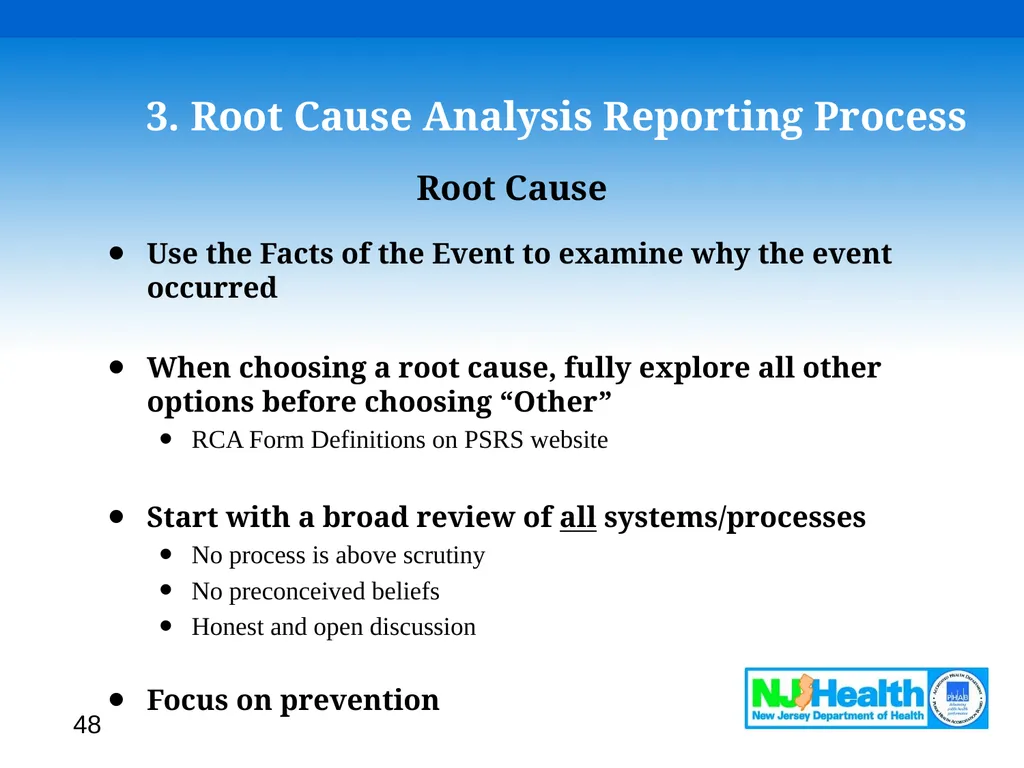
3. Root Cause Analysis Reporting Process Use the Facts of the Event to examine why the event occurred
When choosing a root cause, fully explore all other options before choosing “Other”
RCA Form Definitions on PSRS website
Start with a broad review of all systems/processes
No process is above scrutiny
No preconceived beliefs
Honest and open discussion
Focus on prevention Root Cause<br>
When choosing a root cause, fully explore all other options before choosing “Other”
RCA Form Definitions on PSRS website
Start with a broad review of all systems/processes
No process is above scrutiny
No preconceived beliefs
Honest and open discussion
Focus on prevention Root Cause<br>
49
3. Root Cause Analysis Reporting Process Look for modifiable risk factors
Human error and violations of procedure must have a preceding cause
Must continue to ask ‘Why?’
Often more than 1 root cause
Evidence-based literature review Root Cause<br>
Human error and violations of procedure must have a preceding cause
Must continue to ask ‘Why?’
Often more than 1 root cause
Evidence-based literature review Root Cause<br>
50
3. Root Cause Analysis Reporting Process Connects the root causes with the event
X (cause) increased the likelihood that Y (event) occurred Causality Statement<br>
X (cause) increased the likelihood that Y (event) occurred Causality Statement<br>
51
3. Root Cause Analysis Reporting Process Motivation
Resources
Time
Safe Environment
Team Dynamics
Commitment Obstacles on the road to the Root Cause<br>
Resources
Time
Safe Environment
Team Dynamics
Commitment Obstacles on the road to the Root Cause<br>
52
3. Root Cause Analysis Reporting Process A known complication
Many complications can be prevented
What contributed to or caused the complication
Patient noncompliance/characteristics
Focus should be on how facility decreases risk for patient
Policies and procedures were in place
Adverse event still occurred Root Causes Common Myths<br>
Many complications can be prevented
What contributed to or caused the complication
Patient noncompliance/characteristics
Focus should be on how facility decreases risk for patient
Policies and procedures were in place
Adverse event still occurred Root Causes Common Myths<br>
53
3. Root Cause Analysis Reporting Process The nurse/physician/technician did not follow…
Human error and violations of procedure must have an preceding system cause—something in the system allowed these to occur
Occurrence rate lower than national average
Adverse event still occurred
No Root Cause Root Causes Common Myths<br>
Human error and violations of procedure must have an preceding system cause—something in the system allowed these to occur
Occurrence rate lower than national average
Adverse event still occurred
No Root Cause Root Causes Common Myths<br>
54
3. Root Cause Analysis Reporting Process Specific, doable and measurable
Should prevent or decrease future adverse events
Address each root cause
Stronger actions compared to weaker actions Action/Prevention Strategies<br>
Should prevent or decrease future adverse events
Address each root cause
Stronger actions compared to weaker actions Action/Prevention Strategies<br>
55
3. Root Cause Analysis Reporting Process Permanent actions over temporary actions
Each root cause may have multiple actions
Should include time frame for implementation
Within 45 day time frame for RCA
Someone who is not a member of the RCA Team should be able to understand what to do next Action/Prevention Strategies<br>
Each root cause may have multiple actions
Should include time frame for implementation
Within 45 day time frame for RCA
Someone who is not a member of the RCA Team should be able to understand what to do next Action/Prevention Strategies<br>
56
3. Root Cause Analysis Reporting Process Describes how the effectiveness of each action will be measured and monitored.
What will be monitored, by whom, and for how long
Specific for each action
How will the facility know that the action is being carried out?
How will the effectiveness of each action be communicated? Monitoring<br>
What will be monitored, by whom, and for how long
Specific for each action
How will the facility know that the action is being carried out?
How will the effectiveness of each action be communicated? Monitoring<br>
57
3. Root Cause Analysis Reporting Process General and unmeasurable actions
What are you measuring
Education or review of policy without observation of implementation
Attendance at educational sessions does not demonstrate understanding or a change in behavior Common Pitfalls: Action Plans & Monitoring<br>
What are you measuring
Education or review of policy without observation of implementation
Attendance at educational sessions does not demonstrate understanding or a change in behavior Common Pitfalls: Action Plans & Monitoring<br>
58
3. Root Cause Analysis Reporting Process Delayed Implementation of Actions
New events/injuries not prevented
Insufficient timeframe for monitoring
Compliance wanes over time Common Pitfalls: Action Plans & Monitoring continued<br>
New events/injuries not prevented
Insufficient timeframe for monitoring
Compliance wanes over time Common Pitfalls: Action Plans & Monitoring continued<br>
59
3. Root Cause Analysis Reporting Process N.J.A.C. 8:43E-10.6(m)* requires the Department of Health to:
Review an RCA to determine whether it satisfies the criteria in (l) above**; and
Return an RCA that does not meet the criteria in (l) above to the facility for revision and shall not consider the RCA complete until the Department determines that the RCA meets the criteria in (l) above RCA Review by PSRS * Link available on the NJ Patient Safety website
** Refer to slide #38<br>
Review an RCA to determine whether it satisfies the criteria in (l) above**; and
Return an RCA that does not meet the criteria in (l) above to the facility for revision and shall not consider the RCA complete until the Department determines that the RCA meets the criteria in (l) above RCA Review by PSRS * Link available on the NJ Patient Safety website
** Refer to slide #38<br>
60
3. Root Cause Analysis Reporting Process Each RCA is reviewed by Clinical Reviewers (RN, MD)
Reviewers must understand what occurred
RCA must include required components
RCA must be thorough and credible RCA Review by PSRS continued<br>
Reviewers must understand what occurred
RCA must include required components
RCA must be thorough and credible RCA Review by PSRS continued<br>
61
3. Root Cause Analysis Reporting Process Possible Review Outcomes:
Email: RCA Comment Process
Email: RCA Complete RCA Review by PSRS continued<br>
Email: RCA Comment Process
Email: RCA Complete RCA Review by PSRS continued<br>
62
3. Root Cause Analysis Reporting Process 1. Email: RCA Comment process:
Additional information is needed
PSRS makes comments to determine if the RCA contains the required components of an RCA
Facility responds to comments by editing the RCA
The RCA: Facts of the Event section question #2 is an unlimited text field
Resubmit within 2 weeks; Extensions are available RCA Review by PSRS continued<br>
Additional information is needed
PSRS makes comments to determine if the RCA contains the required components of an RCA
Facility responds to comments by editing the RCA
The RCA: Facts of the Event section question #2 is an unlimited text field
Resubmit within 2 weeks; Extensions are available RCA Review by PSRS continued<br>
63
3. Root Cause Analysis Reporting Process 1. Email: RCA Comment process continued:
Facility resubmits the RCA to PSRS
There may be more than 1 cycle of responding to comments RCA Review by PSRS continued<br>
Facility resubmits the RCA to PSRS
There may be more than 1 cycle of responding to comments RCA Review by PSRS continued<br>
64
3. Root Cause Analysis Reporting Process 2. Email: RCA Complete:
The RCA is closed
Additional information or clarification may be requested to complete the RCA Review
If requested, additional information may be sent to PSRS by
General Comment
Attachment (Upload Supporting Documentation) RCA Review by PSRS continued<br>
The RCA is closed
Additional information or clarification may be requested to complete the RCA Review
If requested, additional information may be sent to PSRS by
General Comment
Attachment (Upload Supporting Documentation) RCA Review by PSRS continued<br>
65
3. Root Cause Analysis Reporting Process ALL communication should go through the confidential reporting system
Do NOT use regular unsecured email
General Comments should be limited to 2-3 sentences
Most of the responses/information should be entered in the RCA
The attachment function (Upload Supporting Documentation) is available if needed Communication<br>
Do NOT use regular unsecured email
General Comments should be limited to 2-3 sentences
Most of the responses/information should be entered in the RCA
The attachment function (Upload Supporting Documentation) is available if needed Communication<br>
66
4. New User Registration Process New Facility Administrators: Access granted by PSRS
Contact PSRS at adan.olmeda@doh.nj.gov to request access as a Facility Administrator.
PSRS will send a link to the registration form via email.
Click on the link.<br>
Contact PSRS at adan.olmeda@doh.nj.gov to request access as a Facility Administrator.
PSRS will send a link to the registration form via email.
Click on the link.<br>
67
4. New User Registration Process New Facility Administrators continued
Sign the User Confidentiality Agreement, complete the registration form and submit the form.
PSRS is accessed through the MyNJ portal. If you are already registered for MyNJ, you must have your Login ID and Password available.
If approved, PSRS will send an email with your User ID, one time key and detailed instructions on how to complete the registration process.<br>
Sign the User Confidentiality Agreement, complete the registration form and submit the form.
PSRS is accessed through the MyNJ portal. If you are already registered for MyNJ, you must have your Login ID and Password available.
If approved, PSRS will send an email with your User ID, one time key and detailed instructions on how to complete the registration process.<br>
68
4. New User Registration Process New Report Readers/Report Writers: Access granted by Facility Administrators
Facility Administrator logs on to the PSRS system
Click the User Maintenance tab at the top of the screen.
Click “Create User”.
Enter the email address of the person who will be registering.<br>
Facility Administrator logs on to the PSRS system
Click the User Maintenance tab at the top of the screen.
Click “Create User”.
Enter the email address of the person who will be registering.<br>
69
4. New User Registration Process New Report Readers/Report Writers continued
Click “Send Email”
An email will be sent to the person who is registering with a link to the User Confidentiality Agreement and registration form.
PSRS is accessed through the MyNJ portal. If the new user is already registered for MyNJ, he/she must have his/her Login ID and Password available.<br>
Click “Send Email”
An email will be sent to the person who is registering with a link to the User Confidentiality Agreement and registration form.
PSRS is accessed through the MyNJ portal. If the new user is already registered for MyNJ, he/she must have his/her Login ID and Password available.<br>
70
4. New User Registration Process New Report Readers/Report Writers continued
Once the user registers, they will show on the User Registrations Grid where you can approve or deny access.
Approved users will then be added to the User Maintenance screen.
If approved, the Facility Administrator will send an email with the User ID, one time key and detailed instructions on how to complete the registration process.<br>
Once the user registers, they will show on the User Registrations Grid where you can approve or deny access.
Approved users will then be added to the User Maintenance screen.
If approved, the Facility Administrator will send an email with the User ID, one time key and detailed instructions on how to complete the registration process.<br>
71
PSRS Contact Information PSRS Telephone: 609-633-7759
PSRS Website: https://www.nj.gov/health/healthcarequality/health-care-professionals/patient-safety-reporting-system/
PSRS Staff:
Mary Noble, MD, MPH, Clinical Director
Mary.Noble@doh.nj.gov
Sara Day, RN, BSN, CPM, Quality Assurance Coordinator
Sara.Day@doh.nj.gov
Regina Smith, RN, BSN, MA, Health Science Specialist
Regina.Smith@doh.nj.gov
Theophilus Olapinsin, RN, BSN, MPH, Quality Assurance Specialist
Theophilus.Olapinsin@doh.nj.gov
Adan Olmeda, Administrative Support
Adan.Olmeda@doh.nj.gov<br>
PSRS Website: https://www.nj.gov/health/healthcarequality/health-care-professionals/patient-safety-reporting-system/
PSRS Staff:
Mary Noble, MD, MPH, Clinical Director
Mary.Noble@doh.nj.gov
Sara Day, RN, BSN, CPM, Quality Assurance Coordinator
Sara.Day@doh.nj.gov
Regina Smith, RN, BSN, MA, Health Science Specialist
Regina.Smith@doh.nj.gov
Theophilus Olapinsin, RN, BSN, MPH, Quality Assurance Specialist
Theophilus.Olapinsin@doh.nj.gov
Adan Olmeda, Administrative Support
Adan.Olmeda@doh.nj.gov<br>