ASEF Risk Communication for Public Health Emergencies, 2015 Objectives Share experience and expertise Understand the importance and challenge of reflecting the voices of healthcare workers in national risk communication Isolate key barriers
Related Topics
Share
Embed code
Download this presentation From Below
"ASEF Risk Communication for Public Health" is the property of its rightful owner. Permission is granted to
download and print the materials on this website for personal, non-commercial use only, and to display it
on your personal computer provided you do not modify the materials and that you retain all copyright
notices contained in the materials. By downloading content from our website, you accept the terms of this
agreement.
Presentation Transcript
01
ASEF Risk Communication for Public Health Emergencies, 2015<br>
02
Objectives Share experience and expertise
Understand the importance and challenge of reflecting the voices of healthcare workers in national risk communication
Isolate key barriers to implementing national risk communication strategies
Develop recommendations for strengthening national risk communication strategies<br>
03
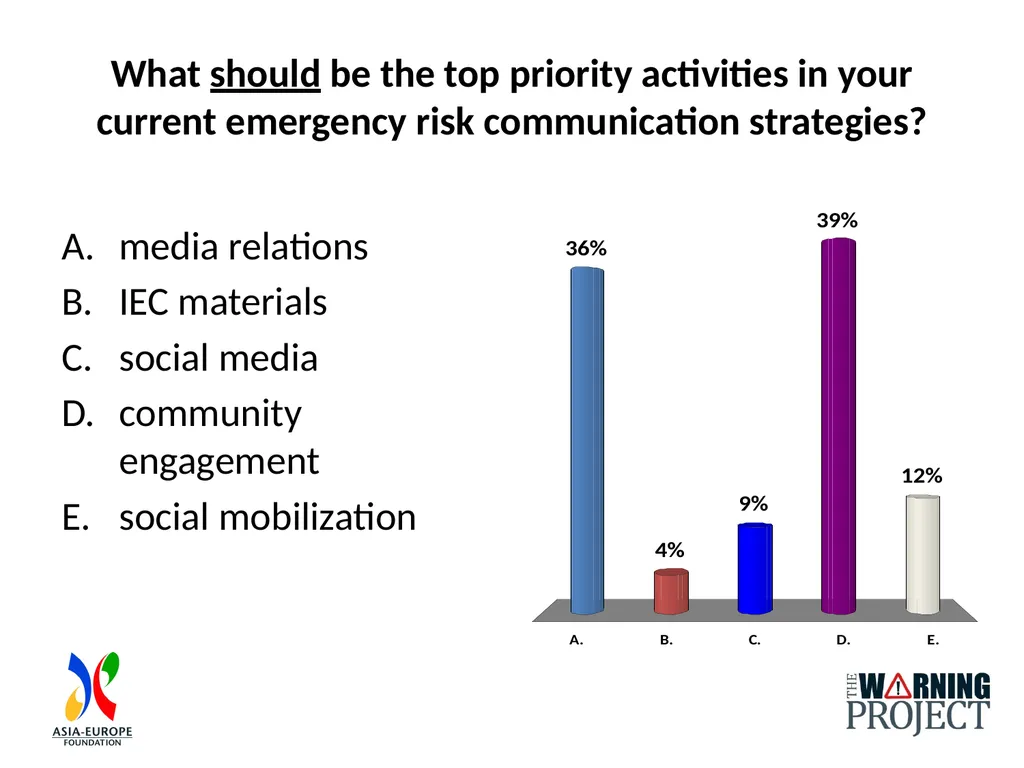
What should be the top priority activities in your current emergency risk communication strategies? media relations
IEC materials
social media
community engagement
social mobilization<br>
04
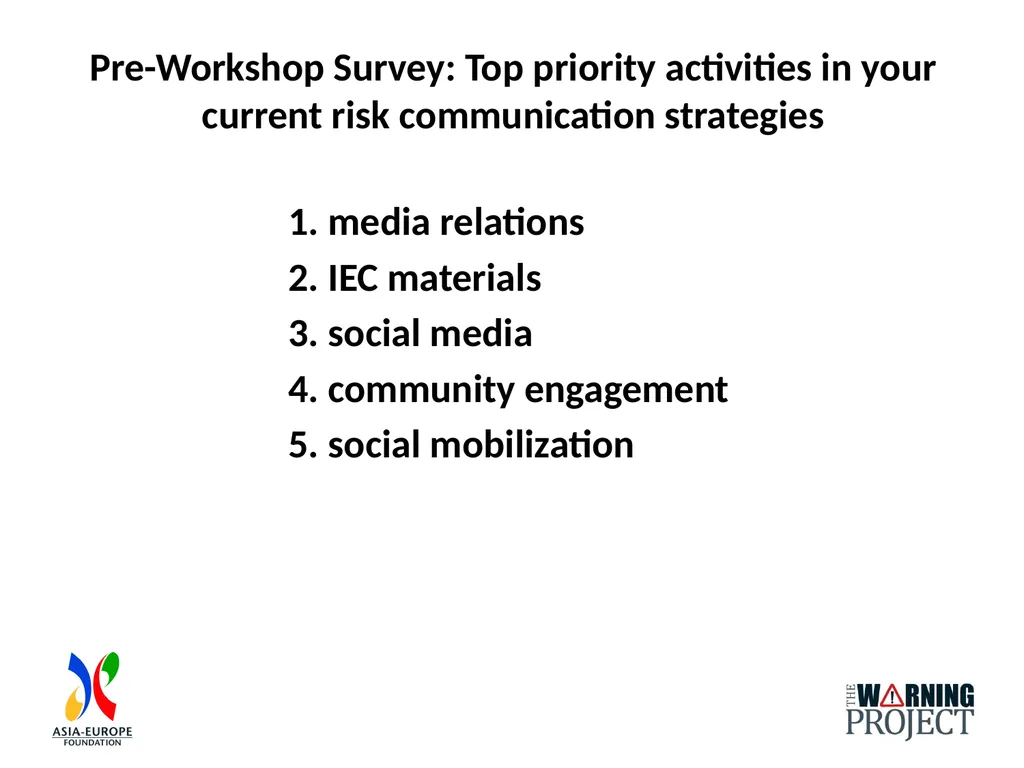
Pre-Workshop Survey: Top priority activities in your current risk communication strategies 1. media relations
2. IEC materials
3. social media
4. community engagement
5. social mobilization<br>
05
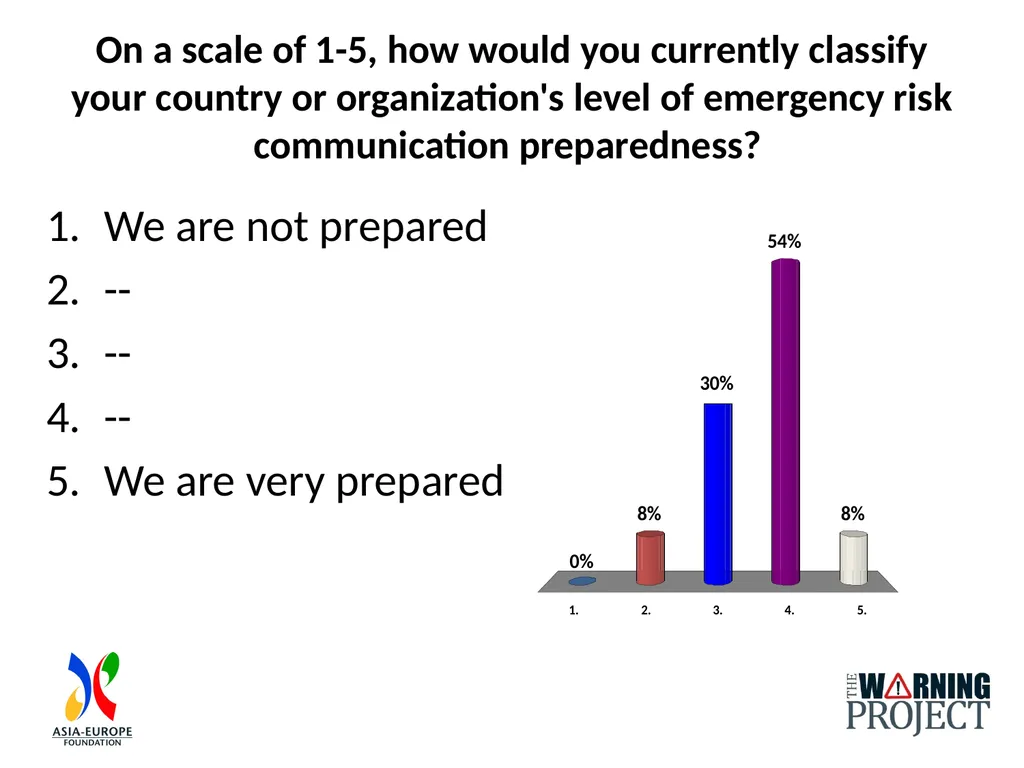
On a scale of 1-5, how would you currently classify your country or organization's level of emergency risk communication preparedness? We are not prepared
--
--
--
We are very prepared<br>
06
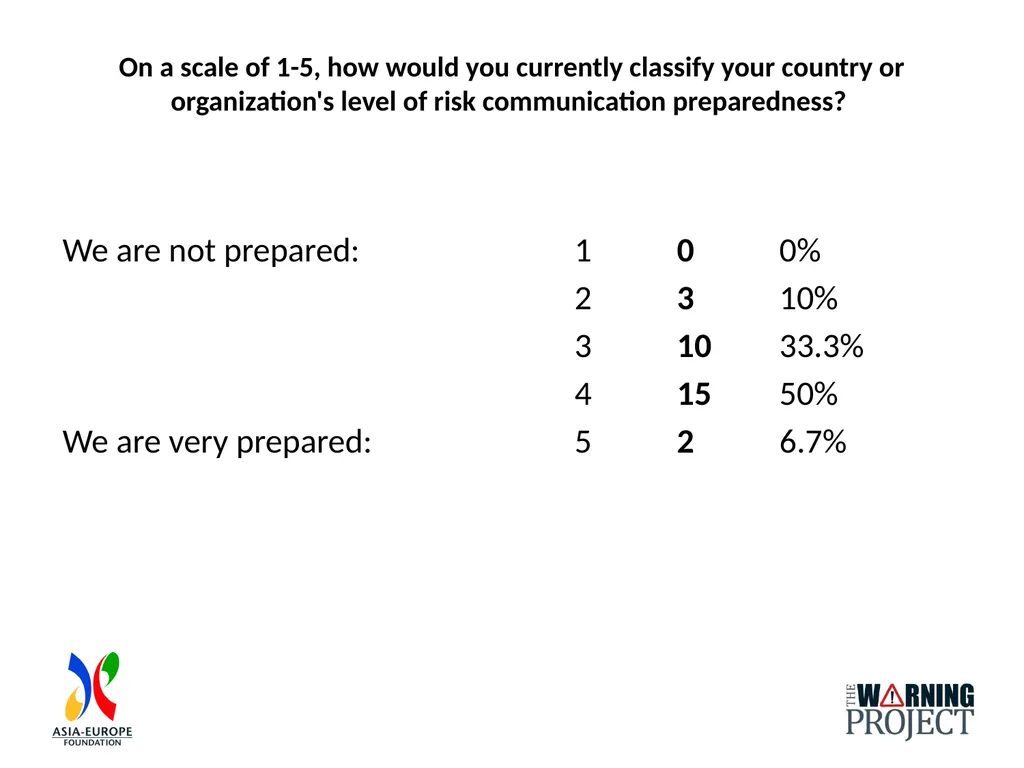
On a scale of 1-5, how would you currently classify your country or organization's level of risk communication preparedness? We are not prepared: 1 0 0%
2 3 10%
3 10 33.3%
4 15 50%
We are very prepared: 5 2 6.7%<br>
07
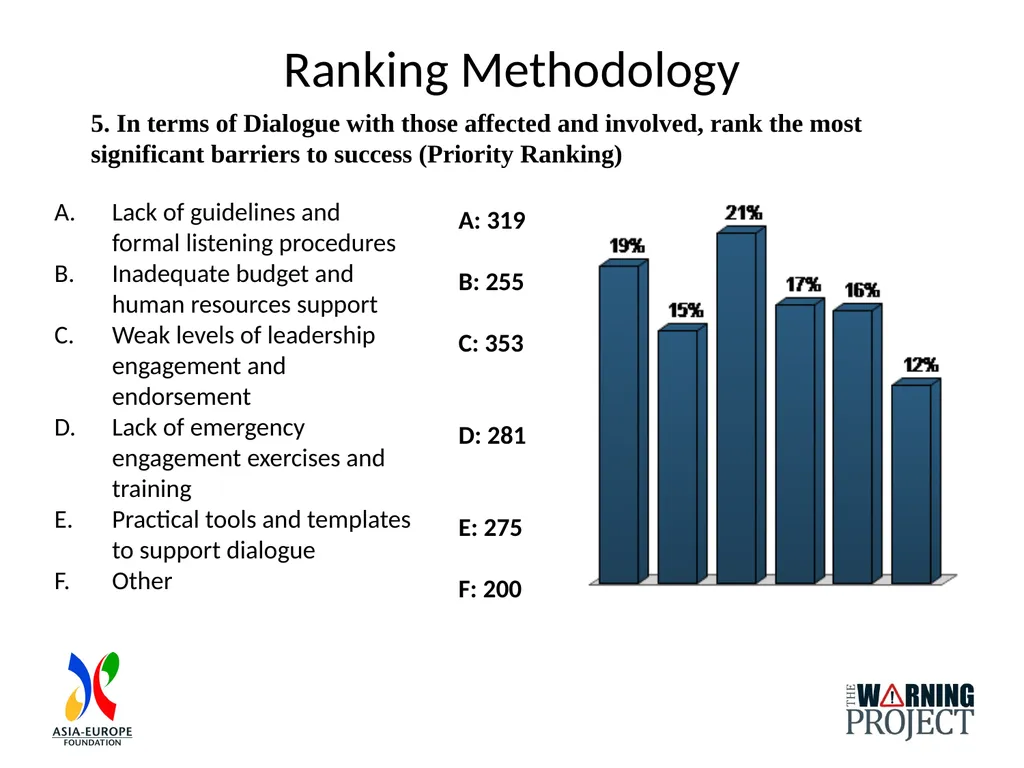
Ranking Methodology 5. In terms of Dialogue with those affected and involved, rank the most significant barriers to success (Priority Ranking) Lack of guidelines and formal listening procedures
Inadequate budget and human resources support
Weak levels of leadership engagement and endorsement
Lack of emergency engagement exercises and training
Practical tools and templates to support dialogue
Other A: 319
B: 255
C: 353
D: 281
E: 275
F: 200<br>
08
Module 1: key discussion 70% -- communicate a serious, emerging risk immediately, prior to lab or other confirmation 57% -- organizations resist transparency due to incomplete information
Transparency is a crucial issue in supporting all emergency risk communication objectives<br>
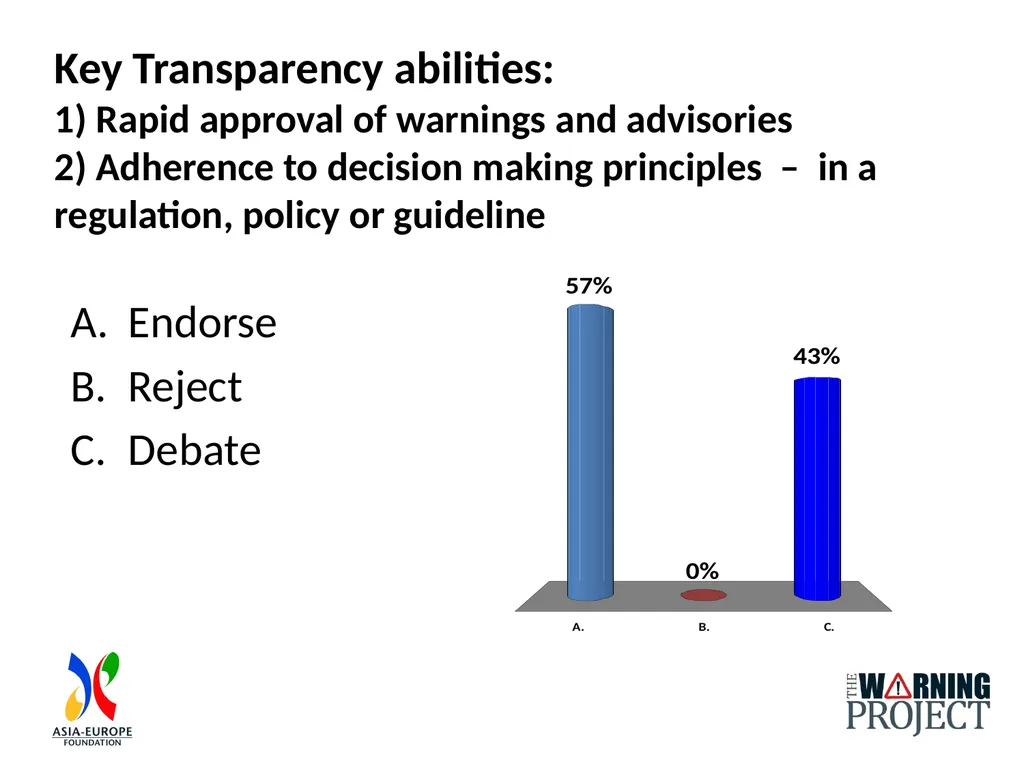
Key Transparency abilities: 1) Rapid approval of warnings and advisories 2) Adherence to decision making principles – in a regulation, policy or guideline Endorse
Reject
Debate<br>
11
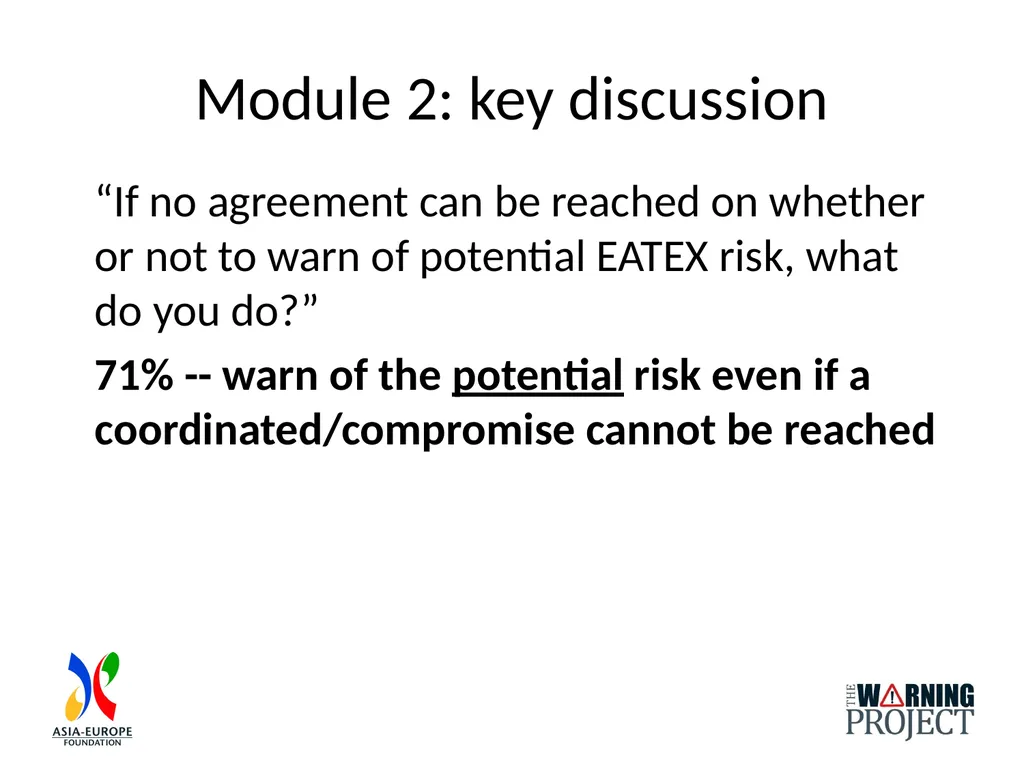
Module 2: key discussion “If no agreement can be reached on whether or not to warn of potential EATEX risk, what do you do?”
71% -- warn of the potential risk even if a coordinated/compromise cannot be reached<br>
12
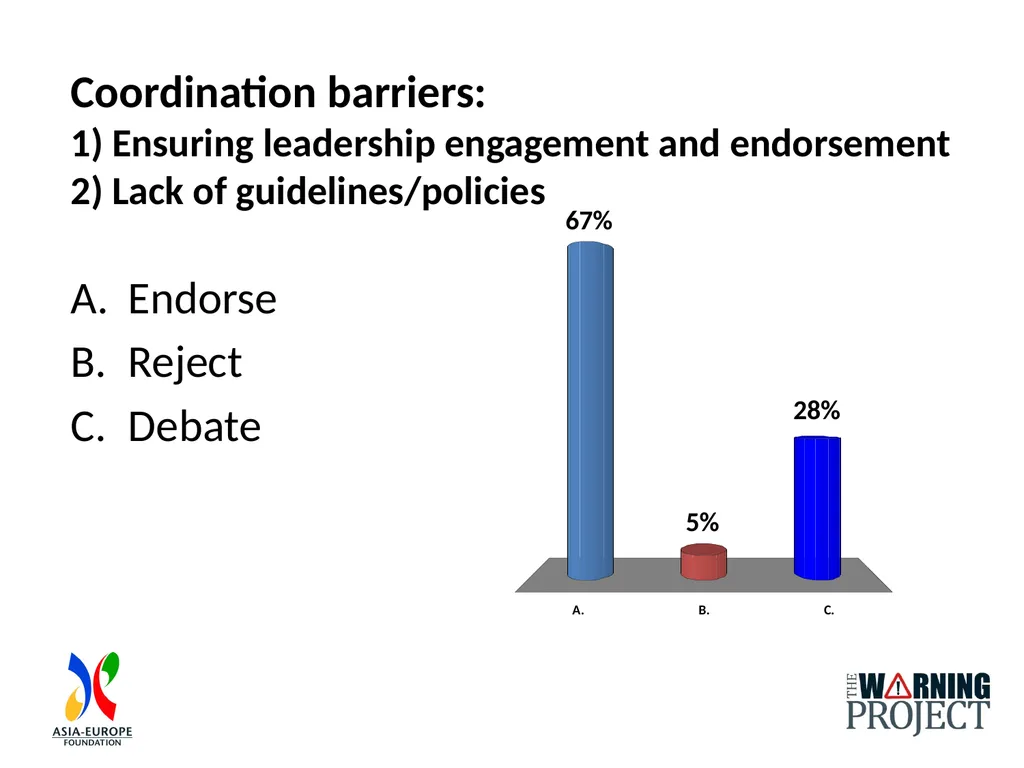
Coordination barriers: 1) Ensuring leadership engagement and endorsement 2) Lack of guidelines/policies Endorse
Reject
Debate<br>
13
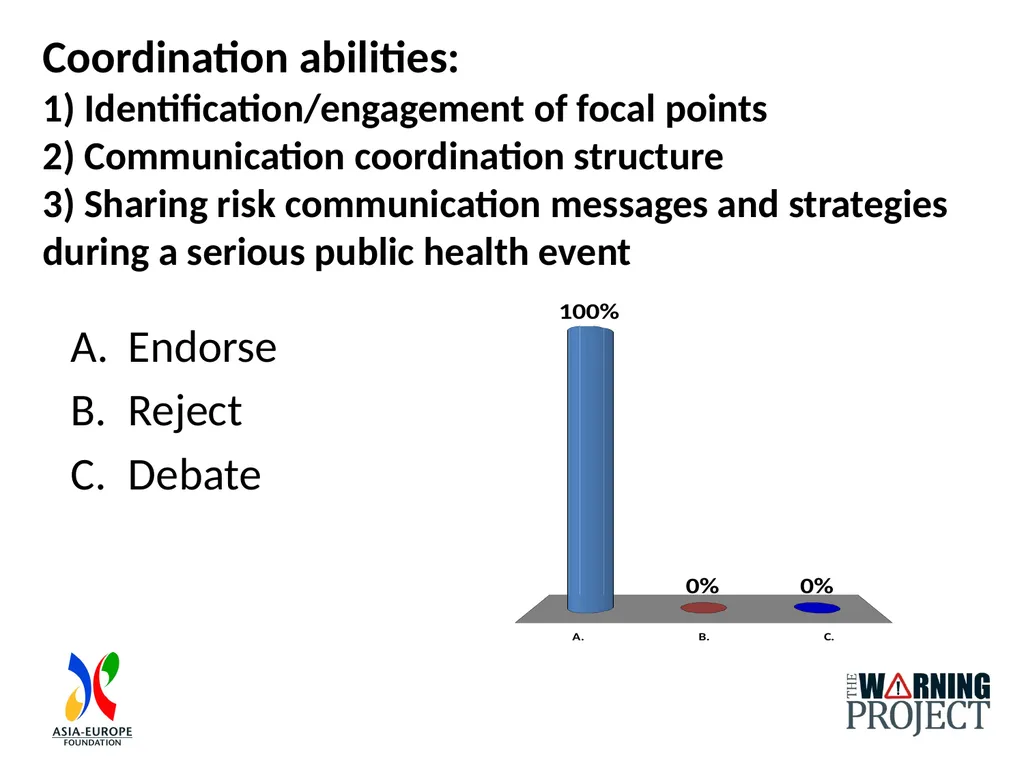
Coordination abilities: 1) Identification/engagement of focal points 2) Communication coordination structure 3) Sharing risk communication messages and strategies during a serious public health event Endorse
Reject
Debate<br>
14
Module 3: key discussion “We should not put the blame on the affected”
We need to change behavior of leaders as well
Knowledge/data gathered must feed into response operation or it becomes useless
On social media: may be the minority, but because of the platform may appear to “represent” the majority<br>
15
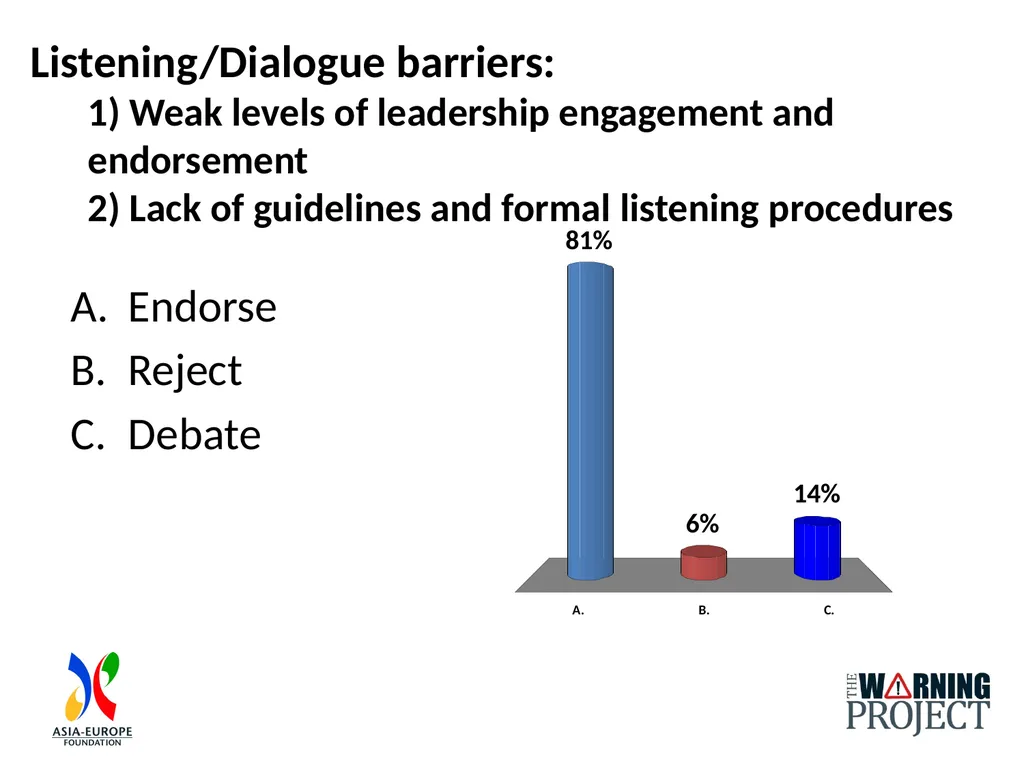
Listening/Dialogue barriers: 1) Weak levels of leadership engagement and endorsement 2) Lack of guidelines and formal listening procedures Endorse
Reject
Debate<br>
16
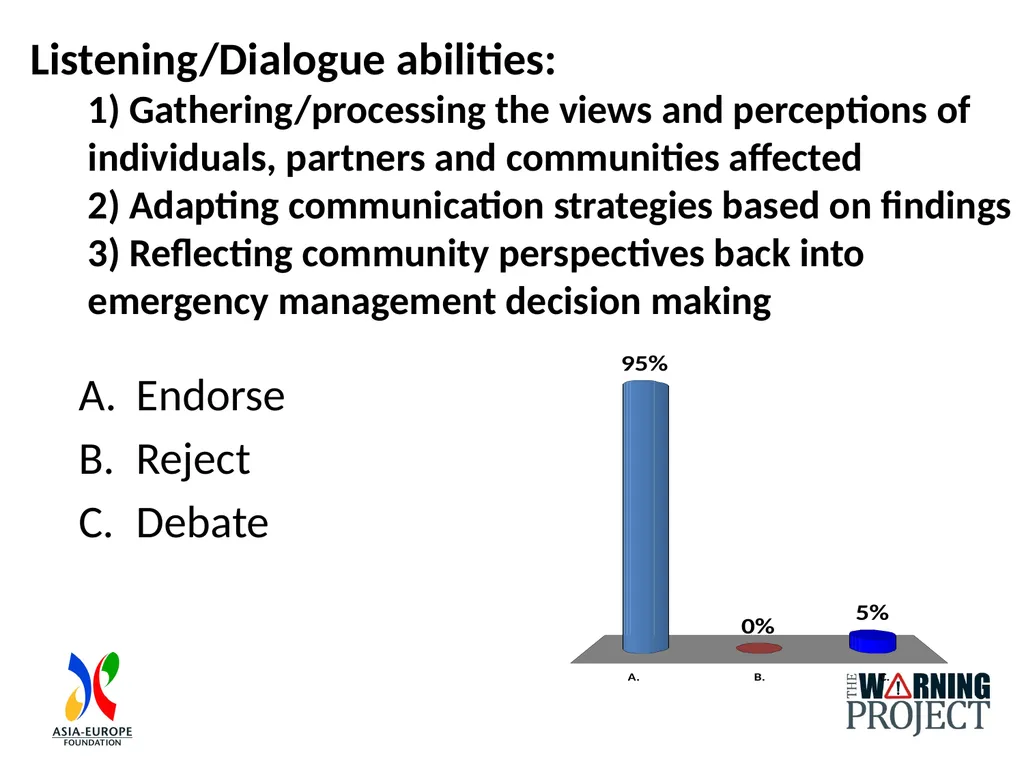
Listening/Dialogue abilities: 1) Gathering/processing the views and perceptions of individuals, partners and communities affected 2) Adapting communication strategies based on findings 3) Reflecting community perspectives back into emergency management decision making Endorse
Reject
Debate<br>
17
Module 4: key discussion Strong push to “move on” undermines real evaluation
Must be part of the planning cycle
KPIs: must align to risk comm objective
Organizations must prioritize/invest in function<br>
18
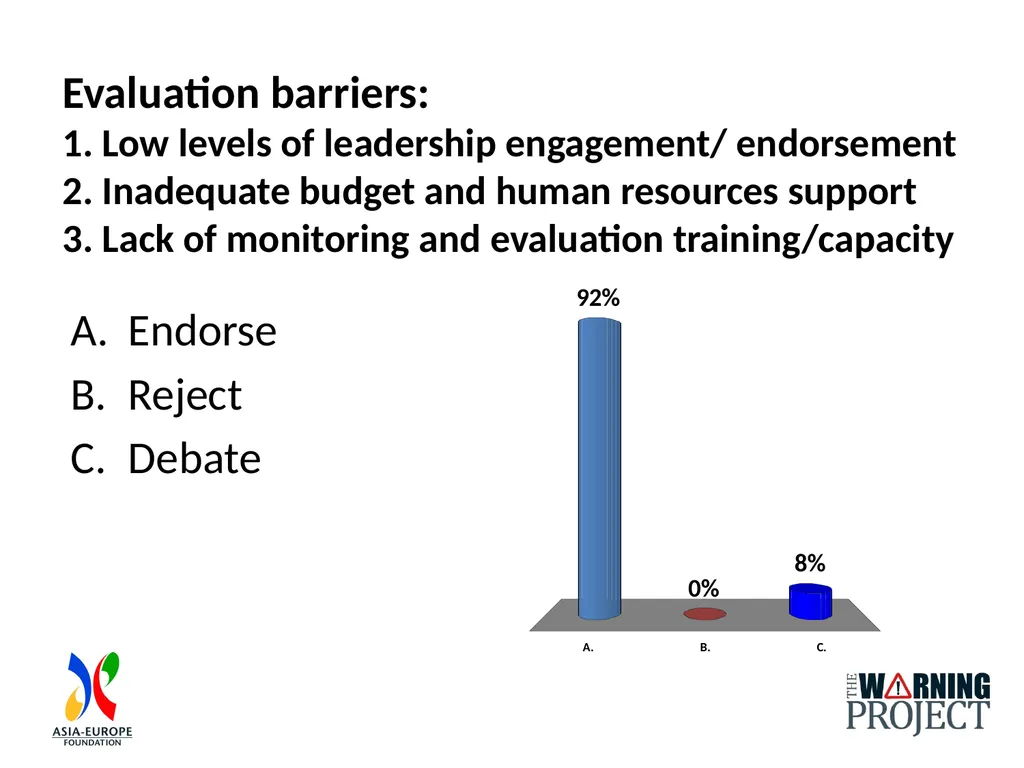
Evaluation barriers: 1. Low levels of leadership engagement/ endorsement 2. Inadequate budget and human resources support 3. Lack of monitoring and evaluation training/capacity Endorse
Reject
Debate<br>
19
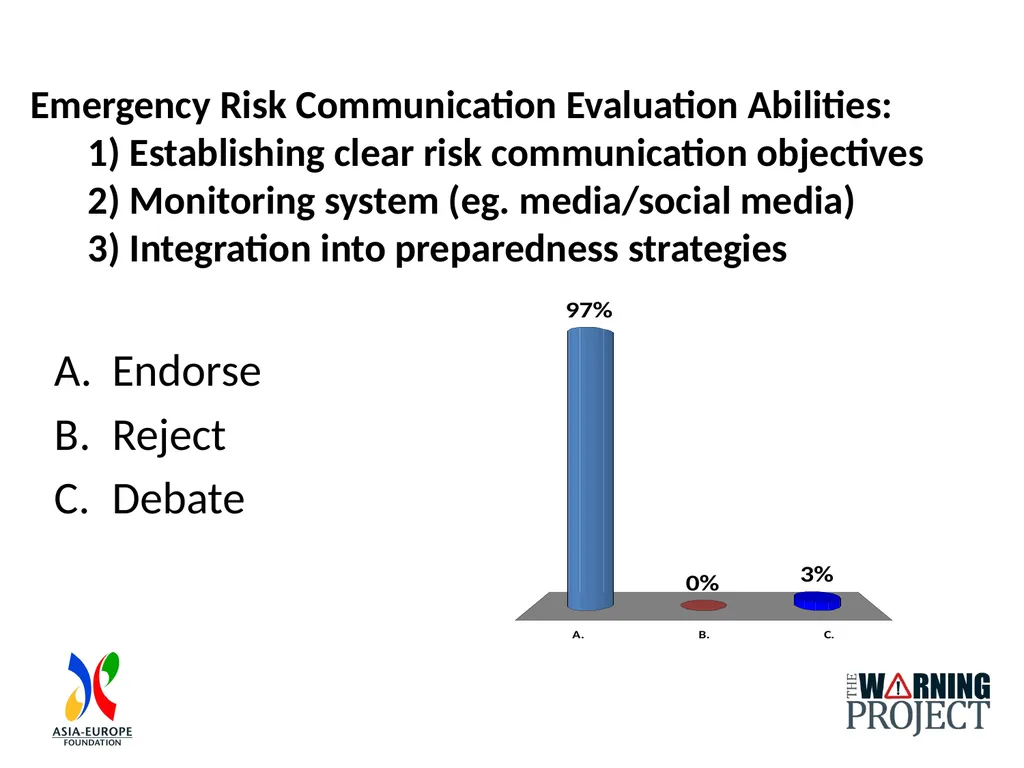
Emergency Risk Communication Evaluation Abilities: 1) Establishing clear risk communication objectives 2) Monitoring system (eg. media/social media) 3) Integration into preparedness strategies Endorse
Reject
Debate<br>