
Assessing the Security of the Cloud What Should

Description: Assessing the Security of the Cloud What Should you ask your vendors? Steve Deitrick, VP, Global Information Security John Heimann, VP, Global Product Security Jari Peters, VP, Security, Risk Management and Regulatory Compliance October 25,
Related Topics
Download Presentation
"Assessing the Security of the Cloud What Should" is the property of its rightful owner. Permission is granted to download and print the materials on this website for personal, non-commercial use only, and to display it on your personal computer provided you do not modify the materials and that you retain all copyright notices contained in the materials. By downloading content from our website, you accept the terms of this agreement.
Presentation Transcript
slide2. Assessing the Security
of the Cloud What Should you ask your vendors? Steve Deitrick, VP, Global Information Security
John Heimann, VP, Global Product Security
Jari Peters, VP, Security, Risk Management and Regulatory Compliance
October 25, 2018<br>
slide3. Safe Harbor Statement The following is intended to outline our general product direction. It is intended for information purposes only, and may not be incorporated into any contract. It is not a commitment to deliver any material, code, or functionality, and should not be relied upon in making purchasing decisions. The development, release, timing, and pricing of any features or functionality described for Oracle’s products may change and remains at the sole discretion of Oracle Corporation. 3<br>
slide4. Session Objective Give you tips and techniques on how to assess the security of your cloud vendors:
What do you need to consider when moving to the cloud?
What goes into securing a cloud?
How do you ask about it?
How should IaaS/PaaS/SaaS/DaaS offerings affect your security expectations? 4<br>
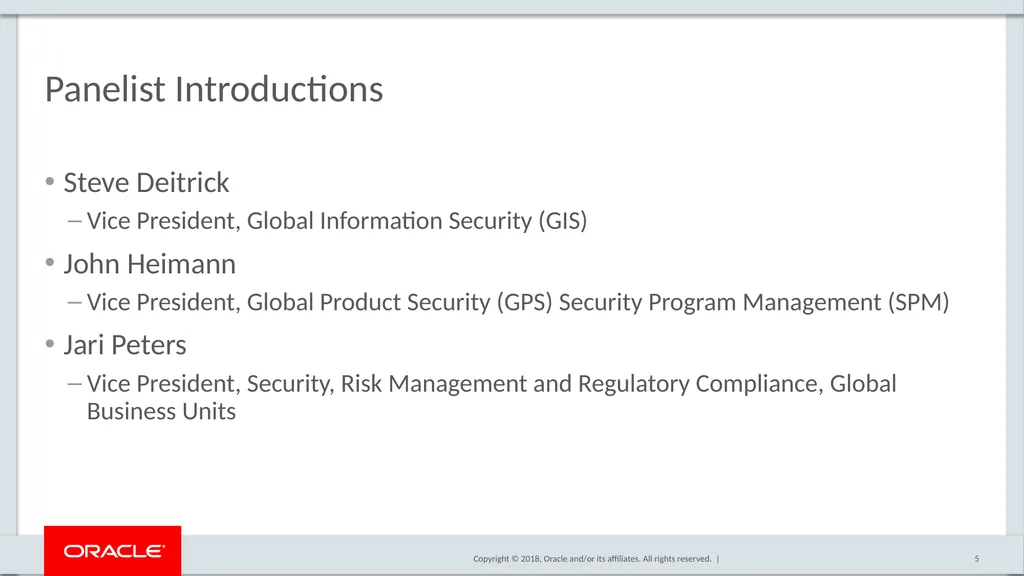
slide5. Panelist Introductions Steve Deitrick
Vice President, Global Information Security (GIS)
John Heimann
Vice President, Global Product Security (GPS) Security Program Management (SPM)
Jari Peters
Vice President, Security, Risk Management and Regulatory Compliance, Global Business Units 5<br>
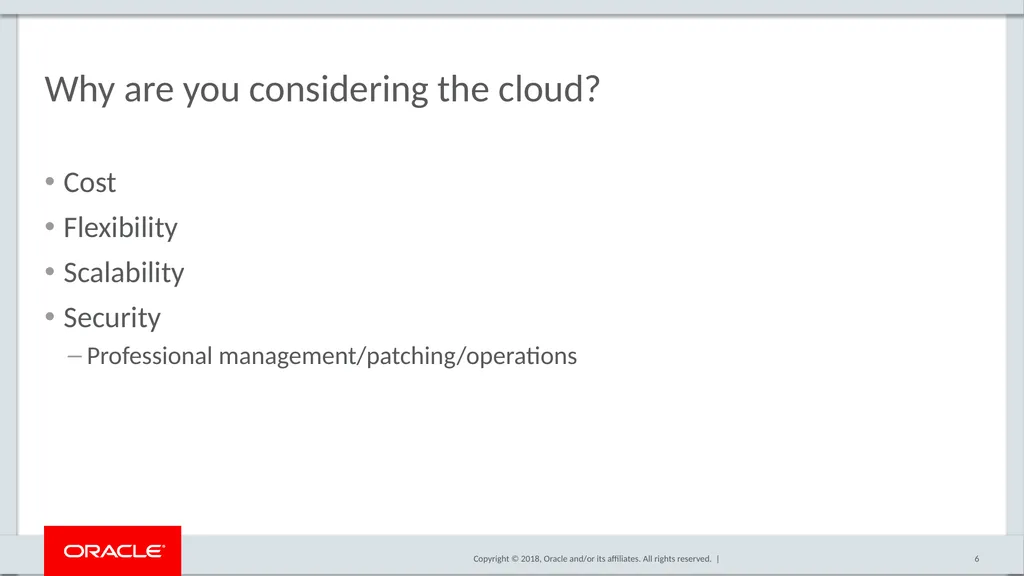
slide6. Why are you considering the cloud? Cost
Flexibility
Scalability
Security
Professional management/patching/operations 6<br>
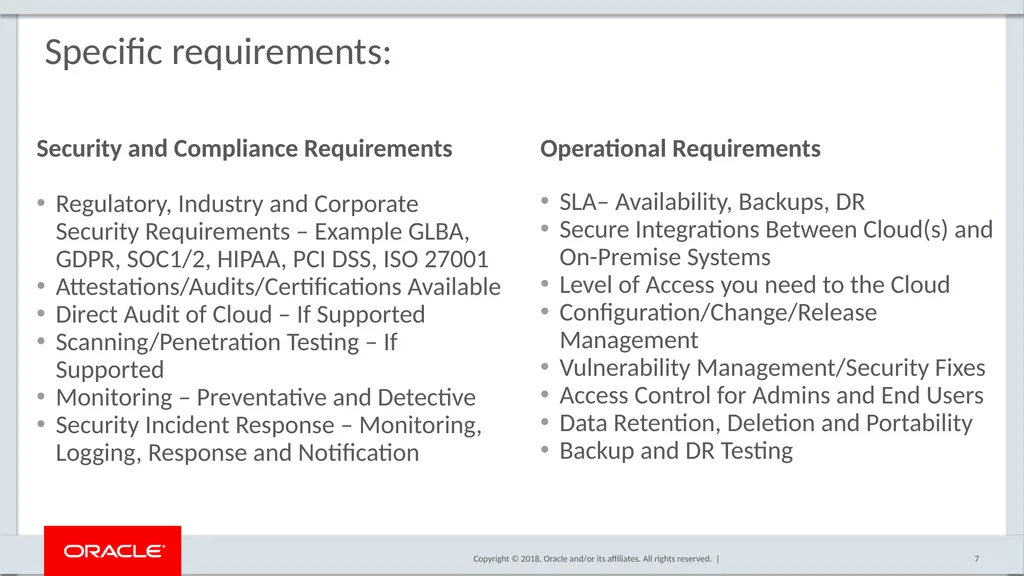
slide7. Specific requirements: Security and Compliance Requirements
Regulatory, Industry and Corporate Security Requirements – Example GLBA, GDPR, SOC1/2, HIPAA, PCI DSS, ISO 27001
Attestations/Audits/Certifications Available
Direct Audit of Cloud – If Supported
Scanning/Penetration Testing – If Supported
Monitoring – Preventative and Detective
Security Incident Response – Monitoring, Logging, Response and Notification Operational Requirements
SLA– Availability, Backups, DR
Secure Integrations Between Cloud(s) and On-Premise Systems
Level of Access you need to the Cloud
Configuration/Change/Release Management
Vulnerability Management/Security Fixes
Access Control for Admins and End Users
Data Retention, Deletion and Portability
Backup and DR Testing 7<br>
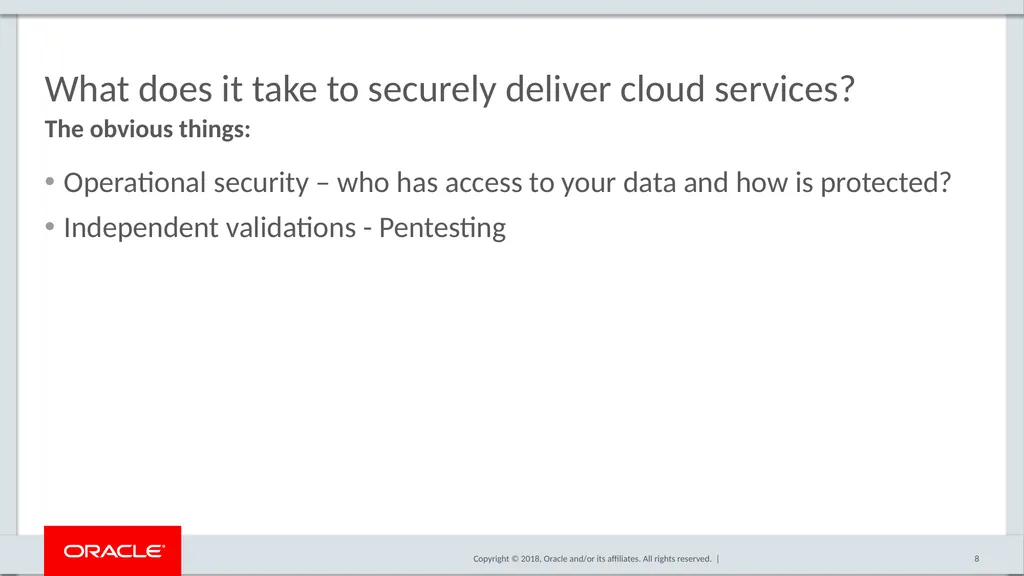
slide8. What does it take to securely deliver cloud services? Operational security – who has access to your data and how is protected?
Independent validations - Pentesting 8 The obvious things:<br>
slide9. What does it take to securely deliver cloud services? Supply chain – components developed in-house?
(and reliance on open source and third party components)
Architecture – multitenancy?
Development assurance – building security in vs. bolting it on? The not-so obvious things: 9<br>
slide10. Why does Oracle have a unique perspective? Oracle is a cloud service provider
IaaS, PaaS, SaaS, DaaS
Oracle is in a unique position for its cloud supply chain (see next point)
Oracle is a cloud technology vendor
Hardware
Operating system/VM
Platform (Database, Java)
Applications
Oracle is a cloud customer (we run our business on our cloud services and technologies)
We also deal with third-party cloud vendors when we acquire organizations 10<br>
slide11. What is the role of customer vs. provider for cloud security? Type of cloud service
For SaaS, provider does almost everything
For IaaS, provider secures technical infrastructure and customer has to do almost everything
Don’t assume your vendor will perform security functions they don’t claim to do
Single vs. multi-vendor approach
Multiple cloud vendors means customer has to do integration and management across vendors
Vertical (Iaas/PaaS/SaaS) and horizontal (multiple vendors’ PaaS or SaaS application) integration may be required 11 It depends on:<br>
slide12. What can you determine about your providers’ security? How should you ask your provider about security?
Make use of standard questionnaires such as SIG and CAIQ
Always ask in the context of the data type you’re expecting to place in the cloud, and the regulatory framework you have to abide to
What are the value and limitations of third party Pen Tests or scans?
Trust but verify: such tests cannot provide you an exhaustive view of your supplier’s security practices
Understand that most Cloud providers do not have more insight into the technologies they’re using than you do
This is why Oracle Software Security Assurance is important 12<br>
slide13. Conclusion Security in the cloud requires customers’ involvement (shared security model)
One size does not fit all (let your requirements determine fit)
Compliance in the cloud doesn’t happen magically
You need to understand that securing a cloud is a complex and multi-facetted discipline
Ask the right questions: be specific and disciplined 13<br>
John Heimann, VP, Global Product Security
Jari Peters, VP, Security, Risk Management and Regulatory Compliance
October 25, 2018<br>
slide3. Safe Harbor Statement The following is intended to outline our general product direction. It is intended for information purposes only, and may not be incorporated into any contract. It is not a commitment to deliver any material, code, or functionality, and should not be relied upon in making purchasing decisions. The development, release, timing, and pricing of any features or functionality described for Oracle’s products may change and remains at the sole discretion of Oracle Corporation. 3<br>
slide4. Session Objective Give you tips and techniques on how to assess the security of your cloud vendors:
What do you need to consider when moving to the cloud?
What goes into securing a cloud?
How do you ask about it?
How should IaaS/PaaS/SaaS/DaaS offerings affect your security expectations? 4<br>
slide5. Panelist Introductions Steve Deitrick
Vice President, Global Information Security (GIS)
John Heimann
Vice President, Global Product Security (GPS) Security Program Management (SPM)
Jari Peters
Vice President, Security, Risk Management and Regulatory Compliance, Global Business Units 5<br>
slide6. Why are you considering the cloud? Cost
Flexibility
Scalability
Security
Professional management/patching/operations 6<br>
slide7. Specific requirements: Security and Compliance Requirements
Regulatory, Industry and Corporate Security Requirements – Example GLBA, GDPR, SOC1/2, HIPAA, PCI DSS, ISO 27001
Attestations/Audits/Certifications Available
Direct Audit of Cloud – If Supported
Scanning/Penetration Testing – If Supported
Monitoring – Preventative and Detective
Security Incident Response – Monitoring, Logging, Response and Notification Operational Requirements
SLA– Availability, Backups, DR
Secure Integrations Between Cloud(s) and On-Premise Systems
Level of Access you need to the Cloud
Configuration/Change/Release Management
Vulnerability Management/Security Fixes
Access Control for Admins and End Users
Data Retention, Deletion and Portability
Backup and DR Testing 7<br>
slide8. What does it take to securely deliver cloud services? Operational security – who has access to your data and how is protected?
Independent validations - Pentesting 8 The obvious things:<br>
slide9. What does it take to securely deliver cloud services? Supply chain – components developed in-house?
(and reliance on open source and third party components)
Architecture – multitenancy?
Development assurance – building security in vs. bolting it on? The not-so obvious things: 9<br>
slide10. Why does Oracle have a unique perspective? Oracle is a cloud service provider
IaaS, PaaS, SaaS, DaaS
Oracle is in a unique position for its cloud supply chain (see next point)
Oracle is a cloud technology vendor
Hardware
Operating system/VM
Platform (Database, Java)
Applications
Oracle is a cloud customer (we run our business on our cloud services and technologies)
We also deal with third-party cloud vendors when we acquire organizations 10<br>
slide11. What is the role of customer vs. provider for cloud security? Type of cloud service
For SaaS, provider does almost everything
For IaaS, provider secures technical infrastructure and customer has to do almost everything
Don’t assume your vendor will perform security functions they don’t claim to do
Single vs. multi-vendor approach
Multiple cloud vendors means customer has to do integration and management across vendors
Vertical (Iaas/PaaS/SaaS) and horizontal (multiple vendors’ PaaS or SaaS application) integration may be required 11 It depends on:<br>
slide12. What can you determine about your providers’ security? How should you ask your provider about security?
Make use of standard questionnaires such as SIG and CAIQ
Always ask in the context of the data type you’re expecting to place in the cloud, and the regulatory framework you have to abide to
What are the value and limitations of third party Pen Tests or scans?
Trust but verify: such tests cannot provide you an exhaustive view of your supplier’s security practices
Understand that most Cloud providers do not have more insight into the technologies they’re using than you do
This is why Oracle Software Security Assurance is important 12<br>
slide13. Conclusion Security in the cloud requires customers’ involvement (shared security model)
One size does not fit all (let your requirements determine fit)
Compliance in the cloud doesn’t happen magically
You need to understand that securing a cloud is a complex and multi-facetted discipline
Ask the right questions: be specific and disciplined 13<br>