
Assistant Professor Dr Waleed Arif Tawfeeq
CM
Published · 31 slides · 0 views

1 / 1









Description
Assistant Professor Dr Waleed Arif Tawfeeq 27-2-2025 Primary Health Care Primary Health Care Reform Medical model Primary Health Care Illness Health Cure Prevention, care, cure Treatment Health promotion Episodic care
Related Topics
Share
Embed code
Download this presentation From Below
"Assistant Professor Dr Waleed Arif Tawfeeq" is the property of its rightful owner. Permission is granted to download and print the materials on this website for personal, non-commercial use only, and to display it on your personal computer provided you do not modify the materials and that you retain all copyright notices contained in the materials. By downloading content from our website, you accept the terms of this agreement.
Presentation Transcript
01
Assistant Professor
Dr Waleed Arif Tawfeeq
27-2-2025 Primary Health Care<br>
02
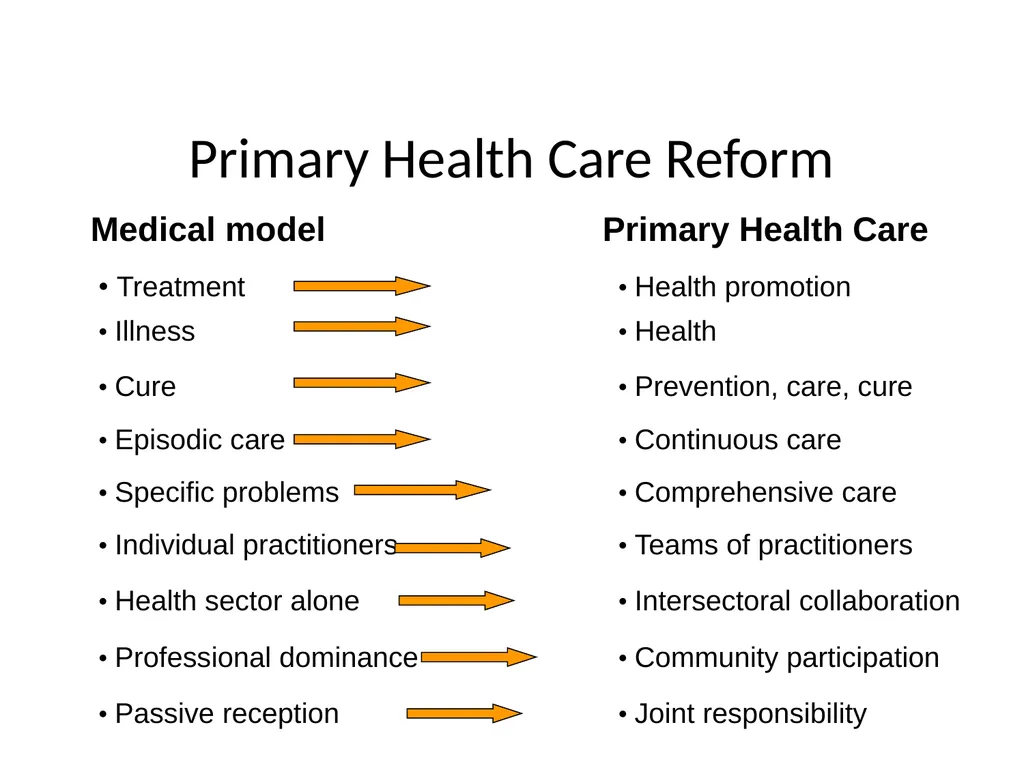
Primary Health Care Reform Medical model Primary Health Care Illness Health Cure Prevention, care, cure Treatment Health promotion Episodic care Continuous care Specific problems Comprehensive care Individual practitioners Teams of practitioners Health sector alone Intersectoral collaboration Professional dominance Community participation Passive reception Joint responsibility<br>
03
PRIMARY HEALTH CARE
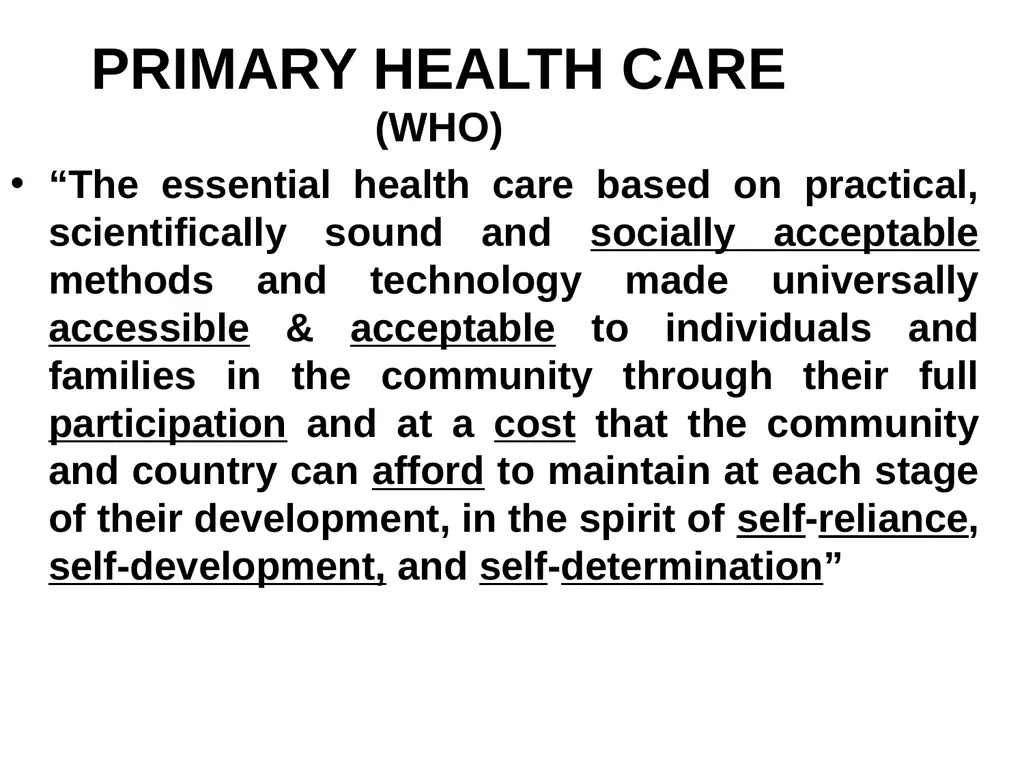
(WHO) “The essential health care based on practical, scientifically sound and socially acceptable methods and technology made universally accessible & acceptable to individuals and families in the community through their full participation and at a cost that the community and country can afford to maintain at each stage of their development, in the spirit of self-reliance, self-development, and self-determination”<br>
04
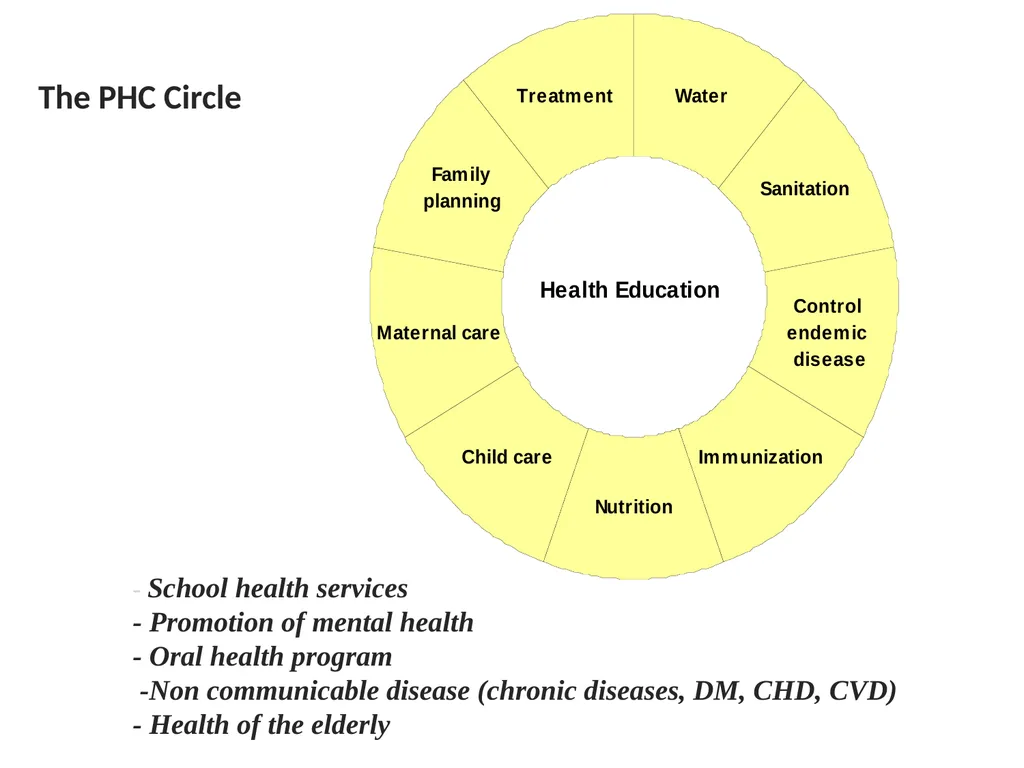
Elements of primary health care Health education
Promotion of food supply and proper nutrition
Safe water supply
Maternal and child care
Immunization
Prevention of endemic diseases
Appropriate treatment
Provision of essential drugs<br>
Promotion of food supply and proper nutrition
Safe water supply
Maternal and child care
Immunization
Prevention of endemic diseases
Appropriate treatment
Provision of essential drugs<br>
05
The PHC Circle - School health services
- Promotion of mental health
- Oral health program
-Non communicable disease (chronic diseases, DM, CHD, CVD)
- Health of the elderly<br>
- Promotion of mental health
- Oral health program
-Non communicable disease (chronic diseases, DM, CHD, CVD)
- Health of the elderly<br>
06
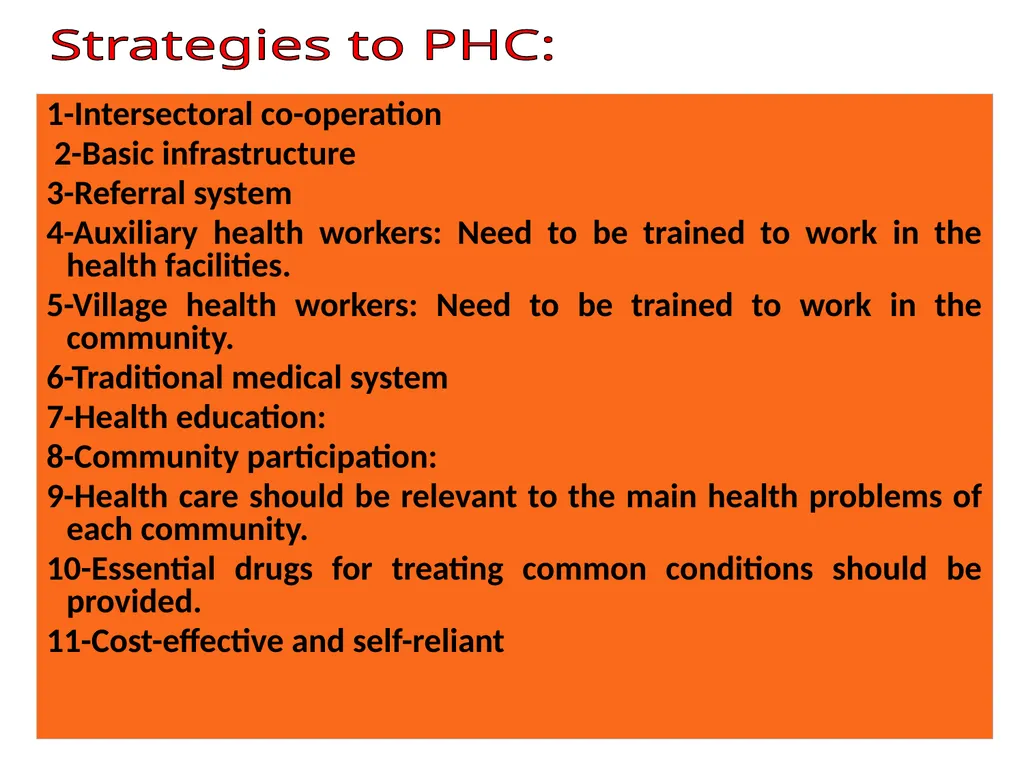
1-Intersectoral co-operation
2-Basic infrastructure
3-Referral system
4-Auxiliary health workers: Need to be trained to work in the health facilities.
5-Village health workers: Need to be trained to work in the community.
6-Traditional medical system
7-Health education:
8-Community participation:
9-Health care should be relevant to the main health problems of each community.
10-Essential drugs for treating common conditions should be provided.
11-Cost-effective and self-reliant Strategies to PHC:<br>
2-Basic infrastructure
3-Referral system
4-Auxiliary health workers: Need to be trained to work in the health facilities.
5-Village health workers: Need to be trained to work in the community.
6-Traditional medical system
7-Health education:
8-Community participation:
9-Health care should be relevant to the main health problems of each community.
10-Essential drugs for treating common conditions should be provided.
11-Cost-effective and self-reliant Strategies to PHC:<br>
07
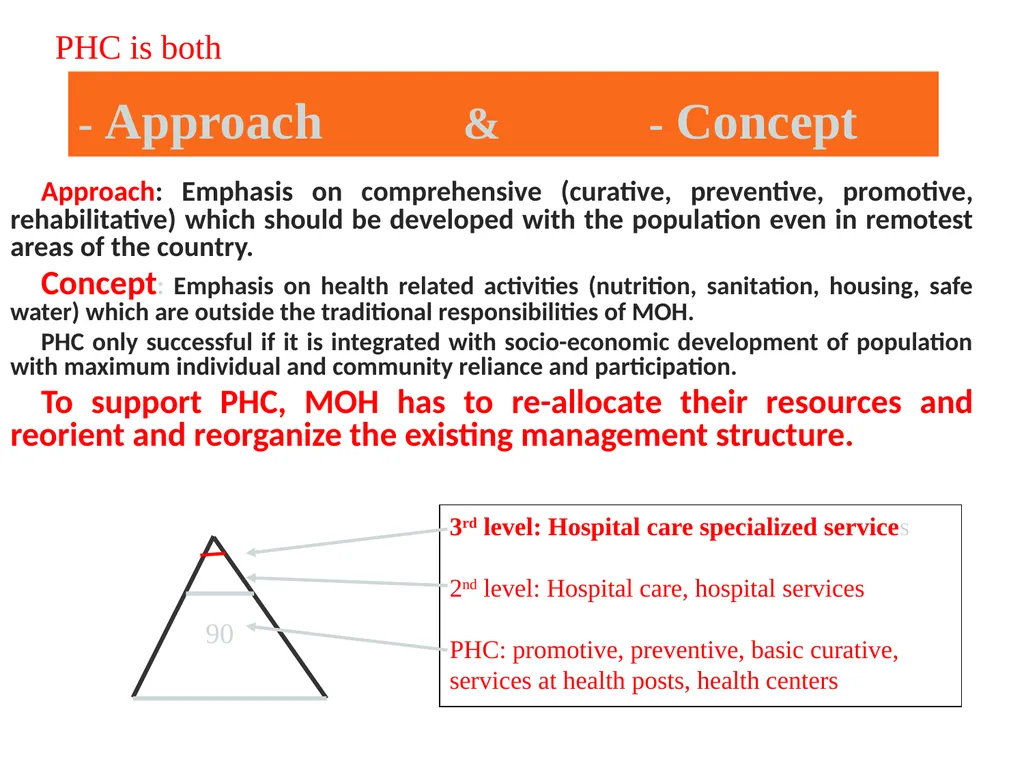
Approach: Emphasis on comprehensive (curative, preventive, promotive, rehabilitative) which should be developed with the population even in remotest areas of the country.
Concept: Emphasis on health related activities (nutrition, sanitation, housing, safe water) which are outside the traditional responsibilities of MOH.
PHC only successful if it is integrated with socio-economic development of population with maximum individual and community reliance and participation.
To support PHC, MOH has to re-allocate their resources and reorient and reorganize the existing management structure. PHC is both - Approach & - Concept 3rd level: Hospital care specialized services
2nd level: Hospital care, hospital services
PHC: promotive, preventive, basic curative, services at health posts, health centers<br>
Concept: Emphasis on health related activities (nutrition, sanitation, housing, safe water) which are outside the traditional responsibilities of MOH.
PHC only successful if it is integrated with socio-economic development of population with maximum individual and community reliance and participation.
To support PHC, MOH has to re-allocate their resources and reorient and reorganize the existing management structure. PHC is both - Approach & - Concept 3rd level: Hospital care specialized services
2nd level: Hospital care, hospital services
PHC: promotive, preventive, basic curative, services at health posts, health centers<br>
08
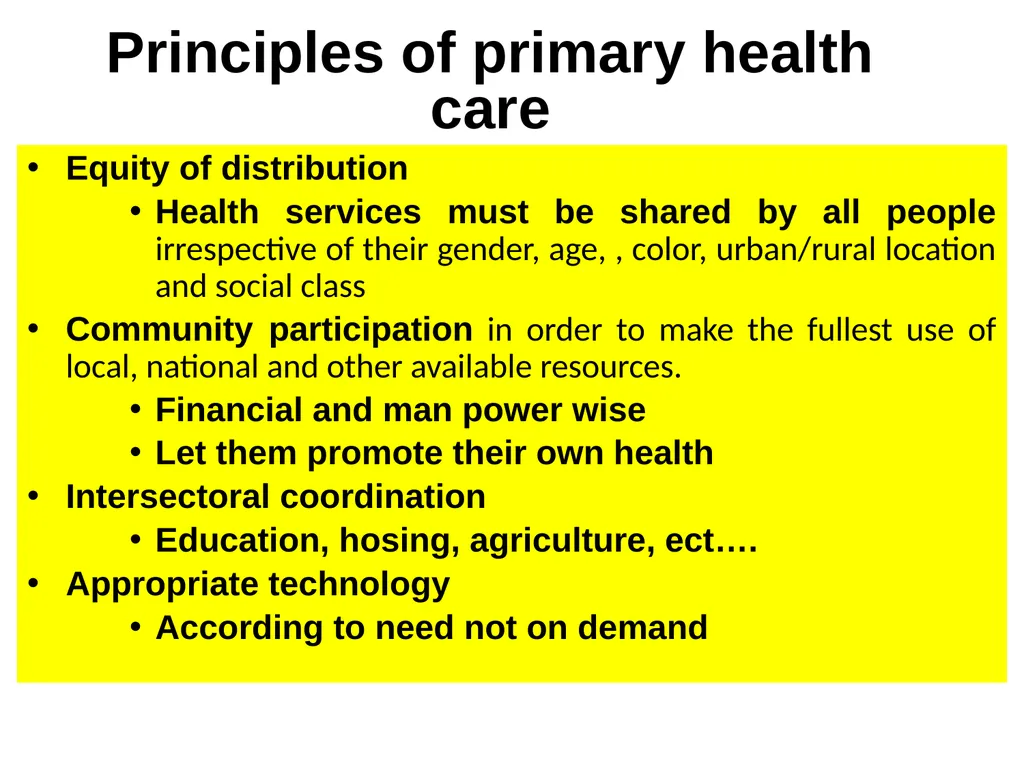
Principles of primary health care Equity of distribution
Health services must be shared by all people irrespective of their gender, age, , color, urban/rural location and social class
Community participation in order to make the fullest use of local, national and other available resources.
Financial and man power wise
Let them promote their own health
Intersectoral coordination
Education, hosing, agriculture, ect….
Appropriate technology
According to need not on demand<br>
Health services must be shared by all people irrespective of their gender, age, , color, urban/rural location and social class
Community participation in order to make the fullest use of local, national and other available resources.
Financial and man power wise
Let them promote their own health
Intersectoral coordination
Education, hosing, agriculture, ect….
Appropriate technology
According to need not on demand<br>
09
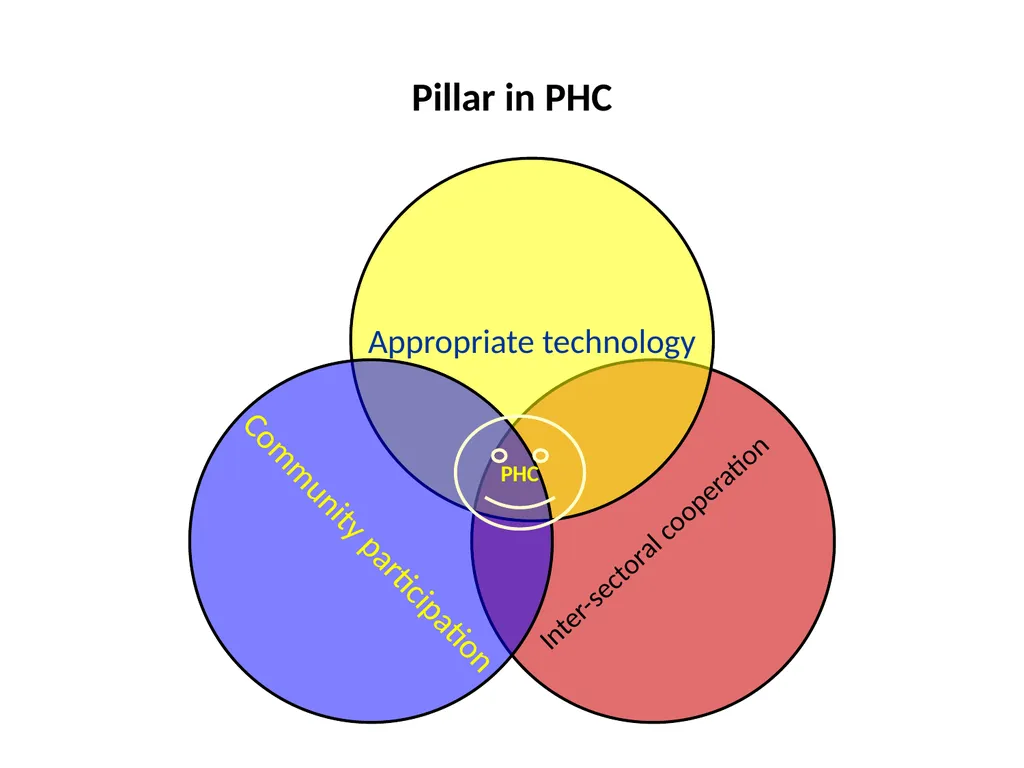
Pillar in PHC Inter-sectoral cooperation Appropriate technology Community participation PHC<br>
10
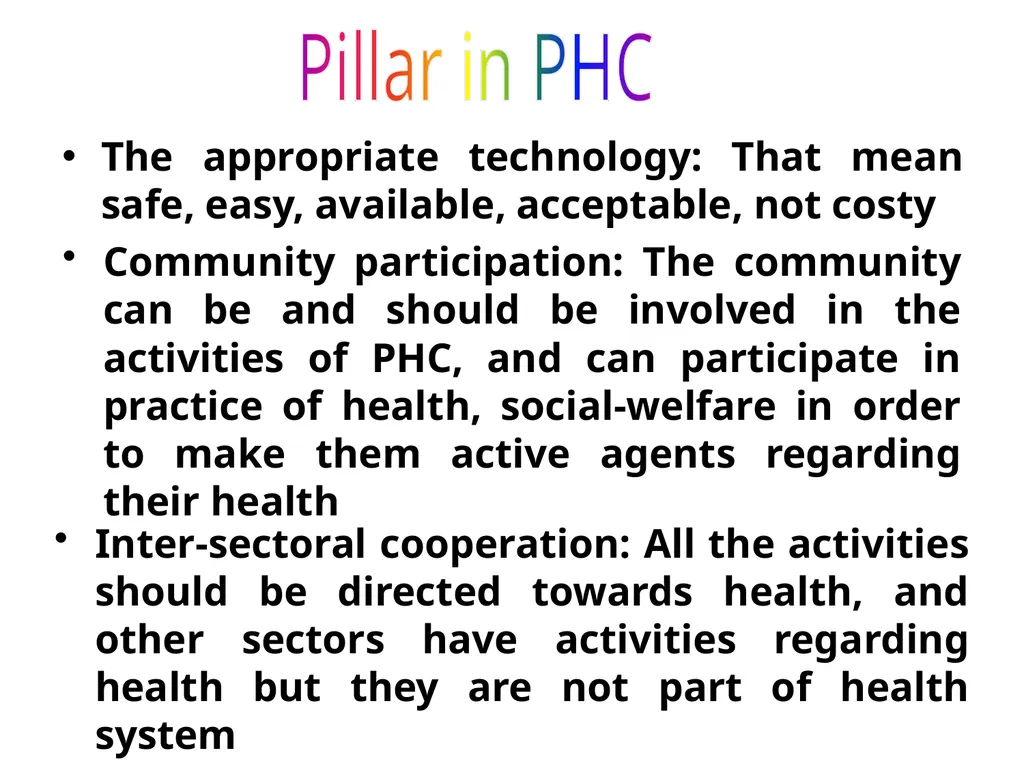
The appropriate technology: That mean safe, easy, available, acceptable, not costy Community participation: The community can be and should be involved in the activities of PHC, and can participate in practice of health, social-welfare in order to make them active agents regarding their health Inter-sectoral cooperation: All the activities should be directed towards health, and other sectors have activities regarding health but they are not part of health system Pillar in PHC<br>
11
Agriculture:
*Investing in small-holder agriculture
*Recognizing and supporting the role of women in food production
*Incorporating nutrition promotive activities into agriculture project
*Planning for adequate food production and not only cash crops Water:
*Investing in water development and ensuring easy access
*Planning for adequate water for household use as
well as cattle, irrigation and industry Commerce & Industry:
*Equitable supply of food & drugs
*Regulating price Planning for industrial production of basic necessities (clothing, milling, cement, hard wave)
*Planning establishment of health related industry (pharmaceuticals, equipment) Communication & Transport:
*Planning for infrastructure of roads and communication network
*Supporting community self-help projects for feeder roads
*Investing in radio programs for distance learning Education:
*Planning for training of requisite to number and type of health workers, agriculture, and water technicians
*Curriculum development and reform in training institutions
*Supporting health education and child to child programs in schools
*|Promoting literacy programs especially functional literacy
*Investing in the production of relevant texts for all health education activities PHC<br>
12
Safe water supply sector
Sewage disposal sector
Refusal disposal sector
Electricity supply sector
Ministry of Trade food, supply, and equipments
Ministry of Education raise the general level of education in the community, eradicate illiteracy, as the educated population value health and maintain health better than illiterate population
Ministry of Agriculture Food, fresh vegetables, and fruits etc..
Ministry of Higher Educations graduating doctors, engineers, etc...
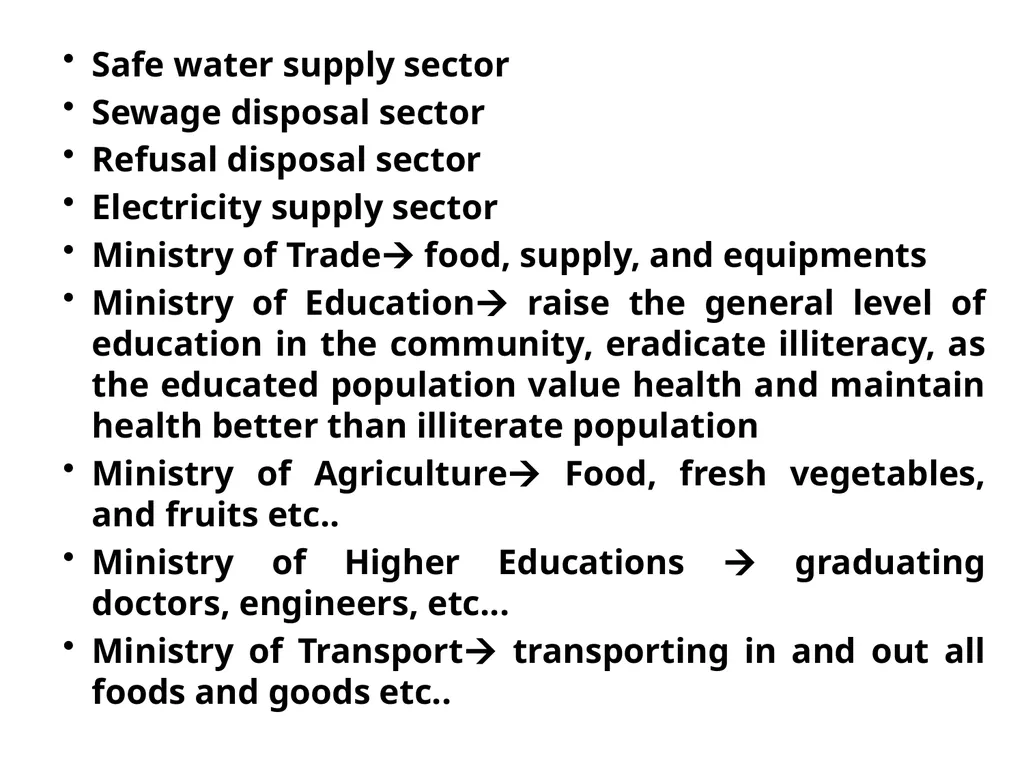
Ministry of Transport transporting in and out all foods and goods etc..<br>
Sewage disposal sector
Refusal disposal sector
Electricity supply sector
Ministry of Trade food, supply, and equipments
Ministry of Education raise the general level of education in the community, eradicate illiteracy, as the educated population value health and maintain health better than illiterate population
Ministry of Agriculture Food, fresh vegetables, and fruits etc..
Ministry of Higher Educations graduating doctors, engineers, etc...
Ministry of Transport transporting in and out all foods and goods etc..<br>
13
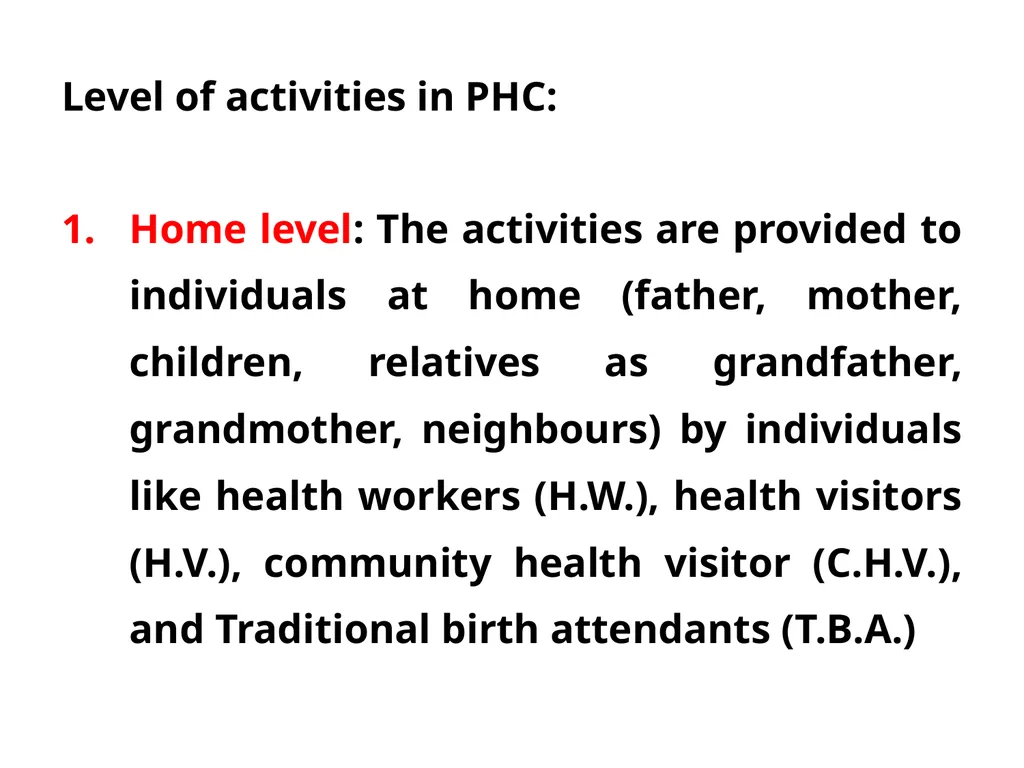
Level of activities in PHC: Home level: The activities are provided to individuals at home (father, mother, children, relatives as grandfather, grandmother, neighbours) by individuals like health workers (H.W.), health visitors (H.V.), community health visitor (C.H.V.), and Traditional birth attendants (T.B.A.)<br>
14
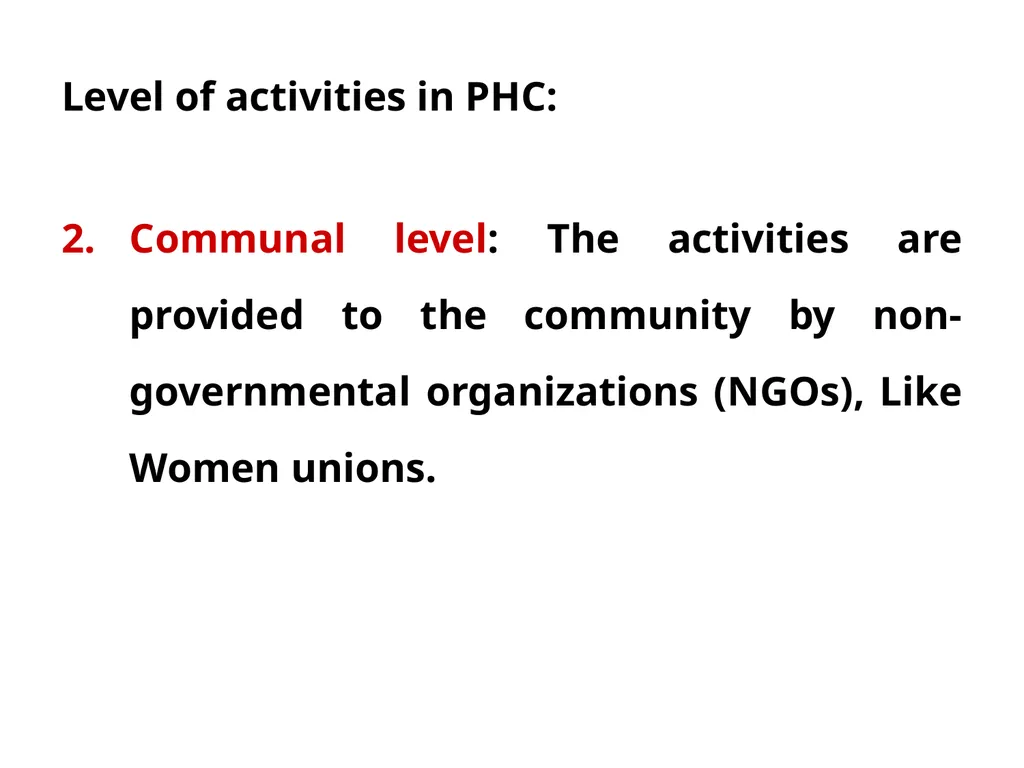
Level of activities in PHC: Communal level: The activities are provided to the community by non-governmental organizations (NGOs), Like Women unions.<br>
15
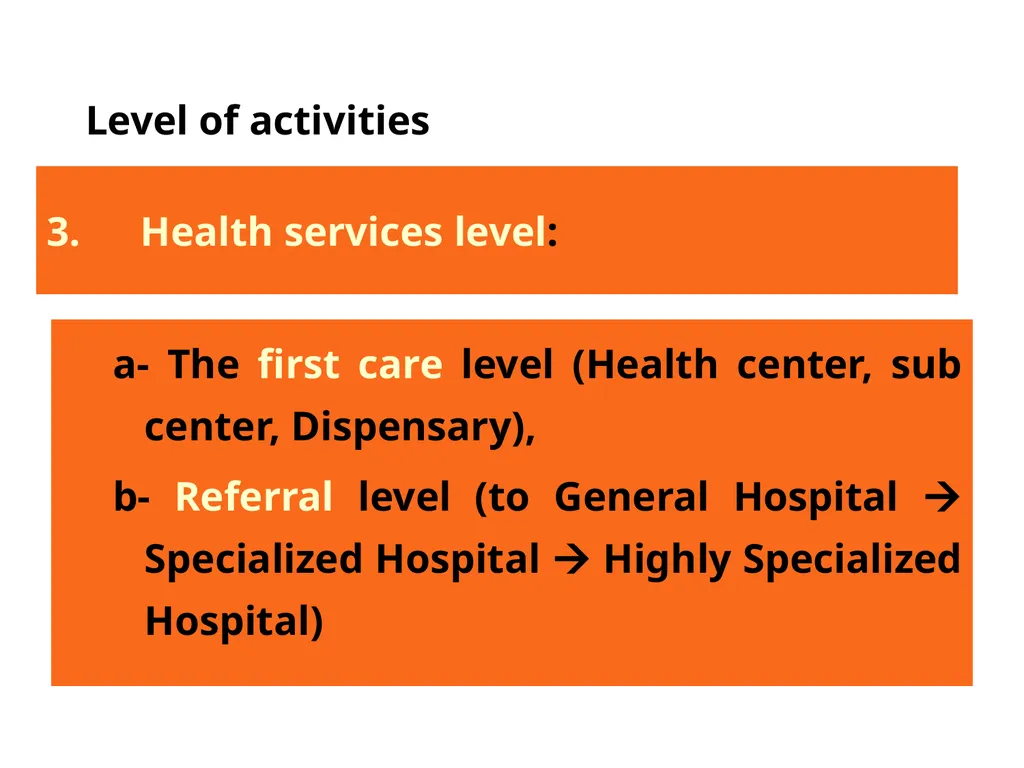
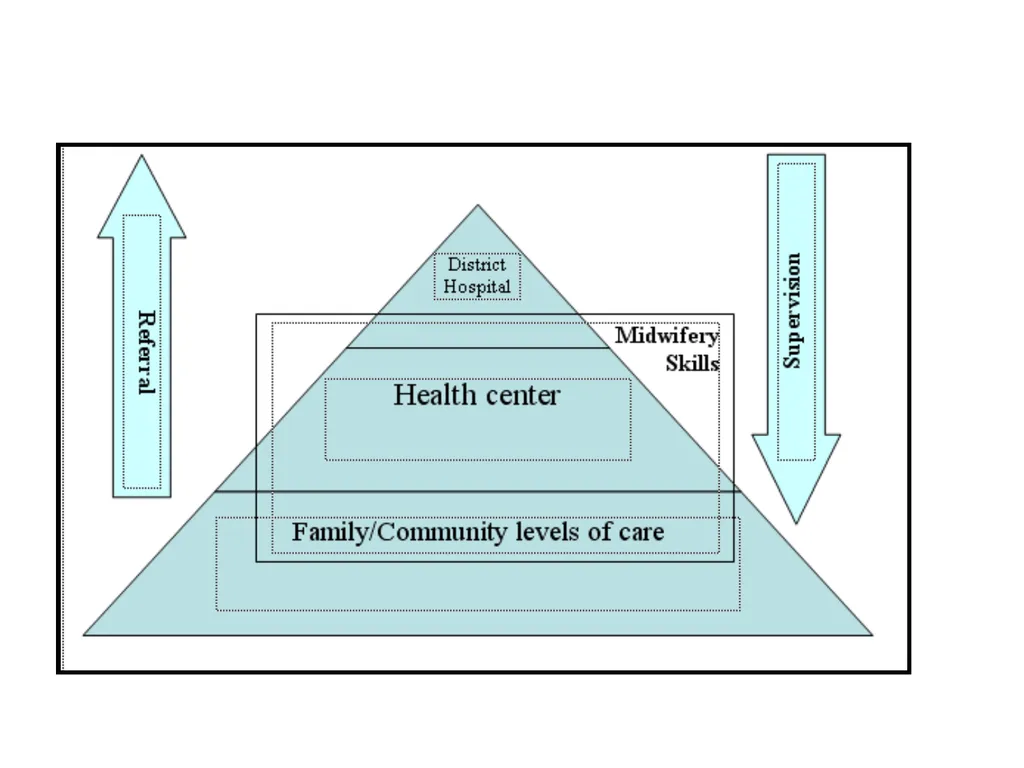
Health services level: a- The first care level (Health center, sub center, Dispensary),
b- Referral level (to General Hospital Specialized Hospital Highly Specialized Hospital) Level of activities<br>
b- Referral level (to General Hospital Specialized Hospital Highly Specialized Hospital) Level of activities<br>
16
The ultimate goal of primary health care is better health for all. The WHO has identified five key elements to achieving that goal:[5]
reducing exclusion and social disparities in health (universal coverage reforms);<br>
reducing exclusion and social disparities in health (universal coverage reforms);<br>
17
organizing health services around people's needs and expectations (service delivery reforms);
integrating health into all sectors (public policy reforms);
pursuing collaborative models of policy dialogue (leadership reforms); and
increasing stakeholder participation<br>
integrating health into all sectors (public policy reforms);
pursuing collaborative models of policy dialogue (leadership reforms); and
increasing stakeholder participation<br>
18
Different primary health care approaches have evolved in different contexts to account for differences in availability of resources and local priority health problems<br>
19
One selective PHC approach is referred to collectively under the acronym “GOBI-FFF”. These are strategies that are being adopted to improve maternal and child health as part of primary care, especially in
low income countries burdened with high infant and child mortality Respectively they include[<br>
low income countries burdened with high infant and child mortality Respectively they include[<br>
20
Growth monitoring - to prevent most child malnutrition before it begins
ORT to combat dehydration associated with diarrhea .
Breast Feeding
Immunization<br>
ORT to combat dehydration associated with diarrhea .
Breast Feeding
Immunization<br>
21
Family Planning (birth spacing)
Female Education
Food supplementation - e.g. iron and folic acid fortification/supplementation to prevent deficiencies in pregnant women<br>
Female Education
Food supplementation - e.g. iron and folic acid fortification/supplementation to prevent deficiencies in pregnant women<br>
22
PHC and population ageing
Given global demographic trends, with the numbers of people aged 60 and over expected to double by 2025, PHC approaches have taken into account the need for countries to address the consequences of population ageing.<br>
Given global demographic trends, with the numbers of people aged 60 and over expected to double by 2025, PHC approaches have taken into account the need for countries to address the consequences of population ageing.<br>
23
In particular, in the future the majority of older people will be living in developing countries that are often the least prepared to confront the challenges of rapidly ageing societies, including high risk of having at least one chronic non-communicable disease, such as diabetes and osteoporosis. According to WHO, dealing with this increasing burden requires health promotion and disease prevention intervention at community level as well as disease management strategies within health care systems<br>
24
PHC and mental health
apply PHC principles in planning and managing mental health problems (for the detection, diagnosis and treatment) of common mental health conditions at local clinics, and organizing the referral of more complicated mental health problems to more appropriate levels of mental health care.
According to World Health Organization, mental health disorders are the fourth leading cause of ill health in Iraqis over the age of 5 years.<br>
apply PHC principles in planning and managing mental health problems (for the detection, diagnosis and treatment) of common mental health conditions at local clinics, and organizing the referral of more complicated mental health problems to more appropriate levels of mental health care.
According to World Health Organization, mental health disorders are the fourth leading cause of ill health in Iraqis over the age of 5 years.<br>
25
Maternal mental health
Worldwide about 10% of pregnant women and 13% of women who have just given birth experience a mental disorder, primarily depression. In developing countries this is even higher, i.e. 15.6% during pregnancy and 19.8% after child birth. In severe cases mothers’ suffering might be so severe that they may even commit suicide. In addition, the affected mothers cannot function properly. As a result, the children’s growth and development may be negatively affected as well. Maternal mental disorders are treatable. Effective interventions can be delivered even by well-trained non-specialist health providers.<br>
Worldwide about 10% of pregnant women and 13% of women who have just given birth experience a mental disorder, primarily depression. In developing countries this is even higher, i.e. 15.6% during pregnancy and 19.8% after child birth. In severe cases mothers’ suffering might be so severe that they may even commit suicide. In addition, the affected mothers cannot function properly. As a result, the children’s growth and development may be negatively affected as well. Maternal mental disorders are treatable. Effective interventions can be delivered even by well-trained non-specialist health providers.<br>
26
Child and adolescent mental health
Worldwide 10-20% of children and adolescents experience mental disorders. Neuropsychiatric conditions are the leading cause of disability in young people in all regions. If untreated, these conditions severely influence children’s development, their educational attainments and their potential to live fulfilling and productive lives.<br>
Worldwide 10-20% of children and adolescents experience mental disorders. Neuropsychiatric conditions are the leading cause of disability in young people in all regions. If untreated, these conditions severely influence children’s development, their educational attainments and their potential to live fulfilling and productive lives.<br>
27
Providing mental health services in primary healthcare involve:- :
1. diagnosing and treating people with mental disorders.
2. putting in place strategies to prevent mental disorders .
3. Ensuring that primary healthcare workers are able to apply key psychosocial and behavioral science skills,
for example, interviewing, counseling and interpersonal skills, in their day to day work in order to improve overall health outcomes in primary healthcare.<br>
1. diagnosing and treating people with mental disorders.
2. putting in place strategies to prevent mental disorders .
3. Ensuring that primary healthcare workers are able to apply key psychosocial and behavioral science skills,
for example, interviewing, counseling and interpersonal skills, in their day to day work in order to improve overall health outcomes in primary healthcare.<br>
28
A good health system delivers quality services to all people, when and where they need them. The exact configuration of services varies from country to country, but in all cases requires a robust financing mechanism; a well-trained and adequately paid workforce; reliable information on which to base decisions and policies; well maintained facilities and logistics to deliver quality medicines and technologies.<br>
29
A well functioning health system responds in a balanced way to a population’s needs and expectations by:
Improving the health status of individuals, families and communities
Defending the population against what threatens its health<br>
Improving the health status of individuals, families and communities
Defending the population against what threatens its health<br>
30
Protecting people against the financial consequences of ill-health
Providing equitable access to people-centered care
Making it possible for people to participate in decisions affecting their health and health system<br>
Providing equitable access to people-centered care
Making it possible for people to participate in decisions affecting their health and health system<br>