
Assumptions of Physics Project overview Gabriele
LS
Published · 35 slides · 0 views

1 / 1



Description
Assumptions of Physics Project overview Gabriele Carcassi and Christine A. Aidala Physics Department University of Michigan Main goal of the project Identify a handful of physical starting points from which the basic laws can be rigorously
Related Topics
Share
Embed code
Download this presentation From Below
"Assumptions of Physics Project overview Gabriele" is the property of its rightful owner. Permission is granted to download and print the materials on this website for personal, non-commercial use only, and to display it on your personal computer provided you do not modify the materials and that you retain all copyright notices contained in the materials. By downloading content from our website, you accept the terms of this agreement.
Presentation Transcript
01
Assumptions of Physics Project overview Gabriele Carcassi and Christine A. Aidala
Physics Department University of Michigan<br>
Physics Department University of Michigan<br>
02
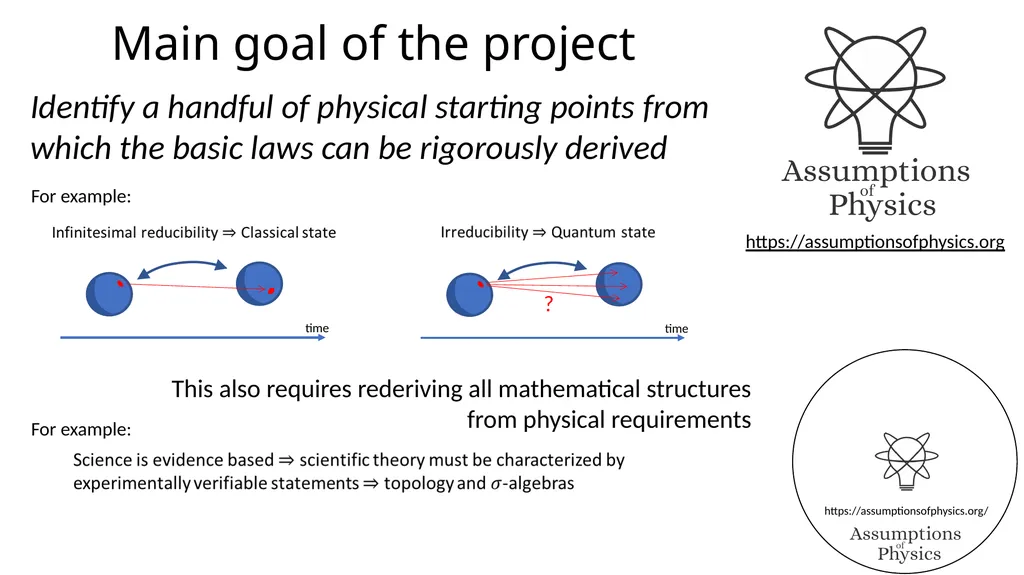
Main goal of the project Identify a handful of physical starting points from which the basic laws can be rigorously derived For example: This also requires rederiving all mathematical structures
from physical requirements For example:<br>
03
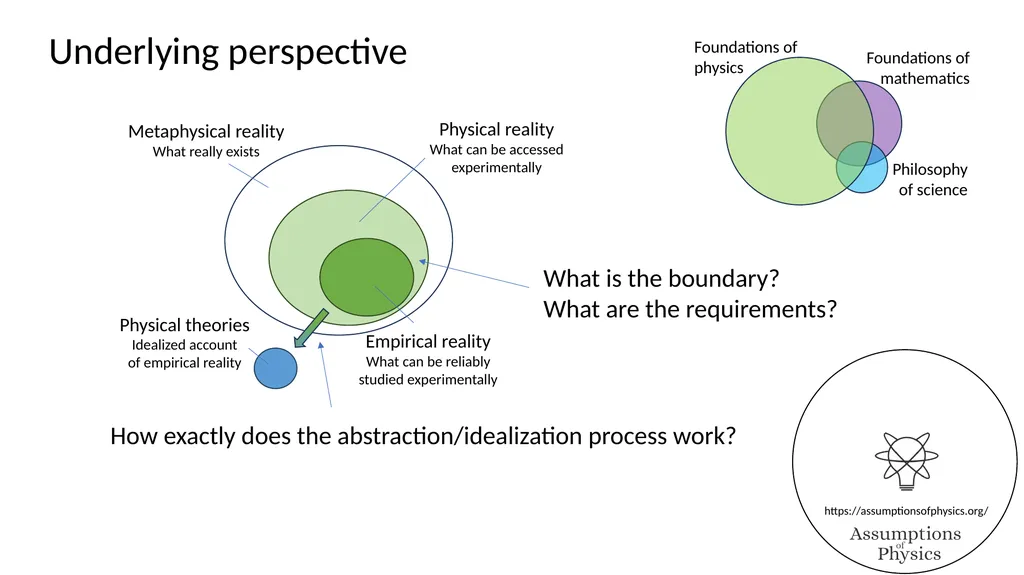
Underlying perspective What is the boundary?
What are the requirements? How exactly does the abstraction/idealization process work?<br>
What are the requirements? How exactly does the abstraction/idealization process work?<br>
04
If physics is about creating models of empirical reality, the foundations of physics should be a theory of models of empirical reality Requirements of experimental verification, assumptions of each theory, realm of validity of assumptions, …<br>
05
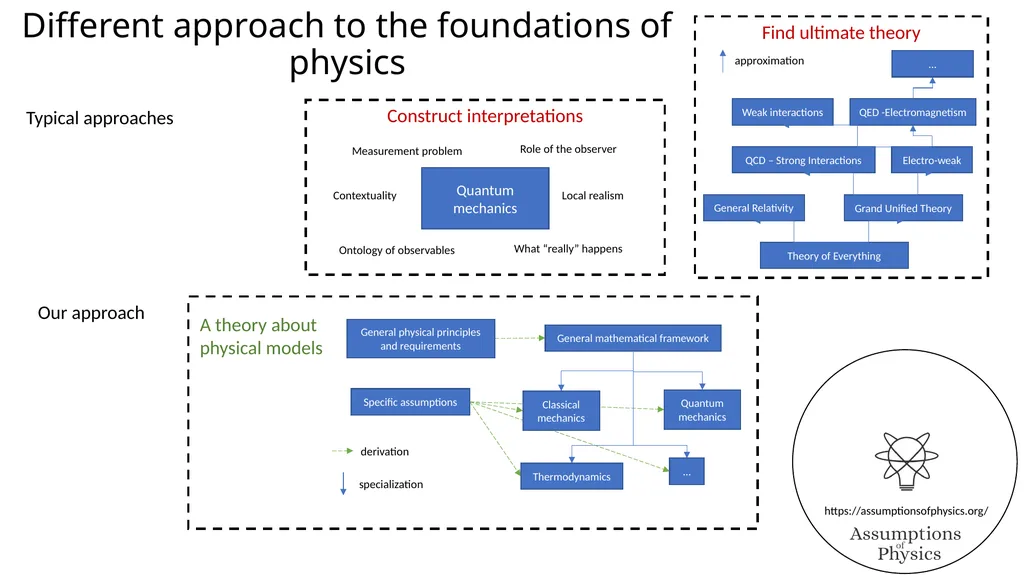
Typical approaches Our approach Different approach to the foundations of physics<br>
06
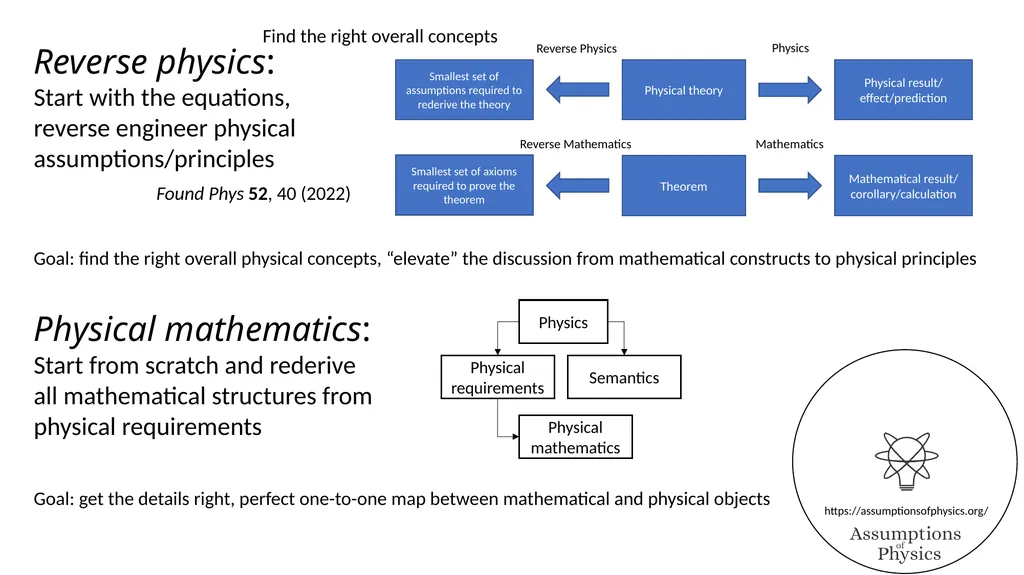
Reverse physics:
Start with the equations,
reverse engineer physical assumptions/principles Goal: find the right overall physical concepts, “elevate” the discussion from mathematical constructs to physical principles Physical mathematics: Start from scratch and rederive all mathematical structures from physical requirements Goal: get the details right, perfect one-to-one map between mathematical and physical objects Found Phys 52, 40 (2022) Find the right overall concepts<br>
07
Reverse Physics J. Phys. Commun. 2 045026 (2018) Assumptions of Physics,
Michigan Publishing (v2 2023)<br>
08
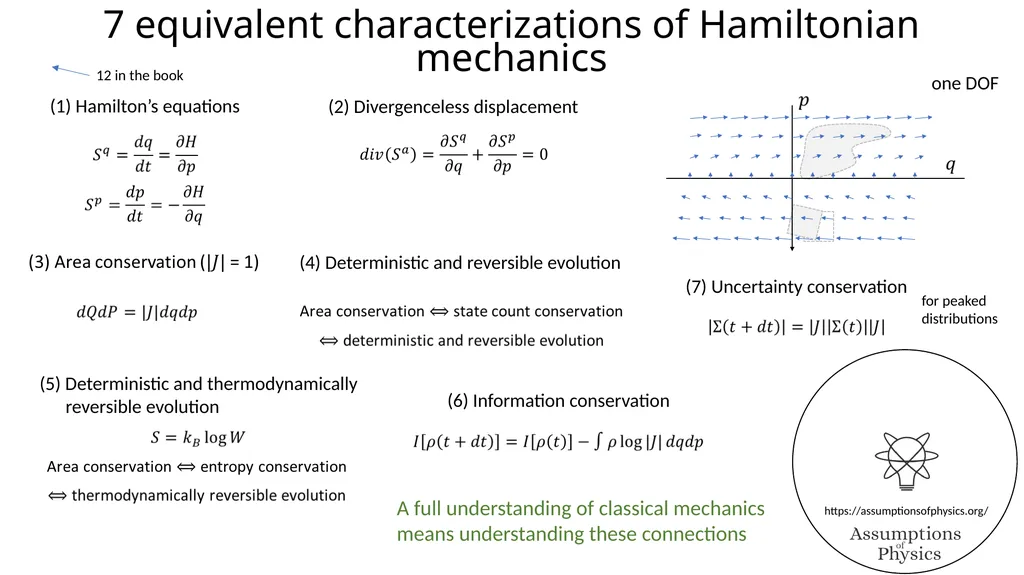
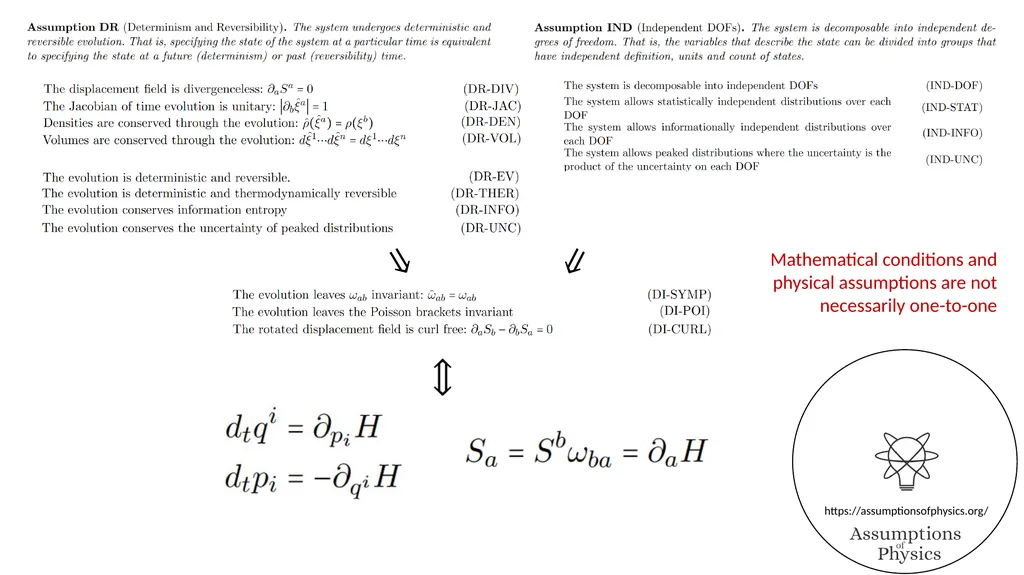
7 equivalent characterizations of Hamiltonian mechanics (1) Hamilton’s equations (2) Divergenceless displacement (4) Deterministic and reversible evolution A full understanding of classical mechanics means understanding these connections one DOF 12 in the book<br>
09
Mathematical conditions and physical assumptions are not necessarily one-to-one<br>
10
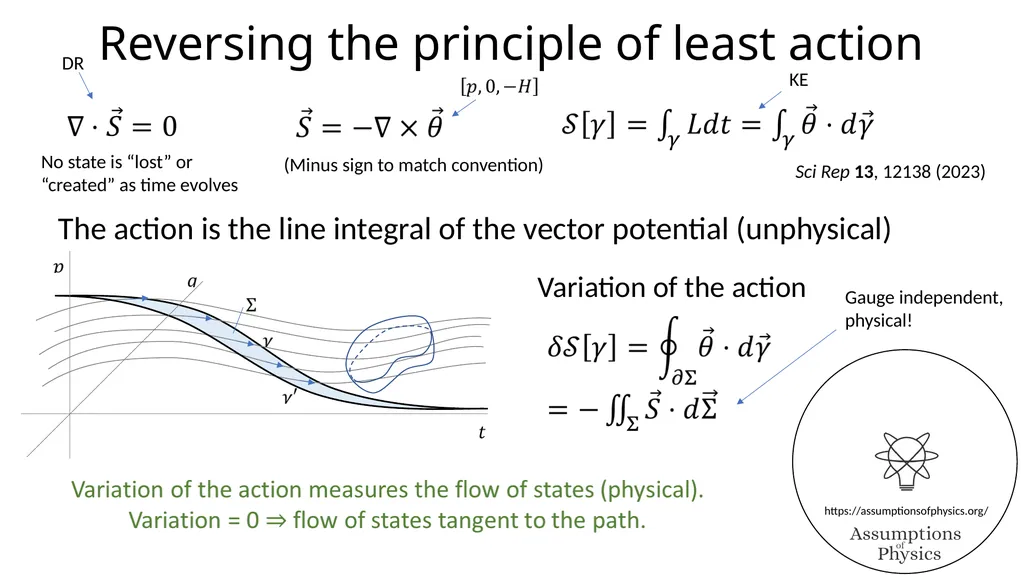
Reversing the principle of least action The action is the line integral of the vector potential (unphysical) No state is “lost” or “created” as time evolves (Minus sign to match convention) DR KE Sci Rep 13, 12138 (2023)<br>
11
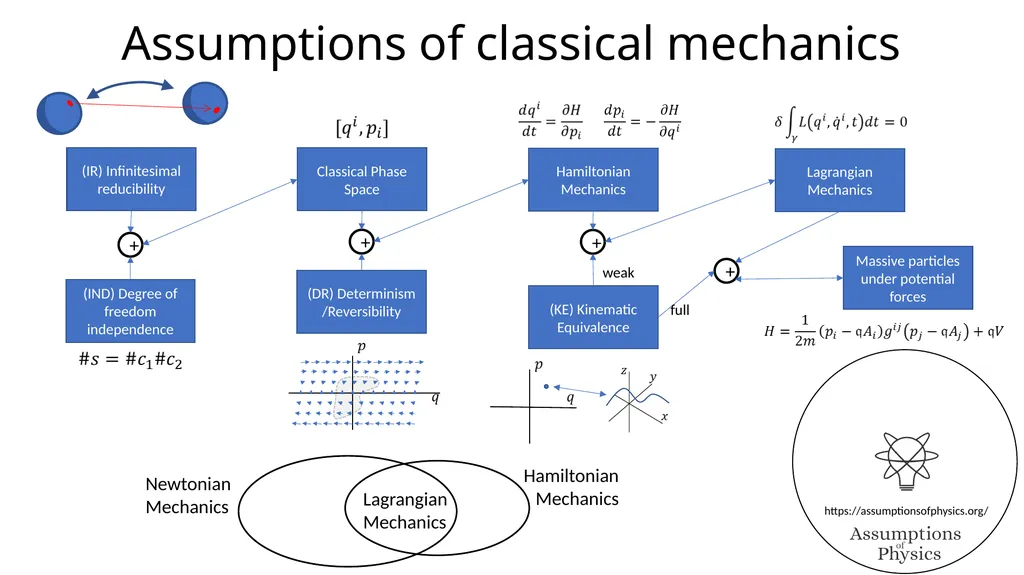
Assumptions of classical mechanics (IR) Infinitesimal reducibility (IND) Degree of freedom independence Hamiltonian
Mechanics (DR) Determinism
/Reversibility Classical Phase Space (KE) Kinematic Equivalence Lagrangian
Mechanics Massive particles under potential forces + + + weak + full<br>
12
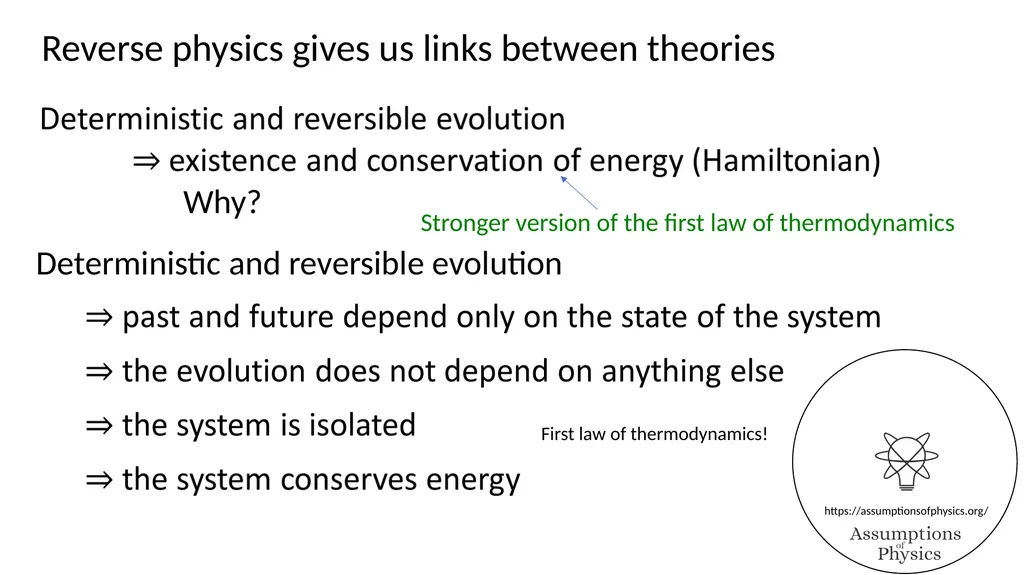
Reverse physics gives us links between theories Why? Deterministic and reversible evolution Stronger version of the first law of thermodynamics First law of thermodynamics!<br>
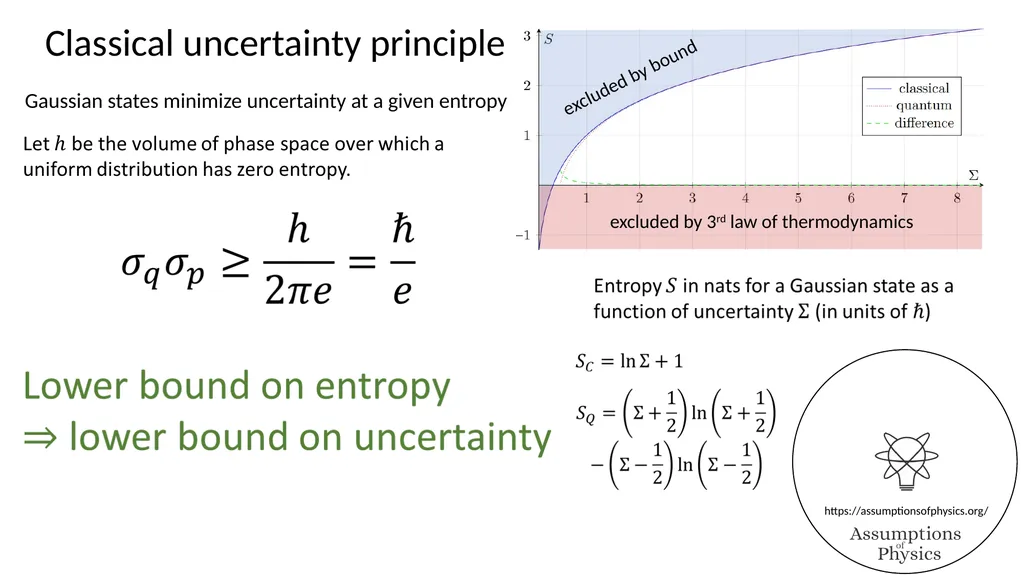
13
Classical uncertainty principle Gaussian states minimize uncertainty at a given entropy excluded by bound excluded by 3rd law of thermodynamics<br>
14
3rd law of thermodynamics and uncertainty principle Uncertainty principle Quantum mechanics Lower bound on entropy Classical mechanics Third law of thermodynamics Principle of maximal description No state can describe a system more accurately
than stating the system is not there in the first place + The uncertainty principle is a consequence of the principle of maximal description Can we understand the rest of quantum mechanics in the same way?<br>
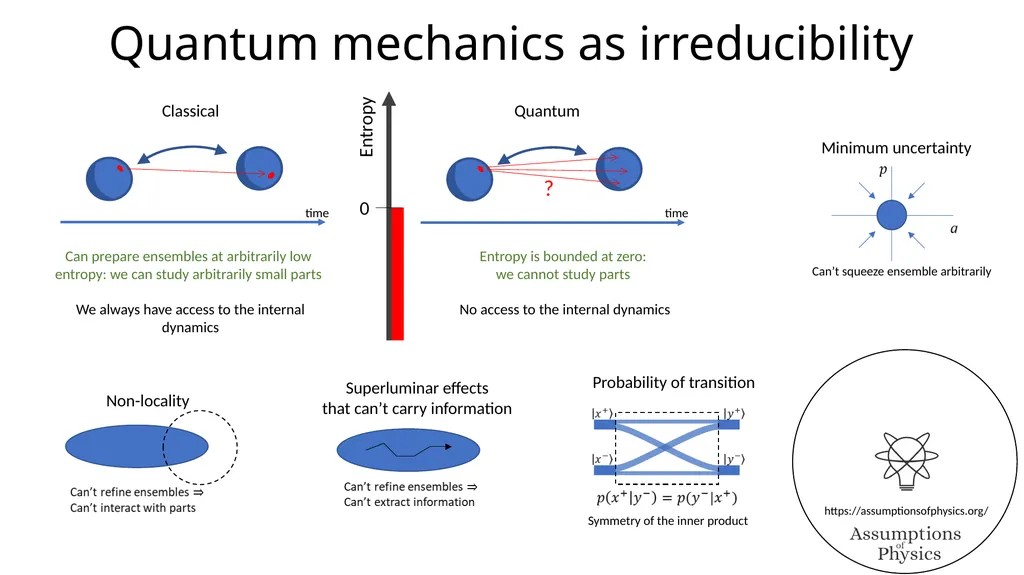
15
Quantum mechanics as irreducibility Classical Quantum We always have access to the internal dynamics Can prepare ensembles at arbitrarily low entropy: we can study arbitrarily small parts No access to the internal dynamics Entropy is bounded at zero:
we cannot study parts<br>
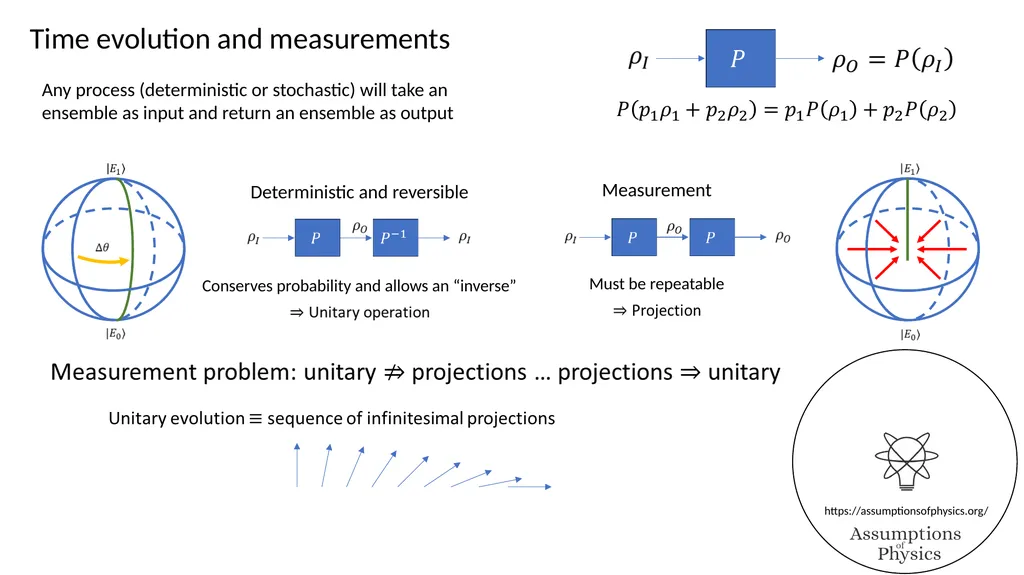
16
Any process (deterministic or stochastic) will take an ensemble as input and return an ensemble as output Unitary evolution is for det/rev, isolated processes
System being measured can’t be isolated Time evolution and measurements<br>
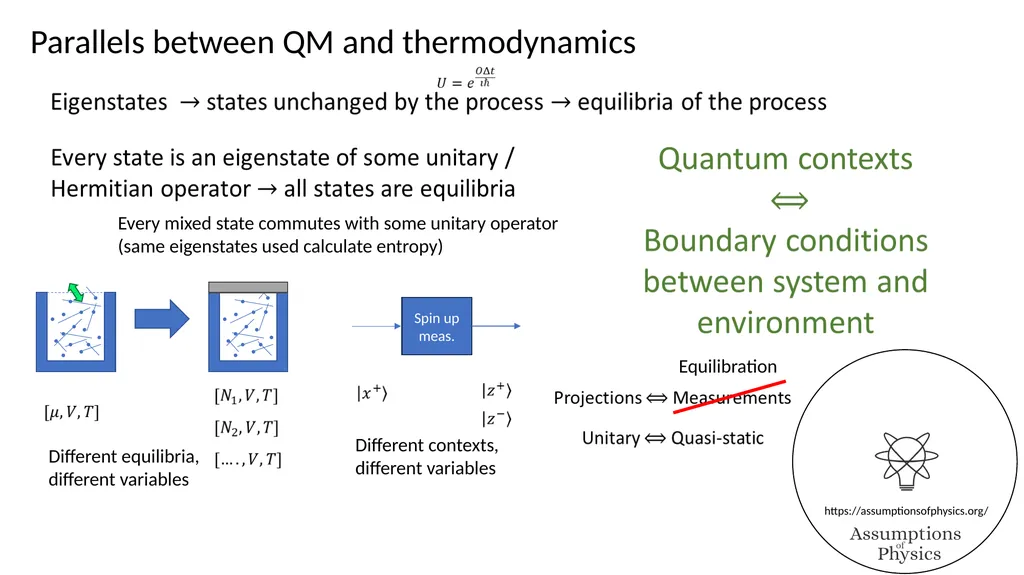
17
Parallels between QM and thermodynamics Every mixed state commutes with some unitary operator (same eigenstates used calculate entropy) Different equilibria,
different variables Different contexts,
different variables Equilibration<br>
18
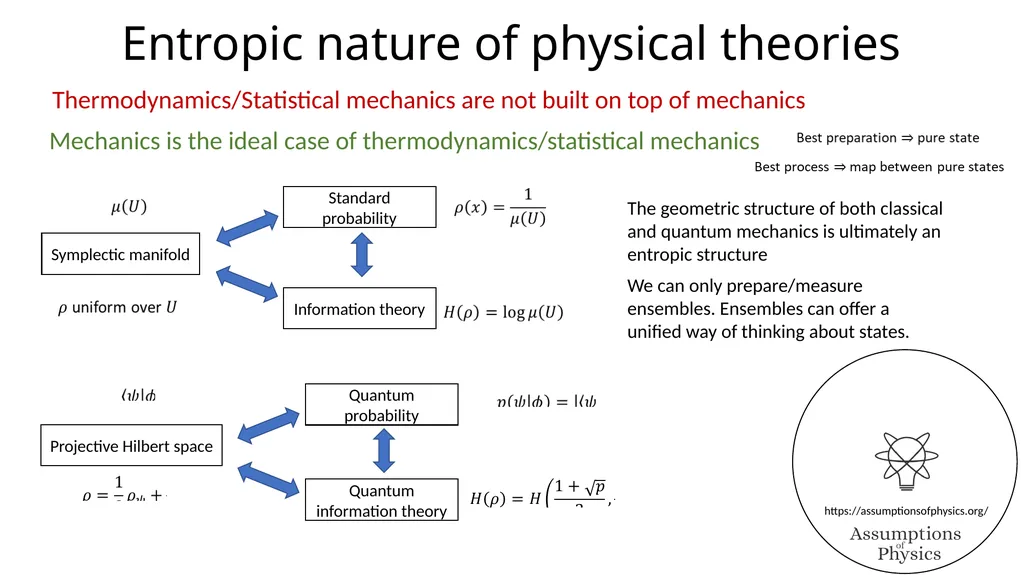
Entropic nature of physical theories Thermodynamics/Statistical mechanics are not built on top of mechanics Mechanics is the ideal case of thermodynamics/statistical mechanics The geometric structure of both classical and quantum mechanics is ultimately an entropic structure We can only prepare/measure ensembles. Ensembles can offer a unified way of thinking about states.<br>
19
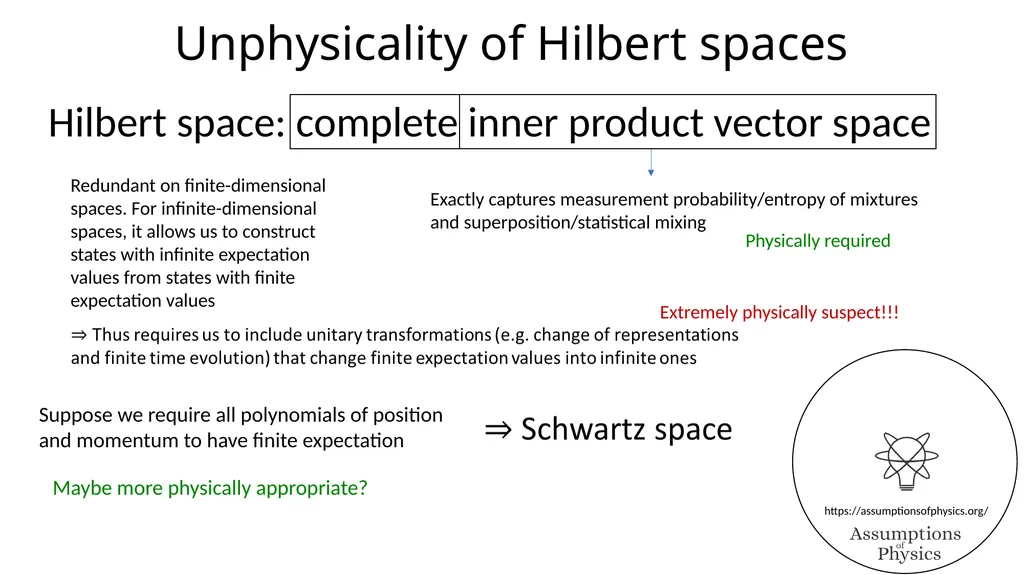
Unphysicality of Hilbert spaces Exactly captures measurement probability/entropy of mixtures and superposition/statistical mixing Physically required Hilbert space: complete inner product vector space Redundant on finite-dimensional spaces. For infinite-dimensional spaces, it allows us to construct states with infinite expectation values from states with finite expectation values Extremely physically suspect!!! Suppose we require all polynomials of position and momentum to have finite expectation Maybe more physically appropriate?<br>
20
Physical mathematics<br>
21
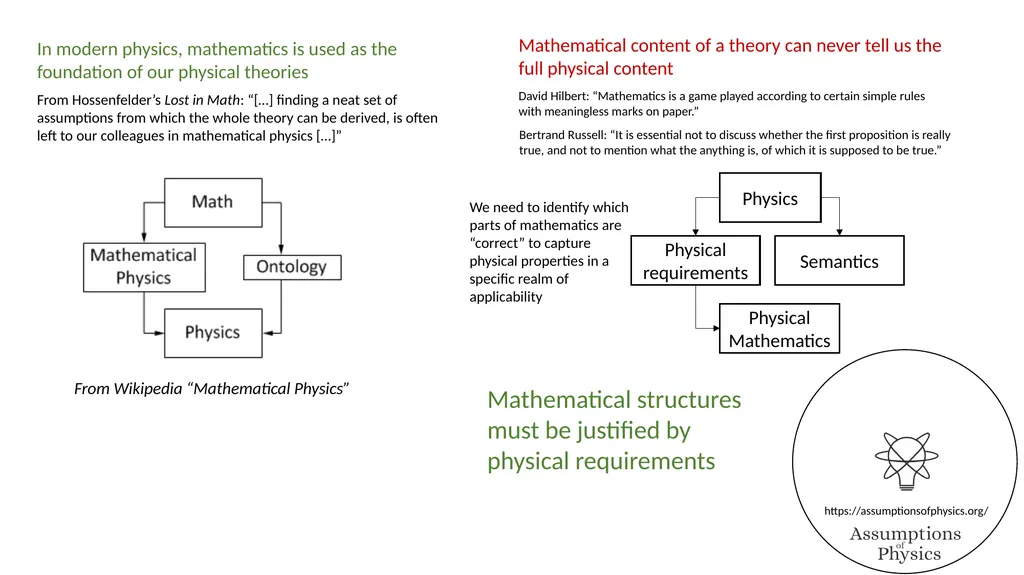
From Wikipedia “Mathematical Physics” In modern physics, mathematics is used as the foundation of our physical theories From Hossenfelder’s Lost in Math: “[…] finding a neat set of assumptions from which the whole theory can be derived, is often left to our colleagues in mathematical physics […]” David Hilbert: “Mathematics is a game played according to certain simple rules with meaningless marks on paper.” Bertrand Russell: “It is essential not to discuss whether the first proposition is really true, and not to mention what the anything is, of which it is supposed to be true.” Mathematical content of a theory can never tell us the full physical content Mathematical structures must be justified by physical requirements We need to identify which parts of mathematics are “correct” to capture physical properties in a specific realm of applicability<br>
22
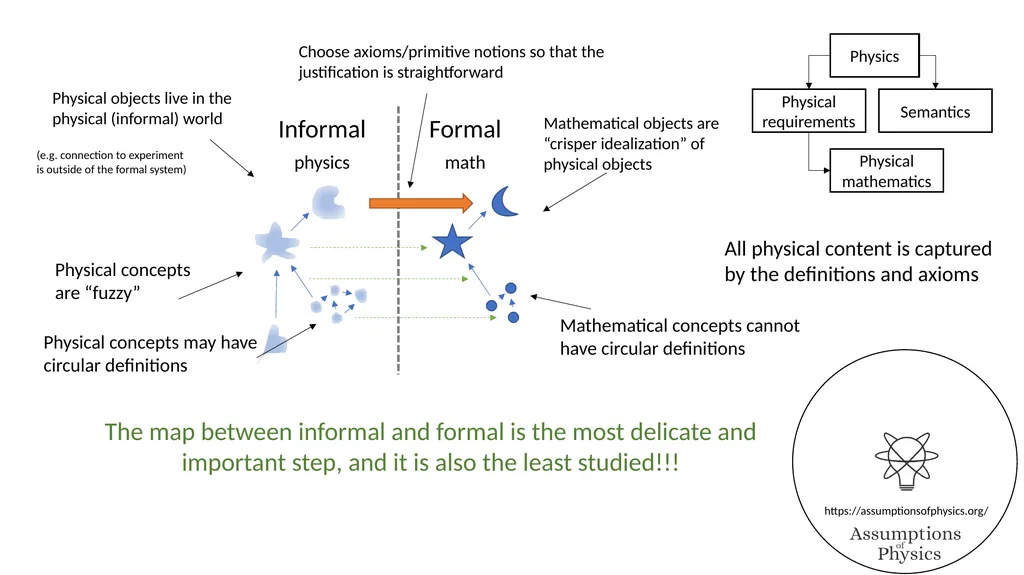
The map between informal and formal is the most delicate and important step, and it is also the least studied!!! All physical content is captured by the definitions and axioms Physical objects live in the
physical (informal) world (e.g. connection to experiment is outside of the formal system) Choose axioms/primitive notions so that the justification is straightforward Mathematical objects are “crisper idealization” of physical objects Physical concepts are “fuzzy” Physical concepts may have circular definitions Mathematical concepts cannot have circular definitions<br>
23
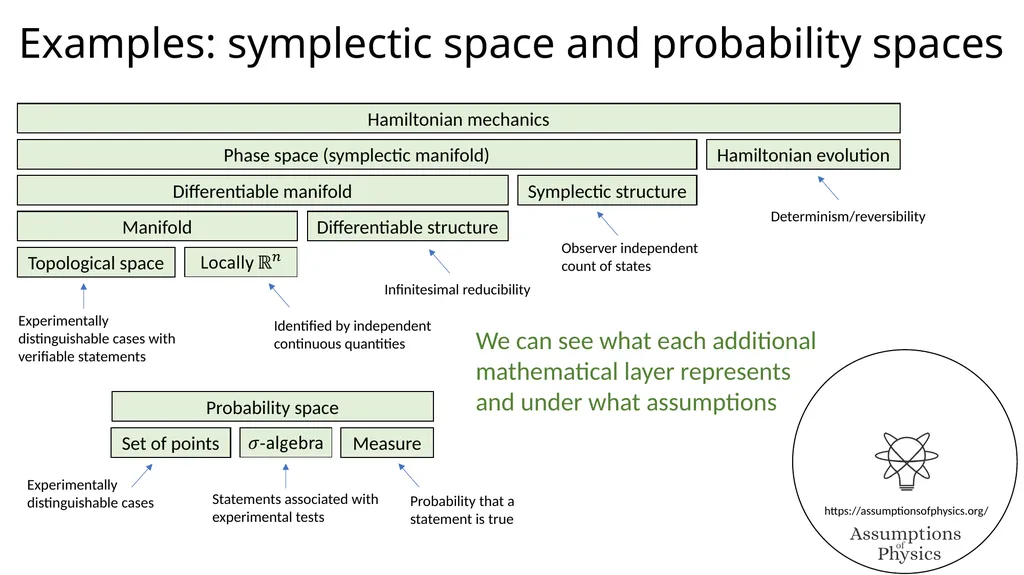
Examples: symplectic space and probability spaces Hamiltonian mechanics Phase space (symplectic manifold) Hamiltonian evolution Differentiable manifold Symplectic structure Manifold Differentiable structure Topological space Probability space Measure Set of points Experimentally distinguishable cases with verifiable statements Identified by independent continuous quantities Infinitesimal reducibility Observer independent count of states Determinism/reversibility Experimentally distinguishable cases Statements associated with experimental tests Probability that a statement is true We can see what each additional mathematical layer represents and under what assumptions<br>
24
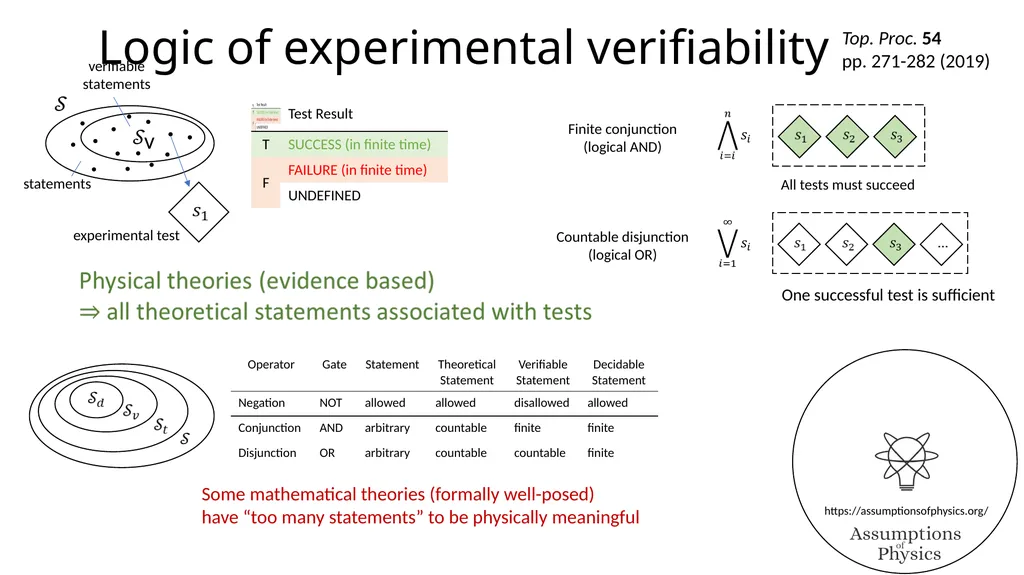
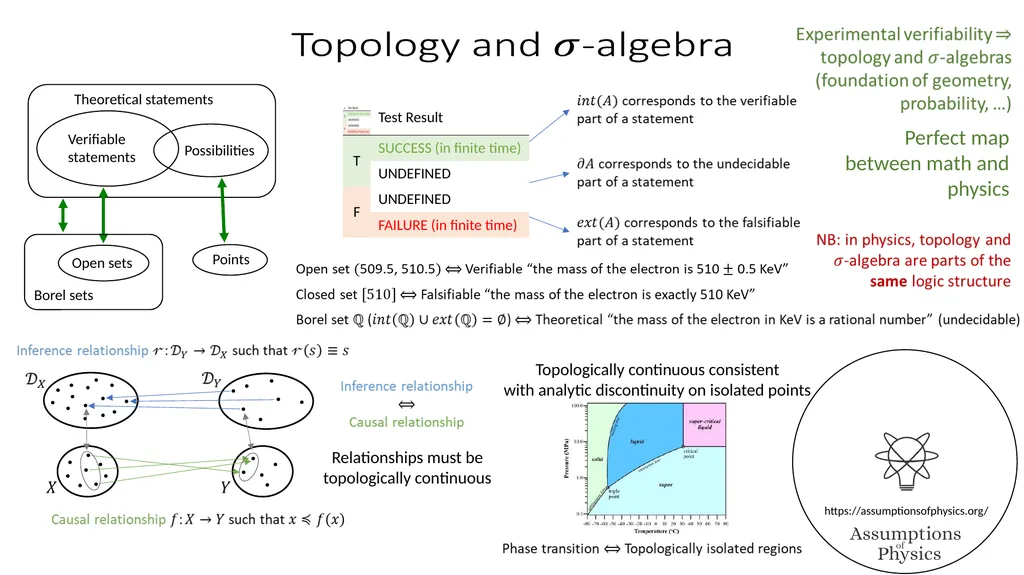
Logic of experimental verifiability experimental test All tests must succeed One successful test is sufficient statements verifiable
statements Finite conjunction
(logical AND) Countable disjunction
(logical OR) Some mathematical theories (formally well-posed)
have “too many statements” to be physically meaningful Top. Proc. 54
pp. 271-282 (2019)<br>
25
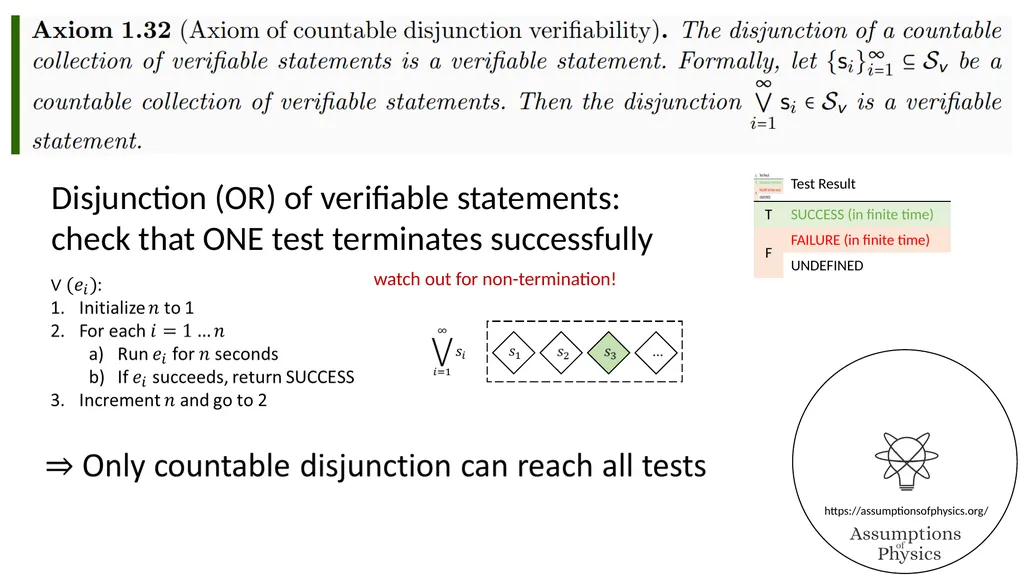
Disjunction (OR) of verifiable statements:
check that ONE test terminates successfully watch out for non-termination!<br>
26
Relationships must be
topologically continuous Topologically continuous consistent
with analytic discontinuity on isolated points Perfect map between math and physics<br>
27
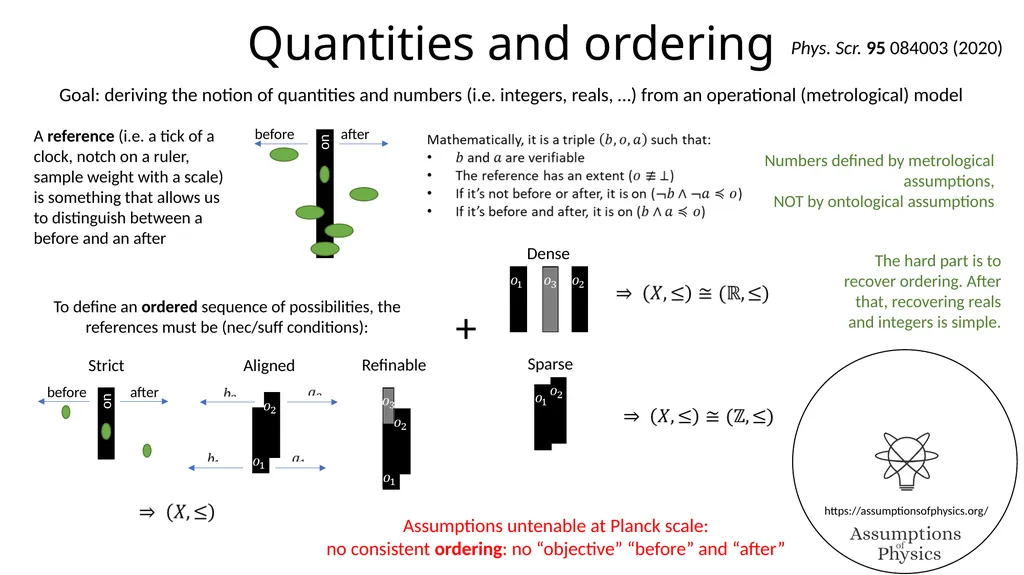
Quantities and ordering A reference (i.e. a tick of a clock, notch on a ruler, sample weight with a scale) is something that allows us to distinguish between a before and an after Goal: deriving the notion of quantities and numbers (i.e. integers, reals, …) from an operational (metrological) model To define an ordered sequence of possibilities, the references must be (nec/suff conditions): + Assumptions untenable at Planck scale:
no consistent ordering: no “objective” “before” and “after” Numbers defined by metrological assumptions,
NOT by ontological assumptions The hard part is to recover ordering. After that, recovering reals and integers is simple. Phys. Scr. 95 084003 (2020)<br>
28
Classical
phase-space Determinism/
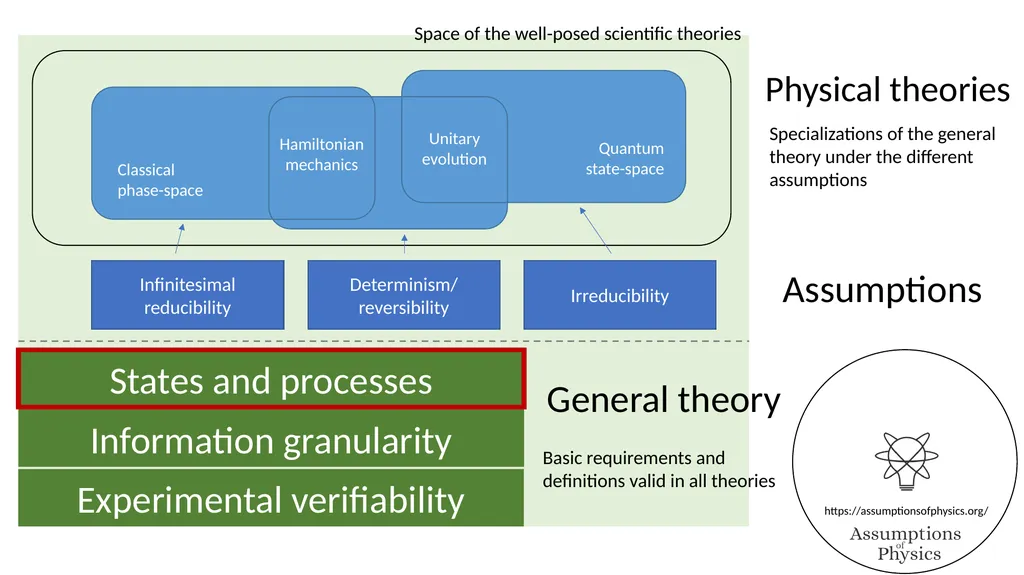
reversibility Irreducibility Infinitesimal reducibility Quantum state-space Hamiltonian mechanics Unitary evolution Space of the well-posed scientific theories Physical theories Specializations of the general theory under the different assumptions Assumptions General theory Basic requirements and definitions valid in all theories Experimental verifiability Information granularity States and processes<br>
reversibility Irreducibility Infinitesimal reducibility Quantum state-space Hamiltonian mechanics Unitary evolution Space of the well-posed scientific theories Physical theories Specializations of the general theory under the different assumptions Assumptions General theory Basic requirements and definitions valid in all theories Experimental verifiability Information granularity States and processes<br>
29
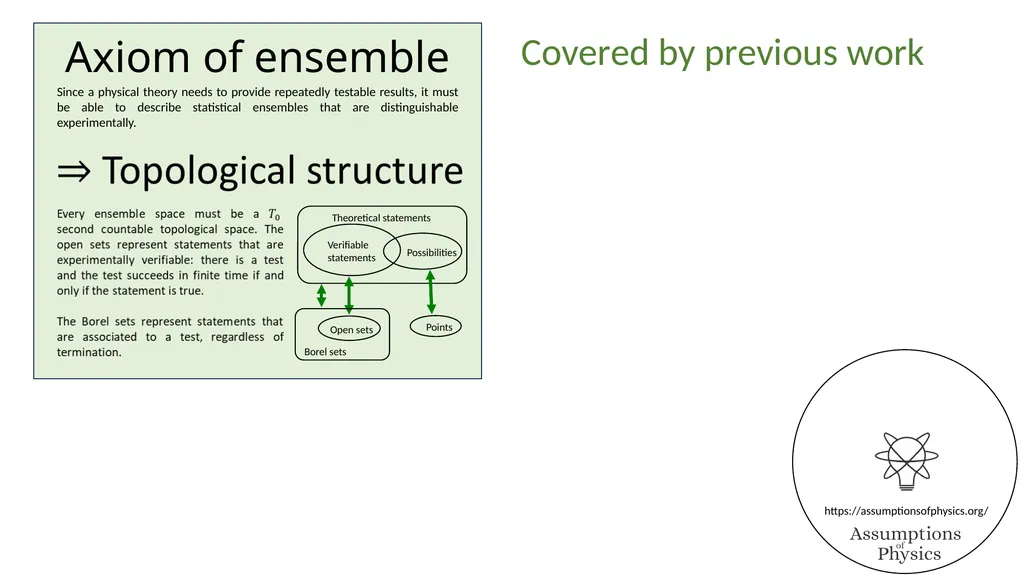
If physical theories are to be repeatably experimentally testable, then they must (at least) be able to describe statistical ensembles (i.e. outputs of repeatable procedures) If physical laws describe relationship that are always applicable (i.e. whenever this is prepared, this is measured), then they are statements about statistical ensembles<br>
30
Covered by previous work<br>
31
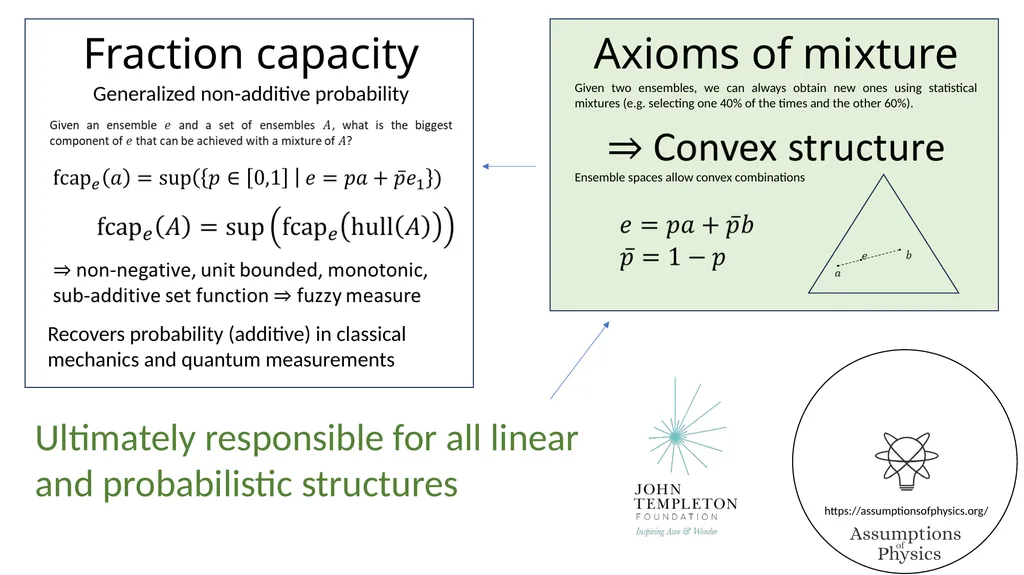
Ultimately responsible for all linear
and probabilistic structures<br>
32
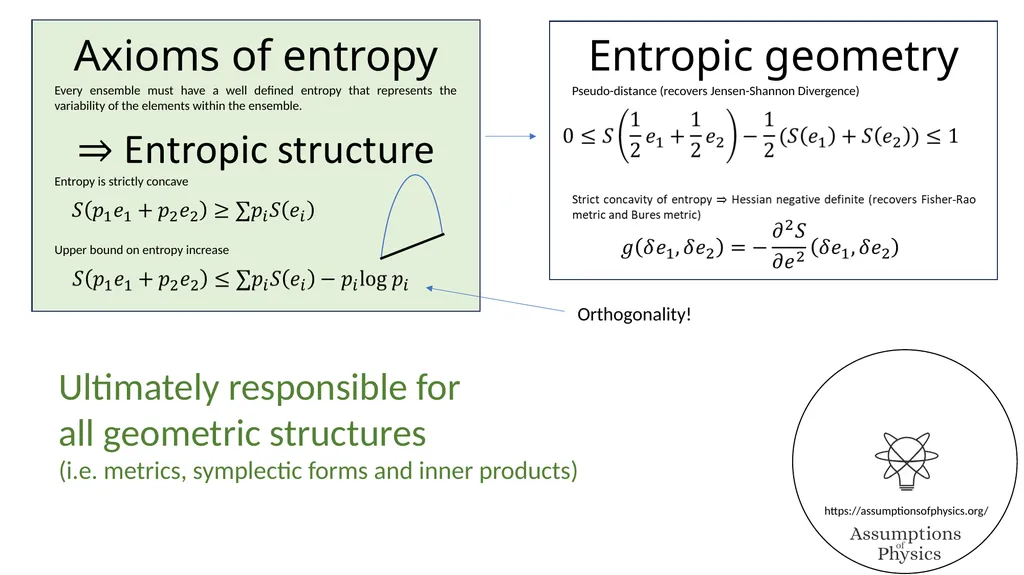
Ultimately responsible for
all geometric structures
(i.e. metrics, symplectic forms and inner products) Orthogonality!<br>
33
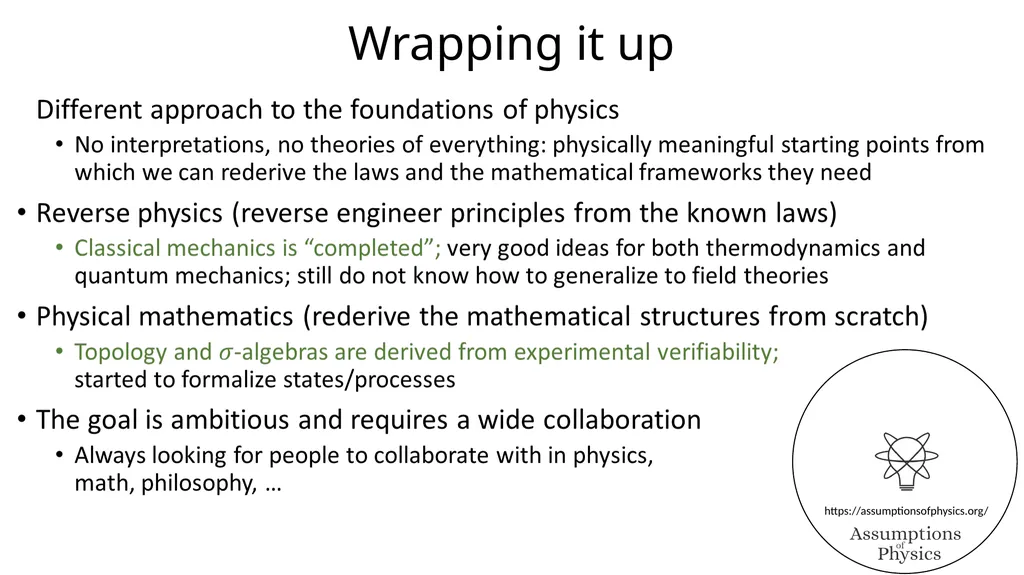
Wrapping it up<br>
34
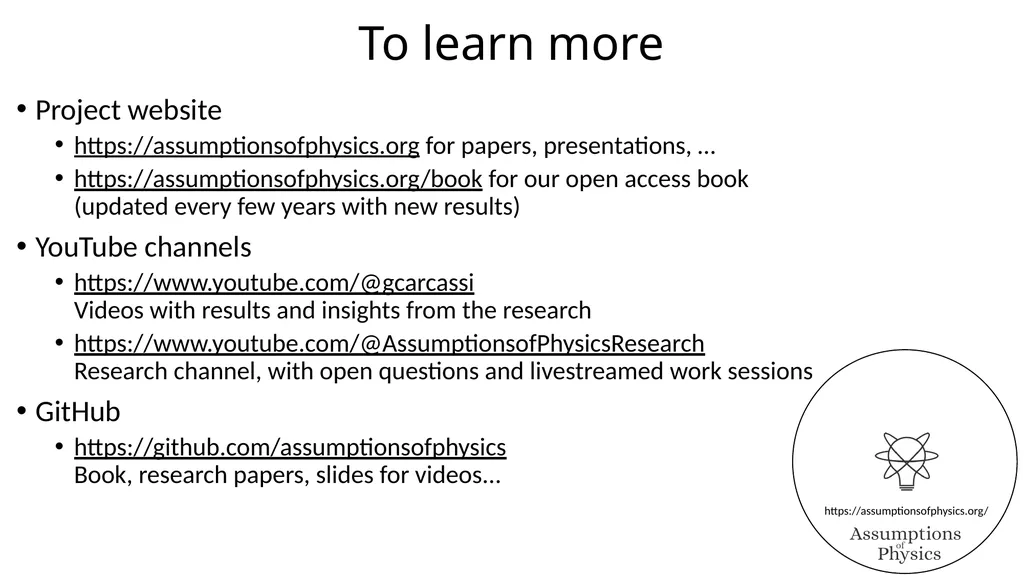
To learn more Project website
https://assumptionsofphysics.org for papers, presentations, …
https://assumptionsofphysics.org/book for our open access book (updated every few years with new results)
YouTube channels
https://www.youtube.com/@gcarcassi Videos with results and insights from the research
https://www.youtube.com/@AssumptionsofPhysicsResearch Research channel, with open questions and livestreamed work sessions
GitHub
https://github.com/assumptionsofphysics Book, research papers, slides for videos...<br>
https://assumptionsofphysics.org for papers, presentations, …
https://assumptionsofphysics.org/book for our open access book (updated every few years with new results)
YouTube channels
https://www.youtube.com/@gcarcassi Videos with results and insights from the research
https://www.youtube.com/@AssumptionsofPhysicsResearch Research channel, with open questions and livestreamed work sessions
GitHub
https://github.com/assumptionsofphysics Book, research papers, slides for videos...<br>