
Astronomy C1 List the planets in the order in
SN
Published · 36 slides · 0 views

1 / 1
Description
Astronomy C1 List the planets in the order in which they orbit the sun. Explain how scientists measure distances in space. Describe how the planets in our solar system were discovered. Describe three ways in which the inner planets and
Related Topics
Share
Embed code
Download this presentation From Below
"Astronomy C1 List the planets in the order in" is the property of its rightful owner. Permission is granted to download and print the materials on this website for personal, non-commercial use only, and to display it on your personal computer provided you do not modify the materials and that you retain all copyright notices contained in the materials. By downloading content from our website, you accept the terms of this agreement.
Presentation Transcript
01
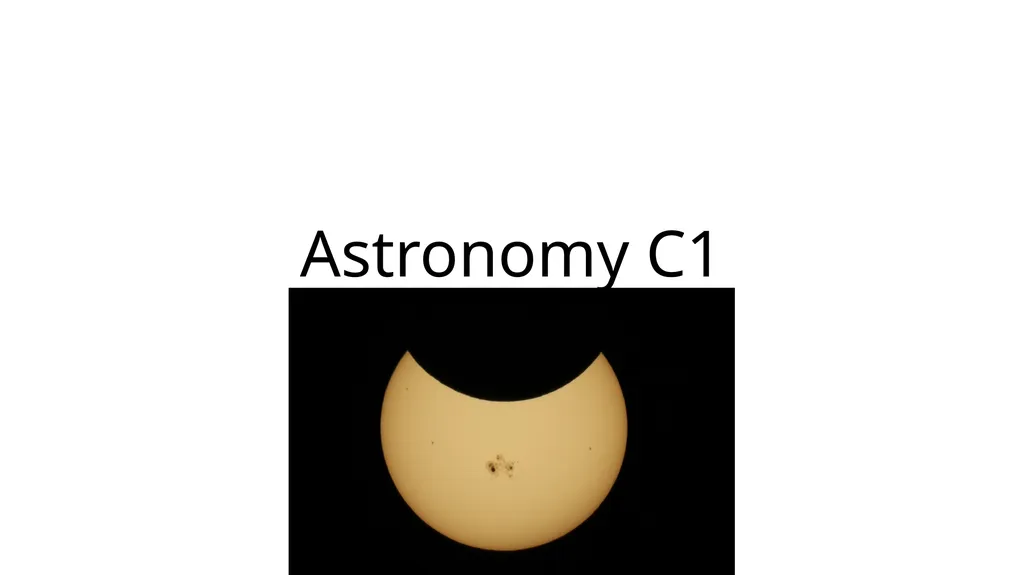
Astronomy C1<br>
02
List the planets in the order in which they orbit the sun.
Explain how scientists measure distances in space.
Describe how the planets in our solar system were discovered.
Describe three ways in which the inner planets and outer planets differ. Objectives Section 1 Astronomy: The Original Science Chapter J1<br>
Explain how scientists measure distances in space.
Describe how the planets in our solar system were discovered.
Describe three ways in which the inner planets and outer planets differ. Objectives Section 1 Astronomy: The Original Science Chapter J1<br>
03
Section 1 Astronomy: The Original Science People in ancient cultures used the seasonal cycles to determine when they should plant and harvest crops. They built observatories to study the night sky.
Over time, the science of astronomy developed. Astronomy is the study of the universe. Astronomy Chapter J1<br>
Over time, the science of astronomy developed. Astronomy is the study of the universe. Astronomy Chapter J1<br>
04
Section 1 Astronomy: The Original Science Our Modern Calendar What Is Our Calendar Based On? The years, months, and days of our modern calendar are based on the observation of bodies in our solar system. Chapter J1<br>
05
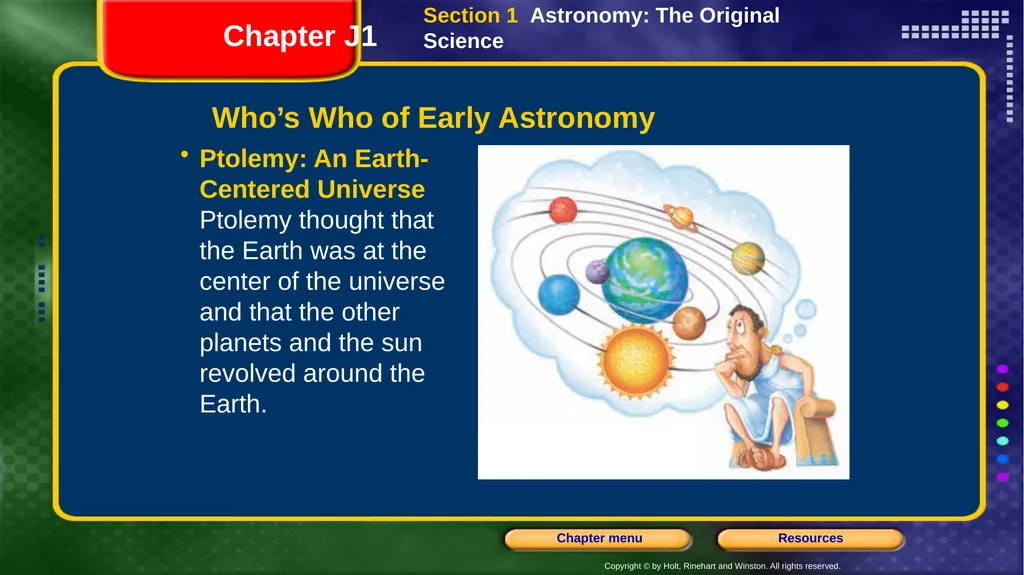
Section 1 Astronomy: The Original Science Who’s Who of Early Astronomy Ptolemy: An Earth-Centered Universe Ptolemy thought that the Earth was at the center of the universe and that the other planets and the sun revolved around the Earth. Chapter J1<br>
06
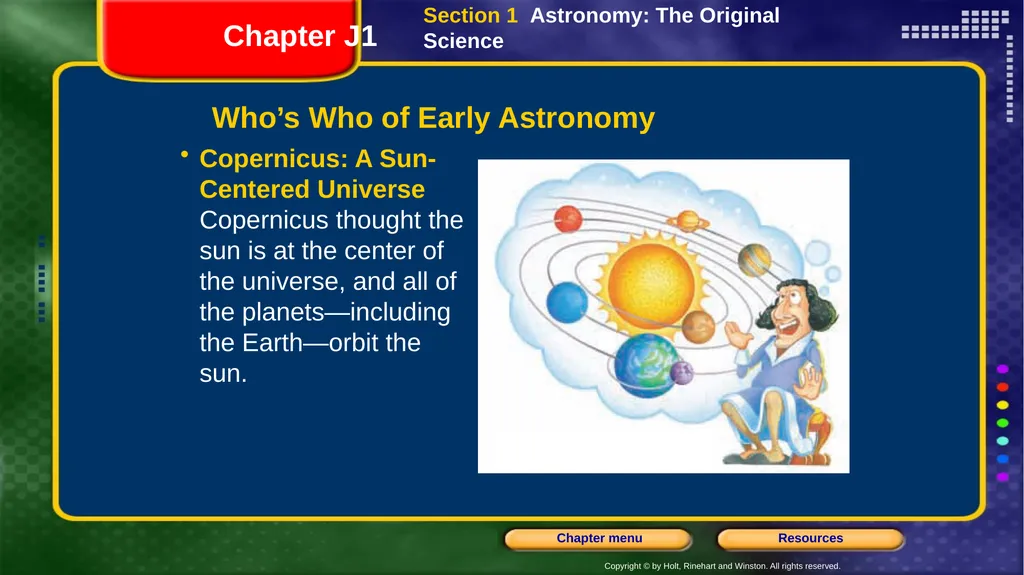
Section 1 Astronomy: The Original Science Who’s Who of Early Astronomy Copernicus: A Sun-Centered Universe Copernicus thought the sun is at the center of the universe, and all of the planets—including the Earth—orbit the sun. Chapter J1<br>
07
Section 1 Astronomy: The Original Science Who’s Who of Early Astronomy, continued Tycho Brahe: A Wealth of Data In the late-1500s, Danish astronomer Tycho Brahe made the most detailed astronomical observations that had ever been recorded.
Johannes Kepler: Laws of Planetary Motion Johannes Kepler stated three laws of planetary motion. These laws are still used today. Chapter J1<br>
Johannes Kepler: Laws of Planetary Motion Johannes Kepler stated three laws of planetary motion. These laws are still used today. Chapter J1<br>
08
Section 1 Astronomy: The Original Science Modern Astronomy Milestones in Modern Astronomy The invention of the telescope and the discovery of gravity were two milestones in the development of modern astronomy.
Edwin Hubble: Beyond the Edge of the Milky Way In 1924, Edwin Hubble proved that other galaxies existed beyond the edge of the Milky Way. Chapter J1<br>
Edwin Hubble: Beyond the Edge of the Milky Way In 1924, Edwin Hubble proved that other galaxies existed beyond the edge of the Milky Way. Chapter J1<br>
09
Section 2 Telescopes Bellringer Have you ever bent or slowed down light? Explain how.
Record your answer in your science journal. Chapter J1<br>
Record your answer in your science journal. Chapter J1<br>
10
Section 2 Telescopes Compare refracting telescopes with reflecting telescopes.
Explain how the atmosphere limits astronomical observations, and explain how astronomers overcome these limitations.
List the types of electromagnetic radiation that astronomers use to study objects in space. Objectives Chapter J1<br>
Explain how the atmosphere limits astronomical observations, and explain how astronomers overcome these limitations.
List the types of electromagnetic radiation that astronomers use to study objects in space. Objectives Chapter J1<br>
11
Section 2 Telescopes Telescopes A Telescope is an instrument that gathers electromagnetic radiation from objects in space and concentrates it for better observation.
There are many different types of telescopes. Chapter J1<br>
There are many different types of telescopes. Chapter J1<br>
12
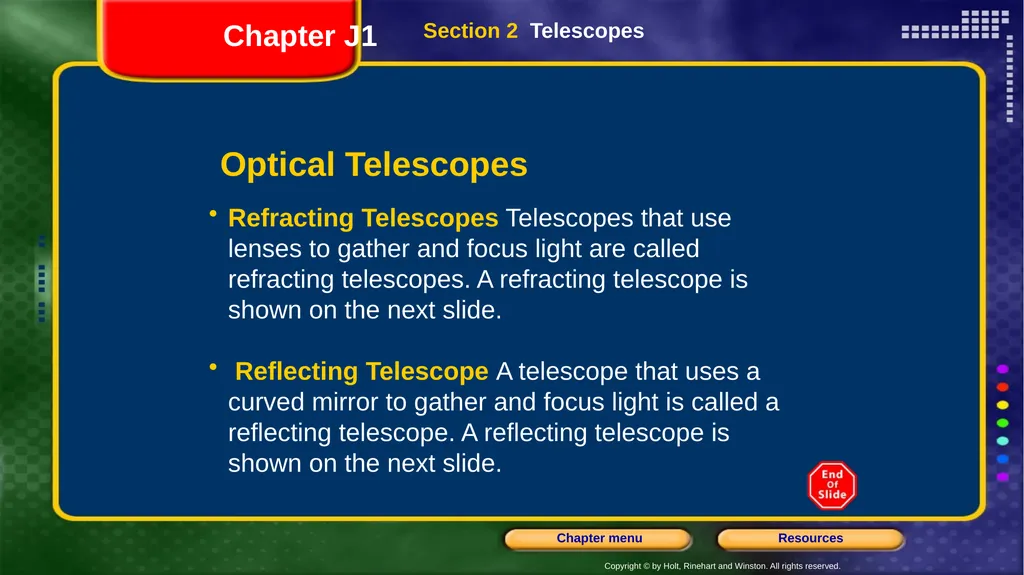
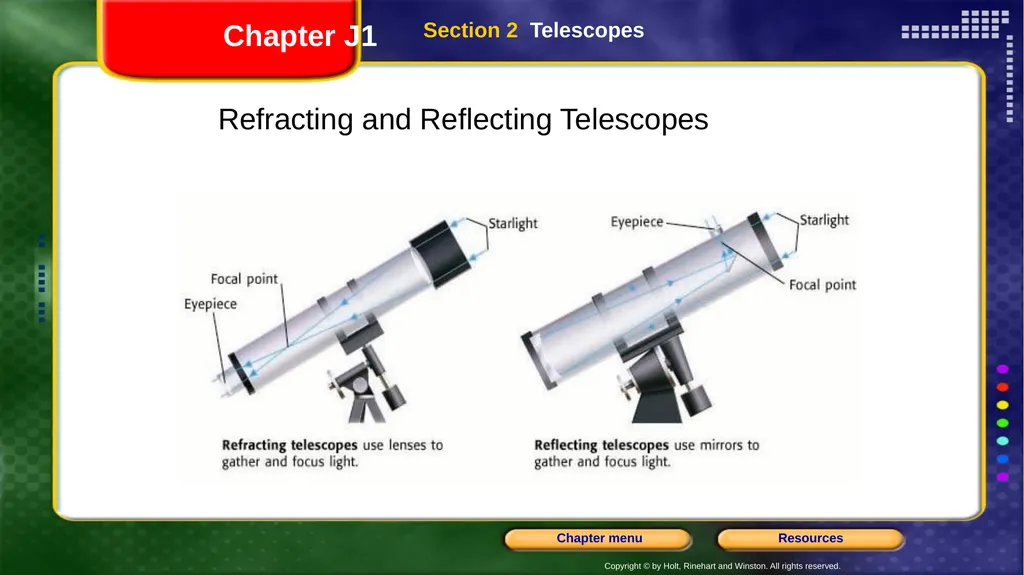
Section 2 Telescopes Optical Telescopes Refracting Telescopes Telescopes that use lenses to gather and focus light are called refracting telescopes. A refracting telescope is shown on the next slide.
Reflecting Telescope A telescope that uses a curved mirror to gather and focus light is called a reflecting telescope. A reflecting telescope is shown on the next slide. Chapter J1<br>
Reflecting Telescope A telescope that uses a curved mirror to gather and focus light is called a reflecting telescope. A reflecting telescope is shown on the next slide. Chapter J1<br>
13
Section 2 Telescopes Optical Telescopes Refracting Telescopes Telescopes that use lenses to gather and focus light are called refracting telescopes. A refracting telescope is shown on the next slide.
Reflecting Telescope A telescope that uses a curved mirror to gather and focus light is called a reflecting telescope. A reflecting telescope is shown on the next slide. Chapter J1<br>
Reflecting Telescope A telescope that uses a curved mirror to gather and focus light is called a reflecting telescope. A reflecting telescope is shown on the next slide. Chapter J1<br>
14
Section 2 Telescopes Refracting and Reflecting Telescopes Chapter J1<br>
15
Section 2 Telescopes Optical Telescopes, continued Very Large Reflecting Telescopes In some very large reflecting telescopes, several mirrors work together to collect light and focus it in the same area. Chapter J1<br>
16
Section 2 Telescopes Optical Telescopes, continued Optical Telescopes and the Atmosphere The light gathered by telescopes on the Earth is affected by the atmosphere.
Optical Telescopes in Space To avoid interference by the atmosphere, scientists have put telescopes in space Chapter J1<br>
Optical Telescopes in Space To avoid interference by the atmosphere, scientists have put telescopes in space Chapter J1<br>
17
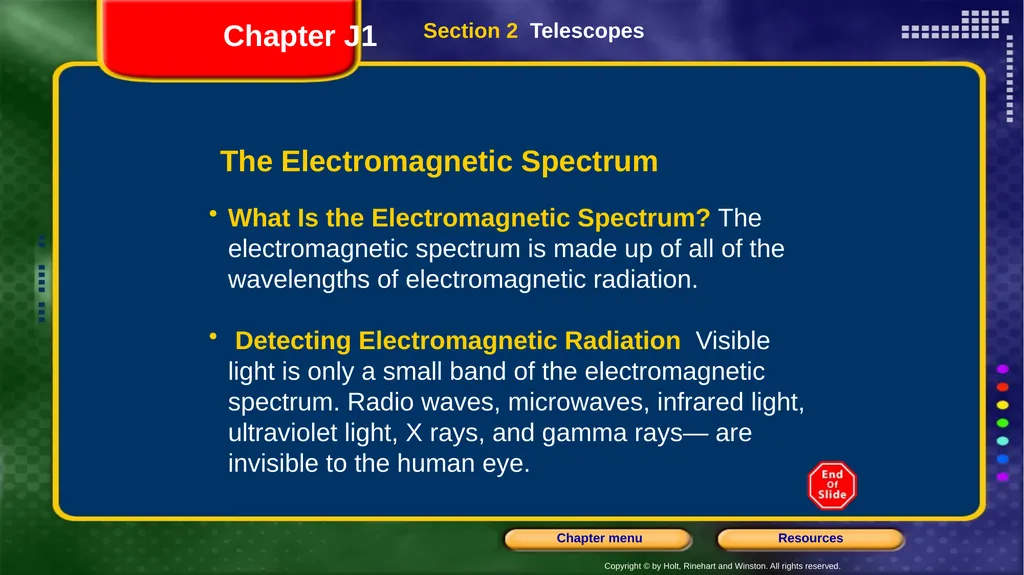
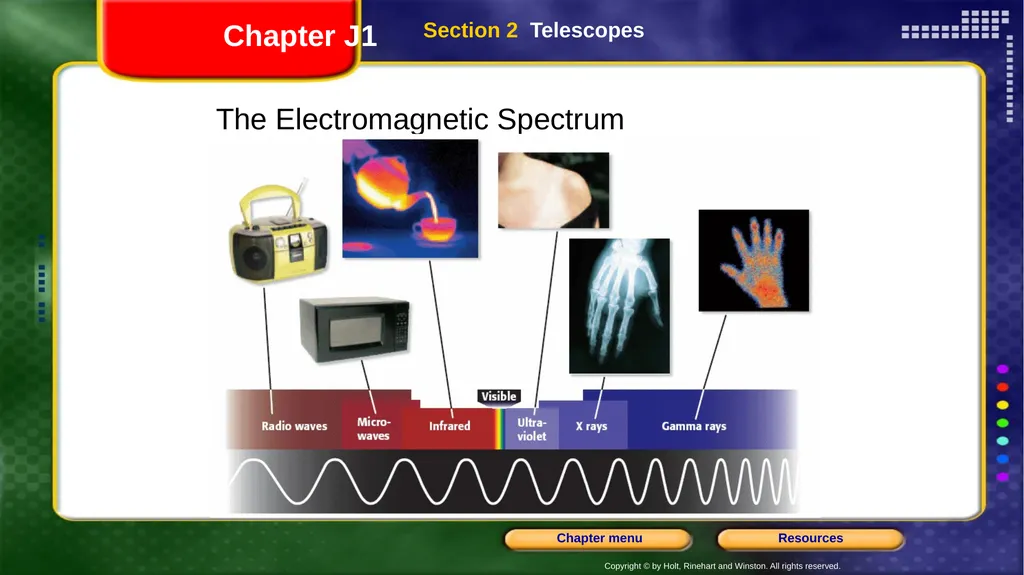
Section 2 Telescopes The Electromagnetic Spectrum What Is the Electromagnetic Spectrum? The electromagnetic spectrum is made up of all of the wavelengths of electromagnetic radiation.
Detecting Electromagnetic Radiation Visible light is only a small band of the electromagnetic spectrum. Radio waves, microwaves, infrared light, ultraviolet light, X rays, and gamma rays— are invisible to the human eye. Chapter J1<br>
Detecting Electromagnetic Radiation Visible light is only a small band of the electromagnetic spectrum. Radio waves, microwaves, infrared light, ultraviolet light, X rays, and gamma rays— are invisible to the human eye. Chapter J1<br>
18
Section 2 Telescopes The Electromagnetic Spectrum Chapter J1<br>
19
Section 2 Telescopes Nonoptical Telescopes Radio Telescopes Radio telescopes detect radio waves. Because radio wavelengths are much larger than optical wavelengths, radio telescopes much be very large.
Linking Radio Telescopes Astronomers can get more detailed images of the universe by linking radio telescopes together. Working together, the telescopes function as a single giant telescope. Chapter J1<br>
Linking Radio Telescopes Astronomers can get more detailed images of the universe by linking radio telescopes together. Working together, the telescopes function as a single giant telescope. Chapter J1<br>
20
Section 2 Telescopes Nonoptical Telescopes, continued Nonoptical Telescopes in Space Because most electromagnetic waves are blocked by the Earth’s atmosphere, scientists have placed ultraviolet telescopes, infrared telescopes, gamma-ray telescopes, and X-ray telescopes in space. Chapter J1<br>
21
Section 3 Mapping the Stars Bellringer Is it possible to determine the direction of the North Pole just by looking at the stars? Explain your answer.
Write your answer in your science journal.
. Chapter J1<br>
Write your answer in your science journal.
. Chapter J1<br>
22
Section 3 Mapping the Stars Explain how constellations are used to organize the night sky.
Describe how the altitude of a star is measured.
Explain how the celestial sphere is used to describe the location of objects in the sky.
Compare size and scale in the universe, and explain how red shift indicates that the universe is expanding. Objectives Chapter J1<br>
Describe how the altitude of a star is measured.
Explain how the celestial sphere is used to describe the location of objects in the sky.
Compare size and scale in the universe, and explain how red shift indicates that the universe is expanding. Objectives Chapter J1<br>
23
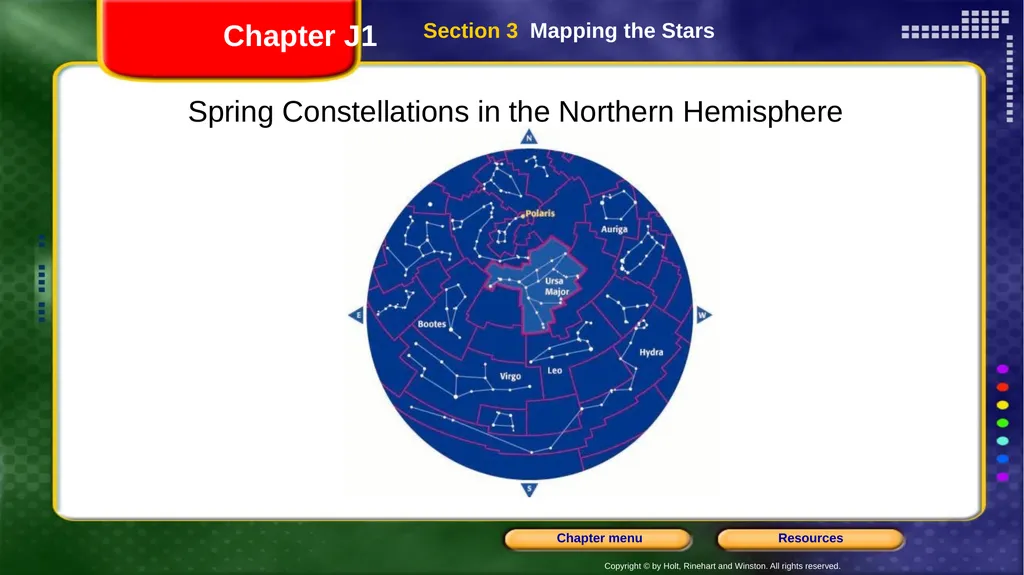
Section 3 Mapping the Stars Patterns in the Sky Constellations Help Organize the Sky A constellation is a region of the sky. Each constellation shares a border with neighboring constellations. A constellation map is shown on the next slide.
Seasonal Changes As Earth revolves around the sun, the apparent locations of the constellations change from season to season. Chapter J1<br>
Seasonal Changes As Earth revolves around the sun, the apparent locations of the constellations change from season to season. Chapter J1<br>
24
Spring Constellations in the Northern Hemisphere Section 3 Mapping the Stars Chapter J1<br>
25
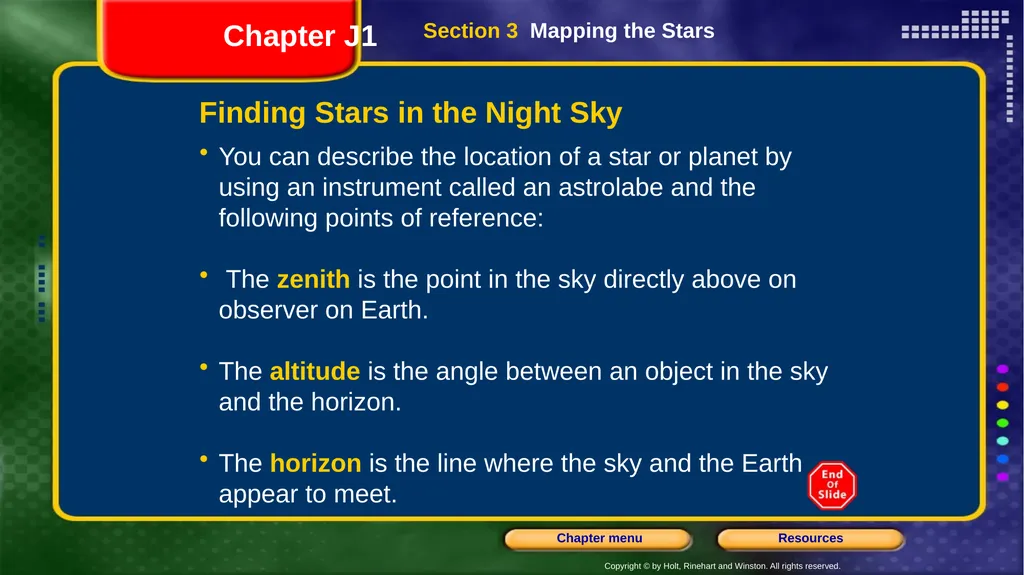
Section 3 Mapping the Stars Finding Stars in the Night Sky You can describe the location of a star or planet by using an instrument called an astrolabe and the following points of reference:
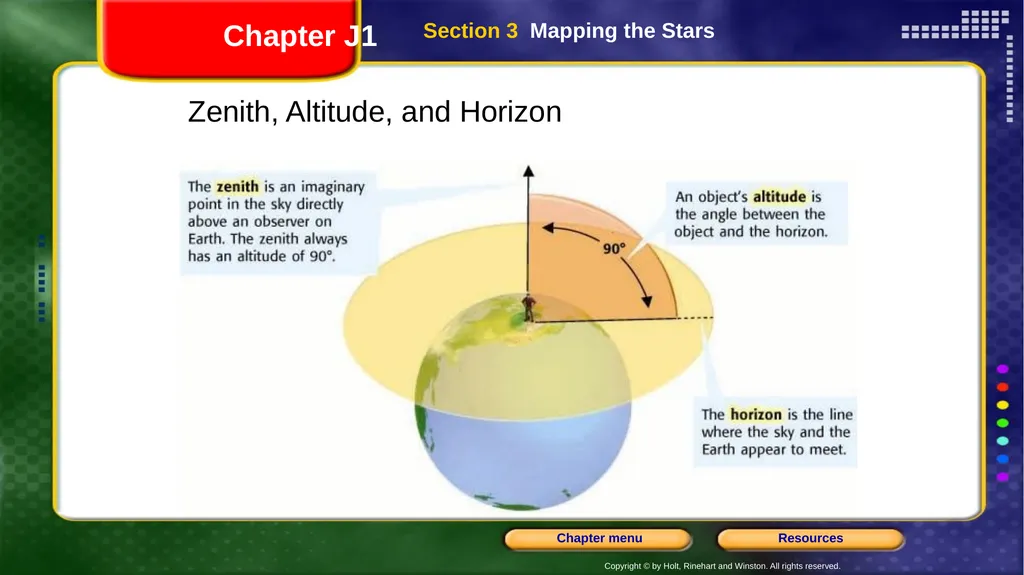
The zenith is the point in the sky directly above on observer on Earth.
The altitude is the angle between an object in the sky and the horizon.
The horizon is the line where the sky and the Earth appear to meet. Chapter J1<br>
The zenith is the point in the sky directly above on observer on Earth.
The altitude is the angle between an object in the sky and the horizon.
The horizon is the line where the sky and the Earth appear to meet. Chapter J1<br>
26
Zenith, Altitude, and Horizon Section 3 Mapping the Stars Chapter J1<br>
27
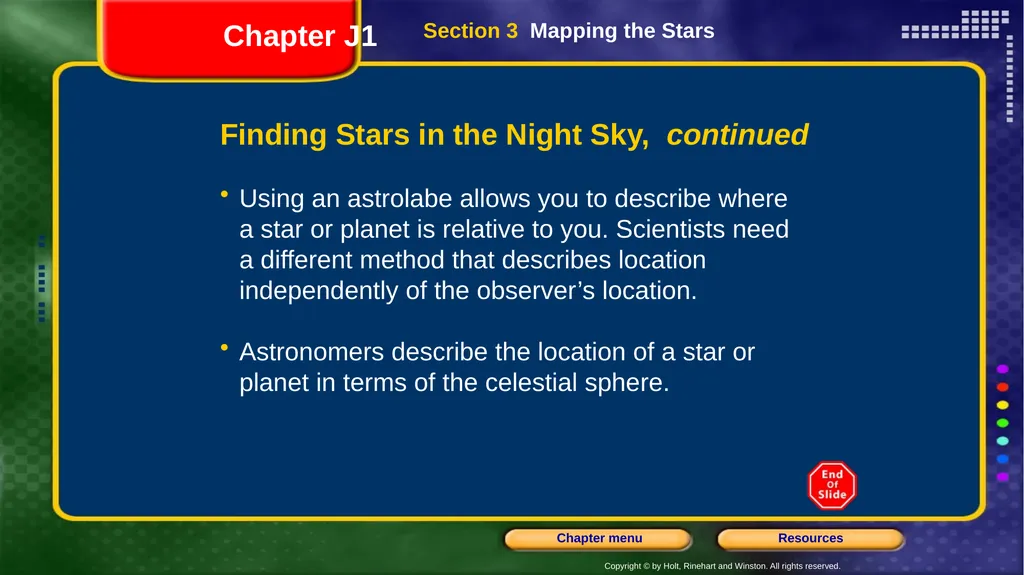
Section 3 Mapping the Stars Finding Stars in the Night Sky, continued Using an astrolabe allows you to describe where a star or planet is relative to you. Scientists need a different method that describes location independently of the observer’s location.
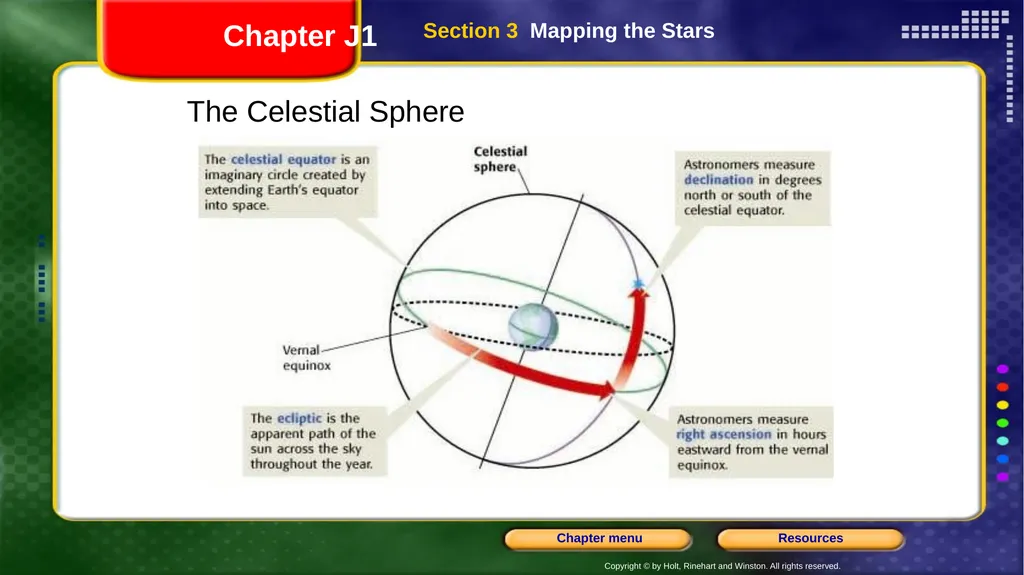
Astronomers describe the location of a star or planet in terms of the celestial sphere. Chapter J1<br>
Astronomers describe the location of a star or planet in terms of the celestial sphere. Chapter J1<br>
28
The Celestial Sphere Section 3 Mapping the Stars Chapter J1<br>
29
Section 3 Mapping the Stars Describing a Star’s Position Click below to watch the Visual Concept.
You may stop the video at any time by pressing the Esc key. Visual Concept Chapter J1<br>
You may stop the video at any time by pressing the Esc key. Visual Concept Chapter J1<br>
30
Section 3 Mapping the Stars The Size and Scale of the Universe In the 1600s, Nicolaus Copernicus noticed that the planets appeared to move relative to each other but that the stars did not. Thus, he thought that the stars must be much farther away than the planets.
Measuring Distance in Space A light-year is a unit of length equal to the distance that light travels in 1 year. Chapter J1<br>
Measuring Distance in Space A light-year is a unit of length equal to the distance that light travels in 1 year. Chapter J1<br>
31
Section 3 Mapping the Stars The Size and Scale of the Universe, continued It is important to consider scale when thinking about the universe. Although stars looks tiny in the night sky, remember that they are actually a lot larger than Earth. Chapter J1<br>
32
Section 3 Mapping the Stars The Doppler Effect What Is the Doppler Effect? Have you ever noticed that when a driver in an approaching car blows the horn, the horn sounds higher pitched as the car approaches and lower pitched after the car passes? This effect is called the Doppler effect.
An Expanding Universe The Doppler effect has been used to discover that galaxies are rapidly moving apart from each other. Chapter J1<br>
An Expanding Universe The Doppler effect has been used to discover that galaxies are rapidly moving apart from each other. Chapter J1<br>
33
Section 3 Mapping the Stars Red Shift Click below to watch the Visual Concept.
You may stop the video at any time by pressing the Esc key. Visual Concept Chapter J1<br>
You may stop the video at any time by pressing the Esc key. Visual Concept Chapter J1<br>
34
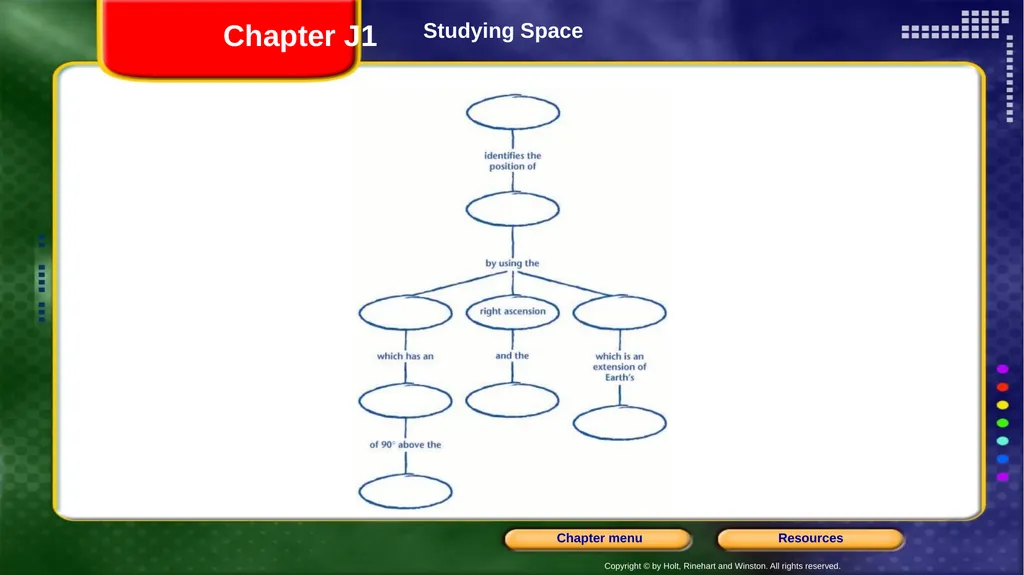
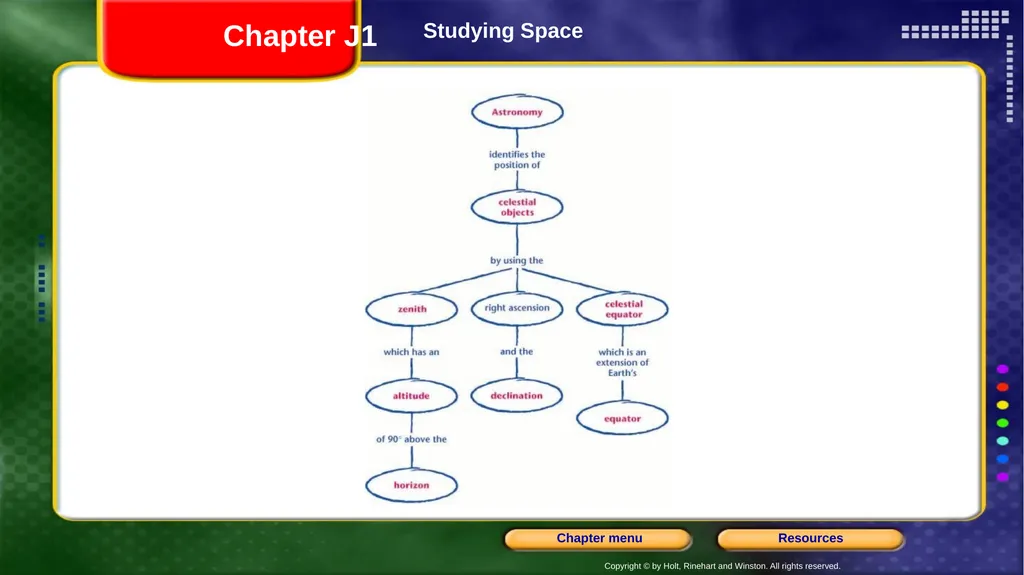
Studying Space Concept Map Use the terms below to complete the concept map on the next slide. Chapter J1<br>
35
Studying Space Chapter J1<br>
36
Studying Space Chapter J1<br>