
At this point, the actor aims to show how
LD
Published · 7 slides · 0 views

1 / 1
Description
At this point, the actor aims to show how conflicted Billy is about pursuing his love of dance. Drama LIVE THEATRE Billy Elliott GCSE Drama Homework Knowledge Organiser You must be able to analyse and evaluate the work of live theatre
Related Topics
Share
Embed code
Download this presentation From Below
"At this point, the actor aims to show how" is the property of its rightful owner. Permission is granted to download and print the materials on this website for personal, non-commercial use only, and to display it on your personal computer provided you do not modify the materials and that you retain all copyright notices contained in the materials. By downloading content from our website, you accept the terms of this agreement.
Presentation Transcript
01
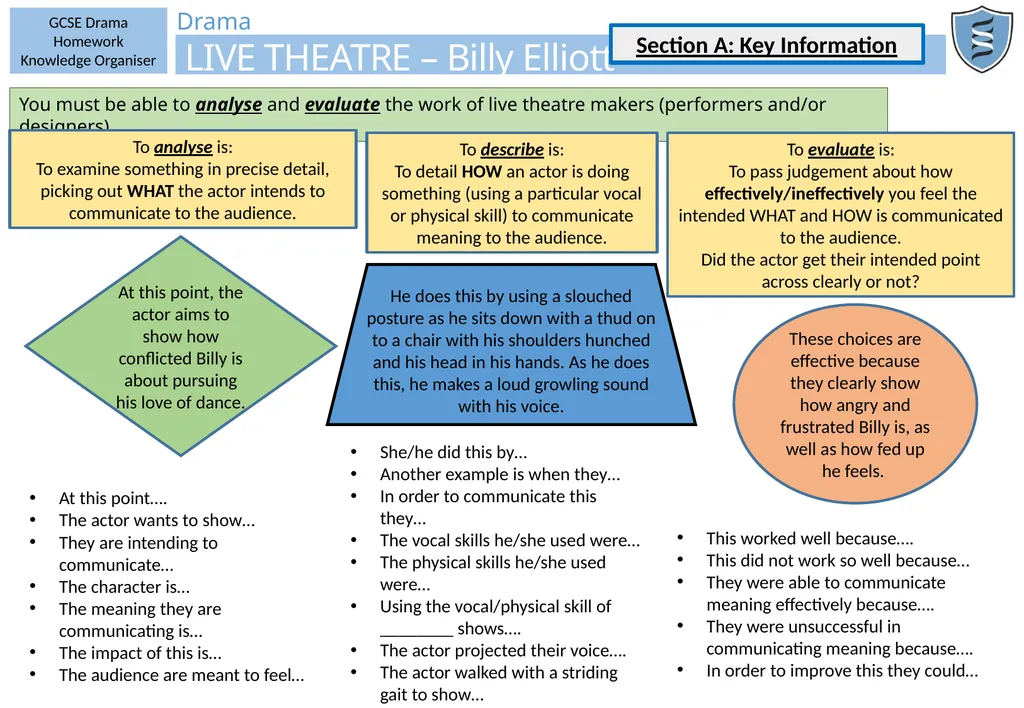
At this point, the actor aims to show how conflicted Billy is about pursuing his love of dance. Drama LIVE THEATRE – Billy Elliott GCSE Drama Homework
Knowledge Organiser You must be able to analyse and evaluate the work of live theatre makers (performers and/or designers). These choices are effective because they clearly show how angry and frustrated Billy is, as well as how fed up he feels. To analyse is:
To examine something in precise detail, picking out WHAT the actor intends to communicate to the audience. To evaluate is:
To pass judgement about how effectively/ineffectively you feel the intended WHAT and HOW is communicated to the audience.
Did the actor get their intended point across clearly or not? To describe is:
To detail HOW an actor is doing something (using a particular vocal or physical skill) to communicate meaning to the audience. He does this by using a slouched posture as he sits down with a thud on to a chair with his shoulders hunched and his head in his hands. As he does this, he makes a loud growling sound with his voice. At this point….
The actor wants to show…
They are intending to communicate…
The character is…
The meaning they are communicating is…
The impact of this is…
The audience are meant to feel… She/he did this by…
Another example is when they…
In order to communicate this they…
The vocal skills he/she used were…
The physical skills he/she used were…
Using the vocal/physical skill of ________ shows….
The actor projected their voice….
The actor walked with a striding gait to show… This worked well because….
This did not work so well because…
They were able to communicate meaning effectively because….
They were unsuccessful in communicating meaning because….
In order to improve this they could… Section A: Key Information<br>
Knowledge Organiser You must be able to analyse and evaluate the work of live theatre makers (performers and/or designers). These choices are effective because they clearly show how angry and frustrated Billy is, as well as how fed up he feels. To analyse is:
To examine something in precise detail, picking out WHAT the actor intends to communicate to the audience. To evaluate is:
To pass judgement about how effectively/ineffectively you feel the intended WHAT and HOW is communicated to the audience.
Did the actor get their intended point across clearly or not? To describe is:
To detail HOW an actor is doing something (using a particular vocal or physical skill) to communicate meaning to the audience. He does this by using a slouched posture as he sits down with a thud on to a chair with his shoulders hunched and his head in his hands. As he does this, he makes a loud growling sound with his voice. At this point….
The actor wants to show…
They are intending to communicate…
The character is…
The meaning they are communicating is…
The impact of this is…
The audience are meant to feel… She/he did this by…
Another example is when they…
In order to communicate this they…
The vocal skills he/she used were…
The physical skills he/she used were…
Using the vocal/physical skill of ________ shows….
The actor projected their voice….
The actor walked with a striding gait to show… This worked well because….
This did not work so well because…
They were able to communicate meaning effectively because….
They were unsuccessful in communicating meaning because….
In order to improve this they could… Section A: Key Information<br>
02
Drama LIVE THEATRE – Billy Elliott GCSE Drama Homework
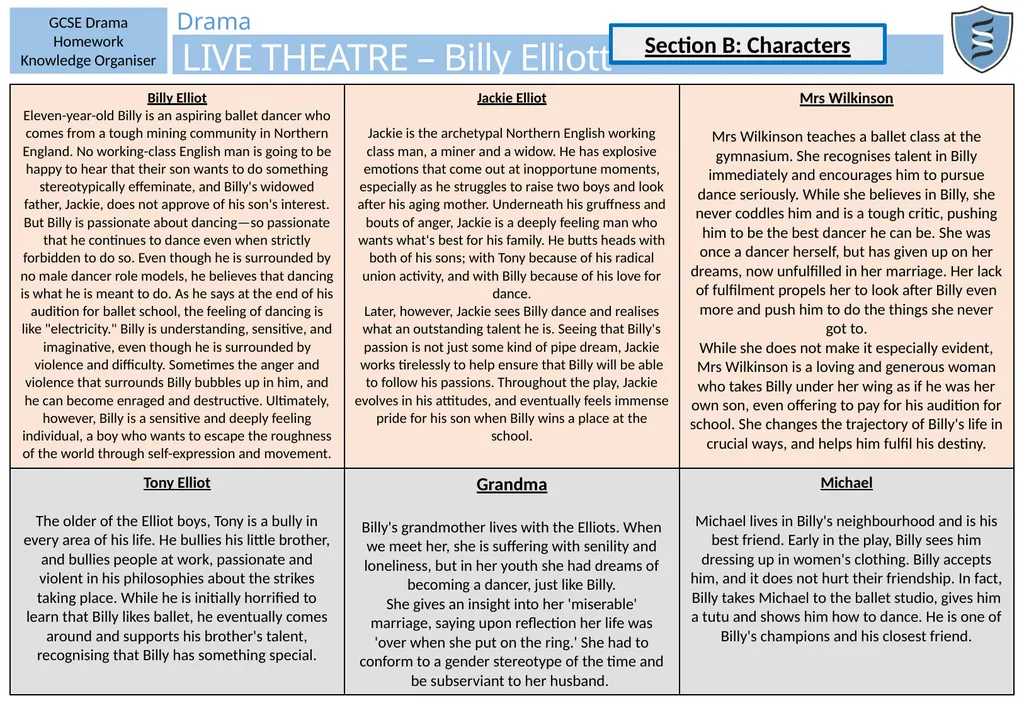
Knowledge Organiser Section B: Characters<br>
Knowledge Organiser Section B: Characters<br>
03
Drama LIVE THEATRE – Billy Elliott GCSE Drama Homework
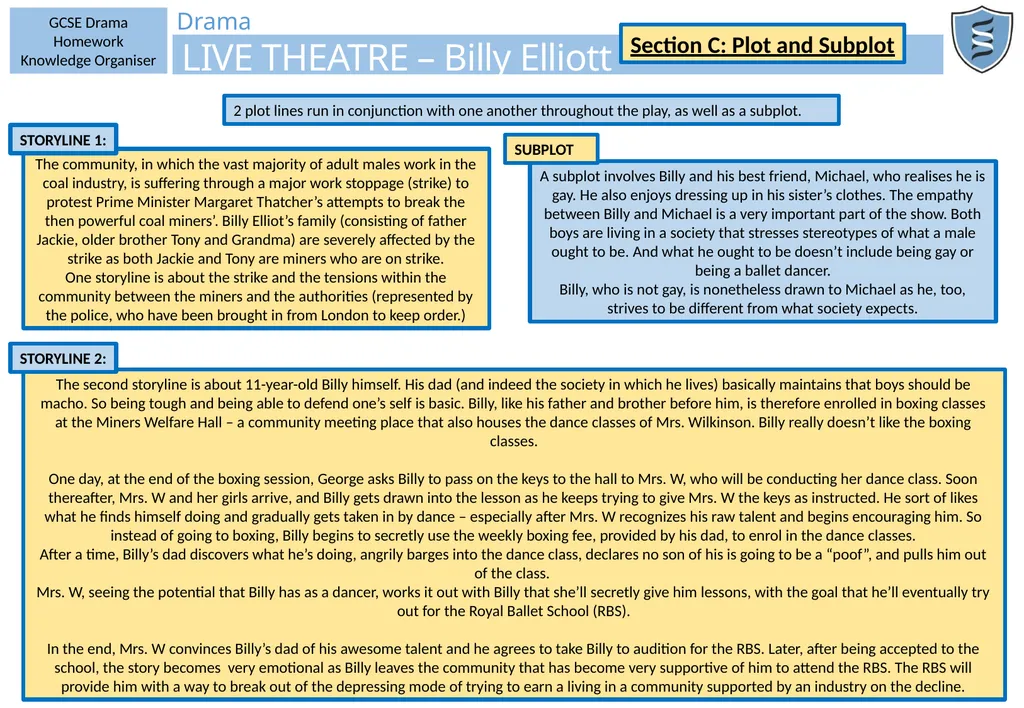
Knowledge Organiser The community, in which the vast majority of adult males work in the coal industry, is suffering through a major work stoppage (strike) to protest Prime Minister Margaret Thatcher’s attempts to break the then powerful coal miners’. Billy Elliot’s family (consisting of father Jackie, older brother Tony and Grandma) are severely affected by the strike as both Jackie and Tony are miners who are on strike.
One storyline is about the strike and the tensions within the community between the miners and the authorities (represented by the police, who have been brought in from London to keep order.) Section C: Plot and Subplot STORYLINE 1: The second storyline is about 11-year-old Billy himself. His dad (and indeed the society in which he lives) basically maintains that boys should be macho. So being tough and being able to defend one’s self is basic. Billy, like his father and brother before him, is therefore enrolled in boxing classes at the Miners Welfare Hall – a community meeting place that also houses the dance classes of Mrs. Wilkinson. Billy really doesn’t like the boxing classes.
One day, at the end of the boxing session, George asks Billy to pass on the keys to the hall to Mrs. W, who will be conducting her dance class. Soon thereafter, Mrs. W and her girls arrive, and Billy gets drawn into the lesson as he keeps trying to give Mrs. W the keys as instructed. He sort of likes what he finds himself doing and gradually gets taken in by dance – especially after Mrs. W recognizes his raw talent and begins encouraging him. So instead of going to boxing, Billy begins to secretly use the weekly boxing fee, provided by his dad, to enrol in the dance classes.
After a time, Billy’s dad discovers what he’s doing, angrily barges into the dance class, declares no son of his is going to be a “poof”, and pulls him out of the class.
Mrs. W, seeing the potential that Billy has as a dancer, works it out with Billy that she’ll secretly give him lessons, with the goal that he’ll eventually try out for the Royal Ballet School (RBS).
In the end, Mrs. W convinces Billy’s dad of his awesome talent and he agrees to take Billy to audition for the RBS. Later, after being accepted to the school, the story becomes very emotional as Billy leaves the community that has become very supportive of him to attend the RBS. The RBS will provide him with a way to break out of the depressing mode of trying to earn a living in a community supported by an industry on the decline. STORYLINE 2: A subplot involves Billy and his best friend, Michael, who realises he is gay. He also enjoys dressing up in his sister’s clothes. The empathy between Billy and Michael is a very important part of the show. Both boys are living in a society that stresses stereotypes of what a male ought to be. And what he ought to be doesn’t include being gay or being a ballet dancer.
Billy, who is not gay, is nonetheless drawn to Michael as he, too, strives to be different from what society expects. 2 plot lines run in conjunction with one another throughout the play, as well as a subplot. SUBPLOT<br>
Knowledge Organiser The community, in which the vast majority of adult males work in the coal industry, is suffering through a major work stoppage (strike) to protest Prime Minister Margaret Thatcher’s attempts to break the then powerful coal miners’. Billy Elliot’s family (consisting of father Jackie, older brother Tony and Grandma) are severely affected by the strike as both Jackie and Tony are miners who are on strike.
One storyline is about the strike and the tensions within the community between the miners and the authorities (represented by the police, who have been brought in from London to keep order.) Section C: Plot and Subplot STORYLINE 1: The second storyline is about 11-year-old Billy himself. His dad (and indeed the society in which he lives) basically maintains that boys should be macho. So being tough and being able to defend one’s self is basic. Billy, like his father and brother before him, is therefore enrolled in boxing classes at the Miners Welfare Hall – a community meeting place that also houses the dance classes of Mrs. Wilkinson. Billy really doesn’t like the boxing classes.
One day, at the end of the boxing session, George asks Billy to pass on the keys to the hall to Mrs. W, who will be conducting her dance class. Soon thereafter, Mrs. W and her girls arrive, and Billy gets drawn into the lesson as he keeps trying to give Mrs. W the keys as instructed. He sort of likes what he finds himself doing and gradually gets taken in by dance – especially after Mrs. W recognizes his raw talent and begins encouraging him. So instead of going to boxing, Billy begins to secretly use the weekly boxing fee, provided by his dad, to enrol in the dance classes.
After a time, Billy’s dad discovers what he’s doing, angrily barges into the dance class, declares no son of his is going to be a “poof”, and pulls him out of the class.
Mrs. W, seeing the potential that Billy has as a dancer, works it out with Billy that she’ll secretly give him lessons, with the goal that he’ll eventually try out for the Royal Ballet School (RBS).
In the end, Mrs. W convinces Billy’s dad of his awesome talent and he agrees to take Billy to audition for the RBS. Later, after being accepted to the school, the story becomes very emotional as Billy leaves the community that has become very supportive of him to attend the RBS. The RBS will provide him with a way to break out of the depressing mode of trying to earn a living in a community supported by an industry on the decline. STORYLINE 2: A subplot involves Billy and his best friend, Michael, who realises he is gay. He also enjoys dressing up in his sister’s clothes. The empathy between Billy and Michael is a very important part of the show. Both boys are living in a society that stresses stereotypes of what a male ought to be. And what he ought to be doesn’t include being gay or being a ballet dancer.
Billy, who is not gay, is nonetheless drawn to Michael as he, too, strives to be different from what society expects. 2 plot lines run in conjunction with one another throughout the play, as well as a subplot. SUBPLOT<br>
04
Drama LIVE THEATRE – Billy Elliott GCSE Drama Homework
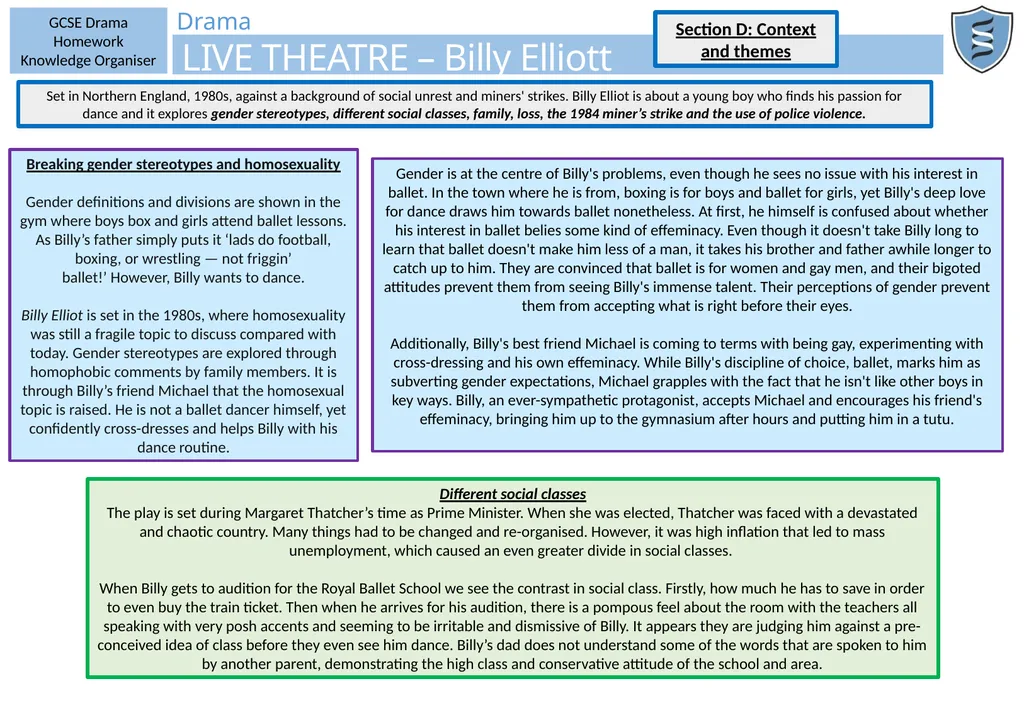
Knowledge Organiser Set in Northern England, 1980s, against a background of social unrest and miners' strikes. Billy Elliot is about a young boy who finds his passion for dance and it explores gender stereotypes, different social classes, family, loss, the 1984 miner’s strike and the use of police violence. Section D: Context
and themes Breaking gender stereotypes and homosexuality
Gender definitions and divisions are shown in the gym where boys box and girls attend ballet lessons. As Billy’s father simply puts it ‘lads do football, boxing, or wrestling — not friggin’ ballet!’ However, Billy wants to dance.
Billy Elliot is set in the 1980s, where homosexuality was still a fragile topic to discuss compared with today. Gender stereotypes are explored through homophobic comments by family members. It is through Billy’s friend Michael that the homosexual topic is raised. He is not a ballet dancer himself, yet confidently cross-dresses and helps Billy with his dance routine. Different social classes
The play is set during Margaret Thatcher’s time as Prime Minister. When she was elected, Thatcher was faced with a devastated and chaotic country. Many things had to be changed and re-organised. However, it was high inflation that led to mass unemployment, which caused an even greater divide in social classes.
When Billy gets to audition for the Royal Ballet School we see the contrast in social class. Firstly, how much he has to save in order to even buy the train ticket. Then when he arrives for his audition, there is a pompous feel about the room with the teachers all speaking with very posh accents and seeming to be irritable and dismissive of Billy. It appears they are judging him against a pre-conceived idea of class before they even see him dance. Billy’s dad does not understand some of the words that are spoken to him by another parent, demonstrating the high class and conservative attitude of the school and area. Gender is at the centre of Billy's problems, even though he sees no issue with his interest in ballet. In the town where he is from, boxing is for boys and ballet for girls, yet Billy's deep love for dance draws him towards ballet nonetheless. At first, he himself is confused about whether his interest in ballet belies some kind of effeminacy. Even though it doesn't take Billy long to learn that ballet doesn't make him less of a man, it takes his brother and father awhile longer to catch up to him. They are convinced that ballet is for women and gay men, and their bigoted attitudes prevent them from seeing Billy's immense talent. Their perceptions of gender prevent them from accepting what is right before their eyes.
Additionally, Billy's best friend Michael is coming to terms with being gay, experimenting with cross-dressing and his own effeminacy. While Billy's discipline of choice, ballet, marks him as subverting gender expectations, Michael grapples with the fact that he isn't like other boys in key ways. Billy, an ever-sympathetic protagonist, accepts Michael and encourages his friend's effeminacy, bringing him up to the gymnasium after hours and putting him in a tutu.<br>
Knowledge Organiser Set in Northern England, 1980s, against a background of social unrest and miners' strikes. Billy Elliot is about a young boy who finds his passion for dance and it explores gender stereotypes, different social classes, family, loss, the 1984 miner’s strike and the use of police violence. Section D: Context
and themes Breaking gender stereotypes and homosexuality
Gender definitions and divisions are shown in the gym where boys box and girls attend ballet lessons. As Billy’s father simply puts it ‘lads do football, boxing, or wrestling — not friggin’ ballet!’ However, Billy wants to dance.
Billy Elliot is set in the 1980s, where homosexuality was still a fragile topic to discuss compared with today. Gender stereotypes are explored through homophobic comments by family members. It is through Billy’s friend Michael that the homosexual topic is raised. He is not a ballet dancer himself, yet confidently cross-dresses and helps Billy with his dance routine. Different social classes
The play is set during Margaret Thatcher’s time as Prime Minister. When she was elected, Thatcher was faced with a devastated and chaotic country. Many things had to be changed and re-organised. However, it was high inflation that led to mass unemployment, which caused an even greater divide in social classes.
When Billy gets to audition for the Royal Ballet School we see the contrast in social class. Firstly, how much he has to save in order to even buy the train ticket. Then when he arrives for his audition, there is a pompous feel about the room with the teachers all speaking with very posh accents and seeming to be irritable and dismissive of Billy. It appears they are judging him against a pre-conceived idea of class before they even see him dance. Billy’s dad does not understand some of the words that are spoken to him by another parent, demonstrating the high class and conservative attitude of the school and area. Gender is at the centre of Billy's problems, even though he sees no issue with his interest in ballet. In the town where he is from, boxing is for boys and ballet for girls, yet Billy's deep love for dance draws him towards ballet nonetheless. At first, he himself is confused about whether his interest in ballet belies some kind of effeminacy. Even though it doesn't take Billy long to learn that ballet doesn't make him less of a man, it takes his brother and father awhile longer to catch up to him. They are convinced that ballet is for women and gay men, and their bigoted attitudes prevent them from seeing Billy's immense talent. Their perceptions of gender prevent them from accepting what is right before their eyes.
Additionally, Billy's best friend Michael is coming to terms with being gay, experimenting with cross-dressing and his own effeminacy. While Billy's discipline of choice, ballet, marks him as subverting gender expectations, Michael grapples with the fact that he isn't like other boys in key ways. Billy, an ever-sympathetic protagonist, accepts Michael and encourages his friend's effeminacy, bringing him up to the gymnasium after hours and putting him in a tutu.<br>
05
Drama LIVE THEATRE – Billy Elliott GCSE Drama Homework
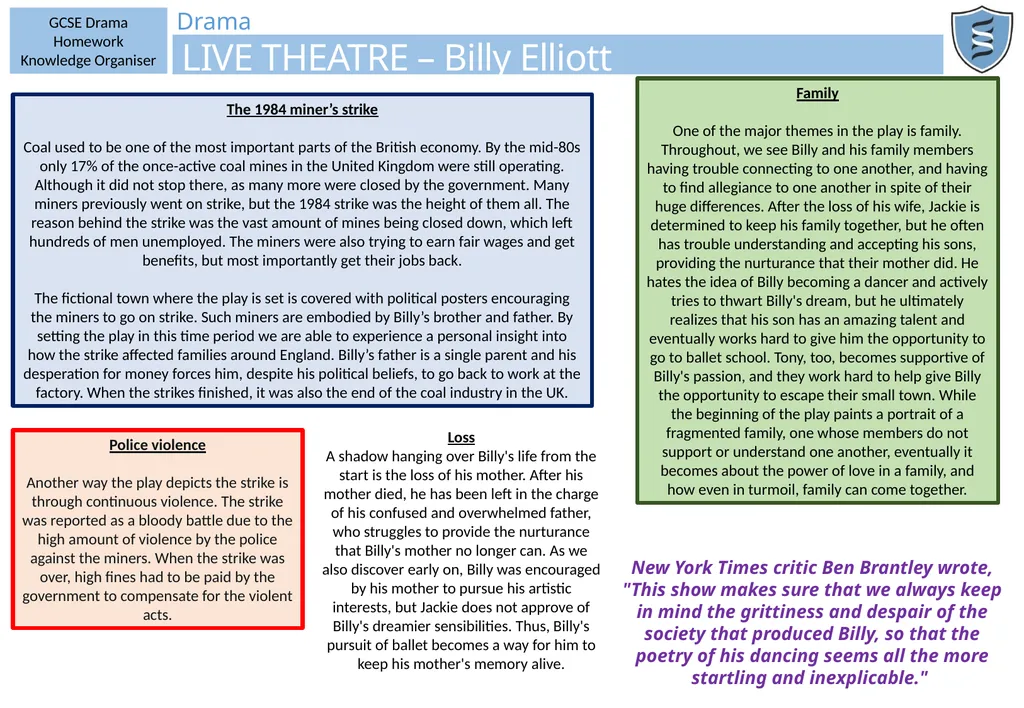
Knowledge Organiser Police violence
Another way the play depicts the strike is through continuous violence. The strike was reported as a bloody battle due to the high amount of violence by the police against the miners. When the strike was over, high fines had to be paid by the government to compensate for the violent acts. The 1984 miner’s strike
Coal used to be one of the most important parts of the British economy. By the mid-80s only 17% of the once-active coal mines in the United Kingdom were still operating. Although it did not stop there, as many more were closed by the government. Many miners previously went on strike, but the 1984 strike was the height of them all. The reason behind the strike was the vast amount of mines being closed down, which left hundreds of men unemployed. The miners were also trying to earn fair wages and get benefits, but most importantly get their jobs back.
The fictional town where the play is set is covered with political posters encouraging the miners to go on strike. Such miners are embodied by Billy’s brother and father. By setting the play in this time period we are able to experience a personal insight into how the strike affected families around England. Billy’s father is a single parent and his desperation for money forces him, despite his political beliefs, to go back to work at the factory. When the strikes finished, it was also the end of the coal industry in the UK. Loss
A shadow hanging over Billy's life from the start is the loss of his mother. After his mother died, he has been left in the charge of his confused and overwhelmed father, who struggles to provide the nurturance that Billy's mother no longer can. As we also discover early on, Billy was encouraged by his mother to pursue his artistic interests, but Jackie does not approve of Billy's dreamier sensibilities. Thus, Billy's pursuit of ballet becomes a way for him to keep his mother's memory alive. Family
One of the major themes in the play is family. Throughout, we see Billy and his family members having trouble connecting to one another, and having to find allegiance to one another in spite of their huge differences. After the loss of his wife, Jackie is determined to keep his family together, but he often has trouble understanding and accepting his sons, providing the nurturance that their mother did. He hates the idea of Billy becoming a dancer and actively tries to thwart Billy's dream, but he ultimately realizes that his son has an amazing talent and eventually works hard to give him the opportunity to go to ballet school. Tony, too, becomes supportive of Billy's passion, and they work hard to help give Billy the opportunity to escape their small town. While the beginning of the play paints a portrait of a fragmented family, one whose members do not support or understand one another, eventually it becomes about the power of love in a family, and how even in turmoil, family can come together. New York Times critic Ben Brantley wrote, "This show makes sure that we always keep in mind the grittiness and despair of the society that produced Billy, so that the poetry of his dancing seems all the more startling and inexplicable."<br>
Knowledge Organiser Police violence
Another way the play depicts the strike is through continuous violence. The strike was reported as a bloody battle due to the high amount of violence by the police against the miners. When the strike was over, high fines had to be paid by the government to compensate for the violent acts. The 1984 miner’s strike
Coal used to be one of the most important parts of the British economy. By the mid-80s only 17% of the once-active coal mines in the United Kingdom were still operating. Although it did not stop there, as many more were closed by the government. Many miners previously went on strike, but the 1984 strike was the height of them all. The reason behind the strike was the vast amount of mines being closed down, which left hundreds of men unemployed. The miners were also trying to earn fair wages and get benefits, but most importantly get their jobs back.
The fictional town where the play is set is covered with political posters encouraging the miners to go on strike. Such miners are embodied by Billy’s brother and father. By setting the play in this time period we are able to experience a personal insight into how the strike affected families around England. Billy’s father is a single parent and his desperation for money forces him, despite his political beliefs, to go back to work at the factory. When the strikes finished, it was also the end of the coal industry in the UK. Loss
A shadow hanging over Billy's life from the start is the loss of his mother. After his mother died, he has been left in the charge of his confused and overwhelmed father, who struggles to provide the nurturance that Billy's mother no longer can. As we also discover early on, Billy was encouraged by his mother to pursue his artistic interests, but Jackie does not approve of Billy's dreamier sensibilities. Thus, Billy's pursuit of ballet becomes a way for him to keep his mother's memory alive. Family
One of the major themes in the play is family. Throughout, we see Billy and his family members having trouble connecting to one another, and having to find allegiance to one another in spite of their huge differences. After the loss of his wife, Jackie is determined to keep his family together, but he often has trouble understanding and accepting his sons, providing the nurturance that their mother did. He hates the idea of Billy becoming a dancer and actively tries to thwart Billy's dream, but he ultimately realizes that his son has an amazing talent and eventually works hard to give him the opportunity to go to ballet school. Tony, too, becomes supportive of Billy's passion, and they work hard to help give Billy the opportunity to escape their small town. While the beginning of the play paints a portrait of a fragmented family, one whose members do not support or understand one another, eventually it becomes about the power of love in a family, and how even in turmoil, family can come together. New York Times critic Ben Brantley wrote, "This show makes sure that we always keep in mind the grittiness and despair of the society that produced Billy, so that the poetry of his dancing seems all the more startling and inexplicable."<br>
06
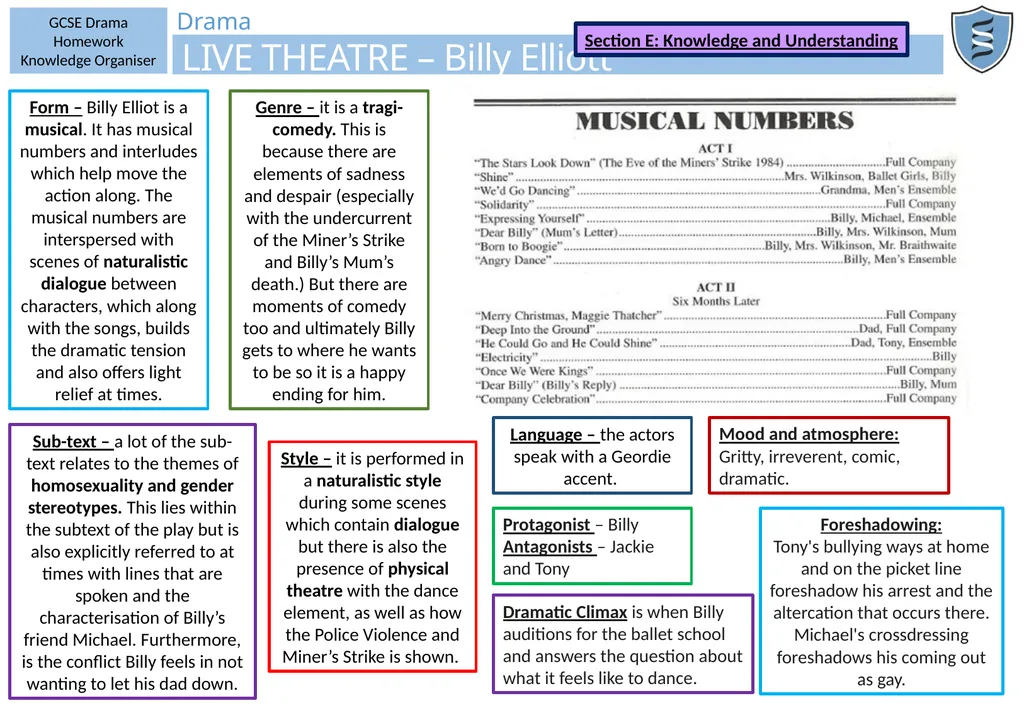
Style – it is performed in a naturalistic style during some scenes which contain dialogue but there is also the presence of physical theatre with the dance element, as well as how the Police Violence and Miner’s Strike is shown. Drama LIVE THEATRE – Billy Elliott GCSE Drama Homework
Knowledge Organiser Section E: Knowledge and Understanding Form – Billy Elliot is a musical. It has musical numbers and interludes which help move the action along. The musical numbers are interspersed with scenes of naturalistic dialogue between characters, which along with the songs, builds the dramatic tension and also offers light relief at times. Genre – it is a tragi-comedy. This is because there are elements of sadness and despair (especially with the undercurrent of the Miner’s Strike and Billy’s Mum’s death.) But there are moments of comedy too and ultimately Billy gets to where he wants to be so it is a happy ending for him. Sub-text – a lot of the sub-text relates to the themes of homosexuality and gender stereotypes. This lies within the subtext of the play but is also explicitly referred to at times with lines that are spoken and the characterisation of Billy’s friend Michael. Furthermore, is the conflict Billy feels in not wanting to let his dad down. Language – the actors speak with a Geordie accent. Mood and atmosphere: Gritty, irreverent, comic, dramatic. Protagonist – Billy
Antagonists – Jackie and Tony Dramatic Climax is when Billy auditions for the ballet school and answers the question about what it feels like to dance. Foreshadowing:
Tony's bullying ways at home and on the picket line foreshadow his arrest and the altercation that occurs there. Michael's crossdressing foreshadows his coming out as gay.<br>
Knowledge Organiser Section E: Knowledge and Understanding Form – Billy Elliot is a musical. It has musical numbers and interludes which help move the action along. The musical numbers are interspersed with scenes of naturalistic dialogue between characters, which along with the songs, builds the dramatic tension and also offers light relief at times. Genre – it is a tragi-comedy. This is because there are elements of sadness and despair (especially with the undercurrent of the Miner’s Strike and Billy’s Mum’s death.) But there are moments of comedy too and ultimately Billy gets to where he wants to be so it is a happy ending for him. Sub-text – a lot of the sub-text relates to the themes of homosexuality and gender stereotypes. This lies within the subtext of the play but is also explicitly referred to at times with lines that are spoken and the characterisation of Billy’s friend Michael. Furthermore, is the conflict Billy feels in not wanting to let his dad down. Language – the actors speak with a Geordie accent. Mood and atmosphere: Gritty, irreverent, comic, dramatic. Protagonist – Billy
Antagonists – Jackie and Tony Dramatic Climax is when Billy auditions for the ballet school and answers the question about what it feels like to dance. Foreshadowing:
Tony's bullying ways at home and on the picket line foreshadow his arrest and the altercation that occurs there. Michael's crossdressing foreshadows his coming out as gay.<br>
07
Drama LIVE THEATRE – Billy Elliott GCSE Drama Homework
Knowledge Organiser<br>
Knowledge Organiser<br>