Atmospheric Processes Ozone Depletion Quick recap The ozone layer refers to the ozone within stratosphere over 90 of the earths ozone resides Ozone is an irritating, corrosive, colourless gas with a smell O3 formed by Ozone-Oxygen
"Atmospheric Processes Ozone Depletion Quick recap…" is the property of its rightful owner. Permission is granted to
download and print the materials on this website for personal, non-commercial use only, and to display it
on your personal computer provided you do not modify the materials and that you retain all copyright
notices contained in the materials. By downloading content from our website, you accept the terms of this
agreement.
Presentation Transcript
01
Atmospheric Processes Ozone Depletion<br>
02
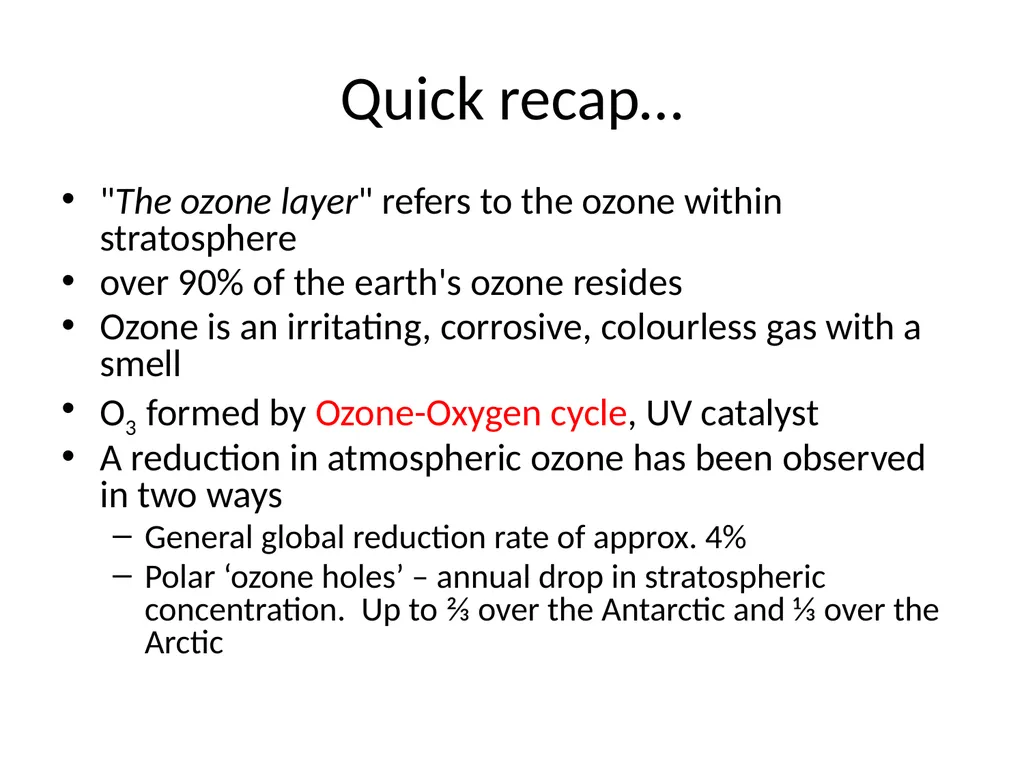
Quick recap… "The ozone layer" refers to the ozone within stratosphere
over 90% of the earth's ozone resides
Ozone is an irritating, corrosive, colourless gas with a smell
O3 formed by Ozone-Oxygen cycle, UV catalyst
A reduction in atmospheric ozone has been observed in two ways
General global reduction rate of approx. 4%
Polar ‘ozone holes’ – annual drop in stratospheric concentration. Up to ⅔ over the Antarctic and ⅓ over the Arctic<br>
03
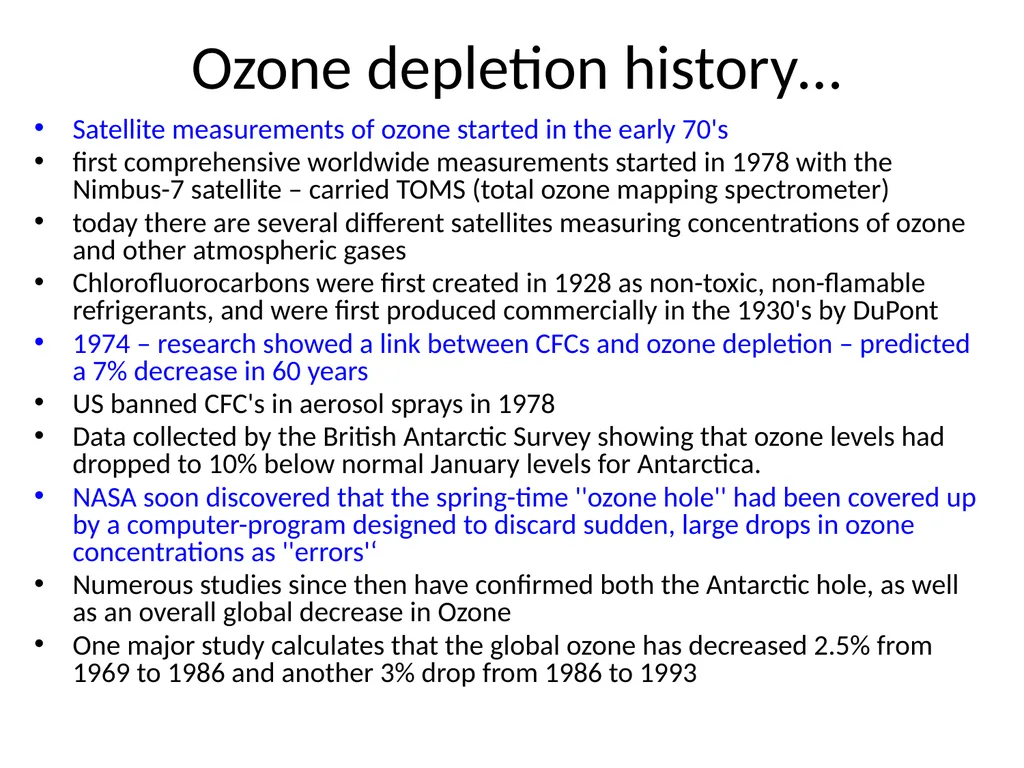
Ozone depletion history… Satellite measurements of ozone started in the early 70's
first comprehensive worldwide measurements started in 1978 with the Nimbus-7 satellite – carried TOMS (total ozone mapping spectrometer)
today there are several different satellites measuring concentrations of ozone and other atmospheric gases
Chlorofluorocarbons were first created in 1928 as non-toxic, non-flamable refrigerants, and were first produced commercially in the 1930's by DuPont
1974 – research showed a link between CFCs and ozone depletion – predicted a 7% decrease in 60 years
US banned CFC's in aerosol sprays in 1978
Data collected by the British Antarctic Survey showing that ozone levels had dropped to 10% below normal January levels for Antarctica.
NASA soon discovered that the spring-time ''ozone hole'' had been covered up by a computer-program designed to discard sudden, large drops in ozone concentrations as ''errors'‘
Numerous studies since then have confirmed both the Antarctic hole, as well as an overall global decrease in Ozone
One major study calculates that the global ozone has decreased 2.5% from 1969 to 1986 and another 3% drop from 1986 to 1993<br>
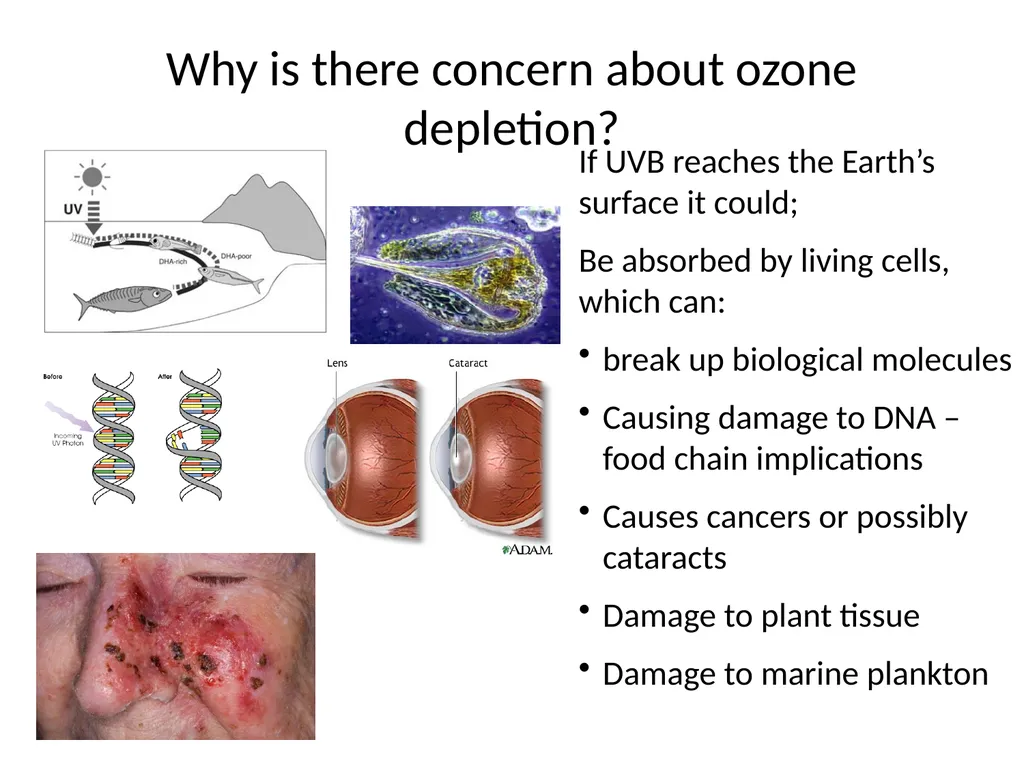
Why is there concern about ozone depletion? If UVB reaches the Earth’s surface it could;
Be absorbed by living cells, which can:
break up biological molecules
Causing damage to DNA – food chain implications
Causes cancers or possibly cataracts
Damage to plant tissue
Damage to marine plankton<br>
06
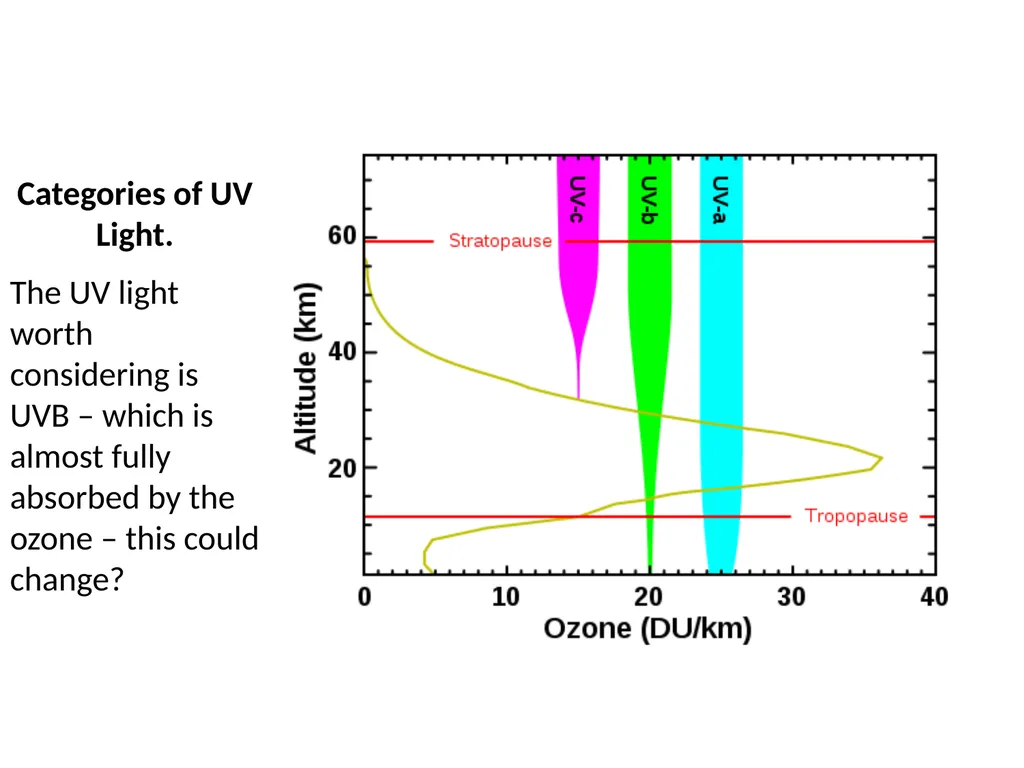
Categories of UV Light.
The UV light worth considering is UVB – which is almost fully absorbed by the ozone – this could change?<br>
07
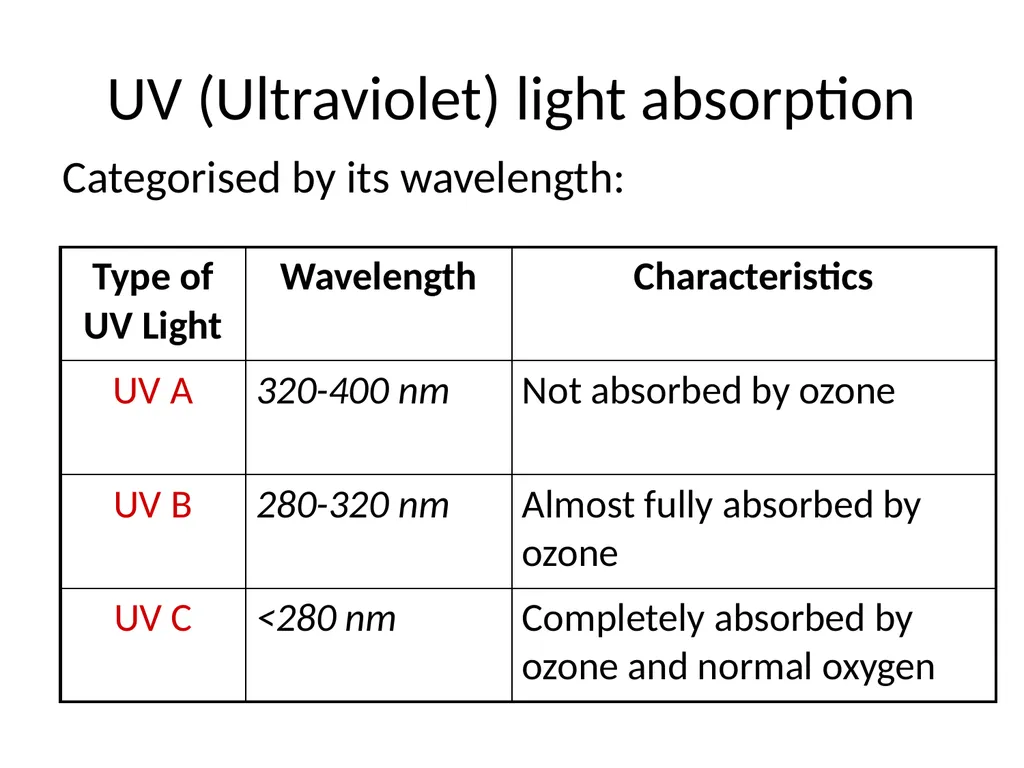
UV (Ultraviolet) light absorption Categorised by its wavelength:<br>
08
The effects of UVB on gases in the atmosphere Number of chemical reactions
Very little reaches the Earth’s surface
Diatomic, Triatomic and photolytic reactions where molecules are split (e.g. Oxygen-Ozone Cycle)
Summary of reactions; O2 + O UV UV O3<br>
09
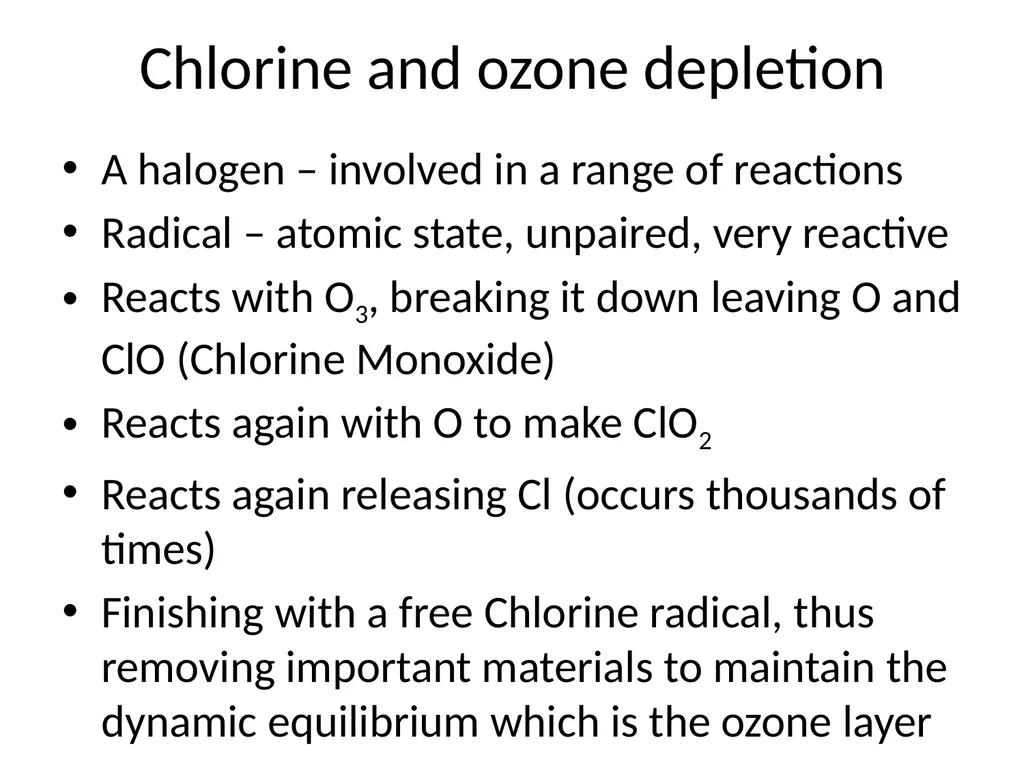
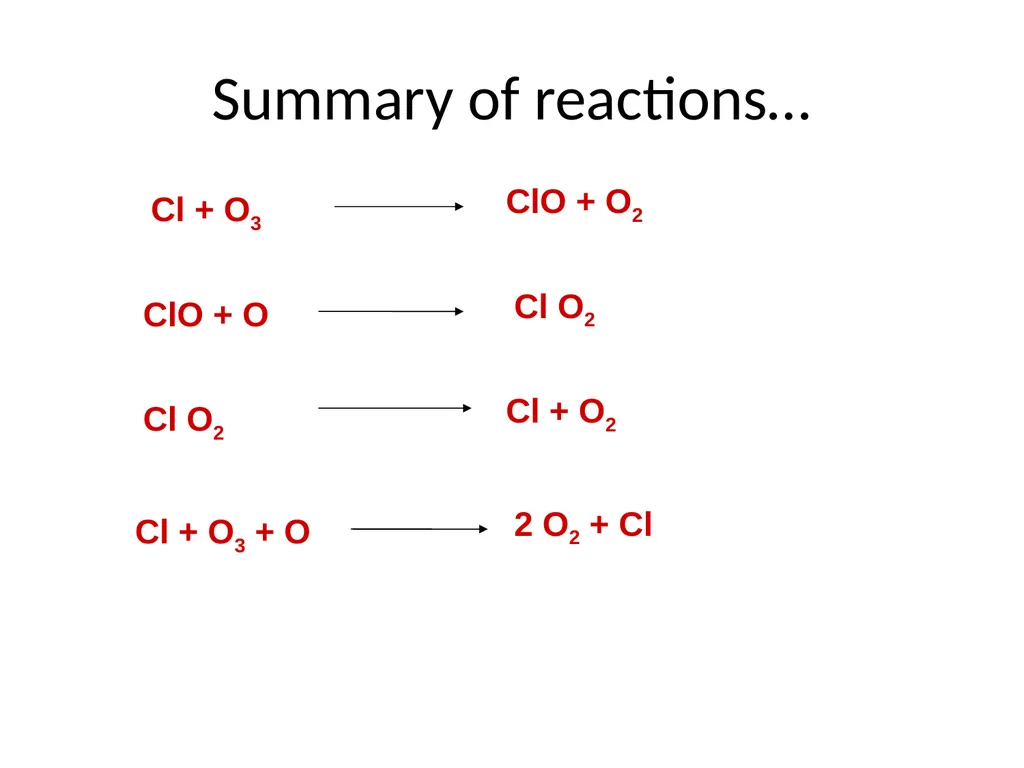
Chlorine and ozone depletion A halogen – involved in a range of reactions
Radical – atomic state, unpaired, very reactive
Reacts with O3, breaking it down leaving O and ClO (Chlorine Monoxide)
Reacts again with O to make ClO2
Reacts again releasing Cl (occurs thousands of times)
Finishing with a free Chlorine radical, thus removing important materials to maintain the dynamic equilibrium which is the ozone layer<br>
10
Summary of reactions… Cl + O3 ClO + O2 ClO + O Cl O2 Cl + O2 Cl O2 Cl + O3 + O 2 O2 + Cl<br>
11
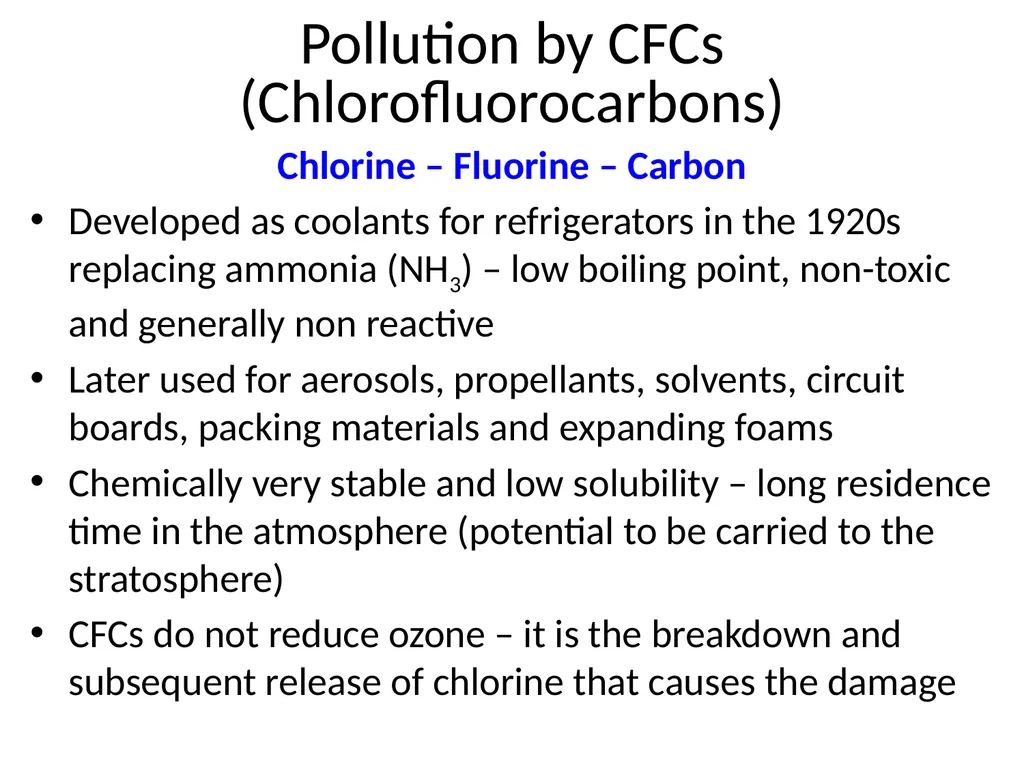
Pollution by CFCs (Chlorofluorocarbons) Chlorine – Fluorine – Carbon
Developed as coolants for refrigerators in the 1920s replacing ammonia (NH3) – low boiling point, non-toxic and generally non reactive
Later used for aerosols, propellants, solvents, circuit boards, packing materials and expanding foams
Chemically very stable and low solubility – long residence time in the atmosphere (potential to be carried to the stratosphere)
CFCs do not reduce ozone – it is the breakdown and subsequent release of chlorine that causes the damage<br>
12
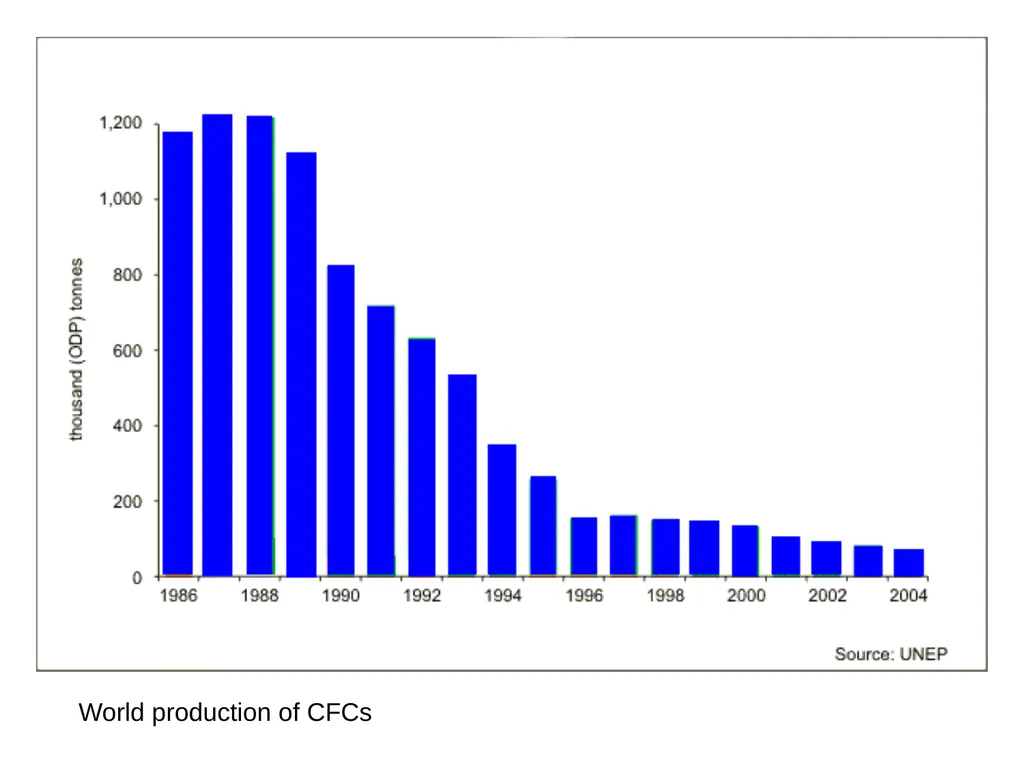
World production of CFCs<br>
13
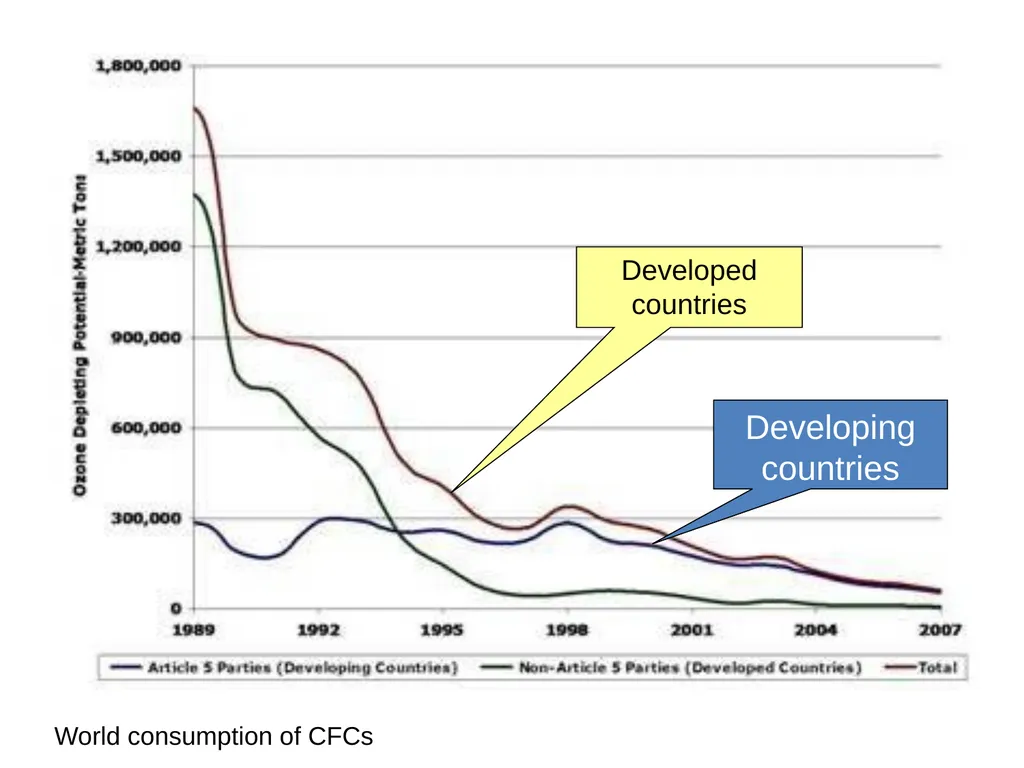
World consumption of CFCs Developed countries Developing countries<br>
14
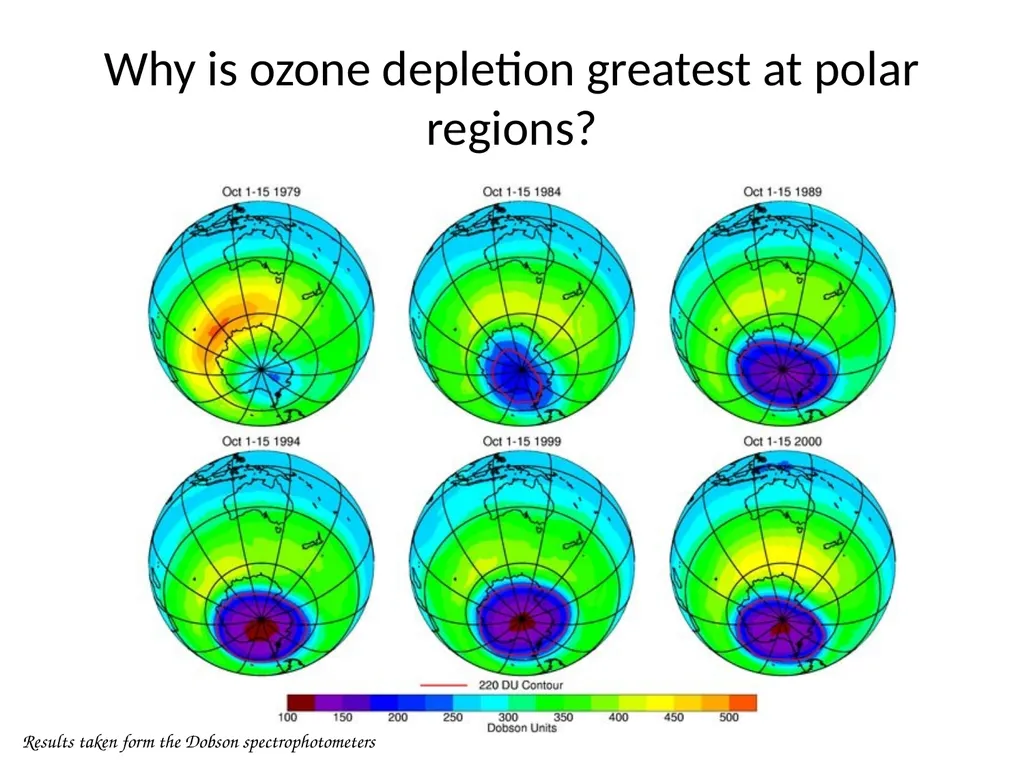
Why is ozone depletion greatest at polar regions? Results taken form the Dobson spectrophotometers<br>
15
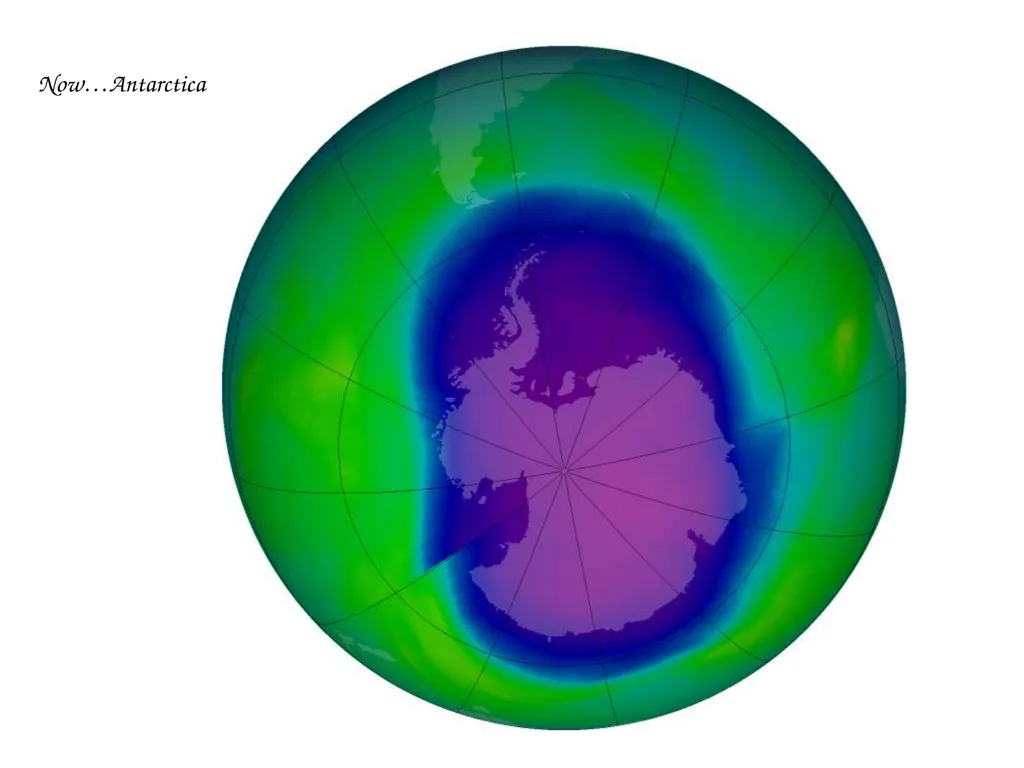
Now…Antarctica<br>
16
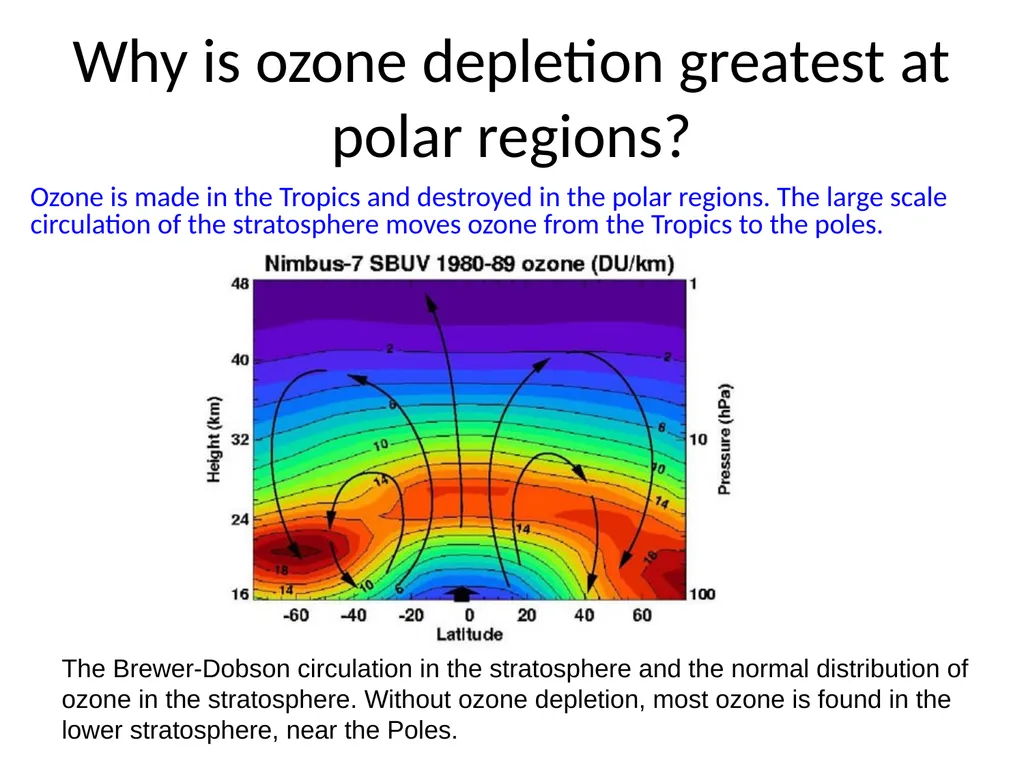
Why is ozone depletion greatest at polar regions? Ozone is made in the Tropics and destroyed in the polar regions. The large scale circulation of the stratosphere moves ozone from the Tropics to the poles. The Brewer-Dobson circulation in the stratosphere and the normal distribution of ozone in the stratosphere. Without ozone depletion, most ozone is found in the lower stratosphere, near the Poles.<br>
17
Why is ozone depletion greatest at polar regions? During the long, dark winter, temperatures in the stratosphere fall to c.-80°C
Water, nitric acid and sulphuric acid form ice crystals
Ice crystals form to provide a suitable catalytic surface - (found on polar stratospheric clouds)
Spring sun in September activate dangerous forms of chlorine (ice melt)
Localised and seasonal increases in chlorine, thus making the ‘hole’ bigger and bigger in spring
Unreactive chlorine compounds into reactive chlorine radicals
The polar vortex has enhanced this process by isolating the cold polar air from the rest of the atmosphere in winter.
This hole gradually fills with warmer ozone rich air brought by the atmospheric circulation in the summer, however, as the hole is getting bigger, it is taking longer to fill
The ozone is also becoming thinner over the Arctic – which could possibly spread over North America affecting peoples health.<br>
18
Are other gases to blame? Oxides of Nitrogen have been identified, however amounts released within the troposphere do not reach the stratosphere due to reactions with other materials and it dissolving in rain
Aviation do release NOx – not enough for any significant change
Latest research has yet to be published on aviations long term impacts on ozone<br>
19
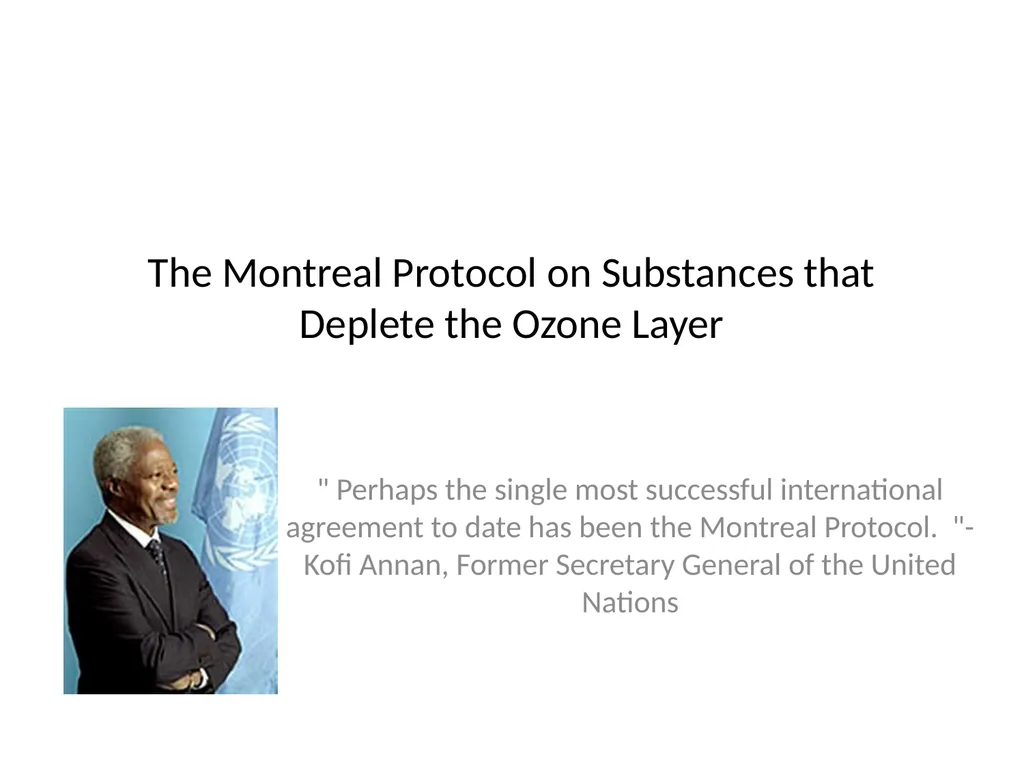
The Montreal Protocol on Substances that Deplete the Ozone Layer " Perhaps the single most successful international agreement to date has been the Montreal Protocol. "-Kofi Annan, Former Secretary General of the United Nations<br>
20
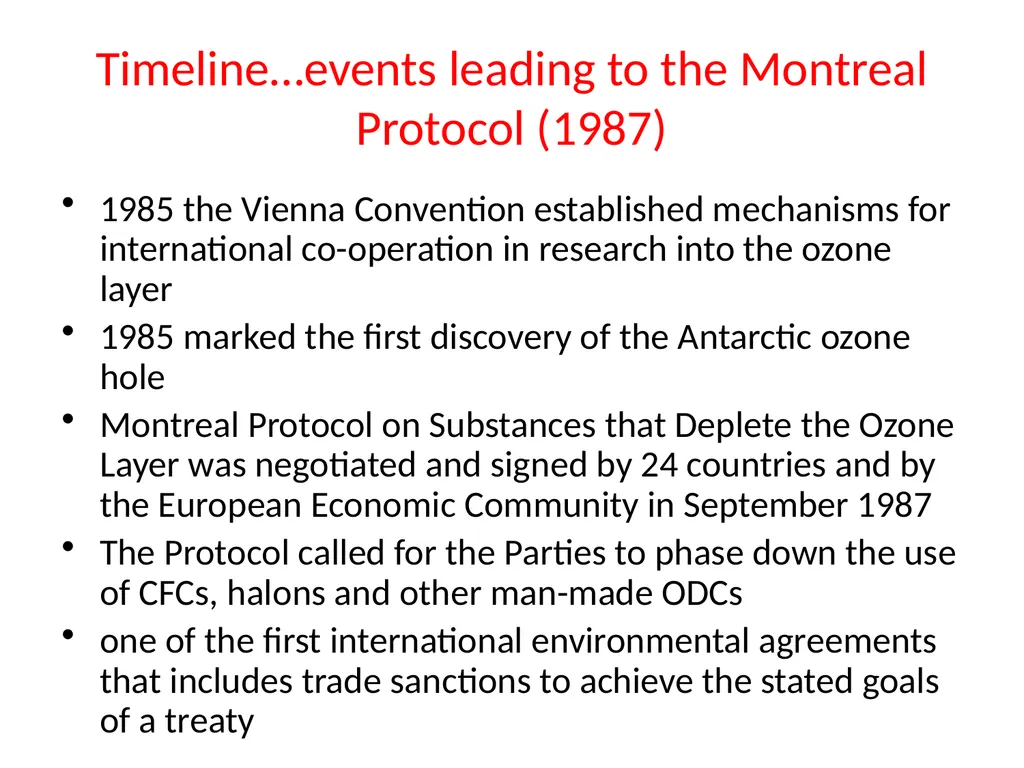
Timeline…events leading to the Montreal Protocol (1987) 1985 the Vienna Convention established mechanisms for international co-operation in research into the ozone layer
1985 marked the first discovery of the Antarctic ozone hole
Montreal Protocol on Substances that Deplete the Ozone Layer was negotiated and signed by 24 countries and by the European Economic Community in September 1987
The Protocol called for the Parties to phase down the use of CFCs, halons and other man-made ODCs
one of the first international environmental agreements that includes trade sanctions to achieve the stated goals of a treaty<br>
21
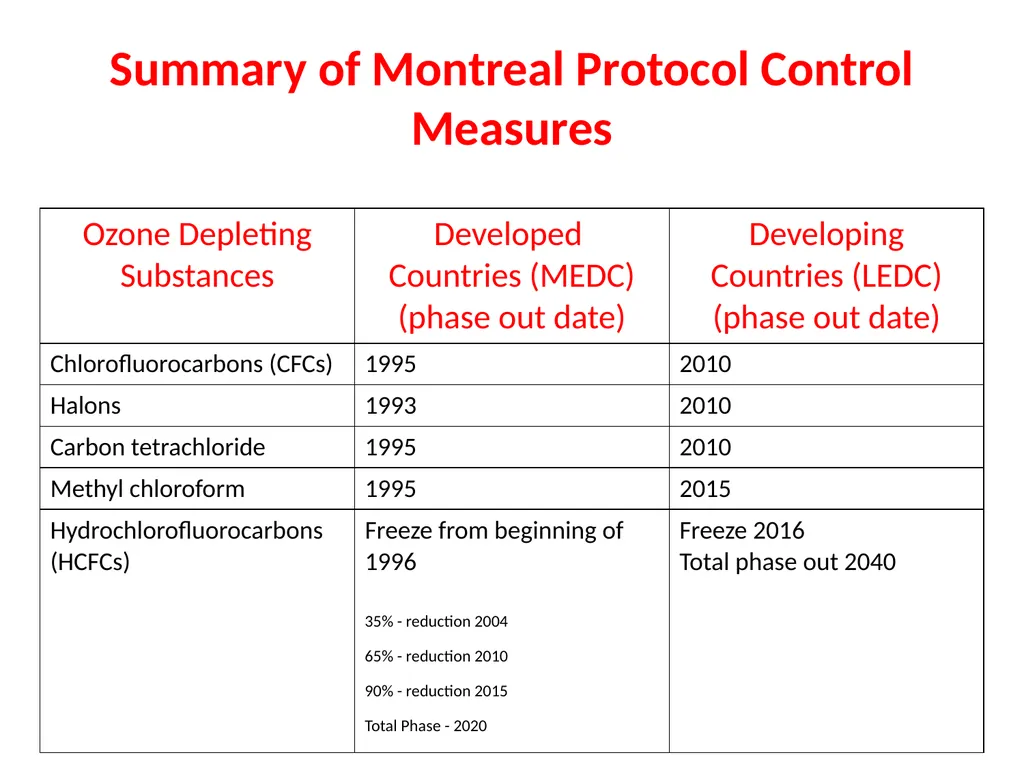
Summary of Montreal Protocol Control Measures<br>
22
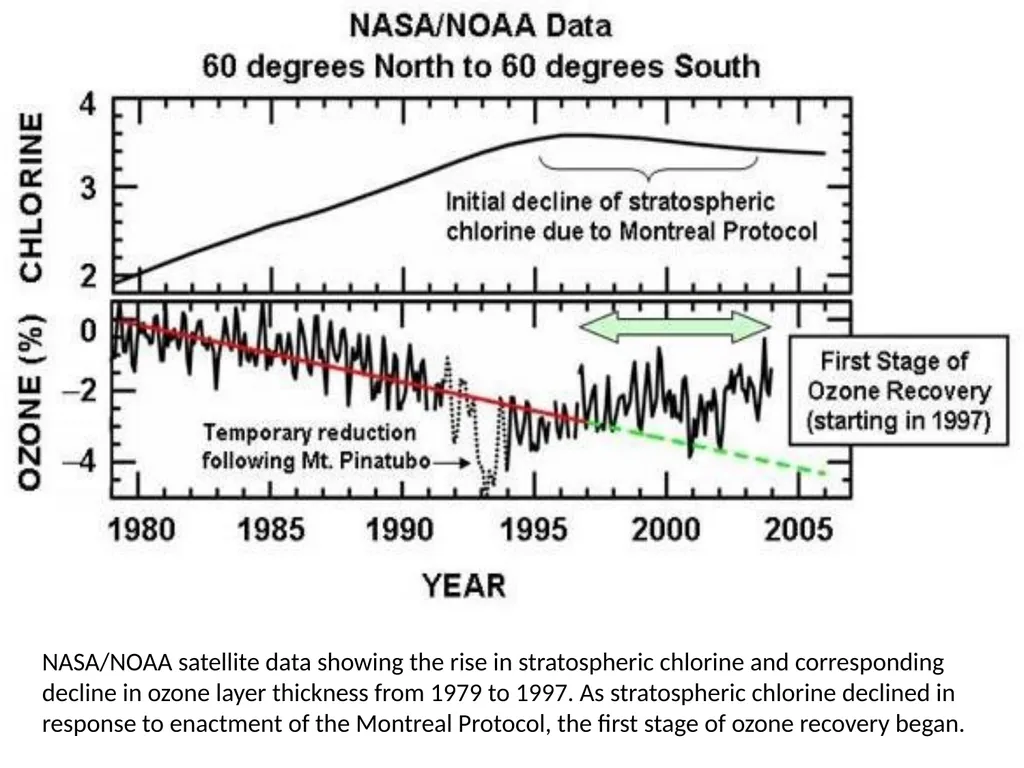
NASA/NOAA satellite data showing the rise in stratospheric chlorine and corresponding decline in ozone layer thickness from 1979 to 1997. As stratospheric chlorine declined in response to enactment of the Montreal Protocol, the first stage of ozone recovery began.<br>
23
Questions… Explain how humans activities have increased/caused ozone depletion (4 marks)
Outline the methods that have been used to reduce ozone depletion (8 marks)
Describe and explain why Antarctica is more susceptible to ozone depletion than equatorial regions (3 marks)<br>
24
Summary of Ozone in the Stratosphere http://www.esrl.noaa.gov/csd/assessments/ozone/2010/twentyquestions/<br>