
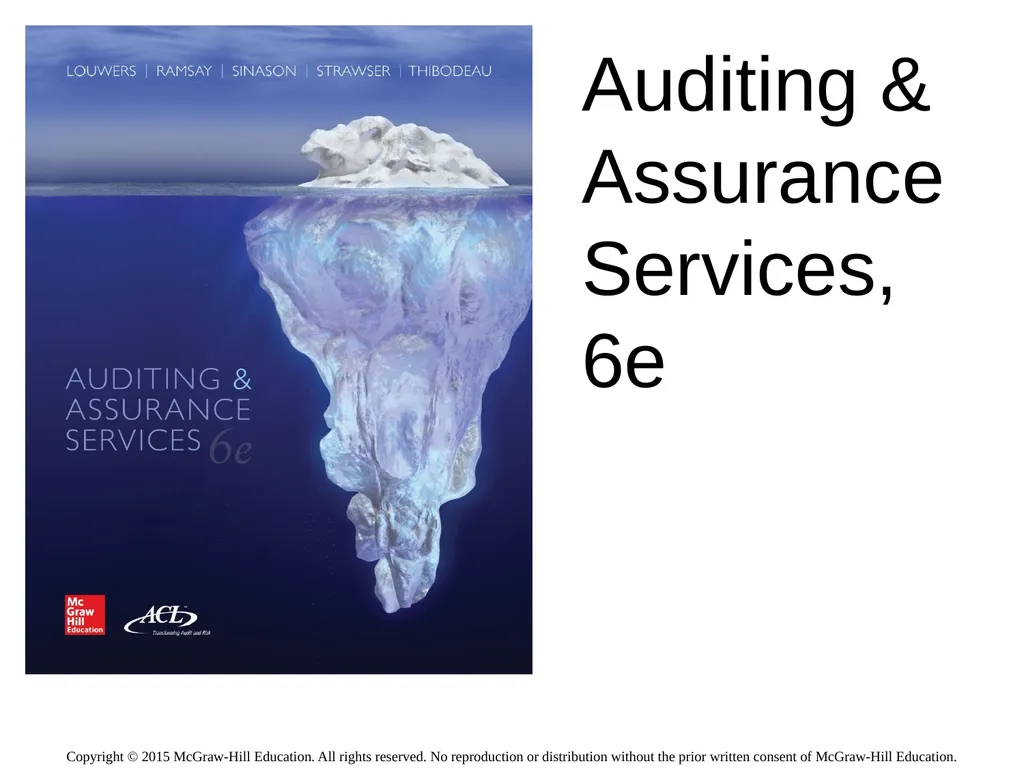
Auditing & Assurance Services, 6e Module B
LD
Published · 41 slides · 0 views
1 / 1


Description
Auditing Assurance Services, 6e Module B Professional Ethics Auditors must approach their jobs with independence and skepticism. How do we instill those necessary traits in auditors? This may be the most important auditing question of
Related Topics
Share
Embed code
Download this presentation From Below
"Auditing & Assurance Services, 6e Module B" is the property of its rightful owner. Permission is granted to download and print the materials on this website for personal, non-commercial use only, and to display it on your personal computer provided you do not modify the materials and that you retain all copyright notices contained in the materials. By downloading content from our website, you accept the terms of this agreement.
Presentation Transcript
01
Auditing & Assurance Services, 6e<br>
02
Module B
Professional Ethics “Auditors must approach their jobs with independence and skepticism. How do we instill those necessary traits in auditors? This may be the most important auditing question of our time.”
James Doty, PCOAB Chairman, remarks made at SEC Reporting Conference, June 2, 2011
“To educate a person in mind and not in morals is to educate a menace to society.”
Theodore “Teddy” Roosevelt, 26th President of the United States
“Always do right—this will gratify some and astonish the rest.”
Mark Twain, famous American novelist Mod B-2<br>
James Doty, PCOAB Chairman, remarks made at SEC Reporting Conference, June 2, 2011
“To educate a person in mind and not in morals is to educate a menace to society.”
Theodore “Teddy” Roosevelt, 26th President of the United States
“Always do right—this will gratify some and astonish the rest.”
Mark Twain, famous American novelist Mod B-2<br>
03
Learning Objectives Understand general ethics and a series of steps for making ethical decisions.
Reason through an ethical decision problem using the imperative, utilitarian, and virtue theories of moral philosophy.
Identify the different entities that make ethics rules for CPAs and public accounting firms.
With reference to American Institute of Certified Public Accounting (AICPA), Government Accountability Office (GAO), Public Company Accounting Oversight Board (PCAOB), and Securities and Exchange Commission (SEC) rules, analyze factual situations and decide whether an accountant’s conduct does or does not impair independence.
With reference to AICPA rules on topics other than independence, analyze factual situations and decide whether an accountant’s conduct does or does not conform to the AICPA Code of Professional of Conduct.
Explain the types of penalties that can be imposed on accountants. Mod B-3<br>
Reason through an ethical decision problem using the imperative, utilitarian, and virtue theories of moral philosophy.
Identify the different entities that make ethics rules for CPAs and public accounting firms.
With reference to American Institute of Certified Public Accounting (AICPA), Government Accountability Office (GAO), Public Company Accounting Oversight Board (PCAOB), and Securities and Exchange Commission (SEC) rules, analyze factual situations and decide whether an accountant’s conduct does or does not impair independence.
With reference to AICPA rules on topics other than independence, analyze factual situations and decide whether an accountant’s conduct does or does not conform to the AICPA Code of Professional of Conduct.
Explain the types of penalties that can be imposed on accountants. Mod B-3<br>
04
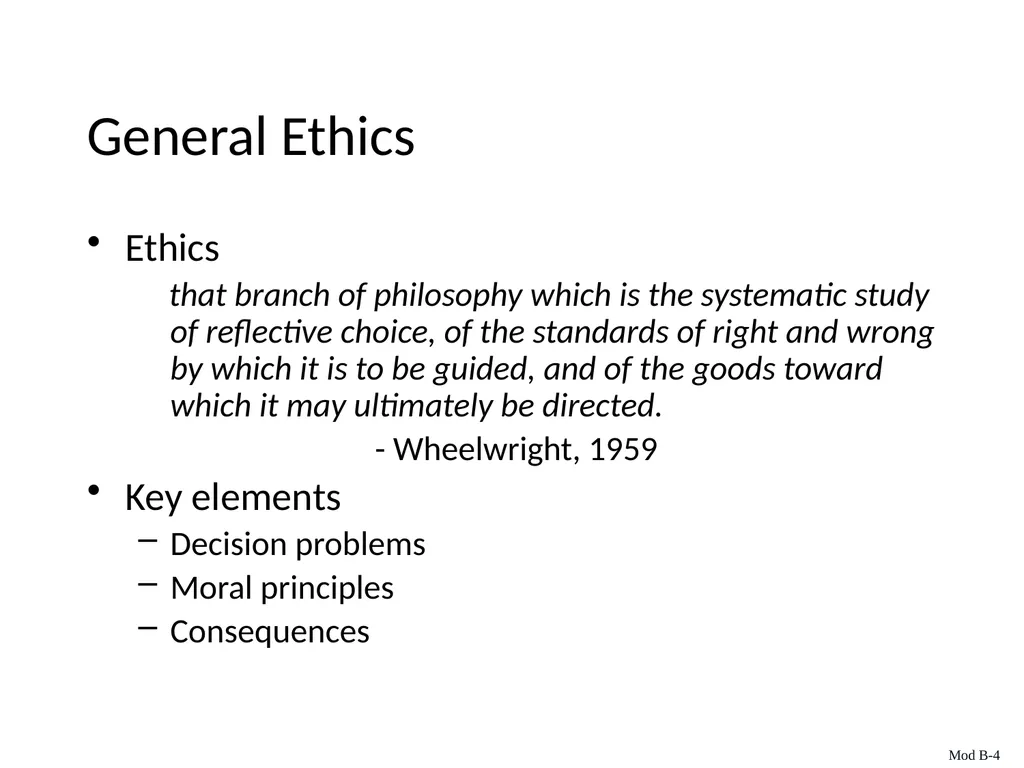
General Ethics Ethics
that branch of philosophy which is the systematic study of reflective choice, of the standards of right and wrong by which it is to be guided, and of the goods toward which it may ultimately be directed.
- Wheelwright, 1959
Key elements
Decision problems
Moral principles
Consequences Mod B-4<br>
that branch of philosophy which is the systematic study of reflective choice, of the standards of right and wrong by which it is to be guided, and of the goods toward which it may ultimately be directed.
- Wheelwright, 1959
Key elements
Decision problems
Moral principles
Consequences Mod B-4<br>
05
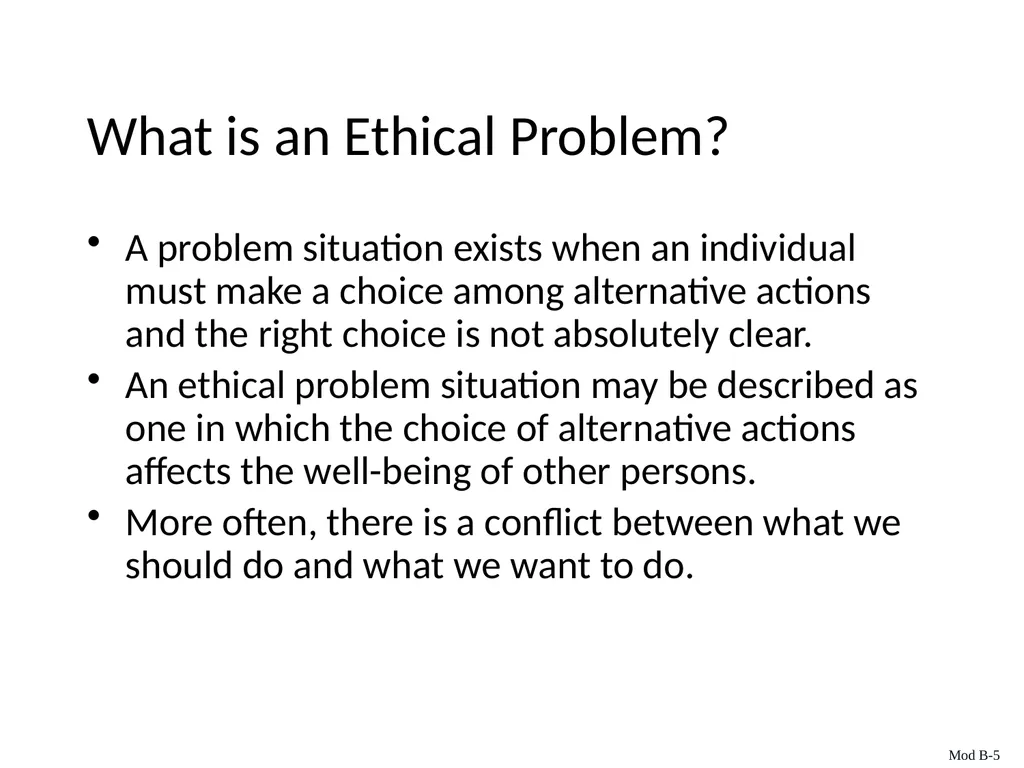
What is an Ethical Problem? A problem situation exists when an individual must make a choice among alternative actions and the right choice is not absolutely clear.
An ethical problem situation may be described as one in which the choice of alternative actions affects the well-being of other persons.
More often, there is a conflict between what we should do and what we want to do. Mod B-5<br>
An ethical problem situation may be described as one in which the choice of alternative actions affects the well-being of other persons.
More often, there is a conflict between what we should do and what we want to do. Mod B-5<br>
06
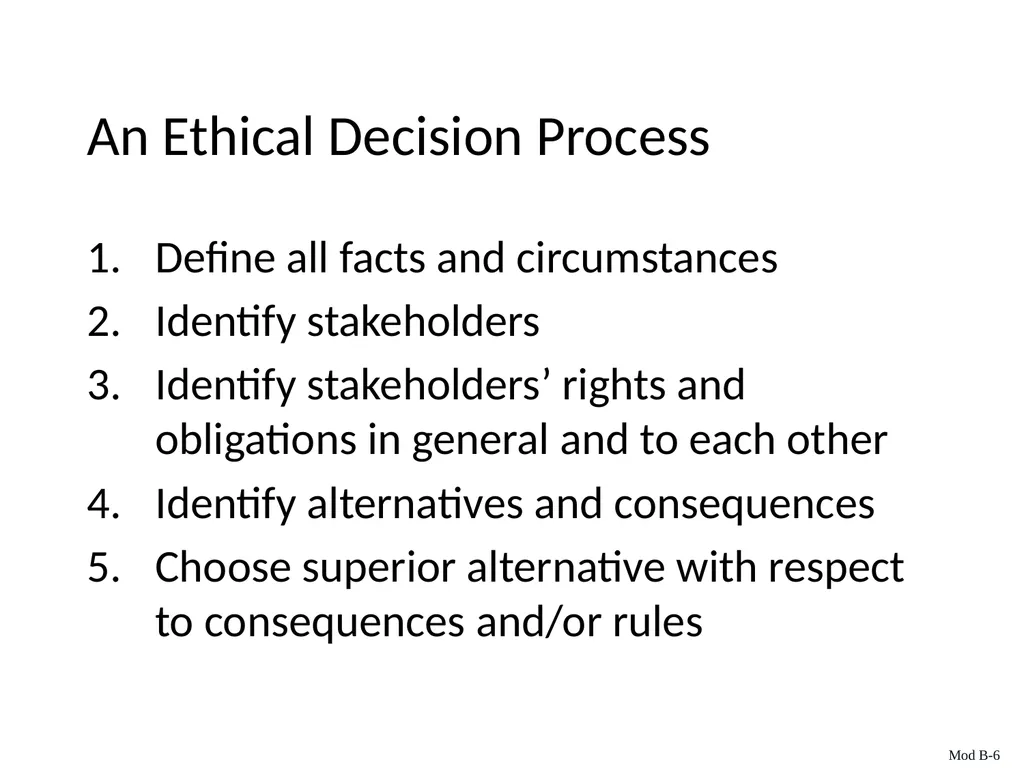
An Ethical Decision Process Define all facts and circumstances
Identify stakeholders
Identify stakeholders’ rights and obligations in general and to each other
Identify alternatives and consequences
Choose superior alternative with respect to consequences and/or rules Mod B-6<br>
Identify stakeholders
Identify stakeholders’ rights and obligations in general and to each other
Identify alternatives and consequences
Choose superior alternative with respect to consequences and/or rules Mod B-6<br>
07
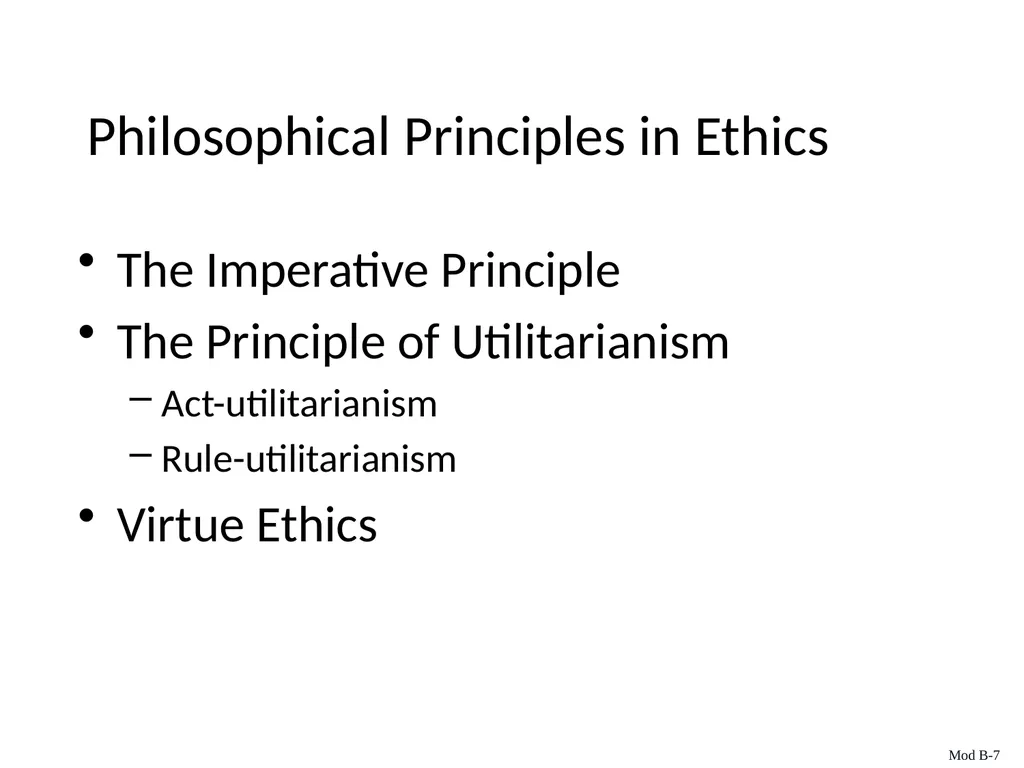
Philosophical Principles in Ethics The Imperative Principle
The Principle of Utilitarianism
Act-utilitarianism
Rule-utilitarianism
Virtue Ethics Mod B-7<br>
The Principle of Utilitarianism
Act-utilitarianism
Rule-utilitarianism
Virtue Ethics Mod B-7<br>
08
The Imperative Principle (Kant) Directs a decision maker to act according to the requirements of an ethical rule
Strict versions of imperative ethics maintain that a decision should be made without trying to predict whether an action will create the greatest balance of good over evil
Ethics in the imperative sense is a function of moral rules and principles and does not involve a situation-specific calculation of the consequences Mod B-8<br>
Strict versions of imperative ethics maintain that a decision should be made without trying to predict whether an action will create the greatest balance of good over evil
Ethics in the imperative sense is a function of moral rules and principles and does not involve a situation-specific calculation of the consequences Mod B-8<br>
09
The Principle of Utilitarianism (J.S. Mill) Emphasizes examining the consequences of an action rather than following rules
The criterion of producing the greater good is made an explicit part of the decision process
In act-utilitarianism, the center of attention is the individual act as it is affected by the specific circumstances of a situation
Rule-utilitarianism emphasizes the centrality of rules for ethical behavior while still maintaining the criterion of the greatest universal good Mod B-9<br>
The criterion of producing the greater good is made an explicit part of the decision process
In act-utilitarianism, the center of attention is the individual act as it is affected by the specific circumstances of a situation
Rule-utilitarianism emphasizes the centrality of rules for ethical behavior while still maintaining the criterion of the greatest universal good Mod B-9<br>
10
The Generalization Argument A judicious combination of the imperative and utilitarian principles
Considers the consequences of a decision made by similar persons acting under similar circumstances
“What would happen if everyone acted in that certain way?”
If the answer to the question is that the consequences would be undesirable, the conclusion is that the way of acting is unethical and should not be done. Mod B-10<br>
Considers the consequences of a decision made by similar persons acting under similar circumstances
“What would happen if everyone acted in that certain way?”
If the answer to the question is that the consequences would be undesirable, the conclusion is that the way of acting is unethical and should not be done. Mod B-10<br>
11
Virtue Ethics (Aristotle) Setting self-focused standards for instilling intra-personal excellence and building character:
Virtues such as honesty, openness, integrity, etc.
Behavior you would be proud to have widely reported. Mod B-11<br>
Virtues such as honesty, openness, integrity, etc.
Behavior you would be proud to have widely reported. Mod B-11<br>
12
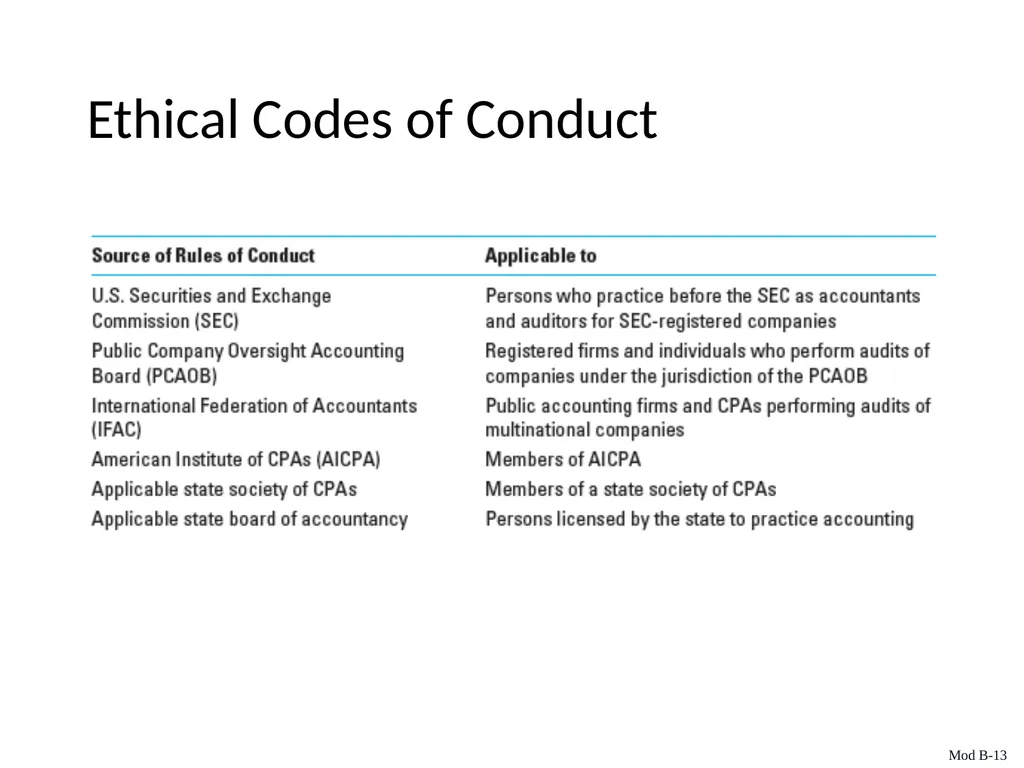
Ethical Codes of Conduct U.S. Securities and Exchange Commission (SEC)
The Public Company Accounting Oversight Board (PCAOB)
The International Federation of Accountants (IFAC)
The Professional Ethics Executive Committee (PEEC) of the American Institute of Certified Public Accountants (AICPA)
Applicable State Society of CPAs
Applicable State Board of Accountancy Mod B-12<br>
The Public Company Accounting Oversight Board (PCAOB)
The International Federation of Accountants (IFAC)
The Professional Ethics Executive Committee (PEEC) of the American Institute of Certified Public Accountants (AICPA)
Applicable State Society of CPAs
Applicable State Board of Accountancy Mod B-12<br>
13
Ethical Codes of Conduct Mod B-13<br>
14
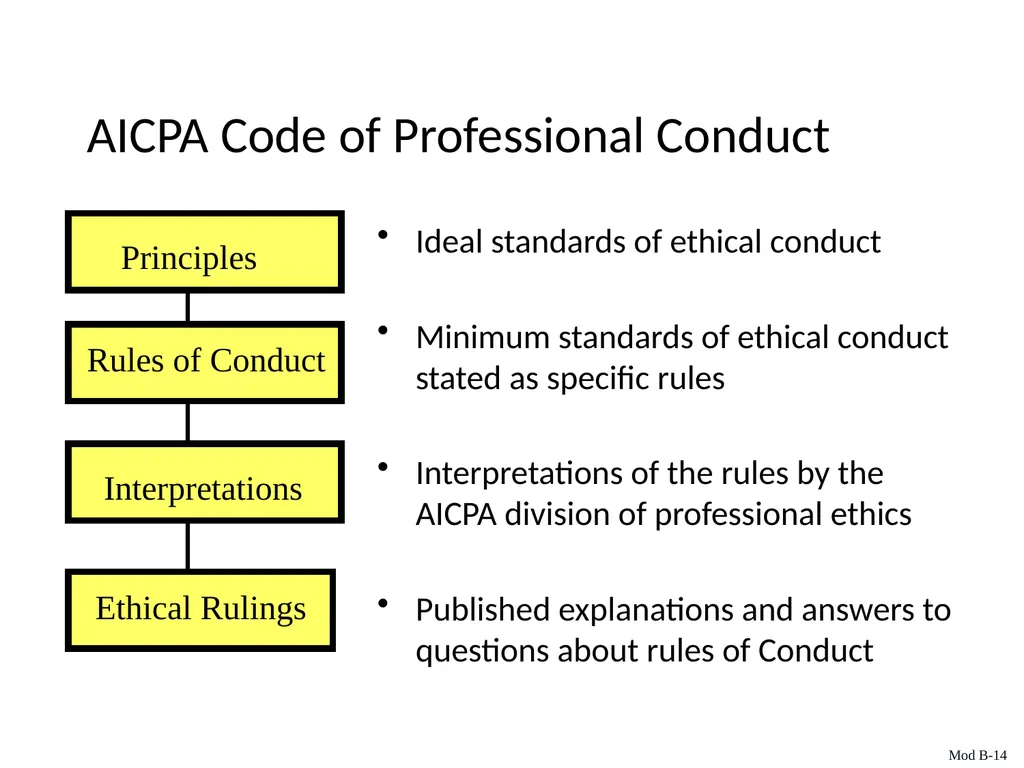
AICPA Code of Professional Conduct Ideal standards of ethical conduct
Minimum standards of ethical conduct stated as specific rules
Interpretations of the rules by the AICPA division of professional ethics
Published explanations and answers to questions about rules of Conduct Mod B-14<br>
Minimum standards of ethical conduct stated as specific rules
Interpretations of the rules by the AICPA division of professional ethics
Published explanations and answers to questions about rules of Conduct Mod B-14<br>
15
AICPA Code of Professional Conduct:
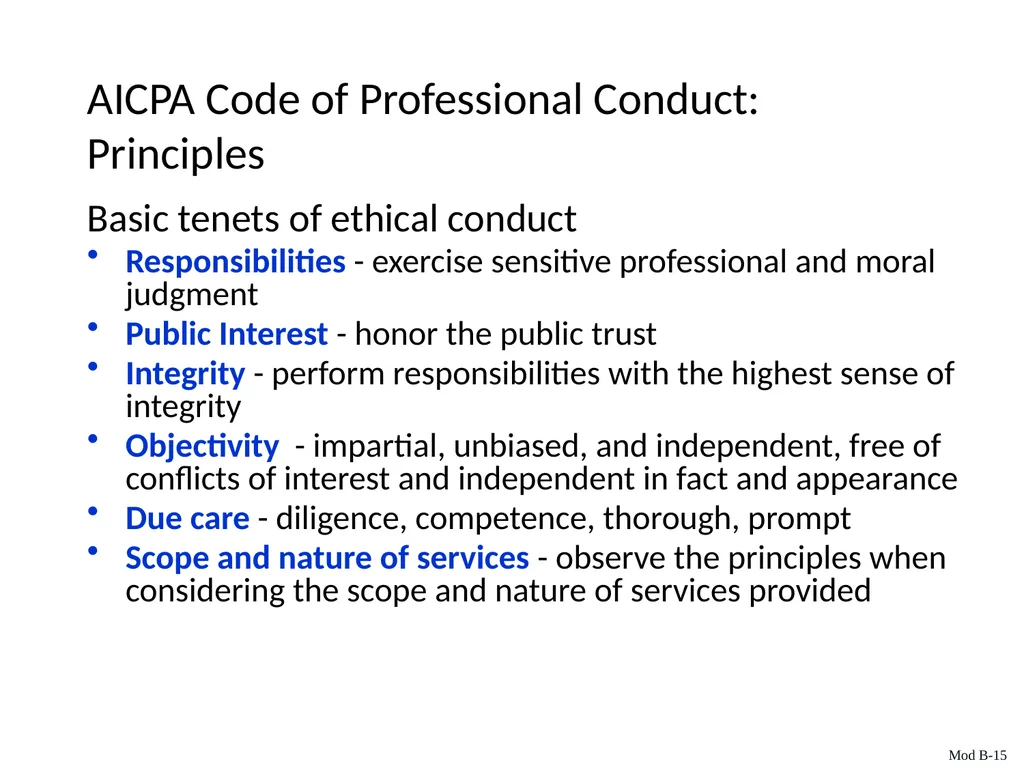
Principles Basic tenets of ethical conduct
Responsibilities - exercise sensitive professional and moral judgment
Public Interest - honor the public trust
Integrity - perform responsibilities with the highest sense of integrity
Objectivity - impartial, unbiased, and independent, free of conflicts of interest and independent in fact and appearance
Due care - diligence, competence, thorough, prompt
Scope and nature of services - observe the principles when considering the scope and nature of services provided Mod B-15<br>
Responsibilities - exercise sensitive professional and moral judgment
Public Interest - honor the public trust
Integrity - perform responsibilities with the highest sense of integrity
Objectivity - impartial, unbiased, and independent, free of conflicts of interest and independent in fact and appearance
Due care - diligence, competence, thorough, prompt
Scope and nature of services - observe the principles when considering the scope and nature of services provided Mod B-15<br>
16
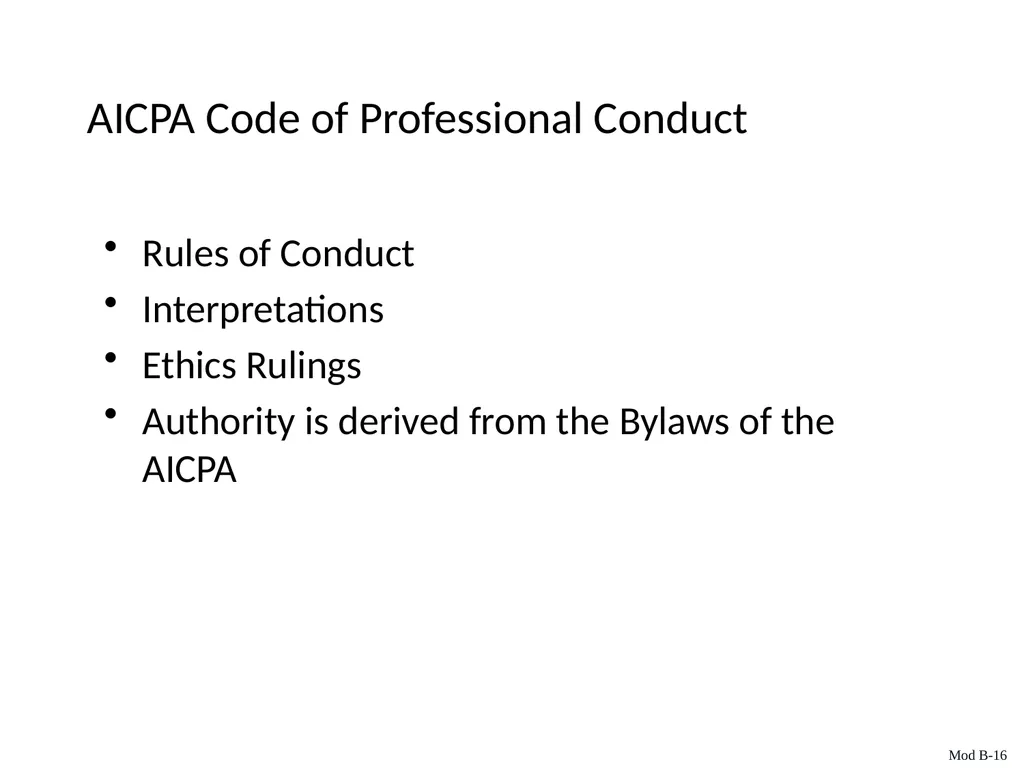
AICPA Code of Professional Conduct Rules of Conduct
Interpretations
Ethics Rulings
Authority is derived from the Bylaws of the AICPA Mod B-16<br>
Interpretations
Ethics Rulings
Authority is derived from the Bylaws of the AICPA Mod B-16<br>
17
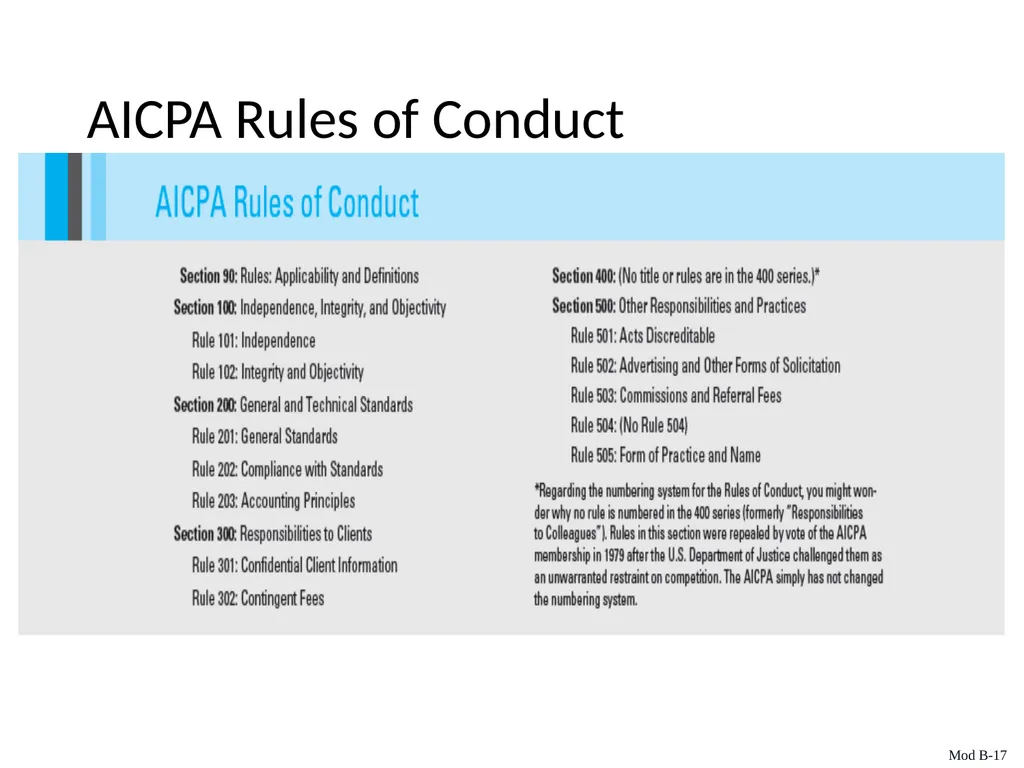
AICPA Rules of Conduct Mod B-17<br>
18
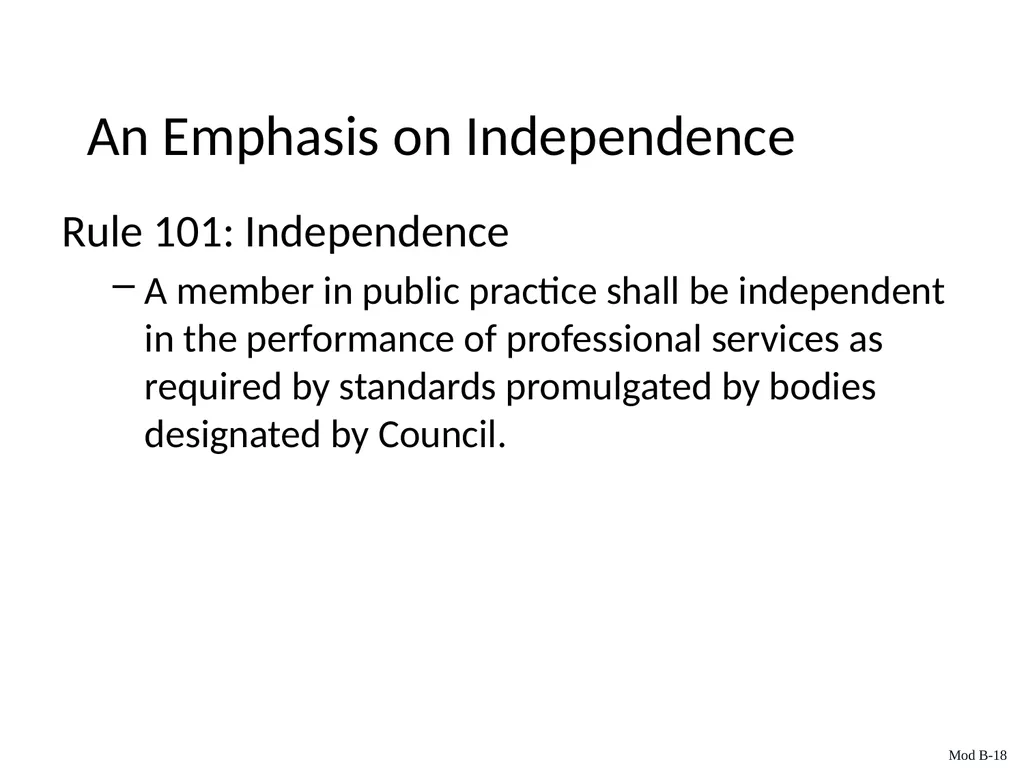
An Emphasis on Independence Rule 101: Independence
A member in public practice shall be independent in the performance of professional services as required by standards promulgated by bodies designated by Council. Mod B-18<br>
A member in public practice shall be independent in the performance of professional services as required by standards promulgated by bodies designated by Council. Mod B-18<br>
19
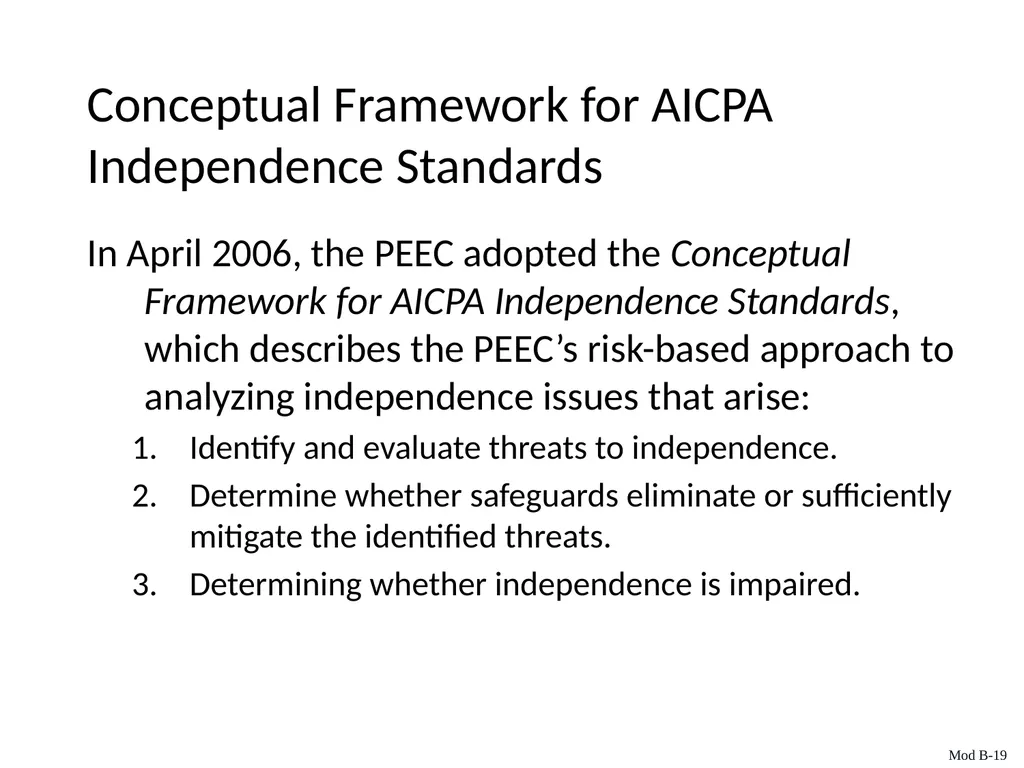
Conceptual Framework for AICPA Independence Standards In April 2006, the PEEC adopted the Conceptual Framework for AICPA Independence Standards, which describes the PEEC’s risk-based approach to analyzing independence issues that arise:
Identify and evaluate threats to independence.
Determine whether safeguards eliminate or sufficiently mitigate the identified threats.
Determining whether independence is impaired. Mod B-19<br>
Identify and evaluate threats to independence.
Determine whether safeguards eliminate or sufficiently mitigate the identified threats.
Determining whether independence is impaired. Mod B-19<br>
20
Threats to an Auditor’s Independence Familiarity threat. CPAs having a close or longstanding relationship with a client.
Adverse interest threat. CPAs acting in opposition to clients (e.g., through litigation).
Undue influence threat. Attempts to coerce or otherwise influence the CPA member (e.g., significant gifts or threats to replace the auditor over an accounting principles disagreement).
Self-review threat. CPAs reviewing their own work.
Financial self-interest threat. CPAs having a financial relationship with a client.
Management participation threat. CPAs taking on the role of client management or otherwise performing management functions.
Advocacy threat. CPAs promoting a client’s interests or position. Mod B-20<br>
Adverse interest threat. CPAs acting in opposition to clients (e.g., through litigation).
Undue influence threat. Attempts to coerce or otherwise influence the CPA member (e.g., significant gifts or threats to replace the auditor over an accounting principles disagreement).
Self-review threat. CPAs reviewing their own work.
Financial self-interest threat. CPAs having a financial relationship with a client.
Management participation threat. CPAs taking on the role of client management or otherwise performing management functions.
Advocacy threat. CPAs promoting a client’s interests or position. Mod B-20<br>
21
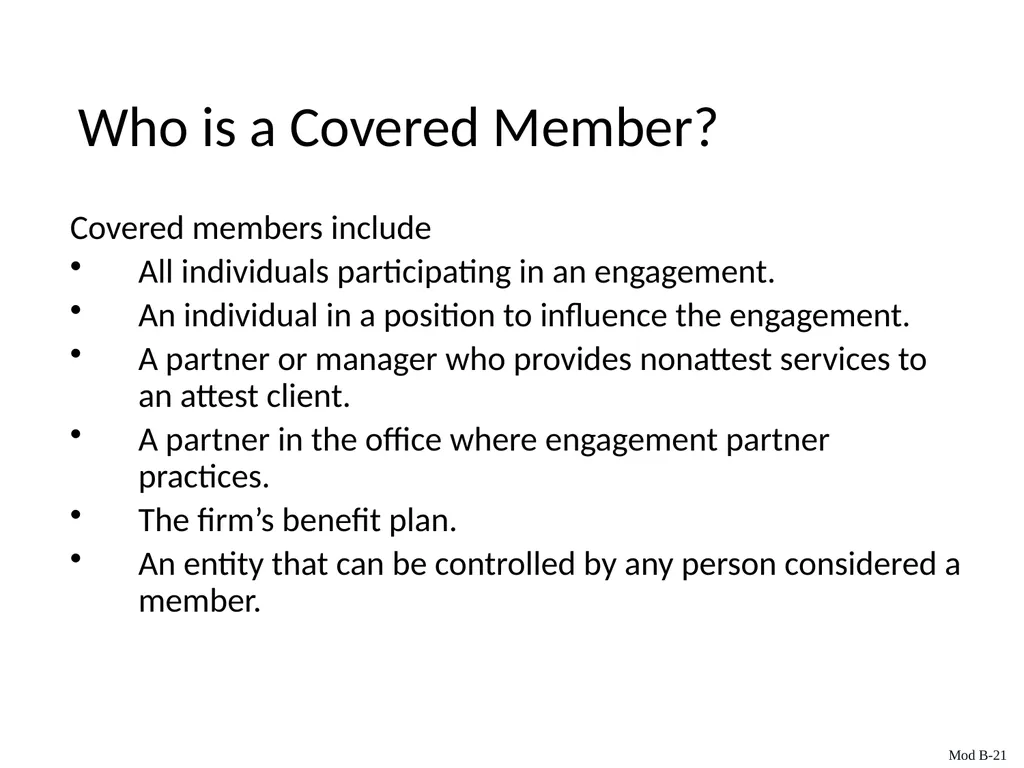
Who is a Covered Member? Covered members include
All individuals participating in an engagement.
An individual in a position to influence the engagement.
A partner or manager who provides nonattest services to an attest client.
A partner in the office where engagement partner practices.
The firm’s benefit plan.
An entity that can be controlled by any person considered a member. Mod B-21<br>
All individuals participating in an engagement.
An individual in a position to influence the engagement.
A partner or manager who provides nonattest services to an attest client.
A partner in the office where engagement partner practices.
The firm’s benefit plan.
An entity that can be controlled by any person considered a member. Mod B-21<br>
22
AICPA Code of Professional Conduct
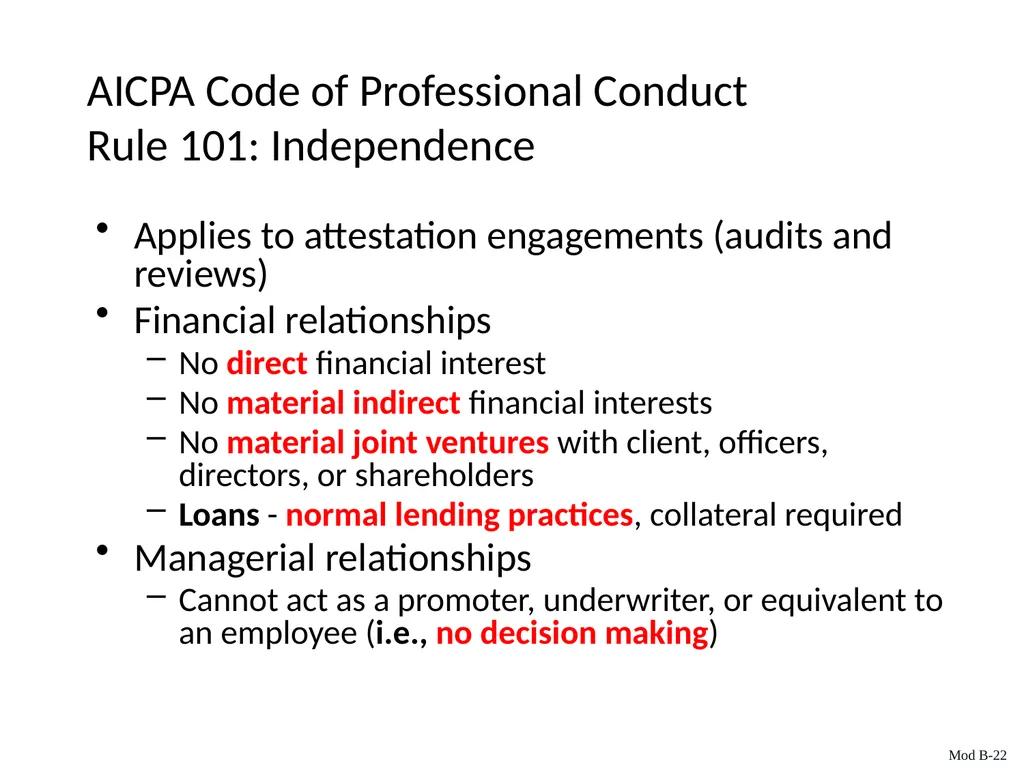
Rule 101: Independence Applies to attestation engagements (audits and reviews)
Financial relationships
No direct financial interest
No material indirect financial interests
No material joint ventures with client, officers, directors, or shareholders
Loans - normal lending practices, collateral required
Managerial relationships
Cannot act as a promoter, underwriter, or equivalent to an employee (i.e., no decision making) Mod B-22<br>
Financial relationships
No direct financial interest
No material indirect financial interests
No material joint ventures with client, officers, directors, or shareholders
Loans - normal lending practices, collateral required
Managerial relationships
Cannot act as a promoter, underwriter, or equivalent to an employee (i.e., no decision making) Mod B-22<br>
23
AICPA Code of Professional Conduct
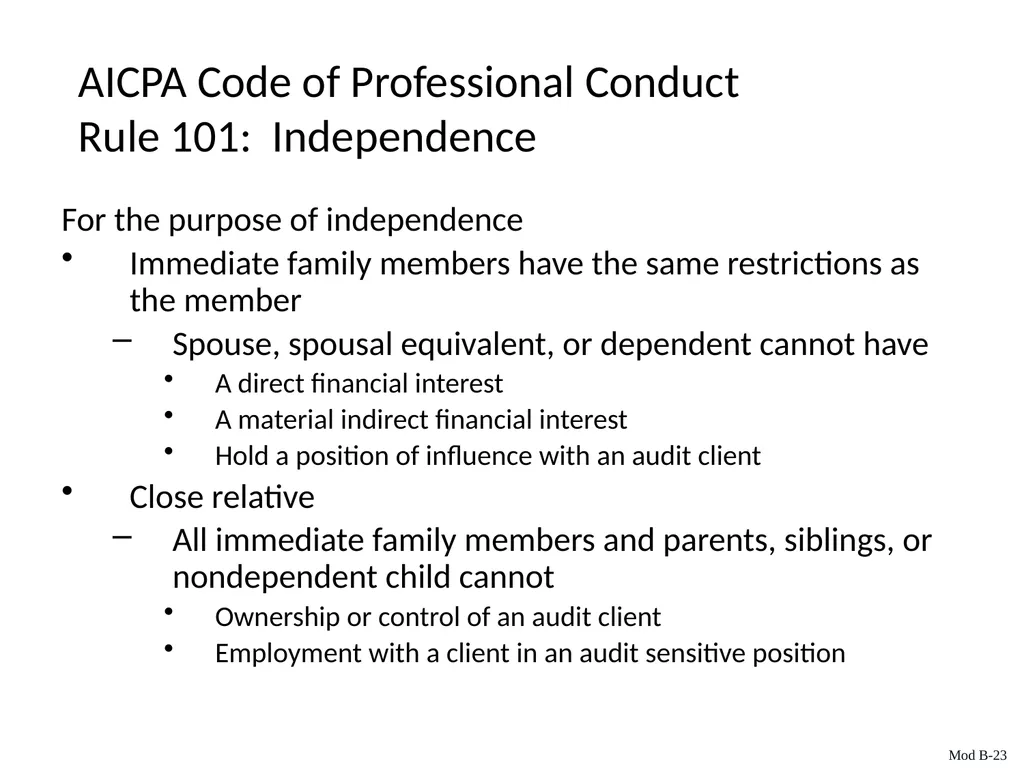
Rule 101: Independence For the purpose of independence
Immediate family members have the same restrictions as the member
Spouse, spousal equivalent, or dependent cannot have
A direct financial interest
A material indirect financial interest
Hold a position of influence with an audit client
Close relative
All immediate family members and parents, siblings, or nondependent child cannot
Ownership or control of an audit client
Employment with a client in an audit sensitive position Mod B-23<br>
Immediate family members have the same restrictions as the member
Spouse, spousal equivalent, or dependent cannot have
A direct financial interest
A material indirect financial interest
Hold a position of influence with an audit client
Close relative
All immediate family members and parents, siblings, or nondependent child cannot
Ownership or control of an audit client
Employment with a client in an audit sensitive position Mod B-23<br>
24
AICPA Code of Professional Conduct
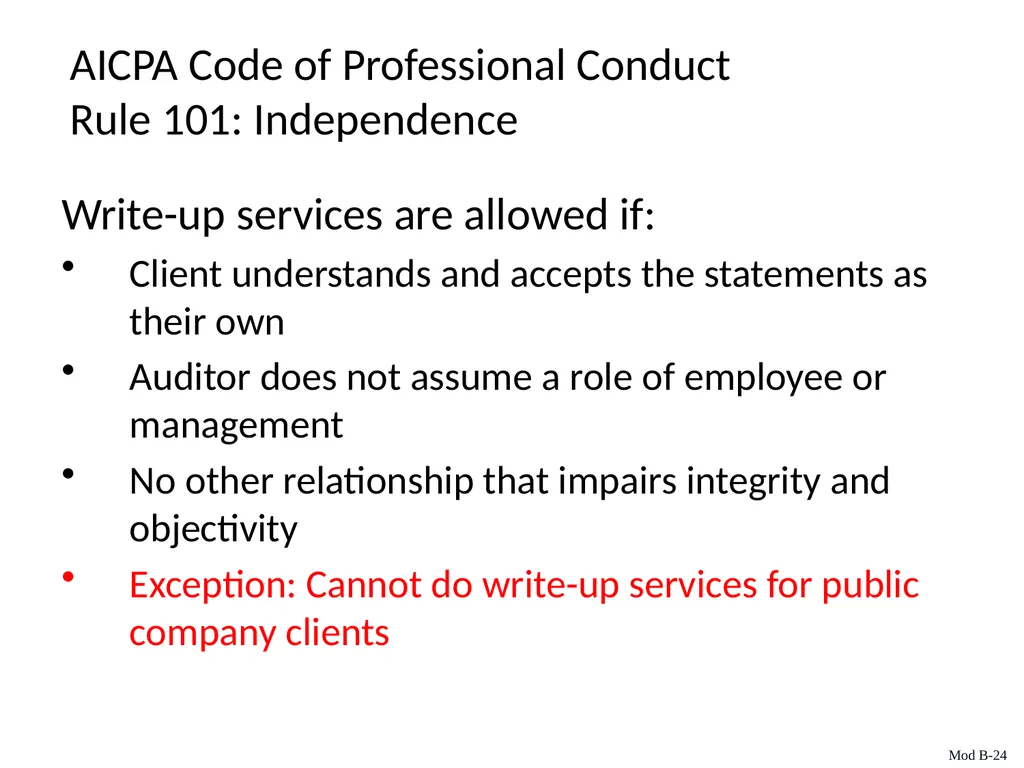
Rule 101: Independence Write-up services are allowed if:
Client understands and accepts the statements as their own
Auditor does not assume a role of employee or management
No other relationship that impairs integrity and objectivity
Exception: Cannot do write-up services for public company clients Mod B-24<br>
Client understands and accepts the statements as their own
Auditor does not assume a role of employee or management
No other relationship that impairs integrity and objectivity
Exception: Cannot do write-up services for public company clients Mod B-24<br>
25
AICPA Code of Professional Conduct
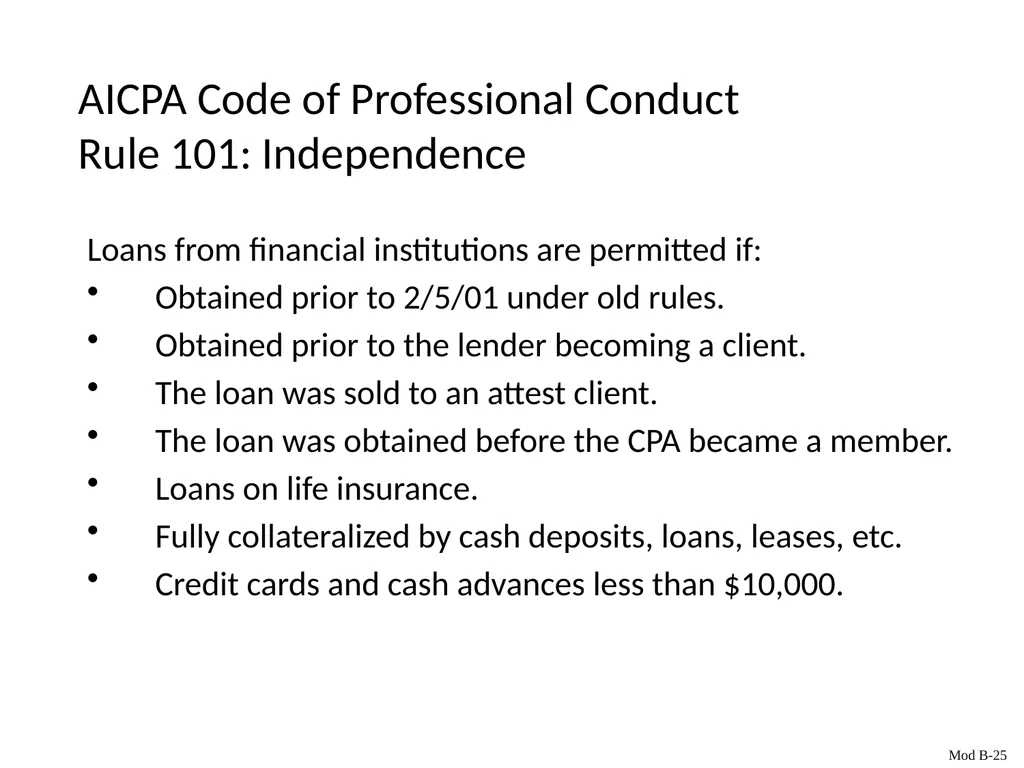
Rule 101: Independence Loans from financial institutions are permitted if:
Obtained prior to 2/5/01 under old rules.
Obtained prior to the lender becoming a client.
The loan was sold to an attest client.
The loan was obtained before the CPA became a member.
Loans on life insurance.
Fully collateralized by cash deposits, loans, leases, etc.
Credit cards and cash advances less than $10,000. Mod B-25<br>
Obtained prior to 2/5/01 under old rules.
Obtained prior to the lender becoming a client.
The loan was sold to an attest client.
The loan was obtained before the CPA became a member.
Loans on life insurance.
Fully collateralized by cash deposits, loans, leases, etc.
Credit cards and cash advances less than $10,000. Mod B-25<br>
26
AICPA Code of Professional Conduct
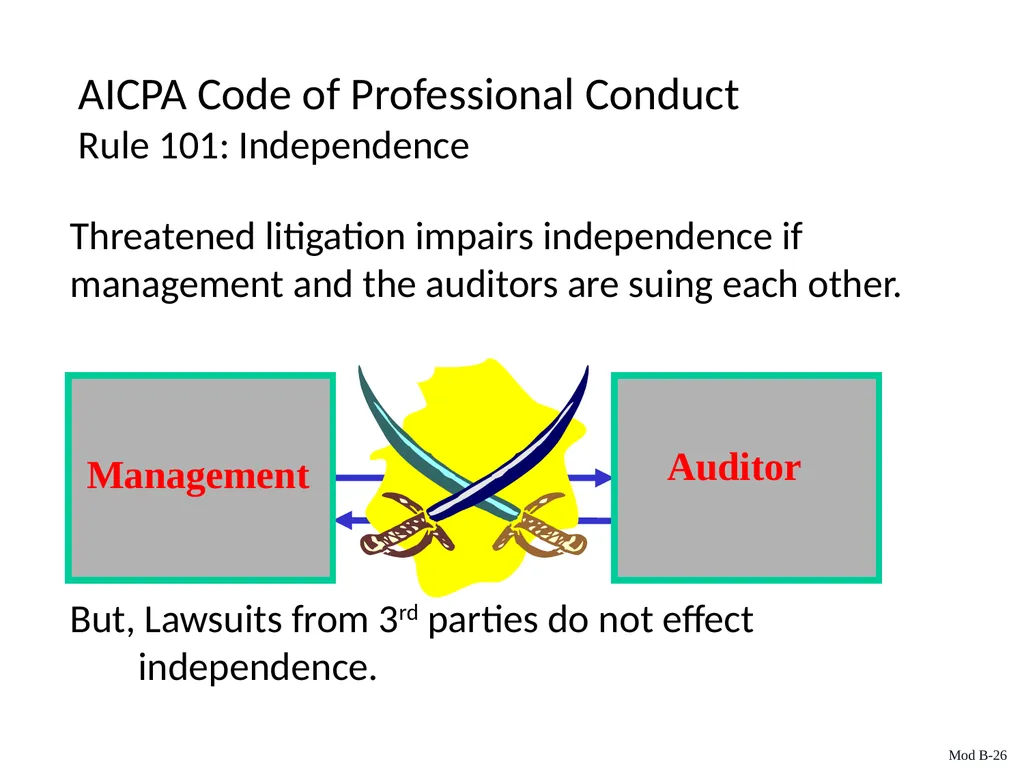
Rule 101: Independence Threatened litigation impairs independence if
management and the auditors are suing each other.
But, Lawsuits from 3rd parties do not effect independence. Mod B-26<br>
management and the auditors are suing each other.
But, Lawsuits from 3rd parties do not effect independence. Mod B-26<br>
27
AICPA Code of Professional Conduct
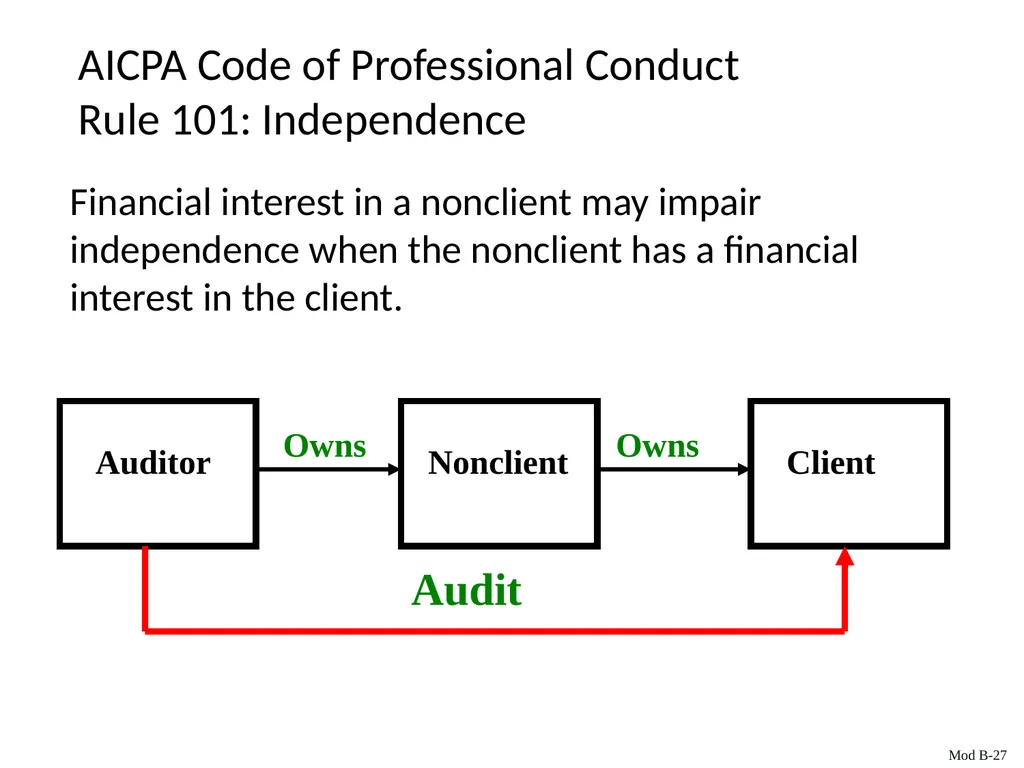
Rule 101: Independence Financial interest in a nonclient may impair
independence when the nonclient has a financial
interest in the client. Owns Owns Audit Mod B-27<br>
independence when the nonclient has a financial
interest in the client. Owns Owns Audit Mod B-27<br>
28
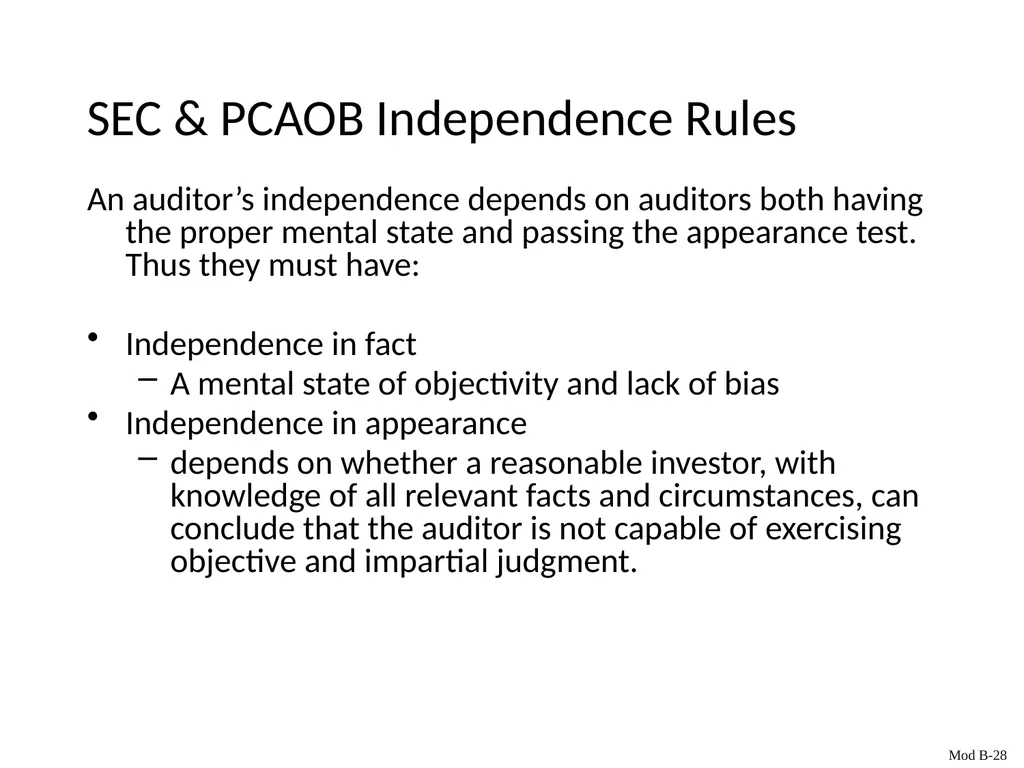
SEC & PCAOB Independence Rules An auditor’s independence depends on auditors both having the proper mental state and passing the appearance test. Thus they must have:
Independence in fact
A mental state of objectivity and lack of bias
Independence in appearance
depends on whether a reasonable investor, with knowledge of all relevant facts and circumstances, can conclude that the auditor is not capable of exercising objective and impartial judgment. Mod B-28<br>
Independence in fact
A mental state of objectivity and lack of bias
Independence in appearance
depends on whether a reasonable investor, with knowledge of all relevant facts and circumstances, can conclude that the auditor is not capable of exercising objective and impartial judgment. Mod B-28<br>
29
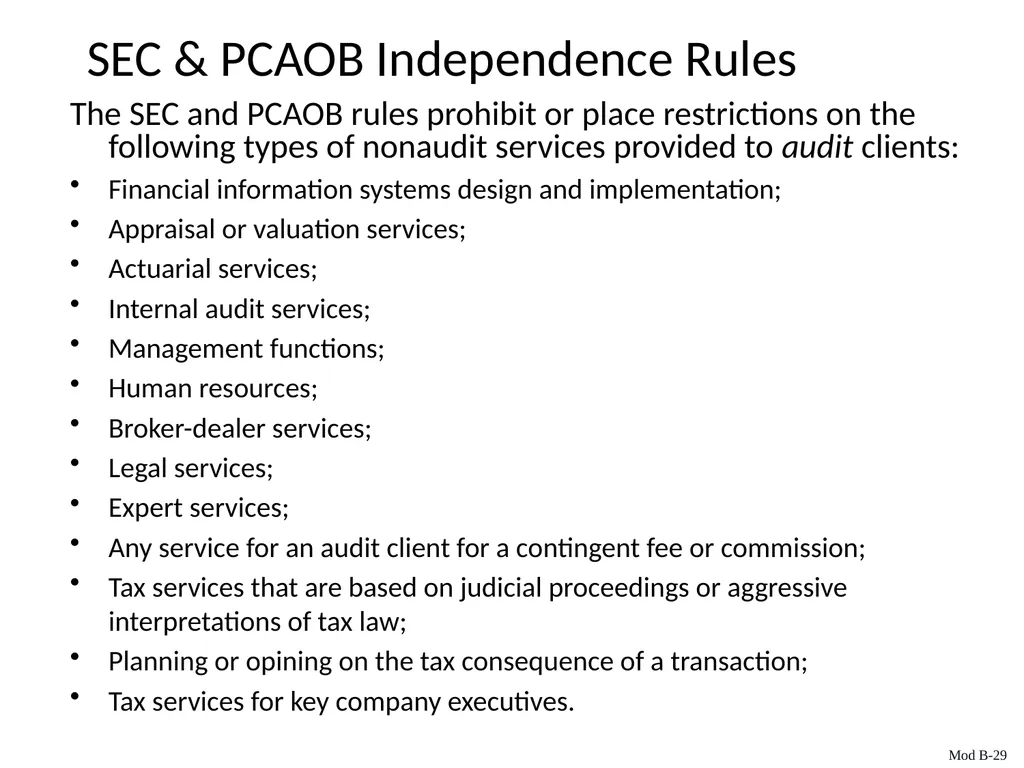
SEC & PCAOB Independence Rules The SEC and PCAOB rules prohibit or place restrictions on the following types of nonaudit services provided to audit clients:
Financial information systems design and implementation;
Appraisal or valuation services;
Actuarial services;
Internal audit services;
Management functions;
Human resources;
Broker-dealer services;
Legal services;
Expert services;
Any service for an audit client for a contingent fee or commission;
Tax services that are based on judicial proceedings or aggressive interpretations of tax law;
Planning or opining on the tax consequence of a transaction;
Tax services for key company executives. Mod B-29<br>
Financial information systems design and implementation;
Appraisal or valuation services;
Actuarial services;
Internal audit services;
Management functions;
Human resources;
Broker-dealer services;
Legal services;
Expert services;
Any service for an audit client for a contingent fee or commission;
Tax services that are based on judicial proceedings or aggressive interpretations of tax law;
Planning or opining on the tax consequence of a transaction;
Tax services for key company executives. Mod B-29<br>
30
SEC & PCAOB Independence Rules SEC rules require that companies (not auditors) disclose the following in proxy statements delivered to their shareholders :
Total audit fees to the public accounting firm for the annual audit and the reviews of quarterly financial information;
Total fees to the public accounting firm for tax and other advisory work;
Whether the audit committee or the board of directors considered the public accounting firm’s advisory work to be compatible with maintaining the auditor’s independence;
If more than 50 percent, the percentage of the audit hours performed by persons other than the principal auditor’s full-time, permanent employees. Mod B-30<br>
Total audit fees to the public accounting firm for the annual audit and the reviews of quarterly financial information;
Total fees to the public accounting firm for tax and other advisory work;
Whether the audit committee or the board of directors considered the public accounting firm’s advisory work to be compatible with maintaining the auditor’s independence;
If more than 50 percent, the percentage of the audit hours performed by persons other than the principal auditor’s full-time, permanent employees. Mod B-30<br>
31
AICPA Code of Professional Conduct
Rule 102: Integrity and Objectivity CPAs must remain free of conflicts of interest
A conflict of interest may exist when there is a significant relationship with a person, entity, product, or service that could be viewed as impairing the members objectivity
Do not knowingly misrepresent facts.
May not subordinate judgments to others.
Do not knowingly make false or misleading entries in an entity’s financial records. Mod B-31<br>
A conflict of interest may exist when there is a significant relationship with a person, entity, product, or service that could be viewed as impairing the members objectivity
Do not knowingly misrepresent facts.
May not subordinate judgments to others.
Do not knowingly make false or misleading entries in an entity’s financial records. Mod B-31<br>
32
AICPA Code of Professional Conduct
Rule 102: Integrity and Objectivity If disagreements exist concerning the preparation of financial statements or the recording of transactions, accept the supervisor’s position if acceptable.
Report to higher level if supervisor’s position is not acceptable.
Consider resigning if upper management will not take appropriate action. Mod B-32<br>
Report to higher level if supervisor’s position is not acceptable.
Consider resigning if upper management will not take appropriate action. Mod B-32<br>
33
AICPA Code of Professional Conduct
Rule 201: General Standards
Rule 202: Compliance with Standards
Rule 203: Compliance with Accounting Principles Follow professional standards and interpretations.
Perform only those services that can be completed with professional competence.
Exercise due care.
Adequately plan and supervise all engagements.
Obtain sufficient relevant data to afford a reasonable basis for all conclusions and recommendations. Mod B-33<br>
Perform only those services that can be completed with professional competence.
Exercise due care.
Adequately plan and supervise all engagements.
Obtain sufficient relevant data to afford a reasonable basis for all conclusions and recommendations. Mod B-33<br>
34
AICPA Code of Professional Conduct
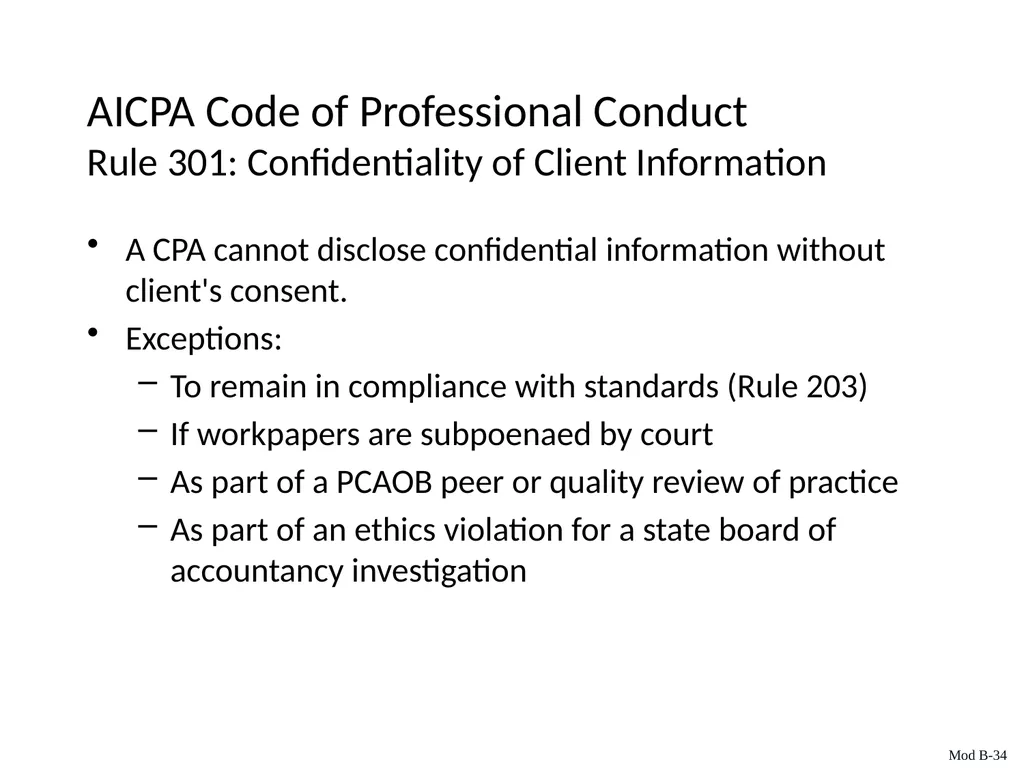
Rule 301: Confidentiality of Client Information A CPA cannot disclose confidential information without client's consent.
Exceptions:
To remain in compliance with standards (Rule 203)
If workpapers are subpoenaed by court
As part of a PCAOB peer or quality review of practice
As part of an ethics violation for a state board of accountancy investigation Mod B-34<br>
Exceptions:
To remain in compliance with standards (Rule 203)
If workpapers are subpoenaed by court
As part of a PCAOB peer or quality review of practice
As part of an ethics violation for a state board of accountancy investigation Mod B-34<br>
35
AICPA Code of Professional Conduct
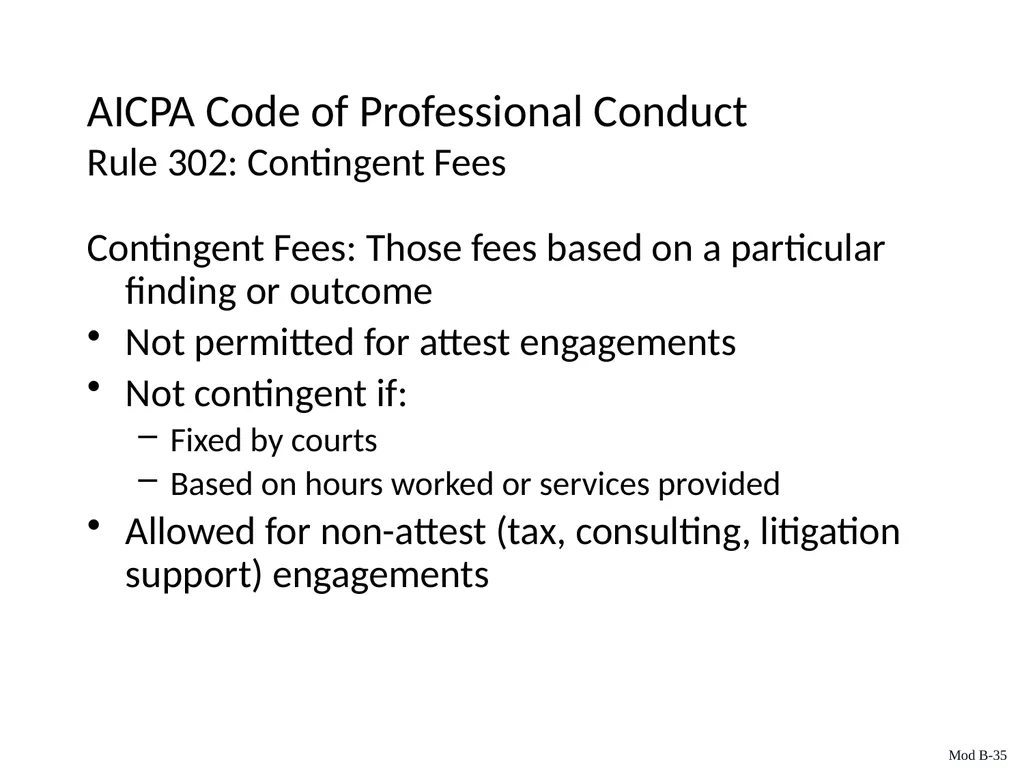
Rule 302: Contingent Fees Contingent Fees: Those fees based on a particular finding or outcome
Not permitted for attest engagements
Not contingent if:
Fixed by courts
Based on hours worked or services provided
Allowed for non-attest (tax, consulting, litigation support) engagements Mod B-35<br>
Not permitted for attest engagements
Not contingent if:
Fixed by courts
Based on hours worked or services provided
Allowed for non-attest (tax, consulting, litigation support) engagements Mod B-35<br>
36
AICPA Code of Professional Conduct
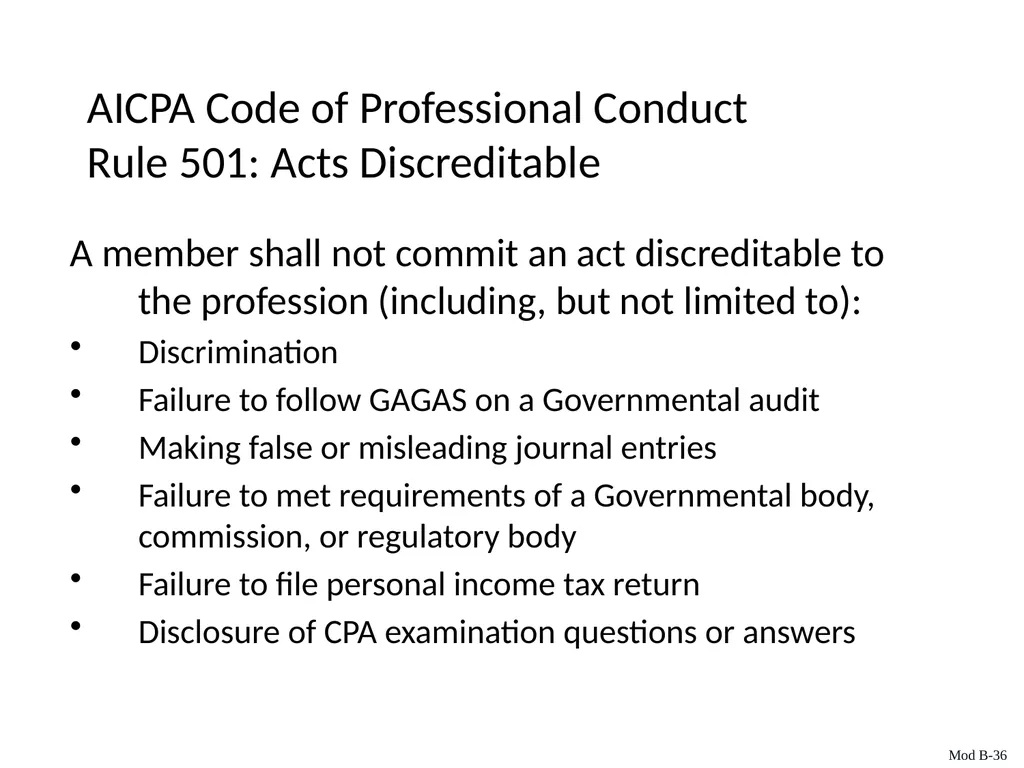
Rule 501: Acts Discreditable A member shall not commit an act discreditable to the profession (including, but not limited to):
Discrimination
Failure to follow GAGAS on a Governmental audit
Making false or misleading journal entries
Failure to met requirements of a Governmental body, commission, or regulatory body
Failure to file personal income tax return
Disclosure of CPA examination questions or answers Mod B-36<br>
Discrimination
Failure to follow GAGAS on a Governmental audit
Making false or misleading journal entries
Failure to met requirements of a Governmental body, commission, or regulatory body
Failure to file personal income tax return
Disclosure of CPA examination questions or answers Mod B-36<br>
37
AICPA Code of Professional Conduct
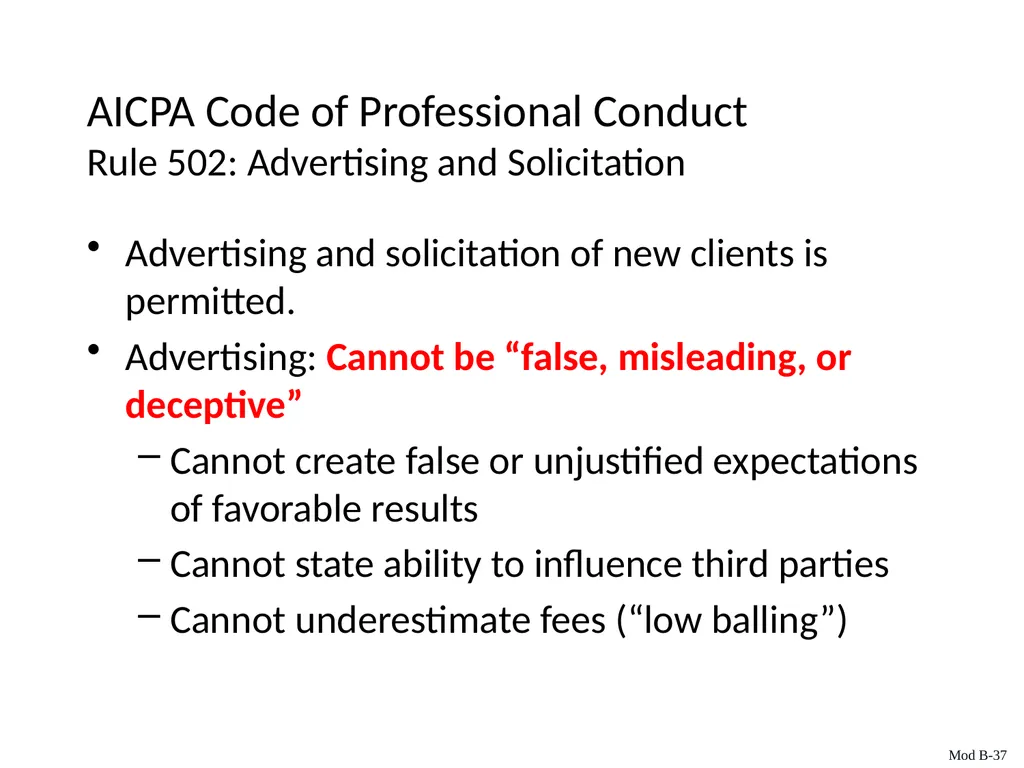
Rule 502: Advertising and Solicitation Advertising and solicitation of new clients is permitted.
Advertising: Cannot be “false, misleading, or deceptive”
Cannot create false or unjustified expectations of favorable results
Cannot state ability to influence third parties
Cannot underestimate fees (“low balling”) Mod B-37<br>
Advertising: Cannot be “false, misleading, or deceptive”
Cannot create false or unjustified expectations of favorable results
Cannot state ability to influence third parties
Cannot underestimate fees (“low balling”) Mod B-37<br>
38
AICPA Code of Professional Conduct
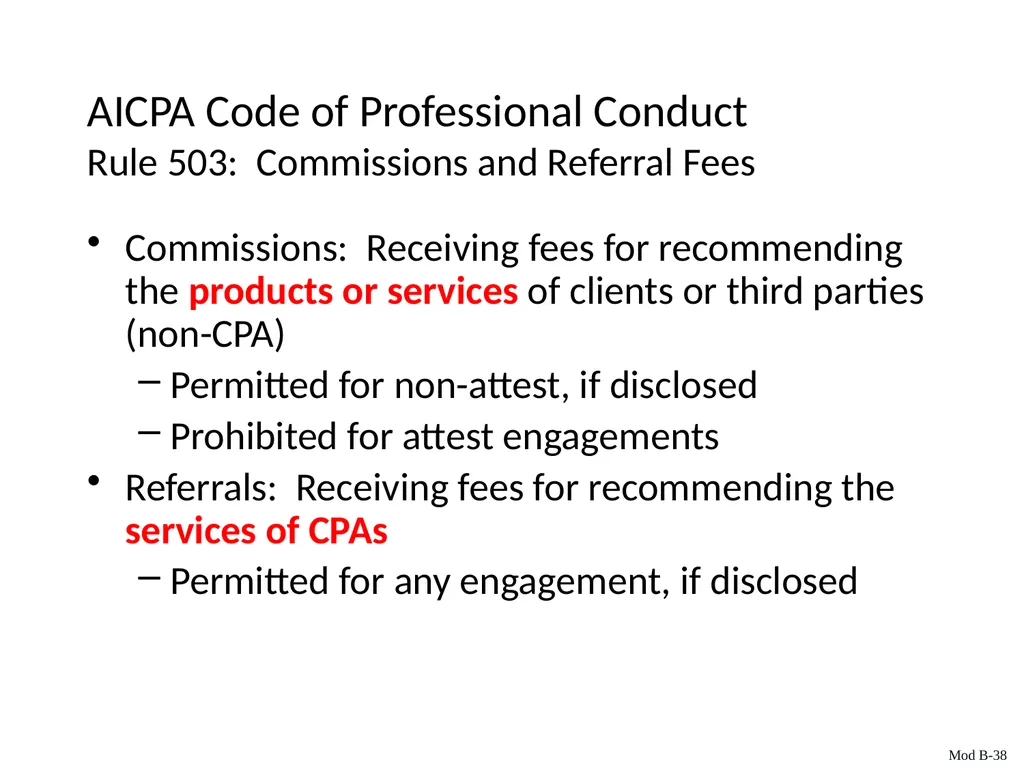
Rule 503: Commissions and Referral Fees Commissions: Receiving fees for recommending the products or services of clients or third parties (non-CPA)
Permitted for non-attest, if disclosed
Prohibited for attest engagements
Referrals: Receiving fees for recommending the services of CPAs
Permitted for any engagement, if disclosed Mod B-38<br>
Permitted for non-attest, if disclosed
Prohibited for attest engagements
Referrals: Receiving fees for recommending the services of CPAs
Permitted for any engagement, if disclosed Mod B-38<br>
39
AICPA Code of Professional Conduct
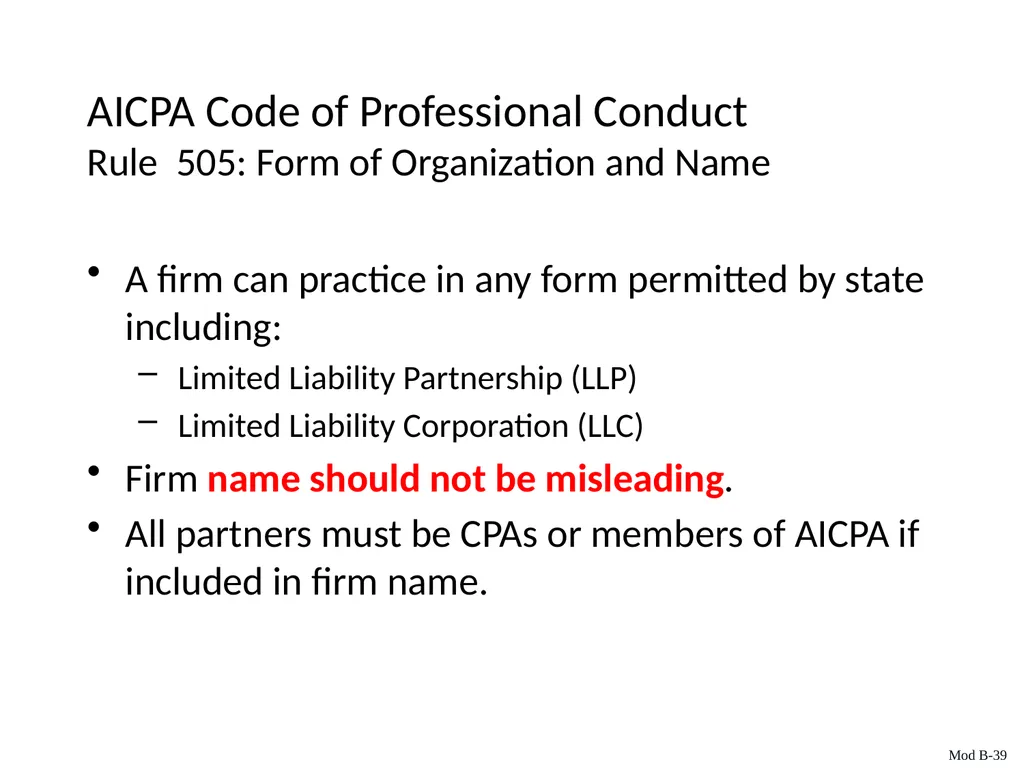
Rule 505: Form of Organization and Name A firm can practice in any form permitted by state including:
Limited Liability Partnership (LLP)
Limited Liability Corporation (LLC)
Firm name should not be misleading.
All partners must be CPAs or members of AICPA if included in firm name. Mod B-39<br>
Limited Liability Partnership (LLP)
Limited Liability Corporation (LLC)
Firm name should not be misleading.
All partners must be CPAs or members of AICPA if included in firm name. Mod B-39<br>
40
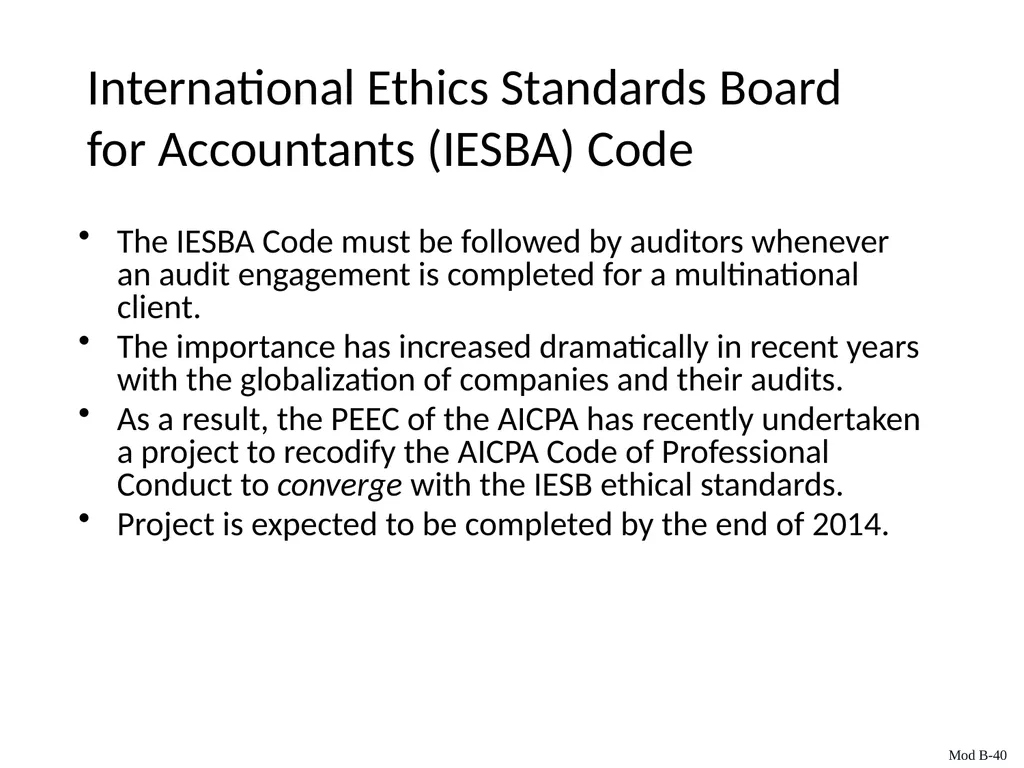
International Ethics Standards Board for Accountants (IESBA) Code The IESBA Code must be followed by auditors whenever an audit engagement is completed for a multinational client.
The importance has increased dramatically in recent years with the globalization of companies and their audits.
As a result, the PEEC of the AICPA has recently undertaken a project to recodify the AICPA Code of Professional Conduct to converge with the IESB ethical standards.
Project is expected to be completed by the end of 2014. Mod B-40<br>
The importance has increased dramatically in recent years with the globalization of companies and their audits.
As a result, the PEEC of the AICPA has recently undertaken a project to recodify the AICPA Code of Professional Conduct to converge with the IESB ethical standards.
Project is expected to be completed by the end of 2014. Mod B-40<br>
41
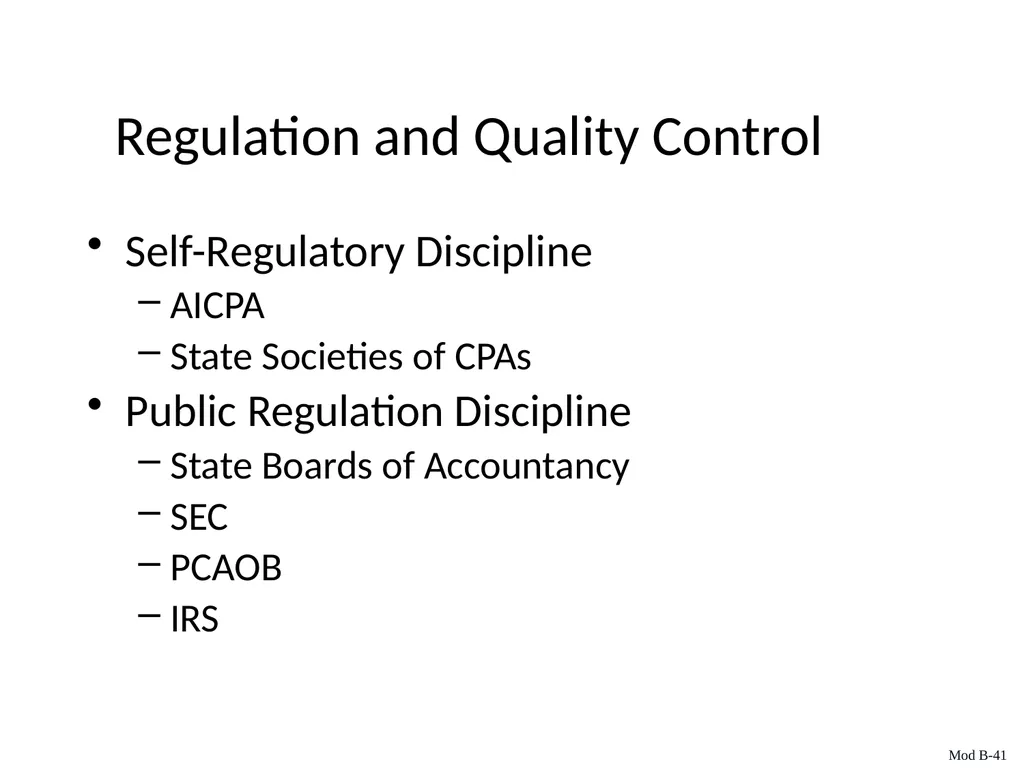
Regulation and Quality Control Self-Regulatory Discipline
AICPA
State Societies of CPAs
Public Regulation Discipline
State Boards of Accountancy
SEC
PCAOB
IRS Mod B-41<br>
AICPA
State Societies of CPAs
Public Regulation Discipline
State Boards of Accountancy
SEC
PCAOB
IRS Mod B-41<br>