
Audits and Internal Controls Presented by: Tami

Description: Audits and Internal Controls Presented by: Tami Bidle, Financial Reporting Manager, Business ServicesController Heather Lopez, Chief Audit Executive, Internal Audit August 22, 2017 1 Agenda Internal Control Who is Responsible Audits and
Related Topics
Download Presentation
"Audits and Internal Controls Presented by: Tami" is the property of its rightful owner. Permission is granted to download and print the materials on this website for personal, non-commercial use only, and to display it on your personal computer provided you do not modify the materials and that you retain all copyright notices contained in the materials. By downloading content from our website, you accept the terms of this agreement.
Presentation Transcript
slide1. Audits and Internal Controls Presented by:
Tami Bidle, Financial Reporting Manager, Business Services/Controller
Heather Lopez, Chief Audit Executive, Internal Audit August 22, 2017 1<br>
slide2. Agenda Internal Control
Who is Responsible
Audits and Audit Process
Components of Internal Control
Resources<br>
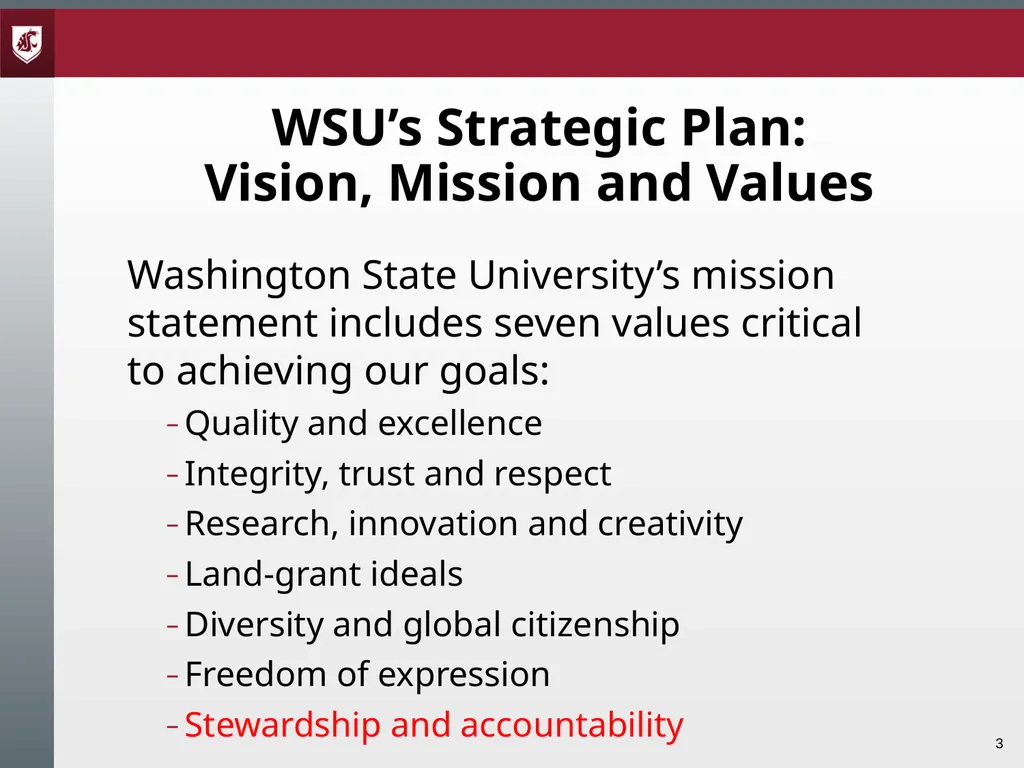
slide3. WSU’s Strategic Plan: Vision, Mission and Values Washington State University’s mission statement includes seven values critical to achieving our goals:
Quality and excellence
Integrity, trust and respect
Research, innovation and creativity
Land-grant ideals
Diversity and global citizenship
Freedom of expression
Stewardship and accountability 3<br>
slide4. How can we, as an institution and as individuals, uphold the University’s values and achieve our mission? …through a strong system of internal controls 4<br>
slide5. Internal Control 'Internal control is a process, effected by those charged with governance, management, and other employees, designed to provide reasonable assurance regarding the achievement of the entity's objectives relating to operations, reporting, and compliance.
… the state’s internal control objectives are defined as the need for each agency to:
Safeguard its assets.
Check the accuracy and reliability of its accounting data.
Promote operational efficiency.
Encourage adherence to policies for accounting and financial controls.’
WA OFM SAAM Chapter 20 (20.15.10) 5<br>
slide6. Why is internal control important? Good controls enable better management of institutional risk and provide for better preparation and ability to respond to the unknown.
Good controls provide assurance of compliance with laws, regulations and policies.
Good controls also seek to eliminate waste, fraud and abuse and help an entity avoid damage to its reputation and other consequences. 6<br>
slide7. Internal Control in WA State WA OFM SAAM Chapter 20, Internal Control
20.10.40 Source of these policies
‘These policies are based on and incorporate information from Standards for Internal Control in the Federal Government (Green Book) and COSO Internal Control – Integrated Framework (2013)’.
Effective date of changes, July 1, 2017<br>
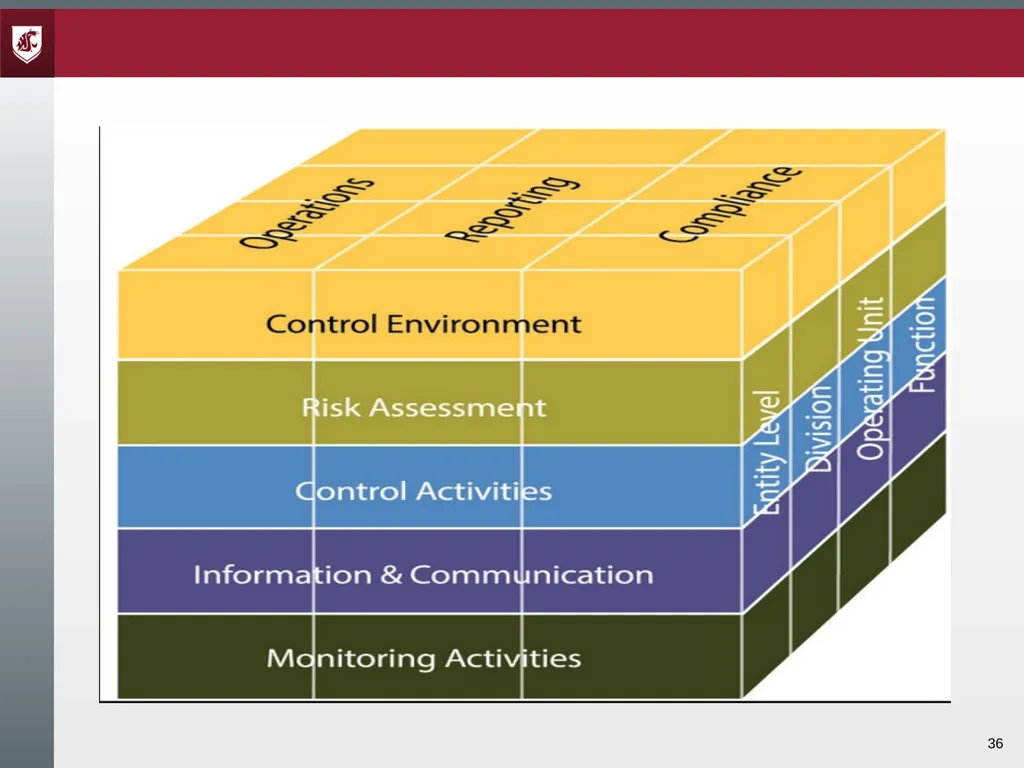
slide8. What is COSO? Committee of Sponsoring Organizations of the Treadway Commission
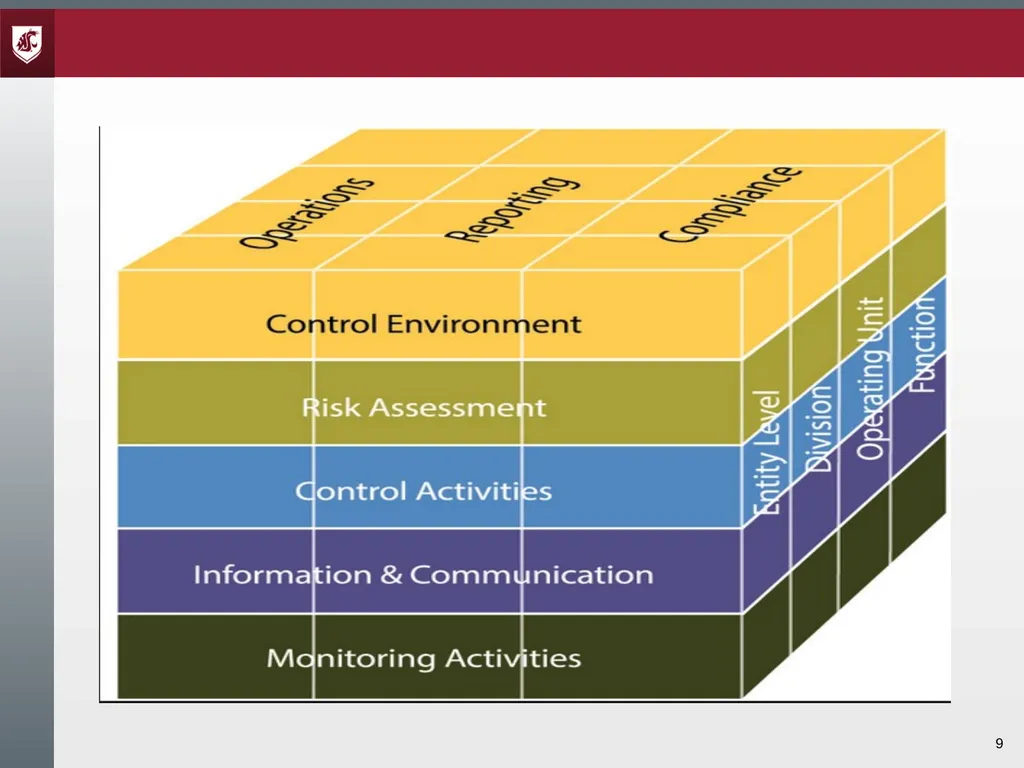
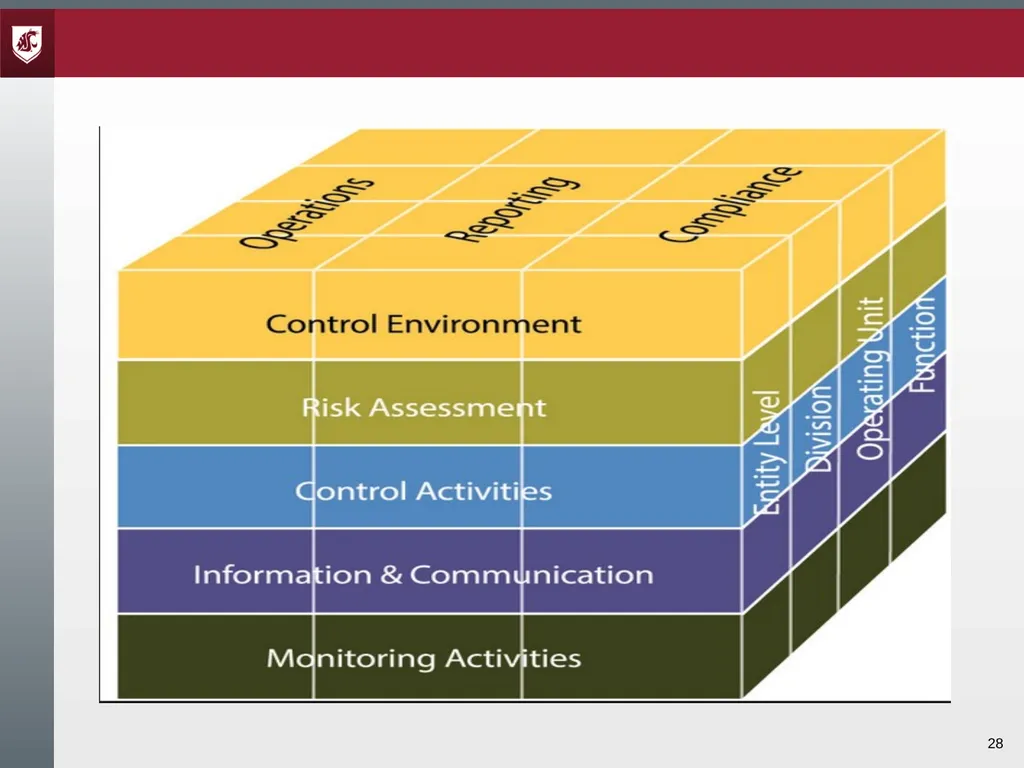
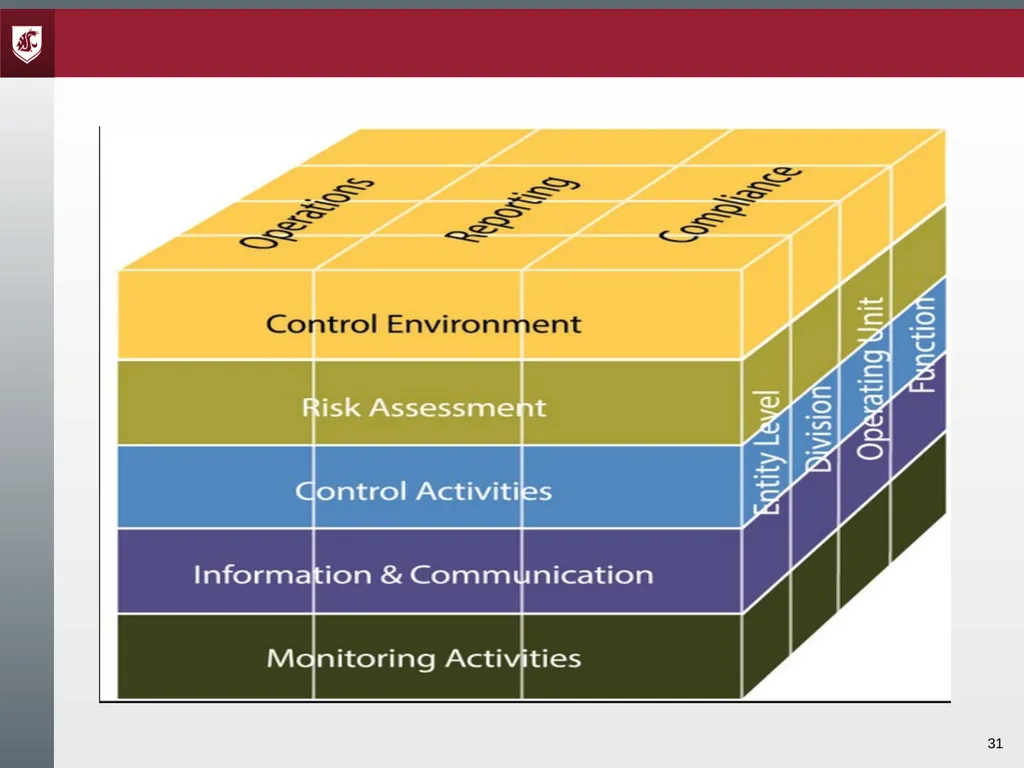
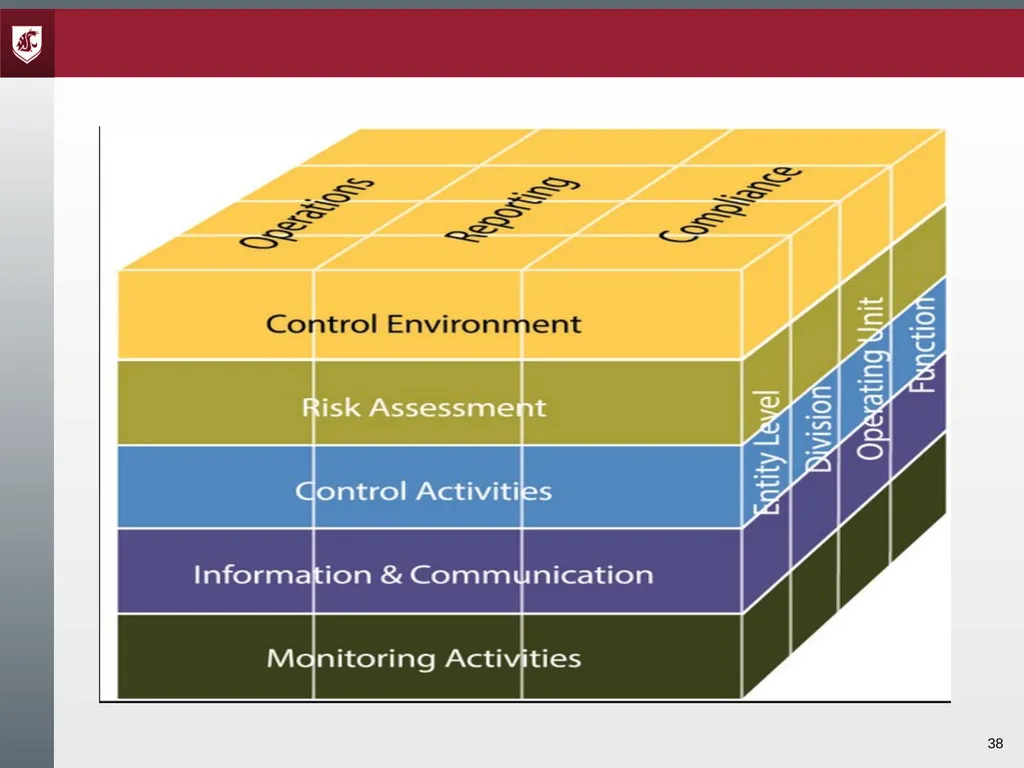
Under COSO, an organization’s internal control system is deemed effective only if all five components (along with relevant principles) are both present and functioning.
It is not enough to design and implement a system of control. There must be processes to ensure continued assessment of risks and evaluation of controls working effectively and efficiently and modified as needed to ensure risk is mitigated sufficient to meet objectives.<br>
slide9. 9<br>
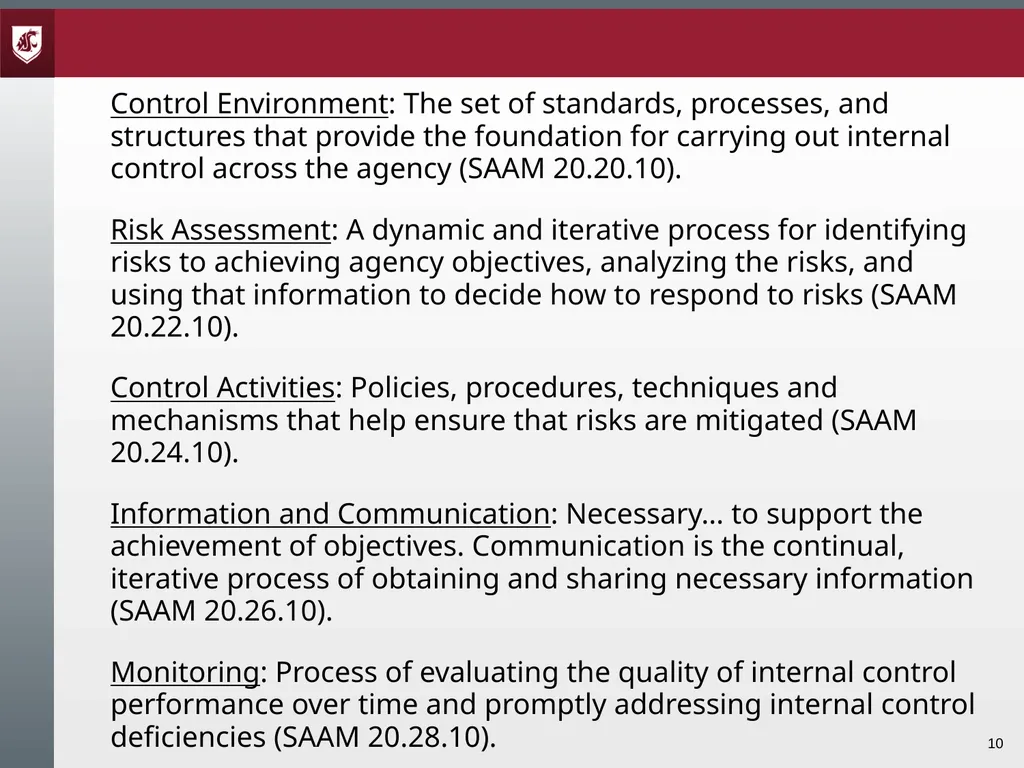
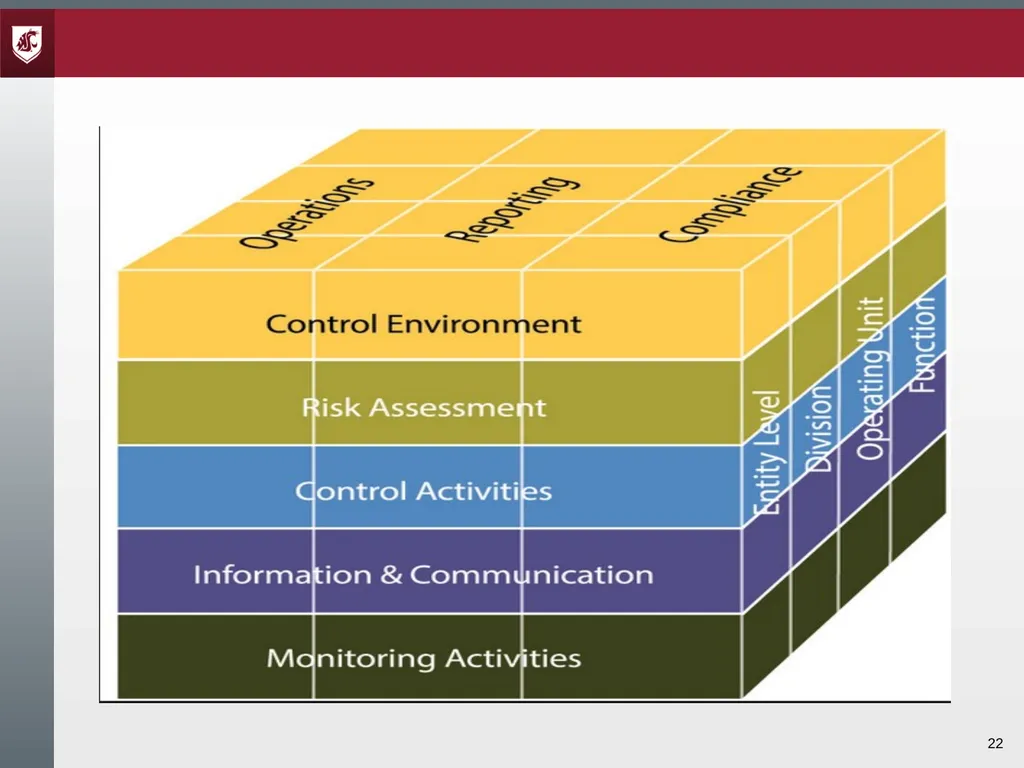
slide10. Control Environment: The set of standards, processes, and structures that provide the foundation for carrying out internal control across the agency (SAAM 20.20.10).
Risk Assessment: A dynamic and iterative process for identifying risks to achieving agency objectives, analyzing the risks, and using that information to decide how to respond to risks (SAAM 20.22.10).
Control Activities: Policies, procedures, techniques and mechanisms that help ensure that risks are mitigated (SAAM 20.24.10).
Information and Communication: Necessary… to support the achievement of objectives. Communication is the continual, iterative process of obtaining and sharing necessary information (SAAM 20.26.10).
Monitoring: Process of evaluating the quality of internal control performance over time and promptly addressing internal control deficiencies (SAAM 20.28.10). 10<br>
slide11. Who is responsible for internal controls? 11<br>
slide12. Though leadership is ultimately responsible, everyone in an entity has some responsibility for the organization’s internal controls.
All personnel should be responsible to effect internal controls and to communicate problems in operations, deviations from established standards and violations of policy or law.
Internal Controls are Everyone’s Business! 12<br>
slide13. 13 Management’s Role Management has responsibility to:
Assess risks to the organization of not meeting its objectives
Identify and develop appropriate controls to mitigate/manage identified risks
Implement controls and monitor them to ensure they are working as designed and are adequate<br>
slide14. 14 Audit’s Role Auditors test to ensure the controls and processes management has established and implemented are adequate to:
Ensure compliance with applicable rules
Safeguard resources
Properly present and report activity (reliable reporting)
Provide for effectiveness and efficiency in operations<br>
slide15. Auditors and Types of Audit Internal vs. External
State vs. Federal
Program Review
Statutory/Mandated
Accountability
Performance
Bond Covenants/Contractual
Single Audit
Financial<br>
slide16. Audits Audits have an objective to evaluate a process, system, unit, operation, program, etc. and tests are performed to ensure the internal controls implemented by management are working as designed.
Audits yield memos or reports that provide results of tests and evaluations with recommendations for improvement.
[Internal] Audits are performed according to schedule of audits in annual audit plan – developed as a result of annual risk assessment.<br>
slide17. General Audit Process Preliminary assessment of risks – scoping
Planning procedures – data analysis, research of audit subject, interviews
Entrance meeting with management
Fieldwork – test of controls, test of transactions, interviews and walkthroughs, observation
Closing – summarize issues noted, develop draft memo/report
Reporting<br>
slide18. Focus on Design and Effectiveness of Internal Controls Auditors evaluate the controls management has put in place to mitigate the risk of objectives not being met. If no controls implemented or controls as designed are inadequate – recommendations are made for improvements.
Auditors are evaluating the internal control system – review all components and how they are working together.<br>
slide19. “Desperate people do desperate things. Loyal employees have bills to pay and families to feed. In a good economy, they would never think of committing fraud against their employers.”
2009 Report on Occupational Fraud, ACFE
Occupational Fraud: “The use of one’s occupation for personal enrichment through the deliberate misuse or misapplication of the employing organization’s resources or assets.”
2016 Report to the Nation on Occupational Fraud and Abuse, ACFE 19<br>
slide20. Contributing Factors for Fraud/Embezzlement A strong system of internal control is the greatest fraud deterrent.
Fraud Triangle
Opportunity: Poor internal controls, lack of oversight, Lack of segregation of duties, lack of clear direction on roles/authorities, poor employee morale due to management, work conditions, work load, other factors
Pressure: Employees have additional outside pressure (economy bad everywhere, personal financial pressure, etc.)
Rationalization: Employees under pressure to do more with less (affects attitude, competence and effectiveness) 20<br>
slide21. Investigations Investigations are unplanned, have a specific focus and ask: Who, what, when, how and why.
Answering how: evaluate controls and gaps in controls.
Investigations yield memos or reports that provide results of test to answer the question and usually recommendations to correct the concern.<br>
slide22. 22<br>
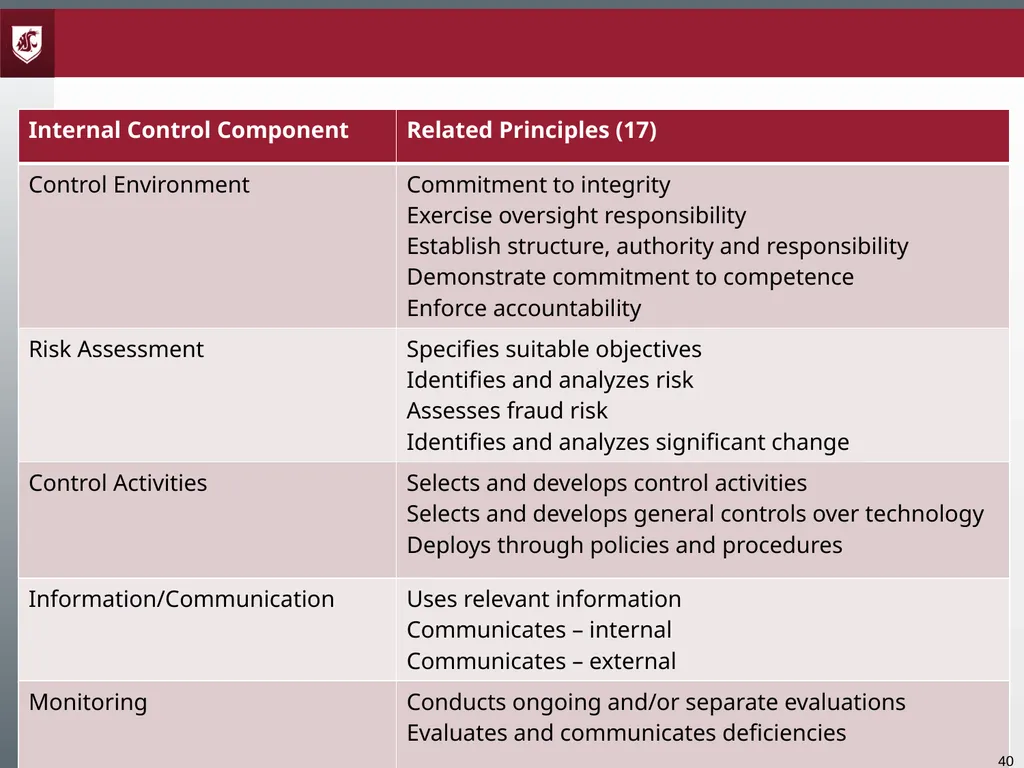
slide23. Control Environment The Control Environment lays the foundation for the internal control system and provides the basis for carrying out internal controls across the organization. If poorly designed, executed or managed other internal controls can crumble.
A strong control environment includes:
Commitment to integrity
Exercised oversight accountability
Enforced accountability
Established structure, authority and responsibility
Demonstrated commitment to competence 23<br>
slide24. Tone at the Top Ethics, Culture and Work Environment
Conditions that impact control environment:
Leaders engaging in bad behavior – poor examples
Offenses not addressed, no consequences
Not providing or encouraging a means for employees to report wrongdoing
Rumor mill as source of “credible” information with no actions to directly address<br>
slide25. What you can do Ensure all employees, including managers and leaders, are aware of standards of conduct and ethics.
Provide training or means to get to training on a regular basis to reinforce as a norm.
Provide regular notices/reminders about ethics and standards and reporting avenues.
Include compliance with standards of conduct as part of employee evaluations.
Enforce consequences – do not turn a blind eye to bad behavior.<br>
slide26. Structure, Roles and Authority Ensure organization charts are current and include reporting lines.
Position descriptions/duties/responsibilities need to be current and clear.
Authorizations and delegations should be clearly defined.
Significant processes should be in writing.<br>
slide27. People are Our Greatest Asset …and can be our greatest risk.
Demonstrate commitment to attracting and retaining competent employees.
Ensure PDs accurately reflect expectations for position before posting.
Ensure recruitment process and hiring personnel/committees understand desired skill sets and are trained to properly evaluate.
Do reference checks – always!
Provide opportunities for employees to gain continuing professional education to stay current and relevant in their field.<br>
slide28. 28<br>
slide29. Risk Assessment Identify and analyze risks to the achievement of objectives and use as a basis for determining how the risks should be managed.
Risk responses:
Acceptance – no action take to respond
Avoidance – action taken to stop the process causing risk
Reduction – action taken to reduce likelihood or magnitude of risk
Sharing – transfer or share risks across agency or with external parties (such as insuring against losses)<br>
slide30. Responding to Changes Risk assessment and risk identification process considers changes in:
The external environment
The business model
Leadership
Changing conditions may prompt new risks or changes to existing risks, management should analyze and respond to identified changes that could significantly impact its system of internal control in order to maintain its effectiveness.<br>
slide31. 31<br>
slide32. Control Activities Control activities are implemented through policies and procedures that should be reassessed periodically and refreshed as necessary
Performed at all levels of the agency, at various stages within business process and over the technology environment.
Preventive controls = designed to deter the occurrence of an undesirable event by implementing procedures to avoid them
Detective controls = identify undesirable events that do occur and alter management about what has happened<br>
slide33. Segregation of Duties No one person should hold responsibility for full string of a business process: record keeping, authorization, asset custody and reconciliation
Where not practical, alternate control activities should be utilized
Problems with lack of separation:
Errors may not be detected since an independent review of transactions may not be occurring
Inappropriate or unauthorized transactions are permitted to occur if one individual controls a major portion of the process<br>
slide34. Technology WA State OCIO policies should be considered
Information systems and related control activities
Information system designed to obtain, store and process data – steps should be taken to safeguard that data
Define responsibilities, assigned to key roles and delegate authority
Restrict technology access rights<br>
slide35. Other Key Control Activities Authorizations, approvals and verifications
Develop written procedures outlining delegation guidelines
Never sign a blank form
Secure access to electronic signatures
No rubber stamping
Monitoring, reconciliation
Means of detecting losses, errors or irregularity
Helps understand effectiveness of internal controls<br>
slide36. 36<br>
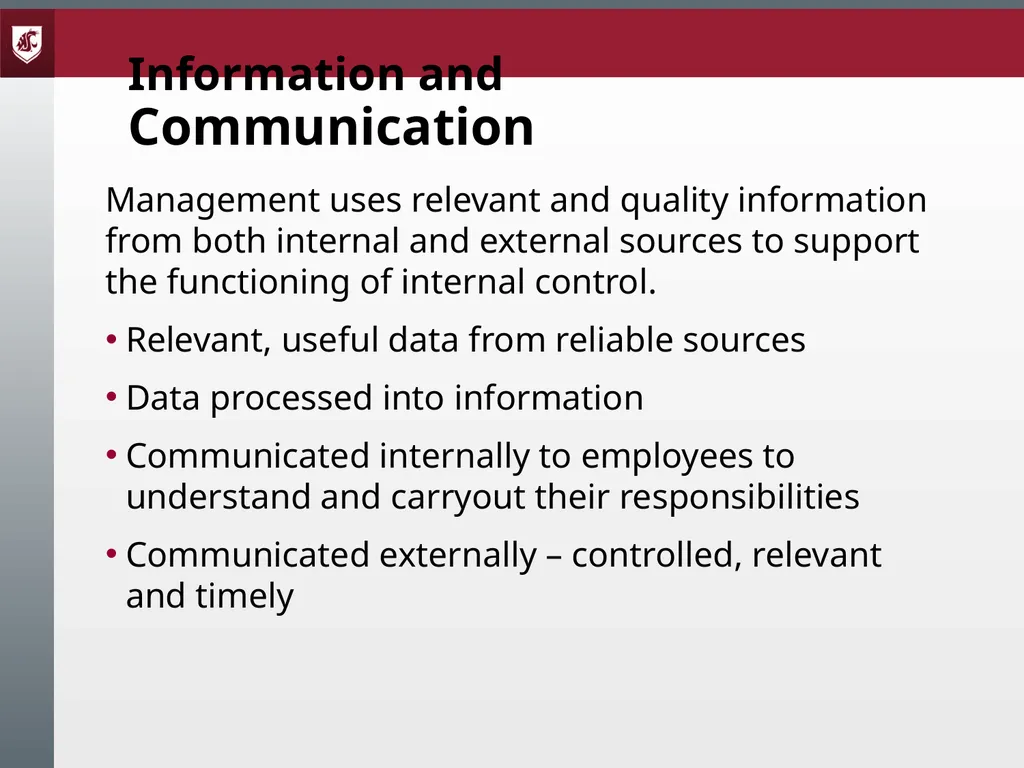
slide37. Information and Communication Management uses relevant and quality information from both internal and external sources to support the functioning of internal control.
Relevant, useful data from reliable sources
Data processed into information
Communicated internally to employees to understand and carryout their responsibilities
Communicated externally – controlled, relevant and timely<br>
slide38. 38<br>
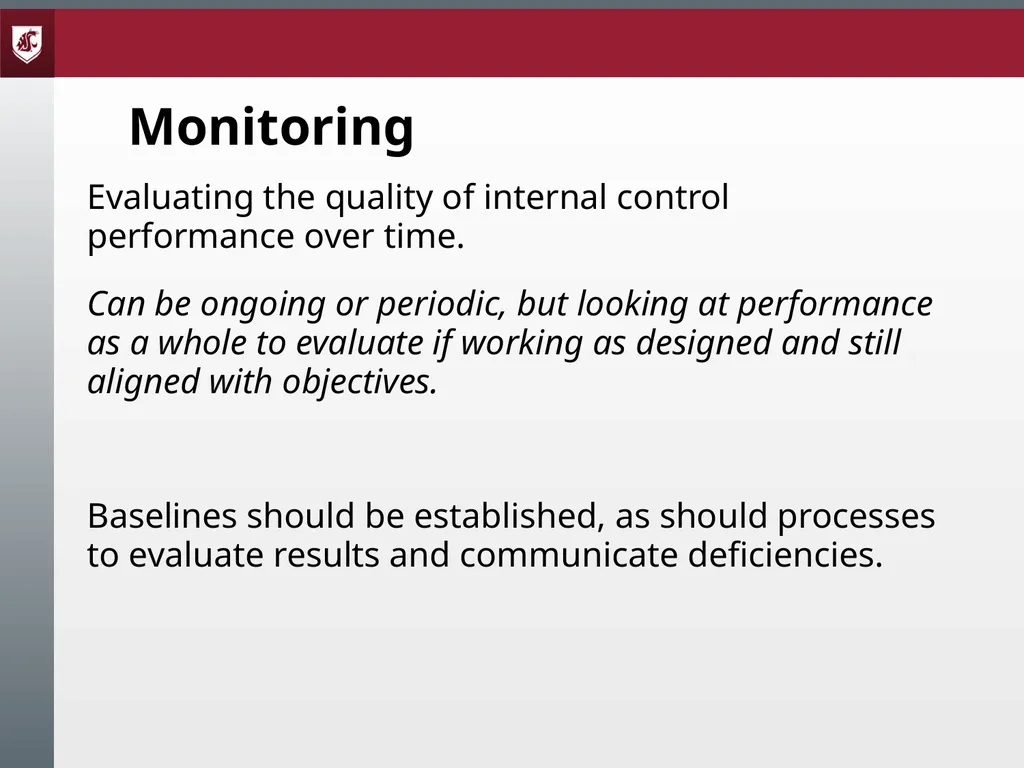
slide39. Monitoring Evaluating the quality of internal control performance over time.
Can be ongoing or periodic, but looking at performance as a whole to evaluate if working as designed and still aligned with objectives.
Baselines should be established, as should processes to evaluate results and communicate deficiencies.<br>
slide40. 40<br>
slide41. Considerations for Key Business Processes Purchasing cards
Understand and comply with policy
Safeguard cards when not in use
Use temporary delegation form and checkout logs
Review timely – follow up on variances
Don’t forget reconciliation to Balances<br>
slide42. Considerations for Key Business Processes Payroll
Management should ensure adequate separation of duties – the following should not be one person without appropriate oversight and approval:
Appoint personnel
Schedule hours
Approve hours worked
Post hours
Approve payroll reports<br>
slide43. Considerations for Key Business Processes More on Payroll
Time records are pay-affecting documents
Never pre-approve or pre-sign
Should be signed/certified by employee and supervisor after the fact
Should reflect actual hours worked
After certification, approved time records should not be returned to employee<br>
slide44. Considerations for Key Business Processes Receipting and Cash Management
Cash and checks should be deposited timely.
Deposits should be intact and in proper composition.
Funds should be properly safeguarded (before deposit and in transit).
Numerical receipts should be used in order.
If using other than official University receipt forms, contact University Receivables for review.
Checks should be immediately restrictively endorsed.<br>
slide45. Considerations for Key Business Processes Security of Data, Facilities
Physical security (lock doors, desk drawers, etc.) and restrict access to keys.
Computer security (for desktops, shared, LAN servers) - don’t forget to protect portable devices.
Establish backup and recovery / disaster recovery.
Periodically review accessibility to programs – limit to those needed.
Periodically change passwords and do not release.
Restrict access to confidential data.<br>
slide46. Considerations for Key Business Processes Physical Assets
Equipment listings should be kept current.
Equipment should be properly tagged.
Equipment taken off premises should be logged.
Equipment transfers should be approved.
Maintenance contacts should be reviewed.<br>
slide47. Considerations for Key Business Processes Reconciliation
Reconciliation is a detective control.
Departmental budgets should be reviewed monthly, timely and discrepancies investigated.
Check budget statements to make sure transactions are:
Posted to the correct account
Listed as the correct amount
Expenditures are appropriate for account
Expenditures/receipts not posting that should
Follow up on errors needing correction.<br>
slide48. Records Maintenance Be familiar with your unit’s record retention schedule.
Do not dispose of records
Before permitted per retention, or
If after retention period, records are under review of audit or public records request
Records to be disposed should be shredded or disposed of appropriately. 48<br>
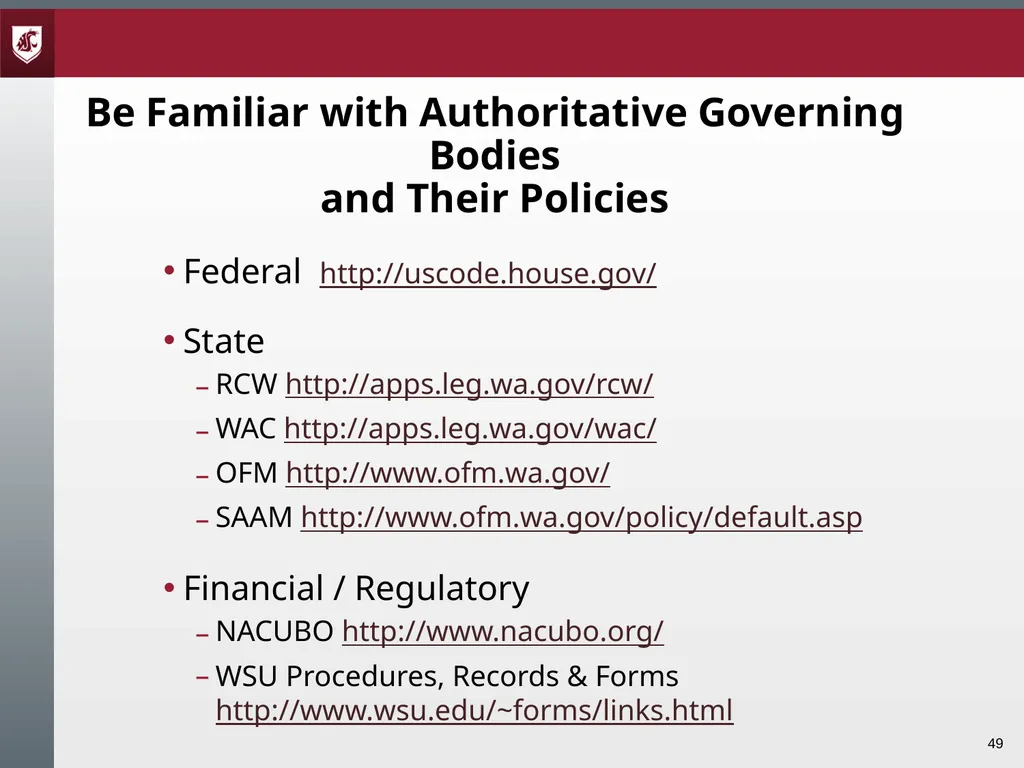
slide49. Be Familiar with Authoritative Governing Bodies and Their Policies Federal http://uscode.house.gov/
State
RCW http://apps.leg.wa.gov/rcw/
WAC http://apps.leg.wa.gov/wac/
OFM http://www.ofm.wa.gov/
SAAM http://www.ofm.wa.gov/policy/default.asp
Financial / Regulatory
NACUBO http://www.nacubo.org/
WSU Procedures, Records & Forms http://www.wsu.edu/~forms/links.html 49<br>
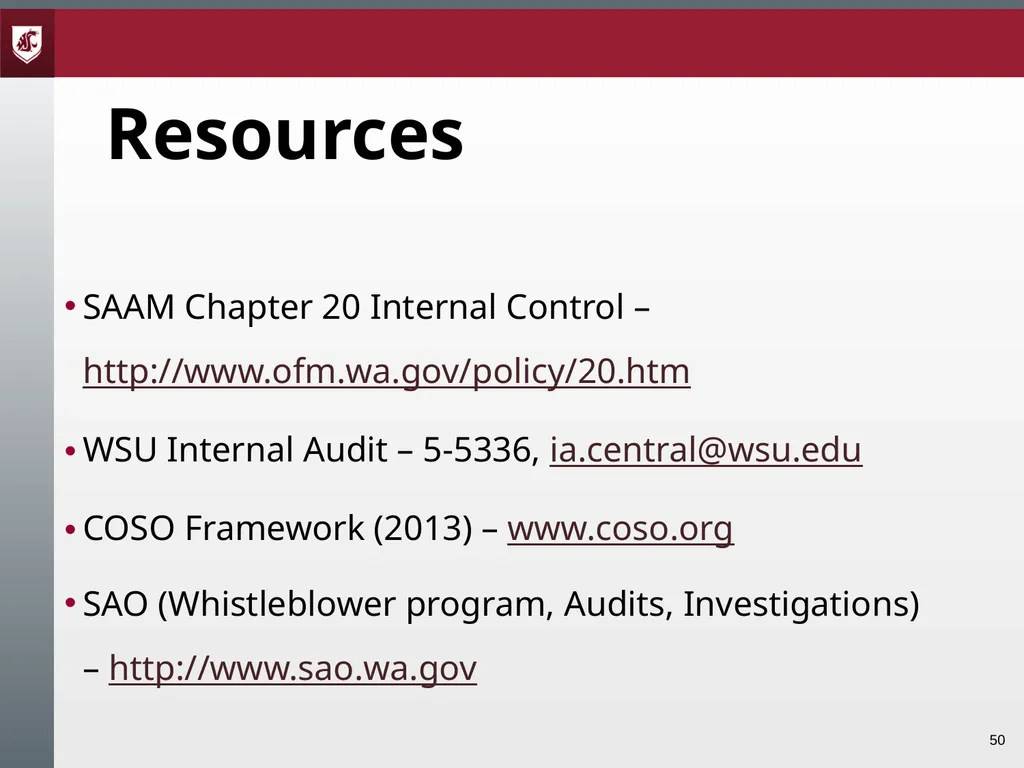
slide50. 50 SAAM Chapter 20 Internal Control – http://www.ofm.wa.gov/policy/20.htm
WSU Internal Audit – 5-5336, ia.central@wsu.edu
COSO Framework (2013) – www.coso.org
SAO (Whistleblower program, Audits, Investigations) – http://www.sao.wa.gov Resources<br>
Tami Bidle, Financial Reporting Manager, Business Services/Controller
Heather Lopez, Chief Audit Executive, Internal Audit August 22, 2017 1<br>
slide2. Agenda Internal Control
Who is Responsible
Audits and Audit Process
Components of Internal Control
Resources<br>
slide3. WSU’s Strategic Plan: Vision, Mission and Values Washington State University’s mission statement includes seven values critical to achieving our goals:
Quality and excellence
Integrity, trust and respect
Research, innovation and creativity
Land-grant ideals
Diversity and global citizenship
Freedom of expression
Stewardship and accountability 3<br>
slide4. How can we, as an institution and as individuals, uphold the University’s values and achieve our mission? …through a strong system of internal controls 4<br>
slide5. Internal Control 'Internal control is a process, effected by those charged with governance, management, and other employees, designed to provide reasonable assurance regarding the achievement of the entity's objectives relating to operations, reporting, and compliance.
… the state’s internal control objectives are defined as the need for each agency to:
Safeguard its assets.
Check the accuracy and reliability of its accounting data.
Promote operational efficiency.
Encourage adherence to policies for accounting and financial controls.’
WA OFM SAAM Chapter 20 (20.15.10) 5<br>
slide6. Why is internal control important? Good controls enable better management of institutional risk and provide for better preparation and ability to respond to the unknown.
Good controls provide assurance of compliance with laws, regulations and policies.
Good controls also seek to eliminate waste, fraud and abuse and help an entity avoid damage to its reputation and other consequences. 6<br>
slide7. Internal Control in WA State WA OFM SAAM Chapter 20, Internal Control
20.10.40 Source of these policies
‘These policies are based on and incorporate information from Standards for Internal Control in the Federal Government (Green Book) and COSO Internal Control – Integrated Framework (2013)’.
Effective date of changes, July 1, 2017<br>
slide8. What is COSO? Committee of Sponsoring Organizations of the Treadway Commission
Under COSO, an organization’s internal control system is deemed effective only if all five components (along with relevant principles) are both present and functioning.
It is not enough to design and implement a system of control. There must be processes to ensure continued assessment of risks and evaluation of controls working effectively and efficiently and modified as needed to ensure risk is mitigated sufficient to meet objectives.<br>
slide9. 9<br>
slide10. Control Environment: The set of standards, processes, and structures that provide the foundation for carrying out internal control across the agency (SAAM 20.20.10).
Risk Assessment: A dynamic and iterative process for identifying risks to achieving agency objectives, analyzing the risks, and using that information to decide how to respond to risks (SAAM 20.22.10).
Control Activities: Policies, procedures, techniques and mechanisms that help ensure that risks are mitigated (SAAM 20.24.10).
Information and Communication: Necessary… to support the achievement of objectives. Communication is the continual, iterative process of obtaining and sharing necessary information (SAAM 20.26.10).
Monitoring: Process of evaluating the quality of internal control performance over time and promptly addressing internal control deficiencies (SAAM 20.28.10). 10<br>
slide11. Who is responsible for internal controls? 11<br>
slide12. Though leadership is ultimately responsible, everyone in an entity has some responsibility for the organization’s internal controls.
All personnel should be responsible to effect internal controls and to communicate problems in operations, deviations from established standards and violations of policy or law.
Internal Controls are Everyone’s Business! 12<br>
slide13. 13 Management’s Role Management has responsibility to:
Assess risks to the organization of not meeting its objectives
Identify and develop appropriate controls to mitigate/manage identified risks
Implement controls and monitor them to ensure they are working as designed and are adequate<br>
slide14. 14 Audit’s Role Auditors test to ensure the controls and processes management has established and implemented are adequate to:
Ensure compliance with applicable rules
Safeguard resources
Properly present and report activity (reliable reporting)
Provide for effectiveness and efficiency in operations<br>
slide15. Auditors and Types of Audit Internal vs. External
State vs. Federal
Program Review
Statutory/Mandated
Accountability
Performance
Bond Covenants/Contractual
Single Audit
Financial<br>
slide16. Audits Audits have an objective to evaluate a process, system, unit, operation, program, etc. and tests are performed to ensure the internal controls implemented by management are working as designed.
Audits yield memos or reports that provide results of tests and evaluations with recommendations for improvement.
[Internal] Audits are performed according to schedule of audits in annual audit plan – developed as a result of annual risk assessment.<br>
slide17. General Audit Process Preliminary assessment of risks – scoping
Planning procedures – data analysis, research of audit subject, interviews
Entrance meeting with management
Fieldwork – test of controls, test of transactions, interviews and walkthroughs, observation
Closing – summarize issues noted, develop draft memo/report
Reporting<br>
slide18. Focus on Design and Effectiveness of Internal Controls Auditors evaluate the controls management has put in place to mitigate the risk of objectives not being met. If no controls implemented or controls as designed are inadequate – recommendations are made for improvements.
Auditors are evaluating the internal control system – review all components and how they are working together.<br>
slide19. “Desperate people do desperate things. Loyal employees have bills to pay and families to feed. In a good economy, they would never think of committing fraud against their employers.”
2009 Report on Occupational Fraud, ACFE
Occupational Fraud: “The use of one’s occupation for personal enrichment through the deliberate misuse or misapplication of the employing organization’s resources or assets.”
2016 Report to the Nation on Occupational Fraud and Abuse, ACFE 19<br>
slide20. Contributing Factors for Fraud/Embezzlement A strong system of internal control is the greatest fraud deterrent.
Fraud Triangle
Opportunity: Poor internal controls, lack of oversight, Lack of segregation of duties, lack of clear direction on roles/authorities, poor employee morale due to management, work conditions, work load, other factors
Pressure: Employees have additional outside pressure (economy bad everywhere, personal financial pressure, etc.)
Rationalization: Employees under pressure to do more with less (affects attitude, competence and effectiveness) 20<br>
slide21. Investigations Investigations are unplanned, have a specific focus and ask: Who, what, when, how and why.
Answering how: evaluate controls and gaps in controls.
Investigations yield memos or reports that provide results of test to answer the question and usually recommendations to correct the concern.<br>
slide22. 22<br>
slide23. Control Environment The Control Environment lays the foundation for the internal control system and provides the basis for carrying out internal controls across the organization. If poorly designed, executed or managed other internal controls can crumble.
A strong control environment includes:
Commitment to integrity
Exercised oversight accountability
Enforced accountability
Established structure, authority and responsibility
Demonstrated commitment to competence 23<br>
slide24. Tone at the Top Ethics, Culture and Work Environment
Conditions that impact control environment:
Leaders engaging in bad behavior – poor examples
Offenses not addressed, no consequences
Not providing or encouraging a means for employees to report wrongdoing
Rumor mill as source of “credible” information with no actions to directly address<br>
slide25. What you can do Ensure all employees, including managers and leaders, are aware of standards of conduct and ethics.
Provide training or means to get to training on a regular basis to reinforce as a norm.
Provide regular notices/reminders about ethics and standards and reporting avenues.
Include compliance with standards of conduct as part of employee evaluations.
Enforce consequences – do not turn a blind eye to bad behavior.<br>
slide26. Structure, Roles and Authority Ensure organization charts are current and include reporting lines.
Position descriptions/duties/responsibilities need to be current and clear.
Authorizations and delegations should be clearly defined.
Significant processes should be in writing.<br>
slide27. People are Our Greatest Asset …and can be our greatest risk.
Demonstrate commitment to attracting and retaining competent employees.
Ensure PDs accurately reflect expectations for position before posting.
Ensure recruitment process and hiring personnel/committees understand desired skill sets and are trained to properly evaluate.
Do reference checks – always!
Provide opportunities for employees to gain continuing professional education to stay current and relevant in their field.<br>
slide28. 28<br>
slide29. Risk Assessment Identify and analyze risks to the achievement of objectives and use as a basis for determining how the risks should be managed.
Risk responses:
Acceptance – no action take to respond
Avoidance – action taken to stop the process causing risk
Reduction – action taken to reduce likelihood or magnitude of risk
Sharing – transfer or share risks across agency or with external parties (such as insuring against losses)<br>
slide30. Responding to Changes Risk assessment and risk identification process considers changes in:
The external environment
The business model
Leadership
Changing conditions may prompt new risks or changes to existing risks, management should analyze and respond to identified changes that could significantly impact its system of internal control in order to maintain its effectiveness.<br>
slide31. 31<br>
slide32. Control Activities Control activities are implemented through policies and procedures that should be reassessed periodically and refreshed as necessary
Performed at all levels of the agency, at various stages within business process and over the technology environment.
Preventive controls = designed to deter the occurrence of an undesirable event by implementing procedures to avoid them
Detective controls = identify undesirable events that do occur and alter management about what has happened<br>
slide33. Segregation of Duties No one person should hold responsibility for full string of a business process: record keeping, authorization, asset custody and reconciliation
Where not practical, alternate control activities should be utilized
Problems with lack of separation:
Errors may not be detected since an independent review of transactions may not be occurring
Inappropriate or unauthorized transactions are permitted to occur if one individual controls a major portion of the process<br>
slide34. Technology WA State OCIO policies should be considered
Information systems and related control activities
Information system designed to obtain, store and process data – steps should be taken to safeguard that data
Define responsibilities, assigned to key roles and delegate authority
Restrict technology access rights<br>
slide35. Other Key Control Activities Authorizations, approvals and verifications
Develop written procedures outlining delegation guidelines
Never sign a blank form
Secure access to electronic signatures
No rubber stamping
Monitoring, reconciliation
Means of detecting losses, errors or irregularity
Helps understand effectiveness of internal controls<br>
slide36. 36<br>
slide37. Information and Communication Management uses relevant and quality information from both internal and external sources to support the functioning of internal control.
Relevant, useful data from reliable sources
Data processed into information
Communicated internally to employees to understand and carryout their responsibilities
Communicated externally – controlled, relevant and timely<br>
slide38. 38<br>
slide39. Monitoring Evaluating the quality of internal control performance over time.
Can be ongoing or periodic, but looking at performance as a whole to evaluate if working as designed and still aligned with objectives.
Baselines should be established, as should processes to evaluate results and communicate deficiencies.<br>
slide40. 40<br>
slide41. Considerations for Key Business Processes Purchasing cards
Understand and comply with policy
Safeguard cards when not in use
Use temporary delegation form and checkout logs
Review timely – follow up on variances
Don’t forget reconciliation to Balances<br>
slide42. Considerations for Key Business Processes Payroll
Management should ensure adequate separation of duties – the following should not be one person without appropriate oversight and approval:
Appoint personnel
Schedule hours
Approve hours worked
Post hours
Approve payroll reports<br>
slide43. Considerations for Key Business Processes More on Payroll
Time records are pay-affecting documents
Never pre-approve or pre-sign
Should be signed/certified by employee and supervisor after the fact
Should reflect actual hours worked
After certification, approved time records should not be returned to employee<br>
slide44. Considerations for Key Business Processes Receipting and Cash Management
Cash and checks should be deposited timely.
Deposits should be intact and in proper composition.
Funds should be properly safeguarded (before deposit and in transit).
Numerical receipts should be used in order.
If using other than official University receipt forms, contact University Receivables for review.
Checks should be immediately restrictively endorsed.<br>
slide45. Considerations for Key Business Processes Security of Data, Facilities
Physical security (lock doors, desk drawers, etc.) and restrict access to keys.
Computer security (for desktops, shared, LAN servers) - don’t forget to protect portable devices.
Establish backup and recovery / disaster recovery.
Periodically review accessibility to programs – limit to those needed.
Periodically change passwords and do not release.
Restrict access to confidential data.<br>
slide46. Considerations for Key Business Processes Physical Assets
Equipment listings should be kept current.
Equipment should be properly tagged.
Equipment taken off premises should be logged.
Equipment transfers should be approved.
Maintenance contacts should be reviewed.<br>
slide47. Considerations for Key Business Processes Reconciliation
Reconciliation is a detective control.
Departmental budgets should be reviewed monthly, timely and discrepancies investigated.
Check budget statements to make sure transactions are:
Posted to the correct account
Listed as the correct amount
Expenditures are appropriate for account
Expenditures/receipts not posting that should
Follow up on errors needing correction.<br>
slide48. Records Maintenance Be familiar with your unit’s record retention schedule.
Do not dispose of records
Before permitted per retention, or
If after retention period, records are under review of audit or public records request
Records to be disposed should be shredded or disposed of appropriately. 48<br>
slide49. Be Familiar with Authoritative Governing Bodies and Their Policies Federal http://uscode.house.gov/
State
RCW http://apps.leg.wa.gov/rcw/
WAC http://apps.leg.wa.gov/wac/
OFM http://www.ofm.wa.gov/
SAAM http://www.ofm.wa.gov/policy/default.asp
Financial / Regulatory
NACUBO http://www.nacubo.org/
WSU Procedures, Records & Forms http://www.wsu.edu/~forms/links.html 49<br>
slide50. 50 SAAM Chapter 20 Internal Control – http://www.ofm.wa.gov/policy/20.htm
WSU Internal Audit – 5-5336, ia.central@wsu.edu
COSO Framework (2013) – www.coso.org
SAO (Whistleblower program, Audits, Investigations) – http://www.sao.wa.gov Resources<br>