
Automatic Post-editing (pilot) Task Rajen





Description: Automatic Post-editing (pilot) Task Rajen Chatterjee, Matteo Negri and Marco Turchi Fondazione Bruno Kessler chatterjee negri turchi fbk.eu Task Automatically correct errors in a machine-translated text Impact Cope with systematic
Related Topics
Download Presentation
"Automatic Post-editing (pilot) Task Rajen" is the property of its rightful owner. Permission is granted to download and print the materials on this website for personal, non-commercial use only, and to display it on your personal computer provided you do not modify the materials and that you retain all copyright notices contained in the materials. By downloading content from our website, you accept the terms of this agreement.
Presentation Transcript
slide1. Automatic Post-editing (pilot) Task Rajen Chatterjee, Matteo Negri and Marco Turchi
Fondazione Bruno Kessler
[ chatterjee | negri | turchi ]@fbk.eu<br>
slide2. Task
Automatically correct errors in a machine-translated text
Impact
Cope with systematic errors of an MT system whose decoding process is not accessible
Provide professional translators with improved MT output quality to reduce (human) post-editing effort
Adapt the output of a general-purpose MT system to the lexicon/style requested in specific domains Automatic post-editing pilot @ WMT15<br>
slide3. Task
Automatically correct errors in a machine-translated text
Impact
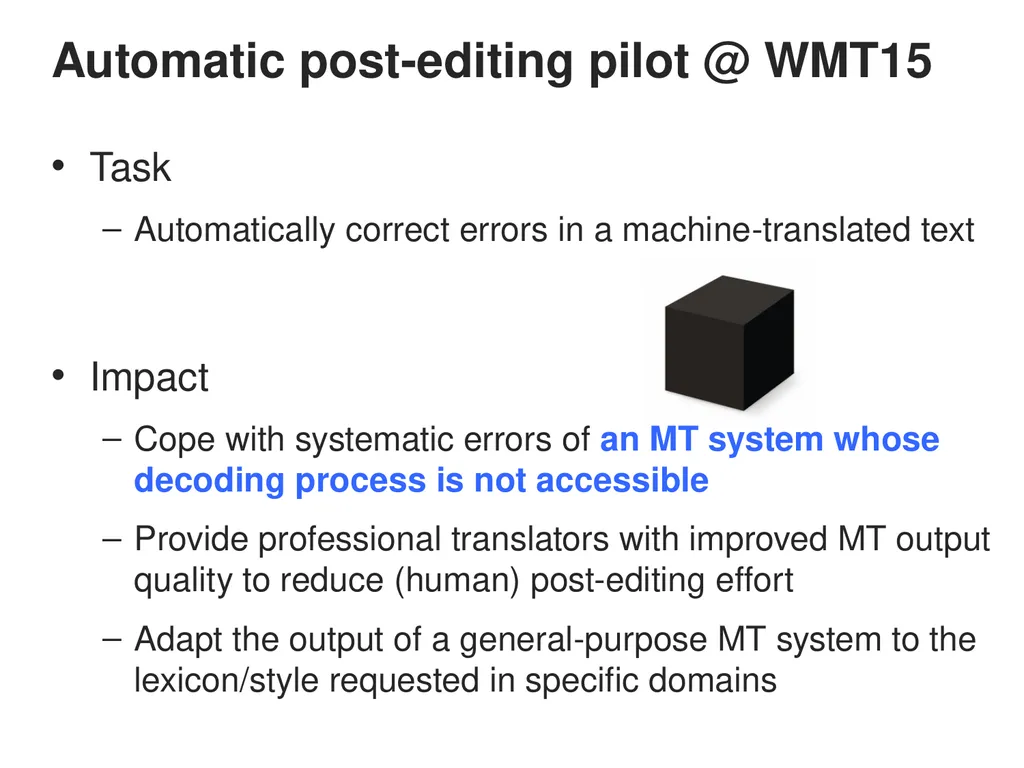
Cope with systematic errors of an MT system whose decoding process is not accessible
Provide professional translators with improved MT output quality to reduce (human) post-editing effort
Adapt the output of a general-purpose MT system to the lexicon/style requested in specific domains Automatic post-editing pilot @ WMT15<br>
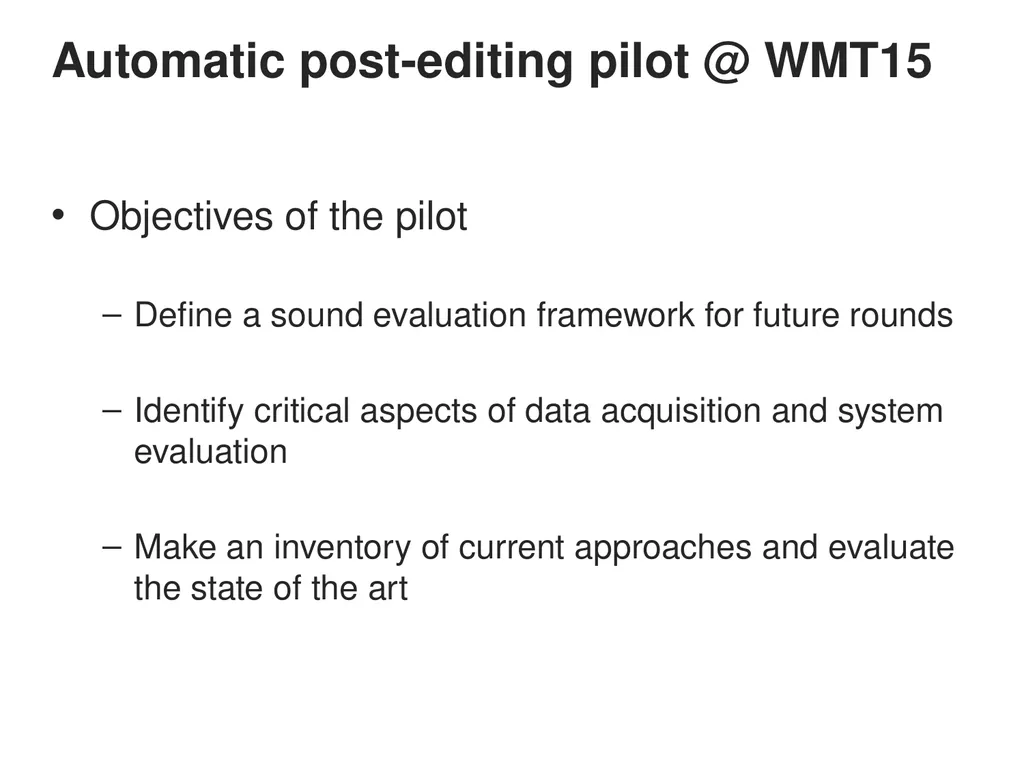
slide4. Objectives of the pilot
Define a sound evaluation framework for future rounds
Identify critical aspects of data acquisition and system evaluation
Make an inventory of current approaches and evaluate the state of the art Automatic post-editing pilot @ WMT15<br>
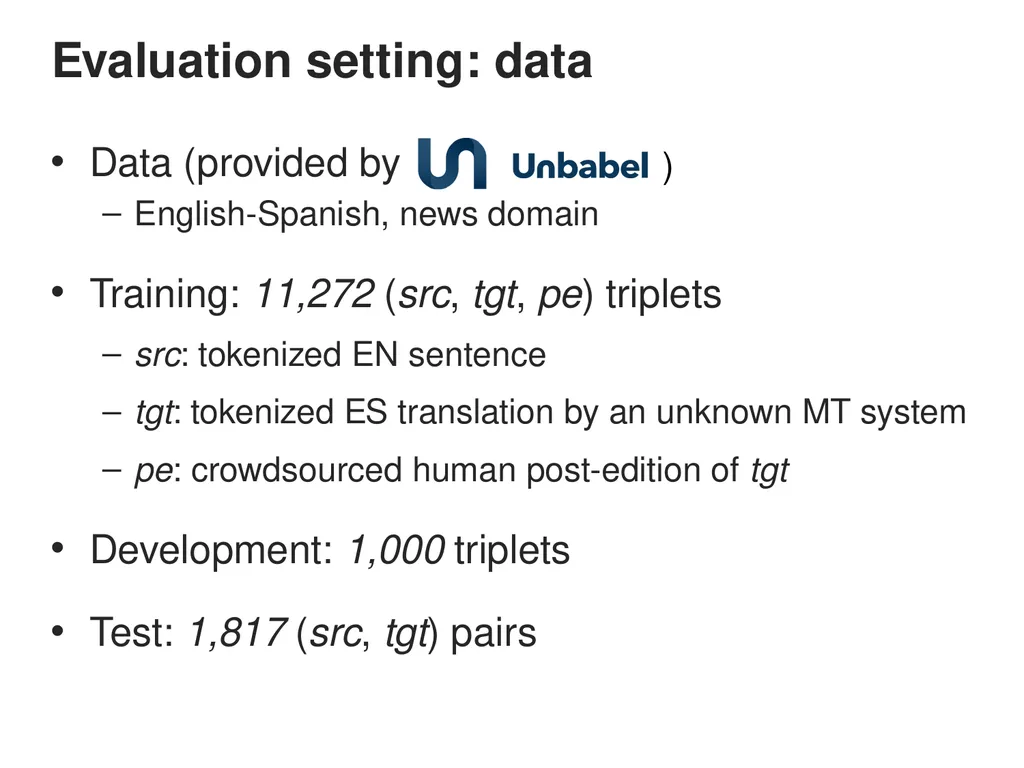
slide5. Evaluation setting: data ) Data (provided by
English-Spanish, news domain
Training: 11,272 (src, tgt, pe) triplets
src: tokenized EN sentence
tgt: tokenized ES translation by an unknown MT system
pe: crowdsourced human post-edition of tgt
Development: 1,000 triplets
Test: 1,817 (src, tgt) pairs<br>
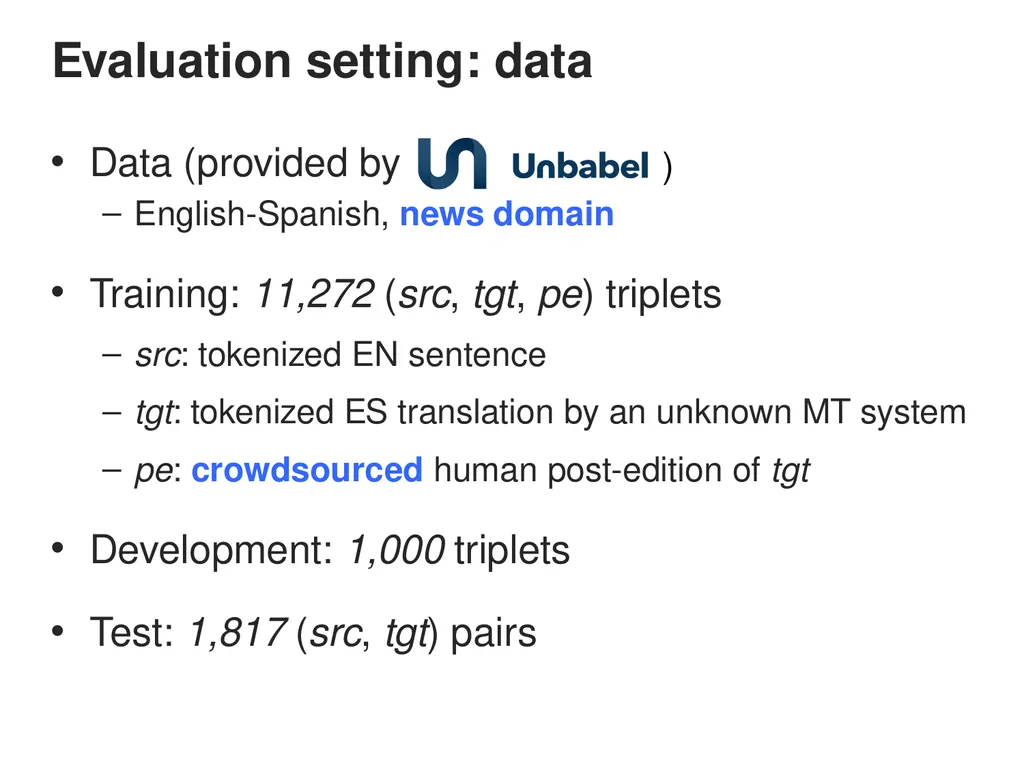
slide6. Evaluation setting: data ) Data (provided by
English-Spanish, news domain
Training: 11,272 (src, tgt, pe) triplets
src: tokenized EN sentence
tgt: tokenized ES translation by an unknown MT system
pe: crowdsourced human post-edition of tgt
Development: 1,000 triplets
Test: 1,817 (src, tgt) pairs<br>
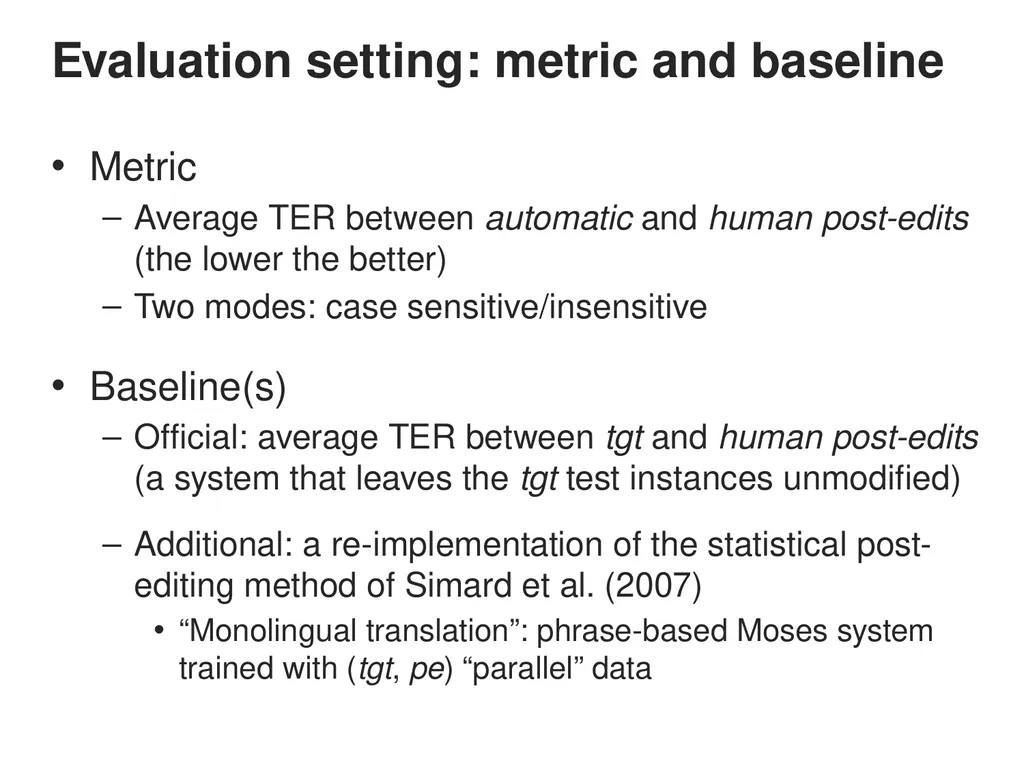
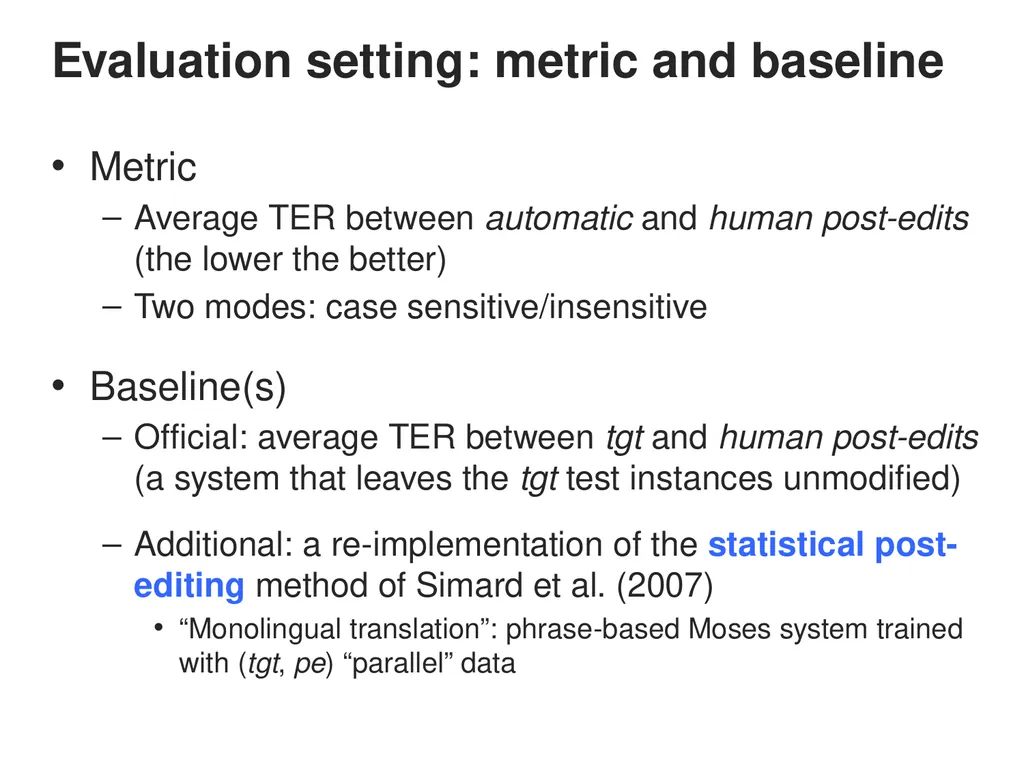
slide7. Metric
Average TER between automatic and human post-edits (the lower the better)
Two modes: case sensitive/insensitive
Baseline(s)
Official: average TER between tgt and human post-edits (a system that leaves the tgt test instances unmodified)
Additional: a re-implementation of the statistical post-editing method of Simard et al. (2007)
“Monolingual translation”: phrase-based Moses system trained with (tgt, pe) “parallel” data Evaluation setting: metric and baseline<br>
slide8. Metric
Average TER between automatic and human post-edits (the lower the better)
Two modes: case sensitive/insensitive
Baseline(s)
Official: average TER between tgt and human post-edits (a system that leaves the tgt test instances unmodified)
Additional: a re-implementation of the statistical post-editing method of Simard et al. (2007)
“Monolingual translation”: phrase-based Moses system trained with (tgt, pe) “parallel” data Evaluation setting: metric and baseline<br>
slide9. Participants and results<br>
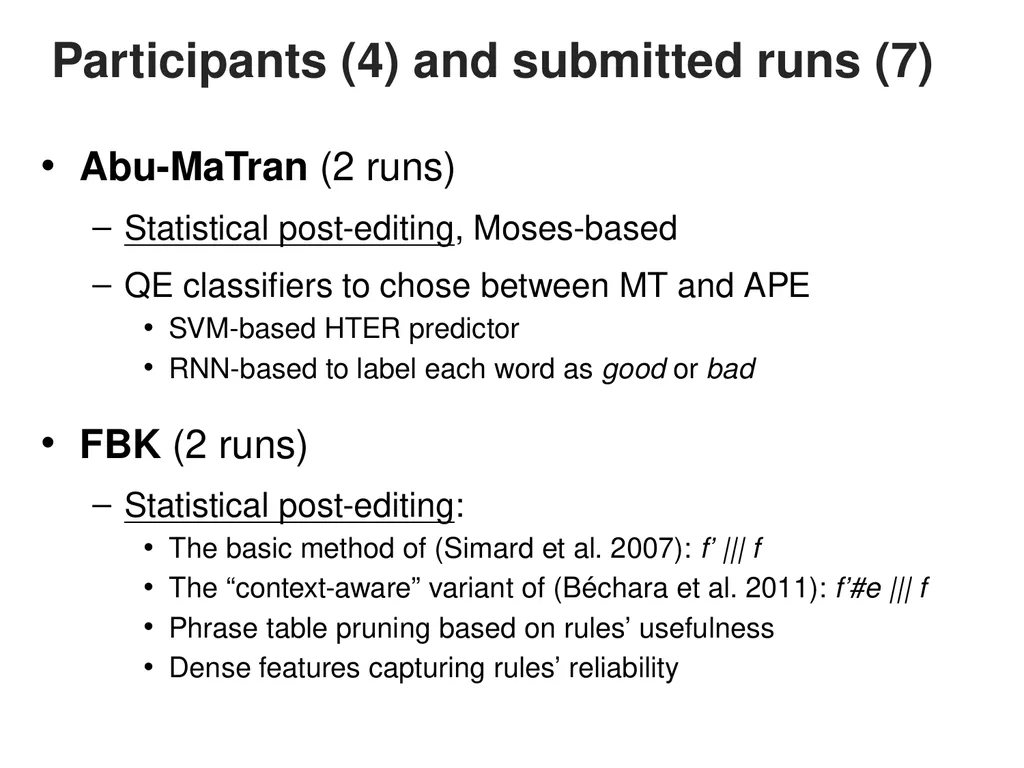
slide10. Abu-MaTran (2 runs)
Statistical post-editing, Moses-based
QE classifiers to chose between MT and APE
SVM-based HTER predictor
RNN-based to label each word as good or bad
FBK (2 runs)
Statistical post-editing:
The basic method of (Simard et al. 2007): f’ ||| f
The “context-aware” variant of (Béchara et al. 2011): f’#e ||| f
Phrase table pruning based on rules’ usefulness
Dense features capturing rules’ reliability Participants (4) and submitted runs (7)<br>
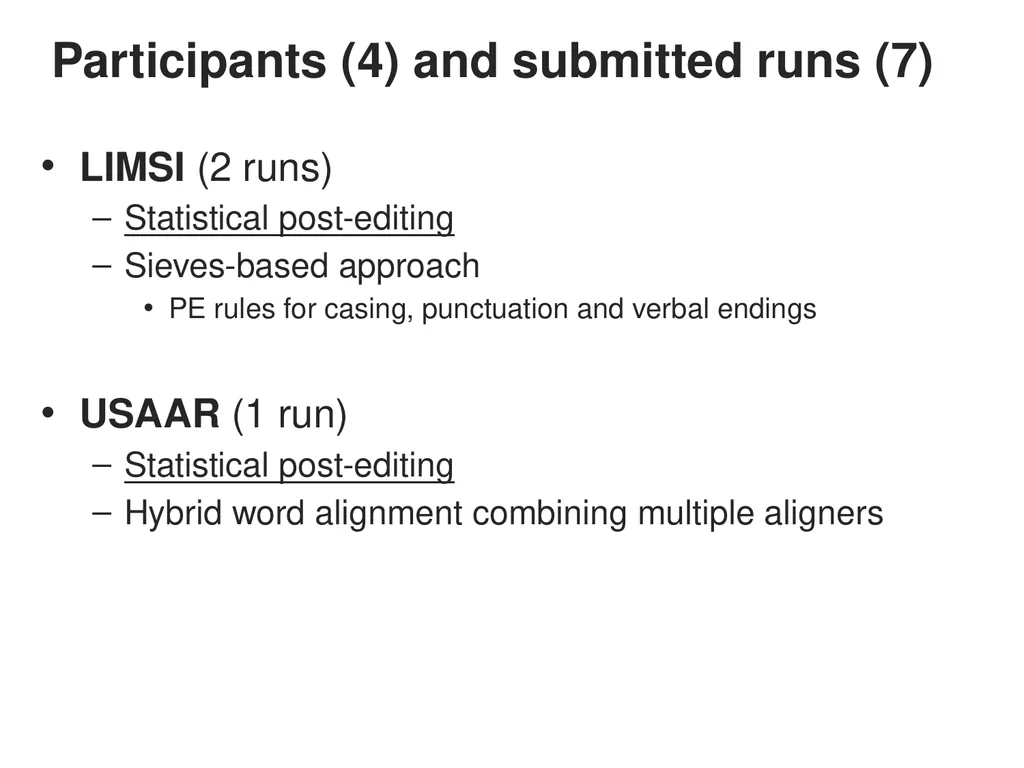
slide11. LIMSI (2 runs)
Statistical post-editing
Sieves-based approach
PE rules for casing, punctuation and verbal endings
USAAR (1 run)
Statistical post-editing
Hybrid word alignment combining multiple aligners Participants (4) and submitted runs (7)<br>
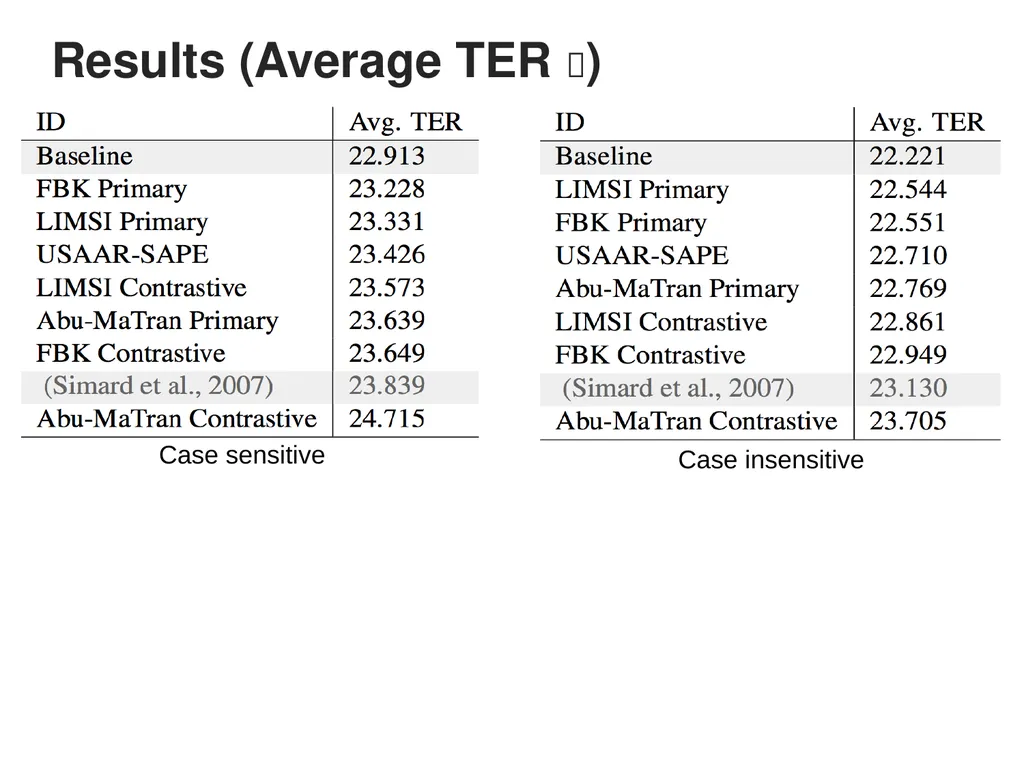
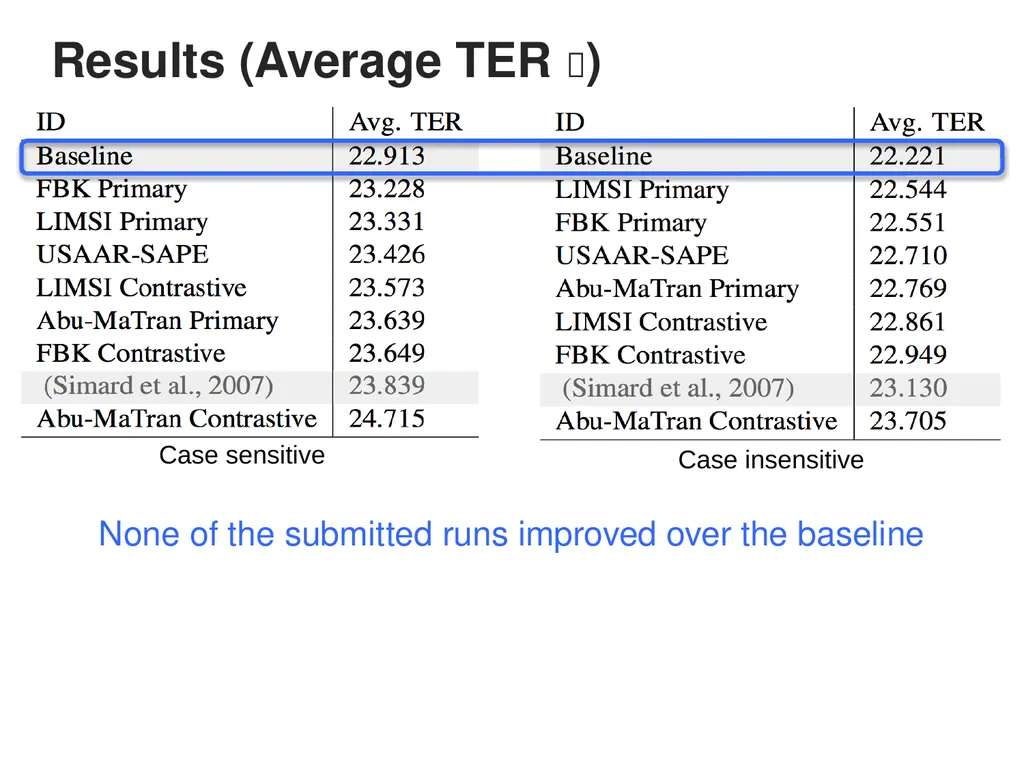
slide12. Results (Average TER )<br>
slide13. Results (Average TER ) None of the submitted runs improved over the baseline
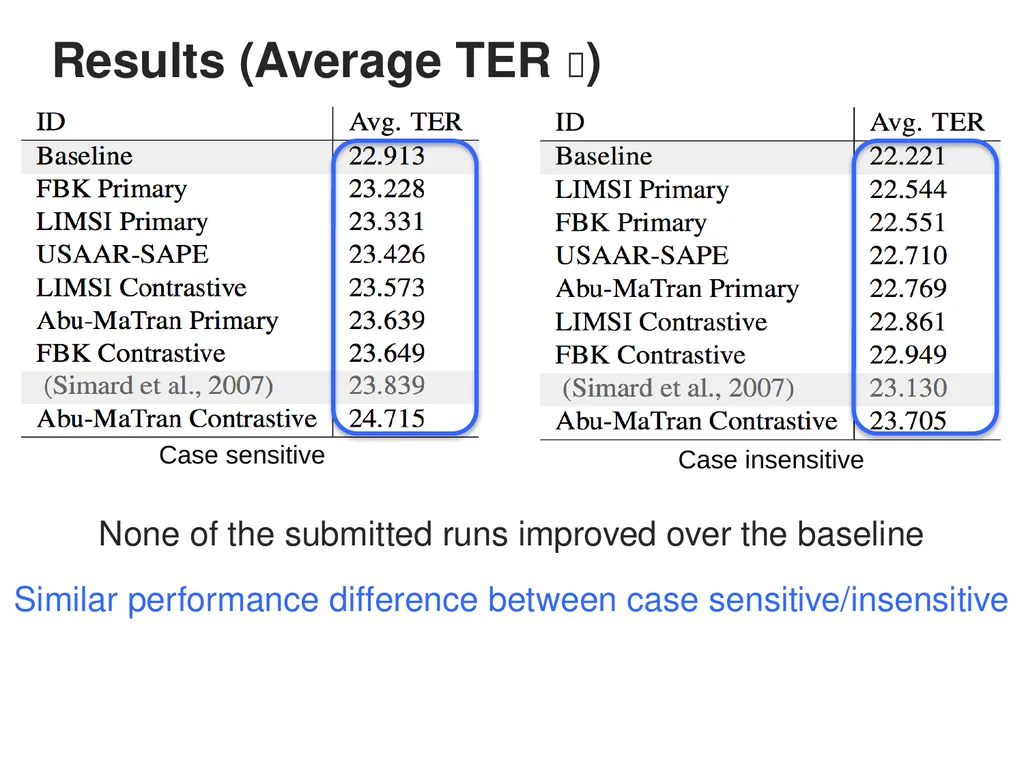
Similar performance difference between case sensitive/insensitive
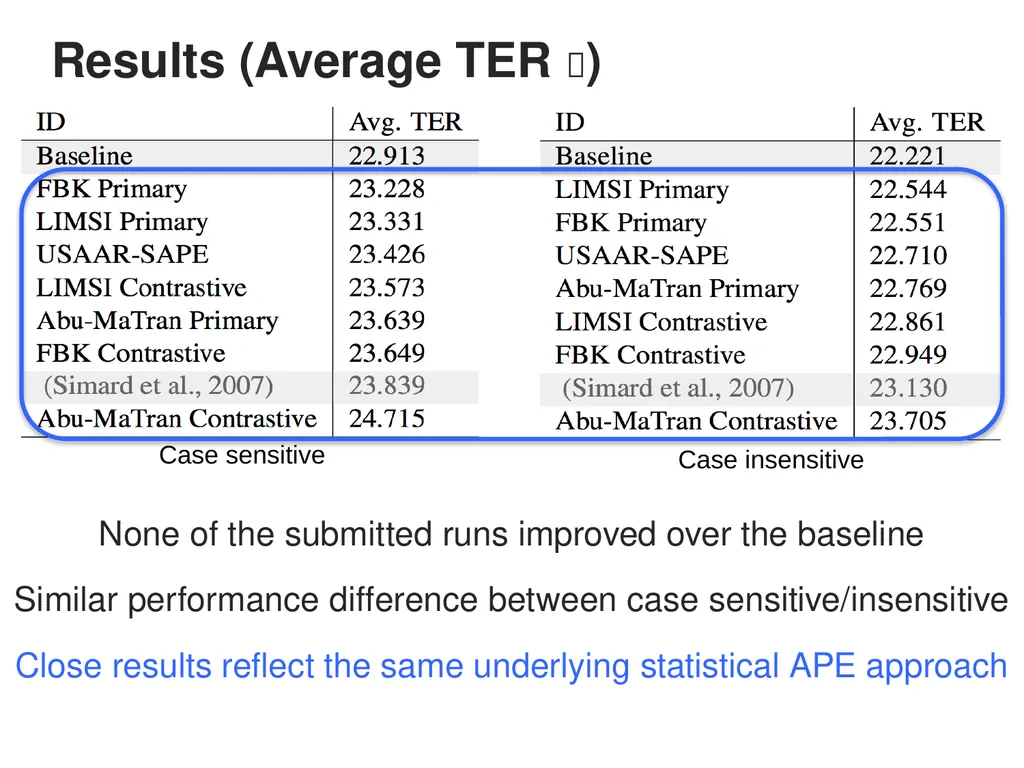
Close results reflect the same underlying statistical APE approach
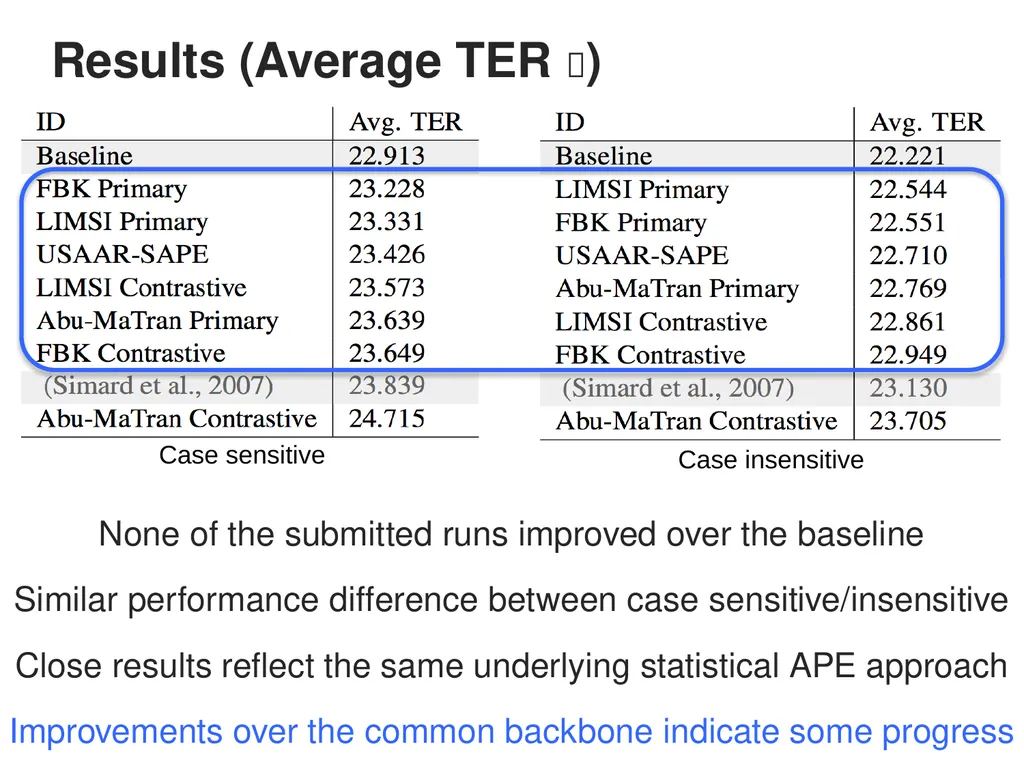
Improvements over the common backbone indicate some progress<br>
slide14. Results (Average TER ) None of the submitted runs improved over the baseline
Similar performance difference between case sensitive/insensitive
Close results reflect the same underlying statistical APE approach
Improvements over the common backbone indicate some progress<br>
slide15. Results (Average TER ) None of the submitted runs improved over the baseline
Similar performance difference between case sensitive/insensitive
Close results reflect the same underlying statistical APE approach
Improvements over the common backbone indicate some progress<br>
slide16. Results (Average TER ) None of the submitted runs improved over the baseline
Similar performance difference between case sensitive/insensitive
Close results reflect the same underlying statistical APE approach
Improvements over the common backbone indicate some progress<br>
slide17. Discussion<br>
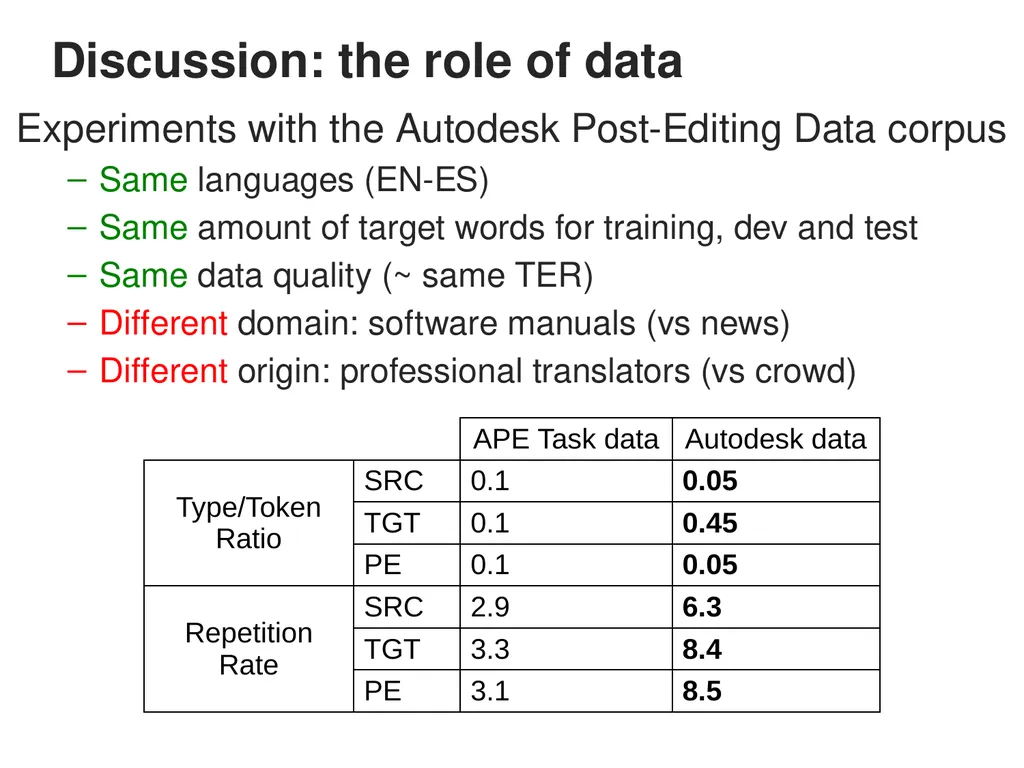
slide18. Experiments with the Autodesk Post-Editing Data corpus
Same languages (EN-ES)
Same amount of target words for training, dev and test
Same data quality (~ same TER)
Different domain: software manuals (vs news)
Different origin: professional translators (vs crowd) Discussion: the role of data<br>
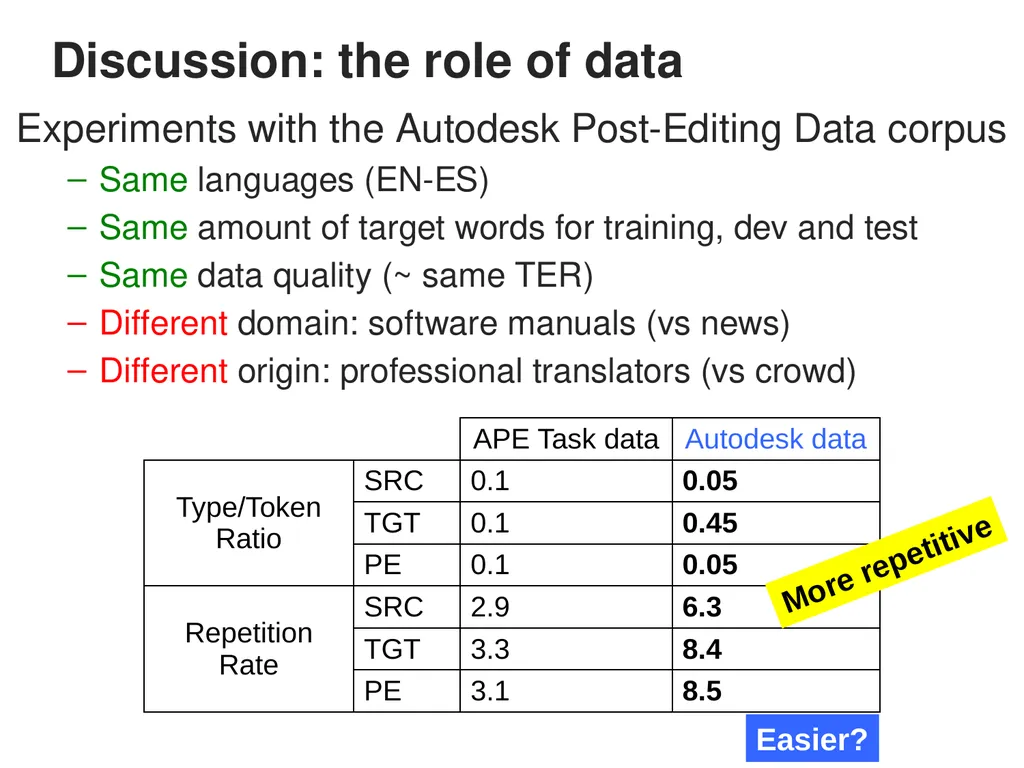
slide19. Experiments with the Autodesk Post-Editing Data corpus
Same languages (EN-ES)
Same amount of target words for training, dev and test
Same data quality (~ same TER)
Different domain: software manuals (vs news)
Different origin: professional translators (vs crowd) Discussion: the role of data More repetitive Easier?<br>
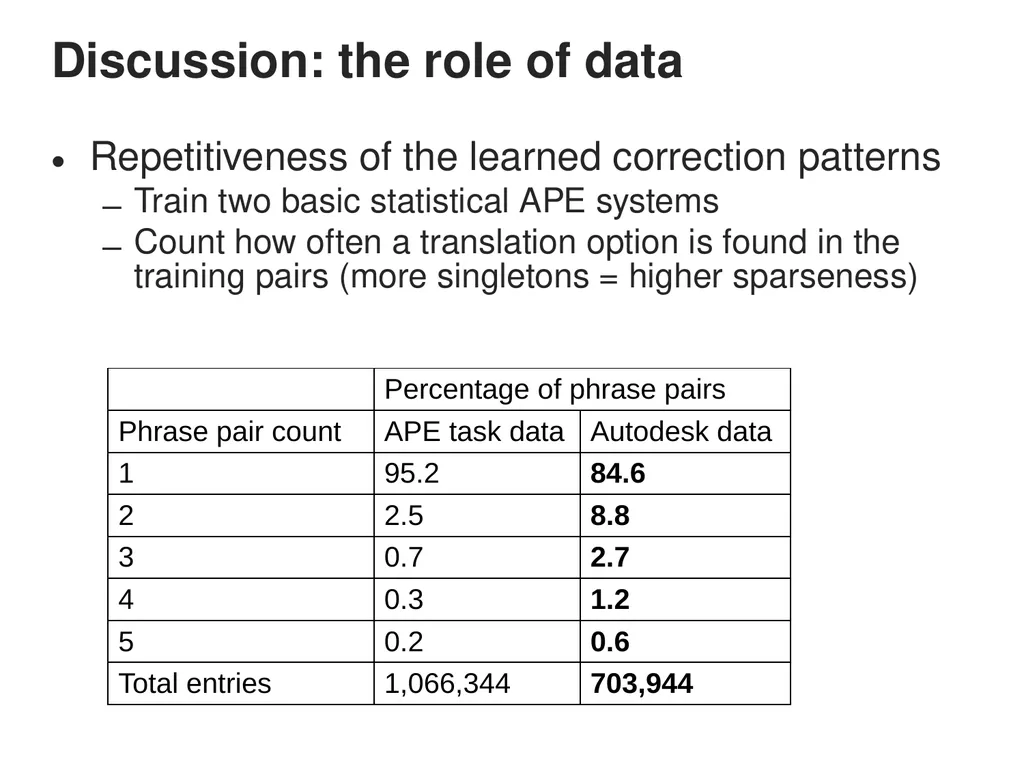
slide20. Repetitiveness of the learned correction patterns
Train two basic statistical APE systems
Count how often a translation option is found in the training pairs (more singletons = higher sparseness) Discussion: the role of data<br>
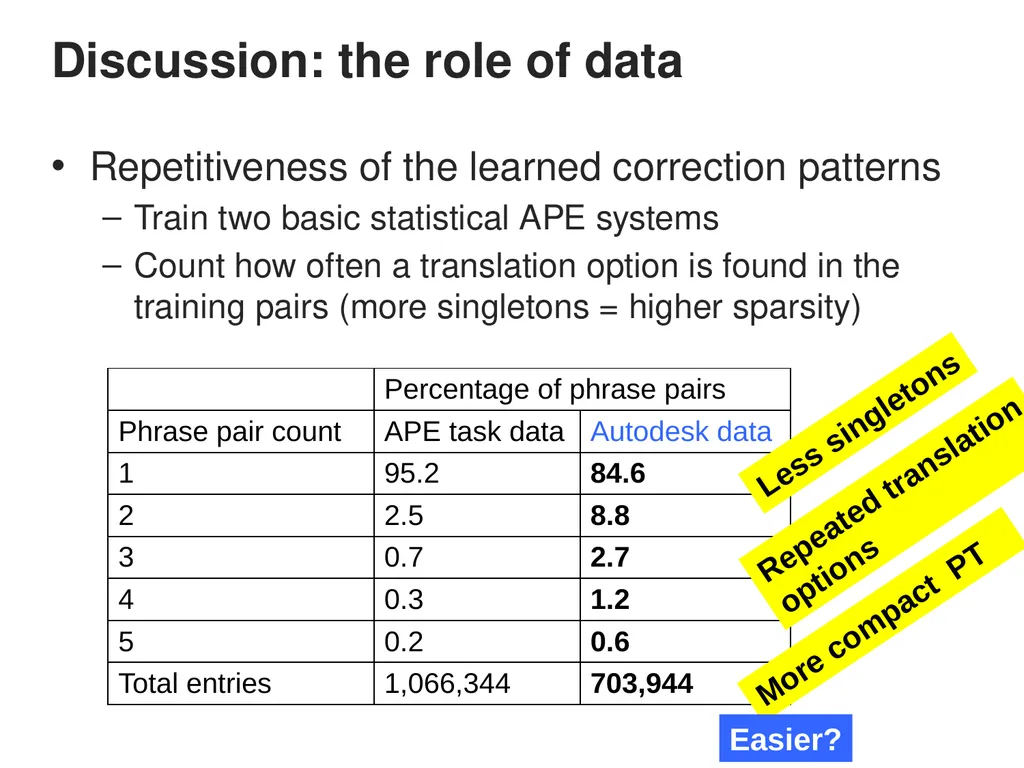
slide21. Repetitiveness of the learned correction patterns
Train two basic statistical APE systems
Count how often a translation option is found in the training pairs (more singletons = higher sparsity) Discussion: the role of data More compact PT Less singletons Repeated translation
options Easier?<br>
slide22. Professionals translators
Necessary corrections to maximize productivity
Consistent translation/correction criteria
Crowdsourced workers
No specific time/consistency constraints
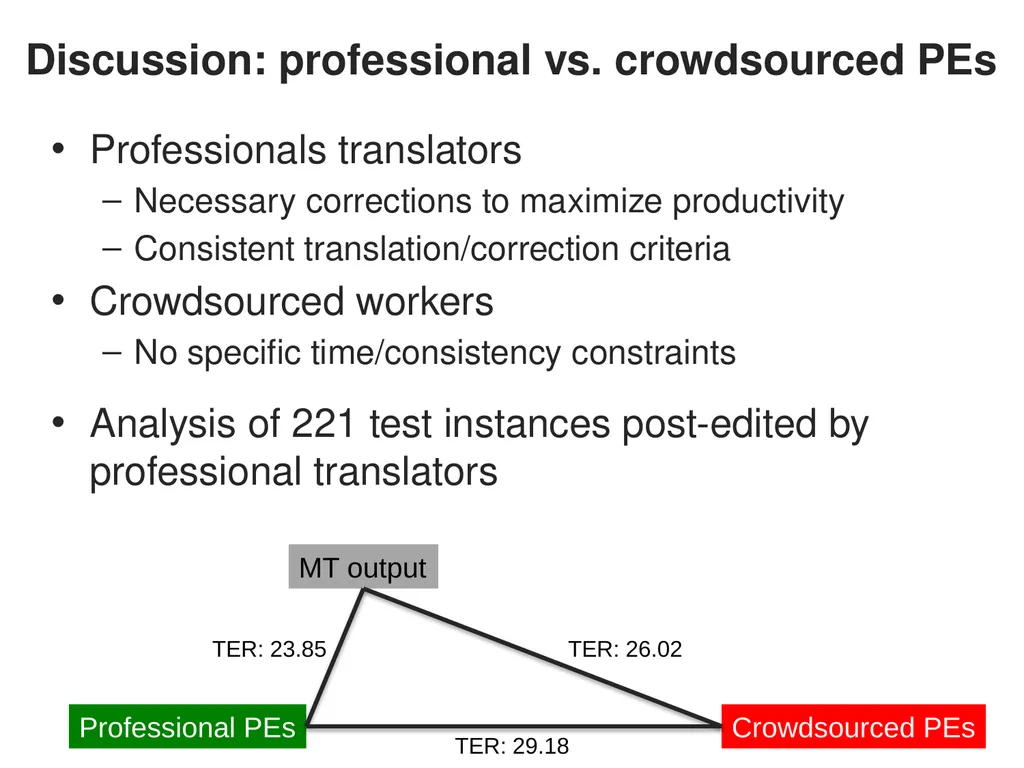
Analysis of 221 test instances post-edited by professional translators MT output Professional PEs Crowdsourced PEs TER: 23.85 TER: 29.18 TER: 26.02 Discussion: professional vs. crowdsourced PEs<br>
slide23. Professionals translators
Necessary corrections to maximize productivity
Consistent translation/correction criteria
Crowdsourced workers
No specific time/consistency constraints
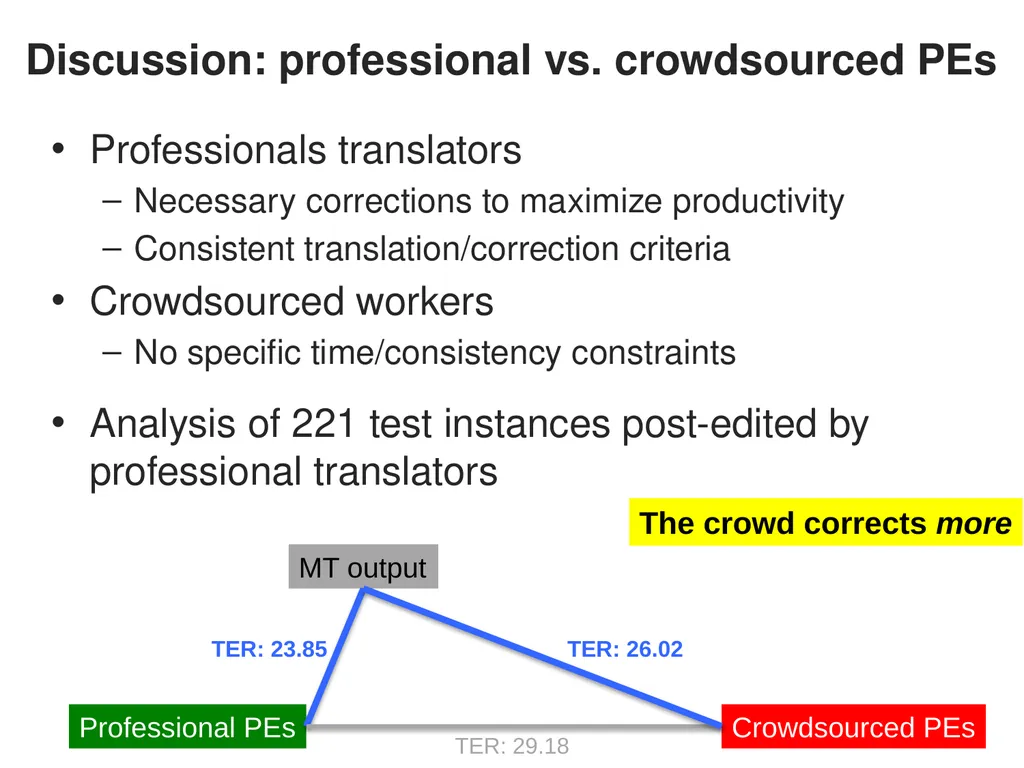
Analysis of 221 test instances post-edited by professional translators Discussion: professional vs. crowdsourced PEs MT output Professional PEs Crowdsourced PEs TER: 23.85 TER: 29.18 TER: 26.02 The crowd corrects more<br>
slide24. Professionals translators
Necessary corrections to maximize productivity
Consistent translation/correction criteria
Crowdsourced workers
No specific time/consistency constraints
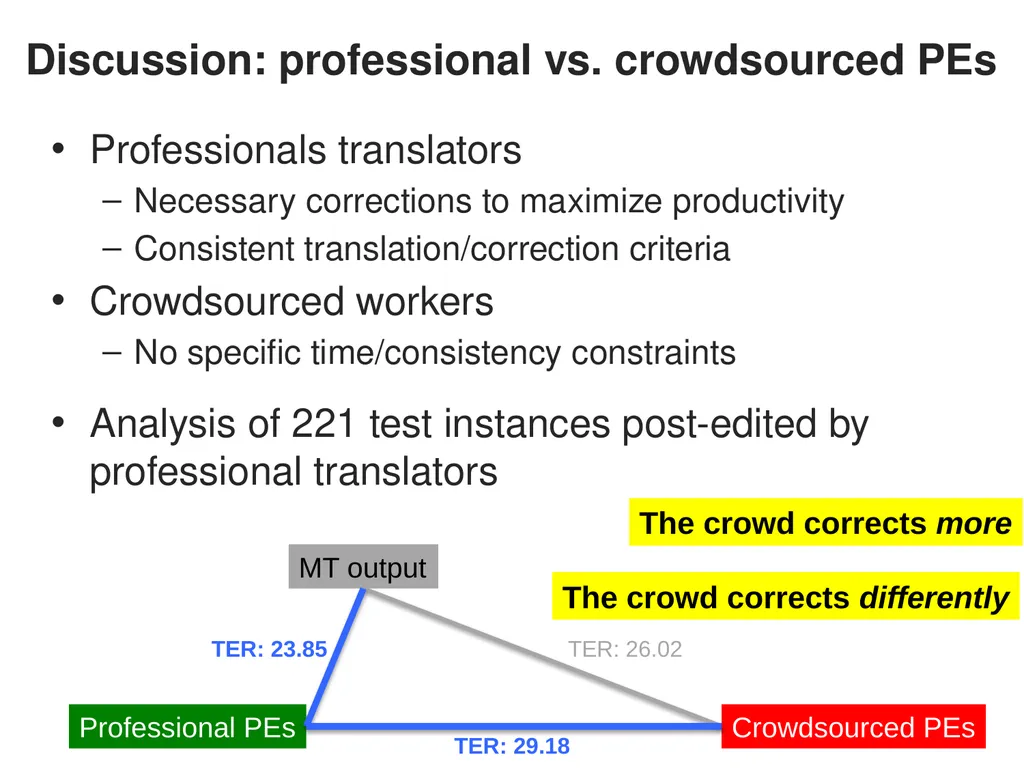
Analysis of 221 test instances post-edited by professional translators Discussion: professional vs. crowdsourced PEs MT output Professional PEs Crowdsourced PEs TER: 23.85 TER: 29.18 TER: 26.02 The crowd corrects more The crowd corrects differently<br>
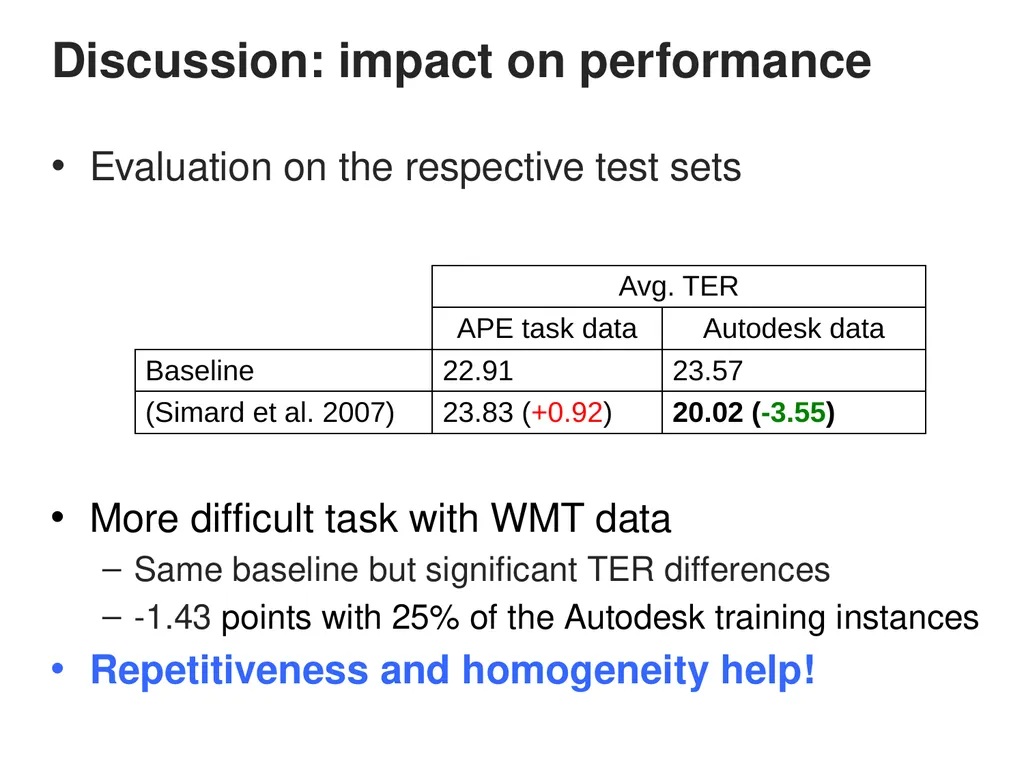
slide25. Discussion: impact on performance Evaluation on the respective test sets More difficult task with WMT data
Same baseline but significant TER differences
-1.43 points with 25% of the Autodesk training instances
Repetitiveness and homogeneity help!<br>
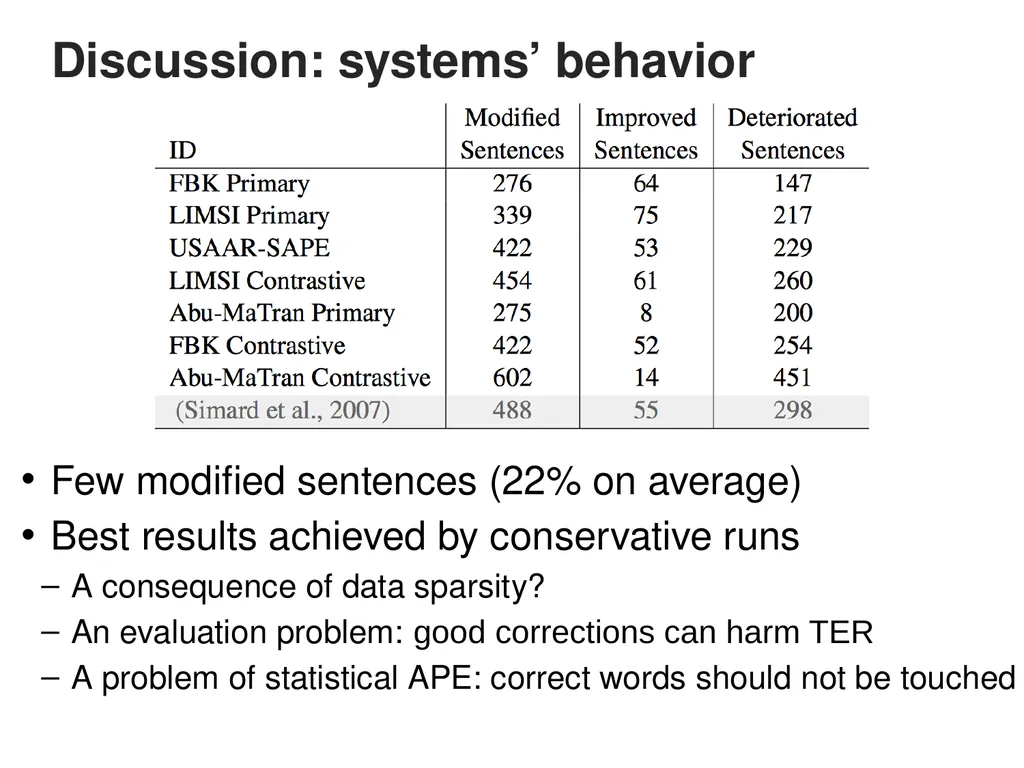
slide26. Discussion: systems’ behavior Few modified sentences (22% on average)
Best results achieved by conservative runs
A consequence of data sparsity?
An evaluation problem: good corrections can harm TER
A problem of statistical APE: correct words should not be touched<br>
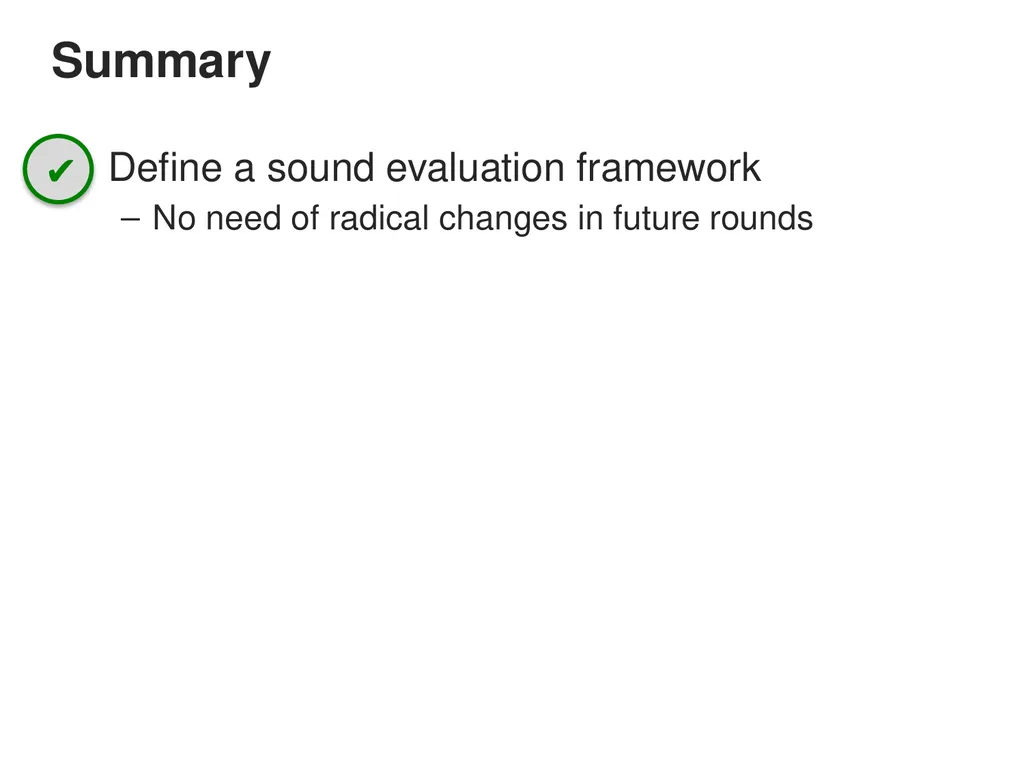
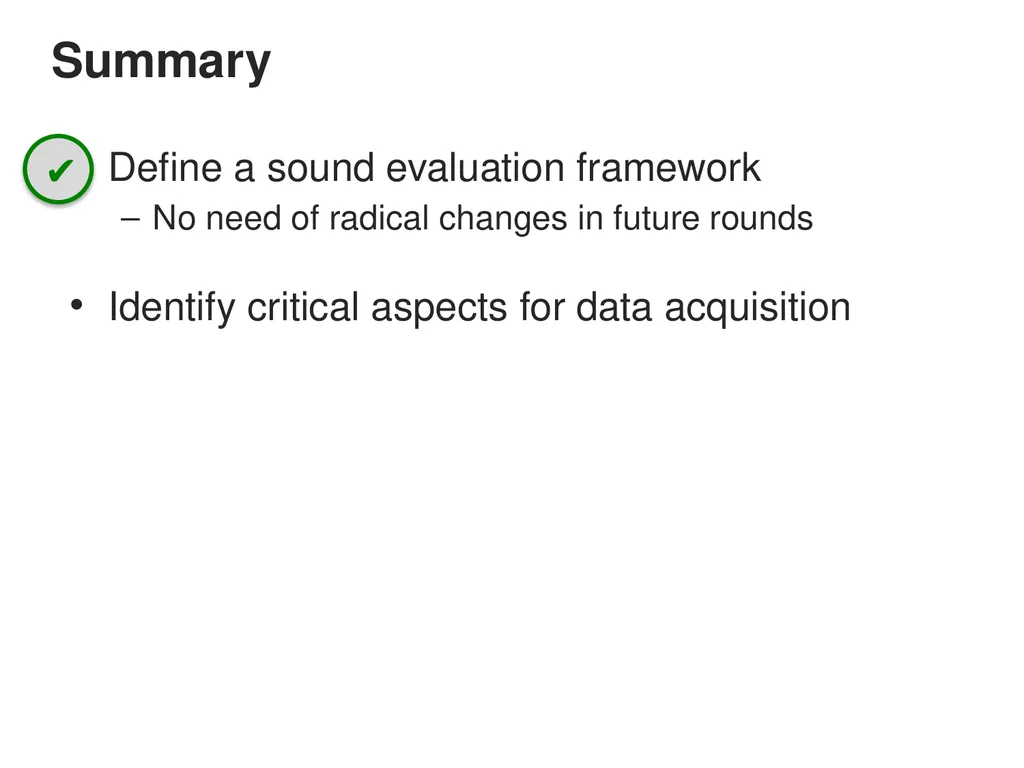
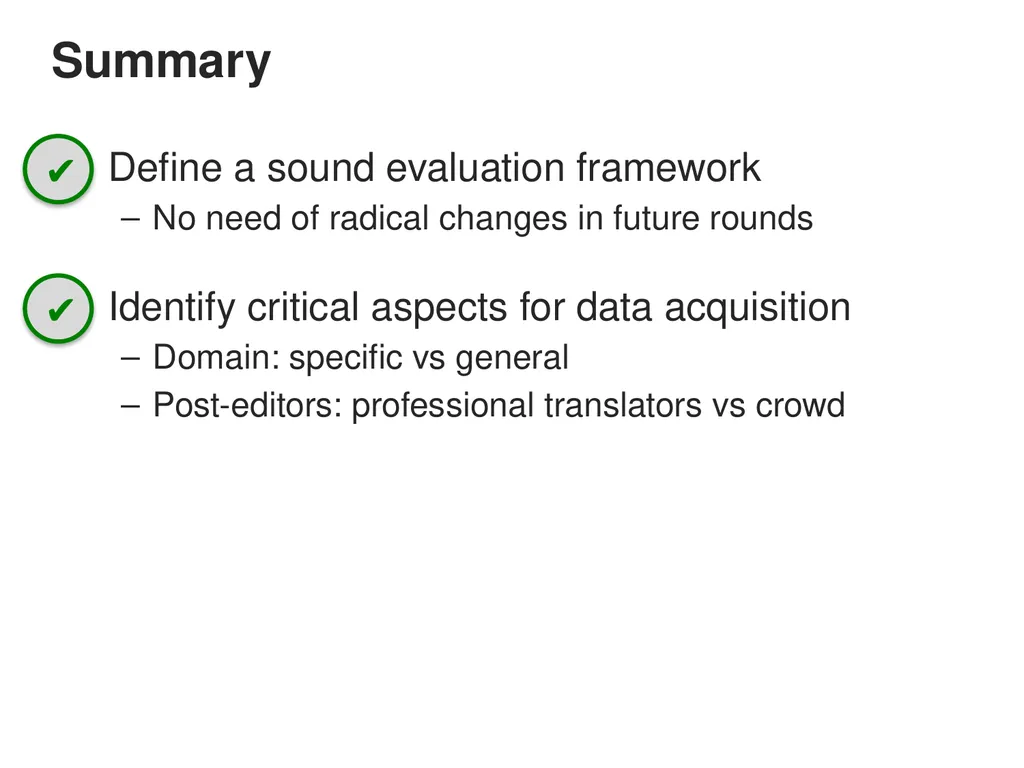
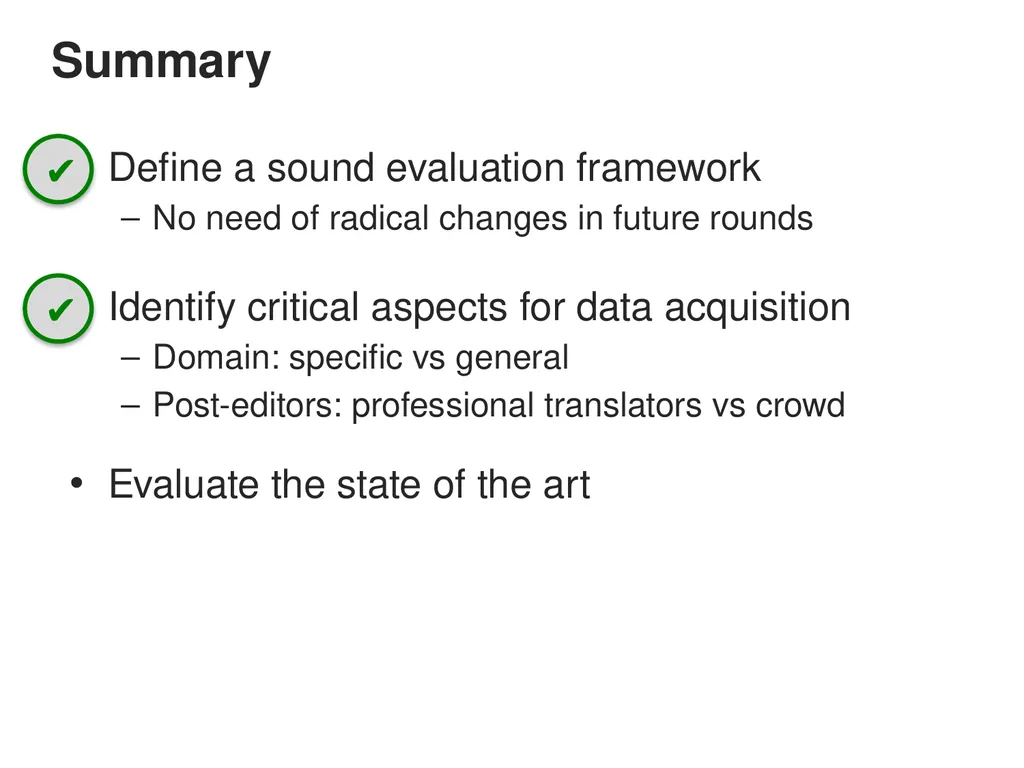
slide27. Define a sound evaluation framework
No need of radical changes in future rounds
Identify critical aspects for data acquisition
Domain: specific vs general
Post-editors: professional translators vs crowd
Evaluate the state of the art
Same underlying approach
Some progress due to slight variations
But the baseline is unbeaten
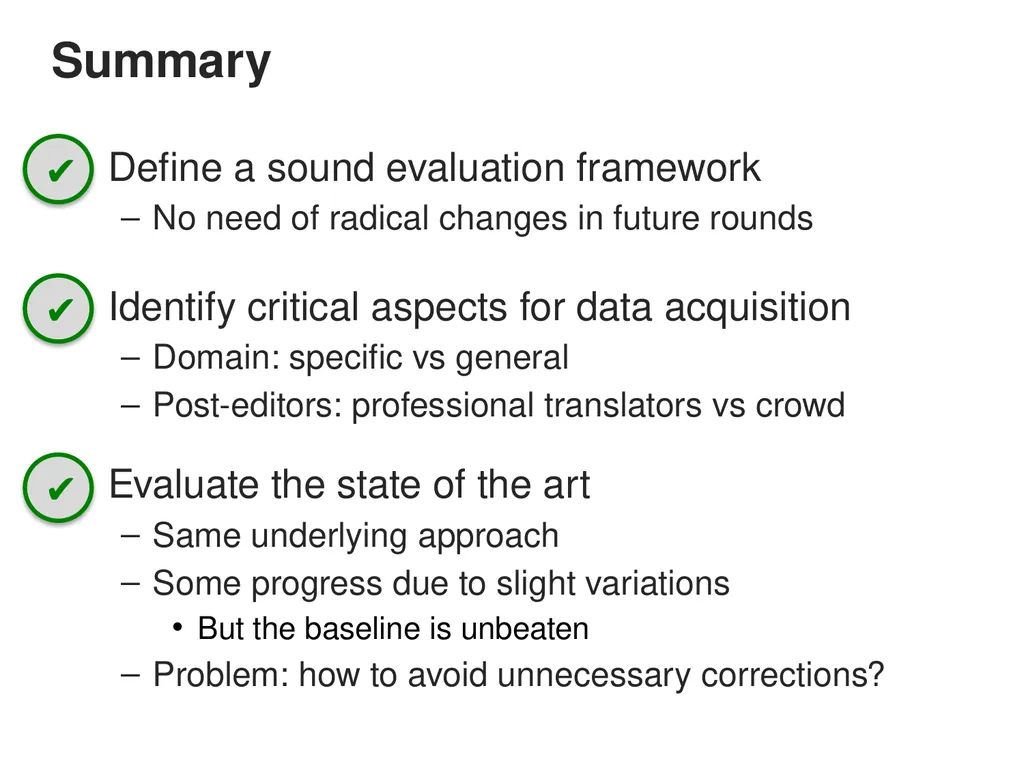
Problem: how to avoid unnecessary corrections? Summary<br>
slide28. Define a sound evaluation framework
No need of radical changes in future rounds
Identify critical aspects for data acquisition
Domain: specific vs general
Post-editors: professional translators vs crowd
Evaluate the state of the art
Same underlying approach
Some progress due to slight variations
But the baseline is unbeaten
Problem: how to avoid unnecessary corrections? Summary ✔<br>
slide29. Define a sound evaluation framework
No need of radical changes in future rounds
Identify critical aspects for data acquisition
Domain: specific vs general
Post-editors: professional translators vs crowd
Evaluate the state of the art
Same underlying approach
Some progress due to slight variations
But the baseline is unbeaten
Problem: how to avoid unnecessary corrections? Summary ✔ <br>
slide30. Define a sound evaluation framework
No need of radical changes in future rounds
Identify critical aspects for data acquisition
Domain: specific vs general
Post-editors: professional translators vs crowd Summary ✔ ✔<br>
slide31. Define a sound evaluation framework
No need of radical changes in future rounds
Identify critical aspects for data acquisition
Domain: specific vs general
Post-editors: professional translators vs crowd
Evaluate the state of the art
Same underlying approach
Some progress due to slight variations
But the baseline is unbeaten
Problem: how to avoid unnecessary corrections? Summary ✔ ✔<br>
slide32. Define a sound evaluation framework
No need of radical changes in future rounds
Identify critical aspects for data acquisition
Domain: specific vs general
Post-editors: professional translators vs crowd
Evaluate the state of the art
Same underlying approach
Some progress due to slight variations
But the baseline is unbeaten
Problem: how to avoid unnecessary corrections? Summary ✔ ✔ ✔<br>
slide33. Thanks!
Questions?<br>
slide35. MT: translation of the entire source sentence
Translate everything!
SAPE: “translation” of the errors
Don’t correct everything! Mimic the human! The “aggressiveness” problem SRC: 巴尔干的另一个关键步骤 TGT: Yet a key step in the Balkans TGT_corrected: Another key step for the Balkans<br>
slide36. MT: translation of the entire source sentence
Translate everything!
SAPE: “translation” of the errors
Don’t correct everything! Mimic the human! The “aggressiveness” problem SRC: 巴尔干的另一个关键步骤 TGT: Yet a key step in the Balkans TGT_corrected: Another key step for the Balkans<br>
slide37. MT: translation of the entire source sentence
Translate everything!
SAPE: “translation” of the errors
Don’t correct everything! Mimic the human! The “aggressiveness” problem SRC: 巴尔干的另一个关键步骤 TGT: Yet a key step in the Balkans TGT_corrected: Another crucial step for the Balkans Changing correct terms will be penalized by TER-based evaluation against humans<br>
Fondazione Bruno Kessler
[ chatterjee | negri | turchi ]@fbk.eu<br>
slide2. Task
Automatically correct errors in a machine-translated text
Impact
Cope with systematic errors of an MT system whose decoding process is not accessible
Provide professional translators with improved MT output quality to reduce (human) post-editing effort
Adapt the output of a general-purpose MT system to the lexicon/style requested in specific domains Automatic post-editing pilot @ WMT15<br>
slide3. Task
Automatically correct errors in a machine-translated text
Impact
Cope with systematic errors of an MT system whose decoding process is not accessible
Provide professional translators with improved MT output quality to reduce (human) post-editing effort
Adapt the output of a general-purpose MT system to the lexicon/style requested in specific domains Automatic post-editing pilot @ WMT15<br>
slide4. Objectives of the pilot
Define a sound evaluation framework for future rounds
Identify critical aspects of data acquisition and system evaluation
Make an inventory of current approaches and evaluate the state of the art Automatic post-editing pilot @ WMT15<br>
slide5. Evaluation setting: data ) Data (provided by
English-Spanish, news domain
Training: 11,272 (src, tgt, pe) triplets
src: tokenized EN sentence
tgt: tokenized ES translation by an unknown MT system
pe: crowdsourced human post-edition of tgt
Development: 1,000 triplets
Test: 1,817 (src, tgt) pairs<br>
slide6. Evaluation setting: data ) Data (provided by
English-Spanish, news domain
Training: 11,272 (src, tgt, pe) triplets
src: tokenized EN sentence
tgt: tokenized ES translation by an unknown MT system
pe: crowdsourced human post-edition of tgt
Development: 1,000 triplets
Test: 1,817 (src, tgt) pairs<br>
slide7. Metric
Average TER between automatic and human post-edits (the lower the better)
Two modes: case sensitive/insensitive
Baseline(s)
Official: average TER between tgt and human post-edits (a system that leaves the tgt test instances unmodified)
Additional: a re-implementation of the statistical post-editing method of Simard et al. (2007)
“Monolingual translation”: phrase-based Moses system trained with (tgt, pe) “parallel” data Evaluation setting: metric and baseline<br>
slide8. Metric
Average TER between automatic and human post-edits (the lower the better)
Two modes: case sensitive/insensitive
Baseline(s)
Official: average TER between tgt and human post-edits (a system that leaves the tgt test instances unmodified)
Additional: a re-implementation of the statistical post-editing method of Simard et al. (2007)
“Monolingual translation”: phrase-based Moses system trained with (tgt, pe) “parallel” data Evaluation setting: metric and baseline<br>
slide9. Participants and results<br>
slide10. Abu-MaTran (2 runs)
Statistical post-editing, Moses-based
QE classifiers to chose between MT and APE
SVM-based HTER predictor
RNN-based to label each word as good or bad
FBK (2 runs)
Statistical post-editing:
The basic method of (Simard et al. 2007): f’ ||| f
The “context-aware” variant of (Béchara et al. 2011): f’#e ||| f
Phrase table pruning based on rules’ usefulness
Dense features capturing rules’ reliability Participants (4) and submitted runs (7)<br>
slide11. LIMSI (2 runs)
Statistical post-editing
Sieves-based approach
PE rules for casing, punctuation and verbal endings
USAAR (1 run)
Statistical post-editing
Hybrid word alignment combining multiple aligners Participants (4) and submitted runs (7)<br>
slide12. Results (Average TER )<br>
slide13. Results (Average TER ) None of the submitted runs improved over the baseline
Similar performance difference between case sensitive/insensitive
Close results reflect the same underlying statistical APE approach
Improvements over the common backbone indicate some progress<br>
slide14. Results (Average TER ) None of the submitted runs improved over the baseline
Similar performance difference between case sensitive/insensitive
Close results reflect the same underlying statistical APE approach
Improvements over the common backbone indicate some progress<br>
slide15. Results (Average TER ) None of the submitted runs improved over the baseline
Similar performance difference between case sensitive/insensitive
Close results reflect the same underlying statistical APE approach
Improvements over the common backbone indicate some progress<br>
slide16. Results (Average TER ) None of the submitted runs improved over the baseline
Similar performance difference between case sensitive/insensitive
Close results reflect the same underlying statistical APE approach
Improvements over the common backbone indicate some progress<br>
slide17. Discussion<br>
slide18. Experiments with the Autodesk Post-Editing Data corpus
Same languages (EN-ES)
Same amount of target words for training, dev and test
Same data quality (~ same TER)
Different domain: software manuals (vs news)
Different origin: professional translators (vs crowd) Discussion: the role of data<br>
slide19. Experiments with the Autodesk Post-Editing Data corpus
Same languages (EN-ES)
Same amount of target words for training, dev and test
Same data quality (~ same TER)
Different domain: software manuals (vs news)
Different origin: professional translators (vs crowd) Discussion: the role of data More repetitive Easier?<br>
slide20. Repetitiveness of the learned correction patterns
Train two basic statistical APE systems
Count how often a translation option is found in the training pairs (more singletons = higher sparseness) Discussion: the role of data<br>
slide21. Repetitiveness of the learned correction patterns
Train two basic statistical APE systems
Count how often a translation option is found in the training pairs (more singletons = higher sparsity) Discussion: the role of data More compact PT Less singletons Repeated translation
options Easier?<br>
slide22. Professionals translators
Necessary corrections to maximize productivity
Consistent translation/correction criteria
Crowdsourced workers
No specific time/consistency constraints
Analysis of 221 test instances post-edited by professional translators MT output Professional PEs Crowdsourced PEs TER: 23.85 TER: 29.18 TER: 26.02 Discussion: professional vs. crowdsourced PEs<br>
slide23. Professionals translators
Necessary corrections to maximize productivity
Consistent translation/correction criteria
Crowdsourced workers
No specific time/consistency constraints
Analysis of 221 test instances post-edited by professional translators Discussion: professional vs. crowdsourced PEs MT output Professional PEs Crowdsourced PEs TER: 23.85 TER: 29.18 TER: 26.02 The crowd corrects more<br>
slide24. Professionals translators
Necessary corrections to maximize productivity
Consistent translation/correction criteria
Crowdsourced workers
No specific time/consistency constraints
Analysis of 221 test instances post-edited by professional translators Discussion: professional vs. crowdsourced PEs MT output Professional PEs Crowdsourced PEs TER: 23.85 TER: 29.18 TER: 26.02 The crowd corrects more The crowd corrects differently<br>
slide25. Discussion: impact on performance Evaluation on the respective test sets More difficult task with WMT data
Same baseline but significant TER differences
-1.43 points with 25% of the Autodesk training instances
Repetitiveness and homogeneity help!<br>
slide26. Discussion: systems’ behavior Few modified sentences (22% on average)
Best results achieved by conservative runs
A consequence of data sparsity?
An evaluation problem: good corrections can harm TER
A problem of statistical APE: correct words should not be touched<br>
slide27. Define a sound evaluation framework
No need of radical changes in future rounds
Identify critical aspects for data acquisition
Domain: specific vs general
Post-editors: professional translators vs crowd
Evaluate the state of the art
Same underlying approach
Some progress due to slight variations
But the baseline is unbeaten
Problem: how to avoid unnecessary corrections? Summary<br>
slide28. Define a sound evaluation framework
No need of radical changes in future rounds
Identify critical aspects for data acquisition
Domain: specific vs general
Post-editors: professional translators vs crowd
Evaluate the state of the art
Same underlying approach
Some progress due to slight variations
But the baseline is unbeaten
Problem: how to avoid unnecessary corrections? Summary ✔<br>
slide29. Define a sound evaluation framework
No need of radical changes in future rounds
Identify critical aspects for data acquisition
Domain: specific vs general
Post-editors: professional translators vs crowd
Evaluate the state of the art
Same underlying approach
Some progress due to slight variations
But the baseline is unbeaten
Problem: how to avoid unnecessary corrections? Summary ✔ <br>
slide30. Define a sound evaluation framework
No need of radical changes in future rounds
Identify critical aspects for data acquisition
Domain: specific vs general
Post-editors: professional translators vs crowd Summary ✔ ✔<br>
slide31. Define a sound evaluation framework
No need of radical changes in future rounds
Identify critical aspects for data acquisition
Domain: specific vs general
Post-editors: professional translators vs crowd
Evaluate the state of the art
Same underlying approach
Some progress due to slight variations
But the baseline is unbeaten
Problem: how to avoid unnecessary corrections? Summary ✔ ✔<br>
slide32. Define a sound evaluation framework
No need of radical changes in future rounds
Identify critical aspects for data acquisition
Domain: specific vs general
Post-editors: professional translators vs crowd
Evaluate the state of the art
Same underlying approach
Some progress due to slight variations
But the baseline is unbeaten
Problem: how to avoid unnecessary corrections? Summary ✔ ✔ ✔<br>
slide33. Thanks!
Questions?<br>
slide35. MT: translation of the entire source sentence
Translate everything!
SAPE: “translation” of the errors
Don’t correct everything! Mimic the human! The “aggressiveness” problem SRC: 巴尔干的另一个关键步骤 TGT: Yet a key step in the Balkans TGT_corrected: Another key step for the Balkans<br>
slide36. MT: translation of the entire source sentence
Translate everything!
SAPE: “translation” of the errors
Don’t correct everything! Mimic the human! The “aggressiveness” problem SRC: 巴尔干的另一个关键步骤 TGT: Yet a key step in the Balkans TGT_corrected: Another key step for the Balkans<br>
slide37. MT: translation of the entire source sentence
Translate everything!
SAPE: “translation” of the errors
Don’t correct everything! Mimic the human! The “aggressiveness” problem SRC: 巴尔干的另一个关键步骤 TGT: Yet a key step in the Balkans TGT_corrected: Another crucial step for the Balkans Changing correct terms will be penalized by TER-based evaluation against humans<br>