04
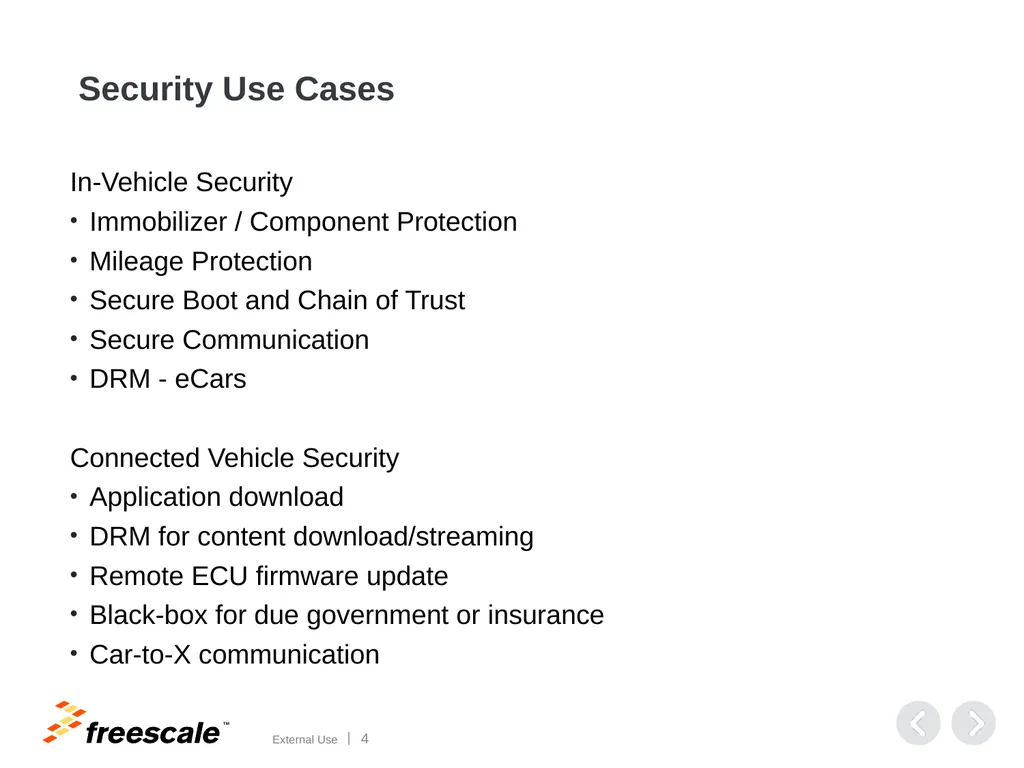
Security Use Cases In-Vehicle Security
Immobilizer / Component Protection
Mileage Protection
Secure Boot and Chain of Trust
Secure Communication
DRM - eCars
Connected Vehicle Security
Application download
DRM for content download/streaming
Remote ECU firmware update
Black-box for due government or insurance
Car-to-X communication<br>
05
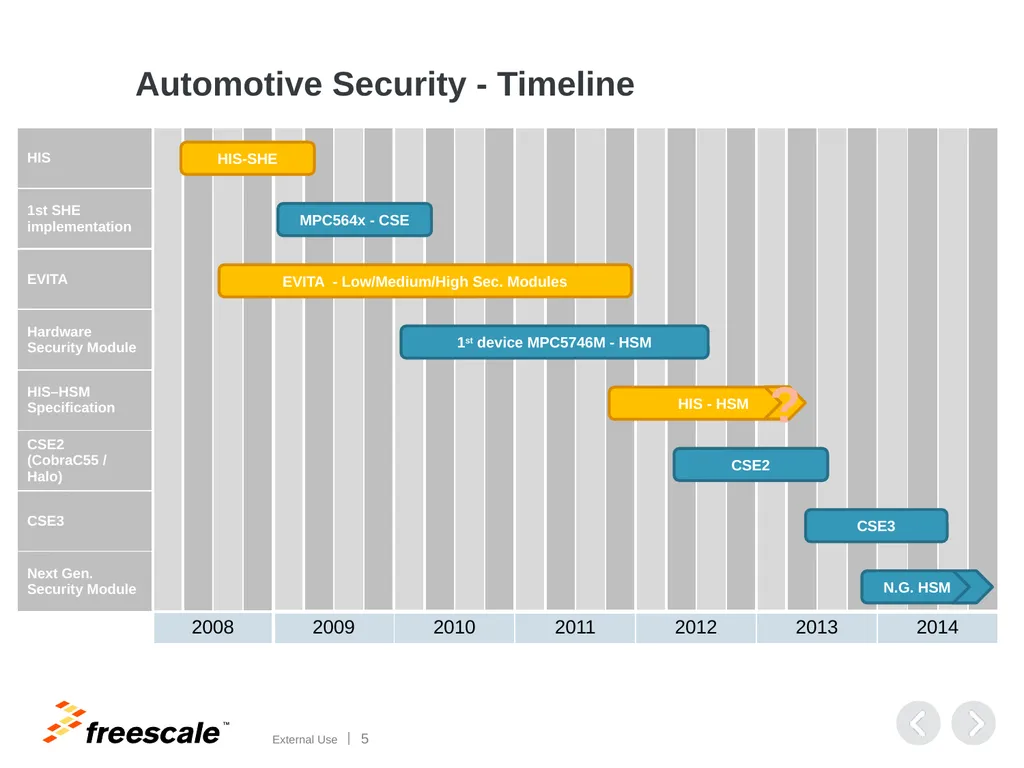
Automotive Security - Timeline MPC564x - CSE 1st device MPC5746M - HSM EVITA - Low/Medium/High Sec. Modules HIS-SHE CSE2 CSE3 ?<br>
07
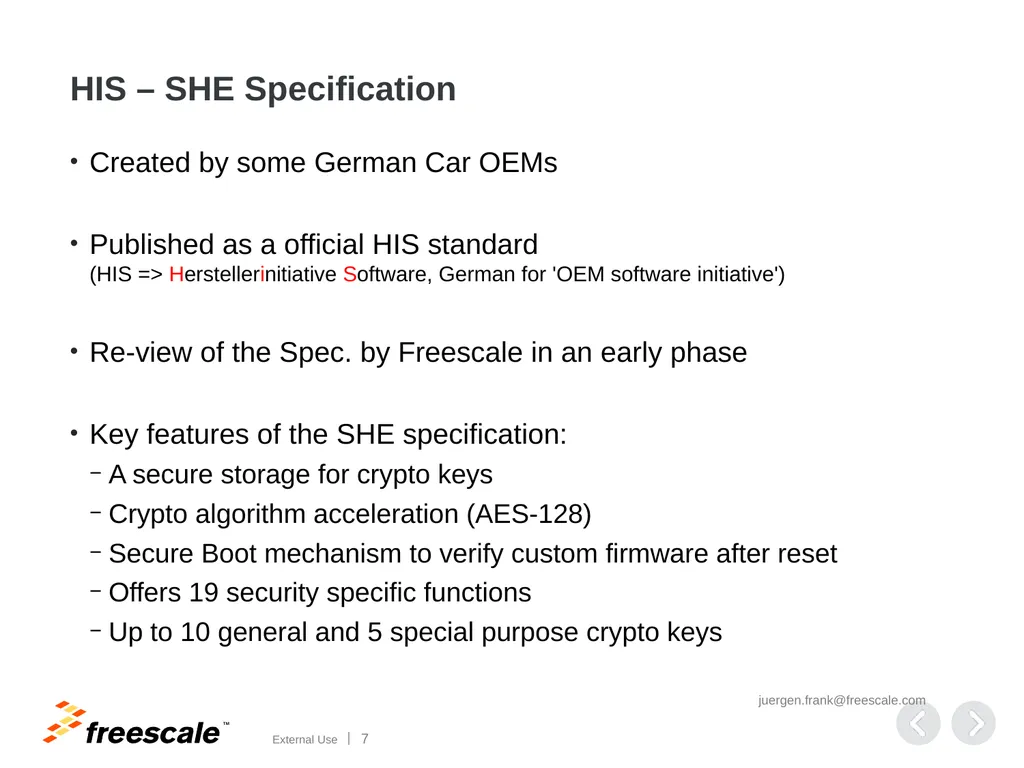
HIS – SHE Specification Created by some German Car OEMs
Published as a official HIS standard�(HIS => Herstellerinitiative Software, German for 'OEM software initiative')
Re-view of the Spec. by Freescale in an early phase
Key features of the SHE specification:
A secure storage for crypto keys
Crypto algorithm acceleration (AES-128)
Secure Boot mechanism to verify custom firmware after reset
Offers 19 security specific functions
Up to 10 general and 5 special purpose crypto keys juergen.frank@freescale.com<br>
08
Evita a project co-funded by the European Union�http://www.evita-project.org The objective of EVITA is to design, verify, and prototype an architecture for automotive on-board networks where security-relevant components are protected against tampering and sensitive data are protected against compromise. High-Level ECC-256
NIST FIPS GF(p) AES based HASH Medium-Level Internal Core
50-250 MHz Sec. Counter Low-Level AES-128 UTC Clock AES-PRNG EVITA HW-IF Internal RAM
64 KBytes Internal NVM
32+10 KBytes EVITA Security Modules Comment:
No OEM request EVITA modules OEMs reference to SHE or HSM
Is not a specification, it’s a guidance
Already outdated on some aspects<br>
09
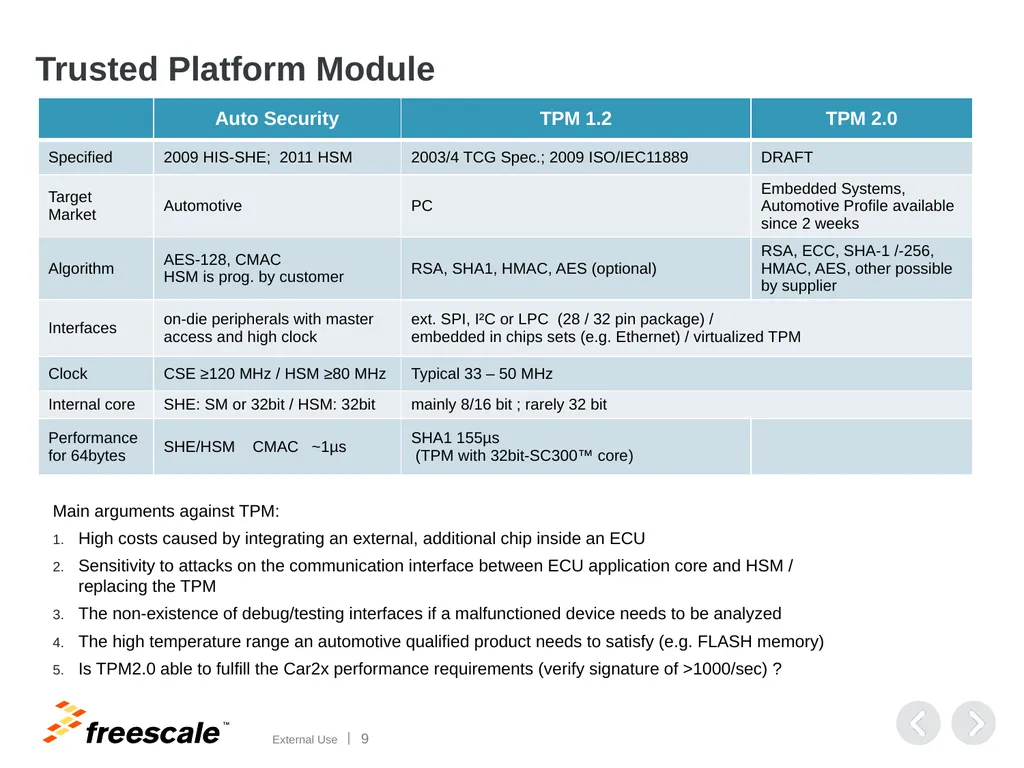
Trusted Platform Module Main arguments against TPM:
High costs caused by integrating an external, additional chip inside an ECU
Sensitivity to attacks on the communication interface between ECU application core and HSM / �replacing the TPM
The non-existence of debug/testing interfaces if a malfunctioned device needs to be analyzed
The high temperature range an automotive qualified product needs to satisfy (e.g. FLASH memory)
Is TPM2.0 able to fulfill the Car2x performance requirements (verify signature of >1000/sec) ?<br>
10
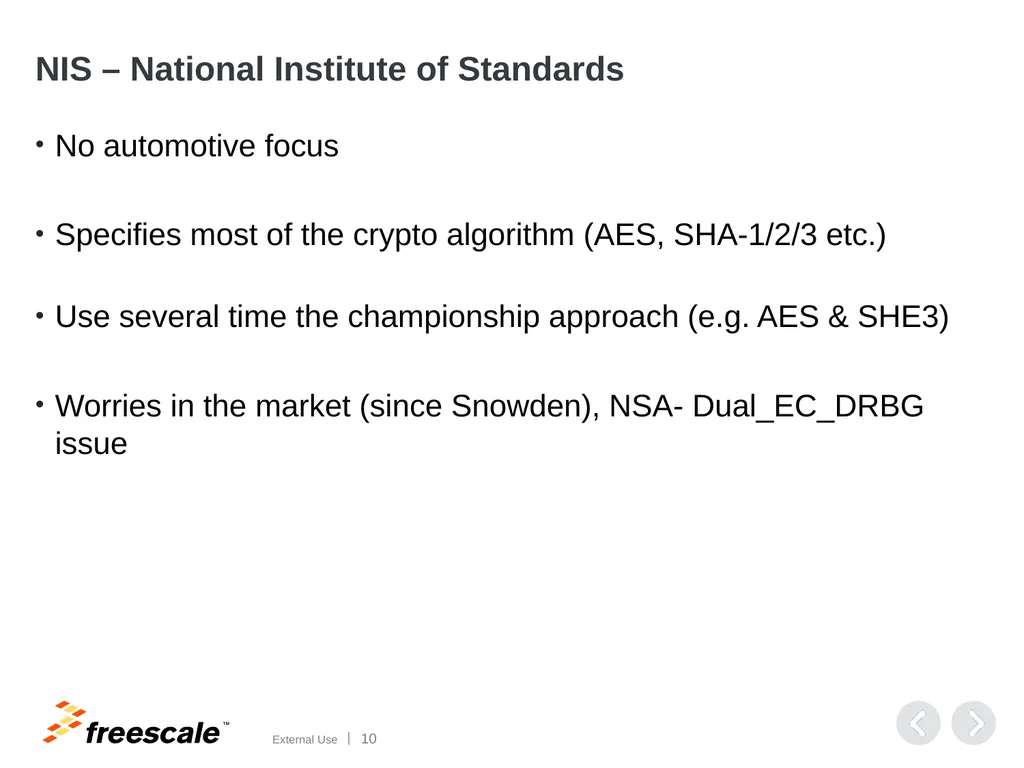
NIS – National Institute of Standards No automotive focus
Specifies most of the crypto algorithm (AES, SHA-1/2/3 etc.)�
Use several time the championship approach (e.g. AES & SHE3)
Worries in the market (since Snowden), NSA- Dual_EC_DRBG issue<br>
11
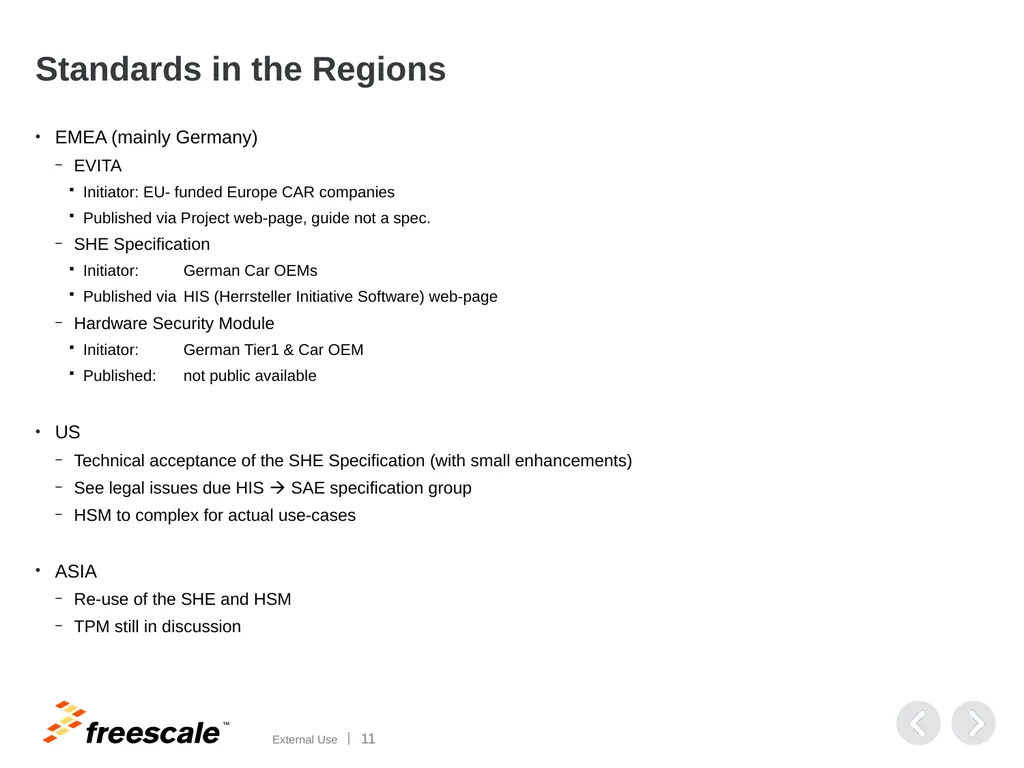
Standards in the Regions EMEA (mainly Germany)
EVITA
Initiator: EU- funded Europe CAR companies
Published via Project web-page, guide not a spec.
SHE Specification
Initiator: German Car OEMs
Published via HIS (Herrsteller Initiative Software) web-page
Hardware Security Module
Initiator: German Tier1 & Car OEM
Published: not public available
US
Technical acceptance of the SHE Specification (with small enhancements)
See legal issues due HIS SAE specification group
HSM to complex for actual use-cases
ASIA
Re-use of the SHE and HSM
TPM still in discussion<br>
13
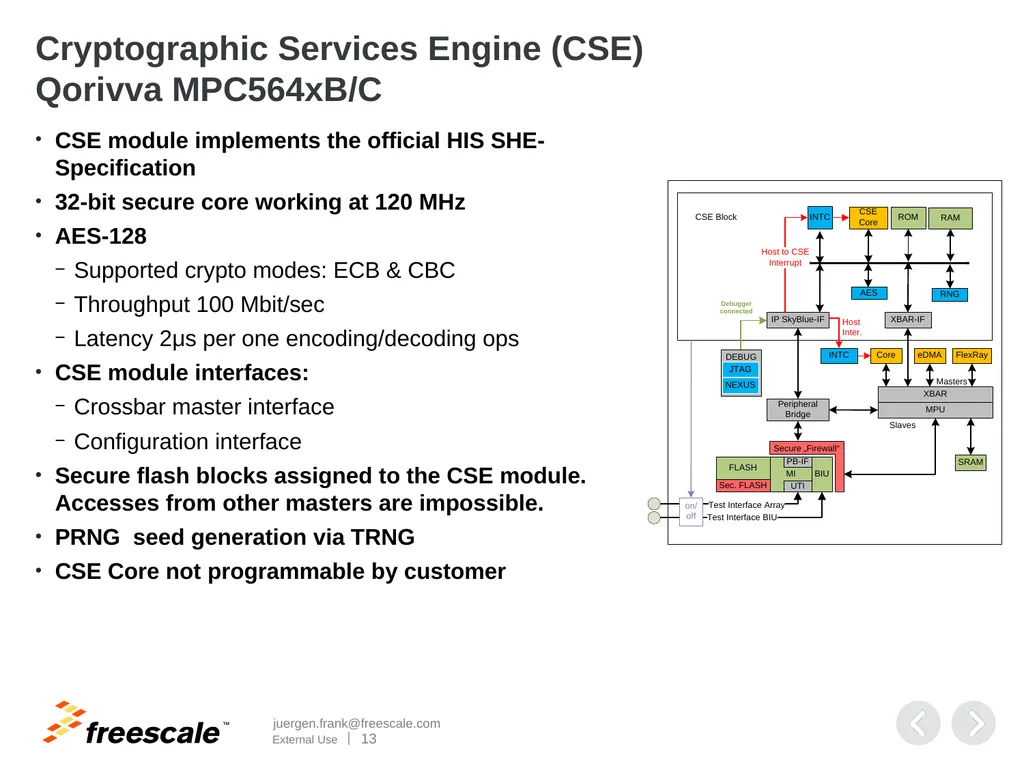
Cryptographic Services Engine (CSE)�Qorivva MPC564xB/C CSE module implements the official HIS SHE-Specification
32-bit secure core working at 120 MHz
AES-128
Supported crypto modes: ECB & CBC
Throughput 100 Mbit/sec
Latency 2μs per one encoding/decoding ops
CSE module interfaces:
Crossbar master interface
Configuration interface
Secure flash blocks assigned to the CSE module. Accesses from other masters are impossible.
PRNG seed generation via TRNG
CSE Core not programmable by customer juergen.frank@freescale.com<br>
14
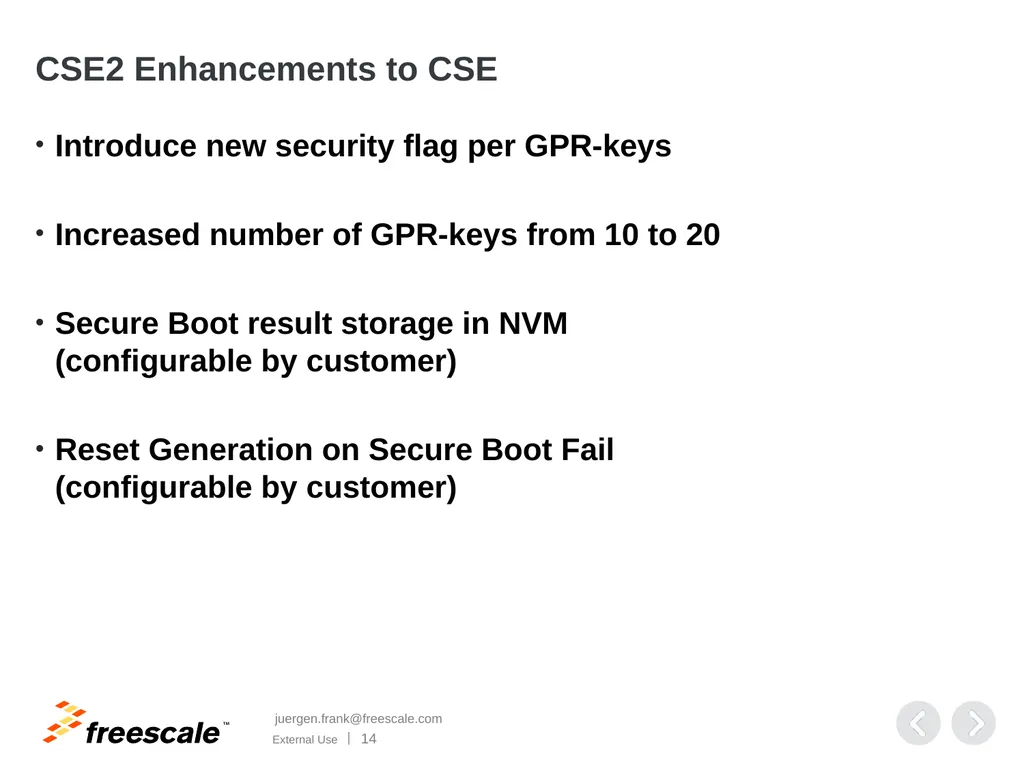
CSE2 Enhancements to CSE Introduce new security flag per GPR-keys
Increased number of GPR-keys from 10 to 20
Secure Boot result storage in NVM�(configurable by customer)
Reset Generation on Secure Boot Fail �(configurable by customer) juergen.frank@freescale.com<br>
15
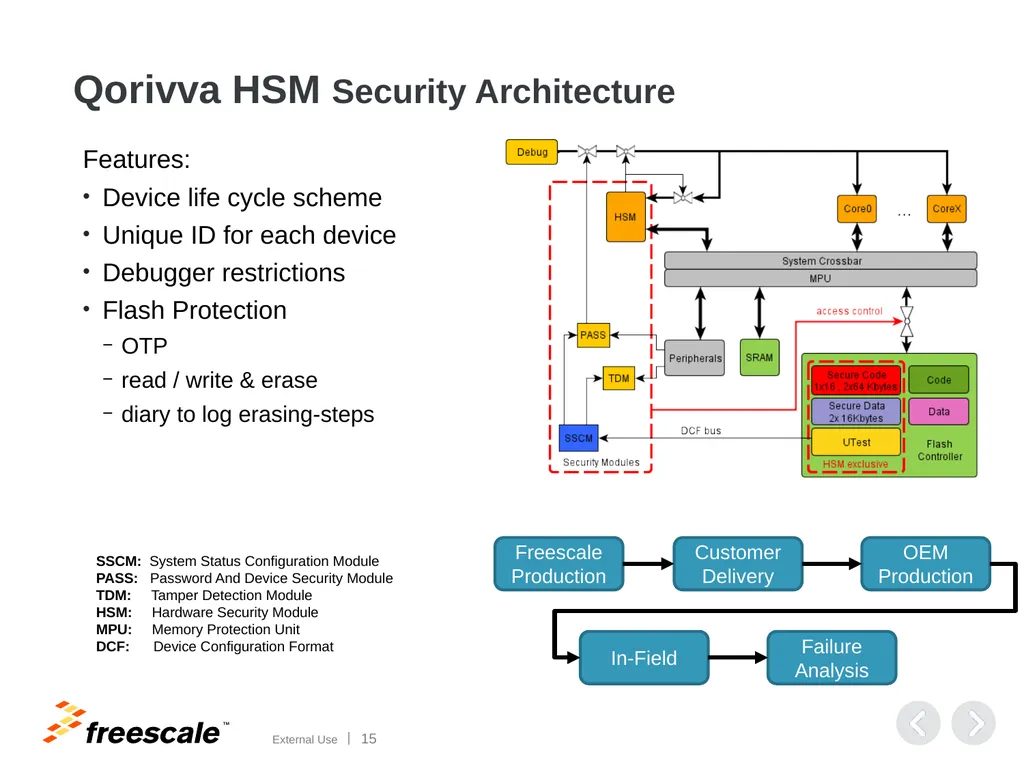
SSCM: System Status Configuration Module
PASS: Password And Device Security Module
TDM: Tamper Detection Module
HSM: Hardware Security Module
MPU: Memory Protection Unit
DCF: Device Configuration Format Qorivva HSM Security Architecture Features:
Device life cycle scheme
Unique ID for each device
Debugger restrictions
Flash Protection
OTP
read / write & erase
diary to log erasing-steps Freescale Production Customer Delivery OEM Production In-Field Failure Analysis<br>
16
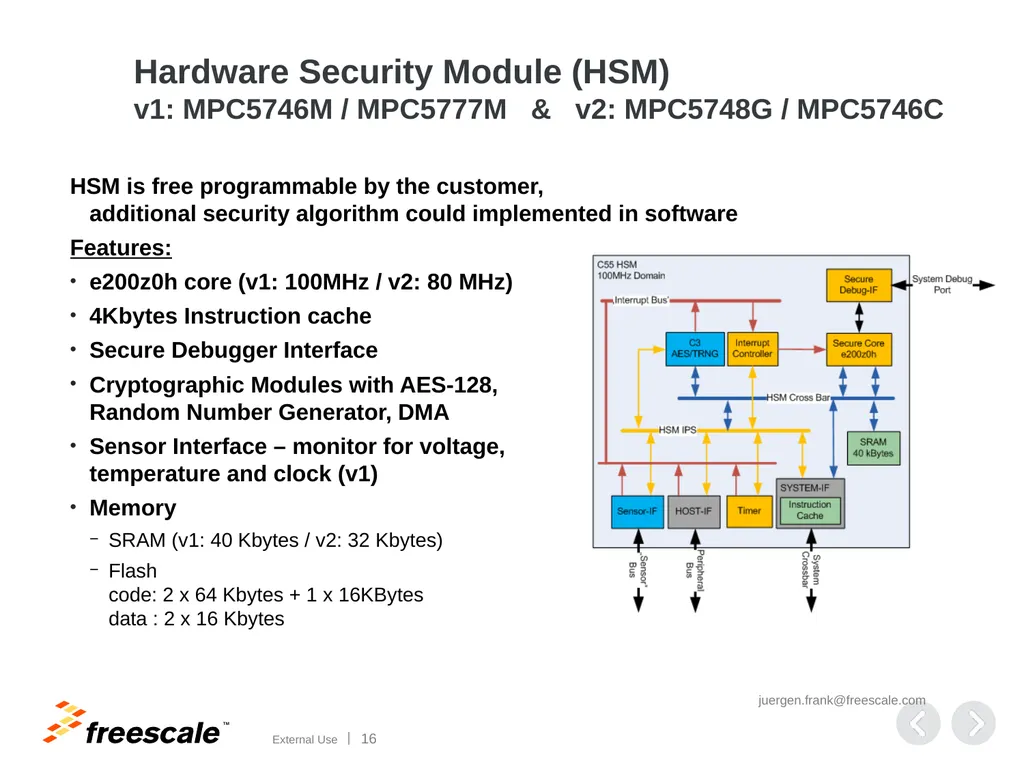
Hardware Security Module (HSM)�v1: MPC5746M / MPC5777M & v2: MPC5748G / MPC5746C HSM is free programmable by the customer, �additional security algorithm could implemented in software
Features:
e200z0h core (v1: 100MHz / v2: 80 MHz)
4Kbytes Instruction cache
Secure Debugger Interface
Cryptographic Modules with AES-128, �Random Number Generator, DMA
Sensor Interface – monitor for voltage,�temperature and clock (v1)
Memory
SRAM (v1: 40 Kbytes / v2: 32 Kbytes)
Flash �code: 2 x 64 Kbytes + 1 x 16KBytes�data : 2 x 16 Kbytes juergen.frank@freescale.com<br>
17
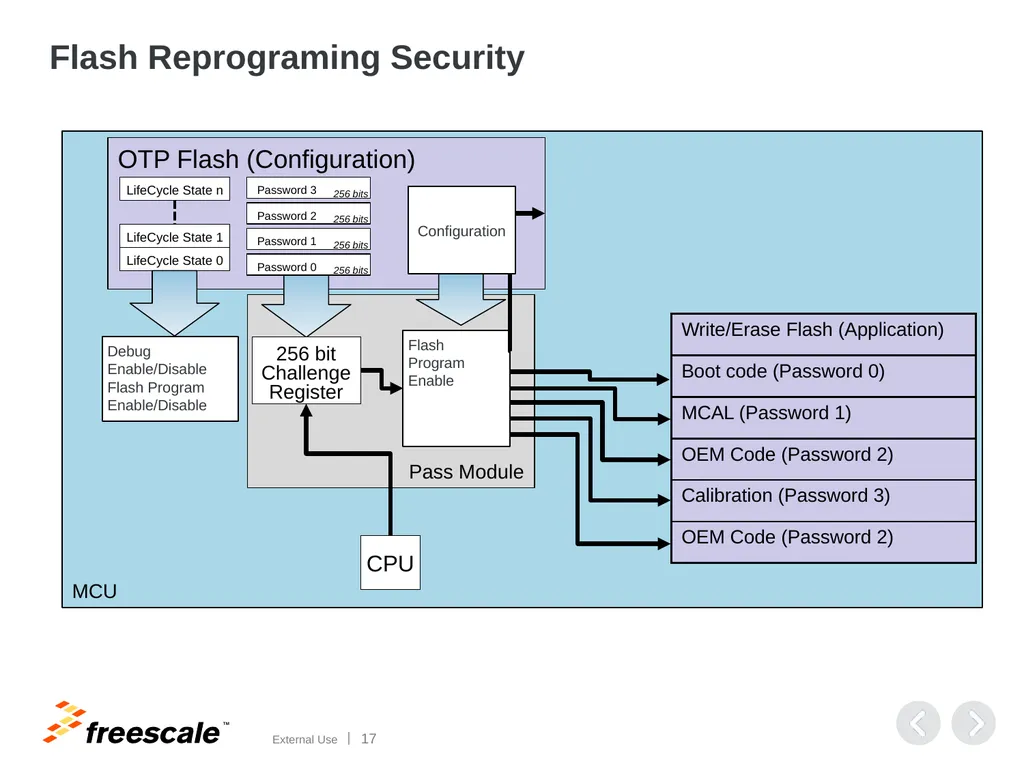
MCU Flash Reprograming Security OTP Flash (Configuration) Pass Module Password 1 256 bits Password 2 256 bits Password 3 256 bits Password 0 256 bits 256 bit Challenge Register CPU LifeCycle State n LifeCycle State 0 LifeCycle State 1 Flash Program Enable Configuration Debug Enable/Disable
Flash Program Enable/Disable<br>
18
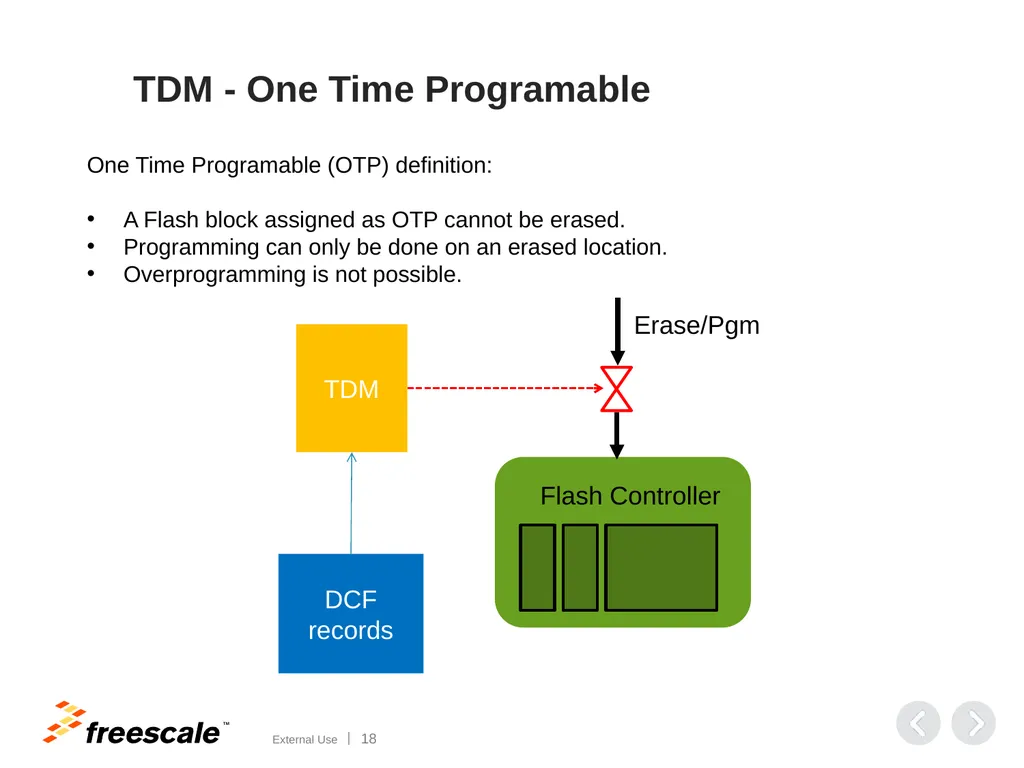
One Time Programable (OTP) definition:
A Flash block assigned as OTP cannot be erased.
Programming can only be done on an erased location.
Overprogramming is not possible. DCF records TDM Flash Controller Erase/Pgm TDM - One Time Programable<br>
19
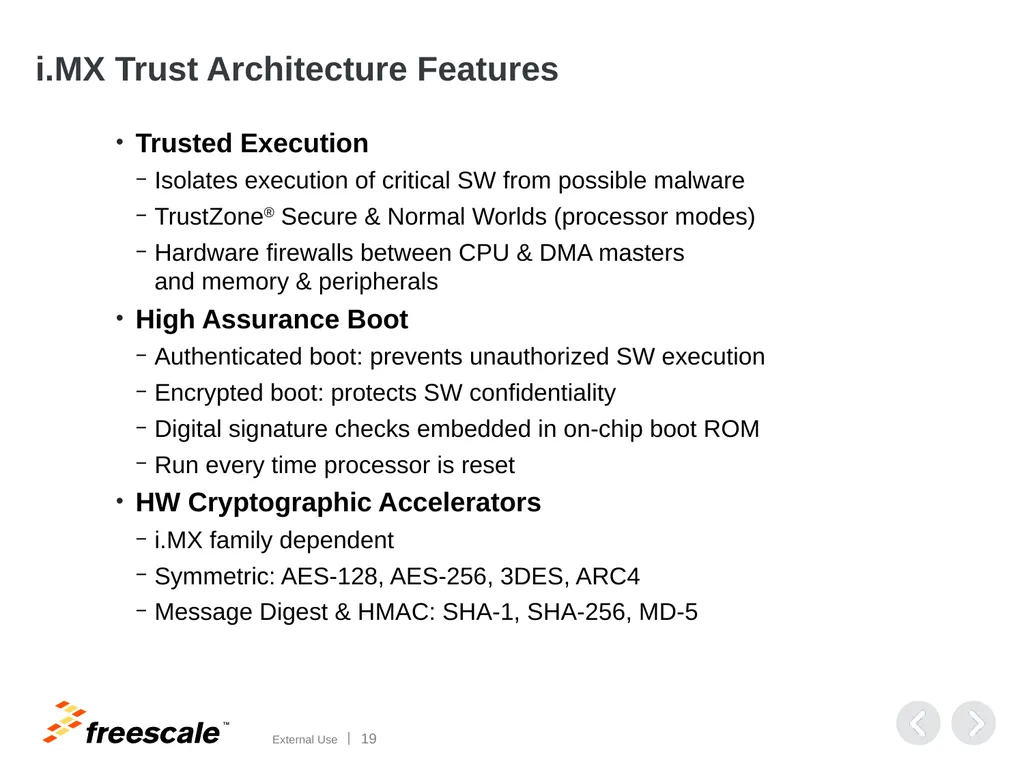
i.MX Trust Architecture Features Trusted Execution
Isolates execution of critical SW from possible malware
TrustZone® Secure & Normal Worlds (processor modes)
Hardware firewalls between CPU & DMA masters�and memory & peripherals
High Assurance Boot
Authenticated boot: prevents unauthorized SW execution
Encrypted boot: protects SW confidentiality
Digital signature checks embedded in on-chip boot ROM
Run every time processor is reset
HW Cryptographic Accelerators
i.MX family dependent
Symmetric: AES-128, AES-256, 3DES, ARC4
Message Digest & HMAC: SHA-1, SHA-256, MD-5<br>
20
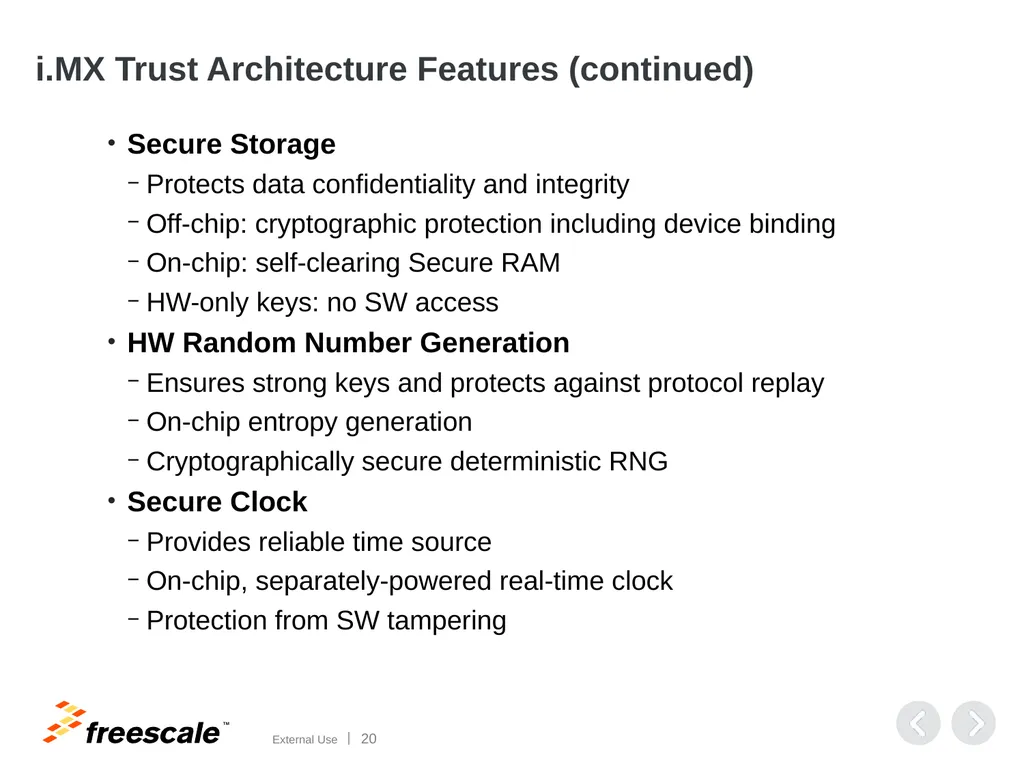
i.MX Trust Architecture Features (continued) Secure Storage
Protects data confidentiality and integrity
Off-chip: cryptographic protection including device binding
On-chip: self-clearing Secure RAM
HW-only keys: no SW access
HW Random Number Generation
Ensures strong keys and protects against protocol replay
On-chip entropy generation
Cryptographically secure deterministic RNG
Secure Clock
Provides reliable time source
On-chip, separately-powered real-time clock
Protection from SW tampering<br>
21
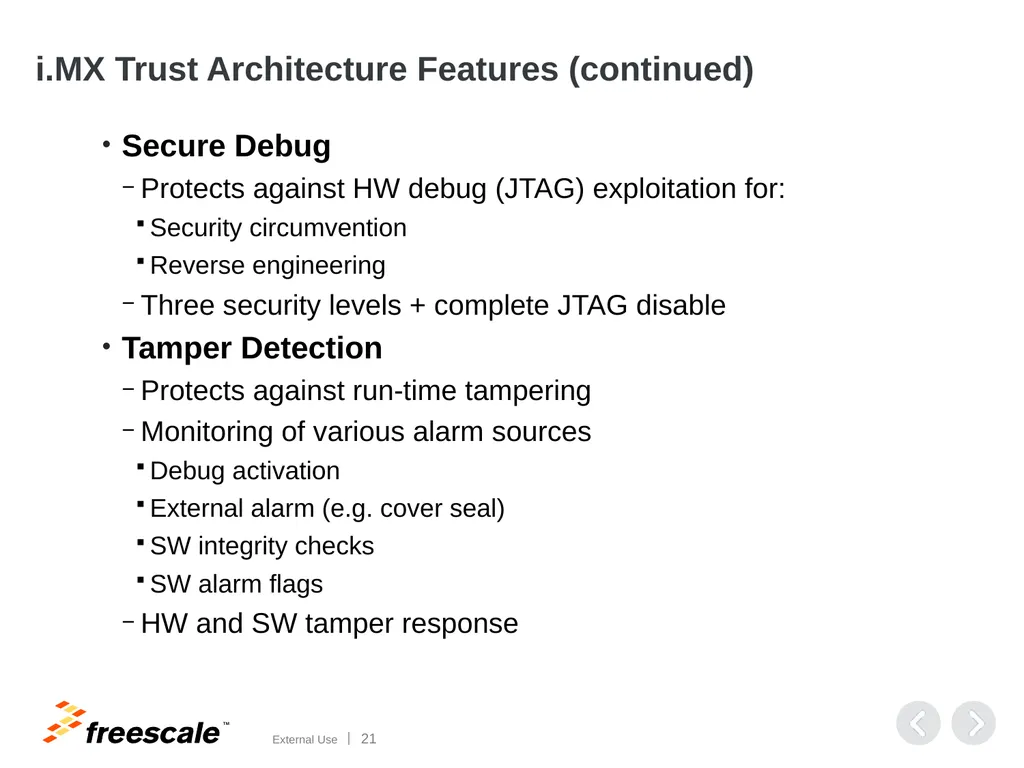
i.MX Trust Architecture Features (continued) Secure Debug
Protects against HW debug (JTAG) exploitation for:
Security circumvention
Reverse engineering
Three security levels + complete JTAG disable
Tamper Detection
Protects against run-time tampering
Monitoring of various alarm sources
Debug activation
External alarm (e.g. cover seal)
SW integrity checks
SW alarm flags
HW and SW tamper response<br>
22
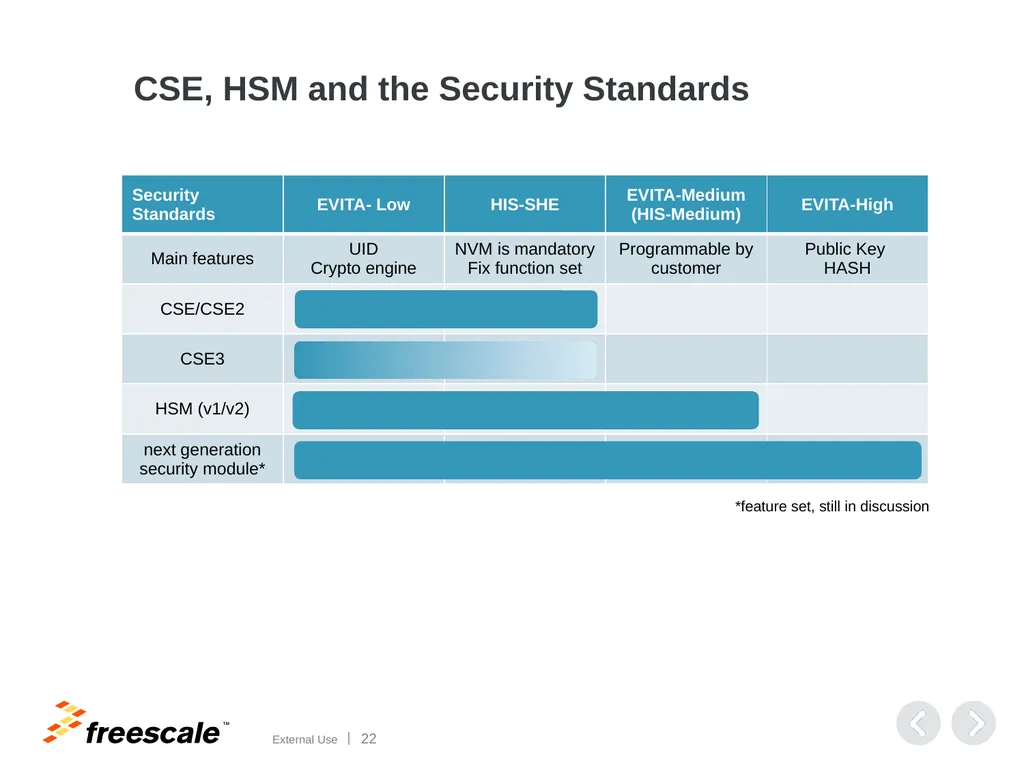
CSE, HSM and the Security Standards *feature set, still in discussion<br>
23
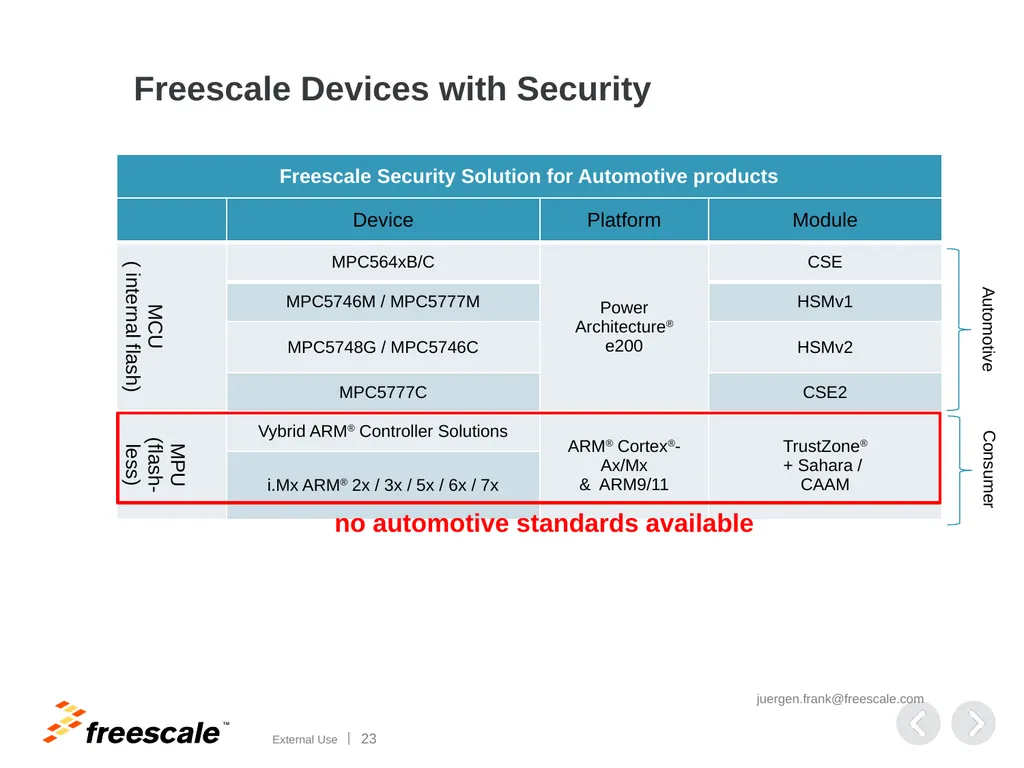
Freescale Devices with Security Automotive Consumer juergen.frank@freescale.com no automotive standards available<br>
24
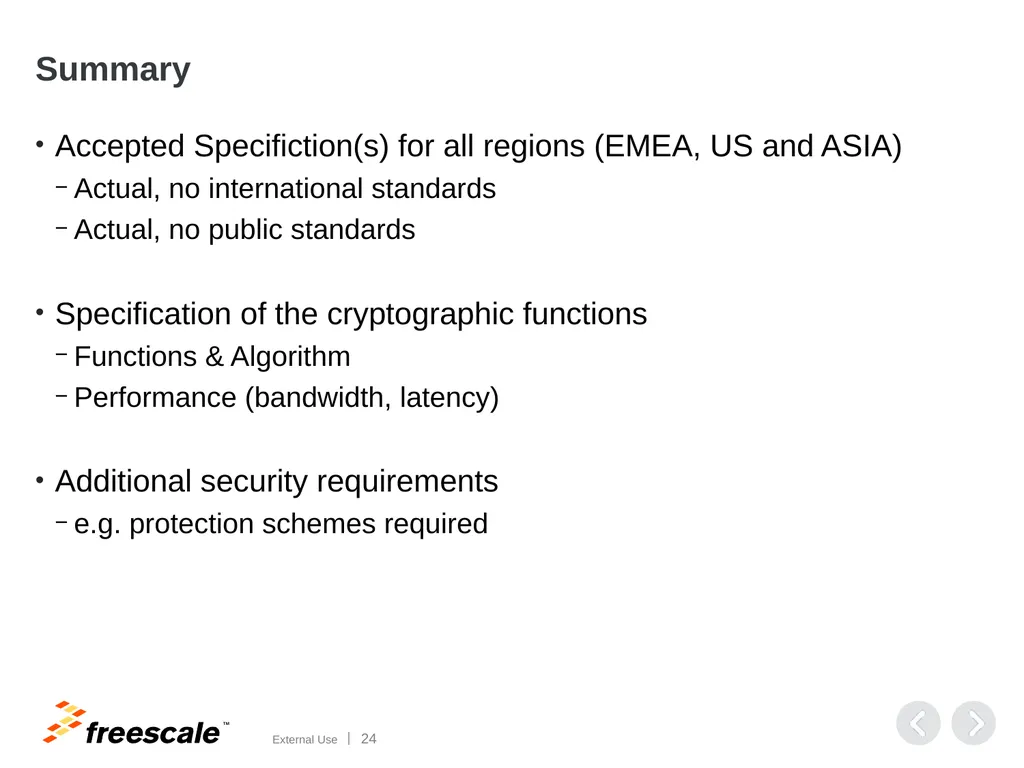
Summary Accepted Specifiction(s) for all regions (EMEA, US and ASIA)
Actual, no international standards
Actual, no public standards
Specification of the cryptographic functions
Functions & Algorithm
Performance (bandwidth, latency)
Additional security requirements
e.g. protection schemes required<br>