
Awarding TAGs at TCC A guide for students and
KB
Published · 44 slides · 0 views

1 / 1


Description
Awarding TAGs at TCC A guide for students and parents 1 2 The process of awarding grades as stipulated by JCQ: subject teams consider what has been taught and what evidence they will ask students to produce in order to support the awarding
Related Topics
Share
Embed code
Download this presentation From Below
"Awarding TAGs at TCC A guide for students and" is the property of its rightful owner. Permission is granted to download and print the materials on this website for personal, non-commercial use only, and to display it on your personal computer provided you do not modify the materials and that you retain all copyright notices contained in the materials. By downloading content from our website, you accept the terms of this agreement.
Presentation Transcript
01
Awarding TAGs at TCC
A guide for students and parents 1<br>
A guide for students and parents 1<br>
02
2 The process of awarding grades as stipulated by JCQ:
subject teams consider what has been taught and what evidence they will ask students to produce in order to support the awarding of a grade;
Subject teams create an assessment record – a list of the pieces of evidence students will produce (or have produced) that will be the basis for deciding upon a TAG (assessment records for every subject are included later in this booklet);
Students complete the work and teachers mark it. Students are told the mark they receive;
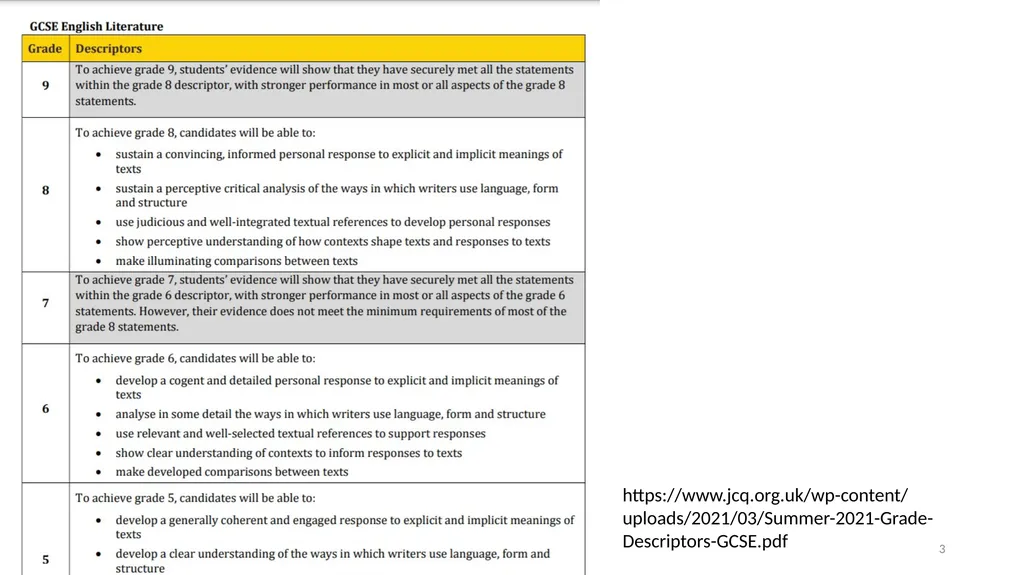
Once all of the pieces of work have been completed, teachers compare them to a list of grade descriptors in order to arrive at a ‘holistic’ judgement about which grade to award.
This grade is released to students in August (10th August A level 12th August GCSE). Teachers cannot share any information about your grade until this date.<br>
subject teams consider what has been taught and what evidence they will ask students to produce in order to support the awarding of a grade;
Subject teams create an assessment record – a list of the pieces of evidence students will produce (or have produced) that will be the basis for deciding upon a TAG (assessment records for every subject are included later in this booklet);
Students complete the work and teachers mark it. Students are told the mark they receive;
Once all of the pieces of work have been completed, teachers compare them to a list of grade descriptors in order to arrive at a ‘holistic’ judgement about which grade to award.
This grade is released to students in August (10th August A level 12th August GCSE). Teachers cannot share any information about your grade until this date.<br>
03
3 https://www.jcq.org.uk/wp-content/uploads/2021/03/Summer-2021-Grade-Descriptors-GCSE.pdf<br>
04
4 Important points
The evidence used should be consistent across the cohort – this means that you all produce the same pieces of work for us to make a judgement. Where there is a valid reason that you have not completed a piece of work, we can ask you to complete a comparable alternative to ensure that you have as much evidence as possible;
All evidence in the assessment record will be used to judge your grade, but work completed in controlled conditions will enable greater confidence that it is authentically your own;
We cannot use any other evidence – the assessment record created by subject teams is “not negotiable”;
For tiered GCSEs, your grade will reflect you tier of entry;
Your teachers have to keep all of your work;
We cannot consider your potential ability – we can only make grading decisions based on the evidence you produce<br>
The evidence used should be consistent across the cohort – this means that you all produce the same pieces of work for us to make a judgement. Where there is a valid reason that you have not completed a piece of work, we can ask you to complete a comparable alternative to ensure that you have as much evidence as possible;
All evidence in the assessment record will be used to judge your grade, but work completed in controlled conditions will enable greater confidence that it is authentically your own;
We cannot use any other evidence – the assessment record created by subject teams is “not negotiable”;
For tiered GCSEs, your grade will reflect you tier of entry;
Your teachers have to keep all of your work;
We cannot consider your potential ability – we can only make grading decisions based on the evidence you produce<br>
05
5 Absent students
After College weekly catch up sessions
You will be invited to stay after College for up to an hour if you miss work that your teacher will use as evidence to determine your TAG
Your parents will receive a letter from the College to let them know when
“the same range of evidence should be used for all students, although there may be individual students for whom the proposed evidence is not appropriate… some students may have missed a section of teaching due to valid reasons”
In which case teachers can: “use alternative evidence to replace assessments”<br>
After College weekly catch up sessions
You will be invited to stay after College for up to an hour if you miss work that your teacher will use as evidence to determine your TAG
Your parents will receive a letter from the College to let them know when
“the same range of evidence should be used for all students, although there may be individual students for whom the proposed evidence is not appropriate… some students may have missed a section of teaching due to valid reasons”
In which case teachers can: “use alternative evidence to replace assessments”<br>
06
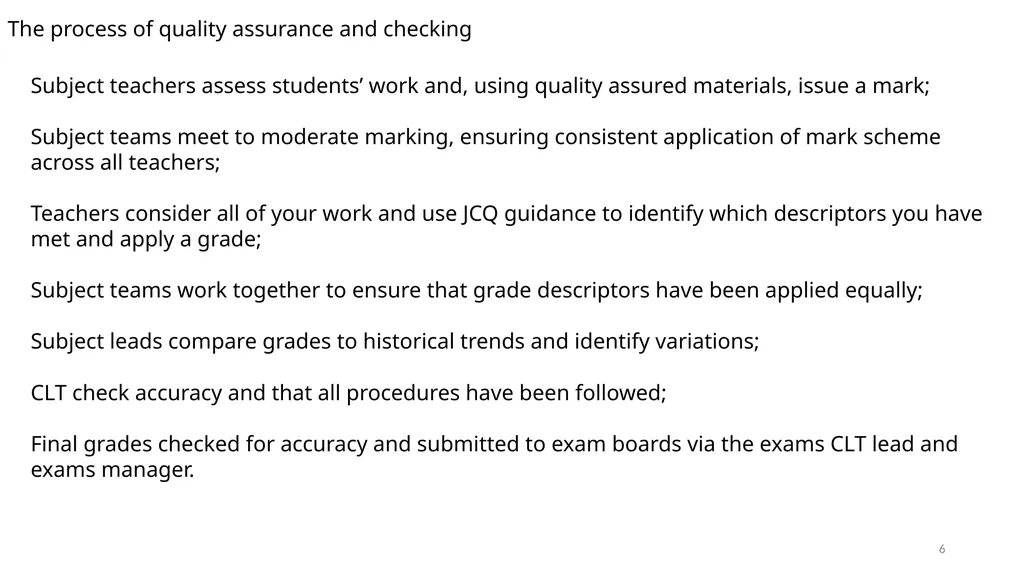
Subject teachers assess students’ work and, using quality assured materials, issue a mark;
Subject teams meet to moderate marking, ensuring consistent application of mark scheme across all teachers;
Teachers consider all of your work and use JCQ guidance to identify which descriptors you have met and apply a grade;
Subject teams work together to ensure that grade descriptors have been applied equally;
Subject leads compare grades to historical trends and identify variations;
CLT check accuracy and that all procedures have been followed;
Final grades checked for accuracy and submitted to exam boards via the exams CLT lead and exams manager. 6 The process of quality assurance and checking<br>
Subject teams meet to moderate marking, ensuring consistent application of mark scheme across all teachers;
Teachers consider all of your work and use JCQ guidance to identify which descriptors you have met and apply a grade;
Subject teams work together to ensure that grade descriptors have been applied equally;
Subject leads compare grades to historical trends and identify variations;
CLT check accuracy and that all procedures have been followed;
Final grades checked for accuracy and submitted to exam boards via the exams CLT lead and exams manager. 6 The process of quality assurance and checking<br>
07
7 Here is a link to JCQ guidance:
https://www.jcq.org.uk/wp-content/uploads/2021/03/JCQ-Guidance-for-Students-and-Parents-on-Summer-2021.pdf
Your teachers cannot share any information with you about the grades awarded until they are formally released in August<br>
https://www.jcq.org.uk/wp-content/uploads/2021/03/JCQ-Guidance-for-Students-and-Parents-on-Summer-2021.pdf
Your teachers cannot share any information with you about the grades awarded until they are formally released in August<br>
08
8 Please note:
The guidance states that:
“It is possible that some students may attempt to influence their teachers’ judgements about
their grades” to try and gain “an unfair advantage.”
This includes:
Submitting plagarised work
Putting pressure on staff to award a certain grade
If this happens, we must record the details and possibly report it to the exam board.<br>
The guidance states that:
“It is possible that some students may attempt to influence their teachers’ judgements about
their grades” to try and gain “an unfair advantage.”
This includes:
Submitting plagarised work
Putting pressure on staff to award a certain grade
If this happens, we must record the details and possibly report it to the exam board.<br>
09
9 Plagiarism - taking someone else's work or ideas and passing them off as your own.
Examples of plagiarism:
Copying someone else’s work without citing where it came from and recognising it as their work
Copying from several writers and rearranging their words without stating where these words come from
Borrowing someone else’s work and submitting it as your own – even if they give you permission
Taking something written by someone else and adding in some of your own words
Asking someone else to write your work for you
Quoting from someone else’s work but not showing that in quotation marks<br>
Examples of plagiarism:
Copying someone else’s work without citing where it came from and recognising it as their work
Copying from several writers and rearranging their words without stating where these words come from
Borrowing someone else’s work and submitting it as your own – even if they give you permission
Taking something written by someone else and adding in some of your own words
Asking someone else to write your work for you
Quoting from someone else’s work but not showing that in quotation marks<br>
10
10 It is important to ensure that you only submit work that is wholly your own.
It is absolutely fine to ask your teachers questions about the process, but you cannot ask them what grade they intend to award you or ask them to award a certain grade.
They have to look at the evidence you produce and make an objective judgement about which grade descriptors it matches.<br>
It is absolutely fine to ask your teachers questions about the process, but you cannot ask them what grade they intend to award you or ask them to award a certain grade.
They have to look at the evidence you produce and make an objective judgement about which grade descriptors it matches.<br>
11
12 “Students must be told what evidence is going to be used, so that they have the opportunity to raise any genuine and valid concerns. It is recommended that any student’s views are recorded and documented along with reasons for the final decision”
If you have any concerns, please email Miss Lockett:
Lockett.c@torpoint.cornwall.sch.uk<br>
If you have any concerns, please email Miss Lockett:
Lockett.c@torpoint.cornwall.sch.uk<br>
12
GCSE subjects
Subject Assessment Records
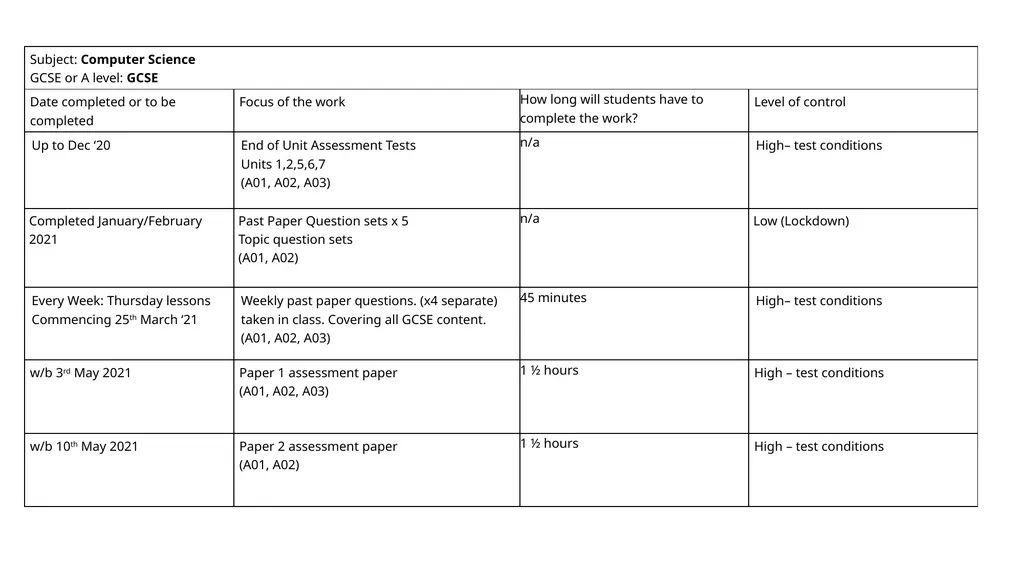
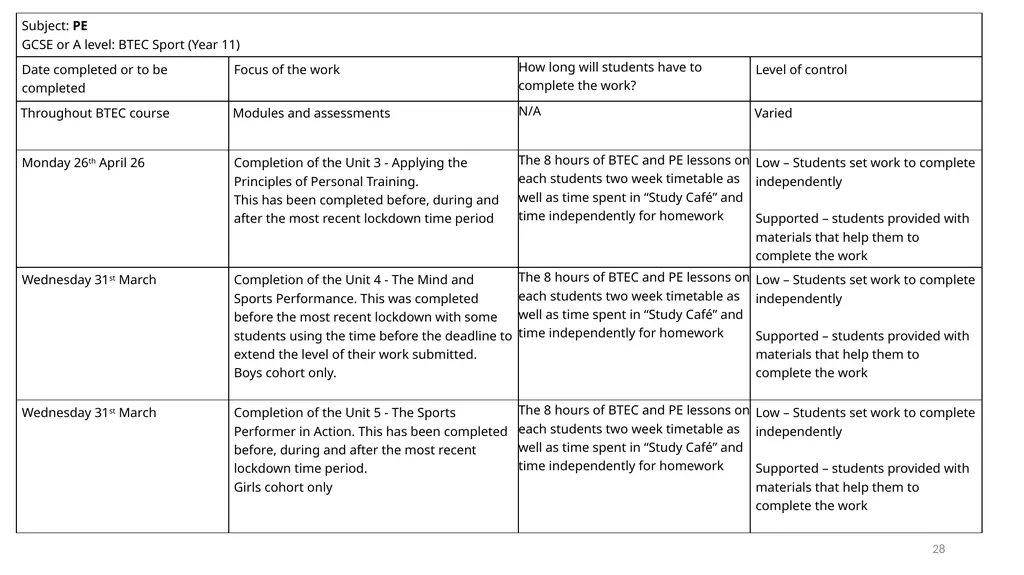
Specific lists of the pieces of work that will be used as evidence for your TAG 13<br>
Subject Assessment Records
Specific lists of the pieces of work that will be used as evidence for your TAG 13<br>
13
14<br>
14
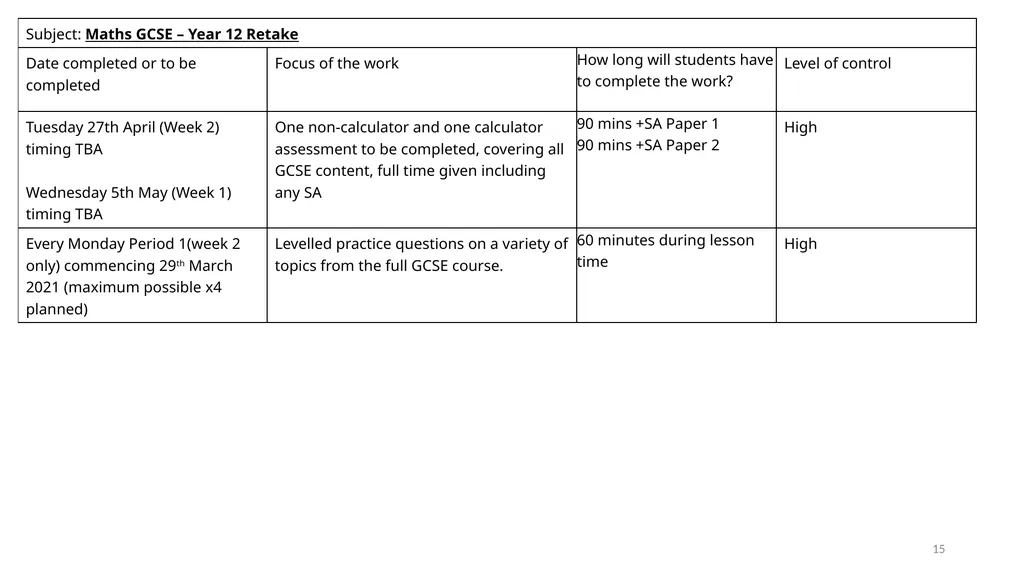
15<br>
15
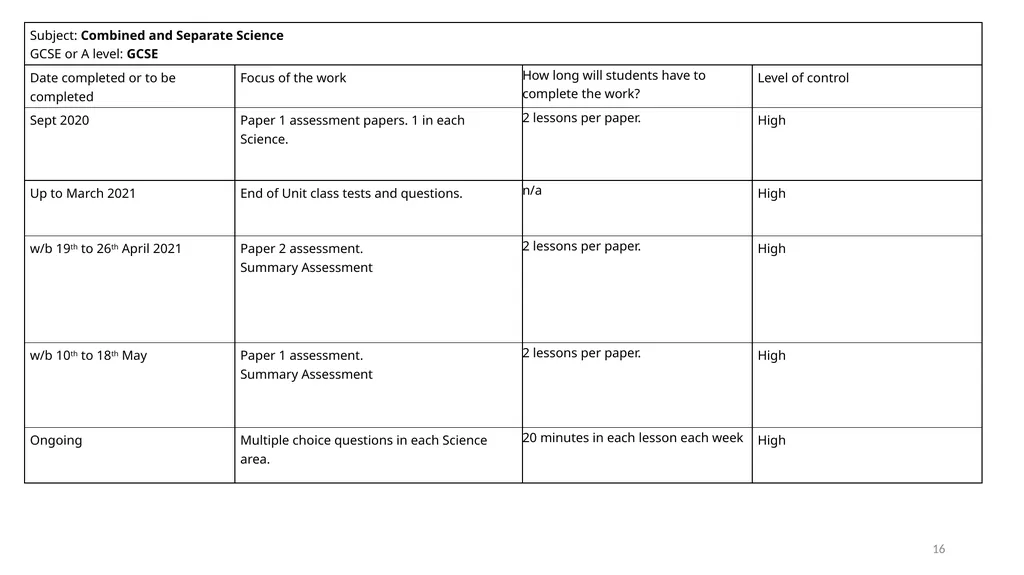
16<br>
16
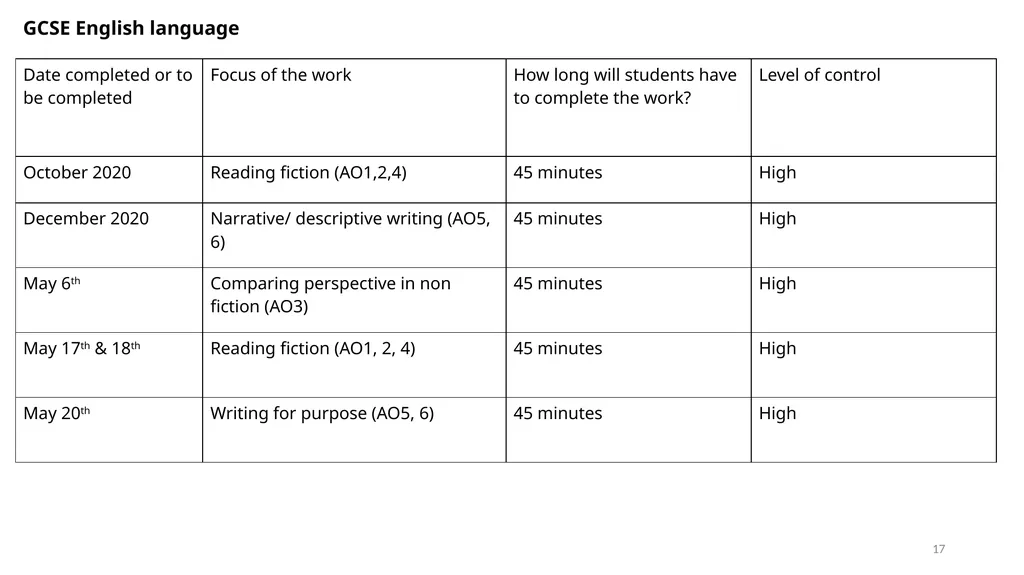
GCSE English language 17<br>
17
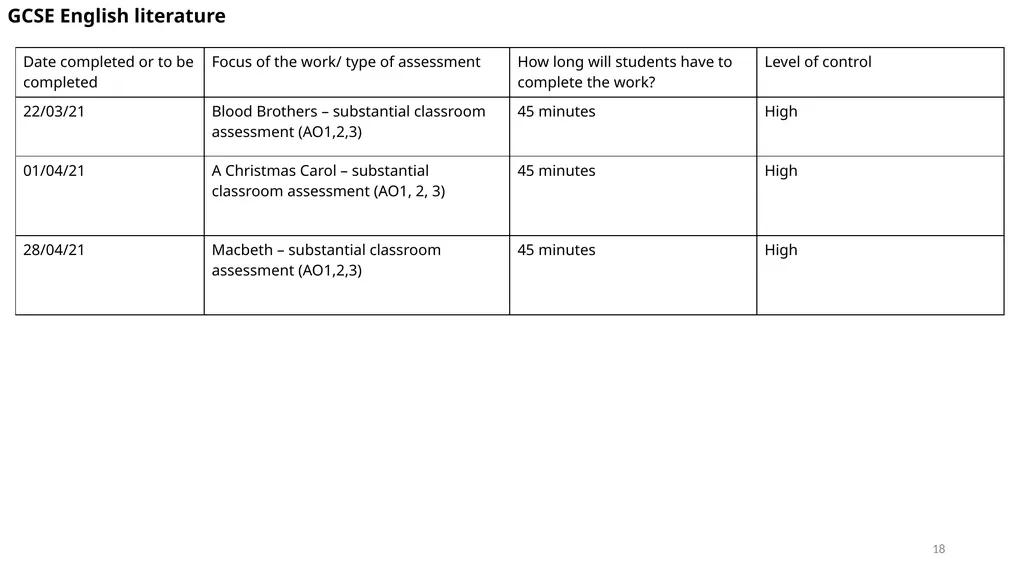
GCSE English literature 18<br>
18
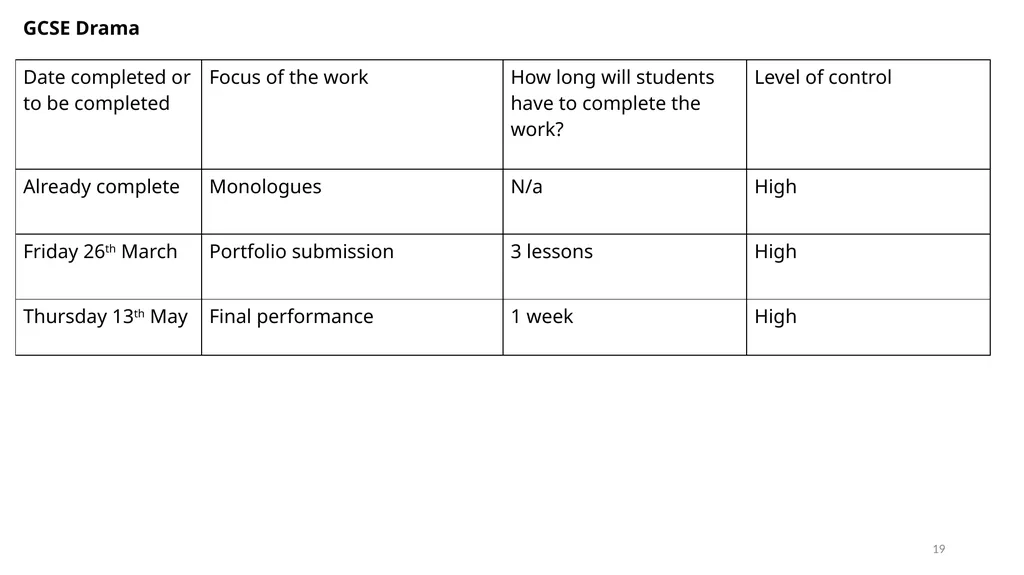
GCSE Drama 19<br>
19
20<br>
20
21<br>
21
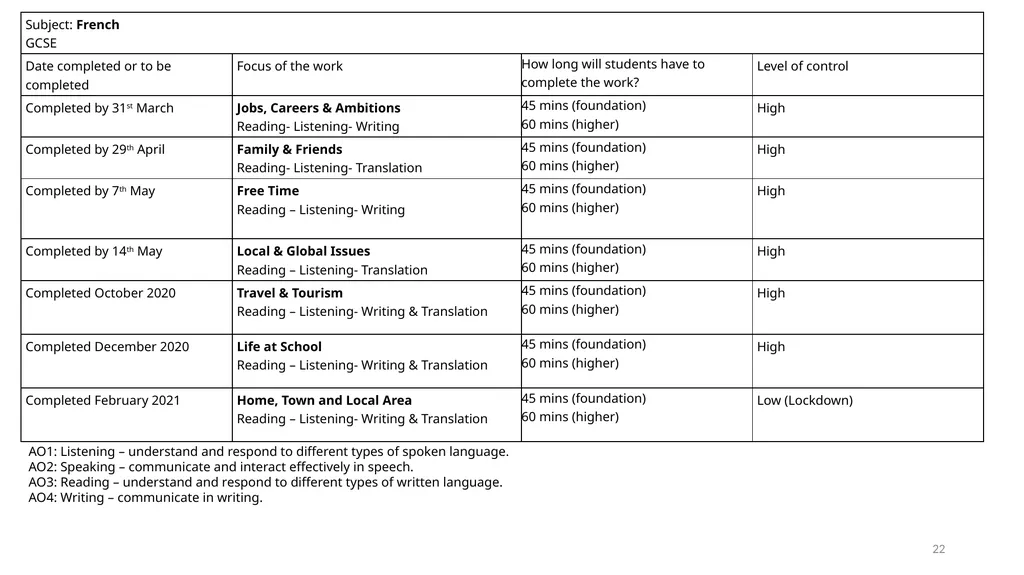
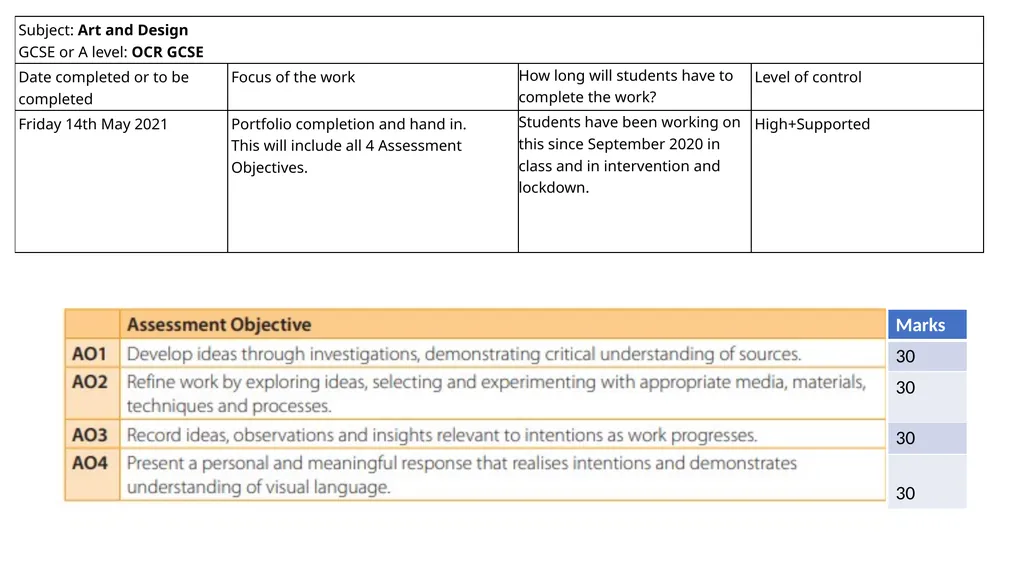
22 AO1: Listening – understand and respond to different types of spoken language.
AO2: Speaking – communicate and interact effectively in speech.
AO3: Reading – understand and respond to different types of written language.
AO4: Writing – communicate in writing.<br>
AO2: Speaking – communicate and interact effectively in speech.
AO3: Reading – understand and respond to different types of written language.
AO4: Writing – communicate in writing.<br>
22
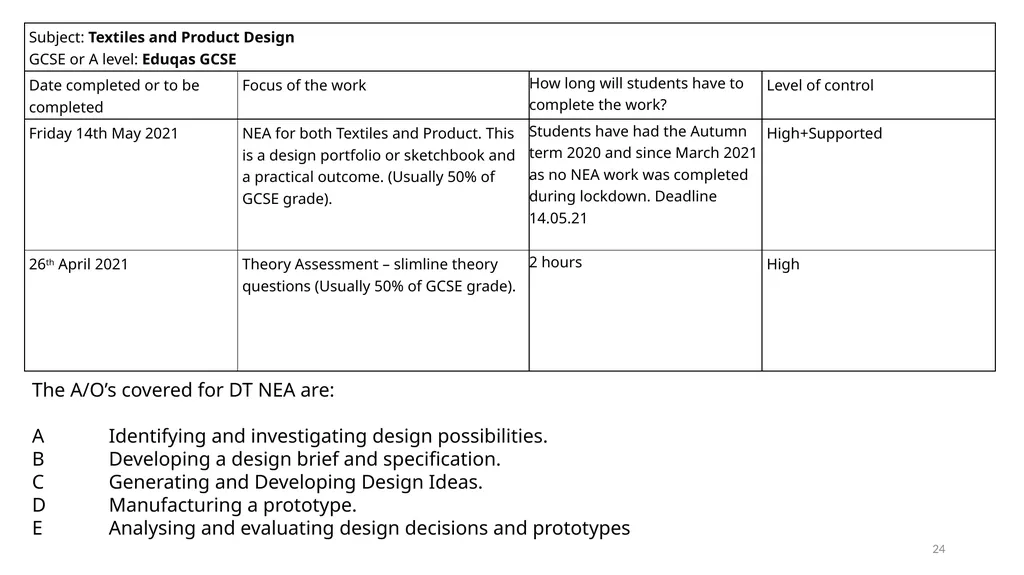
24 The A/O’s covered for DT NEA are:
A Identifying and investigating design possibilities.
B Developing a design brief and specification.
C Generating and Developing Design Ideas.
D Manufacturing a prototype.
E Analysing and evaluating design decisions and prototypes<br>
A Identifying and investigating design possibilities.
B Developing a design brief and specification.
C Generating and Developing Design Ideas.
D Manufacturing a prototype.
E Analysing and evaluating design decisions and prototypes<br>
23
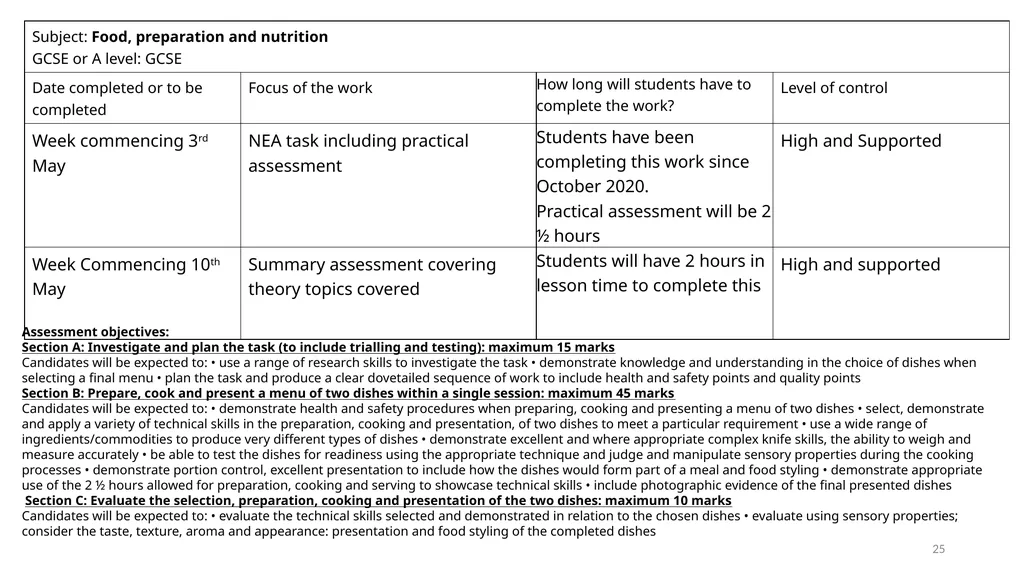
25 Assessment objectives:
Section A: Investigate and plan the task (to include trialling and testing): maximum 15 marks
Candidates will be expected to: • use a range of research skills to investigate the task • demonstrate knowledge and understanding in the choice of dishes when selecting a final menu • plan the task and produce a clear dovetailed sequence of work to include health and safety points and quality points
Section B: Prepare, cook and present a menu of two dishes within a single session: maximum 45 marks
Candidates will be expected to: • demonstrate health and safety procedures when preparing, cooking and presenting a menu of two dishes • select, demonstrate and apply a variety of technical skills in the preparation, cooking and presentation, of two dishes to meet a particular requirement • use a wide range of ingredients/commodities to produce very different types of dishes • demonstrate excellent and where appropriate complex knife skills, the ability to weigh and measure accurately • be able to test the dishes for readiness using the appropriate technique and judge and manipulate sensory properties during the cooking processes • demonstrate portion control, excellent presentation to include how the dishes would form part of a meal and food styling • demonstrate appropriate use of the 2 ½ hours allowed for preparation, cooking and serving to showcase technical skills • include photographic evidence of the final presented dishes
Section C: Evaluate the selection, preparation, cooking and presentation of the two dishes: maximum 10 marks
Candidates will be expected to: • evaluate the technical skills selected and demonstrated in relation to the chosen dishes • evaluate using sensory properties; consider the taste, texture, aroma and appearance: presentation and food styling of the completed dishes<br>
Section A: Investigate and plan the task (to include trialling and testing): maximum 15 marks
Candidates will be expected to: • use a range of research skills to investigate the task • demonstrate knowledge and understanding in the choice of dishes when selecting a final menu • plan the task and produce a clear dovetailed sequence of work to include health and safety points and quality points
Section B: Prepare, cook and present a menu of two dishes within a single session: maximum 45 marks
Candidates will be expected to: • demonstrate health and safety procedures when preparing, cooking and presenting a menu of two dishes • select, demonstrate and apply a variety of technical skills in the preparation, cooking and presentation, of two dishes to meet a particular requirement • use a wide range of ingredients/commodities to produce very different types of dishes • demonstrate excellent and where appropriate complex knife skills, the ability to weigh and measure accurately • be able to test the dishes for readiness using the appropriate technique and judge and manipulate sensory properties during the cooking processes • demonstrate portion control, excellent presentation to include how the dishes would form part of a meal and food styling • demonstrate appropriate use of the 2 ½ hours allowed for preparation, cooking and serving to showcase technical skills • include photographic evidence of the final presented dishes
Section C: Evaluate the selection, preparation, cooking and presentation of the two dishes: maximum 10 marks
Candidates will be expected to: • evaluate the technical skills selected and demonstrated in relation to the chosen dishes • evaluate using sensory properties; consider the taste, texture, aroma and appearance: presentation and food styling of the completed dishes<br>
24
26<br>
25
28<br>
26
A level subjects
Subject Assessment Records
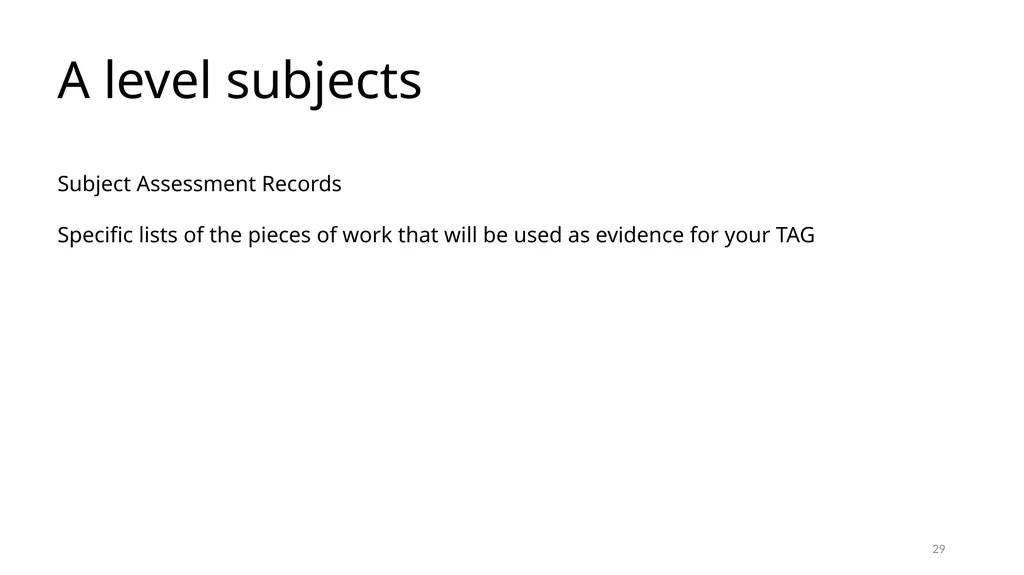
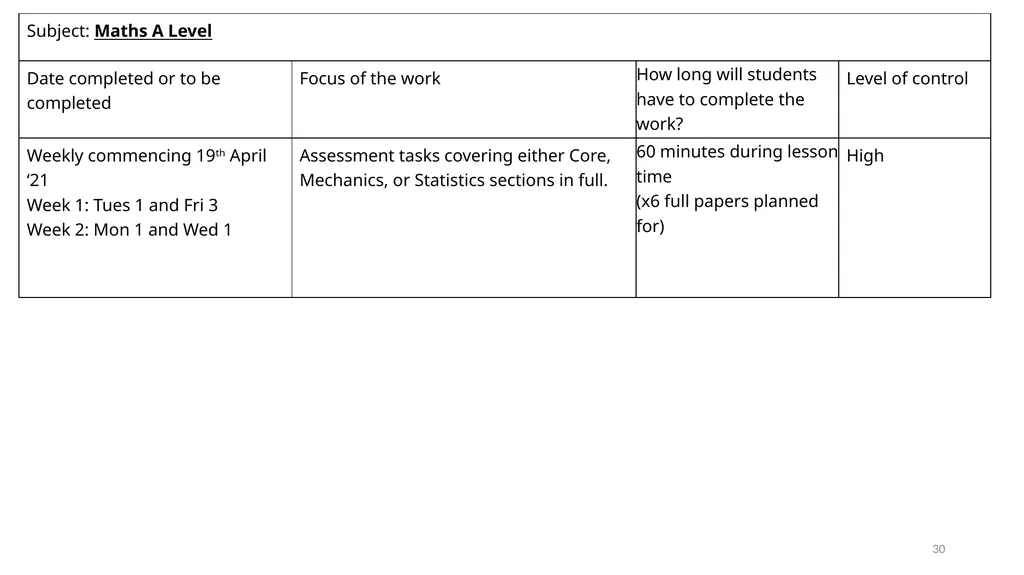
Specific lists of the pieces of work that will be used as evidence for your TAG 29<br>
Subject Assessment Records
Specific lists of the pieces of work that will be used as evidence for your TAG 29<br>
27
30<br>
28
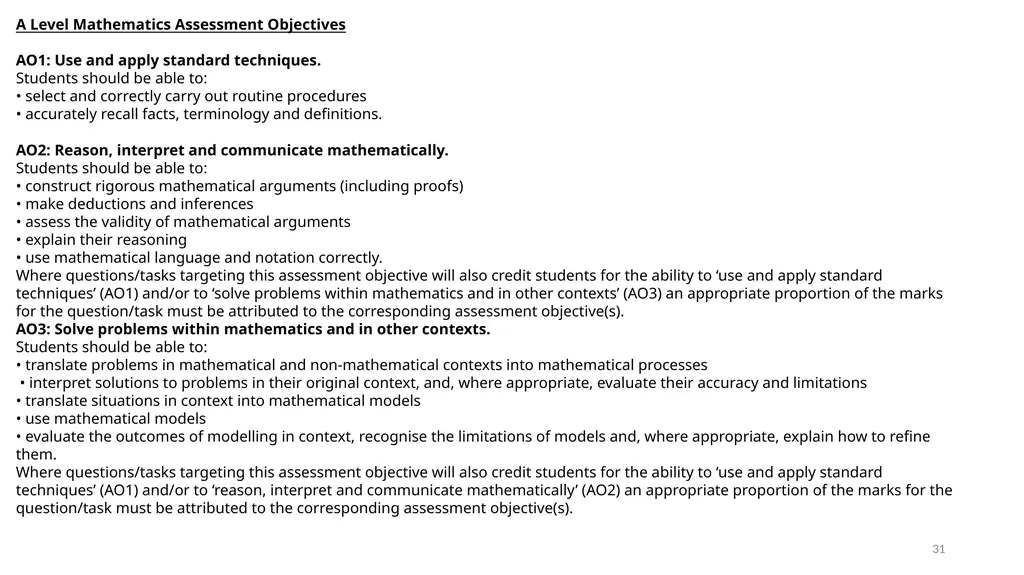
31 A Level Mathematics Assessment Objectives
AO1: Use and apply standard techniques.
Students should be able to:
• select and correctly carry out routine procedures
• accurately recall facts, terminology and definitions.
AO2: Reason, interpret and communicate mathematically.
Students should be able to:
• construct rigorous mathematical arguments (including proofs)
• make deductions and inferences
• assess the validity of mathematical arguments
• explain their reasoning
• use mathematical language and notation correctly.
Where questions/tasks targeting this assessment objective will also credit students for the ability to ‘use and apply standard techniques’ (AO1) and/or to ‘solve problems within mathematics and in other contexts’ (AO3) an appropriate proportion of the marks for the question/task must be attributed to the corresponding assessment objective(s).
AO3: Solve problems within mathematics and in other contexts.
Students should be able to:
• translate problems in mathematical and non-mathematical contexts into mathematical processes
• interpret solutions to problems in their original context, and, where appropriate, evaluate their accuracy and limitations
• translate situations in context into mathematical models
• use mathematical models
• evaluate the outcomes of modelling in context, recognise the limitations of models and, where appropriate, explain how to refine them.
Where questions/tasks targeting this assessment objective will also credit students for the ability to ‘use and apply standard techniques’ (AO1) and/or to ‘reason, interpret and communicate mathematically’ (AO2) an appropriate proportion of the marks for the question/task must be attributed to the corresponding assessment objective(s).<br>
AO1: Use and apply standard techniques.
Students should be able to:
• select and correctly carry out routine procedures
• accurately recall facts, terminology and definitions.
AO2: Reason, interpret and communicate mathematically.
Students should be able to:
• construct rigorous mathematical arguments (including proofs)
• make deductions and inferences
• assess the validity of mathematical arguments
• explain their reasoning
• use mathematical language and notation correctly.
Where questions/tasks targeting this assessment objective will also credit students for the ability to ‘use and apply standard techniques’ (AO1) and/or to ‘solve problems within mathematics and in other contexts’ (AO3) an appropriate proportion of the marks for the question/task must be attributed to the corresponding assessment objective(s).
AO3: Solve problems within mathematics and in other contexts.
Students should be able to:
• translate problems in mathematical and non-mathematical contexts into mathematical processes
• interpret solutions to problems in their original context, and, where appropriate, evaluate their accuracy and limitations
• translate situations in context into mathematical models
• use mathematical models
• evaluate the outcomes of modelling in context, recognise the limitations of models and, where appropriate, explain how to refine them.
Where questions/tasks targeting this assessment objective will also credit students for the ability to ‘use and apply standard techniques’ (AO1) and/or to ‘reason, interpret and communicate mathematically’ (AO2) an appropriate proportion of the marks for the question/task must be attributed to the corresponding assessment objective(s).<br>
29
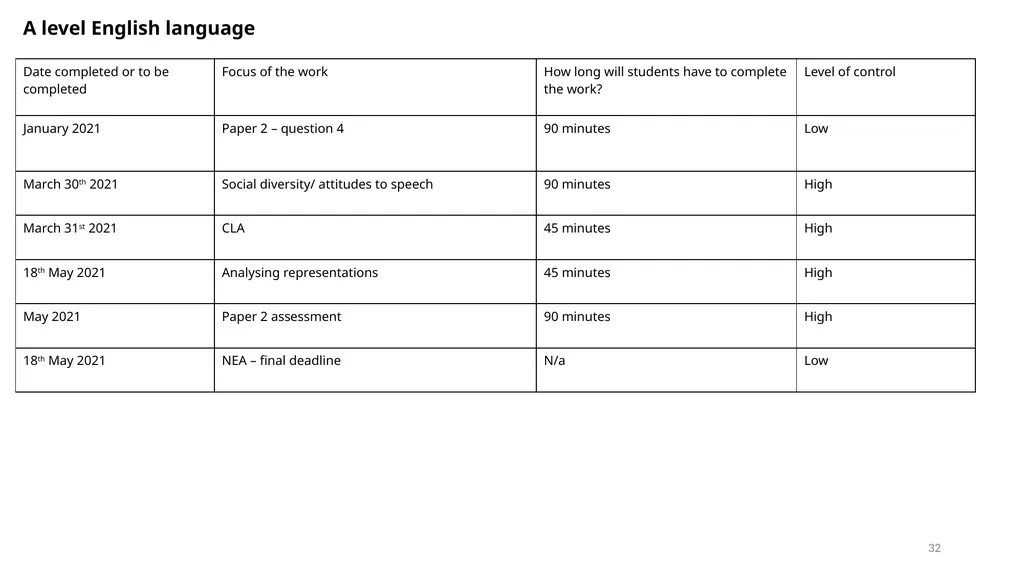
A level English language 32<br>
30
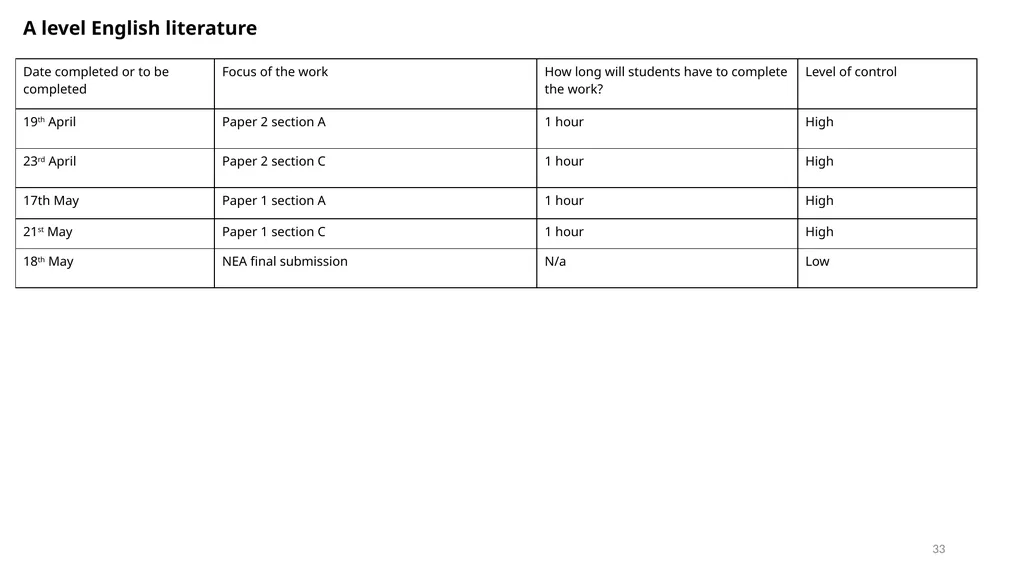
A level English literature 33<br>
31
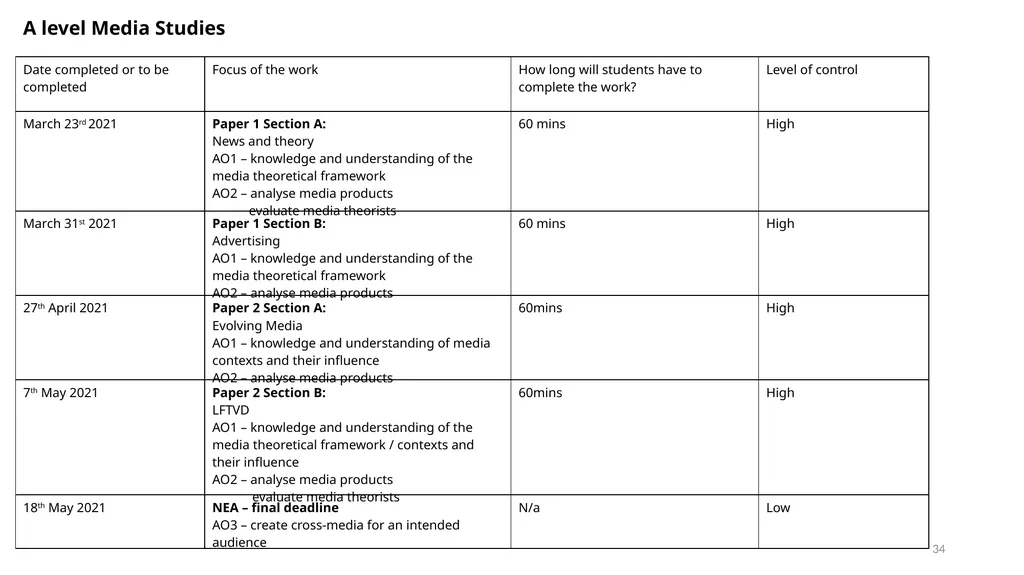
A level Media Studies 34<br>
32
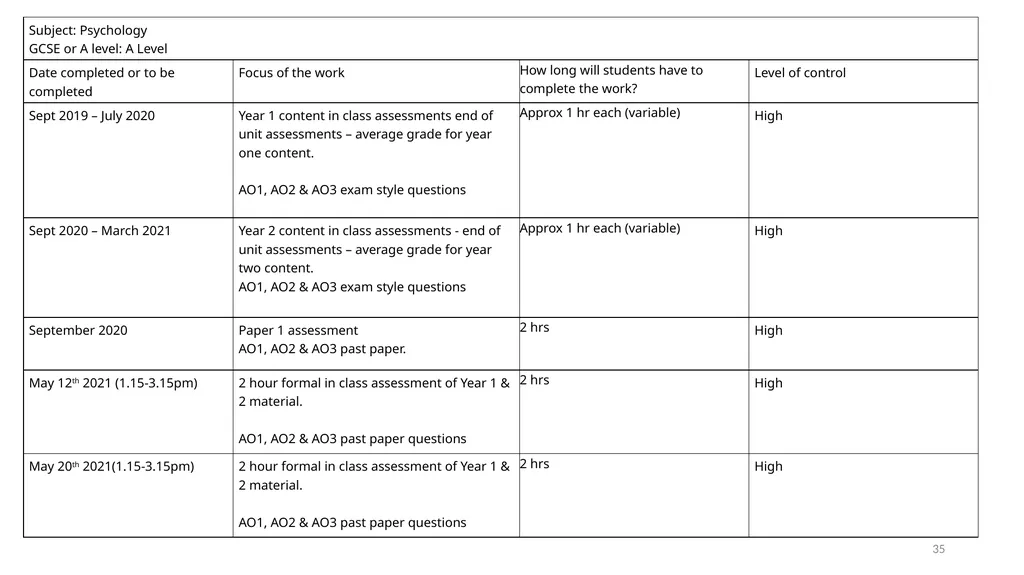
35<br>
33
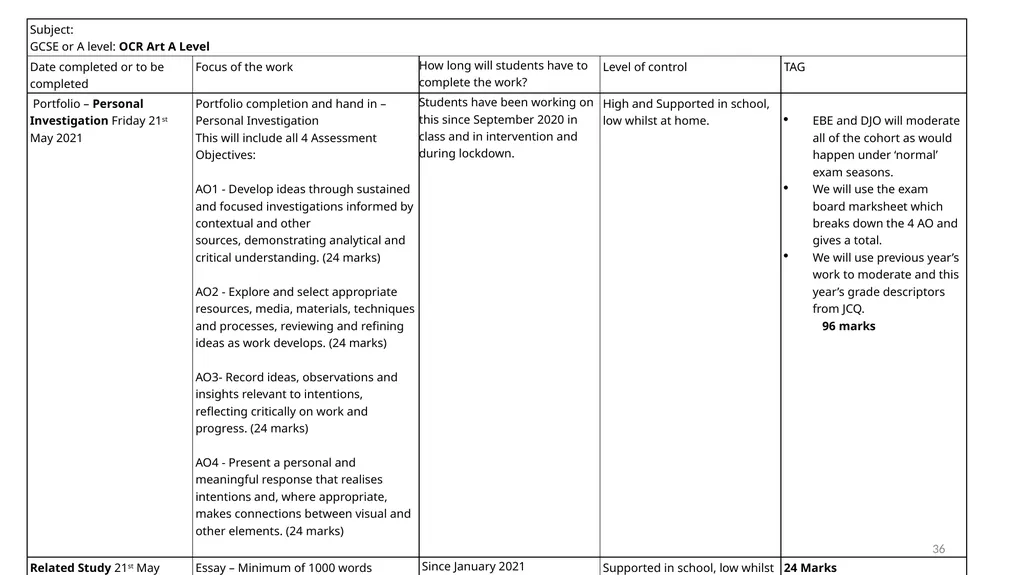
36<br>
34
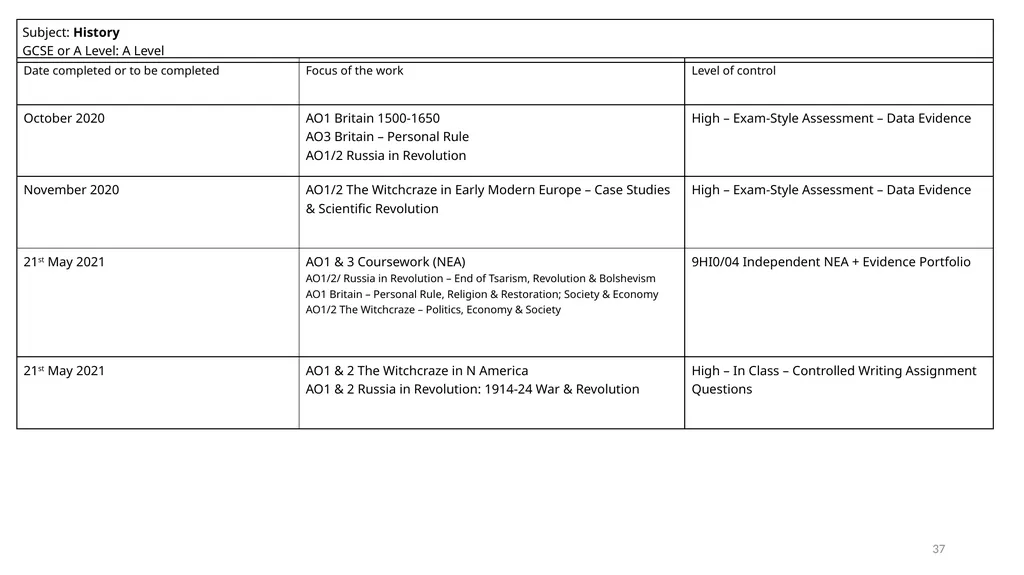
37<br>
35
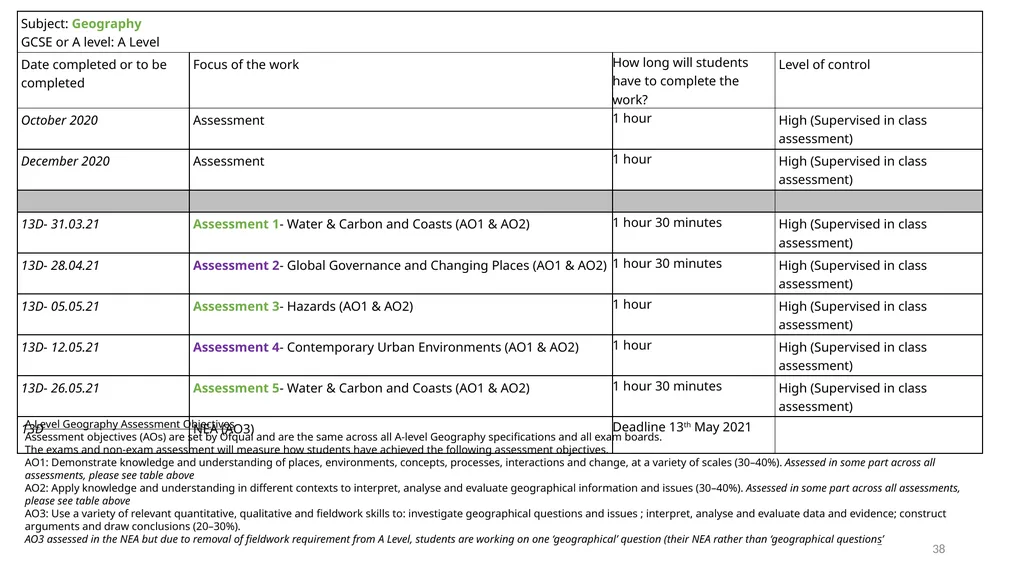
38 A Level Geography Assessment Objectives
Assessment objectives (AOs) are set by Ofqual and are the same across all A-level Geography specifications and all exam boards.
The exams and non-exam assessment will measure how students have achieved the following assessment objectives.
AO1: Demonstrate knowledge and understanding of places, environments, concepts, processes, interactions and change, at a variety of scales (30–40%). Assessed in some part across all assessments, please see table above
AO2: Apply knowledge and understanding in different contexts to interpret, analyse and evaluate geographical information and issues (30–40%). Assessed in some part across all assessments, please see table above
AO3: Use a variety of relevant quantitative, qualitative and fieldwork skills to: investigate geographical questions and issues ; interpret, analyse and evaluate data and evidence; construct arguments and draw conclusions (20–30%). AO3 assessed in the NEA but due to removal of fieldwork requirement from A Level, students are working on one ‘geographical’ question (their NEA rather than ‘geographical questions’<br>
Assessment objectives (AOs) are set by Ofqual and are the same across all A-level Geography specifications and all exam boards.
The exams and non-exam assessment will measure how students have achieved the following assessment objectives.
AO1: Demonstrate knowledge and understanding of places, environments, concepts, processes, interactions and change, at a variety of scales (30–40%). Assessed in some part across all assessments, please see table above
AO2: Apply knowledge and understanding in different contexts to interpret, analyse and evaluate geographical information and issues (30–40%). Assessed in some part across all assessments, please see table above
AO3: Use a variety of relevant quantitative, qualitative and fieldwork skills to: investigate geographical questions and issues ; interpret, analyse and evaluate data and evidence; construct arguments and draw conclusions (20–30%). AO3 assessed in the NEA but due to removal of fieldwork requirement from A Level, students are working on one ‘geographical’ question (their NEA rather than ‘geographical questions’<br>
36
39<br>
37
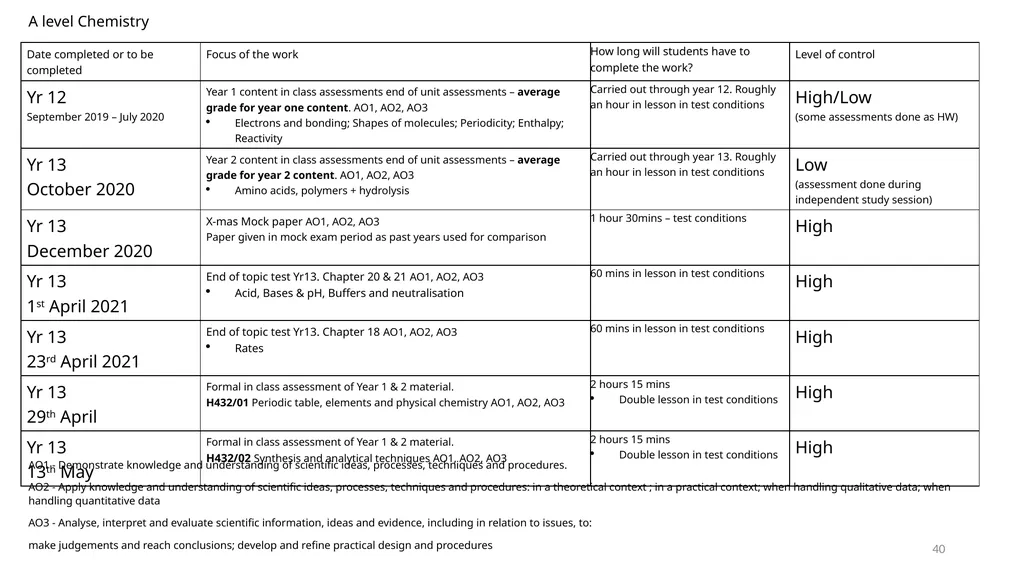
40 AO1 - Demonstrate knowledge and understanding of scientific ideas, processes, techniques and procedures.
AO2 - Apply knowledge and understanding of scientific ideas, processes, techniques and procedures: in a theoretical context ; in a practical context; when handling qualitative data; when handling quantitative data
AO3 - Analyse, interpret and evaluate scientific information, ideas and evidence, including in relation to issues, to:
make judgements and reach conclusions; develop and refine practical design and procedures A level Chemistry<br>
AO2 - Apply knowledge and understanding of scientific ideas, processes, techniques and procedures: in a theoretical context ; in a practical context; when handling qualitative data; when handling quantitative data
AO3 - Analyse, interpret and evaluate scientific information, ideas and evidence, including in relation to issues, to:
make judgements and reach conclusions; develop and refine practical design and procedures A level Chemistry<br>
38
41<br>
39
42<br>
40
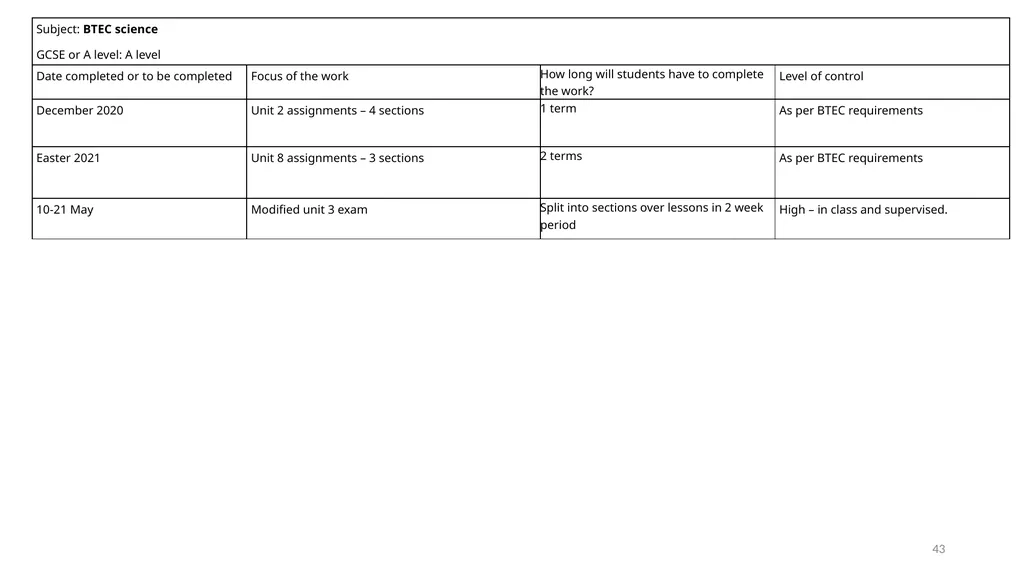
43<br>
41
44 Significant or minor changes to the “whole College robust procedure”<br>