B S G P Analyse the action taken by Khrushchev.

Published  . 0 views
↓ Download
B S G P Analyse the action taken by Khrushchev.
1 / 1
B S G P Analyse the action taken by Khrushchev. - slide 1 of 15 B S G P Analyse the action taken by Khrushchev. - slide 2 of 15 B S G P Analyse the action taken by Khrushchev. - slide 3 of 15 B S G P Analyse the action taken by Khrushchev. - slide 4 of 15 B S G P Analyse the action taken by Khrushchev. - slide 5 of 15 B S G P Analyse the action taken by Khrushchev. - slide 6 of 15 B S G P Analyse the action taken by Khrushchev. - slide 7 of 15 B S G P Analyse the action taken by Khrushchev. - slide 8 of 15 B S G P Analyse the action taken by Khrushchev. - slide 9 of 15 B S G P Analyse the action taken by Khrushchev. - slide 10 of 15 B S G P Analyse the action taken by Khrushchev. - slide 11 of 15 B S G P Analyse the action taken by Khrushchev. - slide 12 of 15 B S G P Analyse the action taken by Khrushchev. - slide 13 of 15 B S G P Analyse the action taken by Khrushchev. - slide 14 of 15 B S G P Analyse the action taken by Khrushchev. - slide 15 of 15
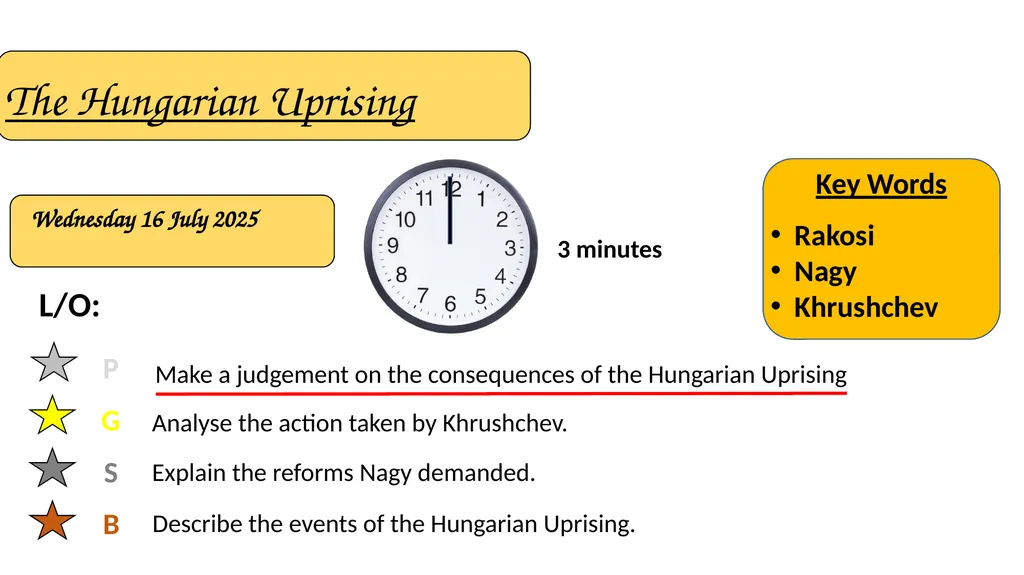
Description: B S G P Analyse the action taken by Khrushchev. Explain the reforms Nagy demanded. Describe the events of the Hungarian Uprising. Make a judgement on the consequences of the Hungarian Uprising LO: Game over L 3 minutes Tuesday, 22

Related Topics

Download Presentation

"B S G P Analyse the action taken by Khrushchev." is the property of its rightful owner. Permission is granted to download and print the materials on this website for personal, non-commercial use only, and to display it on your personal computer provided you do not modify the materials and that you retain all copyright notices contained in the materials. By downloading content from our website, you accept the terms of this agreement.

Presentation Transcript

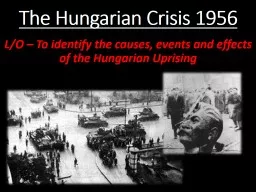
slide1. B S G P Analyse the action taken by Khrushchev. Explain the reforms Nagy demanded. Describe the events of the Hungarian Uprising. Make a judgement on the consequences of the Hungarian Uprising L/O: Game over L 3 minutes Tuesday, 22 September 2020<br>
slide2. Power of 3 Last lesson – What was the Arms Race?

Last week – Name one consequence of the Berlin Crisis?

Last year: Who was Joseph Goebbels?<br>
slide3. When Stalin died in 1953, for the first time in 29 years the USSR had a new leader.
Nikita Khrushchev took over.
In 1956, Khrushchev made a speech criticising Stalin – something that no-one did for fear of death.
He spoke of de-Stalinisation.
The US thought it might signal a change in the relationship – however they were wrong. His ideas were very similar. Nikita Khrushchev– Leader of the USSR from 1953 Task: Copy notes using the subheading who took over when Stalin died?<br>
slide4. Before 1949

Hungary had been part of the Austro-Hungarian Empire. This was something that they were very proud of. Soviet Take-Over

1949 – Soviet Union established a Soviet Government in Hungary. They were now ruled by Communists.<br>
slide5. Questions Task: Using your medal tasks answer the question to the right<br>
slide6. Until 1956, Hungary was led by Matyas Rakosi.
Stalin was a big fan of Rakosi because he did exactly what he wanted.
Rakosi had a secret police he used to get rid of opponents.
Hungarian people had to pay to have Soviet troops in the country.
Street signs, shop signs and schools were all in Russian. Matyas Rakosi – Leader of Hungary until 1956 People in Hungary were angry due to:

Oppression
Fuel shortages
Food shortages<br>
slide7. Appalled by the conditions in Hungary – the people, forced into action by OFF protested on the streets of Budapest.
They demanded free speech and the withdrawal of the Soviet troops.
Stalin’s statue was smashed and there was fierce fighting between Hungarian people and Soviet troops.
Khrushchev decided to replace Rakosi with Imre Nagy a popular communist politician, who he hoped would settle the people. Task make notes on the following:<br>
slide8. Putting Nagy in charge settled things down and the Soviet troops left.
However, even though he was a communist, Nagy was keen for change.
He demanded:

Free elections
A fair legal system
Total withdrawl of Soviet troops
Private land ownership
Hungary be allowed to leave the Warsaw Pact (01 Nov 1956) Imre Nagy – Hungarian leader from 1956. Now he’s gone too far!<br>
slide9. 4th November 1956: The Soviets sent in the Red Army Why would the USSR do this?<br>
slide10. The Red Army, backed by 1000 tanks, rolled into Hungary and killed approximately 20,00 Hungarians to re-establish power.
Nagy and the other rebels had assumed that there would be support from the USA – it never came.
A pro-communist, pro-USSR government was set up under Janos Kadar.
Kadar promised Nagy a safe escape. He lied. Nagy was executed. Janos Kadar – replaced and murdered Imre Nagy.<br>
slide11. Using the completed table (slide 13) of events, finish of the timeline adding the correct events in the correct order. 10 Minutes<br>
slide14. Since the US had offer aid in the form of the Marshall Plan and wanted to contain communism people in Eastern Europe assumed that they would help in other ways.
Some NATO countries did take Hungarian refugees.
There was NO military support offered –the USA showed were they stood. They would not support any country that was already communist.
The risk of a nuclear from USA involvement war was too great<br>
slide15. Writing Frame x 2 One consequence of the Hungarian Uprising was… (1) For example… (1) This meant that… (1) Therefore… (1) Explain two consequences of the Hungarian Uprising (8 marks) Consider:
Khrushchev and the USSR looked strong and forced all other Warsaw Pact members to be obedient.
The USA looked weak. Communist countries now knew the USA would not help them.
The United Nations did nothing and looked weak.
The relationship between the USSR and USA worsened.<br>