
B2B E-Commerce Chapter 2 Learning Objectives
Description: B2B E-Commerce Chapter 2 Learning Objectives Describe the B2B field. Describe the major types of B2B models. Discuss the characteristics of the sell-side marketplace, including auctions. Describe the sell-side models. Describe the
Related Topics
Download Presentation
"B2B E-Commerce Chapter 2 Learning Objectives" is the property of its rightful owner. Permission is granted to download and print the materials on this website for personal, non-commercial use only, and to display it on your personal computer provided you do not modify the materials and that you retain all copyright notices contained in the materials. By downloading content from our website, you accept the terms of this agreement.
Presentation Transcript
slide1. B2B E-Commerce
Chapter 2<br>
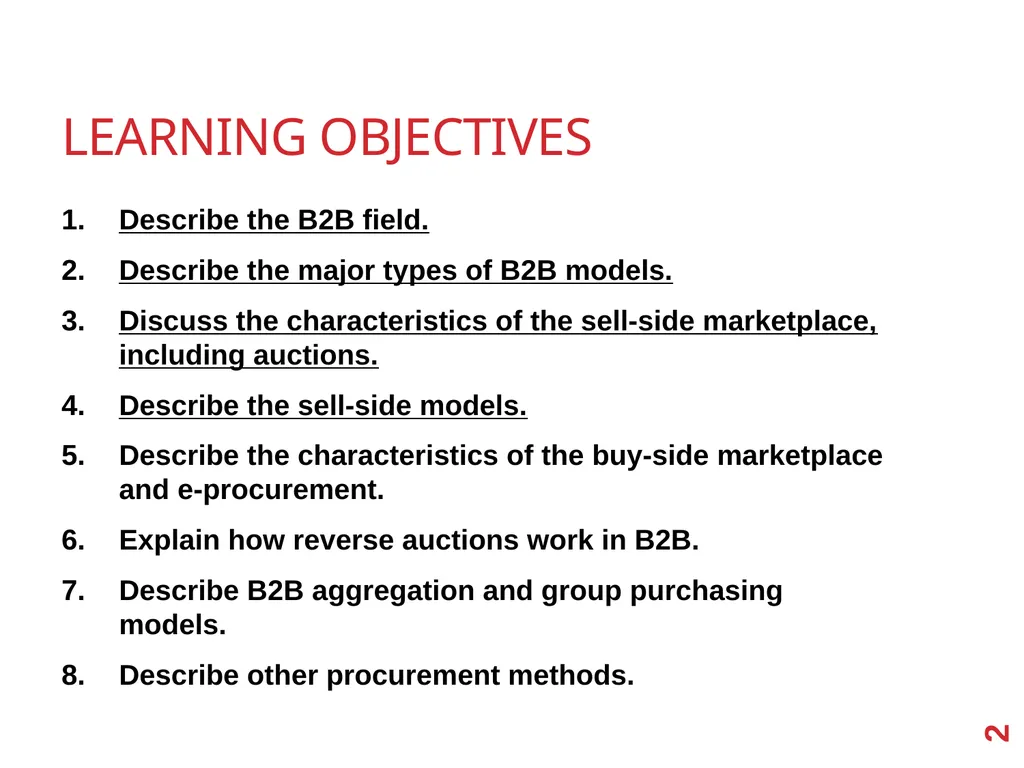
slide2. Learning Objectives Describe the B2B field.
Describe the major types of B2B models.
Discuss the characteristics of the sell-side marketplace, including auctions.
Describe the sell-side models.
Describe the characteristics of the buy-side marketplace and e-procurement.
Explain how reverse auctions work in B2B.
Describe B2B aggregation and group purchasing models.
Describe other procurement methods. 1<br>
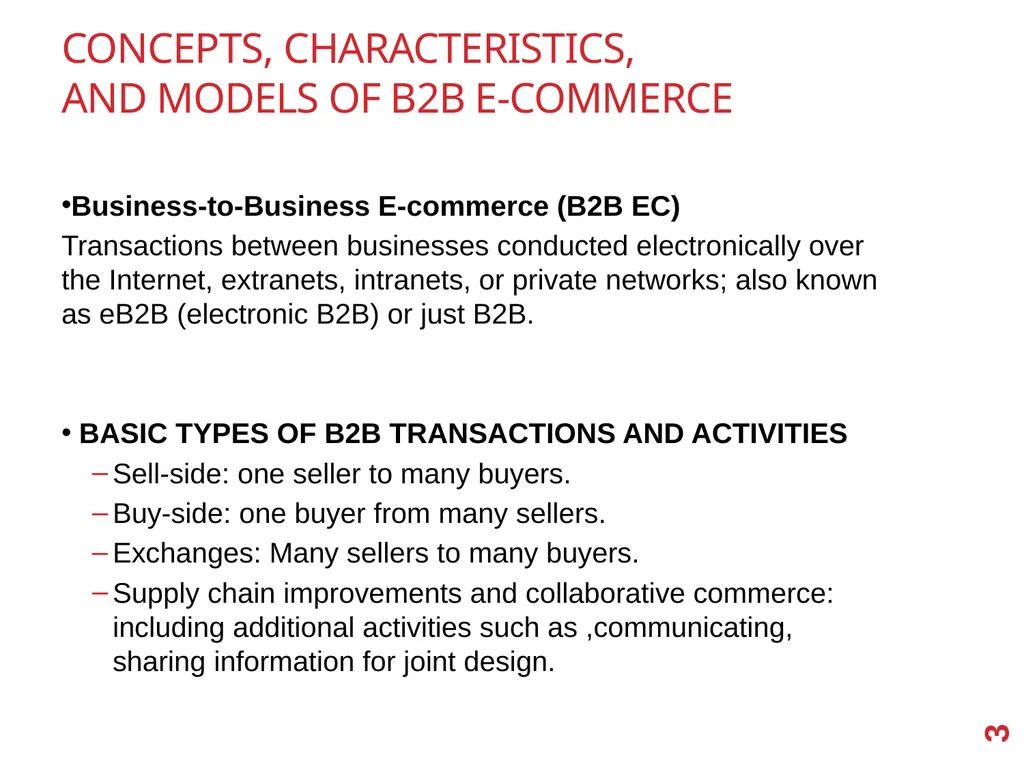
slide3. Concepts, Characteristics, and Models of B2B E-Commerce Business-to-Business E-commerce (B2B EC)
Transactions between businesses conducted electronically over the Internet, extranets, intranets, or private networks; also known as eB2B (electronic B2B) or just B2B.
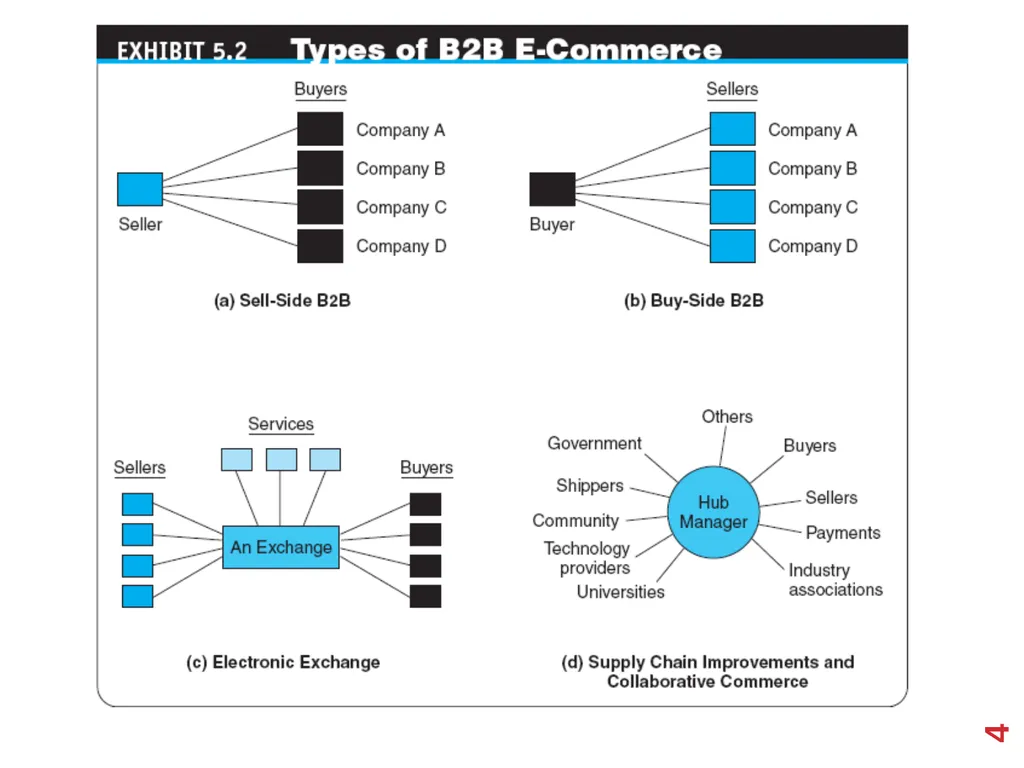
BASIC TYPES OF B2B TRANSACTIONS AND ACTIVITIES
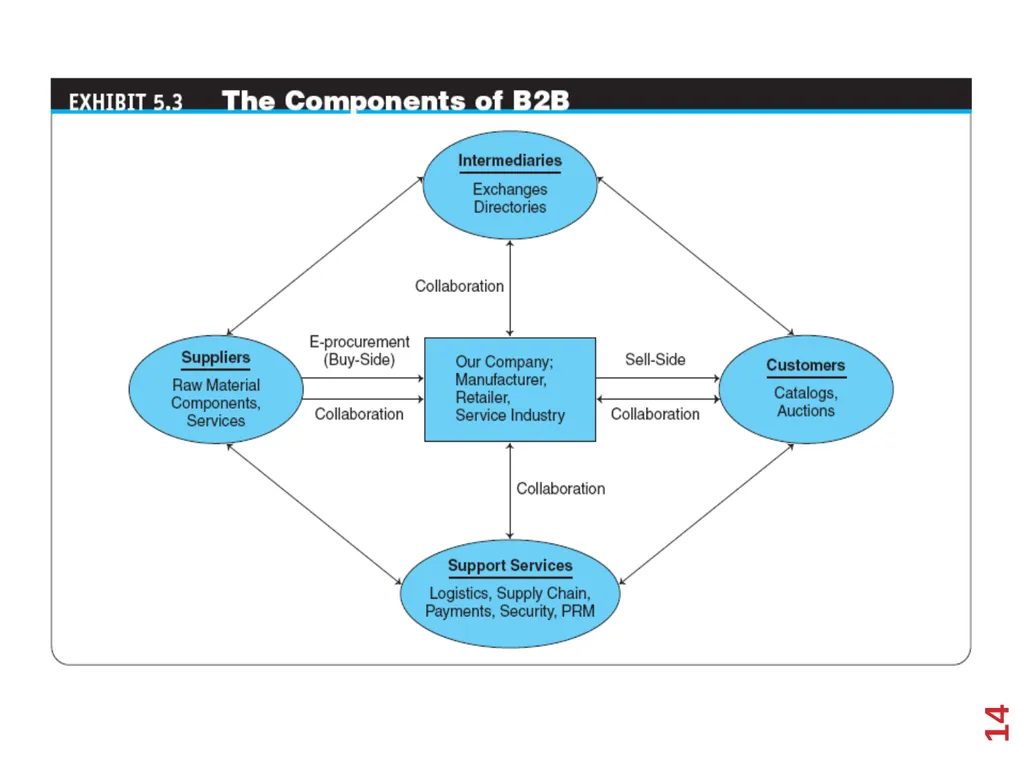
Sell-side: one seller to many buyers.
Buy-side: one buyer from many sellers.
Exchanges: Many sellers to many buyers.
Supply chain improvements and collaborative commerce: including additional activities such as ,communicating, sharing information for joint design. 2<br>
slide4. 3<br>
slide5. 4<br>
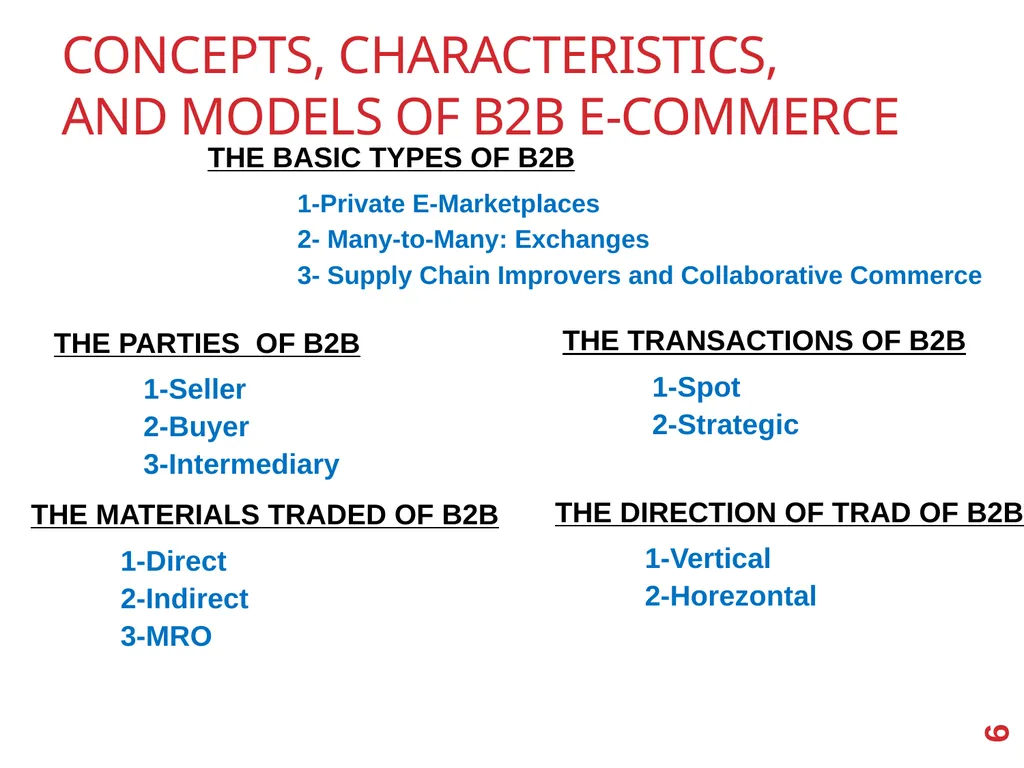
slide6. Concepts, Characteristics, and Models of B2B E-Commerce THE BASIC TYPES OF B2B
1-Private E-Marketplaces
2- Many-to-Many: Exchanges
3- Supply Chain Improvers and Collaborative Commerce 5 THE PARTIES OF B2B
1-Seller
2-Buyer
3-Intermediary THE TRANSACTIONS OF B2B
1-Spot
2-Strategic THE MATERIALS TRADED OF B2B
1-Direct
2-Indirect
3-MRO THE DIRECTION OF TRAD OF B2B
1-Vertical
2-Horezontal<br>
slide7. Concepts, Characteristics, and Models of B2B E-Commerce THE BASIC TYPES OF B2B
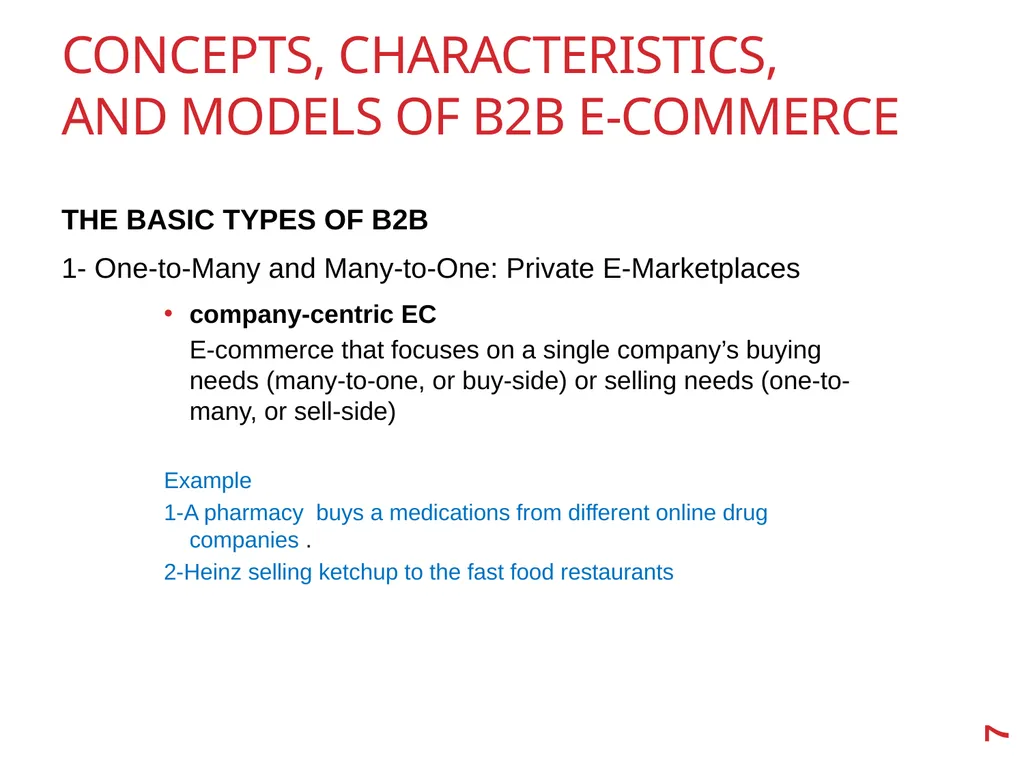
1- One-to-Many and Many-to-One: Private E-Marketplaces
company-centric EC
E-commerce that focuses on a single company’s buying needs (many-to-one, or buy-side) or selling needs (one-to-many, or sell-side)
Example
1-A pharmacy buys a medications from different online drug companies .
2-Heinz selling ketchup to the fast food restaurants 6<br>
slide8. Concepts, Characteristics, and Models of B2B E-Commerce 2 Many-to-Many: Exchanges
exchanges (trading communities or trading exchanges)
Many-to-many e-marketplaces, usually owned and run by a third party or a consortium, in which many buyers and many sellers meet electronically to trade with each other
public e-marketplaces
Third-party exchanges open to all interested parties (sellers and buyers)
3 Supply Chain Improvers and Collaborative Commerce 7 Third-party called also intermediary<br>
slide9. Concepts, Characteristics, and Models of B2B E-Commerce B2B CHARACTERISTICS
Parties to the Transaction:
Sellers, Buyers, and Intermediaries
B2B commerce is conducted directly by customer and manufacturer OR through online intermediary.
online intermediary
An online third party that brokers a transaction online between a buyer and a seller; may be virtual or click-and-mortar 8<br>
slide10. Concepts, Characteristics, and Models of B2B E-Commerce Types of Transactions
spot buying
The purchase of goods and services as they are needed, usually at prevailing market prices
Example : buying fire extinguisher
strategic (systematic) sourcing
Purchases involving long-term contracts that usually are based on private negotiations between sellers and buyers
Example : buying coffee beans for a coffee shop 9<br>
slide11. Concepts, Characteristics, and Models of B2B E-Commerce Types of Materials Traded
direct materials
Materials used in the production of a product (e.g., steel in a car or paper in a book)
indirect materials
Materials used to support production (e.g., office supplies or light bulbs)
MRO (maintenance, repair, and operation)
Indirect materials used in activities that support production 10<br>
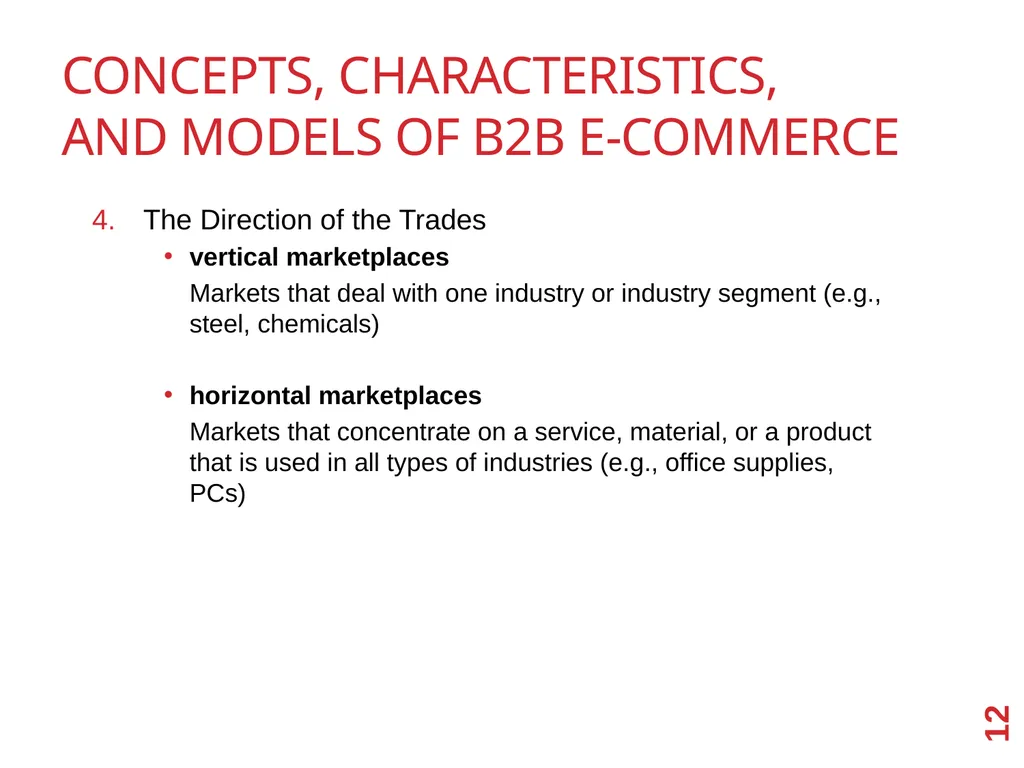
slide12. Concepts, Characteristics, and Models of B2B E-Commerce The Direction of the Trades
vertical marketplaces
Markets that deal with one industry or industry segment (e.g., steel, chemicals)
horizontal marketplaces
Markets that concentrate on a service, material, or a product that is used in all types of industries (e.g., office supplies, PCs) 11<br>
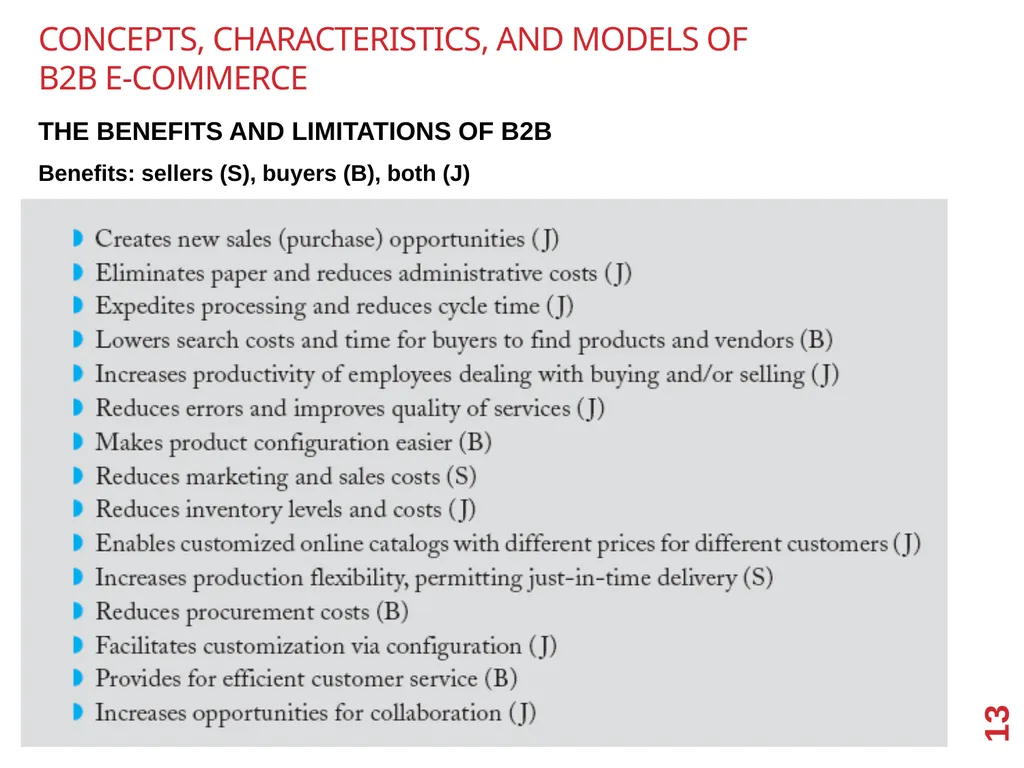
slide13. Concepts, Characteristics, and Models of B2B E-Commerce THE BENEFITS AND LIMITATIONS OF B2B
Benefits: sellers (S), buyers (B), both (J) 12<br>
slide14. 13<br>
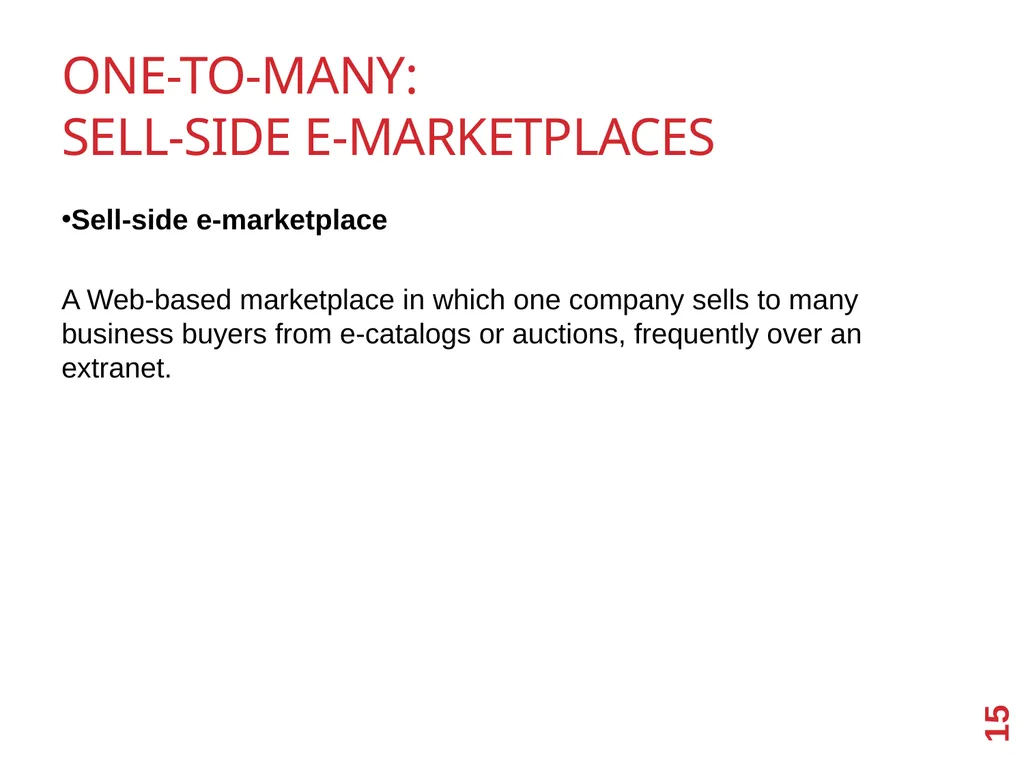
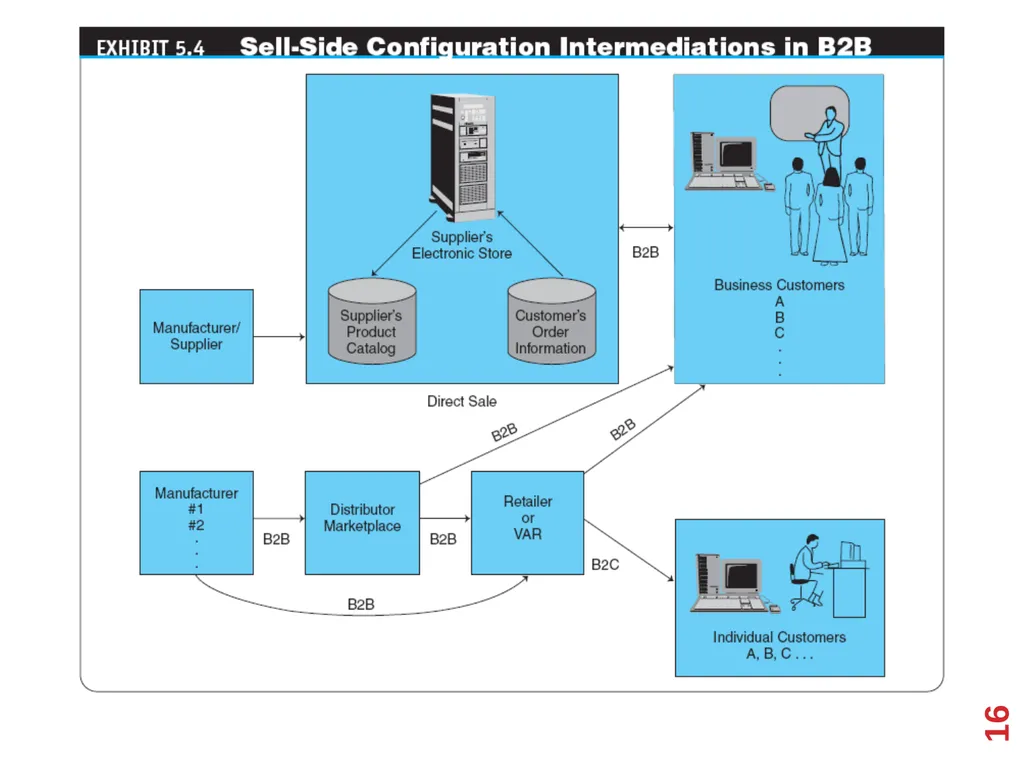
slide15. One-to-Many: Sell-Side E-Marketplaces Sell-side e-marketplace
A Web-based marketplace in which one company sells to many business buyers from e-catalogs or auctions, frequently over an extranet. 14<br>
slide16. 15<br>
slide17. Sell-side methods SALES FROM e-CATALOGS
Configuration and Customization: self-configure, pricing, submit orders
Benefits and Limitations of Online Sales from Catalogs : ??
(on your own !?) 16<br>
slide18. Selling Via E-Auctions USING AUCTIONS ON THE SELL SIDE
Forward auctions offer the following benefits to B2B sellers:
Revenue generation
Cost savings
Increased “stickiness”
Member acquisition and retention
E-Auctions options :
AUCTIONING FROM THE COMPANY’S OWN SITE
USING INTERMEDIARIES IN AUCTIONS
EXAMPLES OF B2B FORWARD AUCTIONS ???? 17<br>
slide19. One-from-Many: Buy-Side E-Marketplaces and E-Procurement Buy-side e-marketplace
A corporate-based acquisition site that uses reverse auctions, negotiations, group purchasing, or any other e-procurement method. 18<br>
slide20. One-from-Many: Buy-Side E-Marketplaces and E-Procurement PROCUREMENT METHODS
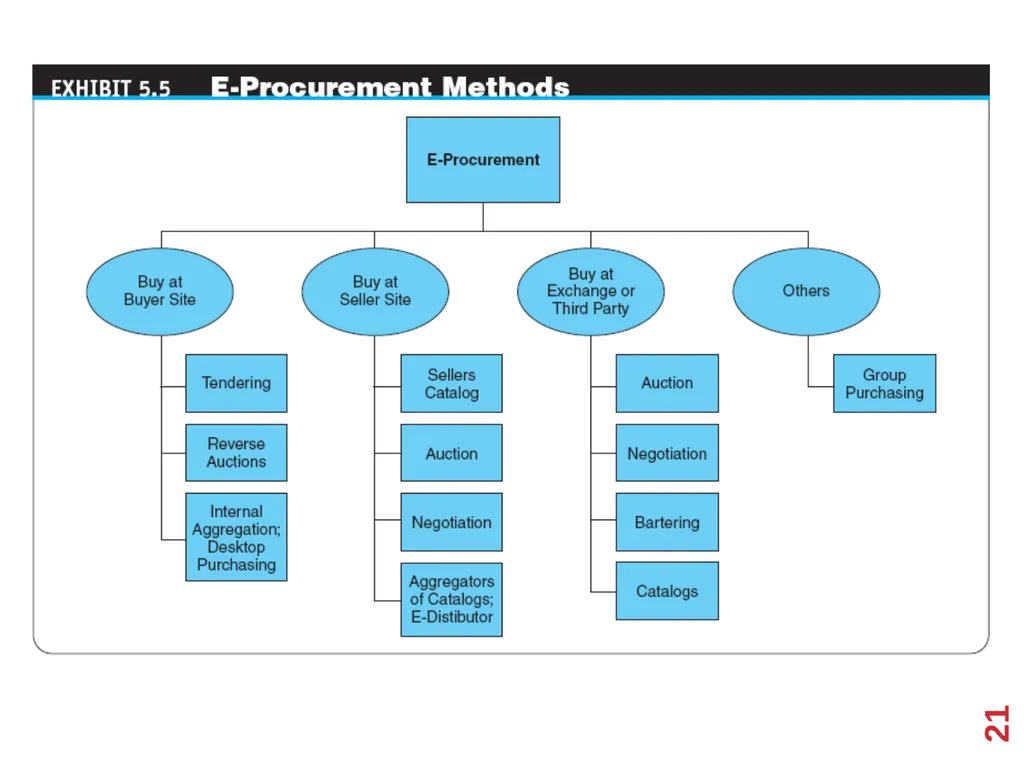
E-Procurement Methods ( as in Figure 5.5)
E-Procurement Organizations and Types
E-sourcing
E-tendering
E-reverse auctioning
E-informing
Web-based ERP
E-marketsites
E-MRO 19<br>
slide21. 20<br>
slide22. One-from-Many: Buy-Side E-Marketplaces and E-Procurement THE GOALS AND BENEFITS OF E-PROCUREMENT
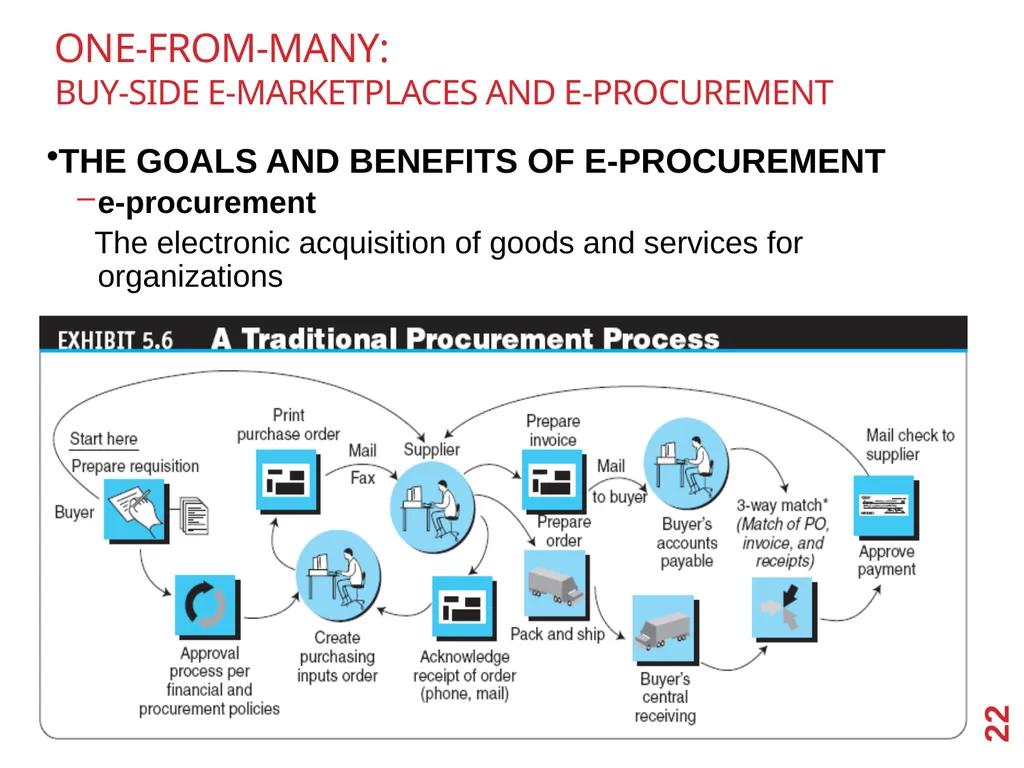
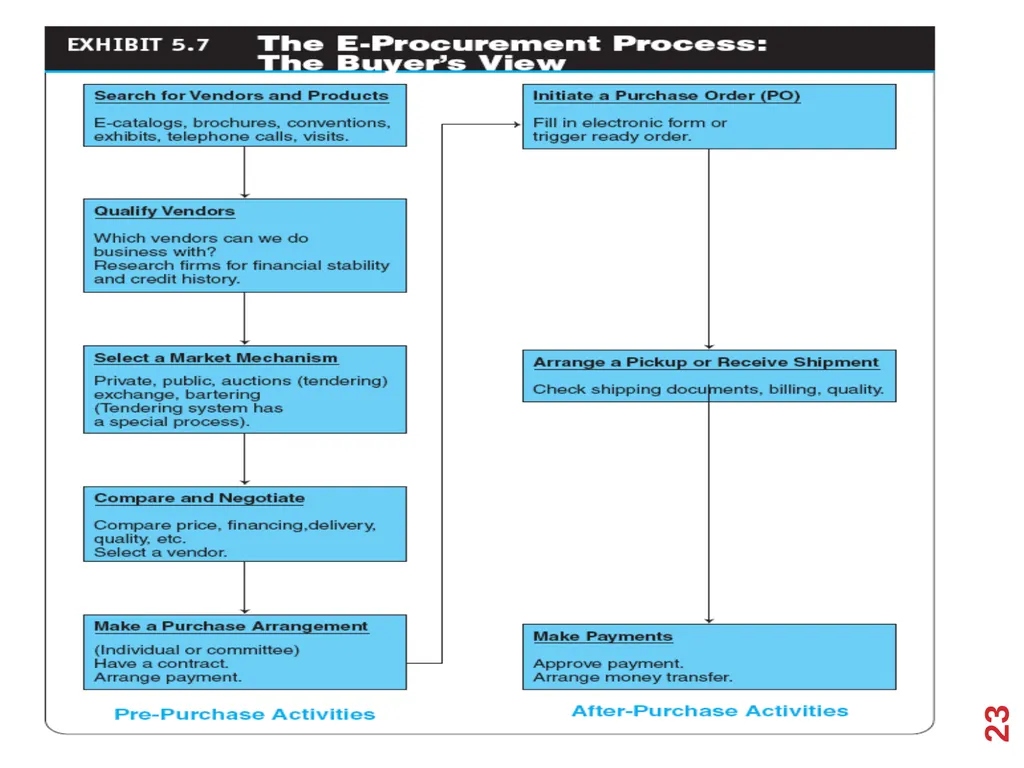
e-procurement
The electronic acquisition of goods and services for organizations 21<br>
slide23. 22<br>
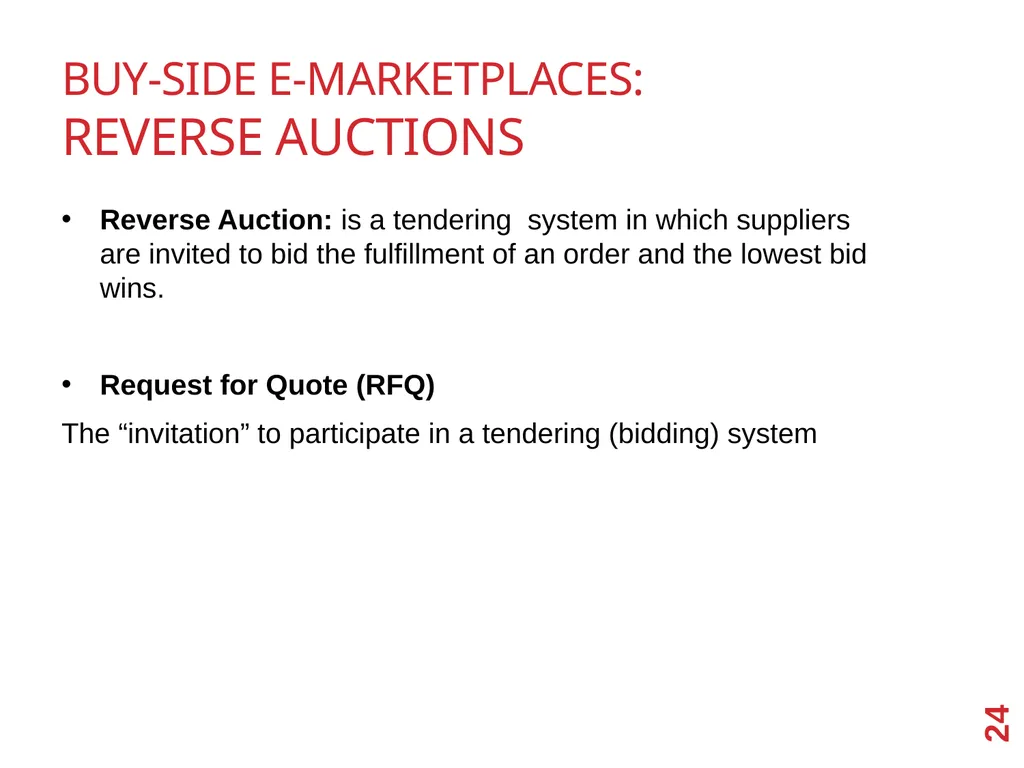
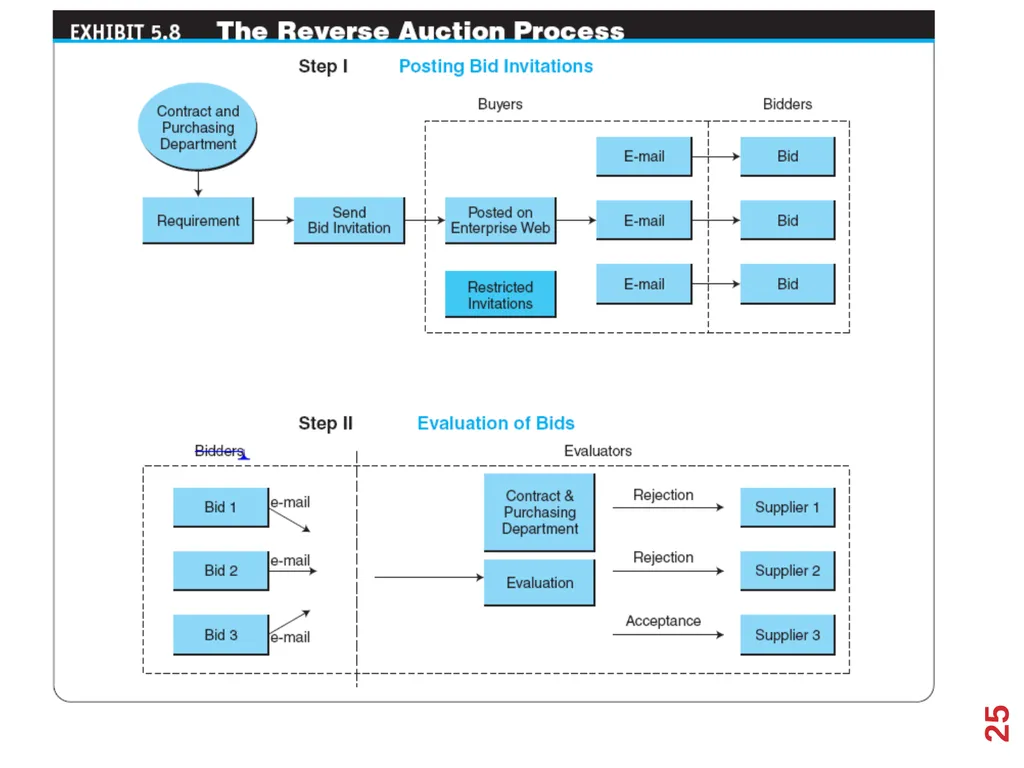
slide24. Buy-Side E-Marketplaces: Reverse Auctions Reverse Auction: is a tendering system in which suppliers are invited to bid the fulfillment of an order and the lowest bid wins.
Request for Quote (RFQ)
The “invitation” to participate in a tendering (bidding) system 23<br>
slide25. 24<br>
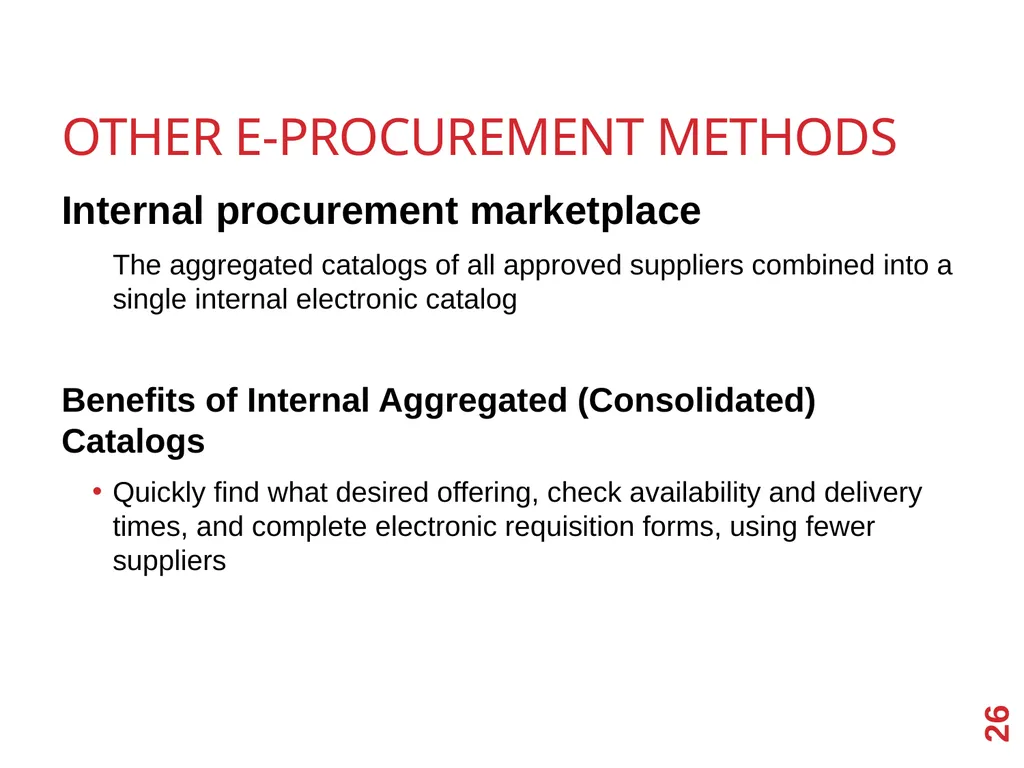
slide26. Other E-Procurement Methods Internal procurement marketplace
The aggregated catalogs of all approved suppliers combined into a single internal electronic catalog
Benefits of Internal Aggregated (Consolidated) Catalogs
Quickly find what desired offering, check availability and delivery times, and complete electronic requisition forms, using fewer suppliers 25<br>
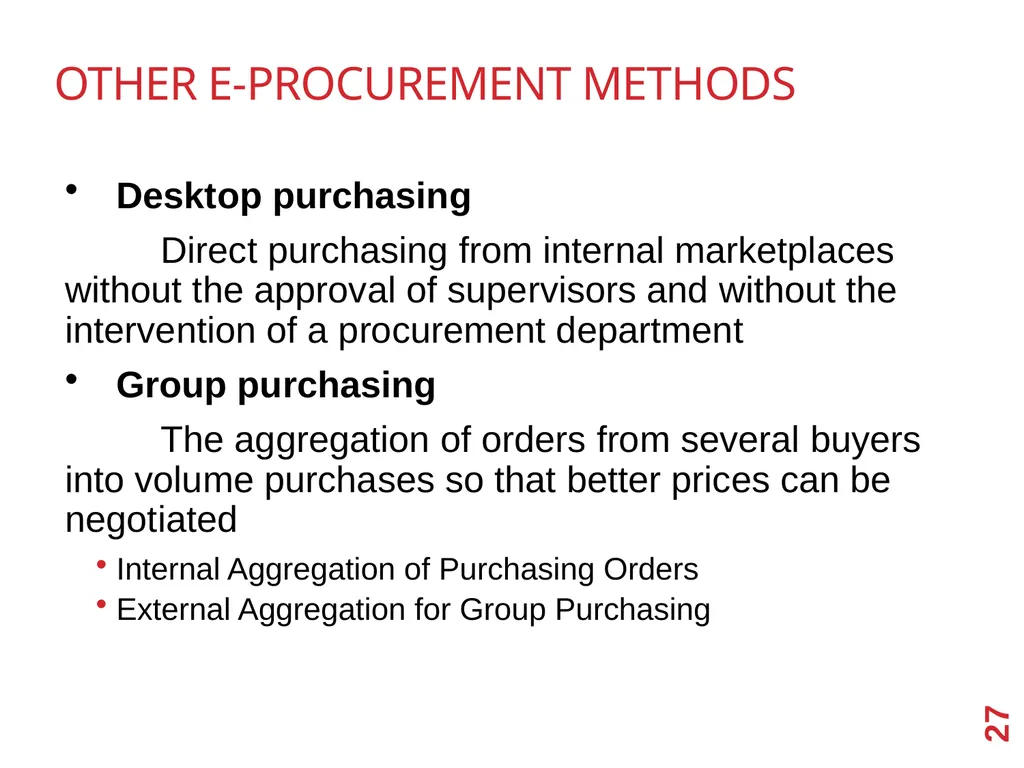
slide27. Other E-Procurement Methods Desktop purchasing
Direct purchasing from internal marketplaces without the approval of supervisors and without the intervention of a procurement department
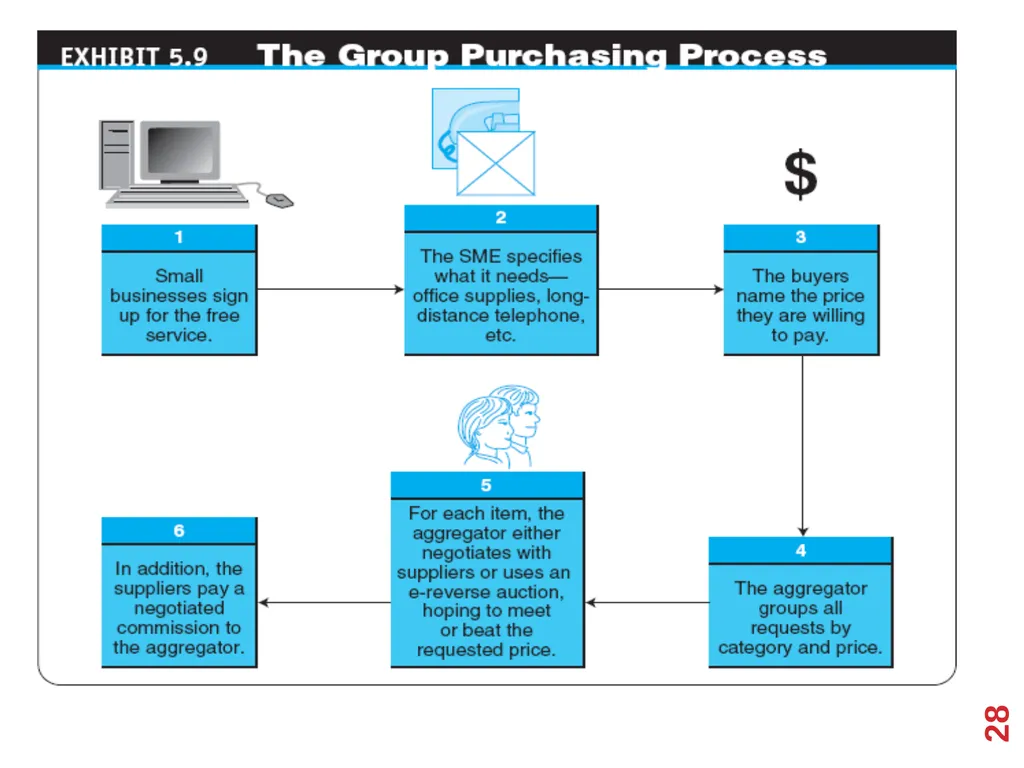
Group purchasing
The aggregation of orders from several buyers into volume purchases so that better prices can be negotiated
Internal Aggregation of Purchasing Orders
External Aggregation for Group Purchasing 26<br>
slide28. 27<br>
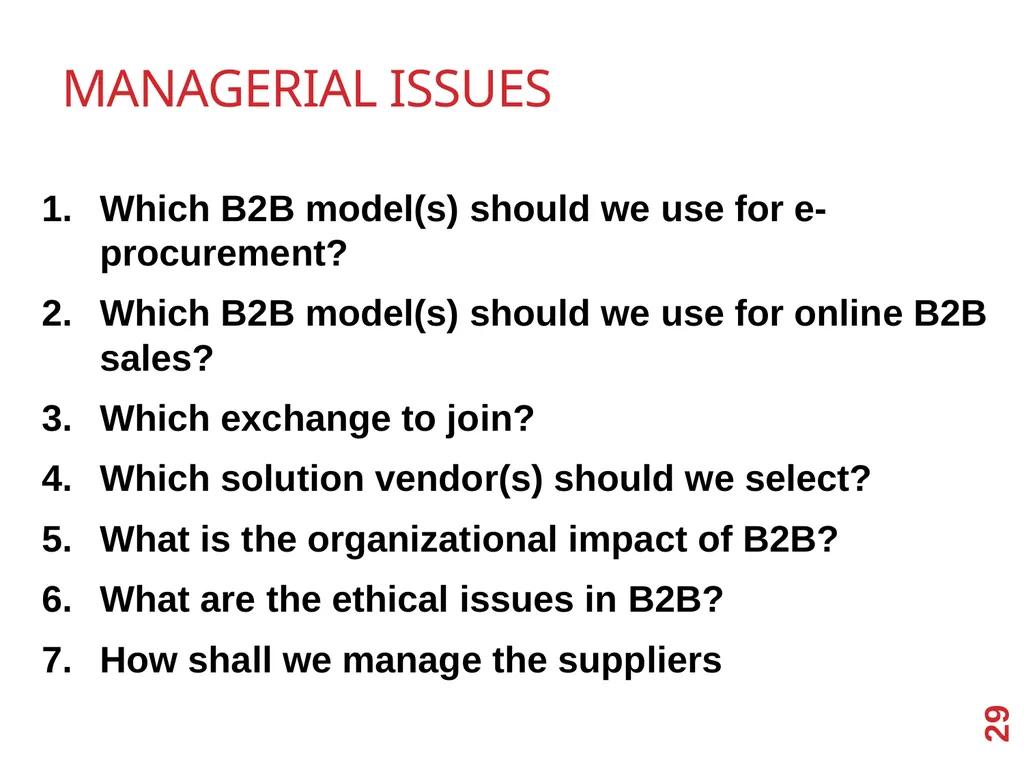
slide29. Managerial Issues Which B2B model(s) should we use for e-procurement?
Which B2B model(s) should we use for online B2B sales?
Which exchange to join?
Which solution vendor(s) should we select?
What is the organizational impact of B2B?
What are the ethical issues in B2B?
How shall we manage the suppliers 28<br>
slide2. Learning Objectives Describe the B2B field.
Describe the major types of B2B models.
Discuss the characteristics of the sell-side marketplace, including auctions.
Describe the sell-side models.
Describe the characteristics of the buy-side marketplace and e-procurement.
Explain how reverse auctions work in B2B.
Describe B2B aggregation and group purchasing models.
Describe other procurement methods. 1<br>
slide3. Concepts, Characteristics, and Models of B2B E-Commerce Business-to-Business E-commerce (B2B EC)
Transactions between businesses conducted electronically over the Internet, extranets, intranets, or private networks; also known as eB2B (electronic B2B) or just B2B.
BASIC TYPES OF B2B TRANSACTIONS AND ACTIVITIES
Sell-side: one seller to many buyers.
Buy-side: one buyer from many sellers.
Exchanges: Many sellers to many buyers.
Supply chain improvements and collaborative commerce: including additional activities such as ,communicating, sharing information for joint design. 2<br>
slide4. 3<br>
slide5. 4<br>
slide6. Concepts, Characteristics, and Models of B2B E-Commerce THE BASIC TYPES OF B2B
1-Private E-Marketplaces
2- Many-to-Many: Exchanges
3- Supply Chain Improvers and Collaborative Commerce 5 THE PARTIES OF B2B
1-Seller
2-Buyer
3-Intermediary THE TRANSACTIONS OF B2B
1-Spot
2-Strategic THE MATERIALS TRADED OF B2B
1-Direct
2-Indirect
3-MRO THE DIRECTION OF TRAD OF B2B
1-Vertical
2-Horezontal<br>
slide7. Concepts, Characteristics, and Models of B2B E-Commerce THE BASIC TYPES OF B2B
1- One-to-Many and Many-to-One: Private E-Marketplaces
company-centric EC
E-commerce that focuses on a single company’s buying needs (many-to-one, or buy-side) or selling needs (one-to-many, or sell-side)
Example
1-A pharmacy buys a medications from different online drug companies .
2-Heinz selling ketchup to the fast food restaurants 6<br>
slide8. Concepts, Characteristics, and Models of B2B E-Commerce 2 Many-to-Many: Exchanges
exchanges (trading communities or trading exchanges)
Many-to-many e-marketplaces, usually owned and run by a third party or a consortium, in which many buyers and many sellers meet electronically to trade with each other
public e-marketplaces
Third-party exchanges open to all interested parties (sellers and buyers)
3 Supply Chain Improvers and Collaborative Commerce 7 Third-party called also intermediary<br>
slide9. Concepts, Characteristics, and Models of B2B E-Commerce B2B CHARACTERISTICS
Parties to the Transaction:
Sellers, Buyers, and Intermediaries
B2B commerce is conducted directly by customer and manufacturer OR through online intermediary.
online intermediary
An online third party that brokers a transaction online between a buyer and a seller; may be virtual or click-and-mortar 8<br>
slide10. Concepts, Characteristics, and Models of B2B E-Commerce Types of Transactions
spot buying
The purchase of goods and services as they are needed, usually at prevailing market prices
Example : buying fire extinguisher
strategic (systematic) sourcing
Purchases involving long-term contracts that usually are based on private negotiations between sellers and buyers
Example : buying coffee beans for a coffee shop 9<br>
slide11. Concepts, Characteristics, and Models of B2B E-Commerce Types of Materials Traded
direct materials
Materials used in the production of a product (e.g., steel in a car or paper in a book)
indirect materials
Materials used to support production (e.g., office supplies or light bulbs)
MRO (maintenance, repair, and operation)
Indirect materials used in activities that support production 10<br>
slide12. Concepts, Characteristics, and Models of B2B E-Commerce The Direction of the Trades
vertical marketplaces
Markets that deal with one industry or industry segment (e.g., steel, chemicals)
horizontal marketplaces
Markets that concentrate on a service, material, or a product that is used in all types of industries (e.g., office supplies, PCs) 11<br>
slide13. Concepts, Characteristics, and Models of B2B E-Commerce THE BENEFITS AND LIMITATIONS OF B2B
Benefits: sellers (S), buyers (B), both (J) 12<br>
slide14. 13<br>
slide15. One-to-Many: Sell-Side E-Marketplaces Sell-side e-marketplace
A Web-based marketplace in which one company sells to many business buyers from e-catalogs or auctions, frequently over an extranet. 14<br>
slide16. 15<br>
slide17. Sell-side methods SALES FROM e-CATALOGS
Configuration and Customization: self-configure, pricing, submit orders
Benefits and Limitations of Online Sales from Catalogs : ??
(on your own !?) 16<br>
slide18. Selling Via E-Auctions USING AUCTIONS ON THE SELL SIDE
Forward auctions offer the following benefits to B2B sellers:
Revenue generation
Cost savings
Increased “stickiness”
Member acquisition and retention
E-Auctions options :
AUCTIONING FROM THE COMPANY’S OWN SITE
USING INTERMEDIARIES IN AUCTIONS
EXAMPLES OF B2B FORWARD AUCTIONS ???? 17<br>
slide19. One-from-Many: Buy-Side E-Marketplaces and E-Procurement Buy-side e-marketplace
A corporate-based acquisition site that uses reverse auctions, negotiations, group purchasing, or any other e-procurement method. 18<br>
slide20. One-from-Many: Buy-Side E-Marketplaces and E-Procurement PROCUREMENT METHODS
E-Procurement Methods ( as in Figure 5.5)
E-Procurement Organizations and Types
E-sourcing
E-tendering
E-reverse auctioning
E-informing
Web-based ERP
E-marketsites
E-MRO 19<br>
slide21. 20<br>
slide22. One-from-Many: Buy-Side E-Marketplaces and E-Procurement THE GOALS AND BENEFITS OF E-PROCUREMENT
e-procurement
The electronic acquisition of goods and services for organizations 21<br>
slide23. 22<br>
slide24. Buy-Side E-Marketplaces: Reverse Auctions Reverse Auction: is a tendering system in which suppliers are invited to bid the fulfillment of an order and the lowest bid wins.
Request for Quote (RFQ)
The “invitation” to participate in a tendering (bidding) system 23<br>
slide25. 24<br>
slide26. Other E-Procurement Methods Internal procurement marketplace
The aggregated catalogs of all approved suppliers combined into a single internal electronic catalog
Benefits of Internal Aggregated (Consolidated) Catalogs
Quickly find what desired offering, check availability and delivery times, and complete electronic requisition forms, using fewer suppliers 25<br>
slide27. Other E-Procurement Methods Desktop purchasing
Direct purchasing from internal marketplaces without the approval of supervisors and without the intervention of a procurement department
Group purchasing
The aggregation of orders from several buyers into volume purchases so that better prices can be negotiated
Internal Aggregation of Purchasing Orders
External Aggregation for Group Purchasing 26<br>
slide28. 27<br>
slide29. Managerial Issues Which B2B model(s) should we use for e-procurement?
Which B2B model(s) should we use for online B2B sales?
Which exchange to join?
Which solution vendor(s) should we select?
What is the organizational impact of B2B?
What are the ethical issues in B2B?
How shall we manage the suppliers 28<br>