
Back to Basics and Challenges to the Financial




Description: Back to Basics and Challenges to the Financial Sustainability of municipalities: Possible Solutions Select Committee on Appropriations: Workshop on Back to Basics Programme and Support Provided to Municipalities For an Equitable Sharing of
Related Topics
Download Presentation
"Back to Basics and Challenges to the Financial" is the property of its rightful owner. Permission is granted to download and print the materials on this website for personal, non-commercial use only, and to display it on your personal computer provided you do not modify the materials and that you retain all copyright notices contained in the materials. By downloading content from our website, you accept the terms of this agreement.
Presentation Transcript
slide1. Back to Basics and Challenges to the Financial Sustainability of municipalities: Possible Solutions
Select Committee on Appropriations: Workshop on Back to Basics Programme and Support Provided to Municipalities For an Equitable Sharing of National Revenue 23 May 2018<br>
slide2. Background to the Submission In 2014 former Minister Pravin Gordhan indicated that:
a third of the municipalities are functioning well, a third were at risk, and another third were dysfunctional”. Then a remedial plan was announced- Back to Basics.
Assessed four years later, Cogta’s notes a less than encouraging picture
On 21 March 2018, the minister of Cogta, Dr Zweli Mkize, noted the following:
Only 7 % of municipalities are well-functioning; 31 % are reasonably functional
31% are almost dysfunctional; and 31 % are dysfunctional.
It would appear that there has been a downward trend: from the third at risk to become dysfunctional in 2014, most of them have become almost dysfunctional.
The AG has also noted the same picture. The audit report on municipal accounts (2015-16) stated that: “the financial health of 65% of the municipalities was either concerning or requiring intervention”. He noted that in total, 27% of municipalities were in “a particularly poor financial position by the end of 2015-16, with material uncertainty with regard to their ability to continue operating in the foreseeable future”.
Of the 55 municipalities regarded as dysfunctional, half of them (27) are district municipalities, that is to say, over 60 % of all DMs are dysfunctional. 2<br>
slide3. A Summary of the Risks to the Financial Sustainability of Municipalities 3<br>
slide4. The Economy and Revenue pressures Slowdown of the Economy: The economy which has been in a recession poses a serious risk to the financial viability of LG that is transfer dependent:
The decade-long trend of low growth that has characterised the South African economy has placed the country’s public finances under severe strain, and moreso revenues available for sharing
Fiscal consolidation measures, accompanied by cuts in grant baselines, have also worsened the fiscal situation of LGs
Low economic growth has also left ratepayers under severe stress, and many failing to service their debts with SNGs, adding more pressure to the budgets of SNGs
Low GDP implies revenues available for sharing are squeezed
Poor revenue management: Main challenges in revenue management in municipalities include:
Poor internal controls, cash flow management and operational inefficiencies, tariff structures that are not always cost reflective, poor billing and debt management, Leakages (funds not used for municipal business), Corruption, Under-spending and Inefficient procurement
Inadequate capacity within municipalities in revenue management and tariff setting 4<br>
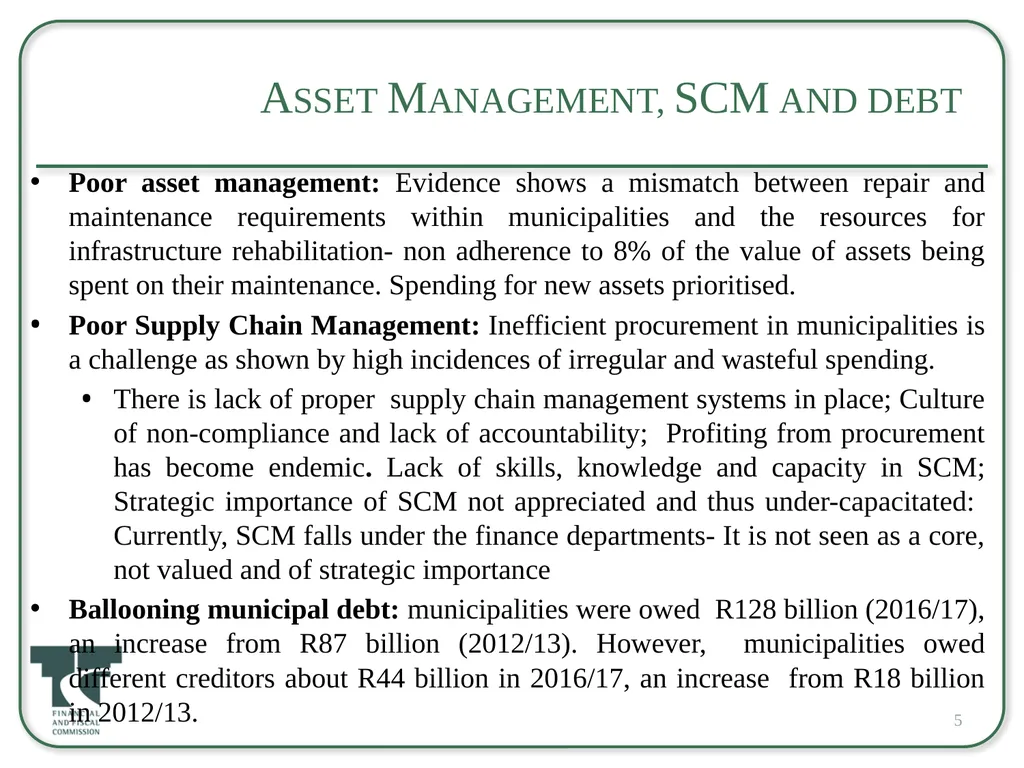
slide5. Asset Management, SCM and debt Poor asset management: Evidence shows a mismatch between repair and maintenance requirements within municipalities and the resources for infrastructure rehabilitation- non adherence to 8% of the value of assets being spent on their maintenance. Spending for new assets prioritised.
Poor Supply Chain Management: Inefficient procurement in municipalities is a challenge as shown by high incidences of irregular and wasteful spending.
There is lack of proper supply chain management systems in place; Culture of non-compliance and lack of accountability; Profiting from procurement has become endemic. Lack of skills, knowledge and capacity in SCM; Strategic importance of SCM not appreciated and thus under-capacitated: Currently, SCM falls under the finance departments- It is not seen as a core, not valued and of strategic importance
Ballooning municipal debt: municipalities were owed R128 billion (2016/17), an increase from R87 billion (2012/13). However, municipalities owed different creditors about R44 billion in 2016/17, an increase from R18 billion in 2012/13. 5<br>
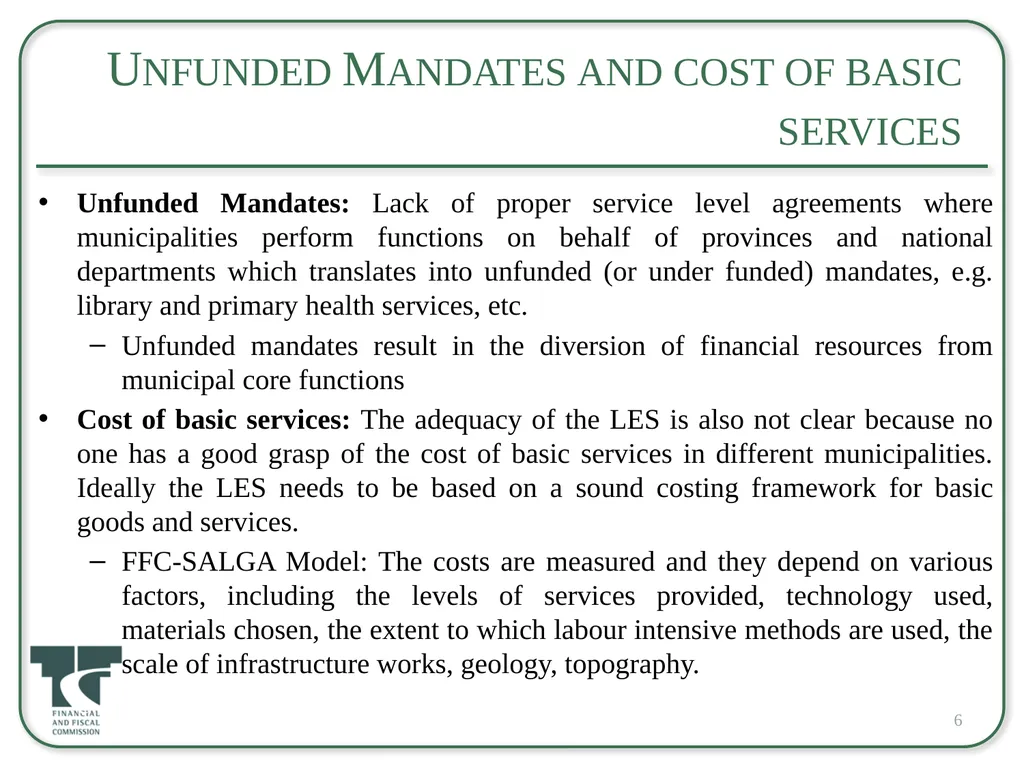
slide6. Unfunded Mandates and cost of basic services Unfunded Mandates: Lack of proper service level agreements where municipalities perform functions on behalf of provinces and national departments which translates into unfunded (or under funded) mandates, e.g. library and primary health services, etc.
Unfunded mandates result in the diversion of financial resources from municipal core functions u
Cost of basic services: The adequacy of the LES is also not clear because no one has a good grasp of the cost of basic services in different municipalities. Ideally the LES needs to be based on a sound costing framework for basic goods and services.
FFC-SALGA Model: The costs are measured and they depend on various factors, including the levels of services provided, technology used, materials chosen, the extent to which labour intensive methods are used, the scale of infrastructure works, geology, topography.
e 6<br>
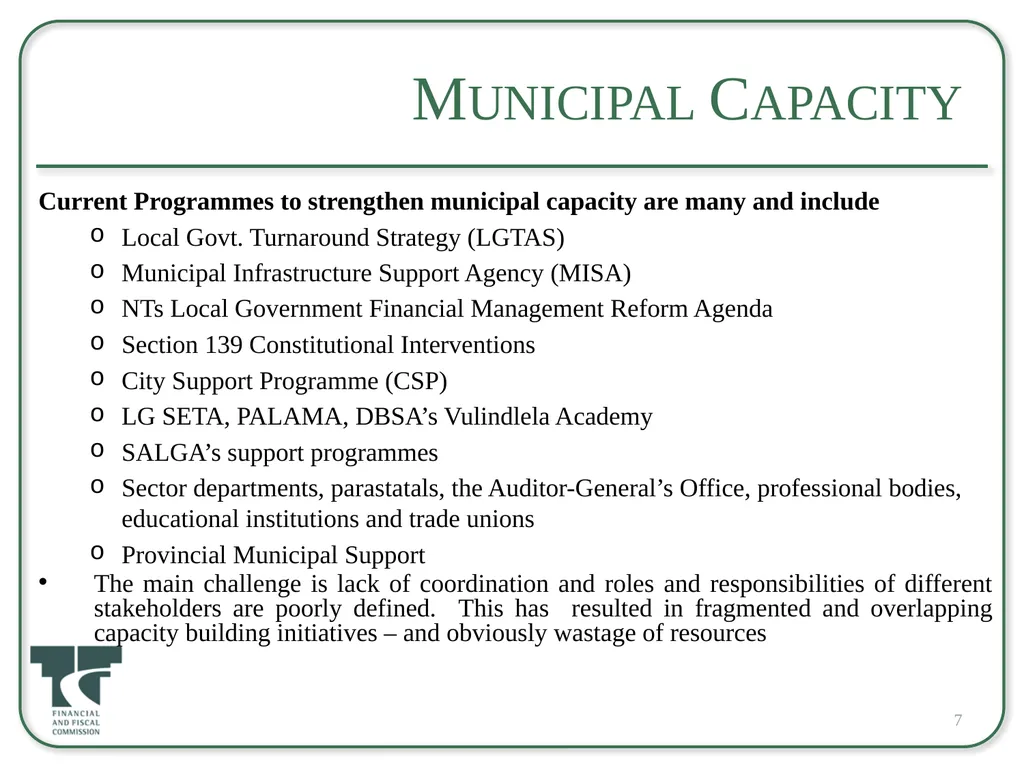
slide7. Municipal Capacity Current Programmes to strengthen municipal capacity are many and include
Local Govt. Turnaround Strategy (LGTAS)
Municipal Infrastructure Support Agency (MISA)
NTs Local Government Financial Management Reform Agenda
Section 139 Constitutional Interventions
City Support Programme (CSP)
LG SETA, PALAMA, DBSA’s Vulindlela Academy
SALGA’s support programmes
Sector departments, parastatals, the Auditor-General’s Office, professional bodies, educational institutions and trade unions
Provincial Municipal Support
The main challenge is lack of coordination and roles and responsibilities of different stakeholders are poorly defined. This has resulted in fragmented and overlapping capacity building initiatives – and obviously wastage of resources 7<br>
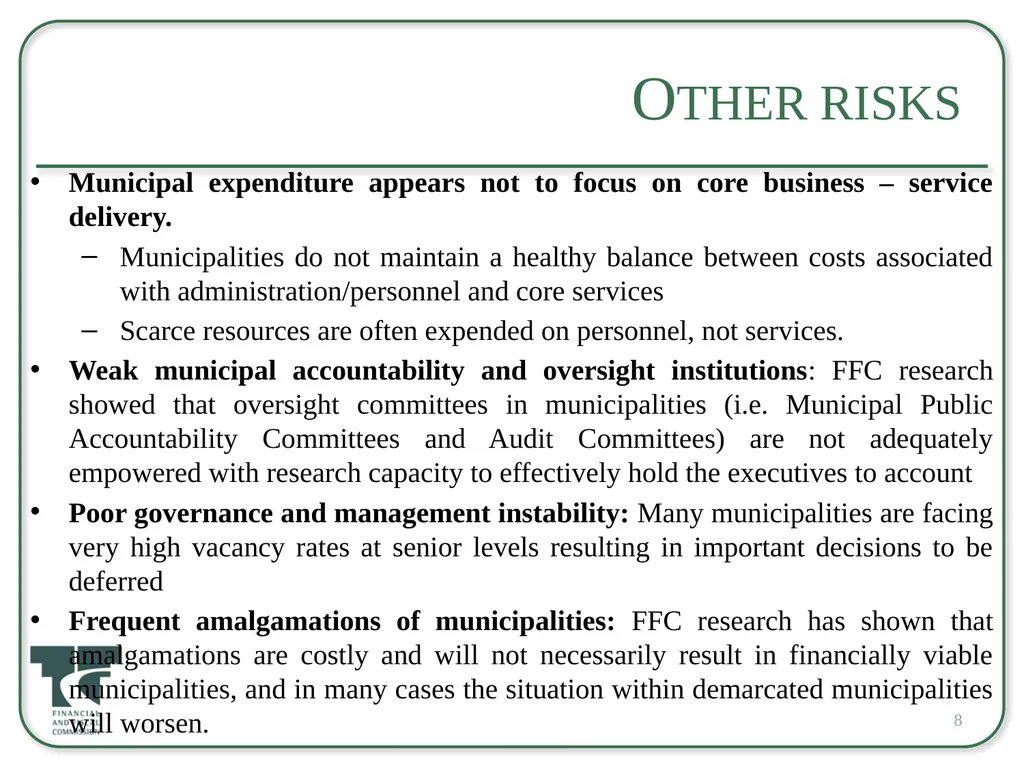
slide8. Other risks Municipal expenditure appears not to focus on core business – service delivery.
Municipalities do not maintain a healthy balance between costs associated with administration/personnel and core services
Scarce resources are often expended on personnel, not services.
Weak municipal accountability and oversight institutions: FFC research showed that oversight committees in municipalities (i.e. Municipal Public Accountability Committees and Audit Committees) are not adequately empowered with research capacity to effectively hold the executives to account
Poor governance and management instability: Many municipalities are facing very high vacancy rates at senior levels resulting in important decisions to be deferred
Frequent amalgamations of municipalities: FFC research has shown that amalgamations are costly and will not necessarily result in financially viable municipalities, and in many cases the situation within demarcated municipalities will worsen. 8<br>
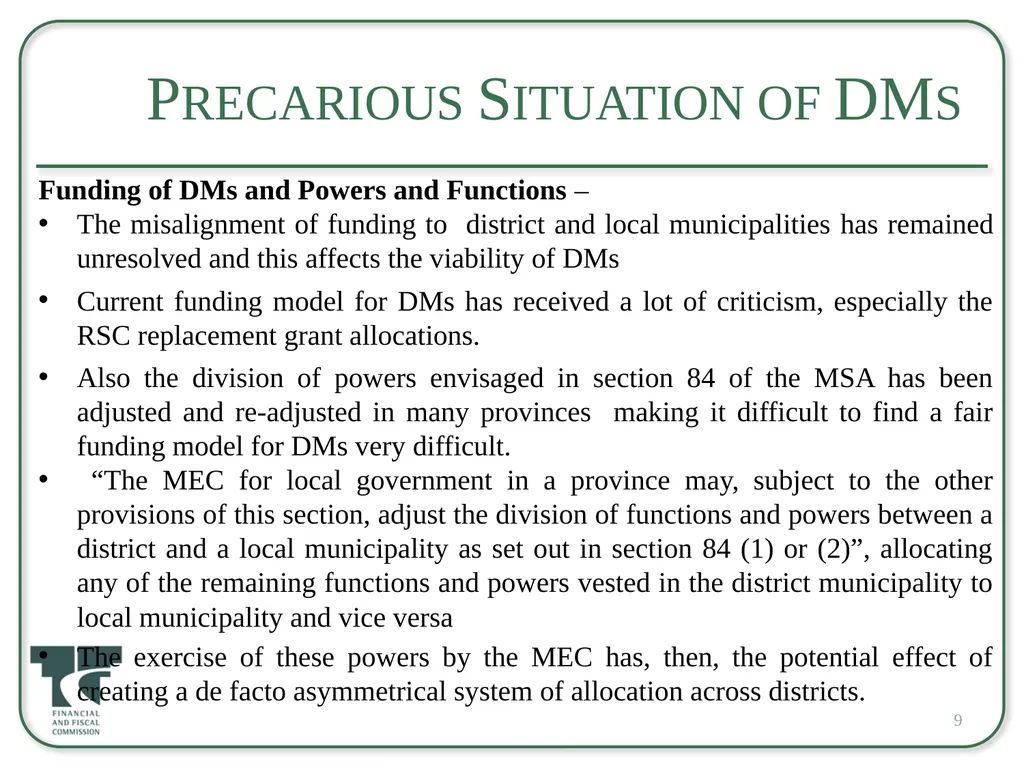
slide9. Precarious Situation of DMs Funding of DMs and Powers and Functions –
The misalignment of funding to district and local municipalities has remained unresolved and this affects the viability of DMs
Current funding model for DMs has received a lot of criticism, especially the RSC replacement grant allocations.
Also the division of powers envisaged in section 84 of the MSA has been adjusted and re-adjusted in many provinces making it difficult to find a fair funding model for DMs very difficult.
“The MEC for local government in a province may, subject to the other provisions of this section, adjust the division of functions and powers between a district and a local municipality as set out in section 84 (1) or (2)”, allocating any of the remaining functions and powers vested in the district municipality to local municipality and vice versa
The exercise of these powers by the MEC has, then, the potential effect of creating a de facto asymmetrical system of allocation across districts. 9<br>
slide10. Possible Solutions<br>
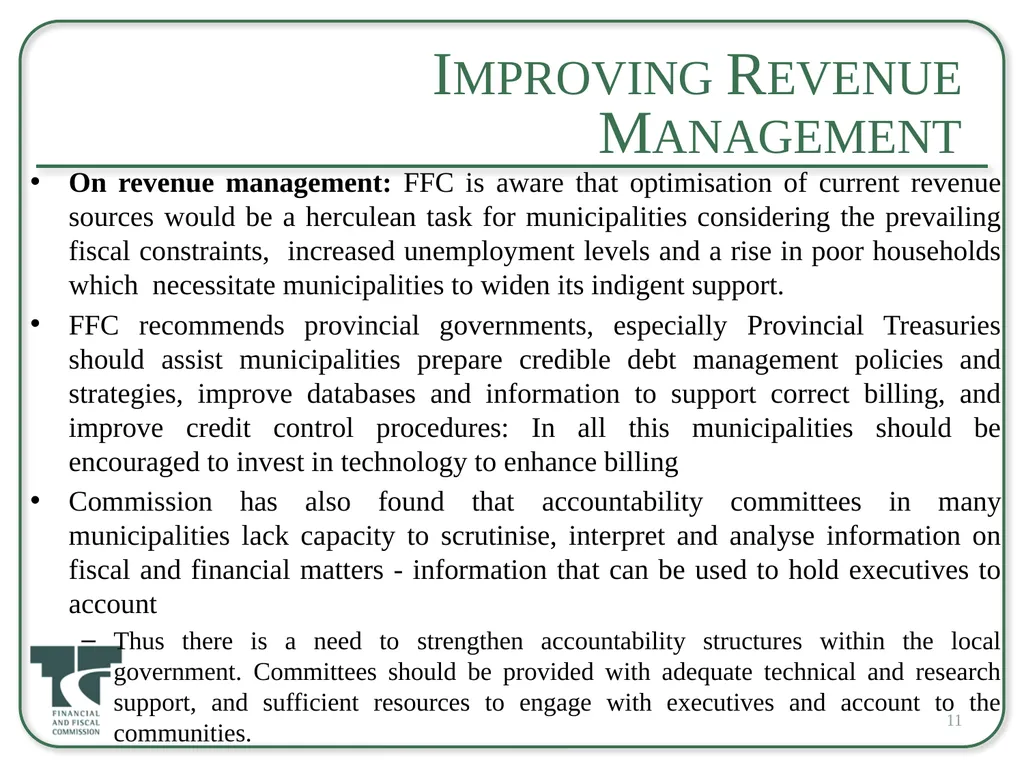
slide11. Improving Revenue Management On revenue management: FFC is aware that optimisation of current revenue sources would be a herculean task for municipalities considering the prevailing fiscal constraints, increased unemployment levels and a rise in poor households which necessitate municipalities to widen its indigent support.
FFC recommends provincial governments, especially Provincial Treasuries should assist municipalities prepare credible debt management policies and strategies, improve databases and information to support correct billing, and improve credit control procedures: In all this municipalities should be encouraged to invest in technology to enhance billing
Commission has also found that accountability committees in many municipalities lack capacity to scrutinise, interpret and analyse information on fiscal and financial matters - information that can be used to hold executives to account
Thus there is a need to strengthen accountability structures within the local government. Committees should be provided with adequate technical and research support, and sufficient resources to engage with executives and account to the communities. 11<br>
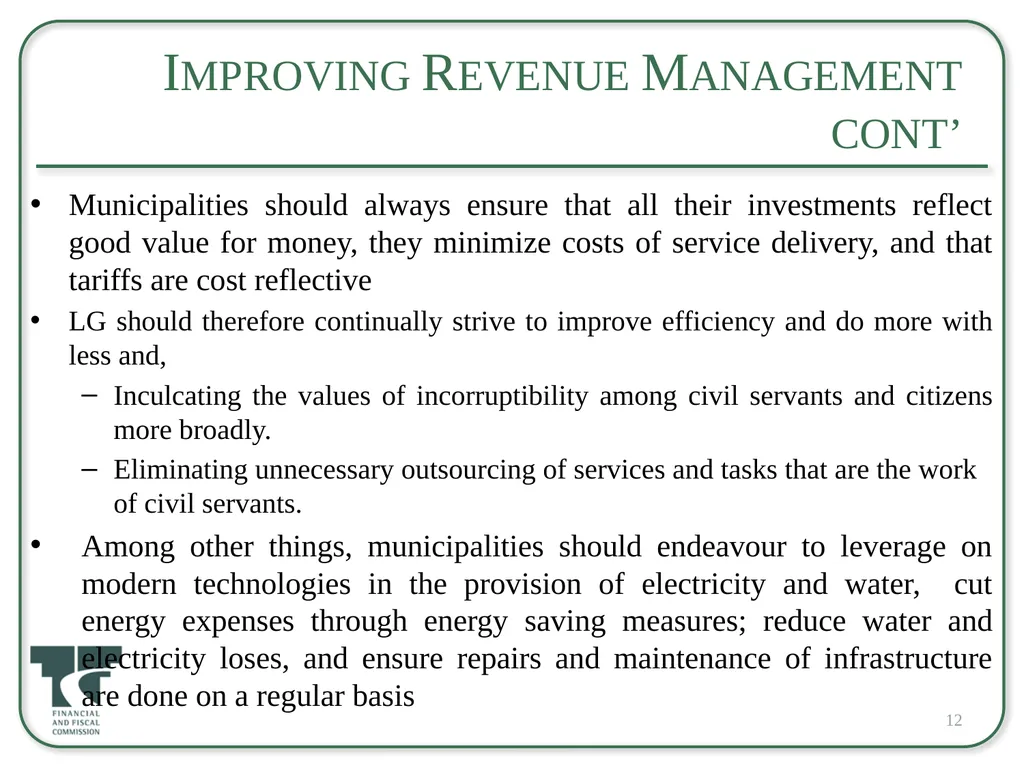
slide12. Improving Revenue Management cont’ Municipalities should always ensure that all their investments reflect good value for money, they minimize costs of service delivery, and that tariffs are cost reflective
LG should therefore continually strive to improve efficiency and do more with less and,
Inculcating the values of incorruptibility among civil servants and citizens more broadly.
Eliminating unnecessary outsourcing of services and tasks that are the work of civil servants.
Among other things, municipalities should endeavour to leverage on modern technologies in the provision of electricity and water, cut energy expenses through energy saving measures; reduce water and electricity loses, and ensure repairs and maintenance of infrastructure are done on a regular basis 12<br>
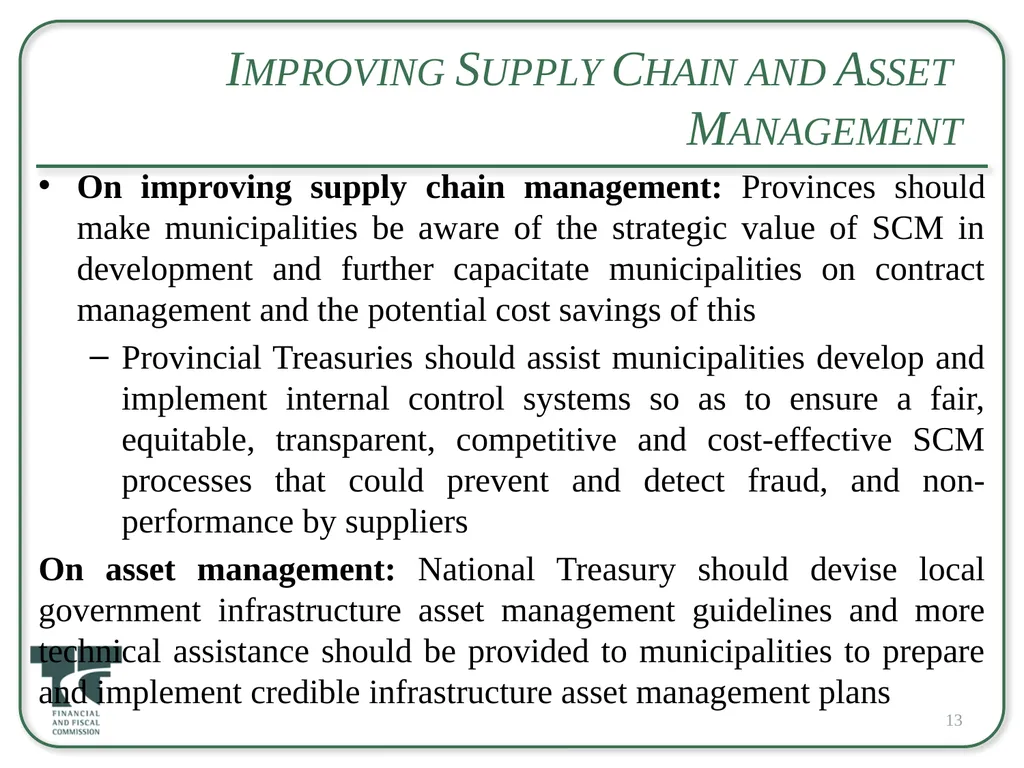
slide13. Improving Supply Chain and Asset Management On improving supply chain management: Provinces should make municipalities be aware of the strategic value of SCM in development and further capacitate municipalities on contract management and the potential cost savings of this
Provincial Treasuries should assist municipalities develop and implement internal control systems so as to ensure a fair, equitable, transparent, competitive and cost-effective SCM processes that could prevent and detect fraud, and non-performance by suppliers
On asset management: National Treasury should devise local government infrastructure asset management guidelines and more technical assistance should be provided to municipalities to prepare and implement credible infrastructure asset management plans 13<br>
slide14. Resolving Debt issues On resolving the debt question:
The approach to debt should be fair and not one sided. Similar pressures should be exerted to all spheres of government to honor their debt. Compliance with the 30 day payment rule should be enforced on municipalities, national and provincial government departments and entities alike
A proper diagnostics of the root cause of non-payment be done and if it is due to bad management, there should be appropriate consequences
Stricter measures should be imposed on individuals within municipalities that are responsible for continued flouting of MFMA rules.
Electricity and water undertakings must be ring fenced. 14<br>
slide15. Other Areas for oversight On costs of basic services: The Local Government Equitable Share and conditional grants should be informed by objectively derived cost estimates, without which the viability of municipalities will always be under threat
On admin vs core services costs: Municipalities need to maintain a health balance between costs associated with administration and core services
On unfunded mandates: It is important that prior to accepting and implementation of assigned and delegated additional functions or powers, some legally binding agreement between parties involved is entered into.
On improving municipal capacity: there is a need for thorough coordination, and building of capacity of provinces and districts as well as capacity of local political leadership. Support should be based on municipality needs and there should be capacity to monitor capacity building programmes. Consultants and experts should be hired on condition they build internal capacity. 15<br>
slide16. Revenue Enhancement Innovative revenue source should be explored:
Pooling Finance Mechanisms (i.e. municipalities that share, inter alia, a similar vision and credit characteristics coming together to access public sector funding, issue bonds or jointly access bank finance) satisfy most of the principles that define a good revenue option for large cities
Land Value Capture: (i.e. seizing the positive impact of municipal investments on land values and to use such funds as a source for financing municipal projects), are a potential source of revenue for large cities and successful implementation of this mechanism depends largely on the proper design of levy, a clear legal framework, effective land use management systems, well trained and capacitated persons charged with its implementation, and an efficient, accurate and timely land valuation
Public private partnerships constitute another viable alternative mechanisms for funding infrastructure in large cities, and require that the approval process is streamlined and specialised capacity to originate, implement and manage PPPs within municipalities is built 16<br>
slide17. Revenue Enhancement Reiterating FFC’s previous recommendations
National Treasury improves access to credit markets for large cities by:
Allowing them to use their infrastructure grant funding allocations to leverage private capital.
Establishing a credit rating mechanism for municipalities with the Development Bank of Southern Africa as the most suitable public entity to lead the establishment of this
Requesting the Development Bank of Southern Africa to facilitate the creation of a special purpose vehicle to facilitate the pooling of financial resources by large cities for the purpose of joint bond issuance and lending to large cities
The Public Private Partnership Unit at National Treasury improves the public-private partnership deal flows within municipalities by:
Streamlining the PPP approval process by subjecting only high value (above R100 million) and complex projects to rigorous feasibility studies
Using the Financial Management Grant to build capacity within large cities in specialised skills in public-private partnership development, procurement, negotiating and monitoring.
Incentivising public-private partnerships through adopting a national facility for financing feasibility studies in municipalities
National Treasury creates awareness of land value capture fiscal instruments among large cities and extends the scope of the Financial Management Grant to cater for capacity building in the design and implementation of land value capture mechanisms 17<br>
slide18. Funding of DMs There is a need for a long term sustainable funding model for DMs, which should be based on the outcomes of the review of DM functions being undertaken by CoGTA.
Developing a sustainable funding model for DMs will require a clear specification of the powers and functions of DMs, a proper appreciation of the situational context and interrelationship with local municipalities, and a clear link between funding and functions
FFC notes and agrees that clarity on the functions and powers of DMs is needed as the first key step. Thus FFC would encourage Cogta to speed up the process of reviewing the functions of DMs. 18<br>
slide19. Concluding Remarks Many stakeholders have responded to the Back to Basics programme, and thus municipalities have received huge support (both financial and non financial) from a number of stakeholders.
It should be noted that failures characterising many municipalities are a result of both bad behaviour and poor performance. Thus the support for municipalities should be based on a firm understanding and a proper diagnostics of the root causes of municipal failures
There is therefore a need for robust coordination of different programmes and stakeholders and responsibilities carefully defined. A long term view should always be taken for any municipality support initiative
Support should be targeted to officials as well as local political leadership. Districts and provincial authorities should be targeted for capacity building initiatives so that they are effective in assisting local municipalities 19<br>
slide20. Thank You. Financial and Fiscal Commission
Montrose Place (2nd Floor), Bekker Street,
Waterfall Park, Vorna Valley, Midrand,
Private Bag X69, Halfway House 1685
www.ffc.co.za
Tel: +27 11 207 2300
Fax: +27 86 589 1038<br>
slide21. www.ffc.co.za 21<br>
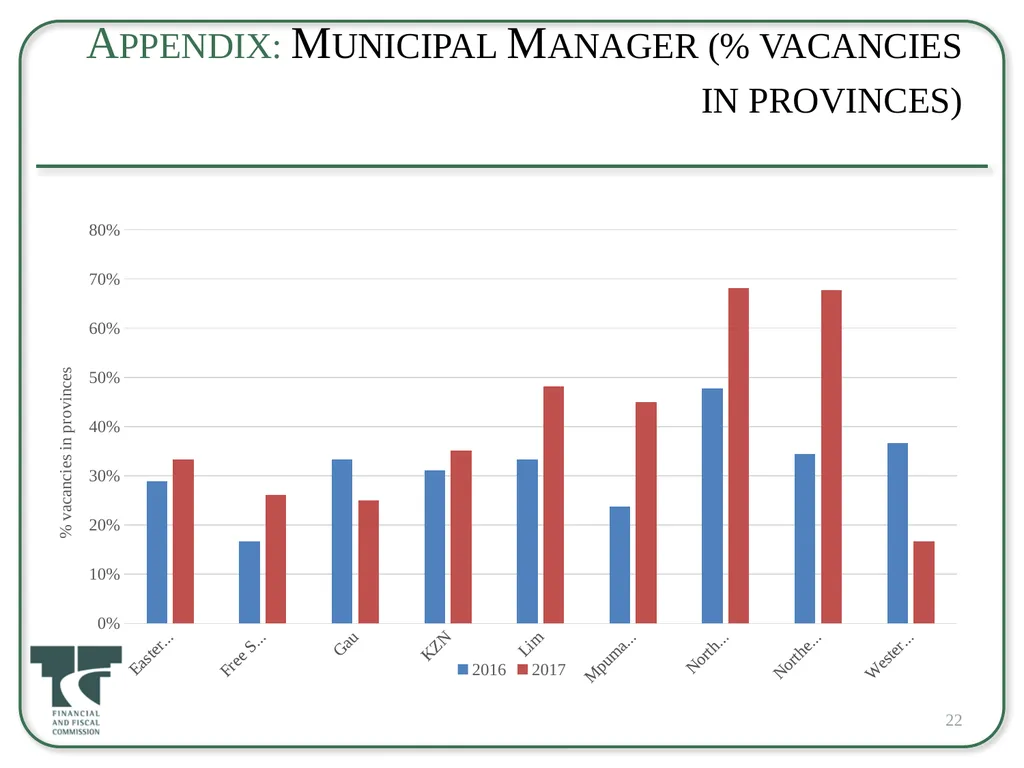
slide22. Appendix: Municipal Manager (% vacancies in provinces) 22<br>
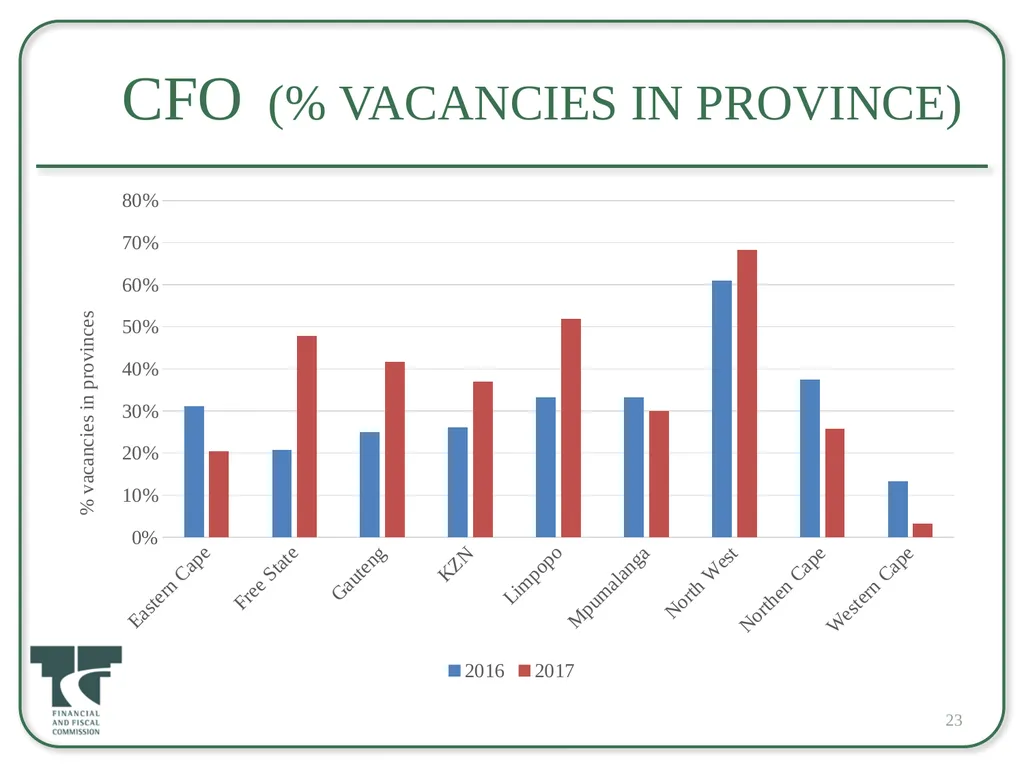
slide23. CFO (% vacancies in province) 23<br>
slide2. Background to the Submission In 2014 former Minister Pravin Gordhan indicated that:
a third of the municipalities are functioning well, a third were at risk, and another third were dysfunctional”. Then a remedial plan was announced- Back to Basics.
Assessed four years later, Cogta’s notes a less than encouraging picture
On 21 March 2018, the minister of Cogta, Dr Zweli Mkize, noted the following:
Only 7 % of municipalities are well-functioning; 31 % are reasonably functional
31% are almost dysfunctional; and 31 % are dysfunctional.
It would appear that there has been a downward trend: from the third at risk to become dysfunctional in 2014, most of them have become almost dysfunctional.
The AG has also noted the same picture. The audit report on municipal accounts (2015-16) stated that: “the financial health of 65% of the municipalities was either concerning or requiring intervention”. He noted that in total, 27% of municipalities were in “a particularly poor financial position by the end of 2015-16, with material uncertainty with regard to their ability to continue operating in the foreseeable future”.
Of the 55 municipalities regarded as dysfunctional, half of them (27) are district municipalities, that is to say, over 60 % of all DMs are dysfunctional. 2<br>
slide3. A Summary of the Risks to the Financial Sustainability of Municipalities 3<br>
slide4. The Economy and Revenue pressures Slowdown of the Economy: The economy which has been in a recession poses a serious risk to the financial viability of LG that is transfer dependent:
The decade-long trend of low growth that has characterised the South African economy has placed the country’s public finances under severe strain, and moreso revenues available for sharing
Fiscal consolidation measures, accompanied by cuts in grant baselines, have also worsened the fiscal situation of LGs
Low economic growth has also left ratepayers under severe stress, and many failing to service their debts with SNGs, adding more pressure to the budgets of SNGs
Low GDP implies revenues available for sharing are squeezed
Poor revenue management: Main challenges in revenue management in municipalities include:
Poor internal controls, cash flow management and operational inefficiencies, tariff structures that are not always cost reflective, poor billing and debt management, Leakages (funds not used for municipal business), Corruption, Under-spending and Inefficient procurement
Inadequate capacity within municipalities in revenue management and tariff setting 4<br>
slide5. Asset Management, SCM and debt Poor asset management: Evidence shows a mismatch between repair and maintenance requirements within municipalities and the resources for infrastructure rehabilitation- non adherence to 8% of the value of assets being spent on their maintenance. Spending for new assets prioritised.
Poor Supply Chain Management: Inefficient procurement in municipalities is a challenge as shown by high incidences of irregular and wasteful spending.
There is lack of proper supply chain management systems in place; Culture of non-compliance and lack of accountability; Profiting from procurement has become endemic. Lack of skills, knowledge and capacity in SCM; Strategic importance of SCM not appreciated and thus under-capacitated: Currently, SCM falls under the finance departments- It is not seen as a core, not valued and of strategic importance
Ballooning municipal debt: municipalities were owed R128 billion (2016/17), an increase from R87 billion (2012/13). However, municipalities owed different creditors about R44 billion in 2016/17, an increase from R18 billion in 2012/13. 5<br>
slide6. Unfunded Mandates and cost of basic services Unfunded Mandates: Lack of proper service level agreements where municipalities perform functions on behalf of provinces and national departments which translates into unfunded (or under funded) mandates, e.g. library and primary health services, etc.
Unfunded mandates result in the diversion of financial resources from municipal core functions u
Cost of basic services: The adequacy of the LES is also not clear because no one has a good grasp of the cost of basic services in different municipalities. Ideally the LES needs to be based on a sound costing framework for basic goods and services.
FFC-SALGA Model: The costs are measured and they depend on various factors, including the levels of services provided, technology used, materials chosen, the extent to which labour intensive methods are used, the scale of infrastructure works, geology, topography.
e 6<br>
slide7. Municipal Capacity Current Programmes to strengthen municipal capacity are many and include
Local Govt. Turnaround Strategy (LGTAS)
Municipal Infrastructure Support Agency (MISA)
NTs Local Government Financial Management Reform Agenda
Section 139 Constitutional Interventions
City Support Programme (CSP)
LG SETA, PALAMA, DBSA’s Vulindlela Academy
SALGA’s support programmes
Sector departments, parastatals, the Auditor-General’s Office, professional bodies, educational institutions and trade unions
Provincial Municipal Support
The main challenge is lack of coordination and roles and responsibilities of different stakeholders are poorly defined. This has resulted in fragmented and overlapping capacity building initiatives – and obviously wastage of resources 7<br>
slide8. Other risks Municipal expenditure appears not to focus on core business – service delivery.
Municipalities do not maintain a healthy balance between costs associated with administration/personnel and core services
Scarce resources are often expended on personnel, not services.
Weak municipal accountability and oversight institutions: FFC research showed that oversight committees in municipalities (i.e. Municipal Public Accountability Committees and Audit Committees) are not adequately empowered with research capacity to effectively hold the executives to account
Poor governance and management instability: Many municipalities are facing very high vacancy rates at senior levels resulting in important decisions to be deferred
Frequent amalgamations of municipalities: FFC research has shown that amalgamations are costly and will not necessarily result in financially viable municipalities, and in many cases the situation within demarcated municipalities will worsen. 8<br>
slide9. Precarious Situation of DMs Funding of DMs and Powers and Functions –
The misalignment of funding to district and local municipalities has remained unresolved and this affects the viability of DMs
Current funding model for DMs has received a lot of criticism, especially the RSC replacement grant allocations.
Also the division of powers envisaged in section 84 of the MSA has been adjusted and re-adjusted in many provinces making it difficult to find a fair funding model for DMs very difficult.
“The MEC for local government in a province may, subject to the other provisions of this section, adjust the division of functions and powers between a district and a local municipality as set out in section 84 (1) or (2)”, allocating any of the remaining functions and powers vested in the district municipality to local municipality and vice versa
The exercise of these powers by the MEC has, then, the potential effect of creating a de facto asymmetrical system of allocation across districts. 9<br>
slide10. Possible Solutions<br>
slide11. Improving Revenue Management On revenue management: FFC is aware that optimisation of current revenue sources would be a herculean task for municipalities considering the prevailing fiscal constraints, increased unemployment levels and a rise in poor households which necessitate municipalities to widen its indigent support.
FFC recommends provincial governments, especially Provincial Treasuries should assist municipalities prepare credible debt management policies and strategies, improve databases and information to support correct billing, and improve credit control procedures: In all this municipalities should be encouraged to invest in technology to enhance billing
Commission has also found that accountability committees in many municipalities lack capacity to scrutinise, interpret and analyse information on fiscal and financial matters - information that can be used to hold executives to account
Thus there is a need to strengthen accountability structures within the local government. Committees should be provided with adequate technical and research support, and sufficient resources to engage with executives and account to the communities. 11<br>
slide12. Improving Revenue Management cont’ Municipalities should always ensure that all their investments reflect good value for money, they minimize costs of service delivery, and that tariffs are cost reflective
LG should therefore continually strive to improve efficiency and do more with less and,
Inculcating the values of incorruptibility among civil servants and citizens more broadly.
Eliminating unnecessary outsourcing of services and tasks that are the work of civil servants.
Among other things, municipalities should endeavour to leverage on modern technologies in the provision of electricity and water, cut energy expenses through energy saving measures; reduce water and electricity loses, and ensure repairs and maintenance of infrastructure are done on a regular basis 12<br>
slide13. Improving Supply Chain and Asset Management On improving supply chain management: Provinces should make municipalities be aware of the strategic value of SCM in development and further capacitate municipalities on contract management and the potential cost savings of this
Provincial Treasuries should assist municipalities develop and implement internal control systems so as to ensure a fair, equitable, transparent, competitive and cost-effective SCM processes that could prevent and detect fraud, and non-performance by suppliers
On asset management: National Treasury should devise local government infrastructure asset management guidelines and more technical assistance should be provided to municipalities to prepare and implement credible infrastructure asset management plans 13<br>
slide14. Resolving Debt issues On resolving the debt question:
The approach to debt should be fair and not one sided. Similar pressures should be exerted to all spheres of government to honor their debt. Compliance with the 30 day payment rule should be enforced on municipalities, national and provincial government departments and entities alike
A proper diagnostics of the root cause of non-payment be done and if it is due to bad management, there should be appropriate consequences
Stricter measures should be imposed on individuals within municipalities that are responsible for continued flouting of MFMA rules.
Electricity and water undertakings must be ring fenced. 14<br>
slide15. Other Areas for oversight On costs of basic services: The Local Government Equitable Share and conditional grants should be informed by objectively derived cost estimates, without which the viability of municipalities will always be under threat
On admin vs core services costs: Municipalities need to maintain a health balance between costs associated with administration and core services
On unfunded mandates: It is important that prior to accepting and implementation of assigned and delegated additional functions or powers, some legally binding agreement between parties involved is entered into.
On improving municipal capacity: there is a need for thorough coordination, and building of capacity of provinces and districts as well as capacity of local political leadership. Support should be based on municipality needs and there should be capacity to monitor capacity building programmes. Consultants and experts should be hired on condition they build internal capacity. 15<br>
slide16. Revenue Enhancement Innovative revenue source should be explored:
Pooling Finance Mechanisms (i.e. municipalities that share, inter alia, a similar vision and credit characteristics coming together to access public sector funding, issue bonds or jointly access bank finance) satisfy most of the principles that define a good revenue option for large cities
Land Value Capture: (i.e. seizing the positive impact of municipal investments on land values and to use such funds as a source for financing municipal projects), are a potential source of revenue for large cities and successful implementation of this mechanism depends largely on the proper design of levy, a clear legal framework, effective land use management systems, well trained and capacitated persons charged with its implementation, and an efficient, accurate and timely land valuation
Public private partnerships constitute another viable alternative mechanisms for funding infrastructure in large cities, and require that the approval process is streamlined and specialised capacity to originate, implement and manage PPPs within municipalities is built 16<br>
slide17. Revenue Enhancement Reiterating FFC’s previous recommendations
National Treasury improves access to credit markets for large cities by:
Allowing them to use their infrastructure grant funding allocations to leverage private capital.
Establishing a credit rating mechanism for municipalities with the Development Bank of Southern Africa as the most suitable public entity to lead the establishment of this
Requesting the Development Bank of Southern Africa to facilitate the creation of a special purpose vehicle to facilitate the pooling of financial resources by large cities for the purpose of joint bond issuance and lending to large cities
The Public Private Partnership Unit at National Treasury improves the public-private partnership deal flows within municipalities by:
Streamlining the PPP approval process by subjecting only high value (above R100 million) and complex projects to rigorous feasibility studies
Using the Financial Management Grant to build capacity within large cities in specialised skills in public-private partnership development, procurement, negotiating and monitoring.
Incentivising public-private partnerships through adopting a national facility for financing feasibility studies in municipalities
National Treasury creates awareness of land value capture fiscal instruments among large cities and extends the scope of the Financial Management Grant to cater for capacity building in the design and implementation of land value capture mechanisms 17<br>
slide18. Funding of DMs There is a need for a long term sustainable funding model for DMs, which should be based on the outcomes of the review of DM functions being undertaken by CoGTA.
Developing a sustainable funding model for DMs will require a clear specification of the powers and functions of DMs, a proper appreciation of the situational context and interrelationship with local municipalities, and a clear link between funding and functions
FFC notes and agrees that clarity on the functions and powers of DMs is needed as the first key step. Thus FFC would encourage Cogta to speed up the process of reviewing the functions of DMs. 18<br>
slide19. Concluding Remarks Many stakeholders have responded to the Back to Basics programme, and thus municipalities have received huge support (both financial and non financial) from a number of stakeholders.
It should be noted that failures characterising many municipalities are a result of both bad behaviour and poor performance. Thus the support for municipalities should be based on a firm understanding and a proper diagnostics of the root causes of municipal failures
There is therefore a need for robust coordination of different programmes and stakeholders and responsibilities carefully defined. A long term view should always be taken for any municipality support initiative
Support should be targeted to officials as well as local political leadership. Districts and provincial authorities should be targeted for capacity building initiatives so that they are effective in assisting local municipalities 19<br>
slide20. Thank You. Financial and Fiscal Commission
Montrose Place (2nd Floor), Bekker Street,
Waterfall Park, Vorna Valley, Midrand,
Private Bag X69, Halfway House 1685
www.ffc.co.za
Tel: +27 11 207 2300
Fax: +27 86 589 1038<br>
slide21. www.ffc.co.za 21<br>
slide22. Appendix: Municipal Manager (% vacancies in provinces) 22<br>
slide23. CFO (% vacancies in province) 23<br>