BACKGROUND RESULTS METHODS CONCLUSION
Description: BACKGROUND RESULTS METHODS CONCLUSION Interprofessional education (IPE) is an accreditation standard for medical and pharmacy schools to ensure students are prepared for effective collaboration in health care settings. An IPE curricular
Related Topics
Download Presentation
"BACKGROUND RESULTS METHODS CONCLUSION" is the property of its rightful owner. Permission is granted to download and print the materials on this website for personal, non-commercial use only, and to display it on your personal computer provided you do not modify the materials and that you retain all copyright notices contained in the materials. By downloading content from our website, you accept the terms of this agreement.
Presentation Transcript
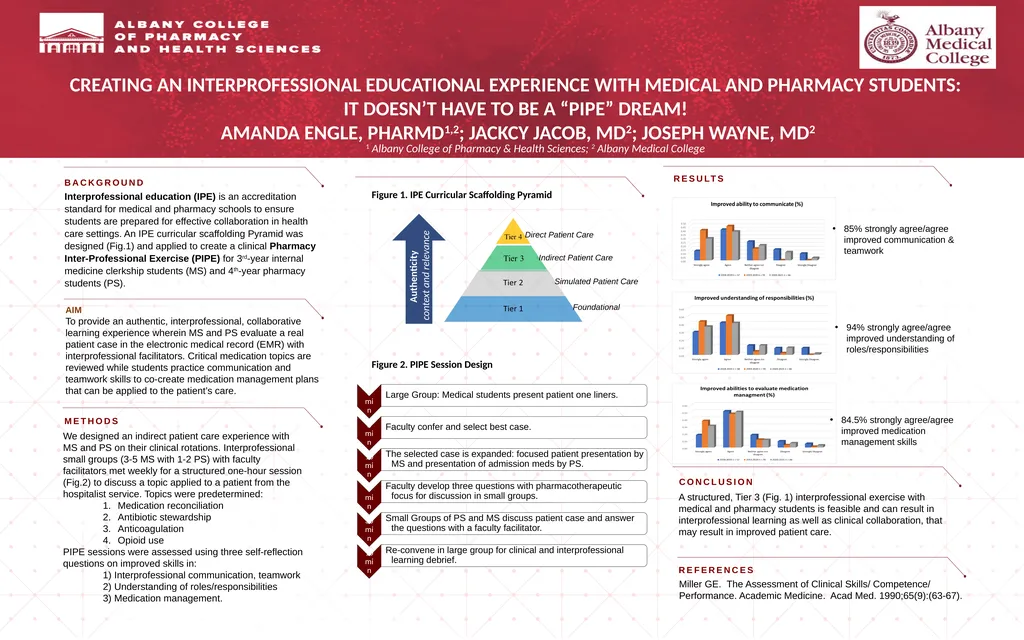
slide1. BACKGROUND RESULTS METHODS CONCLUSION Interprofessional education (IPE) is an accreditation standard for medical and pharmacy schools to ensure students are prepared for effective collaboration in health care settings. An IPE curricular scaffolding Pyramid was designed (Fig.1) and applied to create a clinical Pharmacy Inter-Professional Exercise (PIPE) for 3rd-year internal medicine clerkship students (MS) and 4th-year pharmacy students (PS). We designed an indirect patient care experience with MS and PS on their clinical rotations. Interprofessional small groups (3-5 MS with 1-2 PS) with faculty facilitators met weekly for a structured one-hour session (Fig.2) to discuss a topic applied to a patient from the hospitalist service. Topics were predetermined:
Medication reconciliation
Antibiotic stewardship
Anticoagulation
Opioid use
PIPE sessions were assessed using three self-reflection questions on improved skills in:
1) Interprofessional communication, teamwork
2) Understanding of roles/responsibilities
3) Medication management. A structured, Tier 3 (Fig. 1) interprofessional exercise with medical and pharmacy students is feasible and can result in interprofessional learning as well as clinical collaboration, that may result in improved patient care. REFERENCES Miller GE. The Assessment of Clinical Skills/ Competence/ Performance. Academic Medicine. Acad Med. 1990;65(9):(63-67). CREATING AN INTERPROFESSIONAL EDUCATIONAL EXPERIENCE WITH MEDICAL AND PHARMACY STUDENTS:
IT DOESN’T HAVE TO BE A “PIPE” DREAM!
AMANDA ENGLE, PHARMD1,2; JACKCY JACOB, MD2; JOSEPH WAYNE, MD2 1 Albany College of Pharmacy & Health Sciences; 2 Albany Medical College Figure 2. PIPE Session Design Figure 1. IPE Curricular Scaffolding Pyramid Authenticity
context and relevance 85% strongly agree/agree improved communication & teamwork AIM
To provide an authentic, interprofessional, collaborative learning experience wherein MS and PS evaluate a real patient case in the electronic medical record (EMR) with interprofessional facilitators. Critical medication topics are reviewed while students practice communication and teamwork skills to co-create medication management plans that can be applied to the patient’s care. 94% strongly agree/agree improved understanding of roles/responsibilities 84.5% strongly agree/agree improved medication management skills<br>

Medication reconciliation
Antibiotic stewardship
Anticoagulation
Opioid use
PIPE sessions were assessed using three self-reflection questions on improved skills in:
1) Interprofessional communication, teamwork
2) Understanding of roles/responsibilities
3) Medication management. A structured, Tier 3 (Fig. 1) interprofessional exercise with medical and pharmacy students is feasible and can result in interprofessional learning as well as clinical collaboration, that may result in improved patient care. REFERENCES Miller GE. The Assessment of Clinical Skills/ Competence/ Performance. Academic Medicine. Acad Med. 1990;65(9):(63-67). CREATING AN INTERPROFESSIONAL EDUCATIONAL EXPERIENCE WITH MEDICAL AND PHARMACY STUDENTS:
IT DOESN’T HAVE TO BE A “PIPE” DREAM!
AMANDA ENGLE, PHARMD1,2; JACKCY JACOB, MD2; JOSEPH WAYNE, MD2 1 Albany College of Pharmacy & Health Sciences; 2 Albany Medical College Figure 2. PIPE Session Design Figure 1. IPE Curricular Scaffolding Pyramid Authenticity
context and relevance 85% strongly agree/agree improved communication & teamwork AIM
To provide an authentic, interprofessional, collaborative learning experience wherein MS and PS evaluate a real patient case in the electronic medical record (EMR) with interprofessional facilitators. Critical medication topics are reviewed while students practice communication and teamwork skills to co-create medication management plans that can be applied to the patient’s care. 94% strongly agree/agree improved understanding of roles/responsibilities 84.5% strongly agree/agree improved medication management skills<br>