
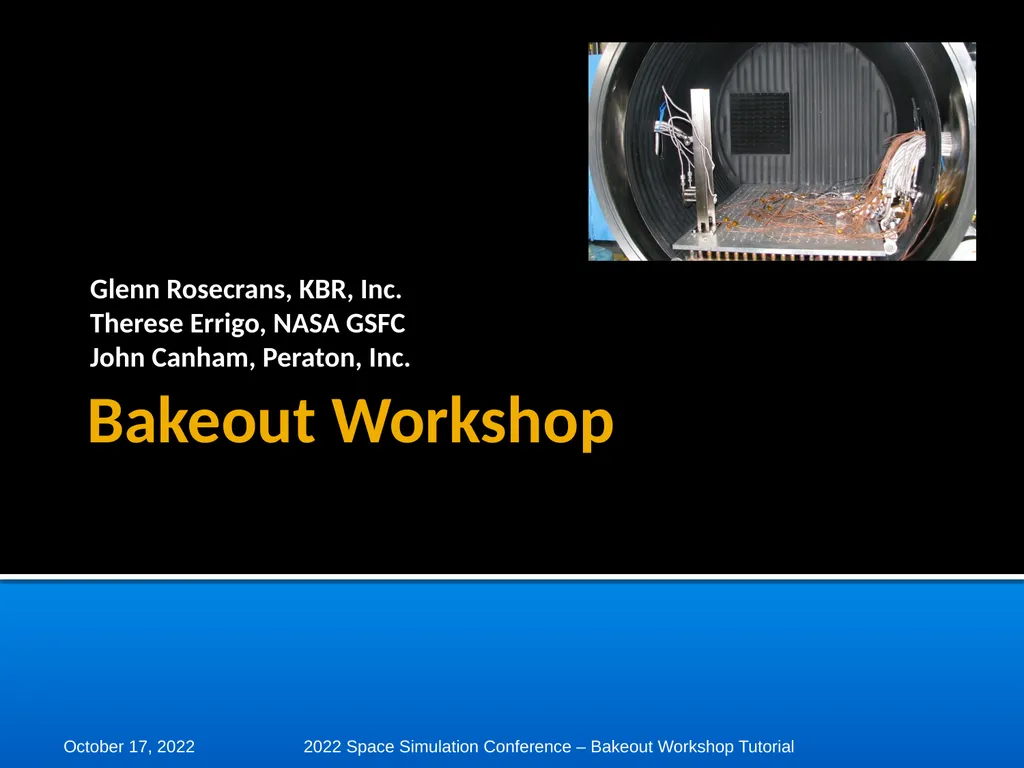
Bakeout Workshop Glenn Rosecrans, KBR, Inc.
Description: Bakeout Workshop Glenn Rosecrans, KBR, Inc. Therese Errigo, NASA GSFC John Canham, Peraton, Inc. October 17, 2022 2022 Space Simulation Conference Bakeout Workshop Tutorial Agenda Outgassing and Outgassing Certifications What is
Related Topics
Download Presentation
"Bakeout Workshop Glenn Rosecrans, KBR, Inc." is the property of its rightful owner. Permission is granted to download and print the materials on this website for personal, non-commercial use only, and to display it on your personal computer provided you do not modify the materials and that you retain all copyright notices contained in the materials. By downloading content from our website, you accept the terms of this agreement.
Presentation Transcript
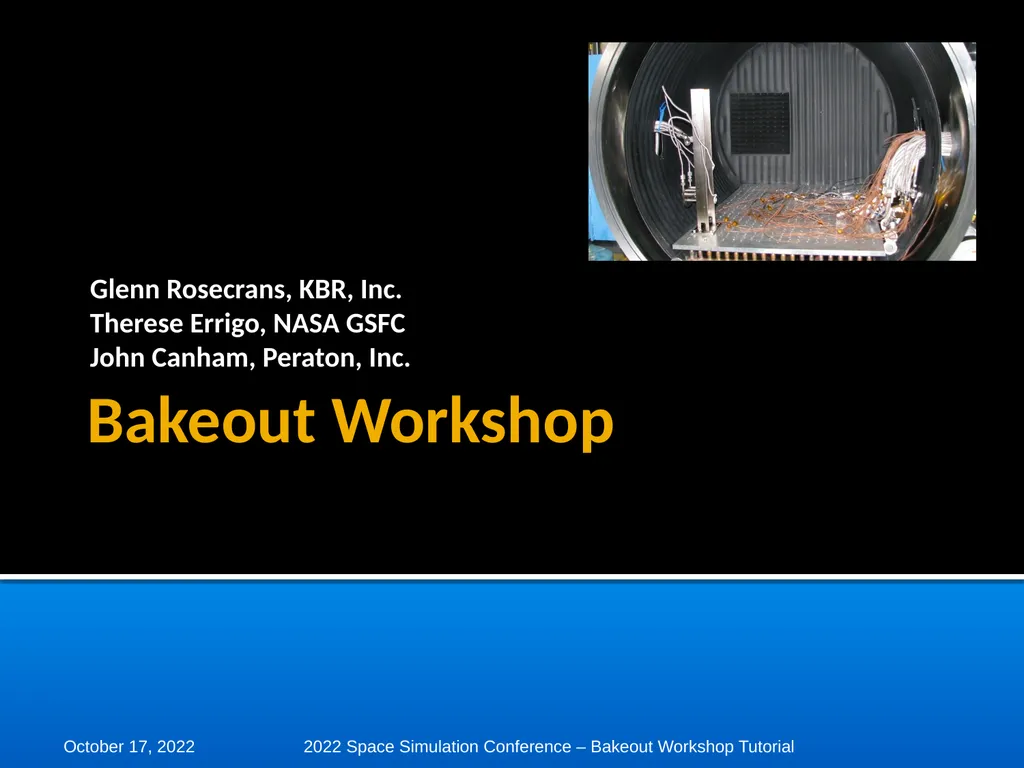
slide1. Bakeout Workshop Glenn Rosecrans, KBR, Inc.
Therese Errigo, NASA GSFC
John Canham, Peraton, Inc. October 17, 2022 2022 Space Simulation Conference – Bakeout Workshop Tutorial<br>
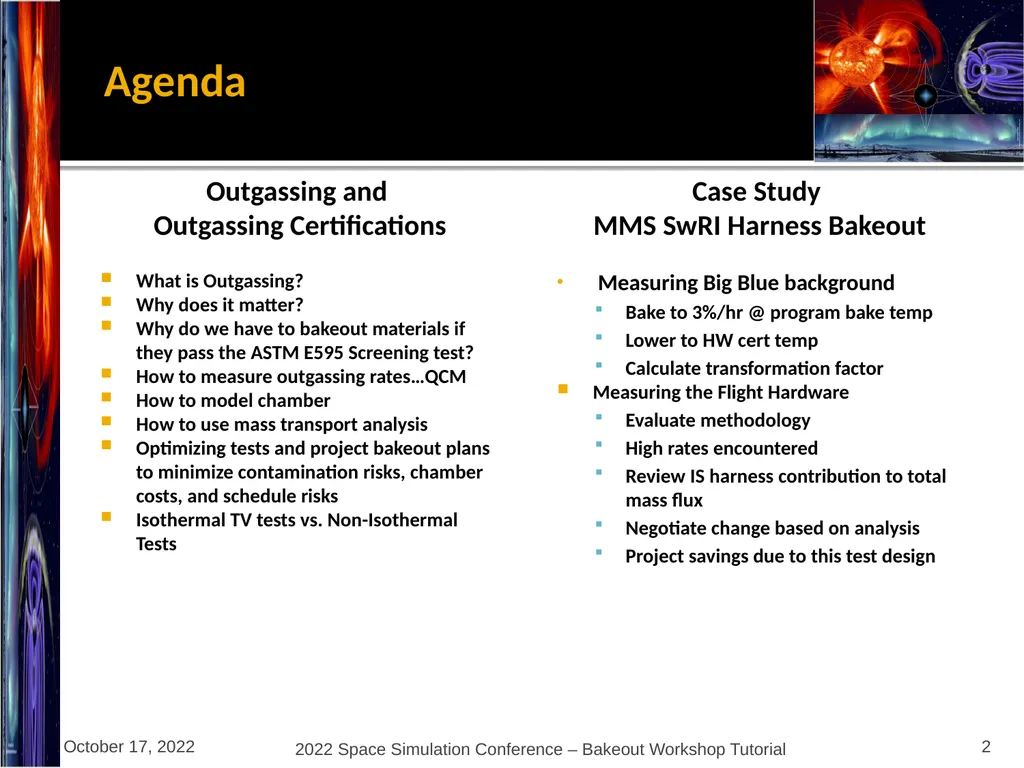
slide2. Agenda Outgassing and
Outgassing Certifications
What is Outgassing?
Why does it matter?
Why do we have to bakeout materials if they pass the ASTM E595 Screening test?
How to measure outgassing rates…QCM
How to model chamber
How to use mass transport analysis
Optimizing tests and project bakeout plans to minimize contamination risks, chamber costs, and schedule risks
Isothermal TV tests vs. Non-Isothermal Tests Case Study
MMS SwRI Harness Bakeout
Measuring Big Blue background
Bake to 3%/hr @ program bake temp
Lower to HW cert temp
Calculate transformation factor
Measuring the Flight Hardware
Evaluate methodology
High rates encountered
Review IS harness contribution to total mass flux
Negotiate change based on analysis
Project savings due to this test design October 17, 2022 2 2022 Space Simulation Conference – Bakeout Workshop Tutorial<br>
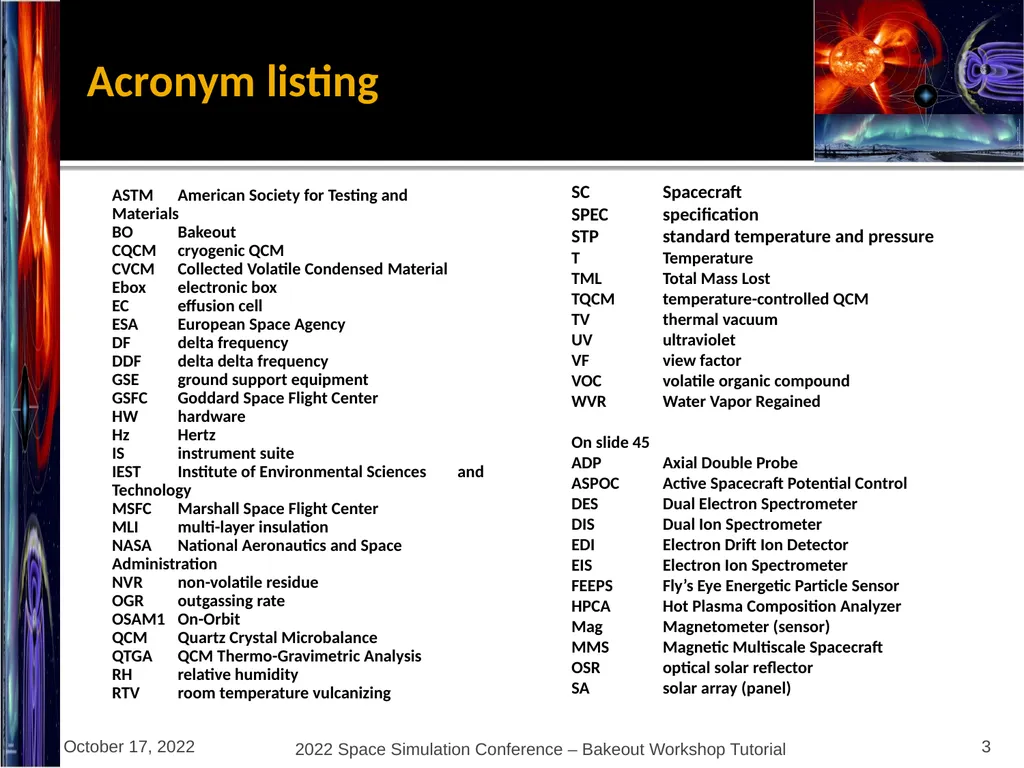
slide3. Acronym listing October 17, 2022 3 2022 Space Simulation Conference – Bakeout Workshop Tutorial ASTM American Society for Testing and Materials
BO Bakeout
CQCM cryogenic QCM
CVCM Collected Volatile Condensed Material
Ebox electronic box
EC effusion cell
ESA European Space Agency
DF delta frequency
DDF delta delta frequency
GSE ground support equipment
GSFC Goddard Space Flight Center
HW hardware
Hz Hertz
IS instrument suite
IEST Institute of Environmental Sciences and Technology
MSFC Marshall Space Flight Center
MLI multi-layer insulation
NASA National Aeronautics and Space Administration
NVR non-volatile residue
OGR outgassing rate
OSAM1 On-Orbit
QCM Quartz Crystal Microbalance
QTGA QCM Thermo-Gravimetric Analysis
RH relative humidity
RTV room temperature vulcanizing SC Spacecraft
SPEC specification
STP standard temperature and pressure
T Temperature
TML Total Mass Lost
TQCM temperature-controlled QCM
TV thermal vacuum
UV ultraviolet
VF view factor
VOC volatile organic compound
WVR Water Vapor Regained
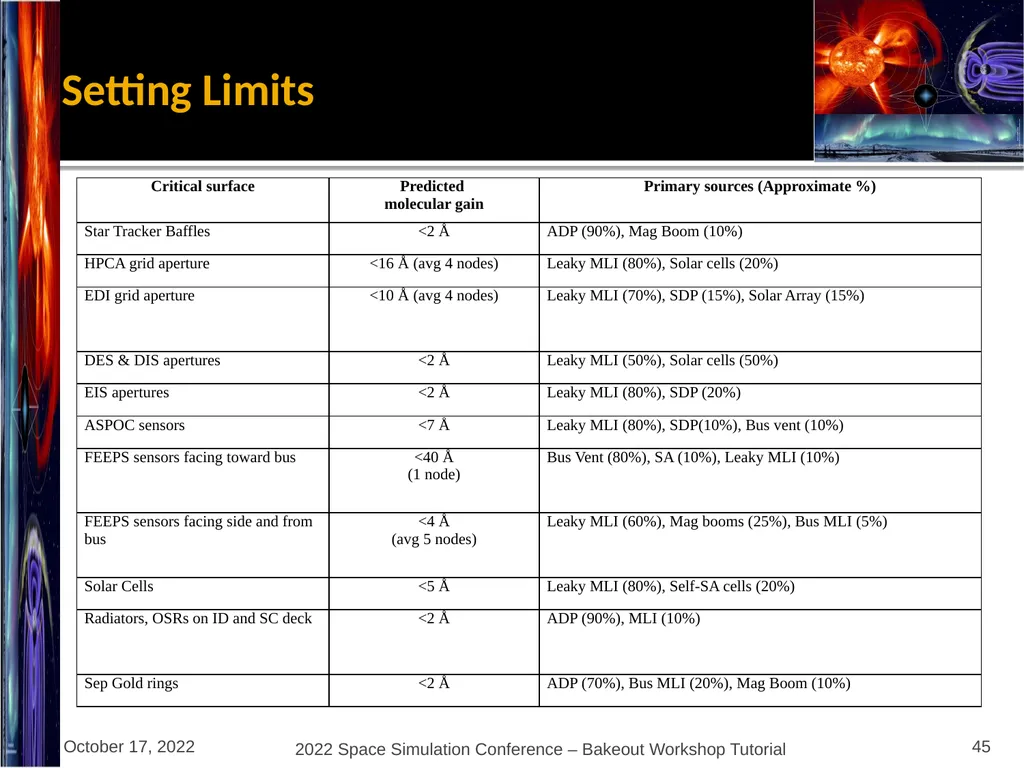
On slide 45
ADP Axial Double Probe
ASPOC Active Spacecraft Potential Control
DES Dual Electron Spectrometer
DIS Dual Ion Spectrometer
EDI Electron Drift Ion Detector
EIS Electron Ion Spectrometer
FEEPS Fly’s Eye Energetic Particle Sensor
HPCA Hot Plasma Composition Analyzer
Mag Magnetometer (sensor)
MMS Magnetic Multiscale Spacecraft
OSR optical solar reflector
SA solar array (panel)<br>
slide4. Who? What? Why? Flight and Ground Support Equipment (GSE) hardware have requirements levied in Contamination Control Plans to measure the hardware outgassing rate.
Mass transport analyses are performed to assess contamination risks to optics, detectors, and thermal surfaces.
Conduct outgassing rate verifications in Thermal Vacuum (TV) chambers, while obtaining low space-like vacuum pressure, either as a tack onto a Thermal validation test or separate TV test.
Bakeouts help expedite the release of volatile molecules from the bulk material. Typically, performed at maximum survival temperature of the hardware.
Certification enables the chance to validate that the outgassing rate had been achieved at the hardware’s predicted hot operating temperature. October 17, 2022 4 2022 Space Simulation Conference – Bakeout Workshop Tutorial<br>
slide5. Molecular Depositions Affect Hardware Performance and Science Absorption (reduction in transmission, reflectance in optical or sensors wavelength of interest)
Scattering (dependent upon deposition pattern and wavelength)
Sticking of mechanical mechanisms (Lube loss, too much?)
Corrosion during ground operations (if incompatible with substrate)
Changes in polarization states of electromagnetic energy (acts as a thin film)
Attenuation or stopping of ionizing radiation before it reaches detectors
Localized increase in pressure resulting in catastrophic failure of high voltage components (corona discharge) October 17, 2022 5 2022 Space Simulation Conference – Bakeout Workshop Tutorial<br>
slide6. Outgassing Sources - NVR and Bulk Offgassing Non-Volatile Residue (NVR) is a condensed film or a contact transferred molecular film
On the ground, NVR or Molecular Film deposits result from two phenomena:
Contact with a contaminated or contaminating surface or material — for example, fingerprints, adhesive tape residues, lubricants, residues from manufacturing processes, greases, silicones, bare hands, etc.
Condensation of airborne molecular organic contamination
Many materials in our environment give off volatile (gaseous) organic compounds (VOC). Examples include: paint, adhesives, machine lubricating greases, engine exhausts, solvents, plasticizers in plastics.
VOCs can condense and form an NVR film on a surface whenever their concentration in the air is too high or whenever they come in contact with a cool condensing surface. Examples, include films on windows after painting and condensation on mirrors in shower October 17, 2022 6 2022 Space Simulation Conference – Bakeout Workshop Tutorial<br>
slide7. Outgassing Sources – NVR, Offgassing, Outgassing Not many contamination sensitive industries have the same level of concern for molecular contamination as the satellite industry
Strong solvents and commercial cleaning agents usually cannot be used to remove contaminants unlike other industries where such strong agents can be used.
Time to integrate satellites is very long (months, even years) as compared to most other contamination sensitive hardware
Sensors used in satellites can be sensitive to levels of contamination in the angstrom (1E-10 m, 1E-4 um) range
In vacuum, NVR / molecular films result when materials outgas from one surface and deposit onto another, usually cooler, surface. Contaminants inside electronic boxes for example can outgas and exit through openings and deposit on colder surfaces. October 17, 2022 7 2022 Space Simulation Conference – Bakeout Workshop Tutorial<br>
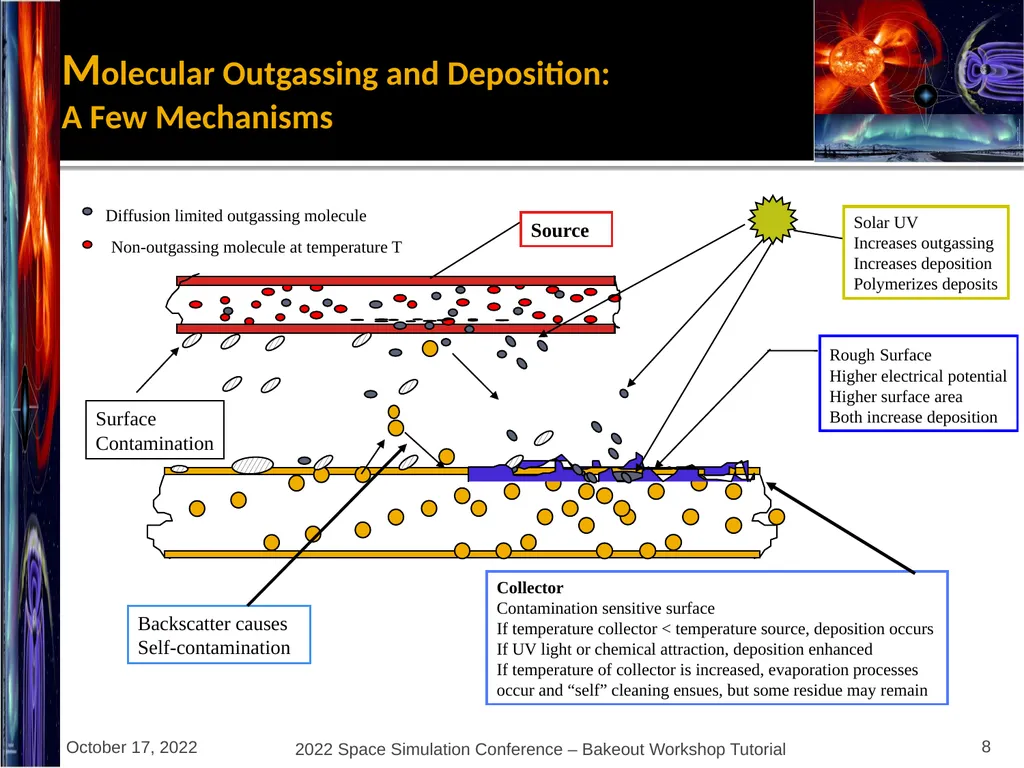
slide8. Molecular Outgassing and Deposition: A Few Mechanisms Surface
Contamination Source Rough Surface
Higher electrical potential
Higher surface area
Both increase deposition Solar UV
Increases outgassing
Increases deposition
Polymerizes deposits Collector
Contamination sensitive surface
If temperature collector < temperature source, deposition occurs
If UV light or chemical attraction, deposition enhanced
If temperature of collector is increased, evaporation processes occur and “self” cleaning ensues, but some residue may remain Backscatter causes
Self-contamination Diffusion limited outgassing molecule Non-outgassing molecule at temperature T October 17, 2022 8 2022 Space Simulation Conference – Bakeout Workshop Tutorial<br>
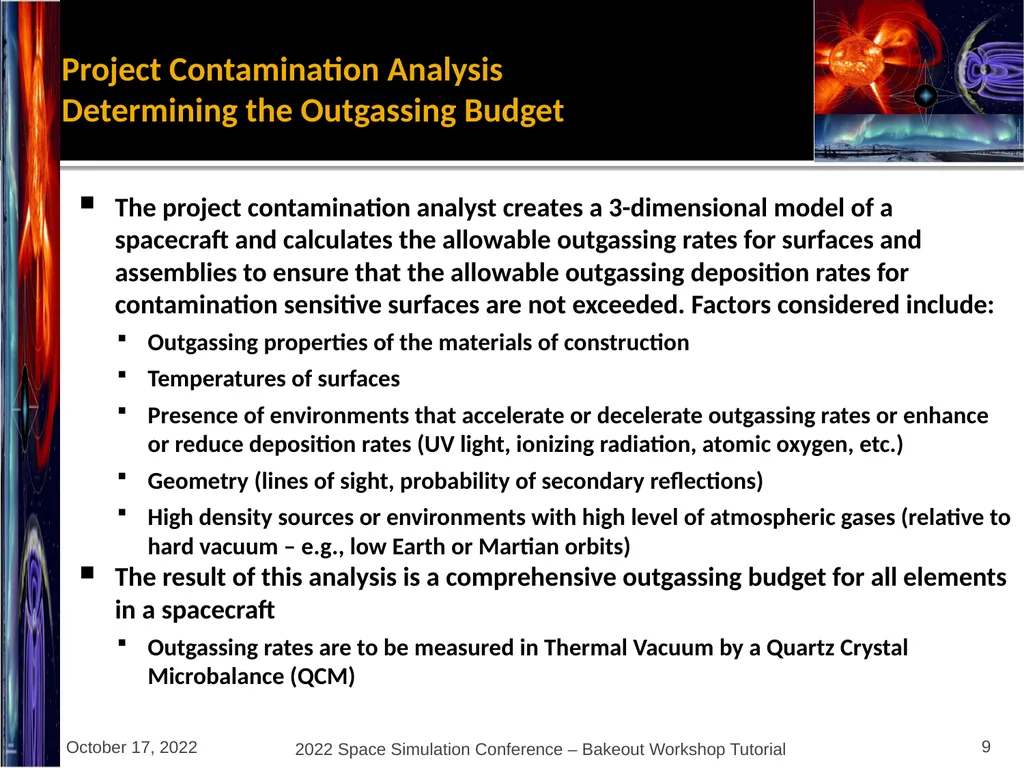
slide9. Project Contamination Analysis Determining the Outgassing Budget The project contamination analyst creates a 3-dimensional model of a spacecraft and calculates the allowable outgassing rates for surfaces and assemblies to ensure that the allowable outgassing deposition rates for contamination sensitive surfaces are not exceeded. Factors considered include:
Outgassing properties of the materials of construction
Temperatures of surfaces
Presence of environments that accelerate or decelerate outgassing rates or enhance or reduce deposition rates (UV light, ionizing radiation, atomic oxygen, etc.)
Geometry (lines of sight, probability of secondary reflections)
High density sources or environments with high level of atmospheric gases (relative to hard vacuum – e.g., low Earth or Martian orbits)
The result of this analysis is a comprehensive outgassing budget for all elements in a spacecraft
Outgassing rates are to be measured in Thermal Vacuum by a Quartz Crystal Microbalance (QCM) October 17, 2022 9 2022 Space Simulation Conference – Bakeout Workshop Tutorial<br>
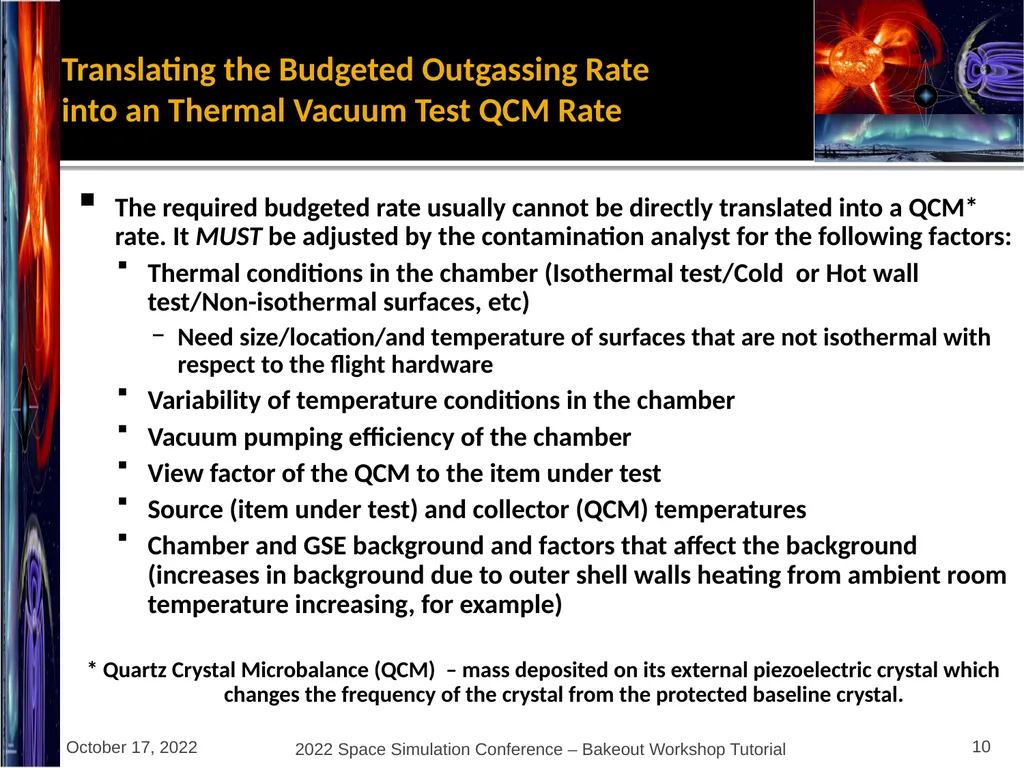
slide10. Translating the Budgeted Outgassing Rate into an Thermal Vacuum Test QCM Rate The required budgeted rate usually cannot be directly translated into a QCM* rate. It MUST be adjusted by the contamination analyst for the following factors:
Thermal conditions in the chamber (Isothermal test/Cold or Hot wall test/Non-isothermal surfaces, etc)
Need size/location/and temperature of surfaces that are not isothermal with respect to the flight hardware
Variability of temperature conditions in the chamber
Vacuum pumping efficiency of the chamber
View factor of the QCM to the item under test
Source (item under test) and collector (QCM) temperatures
Chamber and GSE background and factors that affect the background (increases in background due to outer shell walls heating from ambient room temperature increasing, for example)
* Quartz Crystal Microbalance (QCM) – mass deposited on its external piezoelectric crystal which changes the frequency of the crystal from the protected baseline crystal. October 17, 2022 10 2022 Space Simulation Conference – Bakeout Workshop Tutorial<br>
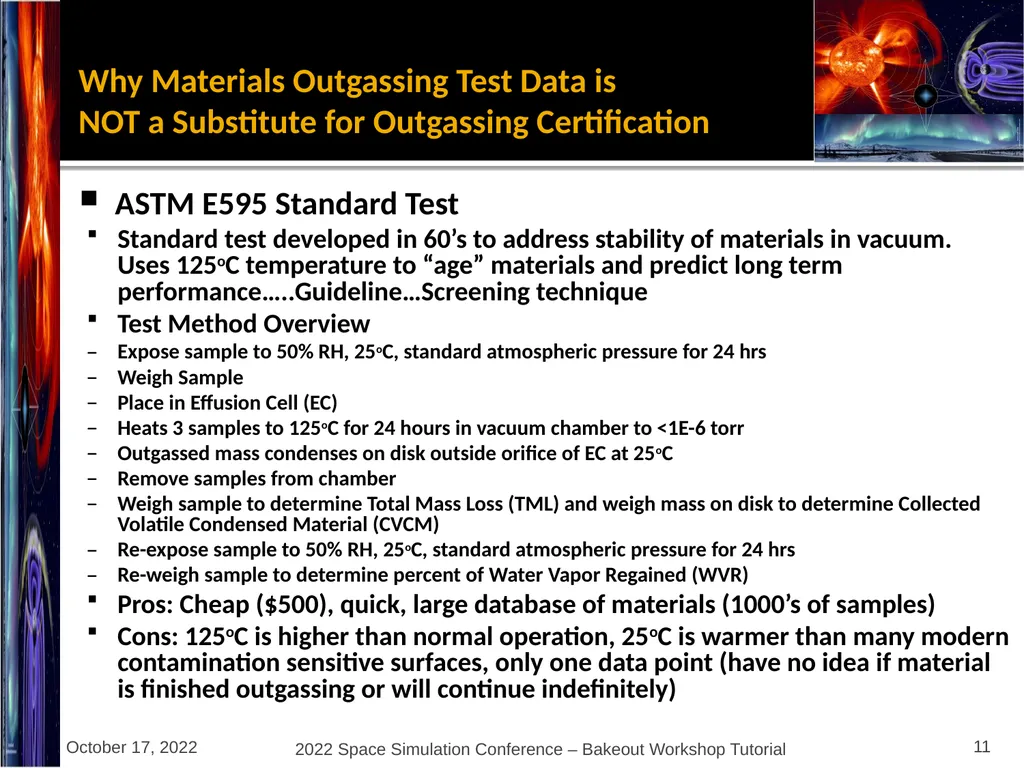
slide11. Why Materials Outgassing Test Data is NOT a Substitute for Outgassing Certification ASTM E595 Standard Test
Standard test developed in 60’s to address stability of materials in vacuum. Uses 125oC temperature to “age” materials and predict long term performance…..Guideline…Screening technique
Test Method Overview
Expose sample to 50% RH, 25oC, standard atmospheric pressure for 24 hrs
Weigh Sample
Place in Effusion Cell (EC)
Heats 3 samples to 125oC for 24 hours in vacuum chamber to <1E-6 torr
Outgassed mass condenses on disk outside orifice of EC at 25oC
Remove samples from chamber
Weigh sample to determine Total Mass Loss (TML) and weigh mass on disk to determine Collected Volatile Condensed Material (CVCM)
Re-expose sample to 50% RH, 25oC, standard atmospheric pressure for 24 hrs
Re-weigh sample to determine percent of Water Vapor Regained (WVR)
Pros: Cheap ($500), quick, large database of materials (1000’s of samples)
Cons: 125oC is higher than normal operation, 25oC is warmer than many modern contamination sensitive surfaces, only one data point (have no idea if material is finished outgassing or will continue indefinitely) October 17, 2022 11 2022 Space Simulation Conference – Bakeout Workshop Tutorial<br>
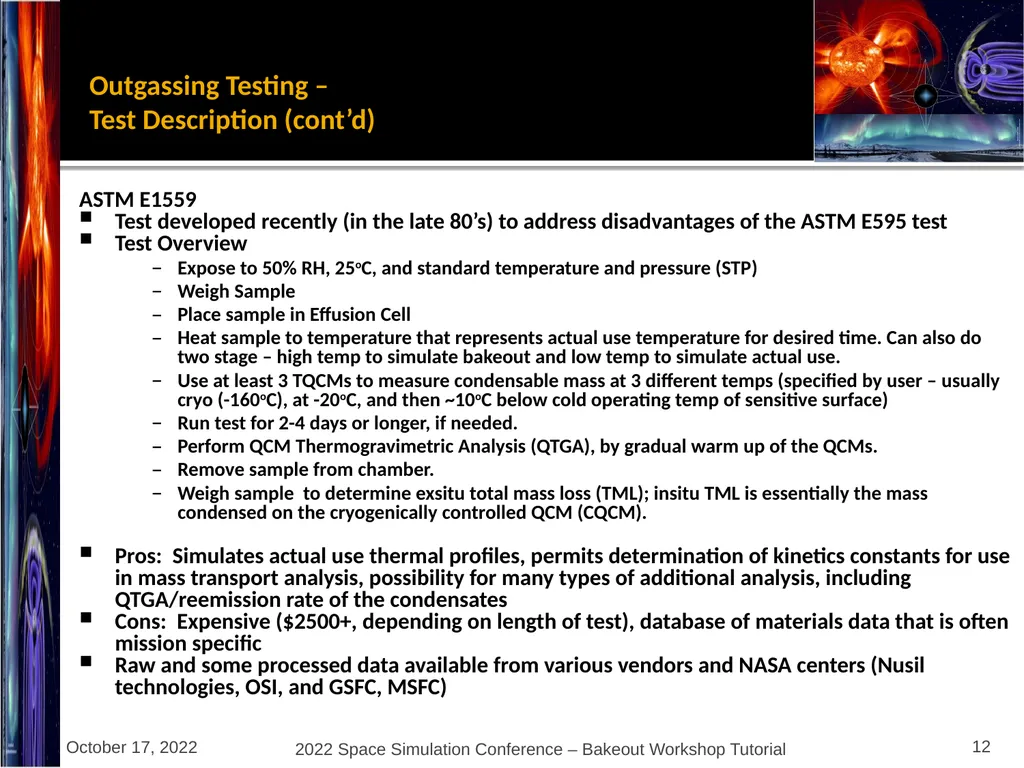
slide12. Outgassing Testing – Test Description (cont’d) ASTM E1559
Test developed recently (in the late 80’s) to address disadvantages of the ASTM E595 test
Test Overview
Expose to 50% RH, 25oC, and standard temperature and pressure (STP)
Weigh Sample
Place sample in Effusion Cell
Heat sample to temperature that represents actual use temperature for desired time. Can also do two stage – high temp to simulate bakeout and low temp to simulate actual use.
Use at least 3 TQCMs to measure condensable mass at 3 different temps (specified by user – usually cryo (-160oC), at -20oC, and then ~10oC below cold operating temp of sensitive surface)
Run test for 2-4 days or longer, if needed.
Perform QCM Thermogravimetric Analysis (QTGA), by gradual warm up of the QCMs.
Remove sample from chamber.
Weigh sample to determine exsitu total mass loss (TML); insitu TML is essentially the mass condensed on the cryogenically controlled QCM (CQCM).
Pros: Simulates actual use thermal profiles, permits determination of kinetics constants for use in mass transport analysis, possibility for many types of additional analysis, including QTGA/reemission rate of the condensates
Cons: Expensive ($2500+, depending on length of test), database of materials data that is often mission specific
Raw and some processed data available from various vendors and NASA centers (Nusil technologies, OSI, and GSFC, MSFC) October 17, 2022 12 2022 Space Simulation Conference – Bakeout Workshop Tutorial<br>
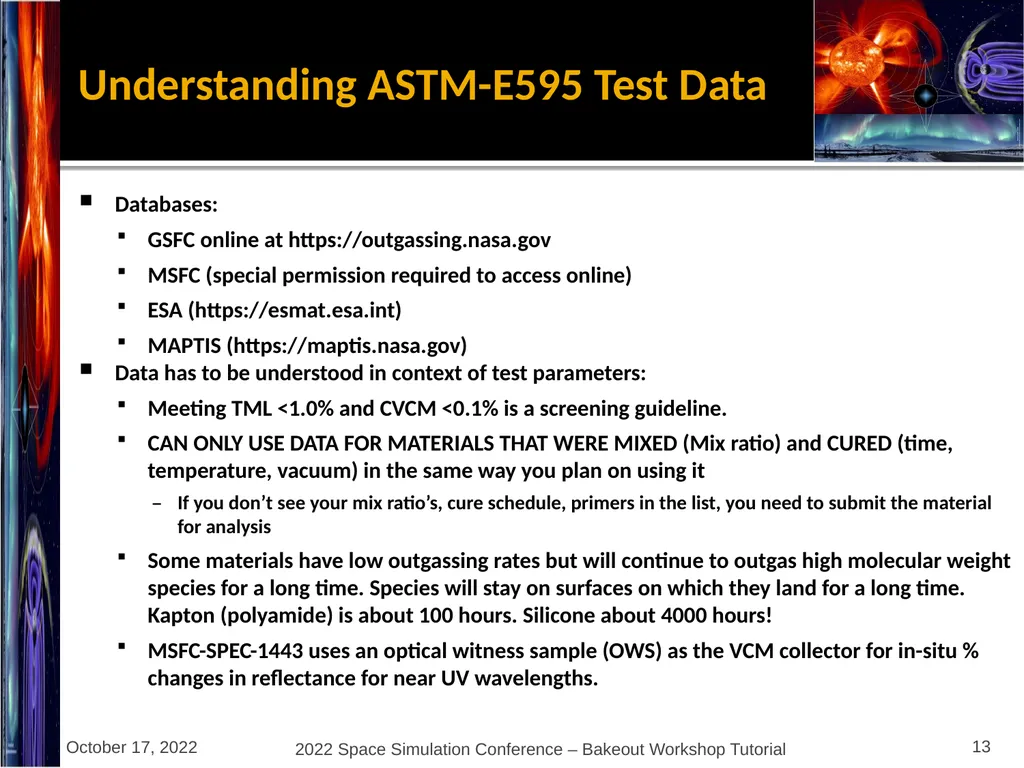
slide13. Understanding ASTM-E595 Test Data Databases:
GSFC online at https://outgassing.nasa.gov
MSFC (special permission required to access online)
ESA (https://esmat.esa.int)
MAPTIS (https://maptis.nasa.gov)
Data has to be understood in context of test parameters:
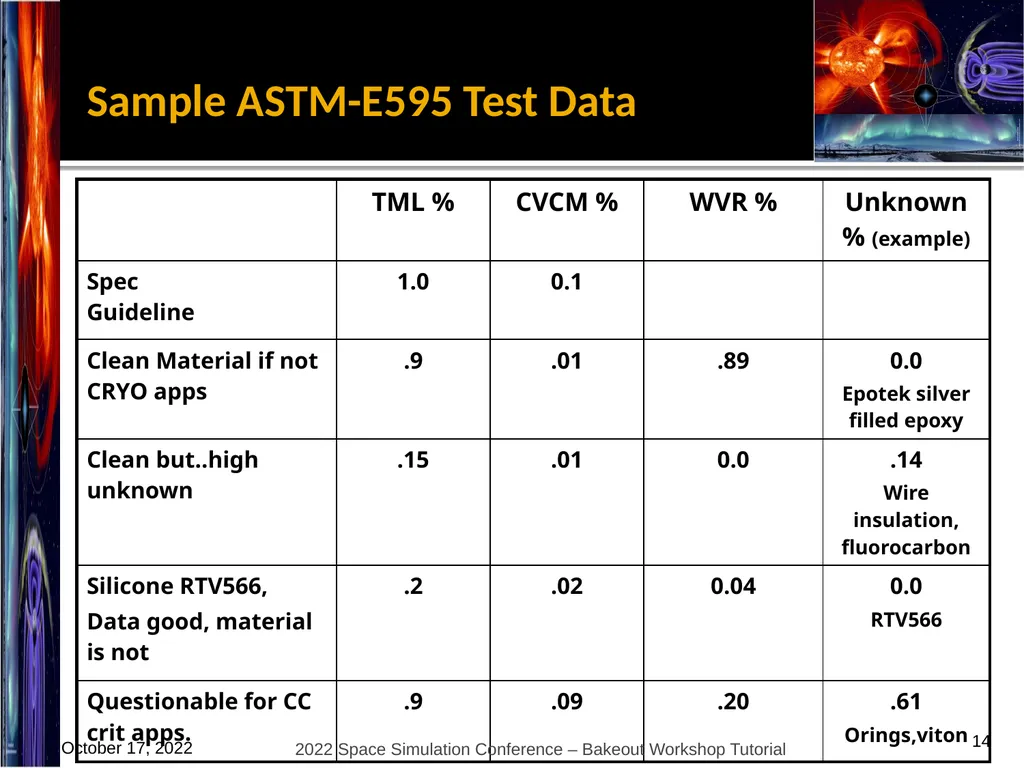
Meeting TML <1.0% and CVCM <0.1% is a screening guideline.
CAN ONLY USE DATA FOR MATERIALS THAT WERE MIXED (Mix ratio) and CURED (time, temperature, vacuum) in the same way you plan on using it
If you don’t see your mix ratio’s, cure schedule, primers in the list, you need to submit the material for analysis
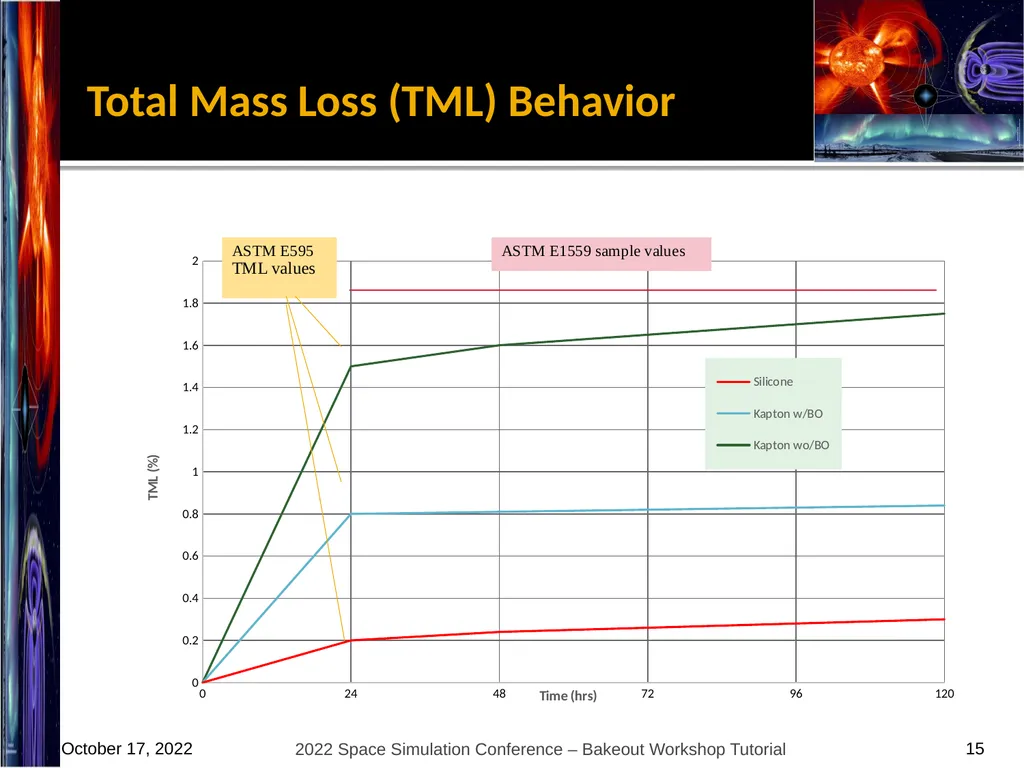
Some materials have low outgassing rates but will continue to outgas high molecular weight species for a long time. Species will stay on surfaces on which they land for a long time. Kapton (polyamide) is about 100 hours. Silicone about 4000 hours!
MSFC-SPEC-1443 uses an optical witness sample (OWS) as the VCM collector for in-situ % changes in reflectance for near UV wavelengths. October 17, 2022 13 2022 Space Simulation Conference – Bakeout Workshop Tutorial<br>
slide14. Sample ASTM-E595 Test Data October 17, 2022 14 2022 Space Simulation Conference – Bakeout Workshop Tutorial<br>
slide15. Total Mass Loss (TML) Behavior October 17, 2022 15 2022 Space Simulation Conference – Bakeout Workshop Tutorial<br>
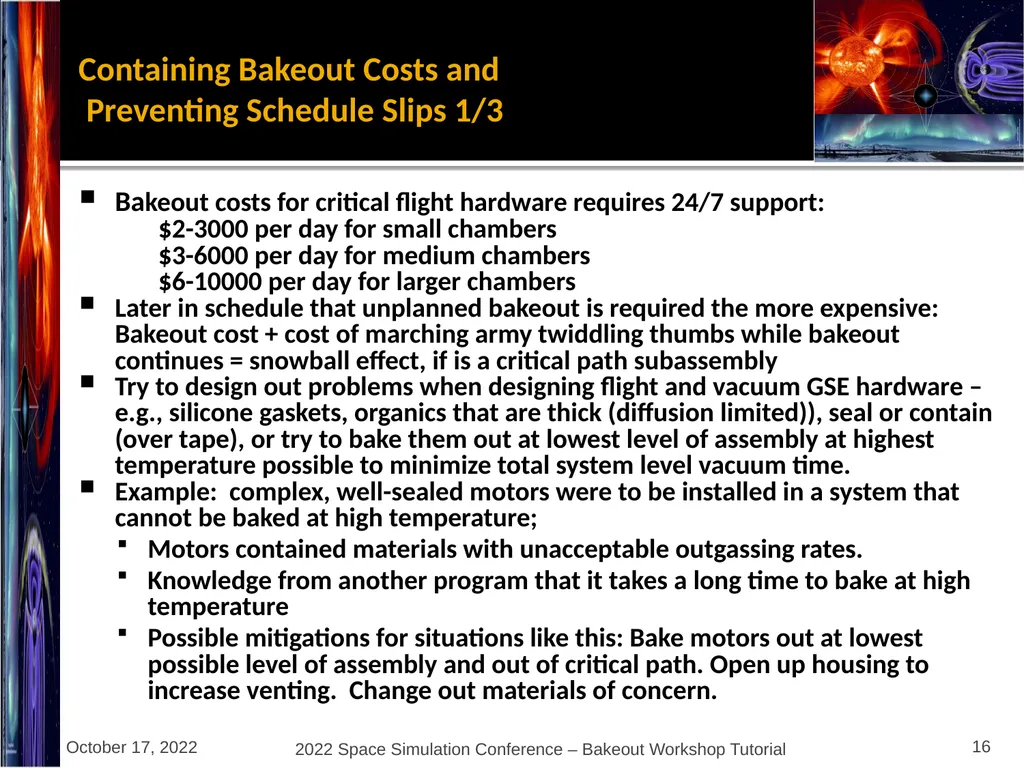
slide16. Containing Bakeout Costs and Preventing Schedule Slips 1/3 Bakeout costs for critical flight hardware requires 24/7 support:
$2-3000 per day for small chambers
$3-6000 per day for medium chambers
$6-10000 per day for larger chambers
Later in schedule that unplanned bakeout is required the more expensive: Bakeout cost + cost of marching army twiddling thumbs while bakeout continues = snowball effect, if is a critical path subassembly
Try to design out problems when designing flight and vacuum GSE hardware – e.g., silicone gaskets, organics that are thick (diffusion limited)), seal or contain (over tape), or try to bake them out at lowest level of assembly at highest temperature possible to minimize total system level vacuum time.
Example: complex, well-sealed motors were to be installed in a system that cannot be baked at high temperature;
Motors contained materials with unacceptable outgassing rates.
Knowledge from another program that it takes a long time to bake at high temperature
Possible mitigations for situations like this: Bake motors out at lowest possible level of assembly and out of critical path. Open up housing to increase venting. Change out materials of concern. October 17, 2022 16 2022 Space Simulation Conference – Bakeout Workshop Tutorial<br>
slide17. Containing Bakeout Costs and Preventing Schedule Slips 2/3 Have a TV chamber pre-close check list to ensure success and avoid costly chamber cleanups or damage to sensitive hardware:
Verify that chamber and GSE were certified clean prior to test (may need pre-test background to calculate outgassing rate of hardware)
Background needs to be stable and of lesser magnitude than QCM delta frequency rate you are seeking to measure
Verify that all polymers are fully cured (typically 5-7 days)
Verify that all materials are vacuum stable and free of problem contaminants (oils, greases, silicones, molecular films, etc.)
Check for items that should not be part of the test
Ink pens, gloves, insects (it has happened!), plastics, etc.
Check that protective cap is off of the QCM sensor
Make sure that the heat sink for QCM was operating properly during chamber certification test. The more sensitive the measurement the more stable the heat sink needs to be. October 17, 2022 17 2022 Space Simulation Conference – Bakeout Workshop Tutorial<br>
slide18. Containing Bakeout Costs and Preventing Schedule Slips 3/3 Make habit of keeping large, expensive chambers clean
Bakeout “dirty” items in cheaper smaller chambers that may not need to be manned 24/7
Create a tent/bagged enclosure within the shroud and vent outgassing to cold plates/traps so entire chamber doesn’t get contaminated
Certify chambers before and after tests. Have a minimum lab standard. If project contaminates the chamber, make them pay to clean it. If no post certification is performed, then next project will have to pay.
Use cold plates or other traps to permit determination of chemical species. Some contaminants worse than others – silicones for example.
Use QCMs in addition to RGAs. RGAs typically (affordable ones) are not as sensitive as QCMs to small quantities of particular condensable materials.
Chamber only use oil free vacuum pumps/non-silicone gaskets and lubricants
for critical subsystems and instruments w/optics October 17, 2022 18 2022 Space Simulation Conference – Bakeout Workshop Tutorial<br>
slide19. Outgassing Rate? Molecular Outgassing rate (Mass lost is really in vapor phase and lost at the molecular level)
Looking for mass loss rate change in terms of:
Mass loss per time (grams/sec, g/s)
Mass loss per surface area per time (g/cm2/sec), or
Mass loss per source mass per time (g/s/kg or ng/s/kg)
Total mass lost is in terms of grams (g), milligrams (mg), or micrograms (ug)
Use the method specified by the analyst. Don’t change method without consulting with the analyst. October 17, 2022 19 2022 Space Simulation Conference – Bakeout Workshop Tutorial<br>
slide20. How? How do we recommend baking out the HW?
Bakeout box (BOB), Very isothermal
small items, don’t overload BOB; for large systems use a “tent” enclosure!
Hot shroud (HS), Isothermal
Typical, most preferred method for bakeouts
Hot baseplate/platen (HB), variable shroud
Requires extra calculations and possibly some ducting methods
Complications in measuring lost mass
BOB, concentrated flow, may overwhelm QCM
HS, have other GSE to account for chamber
HB, Chamber interior never heated & need to position QCM to have decent view of hardware. Cooler surfaces in chamber become collectors. Ambient room temperature can cause release of previously collected materials on chamber walls. October 17, 2022 20 2022 Space Simulation Conference – Bakeout Workshop Tutorial<br>
slide21. Isothermal Test Pro’s Usually easiest to model and get accurate rate
Lowest risk of residual contamination in the event that there are contamination sensitive surfaces on the item under test
Analysis is simplified: simple mass balance equation:
Mass generated = mass lost, when in equilibrium
Mass lost = mass exiting through pump + mass condensed on cold (thermally accommodating ) surfaces + mass deposited onto the QCM + any other mass sinks (all Mass collections areas)
Mass exiting through pump is a function of the conductance of the pump. This can be calculated in two ways:
Calculate physical conductance of pumping system – get orifice sizes, length of tubes/pipes, pumping efficiency of pump, etc.
Take QCM measurements with same source conditions (preferably empty chamber that has reached a steady background) but different parameters – that is every surface area can act as a collector (turn scavenger plate on or off) October 17, 2022 21 2022 Space Simulation Conference – Bakeout Workshop Tutorial<br>
slide22. Isothermal Test – Set-up All surfaces the same temperature except QCM, QCM cooling lines, scavenger plate (SP), cold finger (CF) and resp. cooling lines
If using an internal shroud, make sure it does not have significant cold spots
Typically, all temps on the should be within 10 degrees of each other, BUT for critical measurements this range may have to be further refined
Don’t forget about doors – often they are not temperature controlled. Add a heater plate or put a thin layer of metal or even MLI that will couple with the chamber and create an essentially isothermal environment
Also watch out for extensions and other areas that do not have active heating but a view of the chamber. Getting an accurate pre-test background is even more important.
If using a bakeout box one needs to make sure that it had a clean post previous test and that it was also truly isothermal. The QCM needs to be positioned carefully and the position given to the analyst. The box vent should go to a cold plate to trap effluent and keep the chamber clean. October 17, 2022 22 2022 Space Simulation Conference – Bakeout Workshop Tutorial<br>
slide23. Monitoring Apparatus Thermo-electric Quartz Crystal Microbalance (TQCM)
Collects fraction of material outgassed (crystal is a ~1/4” in diameter)
Molecular Mass is condensed onto a surface cooler than tested element
QCM crystal, typical set point is -20oC, but can be lower
QCM heat sink, if not thermally isolated
Vacuum chamber walls (not shroud)
Exits through to pump
QCMs can be “cleaned” baked off after gain of 10KHz above baseline and reset to continue collecting
15 MHz crystal Mass sensitivity typically is 1.96e-9 g/cm2/Hz (~2 ng/cm2/Hz), can take up to 50,000 Hz or ~32 ug (0.03 mg), but crystal response starts getting negatively affected and may Zero out! It may recover by bakeout or need a physical (delicate) cleaning.
2 US vendors: QCM Research (now owned by Elecsys LLC) and Crystal Tek Corp. (previously Faraday Industries)
QCM Controllers output data in text/log files which can imported into Excel spreadsheet, for analysis, plotting. Also there are visual displays. October 17, 2022 23 2022 Space Simulation Conference – Bakeout Workshop Tutorial<br>
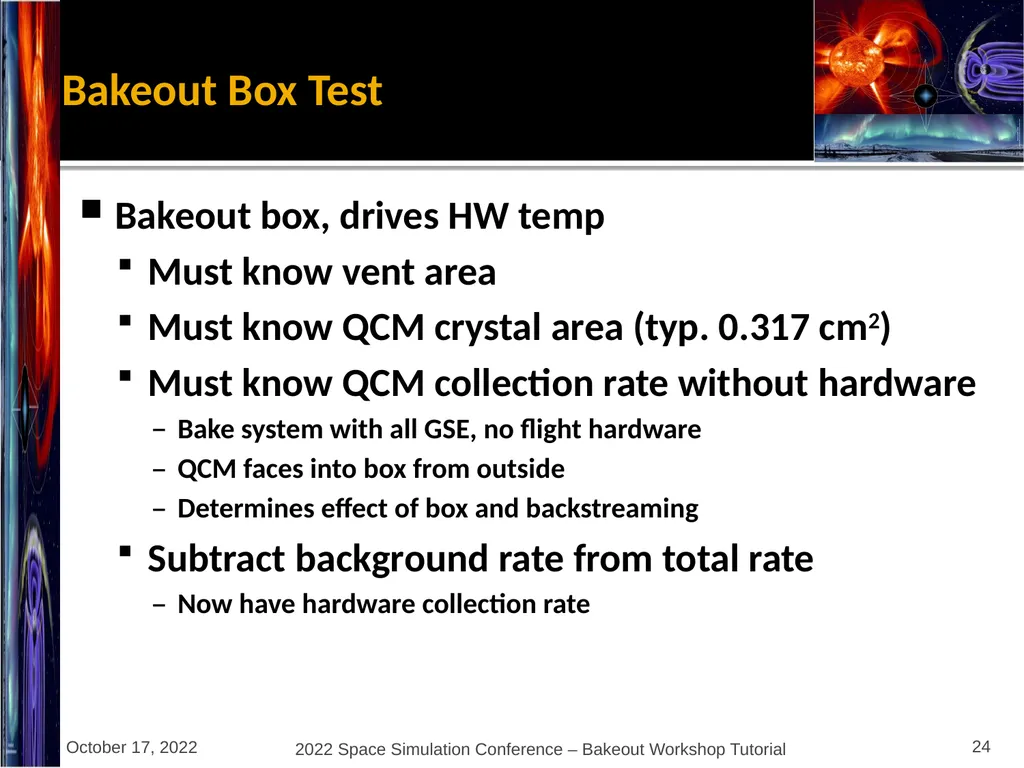
slide24. Bakeout Box Test Bakeout box, drives HW temp
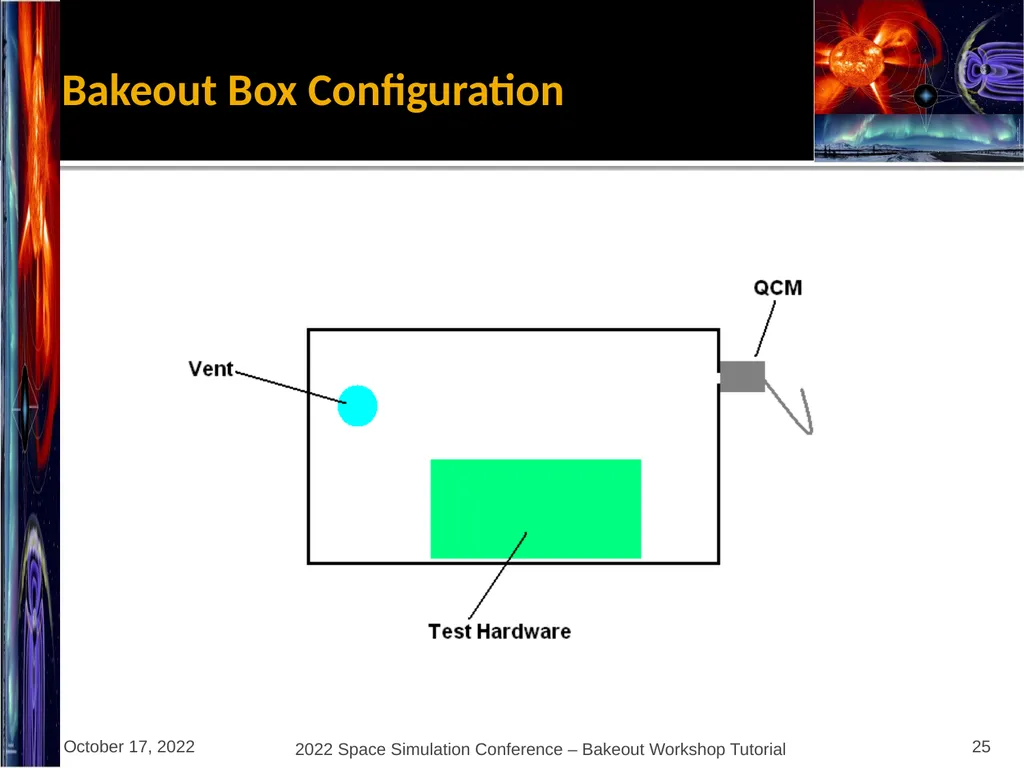
Must know vent area
Must know QCM crystal area (typ. 0.317 cm2)
Must know QCM collection rate without hardware
Bake system with all GSE, no flight hardware
QCM faces into box from outside
Determines effect of box and backstreaming
Subtract background rate from total rate
Now have hardware collection rate October 17, 2022 24 2022 Space Simulation Conference – Bakeout Workshop Tutorial<br>
slide25. Bakeout Box Configuration October 17, 2022 25 2022 Space Simulation Conference – Bakeout Workshop Tutorial<br>
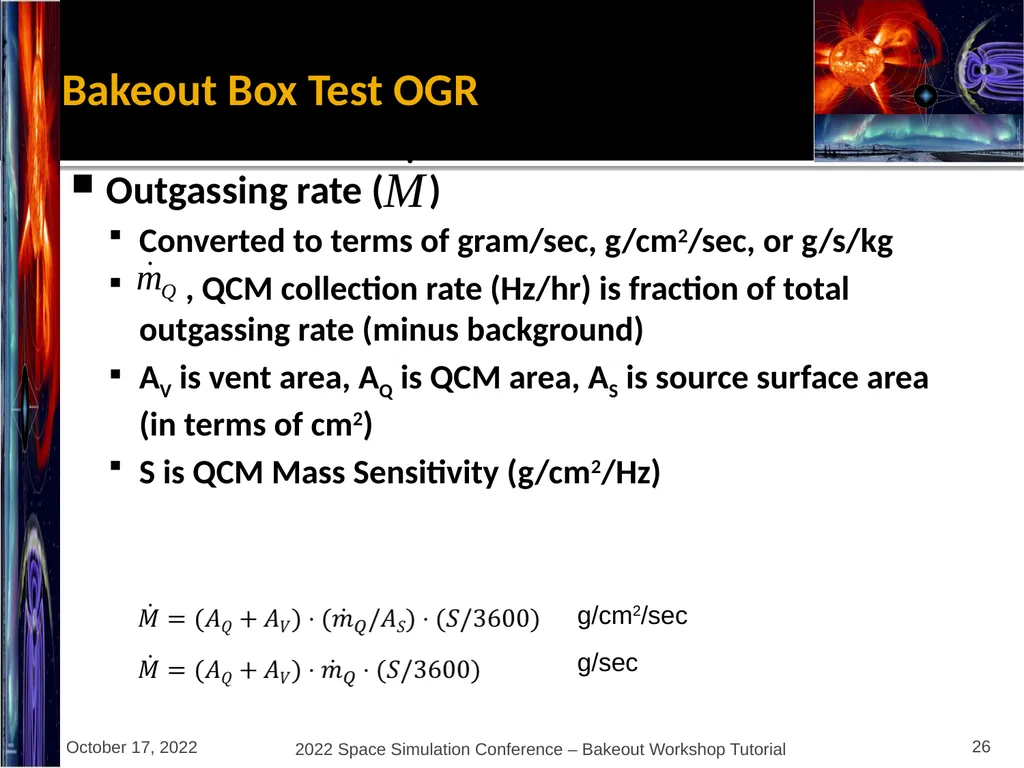
slide26. Bakeout Box Test OGR Outgassing rate ( )
Converted to terms of gram/sec, g/cm2/sec, or g/s/kg
, QCM collection rate (Hz/hr) is fraction of total outgassing rate (minus background)
AV is vent area, AQ is QCM area, AS is source surface area (in terms of cm2)
S is QCM Mass Sensitivity (g/cm2/Hz) g/cm2/sec g/sec October 17, 2022 26 2022 Space Simulation Conference – Bakeout Workshop Tutorial<br>
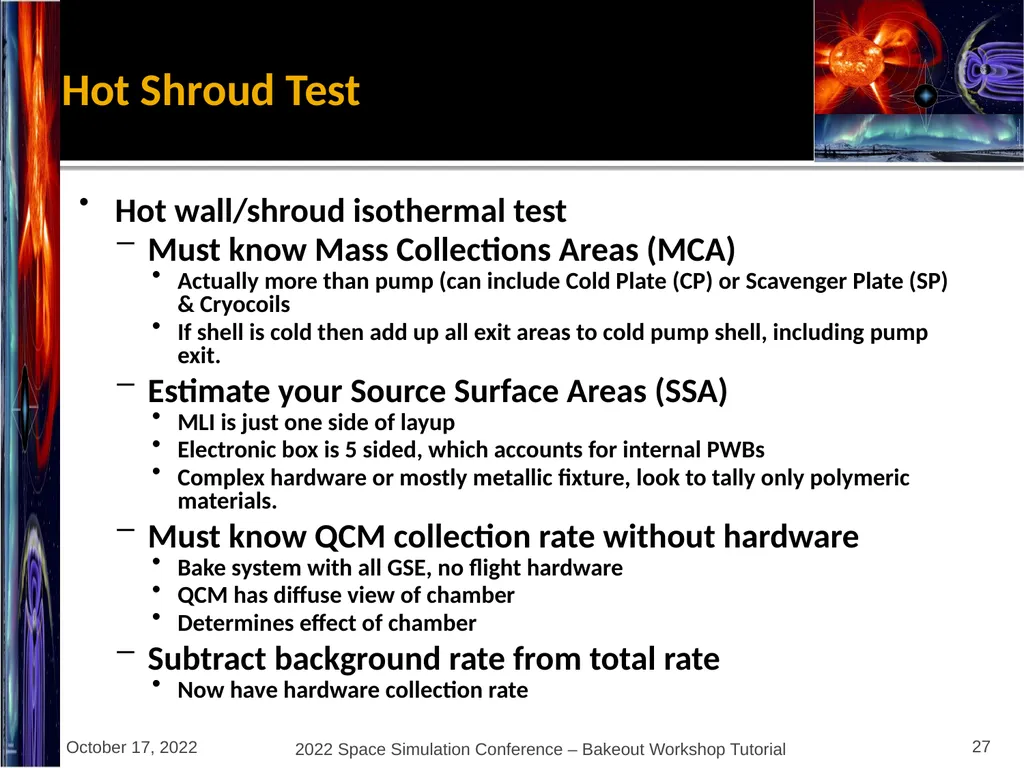
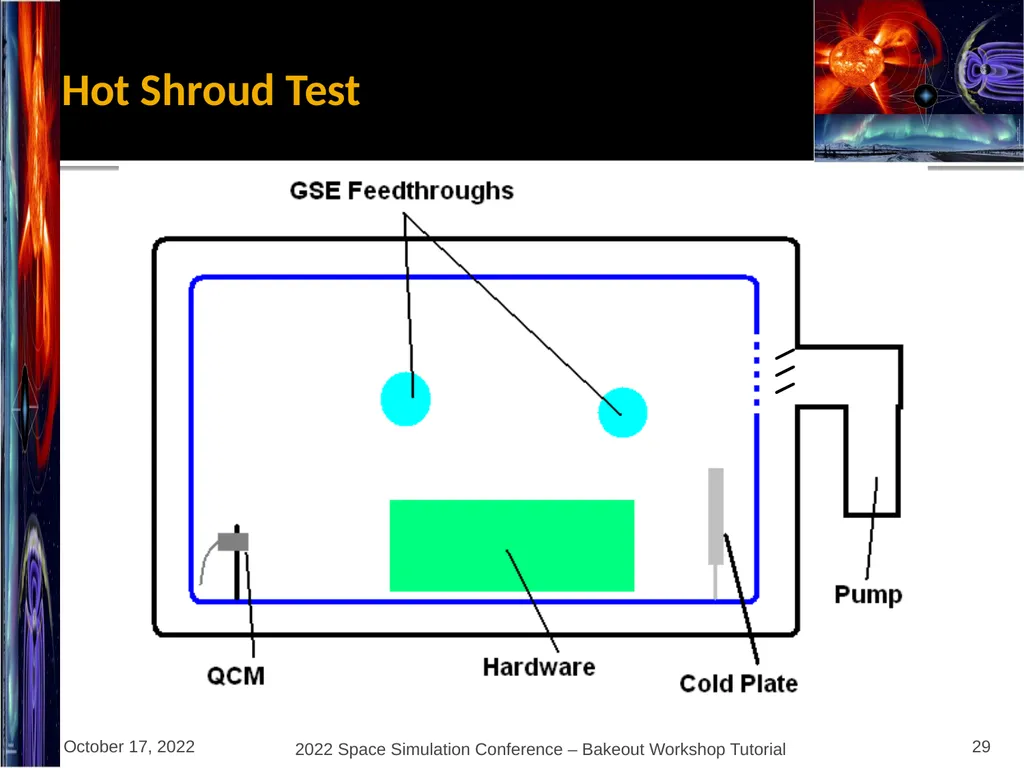
slide27. Hot Shroud Test Hot wall/shroud isothermal test
Must know Mass Collections Areas (MCA)
Actually more than pump (can include Cold Plate (CP) or Scavenger Plate (SP) & Cryocoils
If shell is cold then add up all exit areas to cold pump shell, including pump exit.
Estimate your Source Surface Areas (SSA)
MLI is just one side of layup
Electronic box is 5 sided, which accounts for internal PWBs
Complex hardware or mostly metallic fixture, look to tally only polymeric materials.
Must know QCM collection rate without hardware
Bake system with all GSE, no flight hardware
QCM has diffuse view of chamber
Determines effect of chamber
Subtract background rate from total rate
Now have hardware collection rate October 17, 2022 27 2022 Space Simulation Conference – Bakeout Workshop Tutorial<br>
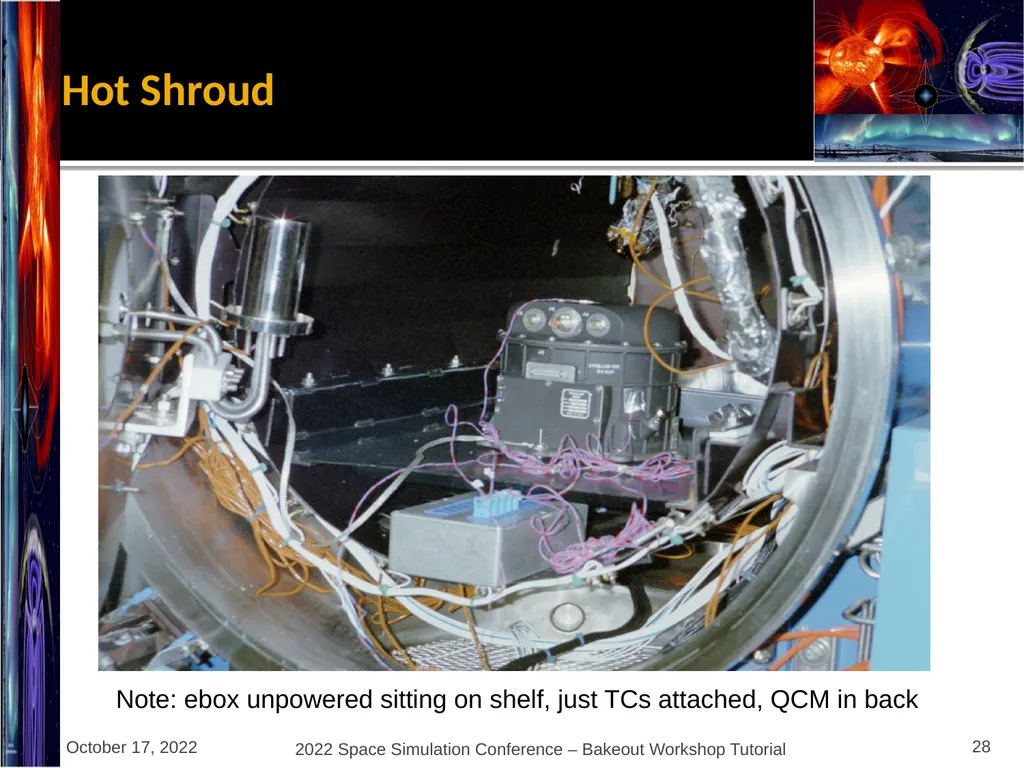
slide28. Hot Shroud Note: ebox unpowered sitting on shelf, just TCs attached, QCM in back October 17, 2022 28 2022 Space Simulation Conference – Bakeout Workshop Tutorial<br>
slide29. Hot Shroud Test October 17, 2022 29 2022 Space Simulation Conference – Bakeout Workshop Tutorial<br>
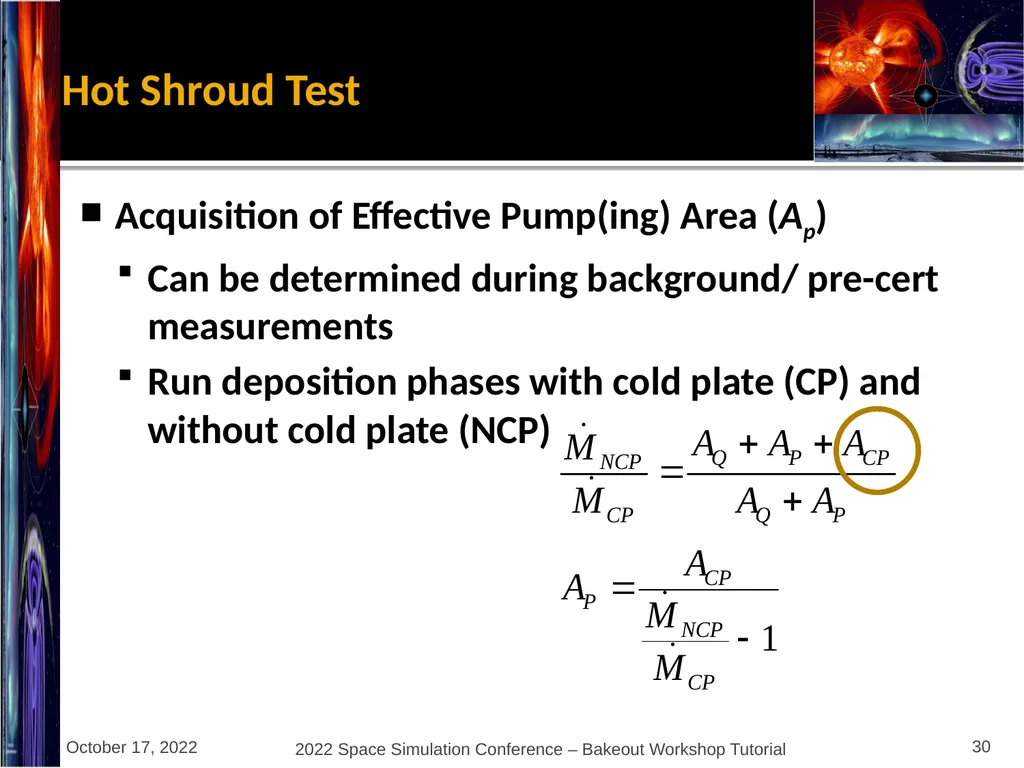
slide30. Hot Shroud Test Acquisition of Effective Pump(ing) Area (Ap)
Can be determined during background/ pre-cert measurements
Run deposition phases with cold plate (CP) and without cold plate (NCP) October 17, 2022 30 2022 Space Simulation Conference – Bakeout Workshop Tutorial<br>
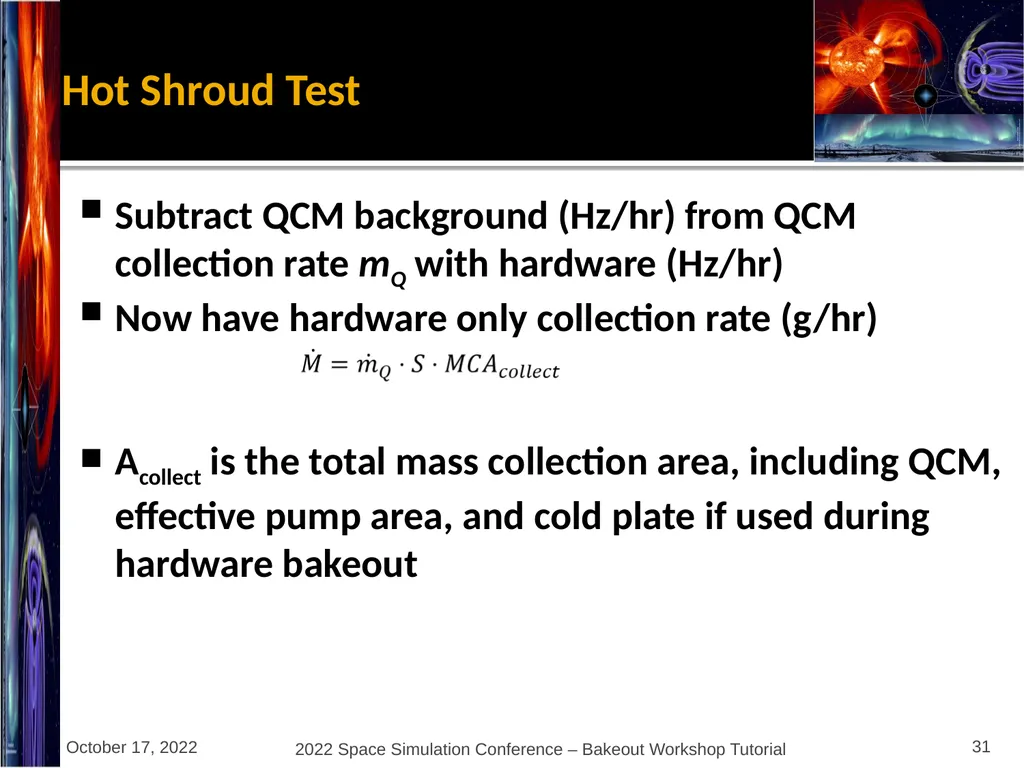
slide31. Hot Shroud Test Subtract QCM background (Hz/hr) from QCM collection rate mQ with hardware (Hz/hr)
Now have hardware only collection rate (g/hr)
Acollect is the total mass collection area, including QCM, effective pump area, and cold plate if used during hardware bakeout October 17, 2022 31 2022 Space Simulation Conference – Bakeout Workshop Tutorial<br>
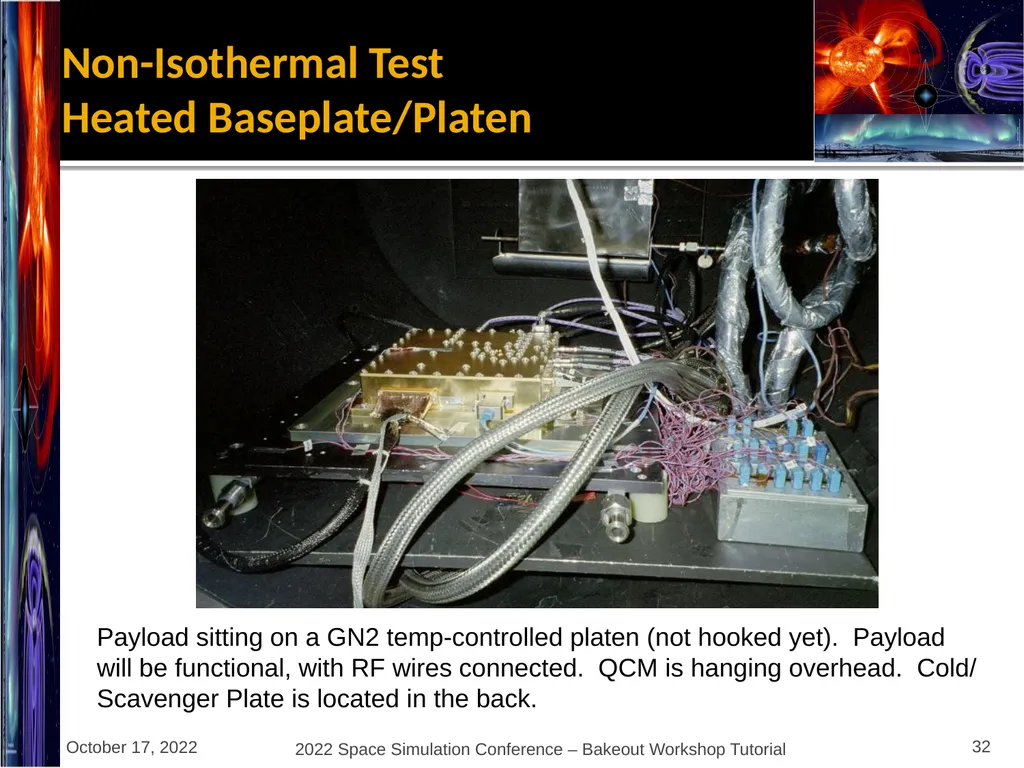
slide32. Non-Isothermal Test Heated Baseplate/Platen Payload sitting on a GN2 temp-controlled platen (not hooked yet). Payload
will be functional, with RF wires connected. QCM is hanging overhead. Cold/
Scavenger Plate is located in the back. October 17, 2022 32 2022 Space Simulation Conference – Bakeout Workshop Tutorial<br>
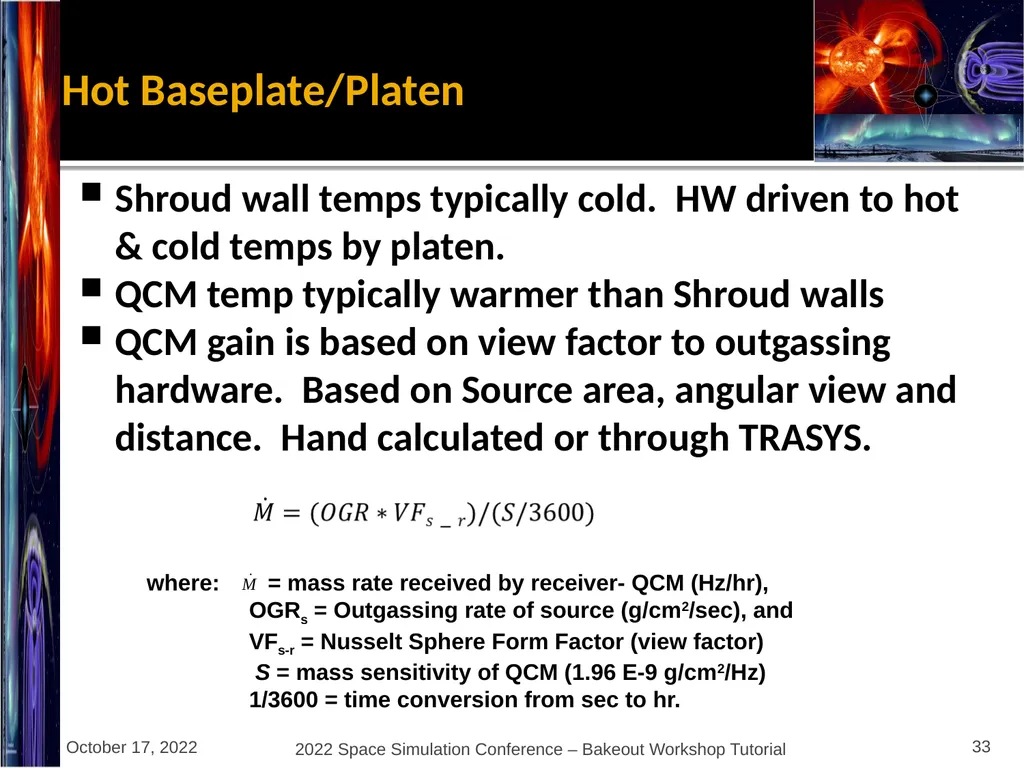
slide33. Hot Baseplate/Platen Shroud wall temps typically cold. HW driven to hot & cold temps by platen.
QCM temp typically warmer than Shroud walls
QCM gain is based on view factor to outgassing hardware. Based on Source area, angular view and distance. Hand calculated or through TRASYS. where: = mass rate received by receiver- QCM (Hz/hr),
OGRs = Outgassing rate of source (g/cm2/sec), and
VFs-r = Nusselt Sphere Form Factor (view factor)
S = mass sensitivity of QCM (1.96 E-9 g/cm2/Hz)
1/3600 = time conversion from sec to hr. October 17, 2022 33 2022 Space Simulation Conference – Bakeout Workshop Tutorial<br>
slide34. Bakeout effectiveness 1/2 Outgassing rate follows kinetic characteristics
“high” vacuum (<1e-5 torr pressure) helps draw molecules from hardware.
Air oven bakes really only aid in thin film cures of paints and volatile materials (i.e. alcohols) and helping accelerate epoxies cures (drying out water)
Follows a Power decay in the short term at BO temps and then exponential decay as bulk (non-gaseous species) material becomes depleted based on activation energy and polymers rearrange. October 17, 2022 34 2022 Space Simulation Conference – Bakeout Workshop Tutorial<br>
slide35. Bakeout effectiveness 2/2 High vacuum in bake outs only minimizes the back scatter of molecules emitted from the surface due to stagnation of gas flow at the surface. The stagnant gas reflects some of the emitted materials back to the surface and some diffuse outward.
Atmospheric (low vacuum) bake outs with GN2 purge minimizes stagnant gas over the surface as it removes the molecules that are emitted by the surface.
Using this technique as a pre-bake exposure for gear motors, which has questionable materials, to help reduce outgassing under lower vacuum levels.
Evolution of molecules from a surface are dependent upon the coverage of the molecules at the surface and the rate of replenishment through diffusion and the loss from evaporation.
In cases (with hardware or instruments that have) long aspect ratio holes or tubes, purged atmospheric pressure bakeouts are significantly more efficient than high vacuum bake outs as the entrained molecules move further when entrained in the gas flow. October 17, 2022 35 2022 Space Simulation Conference – Bakeout Workshop Tutorial<br>
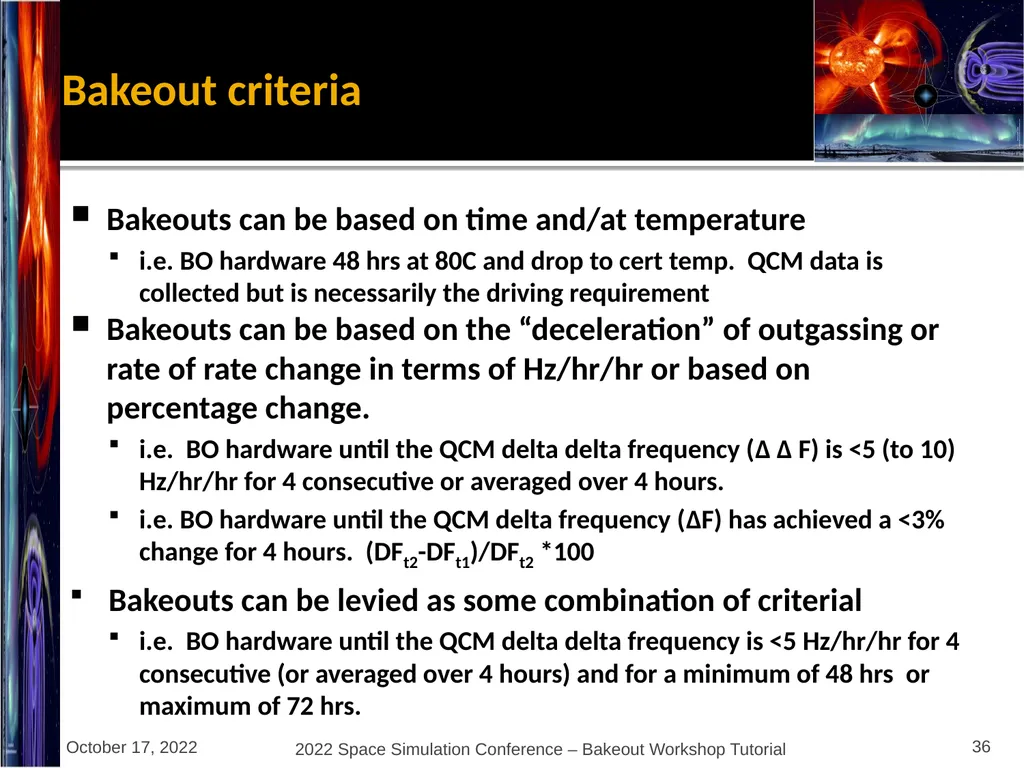
slide36. Bakeout criteria Bakeouts can be based on time and/at temperature
i.e. BO hardware 48 hrs at 80C and drop to cert temp. QCM data is collected but is necessarily the driving requirement
Bakeouts can be based on the “deceleration” of outgassing or rate of rate change in terms of Hz/hr/hr or based on percentage change.
i.e. BO hardware until the QCM delta delta frequency (Δ Δ F) is <5 (to 10) Hz/hr/hr for 4 consecutive or averaged over 4 hours.
i.e. BO hardware until the QCM delta frequency (ΔF) has achieved a <3% change for 4 hours. (DFt2-DFt1)/DFt2 *100
Bakeouts can be levied as some combination of criterial
i.e. BO hardware until the QCM delta delta frequency is <5 Hz/hr/hr for 4 consecutive (or averaged over 4 hours) and for a minimum of 48 hrs or maximum of 72 hrs. October 17, 2022 36 2022 Space Simulation Conference – Bakeout Workshop Tutorial<br>
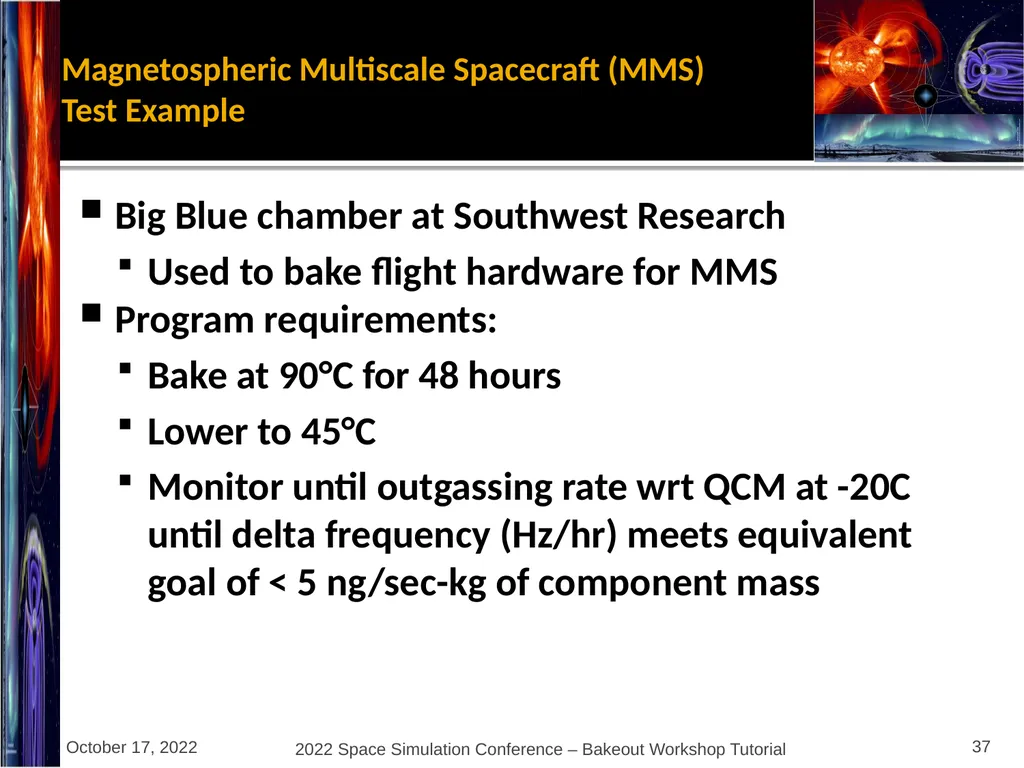
slide37. Magnetospheric Multiscale Spacecraft (MMS) Test Example Big Blue chamber at Southwest Research
Used to bake flight hardware for MMS
Program requirements:
Bake at 90°C for 48 hours
Lower to 45°C
Monitor until outgassing rate wrt QCM at -20C until delta frequency (Hz/hr) meets equivalent goal of < 5 ng/sec-kg of component mass October 17, 2022 37 2022 Space Simulation Conference – Bakeout Workshop Tutorial<br>
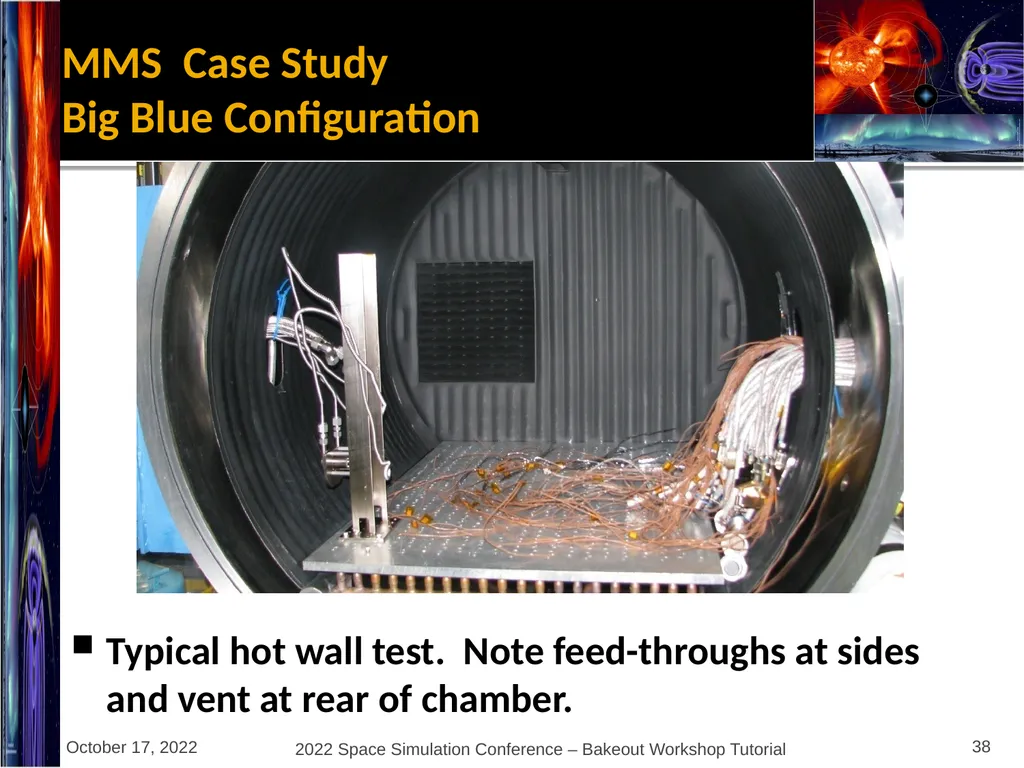
slide38. MMS Case Study Big Blue Configuration Typical hot wall test. Note feed-throughs at sides and vent at rear of chamber. October 17, 2022 38 2022 Space Simulation Conference – Bakeout Workshop Tutorial<br>
slide39. Big Blue Configuration QCM on post at left side of chamber
Feedthrough for QCM cables, cooling lines behind QCM mounting post
Wiring harness feedthrough on right is empty, but hole in shroud still present.
GSE are part of the chamber background
Shroud is warm and covers most of the vacuum chamber shell, so negligible effect from cooler shell.
All extra hardware is part of the effective pump area October 17, 2022 39 2022 Space Simulation Conference – Bakeout Workshop Tutorial<br>
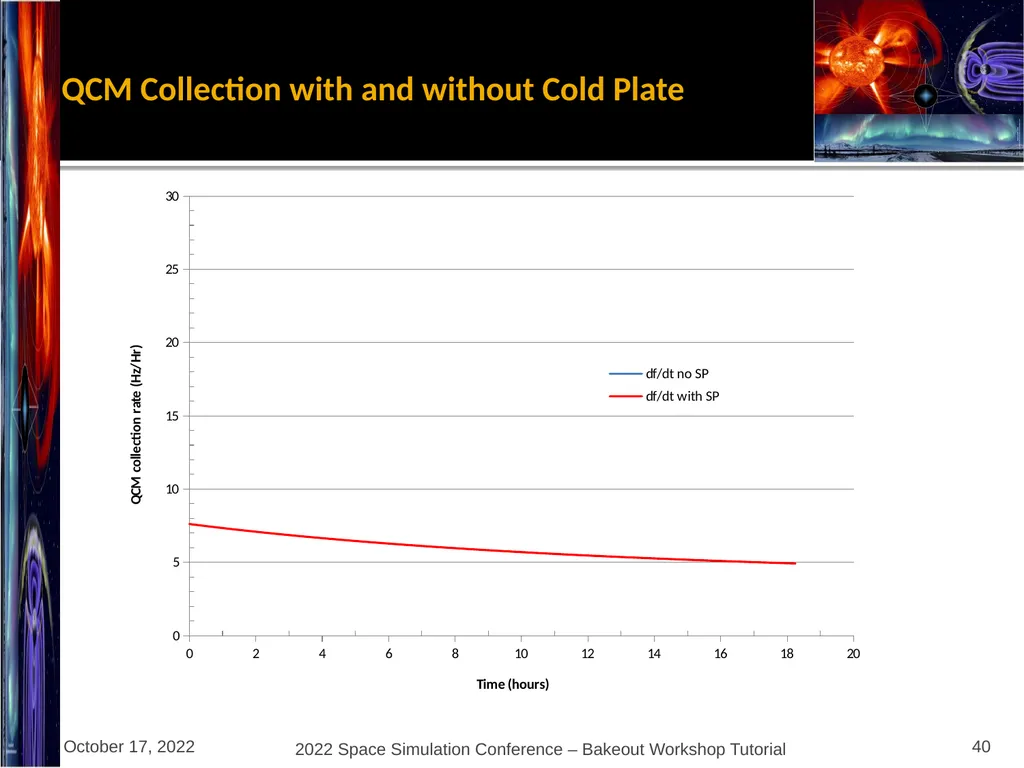
slide40. QCM Collection with and without Cold Plate October 17, 2022 40 2022 Space Simulation Conference – Bakeout Workshop Tutorial<br>
slide41. Big Blue Characterization Average ratio of QCM rates is 25.5/4.9 = 5.18
AP (effective area of the pump) found by test to be 952 cm2
Total area is AQ + AP
S is 1.96 ng/cm2-Hz
Use hardware collection rate equation to calculate the rate
Correction factor is 0.508 ng/Hz to convert QCM rate to hardware rate (~5 Angstroms/Hz) October 17, 2022 41 2022 Space Simulation Conference – Bakeout Workshop Tutorial<br>
slide42. Big Blue Limits OGR limit for harness is 5 ng/sec-kg
Harness mass ~5 kg
Upper OGR limit is 25 ng/sec
Correction factor is 1828 ng/hz
Total pump area is 952 cm2
3980 cm2 if cold plate used
Maximum QCM collection rate is 49.2 Hz/Hr
Add background of 25.5 Hz/hr
Total max. allowable QCM collection rate is 74.7 Hz/Hr, or rounded to 75 Hz/hr. October 17, 2022 42 2022 Space Simulation Conference – Bakeout Workshop Tutorial<br>
slide43. Setting Limits How are mass transport modeling OGR limits set?
Use spacecraft mass transport analysis to evaluate impingements to critical surfaces
Assume all material sticks unless it is problem
Then evaluate amount that might stick at operating temperatures October 17, 2022 43 2022 Space Simulation Conference – Bakeout Workshop Tutorial<br>
slide44. Setting Limits for MMS Total internal SC outgassing estimated at 387 ng/sec (3.9E-7 g/sec) at beginning of life (BOL)
Total mass inside bus was ~390 kg
IS harness mass was ~25kg
IS harness only 6.5% of total mass
Increased outgassing for multi-layer insulation (MLI) leaks and vent emissions is very small
If allowance increased from 1 ng/sec-kg to 5, increase outgassing by 2.3%
This is extremely small increase (see table next page) October 17, 2022 44 2022 Space Simulation Conference – Bakeout Workshop Tutorial<br>
slide45. Setting Limits October 17, 2022 45 2022 Space Simulation Conference – Bakeout Workshop Tutorial<br>
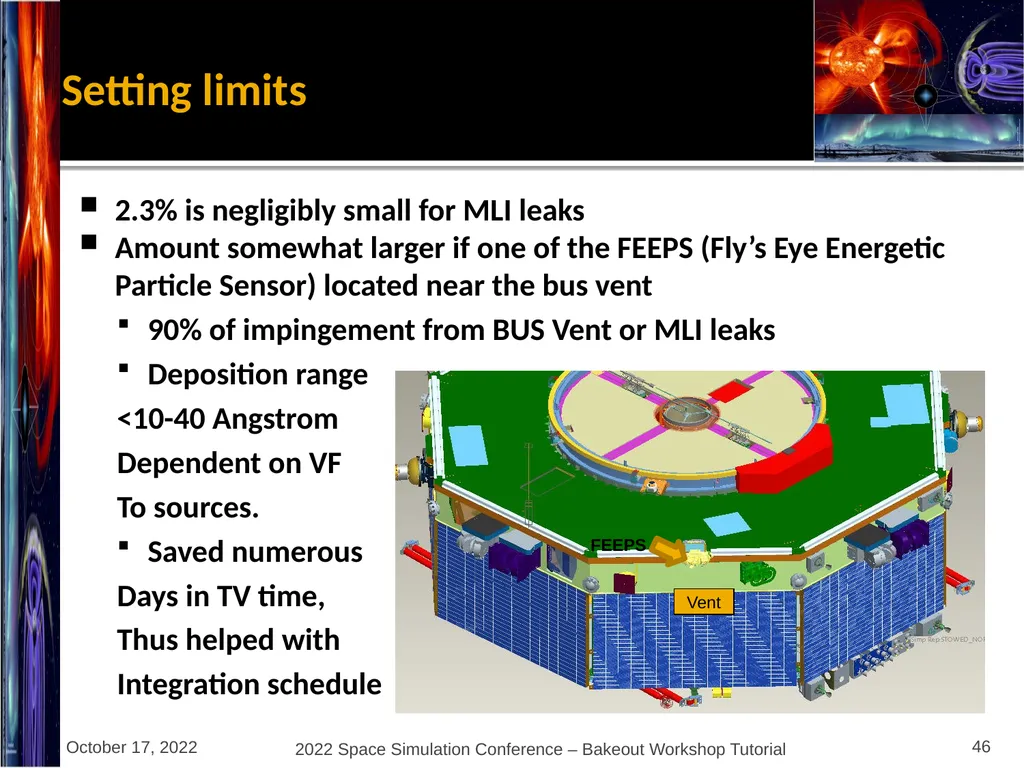
slide46. Setting limits 2.3% is negligibly small for MLI leaks
Amount somewhat larger if one of the FEEPS (Fly’s Eye Energetic Particle Sensor) located near the bus vent
90% of impingement from BUS Vent or MLI leaks
Deposition range
<10-40 Angstrom
Dependent on VF
To sources.
Saved numerous
Days in TV time,
Thus helped with
Integration schedule Vent October 17, 2022 46 FEEPS 2022 Space Simulation Conference – Bakeout Workshop Tutorial<br>
slide47. Links and Discussion GSFC ASTM E595 data base
https://outgassing.nasa.gov
Other material sites listed on slide 13
Discussion/questions October 17, 2022 47 2022 Space Simulation Conference – Bakeout Workshop Tutorial<br>
Therese Errigo, NASA GSFC
John Canham, Peraton, Inc. October 17, 2022 2022 Space Simulation Conference – Bakeout Workshop Tutorial<br>
slide2. Agenda Outgassing and
Outgassing Certifications
What is Outgassing?
Why does it matter?
Why do we have to bakeout materials if they pass the ASTM E595 Screening test?
How to measure outgassing rates…QCM
How to model chamber
How to use mass transport analysis
Optimizing tests and project bakeout plans to minimize contamination risks, chamber costs, and schedule risks
Isothermal TV tests vs. Non-Isothermal Tests Case Study
MMS SwRI Harness Bakeout
Measuring Big Blue background
Bake to 3%/hr @ program bake temp
Lower to HW cert temp
Calculate transformation factor
Measuring the Flight Hardware
Evaluate methodology
High rates encountered
Review IS harness contribution to total mass flux
Negotiate change based on analysis
Project savings due to this test design October 17, 2022 2 2022 Space Simulation Conference – Bakeout Workshop Tutorial<br>
slide3. Acronym listing October 17, 2022 3 2022 Space Simulation Conference – Bakeout Workshop Tutorial ASTM American Society for Testing and Materials
BO Bakeout
CQCM cryogenic QCM
CVCM Collected Volatile Condensed Material
Ebox electronic box
EC effusion cell
ESA European Space Agency
DF delta frequency
DDF delta delta frequency
GSE ground support equipment
GSFC Goddard Space Flight Center
HW hardware
Hz Hertz
IS instrument suite
IEST Institute of Environmental Sciences and Technology
MSFC Marshall Space Flight Center
MLI multi-layer insulation
NASA National Aeronautics and Space Administration
NVR non-volatile residue
OGR outgassing rate
OSAM1 On-Orbit
QCM Quartz Crystal Microbalance
QTGA QCM Thermo-Gravimetric Analysis
RH relative humidity
RTV room temperature vulcanizing SC Spacecraft
SPEC specification
STP standard temperature and pressure
T Temperature
TML Total Mass Lost
TQCM temperature-controlled QCM
TV thermal vacuum
UV ultraviolet
VF view factor
VOC volatile organic compound
WVR Water Vapor Regained
On slide 45
ADP Axial Double Probe
ASPOC Active Spacecraft Potential Control
DES Dual Electron Spectrometer
DIS Dual Ion Spectrometer
EDI Electron Drift Ion Detector
EIS Electron Ion Spectrometer
FEEPS Fly’s Eye Energetic Particle Sensor
HPCA Hot Plasma Composition Analyzer
Mag Magnetometer (sensor)
MMS Magnetic Multiscale Spacecraft
OSR optical solar reflector
SA solar array (panel)<br>
slide4. Who? What? Why? Flight and Ground Support Equipment (GSE) hardware have requirements levied in Contamination Control Plans to measure the hardware outgassing rate.
Mass transport analyses are performed to assess contamination risks to optics, detectors, and thermal surfaces.
Conduct outgassing rate verifications in Thermal Vacuum (TV) chambers, while obtaining low space-like vacuum pressure, either as a tack onto a Thermal validation test or separate TV test.
Bakeouts help expedite the release of volatile molecules from the bulk material. Typically, performed at maximum survival temperature of the hardware.
Certification enables the chance to validate that the outgassing rate had been achieved at the hardware’s predicted hot operating temperature. October 17, 2022 4 2022 Space Simulation Conference – Bakeout Workshop Tutorial<br>
slide5. Molecular Depositions Affect Hardware Performance and Science Absorption (reduction in transmission, reflectance in optical or sensors wavelength of interest)
Scattering (dependent upon deposition pattern and wavelength)
Sticking of mechanical mechanisms (Lube loss, too much?)
Corrosion during ground operations (if incompatible with substrate)
Changes in polarization states of electromagnetic energy (acts as a thin film)
Attenuation or stopping of ionizing radiation before it reaches detectors
Localized increase in pressure resulting in catastrophic failure of high voltage components (corona discharge) October 17, 2022 5 2022 Space Simulation Conference – Bakeout Workshop Tutorial<br>
slide6. Outgassing Sources - NVR and Bulk Offgassing Non-Volatile Residue (NVR) is a condensed film or a contact transferred molecular film
On the ground, NVR or Molecular Film deposits result from two phenomena:
Contact with a contaminated or contaminating surface or material — for example, fingerprints, adhesive tape residues, lubricants, residues from manufacturing processes, greases, silicones, bare hands, etc.
Condensation of airborne molecular organic contamination
Many materials in our environment give off volatile (gaseous) organic compounds (VOC). Examples include: paint, adhesives, machine lubricating greases, engine exhausts, solvents, plasticizers in plastics.
VOCs can condense and form an NVR film on a surface whenever their concentration in the air is too high or whenever they come in contact with a cool condensing surface. Examples, include films on windows after painting and condensation on mirrors in shower October 17, 2022 6 2022 Space Simulation Conference – Bakeout Workshop Tutorial<br>
slide7. Outgassing Sources – NVR, Offgassing, Outgassing Not many contamination sensitive industries have the same level of concern for molecular contamination as the satellite industry
Strong solvents and commercial cleaning agents usually cannot be used to remove contaminants unlike other industries where such strong agents can be used.
Time to integrate satellites is very long (months, even years) as compared to most other contamination sensitive hardware
Sensors used in satellites can be sensitive to levels of contamination in the angstrom (1E-10 m, 1E-4 um) range
In vacuum, NVR / molecular films result when materials outgas from one surface and deposit onto another, usually cooler, surface. Contaminants inside electronic boxes for example can outgas and exit through openings and deposit on colder surfaces. October 17, 2022 7 2022 Space Simulation Conference – Bakeout Workshop Tutorial<br>
slide8. Molecular Outgassing and Deposition: A Few Mechanisms Surface
Contamination Source Rough Surface
Higher electrical potential
Higher surface area
Both increase deposition Solar UV
Increases outgassing
Increases deposition
Polymerizes deposits Collector
Contamination sensitive surface
If temperature collector < temperature source, deposition occurs
If UV light or chemical attraction, deposition enhanced
If temperature of collector is increased, evaporation processes occur and “self” cleaning ensues, but some residue may remain Backscatter causes
Self-contamination Diffusion limited outgassing molecule Non-outgassing molecule at temperature T October 17, 2022 8 2022 Space Simulation Conference – Bakeout Workshop Tutorial<br>
slide9. Project Contamination Analysis Determining the Outgassing Budget The project contamination analyst creates a 3-dimensional model of a spacecraft and calculates the allowable outgassing rates for surfaces and assemblies to ensure that the allowable outgassing deposition rates for contamination sensitive surfaces are not exceeded. Factors considered include:
Outgassing properties of the materials of construction
Temperatures of surfaces
Presence of environments that accelerate or decelerate outgassing rates or enhance or reduce deposition rates (UV light, ionizing radiation, atomic oxygen, etc.)
Geometry (lines of sight, probability of secondary reflections)
High density sources or environments with high level of atmospheric gases (relative to hard vacuum – e.g., low Earth or Martian orbits)
The result of this analysis is a comprehensive outgassing budget for all elements in a spacecraft
Outgassing rates are to be measured in Thermal Vacuum by a Quartz Crystal Microbalance (QCM) October 17, 2022 9 2022 Space Simulation Conference – Bakeout Workshop Tutorial<br>
slide10. Translating the Budgeted Outgassing Rate into an Thermal Vacuum Test QCM Rate The required budgeted rate usually cannot be directly translated into a QCM* rate. It MUST be adjusted by the contamination analyst for the following factors:
Thermal conditions in the chamber (Isothermal test/Cold or Hot wall test/Non-isothermal surfaces, etc)
Need size/location/and temperature of surfaces that are not isothermal with respect to the flight hardware
Variability of temperature conditions in the chamber
Vacuum pumping efficiency of the chamber
View factor of the QCM to the item under test
Source (item under test) and collector (QCM) temperatures
Chamber and GSE background and factors that affect the background (increases in background due to outer shell walls heating from ambient room temperature increasing, for example)
* Quartz Crystal Microbalance (QCM) – mass deposited on its external piezoelectric crystal which changes the frequency of the crystal from the protected baseline crystal. October 17, 2022 10 2022 Space Simulation Conference – Bakeout Workshop Tutorial<br>
slide11. Why Materials Outgassing Test Data is NOT a Substitute for Outgassing Certification ASTM E595 Standard Test
Standard test developed in 60’s to address stability of materials in vacuum. Uses 125oC temperature to “age” materials and predict long term performance…..Guideline…Screening technique
Test Method Overview
Expose sample to 50% RH, 25oC, standard atmospheric pressure for 24 hrs
Weigh Sample
Place in Effusion Cell (EC)
Heats 3 samples to 125oC for 24 hours in vacuum chamber to <1E-6 torr
Outgassed mass condenses on disk outside orifice of EC at 25oC
Remove samples from chamber
Weigh sample to determine Total Mass Loss (TML) and weigh mass on disk to determine Collected Volatile Condensed Material (CVCM)
Re-expose sample to 50% RH, 25oC, standard atmospheric pressure for 24 hrs
Re-weigh sample to determine percent of Water Vapor Regained (WVR)
Pros: Cheap ($500), quick, large database of materials (1000’s of samples)
Cons: 125oC is higher than normal operation, 25oC is warmer than many modern contamination sensitive surfaces, only one data point (have no idea if material is finished outgassing or will continue indefinitely) October 17, 2022 11 2022 Space Simulation Conference – Bakeout Workshop Tutorial<br>
slide12. Outgassing Testing – Test Description (cont’d) ASTM E1559
Test developed recently (in the late 80’s) to address disadvantages of the ASTM E595 test
Test Overview
Expose to 50% RH, 25oC, and standard temperature and pressure (STP)
Weigh Sample
Place sample in Effusion Cell
Heat sample to temperature that represents actual use temperature for desired time. Can also do two stage – high temp to simulate bakeout and low temp to simulate actual use.
Use at least 3 TQCMs to measure condensable mass at 3 different temps (specified by user – usually cryo (-160oC), at -20oC, and then ~10oC below cold operating temp of sensitive surface)
Run test for 2-4 days or longer, if needed.
Perform QCM Thermogravimetric Analysis (QTGA), by gradual warm up of the QCMs.
Remove sample from chamber.
Weigh sample to determine exsitu total mass loss (TML); insitu TML is essentially the mass condensed on the cryogenically controlled QCM (CQCM).
Pros: Simulates actual use thermal profiles, permits determination of kinetics constants for use in mass transport analysis, possibility for many types of additional analysis, including QTGA/reemission rate of the condensates
Cons: Expensive ($2500+, depending on length of test), database of materials data that is often mission specific
Raw and some processed data available from various vendors and NASA centers (Nusil technologies, OSI, and GSFC, MSFC) October 17, 2022 12 2022 Space Simulation Conference – Bakeout Workshop Tutorial<br>
slide13. Understanding ASTM-E595 Test Data Databases:
GSFC online at https://outgassing.nasa.gov
MSFC (special permission required to access online)
ESA (https://esmat.esa.int)
MAPTIS (https://maptis.nasa.gov)
Data has to be understood in context of test parameters:
Meeting TML <1.0% and CVCM <0.1% is a screening guideline.
CAN ONLY USE DATA FOR MATERIALS THAT WERE MIXED (Mix ratio) and CURED (time, temperature, vacuum) in the same way you plan on using it
If you don’t see your mix ratio’s, cure schedule, primers in the list, you need to submit the material for analysis
Some materials have low outgassing rates but will continue to outgas high molecular weight species for a long time. Species will stay on surfaces on which they land for a long time. Kapton (polyamide) is about 100 hours. Silicone about 4000 hours!
MSFC-SPEC-1443 uses an optical witness sample (OWS) as the VCM collector for in-situ % changes in reflectance for near UV wavelengths. October 17, 2022 13 2022 Space Simulation Conference – Bakeout Workshop Tutorial<br>
slide14. Sample ASTM-E595 Test Data October 17, 2022 14 2022 Space Simulation Conference – Bakeout Workshop Tutorial<br>
slide15. Total Mass Loss (TML) Behavior October 17, 2022 15 2022 Space Simulation Conference – Bakeout Workshop Tutorial<br>
slide16. Containing Bakeout Costs and Preventing Schedule Slips 1/3 Bakeout costs for critical flight hardware requires 24/7 support:
$2-3000 per day for small chambers
$3-6000 per day for medium chambers
$6-10000 per day for larger chambers
Later in schedule that unplanned bakeout is required the more expensive: Bakeout cost + cost of marching army twiddling thumbs while bakeout continues = snowball effect, if is a critical path subassembly
Try to design out problems when designing flight and vacuum GSE hardware – e.g., silicone gaskets, organics that are thick (diffusion limited)), seal or contain (over tape), or try to bake them out at lowest level of assembly at highest temperature possible to minimize total system level vacuum time.
Example: complex, well-sealed motors were to be installed in a system that cannot be baked at high temperature;
Motors contained materials with unacceptable outgassing rates.
Knowledge from another program that it takes a long time to bake at high temperature
Possible mitigations for situations like this: Bake motors out at lowest possible level of assembly and out of critical path. Open up housing to increase venting. Change out materials of concern. October 17, 2022 16 2022 Space Simulation Conference – Bakeout Workshop Tutorial<br>
slide17. Containing Bakeout Costs and Preventing Schedule Slips 2/3 Have a TV chamber pre-close check list to ensure success and avoid costly chamber cleanups or damage to sensitive hardware:
Verify that chamber and GSE were certified clean prior to test (may need pre-test background to calculate outgassing rate of hardware)
Background needs to be stable and of lesser magnitude than QCM delta frequency rate you are seeking to measure
Verify that all polymers are fully cured (typically 5-7 days)
Verify that all materials are vacuum stable and free of problem contaminants (oils, greases, silicones, molecular films, etc.)
Check for items that should not be part of the test
Ink pens, gloves, insects (it has happened!), plastics, etc.
Check that protective cap is off of the QCM sensor
Make sure that the heat sink for QCM was operating properly during chamber certification test. The more sensitive the measurement the more stable the heat sink needs to be. October 17, 2022 17 2022 Space Simulation Conference – Bakeout Workshop Tutorial<br>
slide18. Containing Bakeout Costs and Preventing Schedule Slips 3/3 Make habit of keeping large, expensive chambers clean
Bakeout “dirty” items in cheaper smaller chambers that may not need to be manned 24/7
Create a tent/bagged enclosure within the shroud and vent outgassing to cold plates/traps so entire chamber doesn’t get contaminated
Certify chambers before and after tests. Have a minimum lab standard. If project contaminates the chamber, make them pay to clean it. If no post certification is performed, then next project will have to pay.
Use cold plates or other traps to permit determination of chemical species. Some contaminants worse than others – silicones for example.
Use QCMs in addition to RGAs. RGAs typically (affordable ones) are not as sensitive as QCMs to small quantities of particular condensable materials.
Chamber only use oil free vacuum pumps/non-silicone gaskets and lubricants
for critical subsystems and instruments w/optics October 17, 2022 18 2022 Space Simulation Conference – Bakeout Workshop Tutorial<br>
slide19. Outgassing Rate? Molecular Outgassing rate (Mass lost is really in vapor phase and lost at the molecular level)
Looking for mass loss rate change in terms of:
Mass loss per time (grams/sec, g/s)
Mass loss per surface area per time (g/cm2/sec), or
Mass loss per source mass per time (g/s/kg or ng/s/kg)
Total mass lost is in terms of grams (g), milligrams (mg), or micrograms (ug)
Use the method specified by the analyst. Don’t change method without consulting with the analyst. October 17, 2022 19 2022 Space Simulation Conference – Bakeout Workshop Tutorial<br>
slide20. How? How do we recommend baking out the HW?
Bakeout box (BOB), Very isothermal
small items, don’t overload BOB; for large systems use a “tent” enclosure!
Hot shroud (HS), Isothermal
Typical, most preferred method for bakeouts
Hot baseplate/platen (HB), variable shroud
Requires extra calculations and possibly some ducting methods
Complications in measuring lost mass
BOB, concentrated flow, may overwhelm QCM
HS, have other GSE to account for chamber
HB, Chamber interior never heated & need to position QCM to have decent view of hardware. Cooler surfaces in chamber become collectors. Ambient room temperature can cause release of previously collected materials on chamber walls. October 17, 2022 20 2022 Space Simulation Conference – Bakeout Workshop Tutorial<br>
slide21. Isothermal Test Pro’s Usually easiest to model and get accurate rate
Lowest risk of residual contamination in the event that there are contamination sensitive surfaces on the item under test
Analysis is simplified: simple mass balance equation:
Mass generated = mass lost, when in equilibrium
Mass lost = mass exiting through pump + mass condensed on cold (thermally accommodating ) surfaces + mass deposited onto the QCM + any other mass sinks (all Mass collections areas)
Mass exiting through pump is a function of the conductance of the pump. This can be calculated in two ways:
Calculate physical conductance of pumping system – get orifice sizes, length of tubes/pipes, pumping efficiency of pump, etc.
Take QCM measurements with same source conditions (preferably empty chamber that has reached a steady background) but different parameters – that is every surface area can act as a collector (turn scavenger plate on or off) October 17, 2022 21 2022 Space Simulation Conference – Bakeout Workshop Tutorial<br>
slide22. Isothermal Test – Set-up All surfaces the same temperature except QCM, QCM cooling lines, scavenger plate (SP), cold finger (CF) and resp. cooling lines
If using an internal shroud, make sure it does not have significant cold spots
Typically, all temps on the should be within 10 degrees of each other, BUT for critical measurements this range may have to be further refined
Don’t forget about doors – often they are not temperature controlled. Add a heater plate or put a thin layer of metal or even MLI that will couple with the chamber and create an essentially isothermal environment
Also watch out for extensions and other areas that do not have active heating but a view of the chamber. Getting an accurate pre-test background is even more important.
If using a bakeout box one needs to make sure that it had a clean post previous test and that it was also truly isothermal. The QCM needs to be positioned carefully and the position given to the analyst. The box vent should go to a cold plate to trap effluent and keep the chamber clean. October 17, 2022 22 2022 Space Simulation Conference – Bakeout Workshop Tutorial<br>
slide23. Monitoring Apparatus Thermo-electric Quartz Crystal Microbalance (TQCM)
Collects fraction of material outgassed (crystal is a ~1/4” in diameter)
Molecular Mass is condensed onto a surface cooler than tested element
QCM crystal, typical set point is -20oC, but can be lower
QCM heat sink, if not thermally isolated
Vacuum chamber walls (not shroud)
Exits through to pump
QCMs can be “cleaned” baked off after gain of 10KHz above baseline and reset to continue collecting
15 MHz crystal Mass sensitivity typically is 1.96e-9 g/cm2/Hz (~2 ng/cm2/Hz), can take up to 50,000 Hz or ~32 ug (0.03 mg), but crystal response starts getting negatively affected and may Zero out! It may recover by bakeout or need a physical (delicate) cleaning.
2 US vendors: QCM Research (now owned by Elecsys LLC) and Crystal Tek Corp. (previously Faraday Industries)
QCM Controllers output data in text/log files which can imported into Excel spreadsheet, for analysis, plotting. Also there are visual displays. October 17, 2022 23 2022 Space Simulation Conference – Bakeout Workshop Tutorial<br>
slide24. Bakeout Box Test Bakeout box, drives HW temp
Must know vent area
Must know QCM crystal area (typ. 0.317 cm2)
Must know QCM collection rate without hardware
Bake system with all GSE, no flight hardware
QCM faces into box from outside
Determines effect of box and backstreaming
Subtract background rate from total rate
Now have hardware collection rate October 17, 2022 24 2022 Space Simulation Conference – Bakeout Workshop Tutorial<br>
slide25. Bakeout Box Configuration October 17, 2022 25 2022 Space Simulation Conference – Bakeout Workshop Tutorial<br>
slide26. Bakeout Box Test OGR Outgassing rate ( )
Converted to terms of gram/sec, g/cm2/sec, or g/s/kg
, QCM collection rate (Hz/hr) is fraction of total outgassing rate (minus background)
AV is vent area, AQ is QCM area, AS is source surface area (in terms of cm2)
S is QCM Mass Sensitivity (g/cm2/Hz) g/cm2/sec g/sec October 17, 2022 26 2022 Space Simulation Conference – Bakeout Workshop Tutorial<br>
slide27. Hot Shroud Test Hot wall/shroud isothermal test
Must know Mass Collections Areas (MCA)
Actually more than pump (can include Cold Plate (CP) or Scavenger Plate (SP) & Cryocoils
If shell is cold then add up all exit areas to cold pump shell, including pump exit.
Estimate your Source Surface Areas (SSA)
MLI is just one side of layup
Electronic box is 5 sided, which accounts for internal PWBs
Complex hardware or mostly metallic fixture, look to tally only polymeric materials.
Must know QCM collection rate without hardware
Bake system with all GSE, no flight hardware
QCM has diffuse view of chamber
Determines effect of chamber
Subtract background rate from total rate
Now have hardware collection rate October 17, 2022 27 2022 Space Simulation Conference – Bakeout Workshop Tutorial<br>
slide28. Hot Shroud Note: ebox unpowered sitting on shelf, just TCs attached, QCM in back October 17, 2022 28 2022 Space Simulation Conference – Bakeout Workshop Tutorial<br>
slide29. Hot Shroud Test October 17, 2022 29 2022 Space Simulation Conference – Bakeout Workshop Tutorial<br>
slide30. Hot Shroud Test Acquisition of Effective Pump(ing) Area (Ap)
Can be determined during background/ pre-cert measurements
Run deposition phases with cold plate (CP) and without cold plate (NCP) October 17, 2022 30 2022 Space Simulation Conference – Bakeout Workshop Tutorial<br>
slide31. Hot Shroud Test Subtract QCM background (Hz/hr) from QCM collection rate mQ with hardware (Hz/hr)
Now have hardware only collection rate (g/hr)
Acollect is the total mass collection area, including QCM, effective pump area, and cold plate if used during hardware bakeout October 17, 2022 31 2022 Space Simulation Conference – Bakeout Workshop Tutorial<br>
slide32. Non-Isothermal Test Heated Baseplate/Platen Payload sitting on a GN2 temp-controlled platen (not hooked yet). Payload
will be functional, with RF wires connected. QCM is hanging overhead. Cold/
Scavenger Plate is located in the back. October 17, 2022 32 2022 Space Simulation Conference – Bakeout Workshop Tutorial<br>
slide33. Hot Baseplate/Platen Shroud wall temps typically cold. HW driven to hot & cold temps by platen.
QCM temp typically warmer than Shroud walls
QCM gain is based on view factor to outgassing hardware. Based on Source area, angular view and distance. Hand calculated or through TRASYS. where: = mass rate received by receiver- QCM (Hz/hr),
OGRs = Outgassing rate of source (g/cm2/sec), and
VFs-r = Nusselt Sphere Form Factor (view factor)
S = mass sensitivity of QCM (1.96 E-9 g/cm2/Hz)
1/3600 = time conversion from sec to hr. October 17, 2022 33 2022 Space Simulation Conference – Bakeout Workshop Tutorial<br>
slide34. Bakeout effectiveness 1/2 Outgassing rate follows kinetic characteristics
“high” vacuum (<1e-5 torr pressure) helps draw molecules from hardware.
Air oven bakes really only aid in thin film cures of paints and volatile materials (i.e. alcohols) and helping accelerate epoxies cures (drying out water)
Follows a Power decay in the short term at BO temps and then exponential decay as bulk (non-gaseous species) material becomes depleted based on activation energy and polymers rearrange. October 17, 2022 34 2022 Space Simulation Conference – Bakeout Workshop Tutorial<br>
slide35. Bakeout effectiveness 2/2 High vacuum in bake outs only minimizes the back scatter of molecules emitted from the surface due to stagnation of gas flow at the surface. The stagnant gas reflects some of the emitted materials back to the surface and some diffuse outward.
Atmospheric (low vacuum) bake outs with GN2 purge minimizes stagnant gas over the surface as it removes the molecules that are emitted by the surface.
Using this technique as a pre-bake exposure for gear motors, which has questionable materials, to help reduce outgassing under lower vacuum levels.
Evolution of molecules from a surface are dependent upon the coverage of the molecules at the surface and the rate of replenishment through diffusion and the loss from evaporation.
In cases (with hardware or instruments that have) long aspect ratio holes or tubes, purged atmospheric pressure bakeouts are significantly more efficient than high vacuum bake outs as the entrained molecules move further when entrained in the gas flow. October 17, 2022 35 2022 Space Simulation Conference – Bakeout Workshop Tutorial<br>
slide36. Bakeout criteria Bakeouts can be based on time and/at temperature
i.e. BO hardware 48 hrs at 80C and drop to cert temp. QCM data is collected but is necessarily the driving requirement
Bakeouts can be based on the “deceleration” of outgassing or rate of rate change in terms of Hz/hr/hr or based on percentage change.
i.e. BO hardware until the QCM delta delta frequency (Δ Δ F) is <5 (to 10) Hz/hr/hr for 4 consecutive or averaged over 4 hours.
i.e. BO hardware until the QCM delta frequency (ΔF) has achieved a <3% change for 4 hours. (DFt2-DFt1)/DFt2 *100
Bakeouts can be levied as some combination of criterial
i.e. BO hardware until the QCM delta delta frequency is <5 Hz/hr/hr for 4 consecutive (or averaged over 4 hours) and for a minimum of 48 hrs or maximum of 72 hrs. October 17, 2022 36 2022 Space Simulation Conference – Bakeout Workshop Tutorial<br>
slide37. Magnetospheric Multiscale Spacecraft (MMS) Test Example Big Blue chamber at Southwest Research
Used to bake flight hardware for MMS
Program requirements:
Bake at 90°C for 48 hours
Lower to 45°C
Monitor until outgassing rate wrt QCM at -20C until delta frequency (Hz/hr) meets equivalent goal of < 5 ng/sec-kg of component mass October 17, 2022 37 2022 Space Simulation Conference – Bakeout Workshop Tutorial<br>
slide38. MMS Case Study Big Blue Configuration Typical hot wall test. Note feed-throughs at sides and vent at rear of chamber. October 17, 2022 38 2022 Space Simulation Conference – Bakeout Workshop Tutorial<br>
slide39. Big Blue Configuration QCM on post at left side of chamber
Feedthrough for QCM cables, cooling lines behind QCM mounting post
Wiring harness feedthrough on right is empty, but hole in shroud still present.
GSE are part of the chamber background
Shroud is warm and covers most of the vacuum chamber shell, so negligible effect from cooler shell.
All extra hardware is part of the effective pump area October 17, 2022 39 2022 Space Simulation Conference – Bakeout Workshop Tutorial<br>
slide40. QCM Collection with and without Cold Plate October 17, 2022 40 2022 Space Simulation Conference – Bakeout Workshop Tutorial<br>
slide41. Big Blue Characterization Average ratio of QCM rates is 25.5/4.9 = 5.18
AP (effective area of the pump) found by test to be 952 cm2
Total area is AQ + AP
S is 1.96 ng/cm2-Hz
Use hardware collection rate equation to calculate the rate
Correction factor is 0.508 ng/Hz to convert QCM rate to hardware rate (~5 Angstroms/Hz) October 17, 2022 41 2022 Space Simulation Conference – Bakeout Workshop Tutorial<br>
slide42. Big Blue Limits OGR limit for harness is 5 ng/sec-kg
Harness mass ~5 kg
Upper OGR limit is 25 ng/sec
Correction factor is 1828 ng/hz
Total pump area is 952 cm2
3980 cm2 if cold plate used
Maximum QCM collection rate is 49.2 Hz/Hr
Add background of 25.5 Hz/hr
Total max. allowable QCM collection rate is 74.7 Hz/Hr, or rounded to 75 Hz/hr. October 17, 2022 42 2022 Space Simulation Conference – Bakeout Workshop Tutorial<br>
slide43. Setting Limits How are mass transport modeling OGR limits set?
Use spacecraft mass transport analysis to evaluate impingements to critical surfaces
Assume all material sticks unless it is problem
Then evaluate amount that might stick at operating temperatures October 17, 2022 43 2022 Space Simulation Conference – Bakeout Workshop Tutorial<br>
slide44. Setting Limits for MMS Total internal SC outgassing estimated at 387 ng/sec (3.9E-7 g/sec) at beginning of life (BOL)
Total mass inside bus was ~390 kg
IS harness mass was ~25kg
IS harness only 6.5% of total mass
Increased outgassing for multi-layer insulation (MLI) leaks and vent emissions is very small
If allowance increased from 1 ng/sec-kg to 5, increase outgassing by 2.3%
This is extremely small increase (see table next page) October 17, 2022 44 2022 Space Simulation Conference – Bakeout Workshop Tutorial<br>
slide45. Setting Limits October 17, 2022 45 2022 Space Simulation Conference – Bakeout Workshop Tutorial<br>
slide46. Setting limits 2.3% is negligibly small for MLI leaks
Amount somewhat larger if one of the FEEPS (Fly’s Eye Energetic Particle Sensor) located near the bus vent
90% of impingement from BUS Vent or MLI leaks
Deposition range
<10-40 Angstrom
Dependent on VF
To sources.
Saved numerous
Days in TV time,
Thus helped with
Integration schedule Vent October 17, 2022 46 FEEPS 2022 Space Simulation Conference – Bakeout Workshop Tutorial<br>
slide47. Links and Discussion GSFC ASTM E595 data base
https://outgassing.nasa.gov
Other material sites listed on slide 13
Discussion/questions October 17, 2022 47 2022 Space Simulation Conference – Bakeout Workshop Tutorial<br>