Bangalore India Open Lightpath Exchange Facility for Global Scientific Cooperation BIxLight Leena Chandran-Wadia Observer Research Foundation Mumbai Amit Apte TIFR Centre for Applicable Mathematics and ICTS-TIFR GLORIAD Workshop on Advanced
Related Topics
Share
Embed code
Download this presentation From Below
"Bangalore India Open Lightpath Exchange Facility" is the property of its rightful owner. Permission is granted to
download and print the materials on this website for personal, non-commercial use only, and to display it
on your personal computer provided you do not modify the materials and that you retain all copyright
notices contained in the materials. By downloading content from our website, you accept the terms of this
agreement.
Presentation Transcript
01
Bangalore India Open Lightpath Exchange Facility for Global Scientific Cooperation
BIxLight Leena Chandran-Wadia
Observer Research Foundation Mumbai
Amit Apte
TIFR Centre for Applicable Mathematics and ICTS-TIFR
GLORIAD Workshop on Advanced International Network Exchanges
Hong Kong University, 20 January 2012<br>
02
Outline Communities and Applications through
ICTS Meeting of February 2011 on "Scientific Discovery through intensive exploration of data“
US-India Network Enabled Research Collaboration
US-India Workshop on Virtual Institutes for Computing and Data Enabled Science & Engineering (CDS&E)
Interaction with Council for Scientific and Industrial Research (CSIR) - Open Source Drug Discovery (OSDD) team
Facilities
Activities
Challenges
Future Plans<br>
03
Scientific discovery through intensive exploration of data (SDIDE) An 11-day long ICTS program, February 2011,Bangalore (Convenors: Amit Apte and Ravi Nanjudiah)
Main themes:
use of vast amounts of observational, experimental, and numerical data and computations for scientific explorations
mathematical and computer science aspects of storing, accessing, visualizing, and analyzing large data
Panel discussion on Genomics
Panel discussion on IT infra-structure in India - Many scientists expressed their frustration over the lack of technology support for their research<br>
04
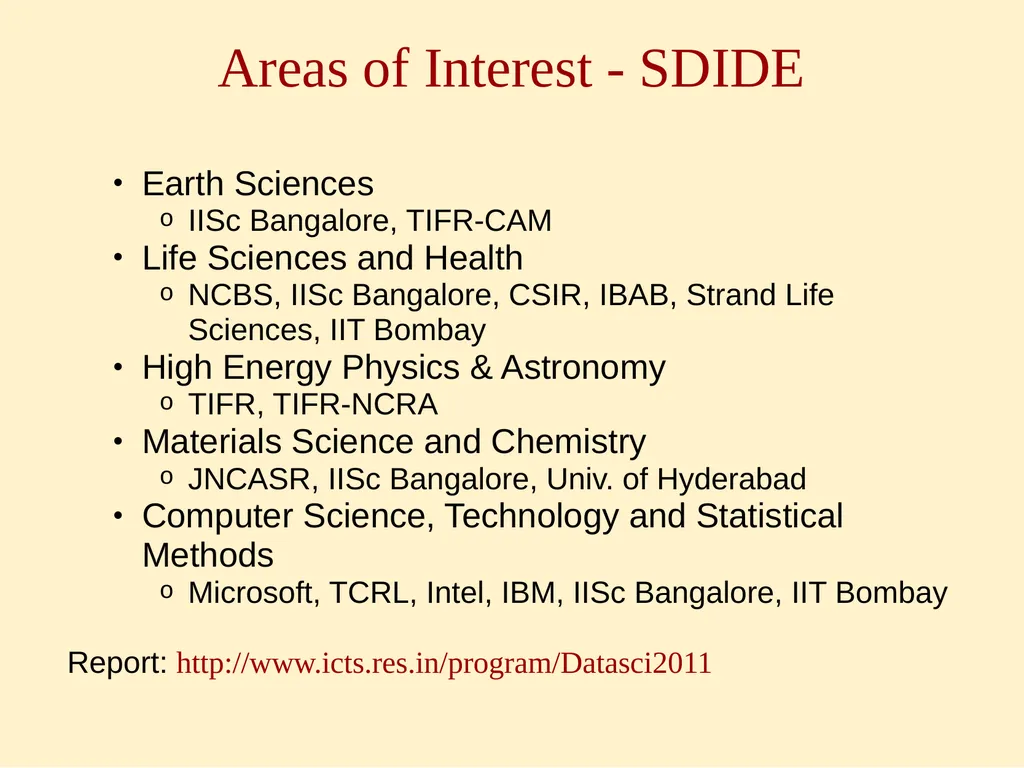
Areas of Interest - SDIDE Earth Sciences
IISc Bangalore, TIFR-CAM
Life Sciences and Health
NCBS, IISc Bangalore, CSIR, IBAB, Strand Life Sciences, IIT Bombay
High Energy Physics & Astronomy
TIFR, TIFR-NCRA
Materials Science and Chemistry
JNCASR, IISc Bangalore, Univ. of Hyderabad
Computer Science, Technology and Statistical Methods
Microsoft, TCRL, Intel, IBM, IISc Bangalore, IIT Bombay
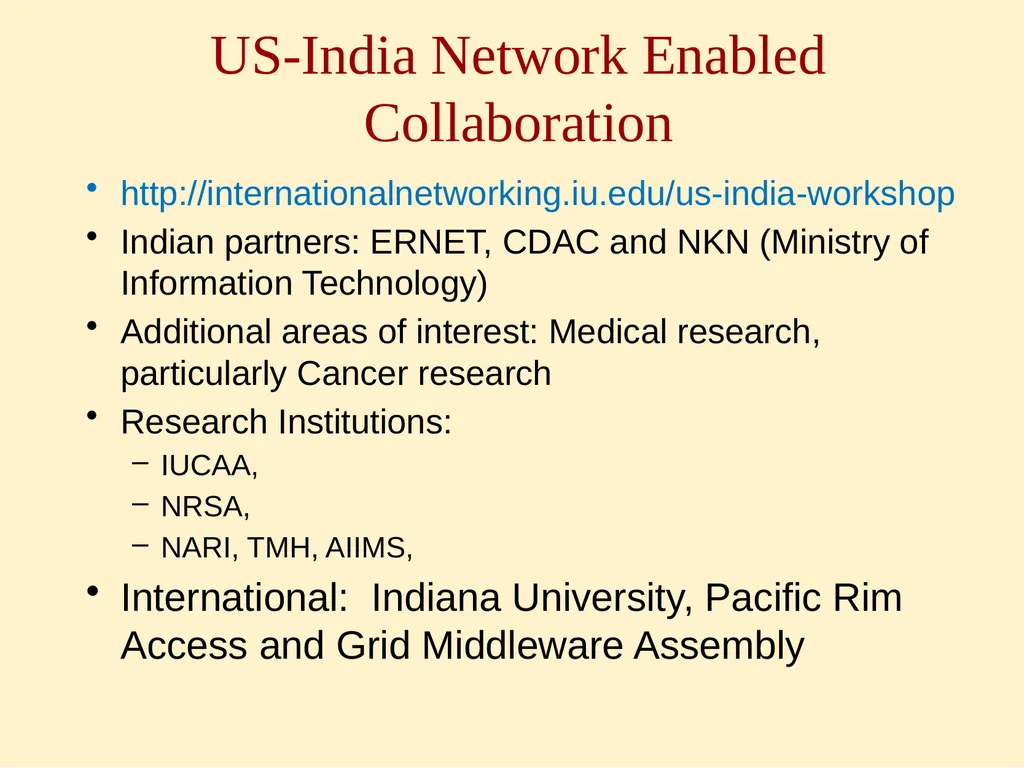
US-India Network Enabled Collaboration http://internationalnetworking.iu.edu/us-india-workshop
Indian partners: ERNET, CDAC and NKN (Ministry of Information Technology)
Additional areas of interest: Medical research, particularly Cancer research
Research Institutions:
IUCAA,
NRSA,
NARI, TMH, AIIMS,
International: Indiana University, Pacific Rim Access and Grid Middleware Assembly<br>
06
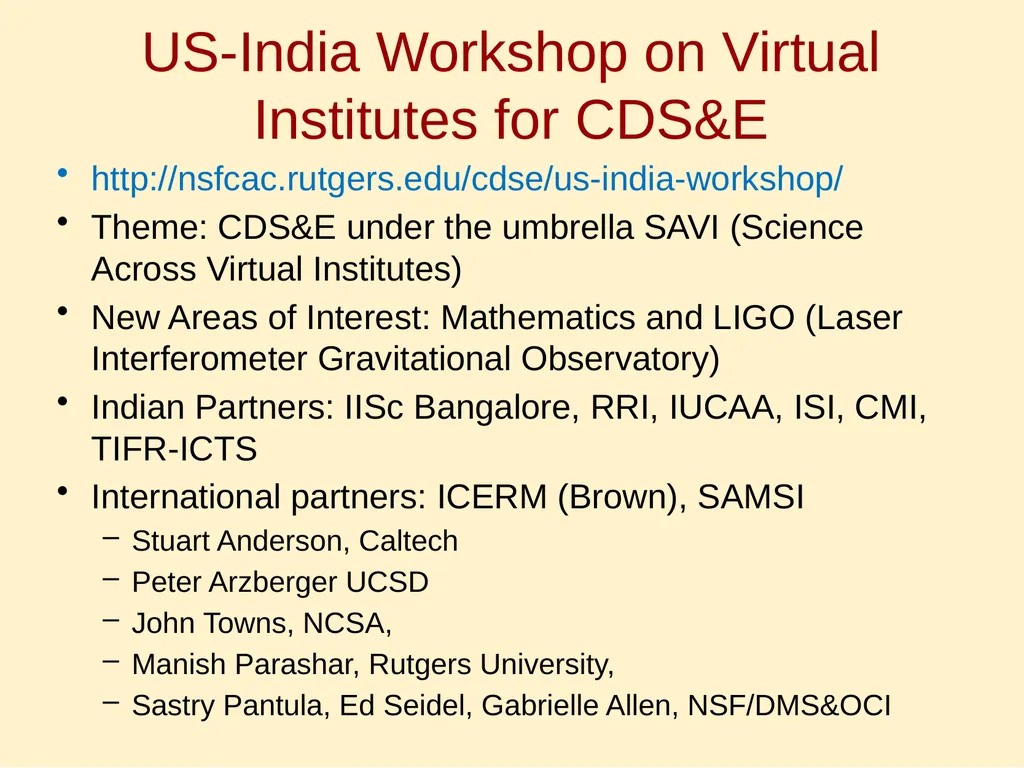
US-India Workshop on Virtual Institutes for CDS&E http://nsfcac.rutgers.edu/cdse/us-india-workshop/
Theme: CDS&E under the umbrella SAVI (Science Across Virtual Institutes)
New Areas of Interest: Mathematics and LIGO (Laser Interferometer Gravitational Observatory)
Indian Partners: IISc Bangalore, RRI, IUCAA, ISI, CMI, TIFR-ICTS
International partners: ICERM (Brown), SAMSI
Stuart Anderson, Caltech
Peter Arzberger UCSD
John Towns, NCSA,
Manish Parashar, Rutgers University,
Sastry Pantula, Ed Seidel, Gabrielle Allen, NSF/DMS&OCI<br>
07
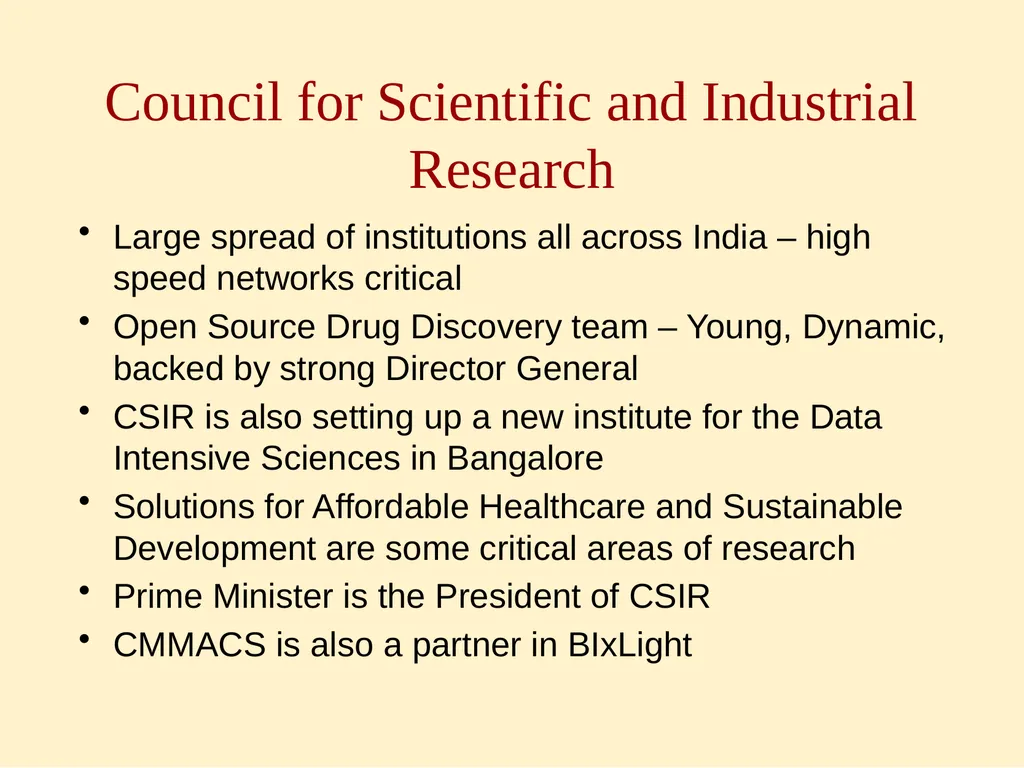
Council for Scientific and Industrial Research Large spread of institutions all across India – high speed networks critical
Open Source Drug Discovery team – Young, Dynamic, backed by strong Director General
CSIR is also setting up a new institute for the Data Intensive Sciences in Bangalore
Solutions for Affordable Healthcare and Sustainable Development are some critical areas of research
Prime Minister is the President of CSIR
CMMACS is also a partner in BIxLight<br>
08
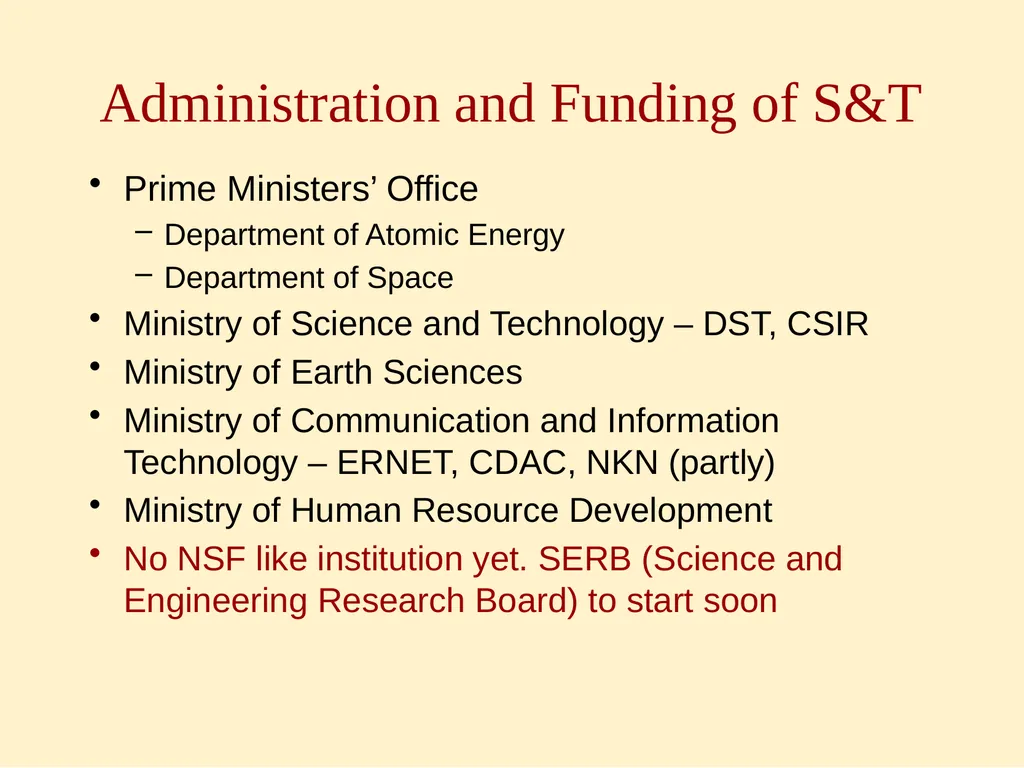
Administration and Funding of S&T Prime Ministers’ Office
Department of Atomic Energy
Department of Space
Ministry of Science and Technology – DST, CSIR
Ministry of Earth Sciences
Ministry of Communication and Information Technology – ERNET, CDAC, NKN (partly)
Ministry of Human Resource Development
No NSF like institution yet. SERB (Science and Engineering Research Board) to start soon<br>
09
BIxLight Project (Facilities and Activities)<br>
10
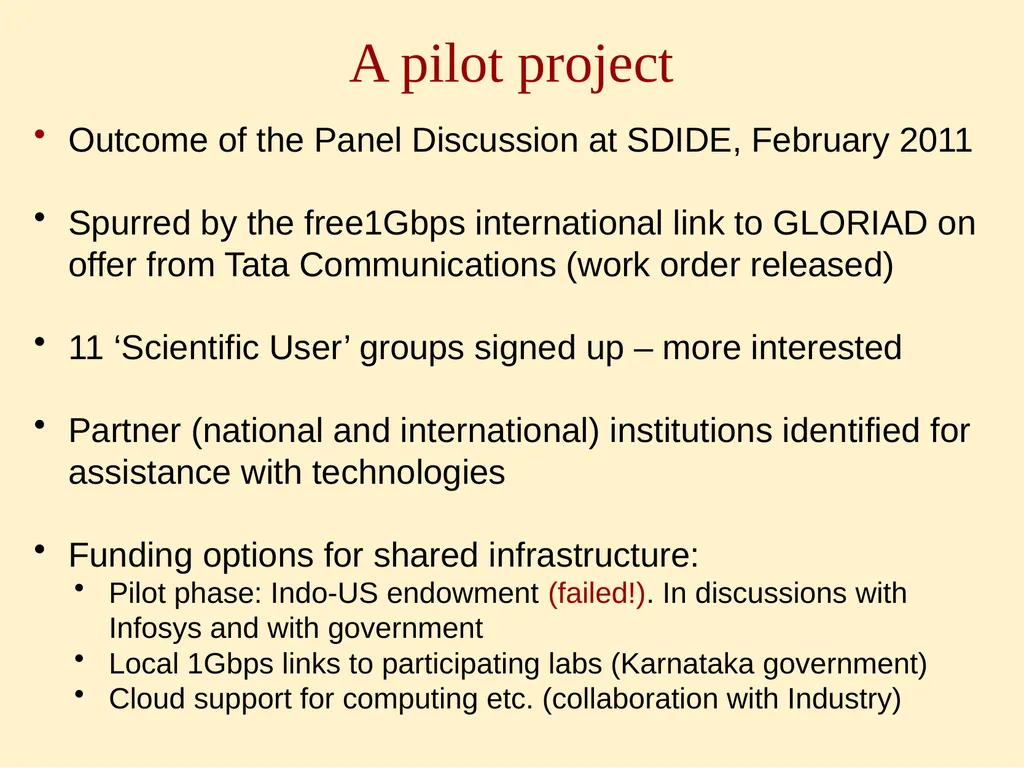
A pilot project Outcome of the Panel Discussion at SDIDE, February 2011
Spurred by the free1Gbps international link to GLORIAD on offer from Tata Communications (work order released)
11 ‘Scientific User’ groups signed up – more interested
Partner (national and international) institutions identified for assistance with technologies
Funding options for shared infrastructure:
Pilot phase: Indo-US endowment (failed!). In discussions with Infosys and with government
Local 1Gbps links to participating labs (Karnataka government)
Cloud support for computing etc. (collaboration with Industry)<br>
11
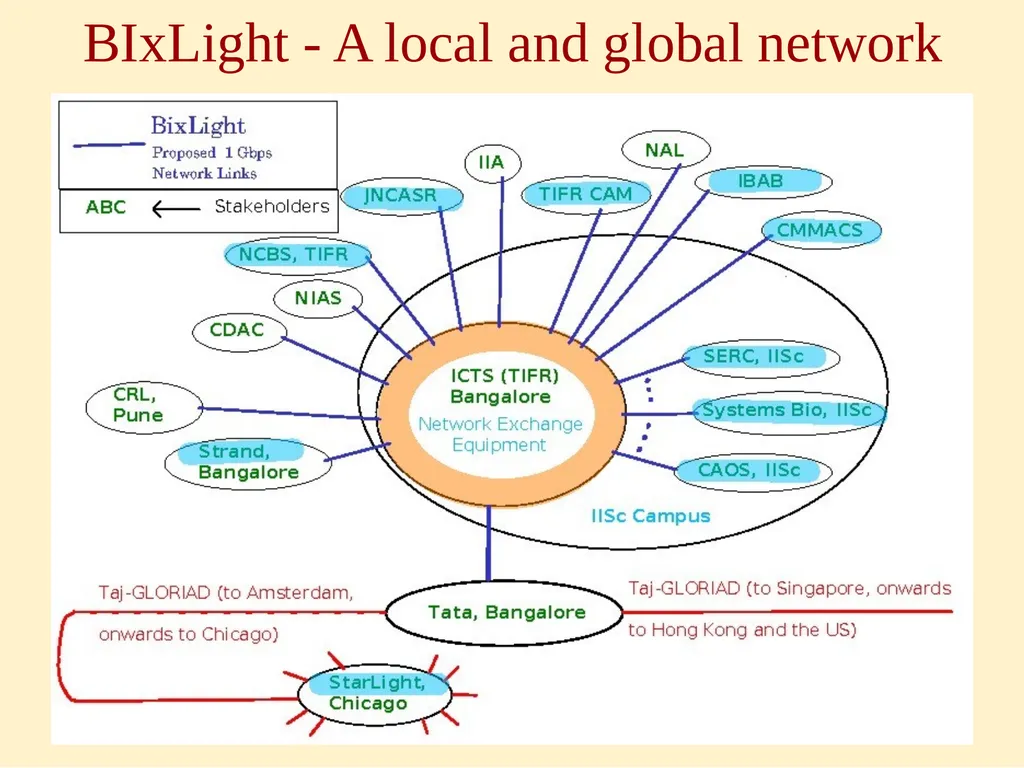
BIxLight - A local and global network<br>
12
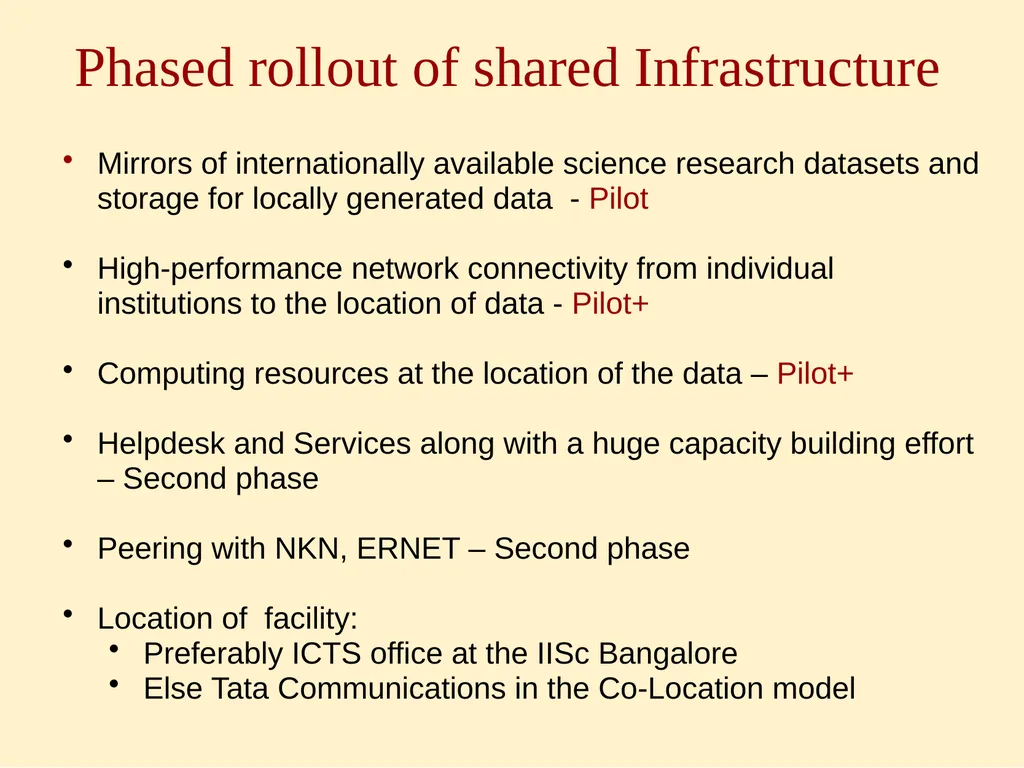
Phased rollout of shared Infrastructure Mirrors of internationally available science research datasets and storage for locally generated data - Pilot
High-performance network connectivity from individual institutions to the location of data - Pilot+
Computing resources at the location of the data – Pilot+
Helpdesk and Services along with a huge capacity building effort – Second phase
Peering with NKN, ERNET – Second phase
Location of facility:
Preferably ICTS office at the IISc Bangalore
Else Tata Communications in the Co-Location model<br>
13
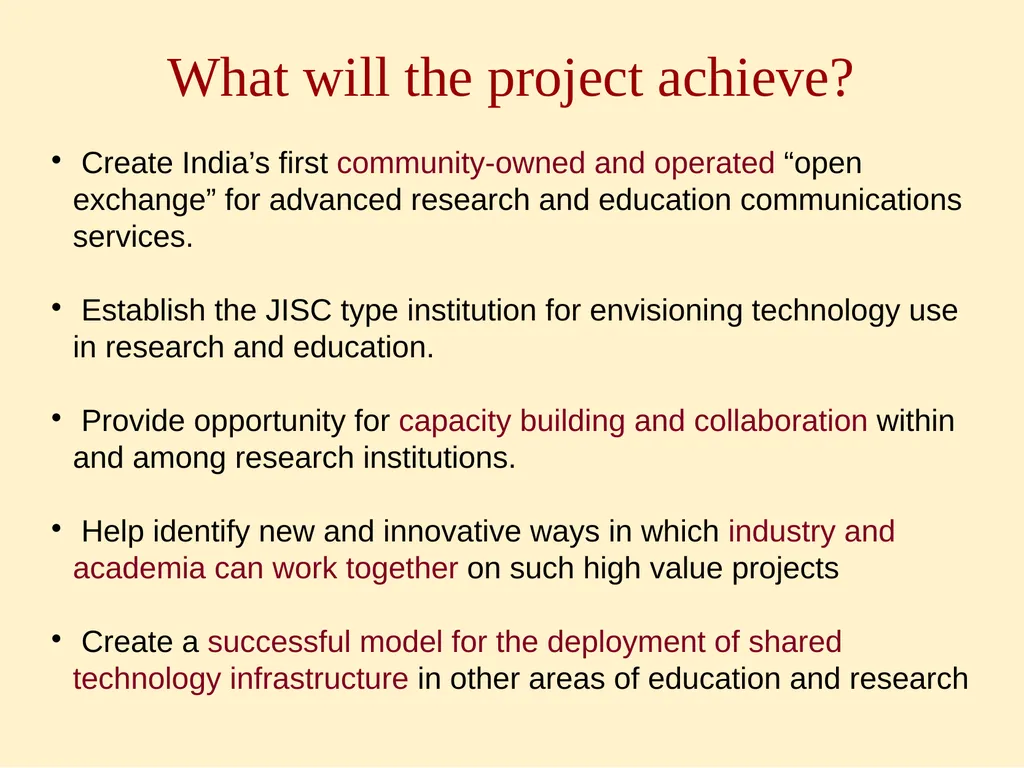
What will the project achieve? Create India’s first community-owned and operated “open exchange” for advanced research and education communications services.
Establish the JISC type institution for envisioning technology use in research and education.
Provide opportunity for capacity building and collaboration within and among research institutions.
Help identify new and innovative ways in which industry and academia can work together on such high value projects
Create a successful model for the deployment of shared technology infrastructure in other areas of education and research<br>
14
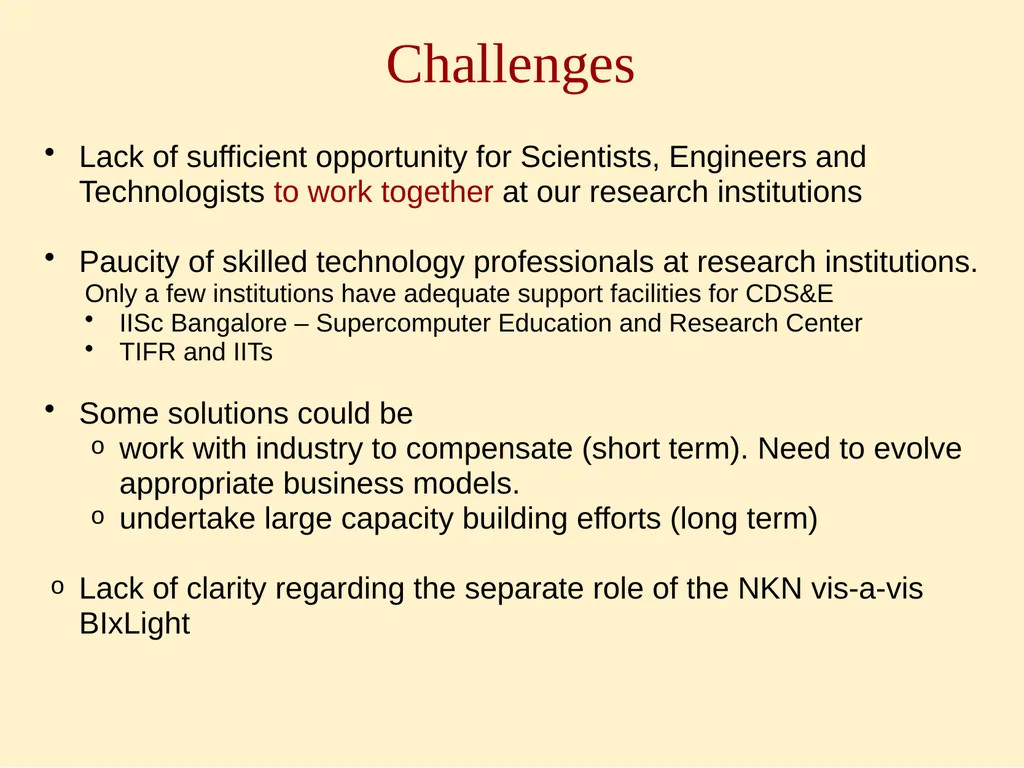
Challenges Lack of sufficient opportunity for Scientists, Engineers and Technologists to work together at our research institutions
Paucity of skilled technology professionals at research institutions.
Only a few institutions have adequate support facilities for CDS&E
IISc Bangalore – Supercomputer Education and Research Center
TIFR and IITs
Some solutions could be
work with industry to compensate (short term). Need to evolve appropriate business models.
undertake large capacity building efforts (long term)
Lack of clarity regarding the separate role of the NKN vis-a-vis BIxLight<br>
15
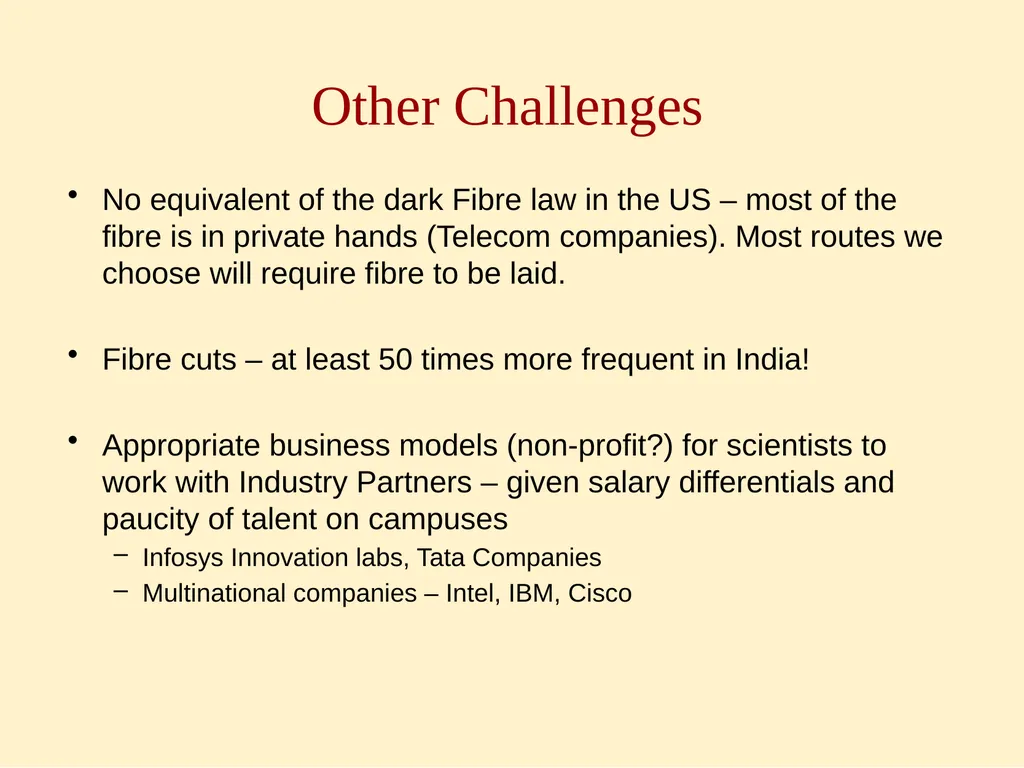
Other Challenges No equivalent of the dark Fibre law in the US – most of the fibre is in private hands (Telecom companies). Most routes we choose will require fibre to be laid.
Fibre cuts – at least 50 times more frequent in India!
Appropriate business models (non-profit?) for scientists to work with Industry Partners – given salary differentials and paucity of talent on campuses
Infosys Innovation labs, Tata Companies
Multinational companies – Intel, IBM, Cisco<br>
16
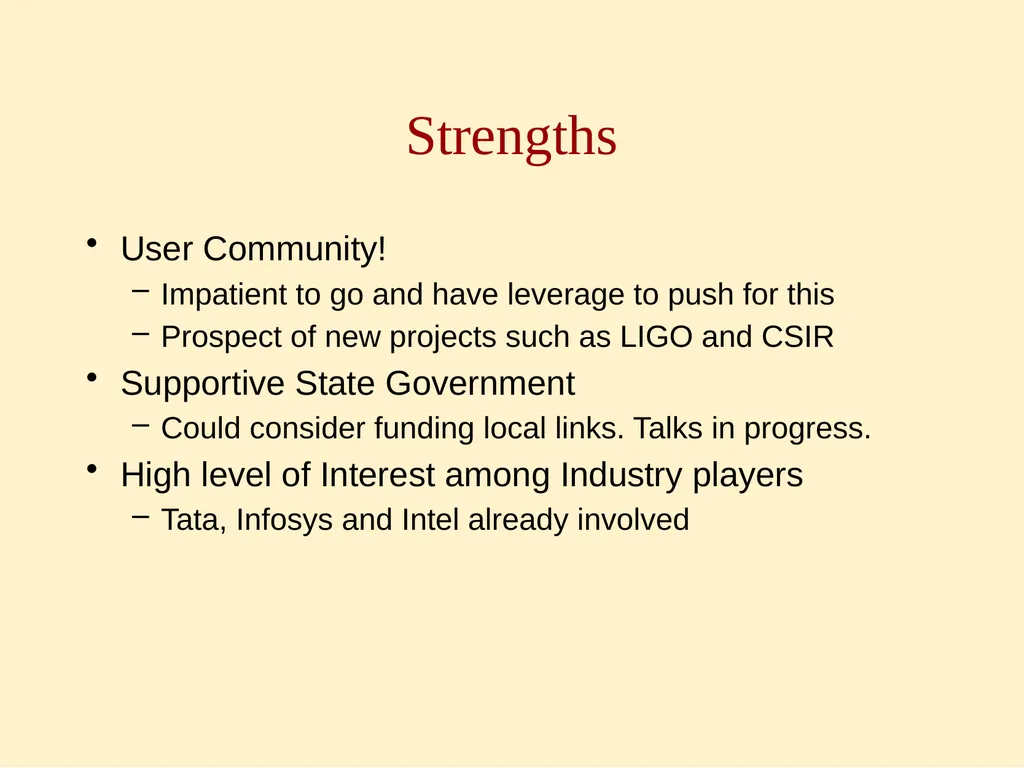
Strengths User Community!
Impatient to go and have leverage to push for this
Prospect of new projects such as LIGO and CSIR
Supportive State Government
Could consider funding local links. Talks in progress.
High level of Interest among Industry players
Tata, Infosys and Intel already involved<br>
17
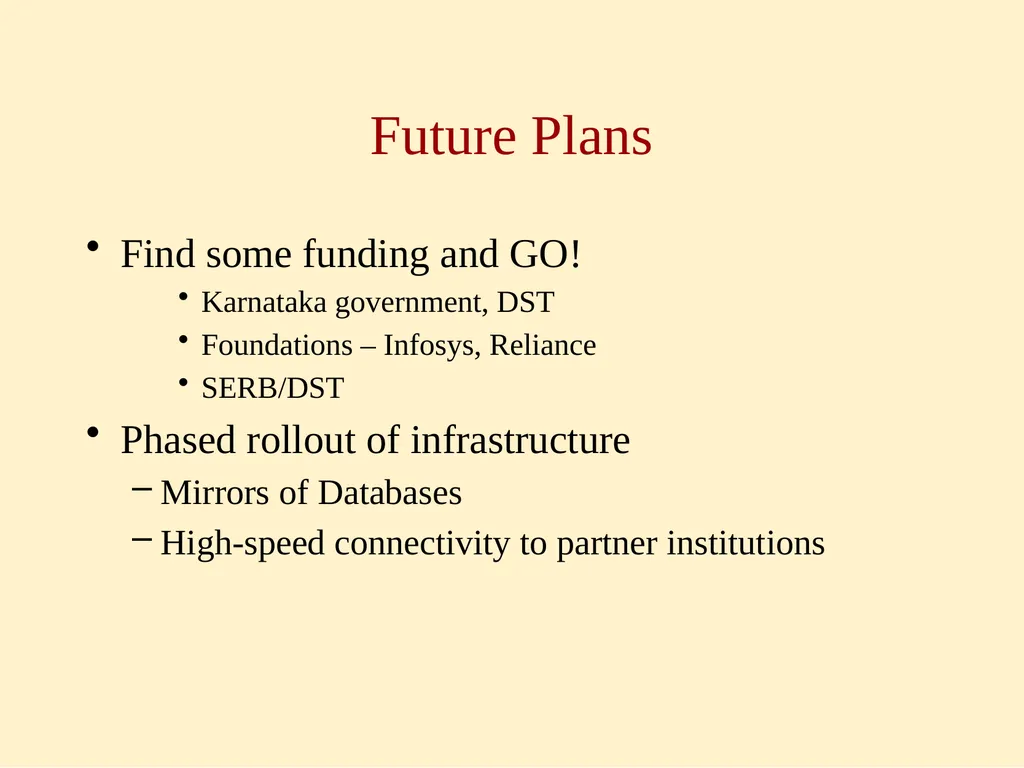
Future Plans Find some funding and GO!
Karnataka government, DST
Foundations – Infosys, Reliance
SERB/DST
Phased rollout of infrastructure
Mirrors of Databases
High-speed connectivity to partner institutions<br>
18
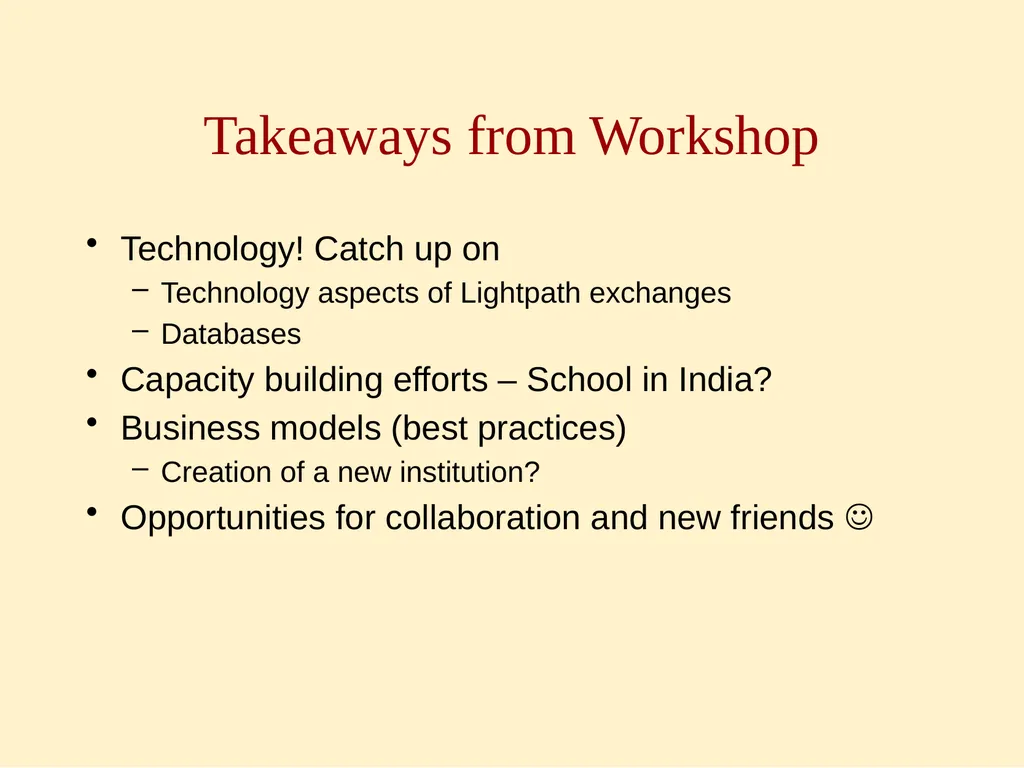
Takeaways from Workshop Technology! Catch up on
Technology aspects of Lightpath exchanges
Databases
Capacity building efforts – School in India?
Business models (best practices)
Creation of a new institution?
Opportunities for collaboration and new friends <br>