Bart Jansen Vertex Cover Kernelization Revisited: Upper and Lower Bounds for a Refined Parameter STACS 2011, Dortmund March 10th, 2011 Joint work with Hans Bodlaender Vertex Cover Input: Graph G, integer k Question: Does G have a vertex
"Bart Jansen Vertex Cover Kernelization Revisited:" is the property of its rightful owner. Permission is granted to
download and print the materials on this website for personal, non-commercial use only, and to display it
on your personal computer provided you do not modify the materials and that you retain all copyright
notices contained in the materials. By downloading content from our website, you accept the terms of this
agreement.
Presentation Transcript
01
Bart Jansen Vertex Cover Kernelization Revisited: Upper and Lower Bounds for a Refined Parameter STACS 2011, Dortmund
March 10th, 2011 Joint work with Hans Bodlaender<br>
02
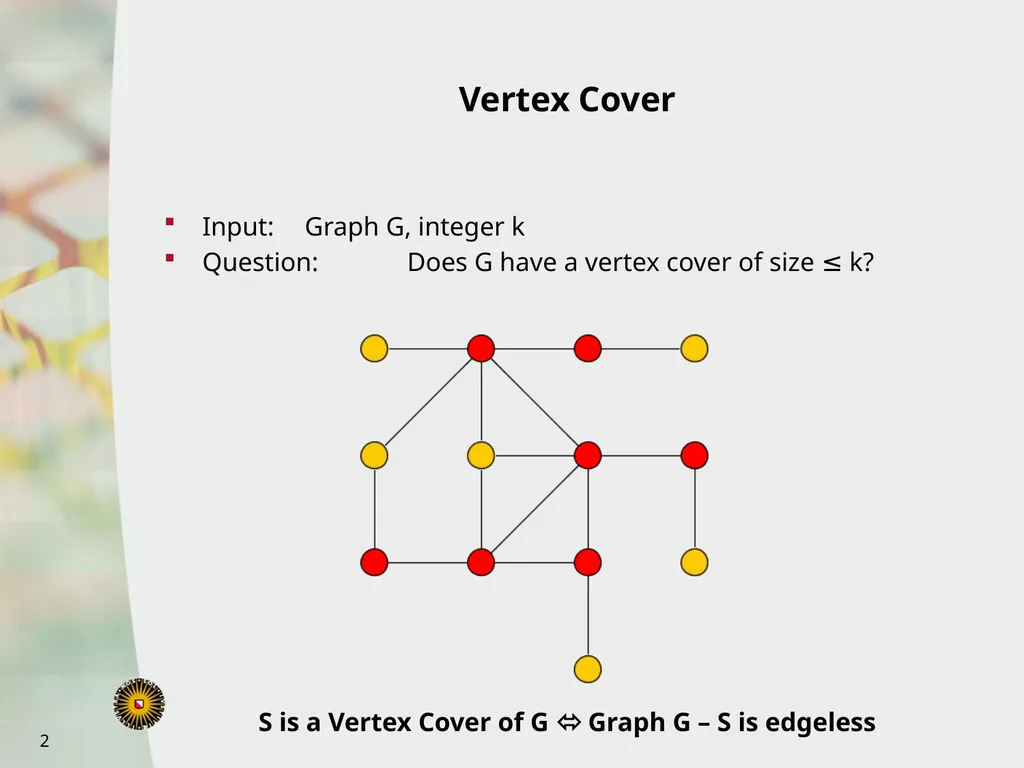
Vertex Cover Input: Graph G, integer k
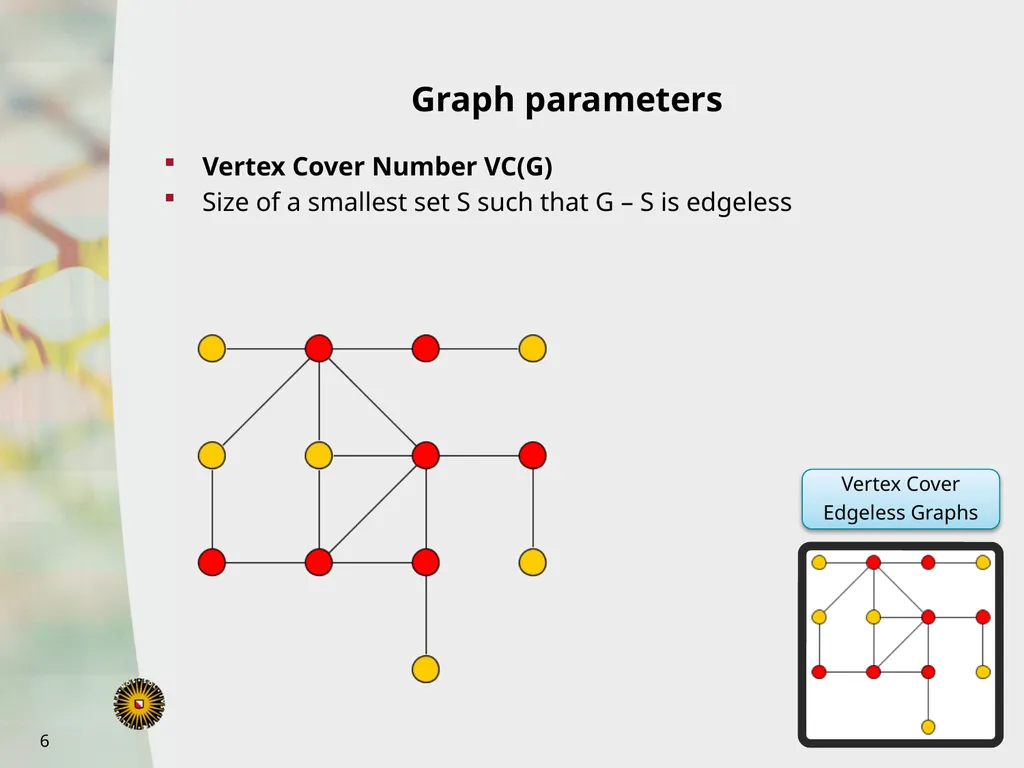
Question: Does G have a vertex cover of size ≤ k? S is a Vertex Cover of G Graph G – S is edgeless<br>
03
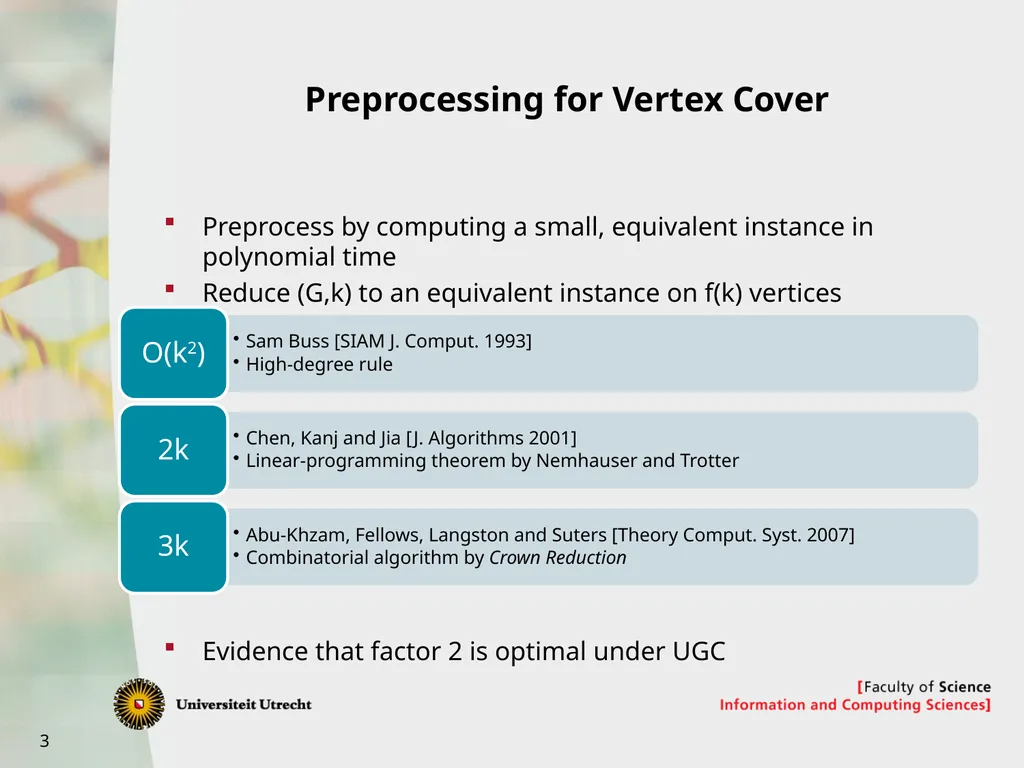
Preprocessing for Vertex Cover Preprocess by computing a small, equivalent instance in polynomial time
Reduce (G,k) to an equivalent instance on f(k) vertices
Evidence that factor 2 is optimal under UGC Sam Buss [SIAM J. Comput. 1993]
High-degree rule O(k2) Chen, Kanj and Jia [J. Algorithms 2001]
Linear-programming theorem by Nemhauser and Trotter 2k Abu-Khzam, Fellows, Langston and Suters [Theory Comput. Syst. 2007]
Combinatorial algorithm by Crown Reduction 3k<br>
04
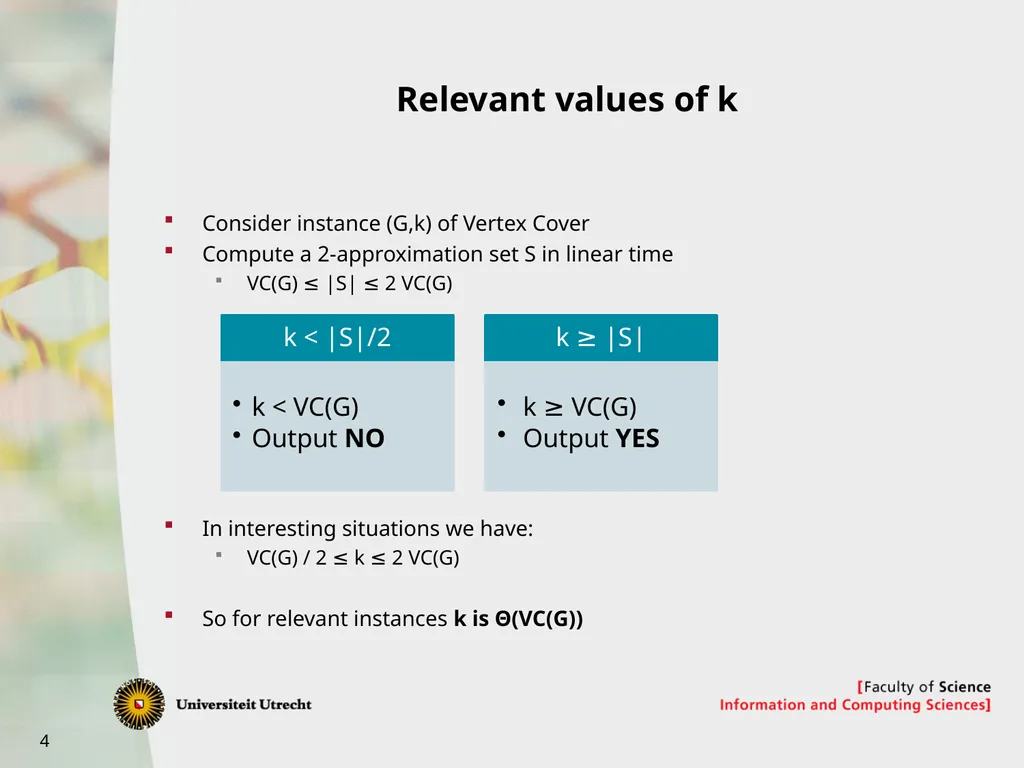
Relevant values of k Consider instance (G,k) of Vertex Cover
Compute a 2-approximation set S in linear time
VC(G) ≤ |S| ≤ 2 VC(G)
In interesting situations we have:
VC(G) / 2 ≤ k ≤ 2 VC(G)
So for relevant instances k is Θ(VC(G)) k < |S|/2 k < VC(G)
Output NO k ≥ |S| k ≥ VC(G)
Output YES<br>
05
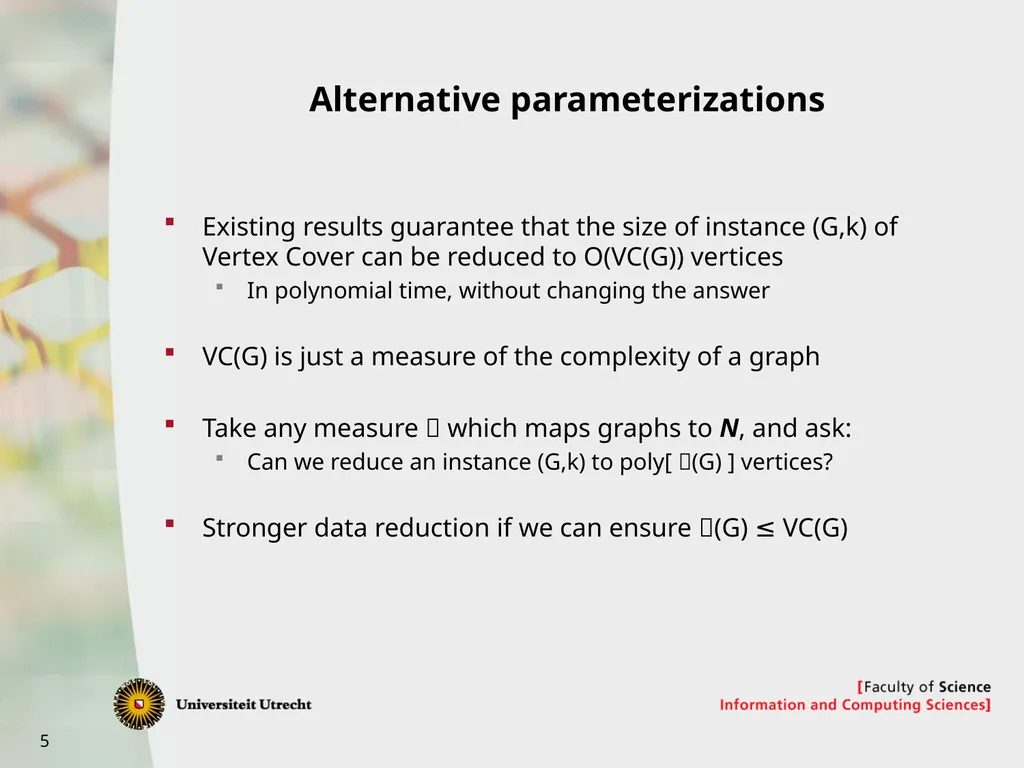
Alternative parameterizations Existing results guarantee that the size of instance (G,k) of Vertex Cover can be reduced to O(VC(G)) vertices
In polynomial time, without changing the answer
VC(G) is just a measure of the complexity of a graph
Take any measure which maps graphs to N, and ask:
Can we reduce an instance (G,k) to poly[ (G) ] vertices?
Stronger data reduction if we can ensure (G) ≤ VC(G)<br>
06
Graph parameters Vertex Cover Number VC(G)
Size of a smallest set S such that G – S is edgeless<br>
07
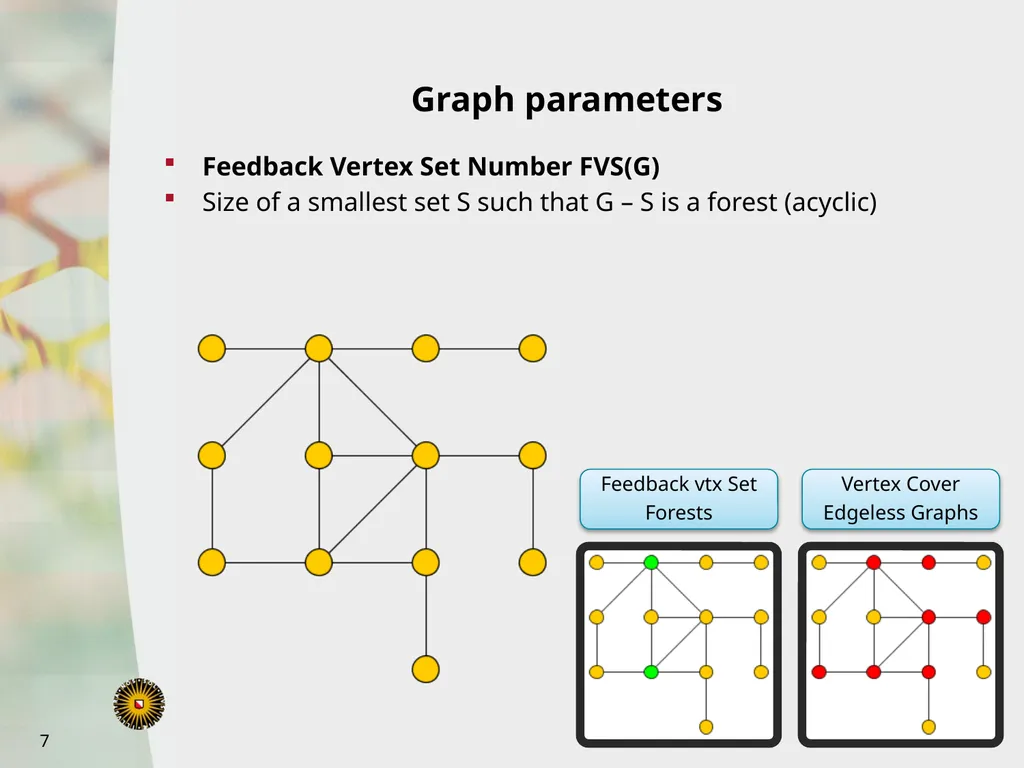
Graph parameters Feedback Vertex Set Number FVS(G)
Size of a smallest set S such that G – S is a forest (acyclic)<br>
08
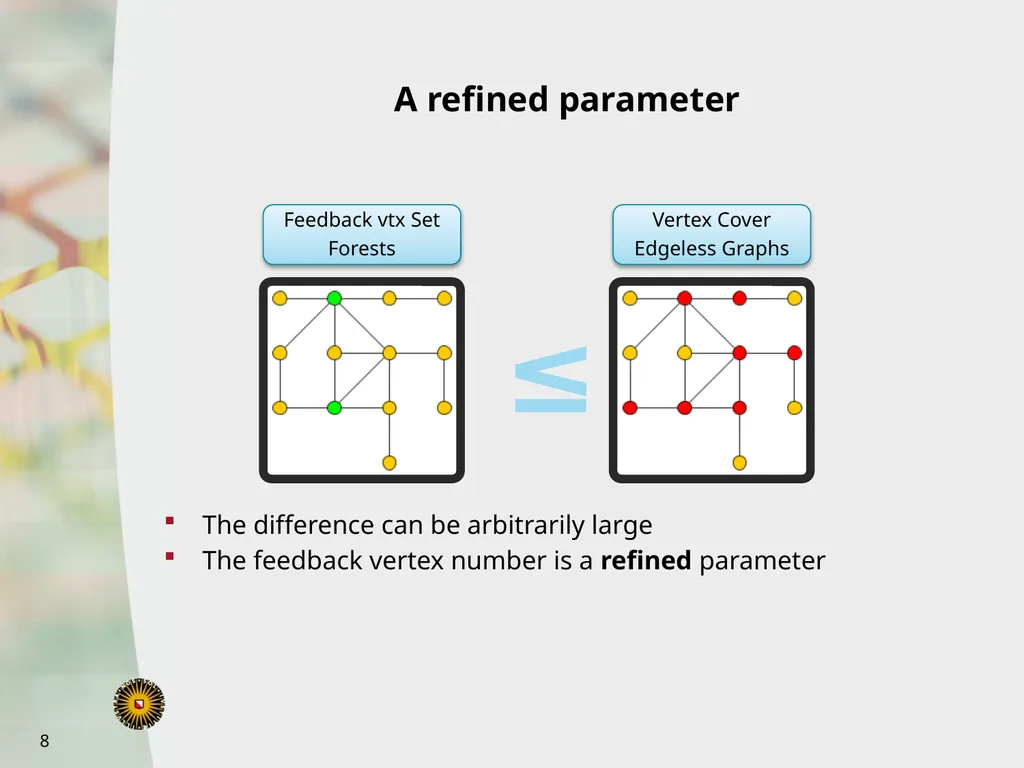
The difference can be arbitrarily large
The feedback vertex number is a refined parameter A refined parameter ≤<br>
09
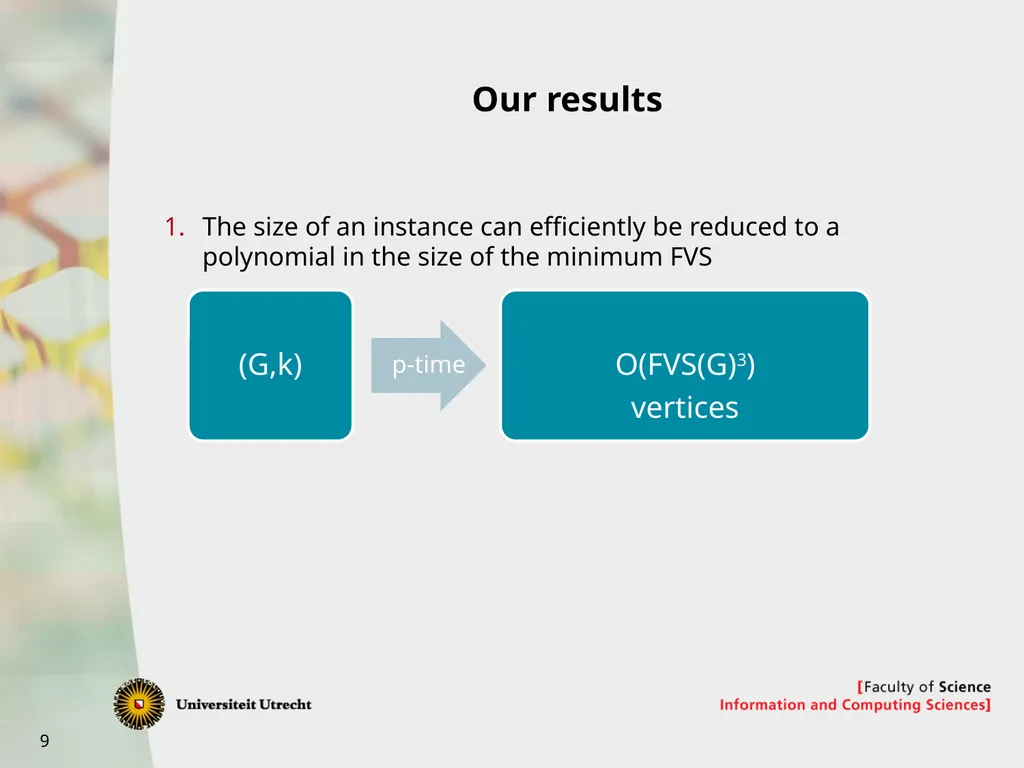
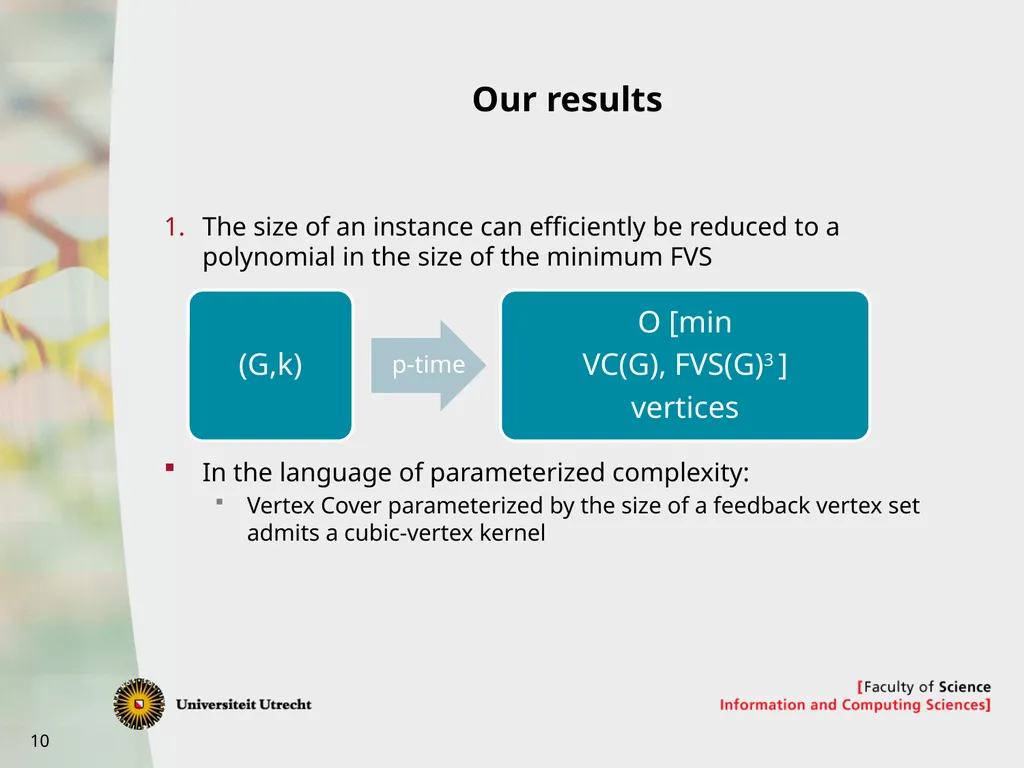
Our results The size of an instance can efficiently be reduced to a polynomial in the size of the minimum FVS<br>
10
Our results The size of an instance can efficiently be reduced to a polynomial in the size of the minimum FVS
In the language of parameterized complexity:
Vertex Cover parameterized by the size of a feedback vertex set admits a cubic-vertex kernel<br>
11
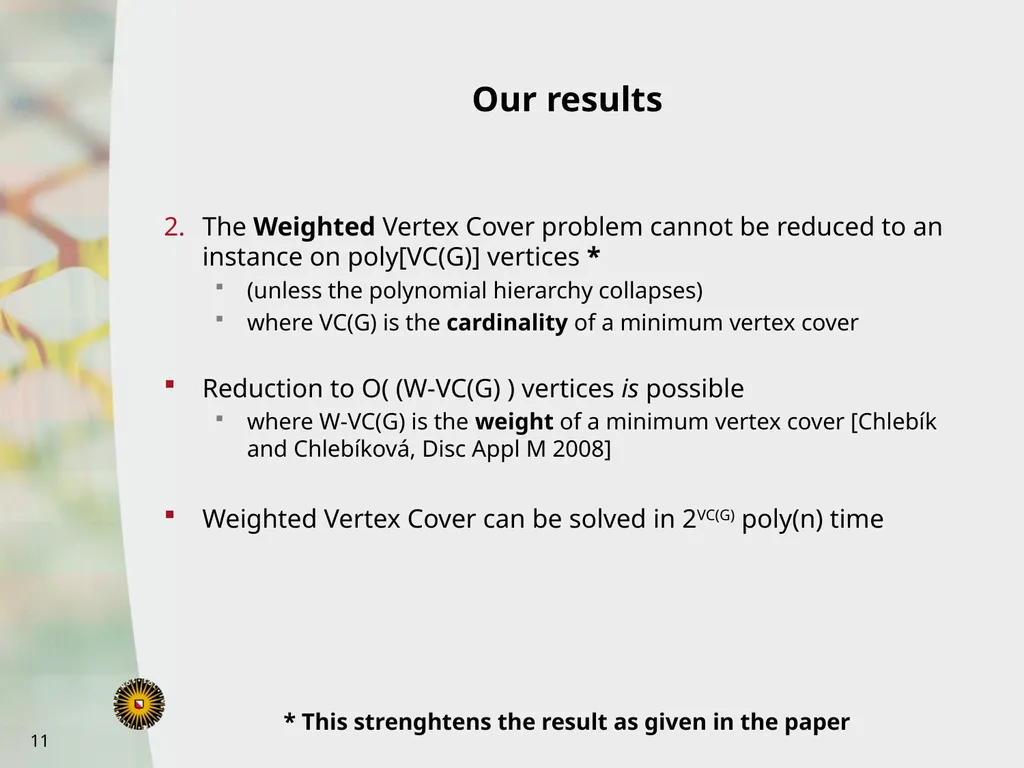
Our results The Weighted Vertex Cover problem cannot be reduced to an instance on poly[VC(G)] vertices *
(unless the polynomial hierarchy collapses)
where VC(G) is the cardinality of a minimum vertex cover
Reduction to O( (W-VC(G) ) vertices is possible
where W-VC(G) is the weight of a minimum vertex cover [Chlebík and Chlebíková, Disc Appl M 2008]
Weighted Vertex Cover can be solved in 2VC(G) poly(n) time * This strenghtens the result as given in the paper<br>
12
the upper bounds Sketch of the reduction rules<br>
13
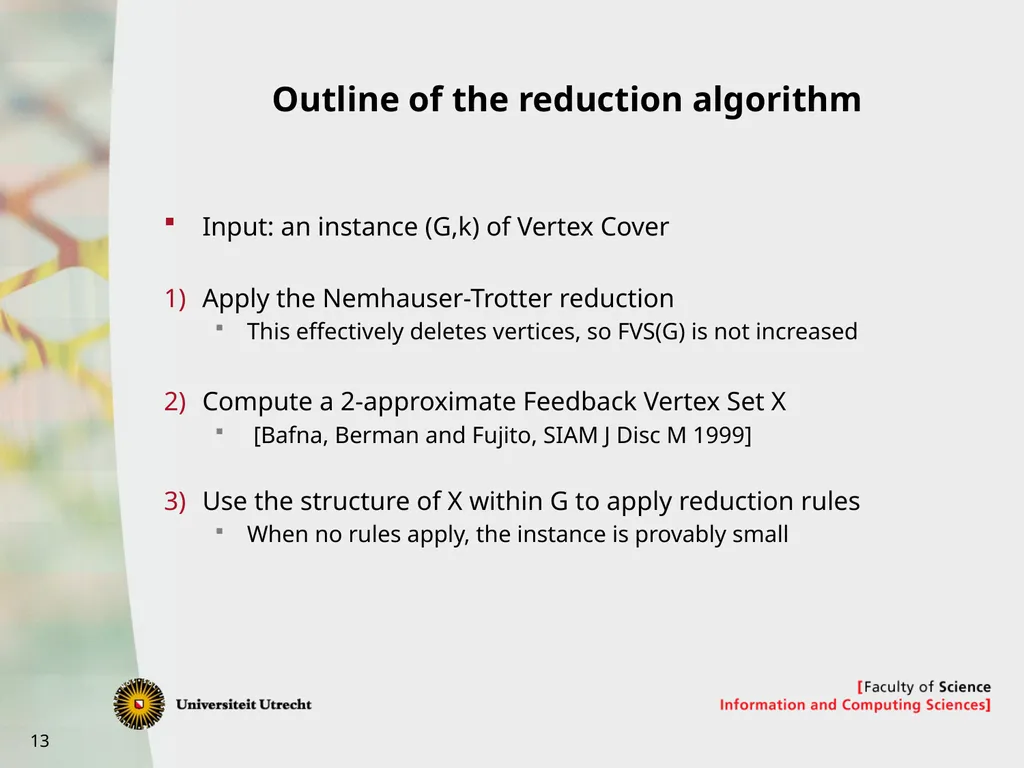
Outline of the reduction algorithm Input: an instance (G,k) of Vertex Cover
Apply the Nemhauser-Trotter reduction
This effectively deletes vertices, so FVS(G) is not increased
Compute a 2-approximate Feedback Vertex Set X
[Bafna, Berman and Fujito, SIAM J Disc M 1999]
Use the structure of X within G to apply reduction rules
When no rules apply, the instance is provably small<br>
14
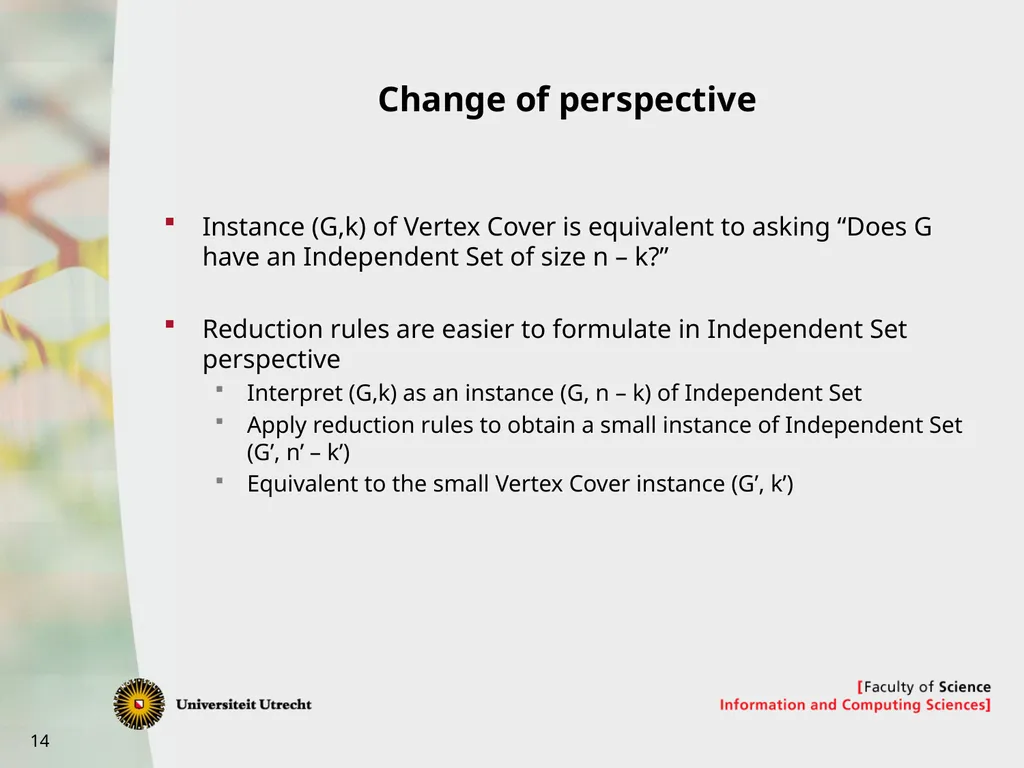
Change of perspective Instance (G,k) of Vertex Cover is equivalent to asking “Does G have an Independent Set of size n – k?”
Reduction rules are easier to formulate in Independent Set perspective
Interpret (G,k) as an instance (G, n – k) of Independent Set
Apply reduction rules to obtain a small instance of Independent Set (G’, n’ – k’)
Equivalent to the small Vertex Cover instance (G’, k’)<br>
15
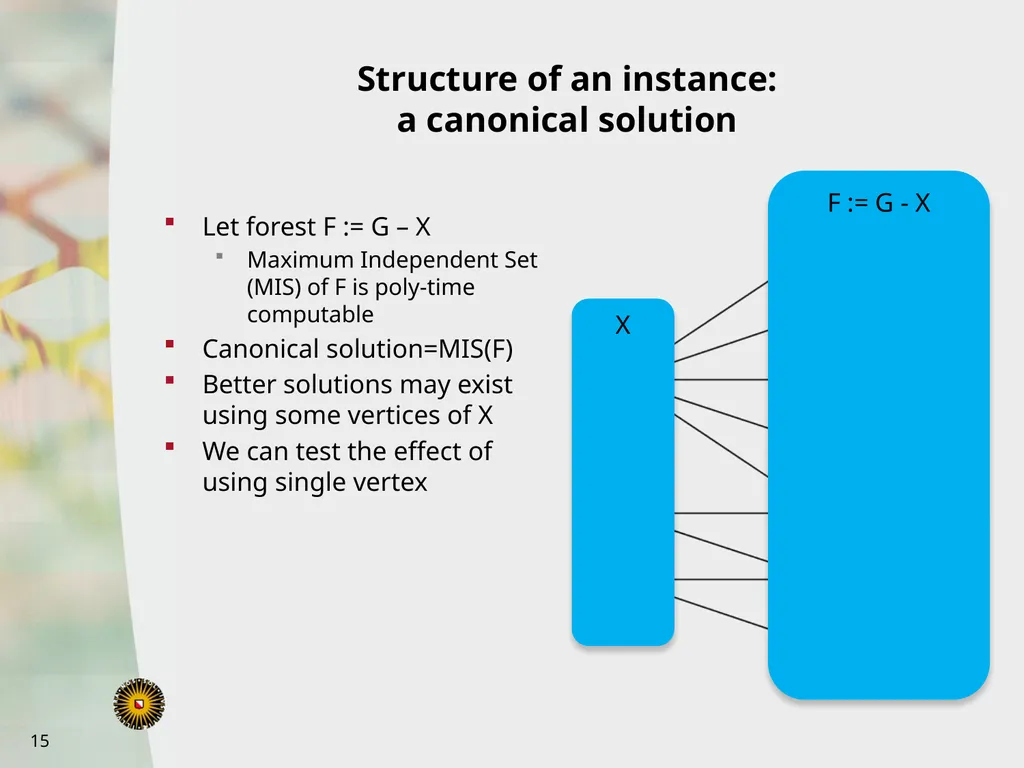
Structure of an instance: a canonical solution Let forest F := G – X
Maximum Independent Set (MIS) of F is poly-time computable
Canonical solution=MIS(F)
Better solutions may exist using some vertices of X
We can test the effect of using single vertex X F := G - X<br>
16
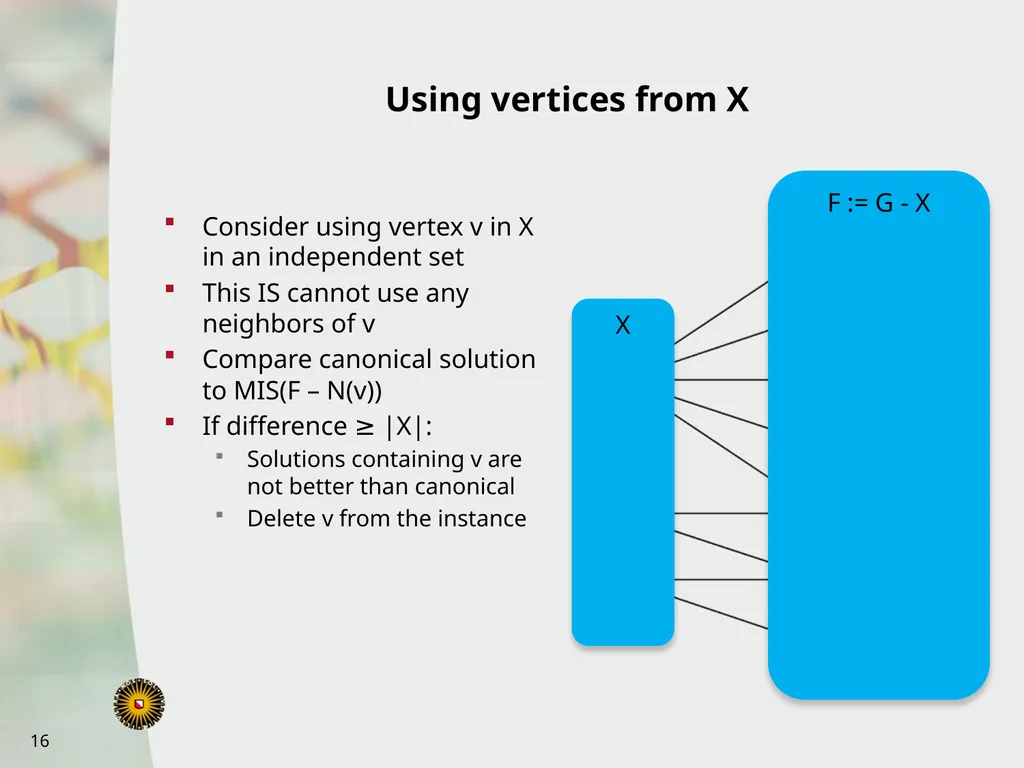
Using vertices from X Consider using vertex v in X in an independent set
This IS cannot use any neighbors of v
Compare canonical solution to MIS(F – N(v))
If difference ≥ |X|:
Solutions containing v are not better than canonical
Delete v from the instance X F := G - X<br>
17
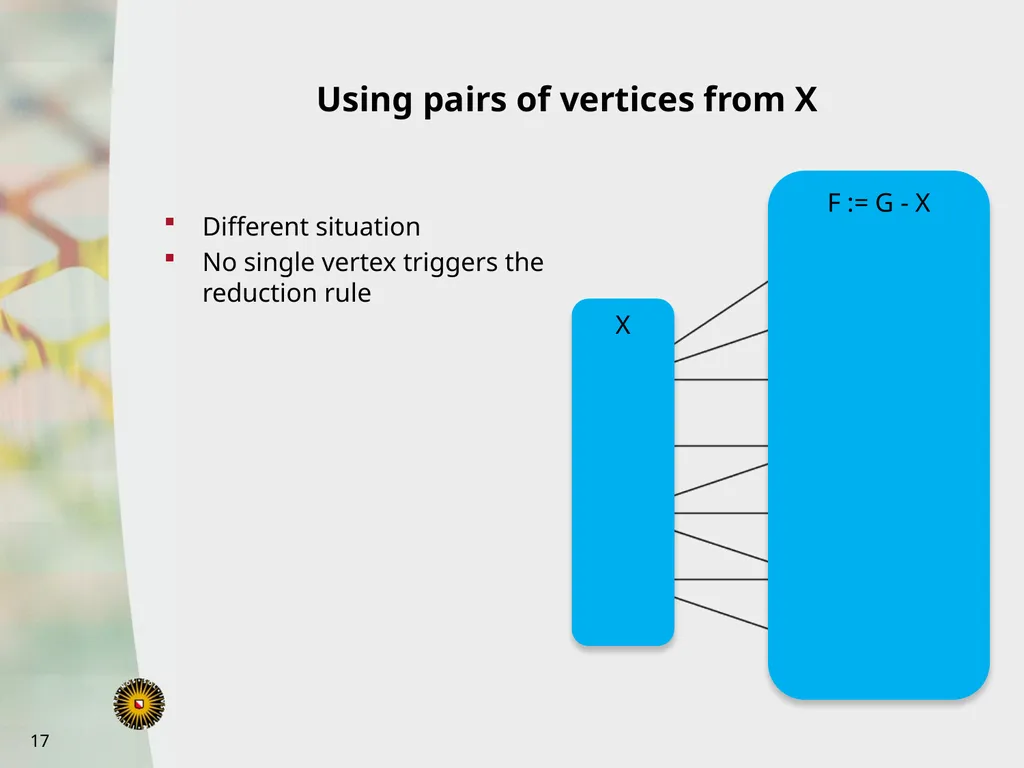
Using pairs of vertices from X Different situation
No single vertex triggers the reduction rule X F := G - X<br>
18
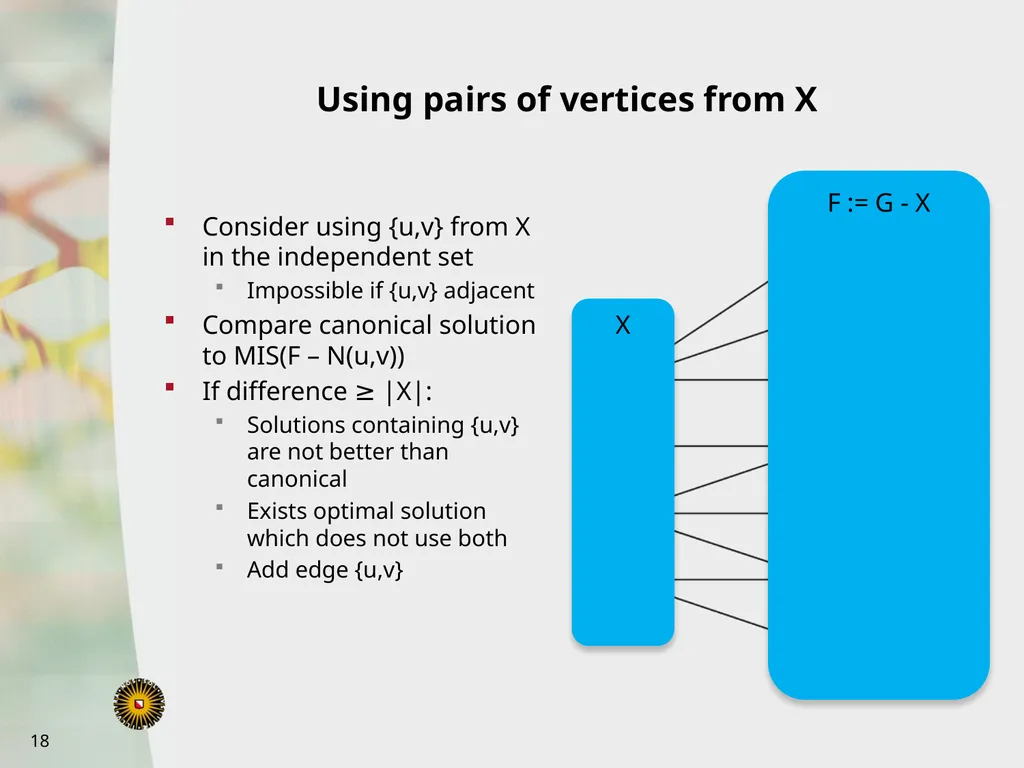
Using pairs of vertices from X Consider using {u,v} from X in the independent set
Impossible if {u,v} adjacent
Compare canonical solution to MIS(F – N(u,v))
If difference ≥ |X|:
Solutions containing {u,v} are not better than canonical
Exists optimal solution which does not use both
Add edge {u,v} X F := G - X<br>
19
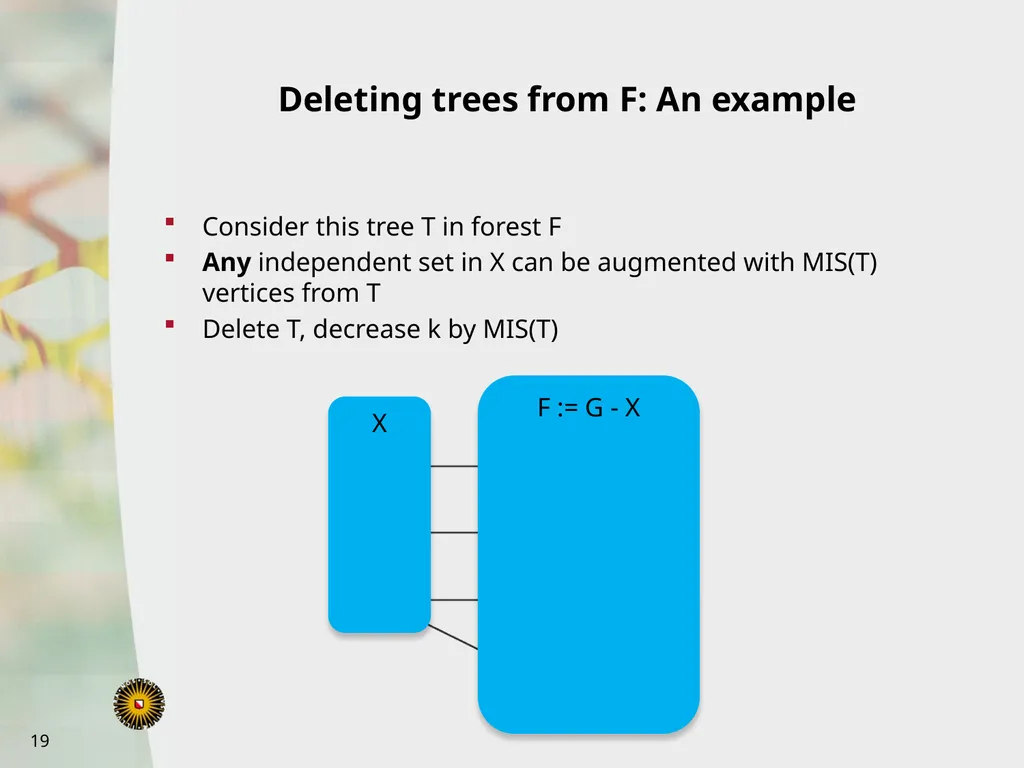
Deleting trees from F: An example Consider this tree T in forest F
Any independent set in X can be augmented with MIS(T) vertices from T
Delete T, decrease k by MIS(T) X F := G - X<br>
20
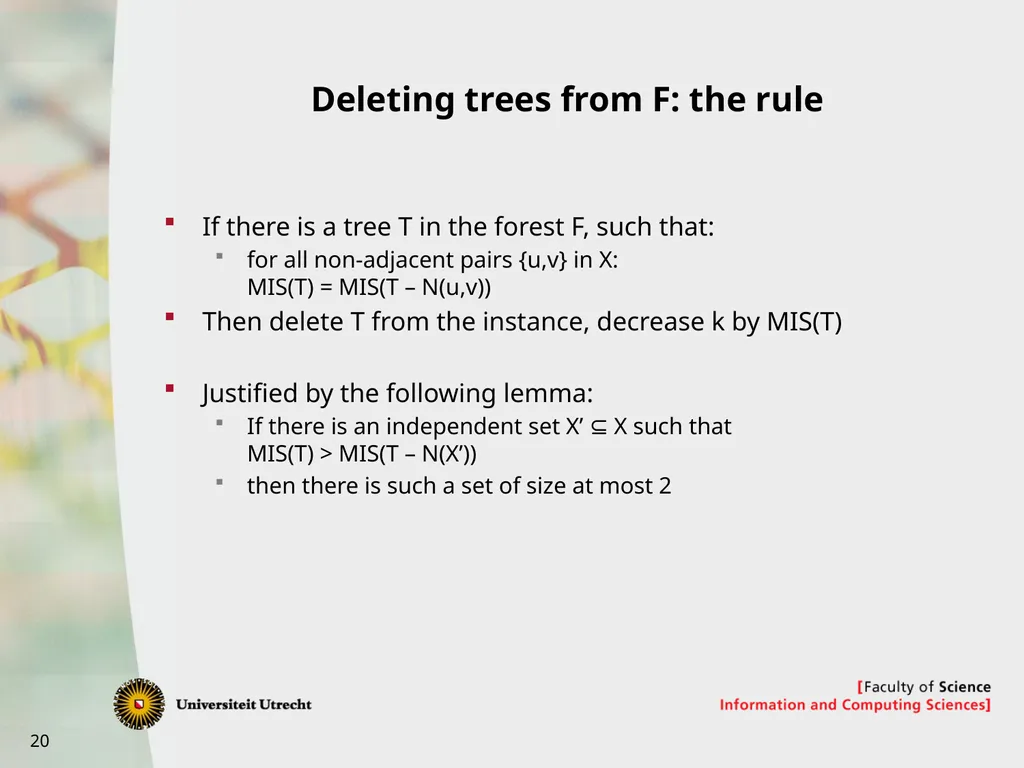
Deleting trees from F: the rule If there is a tree T in the forest F, such that:
for all non-adjacent pairs {u,v} in X: MIS(T) = MIS(T – N(u,v))
Then delete T from the instance, decrease k by MIS(T)
Justified by the following lemma:
If there is an independent set X’ ⊆ X such that MIS(T) > MIS(T – N(X’))
then there is such a set of size at most 2<br>
21
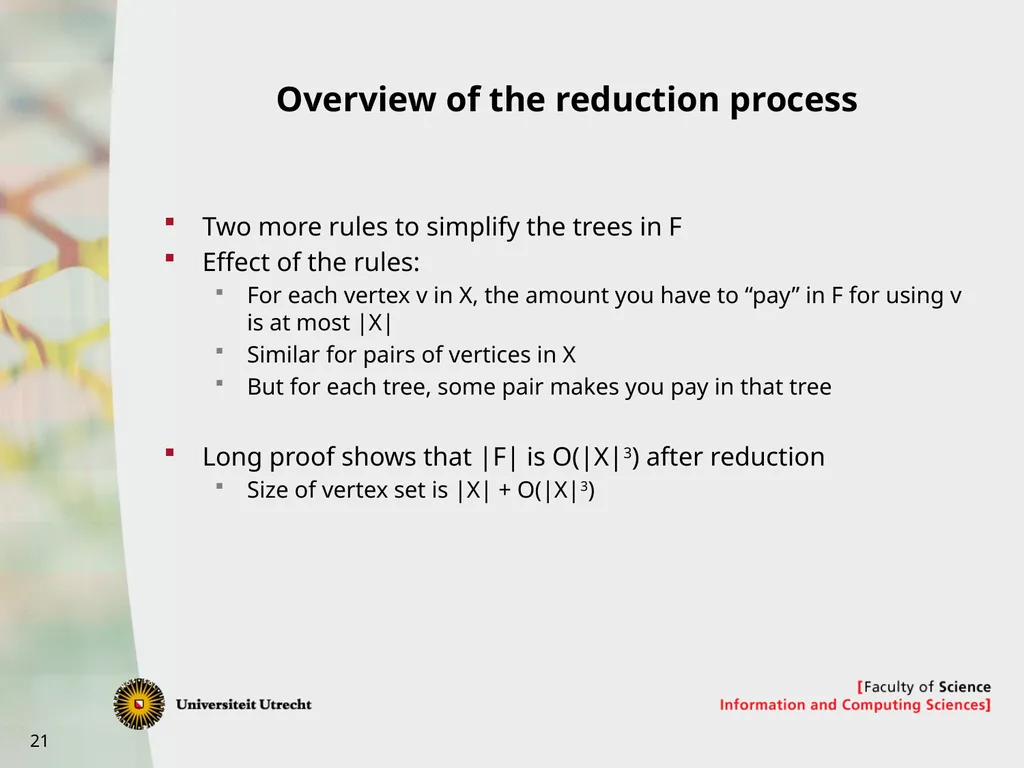
Overview of the reduction process Two more rules to simplify the trees in F
Effect of the rules:
For each vertex v in X, the amount you have to “pay” in F for using v is at most |X|
Similar for pairs of vertices in X
But for each tree, some pair makes you pay in that tree
Long proof shows that |F| is O(|X|3) after reduction
Size of vertex set is |X| + O(|X|3)<br>
22
conclusion and discussion<br>
23
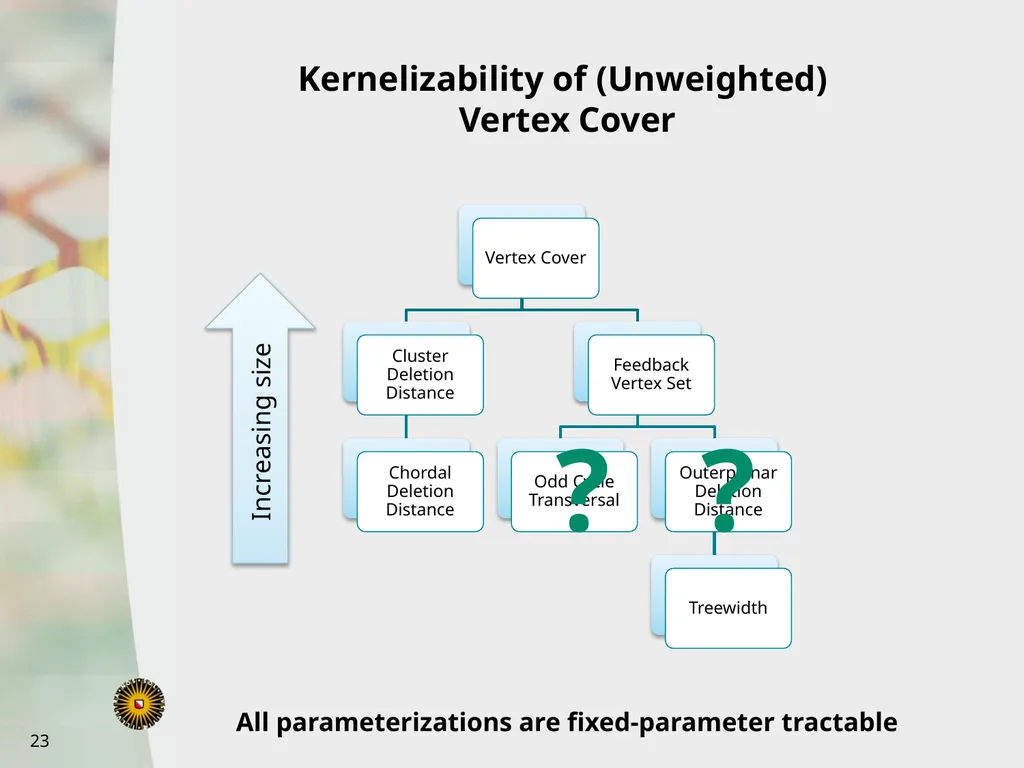
Kernelizability of (Unweighted) Vertex Cover Vertex Cover Cluster Deletion Distance Chordal Deletion Distance Feedback Vertex Set Odd Cycle Transversal Outerplanar Deletion Distance Treewidth ? ? Increasing size All parameterizations are fixed-parameter tractable<br>
24
Conclusion We have studied data reduction for Vertex Cover using a “refined” parameter: Feedback Vertex Number
Kernel with O(|X|3) vertices
Usage of vertex weights affects kernelizability
No polynomial kernel for weighted problem parameterized by VC-size (unless…)
Hierarchy of parameters to explore
Open problems:
Deletion distance to bipartite/outerplanar graphs
Improve the degree of the polynomial: cubic to quadratic? Thank you!<br>