
Base-Delta-Immediate Compression: Practical Data



Description: Base-Delta-Immediate Compression: Practical Data Compression for On-Chip Caches Gennady Pekhimenko Vivek Seshadri Onur Mutlu , Todd C. Mowry Phillip B. Gibbons Michael A. Kozuch Executive Summary Off-chip memory latency is high Large
Related Topics
Download Presentation
"Base-Delta-Immediate Compression: Practical Data" is the property of its rightful owner. Permission is granted to download and print the materials on this website for personal, non-commercial use only, and to display it on your personal computer provided you do not modify the materials and that you retain all copyright notices contained in the materials. By downloading content from our website, you accept the terms of this agreement.
Presentation Transcript
slide1. Base-Delta-Immediate Compression:
Practical Data Compression
for On-Chip Caches Gennady Pekhimenko
Vivek Seshadri
Onur Mutlu , Todd C. Mowry Phillip B. Gibbons*
Michael A. Kozuch* *<br>
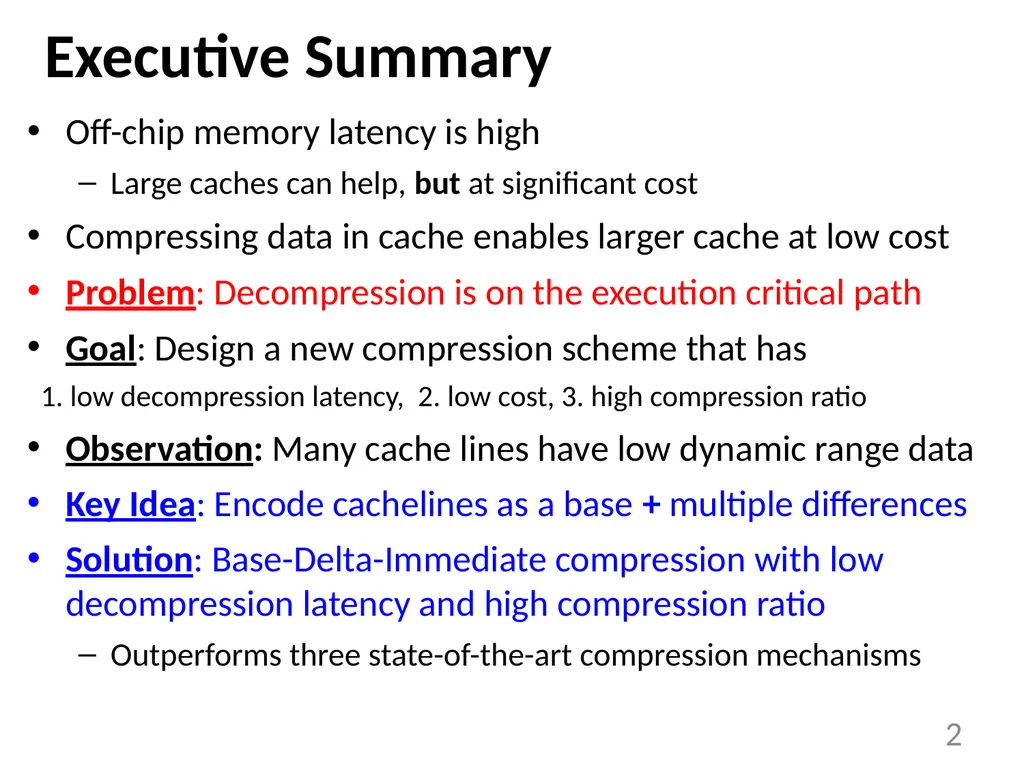
slide2. Executive Summary Off-chip memory latency is high
Large caches can help, but at significant cost
Compressing data in cache enables larger cache at low cost
Problem: Decompression is on the execution critical path
Goal: Design a new compression scheme that has
1. low decompression latency, 2. low cost, 3. high compression ratio
Observation: Many cache lines have low dynamic range data
Key Idea: Encode cachelines as a base + multiple differences
Solution: Base-Delta-Immediate compression with low decompression latency and high compression ratio
Outperforms three state-of-the-art compression mechanisms 2<br>
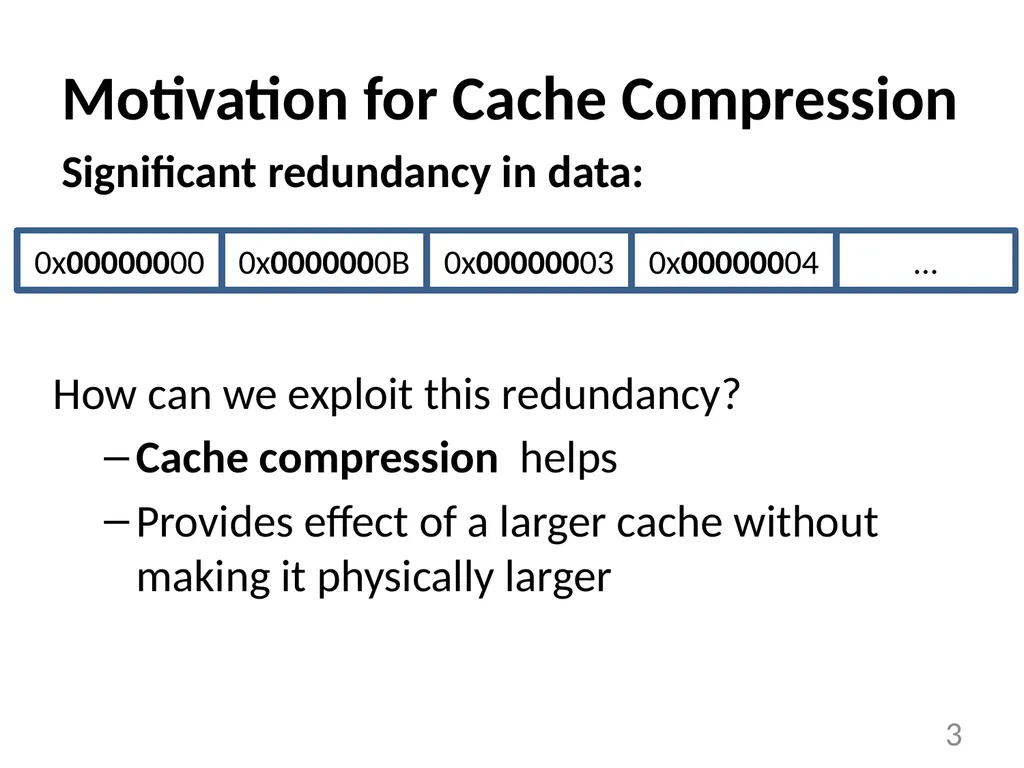
slide3. Motivation for Cache Compression Significant redundancy in data: 3 0x00000000 How can we exploit this redundancy?
Cache compression helps
Provides effect of a larger cache without making it physically larger 0x0000000B 0x00000003 0x00000004 …<br>
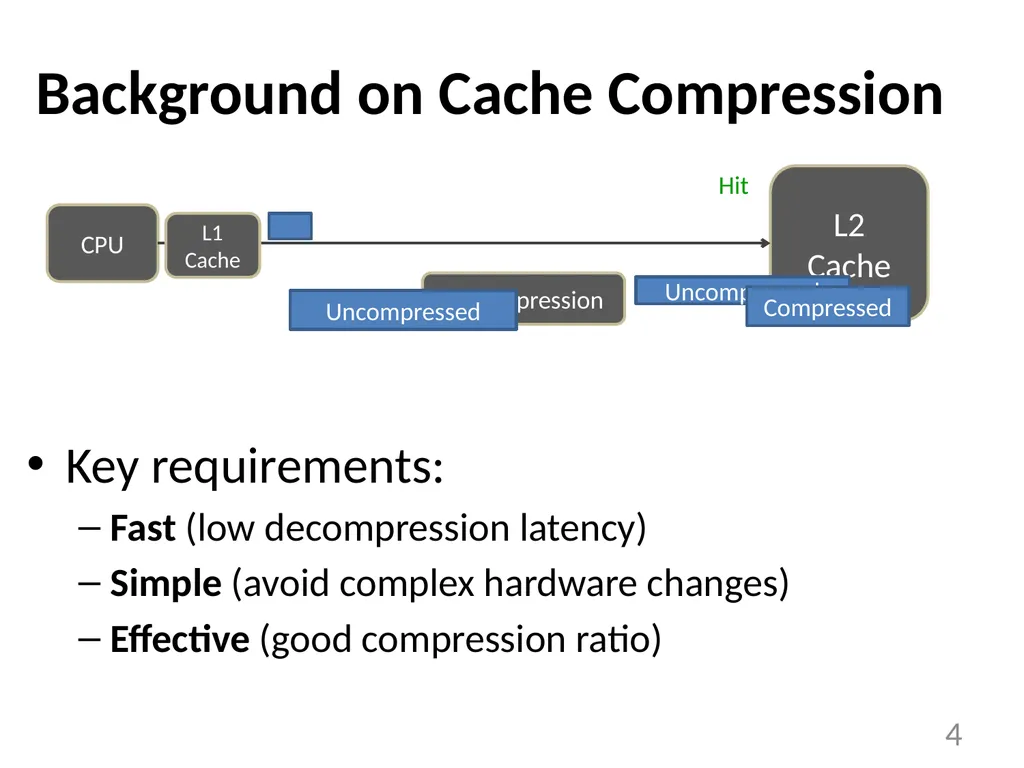
slide4. Background on Cache Compression Key requirements:
Fast (low decompression latency)
Simple (avoid complex hardware changes)
Effective (good compression ratio) 4 CPU L2 Cache Uncompressed Compressed Decompression Uncompressed L1 Cache Hit<br>
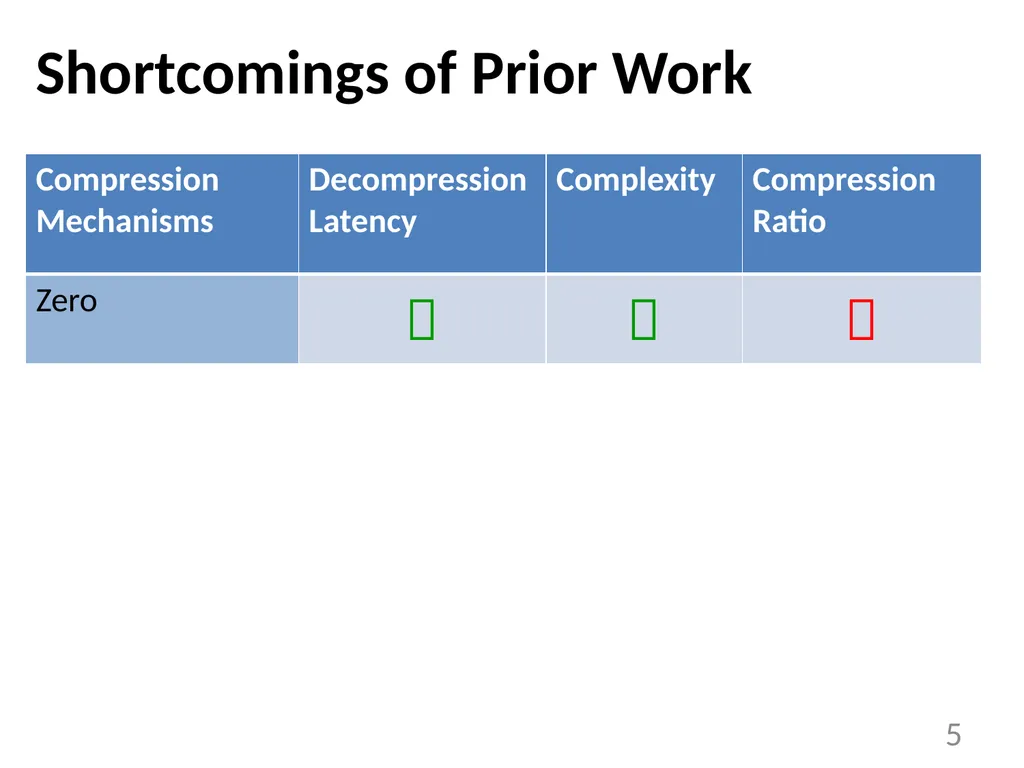
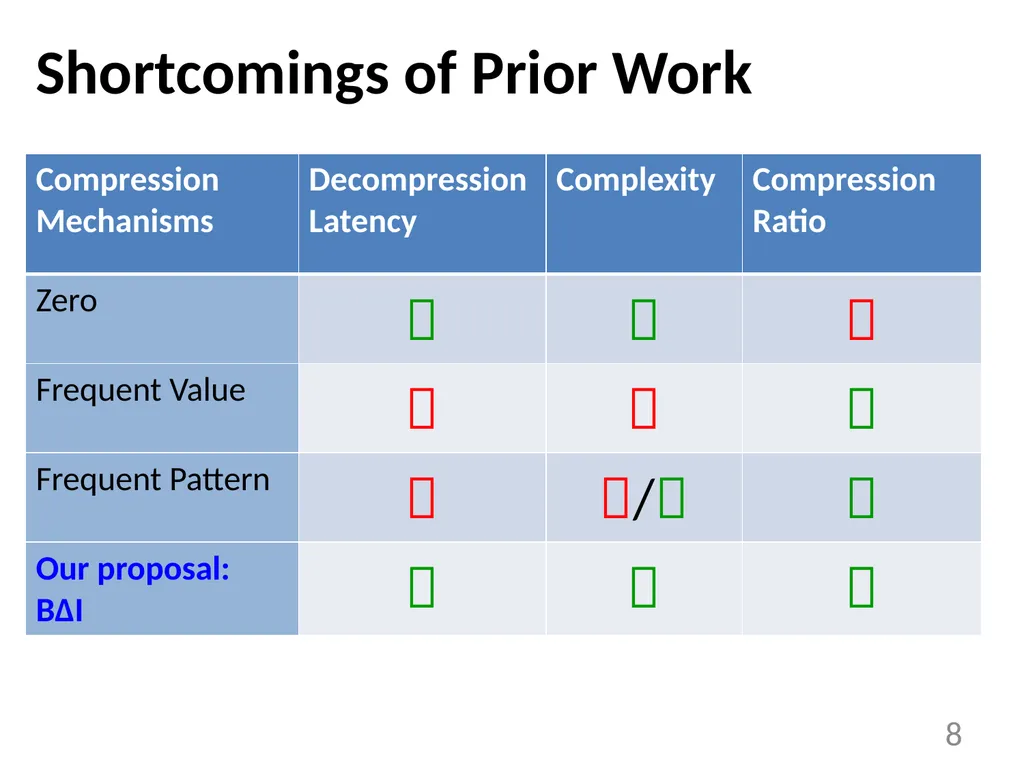
slide5. Shortcomings of Prior Work 5<br>
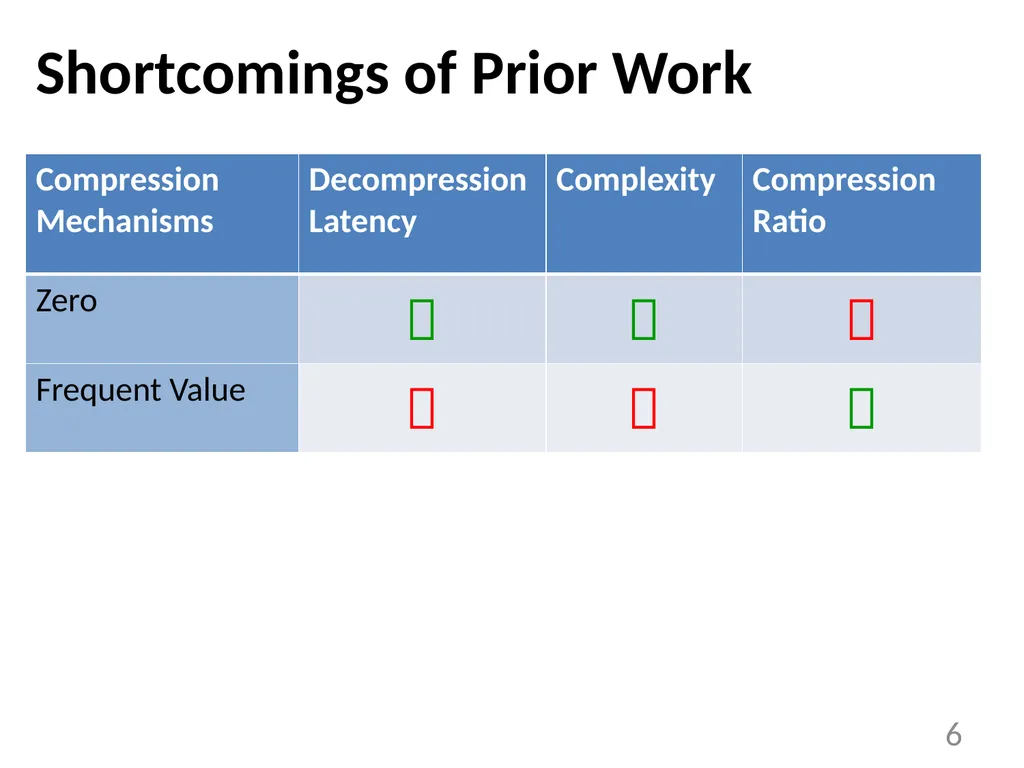
slide6. Shortcomings of Prior Work 6<br>
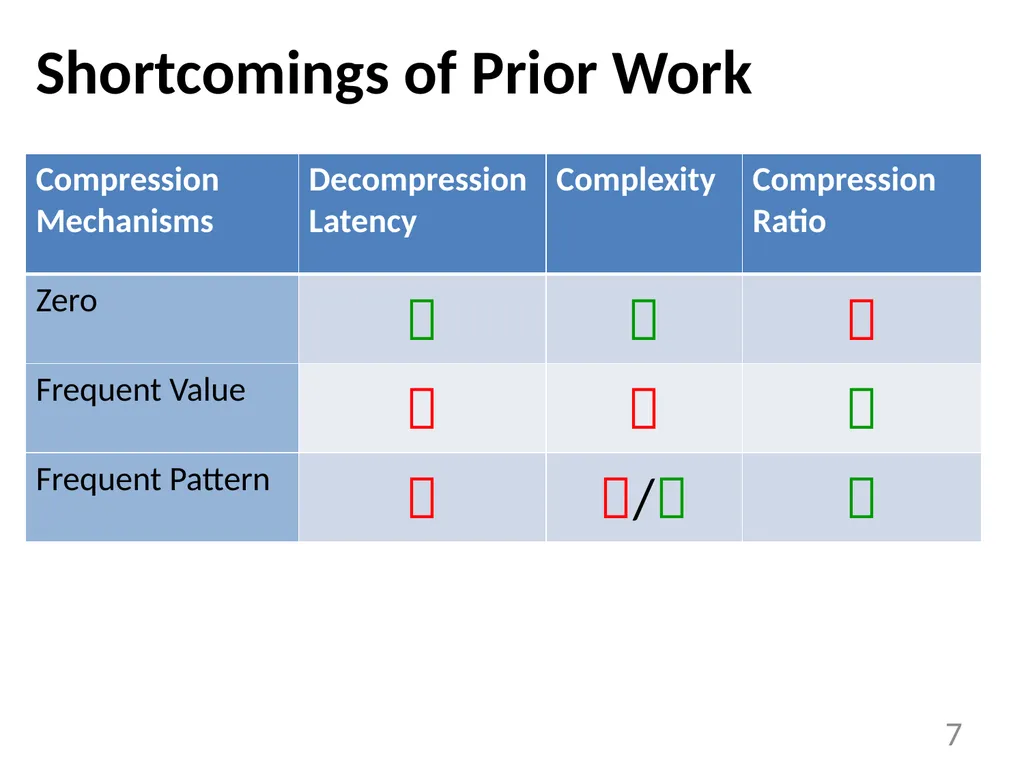
slide7. Shortcomings of Prior Work 7<br>
slide8. Shortcomings of Prior Work 8<br>
slide9. Outline Motivation & Background
Key Idea & Our Mechanism
Evaluation
Conclusion 9<br>
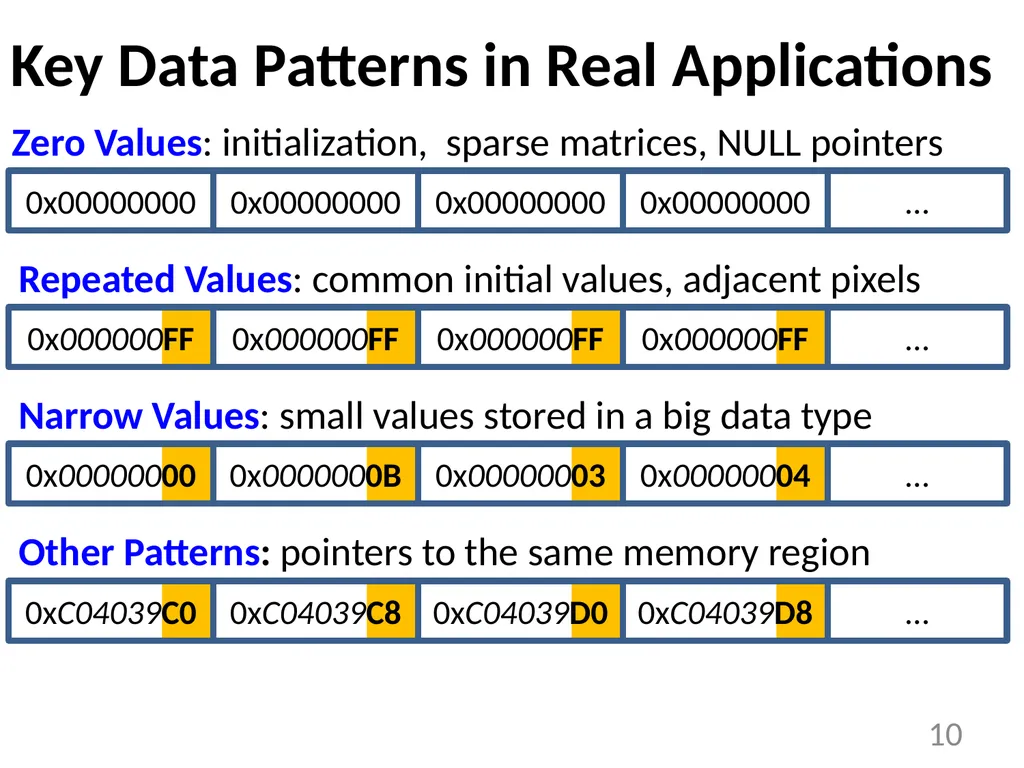
slide10. Key Data Patterns in Real Applications 10 0x00000000 0x00000000 0x00000000 0x00000000 … 0x000000FF 0x000000FF 0x000000FF 0x000000FF … 0x00000000 0x0000000B 0x00000003 0x00000004 … 0xC04039C0 0xC04039C8 0xC04039D0 0xC04039D8 … Zero Values: initialization, sparse matrices, NULL pointers Repeated Values: common initial values, adjacent pixels Narrow Values: small values stored in a big data type Other Patterns: pointers to the same memory region<br>
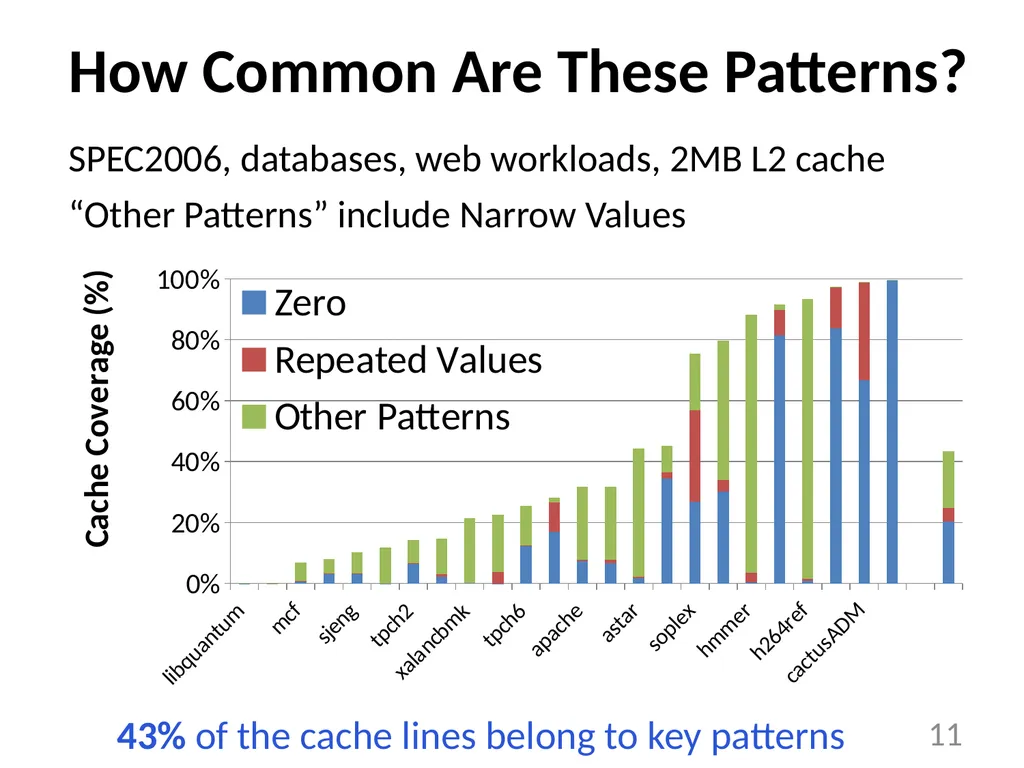
slide11. How Common Are These Patterns? 11 SPEC2006, databases, web workloads, 2MB L2 cache
“Other Patterns” include Narrow Values 43% of the cache lines belong to key patterns<br>
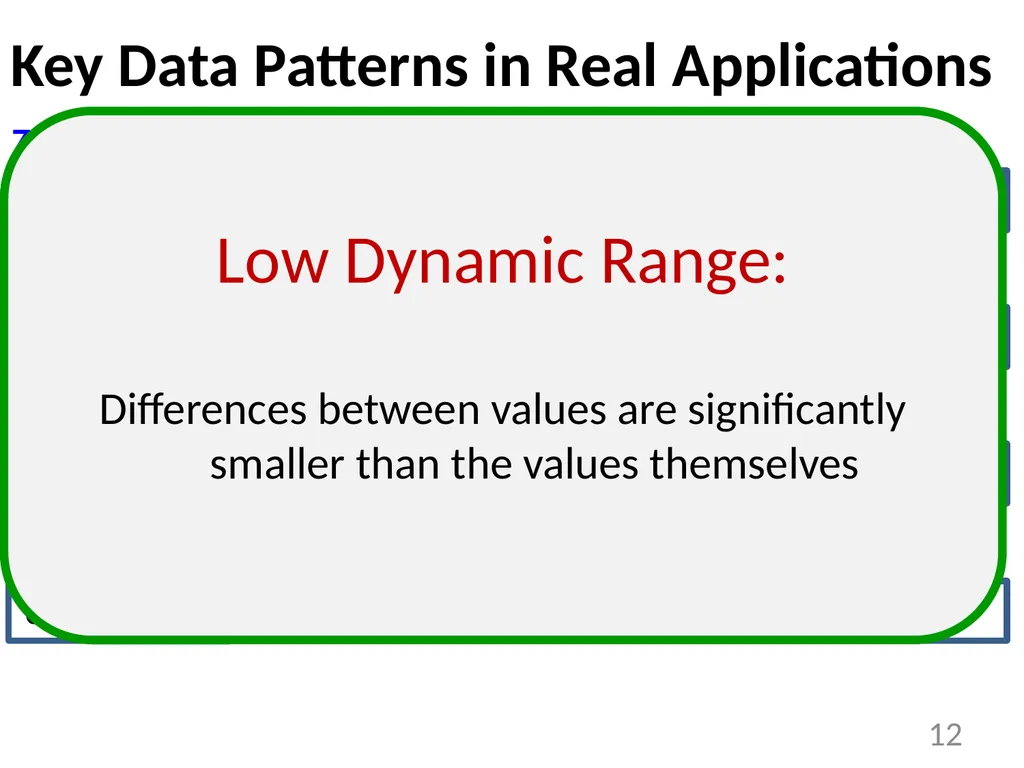
slide12. Key Data Patterns in Real Applications 12 0x00000000 0x00000000 0x00000000 0x00000000 … 0x000000FF 0x000000FF 0x000000FF 0x000000FF … 0x00000000 0x0000000B 0x00000003 0x00000004 … 0xC04039C0 0xC04039C8 0xC04039D0 0xC04039D8 … Zero Values: initialization, sparse matrices, NULL pointers Repeated Values: common initial values, adjacent pixels Narrow Values: small values stored in a big data type Other Patterns: pointers to the same memory region Low Dynamic Range:
Differences between values are significantly smaller than the values themselves<br>
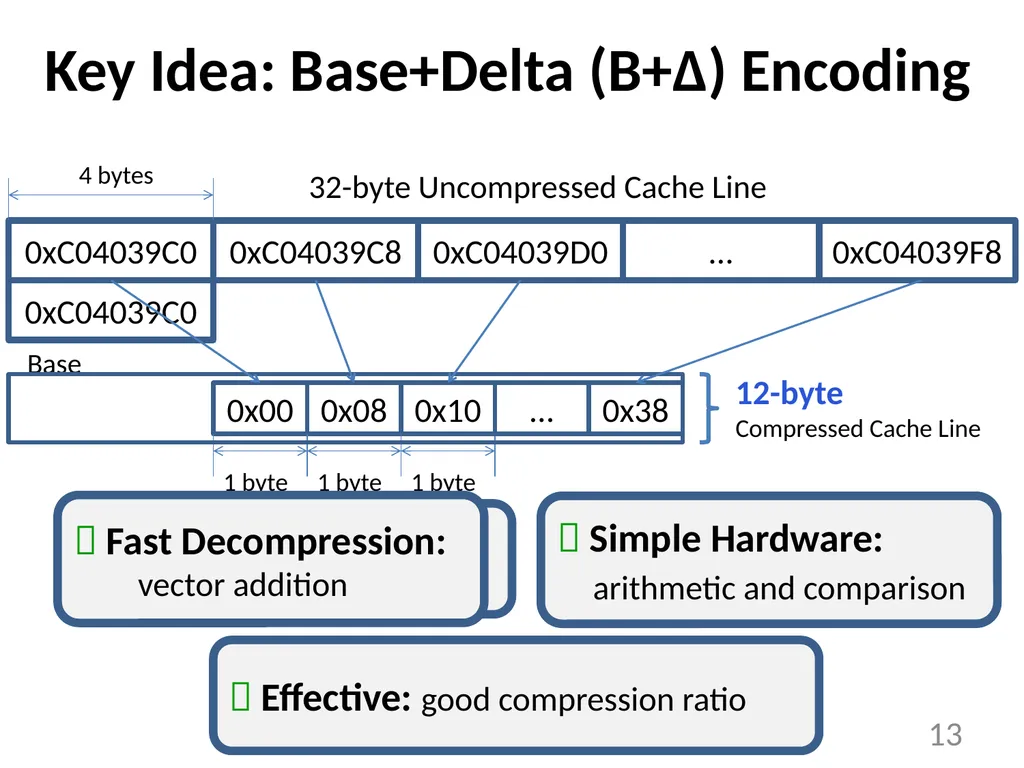
slide13. 32-byte Uncompressed Cache Line Key Idea: Base+Delta (B+Δ) Encoding 13 0xC04039C0 0xC04039C8 0xC04039D0 … 0xC04039F8 4 bytes 0xC04039C0 Base 0x00 1 byte 0x08 1 byte 0x10 1 byte … 0x38 12-byte
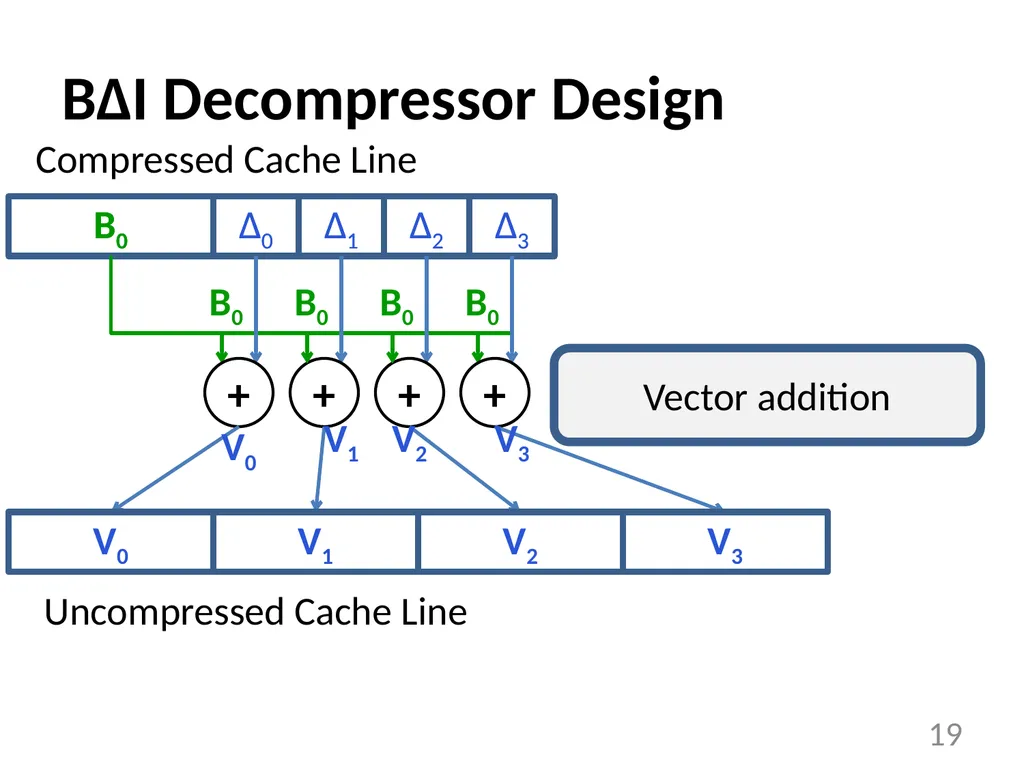
Compressed Cache Line 20 bytes saved Fast Decompression: vector addition Simple Hardware:
arithmetic and comparison Effective: good compression ratio<br>
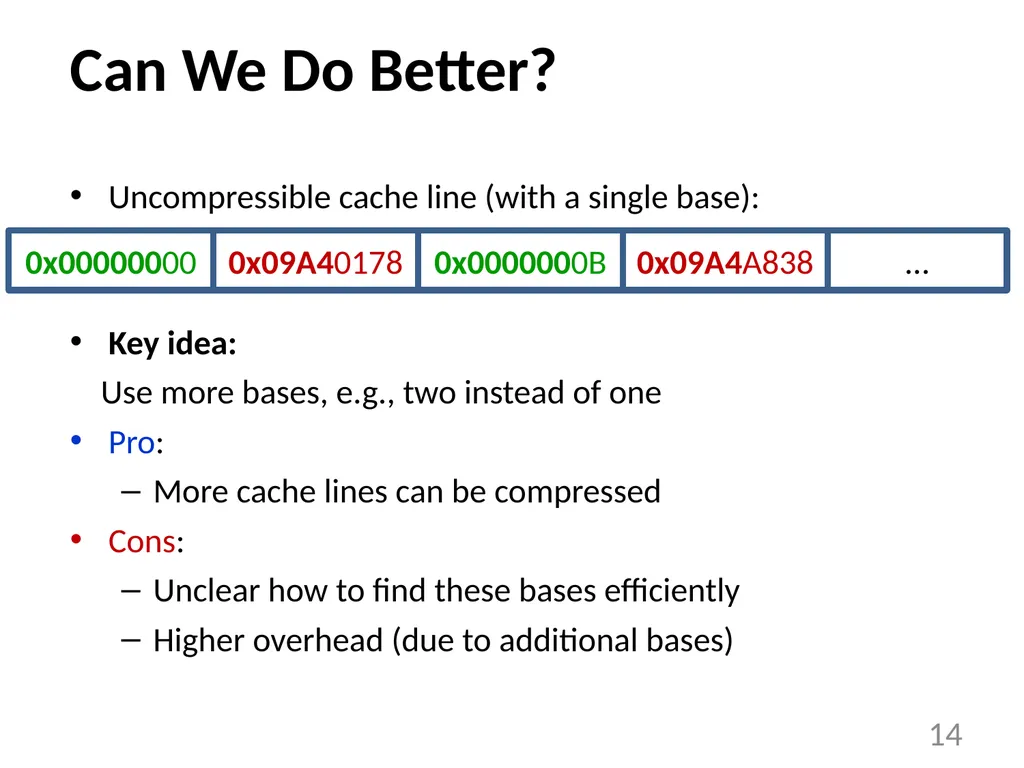
slide14. Can We Do Better? Uncompressible cache line (with a single base):
Key idea:
Use more bases, e.g., two instead of one
Pro:
More cache lines can be compressed
Cons:
Unclear how to find these bases efficiently
Higher overhead (due to additional bases) 14 0x00000000 0x09A40178 0x0000000B 0x09A4A838 …<br>
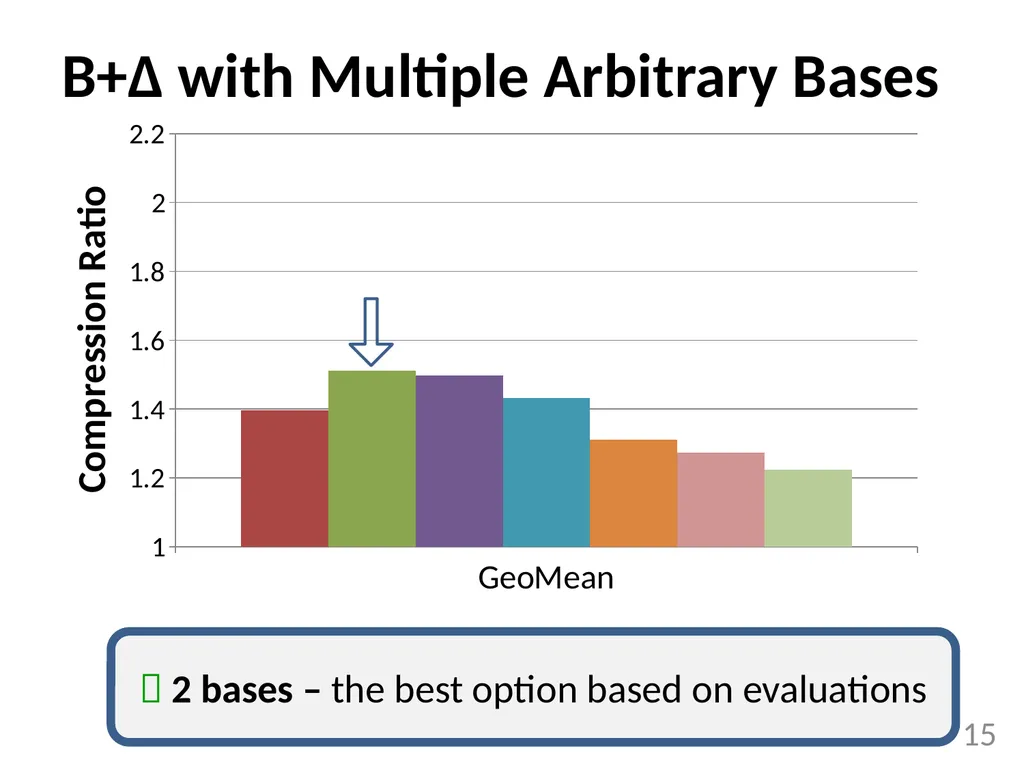
slide15. B+Δ with Multiple Arbitrary Bases 15 2 bases – the best option based on evaluations<br>
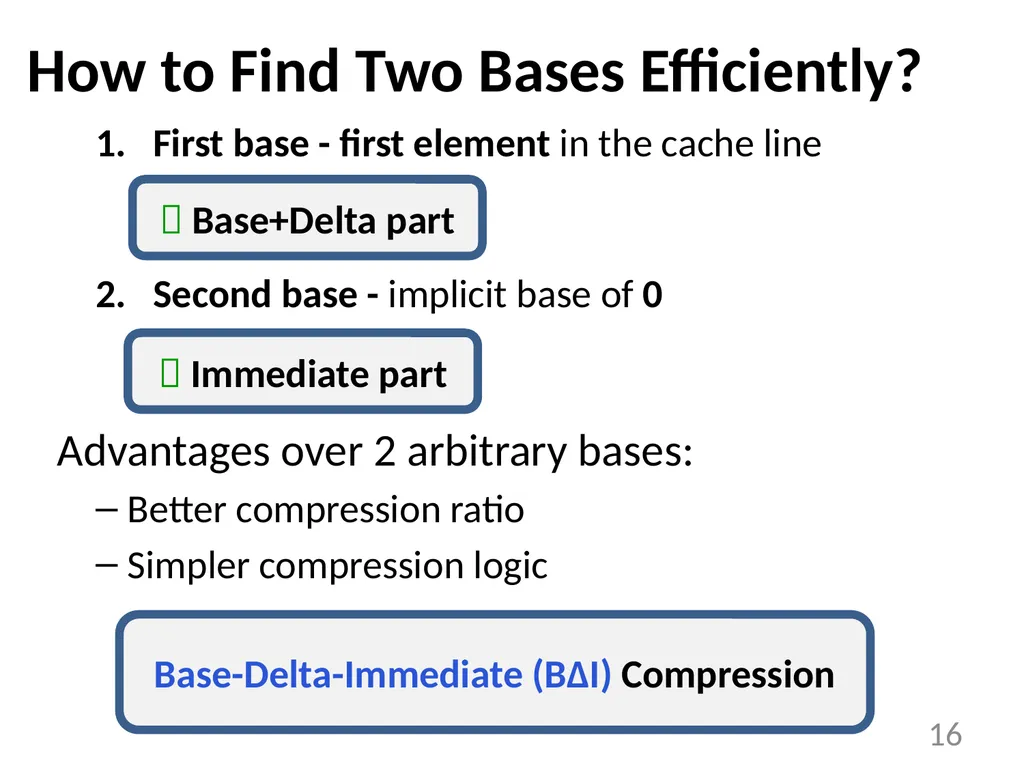
slide16. How to Find Two Bases Efficiently? First base - first element in the cache line
Second base - implicit base of 0
Advantages over 2 arbitrary bases:
Better compression ratio
Simpler compression logic 16 Base+Delta part Immediate part Base-Delta-Immediate (BΔI) Compression<br>
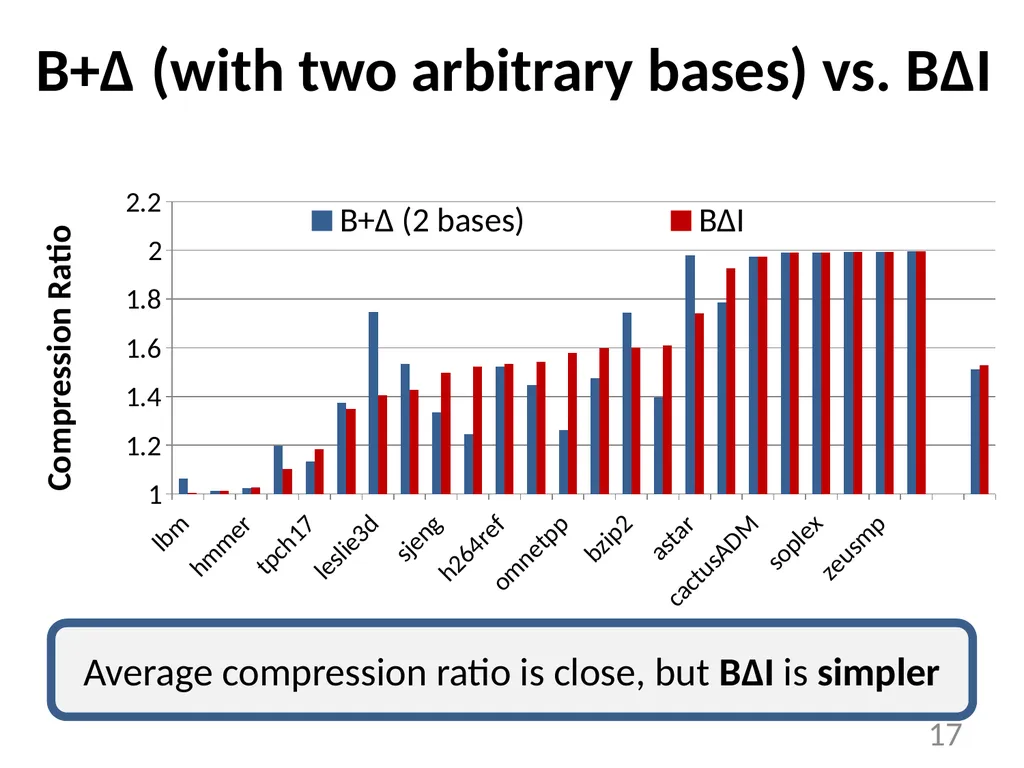
slide17. B+Δ (with two arbitrary bases) vs. BΔI 17 Average compression ratio is close, but BΔI is simpler<br>
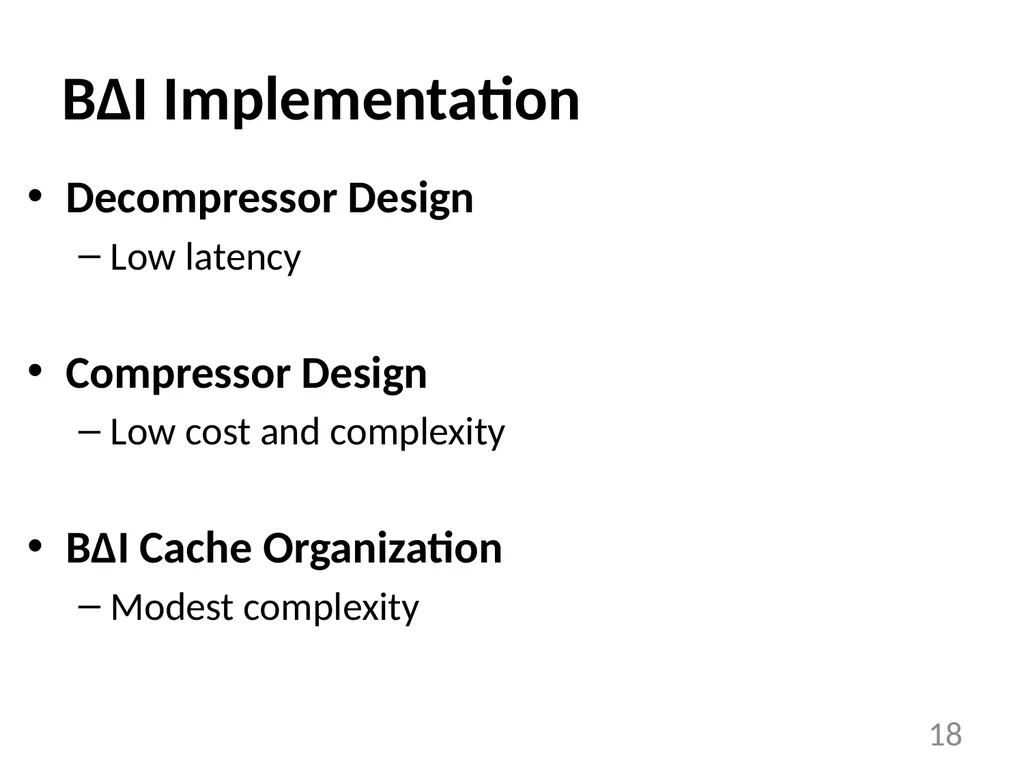
slide18. BΔI Implementation Decompressor Design
Low latency
Compressor Design
Low cost and complexity
BΔI Cache Organization
Modest complexity 18<br>
slide19. Δ0 B0 BΔI Decompressor Design 19 Δ1 Δ2 Δ3 Compressed Cache Line V0 V1 V2 V3 + + Uncompressed Cache Line + + B0 Δ0 B0 B0 B0 B0 Δ1 Δ2 Δ3 V0 V1 V2 V3 Vector addition<br>
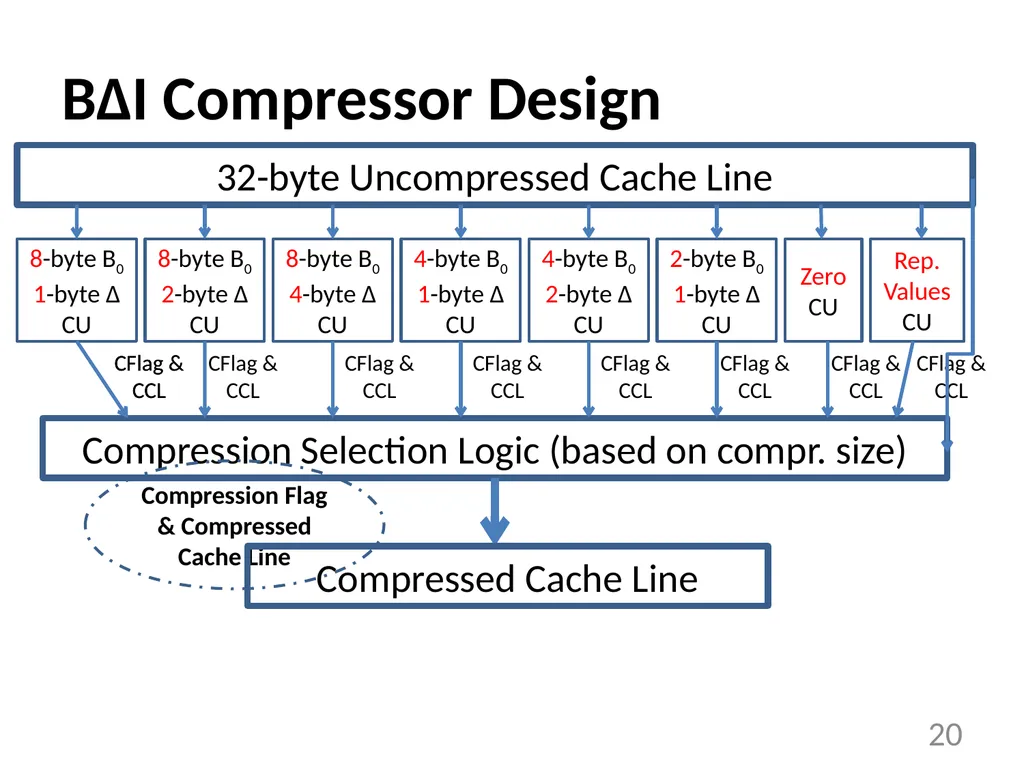
slide20. BΔI Compressor Design 20 32-byte Uncompressed Cache Line 8-byte B0
1-byte Δ
CU 8-byte B0
2-byte Δ
CU 8-byte B0
4-byte Δ
CU 4-byte B0
1-byte Δ
CU 4-byte B0
2-byte Δ
CU 2-byte B0
1-byte Δ
CU Zero
CU Rep.
Values
CU Compression Selection Logic (based on compr. size) CFlag &
CCL CFlag &
CCL CFlag &
CCL CFlag &
CCL CFlag &
CCL CFlag &
CCL CFlag &
CCL CFlag &
CCL Compression Flag & Compressed Cache Line CFlag &
CCL Compressed Cache Line<br>
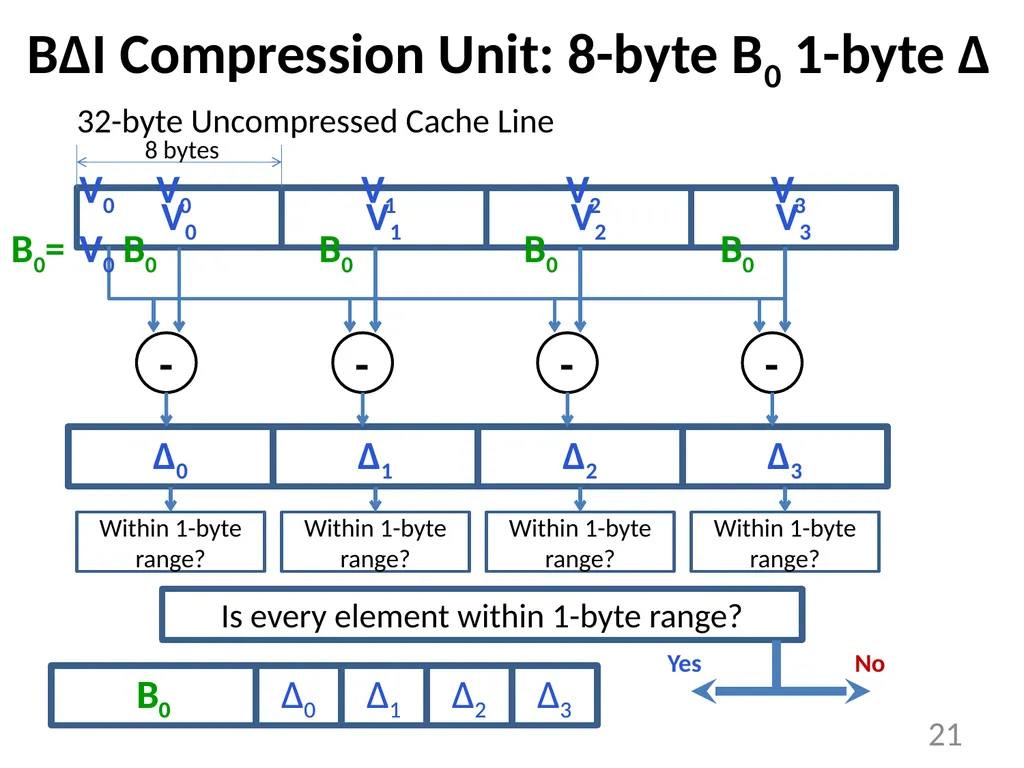
slide21. BΔI Compression Unit: 8-byte B0 1-byte Δ 21 32-byte Uncompressed Cache Line V0 V1 V2 V3 8 bytes - - - - B0= V0 V0 B0 B0 B0 B0 V0 V1 V2 V3 Δ0 Δ1 Δ2 Δ3 Within 1-byte range? Within 1-byte range? Within 1-byte range? Within 1-byte range? Is every element within 1-byte range? Δ0 B0 Δ1 Δ2 Δ3 B0 Δ0 Δ1 Δ2 Δ3 Yes No<br>
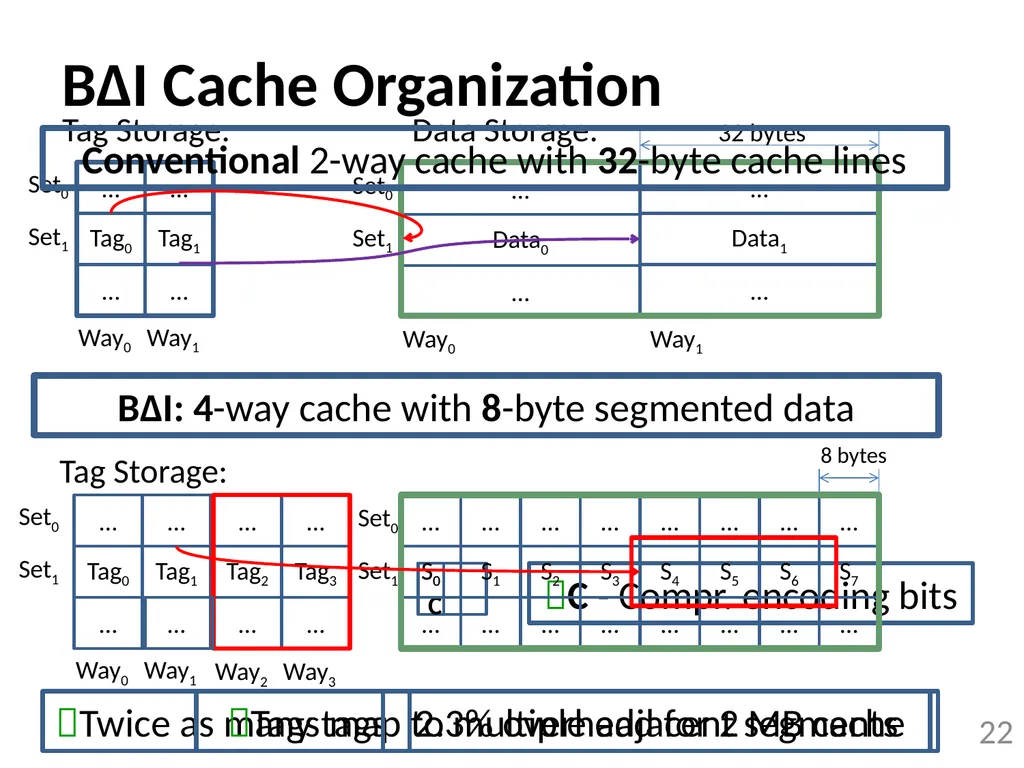
slide22. BΔI Cache Organization 22 Tag0 Tag1 … … … … Tag Storage: Set0 Set1 Way0 Way1 Data0 … … Set0 Set1 Way0 Way1 … Data1 … 32 bytes Data Storage: Conventional 2-way cache with 32-byte cache lines BΔI: 4-way cache with 8-byte segmented data Tag0 Tag1 … … … … Tag Storage: Way0 Way1 Way2 Way3 … … Tag2 Tag3 … … Set0 Set1 Twice as many tags C - Compr. encoding bits C Set0 Set1 … … … … … … … … S0 S0 S1 S2 S3 S4 S5 S6 S7 … … … … … … … … 8 bytes Tags map to multiple adjacent segments 2.3% overhead for 2 MB cache<br>
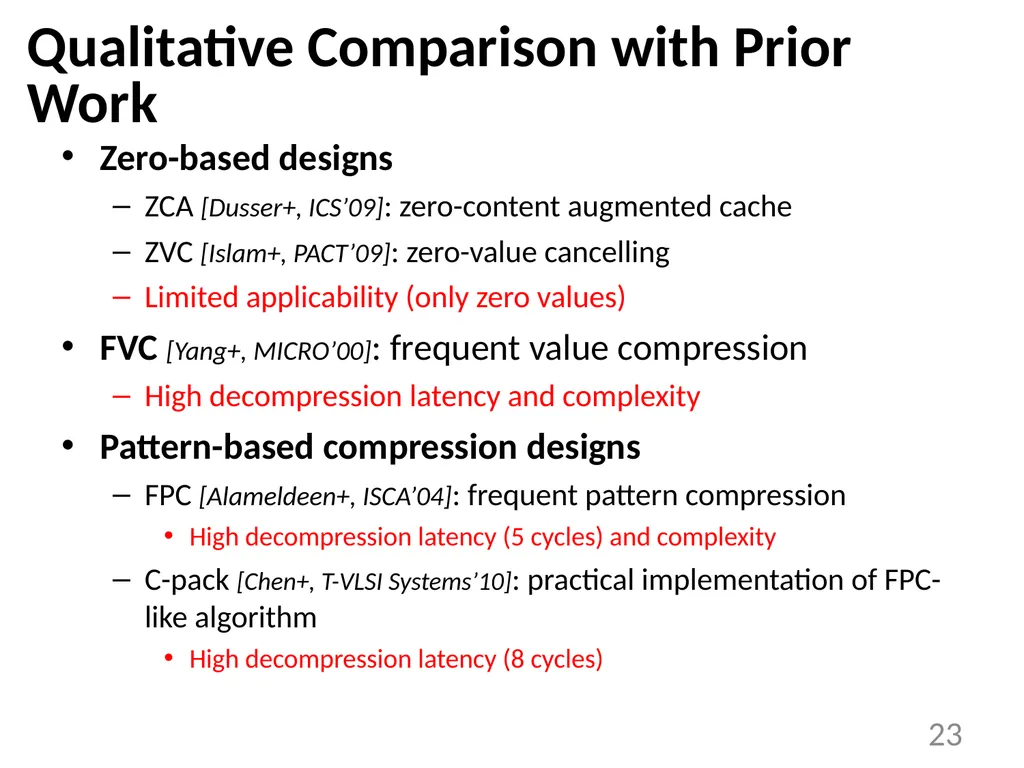
slide23. Qualitative Comparison with Prior Work Zero-based designs
ZCA [Dusser+, ICS’09]: zero-content augmented cache
ZVC [Islam+, PACT’09]: zero-value cancelling
Limited applicability (only zero values)
FVC [Yang+, MICRO’00]: frequent value compression
High decompression latency and complexity
Pattern-based compression designs
FPC [Alameldeen+, ISCA’04]: frequent pattern compression
High decompression latency (5 cycles) and complexity
C-pack [Chen+, T-VLSI Systems’10]: practical implementation of FPC-like algorithm
High decompression latency (8 cycles) 23<br>
slide24. Outline Motivation & Background
Key Idea & Our Mechanism
Evaluation
Conclusion 24<br>
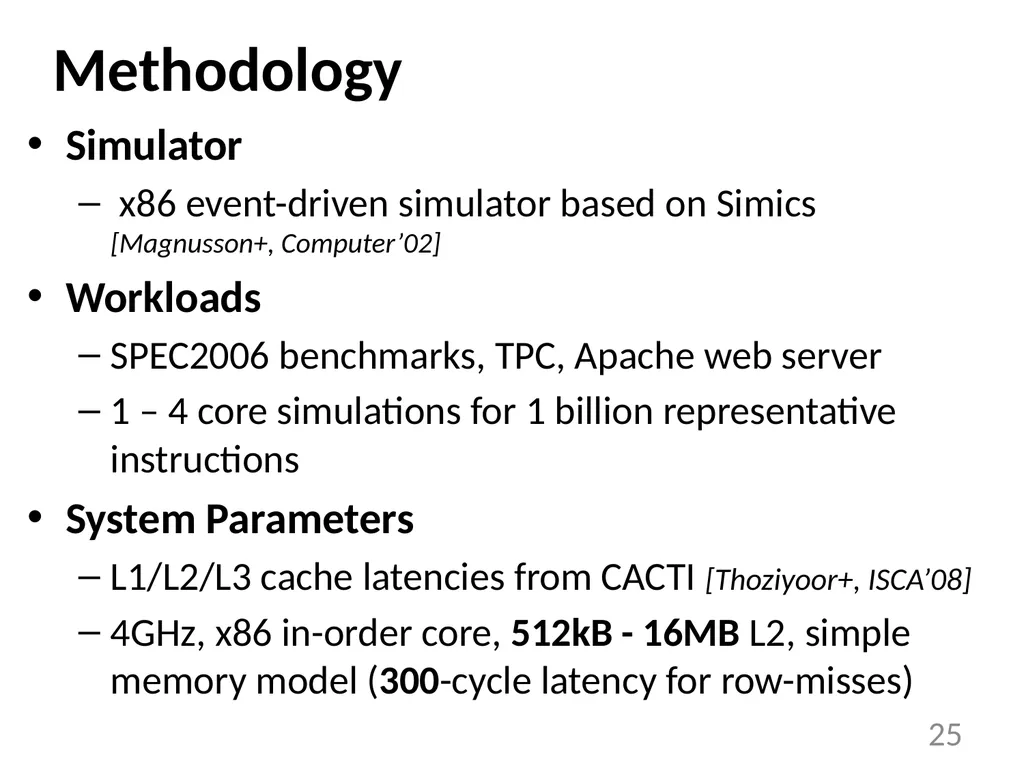
slide25. Methodology Simulator
x86 event-driven simulator based on Simics [Magnusson+, Computer’02]
Workloads
SPEC2006 benchmarks, TPC, Apache web server
1 – 4 core simulations for 1 billion representative instructions
System Parameters
L1/L2/L3 cache latencies from CACTI [Thoziyoor+, ISCA’08]
4GHz, x86 in-order core, 512kB - 16MB L2, simple memory model (300-cycle latency for row-misses) 25<br>
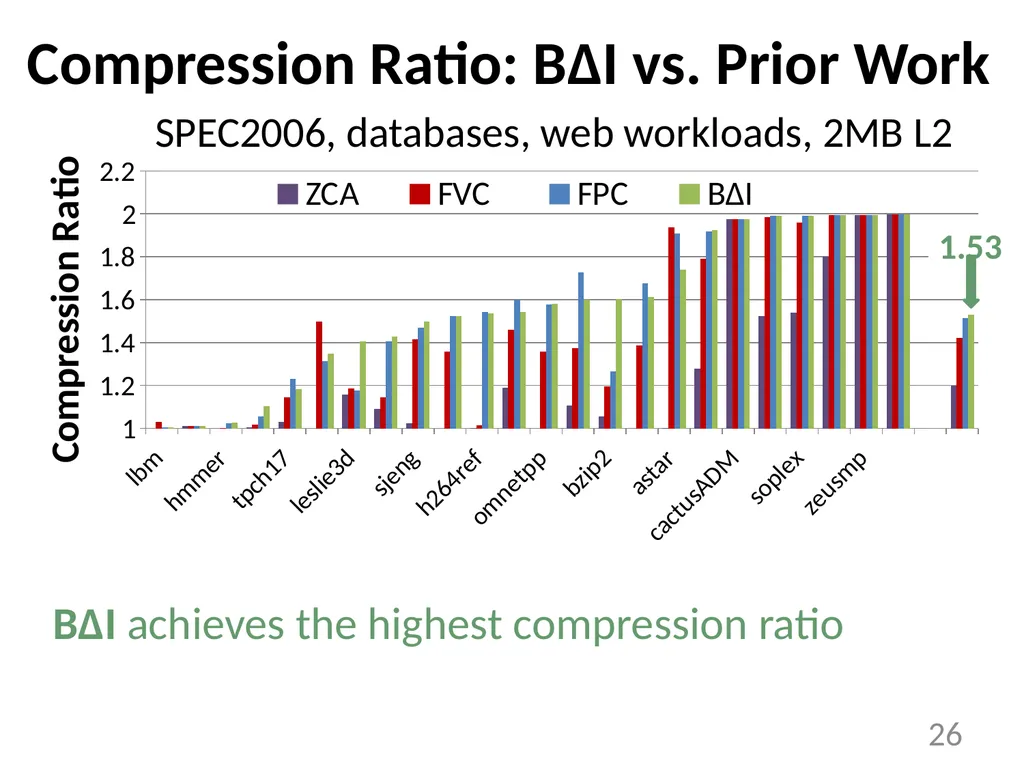
slide26. Compression Ratio: BΔI vs. Prior Work BΔI achieves the highest compression ratio 26 1.53 SPEC2006, databases, web workloads, 2MB L2<br>
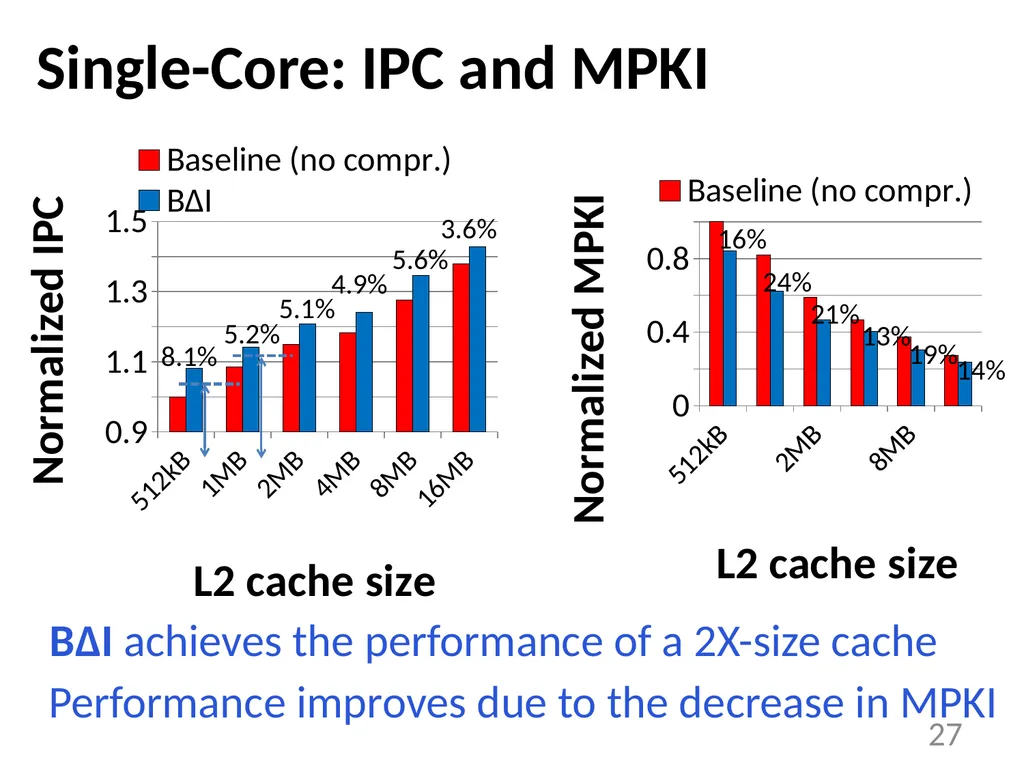
slide27. Single-Core: IPC and MPKI 27 8.1% 5.2% 5.1% 4.9% 5.6% 3.6% 16% 24% 21% 13% 19% 14% BΔI achieves the performance of a 2X-size cache Performance improves due to the decrease in MPKI<br>
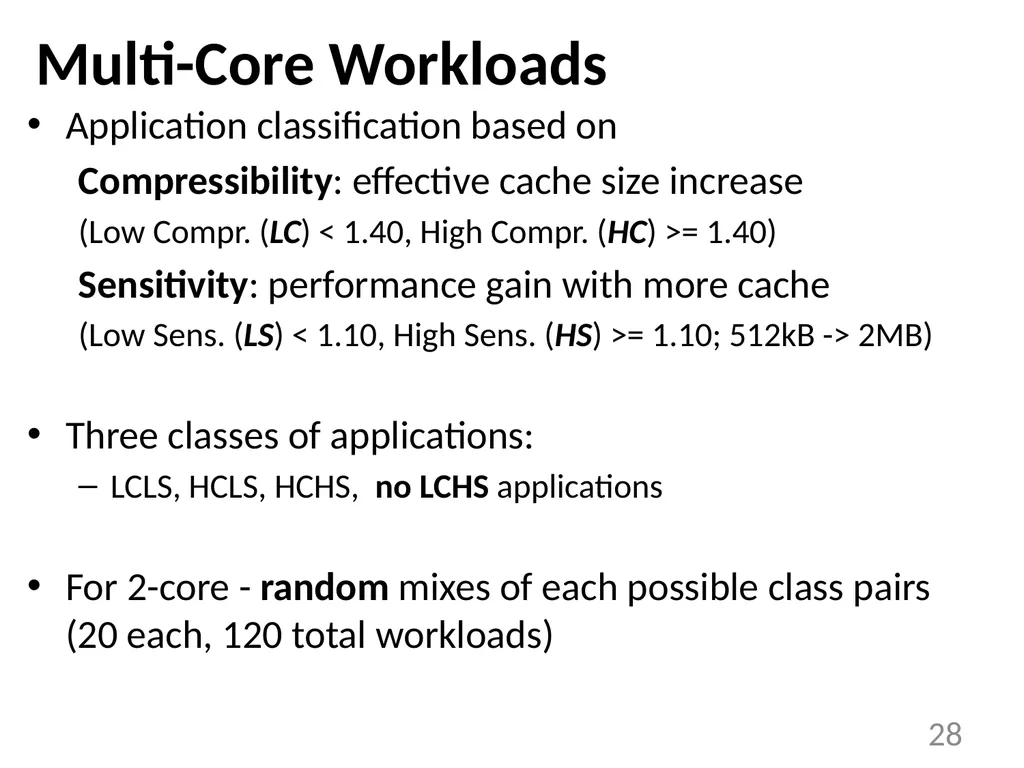
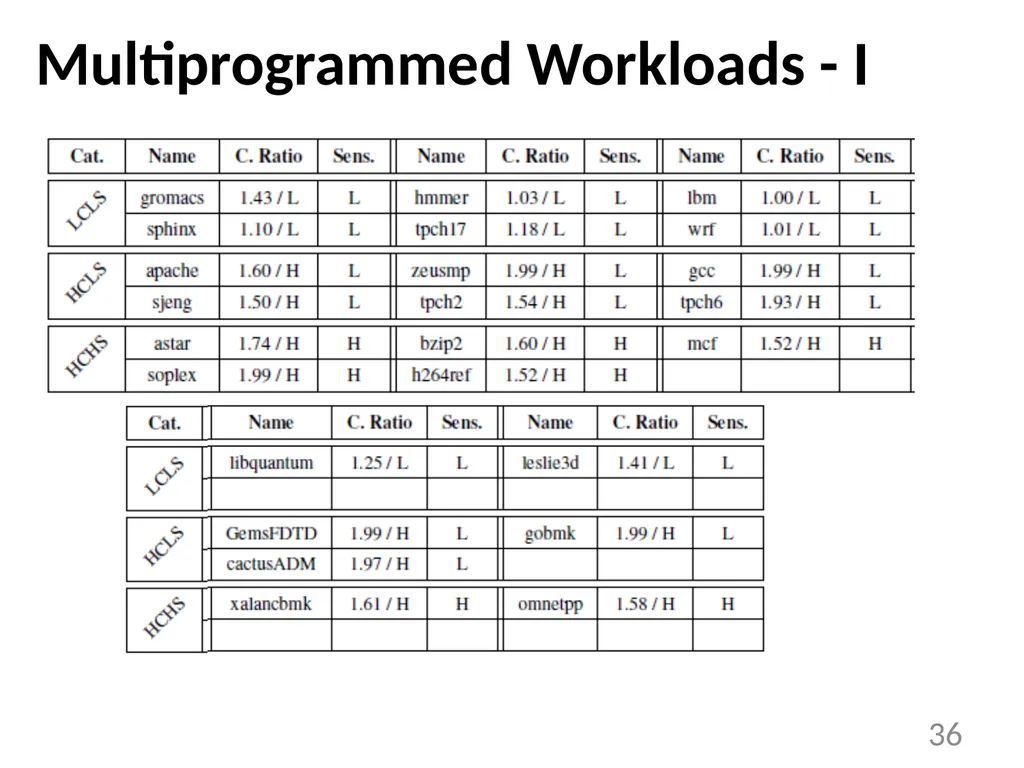
slide28. Multi-Core Workloads Application classification based on
Compressibility: effective cache size increase
(Low Compr. (LC) < 1.40, High Compr. (HC) >= 1.40)
Sensitivity: performance gain with more cache
(Low Sens. (LS) < 1.10, High Sens. (HS) >= 1.10; 512kB -> 2MB)
Three classes of applications:
LCLS, HCLS, HCHS, no LCHS applications
For 2-core - random mixes of each possible class pairs (20 each, 120 total workloads) 28<br>
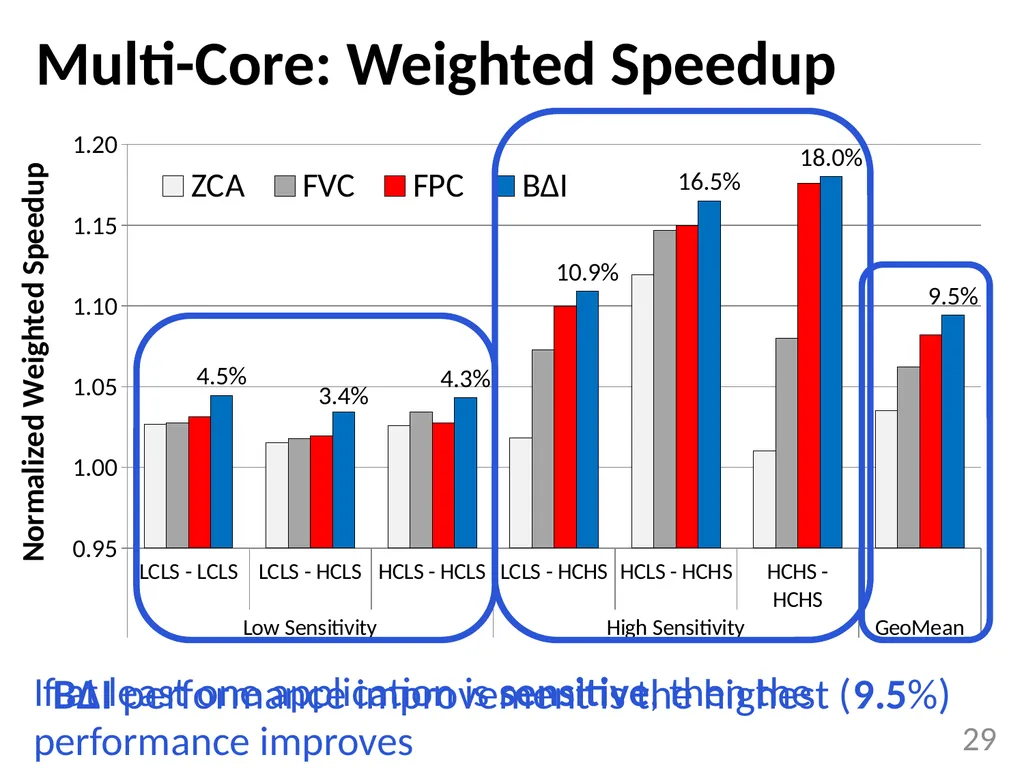
slide29. Multi-Core: Weighted Speedup BΔI performance improvement is the highest (9.5%) If at least one application is sensitive, then the performance improves 29<br>
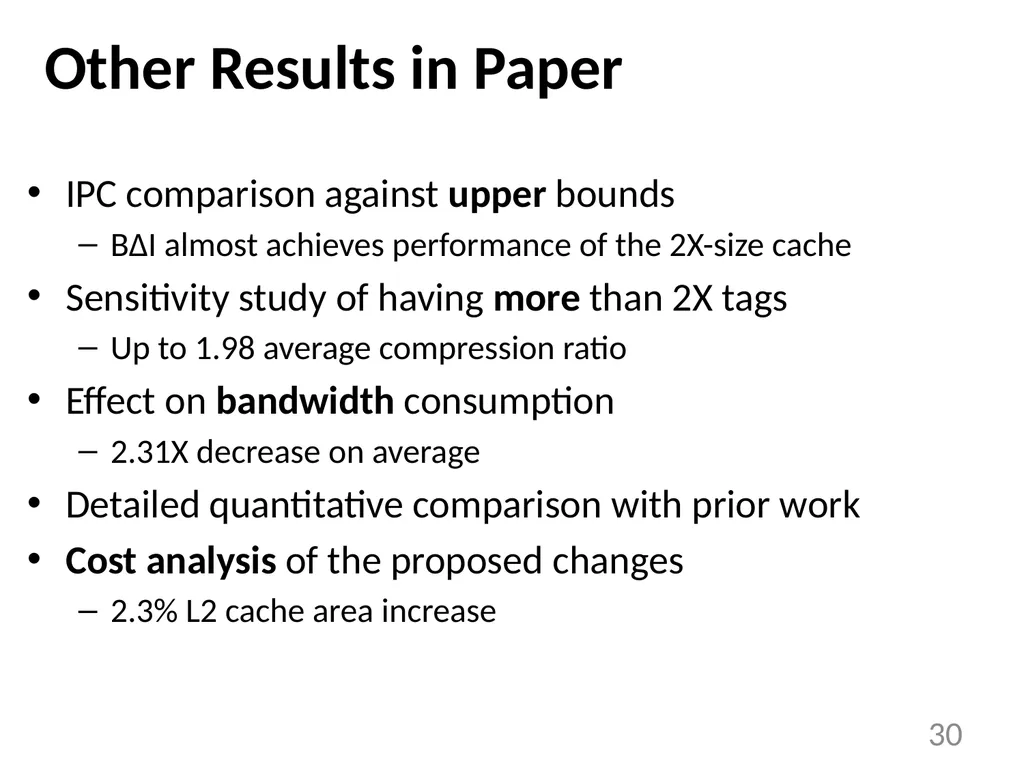
slide30. Other Results in Paper IPC comparison against upper bounds
BΔI almost achieves performance of the 2X-size cache
Sensitivity study of having more than 2X tags
Up to 1.98 average compression ratio
Effect on bandwidth consumption
2.31X decrease on average
Detailed quantitative comparison with prior work
Cost analysis of the proposed changes
2.3% L2 cache area increase 30<br>
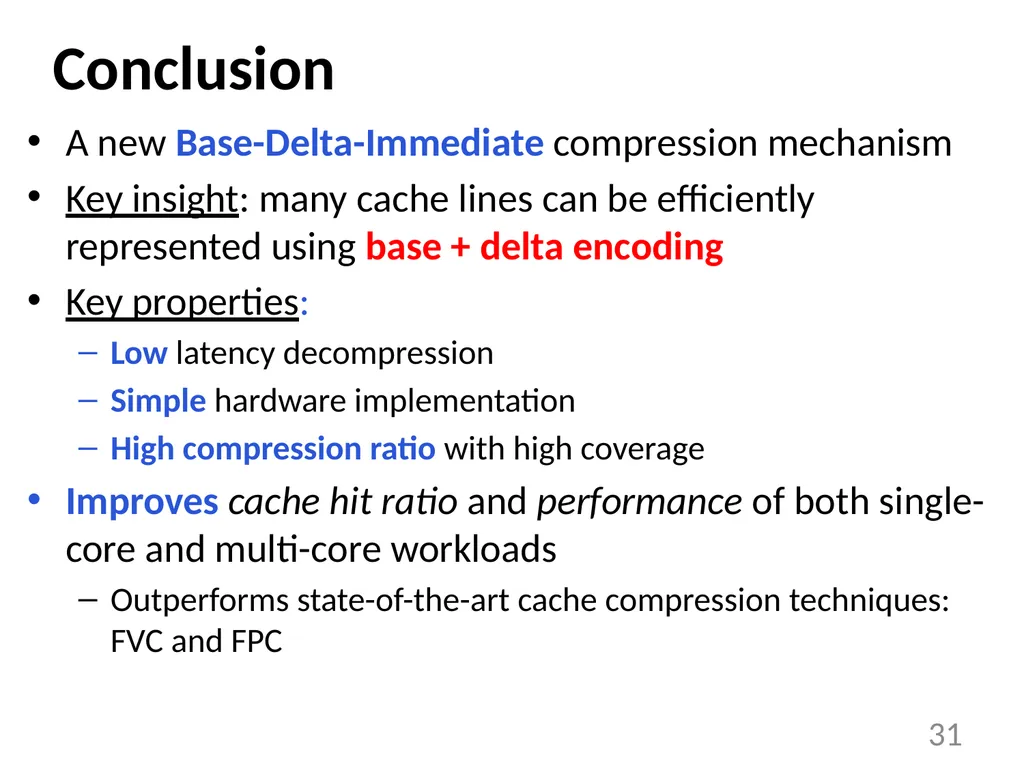
slide31. Conclusion A new Base-Delta-Immediate compression mechanism
Key insight: many cache lines can be efficiently represented using base + delta encoding
Key properties:
Low latency decompression
Simple hardware implementation
High compression ratio with high coverage
Improves cache hit ratio and performance of both single-core and multi-core workloads
Outperforms state-of-the-art cache compression techniques: FVC and FPC 31<br>
slide32. Base-Delta-Immediate Compression: Practical Data Compression for On-Chip Caches Gennady Pekhimenko,
Vivek Seshadri ,
Onur Mutlu , Todd C. Mowry Phillip B. Gibbons*,
Michael A. Kozuch* *<br>
slide33. Backup Slides 33<br>
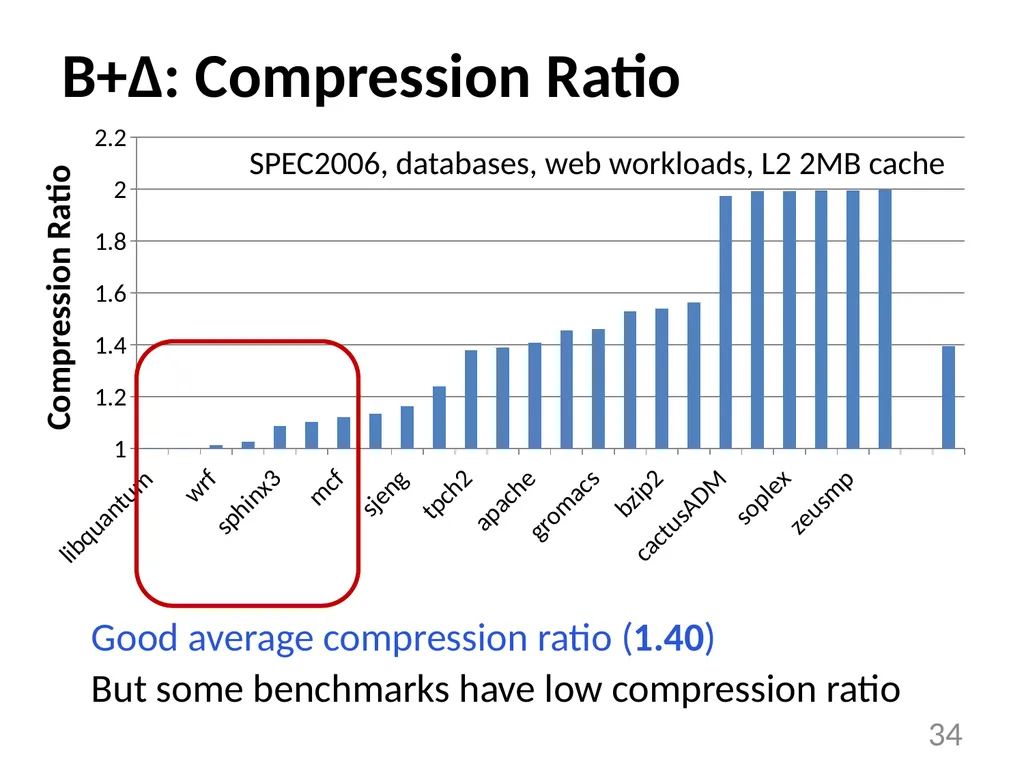
slide34. B+Δ: Compression Ratio Good average compression ratio (1.40) 34 But some benchmarks have low compression ratio SPEC2006, databases, web workloads, L2 2MB cache<br>
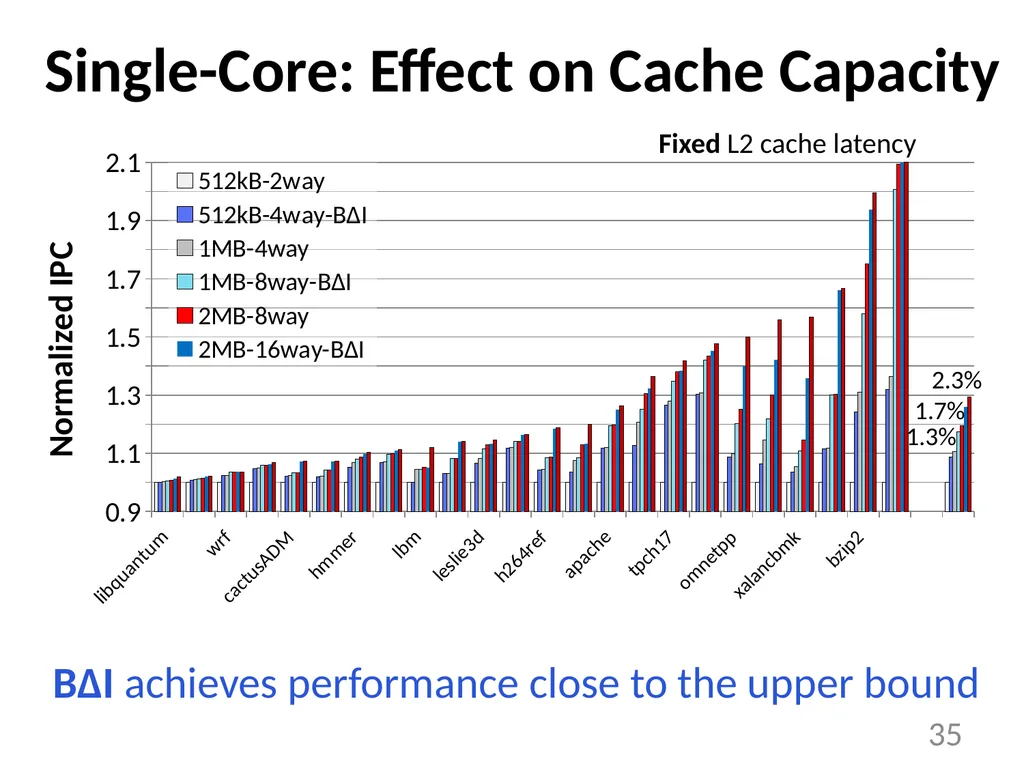
slide35. Single-Core: Effect on Cache Capacity BΔI achieves performance close to the upper bound 35 1.3% 1.7% 2.3% Fixed L2 cache latency<br>
slide36. Multiprogrammed Workloads - I 36<br>
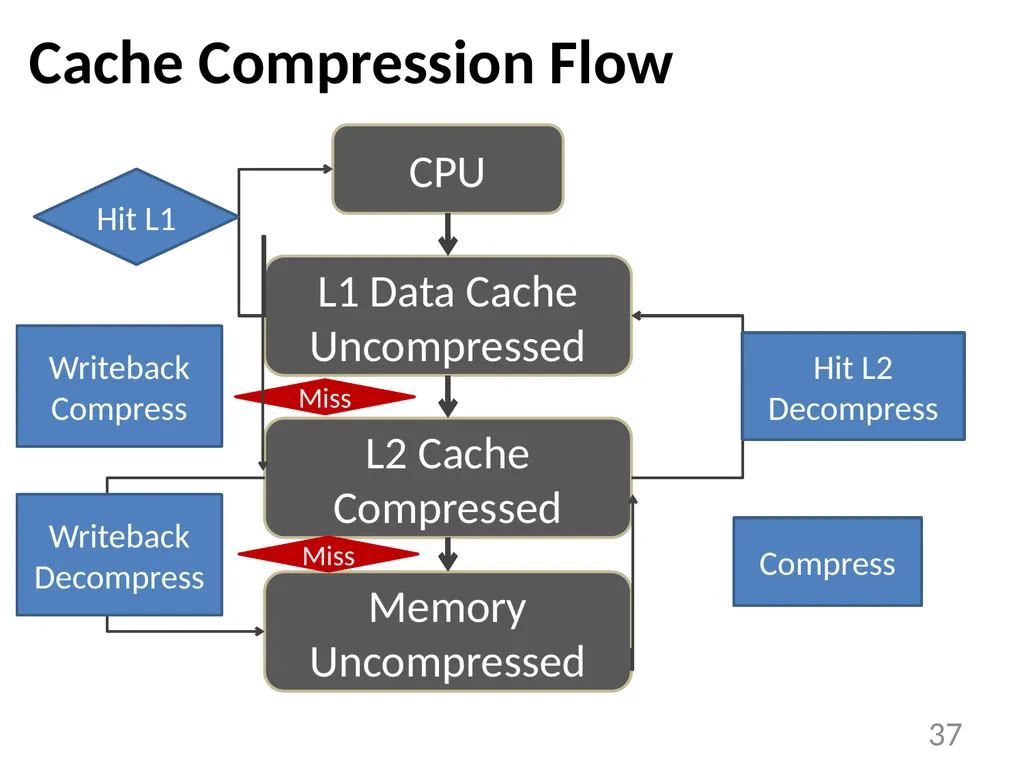
slide37. Cache Compression Flow 37 CPU L1 Data Cache
Uncompressed L2 Cache
Compressed Memory
Uncompressed Hit L1 Miss Miss Hit L2
Decompress Compress Writeback
Decompress Writeback
Compress<br>
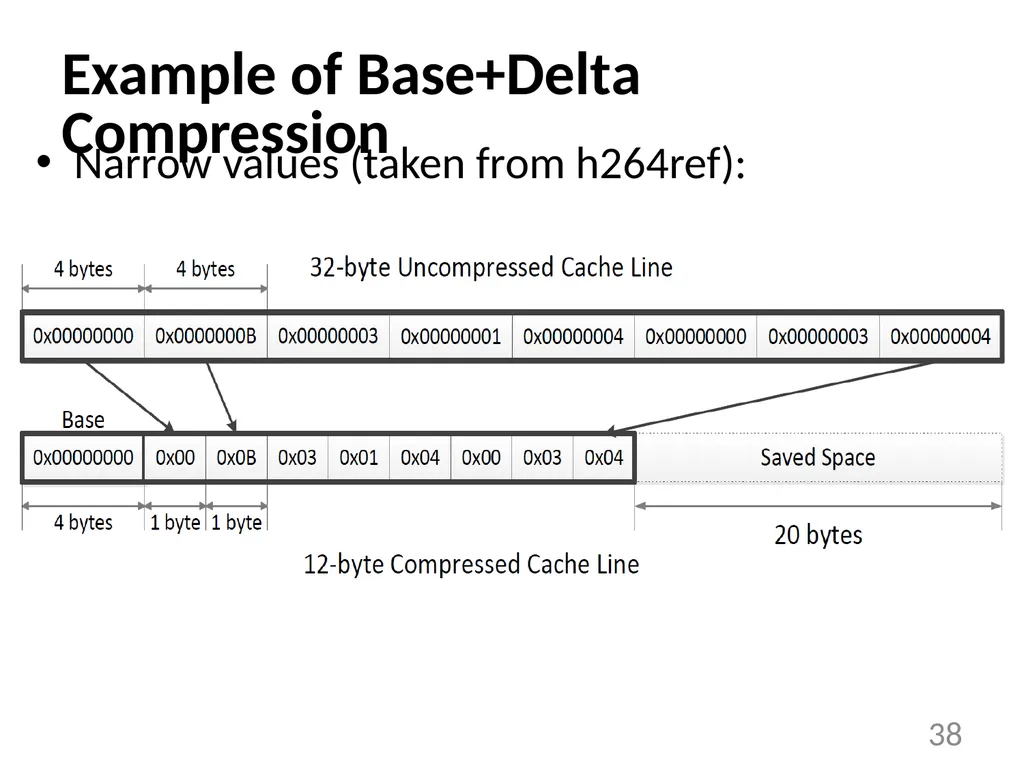
slide38. Example of Base+Delta Compression Narrow values (taken from h264ref): 38<br>
Vivek Seshadri
Onur Mutlu , Todd C. Mowry Phillip B. Gibbons*
Michael A. Kozuch* *<br>
slide2. Executive Summary Off-chip memory latency is high
Large caches can help, but at significant cost
Compressing data in cache enables larger cache at low cost
Problem: Decompression is on the execution critical path
Goal: Design a new compression scheme that has
1. low decompression latency, 2. low cost, 3. high compression ratio
Observation: Many cache lines have low dynamic range data
Key Idea: Encode cachelines as a base + multiple differences
Solution: Base-Delta-Immediate compression with low decompression latency and high compression ratio
Outperforms three state-of-the-art compression mechanisms 2<br>
slide3. Motivation for Cache Compression Significant redundancy in data: 3 0x00000000 How can we exploit this redundancy?
Cache compression helps
Provides effect of a larger cache without making it physically larger 0x0000000B 0x00000003 0x00000004 …<br>
slide4. Background on Cache Compression Key requirements:
Fast (low decompression latency)
Simple (avoid complex hardware changes)
Effective (good compression ratio) 4 CPU L2 Cache Uncompressed Compressed Decompression Uncompressed L1 Cache Hit<br>
slide5. Shortcomings of Prior Work 5<br>
slide6. Shortcomings of Prior Work 6<br>
slide7. Shortcomings of Prior Work 7<br>
slide8. Shortcomings of Prior Work 8<br>
slide9. Outline Motivation & Background
Key Idea & Our Mechanism
Evaluation
Conclusion 9<br>
slide10. Key Data Patterns in Real Applications 10 0x00000000 0x00000000 0x00000000 0x00000000 … 0x000000FF 0x000000FF 0x000000FF 0x000000FF … 0x00000000 0x0000000B 0x00000003 0x00000004 … 0xC04039C0 0xC04039C8 0xC04039D0 0xC04039D8 … Zero Values: initialization, sparse matrices, NULL pointers Repeated Values: common initial values, adjacent pixels Narrow Values: small values stored in a big data type Other Patterns: pointers to the same memory region<br>
slide11. How Common Are These Patterns? 11 SPEC2006, databases, web workloads, 2MB L2 cache
“Other Patterns” include Narrow Values 43% of the cache lines belong to key patterns<br>
slide12. Key Data Patterns in Real Applications 12 0x00000000 0x00000000 0x00000000 0x00000000 … 0x000000FF 0x000000FF 0x000000FF 0x000000FF … 0x00000000 0x0000000B 0x00000003 0x00000004 … 0xC04039C0 0xC04039C8 0xC04039D0 0xC04039D8 … Zero Values: initialization, sparse matrices, NULL pointers Repeated Values: common initial values, adjacent pixels Narrow Values: small values stored in a big data type Other Patterns: pointers to the same memory region Low Dynamic Range:
Differences between values are significantly smaller than the values themselves<br>
slide13. 32-byte Uncompressed Cache Line Key Idea: Base+Delta (B+Δ) Encoding 13 0xC04039C0 0xC04039C8 0xC04039D0 … 0xC04039F8 4 bytes 0xC04039C0 Base 0x00 1 byte 0x08 1 byte 0x10 1 byte … 0x38 12-byte
Compressed Cache Line 20 bytes saved Fast Decompression: vector addition Simple Hardware:
arithmetic and comparison Effective: good compression ratio<br>
slide14. Can We Do Better? Uncompressible cache line (with a single base):
Key idea:
Use more bases, e.g., two instead of one
Pro:
More cache lines can be compressed
Cons:
Unclear how to find these bases efficiently
Higher overhead (due to additional bases) 14 0x00000000 0x09A40178 0x0000000B 0x09A4A838 …<br>
slide15. B+Δ with Multiple Arbitrary Bases 15 2 bases – the best option based on evaluations<br>
slide16. How to Find Two Bases Efficiently? First base - first element in the cache line
Second base - implicit base of 0
Advantages over 2 arbitrary bases:
Better compression ratio
Simpler compression logic 16 Base+Delta part Immediate part Base-Delta-Immediate (BΔI) Compression<br>
slide17. B+Δ (with two arbitrary bases) vs. BΔI 17 Average compression ratio is close, but BΔI is simpler<br>
slide18. BΔI Implementation Decompressor Design
Low latency
Compressor Design
Low cost and complexity
BΔI Cache Organization
Modest complexity 18<br>
slide19. Δ0 B0 BΔI Decompressor Design 19 Δ1 Δ2 Δ3 Compressed Cache Line V0 V1 V2 V3 + + Uncompressed Cache Line + + B0 Δ0 B0 B0 B0 B0 Δ1 Δ2 Δ3 V0 V1 V2 V3 Vector addition<br>
slide20. BΔI Compressor Design 20 32-byte Uncompressed Cache Line 8-byte B0
1-byte Δ
CU 8-byte B0
2-byte Δ
CU 8-byte B0
4-byte Δ
CU 4-byte B0
1-byte Δ
CU 4-byte B0
2-byte Δ
CU 2-byte B0
1-byte Δ
CU Zero
CU Rep.
Values
CU Compression Selection Logic (based on compr. size) CFlag &
CCL CFlag &
CCL CFlag &
CCL CFlag &
CCL CFlag &
CCL CFlag &
CCL CFlag &
CCL CFlag &
CCL Compression Flag & Compressed Cache Line CFlag &
CCL Compressed Cache Line<br>
slide21. BΔI Compression Unit: 8-byte B0 1-byte Δ 21 32-byte Uncompressed Cache Line V0 V1 V2 V3 8 bytes - - - - B0= V0 V0 B0 B0 B0 B0 V0 V1 V2 V3 Δ0 Δ1 Δ2 Δ3 Within 1-byte range? Within 1-byte range? Within 1-byte range? Within 1-byte range? Is every element within 1-byte range? Δ0 B0 Δ1 Δ2 Δ3 B0 Δ0 Δ1 Δ2 Δ3 Yes No<br>
slide22. BΔI Cache Organization 22 Tag0 Tag1 … … … … Tag Storage: Set0 Set1 Way0 Way1 Data0 … … Set0 Set1 Way0 Way1 … Data1 … 32 bytes Data Storage: Conventional 2-way cache with 32-byte cache lines BΔI: 4-way cache with 8-byte segmented data Tag0 Tag1 … … … … Tag Storage: Way0 Way1 Way2 Way3 … … Tag2 Tag3 … … Set0 Set1 Twice as many tags C - Compr. encoding bits C Set0 Set1 … … … … … … … … S0 S0 S1 S2 S3 S4 S5 S6 S7 … … … … … … … … 8 bytes Tags map to multiple adjacent segments 2.3% overhead for 2 MB cache<br>
slide23. Qualitative Comparison with Prior Work Zero-based designs
ZCA [Dusser+, ICS’09]: zero-content augmented cache
ZVC [Islam+, PACT’09]: zero-value cancelling
Limited applicability (only zero values)
FVC [Yang+, MICRO’00]: frequent value compression
High decompression latency and complexity
Pattern-based compression designs
FPC [Alameldeen+, ISCA’04]: frequent pattern compression
High decompression latency (5 cycles) and complexity
C-pack [Chen+, T-VLSI Systems’10]: practical implementation of FPC-like algorithm
High decompression latency (8 cycles) 23<br>
slide24. Outline Motivation & Background
Key Idea & Our Mechanism
Evaluation
Conclusion 24<br>
slide25. Methodology Simulator
x86 event-driven simulator based on Simics [Magnusson+, Computer’02]
Workloads
SPEC2006 benchmarks, TPC, Apache web server
1 – 4 core simulations for 1 billion representative instructions
System Parameters
L1/L2/L3 cache latencies from CACTI [Thoziyoor+, ISCA’08]
4GHz, x86 in-order core, 512kB - 16MB L2, simple memory model (300-cycle latency for row-misses) 25<br>
slide26. Compression Ratio: BΔI vs. Prior Work BΔI achieves the highest compression ratio 26 1.53 SPEC2006, databases, web workloads, 2MB L2<br>
slide27. Single-Core: IPC and MPKI 27 8.1% 5.2% 5.1% 4.9% 5.6% 3.6% 16% 24% 21% 13% 19% 14% BΔI achieves the performance of a 2X-size cache Performance improves due to the decrease in MPKI<br>
slide28. Multi-Core Workloads Application classification based on
Compressibility: effective cache size increase
(Low Compr. (LC) < 1.40, High Compr. (HC) >= 1.40)
Sensitivity: performance gain with more cache
(Low Sens. (LS) < 1.10, High Sens. (HS) >= 1.10; 512kB -> 2MB)
Three classes of applications:
LCLS, HCLS, HCHS, no LCHS applications
For 2-core - random mixes of each possible class pairs (20 each, 120 total workloads) 28<br>
slide29. Multi-Core: Weighted Speedup BΔI performance improvement is the highest (9.5%) If at least one application is sensitive, then the performance improves 29<br>
slide30. Other Results in Paper IPC comparison against upper bounds
BΔI almost achieves performance of the 2X-size cache
Sensitivity study of having more than 2X tags
Up to 1.98 average compression ratio
Effect on bandwidth consumption
2.31X decrease on average
Detailed quantitative comparison with prior work
Cost analysis of the proposed changes
2.3% L2 cache area increase 30<br>
slide31. Conclusion A new Base-Delta-Immediate compression mechanism
Key insight: many cache lines can be efficiently represented using base + delta encoding
Key properties:
Low latency decompression
Simple hardware implementation
High compression ratio with high coverage
Improves cache hit ratio and performance of both single-core and multi-core workloads
Outperforms state-of-the-art cache compression techniques: FVC and FPC 31<br>
slide32. Base-Delta-Immediate Compression: Practical Data Compression for On-Chip Caches Gennady Pekhimenko,
Vivek Seshadri ,
Onur Mutlu , Todd C. Mowry Phillip B. Gibbons*,
Michael A. Kozuch* *<br>
slide33. Backup Slides 33<br>
slide34. B+Δ: Compression Ratio Good average compression ratio (1.40) 34 But some benchmarks have low compression ratio SPEC2006, databases, web workloads, L2 2MB cache<br>
slide35. Single-Core: Effect on Cache Capacity BΔI achieves performance close to the upper bound 35 1.3% 1.7% 2.3% Fixed L2 cache latency<br>
slide36. Multiprogrammed Workloads - I 36<br>
slide37. Cache Compression Flow 37 CPU L1 Data Cache
Uncompressed L2 Cache
Compressed Memory
Uncompressed Hit L1 Miss Miss Hit L2
Decompress Compress Writeback
Decompress Writeback
Compress<br>
slide38. Example of Base+Delta Compression Narrow values (taken from h264ref): 38<br>