
Basic Game AI IMGD 4000 With material from: Ian

Description: Basic Game AI IMGD 4000 With material from: Ian Millington and John Funge. Artificial Intelligence for Games, Morgan Kaufmann, 2009. (Chapter 5) Whats AI Part of a Game? Everything that isnt graphics (sound) or networking... (says an AI
Related Topics
Download Presentation
"Basic Game AI IMGD 4000 With material from: Ian" is the property of its rightful owner. Permission is granted to download and print the materials on this website for personal, non-commercial use only, and to display it on your personal computer provided you do not modify the materials and that you retain all copyright notices contained in the materials. By downloading content from our website, you accept the terms of this agreement.
Presentation Transcript
slide1. Basic Game AI IMGD 4000 With material from: Ian Millington and John Funge. Artificial Intelligence for Games, Morgan Kaufmann, 2009. (Chapter 5)<br>
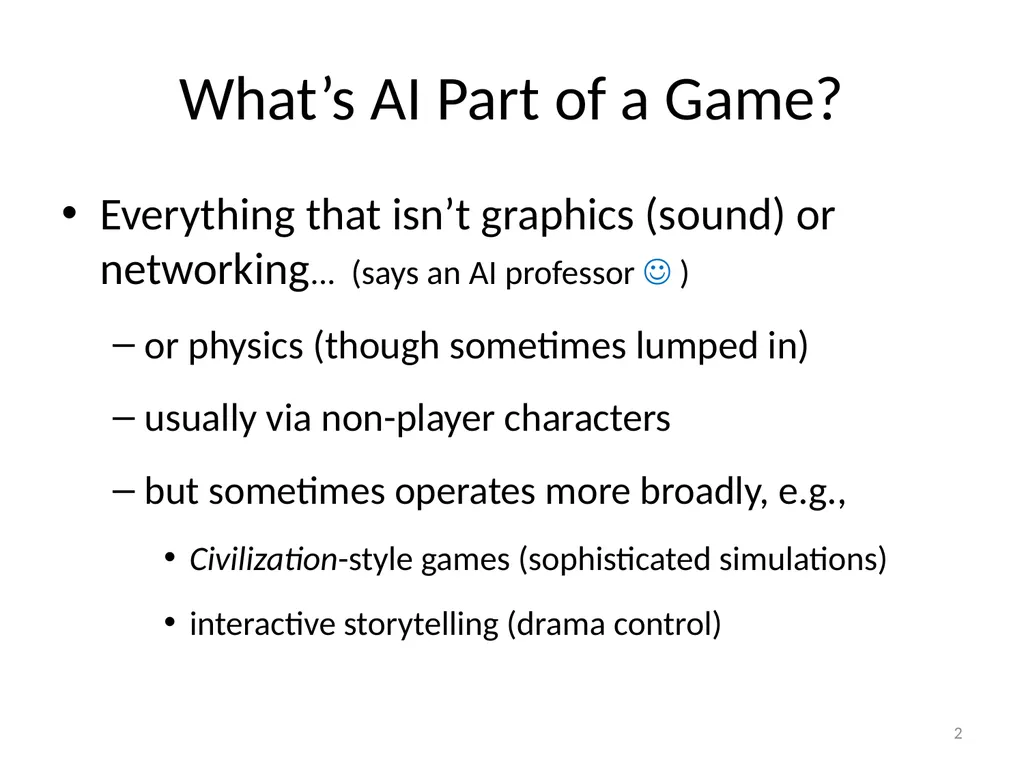
slide2. What’s AI Part of a Game? Everything that isn’t graphics (sound) or networking... (says an AI professor )
or physics (though sometimes lumped in)
usually via non-player characters
but sometimes operates more broadly, e.g.,
Civilization-style games (sophisticated simulations)
interactive storytelling (drama control) 2<br>
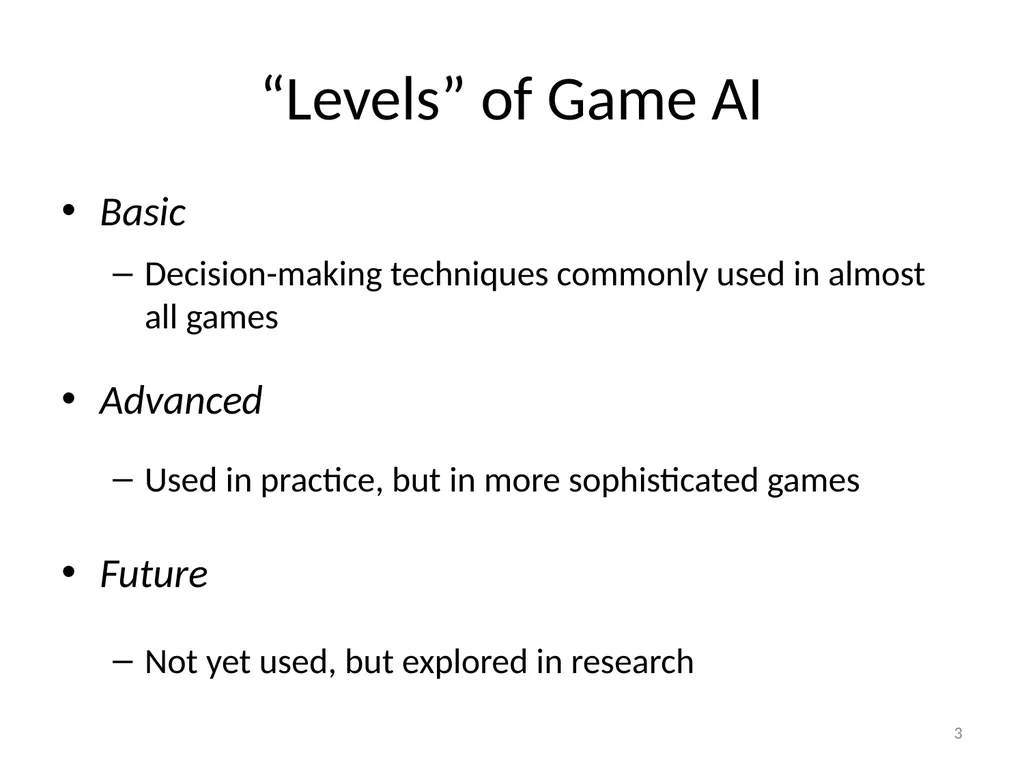
slide3. “Levels” of Game AI Basic
Decision-making techniques commonly used in almost all games
Advanced
Used in practice, but in more sophisticated games
Future
Not yet used, but explored in research 3<br>
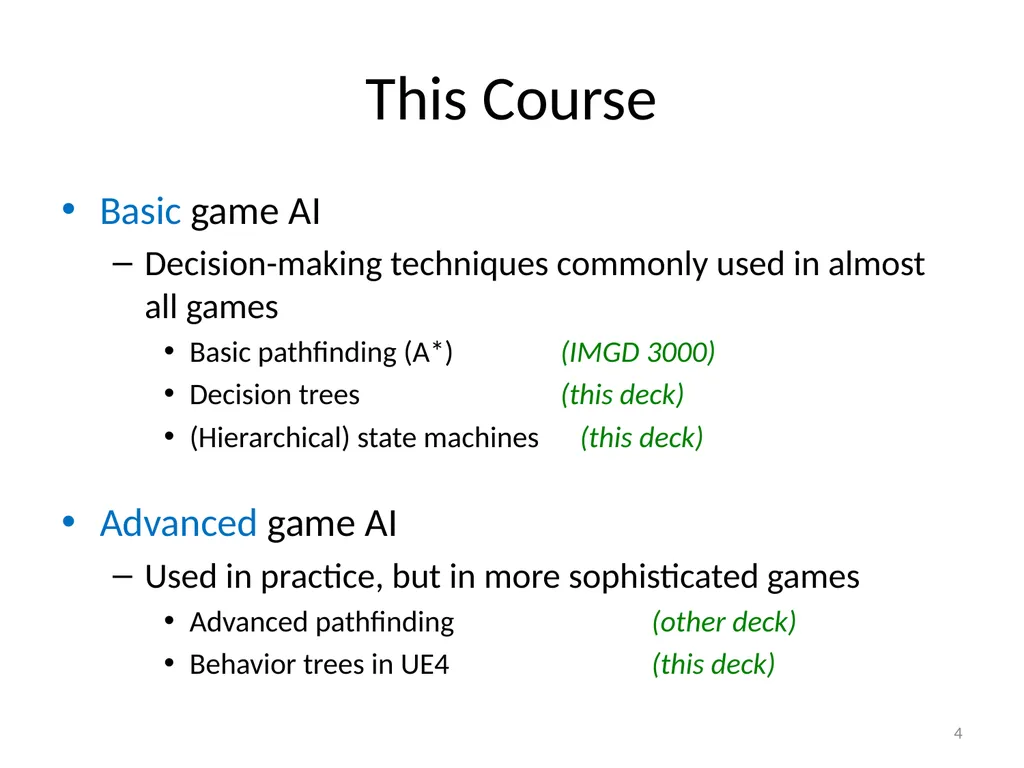
slide4. This Course Basic game AI
Decision-making techniques commonly used in almost all games
Basic pathfinding (A*) (IMGD 3000)
Decision trees (this deck)
(Hierarchical) state machines (this deck)
Advanced game AI
Used in practice, but in more sophisticated games
Advanced pathfinding (other deck)
Behavior trees in UE4 (this deck) 4<br>
slide5. Future Game AI? Take IMGD 4100
“AI for Interactive Media and Games”
Fuzzy logic
More goal-driven agent behavior
Take CS 4341
“Artificial Intelligence”
Machine learning
Planning 5<br>
slide6. Two Fundamental Types of AI Algorithms Non-Search vs. Search
Non-Search: amount of computation is predictable
e.g., decision trees, state machines
Search: upper bound depends on size of search space (often large)
e.g., minimax, planning. Sometimes pathfinding
Scary for real-time games (or need ways to “short-circuit”, e.g., pathfind to closer node)
Need to otherwise limit computation (e.g., threshold, time-slice pathfinding)
Where’s the “knowledge”?
Non-Search: in the code logic (or external tables)
Search: in state evaluation and search order functions
Which one is better? Whichever has better knowledge. ;-) 6<br>
slide7. How About AI Middleware (“AI Engines”)? Recent panel at GDC AI Summit: “Why so wary of AI middleware?”
Only one panelist reported completely positive experience
Steve Gargolinski, Blue Fang (Zoo Tycoon, etc.)
Used Havok Behavior (with Physics)
Most industry AI programmers still write their own AI from scratch (or reuse their own code)
Damian Isla, Flame in the Flood, custom procedural content generation
So, we are going to look at coding details 7<br>
slide8. AI Coding Theme (for Basic AI) Use object-oriented paradigm
instead of...
A tangle of if-then-else statements 8<br>
slide9. Outline Introduction (done)
Decision Trees (next)
Finite State Machines (FSM)
Hierarchical FSM
Behavior Trees<br>
slide10. First Basic AI Technique: Decision Trees 10 See code at: https://github.com/idmillington/aicore
src/dectree.cpp and src/demos/c05-dectree Ian Millington and John Funge. Artificial Intelligence for Games, Morgan Kaufmann, 2009. (Chapter 5)<br>
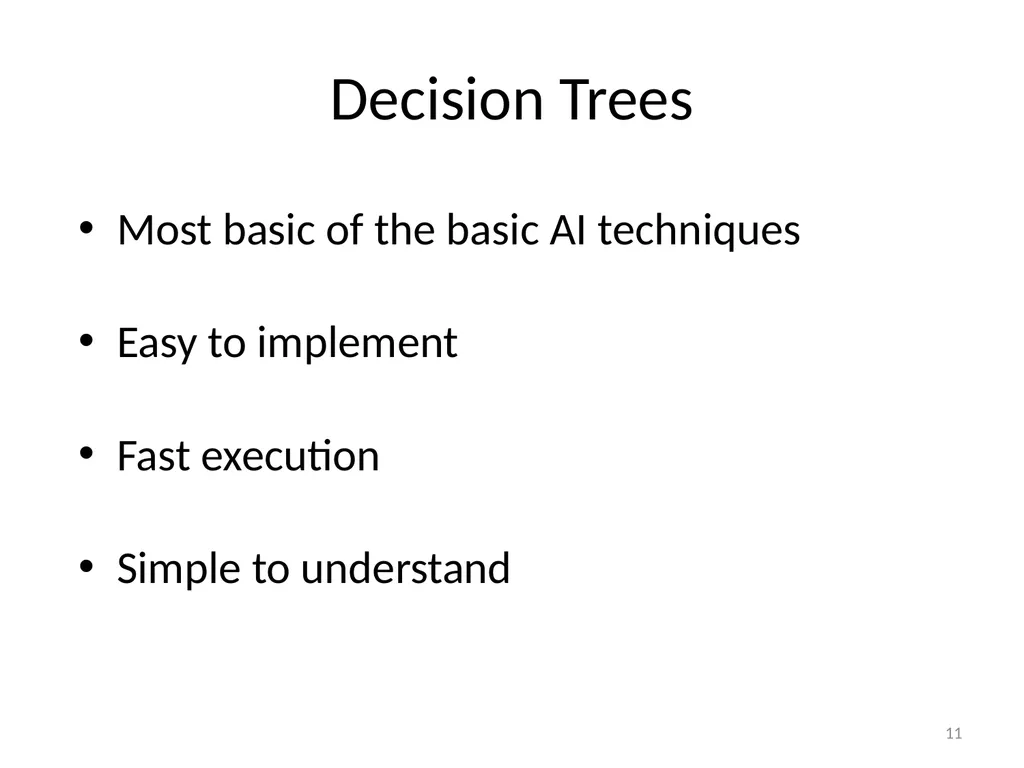
slide11. 11 Decision Trees Most basic of the basic AI techniques
Easy to implement
Fast execution
Simple to understand<br>
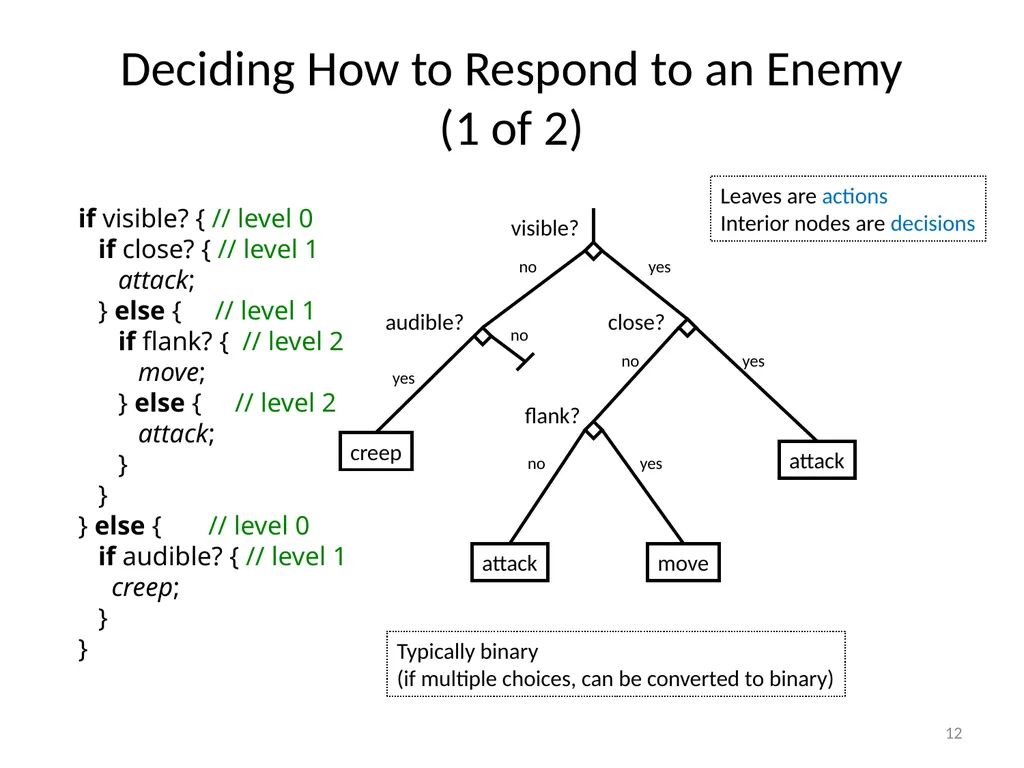
slide12. 12 Deciding How to Respond to an Enemy (1 of 2) if visible? { // level 0
if close? { // level 1
attack;
} else { // level 1
if flank? { // level 2
move;
} else { // level 2
attack;
}
}
} else { // level 0
if audible? { // level 1
creep;
}
} Leaves are actions
Interior nodes are decisions Typically binary
(if multiple choices, can be converted to binary)<br>
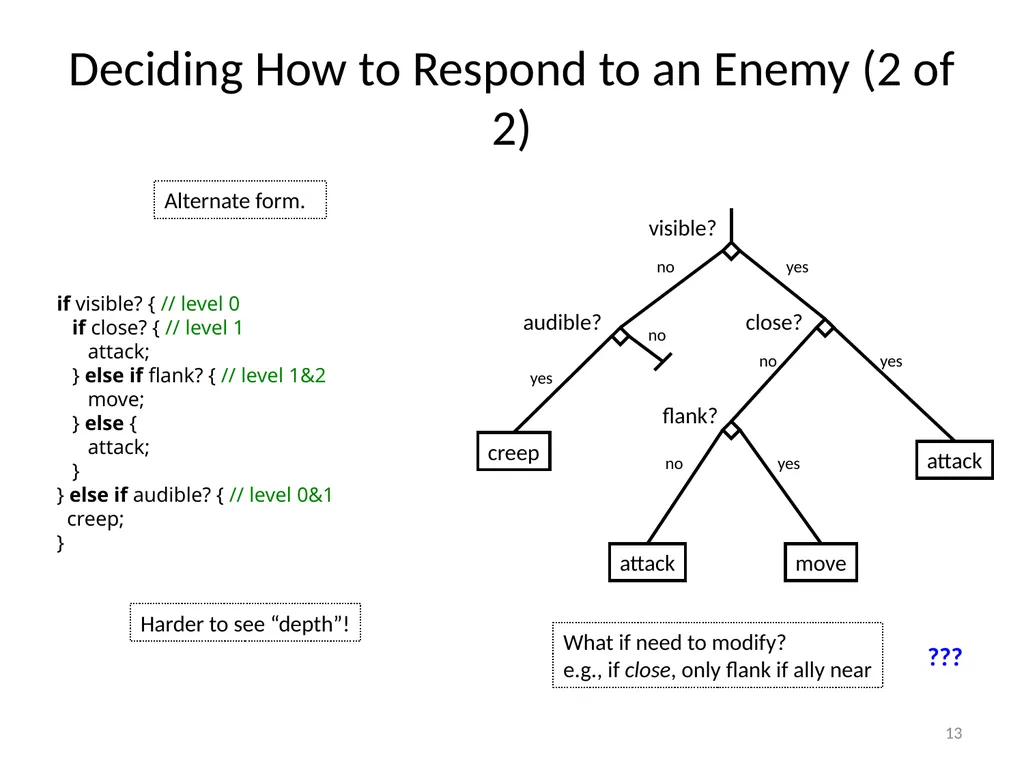
slide13. 13 Deciding How to Respond to an Enemy (2 of 2) What if need to modify?
e.g., if close, only flank if ally near if visible? { // level 0
if close? { // level 1
attack;
} else if flank? { // level 1&2
move;
} else {
attack;
}
} else if audible? { // level 0&1
creep;
} Alternate form. Harder to see “depth”! ???<br>
slide14. if visible? {
if close? {
attack;
} else {
if flank? {
move;
} else {
attack;
}
} if visible? { // level 0
if close? { // level 1
attack;
} else if flank? { // level 1&2
move;
} else {
attack;
}
} else if audible? { // level 0&1
creep;
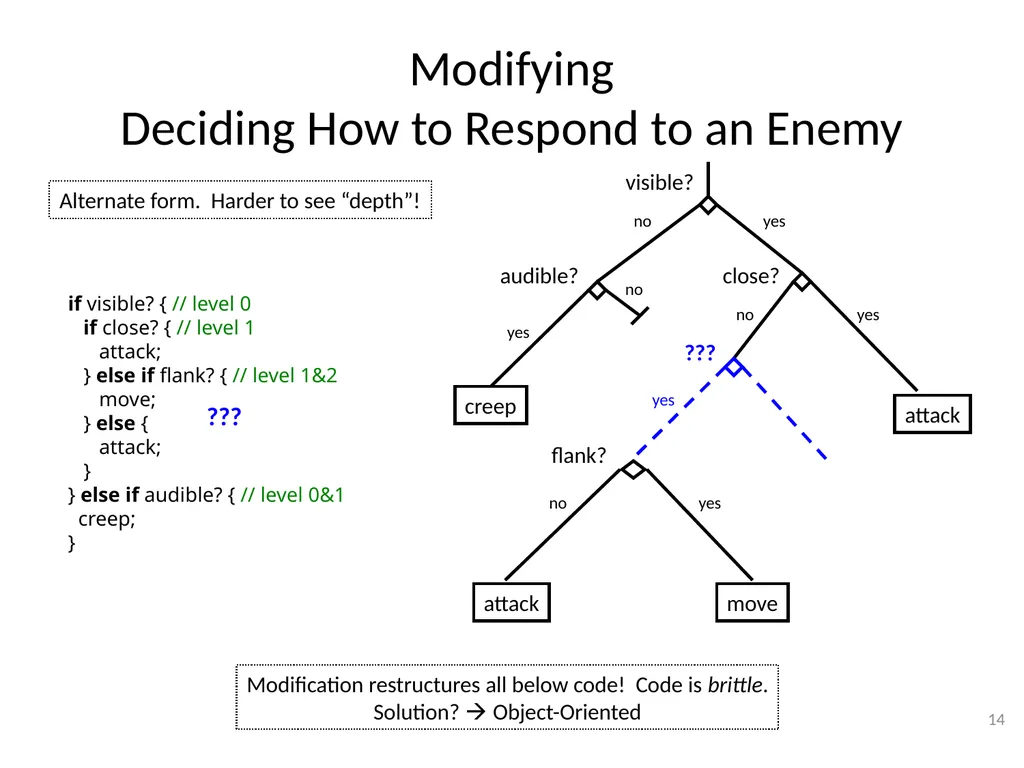
} 14 Modifying Deciding How to Respond to an Enemy ??? yes Modification restructures all below code! Code is brittle.
Solution? Object-Oriented Alternate form. Harder to see “depth”!<br>
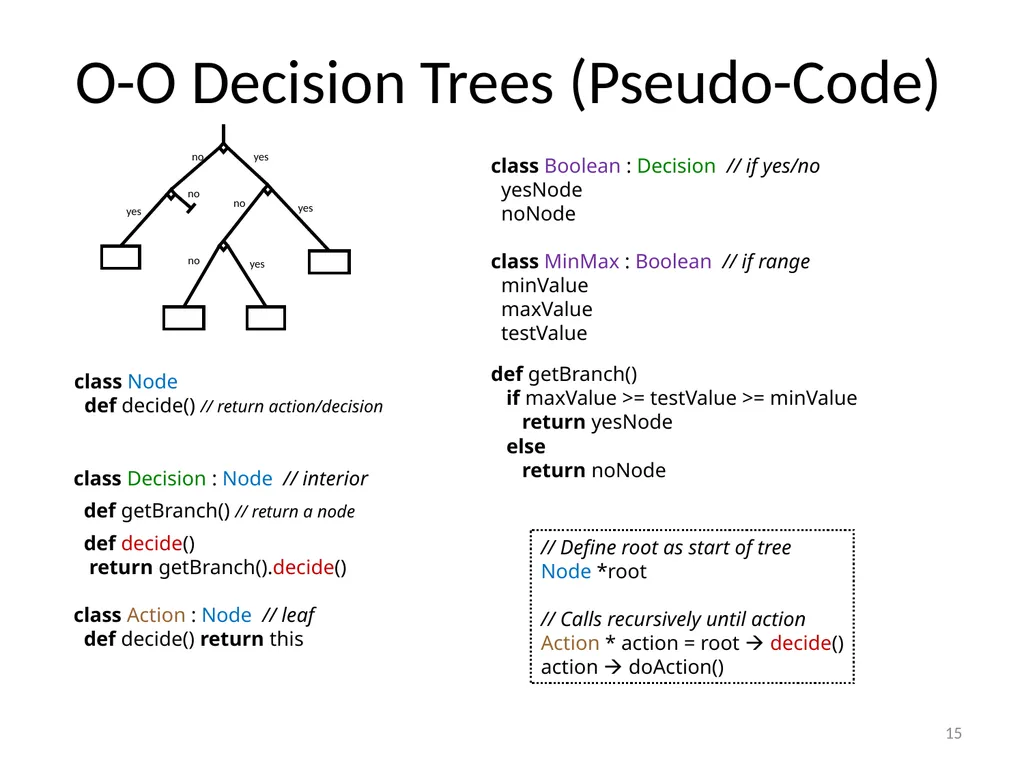
slide15. 15 O-O Decision Trees (Pseudo-Code) class Node
def decide() // return action/decision class Boolean : Decision // if yes/no
yesNode
noNode
class MinMax : Boolean // if range
minValue
maxValue
testValue
def getBranch()
if maxValue >= testValue >= minValue
return yesNode
else
return noNode class Decision : Node // interior
def getBranch() // return a node
def decide()
return getBranch().decide()
class Action : Node // leaf
def decide() return this // Define root as start of tree
Node *root
// Calls recursively until action
Action * action = root decide()
action doAction()<br>
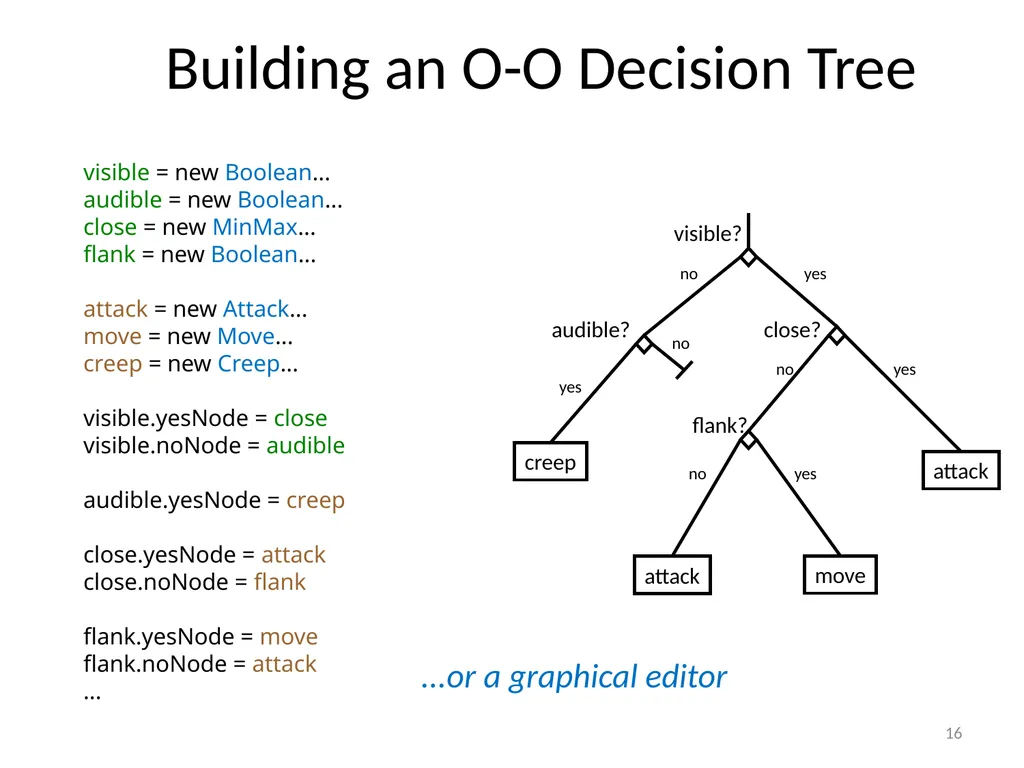
slide16. 16 Building an O-O Decision Tree visible = new Boolean...
audible = new Boolean...
close = new MinMax...
flank = new Boolean...
attack = new Attack...
move = new Move...
creep = new Creep...
visible.yesNode = close
visible.noNode = audible
audible.yesNode = creep
close.yesNode = attack
close.noNode = flank
flank.yesNode = move
flank.noNode = attack
... ...or a graphical editor<br>
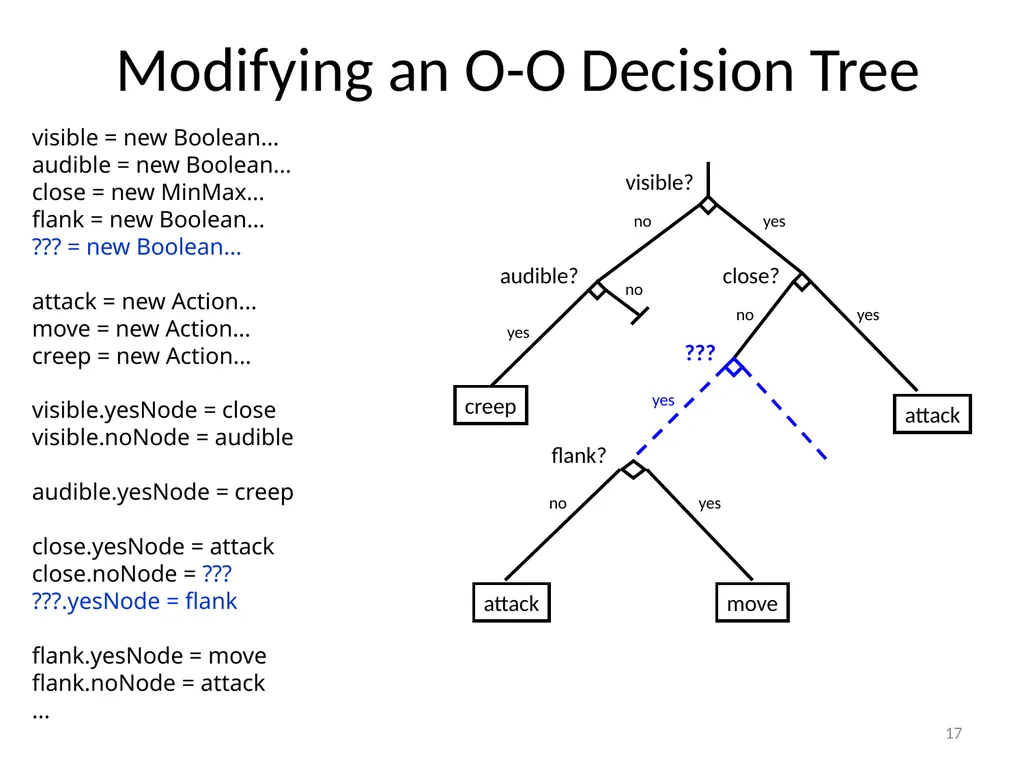
slide17. 17 Modifying an O-O Decision Tree visible = new Boolean...
audible = new Boolean...
close = new MinMax...
flank = new Boolean...
??? = new Boolean...
attack = new Action...
move = new Action...
creep = new Action...
visible.yesNode = close
visible.noNode = audible
audible.yesNode = creep
close.yesNode = attack
close.noNode = ???
???.yesNode = flank
flank.yesNode = move
flank.noNode = attack
... yes<br>
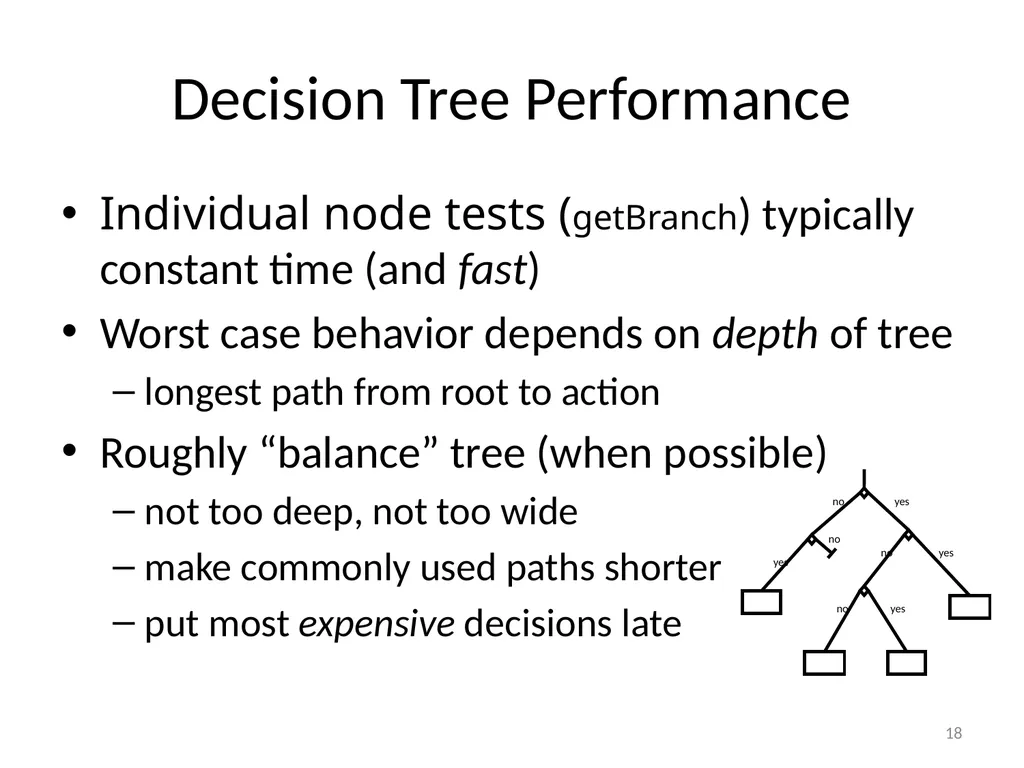
slide18. 18 Decision Tree Performance Individual node tests (getBranch) typically constant time (and fast)
Worst case behavior depends on depth of tree
longest path from root to action
Roughly “balance” tree (when possible)
not too deep, not too wide
make commonly used paths shorter
put most expensive decisions late<br>
slide19. Outline Introduction (done)
Decision Trees (done)
Finite State Machines (FSM) (next)
Hierarchical FSM
Behavior Trees<br>
slide20. Second Basic AI Technique: (Hierarchical) Finite State Machines 20<br>
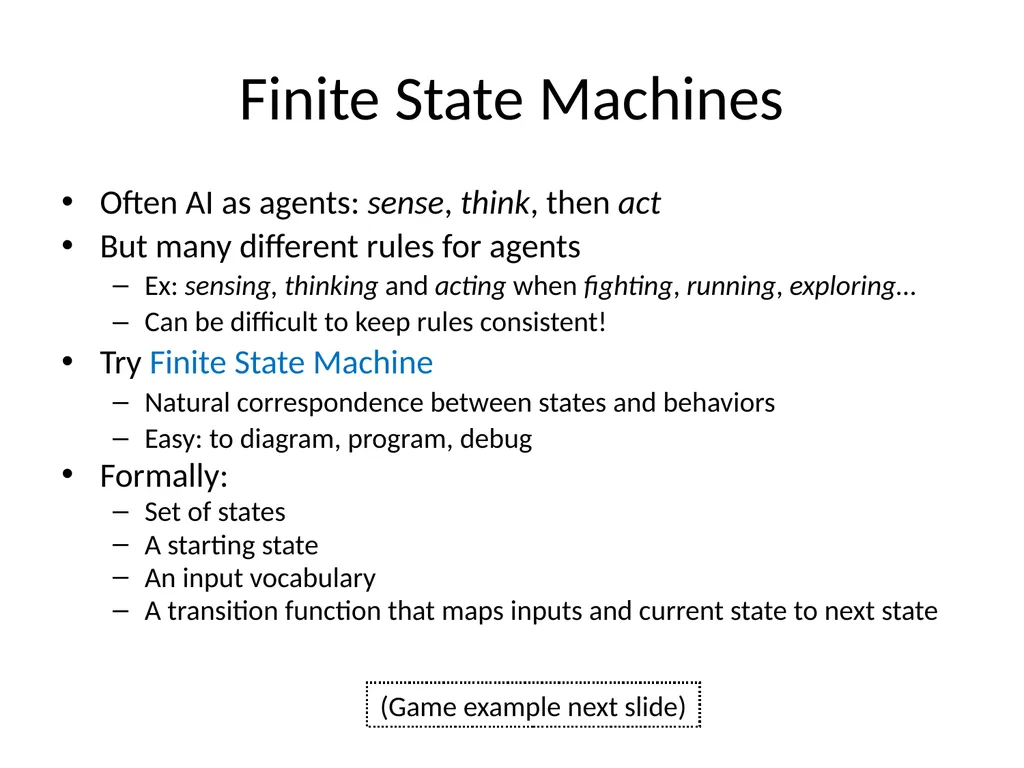
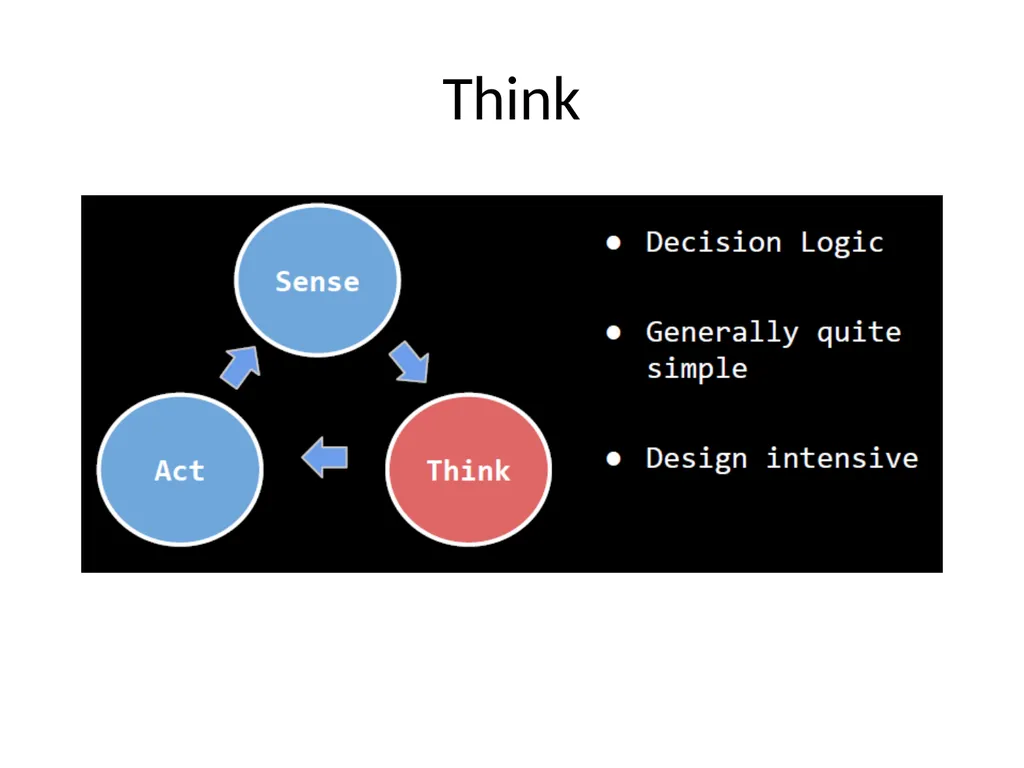
slide21. Finite State Machines Often AI as agents: sense, think, then act
But many different rules for agents
Ex: sensing, thinking and acting when fighting, running, exploring…
Can be difficult to keep rules consistent!
Try Finite State Machine
Natural correspondence between states and behaviors
Easy: to diagram, program, debug
Formally:
Set of states
A starting state
An input vocabulary
A transition function that maps inputs and current state to next state (Game example next slide)<br>
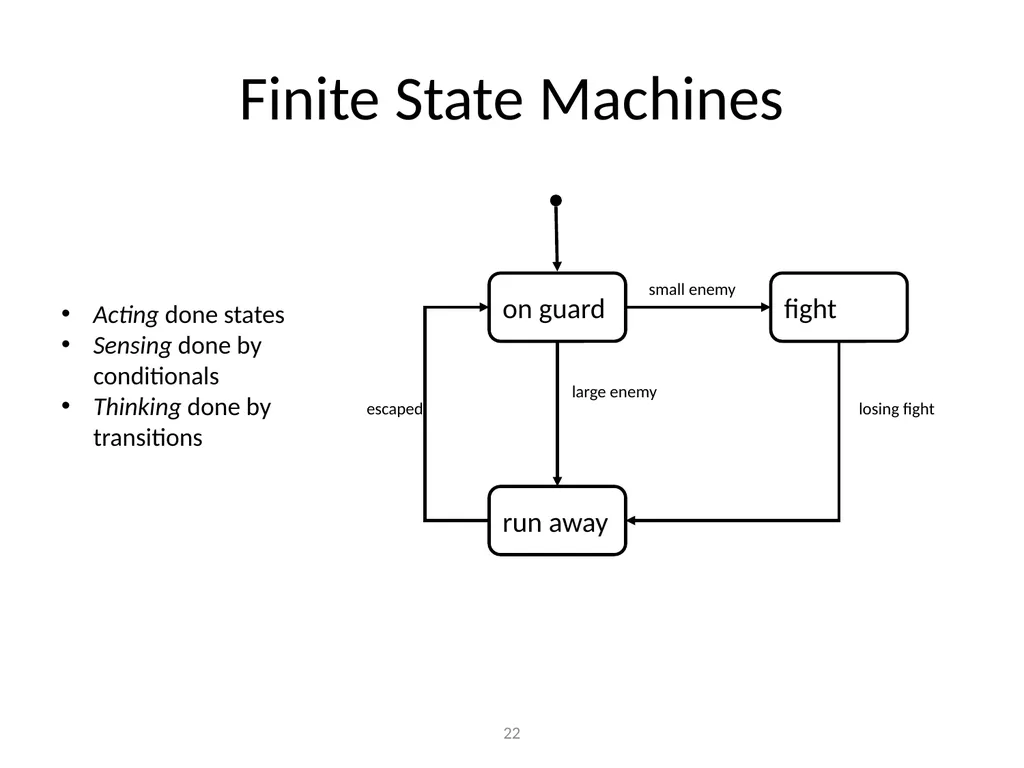
slide22. Finite State Machines 22 Acting done states
Sensing done by conditionals
Thinking done by transitions<br>
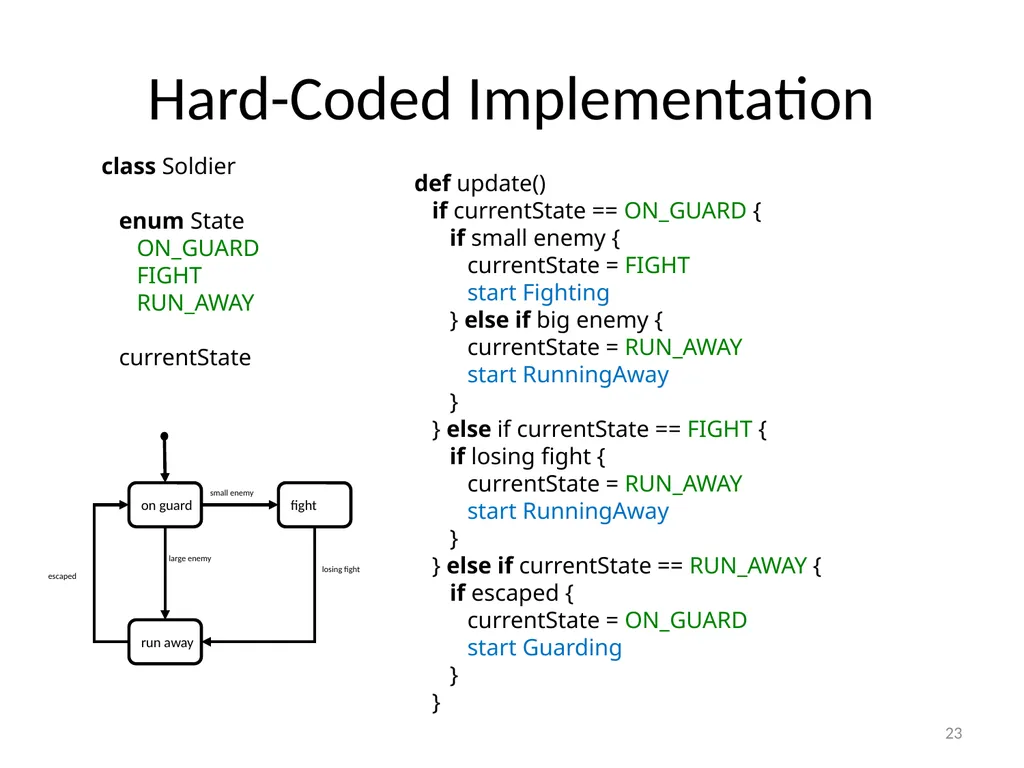
slide23. 23 Hard-Coded Implementation class Soldier
enum State
ON_GUARD
FIGHT
RUN_AWAY
currentState def update()
if currentState == ON_GUARD {
if small enemy {
currentState = FIGHT
start Fighting
} else if big enemy {
currentState = RUN_AWAY
start RunningAway
}
} else if currentState == FIGHT {
if losing fight {
currentState = RUN_AWAY
start RunningAway
}
} else if currentState == RUN_AWAY {
if escaped {
currentState = ON_GUARD
start Guarding
}
}<br>
slide24. 24 Hard-Coded State Machines Easy to write (at the start)
Very efficient
Notoriously hard to maintain (e.g., modify and debug)<br>
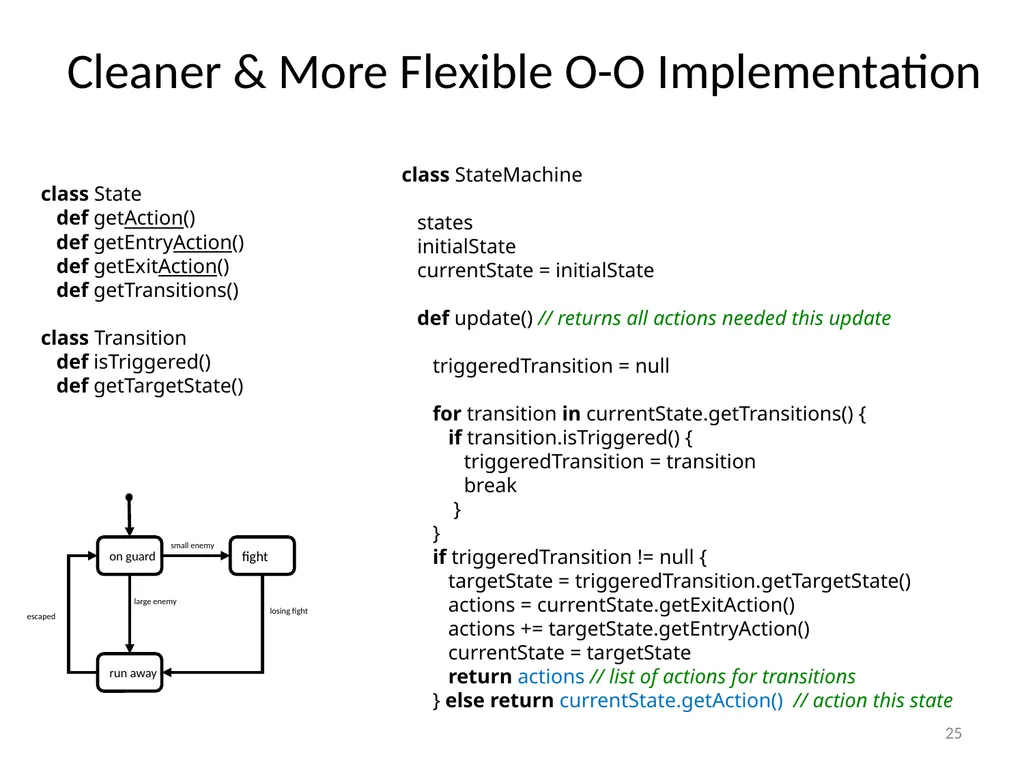
slide25. 25 Cleaner & More Flexible O-O Implementation class State
def getAction()
def getEntryAction()
def getExitAction()
def getTransitions()
class Transition
def isTriggered()
def getTargetState() class StateMachine
states
initialState
currentState = initialState
def update() // returns all actions needed this update
triggeredTransition = null
for transition in currentState.getTransitions() {
if transition.isTriggered() {
triggeredTransition = transition
break
}
}
if triggeredTransition != null {
targetState = triggeredTransition.getTargetState()
actions = currentState.getExitAction()
actions += targetState.getEntryAction()
currentState = targetState
return actions // list of actions for transitions
} else return currentState.getAction() // action this state<br>
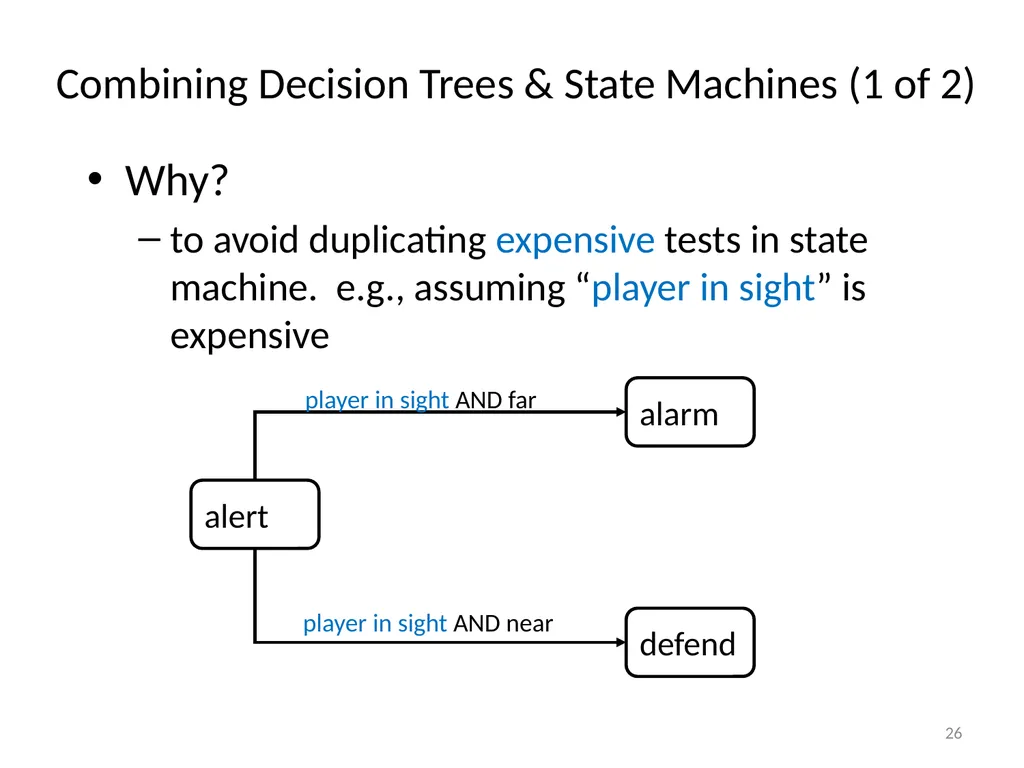
slide26. 26 Combining Decision Trees & State Machines (1 of 2) Why?
to avoid duplicating expensive tests in state machine. e.g., assuming “player in sight” is expensive<br>
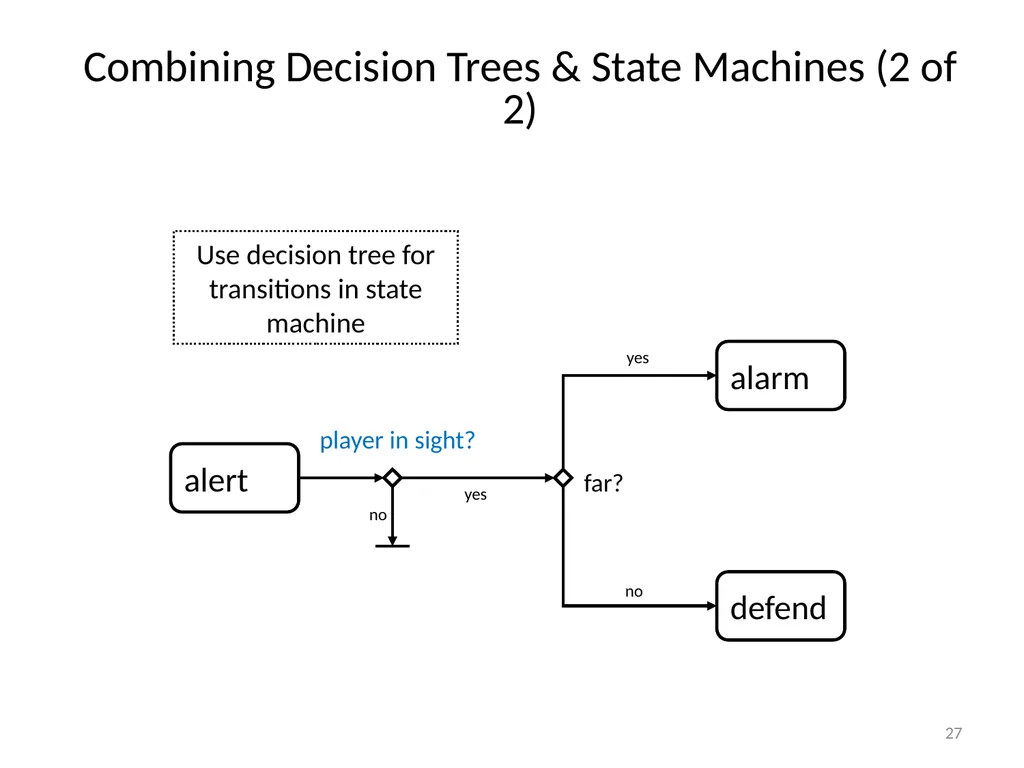
slide27. 27 Combining Decision Trees & State Machines (2 of 2) alert defend alarm player in sight? far? yes yes no no Use decision tree for transitions in state machine<br>
slide28. Outline Introduction (done)
Decision Trees (done)
Finite State Machines (FSM) (done)
Hierarchical FSM (next)
Behavior Trees<br>
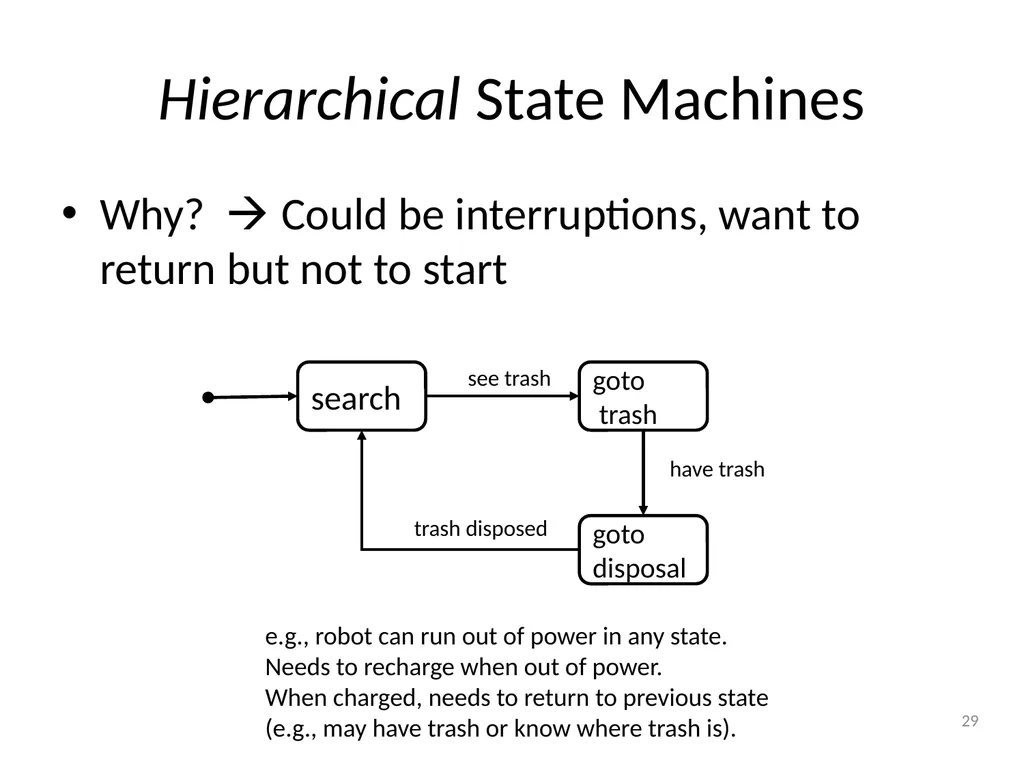
slide29. 29 Hierarchical State Machines Why? Could be interruptions, want to return but not to start e.g., robot can run out of power in any state.
Needs to recharge when out of power.
When charged, needs to return to previous state (e.g., may have trash or know where trash is).<br>
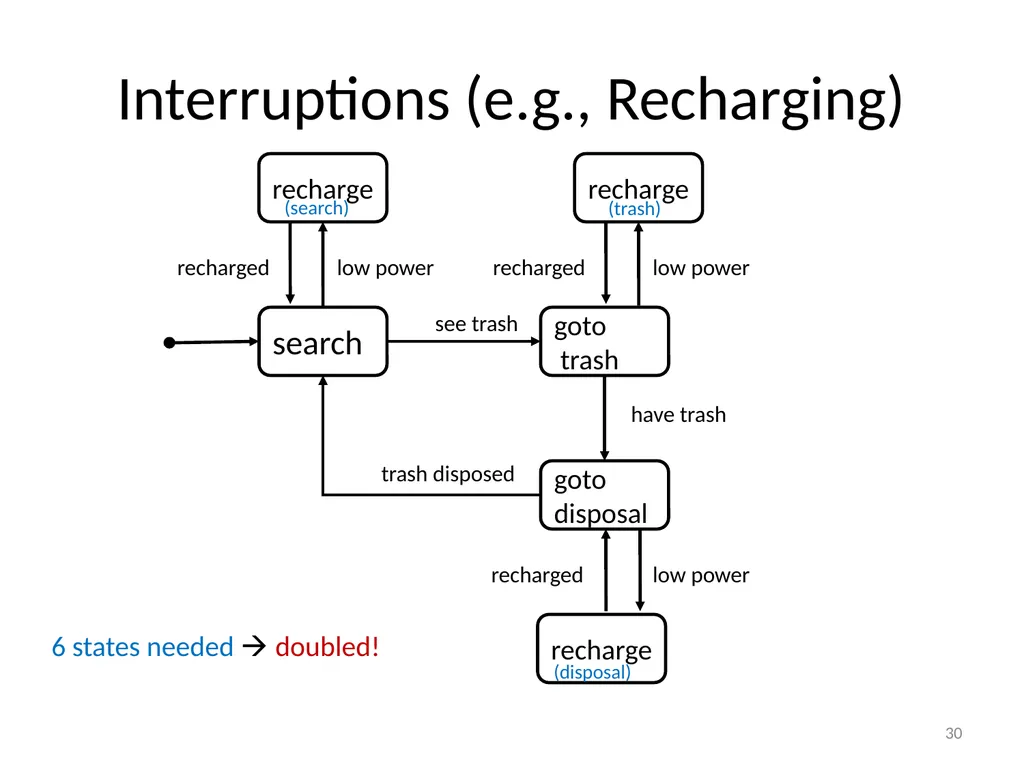
slide30. 30 Interruptions (e.g., Recharging) 6 states needed doubled!<br>
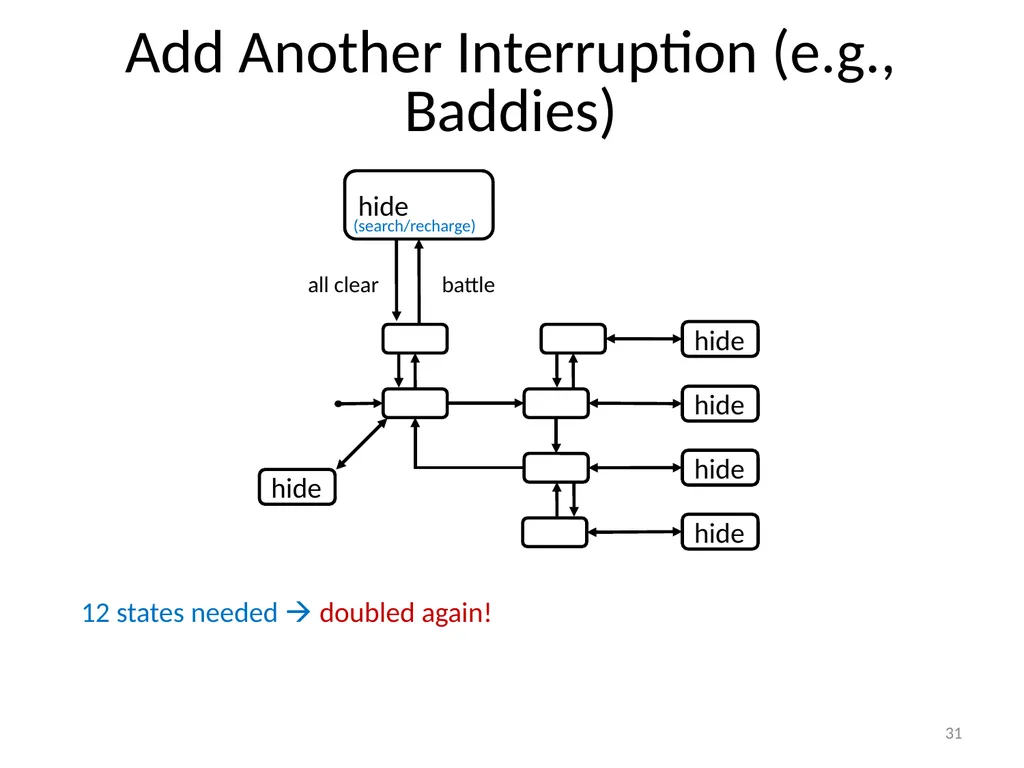
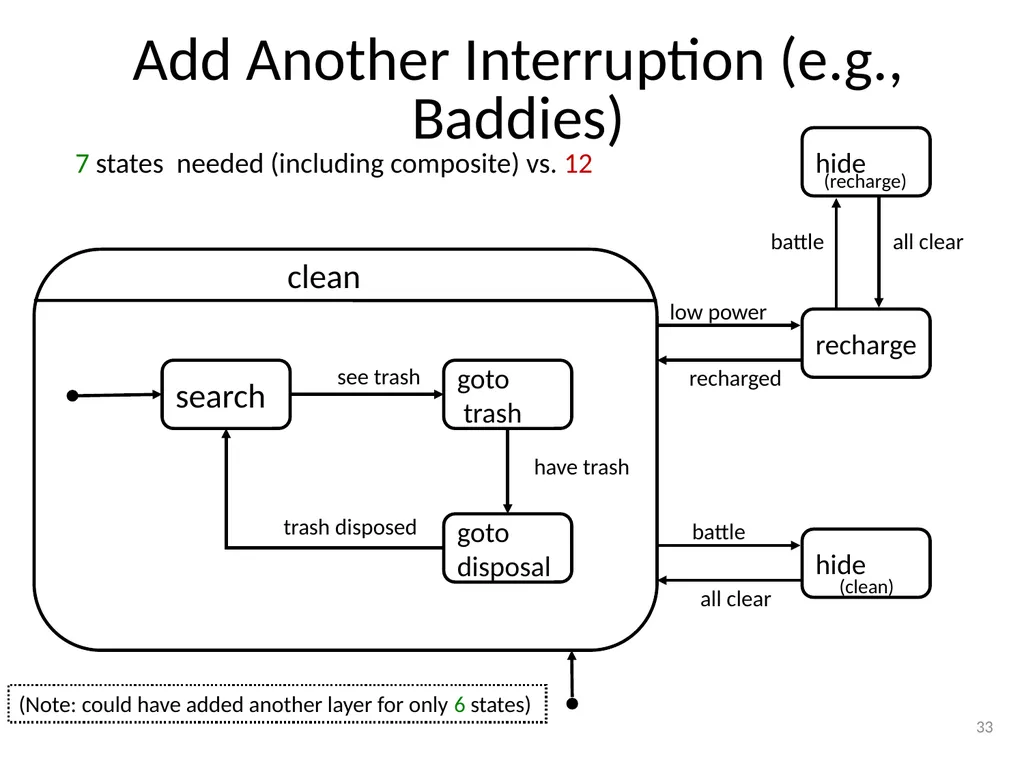
slide31. 31 Add Another Interruption (e.g., Baddies) 12 states needed doubled again!<br>
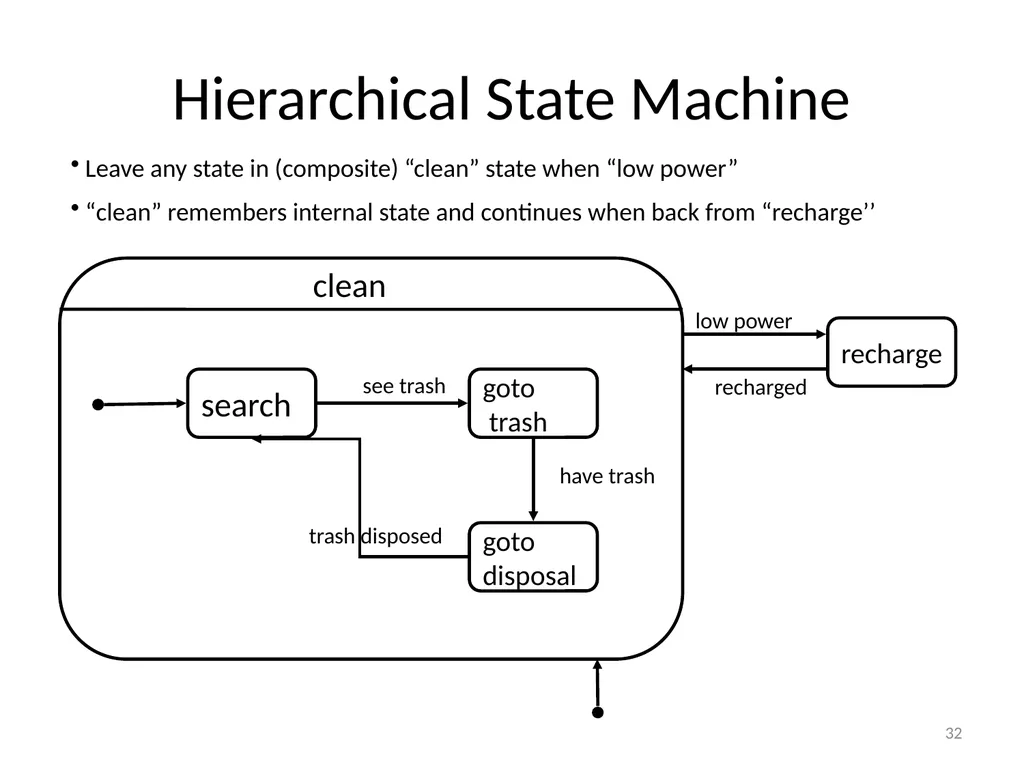
slide32. 32 Hierarchical State Machine Leave any state in (composite) “clean” state when “low power”
“clean” remembers internal state and continues when back from “recharge’’<br>
slide33. 33 Add Another Interruption (e.g., Baddies) clean 7 states needed (including composite) vs. 12 (Note: could have added another layer for only 6 states)<br>
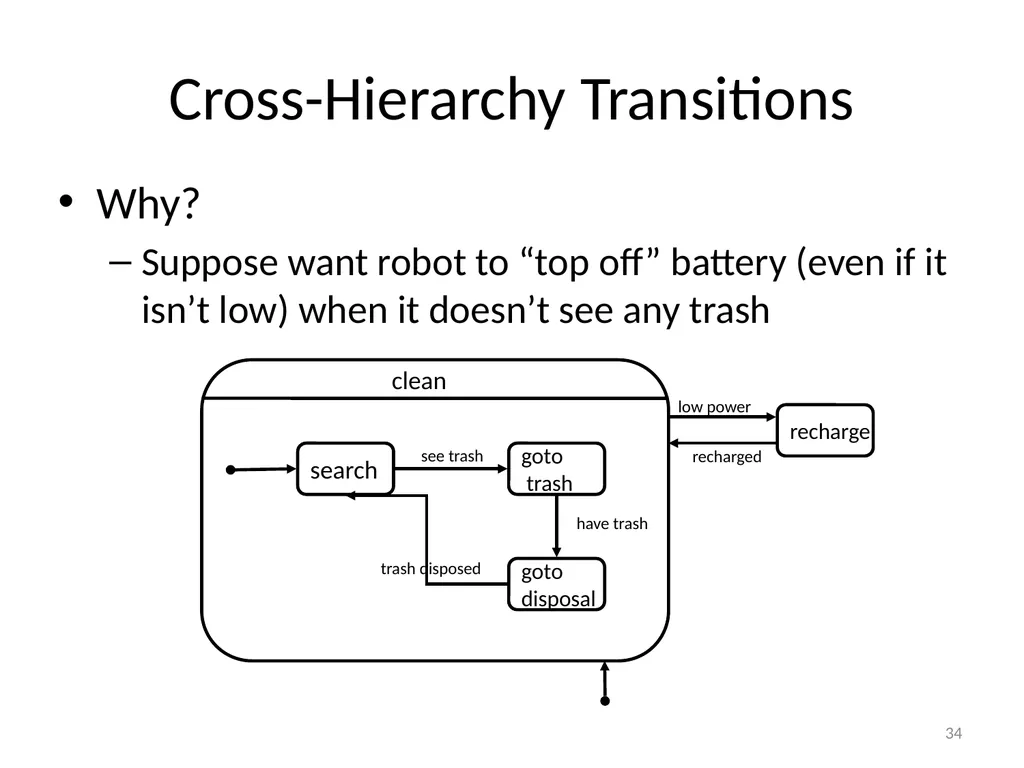
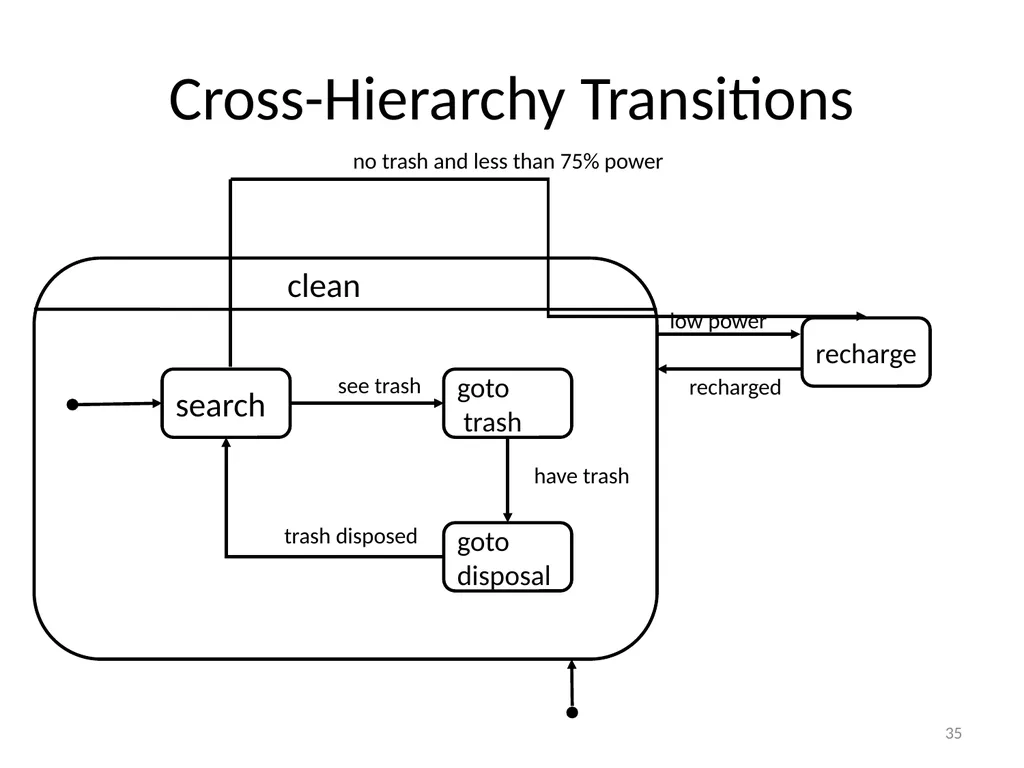
slide34. 34 Cross-Hierarchy Transitions Why?
Suppose want robot to “top off” battery (even if it isn’t low) when it doesn’t see any trash<br>
slide35. 35 Cross-Hierarchy Transitions search goto
disposal goto
trash see trash trash disposed have trash clean<br>
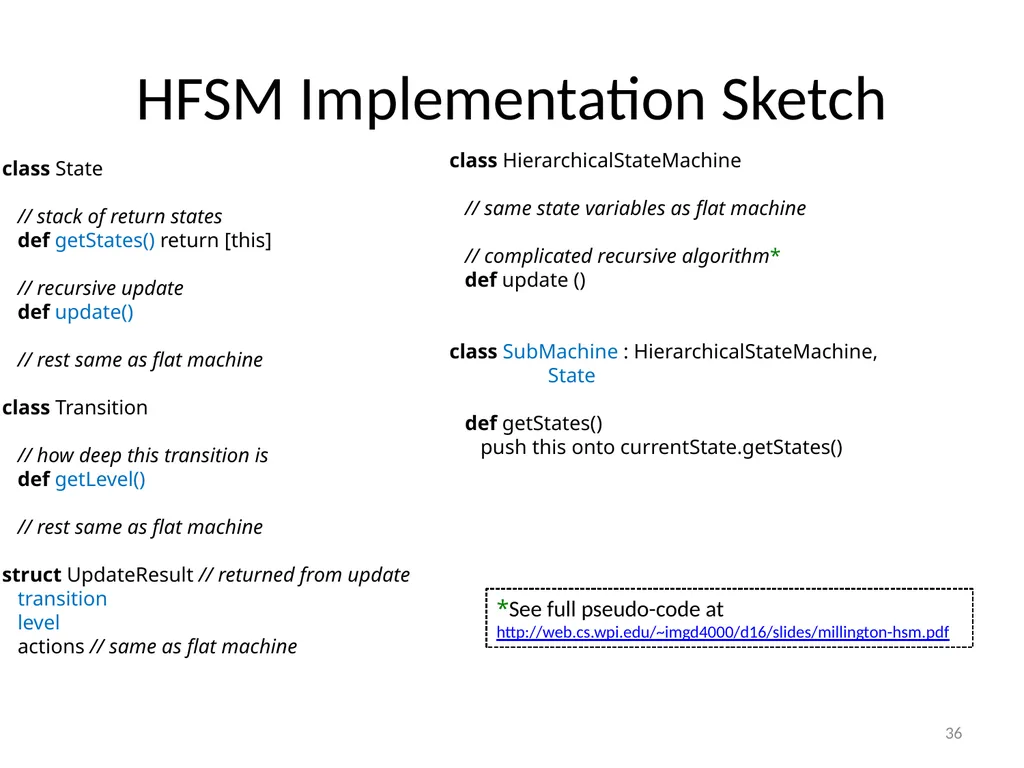
slide36. 36 HFSM Implementation Sketch class State
// stack of return states
def getStates() return [this]
// recursive update
def update()
// rest same as flat machine
class Transition
// how deep this transition is
def getLevel()
// rest same as flat machine
struct UpdateResult // returned from update
transition
level
actions // same as flat machine class HierarchicalStateMachine
// same state variables as flat machine
// complicated recursive algorithm*
def update ()
class SubMachine : HierarchicalStateMachine,
State
def getStates()
push this onto currentState.getStates() *See full pseudo-code at http://web.cs.wpi.edu/~imgd4000/d16/slides/millington-hsm.pdf<br>
slide37. Outline Introduction (done)
Decision Trees (done)
Finite State Machines (FSM) (done)
Hierarchical FSM (done)
Behavior Trees (next)
In UE4 http://www.slideshare.net/JaeWanPark2/behavior-tree-in-unreal-engine-4<br>
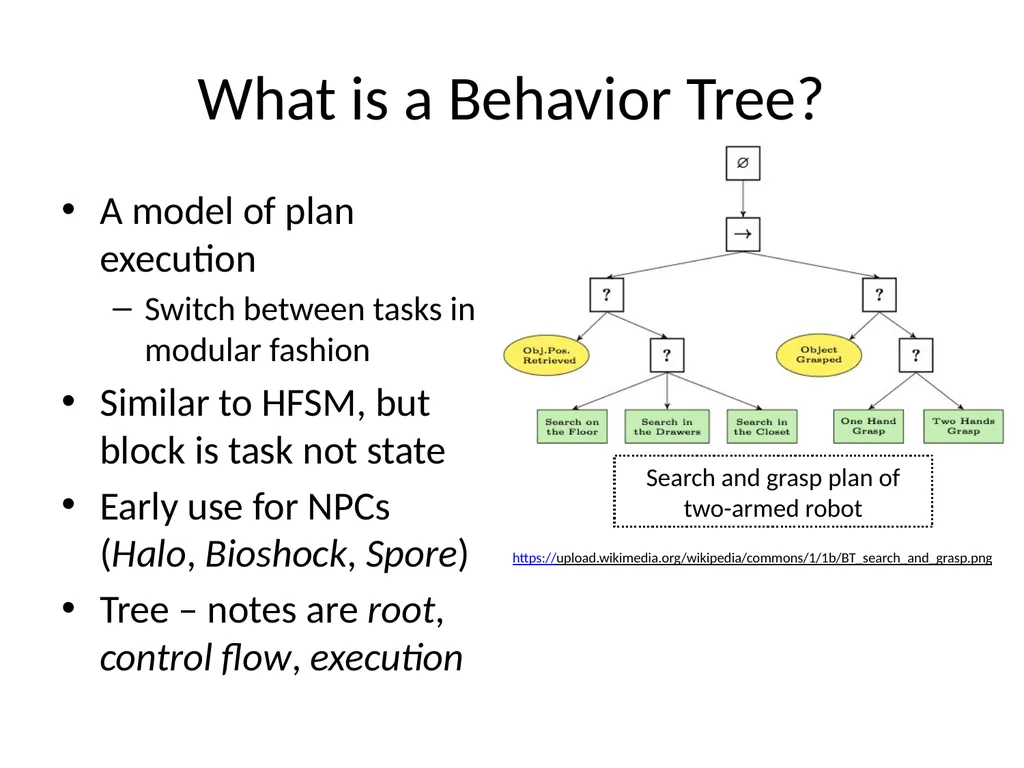
slide38. What is a Behavior Tree? A model of plan execution
Switch between tasks in modular fashion
Similar to HFSM, but block is task not state
Early use for NPCs (Halo, Bioshock, Spore)
Tree – notes are root, control flow, execution Search and grasp plan of two-armed robot https://upload.wikimedia.org/wikipedia/commons/1/1b/BT_search_and_grasp.png<br>
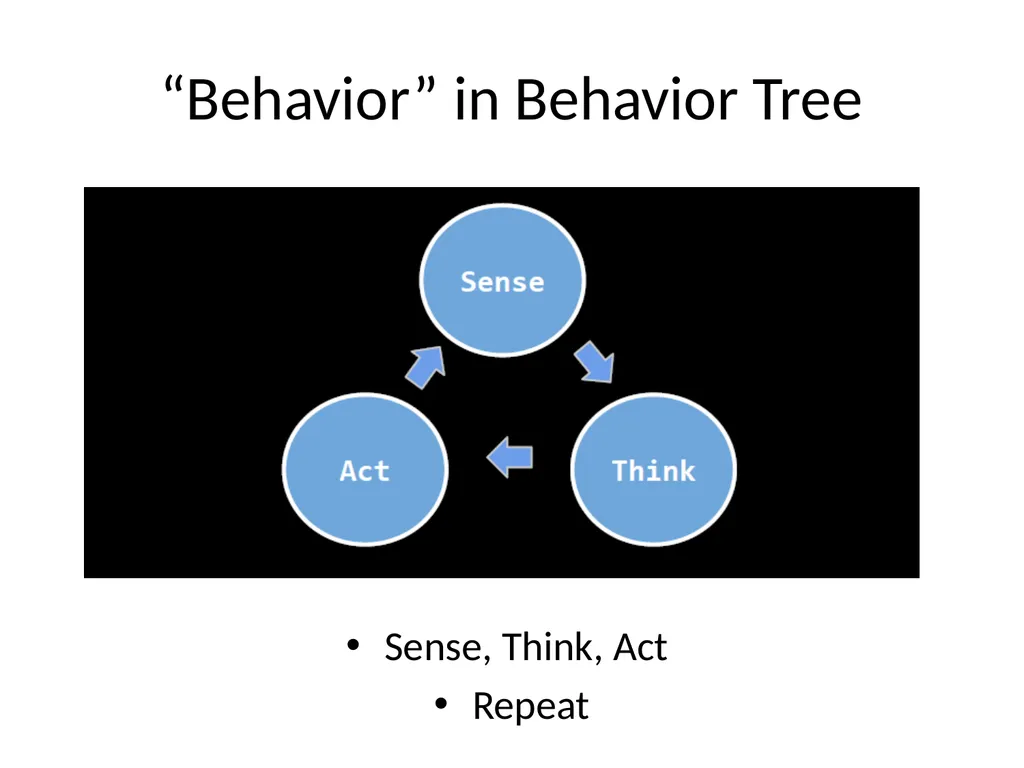
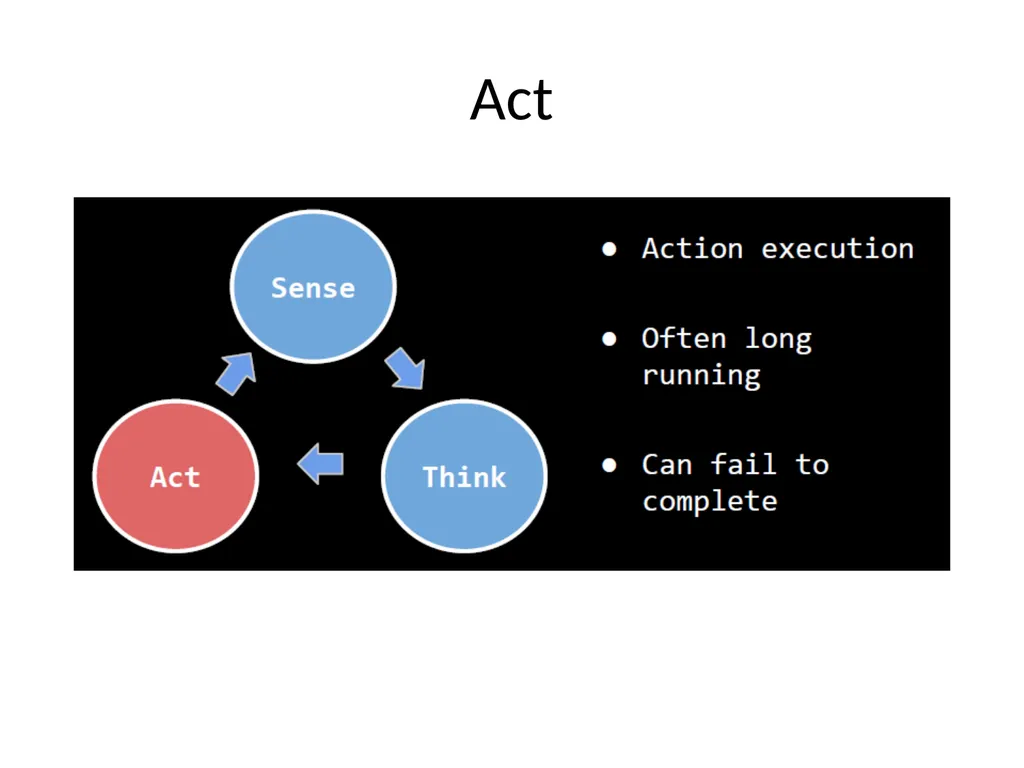
slide39. “Behavior” in Behavior Tree Sense, Think, Act
Repeat<br>
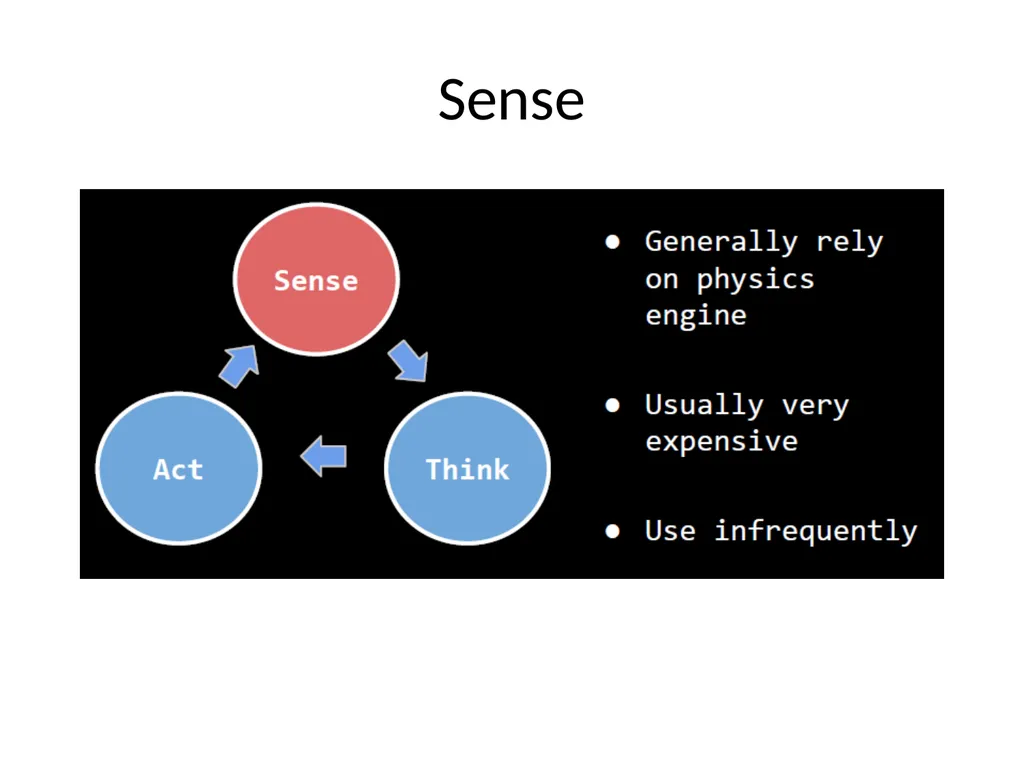
slide40. Sense<br>
slide41. Think<br>
slide42. Act<br>
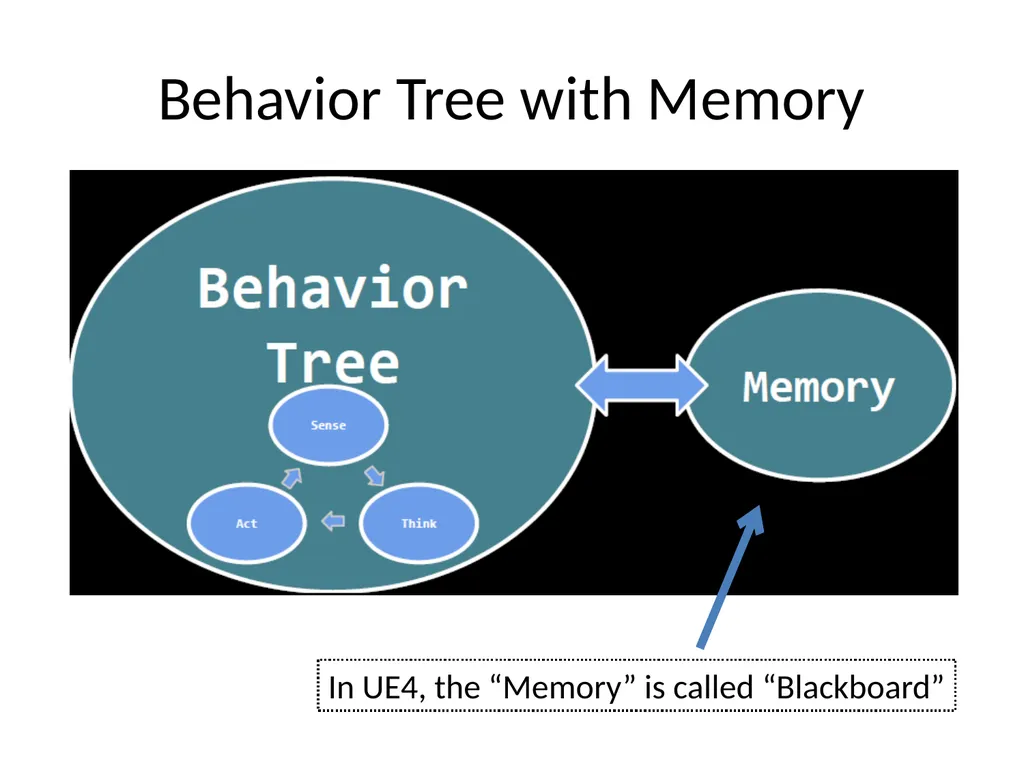
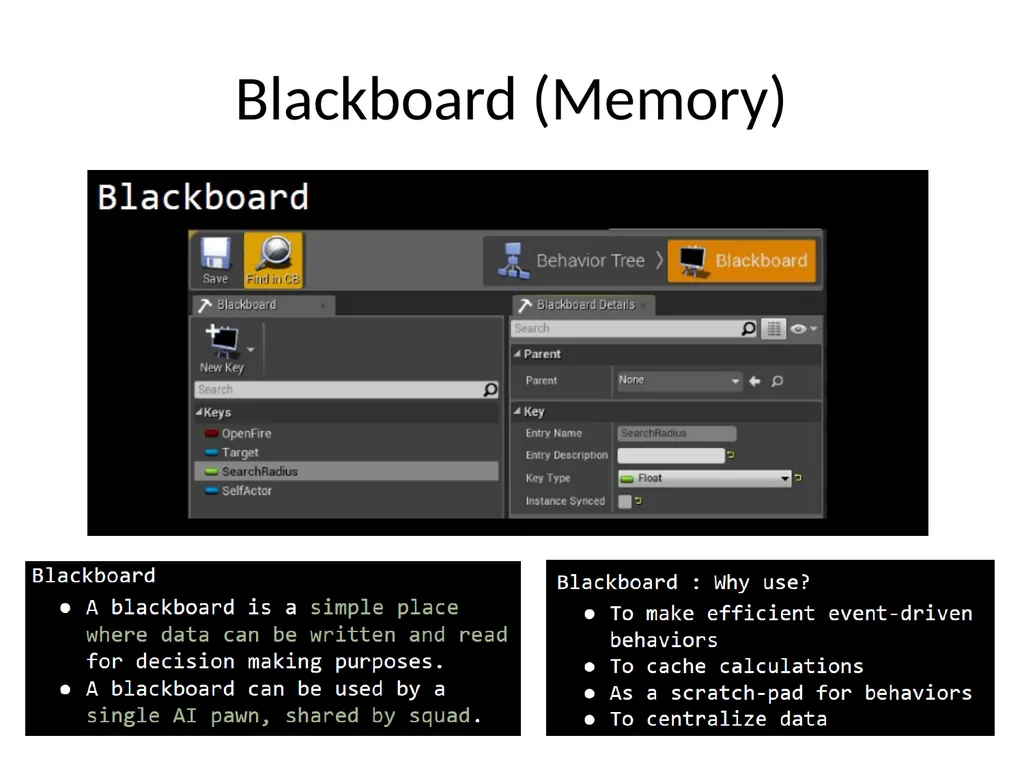
slide43. Behavior Tree with Memory In UE4, the “Memory” is called “Blackboard”<br>
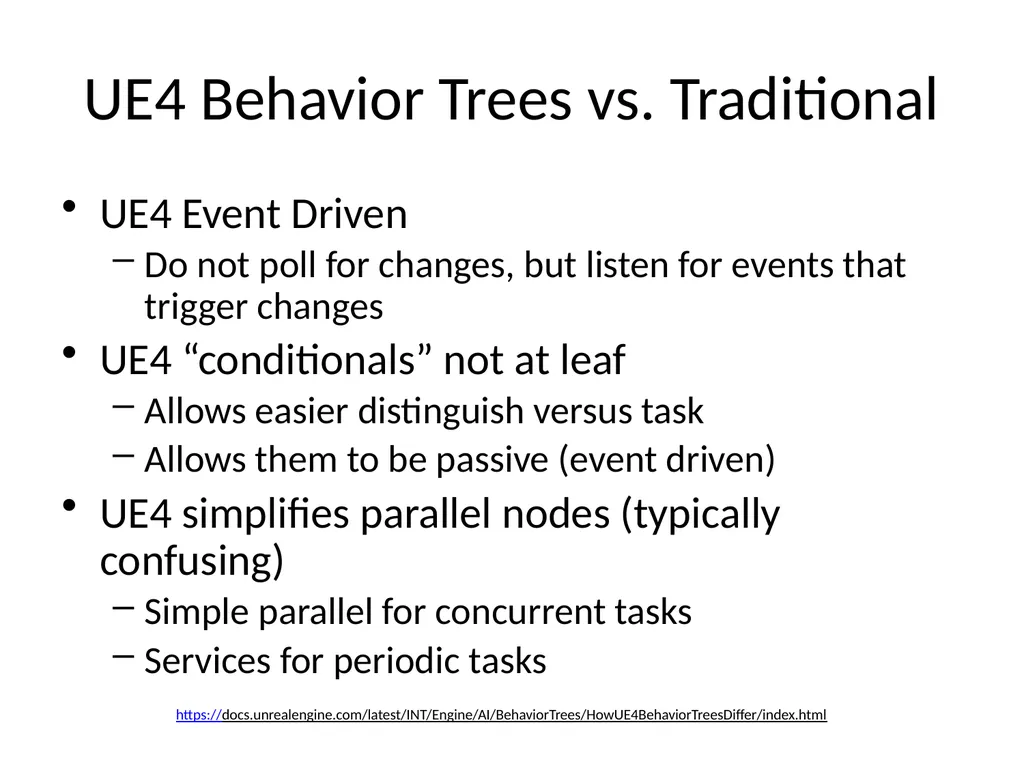
slide44. UE4 Behavior Trees vs. Traditional UE4 Event Driven
Do not poll for changes, but listen for events that trigger changes
UE4 “conditionals” not at leaf
Allows easier distinguish versus task
Allows them to be passive (event driven)
UE4 simplifies parallel nodes (typically confusing)
Simple parallel for concurrent tasks
Services for periodic tasks https://docs.unrealengine.com/latest/INT/Engine/AI/BehaviorTrees/HowUE4BehaviorTreesDiffer/index.html<br>
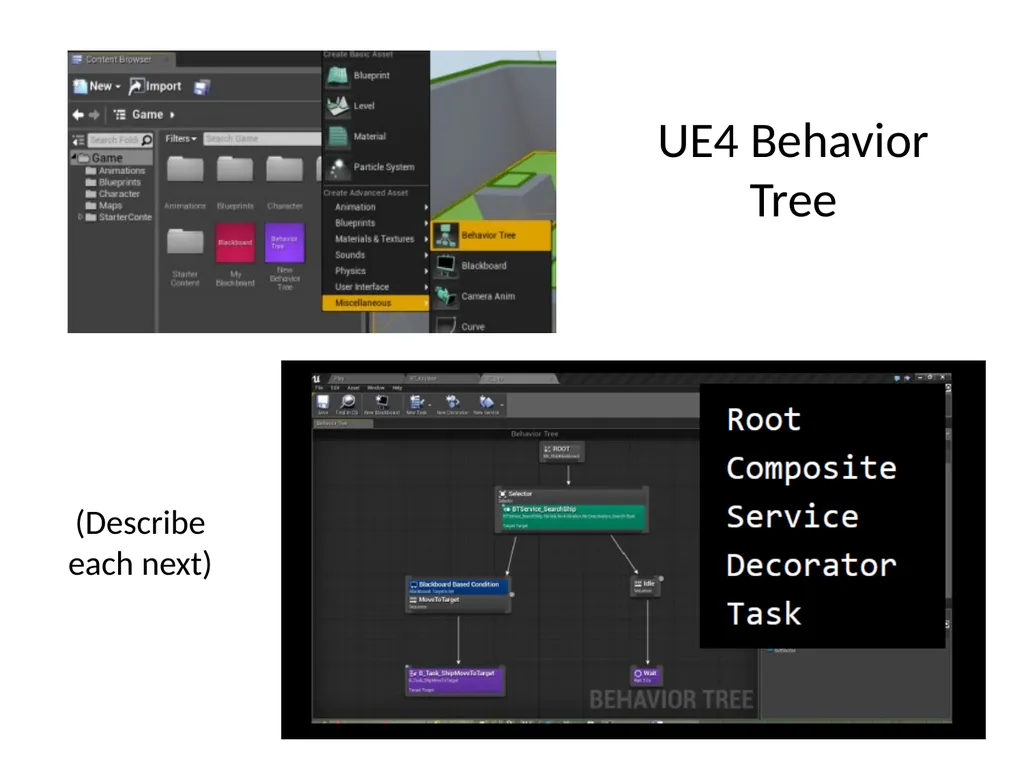
slide45. UE4 Behavior Tree (Describe each next)<br>
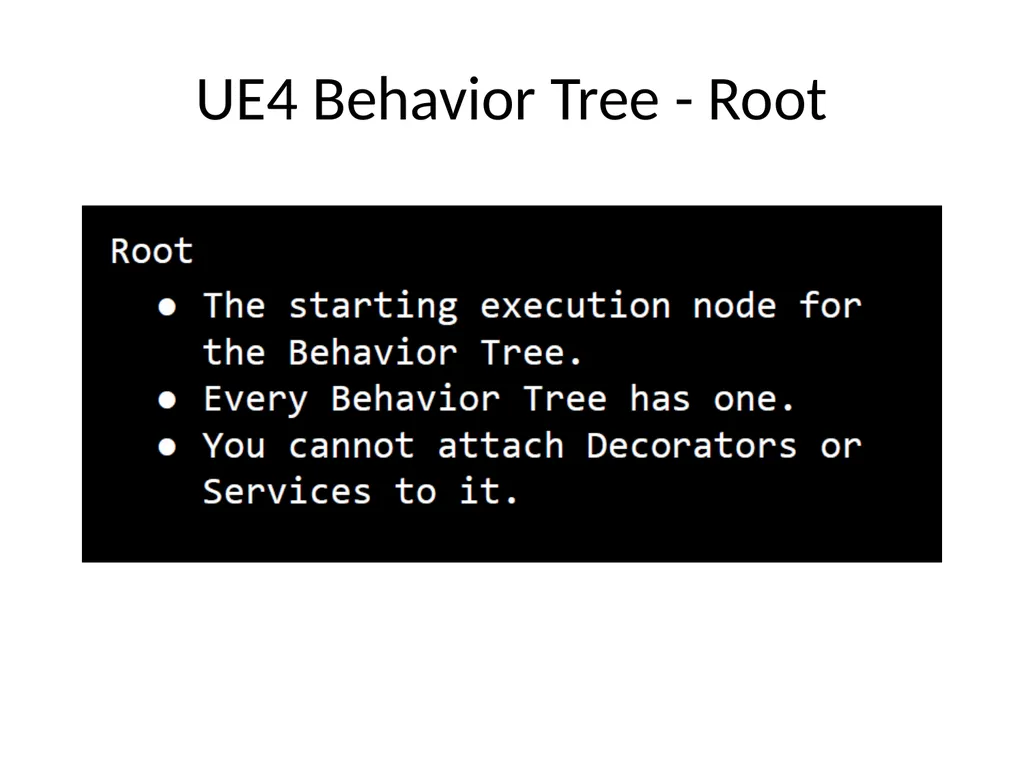
slide46. UE4 Behavior Tree - Root<br>
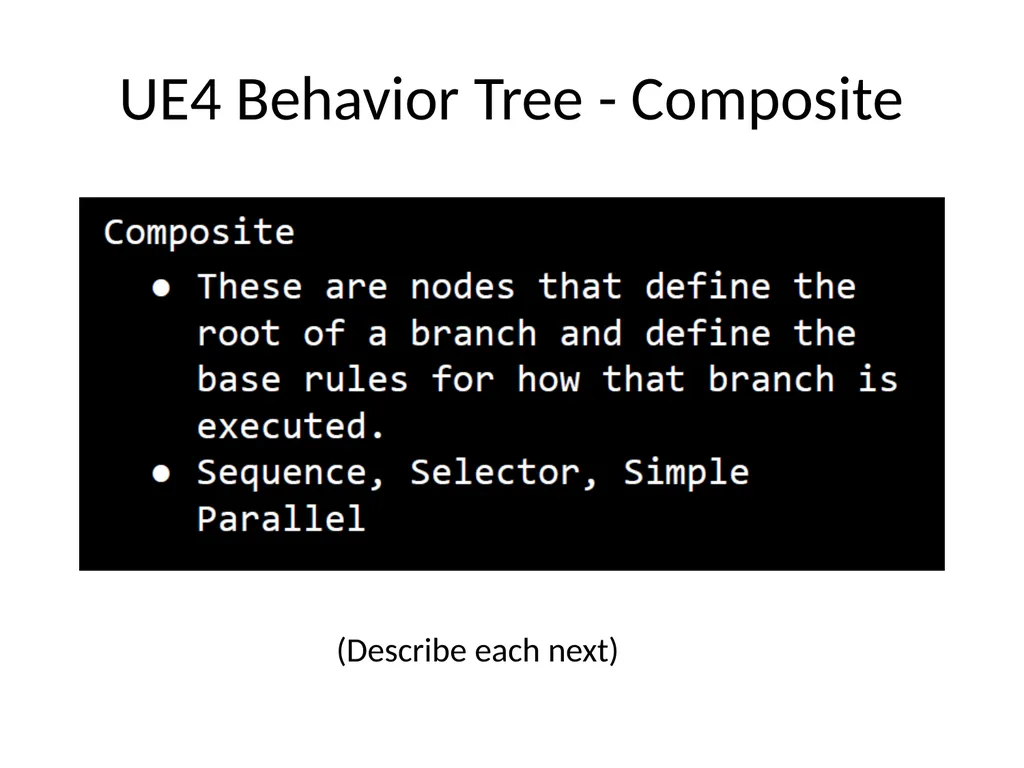
slide47. UE4 Behavior Tree - Composite (Describe each next)<br>
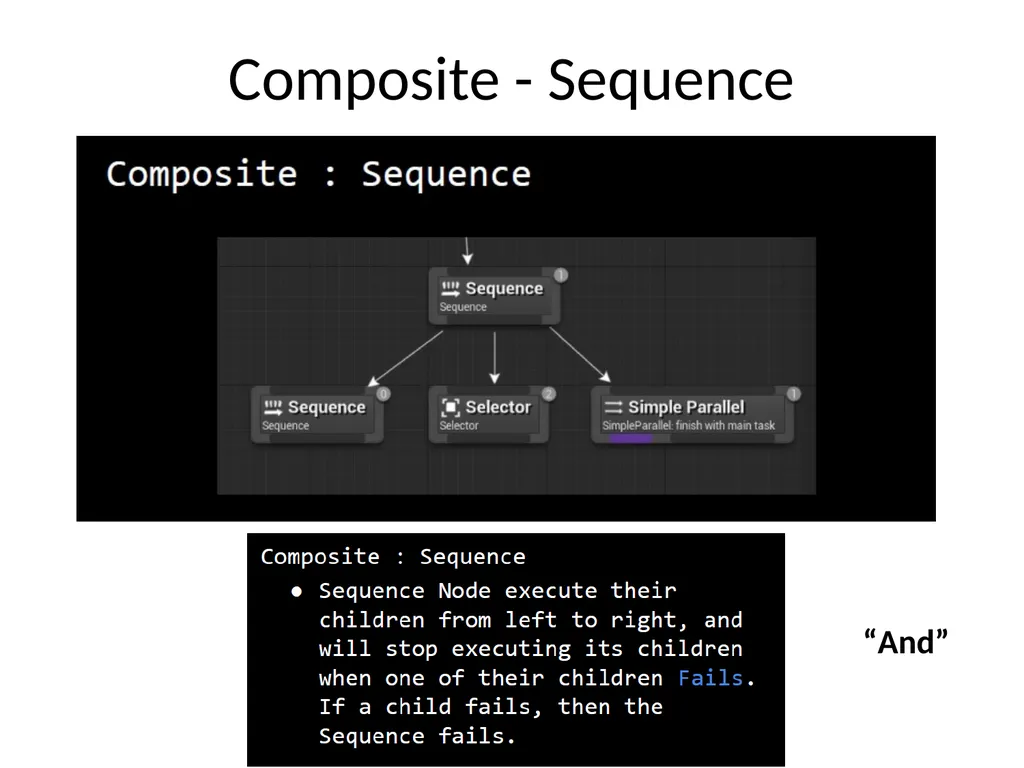
slide48. Composite - Sequence “And”<br>
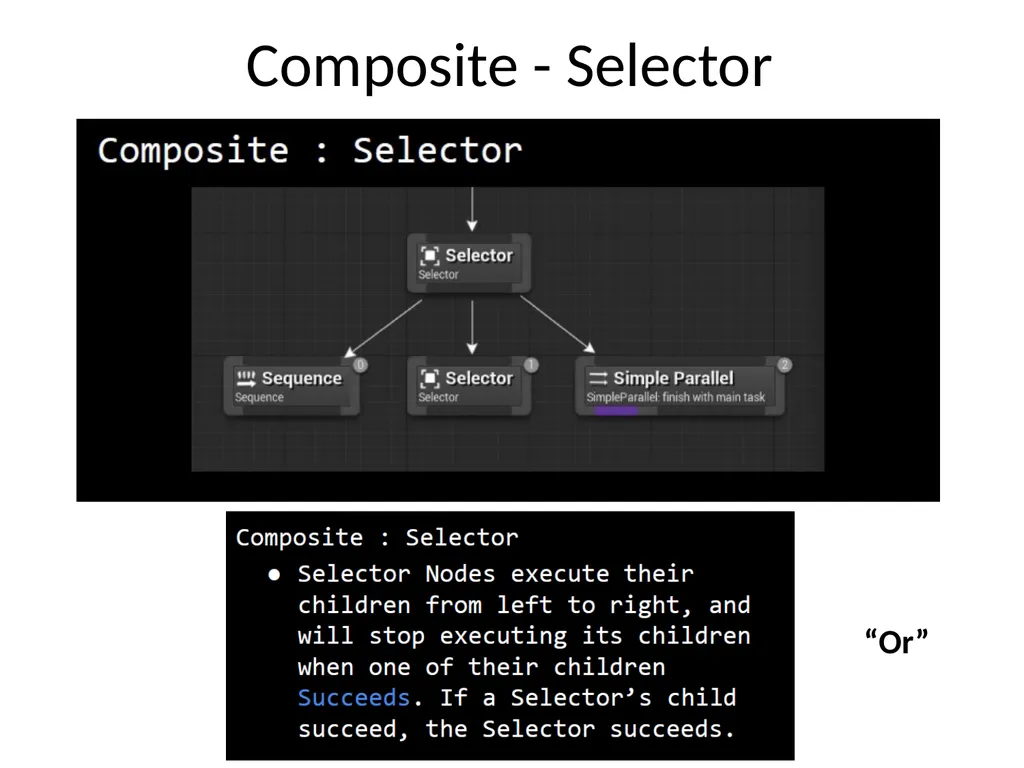
slide49. Composite - Selector “Or”<br>
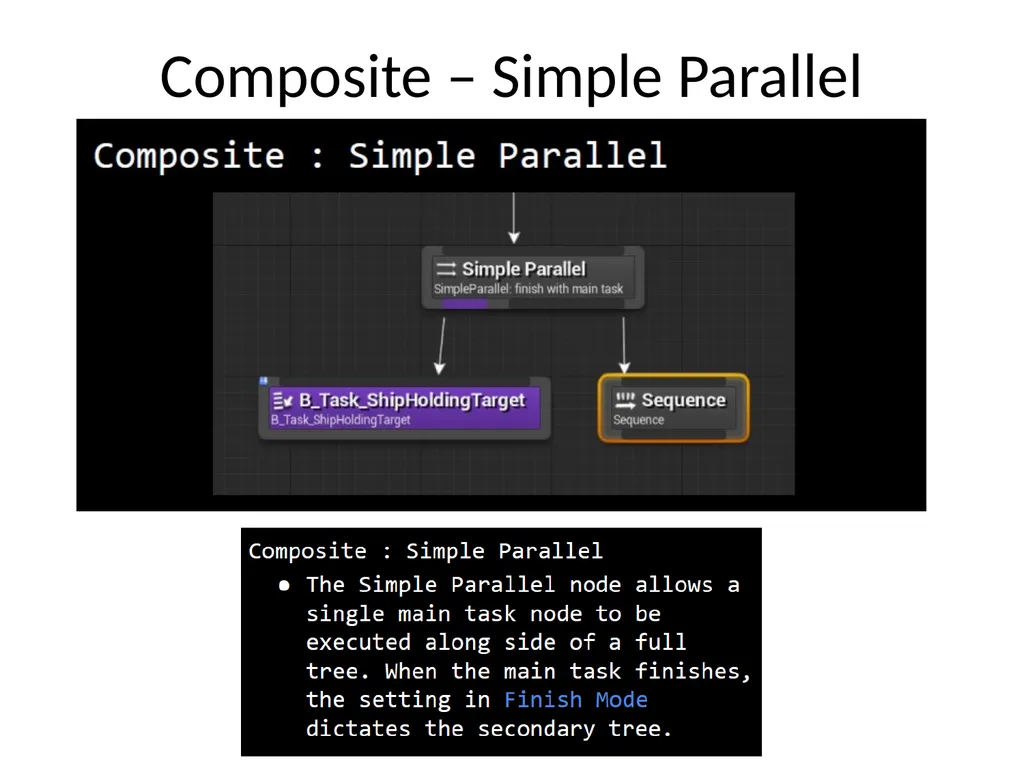
slide50. Composite – Simple Parallel<br>
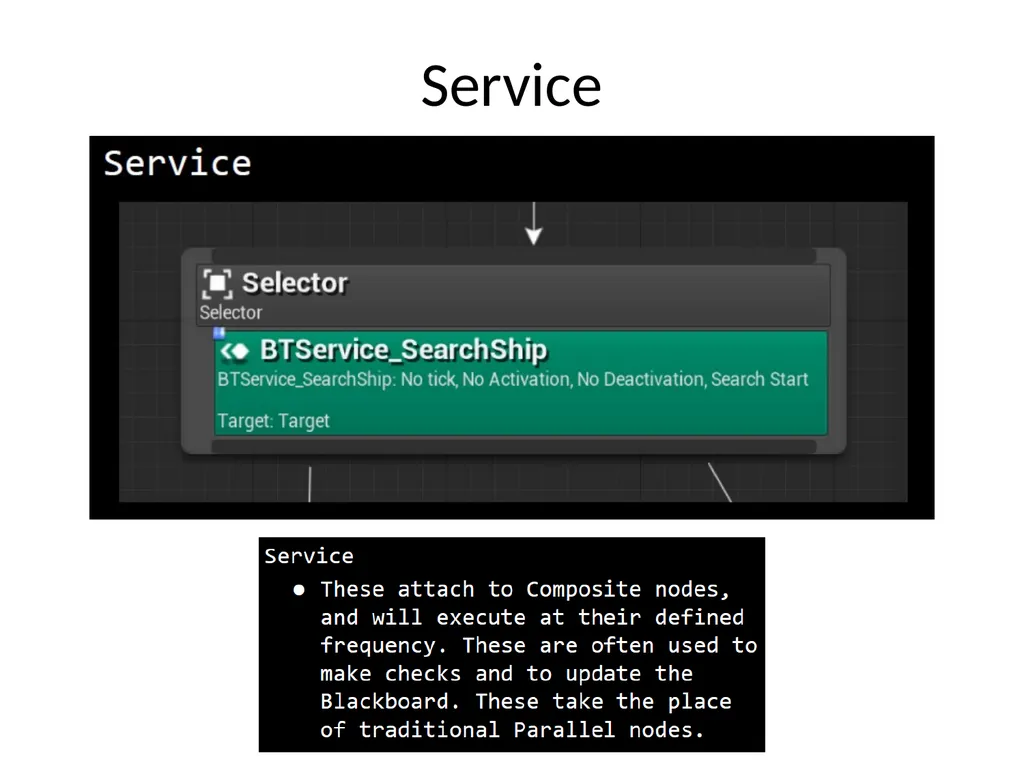
slide51. Service<br>
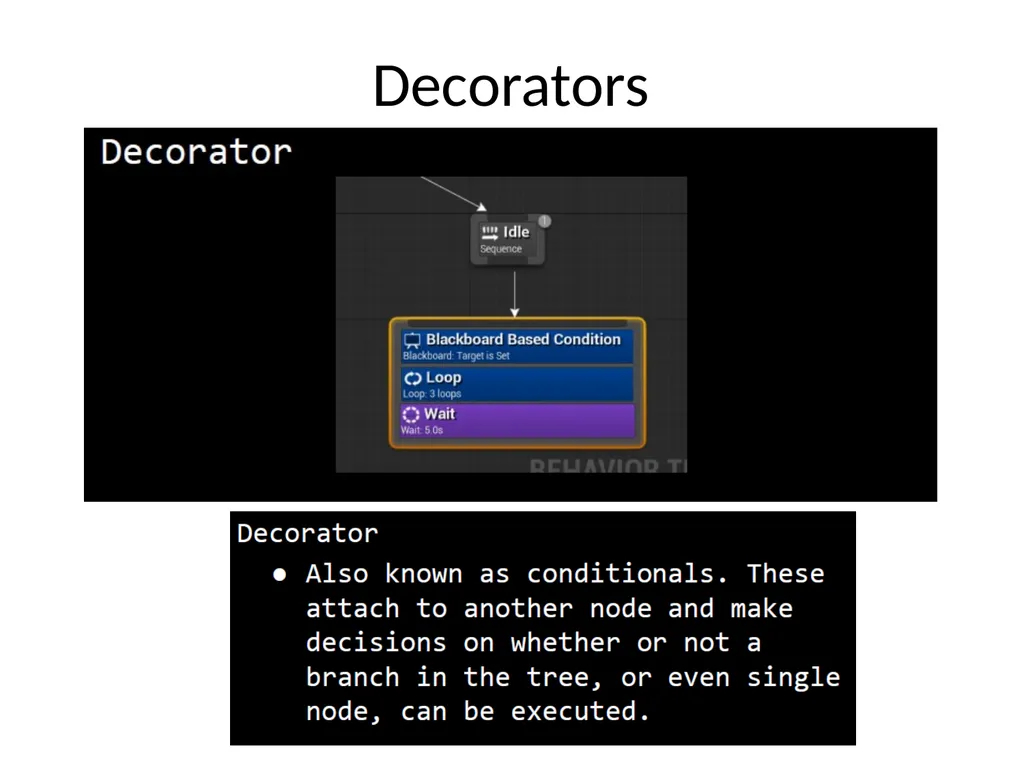
slide52. Decorators<br>
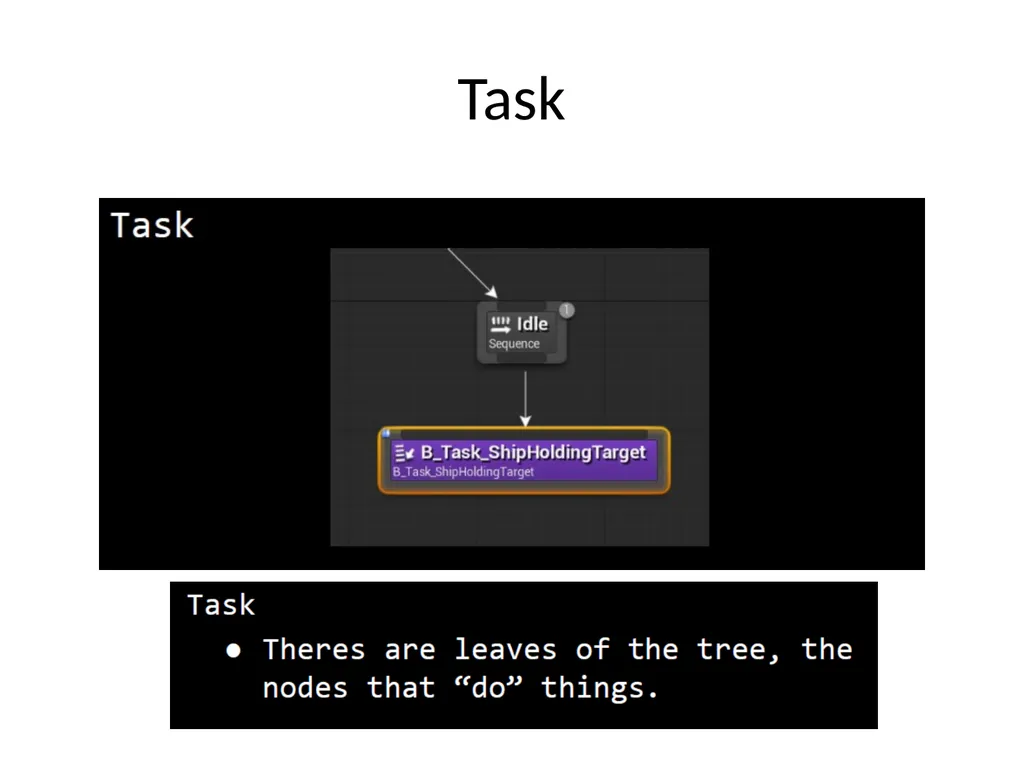
slide53. Task<br>
slide54. Blackboard (Memory)<br>
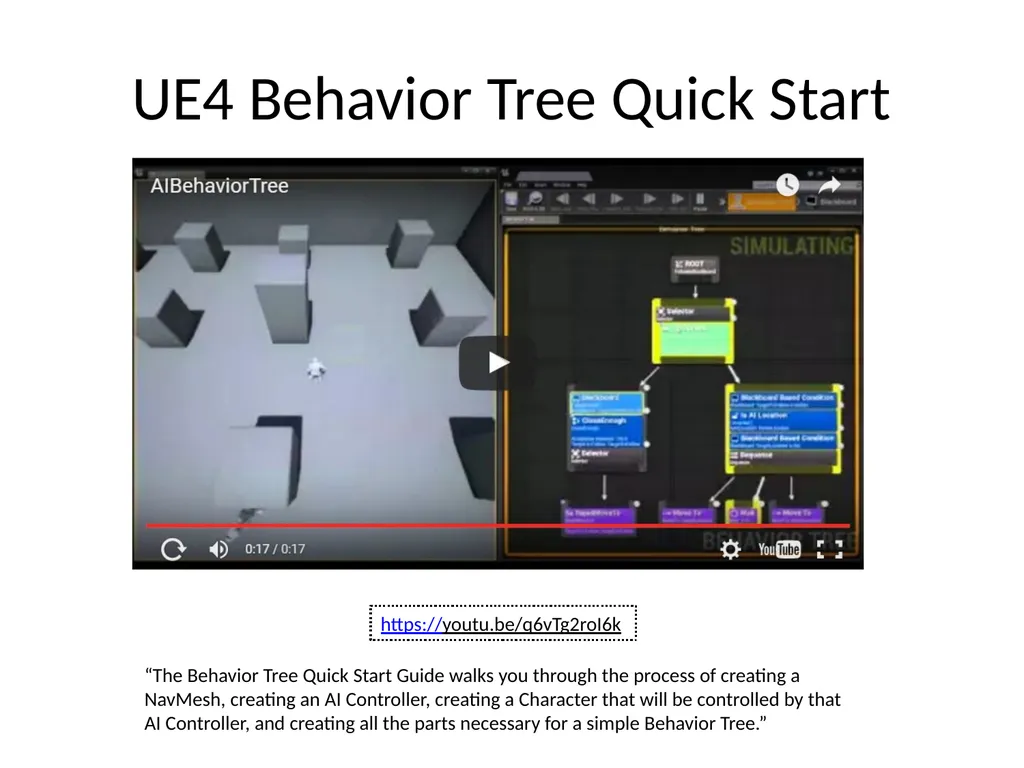
slide55. UE4 Behavior Tree Quick Start “The Behavior Tree Quick Start Guide walks you through the process of creating a NavMesh, creating an AI Controller, creating a Character that will be controlled by that AI Controller, and creating all the parts necessary for a simple Behavior Tree.” https://youtu.be/q6vTg2roI6k<br>
slide56. Resource Links HFSM from Millington and Funge
http://web.cs.wpi.edu/~imgd4000/d16/slides/millington-hsm.pdf
FSM from IMGD 3000
Slides
http://www.cs.wpi.edu/~imgd4000/d16/slides/imgd3000-fsm.pdf
Header files
http://dragonfly.wpi.edu/include/classStateMachine.html
UE4 Behavior Tree
Difference between BT and DT
http://gamedev.stackexchange.com/questions/51693/decision-tree-vs-behavior-tree
Quick Start
https://docs.unrealengine.com/latest/INT/Engine/AI/BehaviorTrees/QuickStart/<br>
slide2. What’s AI Part of a Game? Everything that isn’t graphics (sound) or networking... (says an AI professor )
or physics (though sometimes lumped in)
usually via non-player characters
but sometimes operates more broadly, e.g.,
Civilization-style games (sophisticated simulations)
interactive storytelling (drama control) 2<br>
slide3. “Levels” of Game AI Basic
Decision-making techniques commonly used in almost all games
Advanced
Used in practice, but in more sophisticated games
Future
Not yet used, but explored in research 3<br>
slide4. This Course Basic game AI
Decision-making techniques commonly used in almost all games
Basic pathfinding (A*) (IMGD 3000)
Decision trees (this deck)
(Hierarchical) state machines (this deck)
Advanced game AI
Used in practice, but in more sophisticated games
Advanced pathfinding (other deck)
Behavior trees in UE4 (this deck) 4<br>
slide5. Future Game AI? Take IMGD 4100
“AI for Interactive Media and Games”
Fuzzy logic
More goal-driven agent behavior
Take CS 4341
“Artificial Intelligence”
Machine learning
Planning 5<br>
slide6. Two Fundamental Types of AI Algorithms Non-Search vs. Search
Non-Search: amount of computation is predictable
e.g., decision trees, state machines
Search: upper bound depends on size of search space (often large)
e.g., minimax, planning. Sometimes pathfinding
Scary for real-time games (or need ways to “short-circuit”, e.g., pathfind to closer node)
Need to otherwise limit computation (e.g., threshold, time-slice pathfinding)
Where’s the “knowledge”?
Non-Search: in the code logic (or external tables)
Search: in state evaluation and search order functions
Which one is better? Whichever has better knowledge. ;-) 6<br>
slide7. How About AI Middleware (“AI Engines”)? Recent panel at GDC AI Summit: “Why so wary of AI middleware?”
Only one panelist reported completely positive experience
Steve Gargolinski, Blue Fang (Zoo Tycoon, etc.)
Used Havok Behavior (with Physics)
Most industry AI programmers still write their own AI from scratch (or reuse their own code)
Damian Isla, Flame in the Flood, custom procedural content generation
So, we are going to look at coding details 7<br>
slide8. AI Coding Theme (for Basic AI) Use object-oriented paradigm
instead of...
A tangle of if-then-else statements 8<br>
slide9. Outline Introduction (done)
Decision Trees (next)
Finite State Machines (FSM)
Hierarchical FSM
Behavior Trees<br>
slide10. First Basic AI Technique: Decision Trees 10 See code at: https://github.com/idmillington/aicore
src/dectree.cpp and src/demos/c05-dectree Ian Millington and John Funge. Artificial Intelligence for Games, Morgan Kaufmann, 2009. (Chapter 5)<br>
slide11. 11 Decision Trees Most basic of the basic AI techniques
Easy to implement
Fast execution
Simple to understand<br>
slide12. 12 Deciding How to Respond to an Enemy (1 of 2) if visible? { // level 0
if close? { // level 1
attack;
} else { // level 1
if flank? { // level 2
move;
} else { // level 2
attack;
}
}
} else { // level 0
if audible? { // level 1
creep;
}
} Leaves are actions
Interior nodes are decisions Typically binary
(if multiple choices, can be converted to binary)<br>
slide13. 13 Deciding How to Respond to an Enemy (2 of 2) What if need to modify?
e.g., if close, only flank if ally near if visible? { // level 0
if close? { // level 1
attack;
} else if flank? { // level 1&2
move;
} else {
attack;
}
} else if audible? { // level 0&1
creep;
} Alternate form. Harder to see “depth”! ???<br>
slide14. if visible? {
if close? {
attack;
} else {
if flank? {
move;
} else {
attack;
}
} if visible? { // level 0
if close? { // level 1
attack;
} else if flank? { // level 1&2
move;
} else {
attack;
}
} else if audible? { // level 0&1
creep;
} 14 Modifying Deciding How to Respond to an Enemy ??? yes Modification restructures all below code! Code is brittle.
Solution? Object-Oriented Alternate form. Harder to see “depth”!<br>
slide15. 15 O-O Decision Trees (Pseudo-Code) class Node
def decide() // return action/decision class Boolean : Decision // if yes/no
yesNode
noNode
class MinMax : Boolean // if range
minValue
maxValue
testValue
def getBranch()
if maxValue >= testValue >= minValue
return yesNode
else
return noNode class Decision : Node // interior
def getBranch() // return a node
def decide()
return getBranch().decide()
class Action : Node // leaf
def decide() return this // Define root as start of tree
Node *root
// Calls recursively until action
Action * action = root decide()
action doAction()<br>
slide16. 16 Building an O-O Decision Tree visible = new Boolean...
audible = new Boolean...
close = new MinMax...
flank = new Boolean...
attack = new Attack...
move = new Move...
creep = new Creep...
visible.yesNode = close
visible.noNode = audible
audible.yesNode = creep
close.yesNode = attack
close.noNode = flank
flank.yesNode = move
flank.noNode = attack
... ...or a graphical editor<br>
slide17. 17 Modifying an O-O Decision Tree visible = new Boolean...
audible = new Boolean...
close = new MinMax...
flank = new Boolean...
??? = new Boolean...
attack = new Action...
move = new Action...
creep = new Action...
visible.yesNode = close
visible.noNode = audible
audible.yesNode = creep
close.yesNode = attack
close.noNode = ???
???.yesNode = flank
flank.yesNode = move
flank.noNode = attack
... yes<br>
slide18. 18 Decision Tree Performance Individual node tests (getBranch) typically constant time (and fast)
Worst case behavior depends on depth of tree
longest path from root to action
Roughly “balance” tree (when possible)
not too deep, not too wide
make commonly used paths shorter
put most expensive decisions late<br>
slide19. Outline Introduction (done)
Decision Trees (done)
Finite State Machines (FSM) (next)
Hierarchical FSM
Behavior Trees<br>
slide20. Second Basic AI Technique: (Hierarchical) Finite State Machines 20<br>
slide21. Finite State Machines Often AI as agents: sense, think, then act
But many different rules for agents
Ex: sensing, thinking and acting when fighting, running, exploring…
Can be difficult to keep rules consistent!
Try Finite State Machine
Natural correspondence between states and behaviors
Easy: to diagram, program, debug
Formally:
Set of states
A starting state
An input vocabulary
A transition function that maps inputs and current state to next state (Game example next slide)<br>
slide22. Finite State Machines 22 Acting done states
Sensing done by conditionals
Thinking done by transitions<br>
slide23. 23 Hard-Coded Implementation class Soldier
enum State
ON_GUARD
FIGHT
RUN_AWAY
currentState def update()
if currentState == ON_GUARD {
if small enemy {
currentState = FIGHT
start Fighting
} else if big enemy {
currentState = RUN_AWAY
start RunningAway
}
} else if currentState == FIGHT {
if losing fight {
currentState = RUN_AWAY
start RunningAway
}
} else if currentState == RUN_AWAY {
if escaped {
currentState = ON_GUARD
start Guarding
}
}<br>
slide24. 24 Hard-Coded State Machines Easy to write (at the start)
Very efficient
Notoriously hard to maintain (e.g., modify and debug)<br>
slide25. 25 Cleaner & More Flexible O-O Implementation class State
def getAction()
def getEntryAction()
def getExitAction()
def getTransitions()
class Transition
def isTriggered()
def getTargetState() class StateMachine
states
initialState
currentState = initialState
def update() // returns all actions needed this update
triggeredTransition = null
for transition in currentState.getTransitions() {
if transition.isTriggered() {
triggeredTransition = transition
break
}
}
if triggeredTransition != null {
targetState = triggeredTransition.getTargetState()
actions = currentState.getExitAction()
actions += targetState.getEntryAction()
currentState = targetState
return actions // list of actions for transitions
} else return currentState.getAction() // action this state<br>
slide26. 26 Combining Decision Trees & State Machines (1 of 2) Why?
to avoid duplicating expensive tests in state machine. e.g., assuming “player in sight” is expensive<br>
slide27. 27 Combining Decision Trees & State Machines (2 of 2) alert defend alarm player in sight? far? yes yes no no Use decision tree for transitions in state machine<br>
slide28. Outline Introduction (done)
Decision Trees (done)
Finite State Machines (FSM) (done)
Hierarchical FSM (next)
Behavior Trees<br>
slide29. 29 Hierarchical State Machines Why? Could be interruptions, want to return but not to start e.g., robot can run out of power in any state.
Needs to recharge when out of power.
When charged, needs to return to previous state (e.g., may have trash or know where trash is).<br>
slide30. 30 Interruptions (e.g., Recharging) 6 states needed doubled!<br>
slide31. 31 Add Another Interruption (e.g., Baddies) 12 states needed doubled again!<br>
slide32. 32 Hierarchical State Machine Leave any state in (composite) “clean” state when “low power”
“clean” remembers internal state and continues when back from “recharge’’<br>
slide33. 33 Add Another Interruption (e.g., Baddies) clean 7 states needed (including composite) vs. 12 (Note: could have added another layer for only 6 states)<br>
slide34. 34 Cross-Hierarchy Transitions Why?
Suppose want robot to “top off” battery (even if it isn’t low) when it doesn’t see any trash<br>
slide35. 35 Cross-Hierarchy Transitions search goto
disposal goto
trash see trash trash disposed have trash clean<br>
slide36. 36 HFSM Implementation Sketch class State
// stack of return states
def getStates() return [this]
// recursive update
def update()
// rest same as flat machine
class Transition
// how deep this transition is
def getLevel()
// rest same as flat machine
struct UpdateResult // returned from update
transition
level
actions // same as flat machine class HierarchicalStateMachine
// same state variables as flat machine
// complicated recursive algorithm*
def update ()
class SubMachine : HierarchicalStateMachine,
State
def getStates()
push this onto currentState.getStates() *See full pseudo-code at http://web.cs.wpi.edu/~imgd4000/d16/slides/millington-hsm.pdf<br>
slide37. Outline Introduction (done)
Decision Trees (done)
Finite State Machines (FSM) (done)
Hierarchical FSM (done)
Behavior Trees (next)
In UE4 http://www.slideshare.net/JaeWanPark2/behavior-tree-in-unreal-engine-4<br>
slide38. What is a Behavior Tree? A model of plan execution
Switch between tasks in modular fashion
Similar to HFSM, but block is task not state
Early use for NPCs (Halo, Bioshock, Spore)
Tree – notes are root, control flow, execution Search and grasp plan of two-armed robot https://upload.wikimedia.org/wikipedia/commons/1/1b/BT_search_and_grasp.png<br>
slide39. “Behavior” in Behavior Tree Sense, Think, Act
Repeat<br>
slide40. Sense<br>
slide41. Think<br>
slide42. Act<br>
slide43. Behavior Tree with Memory In UE4, the “Memory” is called “Blackboard”<br>
slide44. UE4 Behavior Trees vs. Traditional UE4 Event Driven
Do not poll for changes, but listen for events that trigger changes
UE4 “conditionals” not at leaf
Allows easier distinguish versus task
Allows them to be passive (event driven)
UE4 simplifies parallel nodes (typically confusing)
Simple parallel for concurrent tasks
Services for periodic tasks https://docs.unrealengine.com/latest/INT/Engine/AI/BehaviorTrees/HowUE4BehaviorTreesDiffer/index.html<br>
slide45. UE4 Behavior Tree (Describe each next)<br>
slide46. UE4 Behavior Tree - Root<br>
slide47. UE4 Behavior Tree - Composite (Describe each next)<br>
slide48. Composite - Sequence “And”<br>
slide49. Composite - Selector “Or”<br>
slide50. Composite – Simple Parallel<br>
slide51. Service<br>
slide52. Decorators<br>
slide53. Task<br>
slide54. Blackboard (Memory)<br>
slide55. UE4 Behavior Tree Quick Start “The Behavior Tree Quick Start Guide walks you through the process of creating a NavMesh, creating an AI Controller, creating a Character that will be controlled by that AI Controller, and creating all the parts necessary for a simple Behavior Tree.” https://youtu.be/q6vTg2roI6k<br>
slide56. Resource Links HFSM from Millington and Funge
http://web.cs.wpi.edu/~imgd4000/d16/slides/millington-hsm.pdf
FSM from IMGD 3000
Slides
http://www.cs.wpi.edu/~imgd4000/d16/slides/imgd3000-fsm.pdf
Header files
http://dragonfly.wpi.edu/include/classStateMachine.html
UE4 Behavior Tree
Difference between BT and DT
http://gamedev.stackexchange.com/questions/51693/decision-tree-vs-behavior-tree
Quick Start
https://docs.unrealengine.com/latest/INT/Engine/AI/BehaviorTrees/QuickStart/<br>