
Basic Notions A TEXT will be defined as a
NS
Published · 11 slides · 0 views
1 / 1
Description
Basic Notions A TEXT will be defined as a COMMUNICATIVE OCCURRENCE which meets seven standards of TEXTUALITY. If any of these standards is not considered to have been satisfied, the text will not be communicative. Hence, non-communicative
Related Topics
Share
Embed code
Download this presentation From Below
"Basic Notions A TEXT will be defined as a" is the property of its rightful owner. Permission is granted to download and print the materials on this website for personal, non-commercial use only, and to display it on your personal computer provided you do not modify the materials and that you retain all copyright notices contained in the materials. By downloading content from our website, you accept the terms of this agreement.
Presentation Transcript
01
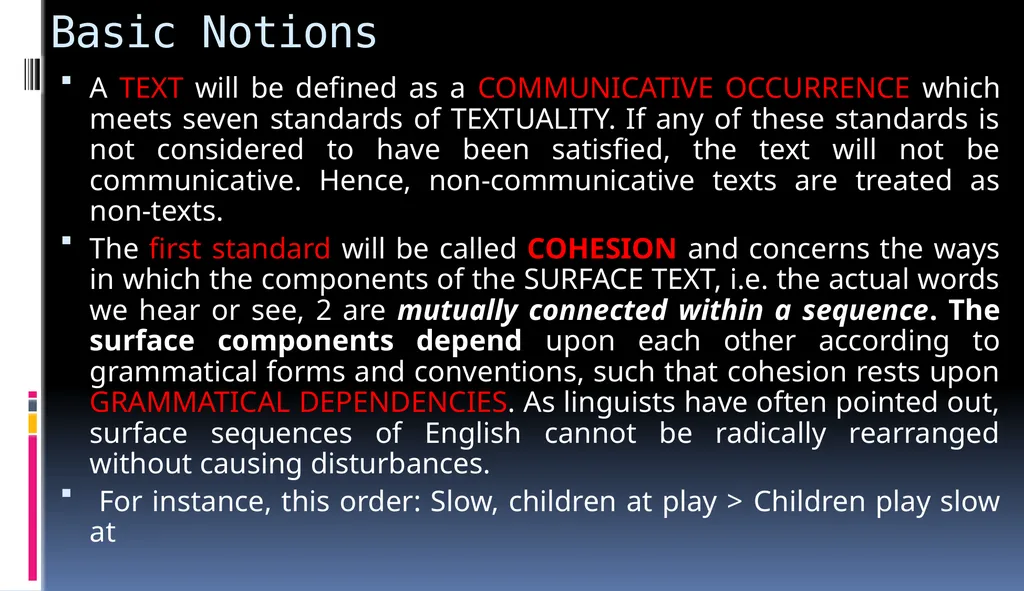
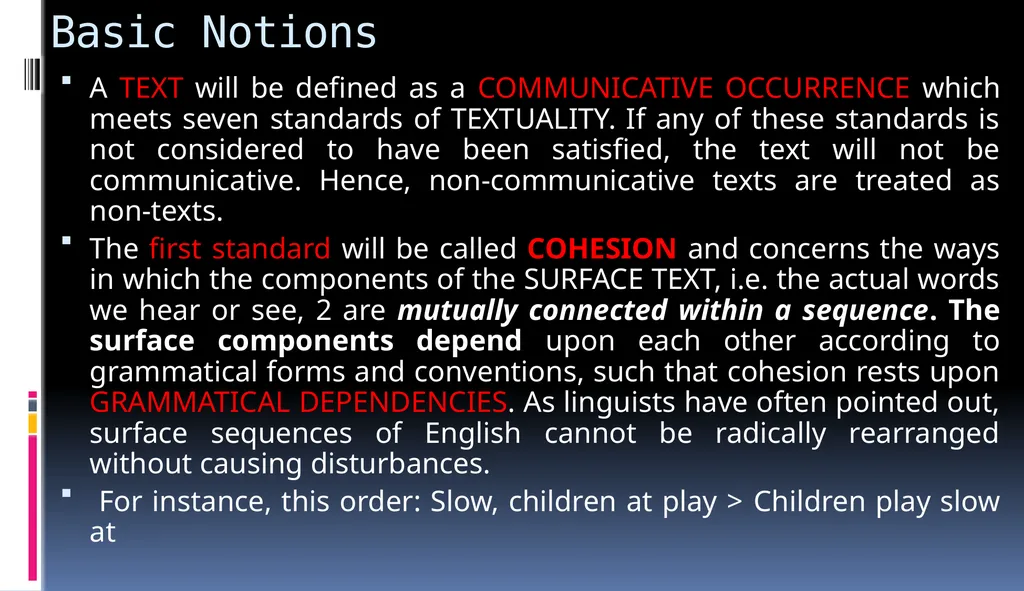
Basic Notions A TEXT will be defined as a COMMUNICATIVE OCCURRENCE which meets seven standards of TEXTUALITY. If any of these standards is not considered to have been satisfied, the text will not be communicative. Hence, non-communicative texts are treated as non-texts.
The first standard will be called COHESION and concerns the ways in which the components of the SURFACE TEXT, i.e. the actual words we hear or see, 2 are mutually connected within a sequence. The surface components depend upon each other according to grammatical forms and conventions, such that cohesion rests upon GRAMMATICAL DEPENDENCIES. As linguists have often pointed out, surface sequences of English cannot be radically rearranged without causing disturbances.
For instance, this order: Slow, children at play > Children play slow at<br>
The first standard will be called COHESION and concerns the ways in which the components of the SURFACE TEXT, i.e. the actual words we hear or see, 2 are mutually connected within a sequence. The surface components depend upon each other according to grammatical forms and conventions, such that cohesion rests upon GRAMMATICAL DEPENDENCIES. As linguists have often pointed out, surface sequences of English cannot be radically rearranged without causing disturbances.
For instance, this order: Slow, children at play > Children play slow at<br>
02
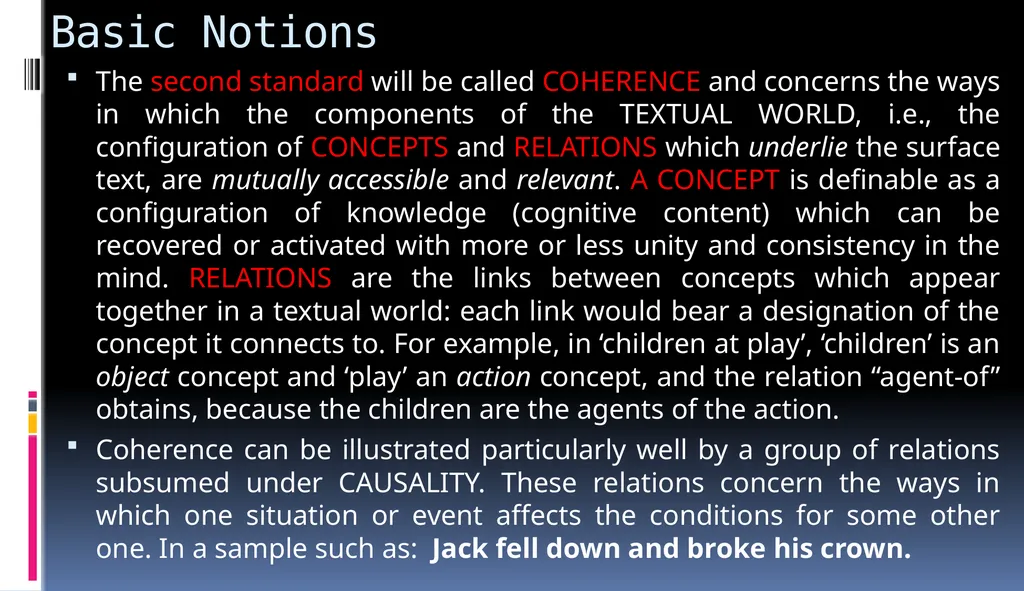
Basic Notions The second standard will be called COHERENCE and concerns the ways in which the components of the TEXTUAL WORLD, i.e., the configuration of CONCEPTS and RELATIONS which underlie the surface text, are mutually accessible and relevant. A CONCEPT is definable as a configuration of knowledge (cognitive content) which can be recovered or activated with more or less unity and consistency in the mind. RELATIONS are the links between concepts which appear together in a textual world: each link would bear a designation of the concept it connects to. For example, in ‘children at play’, ‘children’ is an object concept and ‘play’ an action concept, and the relation “agent-of” obtains, because the children are the agents of the action.
Coherence can be illustrated particularly well by a group of relations subsumed under CAUSALITY. These relations concern the ways in which one situation or event affects the conditions for some other one. In a sample such as: Jack fell down and broke his crown.<br>
Coherence can be illustrated particularly well by a group of relations subsumed under CAUSALITY. These relations concern the ways in which one situation or event affects the conditions for some other one. In a sample such as: Jack fell down and broke his crown.<br>
03
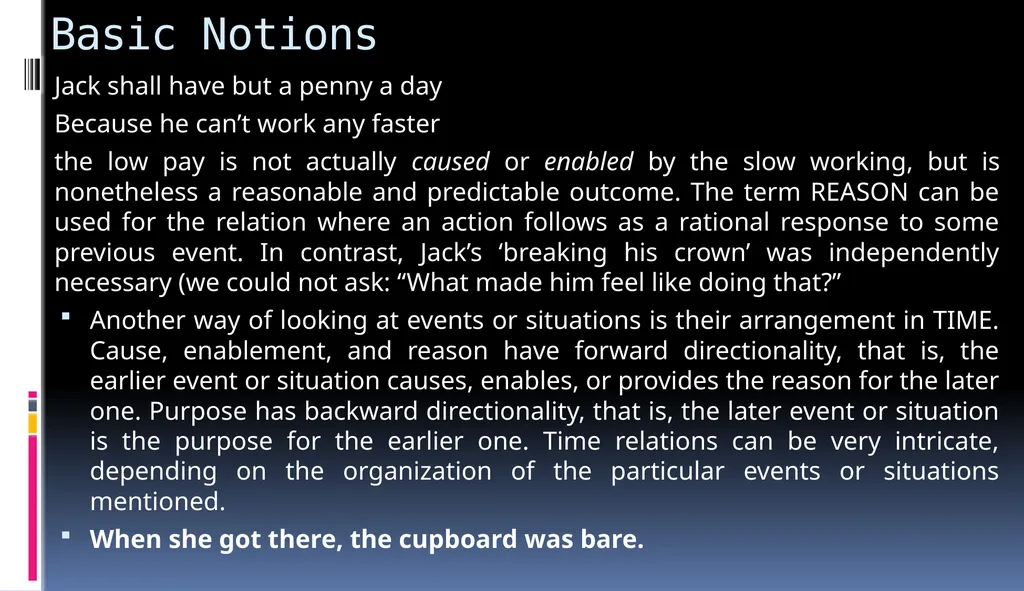
Basic Notions Jack shall have but a penny a day
Because he can’t work any faster
the low pay is not actually caused or enabled by the slow working, but is nonetheless a reasonable and predictable outcome. The term REASON can be used for the relation where an action follows as a rational response to some previous event. In contrast, Jack’s ‘breaking his crown’ was independently necessary (we could not ask: “What made him feel like doing that?”
Another way of looking at events or situations is their arrangement in TIME. Cause, enablement, and reason have forward directionality, that is, the earlier event or situation causes, enables, or provides the reason for the later one. Purpose has backward directionality, that is, the later event or situation is the purpose for the earlier one. Time relations can be very intricate, depending on the organization of the particular events or situations mentioned.
When she got there, the cupboard was bare.<br>
Because he can’t work any faster
the low pay is not actually caused or enabled by the slow working, but is nonetheless a reasonable and predictable outcome. The term REASON can be used for the relation where an action follows as a rational response to some previous event. In contrast, Jack’s ‘breaking his crown’ was independently necessary (we could not ask: “What made him feel like doing that?”
Another way of looking at events or situations is their arrangement in TIME. Cause, enablement, and reason have forward directionality, that is, the earlier event or situation causes, enables, or provides the reason for the later one. Purpose has backward directionality, that is, the later event or situation is the purpose for the earlier one. Time relations can be very intricate, depending on the organization of the particular events or situations mentioned.
When she got there, the cupboard was bare.<br>
04
Basic Notions The King was in the counting house, counting all his money;
The Queen was in the parlour, eating bread and honey;
The Maid was in the garden, hanging out the clothes;
In the explicit text, there is a set of ACTIONS (‘counting’, ‘eating’, ‘hanging out’); the only relations presented are the LOCATION, the AGENT, and the AFFECTED ENTITY of each action. Yet simply by virtue of the textual configuration, a text receiver is likely to assume that the action is in each case the PURPOSE of being at that location; that the locations are PROXIMATE to each other, probably in or near the royal palace; and even that the actions are proximate in TIME. One might well go on to assume that the actions are intended to signal the ATTRIBUTES of the agents (e.g. the King being avaricious, the Queen gluttonous, the Maid industrious). The adding of one’s own knowledge to bring a textual world together is called INFERENCING.<br>
The Queen was in the parlour, eating bread and honey;
The Maid was in the garden, hanging out the clothes;
In the explicit text, there is a set of ACTIONS (‘counting’, ‘eating’, ‘hanging out’); the only relations presented are the LOCATION, the AGENT, and the AFFECTED ENTITY of each action. Yet simply by virtue of the textual configuration, a text receiver is likely to assume that the action is in each case the PURPOSE of being at that location; that the locations are PROXIMATE to each other, probably in or near the royal palace; and even that the actions are proximate in TIME. One might well go on to assume that the actions are intended to signal the ATTRIBUTES of the agents (e.g. the King being avaricious, the Queen gluttonous, the Maid industrious). The adding of one’s own knowledge to bring a textual world together is called INFERENCING.<br>
05
Basic Notions Cohesion and coherence are text-centred notions, designating operations directed at the text materials. In addition, we shall require user-centred notions which are brought to bear on the activity of textual communication at large, both by producers and by receivers. The third standard of textuality could then be called INTENTIONALITY, concerning the text producer’s attitude that the set of occurrences should constitute a cohesive and coherent text instrumental in fulfilling the producer’s intentions, e.g. to distribute knowledge or to attain a GOAL specified in a PLAN. To some degree, cohesion and coherence could themselves be regarded as operational goals without whose attainment other discourse goals may be blocked.<br>
06
Basic Notions The fourth standard of textuality would be ACCEPTABILITY, concerning the text receiver’s attitude that the set of occurrences should constitute a cohesive and coherent text having some use or relevance for the receiver, e.g. to acquire knowledge or provide co-operation in a plan. This attitude is responsive to such factors as text type, social or cultural setting, and the desirability of goals.
Call us before you dig. You may not be able to afterwards.
People are left to infer that digging without asking might lead to cutting off a ground cable and hence to losing the wiring needed in order to call; or even, to sustaining bodily injury and being incapacitated.
Call us before you dig. There might be an underground cable. If you break the cable, you won’t have phone service, and you may get a severe electric shock. Then you won’t be able to call us.
Apparently, text receivers are readily persuaded by content they must supply on their own: it is as if they were making the assertion themselves. Sample is more informative than sample, a factor which constitutes the next standard of textuality.<br>
Call us before you dig. You may not be able to afterwards.
People are left to infer that digging without asking might lead to cutting off a ground cable and hence to losing the wiring needed in order to call; or even, to sustaining bodily injury and being incapacitated.
Call us before you dig. There might be an underground cable. If you break the cable, you won’t have phone service, and you may get a severe electric shock. Then you won’t be able to call us.
Apparently, text receivers are readily persuaded by content they must supply on their own: it is as if they were making the assertion themselves. Sample is more informative than sample, a factor which constitutes the next standard of textuality.<br>
07
Basic Notions The fifth standard of textuality is called INFORMATIVITY and concerns the extent to which the occurrences of the presented text are expected vs. unexpected or known vs. unknown/certain. In the previous sample, the assertion that ‘you will not ‘be able to call’ is much more unexpected than it is in. The processing of highly informative occurrences is more demanding than otherwise, but correspondingly more interesting as well.
Every text is at least somewhat informative: no matter how predictable form and content may be, there will always be a few variable occurrences that cannot be entirely foreseen. Particularly low informativity is likely to be disturbing, causing boredom or even rejection of the text. The opening stretch of a science textbook runs like this:
The sea is water<br>
Every text is at least somewhat informative: no matter how predictable form and content may be, there will always be a few variable occurrences that cannot be entirely foreseen. Particularly low informativity is likely to be disturbing, causing boredom or even rejection of the text. The opening stretch of a science textbook runs like this:
The sea is water<br>
08
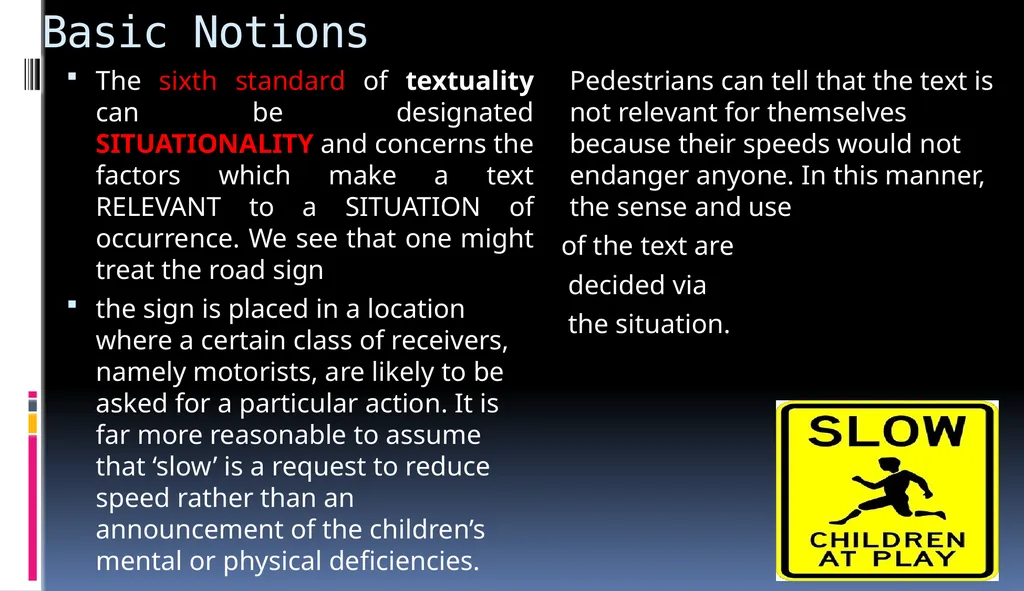
Basic Notions The sixth standard of textuality can be designated SITUATIONALITY and concerns the factors which make a text RELEVANT to a SITUATION of occurrence. We see that one might treat the road sign
the sign is placed in a location where a certain class of receivers, namely motorists, are likely to be asked for a particular action. It is far more reasonable to assume that ‘slow’ is a request to reduce speed rather than an announcement of the children’s mental or physical deficiencies. Pedestrians can tell that the text is not relevant for themselves because their speeds would not endanger anyone. In this manner, the sense and use
of the text are
decided via
the situation.<br>
the sign is placed in a location where a certain class of receivers, namely motorists, are likely to be asked for a particular action. It is far more reasonable to assume that ‘slow’ is a request to reduce speed rather than an announcement of the children’s mental or physical deficiencies. Pedestrians can tell that the text is not relevant for themselves because their speeds would not endanger anyone. In this manner, the sense and use
of the text are
decided via
the situation.<br>
09
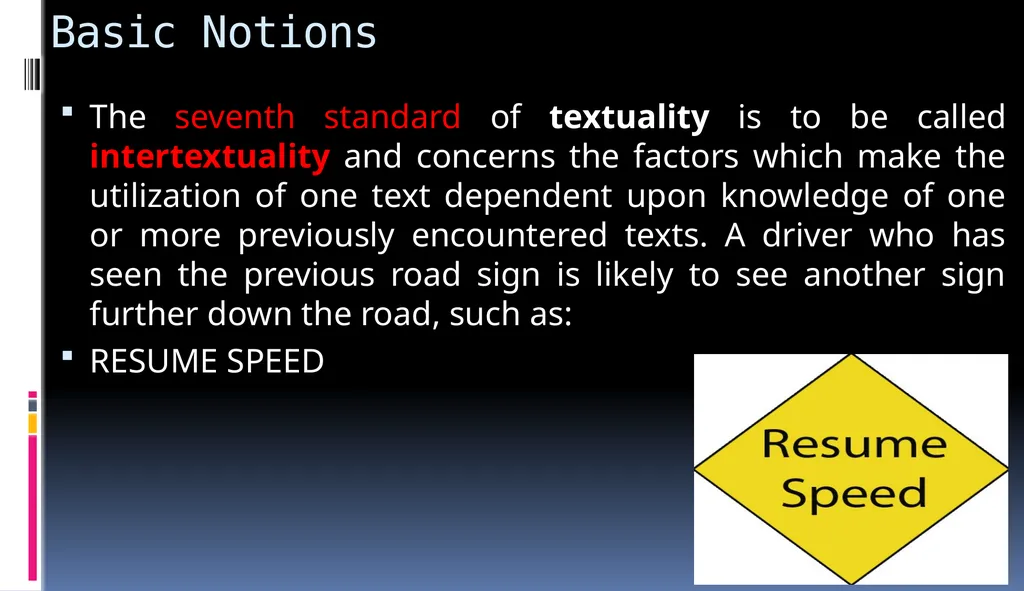
Basic Notions The seventh standard of textuality is to be called intertextuality and concerns the factors which make the utilization of one text dependent upon knowledge of one or more previously encountered texts. A driver who has seen the previous road sign is likely to see another sign further down the road, such as:
RESUME SPEED<br>
RESUME SPEED<br>
10
Basic Notions One cannot ‘resume’ something unless one was doing it at an earlier time and then stopped it for some reason. The ‘speed’ at stake here can only be the one maintained until [1] was encountered and a reduction was made. Clearly, the sense and relevance of the second sign depends upon knowing about [1] and applying the content to the evolving situation.<br>
11
Basic Notions We have now glanced at all seven standards of textuality: cohesion, coherence, intentionality, acceptability, informativity, situationality, and intertextuality. These standards function as CONSTITUTIVE PRINCIPLES (after Searle 1969: 33f.) of textual communication: they define and create the form of behaviour identifiable as textual communicating, and if they are defied, that form of behaviour will break down. There must also exist REGULATIVE PRINCIPLES that control textual communication rather than define it. We envision at least three regulative principles. The EFFICIENCY of a text depends on its use in communicating with a minimum expenditure of effort by the participants. The EFFECTIVENESS of a text depends on its leaving a strong impression and creating favourable conditions for attaining a goal. The APPROPRIATENESS of a text is the agreement between its setting and the ways in which the standards of textuality are upheld.<br>