
Basic Text Processing Regular Expressions Regular
SN
Published · 46 slides · 0 views
1 / 1



Description
Basic Text Processing Regular Expressions Regular expressions A formal language for specifying text strings How can we search for any of these? woodchuck woodchucks Woodchuck Woodchucks Regular Expressions: Disjunctions Letters inside
Related Topics
Share
Embed code
Download this presentation From Below
"Basic Text Processing Regular Expressions Regular" is the property of its rightful owner. Permission is granted to download and print the materials on this website for personal, non-commercial use only, and to display it on your personal computer provided you do not modify the materials and that you retain all copyright notices contained in the materials. By downloading content from our website, you accept the terms of this agreement.
Presentation Transcript
01
Basic Text Processing Regular Expressions<br>
02
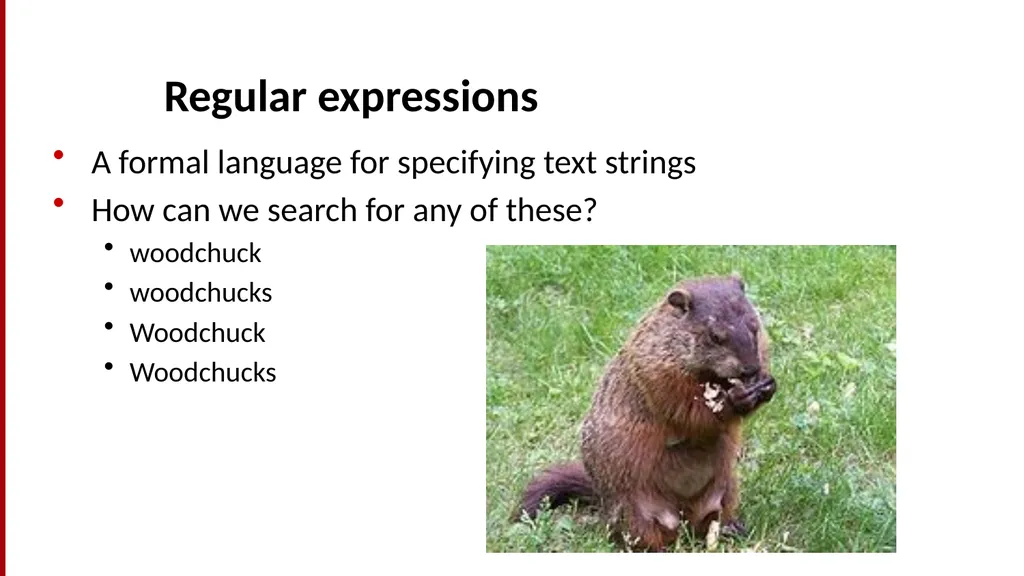
Regular expressions A formal language for specifying text strings
How can we search for any of these?
woodchuck
woodchucks
Woodchuck
Woodchucks<br>
How can we search for any of these?
woodchuck
woodchucks
Woodchuck
Woodchucks<br>
03
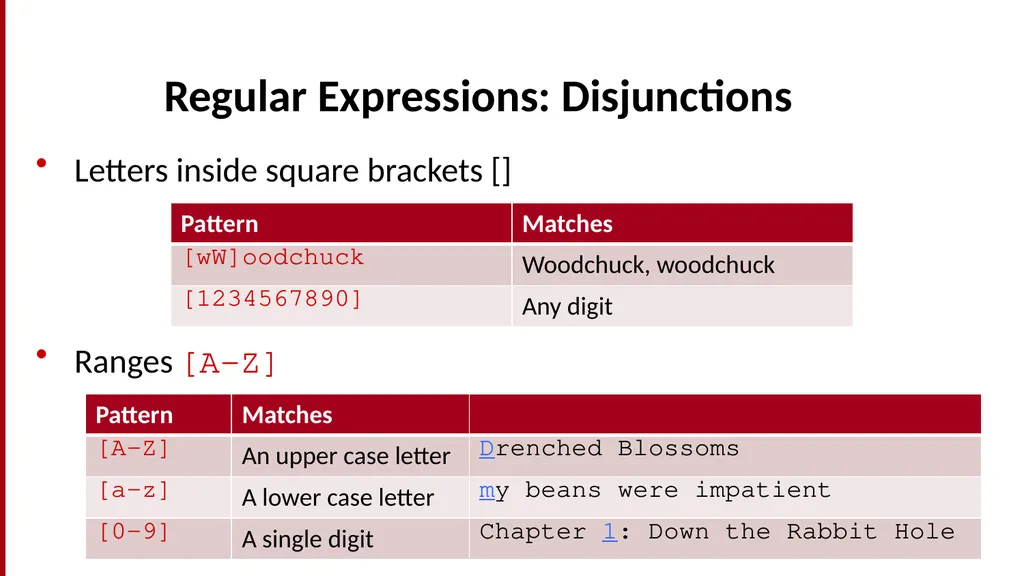
Regular Expressions: Disjunctions Letters inside square brackets []
Ranges [A-Z]<br>
Ranges [A-Z]<br>
04
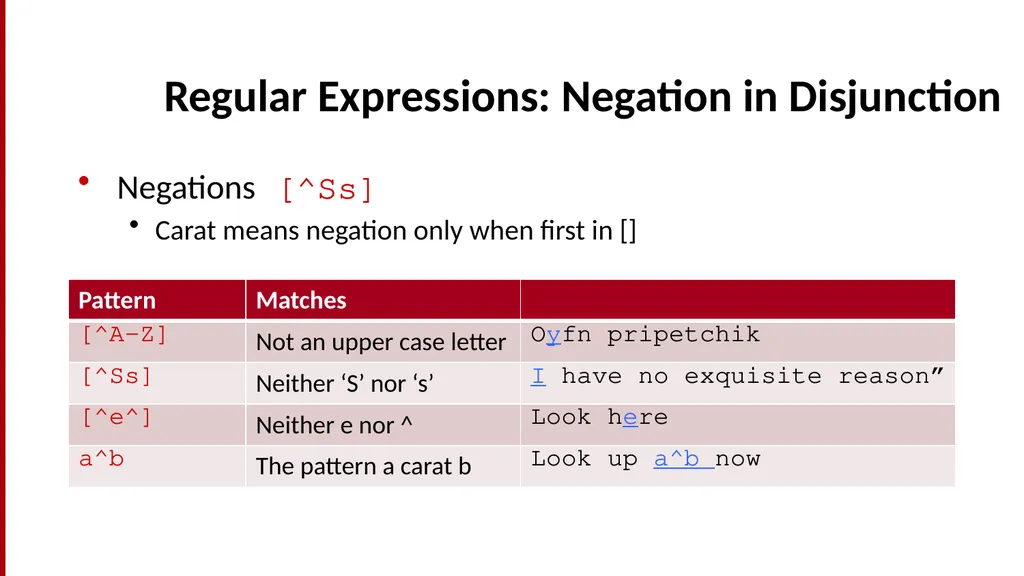
Regular Expressions: Negation in Disjunction Negations [^Ss]
Carat means negation only when first in []<br>
Carat means negation only when first in []<br>
05
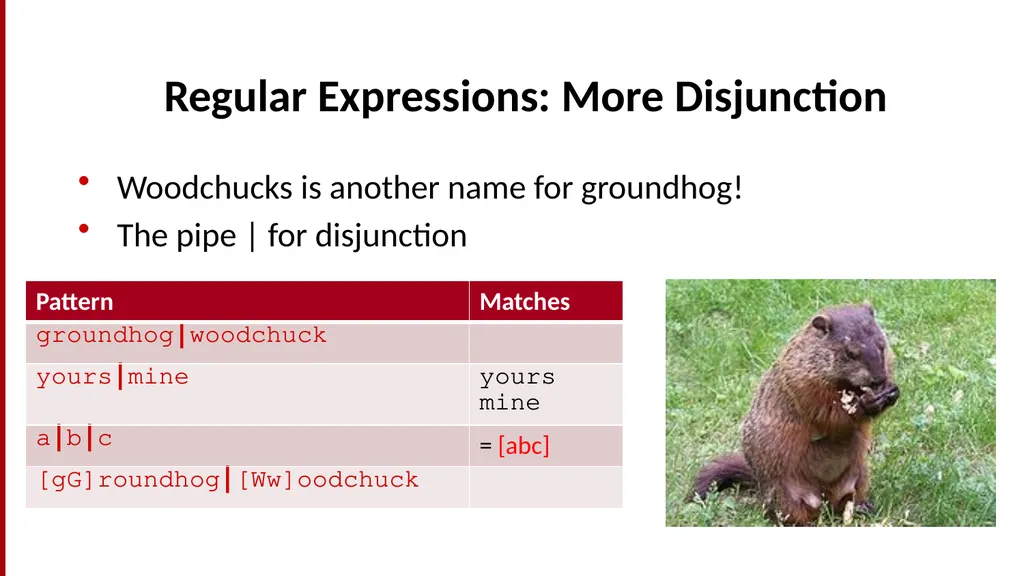
Regular Expressions: More Disjunction Woodchucks is another name for groundhog!
The pipe | for disjunction<br>
The pipe | for disjunction<br>
06
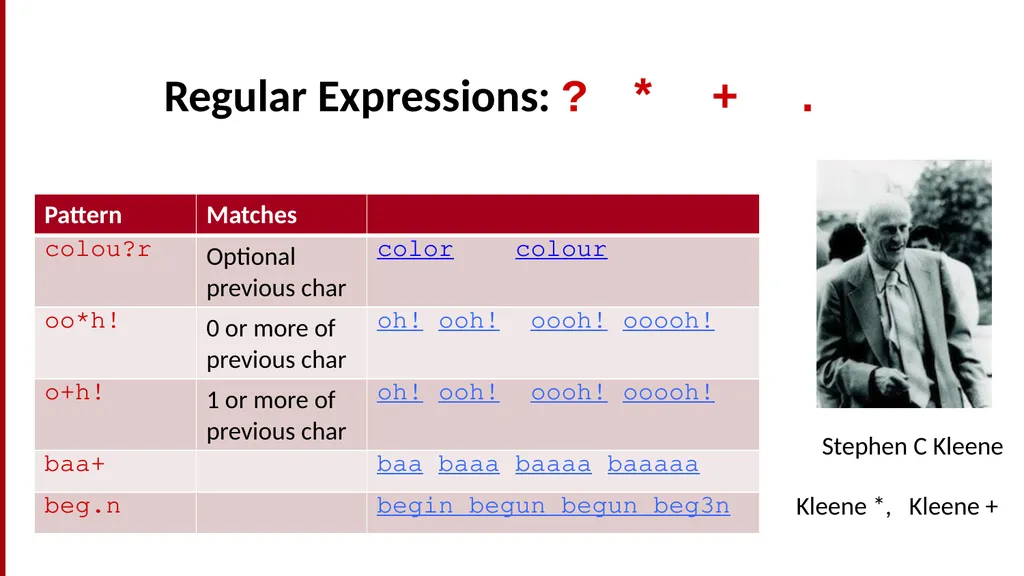
Regular Expressions: ? * + . Stephen C Kleene Kleene *, Kleene +<br>
07
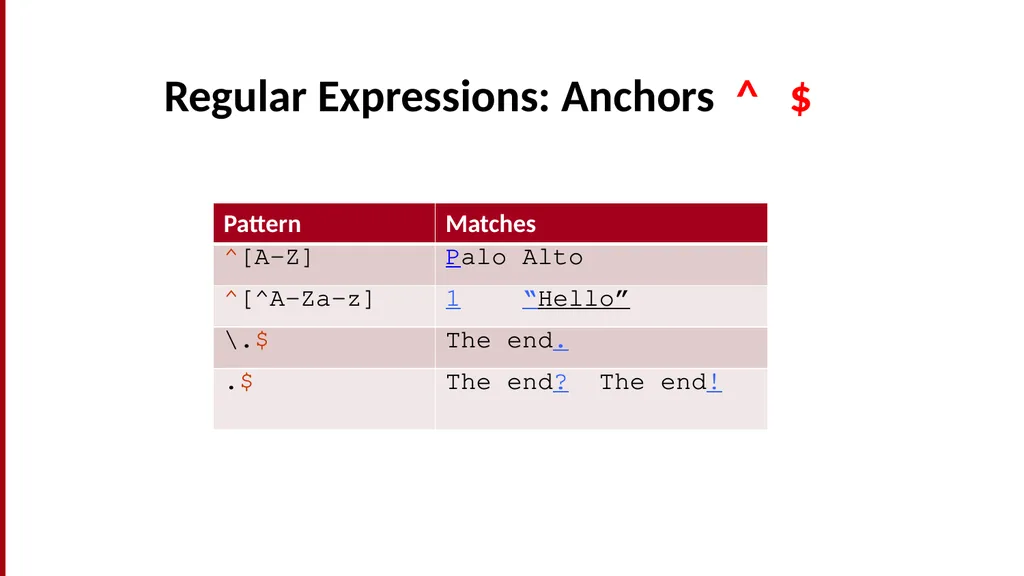
Regular Expressions: Anchors ^ $<br>
08
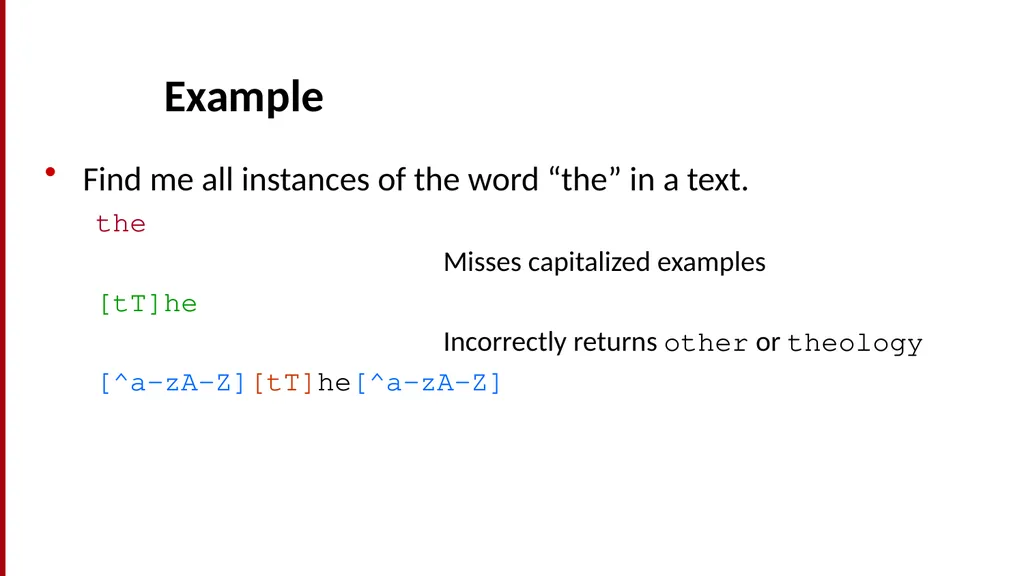
Example Find me all instances of the word “the” in a text.
the
Misses capitalized examples
[tT]he
Incorrectly returns other or theology
[^a-zA-Z][tT]he[^a-zA-Z]<br>
the
Misses capitalized examples
[tT]he
Incorrectly returns other or theology
[^a-zA-Z][tT]he[^a-zA-Z]<br>
09
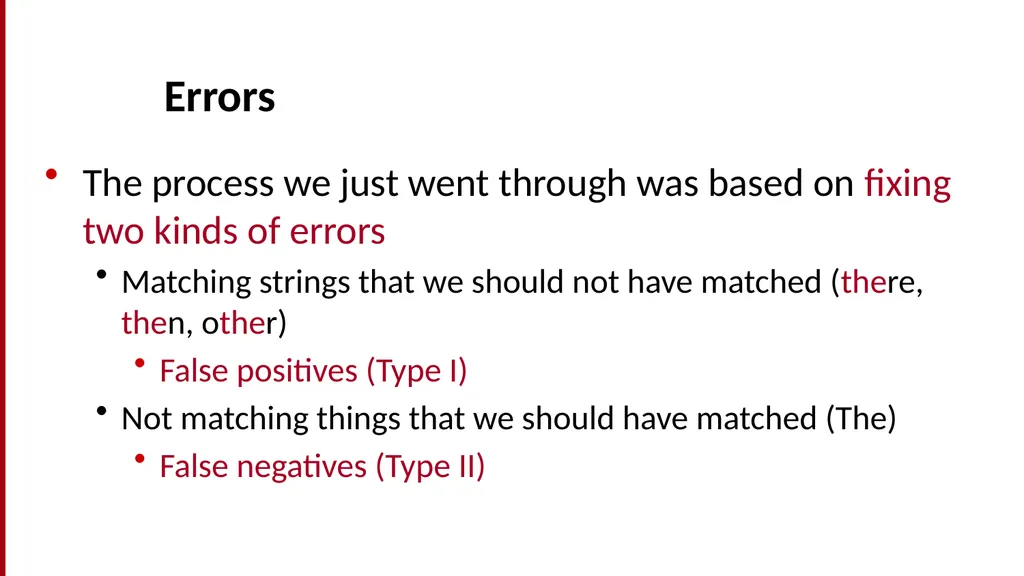
Errors The process we just went through was based on fixing two kinds of errors
Matching strings that we should not have matched (there, then, other)
False positives (Type I)
Not matching things that we should have matched (The)
False negatives (Type II)<br>
Matching strings that we should not have matched (there, then, other)
False positives (Type I)
Not matching things that we should have matched (The)
False negatives (Type II)<br>
10
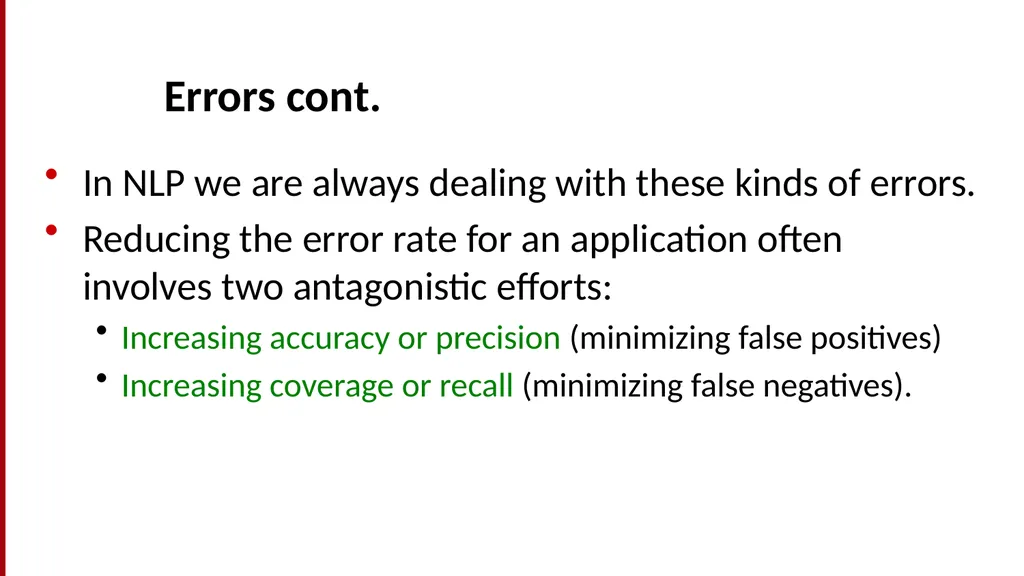
Errors cont. In NLP we are always dealing with these kinds of errors.
Reducing the error rate for an application often involves two antagonistic efforts:
Increasing accuracy or precision (minimizing false positives)
Increasing coverage or recall (minimizing false negatives).<br>
Reducing the error rate for an application often involves two antagonistic efforts:
Increasing accuracy or precision (minimizing false positives)
Increasing coverage or recall (minimizing false negatives).<br>
11
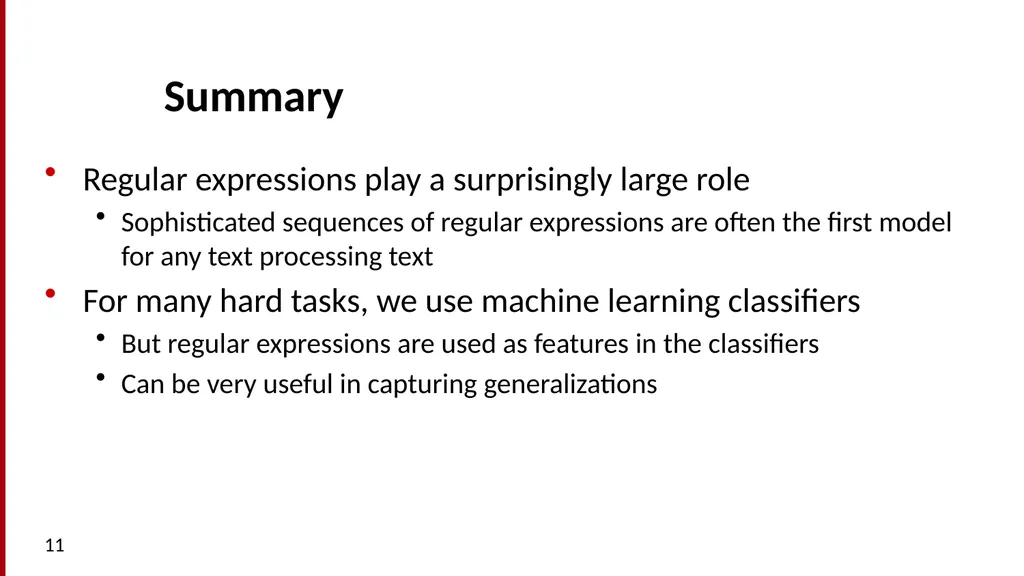
Summary Regular expressions play a surprisingly large role
Sophisticated sequences of regular expressions are often the first model for any text processing text
For many hard tasks, we use machine learning classifiers
But regular expressions are used as features in the classifiers
Can be very useful in capturing generalizations 11<br>
Sophisticated sequences of regular expressions are often the first model for any text processing text
For many hard tasks, we use machine learning classifiers
But regular expressions are used as features in the classifiers
Can be very useful in capturing generalizations 11<br>
12
Basic Text Processing Regular Expressions<br>
13
Basic Text Processing Word tokenization<br>
14
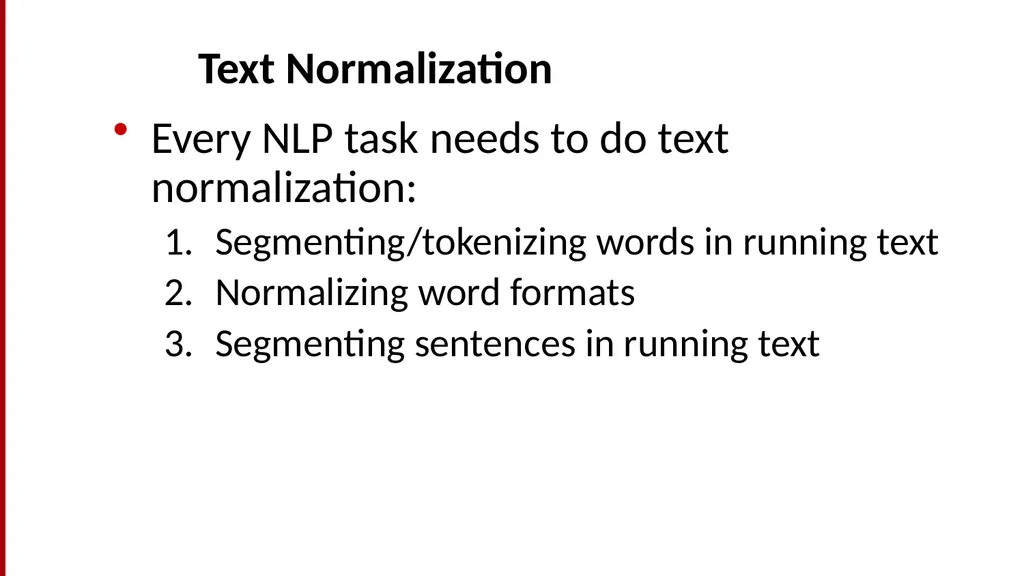
Text Normalization Every NLP task needs to do text normalization:
Segmenting/tokenizing words in running text
Normalizing word formats
Segmenting sentences in running text<br>
Segmenting/tokenizing words in running text
Normalizing word formats
Segmenting sentences in running text<br>
15
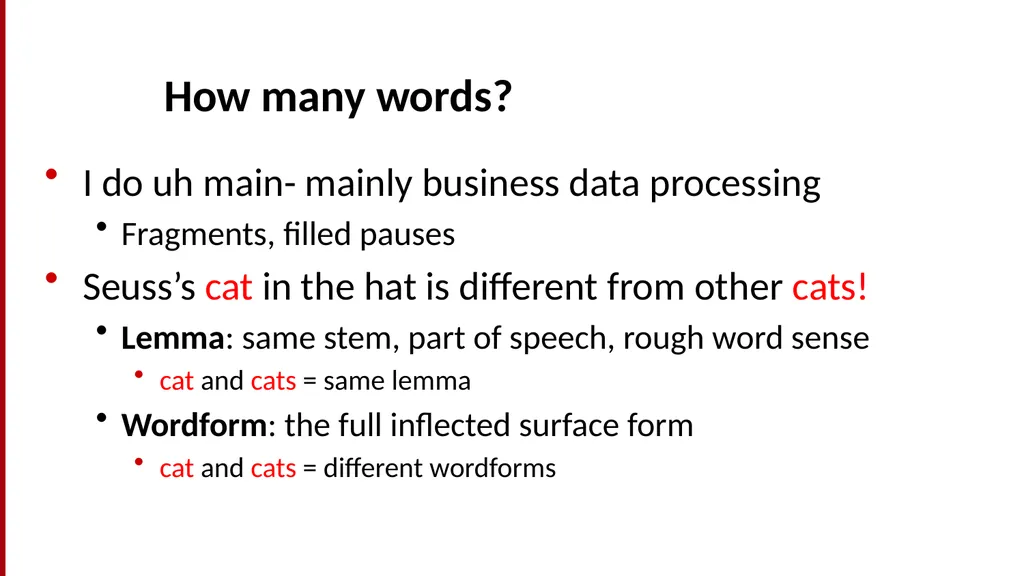
How many words? I do uh main- mainly business data processing
Fragments, filled pauses
Seuss’s cat in the hat is different from other cats!
Lemma: same stem, part of speech, rough word sense
cat and cats = same lemma
Wordform: the full inflected surface form
cat and cats = different wordforms<br>
Fragments, filled pauses
Seuss’s cat in the hat is different from other cats!
Lemma: same stem, part of speech, rough word sense
cat and cats = same lemma
Wordform: the full inflected surface form
cat and cats = different wordforms<br>
16
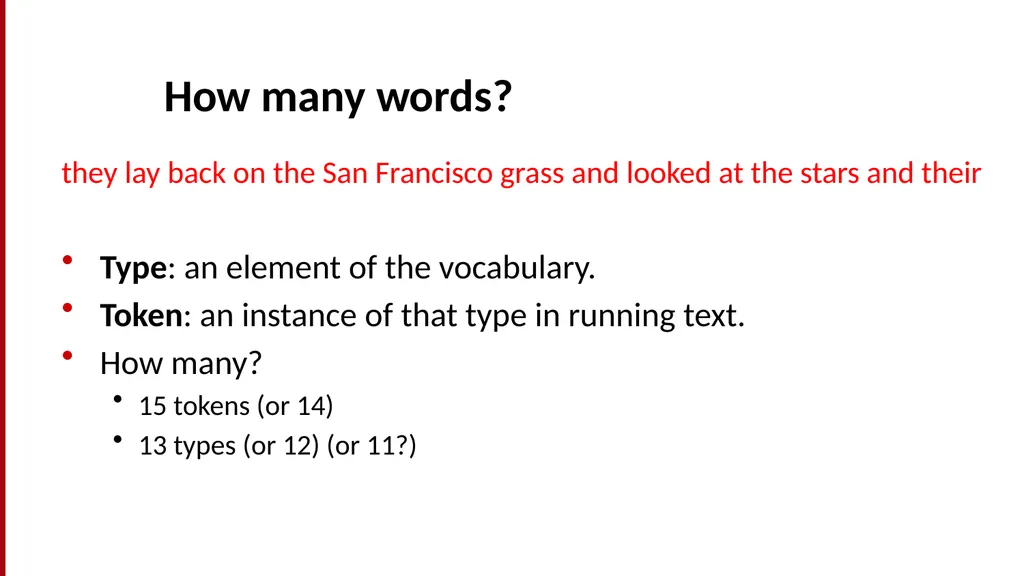
How many words? they lay back on the San Francisco grass and looked at the stars and their
Type: an element of the vocabulary.
Token: an instance of that type in running text.
How many?
15 tokens (or 14)
13 types (or 12) (or 11?)<br>
Type: an element of the vocabulary.
Token: an instance of that type in running text.
How many?
15 tokens (or 14)
13 types (or 12) (or 11?)<br>
17
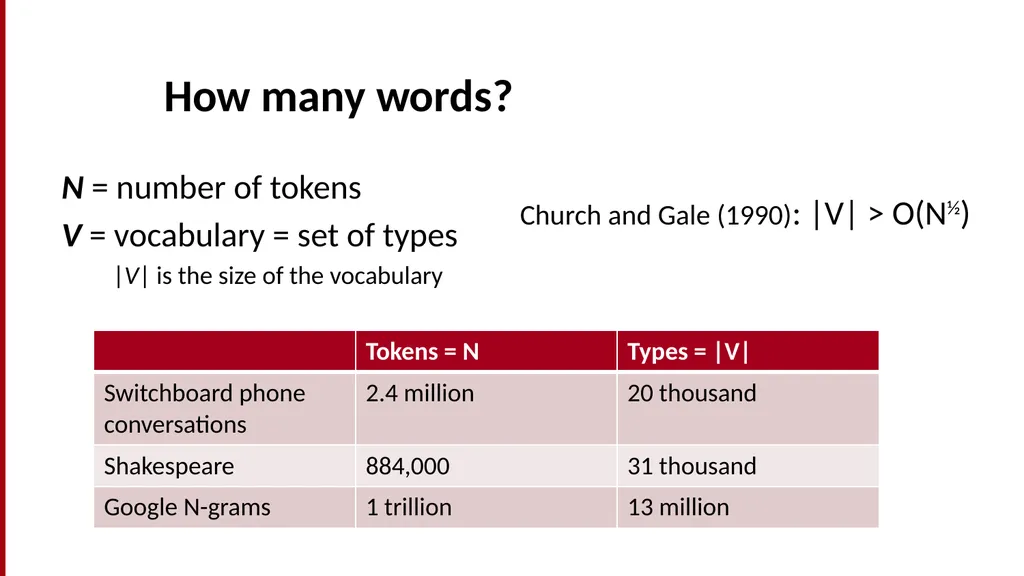
How many words? N = number of tokens
V = vocabulary = set of types
|V| is the size of the vocabulary Church and Gale (1990): |V| > O(N½)<br>
V = vocabulary = set of types
|V| is the size of the vocabulary Church and Gale (1990): |V| > O(N½)<br>
18
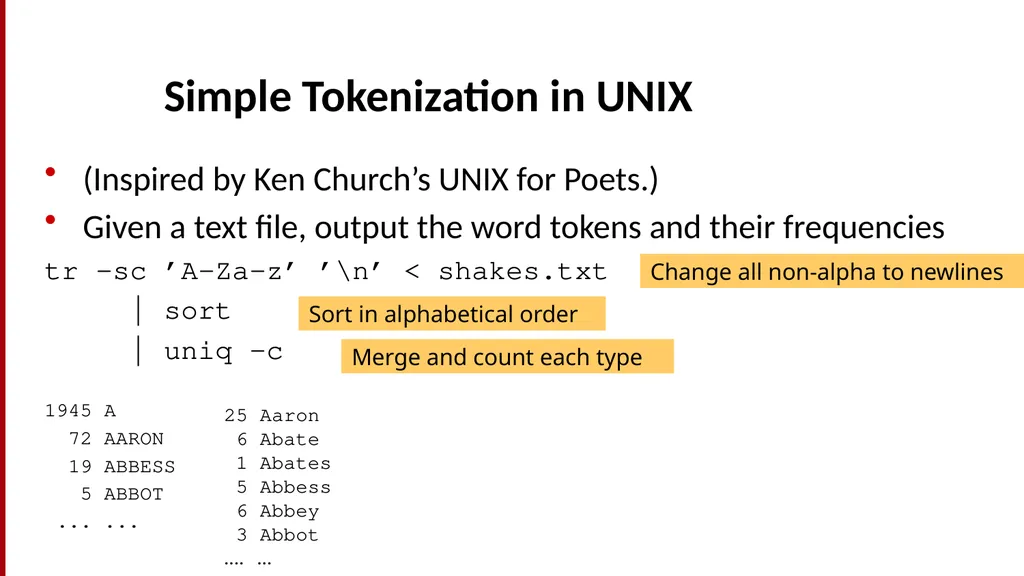
Simple Tokenization in UNIX (Inspired by Ken Church’s UNIX for Poets.)
Given a text file, output the word tokens and their frequencies
tr -sc ’A-Za-z’ ’\n’ < shakes.txt
| sort
| uniq –c
1945 A
72 AARON
19 ABBESS
5 ABBOT
... ... 25 Aaron
6 Abate
1 Abates
5 Abbess
6 Abbey
3 Abbot
.... … Change all non-alpha to newlines Sort in alphabetical order Merge and count each type<br>
Given a text file, output the word tokens and their frequencies
tr -sc ’A-Za-z’ ’\n’ < shakes.txt
| sort
| uniq –c
1945 A
72 AARON
19 ABBESS
5 ABBOT
... ... 25 Aaron
6 Abate
1 Abates
5 Abbess
6 Abbey
3 Abbot
.... … Change all non-alpha to newlines Sort in alphabetical order Merge and count each type<br>
19
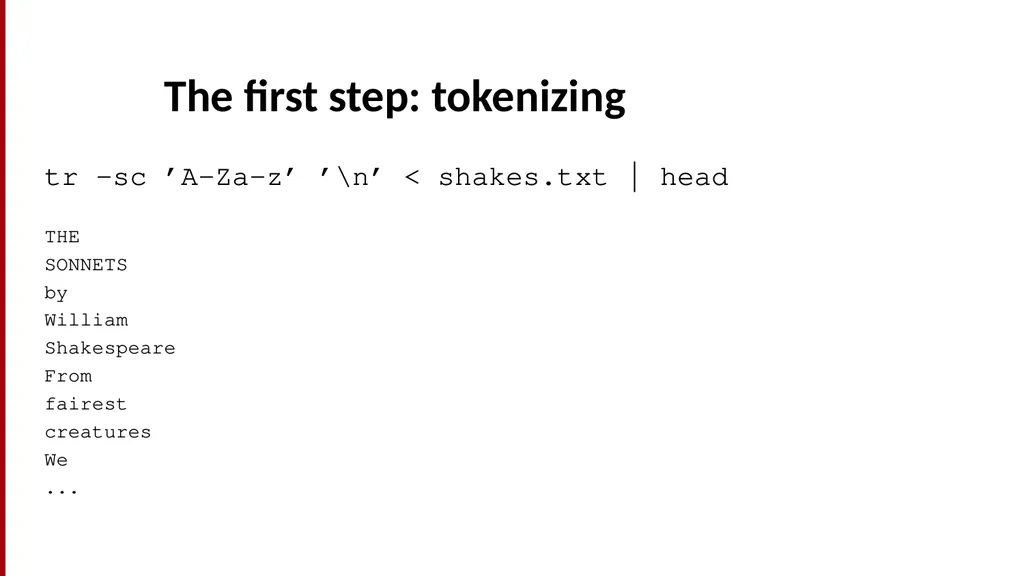
The first step: tokenizing tr -sc ’A-Za-z’ ’\n’ < shakes.txt | head
THE
SONNETS
by
William
Shakespeare
From
fairest
creatures
We
...<br>
THE
SONNETS
by
William
Shakespeare
From
fairest
creatures
We
...<br>
20
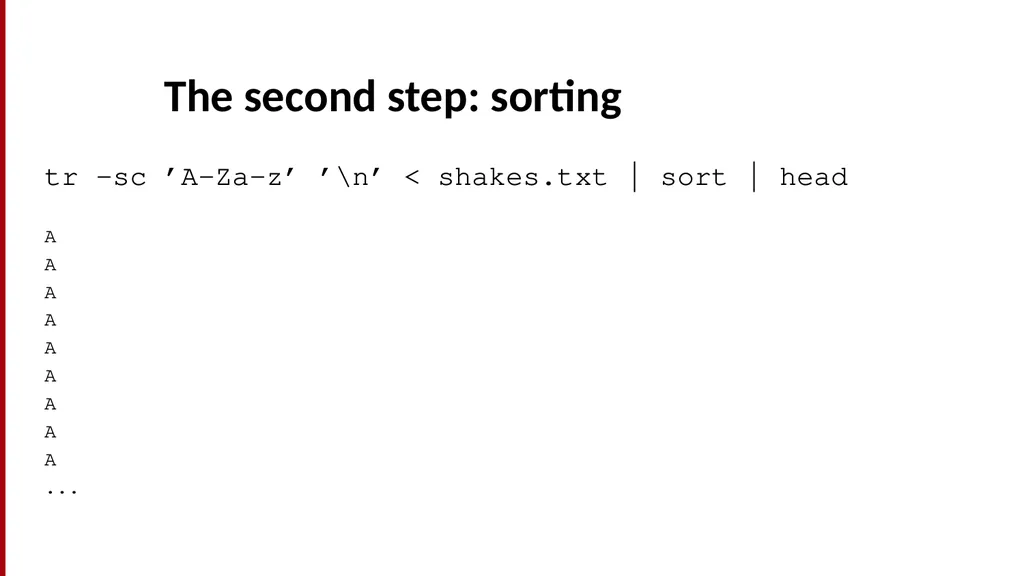
The second step: sorting tr -sc ’A-Za-z’ ’\n’ < shakes.txt | sort | head
A
A
A
A
A
A
A
A
A
...<br>
A
A
A
A
A
A
A
A
A
...<br>
21
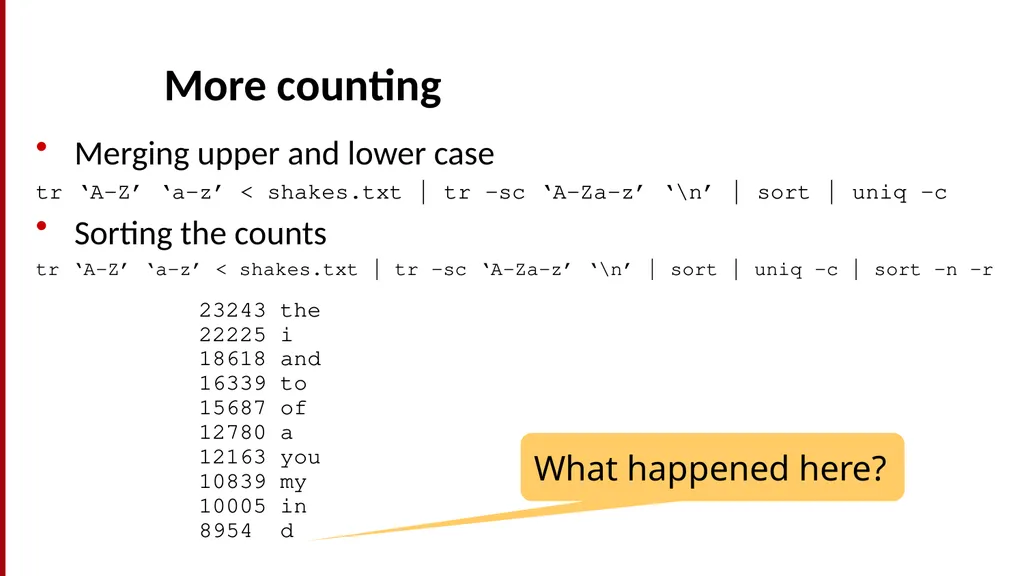
More counting Merging upper and lower case
tr ‘A-Z’ ‘a-z’ < shakes.txt | tr –sc ‘A-Za-z’ ‘\n’ | sort | uniq –c
Sorting the counts
tr ‘A-Z’ ‘a-z’ < shakes.txt | tr –sc ‘A-Za-z’ ‘\n’ | sort | uniq –c | sort –n –r 23243 the
22225 i
18618 and
16339 to
15687 of
12780 a
12163 you
10839 my
10005 in
8954 d What happened here?<br>
tr ‘A-Z’ ‘a-z’ < shakes.txt | tr –sc ‘A-Za-z’ ‘\n’ | sort | uniq –c
Sorting the counts
tr ‘A-Z’ ‘a-z’ < shakes.txt | tr –sc ‘A-Za-z’ ‘\n’ | sort | uniq –c | sort –n –r 23243 the
22225 i
18618 and
16339 to
15687 of
12780 a
12163 you
10839 my
10005 in
8954 d What happened here?<br>
22
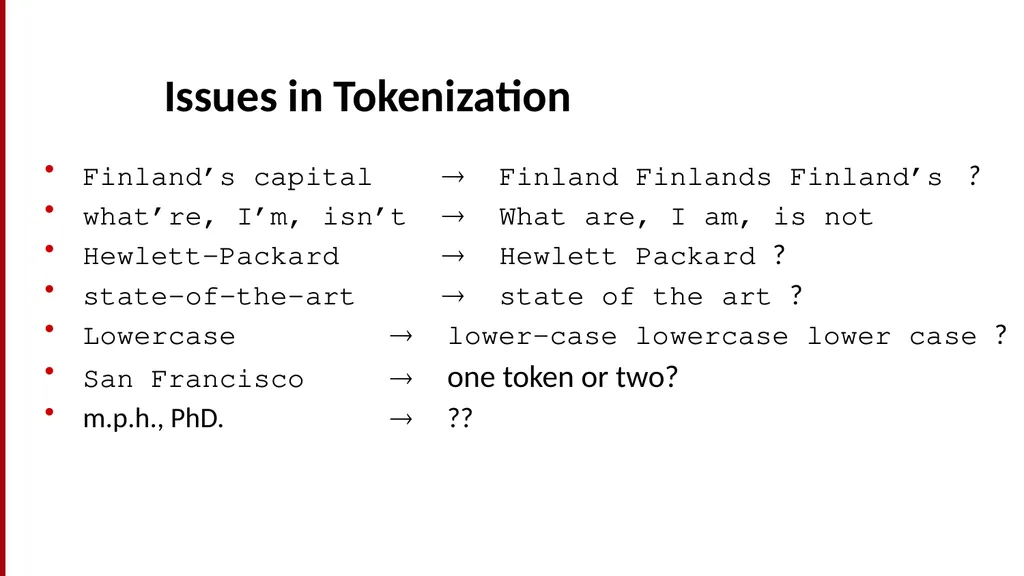
Issues in Tokenization Finland’s capital Finland Finlands Finland’s ?
what’re, I’m, isn’t What are, I am, is not
Hewlett-Packard Hewlett Packard ?
state-of-the-art state of the art ?
Lowercase lower-case lowercase lower case ?
San Francisco one token or two?
m.p.h., PhD. ??<br>
what’re, I’m, isn’t What are, I am, is not
Hewlett-Packard Hewlett Packard ?
state-of-the-art state of the art ?
Lowercase lower-case lowercase lower case ?
San Francisco one token or two?
m.p.h., PhD. ??<br>
23
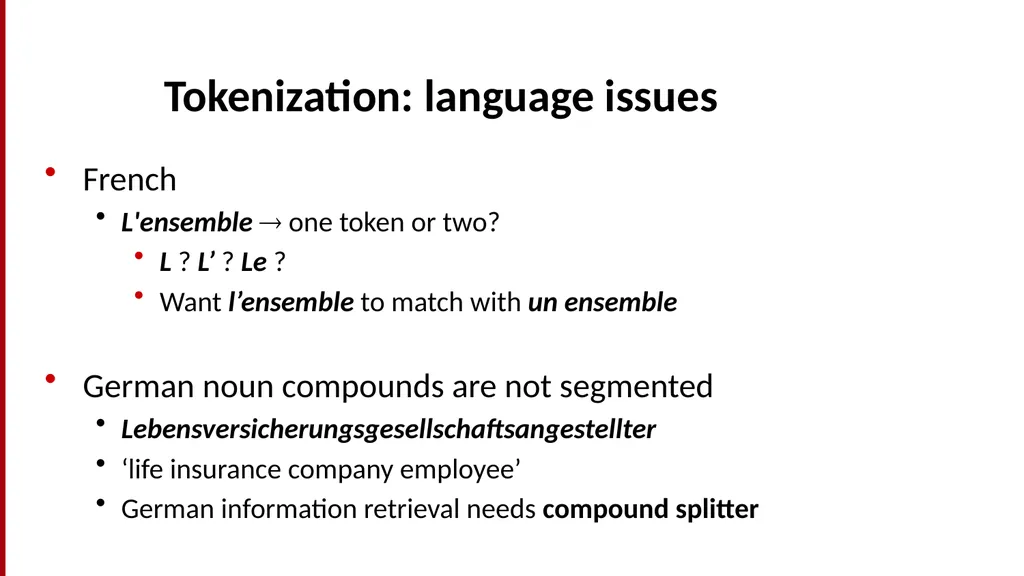
Tokenization: language issues French
L'ensemble one token or two?
L ? L’ ? Le ?
Want l’ensemble to match with un ensemble
German noun compounds are not segmented
Lebensversicherungsgesellschaftsangestellter
‘life insurance company employee’
German information retrieval needs compound splitter<br>
L'ensemble one token or two?
L ? L’ ? Le ?
Want l’ensemble to match with un ensemble
German noun compounds are not segmented
Lebensversicherungsgesellschaftsangestellter
‘life insurance company employee’
German information retrieval needs compound splitter<br>
24
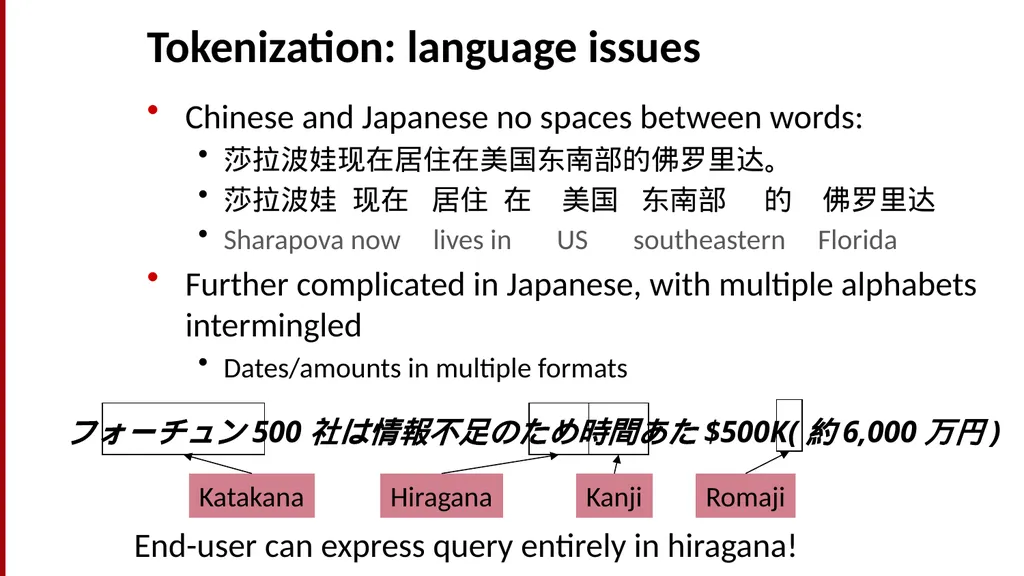
Tokenization: language issues Chinese and Japanese no spaces between words:
莎拉波娃现在居住在美国东南部的佛罗里达。
莎拉波娃 现在 居住 在 美国 东南部 的 佛罗里达
Sharapova now lives in US southeastern Florida
Further complicated in Japanese, with multiple alphabets intermingled
Dates/amounts in multiple formats フォーチュン500社は情報不足のため時間あた$500K(約6,000万円) End-user can express query entirely in hiragana!<br>
莎拉波娃现在居住在美国东南部的佛罗里达。
莎拉波娃 现在 居住 在 美国 东南部 的 佛罗里达
Sharapova now lives in US southeastern Florida
Further complicated in Japanese, with multiple alphabets intermingled
Dates/amounts in multiple formats フォーチュン500社は情報不足のため時間あた$500K(約6,000万円) End-user can express query entirely in hiragana!<br>
25
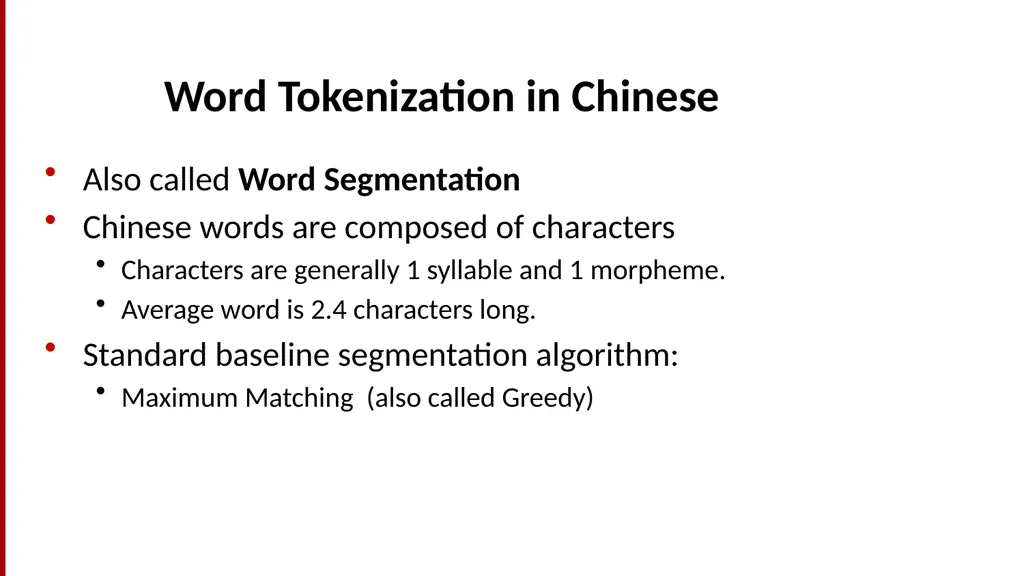
Word Tokenization in Chinese Also called Word Segmentation
Chinese words are composed of characters
Characters are generally 1 syllable and 1 morpheme.
Average word is 2.4 characters long.
Standard baseline segmentation algorithm:
Maximum Matching (also called Greedy)<br>
Chinese words are composed of characters
Characters are generally 1 syllable and 1 morpheme.
Average word is 2.4 characters long.
Standard baseline segmentation algorithm:
Maximum Matching (also called Greedy)<br>
26
Maximum Matching
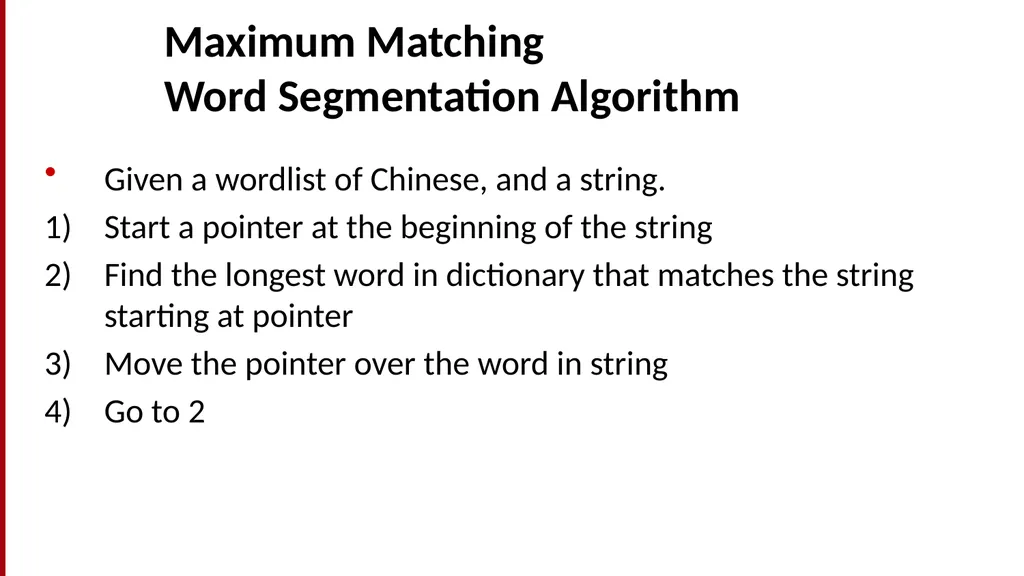
Word Segmentation Algorithm Given a wordlist of Chinese, and a string.
Start a pointer at the beginning of the string
Find the longest word in dictionary that matches the string starting at pointer
Move the pointer over the word in string
Go to 2<br>
Start a pointer at the beginning of the string
Find the longest word in dictionary that matches the string starting at pointer
Move the pointer over the word in string
Go to 2<br>
27
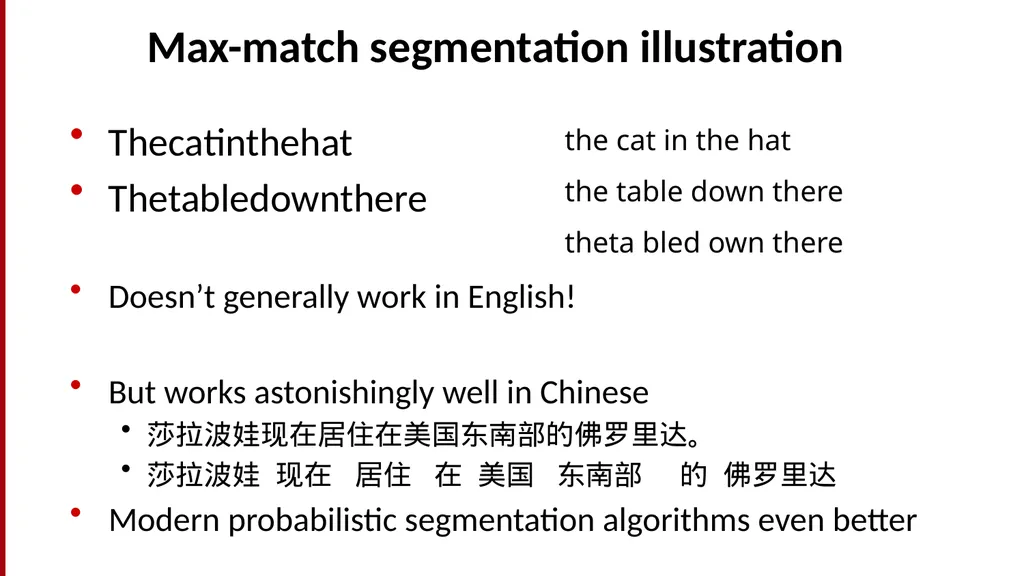
Max-match segmentation illustration Thecatinthehat
Thetabledownthere
Doesn’t generally work in English!
But works astonishingly well in Chinese
莎拉波娃现在居住在美国东南部的佛罗里达。
莎拉波娃 现在 居住 在 美国 东南部 的 佛罗里达
Modern probabilistic segmentation algorithms even better the table down there the cat in the hat theta bled own there<br>
Thetabledownthere
Doesn’t generally work in English!
But works astonishingly well in Chinese
莎拉波娃现在居住在美国东南部的佛罗里达。
莎拉波娃 现在 居住 在 美国 东南部 的 佛罗里达
Modern probabilistic segmentation algorithms even better the table down there the cat in the hat theta bled own there<br>
28
Basic Text Processing Word tokenization<br>
29
Basic Text Processing Word Normalization and Stemming<br>
30
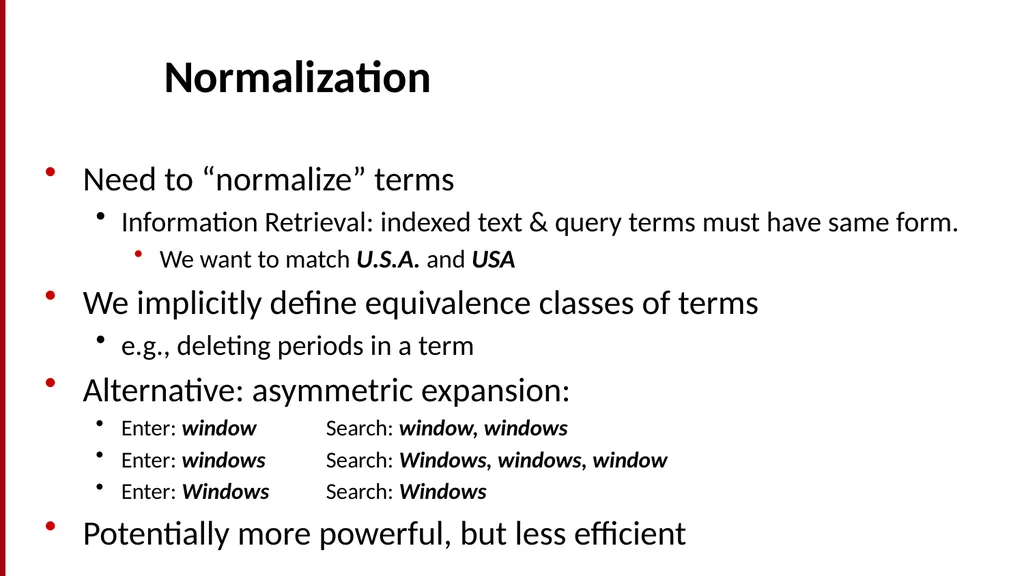
Normalization Need to “normalize” terms
Information Retrieval: indexed text & query terms must have same form.
We want to match U.S.A. and USA
We implicitly define equivalence classes of terms
e.g., deleting periods in a term
Alternative: asymmetric expansion:
Enter: window Search: window, windows
Enter: windows Search: Windows, windows, window
Enter: Windows Search: Windows
Potentially more powerful, but less efficient<br>
Information Retrieval: indexed text & query terms must have same form.
We want to match U.S.A. and USA
We implicitly define equivalence classes of terms
e.g., deleting periods in a term
Alternative: asymmetric expansion:
Enter: window Search: window, windows
Enter: windows Search: Windows, windows, window
Enter: Windows Search: Windows
Potentially more powerful, but less efficient<br>
31
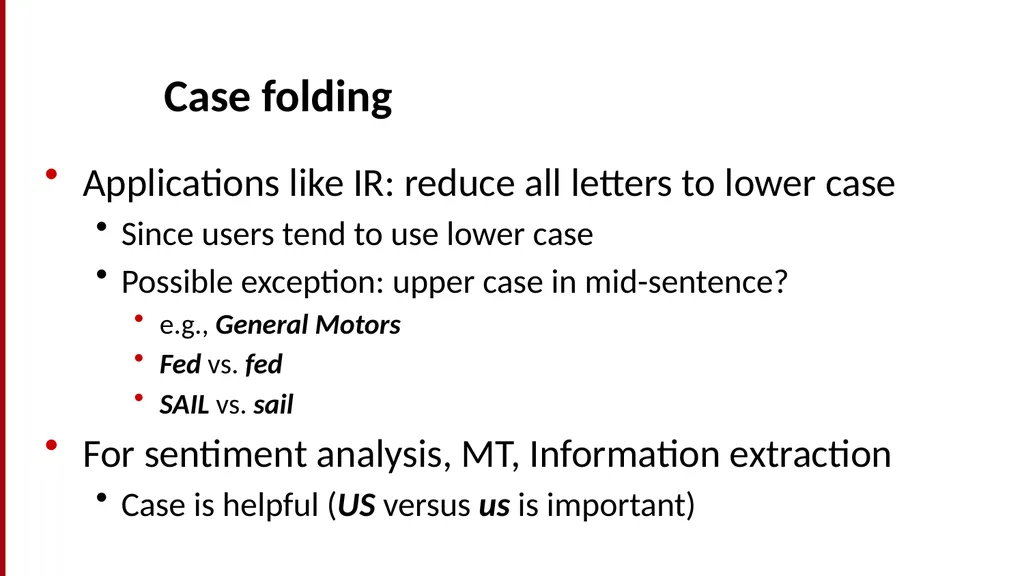
Case folding Applications like IR: reduce all letters to lower case
Since users tend to use lower case
Possible exception: upper case in mid-sentence?
e.g., General Motors
Fed vs. fed
SAIL vs. sail
For sentiment analysis, MT, Information extraction
Case is helpful (US versus us is important)<br>
Since users tend to use lower case
Possible exception: upper case in mid-sentence?
e.g., General Motors
Fed vs. fed
SAIL vs. sail
For sentiment analysis, MT, Information extraction
Case is helpful (US versus us is important)<br>
32
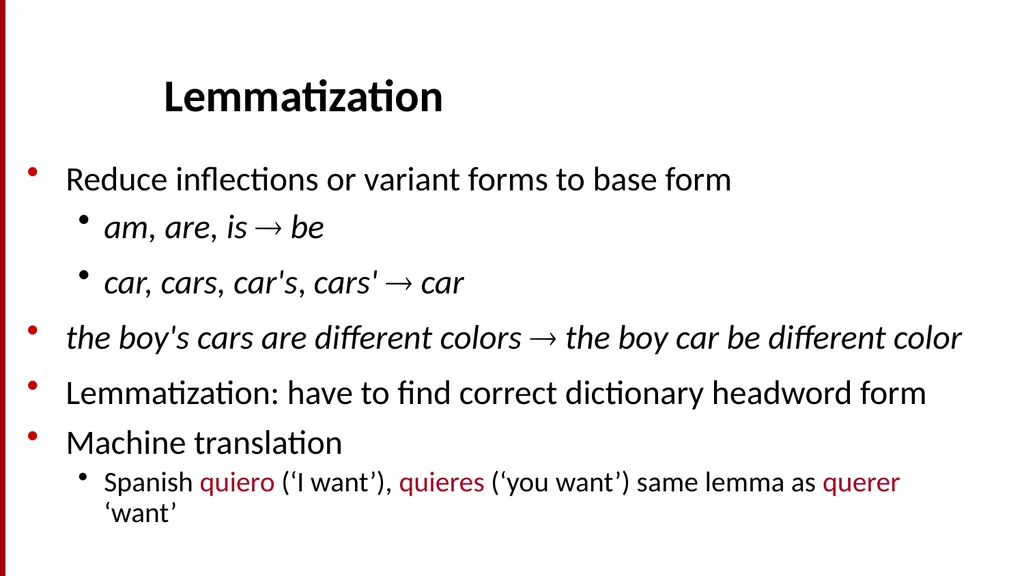
Lemmatization Reduce inflections or variant forms to base form
am, are, is be
car, cars, car's, cars' car
the boy's cars are different colors the boy car be different color
Lemmatization: have to find correct dictionary headword form
Machine translation
Spanish quiero (‘I want’), quieres (‘you want’) same lemma as querer ‘want’<br>
am, are, is be
car, cars, car's, cars' car
the boy's cars are different colors the boy car be different color
Lemmatization: have to find correct dictionary headword form
Machine translation
Spanish quiero (‘I want’), quieres (‘you want’) same lemma as querer ‘want’<br>
33
Morphology Morphemes:
The small meaningful units that make up words
Stems: The core meaning-bearing units
Affixes: Bits and pieces that adhere to stems
Often with grammatical functions<br>
The small meaningful units that make up words
Stems: The core meaning-bearing units
Affixes: Bits and pieces that adhere to stems
Often with grammatical functions<br>
34
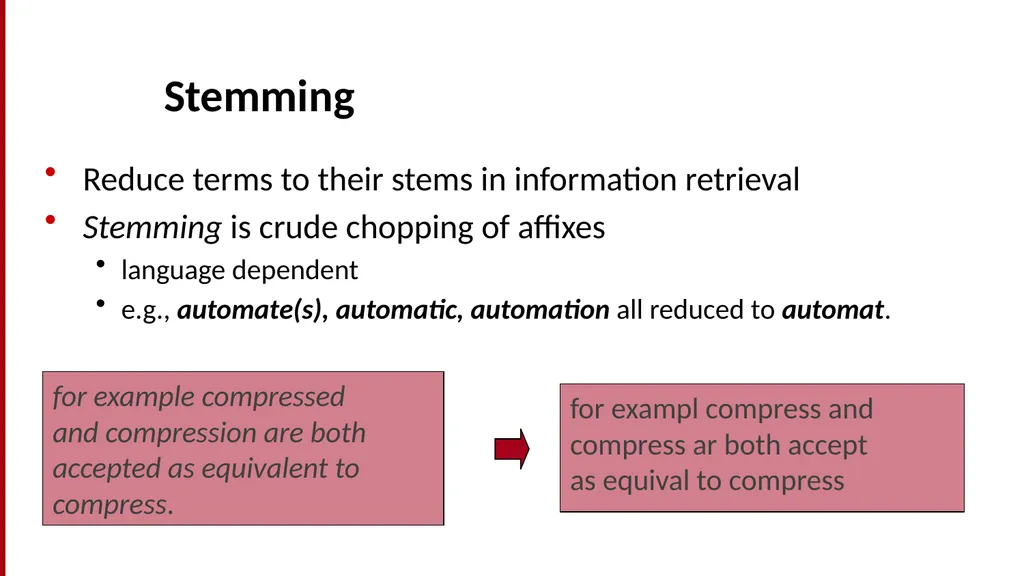
Stemming Reduce terms to their stems in information retrieval
Stemming is crude chopping of affixes
language dependent
e.g., automate(s), automatic, automation all reduced to automat. for example compressed
and compression are both
accepted as equivalent to
compress. for exampl compress and
compress ar both accept
as equival to compress<br>
Stemming is crude chopping of affixes
language dependent
e.g., automate(s), automatic, automation all reduced to automat. for example compressed
and compression are both
accepted as equivalent to
compress. for exampl compress and
compress ar both accept
as equival to compress<br>
35
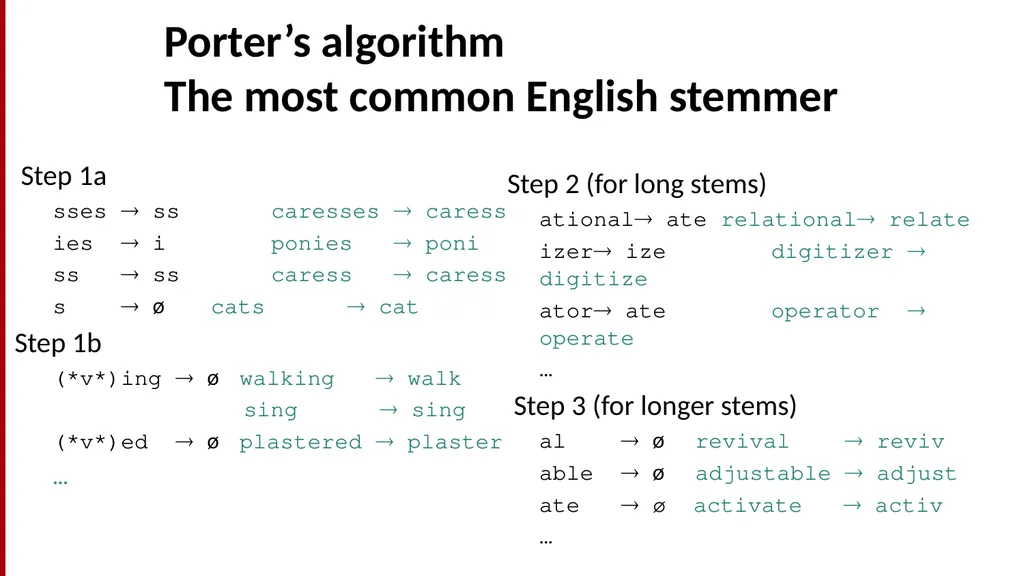
Porter’s algorithm
The most common English stemmer Step 1a
sses ss caresses caress
ies i ponies poni
ss ss caress caress
s ø cats cat
Step 1b
(*v*)ing ø walking walk
sing sing
(*v*)ed ø plastered plaster
… Step 2 (for long stems)
ational ate relational relate
izer ize digitizer digitize
ator ate operator operate
…
Step 3 (for longer stems)
al ø revival reviv
able ø adjustable adjust
ate ø activate activ
…<br>
sses ss caresses caress
ies i ponies poni
ss ss caress caress
s ø cats cat
Step 1b
(*v*)ing ø walking walk
sing sing
(*v*)ed ø plastered plaster
… Step 2 (for long stems)
ational ate relational relate
izer ize digitizer digitize
ator ate operator operate
…
Step 3 (for longer stems)
al ø revival reviv
able ø adjustable adjust
ate ø activate activ
…<br>
36
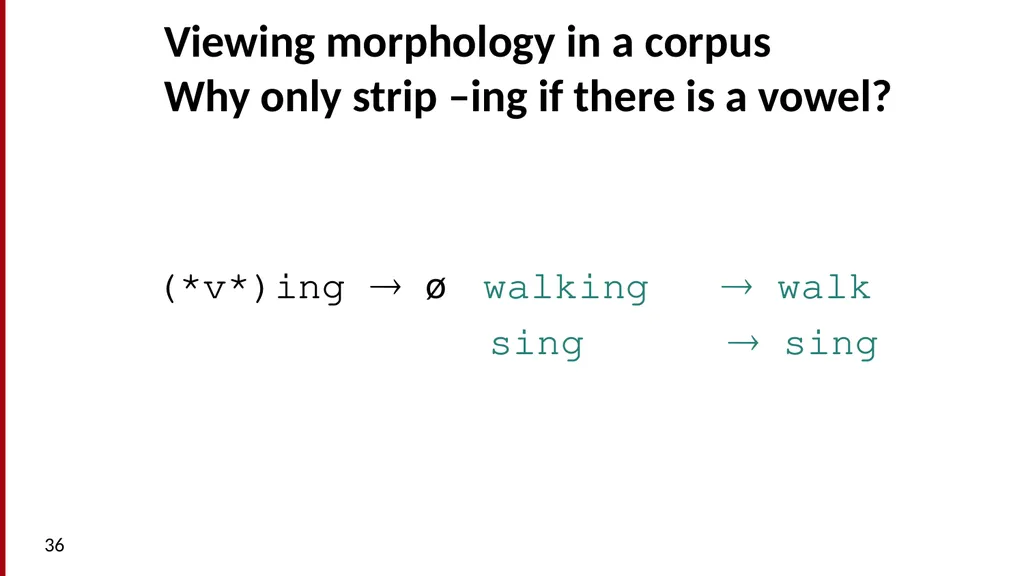
Viewing morphology in a corpus
Why only strip –ing if there is a vowel? (*v*)ing ø walking walk
sing sing 36<br>
sing sing 36<br>
37
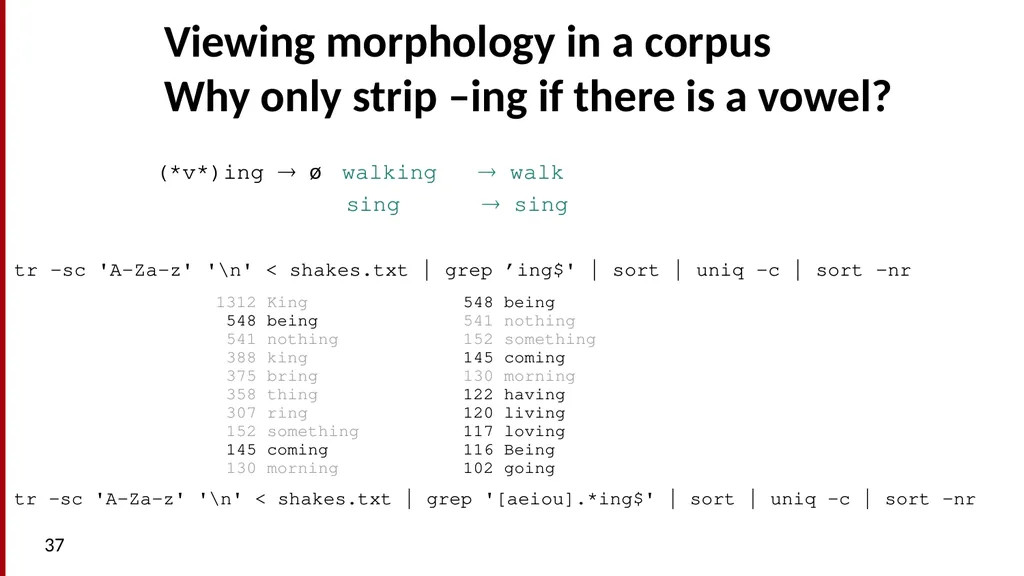
Viewing morphology in a corpus
Why only strip –ing if there is a vowel? (*v*)ing ø walking walk
sing sing 37 tr -sc 'A-Za-z' '\n' < shakes.txt | grep ’ing$' | sort | uniq -c | sort –nr
tr -sc 'A-Za-z' '\n' < shakes.txt | grep '[aeiou].*ing$' | sort | uniq -c | sort –nr 548 being
541 nothing
152 something
145 coming
130 morning
122 having
120 living
117 loving
116 Being
102 going 1312 King
548 being
541 nothing
388 king
375 bring
358 thing
307 ring
152 something
145 coming
130 morning<br>
sing sing 37 tr -sc 'A-Za-z' '\n' < shakes.txt | grep ’ing$' | sort | uniq -c | sort –nr
tr -sc 'A-Za-z' '\n' < shakes.txt | grep '[aeiou].*ing$' | sort | uniq -c | sort –nr 548 being
541 nothing
152 something
145 coming
130 morning
122 having
120 living
117 loving
116 Being
102 going 1312 King
548 being
541 nothing
388 king
375 bring
358 thing
307 ring
152 something
145 coming
130 morning<br>
38
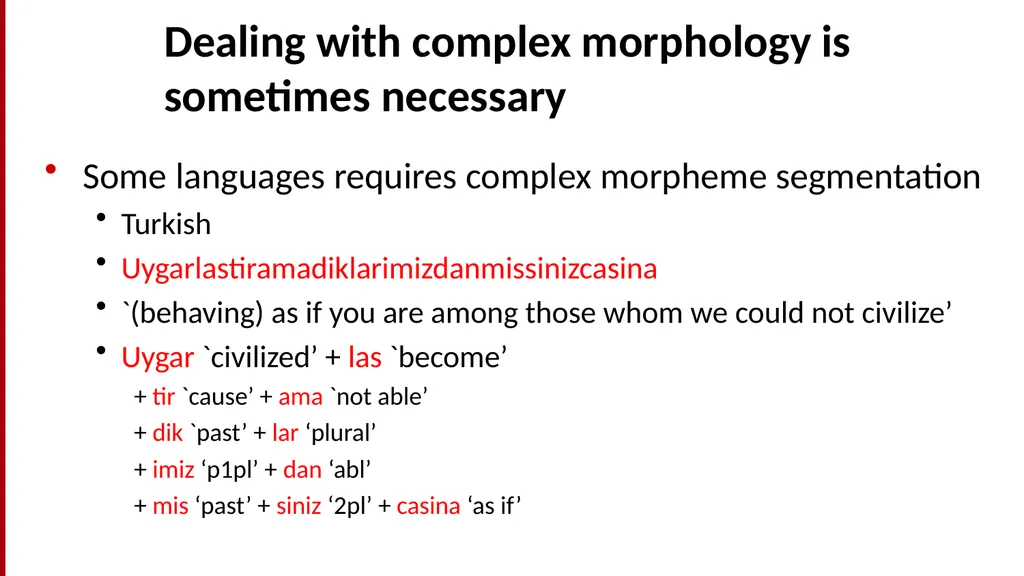
Dealing with complex morphology is sometimes necessary Some languages requires complex morpheme segmentation
Turkish
Uygarlastiramadiklarimizdanmissinizcasina
`(behaving) as if you are among those whom we could not civilize’
Uygar `civilized’ + las `become’
+ tir `cause’ + ama `not able’
+ dik `past’ + lar ‘plural’
+ imiz ‘p1pl’ + dan ‘abl’
+ mis ‘past’ + siniz ‘2pl’ + casina ‘as if’<br>
Turkish
Uygarlastiramadiklarimizdanmissinizcasina
`(behaving) as if you are among those whom we could not civilize’
Uygar `civilized’ + las `become’
+ tir `cause’ + ama `not able’
+ dik `past’ + lar ‘plural’
+ imiz ‘p1pl’ + dan ‘abl’
+ mis ‘past’ + siniz ‘2pl’ + casina ‘as if’<br>
39
Basic Text Processing Word Normalization and Stemming<br>
40
Basic Text Processing Sentence Segmentation and Decision Trees<br>
41
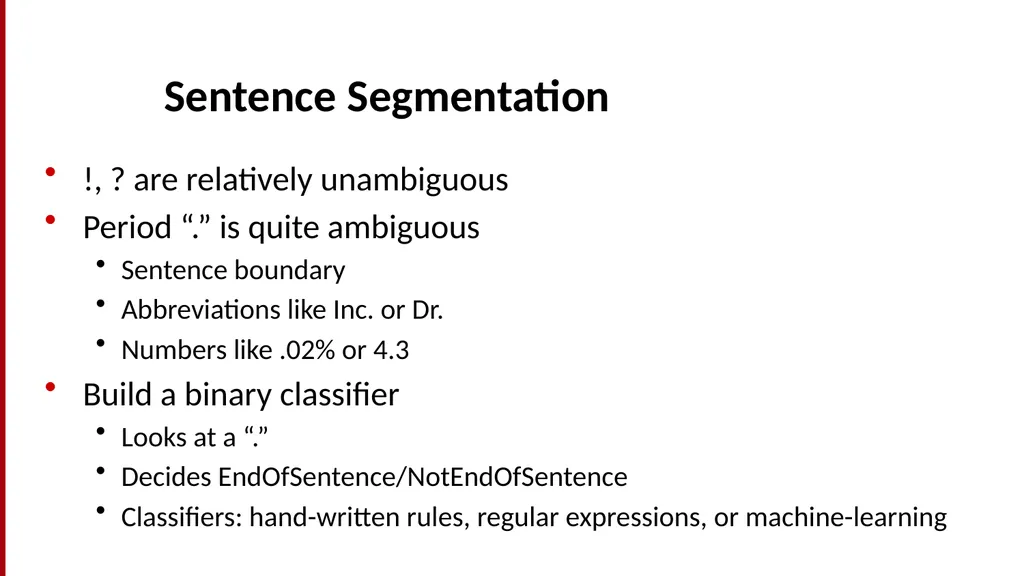
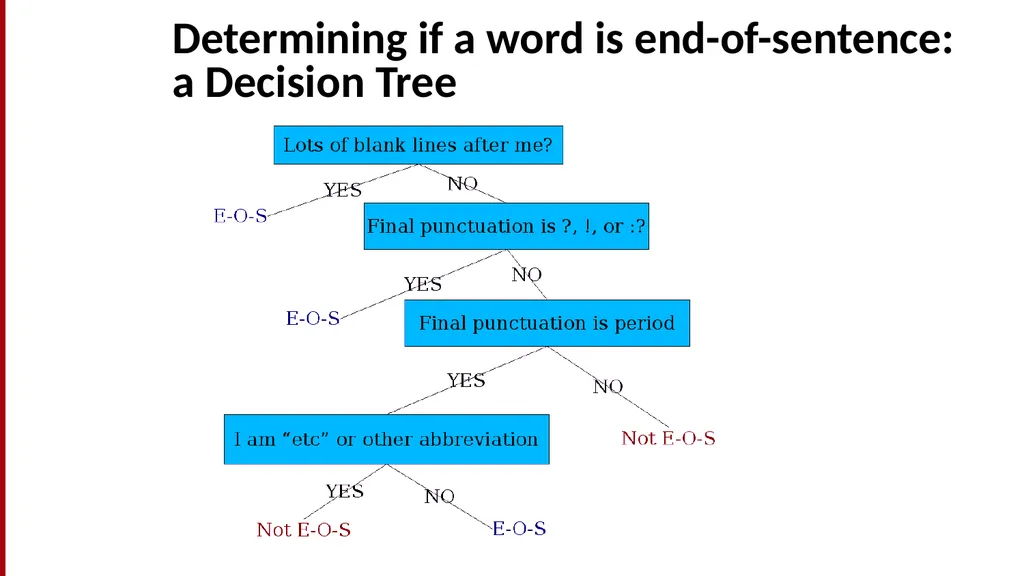
Sentence Segmentation !, ? are relatively unambiguous
Period “.” is quite ambiguous
Sentence boundary
Abbreviations like Inc. or Dr.
Numbers like .02% or 4.3
Build a binary classifier
Looks at a “.”
Decides EndOfSentence/NotEndOfSentence
Classifiers: hand-written rules, regular expressions, or machine-learning<br>
Period “.” is quite ambiguous
Sentence boundary
Abbreviations like Inc. or Dr.
Numbers like .02% or 4.3
Build a binary classifier
Looks at a “.”
Decides EndOfSentence/NotEndOfSentence
Classifiers: hand-written rules, regular expressions, or machine-learning<br>
42
Determining if a word is end-of-sentence: a Decision Tree<br>
43
More sophisticated decision tree features Case of word with “.”: Upper, Lower, Cap, Number
Case of word after “.”: Upper, Lower, Cap, Number
Numeric features
Length of word with “.”
Probability(word with “.” occurs at end-of-s)
Probability(word after “.” occurs at beginning-of-s)<br>
Case of word after “.”: Upper, Lower, Cap, Number
Numeric features
Length of word with “.”
Probability(word with “.” occurs at end-of-s)
Probability(word after “.” occurs at beginning-of-s)<br>
44
Implementing Decision Trees A decision tree is just an if-then-else statement
The interesting research is choosing the features
Setting up the structure is often too hard to do by hand
Hand-building only possible for very simple features, domains
For numeric features, it’s too hard to pick each threshold
Instead, structure usually learned by machine learning from a training corpus<br>
The interesting research is choosing the features
Setting up the structure is often too hard to do by hand
Hand-building only possible for very simple features, domains
For numeric features, it’s too hard to pick each threshold
Instead, structure usually learned by machine learning from a training corpus<br>
45
Decision Trees and other classifiers We can think of the questions in a decision tree
As features that could be exploited by any kind of classifier
Logistic regression
SVM
Neural Nets
etc.<br>
As features that could be exploited by any kind of classifier
Logistic regression
SVM
Neural Nets
etc.<br>
46
Basic Text Processing Sentence Segmentation and Decision Trees<br>