Be a Responsible Online Citizen English Language Education Section Curriculum Development Institute Education Bureau 2023 Learning and Teaching Resources on Law-abidingness for KS3 To learn the importance of respecting others and abiding by
"Be a Responsible Online Citizen English Language" is the property of its rightful owner. Permission is granted to
download and print the materials on this website for personal, non-commercial use only, and to display it
on your personal computer provided you do not modify the materials and that you retain all copyright
notices contained in the materials. By downloading content from our website, you accept the terms of this
agreement.
Presentation Transcript
01
Be a Responsible Online Citizen English Language Education Section
Curriculum Development Institute
Education Bureau
2023 Learning and Teaching Resources on Law-abidingness for KS3<br>
02
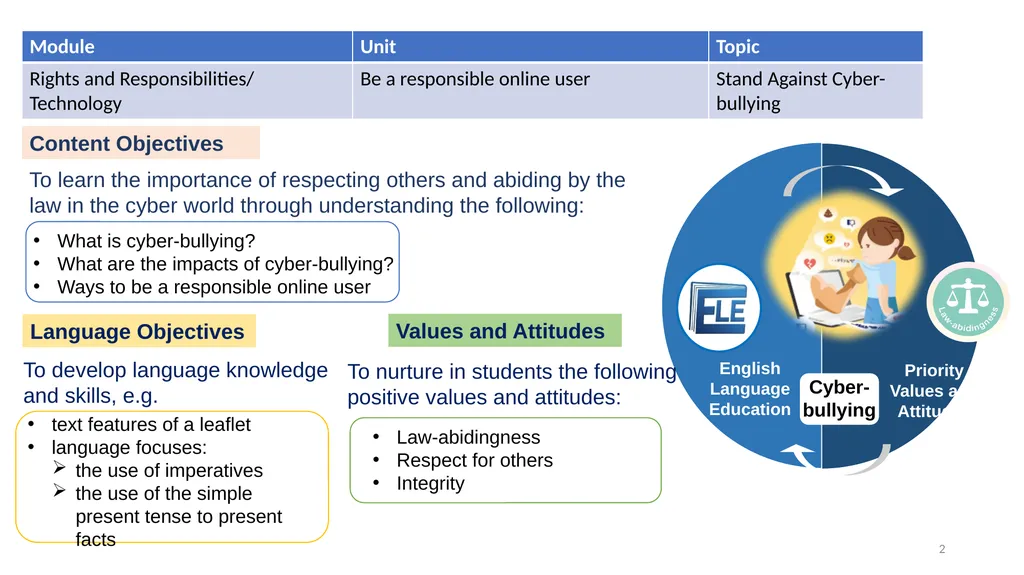
To learn the importance of respecting others and abiding by the law in the cyber world through understanding the following: Content Objectives Language Objectives To develop language knowledge and skills, e.g. 2 Values and Attitudes To nurture in students the following positive values and attitudes: Law-abidingness
Respect for others
Integrity<br>
03
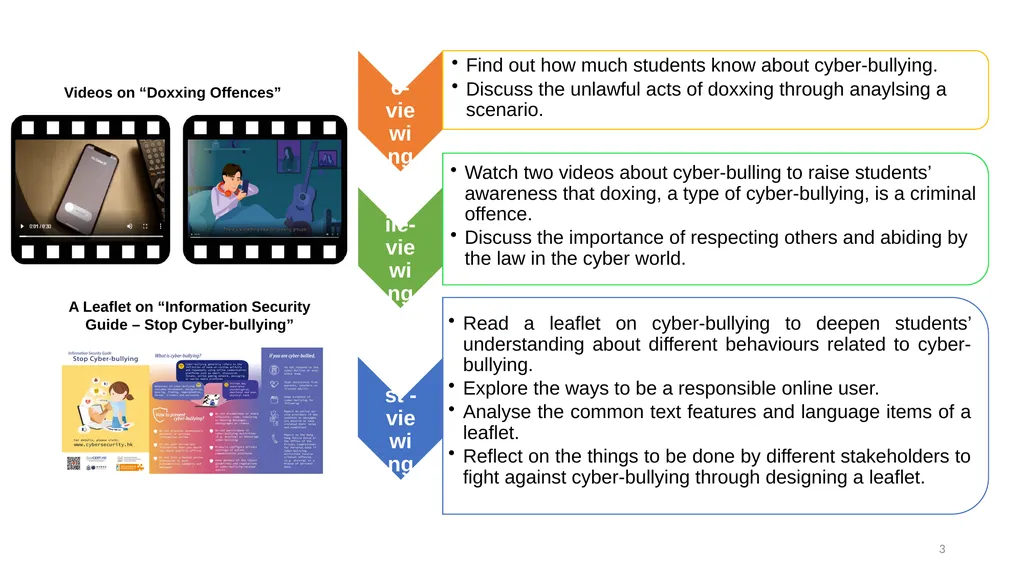
A Leaflet on “Information Security Guide – Stop Cyber-bullying” 3 Videos on “Doxxing Offences”<br>
04
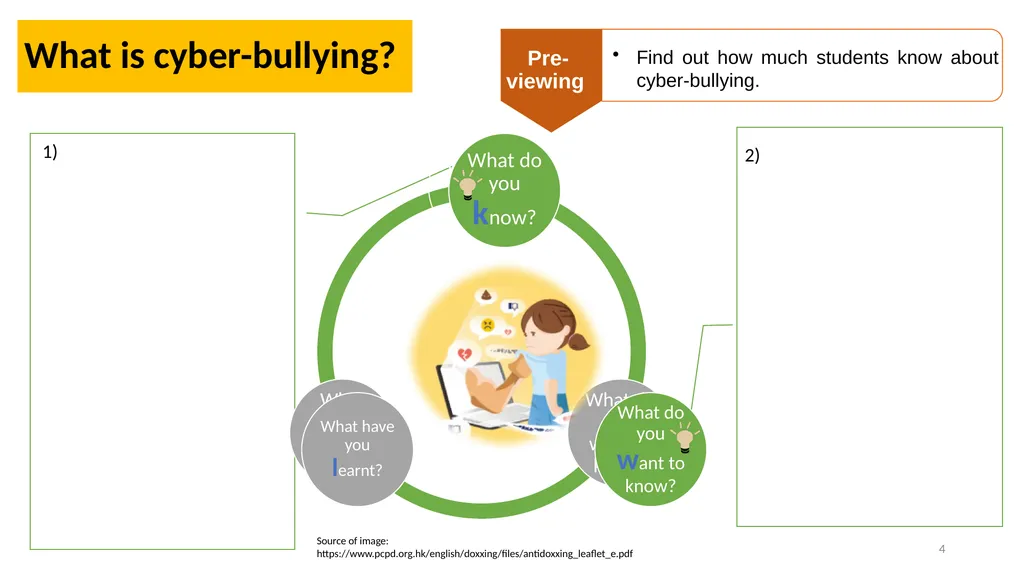
What is cyber-bullying? 4 1) 2) Source of image:
https://www.pcpd.org.hk/english/doxxing/files/antidoxxing_leaflet_e.pdf<br>
05
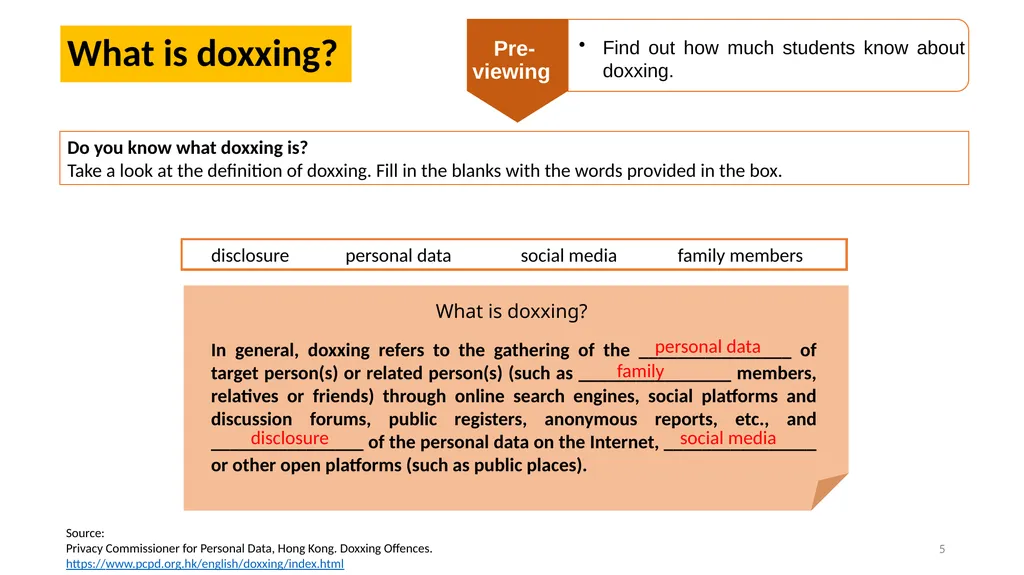
What is doxxing? 5 Do you know what doxxing is?
Take a look at the definition of doxxing. Fill in the blanks with the words provided in the box. Source:
Privacy Commissioner for Personal Data, Hong Kong. Doxxing Offences.
https://www.pcpd.org.hk/english/doxxing/index.html disclosure personal data social media family members<br>
06
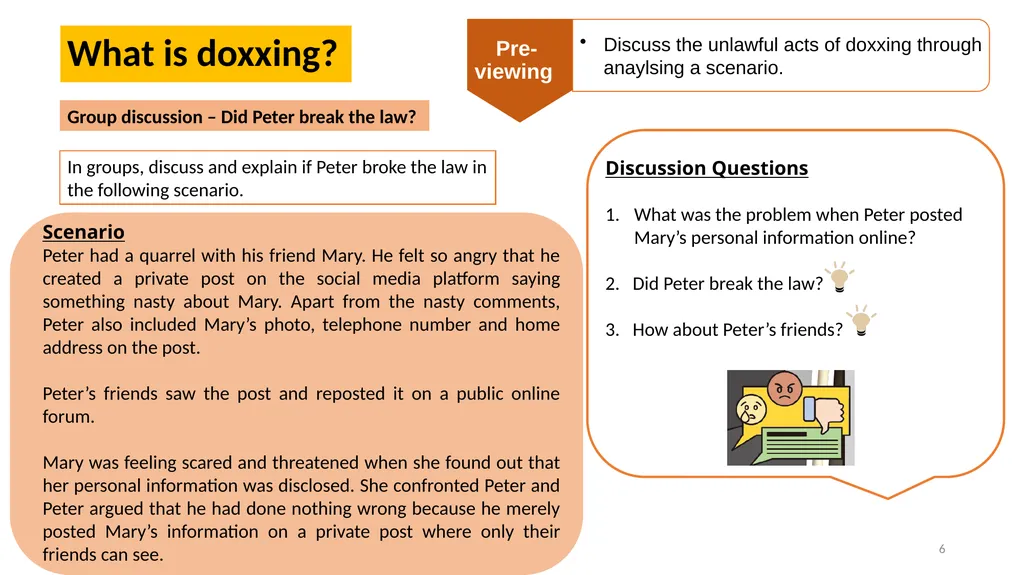
What is doxxing? 6 Group discussion – Did Peter break the law? In groups, discuss and explain if Peter broke the law in the following scenario. Scenario
Peter had a quarrel with his friend Mary. He felt so angry that he created a private post on the social media platform saying something nasty about Mary. Apart from the nasty comments, Peter also included Mary’s photo, telephone number and home address on the post.
Peter’s friends saw the post and reposted it on a public online forum.
Mary was feeling scared and threatened when she found out that her personal information was disclosed. She confronted Peter and Peter argued that he had done nothing wrong because he merely posted Mary’s information on a private post where only their friends can see. Discussion Questions
What was the problem when Peter posted Mary’s personal information online?
2. Did Peter break the law?
3. How about Peter’s friends?<br>
07
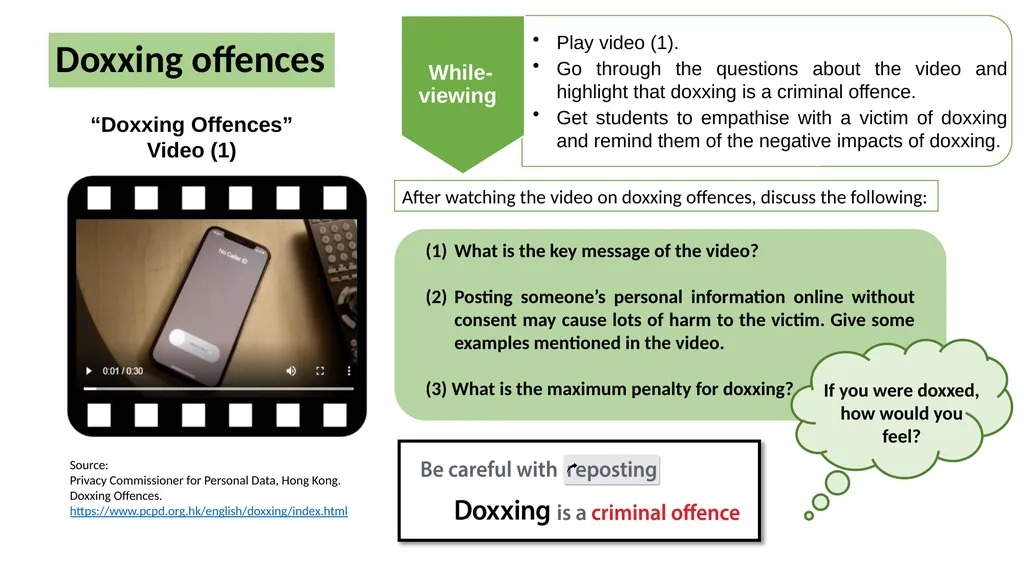
Doxxing offences Source:
Privacy Commissioner for Personal Data, Hong Kong. Doxxing Offences.
https://www.pcpd.org.hk/english/doxxing/index.html “Doxxing Offences”
Video (1) After watching the video on doxxing offences, discuss the following:<br>
08
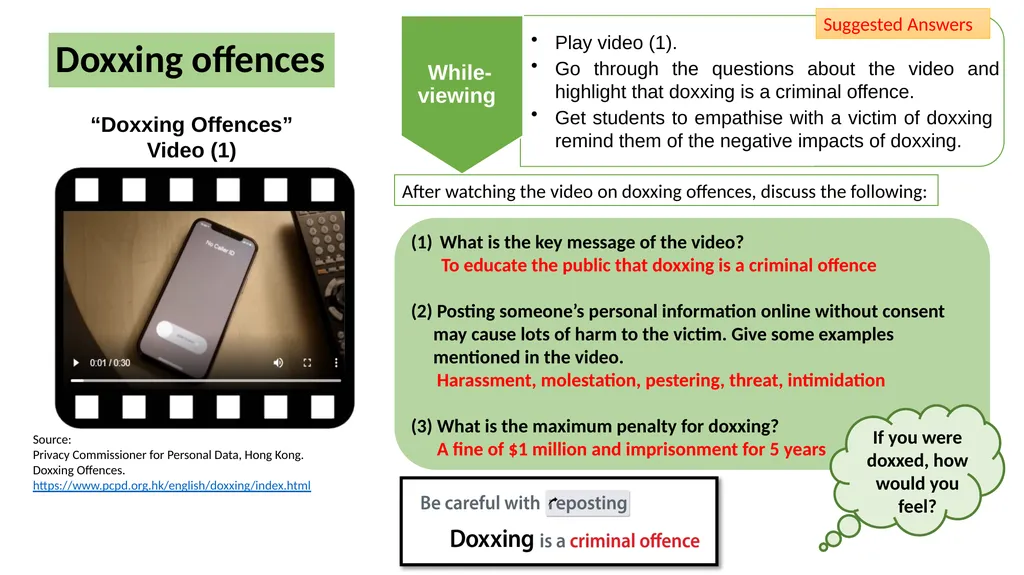
Doxxing offences Source:
Privacy Commissioner for Personal Data, Hong Kong. Doxxing Offences.
https://www.pcpd.org.hk/english/doxxing/index.html “Doxxing Offences”
Video (1) After watching the video on doxxing offences, discuss the following: Suggested Answers<br>
09
Doxxing offences Source:
Privacy Commissioner for Personal Data, Hong Kong. Doxxing Offences.
https://www.pcpd.org.hk/english/doxxing/index.html “Doxxing Offences”
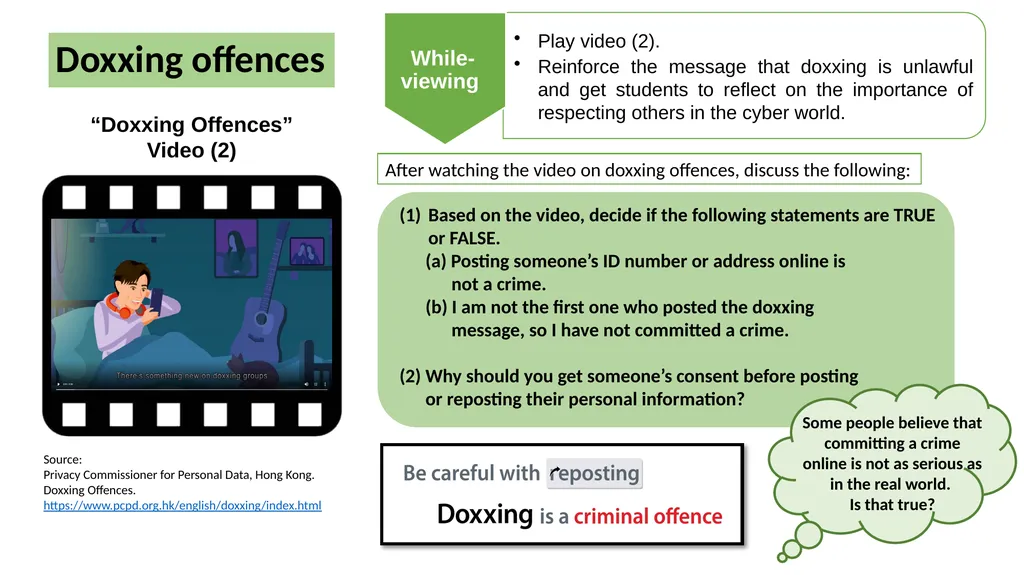
Video (2) After watching the video on doxxing offences, discuss the following: Based on the video, decide if the following statements are TRUE or FALSE.
(a) Posting someone’s ID number or address online is
not a crime.
(b) I am not the first one who posted the doxxing
message, so I have not committed a crime.
(2) Why should you get someone’s consent before posting
or reposting their personal information?<br>
10
Doxxing offences Source:
Privacy Commissioner for Personal Data, Hong Kong. Doxxing Offences.
https://www.pcpd.org.hk/english/doxxing/index.html “Doxxing Offences”
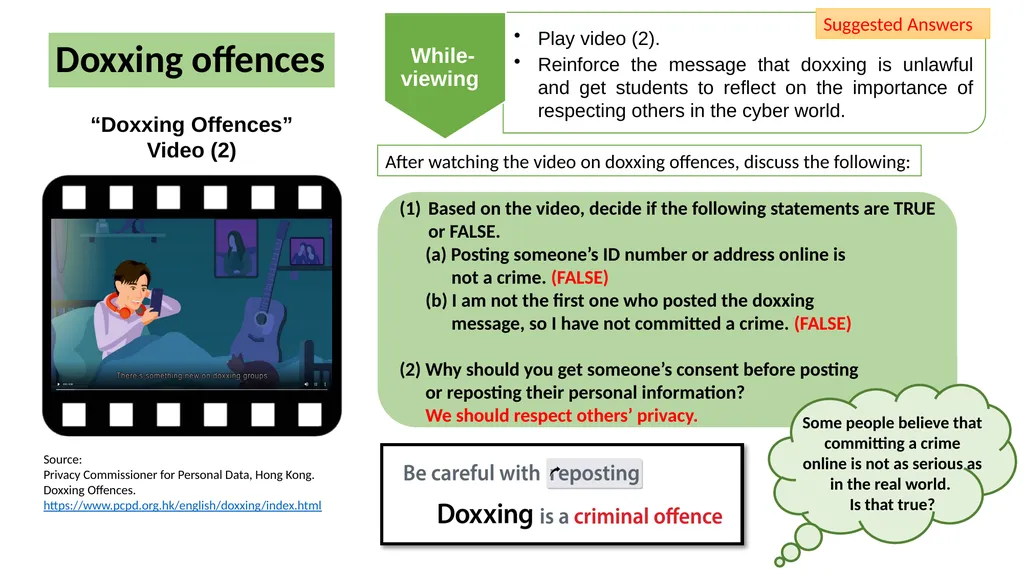
Video (2) After watching the video on doxxing offences, discuss the following: Based on the video, decide if the following statements are TRUE or FALSE.
(a) Posting someone’s ID number or address online is
not a crime. (FALSE)
(b) I am not the first one who posted the doxxing
message, so I have not committed a crime. (FALSE)
(2) Why should you get someone’s consent before posting
or reposting their personal information?
We should respect others’ privacy. Suggested Answers<br>
11
11 Source:
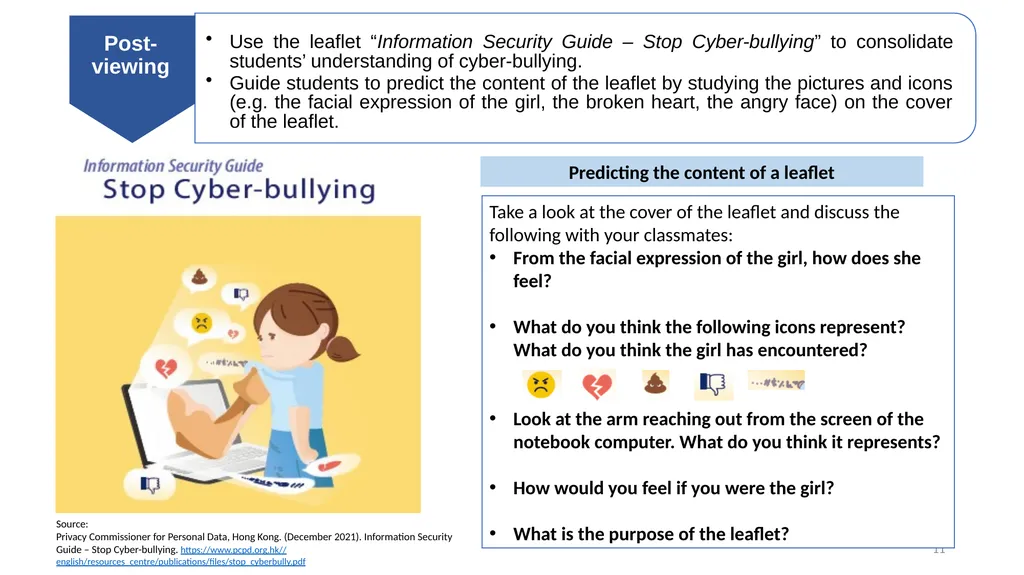
Privacy Commissioner for Personal Data, Hong Kong. (December 2021). Information Security Guide – Stop Cyber-bullying. https://www.pcpd.org.hk//english/resources_centre/publications/files/stop_cyberbully.pdf Take a look at the cover of the leaflet and discuss the following with your classmates:
From the facial expression of the girl, how does she feel?
What do you think the following icons represent? What do you think the girl has encountered?
Look at the arm reaching out from the screen of the notebook computer. What do you think it represents?
How would you feel if you were the girl?
What is the purpose of the leaflet? Predicting the content of a leaflet<br>
12
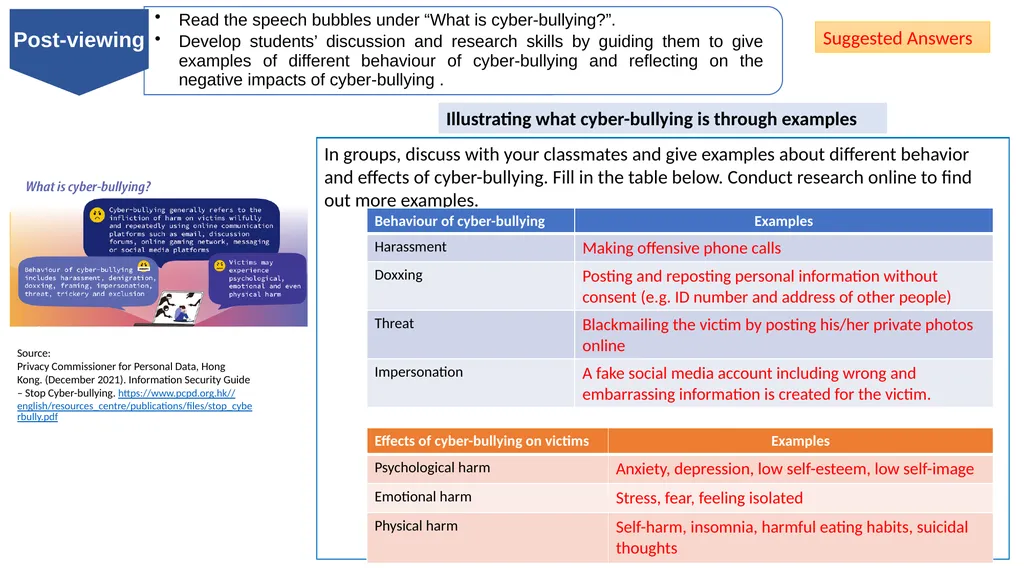
Illustrating what cyber-bullying is through examples Source:
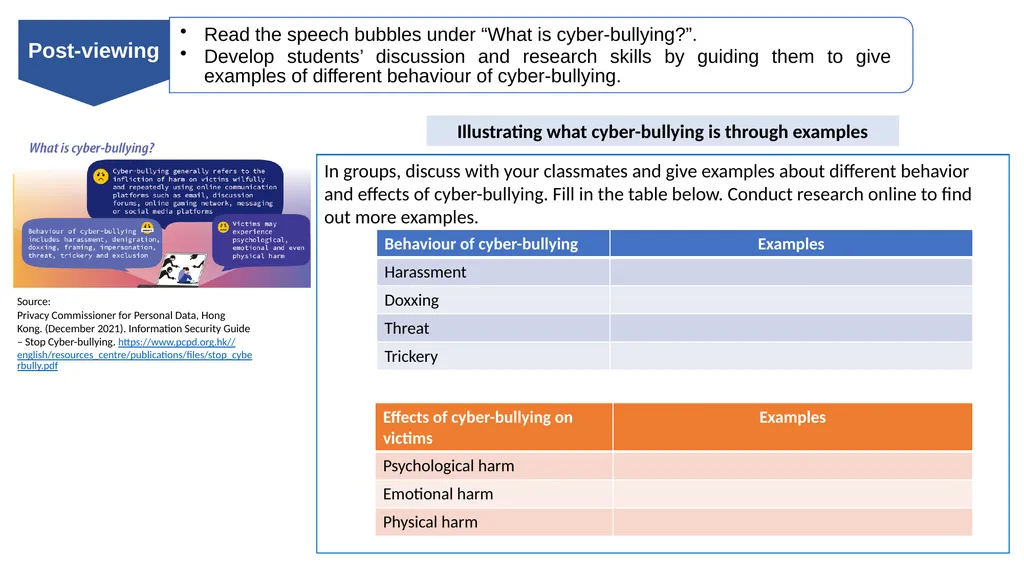
Privacy Commissioner for Personal Data, Hong Kong. (December 2021). Information Security Guide – Stop Cyber-bullying. https://www.pcpd.org.hk//english/resources_centre/publications/files/stop_cyberbully.pdf In groups, discuss with your classmates and give examples about different behavior and effects of cyber-bullying. Fill in the table below. Conduct research online to find out more examples. 12<br>
13
Illustrating what cyber-bullying is through examples Source:
Privacy Commissioner for Personal Data, Hong Kong. (December 2021). Information Security Guide – Stop Cyber-bullying. https://www.pcpd.org.hk//english/resources_centre/publications/files/stop_cyberbully.pdf In groups, discuss with your classmates and give examples about different behavior and effects of cyber-bullying. Fill in the table below. Conduct research online to find out more examples. 13 Suggested Answers<br>
14
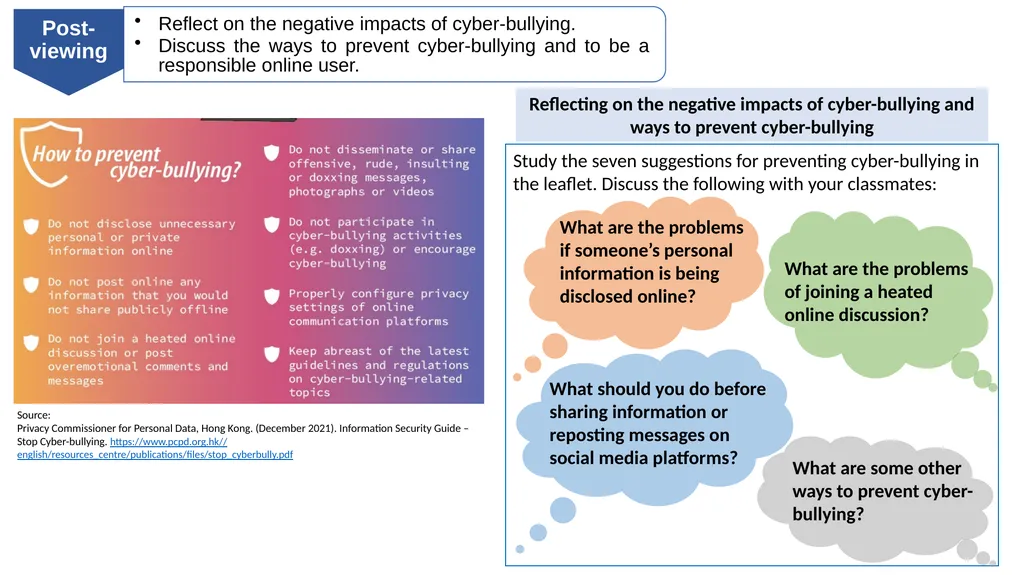
Source:
Privacy Commissioner for Personal Data, Hong Kong. (December 2021). Information Security Guide – Stop Cyber-bullying. https://www.pcpd.org.hk//english/resources_centre/publications/files/stop_cyberbully.pdf Reflecting on the negative impacts of cyber-bullying and ways to prevent cyber-bullying Study the seven suggestions for preventing cyber-bullying in the leaflet. Discuss the following with your classmates: What are the problems if someone’s personal information is being disclosed online? What should you do before sharing information or reposting messages on social media platforms? What are some other ways to prevent cyber-bullying? What are the problems of joining a heated online discussion?<br>
15
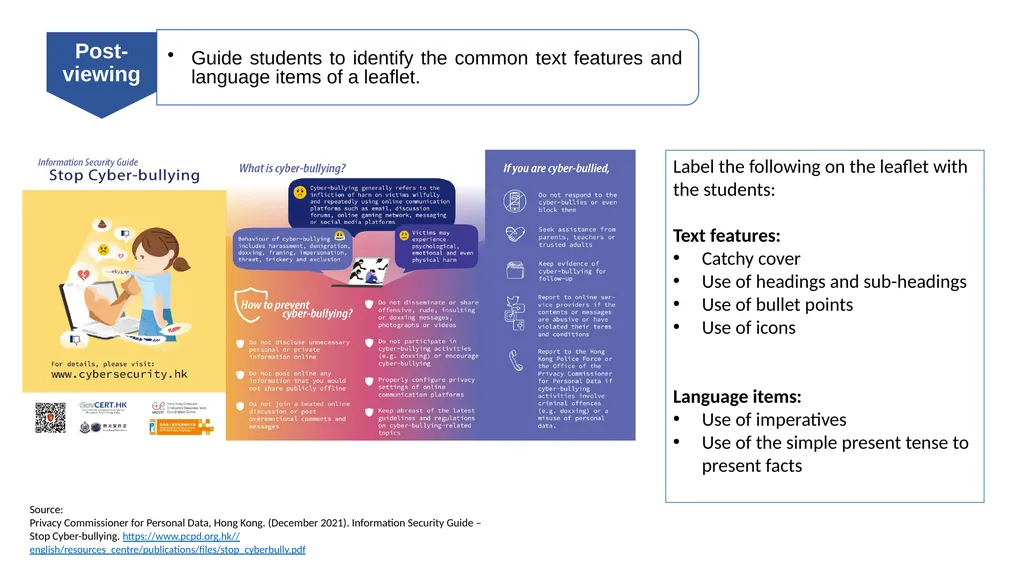
Label the following on the leaflet with the students:
Text features:
Catchy cover
Use of headings and sub-headings
Use of bullet points
Use of icons
Language items:
Use of imperatives
Use of the simple present tense to present facts Source:
Privacy Commissioner for Personal Data, Hong Kong. (December 2021). Information Security Guide – Stop Cyber-bullying. https://www.pcpd.org.hk//english/resources_centre/publications/files/stop_cyberbully.pdf<br>
16
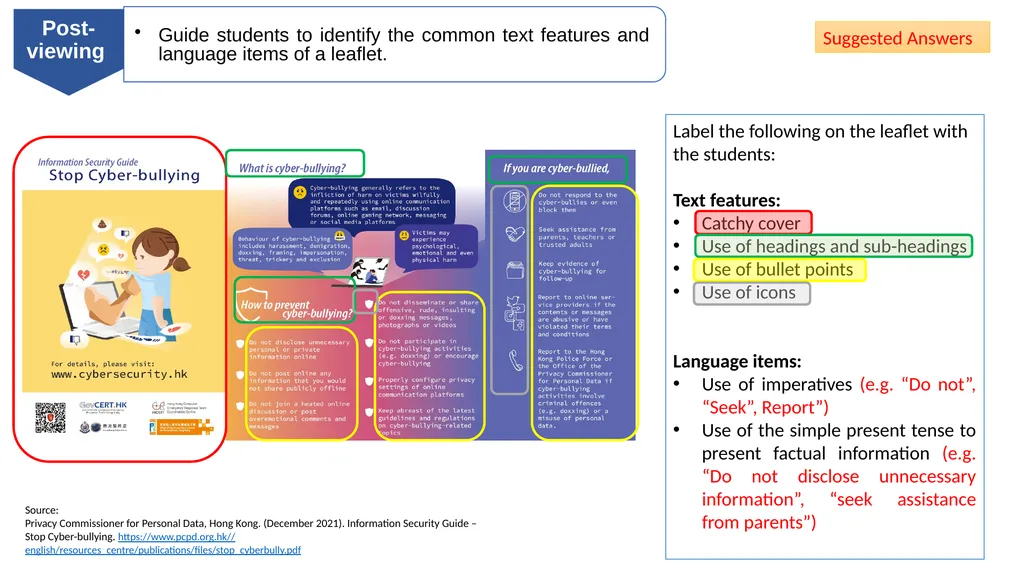
Label the following on the leaflet with the students:
Text features:
Catchy cover
Use of headings and sub-headings
Use of bullet points
Use of icons
Language items:
Use of imperatives (e.g. “Do not”, “Seek”, Report”)
Use of the simple present tense to present factual information (e.g. “Do not disclose unnecessary information”, “seek assistance from parents”) Suggested Answers Source:
Privacy Commissioner for Personal Data, Hong Kong. (December 2021). Information Security Guide – Stop Cyber-bullying. https://www.pcpd.org.hk//english/resources_centre/publications/files/stop_cyberbully.pdf<br>
17
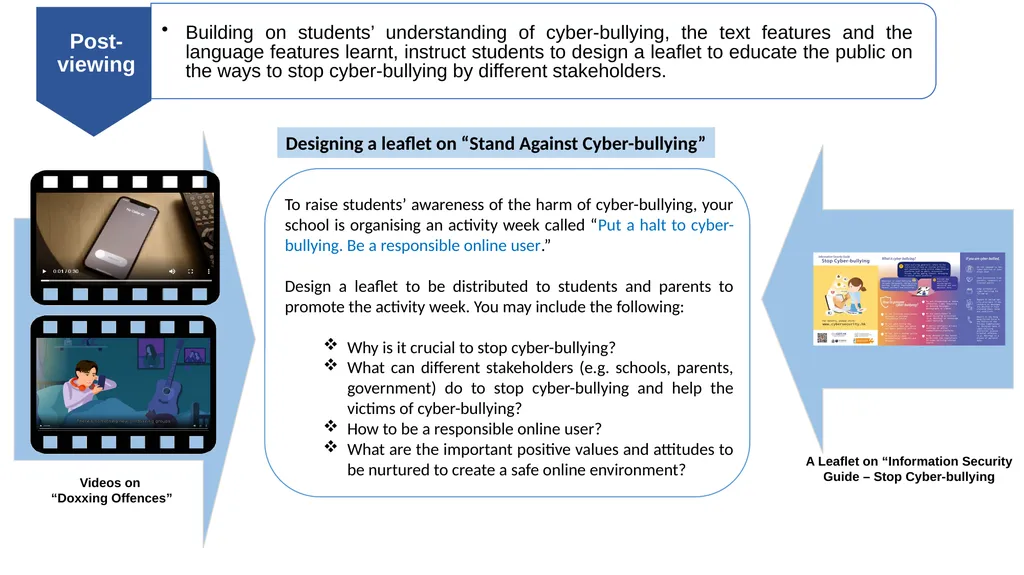
A Leaflet on “Information Security Guide – Stop Cyber-bullying To raise students’ awareness of the harm of cyber-bullying, your school is organising an activity week called “Put a halt to cyber-bullying. Be a responsible online user.”
Design a leaflet to be distributed to students and parents to promote the activity week. You may include the following:
Why is it crucial to stop cyber-bullying?
What can different stakeholders (e.g. schools, parents, government) do to stop cyber-bullying and help the victims of cyber-bullying?
How to be a responsible online user?
What are the important positive values and attitudes to be nurtured to create a safe online environment? Videos on
“Doxxing Offences” Designing a leaflet on “Stand Against Cyber-bullying”<br>