BEC 30325: MANAGERIAL ECONOMICS Introduction to Managerial Economics Session 01 Dr. Sumudu Perera Nature and scope of Managerial Economics Goals and Constraints of business organizations The Theory of the firm The nature and importance of
Related Topics
Share
Embed code
Download this presentation From Below
"BEC 30325: MANAGERIAL ECONOMICS Introduction to" is the property of its rightful owner. Permission is granted to
download and print the materials on this website for personal, non-commercial use only, and to display it
on your personal computer provided you do not modify the materials and that you retain all copyright
notices contained in the materials. By downloading content from our website, you accept the terms of this
agreement.
Presentation Transcript
01
BEC 30325: MANAGERIAL ECONOMICS Introduction to Managerial Economics Session 01 Dr. Sumudu Perera<br>
02
Nature and scope of Managerial Economics
Goals and Constraints of business organizations
The Theory of the firm
The nature and importance of profit
Economic Profit and Accounting Profit
Quantitative techniques in Managerial Economics Session Outline<br>
03
Managerial Economics Managerial Economics is the integration of economic theory with decision science tools, so as to make decision making effective and efficient.
The application of economic theory and the tools of decision science to examine how an organization can achieve its aims or objectives most efficiently.<br>
04
Managerial Economics deals with: “How decisions should be made by managers to achieve the firm’s goals-in particular, how to maximize profit”<br>
05
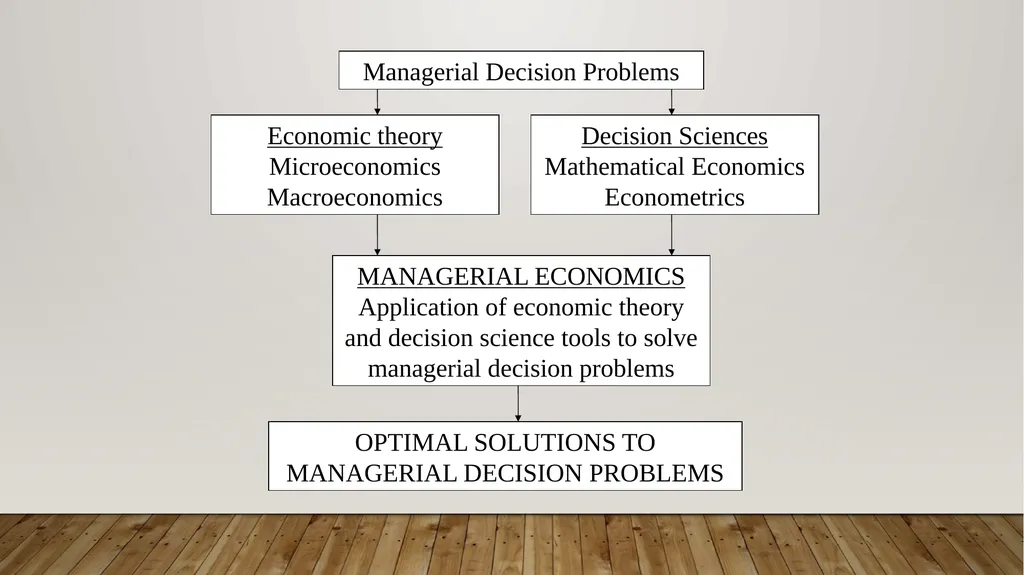
Managerial Decision Problems Economic theory Microeconomics Macroeconomics Decision Sciences Mathematical Economics Econometrics MANAGERIAL ECONOMICS Application of economic theory and decision science tools to solve managerial decision problems OPTIMAL SOLUTIONS TO MANAGERIAL DECISION PROBLEMS<br>
06
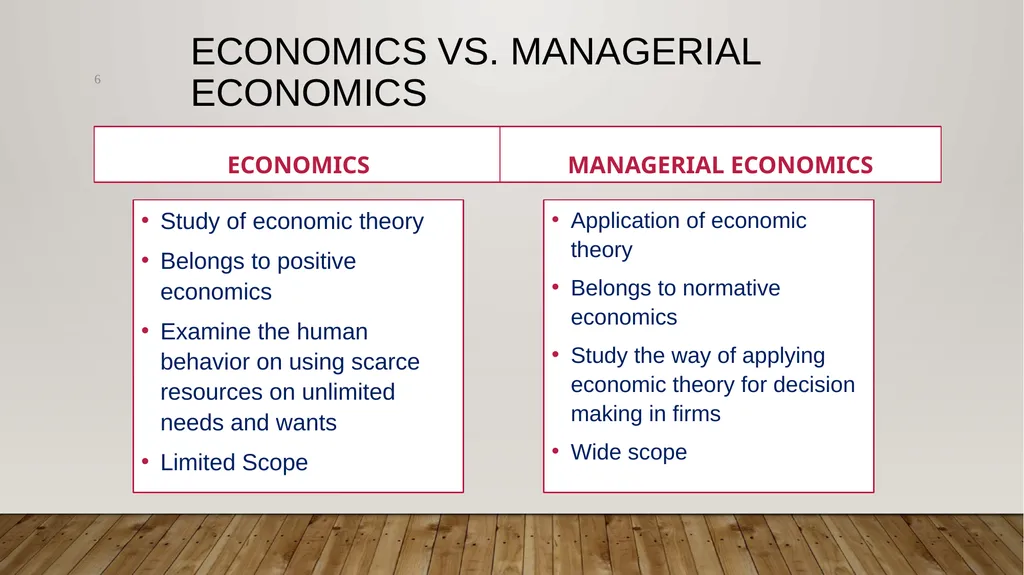
Economics Vs. Managerial Economics Economics Study of economic theory
Belongs to positive economics
Examine the human behavior on using scarce resources on unlimited needs and wants
Limited Scope Managerial Economics Application of economic theory
Belongs to normative economics
Study the way of applying economic theory for decision making in firms
Wide scope 6<br>
07
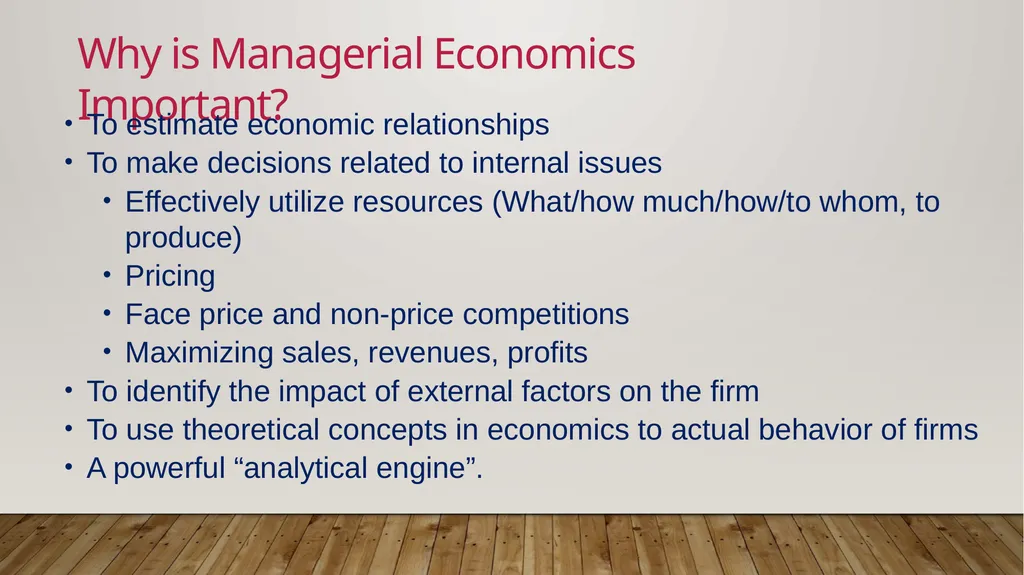
Why is Managerial Economics Important? To estimate economic relationships
To make decisions related to internal issues
Effectively utilize resources (What/how much/how/to whom, to produce)
Pricing
Face price and non-price competitions
Maximizing sales, revenues, profits
To identify the impact of external factors on the firm
To use theoretical concepts in economics to actual behavior of firms
A powerful “analytical engine”.<br>
08
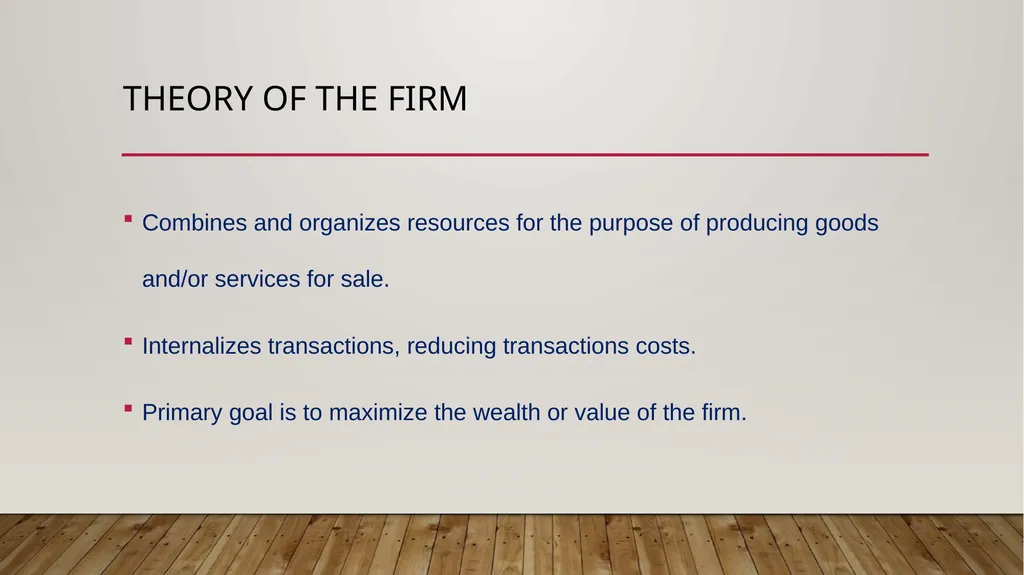
Theory of the Firm Combines and organizes resources for the purpose of producing goods and/or services for sale.
Internalizes transactions, reducing transactions costs.
Primary goal is to maximize the wealth or value of the firm.<br>
09
Example -Theory of the Firm Mr. Smith, an entrepreneur decides to set up a company by recruiting people to work for wages, by purchasing a property for the workplace machinery for the factory. He believes that it is very much efficient and less costly to run a business through a firm, rather than him doing everything alone.
He believes that a general contract agreed with laborers to perform a number of tasks for specific wages and benefits is less costly than specific contacts for each task undertaken.
He can also internalize many functions such as Finance, Marketing, IT, Research and Development etc without giving those tasks to external parties.<br>
10
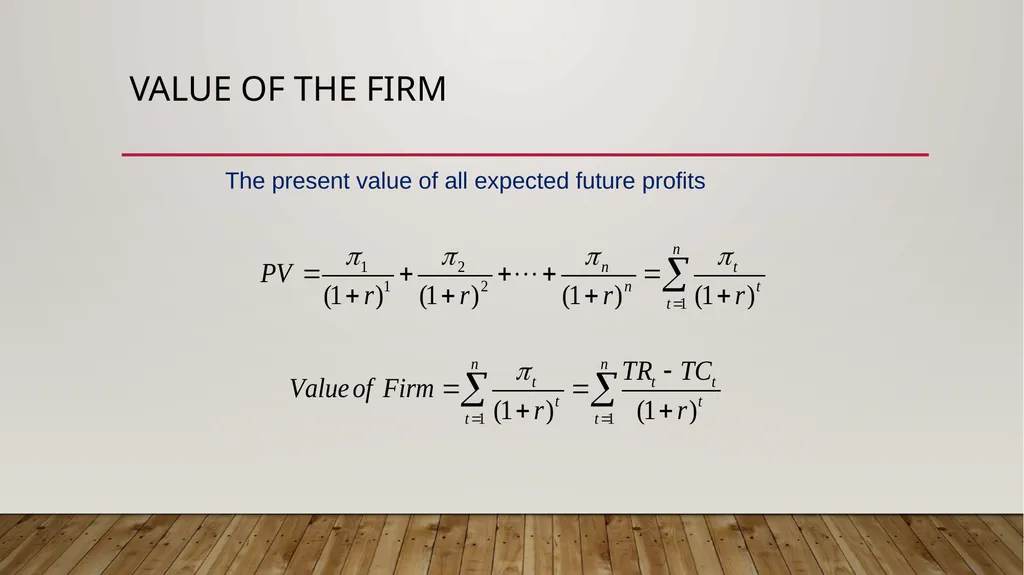
Value of the Firm The present value of all expected future profits<br>
11
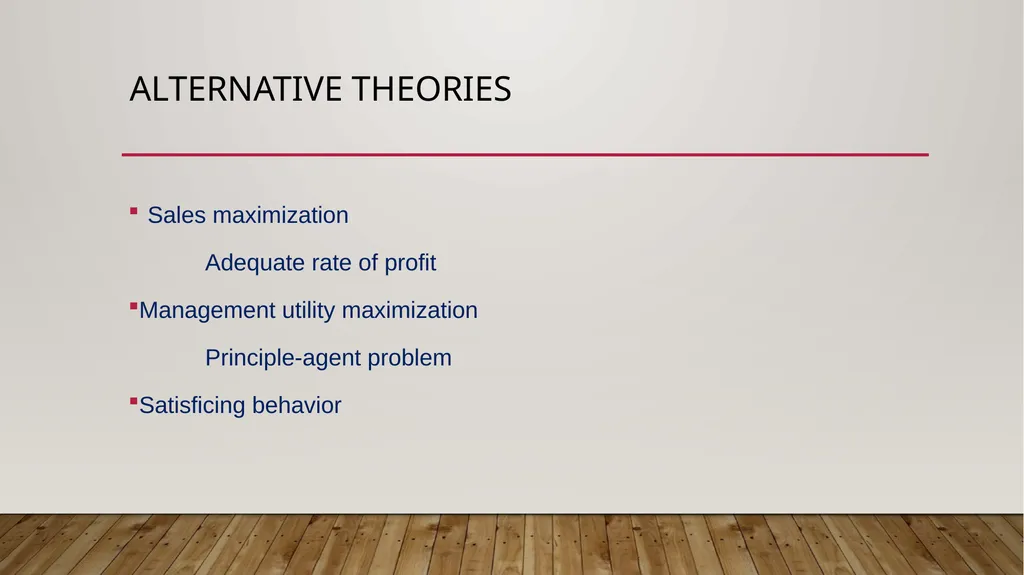
Alternative Theories Sales maximization
Adequate rate of profit
Management utility maximization
Principle-agent problem
Satisficing behavior<br>
12
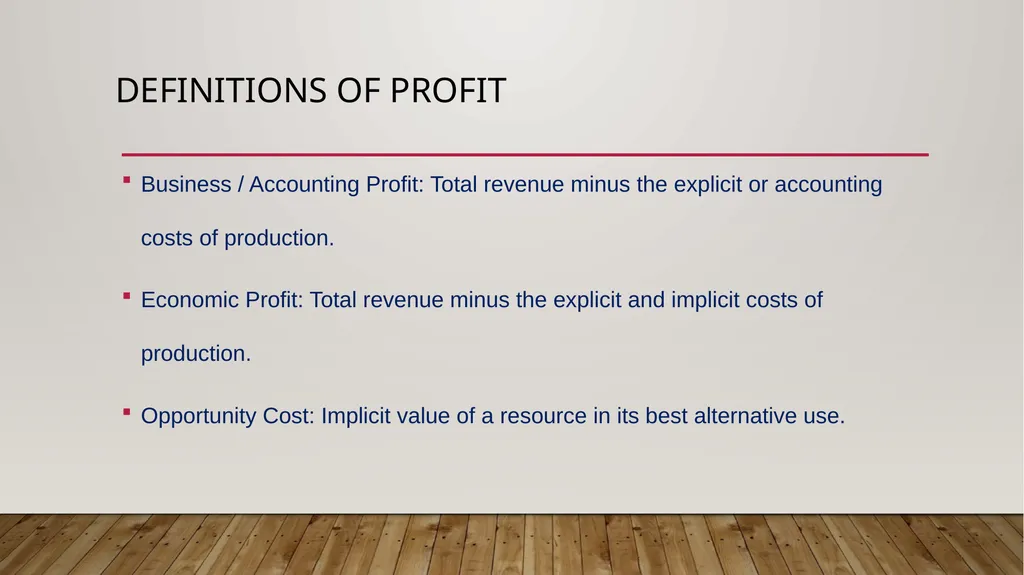
Definitions of Profit Business / Accounting Profit: Total revenue minus the explicit or accounting costs of production.
Economic Profit: Total revenue minus the explicit and implicit costs of production.
Opportunity Cost: Implicit value of a resource in its best alternative use.<br>
13
Example –Accounting vs Economic profit Maya is in the final year of the University and she has lectures only during the evening. Therefore she has free time to engage in an internship programme. She got the opportunity to work at a bank which pays Rs. 12000 per month. If she is to undertake the internship she has to incur extra travelling and food cost of Rs. 3000 per month. However Maya decides to bake cakes at home and sell for private parties. She earns Rs. 25000 per month by making cakes. The costs that she has to incur are given below;
Ingredients Rs.4000
Packaging Rs.500
Electricity Rs.250
Find out the accounting profit and economic profit of carrying out the cake business.<br>
14
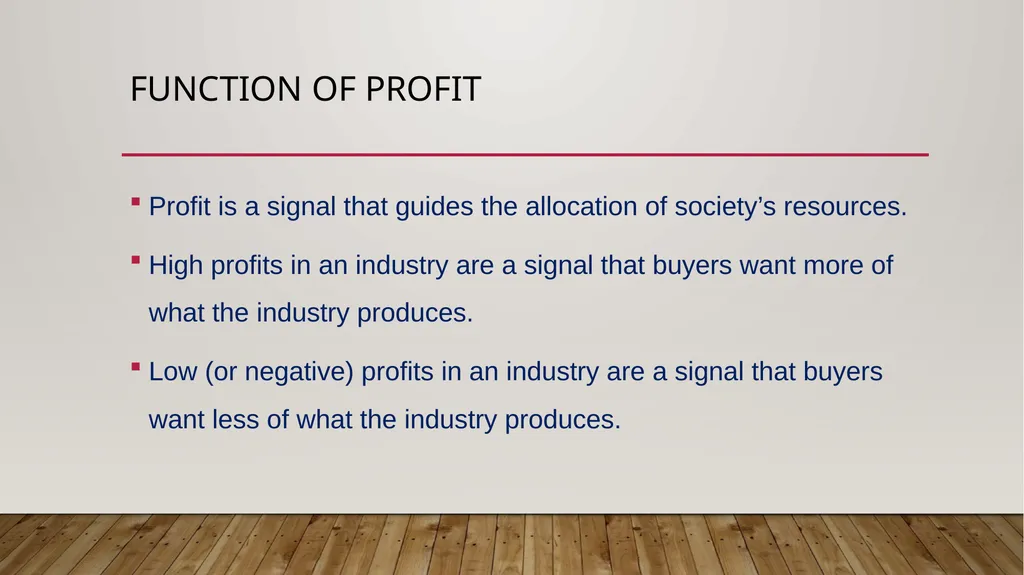
Function of Profit Profit is a signal that guides the allocation of society’s resources.
High profits in an industry are a signal that buyers want more of what the industry produces.
Low (or negative) profits in an industry are a signal that buyers want less of what the industry produces.<br>
15
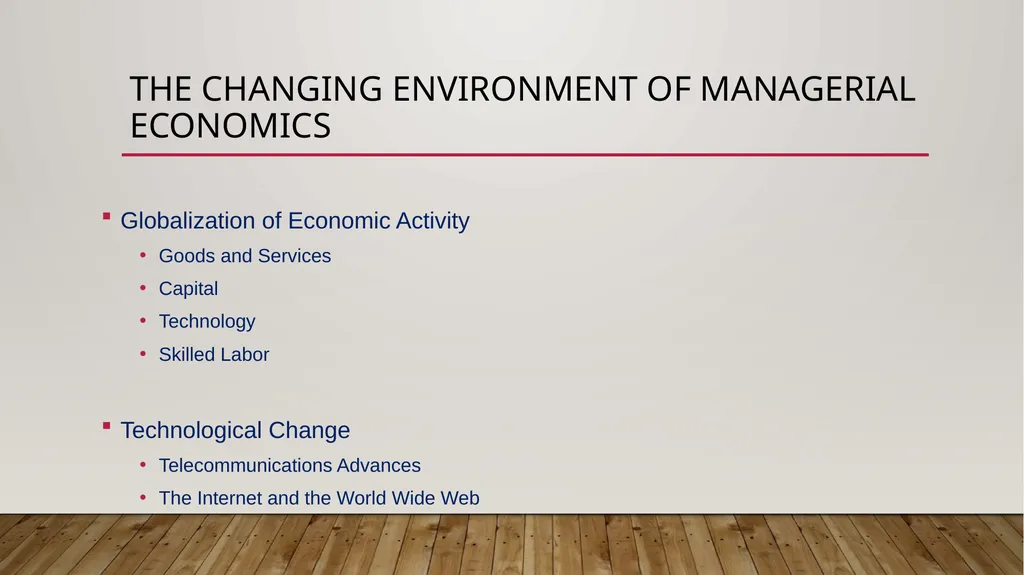
The Changing Environment of Managerial Economics Globalization of Economic Activity
Goods and Services
Capital
Technology
Skilled Labor
Technological Change
Telecommunications Advances
The Internet and the World Wide Web<br>
16
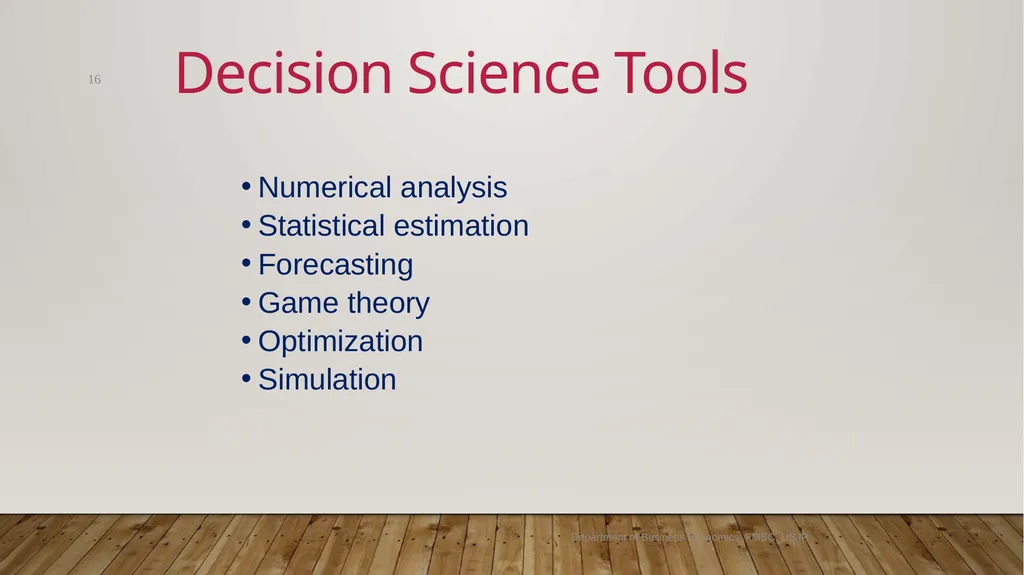
Numerical analysis
Statistical estimation
Forecasting
Game theory
Optimization
Simulation Decision Science Tools Department of Business Economics, FMSC, USJP 16<br>
17
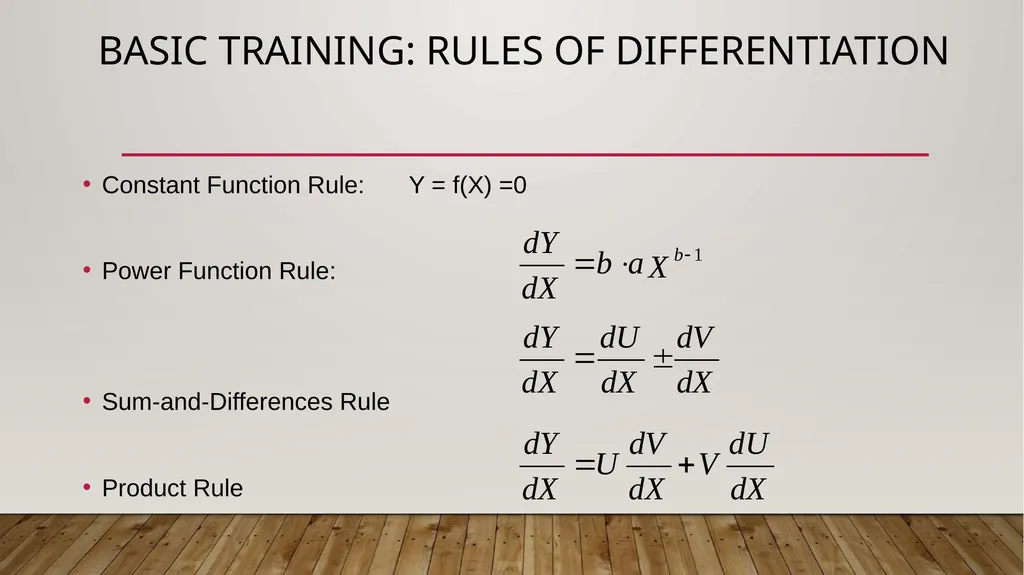
Basic Training: Rules of Differentiation Constant Function Rule: Y = f(X) =0