
Bedfordshire, Luton and Milton Keynes Draft
EM
Published · 35 slides · 0 views

1 / 1




Description
Bedfordshire, Luton and Milton Keynes Draft Framework and Plan for Health and Care Professional Leadership 1 May 2022 Contents Section 2: Draft Framework and Plan (Slides 8 19) - Vision Purpose - Our Health Care Professional
Related Topics
Share
Embed code
Download this presentation From Below
"Bedfordshire, Luton and Milton Keynes Draft" is the property of its rightful owner. Permission is granted to download and print the materials on this website for personal, non-commercial use only, and to display it on your personal computer provided you do not modify the materials and that you retain all copyright notices contained in the materials. By downloading content from our website, you accept the terms of this agreement.
Presentation Transcript
01
Bedfordshire, Luton and Milton Keynes
Draft Framework and Plan for Health and Care Professional Leadership 1 May 2022<br>
Draft Framework and Plan for Health and Care Professional Leadership 1 May 2022<br>
02
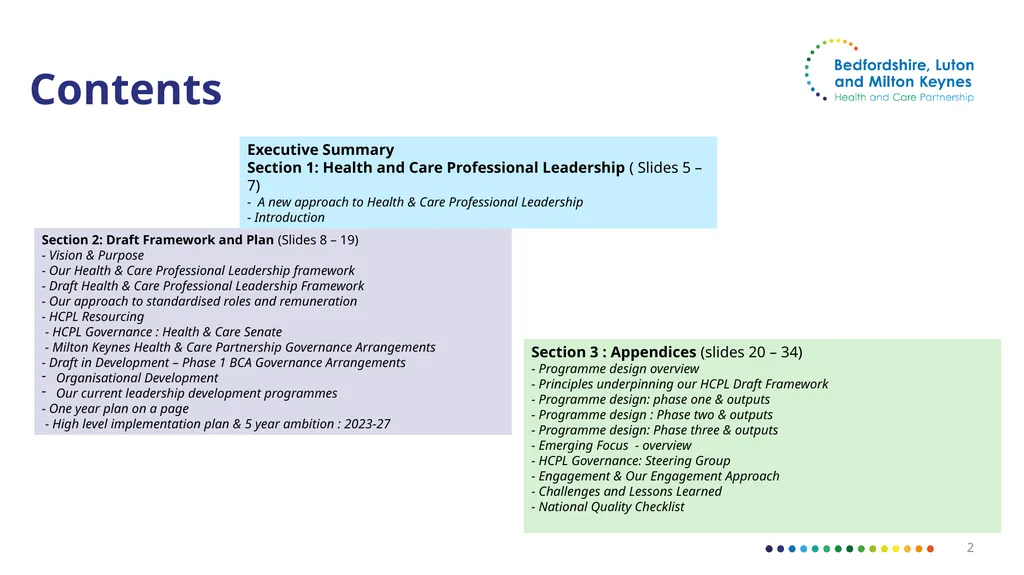
Contents Section 2: Draft Framework and Plan (Slides 8 – 19)
- Vision & Purpose
- Our Health & Care Professional Leadership framework
- Draft Health & Care Professional Leadership Framework
- Our approach to standardised roles and remuneration
- HCPL Resourcing
- HCPL Governance : Health & Care Senate
- Milton Keynes Health & Care Partnership Governance Arrangements
- Draft in Development – Phase 1 BCA Governance Arrangements
Organisational Development
Our current leadership development programmes
- One year plan on a page
- High level implementation plan & 5 year ambition : 2023-27 2 Section 3 : Appendices (slides 20 – 34)
- Programme design overview
- Principles underpinning our HCPL Draft Framework
- Programme design: phase one & outputs
- Programme design : Phase two & outputs
- Programme design: Phase three & outputs
- Emerging Focus - overview
- HCPL Governance: Steering Group
- Engagement & Our Engagement Approach
- Challenges and Lessons Learned
- National Quality Checklist Executive Summary
Section 1: Health and Care Professional Leadership ( Slides 5 – 7)
- A new approach to Health & Care Professional Leadership
- Introduction<br>
- Vision & Purpose
- Our Health & Care Professional Leadership framework
- Draft Health & Care Professional Leadership Framework
- Our approach to standardised roles and remuneration
- HCPL Resourcing
- HCPL Governance : Health & Care Senate
- Milton Keynes Health & Care Partnership Governance Arrangements
- Draft in Development – Phase 1 BCA Governance Arrangements
Organisational Development
Our current leadership development programmes
- One year plan on a page
- High level implementation plan & 5 year ambition : 2023-27 2 Section 3 : Appendices (slides 20 – 34)
- Programme design overview
- Principles underpinning our HCPL Draft Framework
- Programme design: phase one & outputs
- Programme design : Phase two & outputs
- Programme design: Phase three & outputs
- Emerging Focus - overview
- HCPL Governance: Steering Group
- Engagement & Our Engagement Approach
- Challenges and Lessons Learned
- National Quality Checklist Executive Summary
Section 1: Health and Care Professional Leadership ( Slides 5 – 7)
- A new approach to Health & Care Professional Leadership
- Introduction<br>
03
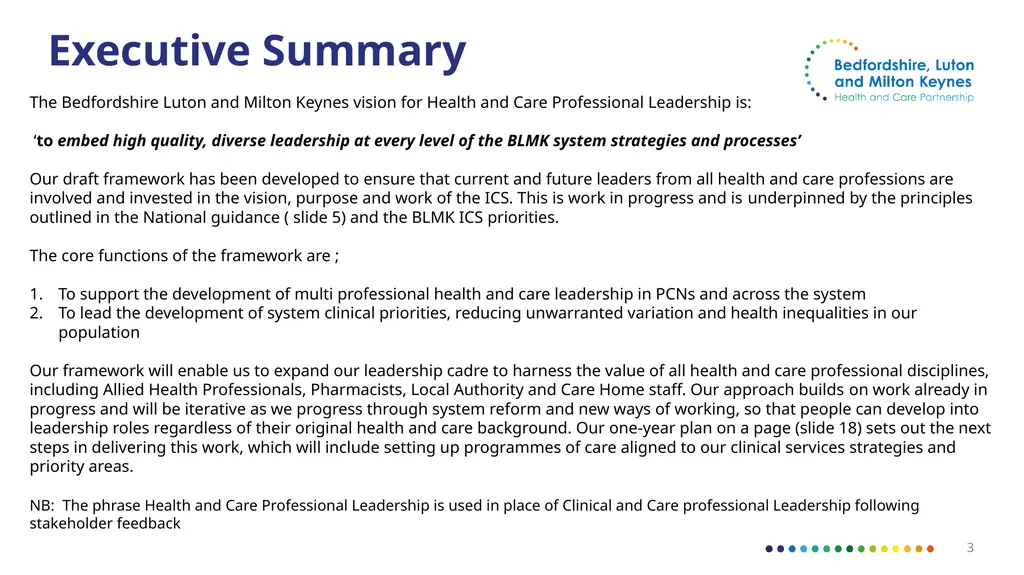
Executive Summary The Bedfordshire Luton and Milton Keynes vision for Health and Care Professional Leadership is:
‘to embed high quality, diverse leadership at every level of the BLMK system strategies and processes’
Our draft framework has been developed to ensure that current and future leaders from all health and care professions are involved and invested in the vision, purpose and work of the ICS. This is work in progress and is underpinned by the principles outlined in the National guidance ( slide 5) and the BLMK ICS priorities.
The core functions of the framework are ;
To support the development of multi professional health and care leadership in PCNs and across the system
To lead the development of system clinical priorities, reducing unwarranted variation and health inequalities in our population
Our framework will enable us to expand our leadership cadre to harness the value of all health and care professional disciplines, including Allied Health Professionals, Pharmacists, Local Authority and Care Home staff. Our approach builds on work already in progress and will be iterative as we progress through system reform and new ways of working, so that people can develop into leadership roles regardless of their original health and care background. Our one-year plan on a page (slide 18) sets out the next steps in delivering this work, which will include setting up programmes of care aligned to our clinical services strategies and priority areas.
NB: The phrase Health and Care Professional Leadership is used in place of Clinical and Care professional Leadership following stakeholder feedback 3<br>
‘to embed high quality, diverse leadership at every level of the BLMK system strategies and processes’
Our draft framework has been developed to ensure that current and future leaders from all health and care professions are involved and invested in the vision, purpose and work of the ICS. This is work in progress and is underpinned by the principles outlined in the National guidance ( slide 5) and the BLMK ICS priorities.
The core functions of the framework are ;
To support the development of multi professional health and care leadership in PCNs and across the system
To lead the development of system clinical priorities, reducing unwarranted variation and health inequalities in our population
Our framework will enable us to expand our leadership cadre to harness the value of all health and care professional disciplines, including Allied Health Professionals, Pharmacists, Local Authority and Care Home staff. Our approach builds on work already in progress and will be iterative as we progress through system reform and new ways of working, so that people can develop into leadership roles regardless of their original health and care background. Our one-year plan on a page (slide 18) sets out the next steps in delivering this work, which will include setting up programmes of care aligned to our clinical services strategies and priority areas.
NB: The phrase Health and Care Professional Leadership is used in place of Clinical and Care professional Leadership following stakeholder feedback 3<br>
04
Section 1: Health and Care Professional Leadership A new approach to Health and Care Professional Leadership 4<br>
05
A new approach to Health and Care Professional Leadership In September 2021 National guidance ‘Building strong integrated care systems everywhere: ICS implementation guidance on effective clinical and care professional leadership’, https://www.england.nhs.uk/wp-content/uploads/2021/06/B0664-ics-clinical-and-care-professional-leadership.pdf
was published setting out two expectations and five core principles for effective clinical and care professional leadership. These are outlined below: Agree a local framework and plan for health and care professional leadership with ICS partners and ensure promotion across system To ensure leaders from all health and care professions are involved and invested in the vision, purpose and work of the ICS Integrating health and care professionals in decision-making at every level of the ICS
Creating a culture of shared learning, collaboration and innovation, working alongside patients and local communities
Ensuring our health and care professional leaders have appropriate resources to carry out
their system role(s)
4. Identifying, recruiting and creating a pipeline of health and care professional leaders
5. Providing dedicated leadership development for all health and care professionals 5<br>
was published setting out two expectations and five core principles for effective clinical and care professional leadership. These are outlined below: Agree a local framework and plan for health and care professional leadership with ICS partners and ensure promotion across system To ensure leaders from all health and care professions are involved and invested in the vision, purpose and work of the ICS Integrating health and care professionals in decision-making at every level of the ICS
Creating a culture of shared learning, collaboration and innovation, working alongside patients and local communities
Ensuring our health and care professional leaders have appropriate resources to carry out
their system role(s)
4. Identifying, recruiting and creating a pipeline of health and care professional leaders
5. Providing dedicated leadership development for all health and care professionals 5<br>
06
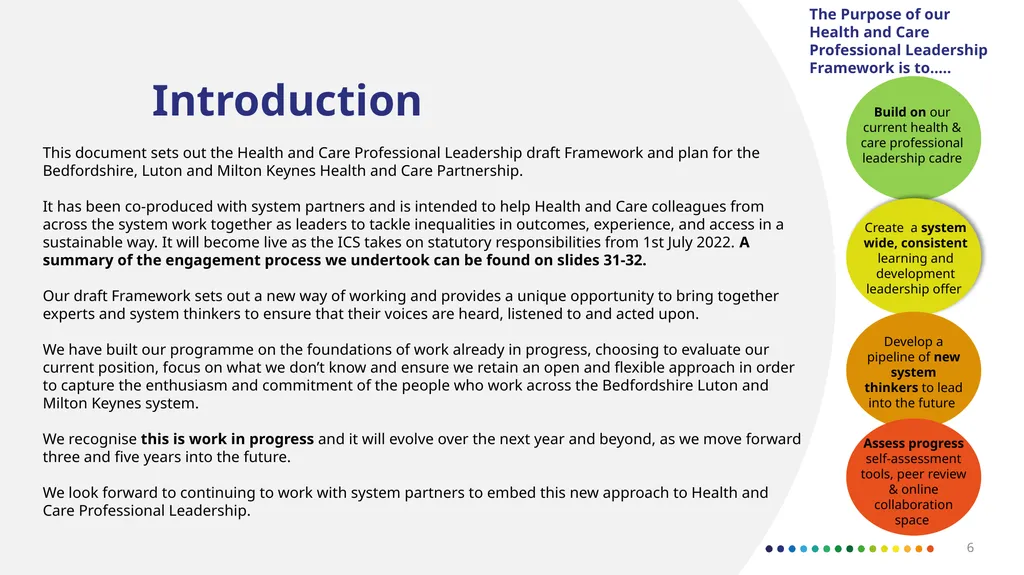
Introduction This document sets out the Health and Care Professional Leadership draft Framework and plan for the Bedfordshire, Luton and Milton Keynes Health and Care Partnership.
It has been co-produced with system partners and is intended to help Health and Care colleagues from across the system work together as leaders to tackle inequalities in outcomes, experience, and access in a sustainable way. It will become live as the ICS takes on statutory responsibilities from 1st July 2022. A summary of the engagement process we undertook can be found on slides 31-32.
Our draft Framework sets out a new way of working and provides a unique opportunity to bring together experts and system thinkers to ensure that their voices are heard, listened to and acted upon.
We have built our programme on the foundations of work already in progress, choosing to evaluate our current position, focus on what we don’t know and ensure we retain an open and flexible approach in order to capture the enthusiasm and commitment of the people who work across the Bedfordshire Luton and Milton Keynes system.
We recognise this is work in progress and it will evolve over the next year and beyond, as we move forward three and five years into the future.
We look forward to continuing to work with system partners to embed this new approach to Health and Care Professional Leadership. The Purpose of our Health and Care Professional Leadership Framework is to….. Assess progress self-assessment tools, peer review & online collaboration space Develop a pipeline of new system thinkers to lead into the future Create a system wide, consistent learning and development leadership offer Build on our current health & care professional leadership cadre 6<br>
It has been co-produced with system partners and is intended to help Health and Care colleagues from across the system work together as leaders to tackle inequalities in outcomes, experience, and access in a sustainable way. It will become live as the ICS takes on statutory responsibilities from 1st July 2022. A summary of the engagement process we undertook can be found on slides 31-32.
Our draft Framework sets out a new way of working and provides a unique opportunity to bring together experts and system thinkers to ensure that their voices are heard, listened to and acted upon.
We have built our programme on the foundations of work already in progress, choosing to evaluate our current position, focus on what we don’t know and ensure we retain an open and flexible approach in order to capture the enthusiasm and commitment of the people who work across the Bedfordshire Luton and Milton Keynes system.
We recognise this is work in progress and it will evolve over the next year and beyond, as we move forward three and five years into the future.
We look forward to continuing to work with system partners to embed this new approach to Health and Care Professional Leadership. The Purpose of our Health and Care Professional Leadership Framework is to….. Assess progress self-assessment tools, peer review & online collaboration space Develop a pipeline of new system thinkers to lead into the future Create a system wide, consistent learning and development leadership offer Build on our current health & care professional leadership cadre 6<br>
07
Section 2 : Draft Framework and Plan A new approach to health and care professional leadership 7<br>
08
8 Our vision
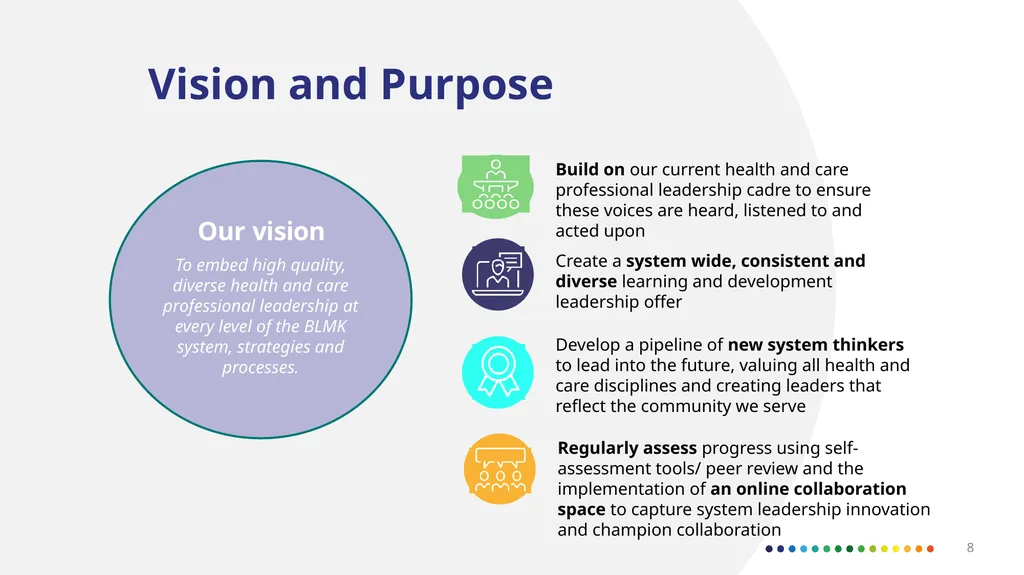
To embed high quality, diverse health and care professional leadership at every level of the BLMK system, strategies and processes. Build on our current health and care professional leadership cadre to ensure these voices are heard, listened to and acted upon Create a system wide, consistent and diverse learning and development leadership offer Develop a pipeline of new system thinkers to lead into the future, valuing all health and care disciplines and creating leaders that reflect the community we serve Regularly assess progress using self-assessment tools/ peer review and the implementation of an online collaboration space to capture system leadership innovation and champion collaboration Vision and Purpose 2<br>
To embed high quality, diverse health and care professional leadership at every level of the BLMK system, strategies and processes. Build on our current health and care professional leadership cadre to ensure these voices are heard, listened to and acted upon Create a system wide, consistent and diverse learning and development leadership offer Develop a pipeline of new system thinkers to lead into the future, valuing all health and care disciplines and creating leaders that reflect the community we serve Regularly assess progress using self-assessment tools/ peer review and the implementation of an online collaboration space to capture system leadership innovation and champion collaboration Vision and Purpose 2<br>
09
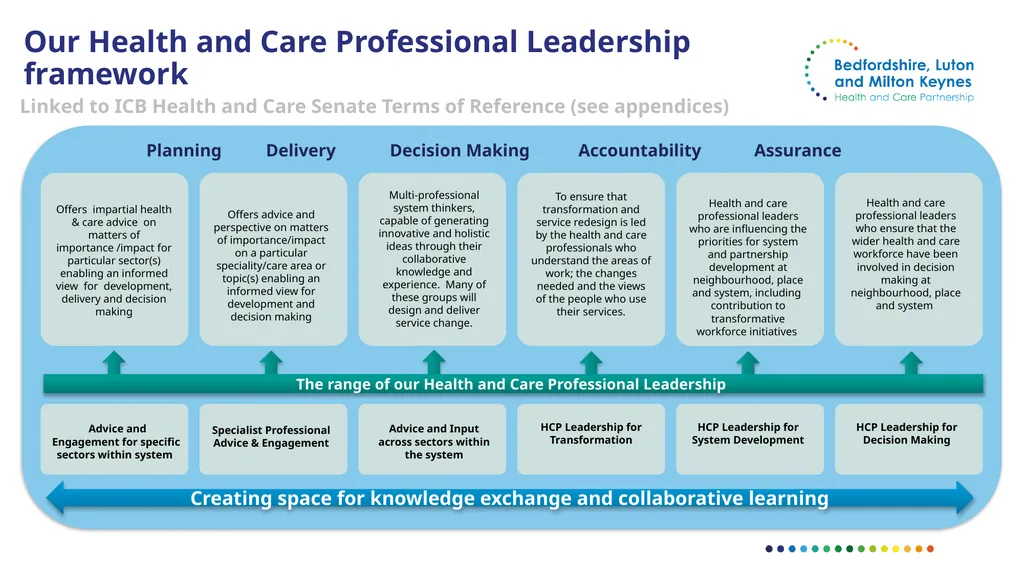
Our Health and Care Professional Leadership framework 9 Advice and Engagement for specific sectors within system Specialist Professional Advice & Engagement Advice and Input across sectors within the system HCP Leadership for Transformation HCP Leadership for System Development HCP Leadership for Decision Making The range of our Health and Care Professional Leadership Creating space for knowledge exchange and collaborative learning Planning Delivery Decision Making Accountability Assurance Linked to ICB Health and Care Senate Terms of Reference (see appendices)<br>
10
Draft Health & Care Professional Leadership Framework 10 Medical Director
Director of Nursing, ICB Professional Leads Health and Care Professional Leadership
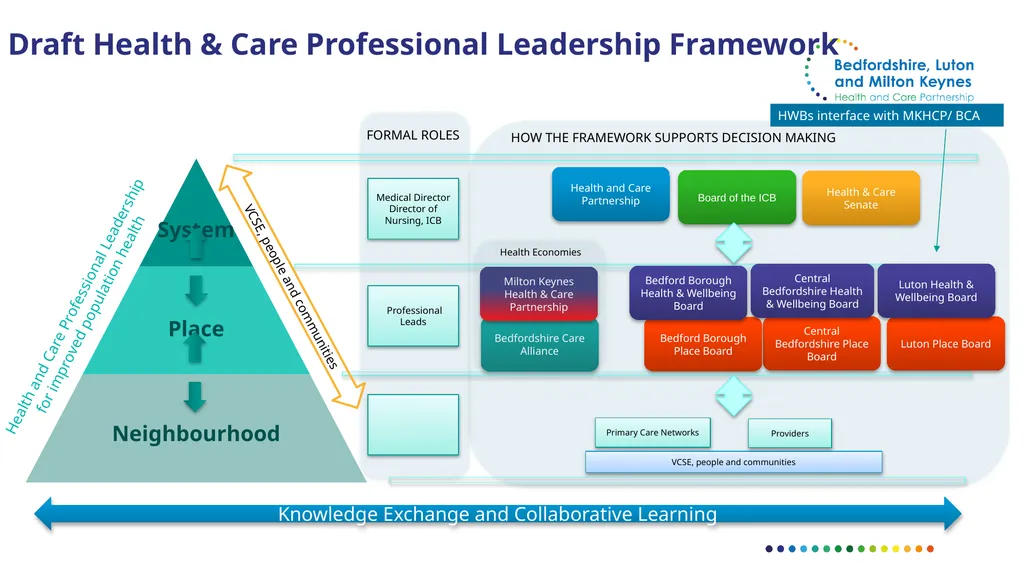
for improved population health Primary Care Networks Knowledge Exchange and Collaborative Learning FORMAL ROLES How the framework supports decision making Central Bedfordshire Place Board Luton Place Board Bedford Borough Place Board Health and Care Partnership Board of the ICB Bedfordshire Care Alliance Health & Care Senate Bedford Borough Health & Wellbeing Board Central Bedfordshire Health & Wellbeing Board Luton Health & Wellbeing Board VCSE, people and communities Milton Keynes Health & Care Partnership VCSE, people and communities Providers HWBs interface with MKHCP/ BCA Health Economies<br>
Director of Nursing, ICB Professional Leads Health and Care Professional Leadership
for improved population health Primary Care Networks Knowledge Exchange and Collaborative Learning FORMAL ROLES How the framework supports decision making Central Bedfordshire Place Board Luton Place Board Bedford Borough Place Board Health and Care Partnership Board of the ICB Bedfordshire Care Alliance Health & Care Senate Bedford Borough Health & Wellbeing Board Central Bedfordshire Health & Wellbeing Board Luton Health & Wellbeing Board VCSE, people and communities Milton Keynes Health & Care Partnership VCSE, people and communities Providers HWBs interface with MKHCP/ BCA Health Economies<br>
11
Future Leadership roles will need to:
Support quality improvements
Manage variation
Identify more efficient ways of working
Help address inequalities Standardised role descriptions
We have developed draft standardised role descriptions and our aim is to introduce these across all HCPLs.
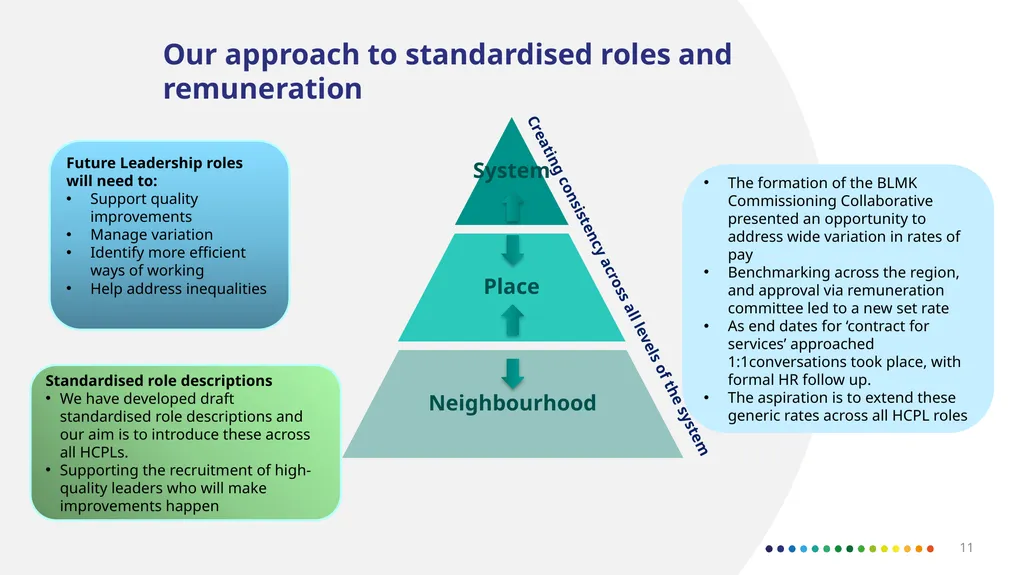
Supporting the recruitment of high-quality leaders who will make improvements happen Our approach to standardised roles and remuneration 11 The formation of the BLMK Commissioning Collaborative presented an opportunity to address wide variation in rates of pay
Benchmarking across the region, and approval via remuneration committee led to a new set rate
As end dates for ‘contract for services’ approached 1:1conversations took place, with formal HR follow up.
The aspiration is to extend these generic rates across all HCPL roles Creating consistency across all levels of the system<br>
Support quality improvements
Manage variation
Identify more efficient ways of working
Help address inequalities Standardised role descriptions
We have developed draft standardised role descriptions and our aim is to introduce these across all HCPLs.
Supporting the recruitment of high-quality leaders who will make improvements happen Our approach to standardised roles and remuneration 11 The formation of the BLMK Commissioning Collaborative presented an opportunity to address wide variation in rates of pay
Benchmarking across the region, and approval via remuneration committee led to a new set rate
As end dates for ‘contract for services’ approached 1:1conversations took place, with formal HR follow up.
The aspiration is to extend these generic rates across all HCPL roles Creating consistency across all levels of the system<br>
12
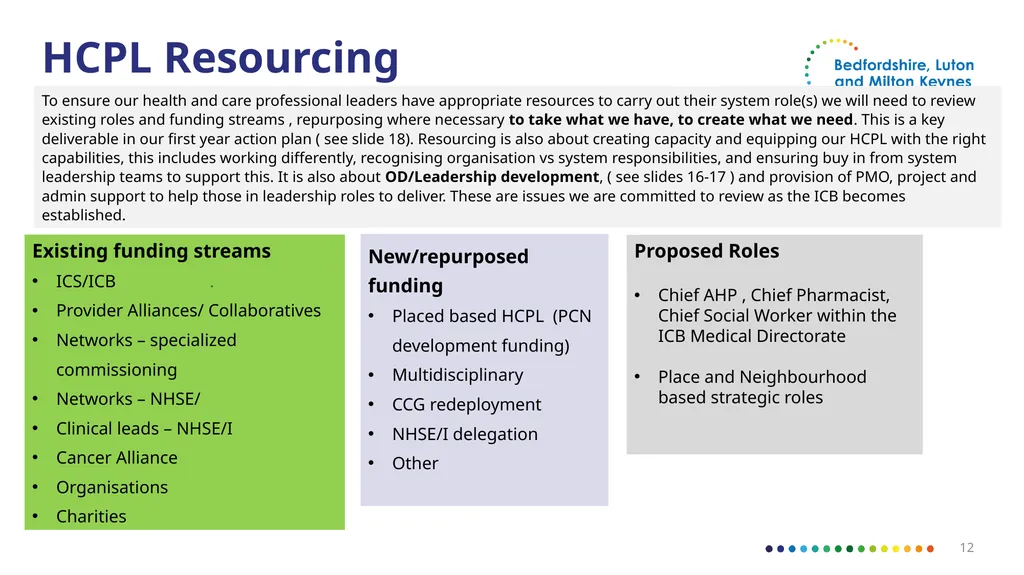
HCPL Resourcing Existing funding streams
ICS/ICB .
Provider Alliances/ Collaboratives
Networks – specialized commissioning
Networks – NHSE/
Clinical leads – NHSE/I
Cancer Alliance
Organisations
Charities New/repurposed funding
Placed based HCPL (PCN development funding)
Multidisciplinary
CCG redeployment
NHSE/I delegation
Other To ensure our health and care professional leaders have appropriate resources to carry out their system role(s) we will need to review existing roles and funding streams , repurposing where necessary to take what we have, to create what we need. This is a key deliverable in our first year action plan ( see slide 18). Resourcing is also about creating capacity and equipping our HCPL with the right capabilities, this includes working differently, recognising organisation vs system responsibilities, and ensuring buy in from system leadership teams to support this. It is also about OD/Leadership development, ( see slides 16-17 ) and provision of PMO, project and admin support to help those in leadership roles to deliver. These are issues we are committed to review as the ICB becomes established. 12 Proposed Roles
Chief AHP , Chief Pharmacist, Chief Social Worker within the ICB Medical Directorate
Place and Neighbourhood based strategic roles<br>
ICS/ICB .
Provider Alliances/ Collaboratives
Networks – specialized commissioning
Networks – NHSE/
Clinical leads – NHSE/I
Cancer Alliance
Organisations
Charities New/repurposed funding
Placed based HCPL (PCN development funding)
Multidisciplinary
CCG redeployment
NHSE/I delegation
Other To ensure our health and care professional leaders have appropriate resources to carry out their system role(s) we will need to review existing roles and funding streams , repurposing where necessary to take what we have, to create what we need. This is a key deliverable in our first year action plan ( see slide 18). Resourcing is also about creating capacity and equipping our HCPL with the right capabilities, this includes working differently, recognising organisation vs system responsibilities, and ensuring buy in from system leadership teams to support this. It is also about OD/Leadership development, ( see slides 16-17 ) and provision of PMO, project and admin support to help those in leadership roles to deliver. These are issues we are committed to review as the ICB becomes established. 12 Proposed Roles
Chief AHP , Chief Pharmacist, Chief Social Worker within the ICB Medical Directorate
Place and Neighbourhood based strategic roles<br>
13
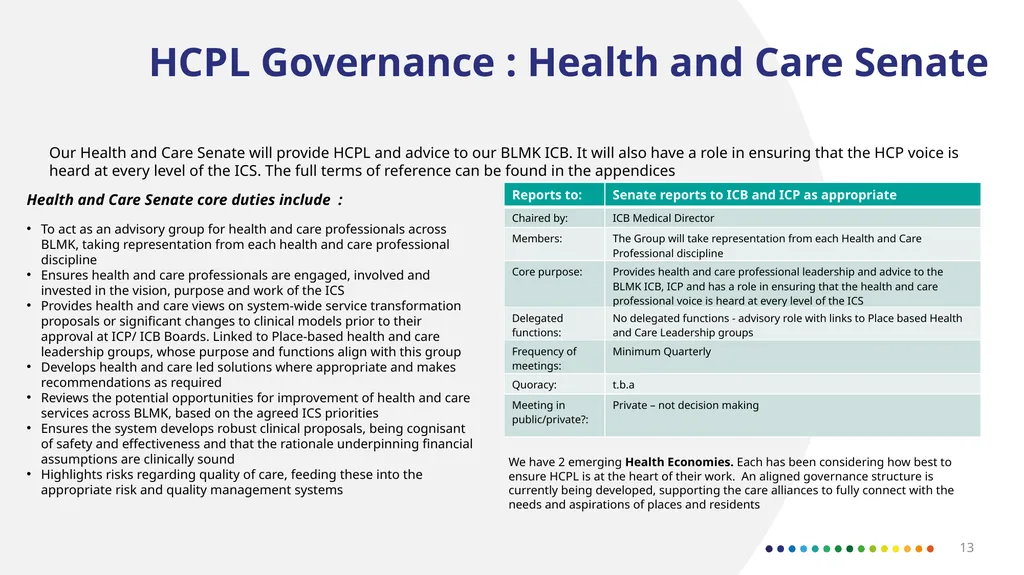
HCPL Governance : Health and Care Senate 13 Our Health and Care Senate will provide HCPL and advice to our BLMK ICB. It will also have a role in ensuring that the HCP voice is heard at every level of the ICS. The full terms of reference can be found in the appendices Health and Care Senate core duties include :
To act as an advisory group for health and care professionals across BLMK, taking representation from each health and care professional discipline
Ensures health and care professionals are engaged, involved and invested in the vision, purpose and work of the ICS
Provides health and care views on system-wide service transformation proposals or significant changes to clinical models prior to their approval at ICP/ ICB Boards. Linked to Place-based health and care leadership groups, whose purpose and functions align with this group
Develops health and care led solutions where appropriate and makes recommendations as required
Reviews the potential opportunities for improvement of health and care services across BLMK, based on the agreed ICS priorities
Ensures the system develops robust clinical proposals, being cognisant of safety and effectiveness and that the rationale underpinning financial assumptions are clinically sound
Highlights risks regarding quality of care, feeding these into the appropriate risk and quality management systems We have 2 emerging Health Economies. Each has been considering how best to ensure HCPL is at the heart of their work. An aligned governance structure is currently being developed, supporting the care alliances to fully connect with the needs and aspirations of places and residents<br>
To act as an advisory group for health and care professionals across BLMK, taking representation from each health and care professional discipline
Ensures health and care professionals are engaged, involved and invested in the vision, purpose and work of the ICS
Provides health and care views on system-wide service transformation proposals or significant changes to clinical models prior to their approval at ICP/ ICB Boards. Linked to Place-based health and care leadership groups, whose purpose and functions align with this group
Develops health and care led solutions where appropriate and makes recommendations as required
Reviews the potential opportunities for improvement of health and care services across BLMK, based on the agreed ICS priorities
Ensures the system develops robust clinical proposals, being cognisant of safety and effectiveness and that the rationale underpinning financial assumptions are clinically sound
Highlights risks regarding quality of care, feeding these into the appropriate risk and quality management systems We have 2 emerging Health Economies. Each has been considering how best to ensure HCPL is at the heart of their work. An aligned governance structure is currently being developed, supporting the care alliances to fully connect with the needs and aspirations of places and residents<br>
14
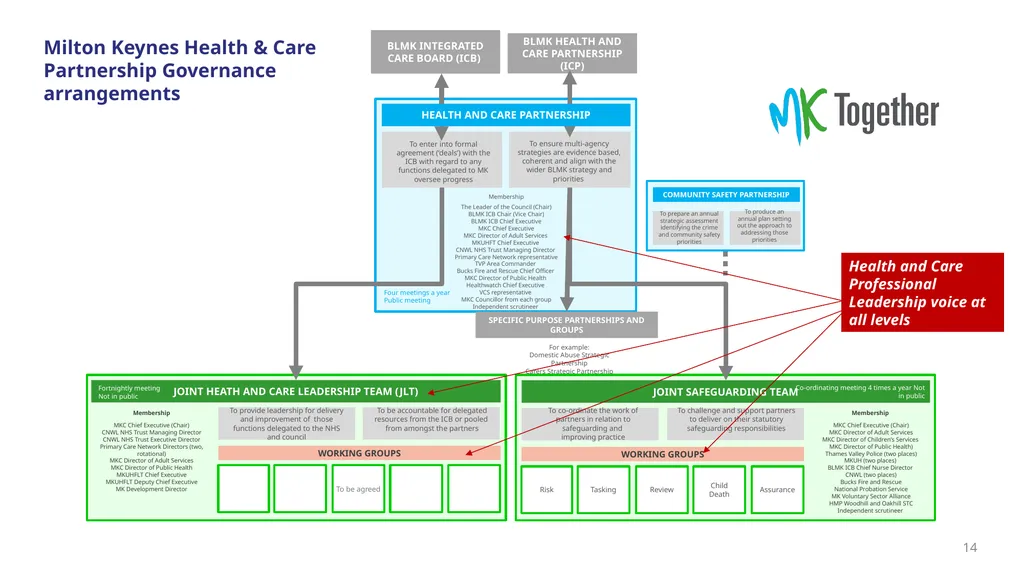
Membership
The Leader of the Council (Chair)
BLMK ICB Chair (Vice Chair)
BLMK ICB Chief Executive
MKC Chief Executive
MKC Director of Adult Services
MKUHFT Chief Executive
CNWL NHS Trust Managing Director
Primary Care Network representative
TVP Area Commander
Bucks Fire and Rescue Chief Officer
MKC Director of Public Health
Healthwatch Chief Executive
VCS representative
MKC Councillor from each group
Independent scrutineer BLMK INTEGRATED CARE BOARD (ICB) BLMK HEALTH AND CARE PARTNERSHIP (ICP) JOINT HEATH AND CARE LEADERSHIP TEAM (JLT) Membership
MKC Chief Executive (Chair)
CNWL NHS Trust Managing Director
CNWL NHS Trust Executive Director
Primary Care Network Directors (two, rotational)
MKC Director of Adult Services
MKC Director of Public Health
MKUHFLT Chief Executive
MKUHFLT Deputy Chief Executive
MK Development Director To ensure multi-agency strategies are evidence based, coherent and align with the wider BLMK strategy and priorities To enter into formal agreement (‘deals’) with the ICB with regard to any functions delegated to MK oversee progress To provide leadership for delivery and improvement of those functions delegated to the NHS and council SPECIFIC PURPOSE PARTNERSHIPS AND GROUPS For example:
Domestic Abuse Strategic Partnership
Carers Strategic Partnership JOINT SAFEGUARDING TEAM Membership
MKC Chief Executive (Chair)
MKC Director of Adult Services
MKC Director of Children’s Services
MKC Director of Public Health)
Thames Valley Police (two places)
MKUH (two places)
BLMK ICB Chief Nurse Director
CNWL (two places)
Bucks Fire and Rescue
National Probation Service
MK Voluntary Sector Alliance
HMP Woodhill and Oakhill STC
Independent scrutineer To be accountable for delegated resources from the ICB or pooled
from amongst the partners To co-ordinate the work of partners in relation to safeguarding and
improving practice To challenge and support partners to deliver on their statutory safeguarding responsibilities Risk Tasking Review Child Death Assurance WORKING GROUPS COMMUNITY SAFETY PARTNERSHIP To prepare an annual strategic assessment identifying the crime and community safety priorities To produce an annual plan setting out the approach to addressing those priorities HEALTH AND CARE PARTNERSHIP Fortnightly meeting
Not in public Co-ordinating meeting 4 times a year Not in public Four meetings a year
Public meeting WORKING GROUPS To be agreed Health and Care Professional Leadership voice at all levels 14 Milton Keynes Health & Care Partnership Governance arrangements<br>
The Leader of the Council (Chair)
BLMK ICB Chair (Vice Chair)
BLMK ICB Chief Executive
MKC Chief Executive
MKC Director of Adult Services
MKUHFT Chief Executive
CNWL NHS Trust Managing Director
Primary Care Network representative
TVP Area Commander
Bucks Fire and Rescue Chief Officer
MKC Director of Public Health
Healthwatch Chief Executive
VCS representative
MKC Councillor from each group
Independent scrutineer BLMK INTEGRATED CARE BOARD (ICB) BLMK HEALTH AND CARE PARTNERSHIP (ICP) JOINT HEATH AND CARE LEADERSHIP TEAM (JLT) Membership
MKC Chief Executive (Chair)
CNWL NHS Trust Managing Director
CNWL NHS Trust Executive Director
Primary Care Network Directors (two, rotational)
MKC Director of Adult Services
MKC Director of Public Health
MKUHFLT Chief Executive
MKUHFLT Deputy Chief Executive
MK Development Director To ensure multi-agency strategies are evidence based, coherent and align with the wider BLMK strategy and priorities To enter into formal agreement (‘deals’) with the ICB with regard to any functions delegated to MK oversee progress To provide leadership for delivery and improvement of those functions delegated to the NHS and council SPECIFIC PURPOSE PARTNERSHIPS AND GROUPS For example:
Domestic Abuse Strategic Partnership
Carers Strategic Partnership JOINT SAFEGUARDING TEAM Membership
MKC Chief Executive (Chair)
MKC Director of Adult Services
MKC Director of Children’s Services
MKC Director of Public Health)
Thames Valley Police (two places)
MKUH (two places)
BLMK ICB Chief Nurse Director
CNWL (two places)
Bucks Fire and Rescue
National Probation Service
MK Voluntary Sector Alliance
HMP Woodhill and Oakhill STC
Independent scrutineer To be accountable for delegated resources from the ICB or pooled
from amongst the partners To co-ordinate the work of partners in relation to safeguarding and
improving practice To challenge and support partners to deliver on their statutory safeguarding responsibilities Risk Tasking Review Child Death Assurance WORKING GROUPS COMMUNITY SAFETY PARTNERSHIP To prepare an annual strategic assessment identifying the crime and community safety priorities To produce an annual plan setting out the approach to addressing those priorities HEALTH AND CARE PARTNERSHIP Fortnightly meeting
Not in public Co-ordinating meeting 4 times a year Not in public Four meetings a year
Public meeting WORKING GROUPS To be agreed Health and Care Professional Leadership voice at all levels 14 Milton Keynes Health & Care Partnership Governance arrangements<br>
15
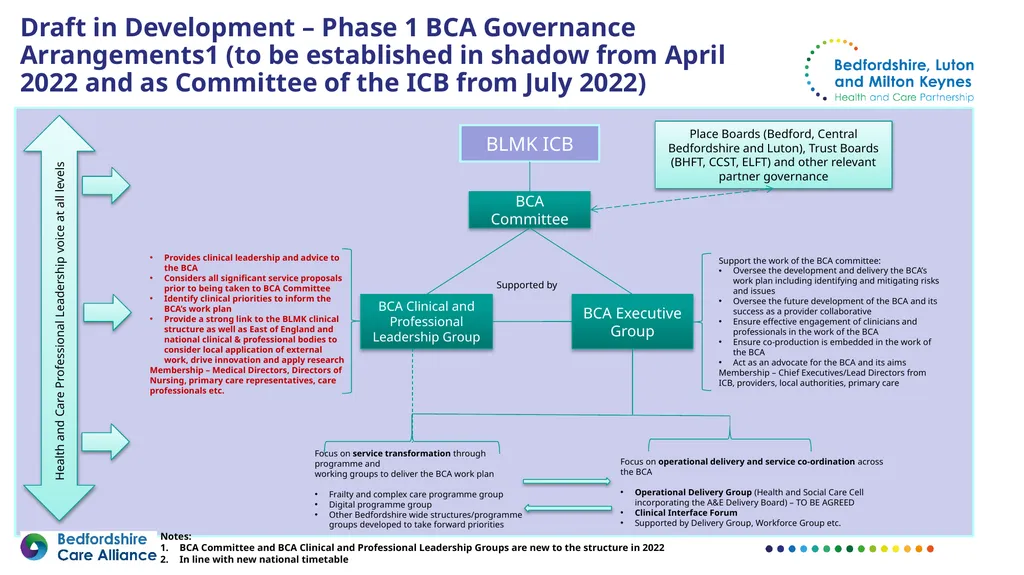
Draft in Development – Phase 1 BCA Governance Arrangements1 (to be established in shadow from April 2022 and as Committee of the ICB from July 2022) 15 BCA Committee BCA Executive Group BCA Clinical and Professional Leadership Group BLMK ICB Place Boards (Bedford, Central Bedfordshire and Luton), Trust Boards (BHFT, CCST, ELFT) and other relevant partner governance Supported by Focus on operational delivery and service co-ordination across the BCA
Operational Delivery Group (Health and Social Care Cell incorporating the A&E Delivery Board) – TO BE AGREED
Clinical Interface Forum
Supported by Delivery Group, Workforce Group etc. Focus on service transformation through programme and
working groups to deliver the BCA work plan
Frailty and complex care programme group
Digital programme group
Other Bedfordshire wide structures/programme groups developed to take forward priorities Support the work of the BCA committee:
Oversee the development and delivery the BCA’s work plan including identifying and mitigating risks and issues
Oversee the future development of the BCA and its success as a provider collaborative
Ensure effective engagement of clinicians and professionals in the work of the BCA
Ensure co-production is embedded in the work of the BCA
Act as an advocate for the BCA and its aims
Membership – Chief Executives/Lead Directors from ICB, providers, local authorities, primary care Provides clinical leadership and advice to the BCA
Considers all significant service proposals prior to being taken to BCA Committee
Identify clinical priorities to inform the BCA’s work plan
Provide a strong link to the BLMK clinical structure as well as East of England and national clinical & professional bodies to consider local application of external work, drive innovation and apply research
Membership – Medical Directors, Directors of Nursing, primary care representatives, care professionals etc. Notes:
BCA Committee and BCA Clinical and Professional Leadership Groups are new to the structure in 2022
In line with new national timetable Health and Care Professional Leadership voice at all levels<br>
Operational Delivery Group (Health and Social Care Cell incorporating the A&E Delivery Board) – TO BE AGREED
Clinical Interface Forum
Supported by Delivery Group, Workforce Group etc. Focus on service transformation through programme and
working groups to deliver the BCA work plan
Frailty and complex care programme group
Digital programme group
Other Bedfordshire wide structures/programme groups developed to take forward priorities Support the work of the BCA committee:
Oversee the development and delivery the BCA’s work plan including identifying and mitigating risks and issues
Oversee the future development of the BCA and its success as a provider collaborative
Ensure effective engagement of clinicians and professionals in the work of the BCA
Ensure co-production is embedded in the work of the BCA
Act as an advocate for the BCA and its aims
Membership – Chief Executives/Lead Directors from ICB, providers, local authorities, primary care Provides clinical leadership and advice to the BCA
Considers all significant service proposals prior to being taken to BCA Committee
Identify clinical priorities to inform the BCA’s work plan
Provide a strong link to the BLMK clinical structure as well as East of England and national clinical & professional bodies to consider local application of external work, drive innovation and apply research
Membership – Medical Directors, Directors of Nursing, primary care representatives, care professionals etc. Notes:
BCA Committee and BCA Clinical and Professional Leadership Groups are new to the structure in 2022
In line with new national timetable Health and Care Professional Leadership voice at all levels<br>
16
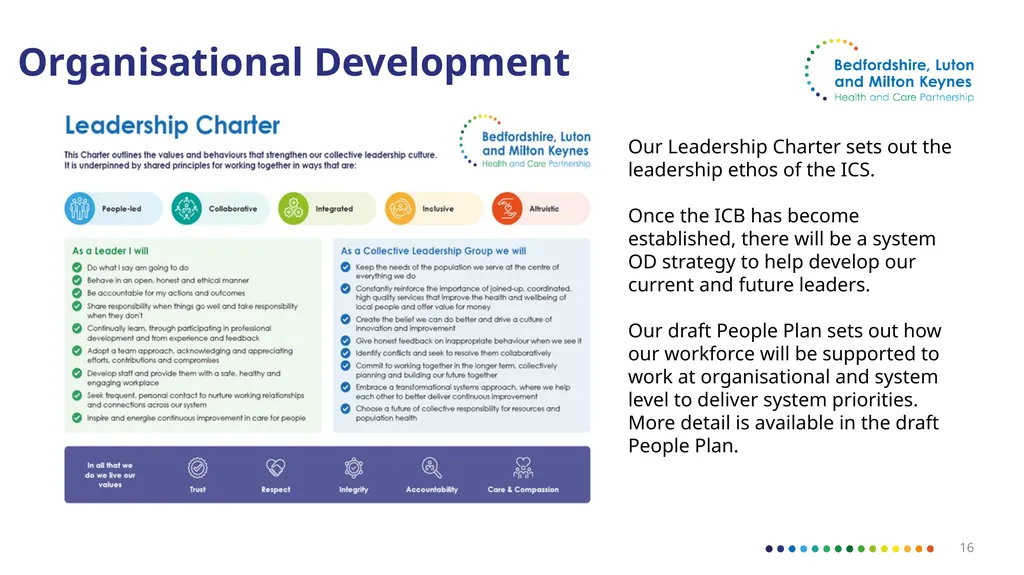
Organisational Development 16 Our Leadership Charter sets out the leadership ethos of the ICS.
Once the ICB has become established, there will be a system OD strategy to help develop our current and future leaders.
Our draft People Plan sets out how our workforce will be supported to work at organisational and system level to deliver system priorities. More detail is available in the draft People Plan.<br>
Once the ICB has become established, there will be a system OD strategy to help develop our current and future leaders.
Our draft People Plan sets out how our workforce will be supported to work at organisational and system level to deliver system priorities. More detail is available in the draft People Plan.<br>
17
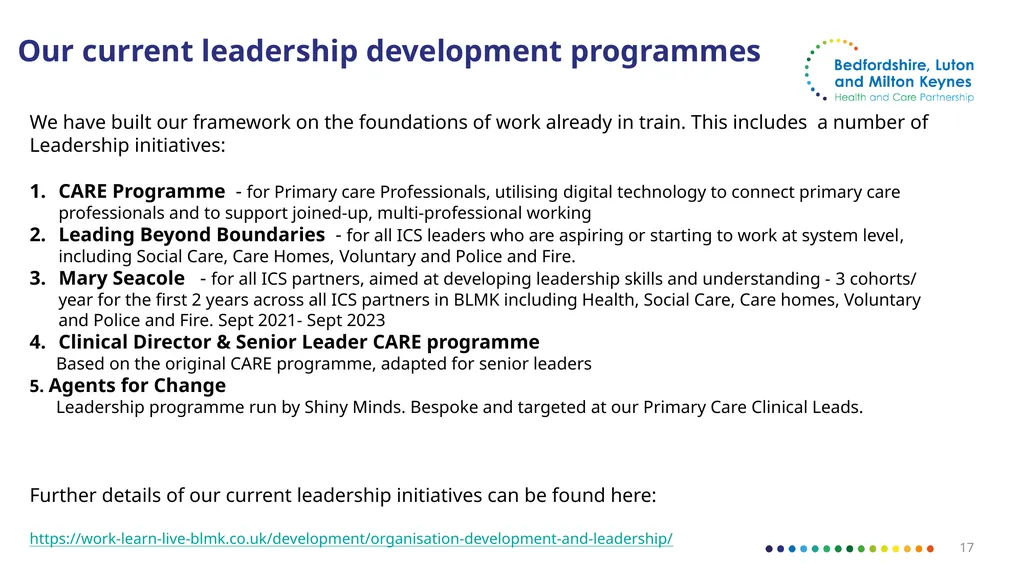
Our current leadership development programmes 17 We have built our framework on the foundations of work already in train. This includes a number of Leadership initiatives:
CARE Programme - for Primary care Professionals, utilising digital technology to connect primary care professionals and to support joined-up, multi-professional working
Leading Beyond Boundaries - for all ICS leaders who are aspiring or starting to work at system level, including Social Care, Care Homes, Voluntary and Police and Fire.
Mary Seacole - for all ICS partners, aimed at developing leadership skills and understanding - 3 cohorts/ year for the first 2 years across all ICS partners in BLMK including Health, Social Care, Care homes, Voluntary and Police and Fire. Sept 2021- Sept 2023
Clinical Director & Senior Leader CARE programme
Based on the original CARE programme, adapted for senior leaders
5. Agents for Change
Leadership programme run by Shiny Minds. Bespoke and targeted at our Primary Care Clinical Leads.
Further details of our current leadership initiatives can be found here:
https://work-learn-live-blmk.co.uk/development/organisation-development-and-leadership/<br>
CARE Programme - for Primary care Professionals, utilising digital technology to connect primary care professionals and to support joined-up, multi-professional working
Leading Beyond Boundaries - for all ICS leaders who are aspiring or starting to work at system level, including Social Care, Care Homes, Voluntary and Police and Fire.
Mary Seacole - for all ICS partners, aimed at developing leadership skills and understanding - 3 cohorts/ year for the first 2 years across all ICS partners in BLMK including Health, Social Care, Care homes, Voluntary and Police and Fire. Sept 2021- Sept 2023
Clinical Director & Senior Leader CARE programme
Based on the original CARE programme, adapted for senior leaders
5. Agents for Change
Leadership programme run by Shiny Minds. Bespoke and targeted at our Primary Care Clinical Leads.
Further details of our current leadership initiatives can be found here:
https://work-learn-live-blmk.co.uk/development/organisation-development-and-leadership/<br>
18
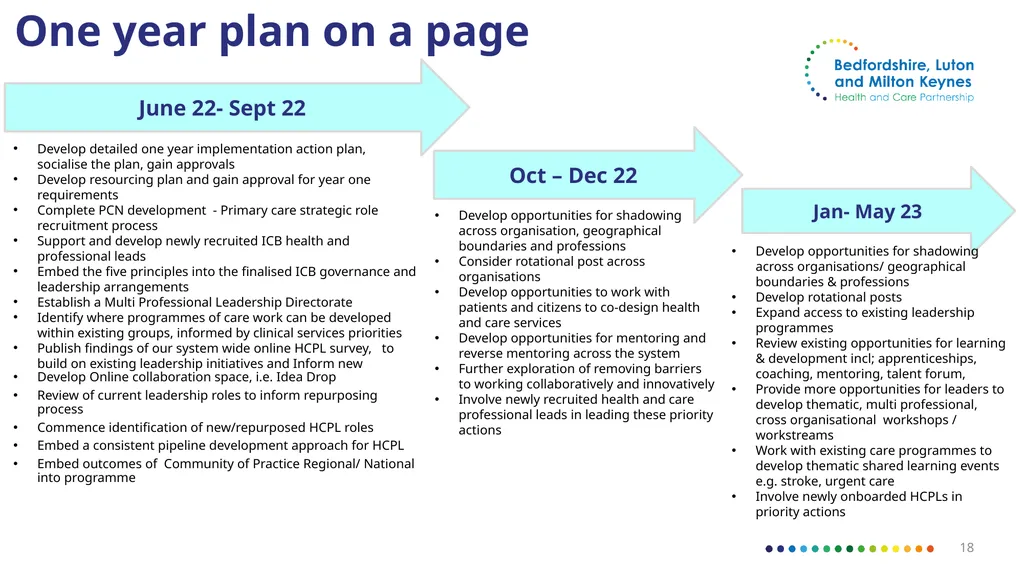
One year plan on a page 18 Oct – Dec 22 Jan- May 23 Develop detailed one year implementation action plan, socialise the plan, gain approvals
Develop resourcing plan and gain approval for year one requirements
Complete PCN development - Primary care strategic role recruitment process
Support and develop newly recruited ICB health and professional leads
Embed the five principles into the finalised ICB governance and leadership arrangements
Establish a Multi Professional Leadership Directorate
Identify where programmes of care work can be developed within existing groups, informed by clinical services priorities
Publish findings of our system wide online HCPL survey, to build on existing leadership initiatives and Inform new
Develop Online collaboration space, i.e. Idea Drop
Review of current leadership roles to inform repurposing process
Commence identification of new/repurposed HCPL roles
Embed a consistent pipeline development approach for HCPL
Embed outcomes of Community of Practice Regional/ National into programme Develop opportunities for shadowing across organisation, geographical boundaries and professions
Consider rotational post across organisations
Develop opportunities to work with patients and citizens to co-design health and care services
Develop opportunities for mentoring and reverse mentoring across the system
Further exploration of removing barriers to working collaboratively and innovatively
Involve newly recruited health and care professional leads in leading these priority actions Develop opportunities for shadowing across organisations/ geographical boundaries & professions
Develop rotational posts
Expand access to existing leadership programmes
Review existing opportunities for learning & development incl; apprenticeships, coaching, mentoring, talent forum,
Provide more opportunities for leaders to develop thematic, multi professional, cross organisational workshops / workstreams
Work with existing care programmes to develop thematic shared learning events e.g. stroke, urgent care
Involve newly onboarded HCPLs in priority actions June 22- Sept 22<br>
Develop resourcing plan and gain approval for year one requirements
Complete PCN development - Primary care strategic role recruitment process
Support and develop newly recruited ICB health and professional leads
Embed the five principles into the finalised ICB governance and leadership arrangements
Establish a Multi Professional Leadership Directorate
Identify where programmes of care work can be developed within existing groups, informed by clinical services priorities
Publish findings of our system wide online HCPL survey, to build on existing leadership initiatives and Inform new
Develop Online collaboration space, i.e. Idea Drop
Review of current leadership roles to inform repurposing process
Commence identification of new/repurposed HCPL roles
Embed a consistent pipeline development approach for HCPL
Embed outcomes of Community of Practice Regional/ National into programme Develop opportunities for shadowing across organisation, geographical boundaries and professions
Consider rotational post across organisations
Develop opportunities to work with patients and citizens to co-design health and care services
Develop opportunities for mentoring and reverse mentoring across the system
Further exploration of removing barriers to working collaboratively and innovatively
Involve newly recruited health and care professional leads in leading these priority actions Develop opportunities for shadowing across organisations/ geographical boundaries & professions
Develop rotational posts
Expand access to existing leadership programmes
Review existing opportunities for learning & development incl; apprenticeships, coaching, mentoring, talent forum,
Provide more opportunities for leaders to develop thematic, multi professional, cross organisational workshops / workstreams
Work with existing care programmes to develop thematic shared learning events e.g. stroke, urgent care
Involve newly onboarded HCPLs in priority actions June 22- Sept 22<br>
19
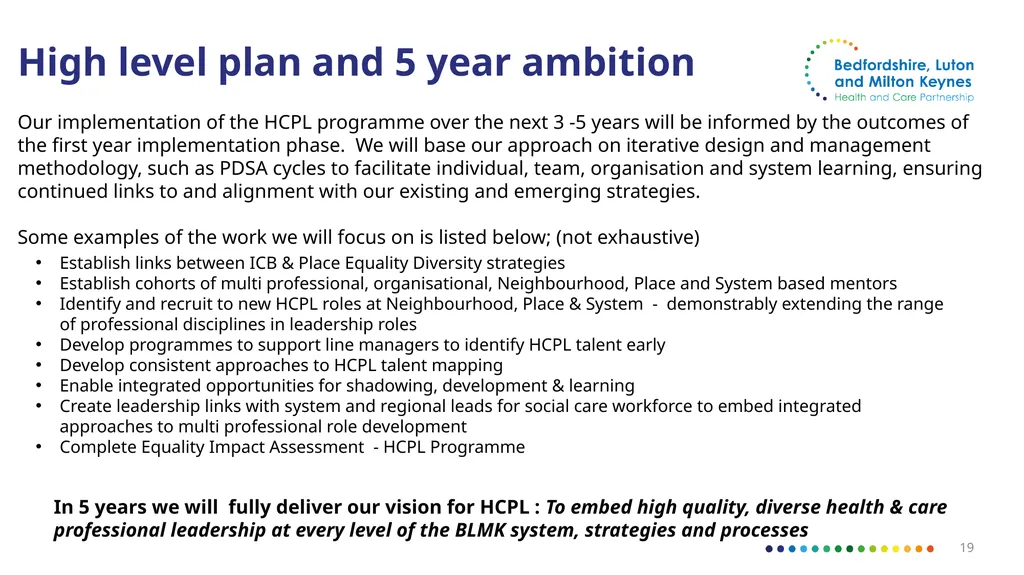
High level plan and 5 year ambition 19 Establish links between ICB & Place Equality Diversity strategies
Establish cohorts of multi professional, organisational, Neighbourhood, Place and System based mentors
Identify and recruit to new HCPL roles at Neighbourhood, Place & System - demonstrably extending the range of professional disciplines in leadership roles
Develop programmes to support line managers to identify HCPL talent early
Develop consistent approaches to HCPL talent mapping
Enable integrated opportunities for shadowing, development & learning
Create leadership links with system and regional leads for social care workforce to embed integrated approaches to multi professional role development
Complete Equality Impact Assessment - HCPL Programme Our implementation of the HCPL programme over the next 3 -5 years will be informed by the outcomes of the first year implementation phase. We will base our approach on iterative design and management methodology, such as PDSA cycles to facilitate individual, team, organisation and system learning, ensuring continued links to and alignment with our existing and emerging strategies.
Some examples of the work we will focus on is listed below; (not exhaustive) In 5 years we will fully deliver our vision for HCPL : To embed high quality, diverse health & care professional leadership at every level of the BLMK system, strategies and processes<br>
Establish cohorts of multi professional, organisational, Neighbourhood, Place and System based mentors
Identify and recruit to new HCPL roles at Neighbourhood, Place & System - demonstrably extending the range of professional disciplines in leadership roles
Develop programmes to support line managers to identify HCPL talent early
Develop consistent approaches to HCPL talent mapping
Enable integrated opportunities for shadowing, development & learning
Create leadership links with system and regional leads for social care workforce to embed integrated approaches to multi professional role development
Complete Equality Impact Assessment - HCPL Programme Our implementation of the HCPL programme over the next 3 -5 years will be informed by the outcomes of the first year implementation phase. We will base our approach on iterative design and management methodology, such as PDSA cycles to facilitate individual, team, organisation and system learning, ensuring continued links to and alignment with our existing and emerging strategies.
Some examples of the work we will focus on is listed below; (not exhaustive) In 5 years we will fully deliver our vision for HCPL : To embed high quality, diverse health & care professional leadership at every level of the BLMK system, strategies and processes<br>
20
Section 3 : Appendices A new approach to health and care professional leadership 20<br>
21
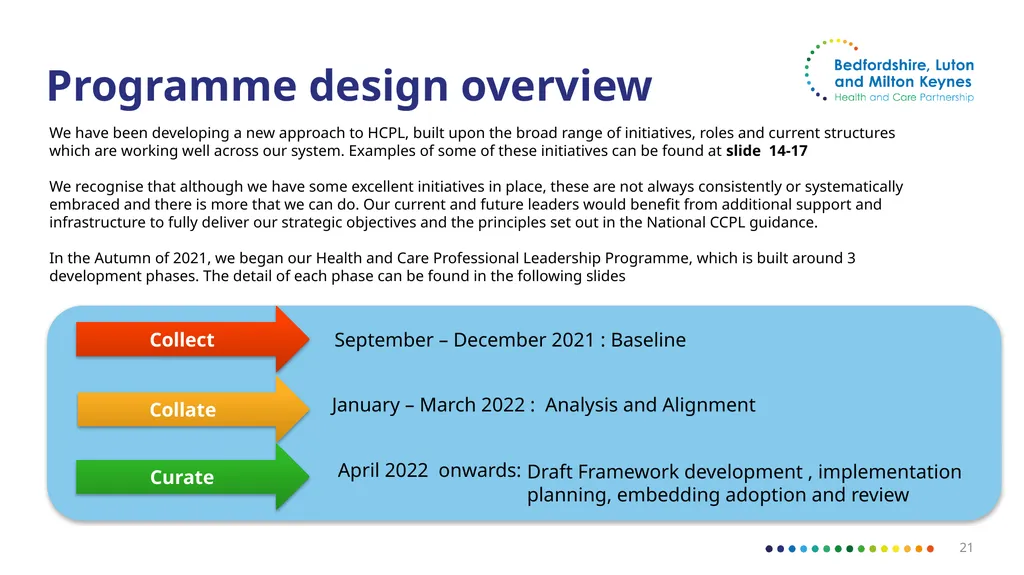
Programme design overview We have been developing a new approach to HCPL, built upon the broad range of initiatives, roles and current structures which are working well across our system. Examples of some of these initiatives can be found at slide 14-17
We recognise that although we have some excellent initiatives in place, these are not always consistently or systematically embraced and there is more that we can do. Our current and future leaders would benefit from additional support and infrastructure to fully deliver our strategic objectives and the principles set out in the National CCPL guidance.
In the Autumn of 2021, we began our Health and Care Professional Leadership Programme, which is built around 3 development phases. The detail of each phase can be found in the following slides Collect Collate Curate September – December 2021 : Baseline January – March 2022 : Analysis and Alignment April 2022 onwards: Draft Framework development , implementation planning, embedding adoption and review 21<br>
We recognise that although we have some excellent initiatives in place, these are not always consistently or systematically embraced and there is more that we can do. Our current and future leaders would benefit from additional support and infrastructure to fully deliver our strategic objectives and the principles set out in the National CCPL guidance.
In the Autumn of 2021, we began our Health and Care Professional Leadership Programme, which is built around 3 development phases. The detail of each phase can be found in the following slides Collect Collate Curate September – December 2021 : Baseline January – March 2022 : Analysis and Alignment April 2022 onwards: Draft Framework development , implementation planning, embedding adoption and review 21<br>
22
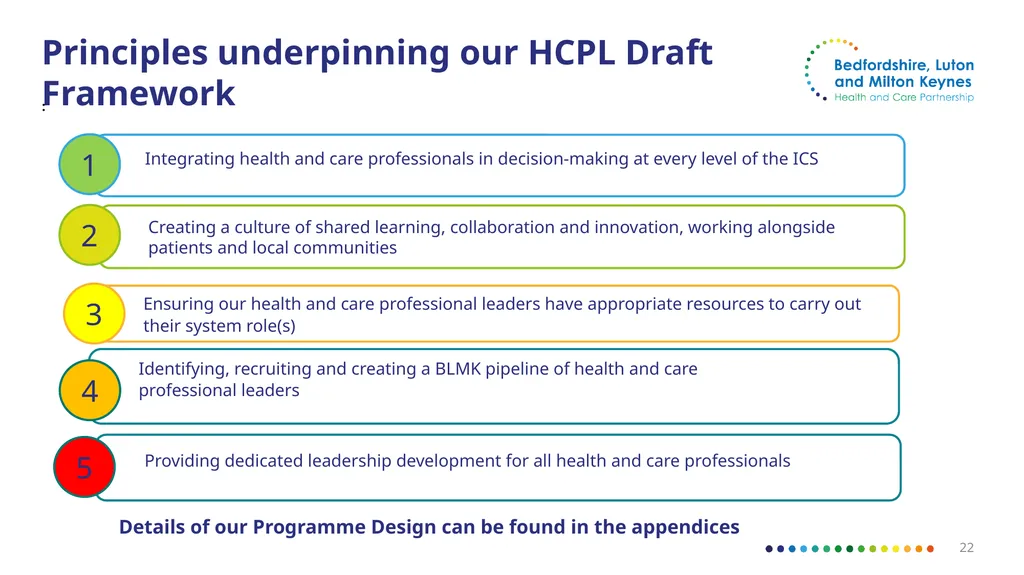
Principles underpinning our HCPL Draft Framework : Integrating health and care professionals in decision-making at every level of the ICS Creating a culture of shared learning, collaboration and innovation, working alongside patients and local communities Ensuring our health and care professional leaders have appropriate resources to carry out
their system role(s) 2 3 1 Identifying, recruiting and creating a BLMK pipeline of health and care
professional leaders 4 Providing dedicated leadership development for all health and care professionals 5 Details of our Programme Design can be found in the appendices 22<br>
their system role(s) 2 3 1 Identifying, recruiting and creating a BLMK pipeline of health and care
professional leaders 4 Providing dedicated leadership development for all health and care professionals 5 Details of our Programme Design can be found in the appendices 22<br>
23
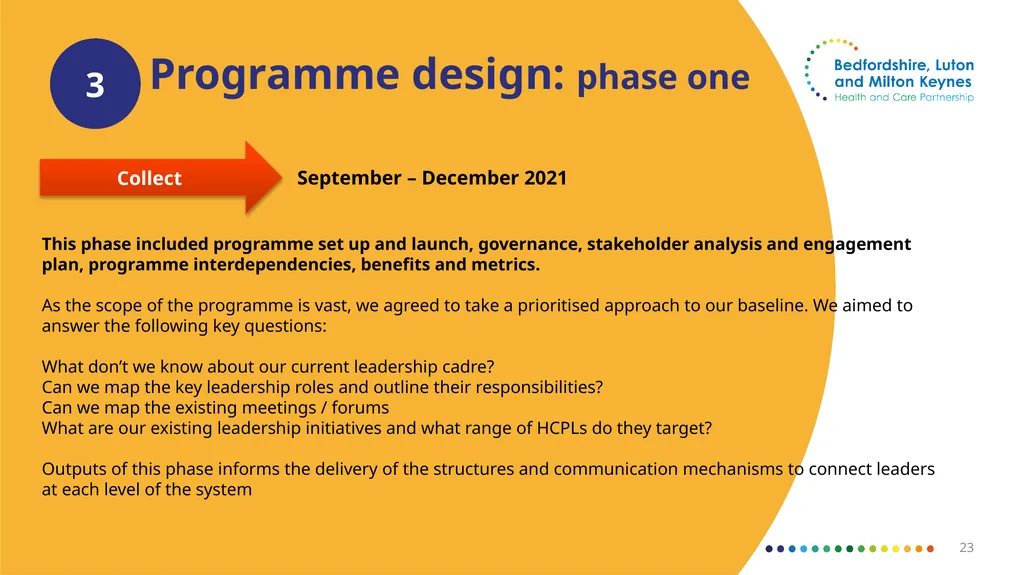
Programme design: phase one This phase included programme set up and launch, governance, stakeholder analysis and engagement plan, programme interdependencies, benefits and metrics.
As the scope of the programme is vast, we agreed to take a prioritised approach to our baseline. We aimed to answer the following key questions:
What don’t we know about our current leadership cadre?
Can we map the key leadership roles and outline their responsibilities?
Can we map the existing meetings / forums
What are our existing leadership initiatives and what range of HCPLs do they target?
Outputs of this phase informs the delivery of the structures and communication mechanisms to connect leaders at each level of the system Collect September – December 2021 3 23<br>
As the scope of the programme is vast, we agreed to take a prioritised approach to our baseline. We aimed to answer the following key questions:
What don’t we know about our current leadership cadre?
Can we map the key leadership roles and outline their responsibilities?
Can we map the existing meetings / forums
What are our existing leadership initiatives and what range of HCPLs do they target?
Outputs of this phase informs the delivery of the structures and communication mechanisms to connect leaders at each level of the system Collect September – December 2021 3 23<br>
24
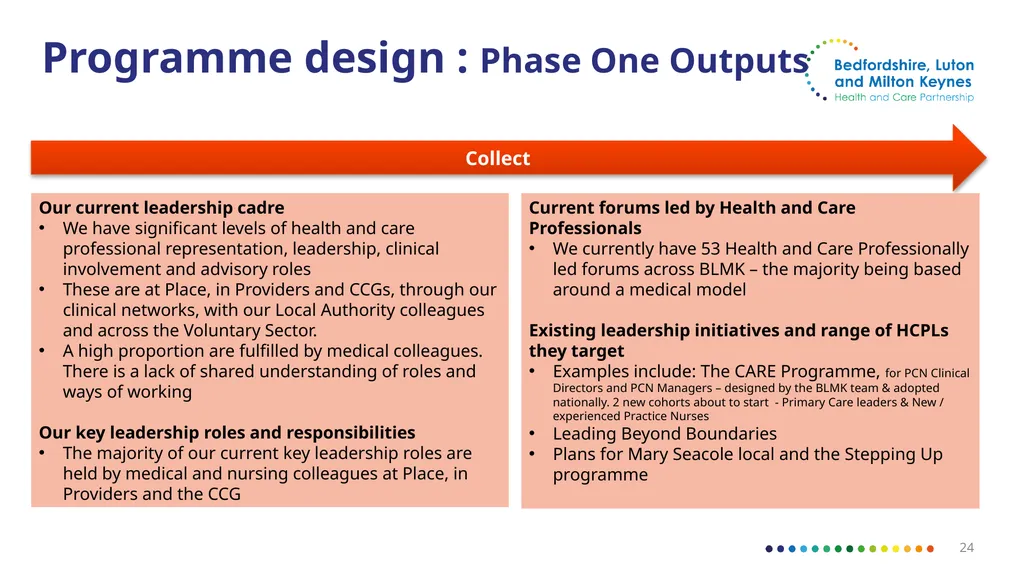
Programme design : Phase One Outputs Our current leadership cadre
We have significant levels of health and care professional representation, leadership, clinical involvement and advisory roles
These are at Place, in Providers and CCGs, through our clinical networks, with our Local Authority colleagues and across the Voluntary Sector.
A high proportion are fulfilled by medical colleagues. There is a lack of shared understanding of roles and ways of working
Our key leadership roles and responsibilities
The majority of our current key leadership roles are held by medical and nursing colleagues at Place, in Providers and the CCG Collect Current forums led by Health and Care Professionals
We currently have 53 Health and Care Professionally led forums across BLMK – the majority being based around a medical model
Existing leadership initiatives and range of HCPLs they target
Examples include: The CARE Programme, for PCN Clinical Directors and PCN Managers – designed by the BLMK team & adopted nationally. 2 new cohorts about to start - Primary Care leaders & New / experienced Practice Nurses
Leading Beyond Boundaries
Plans for Mary Seacole local and the Stepping Up programme 24<br>
We have significant levels of health and care professional representation, leadership, clinical involvement and advisory roles
These are at Place, in Providers and CCGs, through our clinical networks, with our Local Authority colleagues and across the Voluntary Sector.
A high proportion are fulfilled by medical colleagues. There is a lack of shared understanding of roles and ways of working
Our key leadership roles and responsibilities
The majority of our current key leadership roles are held by medical and nursing colleagues at Place, in Providers and the CCG Collect Current forums led by Health and Care Professionals
We currently have 53 Health and Care Professionally led forums across BLMK – the majority being based around a medical model
Existing leadership initiatives and range of HCPLs they target
Examples include: The CARE Programme, for PCN Clinical Directors and PCN Managers – designed by the BLMK team & adopted nationally. 2 new cohorts about to start - Primary Care leaders & New / experienced Practice Nurses
Leading Beyond Boundaries
Plans for Mary Seacole local and the Stepping Up programme 24<br>
25
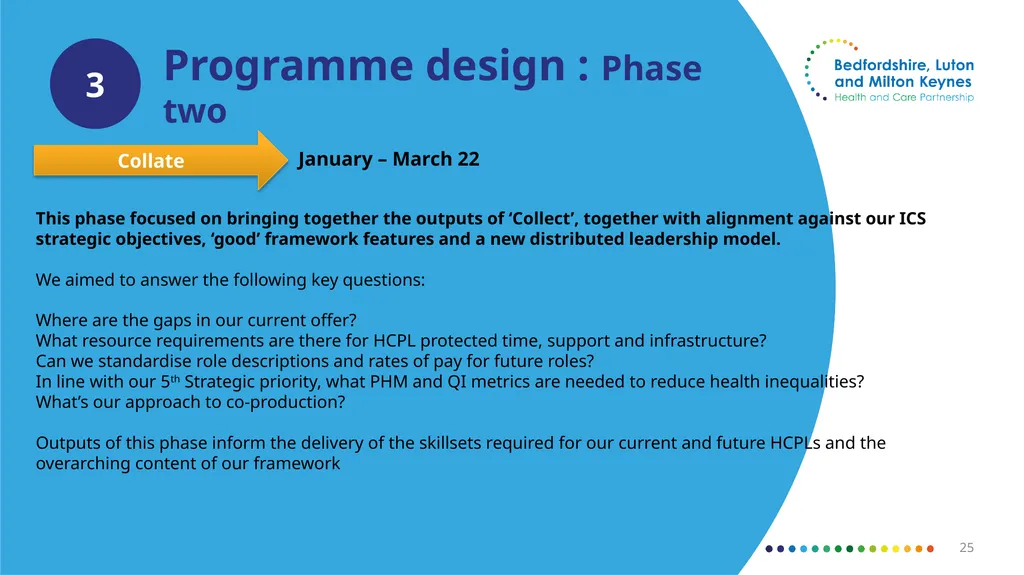
This phase focused on bringing together the outputs of ‘Collect’, together with alignment against our ICS strategic objectives, ‘good’ framework features and a new distributed leadership model.
We aimed to answer the following key questions:
Where are the gaps in our current offer?
What resource requirements are there for HCPL protected time, support and infrastructure?
Can we standardise role descriptions and rates of pay for future roles?
In line with our 5th Strategic priority, what PHM and QI metrics are needed to reduce health inequalities?
What’s our approach to co-production?
Outputs of this phase inform the delivery of the skillsets required for our current and future HCPLs and the overarching content of our framework Collate January – March 22 Programme design : Phase two 3 25<br>
We aimed to answer the following key questions:
Where are the gaps in our current offer?
What resource requirements are there for HCPL protected time, support and infrastructure?
Can we standardise role descriptions and rates of pay for future roles?
In line with our 5th Strategic priority, what PHM and QI metrics are needed to reduce health inequalities?
What’s our approach to co-production?
Outputs of this phase inform the delivery of the skillsets required for our current and future HCPLs and the overarching content of our framework Collate January – March 22 Programme design : Phase two 3 25<br>
26
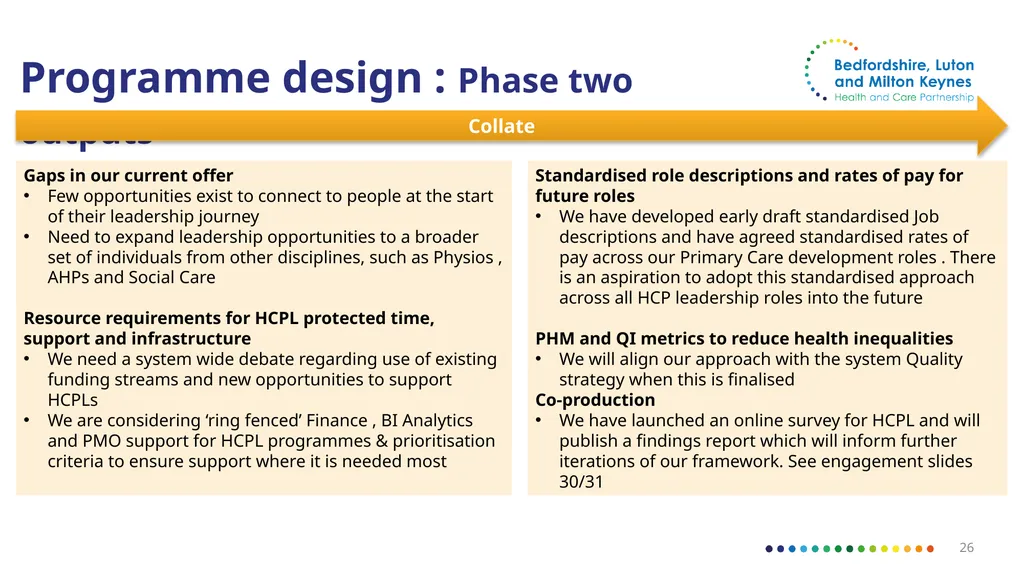
Programme design : Phase two outputs Gaps in our current offer
Few opportunities exist to connect to people at the start of their leadership journey
Need to expand leadership opportunities to a broader set of individuals from other disciplines, such as Physios , AHPs and Social Care
Resource requirements for HCPL protected time, support and infrastructure
We need a system wide debate regarding use of existing funding streams and new opportunities to support HCPLs
We are considering ‘ring fenced’ Finance , BI Analytics and PMO support for HCPL programmes & prioritisation criteria to ensure support where it is needed most Collate Standardised role descriptions and rates of pay for future roles
We have developed early draft standardised Job descriptions and have agreed standardised rates of pay across our Primary Care development roles . There is an aspiration to adopt this standardised approach across all HCP leadership roles into the future
PHM and QI metrics to reduce health inequalities
We will align our approach with the system Quality strategy when this is finalised
Co-production
We have launched an online survey for HCPL and will publish a findings report which will inform further iterations of our framework. See engagement slides 30/31 26<br>
Few opportunities exist to connect to people at the start of their leadership journey
Need to expand leadership opportunities to a broader set of individuals from other disciplines, such as Physios , AHPs and Social Care
Resource requirements for HCPL protected time, support and infrastructure
We need a system wide debate regarding use of existing funding streams and new opportunities to support HCPLs
We are considering ‘ring fenced’ Finance , BI Analytics and PMO support for HCPL programmes & prioritisation criteria to ensure support where it is needed most Collate Standardised role descriptions and rates of pay for future roles
We have developed early draft standardised Job descriptions and have agreed standardised rates of pay across our Primary Care development roles . There is an aspiration to adopt this standardised approach across all HCP leadership roles into the future
PHM and QI metrics to reduce health inequalities
We will align our approach with the system Quality strategy when this is finalised
Co-production
We have launched an online survey for HCPL and will publish a findings report which will inform further iterations of our framework. See engagement slides 30/31 26<br>
27
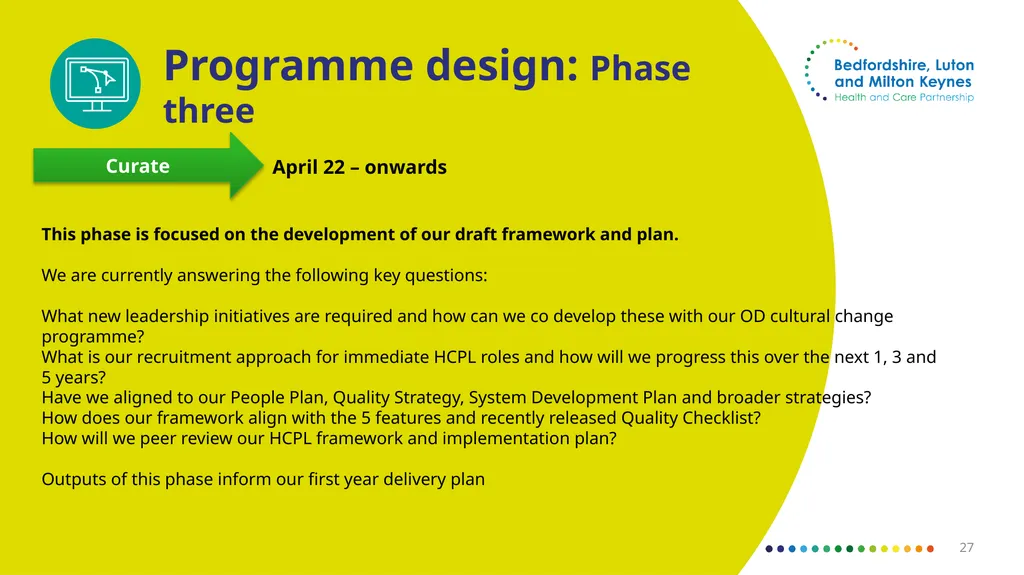
This phase is focused on the development of our draft framework and plan.
We are currently answering the following key questions:
What new leadership initiatives are required and how can we co develop these with our OD cultural change programme?
What is our recruitment approach for immediate HCPL roles and how will we progress this over the next 1, 3 and 5 years?
Have we aligned to our People Plan, Quality Strategy, System Development Plan and broader strategies?
How does our framework align with the 5 features and recently released Quality Checklist?
How will we peer review our HCPL framework and implementation plan?
Outputs of this phase inform our first year delivery plan Curate April 22 – onwards Programme design: Phase three 27<br>
We are currently answering the following key questions:
What new leadership initiatives are required and how can we co develop these with our OD cultural change programme?
What is our recruitment approach for immediate HCPL roles and how will we progress this over the next 1, 3 and 5 years?
Have we aligned to our People Plan, Quality Strategy, System Development Plan and broader strategies?
How does our framework align with the 5 features and recently released Quality Checklist?
How will we peer review our HCPL framework and implementation plan?
Outputs of this phase inform our first year delivery plan Curate April 22 – onwards Programme design: Phase three 27<br>
28
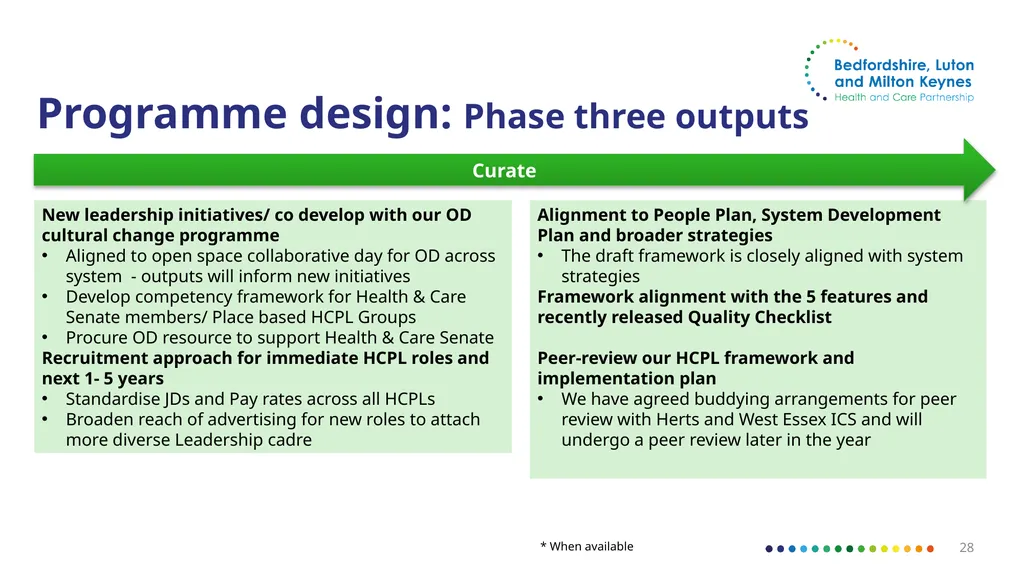
Programme design: Phase three outputs New leadership initiatives/ co develop with our OD cultural change programme
Aligned to open space collaborative day for OD across system - outputs will inform new initiatives
Develop competency framework for Health & Care Senate members/ Place based HCPL Groups
Procure OD resource to support Health & Care Senate
Recruitment approach for immediate HCPL roles and next 1- 5 years
Standardise JDs and Pay rates across all HCPLs
Broaden reach of advertising for new roles to attach more diverse Leadership cadre Alignment to People Plan, System Development Plan and broader strategies
The draft framework is closely aligned with system strategies
Framework alignment with the 5 features and recently released Quality Checklist
Peer-review our HCPL framework and implementation plan
We have agreed buddying arrangements for peer review with Herts and West Essex ICS and will undergo a peer review later in the year * When available Curate 28<br>
Aligned to open space collaborative day for OD across system - outputs will inform new initiatives
Develop competency framework for Health & Care Senate members/ Place based HCPL Groups
Procure OD resource to support Health & Care Senate
Recruitment approach for immediate HCPL roles and next 1- 5 years
Standardise JDs and Pay rates across all HCPLs
Broaden reach of advertising for new roles to attach more diverse Leadership cadre Alignment to People Plan, System Development Plan and broader strategies
The draft framework is closely aligned with system strategies
Framework alignment with the 5 features and recently released Quality Checklist
Peer-review our HCPL framework and implementation plan
We have agreed buddying arrangements for peer review with Herts and West Essex ICS and will undergo a peer review later in the year * When available Curate 28<br>
29
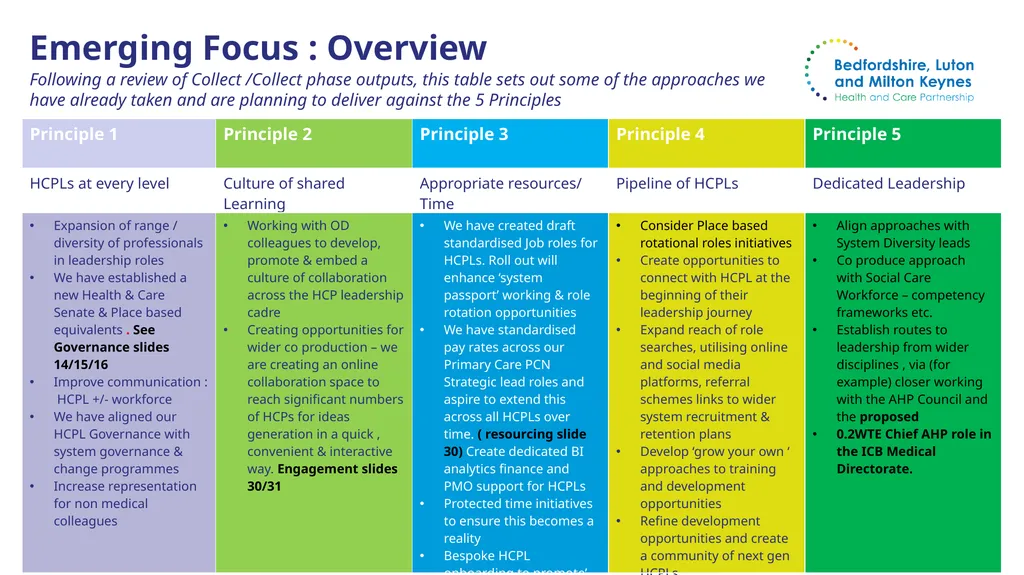
Emerging Focus : Overview Following a review of Collect /Collect phase outputs, this table sets out some of the approaches we have already taken and are planning to deliver against the 5 Principles 29<br>
30
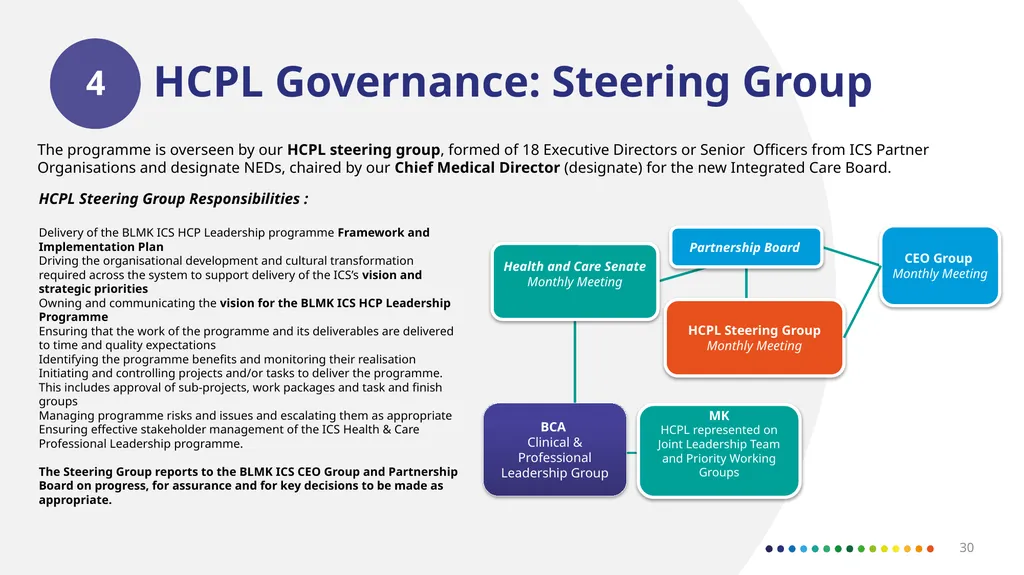
HCPL Governance: Steering Group 30 The programme is overseen by our HCPL steering group, formed of 18 Executive Directors or Senior Officers from ICS Partner Organisations and designate NEDs, chaired by our Chief Medical Director (designate) for the new Integrated Care Board. HCPL Steering Group Responsibilities :
Delivery of the BLMK ICS HCP Leadership programme Framework and Implementation Plan
Driving the organisational development and cultural transformation required across the system to support delivery of the ICS’s vision and strategic priorities
Owning and communicating the vision for the BLMK ICS HCP Leadership Programme
Ensuring that the work of the programme and its deliverables are delivered to time and quality expectations
Identifying the programme benefits and monitoring their realisation
Initiating and controlling projects and/or tasks to deliver the programme. This includes approval of sub-projects, work packages and task and finish groups
Managing programme risks and issues and escalating them as appropriate
Ensuring effective stakeholder management of the ICS Health & Care Professional Leadership programme.
The Steering Group reports to the BLMK ICS CEO Group and Partnership Board on progress, for assurance and for key decisions to be made as appropriate. 4<br>
Delivery of the BLMK ICS HCP Leadership programme Framework and Implementation Plan
Driving the organisational development and cultural transformation required across the system to support delivery of the ICS’s vision and strategic priorities
Owning and communicating the vision for the BLMK ICS HCP Leadership Programme
Ensuring that the work of the programme and its deliverables are delivered to time and quality expectations
Identifying the programme benefits and monitoring their realisation
Initiating and controlling projects and/or tasks to deliver the programme. This includes approval of sub-projects, work packages and task and finish groups
Managing programme risks and issues and escalating them as appropriate
Ensuring effective stakeholder management of the ICS Health & Care Professional Leadership programme.
The Steering Group reports to the BLMK ICS CEO Group and Partnership Board on progress, for assurance and for key decisions to be made as appropriate. 4<br>
31
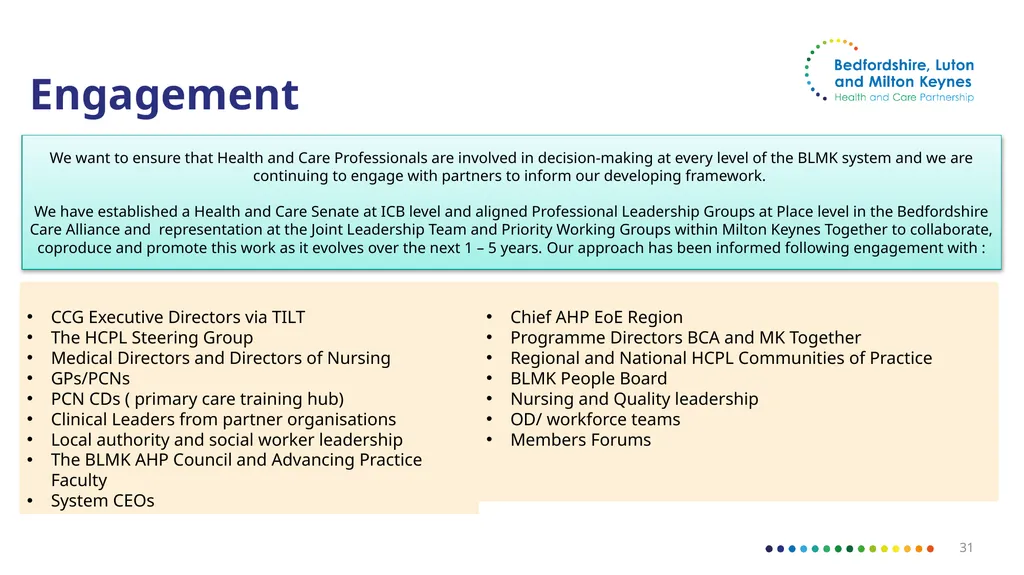
Engagement We want to ensure that Health and Care Professionals are involved in decision-making at every level of the BLMK system and we are continuing to engage with partners to inform our developing framework.
We have established a Health and Care Senate at ICB level and aligned Professional Leadership Groups at Place level in the Bedfordshire Care Alliance and representation at the Joint Leadership Team and Priority Working Groups within Milton Keynes Together to collaborate, coproduce and promote this work as it evolves over the next 1 – 5 years. Our approach has been informed following engagement with : CCG Executive Directors via TILT
The HCPL Steering Group
Medical Directors and Directors of Nursing
GPs/PCNs
PCN CDs ( primary care training hub)
Clinical Leaders from partner organisations
Local authority and social worker leadership
The BLMK AHP Council and Advancing Practice Faculty
System CEOs Chief AHP EoE Region
Programme Directors BCA and MK Together
Regional and National HCPL Communities of Practice
BLMK People Board
Nursing and Quality leadership
OD/ workforce teams
Members Forums 31<br>
We have established a Health and Care Senate at ICB level and aligned Professional Leadership Groups at Place level in the Bedfordshire Care Alliance and representation at the Joint Leadership Team and Priority Working Groups within Milton Keynes Together to collaborate, coproduce and promote this work as it evolves over the next 1 – 5 years. Our approach has been informed following engagement with : CCG Executive Directors via TILT
The HCPL Steering Group
Medical Directors and Directors of Nursing
GPs/PCNs
PCN CDs ( primary care training hub)
Clinical Leaders from partner organisations
Local authority and social worker leadership
The BLMK AHP Council and Advancing Practice Faculty
System CEOs Chief AHP EoE Region
Programme Directors BCA and MK Together
Regional and National HCPL Communities of Practice
BLMK People Board
Nursing and Quality leadership
OD/ workforce teams
Members Forums 31<br>
32
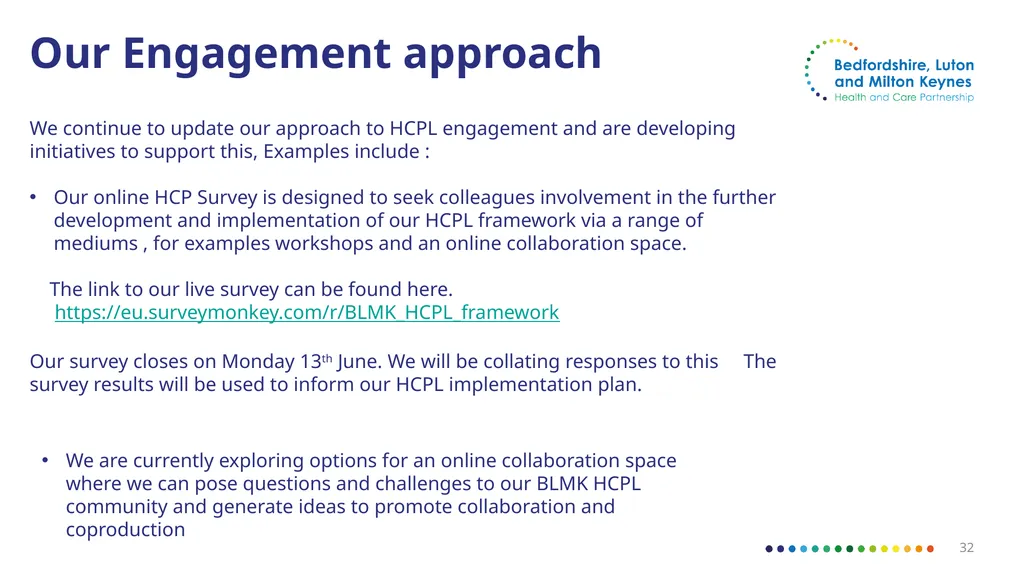
We continue to update our approach to HCPL engagement and are developing initiatives to support this, Examples include :
Our online HCP Survey is designed to seek colleagues involvement in the further development and implementation of our HCPL framework via a range of mediums , for examples workshops and an online collaboration space.
The link to our live survey can be found here.
https://eu.surveymonkey.com/r/BLMK_HCPL_framework
Our survey closes on Monday 13th June. We will be collating responses to this The survey results will be used to inform our HCPL implementation plan. Our Engagement approach We are currently exploring options for an online collaboration space where we can pose questions and challenges to our BLMK HCPL community and generate ideas to promote collaboration and coproduction 32<br>
Our online HCP Survey is designed to seek colleagues involvement in the further development and implementation of our HCPL framework via a range of mediums , for examples workshops and an online collaboration space.
The link to our live survey can be found here.
https://eu.surveymonkey.com/r/BLMK_HCPL_framework
Our survey closes on Monday 13th June. We will be collating responses to this The survey results will be used to inform our HCPL implementation plan. Our Engagement approach We are currently exploring options for an online collaboration space where we can pose questions and challenges to our BLMK HCPL community and generate ideas to promote collaboration and coproduction 32<br>
33
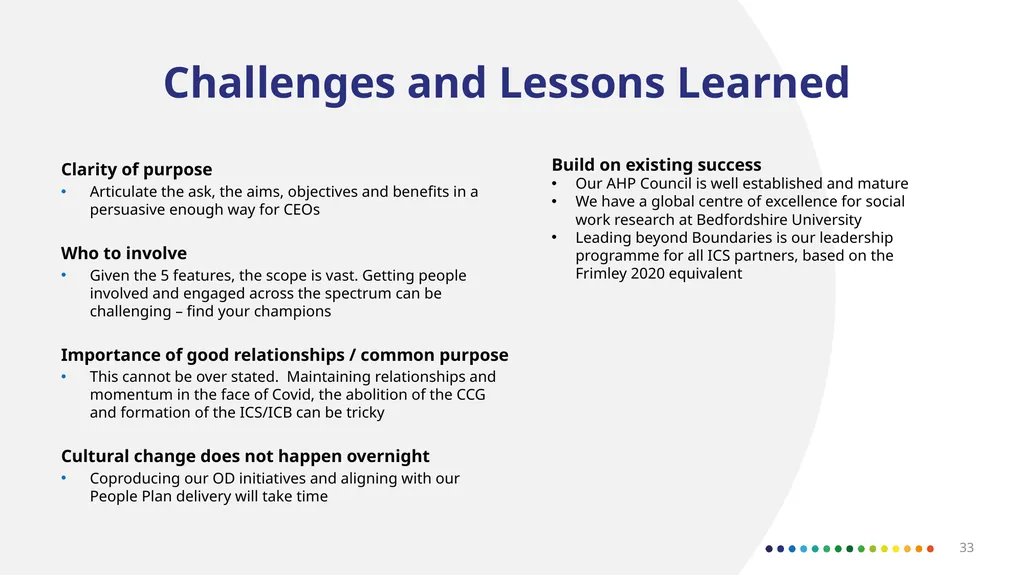
Challenges and Lessons Learned Clarity of purpose
Articulate the ask, the aims, objectives and benefits in a persuasive enough way for CEOs
Who to involve
Given the 5 features, the scope is vast. Getting people involved and engaged across the spectrum can be challenging – find your champions
Importance of good relationships / common purpose
This cannot be over stated. Maintaining relationships and momentum in the face of Covid, the abolition of the CCG and formation of the ICS/ICB can be tricky
Cultural change does not happen overnight
Coproducing our OD initiatives and aligning with our People Plan delivery will take time 33 Build on existing success
Our AHP Council is well established and mature
We have a global centre of excellence for social work research at Bedfordshire University
Leading beyond Boundaries is our leadership programme for all ICS partners, based on the Frimley 2020 equivalent<br>
Articulate the ask, the aims, objectives and benefits in a persuasive enough way for CEOs
Who to involve
Given the 5 features, the scope is vast. Getting people involved and engaged across the spectrum can be challenging – find your champions
Importance of good relationships / common purpose
This cannot be over stated. Maintaining relationships and momentum in the face of Covid, the abolition of the CCG and formation of the ICS/ICB can be tricky
Cultural change does not happen overnight
Coproducing our OD initiatives and aligning with our People Plan delivery will take time 33 Build on existing success
Our AHP Council is well established and mature
We have a global centre of excellence for social work research at Bedfordshire University
Leading beyond Boundaries is our leadership programme for all ICS partners, based on the Frimley 2020 equivalent<br>
34
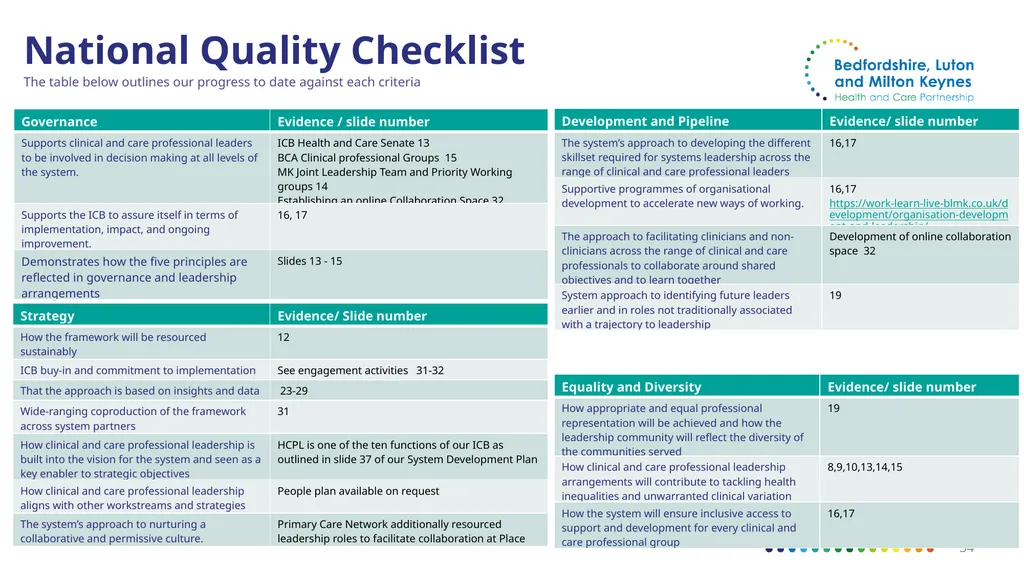
National Quality Checklist The table below outlines our progress to date against each criteria 34<br>
35
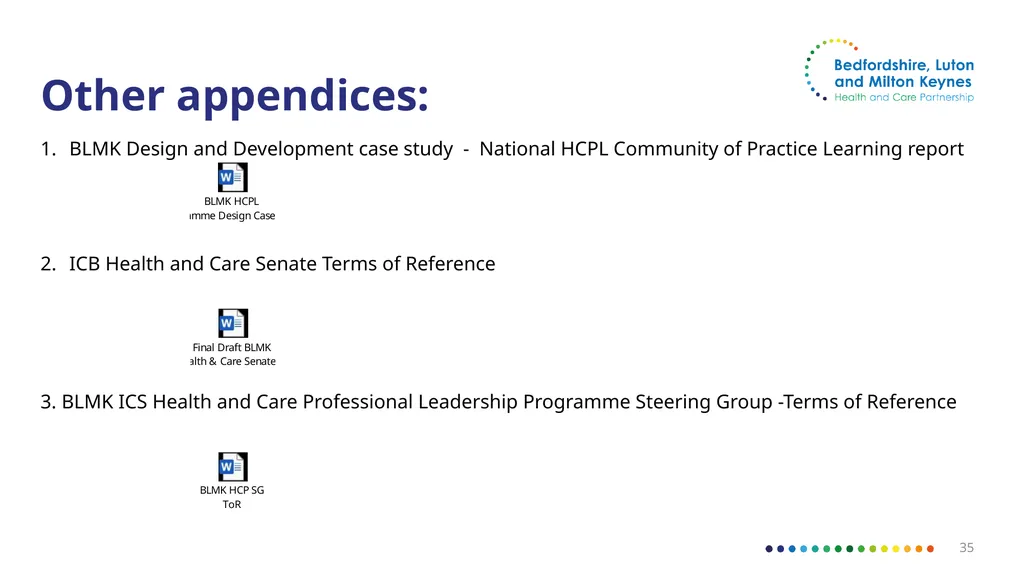
Other appendices: BLMK Design and Development case study - National HCPL Community of Practice Learning report
ICB Health and Care Senate Terms of Reference
3. BLMK ICS Health and Care Professional Leadership Programme Steering Group -Terms of Reference 35<br>
ICB Health and Care Senate Terms of Reference
3. BLMK ICS Health and Care Professional Leadership Programme Steering Group -Terms of Reference 35<br>